
Exponent II's Blog
October 15, 2026
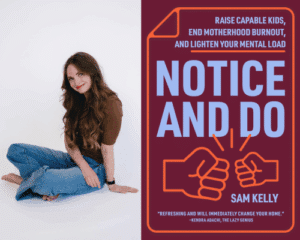
Notice and Do: An Interview with Sam Kelly
 Posted October 15, 2026
By Katie Ludlow Rich
It was my pleasure to talk with Sam Kelly, an entrepreneur and creator of the “Notice and Do” method, ahead of her book release this month for our “Money and Mormon Feminism” blog series. Sam’s path from new mom to business owner and then parenting coach offers helpful resources and mindset shifts for thinking about invisible labor and making home and family life more equitable.
Katie Ludlow Rich: I’m excited for your book to come out on October 20: Notice and Do: Raise Capable Kids, End Motherhood Burnout, and Lighten Your Mental Load. This all began as a viral idea and is now a registered trademark, an audio course, a guide, and a book. Walk us through how a parenting insight became a business and more.
Sam Kelly: In October 2023, I made a carousel post about this idea of lightening your mental load, thinking that maybe it would help a few people, and it just went crazy. I had never had something go viral like that. It was an iteration of an idea I had begun teaching my kids in June of that year. A friend encouraged me to capture some of that viral traffic by developing a freebie I could give away through an automation, so I could collect emails for the course I was developing. So I created the Notice and Do Guide, a free download with scripts to help your kids notice what needs to be done and take action.
A book wasn’t even on my mind at that point. But I developed an audio course because I wanted it to be accessible and usable for exhausted moms who don’t necessarily have time to jump on Zoom calls or sit and watch videos. I wanted it to be like a specialty podcast someone could listen to and come away with tools and resources.
Notice and Do is about more than distributing the mental load. It’s about ending the cycle of motherhood burnout by empowering kids and partners to contribute proactively at home, using evidence-based methods to teach what the mental load means in age-appropriate, understandable ways.
KR: Invisible labor is generally unpaid and often unaccounted for. How do you help women see and name the economic value of the household management they do?
SK: It’s easy for all of us to dismiss invisible labor, sometimes even ourselves, because of our own internalized patriarchy. The work that happens in your brain and heart is real work, even if you aren’t getting a paycheck for it. It serves your home and your family—provides—in real ways. Today, over 70% of women also earn a paycheck, but when they’re home, they still carry much of the household labor in what Arlie Hochschild called “the second shift.” We’re trying to break this cycle for our kids.
KR: The book includes a section on getting partners on board, and you recorded a conversation with your husband, Chas, called “Mental Load Man.” How do you invite men into this work without making them defensive, and what has that looked like in your own marriage or for people who have taken your course?
SK: It’s really interesting how you asked that question: How do we start these conversations without making our partners defensive? With that framing, the onus stays on us as women. Not only do we have to broach these really hard conversations, and it’s a vulnerable thing to say to your partner, “I am so exhausted. I am so alone. I need more from you. I need you to step up,” but we also have to navigate our partner’s emotional reaction with therapist-level expertise. I’d say that isn’t the goal. The goal isn’t to keep him from getting defensive. The goal is to say what you need to say and be honest. You aren’t complaining; you’re explaining. You’re sharing the reality of your lived experience and saying, “My quality of life is not great. You’re my partner, the person I’m supposed to matter to more than anyone else in this life. I need you to see me, hear me, and believe me. And I need you to manage your own emotional response. I don’t have to do that emotional labor for you.”
I talk a lot about this in the husband chapter of the book, and about how we can do this as a team. Truly, sharing my rage with my husband, and his response to my rage, saved our marriage. As women, we’re conditioned not to show rage, not to nitpick, not to say it that way because it might start a fight, and to make sure he doesn’t feel attacked. But we need to move past that, because the whole point of partnership is teamwork.
KR: I love that. It sounds like this approach is about more than who does what at home. It’s about communication, and about allowing each member of the family to be a full person.
SK: Women are taught to be the emotional centers of their families and to make sure everyone else is okay. But it changes everything when there’s a full family team stepping up to support each other, so we don’t have to be the project manager for everyone. Then you get to give from a place of empowerment and full consciousness. And it’s not just so you have a full cup to pour into others. You deserve to live your life with a full cup. Of course you can pour into others, but you aren’t here just to serve and overextend yourself.
KR: What does the cycle of burnout and inequity cost women over a lifetime in health, career, and money?
SK: Oh gosh, there are so many statistics. Women are 30% more likely than men to have an autoimmune disease. So many women my age—I’m 41—say, “I don’t even know what I like anymore.” There’s a loss of identity. There’s a lot of messaging that when you become a mom, you lose your identity, and that’s just part of the process, and we sugarcoat it. But does it have to be that way? Should it be that way? Is that something we should normalize?
When we blindly follow cultural expectations dictated to us by men, we’re all harmed and held back in different ways. I want so much more for my daughters—and my son—than what we’ve normalized as a society. They deserve better.
KR: You use the phrase “supportive care is the new self-care.” Can you explain the difference and why that shift matters for women who have been told to fix their exhaustion on their own?
SK: Self-care puts the onus on women not only to get the short end of the stick—the exhaustion, the burnout, the resentment—but then to turn around and fix it ourselves, doing all the labor of fixing it, when it isn’t an “us” problem. It’s a structural problem. It’s a systems problem. It’s a lack-of-support problem.
It reminds me of the conversation about women being control freaks or having control issues. Do we have control issues, or are we just following the blueprint society has given us, which is to be in control of everyone and everything in our homes and families? If you don’t do that, you’re a bad mom. Then society turns around and calls us control freaks behind our backs. So we take on the work of learning how not to have control issues. But really, other people in the family need to step up and give us support so we can loosen our grip, because we can’t live fully without that support.
KR: How do you handle the mental load of running a business while also teaching about mental load at home?
SK: I see my job as a parent as synonymous with being a teacher, so it isn’t so much that I’m doing an additional thing. I’m always teaching my kids, because that’s what it means to be a parent. Even if I weren’t teaching them about the mental load, I’d still be teaching them something. By continuing to do everything myself, I’d be teaching my kids that burnout is just what comes with being a mom. So now I’m saying, “There are words for this work. These are the words, and you’re capable of carrying some of that mental load too.” It’s not adding more; it’s shifting what I’m already teaching them.
KR: The concepts you’ve been talking about seem relevant to anyone, whether they work outside the home or work inside their homes as a stay-at-home parent. People can bring these ideas into wherever they are. But for you, what was your path to entrepreneurship?
SK: My oldest daughter is 14 now. When I had her, she was a really good sleeper. She was sleeping through the night at about six weeks old, and she would take four- or five-hour naps. I had quit my job when she was born. I’d been working at the University of Utah’s Neuropsychiatric Institute and teaching as an adjunct professor at Utah Valley University. We didn’t have childcare and couldn’t afford it, and honestly, I wanted to stay home and have that time with her, so I wasn’t working.
But I’m the type of person who needs to pour myself into something outside my role as a mom. Because she was sleeping so much, I was bored and antsy. My husband worked in video editing at the time, so we had a lot of cameras and video equipment. I started seeing other people post wedding videos and thought, “Maybe we can do that.” We needed more money, and I needed to be able to provide financially, so that was the first thing we did. My husband and I opened a little business shooting wedding videos, and then family portrait videos and promotional videos for businesses, and then I started doing family photography.
I saw that Instagram was a great platform for sharing my skills, monetizing them for myself and my family, and building community. Since that time, 14 years ago, I’ve built multiple different small businesses, pivoted, and evolved. Looking back, I can now see how it all ultimately led me to this.
KR: As you’ve built your career and your business, what resources have you reached for to shore up skill sets you didn’t get in your previous education? And what do you lean on for mindset work?
SK: I love investing in other women’s gifts and expertise. I’ve worked with different business coaches, life coaches, and intuitive coaches. The energetic side has been really important for me, because the energy you show up with communicates and dictates so much. Your subconscious actually runs most of your business. So along with technical strategy, I also invest in women who can teach me how energy works and how my mindset, thoughts, and beliefs affect the decisions I’m making in my business. I’ve also delved deep into manifestation techniques, meditation practices, journaling, and learning how to listen to my own inner knowing and trust myself, first and foremost.
I also have a personal assistant who handles all my backend work, and that’s really important too. I have concrete strategies and systems in place that support me. I think of it like a tree with different branches, and each branch connects to a different part of my business: strategy, mindset, energetics, and marketing. Marketing has been such a big part of it, and I think women in particular are afraid of it because we don’t want to be salesy. But I’m a huge believer in women selling powerfully, and that’s been a big part of my journey as well.
KR: What have you had to do to get comfortable with selling and marketing?
SK: There are so many patriarchy-soaked messages that show up for women around selling and marketing. We automatically think of the greasy car salesman, and we assume that if we talk about what we’re doing or want to sell anything, that’s who we are. That makes us go small and quiet. We worry about what people will think. But when we tell ourselves we can’t charge for our work, we erase the value and worth of what we have to offer. I see marketing and selling as being willing to show up, willing to take up space, and being confident in who you are, what you have to offer, and how it serves other people. The more money in women’s hands, the better.
So stop apologizing for wanting to earn money. Stop apologizing for charging for your services, your knowledge, your expertise. You don’t just deserve to be paid; you deserve to be paid well. Money amplifies more of who you are. If you’re the type of person who wants to do good things in the world, money can be an amazing vehicle for doing even more good, helping more people, and providing a better life for you and your kids. It’s all good things. Nobody is served by you going small and quiet and telling yourself you’re annoying people, except the patriarchy.
KR: Ooh. What can women do with money when they’re paid well that they can’t do when they stay small?
SK: I think of the phrase “money doesn’t buy happiness,” and I don’t believe that. I have experienced a lot of happiness from having resources. I’ve experienced a lot of peace from having resources. I’ve been able to circulate that money out into the world. Like we were talking about before, I’ve been able to pay other women to support me. I’ve been able to live without the crushing stress and pressure of financial scarcity. If you’ve experienced what it’s like to wonder every single month, “How are we going to pay our mortgage?” (which I have), and to know it’s on you to figure it out and come up with that money, you know it affects every aspect of your life. Having that weight lifted helps you show up as a better human, a better parent, a better friend, a better leader. You deserve to have all the good that money can offer.
KR: What would you say to a woman who has been a stay-at-home mom and is looking at other paths for her future, but feels unsure whether to stay with nonprofit work that doesn’t really pay or find a path that can pay her well? If she has never really focused on earning money and is getting curious about it, what would you tell her?
SK: I would ask, “What would you tell your daughter in this situation?” That mindset piece is so important, and if you don’t address it, nothing else will work. You have to get ahead of it first and deconstruct that sense of “I don’t deserve this” or “I’m not good enough for this.” So I’d ask: What if your daughter wanted to make money? Would you tell her, “No, don’t do that” or “You’re not good enough?” No.
When you put it in that perspective, you can see how crazy that actually is, and how hugely limiting. If she internalizes that and keeps making decisions from that mindset, think how much she’ll be held back and how much she’ll miss out on in her life. The same way you would give your daughter the gift of empowerment, give yourself the gift of empowerment and permission.
***
Pre-order Notice and Do, and let us know in the comments what resonated with you!
Instagram: @samkelly_world
Website: hellosamkelly.com
Book: Notice and Do


October 14, 2026
Guest Post: I am Jane Doe. You may be Jane Doe. We know a Jane Doe.
 Posted October 14, 2026
By Guest Post
Guest Post by Jane Doe
I am Jane Doe. You may be Jane Doe. We know a Jane Doe. To The Jane Doe circulating in the news. I am sorry, I am with you, and I morn with you. You are strong, and I am proud of you. We are proud of you.
It’s heart wrenching every time you hear about a tragedy involving a Jane Doe. It happens too often and is never taken too seriously. It’s a sad reminder that to report means you’ll be more often than not dismissed and suppressed.
The church suppresses. How many Jane Doe’s are/were members? Too many.
I am Jane Doe. You may be Jane Doe. We know a Jane Doe.
I am the Jane Doe that was taught submission and politeness as a virtue. I am the Jane Doe that was bombarded with the teachings of how to be a good daughter, a good wife, a good woman. I am the Jane Doe that at an impressionable age was made to think the my value would only be upheld if a man wanted me. I am the Jane Doe that yearned for the love they preached about.
I am the Jane Doe that no one taught how a boy actually thinks, what they actually want.
I am the Jane Doe that at 14 was told I was helping a porn addiction by instead sending pictures of myself. I am the Jane Doe whose mother told her she was a slut if the rumors were true. I am the Jane Doe that learned to lie, to hide, to withdraw. I am the Jane Doe that was ill prepared to tell someone no a second time, a third time, a fourth time. I am the Jane Doe that felt like she had no one to tell; felt ashamed; felt alone. I am the Jane Doe that was told you already did it once so you have no right to not do it again. I am the Jane Doe that was 14, 15, 16, 17, 18. I am the Jane Doe that was forced into a bishop’s office to repent for my sins. My sins? My sins. I am the Jane Doe that was told “it takes two”. I am the Jane Doe who for the first time was told by a therapist “it’s not your fault, it was never your fault.” I am the Jane Doe that didn’t believe her. I am Jane Doe. Chewed up gum, used, unworthy Jane Doe. I am Jane Doe that deserves the same fate as a murderer. I am Jane Doe.
I AM JANE DOE.
I am a Jane Doe that no longer listens to the teachings of Him, and Them. I am a Jane Doe that unlearned and left. This Jane Doe still has secrets, memories, scars that resurface when another Jane Doe arises. This Jane Doe is healing slowly, silently. To That Jane Doe. I am with you. We are with you.
I am Jane Doe. You may be Jane Doe. We know a Jane Doe.
No Men Necessary
 Posted October 14, 2026
By Michelle Bulsiewicz
All my life growing up in the LDS church, very few events could be held for females without a man present. Maybe a few evening activities at the church were allowed to be women only, but definitely no overnight trips, no Sunday services, and anything with ordinances would obviously be straight up heresy. Even back when the church used to have Relief Society or Young Women general broadcasts, the program always had to end with a male speaker. Nothing was official or truly “approved of” by God unless a man had touched it.
This is something that has bothered me since I was a teenager at least. I remember the bishop coming and speaking in my Young Women lessons, and I would be bothered that he did that, but no women did the same for the Young Men. Or, when I went to Girls’ Camp, and a whole tent-ful of priesthood men always had to come along because us females couldn’t possibly handle a camping trip on our own. It would be dangerous, irresponsible. No matter how often my church leaders tried to insist that God saw women as equal to men, I saw the contradiction in the fact that woman apparently couldn’t be trusted to run a church event on their own.
 Photo by Becca Tapert on Unsplash
For a couple years now, I’ve attended a church that ordains women. A few weeks ago, I went to a women’s retreat in the mountains with other ladies from this church. It was a lovely, relaxing weekend, but something that really struck me after my Mormon upbringing was that there was not a single man present. We did not need them. We had all the authority we needed by ourselves.
The woman who gave the first prayer of the event addressed it to the Hebrew female aspect of the divine, Sophia, and no one blinked an eye. Coming from a tradition where such a prayer would be highly controversial and likely lead to social if not ecclesiastical punishment, hearing it said so unapologetically immediately made me emotional.
That evening, one of the women present wanted to receive a blessing, and there were other women there who could perform it for her, whose assignment within their church was to do so. They decided to have every woman present—about twenty people—bring their hands into the circle in some way while the blessing was given. It was an incredibly powerful experience that brought many to tears, including myself. No one there had to doubt that they had the same equal access to God as anyone else in the world. We didn’t have to call in a man to execute a sacred experience that women were deemed unworthy to perform. We had our own complete spiritual autonomy.
 Photo by Shane Rounce on Unsplash
The point of this story is not that everyone needs to start going to the same church I go to. I no longer feel that way about church or religion in general. Everyone has their own path and different things that work for them. Nor do I think that the church I go to is perfect, by any means. But I do think that women everywhere deserve to feel empowered instead of lesser.
Women don’t need to be on a pedestal to be looked at and preserved and protected, they need to be in charge of their own lives and their own spirituality. They need to know that God sees them as just as capable as any man. Any institution that fails at doing that needs to be corrected, and needs to do better. That’s why we all needed to keep speaking up against it, until women everywhere are treated as fully capable adults, empowered by the divine in us all.
October 13, 2026
Not a Covenant Breaker: In Reaction to Elder Bednar’s Oct. 2026 Sealings Talk
 Posted October 13, 2026
By Guest Post
By Anonymous
About a year ago, I stopped wearing garments, paying tithing, and going to temple interviews.
Even though I’m still a person of faith and attending church, I’ve become the thing I never thought I’d be: what the Church labels an “apostate” spouse (such as Elder Bednar recently addressed).
I’m fortunate my husband listens respectfully to my concerns about the Church and is not a rigid thinker. The transition has nonetheless been painful for both of us–though not for the reasons Bednar, who focuses on afterlife blessings, discusses.
It’s true that during a faith transition, a couple may wonder what will happen after in the afterlife–whether things will be different than they were taught to imagine. But it’s my experience that such questions can and should only take up so much space in a marriage partly because there is nothing solid we can say here–even Bednar admits we can’t know.
Covenants aren’t what weighs most on many couples. The pressing questions are about attachment and meaning here and now– Does this mean I’m losing you? Can our marriage survive this? How will our family life change?
From my experience, one of the pain points is the realization of how precarious it was in the first place for your marriage to be so firmly intertwined with and rooted in the Church and temple, without a plan B in case someone changes their mind or if the Church mistreats you or our children.
You might feel betrayed that no one ever pointed out the value of making sure you establish some kind of escape valve to protect your marriage if one of you loses your testimony. And you might feel let down that in the LDS community there is no consensus that the Church should be held responsible to provide reasonable conditions and policies, and no consensus that shifts in beliefs or loyalties are common and normal and are to be expected as people grow and mature.
You realize that you were conditioned to treat marrying your spouse in the temple as if it was also an act of marrying the Church for life, and as if divorcing one would be divorcing the other, and this all seems kind of horrifying. It can seems like the whole system, whether consciously or not, was set up to chain you to being loyal to the Church.
You see that maintaining the orthodoxy that once anchored your family life required retaining very specific, esoteric beliefs that were much more fragile than you hoped. And that the very thing you thought was impossible happened: beliefs gradually eroded away through exposure to information and difficult experiences, oftentimes even without you seeking to change your worldview, and with no intention to shake the foundation of your marriage.
It seems wrong and cruel that you were set up to have your most important relationships placed in jeopardy in the event that your thinking about religion changed–something that now seems like it was always inevitable.
You feel angry that leaders like Bednar who’ve never gone through this kind of challenge themselves cast blame and judgment on you or your spouse and say things that don’t help or comfort you at all– things that actually pit you against each other spiritually and emotionally and urge you to prioritize and invest in the Church above the other spouse.
I’m still religious, but I don’t feel worried about the afterlife or securing blessings. What I feel is angry that I was taught to prioritize the Church’s truth claims over my need for resilient, safe relationships. I’ve grown to hate and resent this dynamic in the Church system. We are pressured to love and be loyal to the stories the Church tells us more than our loved ones, and to make our love conditional on religion status.
As I examine it now, it doesn’t actually feel like my commitment to my husband is or should be wedded to my commitment to the Church. It’s true my faith transition has shaken shared meanings we agreed on when we got married. But my marriage is a completely different thing, with trust and care that are separate and stronger. Religion is far from everything, and my marriage is largely made up of different dimensions of my life.
I’m angry that the Church abandons and scapegoats individuals like me who leave orthodoxy behind without listening to us or acknowledging our negative feedback about wrongs they commit against members.
Why do I no longer wear garments? I had chronic infections and rashes, and I came to feel garments were more about control and loyalty than my spiritually. Why do I not pay tithing? I know the Church doesn’t need my money (but I do), and I’m unhappy with how the funds are used and the lack of transparency about this use. Why do I not want to go to temple interviews? I’m opposed to having a parent-child relationship with priesthood leaders, and have found one on one meetings violating and bad for my mental health.
I haven’t actually done any of the things Bednar accuses me of. I don’t want to break my spouse’s heart or make him feel abandoned or relinquish my faith. I love him more than I did the day I married him in the temple and infinitely more than the institutional Church. As I have matured emotionally, I have come to feel more committed, not less, to my spirituality and my spouse and family than in the past. I want to show up for them.
The only factor that has truly changed is my relationship to the Church, and even here, I am confident that what is happening is valid and good. I’m going through a faith expansion, a time when you feel invited to ask deeper questions, see a wider perspective, and learn to love and accept others more expansively. My experience is that it is God, not Satan, leading me out of orthodox Mormonism. I am healing from the harms of people pleasing and fawning and growing through claiming more spiritual autonomy. I need to set boundaries with the Church to release anger and have better mental health.
I disagree when Church admins like Bednar claim that someone like me is “violating” my covenants, living unfaithfully and unworthily, and relinquishing blessings. I have reason to doubt and reject such thinking. Here’s part of why–
I didn’t actively make a covenant in the temple to wear garments 24/7. The garment is given to us as a symbolic gift from God. No covenant I made explicitly states I will pay tithing no matter what. These and other standards are enforced on members through gate keeping in the temple recommend process. As meaningful as these practices can be to many people for reasons I understand and respect, these things do not actually work directly as covenants we promise to do for the rest of our lives (on pain of losing all our blessings and favor with God). They work more as loyalty/ identity markers.
When it comes to the things I actually covenanted to do in the temple, let’s reexamine what they are:
The Law of Obedience: God’s commandments/ ten commandments. Yep, still on the “covenant path” here.The Law of Sacrifice: bringing a broken heart and contrite spirit, seeking to improve. I’m pretty humbled by what I’m going through and feeling broken hearted. I seem to continually be in a painful stage of emotional, moral, and spiritual growth like many humans. The Law of the Gospel of Jesus Christ: Living like Jesus and following the two great commandments: Yes, this is still in my value system and what I seek to practice.The Law of Chastity: No problemo.The Law of Consecration: This is the one in which we promise to give all our time, talents, strength, property, and all we possess to the Church (and the building up of God’s kingdom). While I believe in giving of my talents, time, and substance to God’s work and those in need, I feel I should no longer promise to give everything I have to the Church. I believe in making covenants with God, but not with the Church itself. This covenant opens space for exploitation and abuse and isn’t reciprocated by Church admin.I never covenanted to go to the temple for the rest of my life or to maintain a temple recommend for the rest of my life. Why must it be assumed my personal ordinances/ covenants are reversed or nullified if I don’t do these things? Will all the work for the dead become null because they never did proxy work or got a recommend themselves? The inconsistency is absurd. I assume that my endowment and sealing should still be treated as intact. Even Bednar contradicts himself here–he says the blessings are relinquished, and yet also that he doesn’t know what will actually happen. Being committed to our Heavenly Parents and Christ is not the same thing as being submissive and obedient to human leaders’ policies–esp. in the “no matter what” conditions LDS leaders insist on.
As members, we need to learn to assert that it is realistic and probable that at times being right with God and our fellows humans and acting as fully developed adults with spiritual discernment and moral compasses will require we will say no to Church leadership and demanding better from them. If we want any hope of a truly ethical, thoughtful Church, there needs to be room to recognize that, based on human history, including Mormon history, sometimes standing up to religious authority is the right choice and a moral, spiritually legitimate situation. Otherwise, Church leaders have a free pass to do and expect whatever the hell they want with little or no accountability, and to always have their actions justified and defended by orthodox members.
The Church judges people like me as by default guilty, but who’s to say after we die that it won’t be the Church rather than individuals like me doing the heavy lifting reconciling its wrongs and setting its behavior and thinking right? Who’s to say the Church hasn’t been in essence breaking agreements with me as it has failed to provide reasonable conditions for my and my family’s spiritual lives?
I interpret the Church’s thinking about apostasy and marriage as motivated by goals to incentivize life-long loyalty rather than seeking to give adults the best guidance for life, spirituality and relationships. Leaders should do more to encourage us to protect and preserve our relationships and to love, understand, and support our family members whatever their religious status.
Mormons have an immense problem with polarization, and leaders like Bednar fuel the fragmentation, feeding the idea that the only option is to pick a side–fully in or fully out, nothing in between–and that it is justifiable to blame, condemn, exclude and vilify the other side–even or especially when it is a family member.
The thing that disrupts the polarization are people who are somewhere in between, liminal members who think independently, insist on adult-to-adult boundaries with the Church, and who choose to reintegrate parts of the tradition they discern to be genuinely helpful and good. Only non-polarized stances that refuse to label, blame, condemn, or dismiss the value of spirituality have potential to invite people to feel safe moving to the middle and reckoning with all the problematic and harmful stuff in the tradition that needs to be dealt with more honestly and ethically.
Despite the potentially vital roles liminal members play, in the Church, people like me aren’t granted proper space. We don’t receive appropriate spiritual care or support. If we give an honest talk, we get blacklisted, and of course not having a recommend flags us as wayward and unworthy. We’re treated as if we have regressed, when in truth we have grown. The Church makes it hard to stay in the middle or to feel seen or loved in this space.
I have so much more joy and hope about my marriage than my relationship with the Church. I’ve noticed something new happening. Moments when we transcend ourselves and old framings. Moments when we really choose, support and admire each other as we are, religious status aside. I think I’ve always really longed to experience love that is unattached to religious performance. When I receive it, it moves me to tears. Becoming a liminal member is bringing new blessings of feeling more seen, loved, and chosen as an individual with agency, strength, and my own heart and mind. I feel chosen and loved in a new and powerful way, even in the midst of the foundation we initially built being shaken and fractured.
I wouldn’t trade this for anything. Not even a magic wand that would make me comfortable with tithing, garments, and patriarchy again…
Guest Post: Who Knows Where Your Money Goes? Sharing the Financial Mental Load
 Posted October 13, 2026
By Guest Post
“I know this is an uncomfortable question, but if Tim died tomorrow, would you be able to keep up with the various financial responsibilities of running your household? Things like the passwords to your accounts, when and how the various bills get paid, taxes, investments, etc?”
Cassandra thought (and squirmed) about it for a moment and then said, “Truthfully, probably not. I know the password to our main bank account, but haven’t even logged in myself for a while. I am in charge of making the budget, and generally try to stick to it, but have never had to really do any of that other stuff.”
Tim and Cassandra aren’t the only clients who respond similarly to this question (regardless of whether they’re a one-income or two-income household). In their case, Tim wasn’t purposefully hiding financial information or denying Cassandra access to it (though I know many couples who unfortunately are in that situation). They had just never talked about it, and had defaulted into operating this way.
I am a certified coach, and I work with couples to help them intentionally design a partnership for their home and family life. I get a lot of questions about sharing “chores”—and yes, I do have entire programs for that! But I look at household and caregiving labor holistically, including finances. And more often than not, I am the one initiating the conversation about this topic with the couples I work with.
For many aspects of household labor, couples can get away with one of them being the expert. Things like how to do laundry, or how often the air filters in a home need to be changed—if an emergency happens, the other person can look up information online or phone a friend (though there are other reasons I recommend couples rotate responsibilities anyway!). But their personal finances are exactly that—personal and unique to that family. And if their goal is partnership (where both people make life plans and decisions together), then both people need to understand all aspects of their money.
I have always been the primary, and often sole, wage earner for our family. On top of that, I spent the first 15 years of my career in finance. So an unspoken arrangement formed where I did all the money stuff (and neither of us was bothered by that). Yes, he had access to all of our accounts, but he couldn’t have painted a picture of our financial landscape. How much money came in, when did extra money come in, what did we do with it, what were our big picture goals, did we still have school debt, where were we investing, what kind of retirement accounts did we have. When we sat down and made the conscious choice to be more intentional in our partnership in all aspects of operating our home and family, we evaluated every single thing each of us handled—and we decided he would take over being the Money Manager (owner of our financial logistics). Not because I didn’t like doing it, or wasn’t good at it, or was overly burdened by it. We did it on purpose so he would be exposed to that part of our life and become as equally expert as I am in our family’s personal finances.
But we didn’t want to overrotate and create the same problem in reverse, where now I didn’t know what was going on. So, through a period of experimentation, we eventually created foundational principles and a system that let one person handle the logistics while keeping the other involved and aware enough to support the spirit of the law: an equal partnership.
Foundational Principle #1—Transparency is required, Awareness is Prioritized
Transparency: Whether all of your accounts sync to an app (we have personally used and love YNAB for 20 years!) or you log into all of them separately, all money in and out is accessible to both partners. This includes, but is not limited to: bank accounts, credit cards, investment accounts, retirement accounts, loans, etc. And this counts for businesses too—all income, spending, and debts have transparency.
Awareness: Each partner is responsible for taking the time to review the financial landscape across everything on a regular basis. Define what “regular” means, and whether or not you will review this information together or separately. Both of you are expected to prioritize the time on that cadence to gain awareness of what is going on with your money (and if something catches your attention, bring it up and talk).
Foundational Principle #2—All income is allocated across spending/savings/debt goals together
Whether your income is stable every month or variable, each dollar ultimately gets “spent” on something and those decisions are made together.
Do you want to be saving? If so, for what and how much? If your income increases (a promotion/raise, new job, or one-off bonus) does that change how much you are saving? If you have debt, at what rate are you paying it off (on time, paying down extra, or putting it off)?Special shout-out for debt: I tell my couples it should be a non-negotiable that both partners make informed decisions and agree before taking on any amount of debt)What lifestyle do you want to have? What do you actively spend money on, and how much?These are good starter questions, but as you start talking regularly about your finances together you will probably come up with more! The point is that both of you are participating.
Foundational Principle #3—We both stick to the budget
Once the decisions are made, we commit to spending, saving, and paying down debt according to the plan. The plan can change! But refer back to FP #2, that decision is made together. If overspending due to unforeseen circumstances is going to happen, that spender alerts their partner proactively (this is also aligned with FP #1). But overspending due to not paying attention or purposefully disregarding agreements is a broken trust.
The System
(aka how do you ensure these 3 Foundational Principles actually happen?)
Here is how my partner and I do things. I share this as an example, a template, a starting point—and when I work with other couples, we adapt it to work for them while still adhering to the three principles above.
Part 1—Goal Setting—What are your big picture goals? (I recommend revisiting on an annual basis)
None of these are required! My goal is for couples to intentionally decide yes or no on the various places their money can go
RetirementSavings (Rainy Day, a large purchase, college fund for kids, etc)Investments (stocks, real estate, etc)Debt (credit card, student loans, mortgage, car, etc.—what rate are you paying off)Part 2—Budget Planning—Allocating your income (I recommend monthly)
Dedicated time at the beginning of each month to determine where all of the money that came in the previous month should go. (If you are currently living on each paycheck as it comes in, have this planning meeting more frequently the same day each paycheck arrives.) This sets the budget:
Amounts for the Part 1 Goals are put towards those categoriesThe rest is allocated across spending and “smaller” savings (ex: vacations)A note on “fun money:” Our philosophy is that both partners get the same amount of fun money, and then get to spend it on whatever they want (or save it up for something big!). We still follow FP #1, which is transparency, but there is zero judgment (and oftentimes it actually gives insight as to what is interesting or important to my partner and creates a fun date night conversation!)If you have variable income, this is even more important, because it allows you to allocate extra money to necessary expenses for months you think might bring in less. If you had an extra windfall (ex: a bonus), determine if that is going to one of your bigger picture goals or your monthly budget!
Part 3—Spending Sync—Checking spending against the budget (I recommend weekly)
Get together and look at your spending vs. the budget (this is where an app or software does come in handy!). If we see that our food budget is running low and we are getting close to the end of the month, we work harder to use food we already have vs. buying more groceries or going out to eat. If there was a purchase we were going to make for our home but don’t have enough for it, we wait to order it until we get next month’s budget allocated to it. Looking at this on a frequent basis creates mutual accountability to each other and helps you each make more informed financial decisions.
The Money Manager—one person does still need to be in charge of the legwork of finances (for us that includes bills/credit cards being paid or set up on autopay, categorizing the expenses into their budget areas, transferring money into the investment accounts, etc.). And if you can, I recommend rotating who does this work so it’s all familiar. But Parts 1, 2, and 3 above ensure that regardless of who the Money Manager is, “finances” are handled together.
If any of this sounds like a slog, make it fun! Annual goal setting/review can happen on a little getaway, and we frequently do our monthly planning on a date with good food, or our favorite treat after we finish. If your goal is to have a partnership at home, then in my experience (both personally and professionally), a solution that enables both partners to understand, make decisions, and regularly review their finances is foundational.
Sometimes this is easier said than done! For a deeper dive into socially conditioned gender norms and how they influence our reactions to money and financial partnership, stay tuned for a second post coming soon.

Rachel is a corporate leadership development coach and trainer, and leverages her 15+ career to take an operational approach to her couples work helping them create equitable and sustainable systems in their homes. Though a Los Angeles originator, she lives in Provo, UT, with her partner and 2 daughters, and when she isn’t talking about household labor, she plays the violin in a local orchestra and reads lots of books!
This post is part of our “ Money and Mormon Feminism ” blog series.
Featured photo by Sasun Bughdaryan on Unsplash
October 12, 2026
Guest Post: Utah Gen Z Women Are Rewriting the Story of Mormon Womanhood — And Their Voices Deserve to Be Heard
 Posted October 12, 2026
By Guest Post
Guest Post by Pam Shepherd
If you’ve spent any time on social media lately, you’ve probably noticed something remarkable: younger LDS women are sharing their thoughts on things our mothers and grandmothers were taught to keep quiet — garments, Word of Wisdom flexibility, worthiness, gender roles, faith crises, sexuality, motherhood expectations, even what happens in the temple.
What once lived in whispers is now surfacing across social media and nowhere is this more visible– or more consequential–than in Utah, where Mormon identity has shaped daily life for generations. Gen Z women are at the center of this shift, moving through a religious landscape that looks nothing like what earlier generations knew. Their new world deserves a closer look.
A New Religious Landscape for Utah Gen Z Women
Utah Gen Z women are growing up in a world where being LDS isn’t automatic anymore. You can see it everywhere — in the way disaffiliation shows up quietly in conversations, how questioning what they believe, what they’ve been taught, and where they fit has become part of everyday life, and how many women are keeping what feels meaningful and letting go of what doesn’t.
For many, this isn’t about stepping away. It’s about trying to build a kind of belonging that actually fits. They still love the parts of Mormon life that feel like home — the community, the spirituality, the heritage — but they’re also carrying real tension around gender, sexuality, worthiness, and authority. So, they sort through it. They choose what feels true and reject what doesn’t. And they do it in full view, shaping identities that are Mormon, Mormon-ish, formerly Mormon, or somewhere in between.
And underneath all of that choosing sits one steady pressure: gendered expectations, particularly those placed on women. The rules around modesty, purity, motherhood, and priesthood have shaped women’s lives in ways men rarely have to think about — and Gen Z women feel that difference deeply. They grew up watching gender expectations shift everywhere else while hearing messages at church that didn’t match the world they were living in.
Instead of walking away, many are holding onto what grounds them and letting go of what doesn’t. They’re piecing together identities that make sense for them now — and they’re doing a lot of that work online, where Gen Z women can explore new ways of understanding and expressing their faith.
Where the Quiet Things Finally Get Said
Online is where younger LDS women finally say the things they’ve never had room to say in church. TikTok, Instagram, YouTube, and Reddit are where women tell the truth about their lives, compare experiences, and realize they’re not alone.
Questioning feels normal there and sorting through faith feels human. Letting go of certain expectations isn’t a crisis; it’s part of figuring out how to breathe. And the things women once carried privately show up in public ways — in comments, videos, and stories that make someone else exhale and think, “Oh. It’s not just me.”
These spaces give women language and connection. They make room for conversations that used to happen only in whispers. And it is in that shared visibility where they quietly shift who gets to shape the story of Mormon womanhood.
Influencers Are Interpreters of Mormon Womanhood
Online, certain women have become the ones younger LDS women look to when they’re trying to make sense of their faith. Some are fully believing and openly teach traditional doctrine. Others carry cultural or spiritual ties but don’t claim every part of LDS doctrine. Together, they’re offering something Gen Z women haven’t always had: a way to see Mormon womanhood lived in real time.
These women show what different paths can look like — strict devotion, hybrid practice, or a culturally Mormon life that blends faith with wellness, entrepreneurship, humor, and personal storytelling. They’re not just posting outfits or home décor. They’re showing how a life can be built.
And in doing that, they make visible the quiet negotiations so many younger women are already doing privately: navigating gender expectations, worthiness culture, and the pressure to be a certain kind of woman. Their honesty has ripple effects. Topics once tucked behind the “sacred, not secret” curtain — garments, sexuality, temple experiences, purity — now appear in everyday posts and conversations. That kind of visibility doesn’t just open space; it gives younger women permission to tell the truth about their own lives.
Why This Study Matters
So much of what younger LDS women are living right now is happening out in the open — but almost none of it has been gathered in their own words. We see the posts, the comments, the videos, the quiet confessions tucked into captions. What we don’t have is a record of how Utah Gen Z women themselves understand this moment. Their voices are missing from the story.
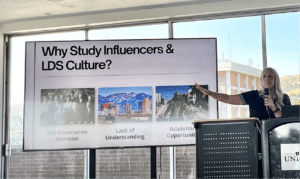
This study is meant to change that. It listens directly to Utah Gen Z women — ages 18–29 — and asks how they’re navigating faith, identity, gender expectations, and the digital spaces where so much of this unfolds. It pays attention to the small choices, the quiet negotiations, and the ways online conversations shape what belonging looks like for them now.
Exponent II readers know better than anyone that LDS women’s voices matter — and that they’re often overlooked in institutional narratives. This study is one way to ensure those voices are heard.
Your Voice Matters — And Your Help Matters
If you are a Utah Gen Z woman ages 18–29, your voice belongs in this research. Your experiences — whether rooted in devotion, ambivalence, frustration, or reinvention — offer insight into how faith and identity are being lived right now.
If you’re not in that demographic, you can still play a crucial role. Share the survey with the women in your life — the ones navigating faith, identity, and culture in ways earlier generations never could. Help the link reach the women whose stories deserve to be part of the record.
This study is about capturing a generation in motion — a generation redefining what it means to belong, believe, question, and adapt within a tradition that has shaped Utah life for nearly two centuries. Gen Z women are already rewriting the story of Mormon womanhood; the question is whether their voices will be preserved as that story unfolds.
Take or share the study survey today!
Pam Shepherd is the Communications Director for Research at George Mason University, where she leads strategic communications, research visibility, and institutional storytelling. Curious about the differences between her own Mormon experience and those of younger women she encountered during recent visits to Utah, she began researching Gen Z women, religious identity, and social media. She recently presented this work at Sunstone and is conducting an ongoing study. She holds a Master’s degree in Communication from The Johns Hopkins University.
October 11, 2026
Guest Post: An Obituary for So-Called Womanhood, 1986-2026
 Posted October 11, 2026
By Guest Post
Guest Post by Mags Edvalson
It is with frustration and utter contempt that I announce the passing of my ovaries. Though I am writing this obituary weeks before they shuffle off, I suppose I must give them the satisfaction of knowing that we will share one more excruciatingly painful period together before their removal. This period, according to my calendar, will come to pass right over a long-awaited trip to Disneyland… with my in-laws. Surgery is scheduled for October 13, 2026, and though my surgeon assures me that they will do everything they can to preserve some tissue to stall menopause until the appropriate age, I’d rather they take the f—ers out.
Pardon my language. It’s been a life with these two clowns defining my entire personhood with their mere existence. When I was a child, people called me a tomboy because I wasn’t feminine enough. I was admonished in church to be more lady-like, to lose weight, to try make up, learn to cook, preserve my chastity, dress attractive, dress modest, etc. All because my body had ovaries. The joke was on everyone, though, because I had no intention of ever using those ovaries. I didn’t want to be a girl. I didn’t want to be a boy either, but there was never a neutral way to be.
My ovaries leave behind a legacy of pain. Physical pain fell swiftly at the age of fourteen when my periods began. I would call my mom to pick me up from school so I could sleep for the rest of the day. The emotional pain came later when I began trying for a baby—oh that ever necessary key to exaltation—because I wanted to parent, even as a formerly LDS person with no obligation to have children, because I like kids and I’d like to think I might be better suited to preparing children for reality than my parents or their church ever did for me. The doctors never did figure out what caused my infertility, perhaps because modern medicine has not caught up to understanding female bodies, and all hope for progress in my lifetime has been lost on the good ship “Scientific Ignorance” captained by wealthy men who probably believe mermaids are real or some such nonsense. Instead of fixing my infertility, I was diagnosed with two dermoid cysts that might have teeth growing in them but would definitely need to be removed eventually.
That eventuality has come. The teeth have been bared.
It’s strange to be forty years old, knowing that my next period is my last, and wondering why on earth any of this happened to me in the first place. Despite all efforts to condition me out of adolescent questioning and rebellion, I have never wanted to give birth. I do want to be a parent and prepare a new generation for the world as well as to bask in the tenacity of their youth, but my plan was always going to be adoption and that is the current route of pursuit even as I ponder the last days of my supposed “fertility.” I feel angry. I’m angry at my body for not performing to expectations. I’m angry at those expectations, particularly the ones written into the narrative of some metaphysical plan that I either can’t or never did actually consent to. I’m angry at the time wasted chasing after a fertility I never cared for, and for all that time spent acquiescing to a gender that I have never identified with because I don’t know how else this could be framed outside the binary. I’m angry that I have one period left during vacation, because OF COURSE I DO, and that the trip in question is marred further by the fact that I have to follow expectant mother protocols on the rides because the jostling and twisting might cause one of my cantaloupe sized cysts to burst. Nope, I’m still not pregnant, but I get to pretend I am! What’s my consolation prize? Not a baby, surely.
I am angry that I feel like I have been cursed with this very weird burden because I haven’t done anything the way my bishop and my dad wanted me to. I thought agency was the whole point, but I guess it was obedience. Terry Tempest Williams wrote in her book Leap about a time when she was asked as a child what her favorite principle of the Gospel was. She answered “agency.” That would still be my answer too. As hurt and confused and angry as I feel right now at this loss of something I never had or wanted, I would still choose agency. I may never pass down genetic code, or obligate another generation into caring about my life story or the story of my ancestors before me, but I wouldn’t trade the choices I’ve made for anything. I still have a life to live beyond this. I’ll find a way to tell that tale.
Memorial services for my ovaries are pending. In my own morbid way, I think I might like to enshrine any teeth, should they be found, in resin and be made into a pendant to wear on a string. I’ll tell people that they belonged to my twin, as a nod to that hilarious scene from My Big Fat Greek Wedding. I may plan a party with some friends to celebrate the end of menstrual cramps. If there is anything I’m excited about, it’s to be done with those. After nearly thirty years, the cramps have never gotten easier. Gender is still a hard prospect as I face HRT and trying to decide what I want to do. Do I transition? Do I take it as directed for a cis-woman? I don’t think I care. I’ve always thought gender was stupid, and I don’t know that there is such a thing as gender affirming care for me. I wonder if I would’ve felt any less confused about it if I hadn’t been so heavily indoctrinated to place my value on my reproductive organs. Why do we do this to ourselves?
In lieu of flowers or condolences, I ask you to be kind to yourself, whatever your identity, and whatever your status. What I have learned most through my journey with these damn ovaries is that there is one thing that no one can ever truly consent to, and that is to be born. Whatever you believe about a premortal existence, you can never know for sure if you agreed to be here in the body you have. Everything else, ideally, is something you get to consent to. It’s your agency, not your body, that guides the brushstroke of your masterpiece.

From the time Mags Edvalson learned to read, they’ve had an obsession with church history and the paranormal. This fixation is what drives them as a folklorist and a church historian for the Community of Christ, which has been their church home since 2017. Mags lives in picturesque Silverton, Oregon with their spouse and an menagerie of furry children.
A Message to the Wayward Souls
 Posted October 11, 2026
By Kara Stevenson
A message to the wayward souls: I see you.
I know general conference can be hard; devastating, even.
Messages from the mouth pieces of the Lord are broadcast to your friends and family, often times preaching with unflattering depictions of the apostate, the prodigal son, the wayward soul… of you.
You wonder if your loved ones are thinking of you as they mention the iron rod. A dull ache settles in your chest at the thought that those you love and admire the most may see you as a stumbling, wandering soul who’s lost in the mist; that they may see you as the apostate who ruined your temple sealings; that they may see you as an unrighteous, unworthy covenant breaker who lost their connection to God and to their own family, merely a broken, weak link that shattered your eternal prospectives.
It doesn’t matter that you are genuine in your exploration of spirituality and faith.
It doesn’t matter that you are trying, with every fiber of your being, to learn and grow.
It doesn’t even matter that you’re a good person simply doing the best you can, just like every Latter-day Saint is.
No, none of that matters.
You see, what matters is that your beliefs changed.
Though you never asked for it, and would have preferred to remain in your cocoon of spiritual comfort forever, it broke.
You found yourself falling.
And it was terrifying.
In your free fall, as you desperately reach out to grasp anything sturdy, you scrape against the harsh rhetoric and the doctrine that suggests you are no longer worthy of blessings, or of God’s presence, and are destined for an eternity separated from your family.
And it’s all your fault. You are to blame. You lacked faith in Jesus Christ.
During this General Conference, they said that you are tossed to and fro.
You’ve left behind a string of broken hearts, as if you are responsible for the feelings of others.
You chose riotous living and erroneous paths.
You are lost in the mist, at the mercy of Satan and the misery he offers.
Your apostasy is an unrighteous exercise of moral agency.
You will lose your sealings with God and your family.
And it stings.
It’s nearly impossible to not feel vilified, deeply misunderstood, and terribly misrepresented.
So you continue to fall, battered and bruised by the very church that you used to love.
The very church that was once your home; a safe, comforting place, that is now anything but.
It may be worth considering that the grief Elder Rasband describes feeling when a loved one leaves the church is, perhaps, misplaced.
It is valid to grieve the loss of simplicity; the convenience and ease of being in agreement with those you love.
I grieve that, too.
But those you love who simply had a change of faith, are exploring and learning what they truly believe, and are following the dictates of their own conscience as the church taught them to do, do not need your grief.
They need your respect. Your understanding. Your listening.
The very act of grieving implies that you don’t see their path as valid, or good, or worthwhile.
It is seen as erroneous.
And that stings.
You would think that Mormons would know what it is like to have their beliefs scoffed at; to be mocked and scorned and to be seen as inferior compared to the rest of the Christian world.
Why is it, then, that we are so quick to throw that same vitriol to our own brothers and sisters who are wrestling with their faith?
Are we not all too familiar with that aching pain?
Do we not know what it is like to feel judged, misunderstood, and slandered?
Do we not know what it is like to be told that your eternal destiny is to rot in hell, simply because your beliefs are supposedly wrong?
That judgement, Elder Rasband, brings a far greater sorrow to those who are already grieving their loss of faith; a grief that can’t possibly be understood unless you have experienced it yourself.
If you want to love your family and friends who step away from the church, this is not the way to do it.
True love and respect comes from listening. Asking questions. Seeking to understand. Learning a new perspective. Being open minded. Trusting them that they will do what is best for them.
And, perhaps, trusting Heavenly Parents that their love is far more expansive than we could ever imagine; that the barriers we’ve created are so very human, and so very unChristlike.
As it turns out, when you stop viewing people as wayward, the grief tends to go away. You realize that that there is nothing to grieve. Rather, there is a human being to honor, to admire, to respect, and to learn from.
I once saw a headline that struck me: the former Pope Francis met with survivors of clergy sexual abuse who had since disaffiliated from the Catholic church.
Pope Francis expressed sorrow, asked for forgiveness, and acknowledged that abuse often times destroys a person’s faith.
I felt a twinge of holy envy toward the church that my grandmother finds herself devoted to; the church that baptized me as an infant.
Yet here I stand in my chosen church, the Church of Jesus Christ of Latter-day Saints, begging for a leader to show the same kindness, the same empathy, the same humility, the same willingness to listen as Pope Francis so beautifully demonstrated.
I have written this before, and I will say it again: General Conference talks like this show me that hardly anyone in Salt Lake is listening.
Hardly anyone is taking the time to understand, to self reflect, to consider what the church could do better.
Instead, fingers continue to be pointed. Disparaging remarks are made. Unwarranted grief is felt. Misplaced certitude is expressed.
And love is used to justify it all.
So the vast expanse continues to grow ever wider.
If this General Conference left you broken and hurting, let me be the first to say:
You, my friend, are not lost.
Your journey has only begun.
Though some may suggest otherwise, there is much to be learned in the mist.
And if someone hasn’t told you recently, please allow me to say that there is absolutely nothing wrong with you.
You’re learning. You’re growing. You’re progressing.
And you should not be judged simply because your path looks different from someone else’s.
If you can’t exercise a particle of faith right now, try giving hope a chance.
What looks like destruction, like the tearing apart of a cocoon, often leads to something far more beautiful.
I hope that this is true, for me and for you.
My message to the wayward souls is this:
I see you.
I hurt with you.
I stand with you.
I am you.
October 10, 2026
When “All Are Welcome” Comes with Conditions: What October 2026 General Conference Taught about Who Belongs
 Posted October 10, 2026
By Rose
In October 2026 General Conference, I welcomed messages that invited me to love, help, and resist judging other people. But alongside those invitations were statements that described people who leave as wayward, treated doubts as possible evidence of hidden problems, and placed institutional conformity over respectful belonging. A loving sentence does not erase a condemning one, especially when both come from leaders who claim to speak for God and whose words can shape how families treat one another.
My concern is for the people listening: the mother whose daughter no longer believes, the gay teenager wondering whether there is a future for him in his faith, the woman who has spent decades serving without equal authority, and the member whose conscience no longer permits unquestioning obedience. When Church leaders speak about these people, do their words help us understand and respect them? Or do they encourage us to see them as spiritually inferior, misguided, or dangerous?
Calling People “Wayward” Before Listening to Them
In his October 2026 address, “Love Like Jesus,” Elder Ronald A. Rasband described loved ones who had departed in terms of broken covenants and wounded families. He asked listeners to surrender their despair for “those wayward souls” to Jesus and spoke of people who had “left behind a string of broken hearts.” His message also urged continued love and warned that arguing and pressuring can deepen family divisions. Those recommendations deserve acknowledgment. But the description of the departing or questioning person remains troubling.
Before we have heard the reasons someone leaves, that person has already been placed in a story of spiritual failure. What about those who leave because they cannot reconcile their conscience with discrimination and dishonesty? What about those who discover that the history they were taught omitted painful facts? What about those who remain devoted to Jesus but no longer believe that Church leaders reliably speak for Him?
We can acknowledge the pain of a changing relationship without making one person the faithful sufferer and the other the wayward cause. We can stop marginalizing, fearing, and condemning honest questioners and start respecting, love, and valuing them.
When Doubt Becomes Grounds for Suspicion
In October 2026, Elder Clark G. Gilbert’s “Teach Truth with Love” repeated this warning from President Russell M. Nelson: “Do not be led astray by those whose doubts may be fueled by things you cannot see in their lives.”
Gilbert encouraged patience, listening, and recognition of hidden pain. Yet this warning also invites suspicion about the person expressing doubts.
There is a profound difference between recognizing that someone may be hurting and suggesting that unseen circumstances explain away their questions. When a person raises a historical, ethical, or theological concern, we should examine the concern. We should not begin by wondering what private weakness might have produced it.
Imagine how different a conference message would sound if leaders said: Some members question because they have studied carefully. Some leave because they take honesty and compassion seriously. Their questions may reveal something we need to learn. That would give families permission to listen without assuming that listening threatens their faith.
Equating Concerns about Church with Rejecting Jesus
The problem becomes more serious when loyalty to leaders is made indistinguishable from loyalty to Christ. In April 2026, Elder Brian J. Holmes declared in “Jesus Christ Is the Way”: “To knowingly reject His prophets is, by His own definition, to reject Him.”
That statement makes an enormous claim about another person’s relationship with Jesus.
A member may reject a leader’s teaching precisely because it seems inconsistent with Jesus’ compassion. A person may question a policy while continuing to pray, serve, forgive, and love. Declaring that rejecting Church leaders means rejecting Jesus places their authority beyond the very moral examination that religious leadership deserves.
In April 2026, Elder Michael John U. Teh similarly taught in “Follow the Prophet; He Knows the Way”:
“When we follow the teachings and examples of prophets, seers, and revelators, we are following our Savior, Jesus Christ.”
The missing qualification matters: human leaders can misunderstand, make mistakes, and require correction. To say that everything they say and do follows Jesus creates an implication of infallibility and perfection that no mortal can attain.
Drawing a Boundary Around Whom We Can Trust
In October 2023, President Nelson instructed members in “Think Celestial!”: “Never take counsel from those who do not believe.”
He also said those who do not follow LDS strict guidelines and rules “are choosing not to live with our families forever.”
The second statement concerned choosing to live what he described as telestial laws. Together, these teachings place considerable pressure on belief, obedience, and family relationships. That is a frightening threat to truth-seekers.
A person’s religious belief does not tell us whether that person is wise, honest, compassionate, or trustworthy. A nonbelieving daughter may be a person of great integrity and compassion. A former member may offer thoughtful advice precisely because that person knows the Church intimately. When disbelief becomes a reason to dismiss someone’s counsel, a difference in faith can become a barrier to mutual respect.
Warnings about eternal family separation can also turn an adult’s change of belief into a family emergency. Instead of asking whether that person is living with integrity, relatives may feel responsible for bringing the person back or may feel justified in excluding them. Love then becomes entangled with fear.
Women Are Present, but Their Voices Remain a Small Minority
Women were not absent from the 2026 conferences. The official programs list three women delivering substantive addresses in October—Tamara W. Runia, Rosemary K. Chibota, and Andrea Muñoz Spannaus—and three in April—Kristin M. Yee, Emily Belle Freeman, and Susan H. Porter. In each conference, women’s voices remained a small minority.
Nor would it be accurate to say that men never acknowledged women’s spiritual contributions. President Dieter F. Uchtdorf’s April address, “Encounter at the Empty Tomb,” discussed the women who first encountered the empty tomb and bore witness of the Resurrection. That recognition is welcome.
But honoring women in a biblical story does not resolve the question of women’s inclusion today. Women need more than praise for their faithfulness. They need substantial opportunities to address the entire Church and participate in the decisions that govern their lives. When the overwhelming majority of authoritative voices are male, the conference itself teaches a lesson about whose ideas and inspiration carry the greatest institutional weight.
When Eternal Belonging Requires Credentials
In October 2026, Elder David A. Bednar’s “Sealed by the Holy Spirit of Promise” quoted Boyd K. Packer: “Ordinances and covenants become our credentials for admission into His presence.”
Bednar developed this teaching through a passport analogy and also listed “personal apostasy” among difficulties that can damage a marriage. His purpose included reassuring faithful spouses that another person’s choices would not deprive them of promised blessings.
The credentials metaphor deserves scrutiny. It presents access to God through authorized religious rites, ongoing eligibility, and institutional boundaries. What does that metaphor communicate to people whose lives do not fit those boundaries? What does it say to a loving spouse who leaves the Church while remaining devoted to the marriage? What does it say to a person who is married to someone who legitimately questions dishonest or unethical practices in the LDS Church?
In his October address, “Come to the Lord in His Holy House,” Elder Gerrit W. Gong taught: “Covenant belonging unites a husband, wife, and children.”
For many members, that teaching is deeply comforting. For others, it raises the question of where their family belongs.
I would not claim, without a systematic analysis, that these conferences mentioned temples or other leaders more often than Jesus. Many talks explicitly centered on Him. My concern is how often following Jesus becomes inseparable from following leaders, receiving authorized ordinances, and maintaining institutional standing. We should ask whether the Church gives compassion, honesty, generosity, and the treatment of vulnerable people sufficient weight, or whether it assumes ritual performance trumps personal transformation.
LGBTQ People: Loved, but Denied an Equal Future
The clearest explicit statements used here about LGBTQ exclusion come from earlier conferences within the past five years. In April 2022, President Dallin H. Oaks taught in “Divine Love in the Father’s Plan” that exaltation requires an eternal marriage between a man and a woman. He also associated Satan’s opposition with: “distorting marriage, discouraging childbearing, or confusing gender.”
These statements were presented within an explanation of God’s love and the Church’s understanding of eternal destiny.
We need to consider what that framing communicates to LGBTQ listeners. A gay couple’s devotion does not receive the same eternal recognition offered to a heterosexual couple. Transgender people hear language that can place their experience within a story of spiritual opposition.
When one group’s marriages are honored and another group’s marriages are excluded from the highest religious ideal, the inequality is real.
Tithing Treated as a Test of Obedience
Other conference messages marginalize people through the expectations placed on them. In October 2026, Elder Patricio M. Giuffra’s “Trusting the Lord Through Tithes and Offerings” described an older woman whose earnings barely covered shelter, warmth, and food. He recounted a mission president’s response: “There are no exceptions to this commandment.”
The address also repeated the claim that “tithing can break cycles of poverty in poor nations and families.”
The account celebrated the woman’s subsequent payment of tithing and fast offerings and implied a form of prosperity gospel. However, many LDS children are malnourished, revealing that paying tithing may not bring the blessings of food or sustenance to families on the brink of starvation.
Why must a person struggling to afford necessities prove faith by giving money? Is it ethical to tell a mother toshto pay tithing rather than feed her children when food is unavailable for them and when they may experience physical and mental stunting because of malnutrition?
If the LDS Church does not provide food for starving children—which in developing countries it often does, it is wrong to tell parents to pay tithing at the expense of feeding their babies.
Such stories can leave struggling members feeling that their hardship reflects insufficient faith. A Church that values the poor should make unmistakably clear that feeding children, keeping a home warm, and obtaining needed medical care are worthy acts and that payments to the Church, which is wealthy enough to be indefinitely financially sustainable without tithing, are not necessary.
Let Love Overrule Fear
October conference also offered language that could lead toward a more generous, kind Church. In President Oaks’ “The Gospel of Jesus Christ Is for All” talk, he affirmed: “His [Jesus’] grace is for all.”
In “A Child of God,” President Rosemary K. Chibota pleaded, “I plead with you as disciples of Jesus Christ to pray to see others as He sees them and to treat them accordingly.” Imagine if that invitation shaped every conversation with a questioning member, every policy affecting LGBTQ families, and every decision about whose voice deserves to be heard. Seeing people as Jesus sees them requires listening to their experiences and taking their pain seriously.
In “Using the Language of Peacemakers,” Elder Alfred Kyungu taught, “We must choose language that strengthens confidence and preserves relationships.” This counsel should apply to those speaking from the pulpit as surely as it applies to those sitting in the pews. Words that portray people who leave as spiritually deficient can follow them into their homes, affecting how parents, spouses, and children understand their choices. Imagine if leaders spoke about those who question or leave with the same respect they ask members to show one another. A difference in belief need not become a wound in a family.
Elder Paul H. Sinclair offered another welcome reminder in “Quick to Help, Slow to Judge”: “He [Jesus] spoke to the woman with dignity, not shame. He earnestly listened to her questions and responded with teaching, not ridicule.” That description of Jesus offers a standard by which we can examine our own religious culture. Are questions welcomed? Is dignity protected? Can people share what they have learned or suffered without fearing that their honesty will cost them their belonging?
Even in a talk whose characterization of those who leave concerns me, Elder Ronald A. Rasband expressed a principle I value. In “Love Like Jesus,” he said, “Love is being interested in their lives, their successes, and their challenges.” We can practice that love without making someone’s return to church the measure of a successful relationship. We can celebrate their happiness, respect their conscience, and remain close even when their path differs from ours.
President Dieter F. Uchtdorf offered a reminder in his October 2026 talk, “Christ-Centered Unity”. Speaking of Jesus, he said, “He consistently reached out to those who would otherwise be shunned as outsiders.”
Those teachings deserve to become more than reassuring words. Imagine if that grace shaped how leaders described people who leave. Imagine if questions were welcomed without speculation about a person’s hidden faults, women’s voices carried equal authority, LGBTQ families received equal dignity, and impoverished members were protected from demands they could not afford. Imagine if leaders acknowledged that disagreement with them can arise from a sincere effort to follow Jesus.
We can recognize that some good things were spoken in General Conference and also identify what wounds people. We can welcome some compassionate thoughts while asking leaders to reconsider language and teachings that undermine compassion and kindness.
My hope is that these calls to kindness will become the standard for both individual behavior and institutional decisions. Imagine a Church willing to examine whether its language and policies reflect the love it preaches, to apologize when it causes harm, and to welcome the wisdom of people it has too often marginalized. Those who remain, those who question, and those who leave all deserve tenderness and respect. If we want to follow Jesus, our love must reach each of them.
If all are welcome, then the person who questions, the woman who seeks to be treated as a fully human, the gay couple who loves faithfully, and the family struggling to survive must be included. I believe that is what Jesus would do. He counseled religious leaders and members to evaluate their own souls before casting stones. His first convert was a Samaritan woman who was living with a man. His greatest condemnation was to oppressive religious leaders who placed heavy burdens on the vulnerable. His strongest invitations were to love others as He loved and to reach out to and feed the hungry, clothe the naked, bring water to the thirsty, and help the stranger or refugee in a foreign land. He said when we are compassionate to others, we show love to Him.
That is a gospel I can embrace.
October 9, 2026
Confessions of a Recovering Good Girl
 Posted October 9, 2026
By Guest Post
Go with me back to a young women’s room one Sunday afternoon in the summer of 2012. The 2008 edition of the young women’s theme is printed on a posterboard and displayed on an easel at the front of the room. It is the week of youth conference, which means that there are many, many announcements and reminders to discuss.
Remember to bring all your luggage to the church parking lot the night before.
Remember to bring sunscreen, a sack lunch, and feminine hygiene products (apparently it was too crass to say “tampons” in a classroom full of teenage girls).
Amid the information for meeting times and packing lists, the presidency turns the time over to a young women’s advisor, Janelle, who stands where her seat is a few rows back for a “special announcement.”
It goes something like this:
“As a mom of four boys, I can tell that they are SO much more comfortable and happy when they are around girls who are dressed modestly. These are the kinds of girls they are interested in and will want to marry someday. It might not seem like a big deal, but PLEASE wear a modest swimsuit, my boys and all the other boys will appreciate this so much, and they will be more comfortable around you. You might not think it makes a difference, but speaking as a mom of boys, it does.”
This young women’s leader is the mother of some of the most popular, well-liked, and attractive boys at school. At this point in time, her boys’ ages spanned the ages of the young women’s organization. I doubt there was a single young woman in the room who had not at one point or other had a crush on one of these sons. Needless to say, we listened when she told us what we could do to get these boys to like us. No two-piece swimsuits? No problem. It seemed a small price to pay, if it meant these boys would like me more.
 Personal Progress booklet https://www.churchofjesuschrist.org/m...
 Time went by, and as I observed her sons grow up, I couldn’t help but notice that the girls they were friends with/dating did not fit the mold of what their mom said. Sometimes they wore tank tops, or *gasp* bikinis. Why wasn’t my young women leader’s advice working?
Now, all four of these boys are married. I’m positive that all of their wives have worn a bikini before. Not that it matters -that’s my whole point. Janelle’s plea to dress more modestly may not have helped any of the girls in our ward bag one of her sons, but it was certainly effective at getting us to wear a one-piece swimsuit to youth conference that week.
“312. That’s approximately how many Sundays I attended young women’s between the ages of 12 and 18. From how many of these Sundays do I specifically remember something from the lesson or opening exercises?”
Over the last few years, I’ve spoken with friends from my ward about that incident and was surprised to learn that they, too, vividly remember that exact same Sunday where Janelle pleaded with us on behalf of her hot sons. I hate that this moment is still so clear to us 14 years later.
312. That’s approximately how many Sundays I attended young women’s between the ages of 12 and 18. From how many of these Sundays do I specifically remember something from the lesson or opening exercises? 10? Maybe 20 at most? It angers me that my clearest memory from those Sundays is of my young women’s leader manipulating my desire to be liked by a boy into compliance with an antiquated dress code. Think of all the lessons about Jesus, my Heavenly Parents, or moments of bonding and friendship that could have been stored in my long-term memory instead.
***
Permit me one more example. Over the holiday break in 2016 I had recently moved out for college, but I met with my bishop at my home ward for a temple recommend interview because I was in between singles wards. Janelle’s husband was now the bishop.
It was also my first time needing to “confess” something to a bishop (or, so I thought at the time). When I moved out for college, my newfound freedom included the family Netflix password, opening up a whole new world of media. I had watched a few episodes of a tv show where characters had made out and talked about having sex. I was convinced this meant that I had a porn problem (Yes, really. Thank you, anxiety and lack of comprehensive sex ed).
To his credit, my bishop was extremely kind and understanding. However, I do wish he had maybe asked a few follow-up questions that could have helped me recognize that maybe not all media that mentions sex counts as “pornography”, but whatever. The main problem was an out of pocket comment he made. In his attempt to tell me that my sins can be forgiven and do not change my worth a bit, he told me that he would love it if I married one of his sons, because he thinks I am such a good person.
At the time this brought me comfort, helping me feel like he really must think I’m able to be forgiven of my sins if he wants me to marry into his family. Now it just seems odd to me, the way that both of these parents leveraged their sons’ dating lives to help the young women obey church standards. Why did this family keep using their sons’ dating life as a motivating factor for young women to be obedient and faithful?
Needless to say, I did not marry the bishop’s son.
***
It is possible that these particular incidents are simply the result of one odd family from my home ward, but I am inclined to think they are data points in the larger purity culture we swam in during the 2010s. The oft-repeated slogan “Modest Is Hottest,” which swept the Christian world at that time, suggests it was part of a larger cultural trend in encouraging women to cover up so that men would like them more. It doesn’t seem like much of a leap to infer that other conservative behaviors (like avoiding sexual content) were also incentivized in the same way for young women.
It is 2026 now. Let’s stop using artificial rewards as motivation for “good” behavior, if we have not already. If we find we need to add extra incentives to get the results we want because intrinsic rewards are not enough, maybe it is time to rethink the dress code/desired result in our faith community, instead of adding inappropriate forms of reinforcement as mechanisms of control.
I hope that if I serve as a young women’s leader someday, their most lucid memory of young women’s classes 14 years later will not be one that comes up in therapy.
I would say the same about being a bishop someday but, well, I’m not holding my breath for female ordination. :)
Anonymous is passionate about building community in her ward and neighborhood. She writes as a way to process experiences that she’s not sure what else to do with.

