Sabrina Fedel's Blog
October 12, 2022
Five Tips for Perfecting Voice
Voice is often something that people new to writing struggle with, and most of us, at some point, have been told by an editor or agent or critique group that our “voice” needs to be stronger, but many early writers struggle with what this means in a practical sense. But even established writers can struggle with voice. Voice is simply the tone your fiction sets, and you want it to mirror as closely as possible your protagonist (main character or MC) and the themes in the manuscript (funny, sad, young, scary, etc.). Here are 5 tips to help you do this:
5. Your narrator is your gateway.
This one seems obvious, but it’s sometimes harder for people to envision, especially in third person (3P) rather than first person (1P). Your narrator (which in 3P is distinct from your MC) should set a tone that reflects the contract you are making with your reader (serious, funny, scary, emotional rollercoaster, angry, etc.). For example, even though it’s 3P, Jane Austen’s first sentence to Pride and Prejudice [It is a truth universally acknowledged that a single man in possession of a good fortune must be in want of a wife] is still famous 220 years later because it (1) is hilarious, (2) reflects the themes of the book and sets up a contract with the reader to expect a light-hearted romp into serious subjects, and (3) represents the character dynamic between the MC and her mother (who reflects/represents society’s expectations for marriage).
Although on its surface, the line might be sympathetic toward the men in the situation (since they have become prey) the humor used lets us know that for such a man, the stakes are low- he is not obliged to marry, which inversely tells us that there is a contingent of ladies who are and who will be vying for him. Even the reader who doesn’t know the horrors that awaited the unmarried woman in Jane’s society will know that to marry for money (security and luxury) is a prize. All of this reflects the impertinent, disdainful, but also loving and realistic personality (voice) of Elizabeth. While Lizzy may poke her bear (society) she will not do full battle with it (for example, she disdains Charlotte’s choice even while she accepts it and acknowledges that it’s a good match for Charlotte financially and emotionally (as Charlotte can ignore the ridiculous in Mr. Collins’ character)) and she accepts that Lydia must marry Wickham even though he’s a cad who will treat her badly. Her own half-formed plan to avoid a loveless marriage relies on the realistic expectation that her very pretty sister will marry well and she can become a dependent aunt. Lizzy treats the world as a joke, but she understands (and avoids) its realities. As does our opening line.
4. Voice is in how your secondary characters interact with your MC.
You can highlight your MC’s voice by contrasting it with the voices around them. Is where your MC comes from important to your themes or plot? Show that not just with dialogue, but also with the entire range of diction at your hands. Would your characters say flat or apartment? Parking lot or car park? Use specific language to discuss horses or musical instruments? Even where you have a 3P narrator, this should align to show us the different voices we are encountering in your story. The emotional connections the MC has with the characters revolving around them can show us the MC’s voice, just as Lizzie Bennett’s does. It isn’t only what the characters say to one another, but how they say it.
3. Voice is reflected in setting.
There is a reason Poe’s stories are always set in dark places of loneliness. This is obvious. But how a character interacts with a setting also shows us who the character is. A park is never just a park. How your character interacts with that setting is their voice. Do they imagine themselves in the golden age of Hollywood movies (romantic)? Do they throw a coin into a fountain (dreamer)? Do they shut out the bird song (they’re shut down)? Do they people watch (lonely introvert)? Use your settings to tell the reader how your character experiences the world in their voice.
2. Voice is scene.
The most common way to show voice is (1) how characters speak (their diction, the topics they speak about, etc.) and (2) a character’s internals (how they speak in their own head, and what they are concerned about). But that is only one aspect of a scene. You can recreate voice in a scene through cadence. See the brilliant opening to Carolyn Coman’s middle grade novel, What Jamie Saw, in which our preteen MC witnesses his mother’s boyfriend throw his and the mother’s infant during a domestic dispute. Coman deftly repeats what the boy is seeing in the same way it would be experienced in that traumatic moment, creating for us, not just the scene, but the rhythm of the human mind when it takes in something unbelievable. Even though our narrator is 3P, they recite for us this opening incident to put us squarely in Jamie’s head in this moment of time. We experience the scene as Jamie would experience it.
1. Metaphors and Similes are voice.
These should not only give a shortcut to the emotional core of a scene (ex: quiet as a mouse) but also to the voice of your character and themes. While a metaphor or simile will give you that emotional shortcut, you want one that (1) YOUR character would say and (2) aligns with the broader themes of the manuscript. For example, Anne Shirley, (Anne of Green Gables by Lucy M. Montgomery), is a very bright, yet unrealistic, romantic orphan searching for love. Therefore, even though the book is in 3P, a metaphor coming from Anne’s viewpoint or describing her should be poetic or tinged with drama. This reflects Anne’s voice (or personality) while reminding the reader that this is a young woman who has known deep loss and is coping with it by believing there is an idyllic family somewhere waiting just for her. Similarly, metaphor and simile should reflect the age, personality, and mood you want to embody. A teen in a horror story may see the same trees that Anne sees, but for Anne, they are vestiges of Camelot, while for our teen in the horror story they will seem like some aspect of dark magic. A metaphor or simile surrounding an elderly character is more evocative of voice if it has a nostalgic ring to it or uses outdated language or images, while a young person’s voice will be more contemporary (soft as grandmother’s worn lace versus soft as a Post Malone hoodie).
I hope these tips help your writing.


May 11, 2019
Thoughts on Mother’s Day 2019
We have a child. We call them ours. We swaddle them in soft cotton blankets, wrapping them up like mummies we can preserve forever. They are ours, fully and completely. We have a lifetime.
For a while, the dream continues. They search our faces for the signs that they belong somewhere. They cry when we leave them, and press their fevered cheeks against us when they are sick, falling asleep in the safety of our presence.
They yell to us from atop the slide to watch them. Watch them. They make us jewelry.
They draw us the house they will buy us when they are famous. They laugh at our jokes and tell us about their field trip. They buy us jewelry.
They are a nervous smile behind the wheel, a navy linen suit for graduation, an angel’s voice singing in an upstairs bedroom.
We call them ours, but they never really are. They are the fleeting ghosts of love, whispers on a moonlit shore, a memory we can’t keep hold of.
They are tiny deposits of DNA left in our brains, long after the feel of their hand on our palm has faded. They are the longing for grace that sits in our heart, the call of a whip-poor-will, a perfect sunset over an living mountain. They are everything that can never be ours, every glimpse of a lost Bird of Paradise.
May 5, 2019
Interview on Reading with Your Kids Podcast
Hi there!
I have a new interview available on the wonderful Reading with Your Kids podcast and you can check it out here!
Many thanks to Jed Doherty for asking me to come on the show and for a very thoughtful interview. It was a great experience. I hope you’ll enjoy it!
January 21, 2019
New 4.5 Star Review
Hi!
I have a new review up at Kids’ Book Buzz by a teen reviewer. She’s really fun, I hope you’ll check it out and share:
May 28, 2018
What You Need to Know About ADD/ADHD
 May is Mental Health Awareness month and Mother’s Day, so it seemed to me the best time to put down on paper the PSA that has been chugging through my brain for the last few months: a warning for other parents about the hidden side of ADD.
Almost twenty-one years ago, I gave birth to my first child. I had read everything I could find on what to expect. He would be pockmarked and misshapen from sitting in amniotic fluid for nine months before being shoved through the birth canal. I was prepared that he would not be as beautiful as a baby is supposed to be on television.
Somehow, though, he came out absolutely perfect. He was such a beautiful baby that all the nurses kept telling me how beautiful he was. I finally said to one of them,”Thank you, but it’s not necessary to say, I know you tell that to all the new mothers.” She laughed and replied, “We actually don’t. Your baby is just really beautiful. Even the floor pediatrician is in the nursery cooing over him, and he never fusses over the babies!”
He was a beautiful baby. Everything I could have wished for and more. He met all of his milestones early. His first phrase was his name followed by “Do self.” At eighteen-months-old, he could say the word convertible clearly enough for anyone to understand him and he knew what it meant. He always had a Matchbox car or a book in his hand. By two, he knew not only his primary colors, but gold and silver and copper. He was the light of our lives.
By the time he was four, I wondered why he loved Thomas the Train so much, but wouldn’t put the tracks together. I had to do that. He never wanted to do puzzles. They aren’t for every one, I told myself. He had one Richard Scarry puzzle that he particularly loved if I put it together. I would ask him “Where’s the pickle car?” or “Can you find the apple car?” His little face would light up when he finally found the one I had picked out, and he memorized where all of his favorites were.
By the time he had finished first grade; though, I knew something was wrong. He wasn’t reading very well. He hated asking for help. He hadn’t been able to do his map homework, despite the fact that we’d been looking at globes and maps since he was a toddler because his father was in the Marine Corps Reserves. I knew in the primordial forest of my heart that something was wrong. His school told me that he seemed fine to them, but that I could have him tested if I felt it was necessary.
This began a fifteen year journey to an ADD diagnosis that has rocked my family to it’s very core. I had my son tested. And tested. And tested. No one could explain to me why my child, who was remarkable in so many ways, who qualified for gifted programs on his standardized testing, was struggling in school with increasing frustration. His first test, done by our school district, told me there was nothing wrong, despite fourteen point swings in his visual nonverbal skills. His second test told me he had Auditory Processing Disorder and was just shy of a disability in Executive Functioning. In his third test, the Head of Pediatric Neuropsychology at a local hospital asked me “What’s your problem? Your kid’s achieving at grade level.” I was stunned. According to my son’s IQ, he should have been achieving above grade level without even trying. Instead, he was struggling in third grade every day, feeling ashamed because he only read picture books while everyone else was reading novels. I was told it was a slight developmental delay and dismissed. I took the test to my son’s teacher and asked her if it was me. Was I crazy? Was I the first-time mom who couldn’t stand it that her kid wasn’t perfect?”
“No,” she replied, “something is wrong. If it were earlier in the year, I might believe this, but he shouldn’t be struggling the way he is.”
I no longer knew where to turn to get answers. I read books, talked to people, asked questions. But no one seemed to be able to help my child. They loved him at school. He was well behaved and smart and funny. At home, he became increasingly frustrated and difficult. He lied. We thought it was a moral issue. We didn’t know that lying is an ADD coping skill. He argued. Relentlessly. He could never understand why he was being punished for anything. It wasn’t that we didn’t punish him, it was that the punishment had no impact because it made no sense to him.
Between the failure of the medical community to diagnose him and the failure of his school to provide proper accommodations because I didn’t understand what he was entitled to and trusted them to do what they could, my child struggled until he imploded. In sixth grade, he became the class clown. In seventh grade, he completely crashed on his standardized testing. His scores plummeted from the high gifted range to barely registering. I was getting daily emails from teachers because he couldn’t turn in his finished homework. It would get lost in his locker. He lost three $120 required calculators. He routinely lost his books, notebooks, and clothes. I would have to go into his school at the end of the day and search for his things. He would never remember to bring home the book he needed. Or he hadn’t written down the homework. He was angry and disengaged. He told me he would care about school when he was in high school and it wasn’t stupid anymore. He grew to hate me because I was always looking for the answers he didn’t believe in.
We had him tested again. There were tears in my eyes when I begged them to believe me that something was horribly wrong. I told them that if they didn’t help me, I was going to lose him. He was becoming increasingly at risk for substance use. In less than six months, my child had gone from repeatedly telling an older student who solicited him for drugs online that he wasn’t interested to trying to experiment. I was terrified of being dismissed again. I knew that I was fighting for my child’s soul.
He was diagnosed with a profound global executive functioning impairment, but they told me that he functioned highly in attention. He was also diagnosed with depression from not being properly accommodated. I thought I finally had my answer. Everything they told me made sense to me. It fit him, and I really believed that the accommodations they recommended would make a difference. I had hope.
The promise I had never materialized; however, because my son still wasn’t properly diagnosed. We were a very, very long way from getting him the help he needed and deserved.
It took until this year, his twentieth, for us to get him the help he should have had fifteen years ago. It took me stitching the pieces together and refusing to accept another failed diagnosis in his nineteenth year. The psychologist told me that he was presenting as extremely ADHD at the assessment. I was surprised, because they had told me before that he functioned highly in attention. I was expecting an ADHD diagnosis, but then my son passed the Conners Continuous Performance Test so we got a different diagnosis. A diagnosis that didn’t fit my son in any real way, but made sense to the psychologist because of the defiant behaviors my son has used as a coping mechanism for so long.
It also took my son finally having some developmental growth to self reflect enough that he gave me one of the pieces when he told me he thought he might be autistic. Autism had never occurred to me, but I asked him why he thought that and, when he explained, I remembered the tortuous way he couldn’t stand to have water on his face at bath time when he was little. They way he compulsively lined up his cars over and over again, and how he now played video games for hours. He told me things I had never seen in him-how he struggled to look people in the eye and how socially awkward he felt. This, from my son who had been voted captain of his ninth grade hockey team, who always had friends, who always had a girlfriend. He had hidden what he saw as the darkest parts of him so well that even we couldn’t see them.
We had him assessed. He is not autistic, but he has five of the ten criteria they use to diagnose autism. Then I found out that many people with ADD/ADHD have co-occurring symptoms of autism but are not autistic.
I started asking any adult who told me they were ADD/ADHD what it was like for them. Almost invariably, they described it as having twenty televisions in your head and you can’t focus on the one you need to focus on, like standing in front of the television wall at the electronics store and being unable to look at just one long enough to know what is going on.
I asked my son if he ever felt this way. He looked at me with a confused look on his face. “All the time,” he said. “Why?”
“Have you always felt this way?”
“My whole life,” he replied.
“You have ADD,” I told him.
Dealing with mental health and learning/behavioral issues is complicated. They co-occur (called comorbidity in psychological jargon), which you can learn more about here ). They often trigger depression and anxiety. Symptoms overlap. They change and morph.
But the signs that my son was ADD, while hidden, were always there. His inability to sleep. His lying. His frustration, depression, and profound executive functioning problems. His constant stomach problems that had no source we could discover.
But I still needed the diagnosis to get him treated. He could pass a Conners. Every psychologist I had taken him to had missed this. Over and over. When I asked the psychologist he sees now why no one had ever asked him how many televisions my kid had in his head, he answered with “well, that’s not empirical.”
But asking a patient “On a scale of one to ten, how bad is your pain?” is empirical.
Psychologists love to be empirical. But the vast majority won’t do a SPECT scan to see what is happening in a patient’s brain biologically. They want to rely on “emotions” and “symptoms.” The problem is that, with psychological conditions, symptoms routinely overlap and doctors are left taking an educated guess at what is wrong, treating it, and hoping they were right in the first place. For more on why this is disastrous and has to change, read psychiatrist, Dr. Daniel Amen’s, information on why he uses SPECT scans here. As Dr. Amen says, the brain is the only organ we will treat without imaging it first, and it makes no sense. His own struggle to get help for his nephew is proof that even those who are educated and connected have to fight through a broken system. In fact, it’s dangerous. A SPECT scan could have revealed my son’s ADD years ago, saving our family untold heartache and my son absolute agony.
How we treat mental illness and learning and behavioral disabilities has to change. But until it does, here are the main things you need to know if you suspect that you or a loved one may have ADD/ADHD:
You can pass a neurospychology assessment and still have ADD. If the results don’t make sense to you, seek out a medical doctor in a program called ADD through the Lifespan. The programs are sometimes called ADHD Across the Lifespan or other minor variants, but you can find the main idea here. Finding an ADD specialist, who could diagnose my son with other tests and who was familiar with the co-occurring problems of ADD, has made a world of difference already, and we are still in the early stages of proper treatment.
There are different kinds of ADD, not just “ADD” and “ADHD.” Understood.org, which helps parents of children with learning and/or behavioral disabilities, lists three types of ADHD, which you can learn more about here. Dr. Amen has identified what he terms seven types of ADD based on SPECT scanning, see here. In general, I suggest that this is still a developing area of study but the important piece of information is that ADD/ADHD is not a one size fits all based on whether you are hyperactive or not. There are gradations in each category.
The systems are not set up to help you as a parent. They are set up to make you fail. I was as engaged and willing to accept that there was something wrong with my child as any parent could have been. I didn’t need an expert to tell me there was something wrong with a child who had asked me at three why a plane’s nose was shaped the way it was and how the telephone wire knew to take his voice to his grandmother’s house still reading picture books in third grade. I was constantly seeking help: from the medical community, the psychological community, his school community. And it’s not that no one helped me. Some did and some didn’t. But those who did too often didn’t know themselves. To find the ADD Across the Lifespan doctor I recently found, I was at a dead end. I suppose I should have been googling how to treat ADD, but I grew up in a time where you went to the experts, not google. I only found this program because my son’s well meaning psychologist had suggested another neurospsychologist who, when I spoke to her, I knew was the wrong person to understand. So then I called my pediatrician, in tears. Because we have a long history together, she knew that I was not an overreacting mother. But she didn’t know what to do either. She put in a call to a psychiatrist friend and discovered the Across the Lifespan program. She recommended one at our local psychiatric hospital, but when I went to look for it, I found the doctor I now take my son to, hiding in plain sight.
ADD/ADHD puts people at a significantly higher risk for substance abuse, often starting with teens who, improperly treated, try to self medicate this debilitating condition and/or associated conditions such as depression and anxiety. People with ADD have significantly higher, sometimes more than double, the chance of abusing marijuana, alcohol, nicotine, and other drugs, as discussed here. (But if you want to quibble with this site, you will find that the medical community agrees there is a seriously increased risk for addiction and abuse by those with ADD/ADHD). The good news is that, when ADD/ADHD are properly treated, this risk is reduced and there is less risk for those who are properly medicated to start with, as discussed here.
It is never too late to get help as long as a person is willing to address their condition. That is the beauty of the ADD/ADHD Across the Lifespan treatment. My son has different issues coming into treatment as a young adult instead of when he should have entered into treatment years ago. He has lost more than I can bear to think about, but thanks to treatment, he has a new path that is helping him to actually work toward his goals in life.
The smarter a kid is, the easier it is for them to hide their struggles. I knew my child was gifted. I also knew my child was learning disabled. But even with all of that, I didn’t think he was ADD or ADHD. Not because he wasn’t hyperactive. I knew there was a difference. But because he could over-focus, I never saw what was at the root of his problems. I understood the executive functioning problems as what I was told they were-separate and distinct from ADD or ADHD. The doctors were wrong, but I was, too. Ask your child how he or she feels in their head. Have them explain it to you. But don’t assume they are telling you the truth because if they think you think they might be crazy, then they will tell you what you want to hear, not what you need to hear. Ask them about TVs. Ask and ask and ask.
Don’t discount those things you think are quirks. Not being able to stand water on his face seemed like just a weird aberration in an otherwise well adjusted kid from a sensory standpoint. He hid all the rest of his autism symptoms, in fact, he appeared to be the opposite. Now my heart aches for him when I see him write things on his intake assessments like “I just don’t feel like I am part of the world. I feel separate from it. I don’t understand how things work.”
ADD/ADHD kids are usually difficult kids. The frustration is unimaginable. They are often diagnosed with Oppositional Defiant Disorder. Treating the ADD/ADHD can resolve this oppositional behavior for many kids, as well as lying and other avoidance behaviors. As a parent, or even someone with the disorder yourself, understand the source of “bad” behavior. What we think of as bad is really just poor executive judgment or the inability to put long term goals over short term desires that most of us have the ability to do. Biology is what often separates us into the good and bad columns, not some inner moral turpitude or the values parents try to instill or how well they discipline. We did everything you are supposed to do to make your child responsible. My son wasn’t capable of understanding without intervention, and I sought intervention, and every place I sought it failed until now that my son is getting properly treated. He is just starting to recognize this behavior in himself. It is a nascent understanding, but I’ll take it for now.
These are the lessons I have learned the hard way. Beyond hard. To explain the heartache of dealing with this, the things we have lost along the way, the anger and resentment that I harbor for those who didn’t care enough to even try, is beyond description, at least in this post. So I am giving this to you in the hope that it helps you, that it enables you to find help sooner, that you or your loved one will not have to lose the way we did, will not have to be broken down to your core before you get help for ADD/ADHD.
Please let me know if this post helps you or someone you love. Current statistics put this disorder at about 8% of the population, but I believe it is much higher and often goes undiagnosed. But with enough persistence, it is possible to beat the system. My son is living proof.
March 6, 2018
Marketing for Authors
 There are a lot of obstacles that stand in the way of getting your books into the hands of readers. For many authors, there is, first and foremost, the whole issue of an introvert trying to tell the world that something they did is not only great, but worth actual greenbacks to gain access to. Marketing is not for the faint of heart. Marketing for authors is akin to suddenly finding yourself in the role of a gladiator wearing nothing but old lady underwear and wielding a pool noodle while the lions circle you. Add in the plethora of social media (Should I tweet? Blog? Insta? Where is my audience and how do I find them? What’s a Snapchat and why does everyone have dog ears on their pictures?) and the whole platform idea can make any author want to quit.
I’m still trying to find my way onto my audience’s horizon. It’s not an easy task. I asked Siri to “find me teens who like to read historical fiction that is more literary than commercial.” She gave me The Most Popular World War II Fiction of the Past Decade, a Book Riot list of U.S. historical fiction, and an article on literary vs. commercial writing. But no teens wanting to read my book.
So there’s the blog. Yeah. That thing that sits on your website and stares at you because you have ignored it. Kind of like that picture of my dog above. It makes you feel guilty while you do everything but pay attention to it. “Feed me,” it says, while you look around your house like you’re Old Mother Hubbard.
What about a hook? What do you call your blog? Something clever, of course. I named mine “Destination Providence.” It seemed like a really cute idea at the time, reflective of my journey to be a successful author, a little bit serious, a little bit irreverent. Tonight, I googled myself for the first time using just my blog title. It was not successful. I scrolled through fifteen pages of hits looking for me, but instead I only found cheap flights to Providence (we should all be going because apparently there is no shortage of cheap flights), wedding Providence, gay Providence, and (my personal favorite) Jerry’s Artorama of Providence. But if you want to find me by my blog name, you’re probably going to have to put it in quotes and add either my name or wordpress to the title (don’t forget the quotes).
There are, of course, lots of places to advertise your book. Advertising is marketing. If you have a budget. There used to be free Goodreads giveaways, but then Goodreads figured out that desperate authors would be willing to shill out real money for a chance to be discovered by readers and, well, now you have to buy a package. Because America and all that.
You could enter a contest or two. I did. They cost money, too (most of them, anyway). And unless your book is already receiving some buzz, published by a major house, or coauthored by a celebrity, you probably would be wasting your money to apply to any well known contests. Keep it simple, look for places where you actually have a chance to win, and hope for the best. It happens, I’m living proof. Just don’t go broke on trying to win contests that are out of reach for undiscovered authors.
Which brings me back to my Siri question. Where do you find teens who like to read and who like to read historical fiction and who want to fall in love with a book like mine that isn’t weighted down in snappy banter or page turning plot twists? I know such readers exist, because I’ve met some.
I just don’t know where to find any more. If you meet some send them my way. In the meantime, I’ll be waiting here with the same look on my face that my dog gets when I eat a bag of crisps in front of him.
February 23, 2018
Gold Mom’s Choice Award for Leaving Kent State
I’m happy to report that Leaving Kent State has been chosen for a Gold label designation in the Mom’s Choice Awards.
You can get your copy by visiting the Mom’s Choice Awards store here.
Much love to everyone who has supported this labor of love!
January 1, 2018
My Year as a Debut Novelist
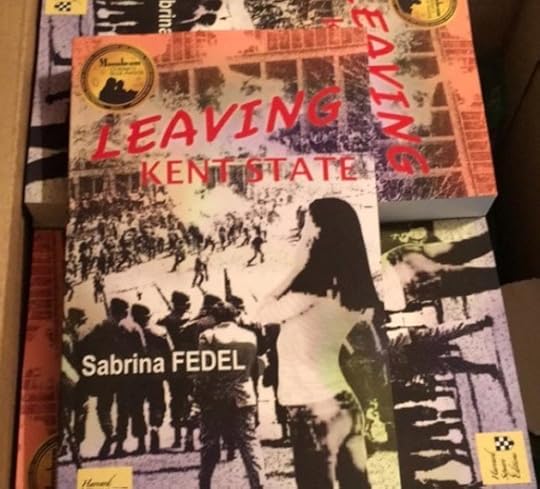 I was waiting a long time to get my first “yes” on a novel. Now, a little more that a year past it’s release into the world, here are the top five things I’ve learned in my first year as a novelist:
5. Being with a small press is awesome. It is also terrible. It’s awesome because you now are, FINALLY, validated that you don’t totally bite as an author. Someone believed in your book enough to actually go through the process of giving it an ISBN and putting it into the world. Being with a small press is terrible because they can’t afford to give you the kind of support that a book needs to be really successful. Expect to be on your own more than you’re not.
4. Prizes are good, but, as with everything, there are qualifiers. It’s okay to dream big if you have an unlimited budget. Submit to every contest you can if money is no object. If, however, you do have to pick and choose your marketing dollars, be realistic. Look for contests without fees or with small fees. Think about the kind of competition you will be up against. Will you actually get noticed? What about your book will put it over the top? Spend your dollars where they can do the most good for you. And be careful of the costs associated with winning. Many prizes offer you fancy images, but if your publisher can’t use them with their printer, then you will just be wasting your money. Most likely, your publisher can pull the image for free from the internet if you want to update your book cover with it.
3. Marketing. Ugh. Don’t market on Facebook if your audience is on instagram. Know where your readers socialize and meet them there. Goodreads giveaways were a great way to get exposure, but starting this month, Goodreads will be charging authors a lot to run giveaways. It probably isn’t worth the new price if you are with a small press. Be careful of wasting money on things you don’t need. Look for local book fairs and library conferences to take part in. Don’t be disappointed if you only sell a book or two. You never know what contacts you may make that may help you get more books into the hands of more readers. Look for local or professional writer groups where you may be able to promote or list your book-especially if they are free, or you are joining a respectable organization like the Society of Children’s Writers and Illustrators.
2. Amazon author central is really cool. You can see the geographic regions where people bought your book (thank you, Laurie, my best friend who lives in Johnson City, TN). It’s very exciting when your book sells in a region where you don’t know anyone. Yes- on rare occasions, people you don’t know will BUY your book, READ your book, and may even leave you a REVIEW on your book. That is awesome (assuming they don’t trash your book). BUT, most people who read your book won’t bother to leave you a review. So beg your friends and keep on begging. Because reviews matter. Mostly the ones from places like Kirkus or School Library Journal, but even the ones from your Uncle Ned. Although, you might want to mention to him that he doesn’t have to disclose that he is your uncle and therefore of course is not going to leave you a trashy review. Because,otherwise, he will probably mention with great pride that he is your Uncle Ned. And then no one will take his review seriously anyway. Also, as a side note on reviewers, beware people who say they want a copy of your book to review. If, like me, you have to pay a high cost per book, know that most of these people won’t come through for you. It’s frustrating, but true. They will promise you a review, you pay for the cost of your book and for the postage, and that is the last you ever hear from them. Take the high road, because there is really no good way to confront them. If you pester them, they may leave you a bad review. It’s a cost of trying to get reviews, so send them out carefully. Ask author friends for recommendations of people who have reviewed their books and done a professional job. And then hope for the best.
1. Bookstores are afraid to take chances on small press books. This was a hard truth for me. I had always thought that indie bookstores were the champions of authors. That’s true, but only to a degree. Big bookstores don’t take risks on small press authors because they don’t need to. Indie bookstores don’t take risks on small press authors because they can’t afford to. If you want an indie to shelve your book, you’d better come up with a serious marketing plan first. Know their demographic. Approach stores where you believe you can pull customers in (cities where you have friends or other contacts who will turn out for you, or some other connection that makes your book an easy sell for them). Indie bookstores do support books that aren’t always from A-list authors, but those books that you see on an indie shelf that you don’t see plastered all over social media or the big box stores are still likely to be midlist authors from substantial houses.
If you are a soon-to-be published author, or if you are just planning ahead, I hope these lessons help you as you plan your debut year. We strive so hard to be published, but the truth is, getting your book into the world is only one part of the equation. If you actually want people to read it, you need to plan for a debut year of serious marketing. It’s great to have a published book, but if you aren’t with a major house, you’re going to have to be pretty creative in finding ways to get your book into the hands of readers. Best wishes!
October 5, 2017
Leaving Kent State Wins Gold
 I’m feeling a little Olympic today, as yesterday it was announced that Leaving Kent State has won a 2017 Moonbeam Children’s Award Gold Medal in the Young Adult Historical Fiction category. Independent Publisher magazine runs the awards, which are “intended to bring increased recognition to exemplary children’s books and their creators, and to celebrate children’s books and life-long reading.” Those are two goals that I can definitely support!
One thing that I have learned on my journey of being published is that getting a publisher to say “yes” is kind of like a marriage proposal. You ask, they say yes, and then the hard work begins. Just like a marriage, putting your book into the world takes a lot of dedication and hard work. It’s difficult to get one little book noticed the a sea of thousands that are being published each year, many to large houses with actual budgets to spend money promoting their lists. When I see authors talk about their new book tour, my jaw drops a little at the idea of what it means to have a budget for that. Independent bookstores live on small margins and are not willing to take the risk on an unknown author, especially for something SO un-trendy as historical fiction. I’ve spent a lot of time just trying to get the word out that my little book even exists. So this recognition is very heartening to me. If you’ve read Leaving Kent State and have a moment, please leave me a review on Goodreads or any of the book selling sites (Barnes & Noble, Indiebound, your favorite bookseller, or Amazon). It’s a great way to spread the word, and it really helps small press authors to have reviews (and if you didn’t like it, that’s okay, too-just please let people know why so that they can decide if the reason(s) would be an issue for them or not).
So, thank you for being on this journey with me. Thank you to everyone who helped me write this book, because it could not have existed without the input and talents and knowledge of many, many wonderful people. Thanks to my publisher, Harvard Square Editions for loving my story and for bringing to light an event and a time that was largely ignored in fiction so far. And thanks to every one of you who gives your valuable time to read it. I hope you like it.
Cheers
August 20, 2017
Young Adult Romance – Is the Crush Over?
 YA Romance–
For several years now, I’ve been hearing a lot of chatter about YA romance, as if the whole idea of romance is undesirable. Romance has become that thing, the guilty pleasure that no one wants to admit they like and some people flat out hate. Romance, and particularly Young Adult romance, has become something that authors feel they should kill, like Romeo when he believes Juliet is dead and drinks the poison. Many reviewers have embraced the haters stance on romantic plot lines with a vengeance, finding little to say that is good about a novel that includes any romantic thread.
At conferences, I’ve heard editors say they were “over” romance, and that it was time to move on. Teen readers, these editors argue, should aspire to do more than read about characters who have nothing better to do than look for fulfillment in someone else. Modern characters should be above romance. They should be embracing their real destinies, the ones that center solely and completely on them, without the sloppy sentiment of a Hallmark movie. The modern girl (even if she exists in a fantasy world from some long ago time period) should be focused on herself, on developing her own talents and being all that she can be. She doesn’t need a brooding YA hero, and she doesn’t need to be distracted from her destiny by the weakness of romantic love.
And I get where the haters of romance are coming from. Romance in the real world may not be dead, but it’s kind of like some lizard that got caught in the Arizona sun too long and is slowly shriveling up. In an age of hook-up culture and reality tv shows where people vie to win the heart of someone they’ve never met and, mathematically speaking, couldn’t possibly be within cosmic destiny of, it’s easy to lose sight of the joy of romance.
There is also a legitimate claim to be made that none of us needs some “other” to complete us. We are, each of us, capable of being enough all on our own and we should never lose sight of that, even when we do fall in love. Love should not be something that stunts our growth or our exploration of who we are as an individual.
Romance in the Modern Age
Despite these drawbacks, or even death knells, for romance, it keeps coming back though. It turns out that love is more like the the terminator than like the Juliet who sacrifices herself on the dagger of her deceased husband. When I first heard editors bemoaning the “overdone to death” lament of romance in YA books, I felt really discouraged. I love romance. I get that it may not be real, at least not in any long-lasting temporal sense, but all of the best things in life somehow involve love. There are all kinds of love, and each of them has their own romantic language: the way a mother looks at her child; the way you smile when you think of your best friend when you need her most; the need you have, even as an adult, to look up to your parents. All of these forms of love have a romance of sorts in them, even if they are without sexual tension. Love is the most complicated and intricate of our emotions, and it is ever changing. The love you have for the infant in your arms is not the love you carry for your child away at college. It changes, morphs, grows. It is the one constant that we need to grab onto if we are to actually, truly participate in this thing called life.
So the idea that we shouldn’t have romantic plot lines in our stories depressed me. I was talking about this to a friend of mine from Lesley who had recently taken on a job as a reader for a successful literary agent who represents a lot of YA authors. My friend laughed. “Don’t believe it,” she said. “Romance isn’t dead no matter what they say. The majority of the projects we take on have a romantic story line to them.”
This made me question why? Why if everyone is hating on romance are agents and editors still acquiring it? It seems to me that there can only be two possible answers to this question: either there is still a market for it or the agents and editors haven’t yet figured out that the market for it is dead.
The Fault in Our Stars
The answer, if we look at what titles are making the blockbuster lists and being turned into movies, is that romance isn’t dead at all. From John Green’s The Fault in our Stars to Veronica Roth’s Divergent series to Nicola Yoon’s Everything, Everything, romance is popular. Romance sells. YA romance is hot.
So why is romance so hot when there are so many haters of it, so many who dismiss books with romance plot lines? Why, despite the fact that many of us are shamed into pretending we don’t actually like romance is it still selling?
I think it’s because romance is the best and brightest fairy tale. The idea that we are not alone, that there is someone else out there who could know us intimately and still think we are not only worthwhile but a beautiful soul, is an ideal that is embedded in the human heart. Like mythology, romantic love represents a type of transcendence from the ordinary of our lives. It grants us a kind of eternal youth, a wanderlust, a hope for the future. It represents us in our most validated form-as someone worthy of the respect and love of someone we respect and love.
The Eternal Jane Austen
I was sixteen the first time I fell in love with Mr. Fitzwilliam Darcy. I was ready to take him the first time he asked, but then I knew that Elizabeth was being harder on him than he deserved. Still, Lizzie was right in holding out, because it was the holding out that fixed the one flaw Mr. Darcy had-his abominable pride. Of course, Lizzie had her own pride to get over and I could spend an entire post talking about the feminism of Jane Austen-both its subversive genius and its imaginative drawbacks. The important thing here is that I am not alone. Jane Austen remains the quintessential romance writer two hundred years after her death because she taps into the very core of what matters in romance-the ideal of the match of two souls that are uniquely compatible in temperament, intelligence, and ethics. Surely, if there is a recipe for a happy marriage, Jane Austen is the Julia Child of premarital counseling, despite never having been married herself.
So we beat on, boats against the current as Fitzgerald tells us in the failed romance of Jay Gatsby because romance isn’t dead. Even in the tragedy, romance is alive and well (did I mention The Fault in Our Stars?) It is alive and well and sitting at our fingertips any time we wish to read it. And I believe that teens, more than any of us, can relate to these stories because romance for them hasn’t become cliché. Romance for them is still a shiny new experience that is filled with possibilities. For their sake as well as my own, I can only hope that YA literature never runs out of brooding heroes and lovelorn teens.