A.S. Green's Blog
April 28, 2020
The Science Behind the Meet-Cute

Originally published by me at Writer Unboxed
At the WU Unconference last fall, I gave a presentation on the “meet-cute.” If you’re unfamiliar with the term, it’s that moment when your characters meet for the first time. Sometimes they click immediately (Titanic; 50 First Dates), other times they don’t (Pride & Prejudice; When Harry Met Sally).
Regardless, some kind of chemistry is established between them that makes the reader want to root for the characters as a couple. It’s a typical element of every romance novel, but it can manifest in other ways in other genres. The typical meet-cute goes a little something like this:
Sarah walked onto campus as a new freshman. While she wrestled one-handed with the campus map, her Human Anatomy textbook slipped from her hands and fell open on the sidewalk to a page her mother would have censored. Embarrassed, Sarah quickly crouched to retrieve the book before anyone saw, just as someone knelt to help her. She looked up and locked eyes with the most handsome man she’d ever seen. Sarah’s heart raced.
When I say this example reflects the typical meet-cute, I mean really, really typical. Too many meet-cutes I read are all about racing hearts, or some other obvious go-to like stammering, sweaty palms, or stumbling over words and/or feet. These common crutches got me thinking. How can we better delve into our own personal experiences to come up with more unique and inspired ways to demonstrate the interior landscape of a scene? How can we show our characters’ feelings through more unique physical reactions to those feelings?
According to a team of scientists at Rutgers University, romantic love can be broken down into three categories: lust, attraction, and attachment. Each of these categories is characterized by its own set of chemicals (or hormones) that manifest in physical ways.
With lust, the hypothalamus stimulates the production of the sex hormones, which shut off the prefrontal cortex, the origin of rational behavior. Sexual arousal also appears to turn off parts of the brain that regulate critical thinking, self-awareness, and rational behavior. The younger and more outrageously hormonal you are, the more irrational you may act. (Romeo & Juliet, anyone?).
With attraction, the hypothalamus stimulates the production of dopamine. Dopamine is released when we do things that feel good to us, and it controls “reward” behavior, which partly explains why the beginning of a new relationship can be so exciting. When dopamine gets released at high levels, it triggers physical reactions such as giddiness, increased energy, euphoria, stress, and even an increased fight or flight response. (e.g., Hugh Grant in Four Weddings and a Funeral, or Love Actually or Notting Hill).
Finally, attachment is the predominant factor in long-term relationships. The hypothalamus stimulates the production of oxytocin—a bonding hormone—which has also been nicknamed the “cuddle hormone.” Oxytocin reinforces the positive feelings we already have for the people we love most in our lives.
Okay, you say. Thanks for the science lesson. Now what?
Well, one way to write more creative meet-cutes is to step away from the actual meet-cute scene itself and instead look at other types of scenes that trigger the same chemical reactions as lust, attraction, and/or attachment. What I’m suggesting is that we write about those other things, then use those writing exercises to enrich the meet-cute scenes when we’re ready to return to them.
For example, while lust triggers the production of testosterone, so does the need to protect one’s territory (e.g., playing in a football game, witnessing someone bully your child; or confronting a colleague who stole your idea during a business meeting). A surge of estrogen can make one experience quick and totally inexplicable changes in emotion. Imagine another setting where you might have that same experience, for example laughing at a funeral. What happened? How did others around you react? How did that make you feel?
While attraction triggers a release of dopamine, so does lying in the sun on vacation, going on a long run, experiencing a drug high, listening to your favorite music, or eating chocolate.
Oxytocin can be triggered by attachment, but also by giving someone 100% of your listening attention, watching someone open a gift you’ve put a lot of thought into, riding a roller coaster, or petting your dog/cat.
So here’s the writing experiment you’ve been waiting for: Write a scene about one of the alternative prompts above (e.g., sunbathing on vacation), then incorporate the details of that scene to enrich your meet-cute scene. For example:
Write a Short Scene About Lying on the Beach (Dopamine/Attraction):
Waves pulsed against the shoreline, the rushing sound filling my ears. The sun beat down on me, warming my skin and washing away all the stress of the day. All thoughts of work, and deadlines disappeared. Beside me, the melting ice in my margarita glass shifted with a clink. My head felt swimmy and light from too much tequila. Or maybe it was exactly enough.
Then Return to that Original Meet-Cute Scene, but Use the Beach Details to Enhance it:
Sarah walked onto campus as a new freshman. While she wrestled one-handed with the campus map, her Human Anatomy textbook slipped from her hands and fell open on the sidewalk to a page her mother would have censored. Embarrassed, Sarah quickly crouched to retrieve the book before anyone saw, just as someone knelt to help her. She looked up and locked eyes with the most handsome man she’d ever seen. A rushing sound filled her ears, and her skin warmed. All anxiety about making it to class on time washed away. There was a shift inside her, like ice cubes melting in a glass, and her head felt swimmy and light from too much male beauty. Or maybe, just maybe, it was exactly enough.
So, what do you think? You might even find that writing unrelated scenes triggers new and exciting metaphors, or unique ideas about where the meet-cute can take place (e.g., on a football field, or at a funeral). If you give it a shot, I’d love to see some short examples in the comments.
Happy writing!


February 18, 2019
HOW DO YOU SAY THAT NAME?
While some Irish names (like Meghan) have
become commonplace in America, other Irish names are harder to decipher, simply
because Irish spelling and pronunciation are not always obviously connected to
the English-speaking eye, especially in America.

In my new paranormal series, I provide a glossary for unfamiliar Irish words with their pronunciations; however, I did not do the same for the characters’ names themselves.
This interview from actress Saoirse
Ronan about
all the funny pronunciations she hears for her name reminds me that a
pronunciation key for the characters’ proper names might also be helpful to
some readers. (Check out the link, it’s pretty cute.)
In Order of Appearance or Mention:
Cormac (KOR-mac)
Meghan
(MEG-en)
Branna
(BRAH-nuh)
Conan (KO-nen)
Siobhan (shuh-VONN)
Aiden (AY-den)
Declan (DECK-len)
Rowan (ROE-en)
Ciera (KEER-uh)
Sean (SHAWN)
Niall (NIE-ul)
Naoise
(NEE-sha)
Peadar
(PAD-er)
Muirgen
(MWIR-gen)
Aoife (EE-fa)
March 26, 2018
Visual Thinking
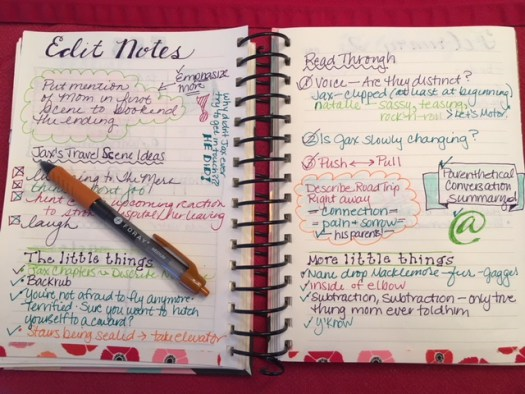
A month or so ago, I was deep into first-pass editing. This is the stage after you receive an editorial letter that poses questions about character development, suggests adding scenes (or removing them), and encourages other “big picture” thinking. I posted a photo of what my editing process looked like for that morning, and Therese Walsh messaged me: “Please write a post about this.”
I thought that was Therese just being sweet and supportive (as is her way) because what could I possibly say about something so obvious?
But then, over the course of the day, similar comments trickled in. I was surprised, and it got me thinking that maybe…was it possible?…not everyone organized their thoughts in pictures? So I did a little digging.
Turns out, I am a visual thinker (aka picture thinker), as are 60-65% of the rest of you. When you write, do you first picture the scene in your mind, and then describe what you see? Or, do you begin to write and the scene slowly materializes as your words hit the page? If you are the former, [insert Jeff Foxworthy’s voice] you might be a visual thinker.
If you are athletic, musical or mathematically inclined, you may be more inclined to visual thinking.
Back in the 1970s,“visual” and “verbal” thinking were set up as opposites, but the brain is never that simple. Most of us think and learn in a combination of ways.
For example, Temple Grandin reports that words touch off cascades of images as her visual and language systems interact. (Otis, Psychology Today)
Poet Natasha Trethewey has such a strong visual memory that, when she studied for tests in high school, she would visually memorize her notes and then read the answers off her mental scans. (Id.)
Jessica Spotswood, an author friend of mine, gets down to editing by retyping her entire book, character-by-character, starting with page one. She says, seeing the words all together on the page visually disengages her from the specific words originally selected, and allows her to fine-tune her message.
So, this brings me back to my own writing and editing processes. Why do I do it the way that I do, and might it also help you?
When in initial drafting mode, I often google headshots of people who look like the characters in my head. I print them out and have them on my desktop, ready to pull up when I want to “hear” their voices. Same thing with natural landscapes, even road maps. I’ve gone so far as to make dioramas and poster boards. That is until Pinterest came around and made the process digital.
Mind maps are great for brainstorming all the elements you want to include in the scene and depicting how contrasting ideas will play off each other.
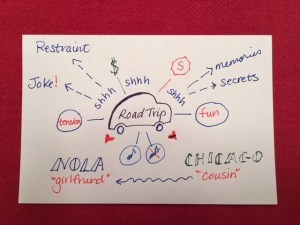
Once the story is underway, I need the pictures less, but the need resurfaces when it comes to editing. I cannot jump into the manuscript and immediately start putting new words to paper. It feels a bit like being dropped into a thick forest of words without a compass.
To accomplish my editing goals, I have to step back and focus on the concepts, feelings, moods, and ideas, rather than the words that will ultimately express those same things to the reader.
I might use color to conceptualize emotion, or even just to separate my thoughts and keep my mind clear. Symbols help me focus on themes.
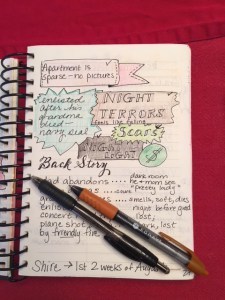
I often use check boxes, or dialogue bubbles. Sketching my ideas helps me “see” them and think about them—sometimes staring at a wall for half an hour is my most productive writing time. The goal is to ultimately understand my ideas well enough that I can describe them to someone who hasn’t seen the picture before.
In short, picture-thinker or not, we all have our own ways of working through the editing process.
For more information on visual learning, check out these articles: Reuell, Peter, Visual Images Often Intrude on Verbal Thinking, The Harvard Gazette (May 11, 2017); Otis, Laura, A New Look at Visual Thinking, Laura Otis, Psychology Today (Feb. 16, 2016) https://www.psychologytoday.com/blog/rethinking-thought/201602/new-look-visual-thinking; Grandin, Temple, Thinking in Pictures and Other Reports from My Life with Autism. (Bloomsbury 2006.)
What tips, tricks, or methods do you use to work through the brainstorming or editing process?
February 19, 2018
Mea Culpa, Mea Culpa
For those not involved in the publishing world, this past week hit hard when a number of high profile male authors of young adult fiction (I guarantee you, you’ve heard their names) were accused in more than one article, including the New York Times, as using their power to abuse, intimidate, and to pressure young aspiring female writers (and others) into granting them sexual favors.
These were multiple, unassociated female accusers naming the same handful of men over and over. The situation was made worse by denial and victim-blaming.
One man, however, responded in the right way. The BEST way. When you make a mistake you have to own it
I hope we see more mea culpas–in all fields–because there is a way out of this for all of is. A little self-awareness goes a long, long way.
Irish Soda Bread and Cinnamon/Honey Butter

In my young adult novel, Cold Hard Truth, the father is originally from Ireland (a country near and dear to my heart). With St. Patrick’s Day just around the corner, enjoy this recipe for Irish Soda Bread and cinnamon/honey butter.
3-1/4 C flour
1/3 C, plus 1 T sugar, divided
1 tsp. baking powder
1 tsp. baking soda
1 tsp. salt
1/2 C (1 stick) cold butter
1-1/3 C buttermilk
1/2 C currants or raisins
Preheat oven to 350 F. Mix flour, 1/3 C of sugar, baking powder, baking soda, and salt in large bowl. Cut in cold butter with a pastry blender or 2 knives until mixture resembles coarse crumbs. Add buttermilk and currants; mix just until moist.
December 22, 2017
Query Critique, Anyone? A Christmas Gift for Writers Looking to Get Published.

Quite some time ago, I wrote the first novel that I wanted to query to literary agents. (Note: not the first novel I wrote, just the first one I thought was worth sharing with the world.) I researched “how to get an agent,” and then “what’s the difference between a query and a synopsis?” I looked at sample query letters on agent websites about how not to do it, and then I took my first stab at my own.
If you don’t know, a query letter is what you send to agents in the hopes that one will agree to represent you to editors at publishing houses. Most houses won’t even look at un-agented writers, so sending query letters is the typical process for writers who yearn to be “traditionally” published. (It is unnecessary if you’re going to self-publish.)
The letter itself is a bit formulaic, and it has to capture the soul of your story in 1-2 paragraphs, similar to what you might read on the back cover of a novel and entice the reader to want to read your manuscript. This is not to say that they will automatically agree to represent you (far from it), but a good query letter is the first step that gets you on the path toward traditional publication.
My first steps were…shall we say…much like someone staggering home at two in the morning with their shirt sticking to their midsections from too many body shots.
After much rejection to my letter (so no takers on anyone even taking a peek at my actual manuscript), I reached out to a published writer I had had some inconsequential Twitter conversations with in the past. I asked if she would be willing to look at my query letter.
To this day I have no idea why she agreed. I am eternally grateful because she tore that sucker apart and told me how to put it back together again.
Learning how to write a query letter got me to the point where agents would read my manuscript. There were still a lot of rejections, but all it took was one “yes” from an agent, and then another from an editor.
So now I’m at a point where I can pay it forward. I’ve written numerous queries, pitches, and back cover copy at this point, and my sixth, seventh, eighth, and ninth novels will all be published this summer (from different publishers).
As my Christmas gift to my readers who are also struggling writers, I am offering five (5) query critiques. Interested? Email me at asgreenbooks@gmail.com for adult contemporary or at annegreenwoodbrown@gmail.com for young adult contemporary and paranormal.
P.S. – I’ll update this blog post if/once I get five takers. Until then, feel free to get in touch!
October 24, 2017
Sometimes a Good Book Doesn’t Find a Home

Hello. This is a short blog post on perseverance. It’s short because the book behind the post is not yet a “done deal,” but I still want to take the time to make a point.
Sometimes a good book doesn’t find a home. Maybe it’s because the publisher deems there’s no audience for it. Maybe it’s because there are too many similar books coming out at the same time. Maybe it’s because its time has not yet come. I wrote a good book seven years ago. It’s the book that got me my agent, but it didn’t sell to a publisher because it was deemed too “quiet.” It was a book about characters, more than plot. At the time, that wasn’t a winning proposition in the particular genre I was writing. I shelved the book and wrote something else. I wrote a lot of something elses.
Then I took the book out again a few years later, dusted it off, and brought it to my critique partners. We punched up the plot. It got more interest, but now there were too many similar books. I shelved it for a couple more years and we sent it out again. Now it’s getting traction because one small nugget of the story (something I hadn’t really thought about) is now hitting on some current, newsy topics. Suddenly I might be…(hold onto your hat)…topical?
I still don’t know what the fate of this book will be, but I tell this story to encourage you to not give up on a good book. If you know it’s quality, it will likely find a home. Eventually. Some day. If you’re patient and persevere.
September 12, 2017
Join my Street Team!
 WILD CHILD (coming June 2018)
Jackson Sparke, former Navy SEAL now private investigator, has lost everything. Could the one woman who promises to give him the world be more terrifying than anything he’s faced so far?
Hello all,
I’m reaching out to see who might be interested in joining my street team as I prepare for the launch of WILD CHILD, the sequel to SUMMER GIRL.
Don’t know what a “street team” is? It’s a group of people who hit the streets (literal or virtual) to help promote a new book in exchange for the early peeks and the chance to win *fabulous* prizes like gift cards, books, and swag. (I’ve got some awesome swag, by the way.)
I’m looking for people who love to read, love romance, are active on social media, and might even love having a supporting character named after them.
Here’s the working back-cover blurb for WILD CHILD, though it may ultimately change closer to next summer’s publication date:
I have never been to a place so tiny. So backward. So…insignificant. Compared to New York, Chicago seemed pint-sized. This Little Bear Island could fit in Chicago’s armpit. Still, a job is a job. After surviving Afghanistan, what’s twenty-four hours in po-dunk hell?
Tonight, my company Sparke Investigations is providing private security for a celebrity bride and groom who wanted their nuptials to be off the grid. Mission accomplished. This is where I come face-to-face with Natalie O’Brien. “The hostess with the mostess,” they tell me. Truer words were never spoken, at least in the looks department. She might be ten years younger, but this redheaded bombshell could seriously knock me off my game, that is, if it wasn’t for that sharp tongue of hers.
I’d keep dodging those verbal bullets, except the woman I hired to assist me on my next assignment bails. Natalie is the only woman in a 100-mile radius who not only looks the part but has the steady nerves and rebel attitude I need to get the job done. Couple that with her desperation to get off this tiny island, and the deal is done.
Now we’re stuck in my Escalade, criss-crossing the country with her sweet scent filling the cab, and her smart mouth making it hard to stop fantasizing about what could happen when the job is done. Good thing it will all be over soon. I can get back to New York, and she can get back to that tiny island of hers. So why does the thought of saying goodbye make my blood run cold? Couldn’t have anything to do with the pregnancy test I found in the bathroom.
Interested in joining my street team? Sign up here!
August 23, 2017
Wondering Why I was Inspired to Write Summer Girl?

When I talk to book clubs, the most often-asked question is: Where do you get your ideas?
The seed idea for SUMMER GIRL came from the lighthouse on Sand Island, which is part of the Apostle Islands in Lake Superior. In the 1920s, my great-great aunt Florence was one of the so-called “summer girls” who would come up to the island for the summer to tend the lighthouse.
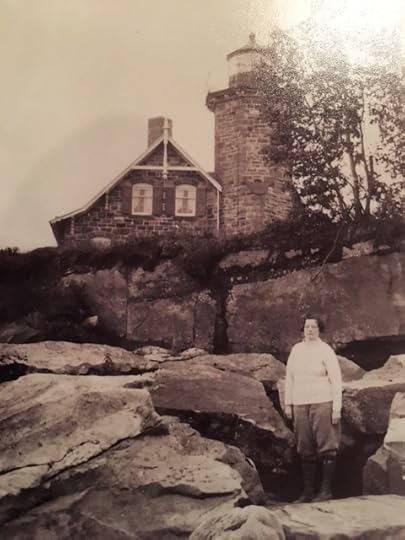
It seemed like such a romantic idea and location that it quickly turned into the love story between Katherine D’Arcy, the naive and misguided summer girl, who falls for Bennet, the secretive but ruggedly handsome ferry boat driver.
What is the most romantic location you’d like to read about?
July 31, 2017
My Favorite Summer Dessert Recipe

“Iced Coffee Pie”
Crust:
1/2 C. chocolate wafer crumbs
6 T. butter
(Or just buy a pre-made chocolate cookie crumb crust)
Pie:
1 C. whipping cream
2/3 C. sweetened condensed milk
1/4 C. STRONG cold coffee
1/2 tsp. vanilla
2 Heath Bars, crushed (about 1/2 C.)
If you’re making your own crust, melt butter and add chocolate crumbs. Press mix firmly into a 9-inch pie tin (sides and bottom). Chill.
To make pie filling, combine whipping cream, sweetened condensed milk, coffee, and vanilla on slow speed until thickened (it won’t get totally stiff). Set aside 2 T. Heath Bar crumbles, then mix the remainder into the pie filling. Pour mixture into chilled crust. Sprinkle top of pie with the reserved Heath Bar crumbles. Freeze several hours, or overnight. Soften slightly at room temperature before serving.