Catherine Kullmann's Blog
October 28, 2019
The Regency Decade: 1815 Part One: Waterloo
 19th Century View of Brussels I must apologise for the delay in continuing with this series. To quote Rabbie Burns, and as today’s post shows, “The best laid schemes o' mice an' men/Gang aft a-gley.”
 At the end of 1814, we left the exiled Napoleon on Elba. Across the Atlantic, on January 8th 1815, American forces defeated the British in the Battle of New Orleans, the last major battle of the War of 1812. On January 21st, the mortal remains of the guillotined Marie Antoinette and Louis XVI were transferred in a sombre procession to the royal crypt in Saint-Denis. The restoration was complete. The map of Europe could be re-drawn again and the victorious allies agreed to meet in Vienna to discuss the new borders.
Meanwhile, thousands of Britons had decamped for the Continent. Their reasons were mixed; some simply wished to travel again while others hoped to leave their massive debts behind and live abroad on an ‘economical plan’. They soon established their own enclaves in Brussels and Paris where they continued to live the same life as they had at home, mixing with the same people and founding such bulwarks of English society as clubs and libraries where they could be sure to remain among themselves.
At the beginning of March, with trade with the European continent open again, Britain’s ruling classes looked to protect the interests of the landowners by introducing the Importation Bill. This was the first of the so-called Corn Laws, designed to prevent the importation of cheap foreign grain, thus keeping their incomes at the war-time levels. They readily ignored the fact that as a result the price of bread would be at an artificially high level, a fact that did not escape the poorer classes. In the ensuing riots, the windows of White’s club were broken and parliament had to be surrounded by a protective cordon of soldiers.
All rioting ceased when the news reached England that Napoleon had escaped from Elba and was marching towards Paris. He had indeed returned with the violets. The Importation Bill became law without further ado and Europe awaited the next developments with bated breath.
A contemporary source summarised Napoleon’s progress as follows:
A Conversation between Two Gendarmes, modelled on THE TIMES:
First Gendarme: What is the news?
Second Gendarme: Ma foi! the news is short.
The tiger has broken out of his den.
The Monster was three days at sea
The Wretch has landed at Frejus
The Brigand has arrived at Grenoble
The Invader has entered Lyons
Napoleon slept last night at Fontainbleu
The Emperor enters the Thuilleries this day.
On March 19th, Louis XVIII and his family hurried away from the Tuilleries, only some hours before the Emperor’s triumphant return. The English who had flocked to Paris now as hastily left it, many heading for Brussels.
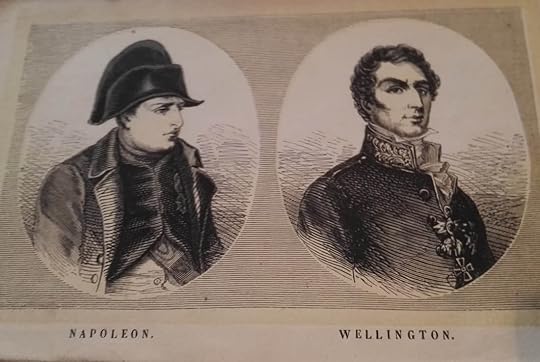 The allies, happily ensconced in Vienna, were caught wrong-footed. Armies recently dismissed were hastily recalled and on April 5th, the Duke of Wellington arrived in Brussels to take command, initially of the British forces but soon, as Commander-in-Chief, also of the army of the United Netherlands.
Enriched and enlivened by the influx of officers, the Brussels social whirl continued alongside the preparations for war. Would Napoleon sally across the French border to attack the allied forces or would he remain in France, daring them to invade?
The Duchess of Richmond appealed to Wellington himself for advice as to whether her ball, planned for June 15th, might go ahead. “Duchess, you may give your ball with the greatest safety, without fear of interruptions” was his reply.
Byron captures best what happened next:
There was a sound of revelry by night,
And Belgium's capital had gathered then
Her beauty and her chivalry, and bright
The lamps shone o'er fair women and brave men;
A thousand hearts beat happily; and when
Music arose with its voluptuous swell,
Soft eyes looked love to eyes which spake again,
And all went merry as a marriage-bell;
But hush! hark! a deep sound strikes like a rising knell!
Did ye not hear it?--No; 'twas but the wind,
Or the car rattling o'er the stony street;
On with the dance! let joy be unconfined;
No sleep till morn, when Youth and Pleasure meet
To chase the glowing Hours with flying feet.
But hark! that heavy sound breaks in once more,
As if the clouds its echo would repeat;
And nearer, clearer, deadlier than before!
Arm! arm! it is--it is--the cannon's opening roar
Napoleon had ‘humbugged’ him, as Wellington admitted to the Duke of Richmond, sending Ney to attack the British and Dutch-Belgian forces at Quatre Bras while he himself forced the Prussians to retreat at Ligny. But even as the wounded from these encounters were brought to Brussels, the Allied and French armies marched towards Waterloo, a small village south of Brussels on the far side from Brussels of the Forest of Soigné.
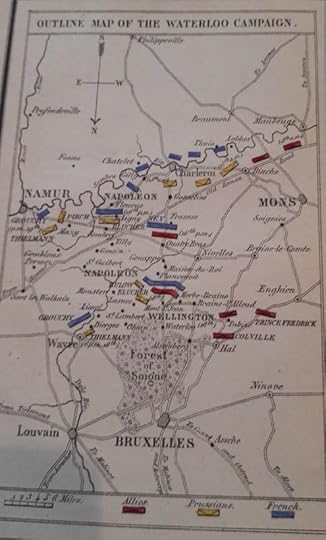 Overnight, regiments assembled on the Place Royale before marching out of Brussels, past the long procession of farm carts coming to market as usual. As one observer put it, After the army was gone, Brussels indeed seemed a perfect desert. Every countenance was marked with anxiety or melancholy—every heart was filled with anxious expectations….At about three o’clock [on the 16th], a furious cannonading was heard.
From then until the evening of the 18th, the residents of Brussels were torn between hope of victory and fear of defeat. Some fled immediately towards Antwerp while others remained but prepared for instant flight. One after the other, the dreadful reports arrived: The Prussians had retreated, the Highland regiments that had been piped out of Brussels only that morning had been slaughtered, Wellington had been defeated; the French were at the gates…Every hour only served to add to the dismay.
On the night of the 17th, a violent thunderstorm came on, followed by torrents of rain which during the night, when the army were laying unsheltered upon the field of Waterloo, never ceased a single moment. On Sunday [the 18th] the terror and confusion [in Brussels] reached its highest point.
Meanwhile, on the plain of Waterloo, Wellington and Napoleon set out their armies as calmly as a grand master might dispose of his chessmen were he allowed a free hand in their positioning. It was mid-morning before battle commenced, perhaps because the ground was too wet to allow the artillery to move its guns. But soon about two hundred thousand men were engaged in deadly combat. The battle waged all day until, near sunset, the invincible Imperial Guard was forced to retreat causing the surviving French to flee. The battle was over, the allies under Wellington had won the day, Napoleon was finally defeated, but at what cost?
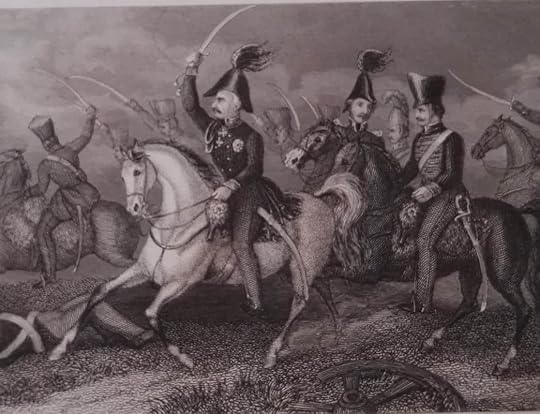 Blücher The story of the battle is too well known for me to go into it in depth here. I have done this in The Murmur of Masks. For now, let us leave the last word to Byron.
The earth is cover’d thick with other clay,
Which her own clay shall cover, heap’d and pent,
Rider and horse,—friend, foe,—in one red burial blent!


July 20, 2019
The Regency Decade: 1814 Part 2: Peace at Last
 The Napoleonic wars were over. On 5 April despatches arrived in London via Antwerp announcing the fall of Paris. The news spread rapidly, carried across the country by the stage and mail coachmen. Church bells rang and the populace poured onto the streets to celebrate. Soon premises all over Britain were illuminated, their windows displaying transparencies depicting the fall of the Corsican tyrant and celebrating peace and victory.
On 9 April, the Times reported that Napoleon had abdicated. In subsequent negotiations, he was exiled to the island of Elba over which he was given sovereignty while his wife Marie Louise was made Duchess of Parma, Placentia and Guastalla. Napoleon was to receive an income of 2 million francs a year, and members of the Bonaparte family were promised pensions to be paid by the French government. He would return ‘with the violets’ i.e. in the Spring, he promised, and the modest flower became a symbol for the deposed Emperor. In this little engraving of a bunch of violets, the silhouettes (here outlined in blue) of Napoleon, Marie Louise and their young son were hidden.
On 20 April, the brother of the guillotined Louis XVI, fifty-nine-year-old Louis XVIII who had lived in exile since 1791, and in England since 1808, set out to reclaim his throne. He was met at the Abercorn Arms in Stanmore, some ten miles from London, by a large delegation led by the Prince Regent and escorted in state in a procession led by one hundred Gentlemen on horseback and including six royal carriages, in the second of which sat the King and the Prince Regent. Onlookers along the route cheered the royal party, displaying laurels and white ribbons as they passed. Finally the procession reached Grillon’s Hotel where the king was to lodge. On 23 April, hostilities were suspended between Great Britain and France and on the 24th the King set sail for France.
The Regent's domestic troubles continued, the populace siding with his estranged wife, the Princess of Wales. On 2 June the problem of the formal come-out of his daughter and heir, eighteen-year-old Princess Charlotte, was resolved by having the Tsar’s sister, the Grand Duchess of Oldenburgh, present her to the Queen. On his way to her majesty's Drawing-room the Prince was beset by ‘the most dismal yells, groans and hisses’ so that the horses were put to their full speed to carry him through this ‘ungracious scene’.
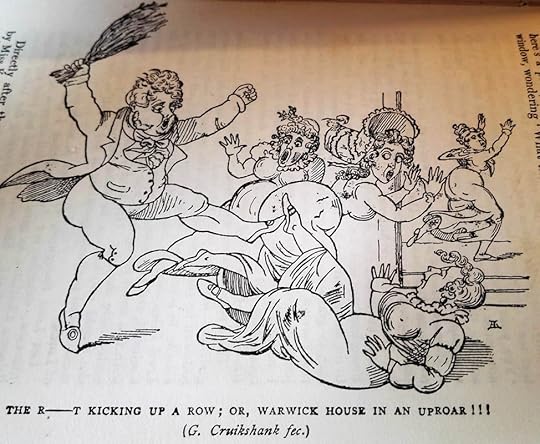
It was hoped that the princess would make a match of it with the Hereditary Prince of Orange but she refused, to her father’s wrath and the entertainment of the cartoonists of the day. Here he threatens his daughter's ladies while, on the right, the princess makes her escape to seek refuge with her mother. Advice and counsel was sought on all sides and public uproar only averted when she agreed, at five a.m. the following morning, to return to her home at Warwick House, but not before she signed a minute witnessed by the Duke of Sussex and the future Lord Brougham that she was resolved not to marry the Prince of Orange.
 Some days later, the victorious Allied Sovereigns—the Emperor of Russia and the King of Prussia—accompanied by Major-General Blücher and other military luminaries, made a state visit to England. There followed almost three weeks of festivities. In between levées, royal visits and dinners, and nightly balls, they went to Ascot races. rode in the Park, went by water to view the dockyard and arsenal at Woolwich, had degrees conferred upon them in Oxford, saw the charity children at St. Pauls, visited Chelsea Hospital, attended a boxing exhibition by the most celebrated pugilists of the day, were escorted by one hundred Yeomen of the Guard to a banquet given by the City of London at the Guildhall, attended a Grand (Military) Review in Hyde Park and finally left for Portsmouth where there was a Naval Review in their honour. Here they were joined by the Duke of Wellington who had just arrived back in England after five years spent in pursuit of Napoleon.
The sovereigns left England on 27 June. The next day, in an unprecedented ceremony, the Duke of Wellington appeared in the House of Lords for the first time since being elevated to the peerage in August 1809, where the clerks read his patents as baron and viscount, earl, marquis, and lastly as duke. Peace had formally been proclaimed on 20 June and on 7 July the Prince Regent proceeded to St Paul’s Cathedral for a thanksgiving service. He was much hissed both going and coming. Despite this, he arranged for a Grand Jubilee to be held on 1 August to mark both the peace and the centenary of the accession of King George I, founder of the Hanoverian dynasty in England. The elaborate festivities included two balloon ascents, a ‘Naumachia’ or mini naval combat on the Serpentine between an English and a French Fleet, and grand fireworks from a castle or fortress especially erected in Green Park for the purpose. After the fireworks there followed ‘the Grand Metamorphosis of the Fortress into the Temple of Concord’.
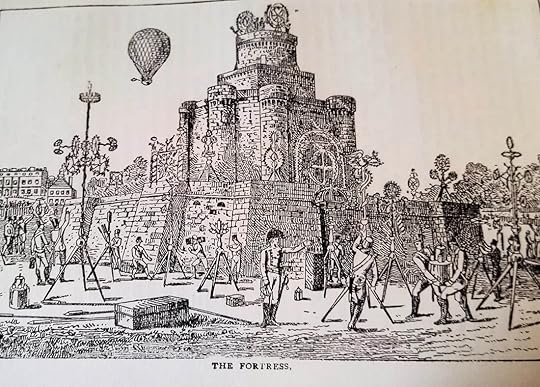
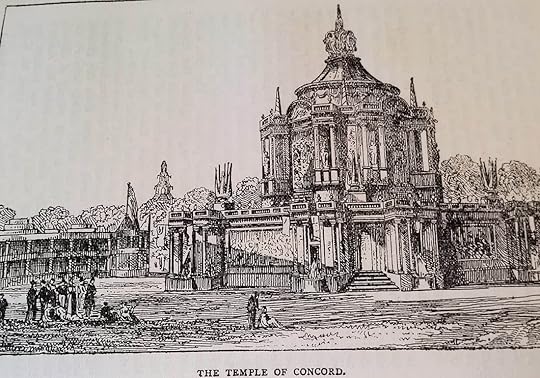 On 9 August, the Princess of Wales who had not been invited to any of these celebrations, left England for the Continent, ‘weary of the petty persecutions and slights she had to undergo’.
7 July also saw the anonymous publication of a new novel, Waverley or ‘Tis Sixty Years Since. Set during the Jacobite uprising of 1745, it proved an instant success, the first edition of one thousand copies being followed in the same year by two further editions, together comprising four thousand copies. Waverley is frequently regarded as being the first historical novel in the western tradition. It was soon rumoured to be by the Scottish poet Walter Scott, but he insisted on preserving the anonymity, publishing succeeding novels as ‘by the Author of Waverley”. Eventually, although not a series or sequels, these became known as the Waverley novels.
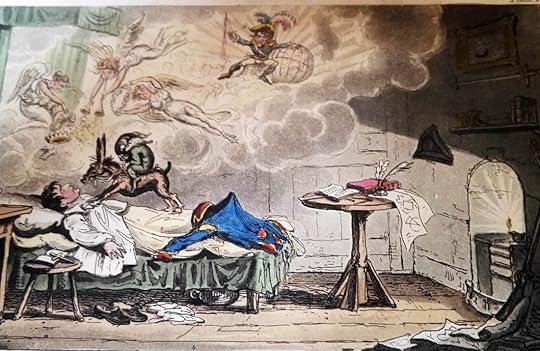
Another publication later that year was The Life of Napoleon, a Hudibrastic Poem by Doctor Syntax that demonised the fallen emperor in mock celebratory verses. In this illustration, a parody of Fuseli’s Nightmare, the young Napoleon dreams of future glory.
 Across the Atlantic, meanwhile, the war continued with the British army reinforced by a contingent lately arrived from France. On 24 August they attacked the Americans at Bladensburg, later entering Washington, as Harry Smith recorded in his memoirs ‘for the barbarous purpose of destroying the city’. He continued, ‘Admiral Cockburn would have burnt the whole but [General] Ross would only consent to the burning of the public buildings. I have no objection to burn arsenals, dockyards, frigates, buildings, stores, barracks etc., but well do I remember that, fresh from the Duke’s humane warfare in the South of France, we were horrified at the order to burn the elegant Houses of Parliament and the President’s House.’
Harry, to his great delight, was sent home with despatches, making the crossing from the Chesapeake to Spithead in only twenty-one days. It was seven years since he had set foot in England, but uppermost in his mind was the reunion with his wife, Juana, from whom he had parted the previous May.
On 24 December the Treaty of Ghent was signed, formally ending the war between the United Kingdom and the United States. However it took some time for the news to reach the combatting armies. On 8 January 1815, the British attacked New Orleans and were defeated, but some hostilities continued until mid-February when both sides had ratified the Treaty.
To read previous posts in the Regency Decade series, either scroll down or click on The Regency Decade in the righthand margin.
May 23, 2019
The Regency Decade—1814, Part One: Frost, Fraud and the Fall of Paris
1814 was so eventful a year that one post cannot do it justice. This post takes us up to 31 March, the day Paris fell. Napoleon's days as Emperor were now numbered.
At the turn of the year, fog shrouded the British Isles. This later gave way to a bitter week-long cold spell bringing snow and ice. Supplies became scarce as roads remained closed and the price of coal soared. The Cambridge mail coach was snowed up and completely covered for almost eight hours. It took fourteen waggon-horses to drag it out. Amazingly, the passengers survived though ‘almost frozen to death’. There is no mention of the fate of the coachman—it is possible he continued the journey on horseback to deliver the mails and seek assistance.
At the end of January, the Thames froze to such a depth that a Frost Fair could be held on it and all the usual entertainments of a fair—swings, book-stalls, drinking and eating booths, dancing, skittles, knock-em-downs, wheels of fortune, and gaming tables were soon to be found on the frozen river. Printers set up their presses, selling commemorative pieces printed ‘on the Ice’ to the thousands promenading on the central footpath or ‘City Road’.
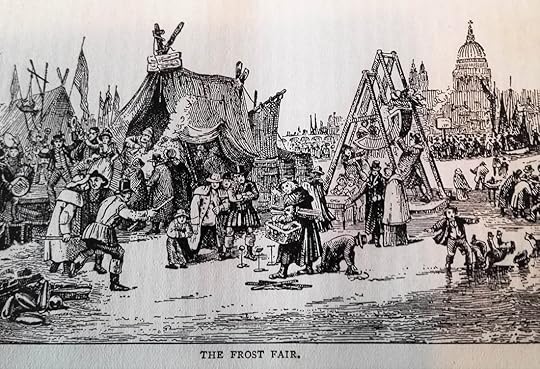 By the fifth of February it was all over. When the thaw set in, blocks of broken up ice swept light craft and barges that had been imprisoned by the frost. inexorably down river, causing considerable damage and some loss of life.
On 21st February, news reached London that the Allies had secured a great victory over Napoleon who had been slain by the Cossacks and that the Allied Sovereigns (the Tsar of Russia and the King of Prussia) were in Paris. The price of Government Omnium stock rose sharply, only to fall again when it became apparent that there had been no victory and that the whole thing was 'Fake News', a deliberate fraud by Charles Random de Berenger who, having posed as the bearer of important despatches from France, posted to London with horses decked with laurels.
Caught up in this Great Stock Exchange Fraud, as it came to be known, was Lord Cochrane, a renowned naval captain, Member of Parliament and eldest son and heir of the Earl of Dundonald, who had profited from the short surge in the price of omnium. Despite his protests that his stockbroker was acting on his standing instructions to sell Omnium if the price rose by one percent, he was convicted of complicity, fined a thousand pounds and sentenced to twelve months imprisonment in the Marshalsea. Before serving this sentence, he was to stand in the pillory for one hour. This last was afterwards remitted but a devastating social pillorying followed. His name was struck off the Navy list, he was expelled from the House of Commons, his arms were taken down from his stall as Knight of the Bath and his banner torn down and kicked ignominiously out of Henry VII’s Chapel in Westminster Abbey.
Many believed Lord Cochrane innocent and in the subsequent by-election he was re-elected to his seat in Parliament which he took the day he was released from prison. He continued to fight for the restoration of his good name and in 1832 received a ‘free pardon’; was restored to the Navy List, gazetted a rear-admiral and attended a levée at court. In 1847, his knighthood was restored and he was created a Knight Grand Cross of the Order of the Bath. He died in 1860. The day before his funeral, his banner was returned to Westminster Abbey where he is buried.
In 1876 his grandson received a payment of £40,000 from the British government, based on the recommendations of a Parliamentary select committee, in compensation for Cochrane's conviction which was believed to be unjust.
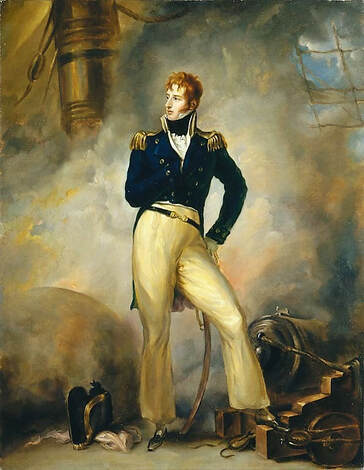 Lord Cochrane 1807 On 31 March, Ekaterina Pavlovna, the widowed Duchess of Oldenburg, arrived in England. She entered London in great state, travelling in the Prince Regent’s own carriage and escorted by the Duke of Clarence who had met her at Sheerness. Although her visit was said to be a private one, it was generally assumed that she had been entrusted with a political mission. As she travelled to Britain, the Allied Armies, led by her brother the Tsar and the King of Prussia were advancing on Paris. Following a two-day battle, Paris surrendered on 31 March and the same day the Allied Sovereigns triumphantly led their troups into the city.
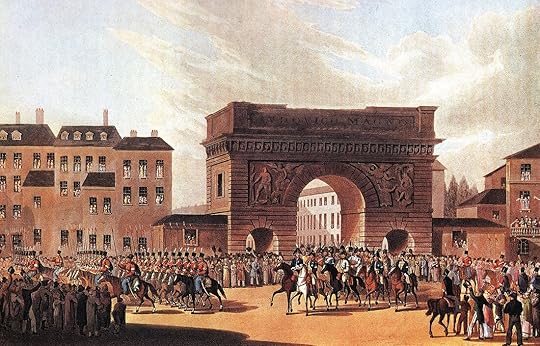 The Russian Army enters Paris To read previous posts in the Regency Decade series, either scroll down or click on The Regency Decade in the righthand margin.
At the turn of the year, fog shrouded the British Isles. This later gave way to a bitter week-long cold spell bringing snow and ice. Supplies became scarce as roads remained closed and the price of coal soared. The Cambridge mail coach was snowed up and completely covered for almost eight hours. It took fourteen waggon-horses to drag it out. Amazingly, the passengers survived though ‘almost frozen to death’. There is no mention of the fate of the coachman—it is possible he continued the journey on horseback to deliver the mails and seek assistance.
At the end of January, the Thames froze to such a depth that a Frost Fair could be held on it and all the usual entertainments of a fair—swings, book-stalls, drinking and eating booths, dancing, skittles, knock-em-downs, wheels of fortune, and gaming tables were soon to be found on the frozen river. Printers set up their presses, selling commemorative pieces printed ‘on the Ice’ to the thousands promenading on the central footpath or ‘City Road’.
By the fifth of February it was all over. When the thaw set in, blocks of broken up ice swept light craft and barges that had been imprisoned by the frost. inexorably down river, causing considerable damage and some loss of life.On 21st February, news reached London that the Allies had secured a great victory over Napoleon who had been slain by the Cossacks and that the Allied Sovereigns (the Tsar of Russia and the King of Prussia) were in Paris. The price of Government Omnium stock rose sharply, only to fall again when it became apparent that there had been no victory and that the whole thing was 'Fake News', a deliberate fraud by Charles Random de Berenger who, having posed as the bearer of important despatches from France, posted to London with horses decked with laurels.
Caught up in this Great Stock Exchange Fraud, as it came to be known, was Lord Cochrane, a renowned naval captain, Member of Parliament and eldest son and heir of the Earl of Dundonald, who had profited from the short surge in the price of omnium. Despite his protests that his stockbroker was acting on his standing instructions to sell Omnium if the price rose by one percent, he was convicted of complicity, fined a thousand pounds and sentenced to twelve months imprisonment in the Marshalsea. Before serving this sentence, he was to stand in the pillory for one hour. This last was afterwards remitted but a devastating social pillorying followed. His name was struck off the Navy list, he was expelled from the House of Commons, his arms were taken down from his stall as Knight of the Bath and his banner torn down and kicked ignominiously out of Henry VII’s Chapel in Westminster Abbey.
Many believed Lord Cochrane innocent and in the subsequent by-election he was re-elected to his seat in Parliament which he took the day he was released from prison. He continued to fight for the restoration of his good name and in 1832 received a ‘free pardon’; was restored to the Navy List, gazetted a rear-admiral and attended a levée at court. In 1847, his knighthood was restored and he was created a Knight Grand Cross of the Order of the Bath. He died in 1860. The day before his funeral, his banner was returned to Westminster Abbey where he is buried.
In 1876 his grandson received a payment of £40,000 from the British government, based on the recommendations of a Parliamentary select committee, in compensation for Cochrane's conviction which was believed to be unjust.
Lord Cochrane 1807 On 31 March, Ekaterina Pavlovna, the widowed Duchess of Oldenburg, arrived in England. She entered London in great state, travelling in the Prince Regent’s own carriage and escorted by the Duke of Clarence who had met her at Sheerness. Although her visit was said to be a private one, it was generally assumed that she had been entrusted with a political mission. As she travelled to Britain, the Allied Armies, led by her brother the Tsar and the King of Prussia were advancing on Paris. Following a two-day battle, Paris surrendered on 31 March and the same day the Allied Sovereigns triumphantly led their troups into the city. The Russian Army enters Paris To read previous posts in the Regency Decade series, either scroll down or click on The Regency Decade in the righthand margin.April 20, 2019
The Regency Decade Post Four: 1813—A Year of Change
Welcome back to my year by year look at the Regency decade. We have reached 1813. It began grimly with the hanging of fourteen Luddites at York on 14 January. Could things get any worse?
The UK had now been at war wth France for ten years and with the United States for a year and a half. Food prices were rising, supplies were limited and there was a thriving trade in smuggling to and from France. The Prince Regent declared Wednesday 10 March, “A Public Day of Fasting and Humiliation………..for imploring His [Almighty God’s] Blessing and assistance on His Majesty’s Arms, for the restoration of peace and prosperity to His Majesty and His Dominions’. On the day appointed, the Regent, his daughter, and the Dukes of York, Cumberland and Cambridge went to the Chapel Royal, St. James; the House of Lords to Westminster Abbey and the Commons to St. Margaret’s Westminister.
Presumably this covered the humiliation part of the agenda. It is not reported for how long that well known gourmand the Prince Regent fasted or with what plain dishes he chose to mortify himself.
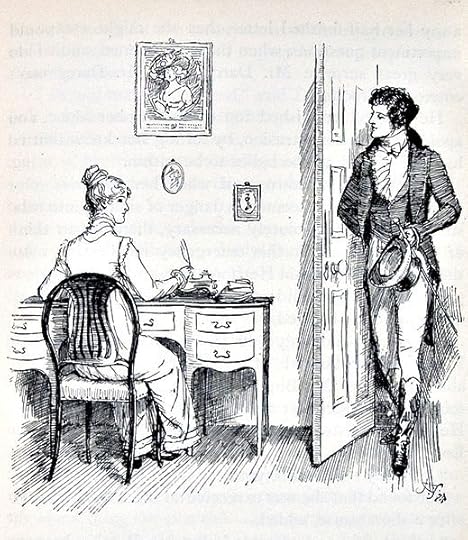 Elizabeth and Darcy at the Collins's Looking back, 1813 must be regarded as one of the culturally most significant years of the period. On January twenty-eight, a new novel by the author of Sense and Sensibility was published and with it the history of the novel was changed for ever. Over two hundred years later, Pride and Prejudice continues to fascinate readers everywhere. No-one who has read it is without an opinion on it—the characters are presented to us with all their failings and virtues and each will find his or her supporters in any discussion of the book. Perhaps it is this that accounts for its enduring popularity.
In the same month, the Philharmonic Society of London, now the Royal Philharmonic Society, was formed, its aim being “to promote the performance, in the most perfect manner possible of the best and most approved instrumental music". Not content with the existing repertoire, they also commissioned new works, most notably in 1817 a new symphony from Ludwig van Beethoven, and were amply rewarded with one of the greatest symphonies ever written, his Symphony No. 9, the Choral Symphony whose final movement is a monumental setting of Schiller’s Ode to Joy.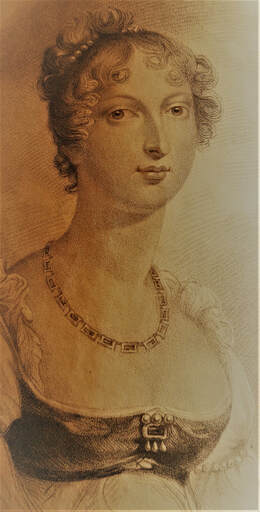 Princess Charlotte of Wales But that was for the future. Now the beau monde was concerned with other things. Princess Charlotte, the Prince Regent’s only child and heir presumptive had just turned seventeen and it was time for her to ‘come out’ into society. It was expected she would be formally presented to her grandmother, the Queen, at the birthday drawing-room on 5 February and this led it to be “one of the most crowded drawing-rooms within recollection. The company began to arrive soon after twelve 0’clock and continued setting down until near four. The number of nobility and gentry assembled was so great that they had not all left St. James by half-past seven”. But the young princess did not appear. The Prince Regent had forbidden his wife to attend his mother’s court and Charlotte refused to be presented by anyone other than her mother. Stalemate!
He was determined to treat Charlotte as a child until she married, not allowing her to replace her governesses with ladies-in-waiting or otherwise set up her own household. She was however permitted to attend the birth-night ball at Carlton House where she danced with her uncle, the Duke of Clarence, thirty years her senior. We can imagine how thrilled the seventeen-year-old Charlotte must have been by this treat.
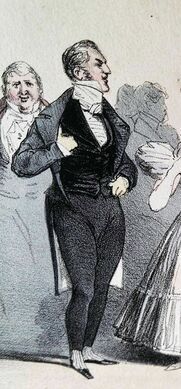 Beau Brummell That summer, the Prince Regent also fell out with his previous favourite, the dandy and self-appointed arbiter of fashion, Beau Brummell. Stung by a deliberate cut by the Prince who ignored him at a fancy dress ball of which Brummell was co-host, the dandy responded by enquiring of Lord Alvanley, who had been recognised, “Ah, Alvanley, who is your fat friend?”
The prince not unnaturally took offence and the breach between the two men was never healed.
Meanwhile In the Peninsula Wellington’s army had left their winter quarters and were on the hunt. On 21 June, at the Battle of Vitoria, they decisively defeated the French army commanded by Joseph Bonaparte who had been installed by his brother Napoleon as King of Spain
In the ensuing rout, the King’s carriage and the French baggage train containing vast amounts of looted treasure were abandoned to the pursuing English army who in turn helped themselves liberally. The Marshall’s baton presented by Napoleon to General Jean Baptiste Jourdan was sent by Wellington to the Prince Regent while King Joseph’s silver chamber pot, another gift from the emperor, was appropriated by the 14th Light Dragoons (later 14th Hussars and now the King’s Royal Hussars), who to this day drink from it on regimental mess nights. The chamber pot became known as ‘the Emperor’ in honour of its august donor and the 14th subsequently were nicknamed ‘the Emperor’s chambermaids’.
The news of the victory was met with great rejoicing in England. On 20 July there was a great public fête in Vauxhall, at which Marshal Jourdan’s baton was displayed.. The gardens were illuminated on a grand scale, bands played, there were three displays of fireworks and the whole closed with dancing which went on until 2 p.m. Tickets, excluding dinner, cost between three and ten guineas.
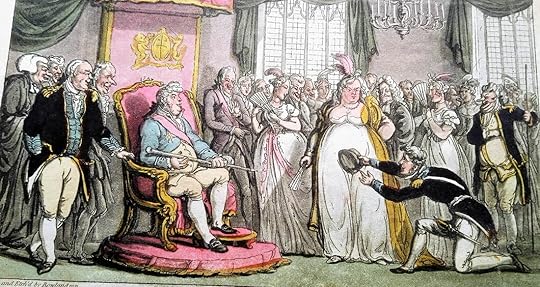 Presenting the Trophies On the Eastern front, Russia and Prussia had now allied with Sweden and Great Britain to combat Napoleon. The Emperor's new eastern campaign met with initial success but on 19 October the allies, now joined by Austria, trounced him at the Battle of Leipzig. With over 600,000 combatants, it was the largest battle ever fought on European soil, and would remain so until World War I.
Once again, Napoleon was forced to retreat to France. He was now hard-pressed on all sides. On 9 November, Wellington’s army crossed the Pyrenees and entered France. By the end of the year, The Netherlands had been liberated and the exiled Prince of Orange proclaimed Sovereign Prince. In December, his twenty-one-year-old son, Prince William, was presented to Princess Charlotte as a potential bridegroom.
To read other posts in this series, scroll down or click on The Regency Decade in the side bar.
The UK had now been at war wth France for ten years and with the United States for a year and a half. Food prices were rising, supplies were limited and there was a thriving trade in smuggling to and from France. The Prince Regent declared Wednesday 10 March, “A Public Day of Fasting and Humiliation………..for imploring His [Almighty God’s] Blessing and assistance on His Majesty’s Arms, for the restoration of peace and prosperity to His Majesty and His Dominions’. On the day appointed, the Regent, his daughter, and the Dukes of York, Cumberland and Cambridge went to the Chapel Royal, St. James; the House of Lords to Westminster Abbey and the Commons to St. Margaret’s Westminister.
Presumably this covered the humiliation part of the agenda. It is not reported for how long that well known gourmand the Prince Regent fasted or with what plain dishes he chose to mortify himself.
Elizabeth and Darcy at the Collins's Looking back, 1813 must be regarded as one of the culturally most significant years of the period. On January twenty-eight, a new novel by the author of Sense and Sensibility was published and with it the history of the novel was changed for ever. Over two hundred years later, Pride and Prejudice continues to fascinate readers everywhere. No-one who has read it is without an opinion on it—the characters are presented to us with all their failings and virtues and each will find his or her supporters in any discussion of the book. Perhaps it is this that accounts for its enduring popularity.In the same month, the Philharmonic Society of London, now the Royal Philharmonic Society, was formed, its aim being “to promote the performance, in the most perfect manner possible of the best and most approved instrumental music". Not content with the existing repertoire, they also commissioned new works, most notably in 1817 a new symphony from Ludwig van Beethoven, and were amply rewarded with one of the greatest symphonies ever written, his Symphony No. 9, the Choral Symphony whose final movement is a monumental setting of Schiller’s Ode to Joy.
Princess Charlotte of Wales But that was for the future. Now the beau monde was concerned with other things. Princess Charlotte, the Prince Regent’s only child and heir presumptive had just turned seventeen and it was time for her to ‘come out’ into society. It was expected she would be formally presented to her grandmother, the Queen, at the birthday drawing-room on 5 February and this led it to be “one of the most crowded drawing-rooms within recollection. The company began to arrive soon after twelve 0’clock and continued setting down until near four. The number of nobility and gentry assembled was so great that they had not all left St. James by half-past seven”. But the young princess did not appear. The Prince Regent had forbidden his wife to attend his mother’s court and Charlotte refused to be presented by anyone other than her mother. Stalemate!He was determined to treat Charlotte as a child until she married, not allowing her to replace her governesses with ladies-in-waiting or otherwise set up her own household. She was however permitted to attend the birth-night ball at Carlton House where she danced with her uncle, the Duke of Clarence, thirty years her senior. We can imagine how thrilled the seventeen-year-old Charlotte must have been by this treat.
Beau Brummell That summer, the Prince Regent also fell out with his previous favourite, the dandy and self-appointed arbiter of fashion, Beau Brummell. Stung by a deliberate cut by the Prince who ignored him at a fancy dress ball of which Brummell was co-host, the dandy responded by enquiring of Lord Alvanley, who had been recognised, “Ah, Alvanley, who is your fat friend?”The prince not unnaturally took offence and the breach between the two men was never healed.
Meanwhile In the Peninsula Wellington’s army had left their winter quarters and were on the hunt. On 21 June, at the Battle of Vitoria, they decisively defeated the French army commanded by Joseph Bonaparte who had been installed by his brother Napoleon as King of Spain
In the ensuing rout, the King’s carriage and the French baggage train containing vast amounts of looted treasure were abandoned to the pursuing English army who in turn helped themselves liberally. The Marshall’s baton presented by Napoleon to General Jean Baptiste Jourdan was sent by Wellington to the Prince Regent while King Joseph’s silver chamber pot, another gift from the emperor, was appropriated by the 14th Light Dragoons (later 14th Hussars and now the King’s Royal Hussars), who to this day drink from it on regimental mess nights. The chamber pot became known as ‘the Emperor’ in honour of its august donor and the 14th subsequently were nicknamed ‘the Emperor’s chambermaids’.
The news of the victory was met with great rejoicing in England. On 20 July there was a great public fête in Vauxhall, at which Marshal Jourdan’s baton was displayed.. The gardens were illuminated on a grand scale, bands played, there were three displays of fireworks and the whole closed with dancing which went on until 2 p.m. Tickets, excluding dinner, cost between three and ten guineas.
Presenting the Trophies On the Eastern front, Russia and Prussia had now allied with Sweden and Great Britain to combat Napoleon. The Emperor's new eastern campaign met with initial success but on 19 October the allies, now joined by Austria, trounced him at the Battle of Leipzig. With over 600,000 combatants, it was the largest battle ever fought on European soil, and would remain so until World War I.Once again, Napoleon was forced to retreat to France. He was now hard-pressed on all sides. On 9 November, Wellington’s army crossed the Pyrenees and entered France. By the end of the year, The Netherlands had been liberated and the exiled Prince of Orange proclaimed Sovereign Prince. In December, his twenty-one-year-old son, Prince William, was presented to Princess Charlotte as a potential bridegroom.
To read other posts in this series, scroll down or click on The Regency Decade in the side bar.
March 15, 2019
The Regency Decade: Post Three - 1812 - A Year of War and Violence
Welcome to post 3 of by year by year survey of the Regency Decade.
1812 was marked by warfare and violence. In England, the Luddite protests continued, with machinery broken at Nottingham, Leeds, Bristol, Sheffield and Manchester to name but some of the areas affected. Troops were sent to Cornwall to put down riots among the miners who demanded reductions in the price of food. The Frame Breaking Act of 1812 made ‘machine breaking’ a capital offence and in May a Special Commission was set up to try captured Luddites.
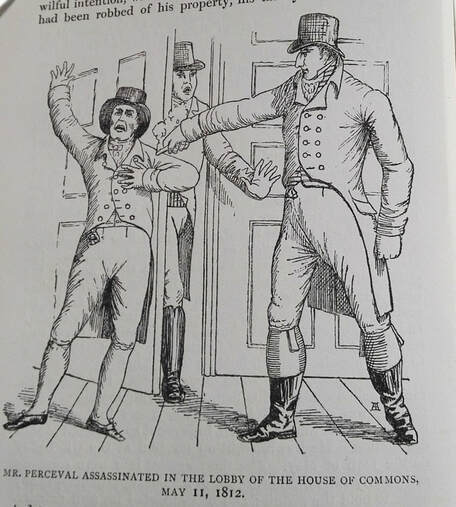
On 11 May, the UK was shocked by the assassination in the lobby of the House of Commons of the Prime Minister, Spencer Perceval who was shot at point-blank range by John Bellingham who had a long-standing grievance against the government. When news of the murder reached Nottingham however, the Riot Act had to be read and the military called out to suppress the public celebrations of shouts, huzzas, drums beating, flags flying, bells ringing, and bonfires blazing.
 In Spain, the army under the command of Lord Wellington first besieged and then successfully stormed the cities of Ciudad Rodrigo and Badajoz. Badajoz was taken on 6 April and subsequently sacked by the British army in what Sir Harry Smith in his autobiography describes as ‘A scene of horror I would willingly bury in oblivion. The atrocities committed by our soldiers on the poor innocent and defenceless inhabitants of the city, no words suffice to depict.’ He continues: ‘Yet this scene of debauchery, however cruel to many, to me has been the solace and the whole happiness of my life for thirty-three years. A poor defenceless maiden of thirteen years was thrown upon my generous nature.’
The story of Harry Smith and Juana María de los Dolores de León is one of the great love stories not only of the Regency but also of the nineteenth century. Married within a couple of days of their meeting in 1812, she devotedly followed the drum. She learnt to ride and kept up with the regiment on the long marches through mountainous Spain and over the Pyrenees into France. She accompanied him when possible on his overseas postings and they were rarely parted until his death in 1860. The town of Ladysmith in South Africa is called after her.
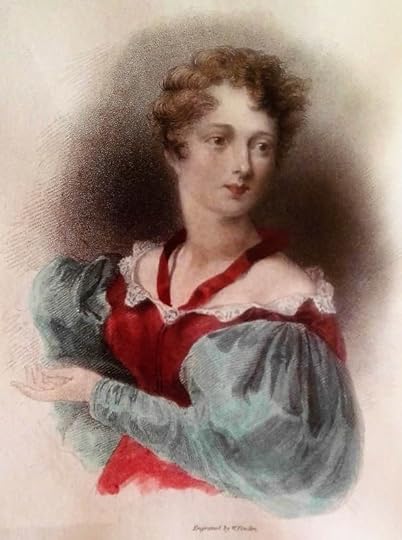
If you would like to know more about them, I highly recommend Georgette Heyer’s The Spanish Bride which draws heavily on the memoirs of Harry and other Riflemen to describe the first years of their marriage, up to and including the Battle of Waterloo, and for the rest, I refer you to Sir Harry himself whose autobiography written in a colloquial, anecdotal style is most entertaining. The portraits below were painted three years after their wedding in Paris in 1815, after the Battle of Waterloo.
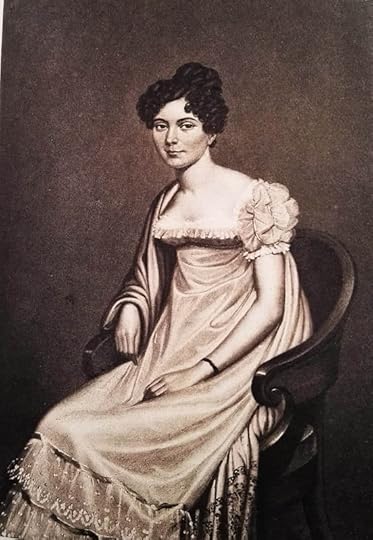 This was the age of the Romantic Poets—among others, Wordsworth, Coleridge, Shelley and Keats, and it is interesting to see their heightened sensibility and emotional outpourings reflected in the memoirs of military men such as Harry Smith and his fellow rifleman, Sir John Kincaid. Kincaid also describes the arrival of Juana and her elder sister into the British camp at Badajoz, and the sister’s impassioned appeal for protection for the younger woman. ‘Nor was it [the appeal] made in vain! Nor could it be abused, for she stood by the side of an angel! A being more transcendingly lovely I had never before seen—one more amiable I have never yet known……..to look at her was to love her; and I did love her, but I never told my love, and in the mean time another and a more impudent fellow stepped in and won her.’
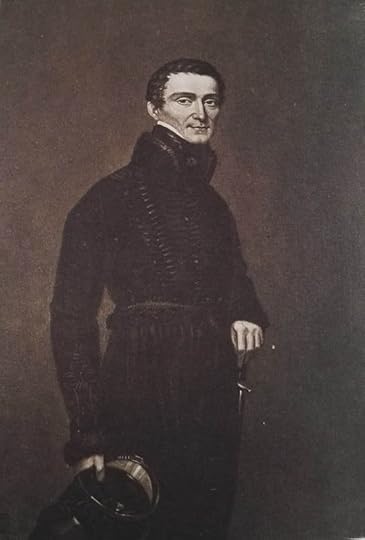
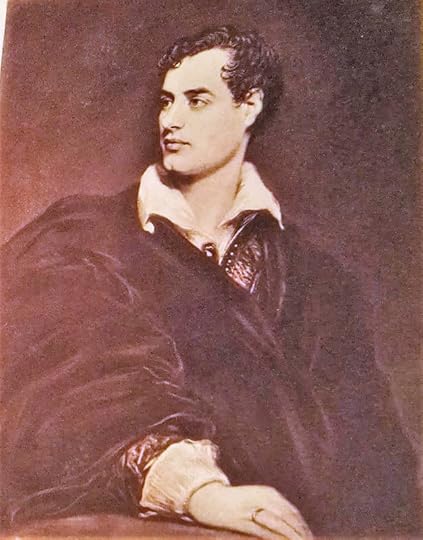
In March 1812 another romantic poet, the twenty-four-year-old Lord Byron, published the first two cantos of Childe Harold’s Pilgrimage and, as he described it, 'awoke to find himself famous'. His passionate verse and brooding, flawed hero appealed to feminine hearts while, as can be seen in the portrait below from 1813, he knew how to present himself in the most romantic light. He was perhaps the first popular heartthrob, idolised by innocent girls and society matrons alike. After meeting him for the first time, the married Lady Caroline Lamb described him in her diary as ‘mad, bad and dangerous to know’; in other words irresistible to a woman known for her restless spirit and passionate enthusiasms, Soon the couple embarked on a very public affair that was to both scandalise and entertain the polite world of the haut ton for several years.
 Meanwhile, across the Atlantic, all was not well between the UK and its former colony and, on 18 June 1812, the United States declared war on the United Kingdom.
6 days later, on 24 June, Napoleon invaded Russia. On 14 September he entered Moscow. But what might have been supposed to be one of his greatest triumphs, turned out to be his downfall. The Russians had evacuated the city, withdrawing also the civic authorities but leaving behind them a small detachment charged with firing the city. Composed mainly of wooden buildings, Moscow was burnt almost completely to the ground. Napoleon was left with no choice but to retreat along the same route he had taken to reach the city and which had been denuded of supplies, including fodder for the horses. Starving, and wearing uniforms that were no match for a Russian winter, the Grande Armée suffered devastating losses. After almost ten years, the tide of war had turned.
To read previous posts in this series, click on The Regency Decade in the list of categories on the right and scroll down.
1812 was marked by warfare and violence. In England, the Luddite protests continued, with machinery broken at Nottingham, Leeds, Bristol, Sheffield and Manchester to name but some of the areas affected. Troops were sent to Cornwall to put down riots among the miners who demanded reductions in the price of food. The Frame Breaking Act of 1812 made ‘machine breaking’ a capital offence and in May a Special Commission was set up to try captured Luddites.
On 11 May, the UK was shocked by the assassination in the lobby of the House of Commons of the Prime Minister, Spencer Perceval who was shot at point-blank range by John Bellingham who had a long-standing grievance against the government. When news of the murder reached Nottingham however, the Riot Act had to be read and the military called out to suppress the public celebrations of shouts, huzzas, drums beating, flags flying, bells ringing, and bonfires blazing.
In Spain, the army under the command of Lord Wellington first besieged and then successfully stormed the cities of Ciudad Rodrigo and Badajoz. Badajoz was taken on 6 April and subsequently sacked by the British army in what Sir Harry Smith in his autobiography describes as ‘A scene of horror I would willingly bury in oblivion. The atrocities committed by our soldiers on the poor innocent and defenceless inhabitants of the city, no words suffice to depict.’ He continues: ‘Yet this scene of debauchery, however cruel to many, to me has been the solace and the whole happiness of my life for thirty-three years. A poor defenceless maiden of thirteen years was thrown upon my generous nature.’The story of Harry Smith and Juana María de los Dolores de León is one of the great love stories not only of the Regency but also of the nineteenth century. Married within a couple of days of their meeting in 1812, she devotedly followed the drum. She learnt to ride and kept up with the regiment on the long marches through mountainous Spain and over the Pyrenees into France. She accompanied him when possible on his overseas postings and they were rarely parted until his death in 1860. The town of Ladysmith in South Africa is called after her.
If you would like to know more about them, I highly recommend Georgette Heyer’s The Spanish Bride which draws heavily on the memoirs of Harry and other Riflemen to describe the first years of their marriage, up to and including the Battle of Waterloo, and for the rest, I refer you to Sir Harry himself whose autobiography written in a colloquial, anecdotal style is most entertaining. The portraits below were painted three years after their wedding in Paris in 1815, after the Battle of Waterloo.
This was the age of the Romantic Poets—among others, Wordsworth, Coleridge, Shelley and Keats, and it is interesting to see their heightened sensibility and emotional outpourings reflected in the memoirs of military men such as Harry Smith and his fellow rifleman, Sir John Kincaid. Kincaid also describes the arrival of Juana and her elder sister into the British camp at Badajoz, and the sister’s impassioned appeal for protection for the younger woman. ‘Nor was it [the appeal] made in vain! Nor could it be abused, for she stood by the side of an angel! A being more transcendingly lovely I had never before seen—one more amiable I have never yet known……..to look at her was to love her; and I did love her, but I never told my love, and in the mean time another and a more impudent fellow stepped in and won her.’In March 1812 another romantic poet, the twenty-four-year-old Lord Byron, published the first two cantos of Childe Harold’s Pilgrimage and, as he described it, 'awoke to find himself famous'. His passionate verse and brooding, flawed hero appealed to feminine hearts while, as can be seen in the portrait below from 1813, he knew how to present himself in the most romantic light. He was perhaps the first popular heartthrob, idolised by innocent girls and society matrons alike. After meeting him for the first time, the married Lady Caroline Lamb described him in her diary as ‘mad, bad and dangerous to know’; in other words irresistible to a woman known for her restless spirit and passionate enthusiasms, Soon the couple embarked on a very public affair that was to both scandalise and entertain the polite world of the haut ton for several years.
Meanwhile, across the Atlantic, all was not well between the UK and its former colony and, on 18 June 1812, the United States declared war on the United Kingdom.6 days later, on 24 June, Napoleon invaded Russia. On 14 September he entered Moscow. But what might have been supposed to be one of his greatest triumphs, turned out to be his downfall. The Russians had evacuated the city, withdrawing also the civic authorities but leaving behind them a small detachment charged with firing the city. Composed mainly of wooden buildings, Moscow was burnt almost completely to the ground. Napoleon was left with no choice but to retreat along the same route he had taken to reach the city and which had been denuded of supplies, including fodder for the horses. Starving, and wearing uniforms that were no match for a Russian winter, the Grande Armée suffered devastating losses. After almost ten years, the tide of war had turned.
To read previous posts in this series, click on The Regency Decade in the list of categories on the right and scroll down.
February 15, 2019
The Regency Decade Post Two: 1811
The Regency Act was passed in January 1811 and on 6 February the Prince of Wales was appointed Prince Regent in place of his father King George III, swearing to be ‘faithful and bear true allegiance’ to the king, to maintain ‘the safety, honour and dignity’ of the king and ‘the welfare of his people’ and to uphold the Protestant religion. Although prior to this the Prince had supported the oppositional Whigs, to their disappointment and disgust he now insisted on ‘maintaining his father’s cabinet,” as the Whig MP, Thomas Creevey put it. Although the King’s health continued to deteriorate, to the extent that on 12 July Creevey wrote that that he was expected to die before 22 August, the day on which Parliament was supposed to resume sitting, the Regent’s main efforts in the first six months of his tenure appear to have been focussed on the magnificent midsummer fête he held at his residence Carlton House on 19 June. About two thousand guests were invited to this sumptuous feast, where a real stream purled between floral banks down the length of the main table, affording those privileged to sit there with glimpses of the silver and gold fish that swam therein.
So keen was he to display this magnificence that for three days afterwards, tickets were issued permitting visitors to visit Carlton House On the final day some thirty-thousand availed themselves of this privilege.
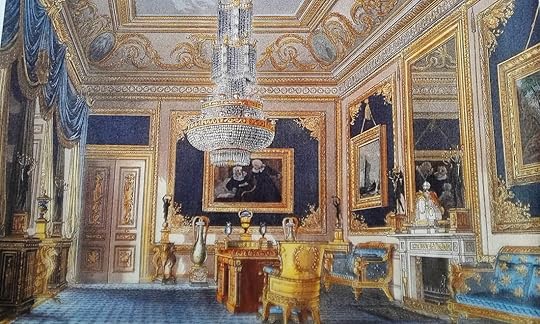 Blue Velvet Room Carlton House 1816 Conspicuously absent from these festivities was the Regent’s wife, the Princess of Wales. If ever there was a match made in hell, it was theirs. Bribed by the promise of having his personal debts of £630,000 (roughly £48 million today) repaid, in April 1795 he married his cousin Caroline, daughter of the Duke of Brunswick. The couple met for the first time on their wedding day and the Prince’s reported response to the sight of his bride was “Harris, I am not well. Pray get me a glass of brandy.”
They had already separated before the birth in January 1796 of their only child, Princess Charlotte. In 1811, the princess lived with her mother at Kensington. In November 1811 however, the Prince Regent is recorded as leading off the dance with his daughter at a party given by the Duchess of York at Oatlands. According to the Morning Chronicle, he ‘gave his leg a twist and sprained his ankle’ while dancing. This injury required him to recuperate at Oatlands for almost a month. Nobody believed in the sprain; the most popular story being that he had grossly insulted Lady Yarmouth at the ball and been soundly thrashed by her husband.
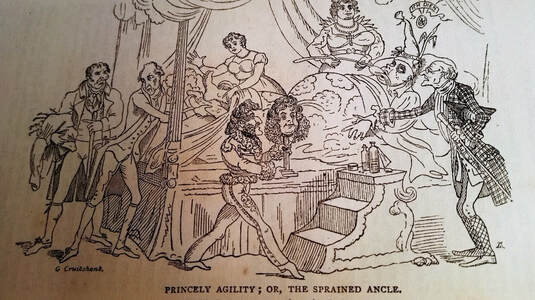 The Bed-Ridden Prince with Two Black Eyes At the same time there was unrest among the working classes, in particular among the textile workers of Nottingham many of whom had lost their employment, partly because of a decrease in demand and partly due to the introduction of labour-saving automated looms and knitting machines. Claiming to be following orders from a ‘General Ludd’, called after an apprentice, Ned Ludd, who was alleged to have wrecked a machine some decades before, In November 1811 the Luddites embarked on a campaign of intimidation and machine breaking that was to last for over a year and see dozens hanged or transported to Australia.
But just as the protestors were unsuccessful in blocking the march of technology, so were the authorities unable to prevent workers from continuing to fight for better pay and working conditions. Although it would take a century, eventually Labour would replace the Whigs (by then known as the Liberals) as one of the two major parties in the UK parliament.
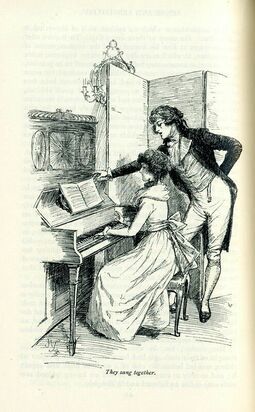 Willoughby and Marianne from Sense and Sensibility One significant event in 1811 passed without fanfares of any sort. In June, Jane Austen wrote to her sister Cassandra, “No, indeed, I am never too busy to think of S&S. I can no more forget it, than a mother can her sucking child; & I am obliged to you for your enquiries. I have had two sheets to correct, but the last only brings us to W.s first appearance.” It fact it was to be October before Sense and Sensibility was published, introducing to readers the author we associate most with the Regency era.
On the continent, the French and allied troops warred in Spain, here a victory and there a defeat with the year ending in stalemate. Meanwhile in Paris, Napoleon’s second wife, the Empress Marie-Louise, gave birth to his long-desired son, Napoleon François Charles Joseph Bonaparte who was given the title of King of Rome.
Please scroll down to read previous posts in this Blog Series or click on The Regency Decade under Blog Categories above on the right.
So keen was he to display this magnificence that for three days afterwards, tickets were issued permitting visitors to visit Carlton House On the final day some thirty-thousand availed themselves of this privilege.
Blue Velvet Room Carlton House 1816 Conspicuously absent from these festivities was the Regent’s wife, the Princess of Wales. If ever there was a match made in hell, it was theirs. Bribed by the promise of having his personal debts of £630,000 (roughly £48 million today) repaid, in April 1795 he married his cousin Caroline, daughter of the Duke of Brunswick. The couple met for the first time on their wedding day and the Prince’s reported response to the sight of his bride was “Harris, I am not well. Pray get me a glass of brandy.”They had already separated before the birth in January 1796 of their only child, Princess Charlotte. In 1811, the princess lived with her mother at Kensington. In November 1811 however, the Prince Regent is recorded as leading off the dance with his daughter at a party given by the Duchess of York at Oatlands. According to the Morning Chronicle, he ‘gave his leg a twist and sprained his ankle’ while dancing. This injury required him to recuperate at Oatlands for almost a month. Nobody believed in the sprain; the most popular story being that he had grossly insulted Lady Yarmouth at the ball and been soundly thrashed by her husband.
The Bed-Ridden Prince with Two Black Eyes At the same time there was unrest among the working classes, in particular among the textile workers of Nottingham many of whom had lost their employment, partly because of a decrease in demand and partly due to the introduction of labour-saving automated looms and knitting machines. Claiming to be following orders from a ‘General Ludd’, called after an apprentice, Ned Ludd, who was alleged to have wrecked a machine some decades before, In November 1811 the Luddites embarked on a campaign of intimidation and machine breaking that was to last for over a year and see dozens hanged or transported to Australia.But just as the protestors were unsuccessful in blocking the march of technology, so were the authorities unable to prevent workers from continuing to fight for better pay and working conditions. Although it would take a century, eventually Labour would replace the Whigs (by then known as the Liberals) as one of the two major parties in the UK parliament.
Willoughby and Marianne from Sense and Sensibility One significant event in 1811 passed without fanfares of any sort. In June, Jane Austen wrote to her sister Cassandra, “No, indeed, I am never too busy to think of S&S. I can no more forget it, than a mother can her sucking child; & I am obliged to you for your enquiries. I have had two sheets to correct, but the last only brings us to W.s first appearance.” It fact it was to be October before Sense and Sensibility was published, introducing to readers the author we associate most with the Regency era.On the continent, the French and allied troops warred in Spain, here a victory and there a defeat with the year ending in stalemate. Meanwhile in Paris, Napoleon’s second wife, the Empress Marie-Louise, gave birth to his long-desired son, Napoleon François Charles Joseph Bonaparte who was given the title of King of Rome.
Please scroll down to read previous posts in this Blog Series or click on The Regency Decade under Blog Categories above on the right.
January 22, 2019
The Regency Decade Post One: 1810 The Beginning
I write Regency novels. This is shorthand for saying I write historical novels set in England in the second decade of the nineteenth century, a time of unprecedented change that continues to affect our modern lives. In this series of blogs, we will look behind the scenes to discover what makes this decade tick. What makes it so fascinating to us, two hundred years later?
Let us start with a snapshot of the UK on 31 December 1810. All was not well in the island kingdom. Having lapsed in and out of insanity for over two decades, King George III, sober paterfamilias, was finally deemed incapable of undertaking any affairs of state. Preparations were set in train to appoint as Regent his eldest son and heir, the affable, extravagant and adulterous Prince of Wales.
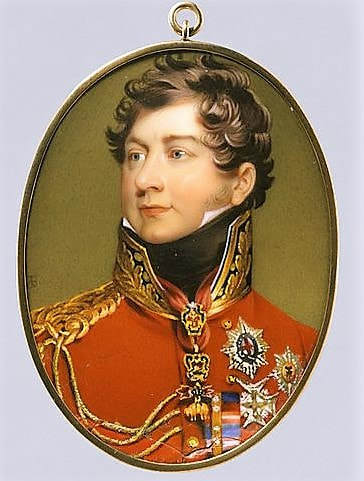 The country had been at war with France since 1803. Across the English Channel, the French Emperor Napoleon Bonaparte had consolidated his hold on the European Continent; his sphere of influence extending west across the Iberian Peninsula, north into Sweden where one of his generals, Jean-Baptiste Bernadotte, had been elected crown prince, and eastwards through modern Germany, Italy, Austria, Hungary and Poland to the borders of the Russian and Ottoman Empires. The only ray of light was provided by Lord Wellington whose Peninsular army was driving that of the French General Massena out of Portugal and into Spain.
Back at home, the bulk of wealth, power and influence lay in the hands of the aristocracy and landed gentry who also controlled the established Church of England, the universities and the military and legal professions. In a study carried out two years later, in 1812, these classes made up 7.8% of families in Great Britain and Ireland but received 40.19% of the total annual income generated therein. Unsurprisingly, they resisted any attempts to reform a system that worked well for them but not so well for the rest of the country.
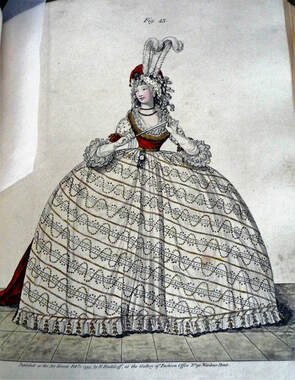 Apart from formal Court dress which remained unchanged as long as the elderly Queen Charlotte was alive, the vast skirts and cumbersome hoops of the previous century had yielded to the classical styles copied from revolutionary and imperial France while gentlemen had abandoned their silks and brocades for boots, buckskin breeches and riding coats.
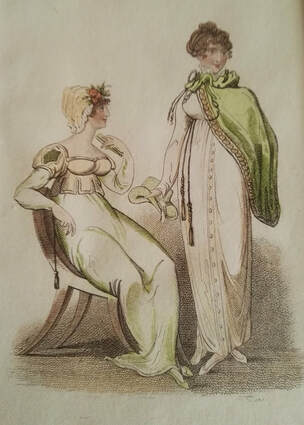 Did these lighter, looser clothes lead to a lighter, looser way of life? The Regency was certainly one of the great party decades. Perhaps this was due to the shift in the dates of the London Season, the months that the upper classes spent in London while Parliament was sitting. Every peer had a seat in the House of Lords and where the noble families led, others followed. During the 18th century Parliament had sat from November to May. From 1806 onwards, the opening of Parliament veered towards February and the session extended into July or even August.
This change from a winter to spring/summer Season with its warmer and brighter days provided many more opportunities for entertainment and dalliance. The Season was the great ‘marriage market’ when eligible young ladies of good birth and varying fortunes sought to find a suitable husband. Night was turned into day. Eight p.m. was the fashionable dinner hour, after which both sexes flocked to the theatres, balls, assemblies and routs while gentlemen also had their clubs and the dubious establishments of the demi-monde – gaming hells and brothels for the most part.The social round continued into the small hours and resumed the next day with ‘morning calls’ i.e. visits which were made between noon and three p.m.. A ‘breakfast’ at three o’clock might be followed by a ride or drive in Hyde Park at the fashionable hour and soon it was time for dinner again.
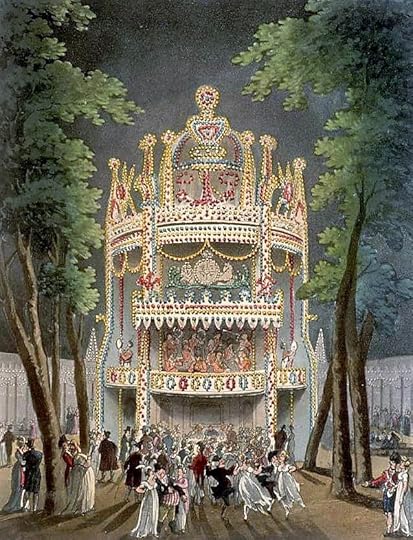 Over the coming months, we shall experience the highs and lows of the Regency year by year. I hope you will join me and look forward to your comments.
The Regency: 1810 The Beginning
I write Regency novels. This is shorthand for saying I write historical novels set in England in the second decade of the nineteenth century, a time of unprecedented change that continues to affect our modern lives. In this series of blogs, we will look behind the scenes to discover what makes this decade tick. What makes it so fascinating to us, two hundred years later?
Let us start with a snapshot of the UK on 31 December 1810. All was not well in the island kingdom. Having lapsed in and out of insanity for over two decades, King George III, sober paterfamilias, was finally deemed incapable of undertaking any affairs of state. Preparations were set in train to appoint as Regent his eldest son and heir, the affable, extravagant and adulterous Prince of Wales.
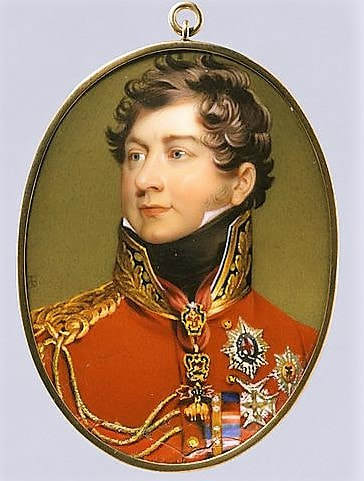 The country had been at war with France since 1803. Across the English Channel, the French Emperor Napoleon Bonaparte had consolidated his hold on the European Continent; his sphere of influence extending west across the Iberian Peninsula, north into Sweden where one of his generals, Jean-Baptiste Bernadotte, had been elected crown prince, and eastwards through modern Germany, Italy, Austria, Hungary and Poland to the borders of the Russian and Ottoman Empires. The only ray of light was provided by Lord Wellington whose Peninsular army was driving that of the French General Massena out of Portugal and into Spain.
Back at home, the bulk of wealth, power and influence lay in the hands of the aristocracy and landed gentry who also controlled the established Church of England, the universities and the military and legal professions. In a study carried out two years later, in 1812, these classes made up 7.8% of families in Great Britain and Ireland but received 40.19% of the total annual income generated therein. Unsurprisingly, they resisted any attempts to reform a system that worked well for them but not so well for the rest of the country.
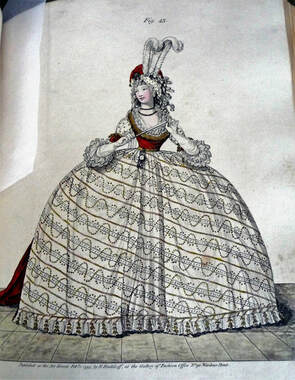 Apart from formal Court dress which remained unchanged as long as the elderly Queen Charlotte was alive, the vast skirts and cumbersome hoops of the previous century had yielded to the classical styles copied from revolutionary and imperial France while gentlemen had abandoned their silks and brocades for boots, buckskin breeches and riding coats.
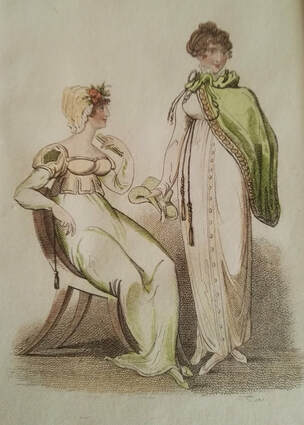 Did these lighter, looser clothes lead to a lighter, looser way of life? The Regency was certainly one of the great party decades. Perhaps this was due to the shift in the dates of the London Season, the months that the upper classes spent in London while Parliament was sitting. Every peer had a seat in the House of Lords and where the noble families led, others followed. During the 18th century Parliament had sat from November to May. From 1806 onwards, the opening of Parliament veered towards February and the session extended into July or even August.
This change from a winter to spring/summer Season with its warmer and brighter days provided many more opportunities for entertainment and dalliance. The Season was the great ‘marriage market’ when eligible young ladies of good birth and varying fortunes sought to find a suitable husband. Night was turned into day. Eight p.m. was the fashionable dinner hour, after which both sexes flocked to the theatres, balls, assemblies and routs while gentlemen also had their clubs and the dubious establishments of the demi-monde – gaming hells and brothels for the most part.The social round continued into the small hours and resumed the next day with ‘morning calls’ i.e. visits which were made between noon and three p.m.. A ‘breakfast’ at three o’clock might be followed by a ride or drive in Hyde Park at the fashionable hour and soon it was time for dinner again.
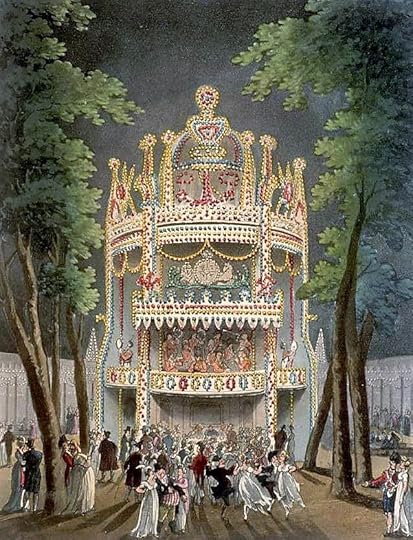 Over the coming months, we shall experience the highs and lows of the Regency year by year. I hope you will join me and look forward to your comments.
August 9, 2018
From Regency Drawing-Rooms to Star Trek—The Next Generation: Thomas Moore’s Irish Melodies
 The Last Rose of Summer, The Harp that once thro’ Tara’s Halls, Let Erin Remember the Days of old, Believe me if all those endearing young Charms, Love’s young Dream, At the mid-Hour of Night, Dear Harp of my Country--the list goes on and on. Some of these songs may be familiar from sessions in an Irish pub, from film soundtracks, from school choir, early music lessons or from old recordings of parlour music but two hundred years ago Moore's Irish Melodies were heard in every Regency drawing-room and parlour. Thomas Moore was born in Dublin in 1779, the eldest of eight children of John and Anastasia Moore. As a Roman Catholic, the professions were barred to John who in 1779 opened a Tea, Wine, Spirit and Grocery Warehouse at 12 Aungier Street. Penal Law restrictions notwithstanding, young Thomas was sent to Samuel Whyte’s English Grammar School in Grafton Street where he shone as a public speaker and reciter. The Roman Catholic Relief Act (Ireland) of 1793 opened the doors of Trinity College Dublin to him and, having hastily learnt Latin, he began his studies there in January 1795. However, the decision of the College authorities to reserve fellowships and scholarships for members of the Established [Anglican] Church deprived him in 1797 of a scholarship worth £60 or £70 a year (£6000 to £7000 today).
 Unrest was brewing in Ireland. Moore, who was sympathetic to the cause of the United Irishmen, was confined with Illness when rebellion broke out in 1798. Following its suppression, he left Dublin for London to study for the bar, an ambition that was soon abandoned in favour of poetry and society. In 1800, he published his translation of the Odes of Anacreon, dedicating it by permission to the Prince of Wales. It was an immediate hit and within a month the poet had been introduced to the Prince himself. From now on, he was frequently referred to as Anacreon Moore.
The publication of the first volume of Irish Melodies in 1807 set the seal on his success, giving him a position in society similar to that of today’s rock stars. The poet, who already moved in the highest circles, was lionised now as an after-dinner performer in the most exclusive drawing-rooms, as contemporary reports tell us. When he commenced, every breath was almost hushed, lest a note should be lost. (Eliza Rennie). He appears to have had the knack of seeming to improvise his accompaniment, creating an extraordinary intimacy and bond with his listeners. His delivery of the words rich and delicious……..his fingers seemed accidentally to drop on the keys, producing a simple harmony just sufficient to support the voice. (William Gardiner). According to another commentator, the American N P Willis, the sentiment of the song goes through your blood, warming you to the very eyelids, and starting your tears, if you have soul or sense in you.
And this was no fly-by-night success. On 20th June, 1831,Thomas Creevey wrote to Miss Ord, Yesterday I dined in Portland Place and went in the evening to Downing Street [official home of the Prime Minister, Lord Grey], where I found Tommy Moore at the pianoforte, playing and singing his own melodies; and very much delighted I was with his performance. The lyrics, extolling, as they did, the old Gaelic traditions of Ireland, did not meet with overall approval. In his prefatory letter to Volume III of the Melodies, Moore wrote, It has been said that the tendency of this publication is mischievous, and that I have chosen these airs but as a vehicle of dangerous politics……To those who identify nationality with treason, and who see, in every effort for Ireland, a system of hostility towards England—to those, too, who nursed in the gloom of prejudice, are alarmed by the faintest gleam of liberality that threatens to disturb their darkness…….To such men I shall not deign to apologize for the warmth of any political sentiment, which may occur in these pages.
But not even the secret, subversive allusions in Oh! Breathe not his Name to Moore's fellow-student at Trinity, Robert Emmet who was hanged (and beheaded once dead) in 1803 following his ill-fated rebellion, or to Emmet’s beloved, Sarah Curran in She is far from the Land where her young Hero sleeps, could diminish Moore’s popularity.
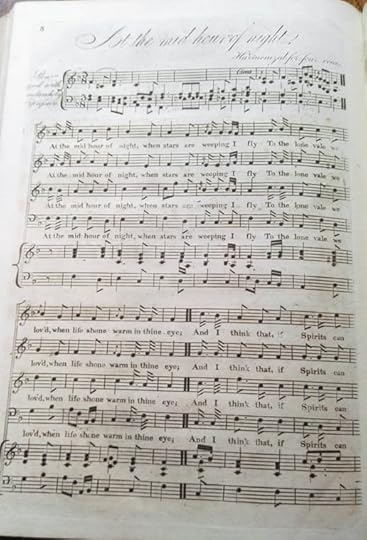
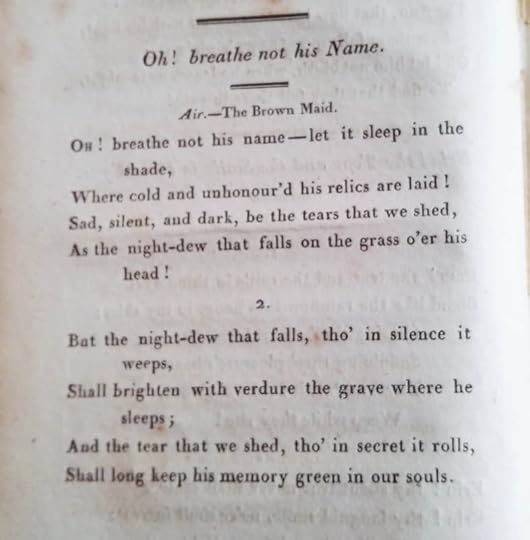 While not everyone could have the pleasure of experiencing Moore live, the Melodies, words and music, were easily if not cheaply purchased in both solo and multi-part settings. They were found to be admirably suited to amateur performers and were a welcome addition to the repertoire of the Regency’s young ladies as described in my novel, A Suggestion of Scandal.
Chloe, Ann and Cynthia were gathered around the pianoforte, comparing music and trying snatches of melody. Once the gentlemen had arrived, Cynthia took her seat at the harp and they embarked on a selection of Mr Moore’s Irish melodies, at times singing together, at times each one taking a solo verse. Their voices blended charmingly and, when they finished with a poignant yet defiant rendition of The Minstrel Boy there was heartfelt applause and congratulations.
There are hundreds if not thousands of versions of Moore’s songs on YouTube. I have selected two which to me best convey his original intention.
If you overlook the orchestra and the uileann pipes, there is a charm and simplicity about this performance of The Last Rose of Summer by a young Charlotte Church that seems to reach back to those Regency drawing-rooms
You will find many bombastic, martial renditions of The Minstrel Boy but this a capella version, sung by 0’Brien (Colm Meaney) in the episode The Wounded of Star Trek—The Next Generation is my favourite.
 If you would like to learn more about Thomas Moore, I refer you to Ronan Kelly’s excellent biography Bard of Erin, Penguin Ireland, 2008.
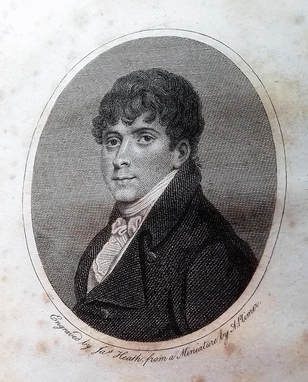
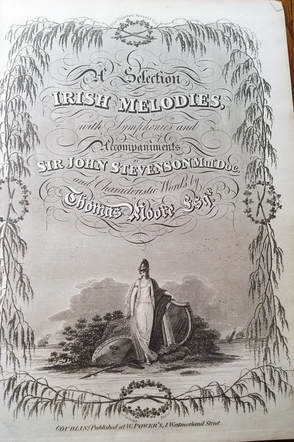
The Melodies were published in ten volumes between 1807 and 1837. The portrait of Thomas Moore and text of Oh! Breathe not his Name are from the 1819 five volume set of his works published in Paris by Galignani in 1819 which includes the lyrics of volumes 1 to VII of the Melodies. The Melodies with their settings were published in foolscap size scores by W Power's Music Warehouse, Westmoreland Street, Dublin and J Power's Music and Instrument Warehouse, 34 Strand, London. The early volumes were luxury items, priced at 15 shillings each (around £47 today).
Thank you for visiting my web-site. If you would like to be know more about my books and writing, you can sign up to receive my quarterly newsletter on my home page.
March 29, 2018
Allegri's Miserere and Tenebrae in the Sistine Chapel - An Evocative Description from 1803
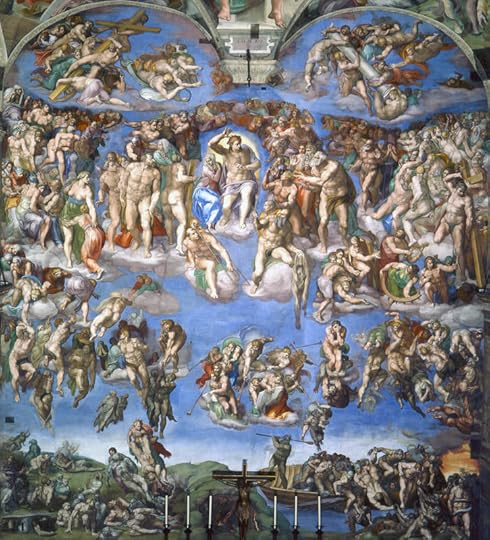 The Last Judgement Michelangelo, The Sistine Chapel Yesterday was the Wednesday of Holy Week—the week leading up to Easter Sunday, one of the two days—the other is Good Friday—when Gregorio Allegri’s setting of Psalm 51, beginning “Miserere mei, Deus--Have mercy on me, O God,” was sung as part of the Tenebrae service in the Sistine Chapel in Rome. Composed in the 1630s for Pope Urban VIII, it soon became famous for its ethereal ornamentation but for almost a hundred and fifty years succeeding popes and papal musicians jealously guarded the score. In 1770, a fourteen-year-old Wolfgang Amadeus Mozart visited Rome and was so struck by the music that he later wrote it down from memory, a feat for which Pope Clement XIV rewarded him with the Chivalric Order of the Golden Spur.
Listening yesterday evening to a recording of the Miserere, I was reminded of Catherine Wilmot's evocative portrayal of the Tenebrae service. Miss Wilmot was a young Irish woman who accompanied Lord and Lady Mount Cashell on their tour of the Continent in 1801-1803 during the brief peace with revolutionary France. Her journal, edited by Thomas U Sadleir M.A. was published in 1920 as An Irish Peer on the Continent. Here is what she says—spelling, punctuation etc are as in the original.
This ceremony[Tenebrae] coming late in the evening, every Lady is drest in deep mourning with a black veil, and is handed into the place set apart for her, the gentlemen sitting at the opposite side. Excepting the Altar there is no light, but there is sufficient to glimmer on the figures in the “Last Judgment” done by Michael Angelo and reckon’d one of the finest paintings in the world. This glimmering effect of yellow light upon the figures seem’d to fancifully set them in motion and gave an illusion to the scene particularly to a group of Angels to the Front, who held the last Trumpet and woke from their graves those who were represented in every gradation of preternatural change…………The ceremonies began by the lamentations of Jeremiah and ended by the Miserere which was perform’d by innumerable Musicians, in so heavenly a manner, and in such heartrending strains, heaving through the sweetest chords, broken and scatter’d, from the spirit of contrition with such angelic force, that it seem’d a celestial intercourse which reach’d the skies, to absolve the sins, which humiliation acknowledged through those deeply plaintive and slow expiatory peals!
There are many recordings of the Miserere available. Here is a short extract which I have chosen because it was recorded in the Sistine Chapel and shows some of the frescos.
https://www.youtube.com/watch?v=6t5fEnPtYzs
And here is the full version, sung by the choir of New College, Oxford
https://www.youtube.com/watch?v=3s45XOnYOIw
Image of the Last Judgment is from Wikipedia.