
Jack Dempsey's Blog: TRAVEL THE ANCIENT WORLD WITH 'PEOPLE OF THE SEA: A NOVEL OF THE PROMISED LAND'
April 25, 2026
CREATING COMMUNITY: THE MERRYMOUNT MANIFESTO 2026

To “all comers”—Happy May Day and, in Massachusetts USA, Happy Thomas Morton Day! Here’s a hope that you and your neighbors near and far will gather together, kick up your heels to welcome Spring’s rebirth, share a mug of “nectar” (the drink of the gods), and join hands in a Native American-style Unity Circle round your local Maypole (the ancient ancestor of America’s Liberty Pole).
If your mind is dark and dubious, join the dance anyway, and let your body lead you to a place where you feel more alive. For that is the “argument” and the year-round reward of Revels: a deeper grateful connection with the Nature that sustains us, and a richer community where giving and sharing show that, together with others, you have indeed the power to make the future world we all desire.
What can be more medicinal in such a plague-year, with needless war imposed by ignorant tyrants, more-than-usual devastation of Nature, and faux scarcity trumped up by a psychotically greedy few, at your expense? These defiantly spirit-lifting customs were just what Renaissance-man Thomas Morton prescribed on the New England frontier of 1627, where indispensable Native American relations and understandings created his trade-post’s success. And Anytown in the world can do worse than to build on America’s truly-first civic festival: a practical market day and a multilevel celebration of being alive.
Such Revels were not to be a one-off event like the Plimoth Pilgrims’ uneasy Thanksgiving, but an annual renewal of crucial social bonds: as Morton’s May Day “Poem” (America’s first English poetry) prescribed, “the first of May/at Merrymount shall be kept holy day.” In the hands of Morton’s company and guests, a host of traditions converged into something quite new: a multicultural affirmation that we need each other to make life truly worthwhile—and it welcomed “all comers,” including Plimoth people no longer content to be purgatorial “servants,” and others whom the self-“chosen” Pilgrims deemed “the scum of the country.”
So, yes, this missive presents Merrymount’s first May Day as precisely the “new precedent” we must have, to collectively throw off the paper-thin chains that hold us in hostile separation from each other and retard our human evolution. We not only can live together: “we must love one another or die,” as poet W.H. Auden said. And, in the words of Dene Athabascan George Erasmus—former National Chief of the Assembly of First Nations in Canada—“Where common memory is lacking, where people do not share in the same past, there can be no real community.”
We simply must, then, choose an ancestral moment as the fulcrum of our leverage to build a worthwhile future on Earth. Was Morton “a colonizer”? Yes—but his 1637 New English Canaan was built on the unique (and uniquely-condemned) vision that, where all kinds of humanity were inevitably converging, every single human being had interests that had to be reconciled with the whole, or there could be no equality, community or peace.
Is such a synthesis unlikely? Perhaps: we can go on idealizing “individuality” (meaning omni-destructive selfishness), or grow a broader, richer idea of where self-interest lies. We can go on denying our depressing desperation, and live out the modern Israeli motto of “When force fails, use more force,” until it kills us all and Earth with us. We can go on cutting moral corners and hope for our own in-group’s dominance (you only have to believe that everybody else will kneel at your feet). And we can “make the perfect the enemy of the good,” finding nobody worthy to lift our souls out of this murderous mud.
Well, look around. Business As Usual—meaning, Profit At Any Cost—demonstrates itself as a centrifugal force demanding that we ignore Nature, ignore our pain, and limp ass-backward into a future misled by kleptocrats who despise us.
Or, we can daily choose a new gesture—the many forms of our joy—in love and gratitude for Nature, in our will to heal pain everywhere, and build a new/old way based in Merrymount’s centripetal core medicine: the compassionate coexistence that creates justice, shares wealth, and sanctifies daily life with the goal, to paraphrase Walt Whitman, that will not have even one person left away from the feast that beckons our species.
Which do you want? What shall we do?
***

March 28, 2026
GAZA’S CIRCLES OF HELL: HUNGER, CRIME & BOMBING GO ON AS ISRAEL’S WARS RAGE ON EVERY SIDE
 Twins Dina and Lina, son JoJo, baby Mary (now 1 year old) and Muhammad sport their best clothes and share some candy at the Eid conclusion of Ramadan’s holy days
 Dina and Lina are growing up so fast!
 Little Mary shares the Ramadan Eid tradition with her best dress!
YOU CAN SEND DIRECT HELP to the Ismael Family. Please
CONTACT US
(below) and we will arrange that every single penny of your help goes directly to them—for food, water, medicine, and keeping the family alive until they can arrange to emigrate.
Little Mary shares the Ramadan Eid tradition with her best dress!
YOU CAN SEND DIRECT HELP to the Ismael Family. Please
CONTACT US
(below) and we will arrange that every single penny of your help goes directly to them—for food, water, medicine, and keeping the family alive until they can arrange to emigrate.CONTACTS:
Dr. Jack Dempsey at jpd37@hotmail.com
Muhammad Ismael at Muhammad.eagle.85@gmail.com
KINDNESS, JUSTICE AND PEACE FOR EVERYBODY!March 8, 2026
February 25, 2026
TUNE IN! “EVERYTHING YOU ALWAYS WANTED TO KNOW ABOUT THE ANCIENT MINOANS BUT WERE AFRAID TO ASK”
QUESTION: What brought us to this hideous life-hating state called Permanent War?
HONORING & IMITATING THE WRONG ANCESTORS! And it’s time to get it right while we still can!February 23, 2026
February 4, 2026
January 28, 2026
WAITING FOR BOMB DISPOSAL: GAZA’S “CEASEFIRE” SIEGE GOES ON
In this program—made brief by constant interference with our Internet/Zoom connection—Muhammad just had time to relate that an unexploded Israeli artillery shell has been lying next to the family home in Balah for about 2 weeks, as they wait for expert authorities to come and remove it. But, as Muhammad reports, Hamas forces make this difficult because they want the shell for making more explosives for the mutual Hamas/Israeli failure of the so-called “ceasefire” which, since it began, has continued to kill, terrorize and starve many Gaza Palestinians every day.
On the day before this meeting, Muhammad was walking 3+ kilometers to retrieve polluted well-water for his household, when an Israeli tank fired two rounds very close to him, and he survived by diving flat to the ground. We will keep trying to deliver our Gaza reports for you—but there is no doubt that either Hamas, Israel, the U.S. or all of them are trying to jam and stop our Internet connection.
 This Israeli artillery shell landed 12 days ago in the yard beside Muhammad’s house in Balah. It is still lying there between the Israelis who fired it and the Hamas thugs who want it for a new weapon—both of them interfering with experts who might be able to remove it.
 Little Mary Ismael (now 11 months old) likes the new keep-warm clothing the family has received from humanitarian aid organizations!
 Muhammad’s son Jihad (a/k/a JoJo, or “Hollywood”) is longing to go back to school or just to play with friends outside again—but the dangers and hazards are too severe, from poisonous puddles to random grenades dropped by Israeli drones (which hum with maddening constancy overhead day and night).
 Just a few of the medicines (from humanitarian aid organizations) helping Muhammad’s whole family to get well from the flu. Every month in these hellish conditions breeds strong new strains of infectious disease.
PLEASE CONSIDER SENDING THE ISMAEL FAMILY SOME SMALL BUT DIRECT ASSISTANCE! Contact us
via this page and we will make it happen!
Just a few of the medicines (from humanitarian aid organizations) helping Muhammad’s whole family to get well from the flu. Every month in these hellish conditions breeds strong new strains of infectious disease.
PLEASE CONSIDER SENDING THE ISMAEL FAMILY SOME SMALL BUT DIRECT ASSISTANCE! Contact us
via this page and we will make it happen!
December 17, 2025
“WE ALL DESERVE TO BE FREE”: SELECTIONS FOR YOU FROM POET HARRIET ELLENBERGER

Language is always dying and being reborn (so, I surmise, are we). For better or worse, its evolution and ours go hand in hand. The arts and sciences emerge from that unstable flux: in artifice (i.e., what is artificial), we struggle to hold even one Real living moment in both hands, and thus comfort ourselves in the swirl of existence that, yes, I am in touch with this tossing singing thing Reality.
And yet, what a poor instrument is our “vocabulary of primate grunts and noises” (Terence McKenna)! No surprise that our labors are instantly again forsworn, because (this from Australian poet Les Murray, emphasis added) “everything except language knows the meaning of existence.”
This brain-busting crux does have a blessing. Likely, if we could capture Life with words, we’d be bored with its Meaning in five minutes. This is based for example in how furiously The Bible tries for such a capture, fails, and amounts to an unholy biophobic bore.
Hence I think we turn to the Poets (The Bible does!) for the most keenly observed distillations of quotidian and cosmic Reality. When their language hits home in our minds, senses, guts and souls, we feel more alive (in direct comprehending touch with Life), and our standards for these grunts and noises evolve an ever-sharper edge. As Rome’s Cicero put it in The Orator, where literal language is inadequate for experience, poetry’s aim is “that the whole nature of any action or design…be more significantly expressed.”
You may notice, in 10 years of this WordPress (also a decade of especially-sick distortions of planetary Reality), an increasing focus on poets. Born in a labor-camp country either mostly indifferent or hostile to them, I’m ever more grateful for their medicine. So, this is my third focus on a poet who makes me more alive and hones my edge with every line—Harriet Anne Ellenberger, living and writing in Canadian New Brunswick.
Here come 9 choices from Harriet’s 2024 collection: with her permission, and a deepest wish to You for More Aliveness and A Sharper Edge.
(I have no control over where the goddam advertisements fall.)
NOTE: *** The Ones You Love IS FREE! ***Just contact Harriet (akadesmoines@gmail.com) or me (jpd37@hotmail.com) for your copy!
*************
[from “Foreword”:] The power drawing me onward is my desire to be free of oppression and my desire for everyone else to be free too. Writing is liberation for me from muteness and despair, and I hope these selected pieces will communicate that liberation by osmosis. Like the dog in the title poem [below], we all deserve to be free.
***
[from “Notes for a Magazine”:] “Winged words make their own spiral — caught up in them, we are lost, or found” (poet H.D.). If “humanity” is constituted by its language, a new species composed of life-lovers will be created with and expressed by new language. And what better place to experiment with new naming than in a magazine? We do this by wrenching the old words out of their patriarchal contexts (tearing apart the body of male language) and using them, reborn, to speak to women out of women’s shared experience. We rename the universe out of a subjectivity that is female and animal; and the violence we practice by doing so is the violence of leaving the dead to bury their own dead. Our curses are “to each his due” … let the evil be destroyed by his own evil and the innocent sheltered by her innocence.
***
[from “There Goes the Revolution”:] Patriarchal politics has worked for the last maybe five thousand or so years on the basis of mass delusion, and the background of the word politics gives clues as to what that delusion may be. Men must imagine that their city-states and their fortresses and their police and their political institutions are going to protect them against something. However, it’s clear that the most dangerous animals are male homo sapiens, and their political institutions don’t protect them from each other; on the contrary, their political institutions make them more dangerous to each other. Therefore, their political behavior is irrational; it can’t be reality-based since it doesn’t work toward survival, it works against survival. Their fortress in the wilderness is a delusion, a mindbox, a university of dead universals, a defensive system erected against the wild, against nature, against the real-ness of every real thing. And the conceptual cornerstone of that defensive system that protects no one from no thing is the very unreal (and very snotty) human-being-as-king-of-the-beasts theory.
***
FIFTEEN REASONS I DON’T WANT TO WORK
1. I don’t have time.
2. Everything else is more interesting.
3. Women do two-thirds of the world’s work — most of it unpaid — and look where it’s gotten us.
4. There must be a better way to survive.
5. Jobs are ruinous to the art of conversation.
6. To harness one’s creative power to someone else’s goals is a form of slavery.
7. The work world worships the clock, but the clock takes no account of the natural rhythms of the body and the universe.
8. In the modern world that defines work, nothing has value until it passes through the marketplace. Nonetheless, it remains true that the best things in life are free.
9. The workplace is soul-less.
10. Computer screens give me a headache.
11. Children aren’t allowed in offices.
12. People tend to identify their Self with their job — a syndrome leading inevitably to boredom.
13. When you work in an office or school or store or factory or fast-food restaurant, you forget that life is an adventure.
14. The work world is unkind to poets.
15. I hate to be bossed.
Conclusion: I shall work jobs only when pressed by direst necessity. And I shall make sure to give myself very many treats, to make up for this unpleasant diversion from the real reason I came to this Earth.
***
THE ONES YOU LOVE
People you love
build a small house for you,
cover the dirt floor with hay,
hook a long chain to the cowhide
that circles your throat,
fix the chain to a stake in their yard.
In the day, the cut grasses hear you howl;
at night, they make a nest for your body.
You go nowhere.
You could lie down and die,
but someone wants you kept alive,
a cheap security system.
Years of this and then one full-moon night,
suddenly you hear them ―
the motley wolf-coyote clan.
They’re calling
from the far side of the creek,
and you’re answering.
Break the chain, they say,
and you do.
***
PRAYER TO THE WHALES WHO COME
TO TADOUSSAC, QUÉBEC
I remember you,
dying erotic poets of the sea,
surrounding the whale-watch boats,
singing.
Wind-burned,
in fog and in pain,
I sent up my silent love-calls to you:
O come,
O live,
O let me caress your mind.
We share a mortal enemy,
unnatural man.
Yet you surround his boats,
singing.
Teach me to do the same.
***
I TASTE YOU [from “Tongues of Fire”]
and the moon becomes a lotus
ivory with rose core
violet along all her trembling verge
you rise in my sky
car of ecstasy
cry of light
my skull flies up
from the intricate
column of bone
my mouth falls
open
oh
***
W AR BABIES
War babies are babies
who make war
without knowing what war is.
War babies make war
on nature,
on drugs,
on anyone who crosses them,
on each other.
War babies have guns
that are big and mean.
War babies have money
that won’t buy them more time.
War babies hit a telephone pole
at 100 miles an hour,
and expect to walk away.
War babies stay babies
because they don’t learn.
Oh look, they’re doing it again.
***
M AGIC FOR BIG KIDS
We were born for this,
to work with the strands
of ancient knowledge woven into our DNA,
gifts from a long lineage stored in the 90 percent of our brain
we don’t use.
We are all the descendants of
gathering, fishing, hunting, travelling peoples
who moved through the fullness
of vibrational reality.
Survival depended on being aware.
Willed ignorance was not an option,
nor unbridled greed.
What they found, they shared.
What they learned, they passed on.
The nature of reality has not changed.
What they knew remains true.
Everything is alive, everything is connected,
everything shimmers with significance.
Those who see only in three dimensions
cannot see the spirit world.
That purring under our thoughts is love,
anima mundi, psyche of the cosmos, soul of the world.
Listen for the purring,
and many more dimensions unfold.
***
LOVING THE DEAD
I remember you giving me glimpses
of a past that haunted you,
memories of war that robbed your sleep —
your boots soaked in human blood;
one of your men begging to be let go,
then dying in your arms.
You told me more than once,
but the telling did not make
your nightmares go away.
Instead, they repeated,
and I think they were still repeating
as you lay dying and unable to speak.
Does death heal the nightmares of memory?
I want to be told your suffering is over,
but how do I listen to you now?
The answer comes when I am alone
and feel your peaceful presence beside me —
no words needed. All is well.
**************
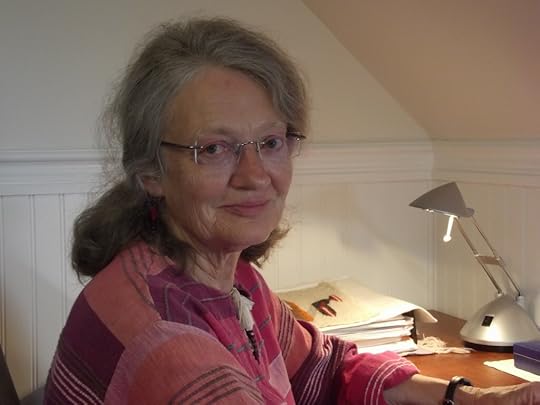 CLICK THE PHOTO for more info and an INTERVIEW!
PEACE ON EARTH 2026
CLICK THE PHOTO for more info and an INTERVIEW!
PEACE ON EARTH 2026
December 13, 2025
DAVID WAGNER, “LET ME SHOW YOU”: RADICAL LEGACIES OF A MASTER HISTORICAL ARTIST
 Writer/historian Jack Dempsey (left) and painter/archaeologist David Wagner (right) in 2003, on the hunt for new facts about New England’s first war, against the Pequots of Connecticut
.
Writer/historian Jack Dempsey (left) and painter/archaeologist David Wagner (right) in 2003, on the hunt for new facts about New England’s first war, against the Pequots of Connecticut
.Big-Hearted Little Bear—That was the perfect name for my beloved brother David Wagner, bestowed by Quinnipiac Native New Englanders (near New Haven, CT) when they tribally adopted both of us in the late 1990s. The name was one measure of how much visibility and voice David’s fearless creative life brought to peoples long erased and silenced by colonial kleptocracy.
We were close friends for over 30 years. We met in the Massachusetts statehouse during the first Native American Heritage Month held there, David exhibiting some of his stunning historical paintings and I reaching out for help producing my second documentary-film, NANI: A Native New England Story.
Why was our connection so immediate and strong? The answer is in the first and last things I’d like people to know about this man, who passed away at age 85 on December 6th, 2025. David was not only a consummate scholar, patient, fine-toothed, self-taught, and working where the history of the landscape put its every book, document and artifact in new contexts, with hard-nosed luminous insight and uncanny common sense.
For all that, David’s central trait was his wide-open jovial generosity, plus zero concern for the power-serving petty politics that infect so many with his level of expertise. He had no time for that: he’d talk with anybody, listen astutely, and debate with open-minded civility. As you’ll see, David’s inclusive criteria for really knowing something put a lot of “noses out of joint,” in the phrase of our fellow Thomas Morton. I can’t count how many times David shrugged and smiled, “Jeeze, I guess that’s too bad.”
You’ll find detailed biographical facts at David’s obituary-page—and a virtual showcase of his Native New England paintings at our collaborative website Ancientlights.org. At the top of the latter’s Welcome-page, you can hear David talk about another of his core principles: what he called spiritual archaeology. It’s a “felt” term that panics most careerists. David only meant that the key to understanding ancient peoples was/is their reverence for Nature’s every living atom, and that their life-ways and arts embody this in mysterious plain sight.
Was that what gave David such a knack for uncanny discoveries large and small? I hope this page is one beginning-measure of his achievements.

As our friendship grew in the 1990s, David had multiple ongoing projects: I was digging into Thomas Morton’s New English Canaan and Merrymount on Massachusetts Bay. One spring day we walked that Wollaston Beach together, David sharing facts about the once-numerous shell-heaps left there by Native New England’s regular seafood feasts and family festivals. He stopped, showed me the mud flecked with white remnants of those heaps—and straight to his hand came the clearly-fashioned tool shown above, of puddingstone as hard as granite.
“Look,” David said (always his first lesson!). He fingered the clearly sharpened edge (above, right), and the worn-in little “cup” just behind it, exactly where a forceful thumb would fall in years of prying open clams or tanning a deer-hide. (The pointed left end too would find many uses.) He judged it Early or Middle Archaic, or roughly 11,000 to 8500 years old. Still here? In such a built-up area? “So are the Native peoples,” he smiled. “Some of the oldest finds are from close-by places ploughed up for golf-courses. They didn’t carry stone tools around, but left them where they used them in common. That also partly explains the spectacular ‘tool-kit’ found right near here, in Caddy Park. Here, Jack—you keep it for us.” I still do.
 Above, part of David’s history of New England just after the Ice Age, with a seaboard waterfall 60 times the scale of today’s Niagara (see “After the Ice” at Ancientlights.org). In those days of low sea-levels the region had over 250,000 more square miles of dry land, oral history told of people walking to visit relatives on Nantucket, and fishermen still dredge up teeth of mastodons. Below, David’s concept of a Middle Archaic village with spiral-form wetus.

As that find came to David’s hand, another one came to his foot. He loved to explore Connecticut’s woodlands. He told me that one day his boot scuffed into the soil, and struck another cache of tools and points only inches from the surface. To his wonderment, it included Clovis spearpoints like the one below. If the famous ultra-early age of Clovis artifacts belonged to the American Southwest, what were they doing here? For this and reasons below, David was sure that Native New Englanders preserved their ancient broad heritage in part by caching together objects made in far-flung places and ages of time.

This region’s forests are filled with ancient Stone-Works and David had a gift for finding them. Small pillar-like cairns of piled stones intrigued him enough to persuade University of Connecticut archaeologists to look inside and below some of them. Sure enough, David found another cache even larger and more diverse in multi-period artifacts—elegant tobacco-pipes and drilled stems, whale-tail weights for giving heft to atlatl throwing-sticks, even the figurine below that evokes a Hopewell (mid-American) inheritance.
When his fellows balked at such an anti-chronological “jumble” of objects—one of them even remarking, “That shouldn’t be there”—David held to the fact of such careful burial. Why? They had to be heirloom-objects of tribal memory, left behind when the last free Native New Englanders decided to leave their ancient but conquered country, for parts-unknown. Most of David’s fellows rejected the idea (offering none themselves), and to this day most of these continental-scale finds remain stowed away on dark University shelves.

 A Late Woodland-period village
 In David’s portrait of a Late Woodland (“Historic” period)
family dwelling, you can see each step of how Native New Englanders crafted their elegant pottery.
In David’s portrait of a Late Woodland (“Historic” period)
family dwelling, you can see each step of how Native New Englanders crafted their elegant pottery.
If Native New England still hides in plain sight, David had an eye for finding it. Hiking the forests of eastern Connecticut, David noticed multiple boulders pecked with features of snakes (a long-acknowledged Native symbol of power and rebirth). Soon, he was finding significant alignments between them. Below is his chart demonstrating their use as a calendar of New England’s narrow seasonal window for growing corn—along with beans and squash, the life-sustaining staples of their bountiful “Three Sisters” agriculture.
 You can watch David explain this calendric site in Part 1 (“The Land & the People”) of NANI: A Native New England Story (2000).
“Now, look up,” David said, as we studied the animal-images pecked into the site’s largest boulder (A above). And there, dangling high in the sunny boughs of a 30-foot sapling too slender to climb, were dozens of small carved animal-effigies from deer to beaver and eagle: proof that Native New Englanders still secretly reverenced this place. But how did they put them up there? “Those animals are still totem-spirits of families and clans,” David answered. “They had to be hung when the tree was small, and now every year it lifts them higher toward the sun, moon and stars.”
Yet another mystery in plain sight had always sparked David’s interest and decades of research: the still-controversial seaside structure called Newport Tower (RI), whose likely-first historical mention came from the explorer Verrazanno in 1524. Who built it, when and why? (See Time Line 2 at Ancientlights.)
David put his view into the painting below, showing part of the well-attested pre-Columbus voyage of Scottish Knights Templar led by Henry Sinclair in 1398. Indeed, we and others met with Sinclair’s direct living descendant (of Rosalyn Chapel fame), all of us hoping to organize a symposium as wide as the whole Northeast to feature the region’s cutting-edge discoveries. But alas, we reached no agreement about where this should happen: either in Boston for maximum visibility, or in Nova Scotia Micmac country where Sinclair had first come ashore (and is remembered to this day). “Why not hold it altogether out of sight, in Greenland?” David remarked.

Meanwhile, as my edition of Morton’s Canaan neared publication (2000), I showed David a detailed design for the book’s cover, which he turned into the painting below. “And there it stands, as a fair sea-mark,” to paraphrase Morton, “how to find the way to Mine Host of Merrymount.” Never again will American Puritans chop it down, nor denigrate Morton’s manifold achievements at the foundation of our multicultural frontier—not least, his documented standing as America’s first poet in English, whose work envisioned a country of respectful coexistence and compassionate cooperation. Enjoy the raucous Revels dance and music still going on at the site of Morton’s trading-post!

David’s generous compassion guided more years of labor to document other long-ignored contributions to America—below for example, in the “desperate valor” of the American Revolution’s only Black/African-American fighting force, The First Rhode Island Regiment. In 1778, the hard-pressed General Washington ordered the colony’s governor to organize a force of “Blacks, Mulattoes and Indians” into the Continental Army. And every American and French officer who encountered them noted their rigorous spit-and-polish as well as their ferocious bravery in multiple battles against British and Hessian divisions.

“See the regimental symbol on their hats, the stitched-in anchor?” David said as I watched these paintings take shape in his workshop. “Now how could that still be the symbol of Rhode Island today, and yet almost nobody knows about their fight for freedom? Former slaves, life-indentured artisans—Find out about their brutal stand at Bloody Run Brook, in the battle of Portsmouth in 1778, which covered the Continental Army’s retreat and saved them to fight another day. In the end, what did First Rhode Islanders get for it, while Town-Destroyer Washington paid his white troops with land he’d stolen from the Iroquois? They went back to lives of subjection and poverty.”
As you’ll see in the full story linked just above, David’s indignant labors in this matter spanned 20 years of art-based activism. He took them as far as Washington, D.C., prompting a review of African-American inclusions in the historical paintings that grace the Capitol. But after the building’s Chief Architect George M. White (yes) found only a paltry presence for them there—one was “a black man at the back of a boat”—White told Congress that he saw no need for more. From there David, stepping past a few “sorry” senators, reached out to Colin Powell (at the time, Chairman of the Joint Chiefs of Staff). “Very interesting,” Powell replied. “Regrettably, I cannot express a view or preference….Best of luck.”
For all this, David’s paintings and murals now have homes in public institutions across the Northeast and beyond. Here are two invitations to online galleries of his extraordinary works on American and French cooperations in Revolutionary times (accurate down to the coat-buttons), which led below to his late-life international recognition (below). Enjoy David’s own website and his works presented by the Helen Bumpus Gallery.
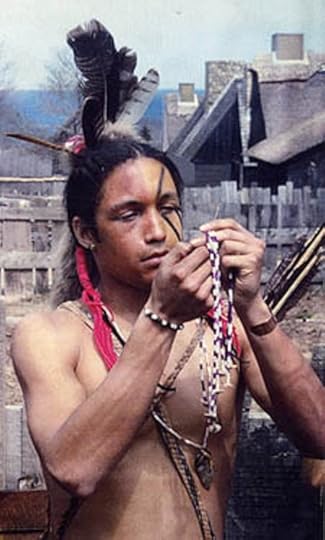 Nanepashemet a.k.a. Anthony Pollard, late of the Assonet Wampanoags, whose self-taught scholarship and multi-dimensional artistry also revolutionized understandings of Native New England. To find out how, click on the photo.
I bring this film NANI: A Native New England Story into this page about David Wagner because I’ll never have words for how much he helped me to produce it. As said at the top here, from the day he heard of the project in the Massachusetts statehouse, David (who of course had known the man) became an inexhaustible source of new learning and connections with new colleagues in the Native and historical communities surrounding both of them. Introductions, phone-numbers, addresses, key powwows and events: without him I could not have found so many paths and people crucial to show-and-telling Nanepashemet’s achievements. These days, when I glow with gratitude for the work, David’s smile lights up inside me with a darkly funny postscript.
You see, Nanepashemet’s own loving laboratory for the rigorous re-creation of early New England had been the full village he built with other Native scholars at Plimoth Plantation. (We had both noticed this distinguished museum’s backwards topography: today, the one village lies down a side-path from the main exhibits, but in original times it was fortified Plimoth surrounded by Native villages.) Well, a few years after Nanepashemet’s untimely passing, Plimoth held an evening of remembrances for him. “And,” I growled to David, “as the man’s only film-biographer, I was not invited.”
“Jeeze, I guess that’s too bad,” David made (and still makes) me laugh, with a shrug and a dark grin in all directions.
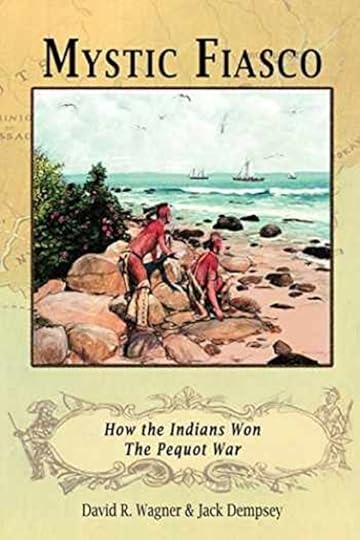
Here you’ve seen only some fruitful legacies of David’s wide-awake walking in his landscape. The book above was our last and longest (7-year) project: click the photo for the full free text with his painting-illustrations in color.
“What? The Indians won?”
“When you cooperate across communities, prevail in the fight, and quietly survive the attempt to exterminate you and steal your land, yes—you win. That’s what the Pequots, Mohegans and their kinsmen accomplished, and it’s why they’re here today. Let me show you,” David said.
So, with countless site-excursions and discussions (along with another of David’s dearest scholarly brethren, Connecticut’s David Ostrowski), here in brief are the startling findings, fruits, and fallout-so-far of our investigations. If we’re learning from David, keep an open mind until the book’s documentations take you through the fine-tooth weeds.
 Mohegan Sachem Uncas (left) and Narragansett Sachem Miantonomo, complex and formidable men in and after the Pequot War.
 And here is David—or rather (!), here is his conception of Captain John Mason, one of the two chief bumbling bloody evangelical mercenaries who wished they had massacred Pequot people on behalf of the Puritan colonies. I never could make David explain why he gave Mason his own face—of all people!
In the beauties of David’s works above, you see why the Mashantucket Pequots and Mohegans wanted his paintings to grace their resurgent reservations in the 1990s. Then came the Pequots’ commission for him to paint every stage of the Pequot War.
As usual, David started by walking the war’s landscapes from Narragansett RI to Mystic CT and beyond. He was thus the war’s first historian to bother doing so, and in his hands were the only eyewitness accounts of what supposedly happened (by English captains Mason and Underhill). Immediately, David told me, the land began to show him that most of the “English victory” claims were impossible, even laugh-out-loud preposterous—notwithstanding generations of later historians who blessed those accounts as fact, with all the trimmings of fiction, elision, racist-colonial sadomasochism, and egregious fakery.
 David follows the “histories” round the shores of the tidal river called Mystic (from Native Missituc).
In the Englishmen’s own words, they confessed that they couldn’t tell one “savage” from another; that they did not know the landscape, nor could they follow their yet-uncounted “enemies” through it with their bulky armor and weapons (this was ancient Old Growth forest that intimidated Thoreau himself two centuries later).
They confessed that without help, they couldn’t find their cross-country way to the targets of their murderous plan, itself so poorly defined that more than one fellow-English refused it; that they scarcely understood Native New England’s old and close family relationships, their ways and values in warfare; and, that every report of Native deaths came from Native people themselves. Not least—not a single fort-bound colonist even tried to confirm their captains’ glorious claims.
 As Mohegan “guide” Uncas looks on (left), Narragansett’s war-seasoned Sachem Miantonomo laughs at the Englishmen’s poor plan of attack and too-few numbers for it against New England’s most powerful Native nation, the Pequots led by the “villain” Sassacus.
Chanting psalms of war from their all-knowing Bibles, could the English make the watchful Pequots believe they’d sailed timidly away from the Pequots’ chosen battleground—and then march “undetected” all the way back from Narragansett to Mystic, for a genocidal surprise-attack? Did they know that their keenly intelligent “guide,” Uncas, was leading them west on the main highway of kinship and trade still called the Pequot Trail?
Did they know that Uncas was in fact brother-in-law to their mortal enemy Sassacus? (So was the sachem of Mystic itself, Mamoho.) Why didn’t they believe intelligence that the people they meant to mass-murder had already fled to safety among affiliated tribes, from central Massachusetts to Long Island and “upstate” New York? What did it mean that they ignored the large seasoned fighting-force likely waiting to welcome them?
The land told David that to surprise Mystic was all but impossible. The land showed him that Pequot counterattacks instead trapped most English inside the fort they’d meant to annihilate. The land falsified English and historians’ claims of a look back over their shoulders (as they fled downhill from Mystic) to see heaps of dead Pequots in flames and the hair-tearing rage of their warriors—because no such look is possible there in leafy May.
Nor thus could they have “sighted their [rescue] boats” arriving on Mystic shore, which was actually miles from their intended rendezvous. The lay of this land led them and David not miles further west, and so straight toward Sassacus’ own formidable village at Weinshauks—but to the beach right below Mystic’s hill. There, a company under siege could at least put the sea at their backs, to make weakening men fight the harder for their lives. The victors had been routed utterly.
For all this, as Pequots “faded” into the land and other tribal identities, the English went home and sang and scribbled for years of their genocide’s success. The self-terrorized colonists wanted desperately to believe them, such that their so-called Treaty of Hartford outlawed utterance of the Pequot name. When Uncas, who’d saved hundreds of people behind the scenes, showed up at Boston to pledge his fake future fealty, several “most wanted” Pequot warriors stood at his sides unrecognized (till it was too late to spare the confused tyrant-governor John Winthrop such embarrassment).
And that—a lied-about fiasco of a war declared as “Connecticut’s Birthday”—became the schoolbook paradigm for how colonizers should behave on the human frontiers to come. Of course! God, or at least their own violent greed, would furnish astounding miracles, quoth the captains! Shouldn’t childish but dangerous Natives who’d been family for centuries be grateful for a chance to serve the cantankerous sons of light who openly despised them, armed to their civilizing teeth as they planned more conquest?

Perhaps, given David’s fruitful liberating paths, we might start asking where else Native Americans actually won against the land’s new wanton non-rules, called Total War.
The radical point within David’s observations exposed the self-blinded assumption between the lines of Bible-authorized colonial history—that Native New Englanders possessed no real world of their own, and no agency to change their (Mystic-al) “fate.” The good Christian capitalist patriarchs didn’t mean to conquer: their untamable manly energies merely rushed in to fill a void, which of course was their own willful ignorance.
Example: The night before their planned attack, Uncas delivered the footsore English to a place called Porter’s Rocks just north of Mystic village. Then, Mason’s narrative makes no mention that Uncas apparently vanished—while the English all fell asleep, finding only at sunrise that they’d missed their opportunity.
Well, what was Uncas doing all night? Snoring at master’s feet? Or fine-tuning plans with nearby Mystic’s welcome-party? From inside Mystic, the English heard singing: a foolish Pequot belief in their own safety, or a provocative taunt that meant We can’t wait to bust you up? Even if Uncas did stay by Mason, he “failed” to wake them up in time to launch their plan.
The Pequots’ own subtle plan drew the English in and then drove them into the wrong Atlantic. And yet, they let their cornered attackers live. In fact, a wound from a man who can kill you at will is a message, this one in the Pequots’ own words recorded elsewhere: Have you fought enough?
In Native New England, the aim of war was to teach your foes a lesson, and they held to their ways. The English aim was genocide—demonstrated down further bloody years of this war’s aftermath. Yet the Pequots and Mohegans outlived that too, trading space for something that never had meant much to them: time. With their world, their ways and their own brilliant agency, they saved their selves, from a predatory psychosis of profit now killing us and the free living planet. And they are still here, waiting for the lesson to sink in one way or another.
 David’s scene of a Pequot escape from genocide. Native New England’s interconnective trails and waterways—and, their ancient close and complex relationships—enabled their secret survival, while “history” books reassured the American nation of total victory.
Yet, alas, when David presented his findings to the Pequots and Mohegans, the response was almost-pure silence. Instead, David’s purchased works hang mostly in their hotel/casino hallways and private offices. So, we submitted this book to University of New England Press, and waited a year to hear anything about it from them. Finally cornered on the phone, they confessed “We were kind of hoping that Fiasco would go away.” Quote-unquote.
Still we kept on, very grateful for long sincere dialogues with the Mashantucket Museum’s own open-minded directors, as they dug and studied to create a whole new exhibit about this war. Yet in the end, it followed only the captains’ putative paths, and pseudo-confirmed their claims of mass carnage and conquest. How did the “Mystic Massacre” happen against all likelihood? Their best: “The Pequots didn’t expect the English to fall upon them so quickly….” Another miracle.
“Jeeze, I guess that’s too bad.” Then tell me, brother, how much longer will we imitate reckless fools and endure their destructive, wholly demoralizing results?
***Finally, the unfortunate yet promising adage: “Everybody who makes it starts in Europe.”


At long last, in 2015 the Republic of France bestowed their Order of National Merit on David, for his dozens of stunning tableaus of French-American cooperations in the age of Revolution. Some predictably-posthumous day, perhaps some American institution will rise to honor his extraordinary art and discoveries, to foster a multidimensional history from which we can really learn.
David, dear brother forever—Thank You.
 Last photo of the old guys’ last visit together (2018)
November 2, 2025
COFFEE WITH GAZA’S (LATE) POET SALEEM AL NAFFAR
 Saleem al Naffar—who wrote defiantly, “I am hiding my resurrection among flowers.” True enough, for Saleem will live forever in his poems.
My dear Palestinian brother, Gaza historian Muhammad Ismael, has suffered many deeply-personal losses of family and friends in these years of Israel’s genocidal onslaught. And one of the hardest to bear was the murder of his close friend and coffee-partner, acclaimed poet Saleem al Naffar. Saleem, whom Muhammad called “a wild adventurer,” had refused to leave his home in Gaza City. And one day in late December 2023, Saleem and his entire family (12 persons) were killed in an Israeli airstrike targeting the house. To this day, their bodies (like tens of thousands of other Gazans’) lie unrecovered from the shattered rubble.
Saleem’s fame as a poet had been growing through the years of their friendship, and he was “ecstatic” when Muhammad began to translate samples of Saleem’s works into English (which you can enjoy with several other pages about him on this WordPress site: just search for “Saleem”). This work, a great source of comfort to Muhammad, goes on whenever he can muster the spirit to do more—in-between his harrowing weekly walks through artillery-fire to carry home water and food to his starving wife, children and family.

Below, you have Muhammad’s latest tribute to Saleem—a testimony to the love, literary passions, and life-loving laughter they shared in weekly rendezvous in a Gaza cafe.
***Raise Your Glass High, My FriendOn December 7th, 2023, my friend Saleem Al-Nafar and his entire family of twelve persons were murdered by an Israeli airstrike targeting their shelter in a building in Gaza City. Saleem stands among the best poets writing and chanting their words in the history of the Palestinian people. He was a gentle, peaceful, and tolerant person. He loved life passionately, and dreamed of a better future for his four children.
Over many years, Saleem and I met two or three times a week, most often in the central area of Gaza at Delice Café in the Nuseirat refugee camp. Despite my lack of proficiency in poetry (I am an historian), Saleem considered me his first listener and the first critic who should weigh in on his new poems. He once told me that he was confident of a fair hearing for every new work he shared with me.
His recitations in the café were like a special ritual. He recited his verses with reverence, like a monk or a shaman, with the steam of hot coffee and the smoke of his endless cigarettes rising between us. I would listen and savor the coffee until, eventually, I reached ecstasy.
Knives might eat
what remains of my ribs,
machines might smash
what remains of stones,
but life is coming,
for that is its way,
creating life even for us.
In our café sessions we talked about poetry, literature, and everything else in the strange life we led in Gaza. We shared politics, sports, cinema, cuisines: our difficult financial circumstances, our debts, and our tactics for escaping creditors. We reflected on our struggles in life and how we each found food for our families. We kept no secrets from each other, Saleem involving me even in his most private matters, such as the details of his romantic adventures.
He usually had something to share also about wine. Saleem enjoyed drinking wine and making it himself in his kitchen with primitive techniques. He did all this confidentially, as wine is forbidden in Gaza, and Hamas severely punishes anyone involved with it. Saleem’s chases with Hamas were endless. He was brave, daring, and adventurous, challenging the mightiest risks for a moment of enjoyment in raising his glass and making a toast.
He talked a great deal about his wine-making methods: he was always striving to expand and update his knowledge in the field. For his toasts, Saleem extracted nectar from grapes, apples, figs, persimmons, dates and other fruits. I don’t drink wine, but I could judge that he had talent in producing it.
I was frequently afraid for Saleem because of his wines’ consequences. It was exhausting him financially, as he spent a lot of income on it and sometimes went into debt to pay for it. Worse, because of wine he might fall into the jaws of Hamas, and so face their violence, persecutions, imprisonment or torture. This would have done Saleem much harm both socially and psychologically.
My last meeting with Saleem was a week before our new catastrophe began on October 7th, 2023. We met at his home in the Nasr neighborhood of Gaza City, not at the café in Nuseirat. We shared a delicious dinner prepared by his wife and daughters, drank coffee, went for a walk through the streets of Gaza, and ate kunafa from a shop. That evening, a strange feeling came over me. I saw the city sad, as if she were preparing herself for some disaster. I had no idea that it was the farewell meeting for Saleem, and for Gaza.
We were in constant contact from the start of Palestine’s new catastrophe until the day when he and his family were murdered. We checked in on each other almost daily, communicating mostly via SMS because the internet was often unavailable and phone-calls were difficult. I kept up with Saleem and his family as the food crisis intensified into famine in his Gaza City: he was updating me with new locations in their repeated displacements, as they ran from Israeli tanks and bombing to one neighborhood after another.
I feel nostalgic about Saleem. He never leaves my mind, and I cannot stop remembering our days together. I hope that The Lord will grant him Paradise because, as we believe in Islam, there forever flow rivers of refined wine. There he will drink the best vintage for free, drink it happily and in peace, without fear, anxiety, or being pursued by anybody.
Heaven’s wine suits you, Saleem. Look down at me from above the clouds, show me your clear strong smile, and raise your glass high, my friend.
*** PostscriptsSaleem and Muhammad relished their differences of approach to the arts of language, one a visionary poet and the other an empirical historian. Saleem always shared new work first with Muhammad probably to take his chants and visions right into the jaws of Muhammad’s discipline. So, in honor of both these courageous loving creative men, first below is Muhammad’s own rare poem—and then, the video-reading that he asked me to do for his essay above.
PEACE, THROUGH JUSTICE & EQUALITY FOR PALESTINE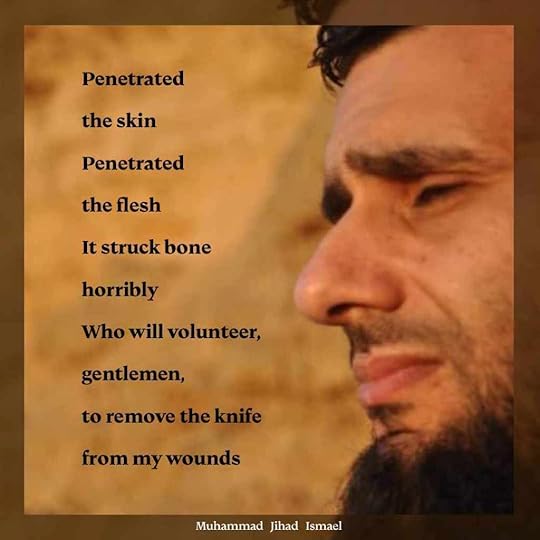
TRAVEL THE ANCIENT WORLD WITH 'PEOPLE OF THE SEA: A NOVEL OF THE PROMISED LAND'

- Jack Dempsey's profile
- 3 followers

