Ray Wright's Blog
April 23, 2026
What in thee Hell did I just read?!
Daytona Beach, FL –
SPOILER ALERT! Only for those who have read my book!
After my dear friend Doley introduced me to my dear editor, Catherine Adams, The Inkslinger, the real heavy lifting began. If I was to convince her to work with me, I had to submit a 10-page essay to her detailing what my book was all about for her to consider my submission. “Well,” I thought, “what’s another ten pages?”
The following write-up differs slightly from what I initially shared with The Inkslinger, as I’ve modified it for people that reach out to me who tell me that their Book Club has selected my work for their monthly discussion. But I hope you find what I share to be insightful, and if you pick up my work for a second or third time, I hope this gives you a new appreciation for what you’ve read.
Enjoy!
I. Plot Level: If you ain’t a pilot, you are a failure.
The plot of If You Ain’t a Pilot… is not very complicated. With the goal of Undergraduate Pilot Training (UPT) being to graduate and become an Air Force pilot, the basic plot is fairly simple: If you ain’t a pilot, you are a failure. The struggle of the main character, me — and of all the students in Class 88-07 — is to graduate and become an Air Force pilot. The good guys are the student pilots. Relative to this plot, the bad guys are the instructor pilots to a certain degree, but more so, the pilots of a special group of instructors assigned to evaluate students, known as Check Section, are the main adversaries.
After being confined to a mountainside on the eastern slope of the Colorado Rockies for four long years as Air Force Academy cadets, my classmates and I were tired of rules, ready for our freedom, and fired up to fly jets to defend the freedom of others. What we didn’t see coming was that one year of flight school would be even harder than four years at the Air Force Academy, that not everybody who started UPT would finish it, and that not everybody who finished UPT would get a desirable flying assignment.
A wrinkle in the basic plot is the irony that even by graduating and becoming a pilot, there was a real possibility that students could be assigned to a number of undesirable aircraft and Air Force bases. Guarding against the threat of a Soviet attack at the end of the Cold War, most tanker and bomber bases were positioned far from the edge of humanity in desolate nowhere-lands of mosquitoes, moose, and fish. Another possible outcome was to graduate and then be assigned as an instructor pilot in Columbus, which almost nobody wanted. All I wanted to do was to fly a cargo jet at a base near a beach. Thus, the plot also involves not only graduating but not getting stuck with an undesirable assignment.
The climax of the action on this level occurs in the scene where I am flying my T-38 formation check ride against Beez. He puts me in a bad situation, and if it weren’t for the Check Section pilot taking control of the aircraft from me, I would not have been able to avoid a mid-air collision. Having had the jet ripped out of my hands, my classmates, instructors, and I all think I have failed the ride, and by failing this particular ride, it would be my third failed check ride and quite possibly the end of my flying career.
In the next scene, I reveal that I earned a passing grade because I’d applied the proper procedure when the unsafe situation occurred. The next scene also offers an important plot development on this level when I learn that I have earned a FAR (Fighter Attack Reconnaissance) rating, ranking me in the top half of the class, opening the door to the possibility that I will be chosen to become an instructor pilot and remain in Columbus.
The resolution to both pieces of this plot level are revealed in the scenes on Assignment Night. When I share the story of how I passed my last check ride with Skeletor, the most villainous of all Check Section pilots, I reveal to the reader that I have done enough to graduate from UPT, and I will become a pilot. Moments later, when I learn my assignment, I find out that I’ve been given an undesirable assignment. Though being named to remain in Columbus as an instructor pilot is not the assignment I wanted, however, I should have seen it coming. When Captain Fitzmorris asks me if I’m ready to buy his boat, a tired joke I’ve never found funny, I ask him, “How much?” This shows that I am ready to accept my fate.
Even though I suffer multiple setbacks, I try to keep the tone of the story positive and fun. First and foremost, If You Ain’t a Pilot… is a comedy, and in telling my story, I tried to include all the elements of a classic comedy. It is also a story about friendship, and while our class at Columbus Air Force Base, UPT Class 88-07, was a very tight group, the main relationships on which I focus are those with my best friends, Kenny, Doley, and Kurt. I try to include an anecdote about each one of these characters in every chapter. The humor in scenes with Kenny is usually off-the-wall and unexpected behavior from an Air Force officer. The humor in scenes with Doley is mostly when he makes fun of someone or something. The humor in the scenes with Kurt occurs when he candidly talks about life as a husband or father in ways that single guys cannot understand or do not want to know.
II. Theme Level: If you ain’t a pilot, you are not to be valued.
As the title of the story implies, If You Ain’t a Pilot… is very much a story about attitudes. The conflict with which my character wrestles in this layer of the story is the same Air Force adage on a different level: If you ain’t a pilot, you have less value than those who are. First, is it true? Next, if it is true, must it be so? The opposing sides on this theme are much less distinct than those on the basic plot level. In this layer of the story, there are those who accept this attitude and others who reject it from various groups of people. For example, not all instructor pilots think and treat students less than professionally, and not all students are bothered by not being treated with dignity and respect.
At the Air Force Academy, we were taught that after graduation, we would be military officers first and pilots second, but at Columbus Air Force Base, we are immediately introduced to the opposite doctrine, one that creates a very segregated environment. Throughout the story, I point out elements of segregation in the town of Columbus between Blacks and Whites in a matter-of-fact manner without really condemning either side. I am less overt, though much more critical, about the segregation that exists between pilots and non-pilots and male pilots and female pilots in the Air Force. I also take shots at religion, North-versus-South, and many other ways we define and divide ourselves as people, and for the most part, I attempt to do so through ridicule and sarcasm rather than through judgment and self-righteousness.
In the scene where I have a conversation about politics and life with an elderly man who was supposed to have mowed our lawn, I finally make the connection that segregated systems, like pilots and non-pilots, Blacks and Whites, male pilots and female pilots, etc., all result from one group having the aforementioned attitude, which could be more universally applied as: If you ain’t like me, you have less value than I do.
The climax of this theme in the story occurs just before my friends and I need to brief up a four-ship formation ride. Having just seen my T-37 instructor, Major Lawson, who has left the Air Force for a job as an airline pilot, my friends and I wonder why good people seem to leave the Air Force, and not-so-nice people remain. When Kurt suggests, “We can change it,” his statement is the rejection of this bad Air Force attitude and is meant to give hope for the future. I demonstrate that I also reject this manner of thinking when Smudgie, my instructor for our four-ship flight, one who embodies the “If you ain’t a pilot…” attitude, repeatedly tells me how I must say something he wants me to say. I purposely don’t say what he wants, which makes him go crazy.
III. Framework: To be a pilot, you must understand the Laws of Thermodynamics and the Law of Maximum Entropy Production.
I have always thought of my book as a story about chaos, illustrating the breakdown of systems from order to disorder. Entropy degrades just about every type of system mentioned throughout the story. Some examples of this: The civilian maintenance system breaks down, the training timeline breaks down, relationships that are not maintained break down, and even my digestive system breaks down when I don’t take care of it. This goes on throughout the story in various degrees right up to the scenes where my buddies and I drink tequila in Mark Jellicot’s van and I come up with the stupid idea that growing a mustache will make a difference in my future flying assignment. These scenes are intentionally completely ridiculous (and pathetically, they are pretty much true to what really happened).
For years, I had no idea how entropy could sustain a story or how entropy could allow me to arrive at an ending point. As cadets at the Academy, we joked about entropy and the Second Law of Thermodynamics, wondering, “If this Law were true, then why didn’t everything in the entire universe move from order to disorder, causing the universe to revert to total chaos?” At the time, our professors told us that the reason the world did not revert to total chaos was because the Laws of Thermodynamics only applied to closed systems.
What none of us knew at the time– and what nobody knew at the time, because the reason had not yet been codified– was how the Law of Maximum Entropy Production explained why the world did not revert to total chaos. This Law was not recognized until 1988 and not articulated in its present form until 1989. I graduated from college in 1987 and finished flight school in 1988. I didn’t even know this Law existed until about ten years ago, when I was doing research for my book.
The Law of Maximum Entropy Production (LMEP) is as follows:
“A system will select the path or assemblage of paths out of available paths that minimizes the potential or maximizes the entropy at the fastest rate given the constraints.” ( http://www.lawofmaximumentropyproduction.com/ )
The LMEP made me realize that both the joke we asked as cadets about entropy and the answer our instructors gave out at the time were wrong. Entropy is not an on-going process. Systems do not continuously move toward a more disorderly state. Instead, systems move to maximum disorder as fast as they possibly can until they run up against constraints that prevent them from further chaos, or the entropy has been maximized.
This law also states that systems move to minimize potential as fast as possible, and this ties directly into the segregation themes. Even though Air Force officers are supposedly officers first and pilots second, the pervasive attitude of “If you ain’t a pilot, you ain’t shit” minimizes the potential of non-pilots and results in a segregated system. Likewise, even though the story takes place two decades after the Civil Rights Movement, and people of all races are equal under the law of the land, the attitude that Blacks and Whites don’t mix effectively minimizes potential of one group relative to the other and again results in a segregated system. In spite of the promise of a system of equality, the LMEP explains how attitude is a sufficient constraint upon people to allow one group to keep another in check.
After learning about the LMEP, I realized I had my framework for my story, because this Law allows me to relate a tale of entropy and still wrap it up with an orderly ending. Thus, I weave in the Laws of Thermodynamics, the rules that govern how heat and energy behave within systems, and I include the LMEP as the framework for my story to explain why system degradation occurs and to provide a strategy for managing entropy.
The opening line of the book, “You can’t fart with impunity while a ceiling fan spins overhead,” is a clue that these laws and the LMEP play a major role in the book. If someone were to read my opening sentence and ask, “Why not?”, he or she would understand the concepts of equilibrium, transfer of heat and energy, entropy, and the constraints of the fan blades blowing air back in one’s face are all reasons why one cannot.
The scene in which my friends and I are fitted for our flight helmets at the beginning of our training is another microcosm for this level of the story. Because Kurt’s head is too big for the standard helmet mold-making apparatus, the helmet makers piece together an ill-fitting mold-maker with very poor constraints. As the chemicals are combined in the makeshift mold and begin to expand, the mixture oozes through the holes in the mold as fast as it possibly can because the constraints are not very good.
The Zeroth Law of Thermodynamics, that of thermal equilibrium, is introduced when Captain Wright tells Doley and me why he prefers cold beer to free beer. The concept of equilibrium, though not thermal equilibrium, is also presented in the scene in the altitude chamber, where students practice the One Cheek Sneak to equalize gastric pressure, and I am worried that I may not be able to equalize the pressure in my inner ear upon descent from altitude.
The First Law of Thermodynamics, a version of the conservation of energy, is explained partially to me by my T-37 instructor, Lieutenant Wilson, and fully to me by my T-38 instructor, Lieutenant Baiber, who mentions the law by name. There is a finite amount of energy. It can neither be created nor destroyed. You can use it wisely, or you can waste it, and the best pilots manage their energy to make the most of their time in the sky.
The Second Law of Thermodynamics is mentioned by name during the formation phase of T-38 training. When I say to Captain Schipp, “it seems to me like the flights are never flown the way they are briefed,” he tells me that the Second Law of Thermodynamics is the reason they never will be. Not only do the best laid schemes often go awry, but according to the Second Law, they always go awry, which is the heart of my story. Rather than leave me in despair, distraught that I will never fly the perfect ride, Captain Schipp provides a strategy for combatting entropy, which is preparation for a way to get back to one’s plan.
The Third Law of Thermodynamics, dealing with the concept of absolute zero, is invoked when I try to remove a tray of ice cubes from the freezer in our kitchen and cannot do it, because the temperature in the icebox has become like absolute zero. While the Third Law of Thermodynamics is not a major point of emphasis within the story, it is the ultimate punchline on the level of the story that deals with Ginsberg’s Law, a twist on this particular level of the story.
Finally, the LMEP is introduced in my conversation with the astronaut in the flight planning room at the Johnson Space Center in Houston. He affirms what Captain Schipp has told me about preparation being one way to battle entropy, but he goes even farther to tell me that if I have the proper constraints in place, I might even be able to prevent entropy. I cannot mention the LMEP by name in my story, because it hadn’t been articulated when I was a student pilot in 1987 and 1988. However, the astronaut pretty much recites this law to me word for word.
Whereas the Second Law of Thermodynamics is a law of despair, stating that systems fall apart over time, the LMEP states that not only do things fall apart as fast as possible, but once they have done so, order is restored. That is, the world is in the order production business. The LMEP also dictates that it is possible to keep things from falling apart, if one has put the proper constraints into place beforehand. Therefore, I can credibly relate a tale where everything feels like it wants to dissipate into chaos yet I can wrap it all up neatly in a world that once again has order. The LMEP allows me the positive outcome I wish to convey.
Having shared how the Laws of Thermodynamics and the LMEP frame the story, I’d like to make you aware of a few other devices employed throughout the work.
Flashback: The story, as presented in the manuscript, begins in media res, so that the anecdotes retold up until the week before Assignment Night can be done in a non-linear narrative, grouped around a particular theme. If told chronologically, the events of the first chapter ought to be presented just prior to what is now the penultimate chapter. I do refer to my six check rides in the order they occurred.
Double entendre: Nearly every chapter title is a double entendre, and I consciously try to employ some form of misdirection in each chapter, as the anecdotes are currently grouped, to lead the reader to believe each chapter is about something I readily reveal, when really it’s about something else. For example, “Funky Chicken” refers to the cigarette ash in my chicken salad, but pilots will know it refers to what happens when one experiences a G-force induced loss of consciousness (or G-LOC; see an example of the funky chicken here: https://www.youtube.com/watch?v=eMjjGgRLG8k). The rap trio of Kenny, Doley, and me is also called Funky Chicken, which I don’t think any reader, pilot or not, would see coming.
Another example from a chapter title is “Souls of Men.” All Air Force Academy graduates, and a handful of non-grads, will know this phrase from the second verse of the Air Force Song…
Souls of men dreaming of skies to conquer
Gave us wings, ever to soar!
I even have Kurt Spranger say to me, “we’ve got skies to conquer.” Trickery! This chapter title is directed more at the souls of men who have circumvented the Civil Rights Movement to perpetuate a segregated educational system through the use of private academies and the souls of Air Force officers, like Smudgie, who treat people poorly.
Hyperbole: This may be a bit of an over-exaggeration, but I purposely use mostly first names when I talk about student pilots and rank-with-last-names when I talk about instructor pilots. In practice, many instructors referred to student pilots only by last name, and likewise, when students spoke about instructors, we used only last names. I add this layer of formality with instructors as a device to help draw the line between instructors and students. Even though we were all Air Force officers, there was a deep chasm between these two groups. Our instructors were like our big brothers in that they could be our heroes one minute and our enemies the next. In my initial drafts, the feedback I got from my beta-readers was that I needed to show a clear divide between students and instructors.
IV. Metaphorical Level: If you ain’t a pilot, you are not in control of your life.
Getting back to the various levels of meaning of If You Ain’t a Pilot…, on the metaphorical level, if you ain’t a pilot, you are not in control of your life. The jet in my story, whether it is a T-37 or a T-38, represents a person’s life. Do you fly it in the direction you want to go, or are you simply a passenger along for the ride? Either way, on this level of the story being a pilot is representative of a person being in control of his or her own life.
The conversations around energy management, entropy, and other thermodynamic principles are as much discussions about life as they are about flying jets. In one such discussion with Lieutenant Baiber, he tells me, “You’re not doing a good job managing your energy.” Doley then adds, “Lieutenant Wright wastes a lot of energy.” When the astronaut teaches me the LMEP, I ask him if he’s alluding to the Challenger disaster, but it’s not just about that. Like my other instructors before him, he’s giving me a prescription for life.
To successfully operate in any system, you need to understand that systems want to break down, use your energy wisely, put constraints in place to prevent the system from breaking down when it tries to do so, and have a plan for getting back in control when systems do break down. Otherwise, you are only along for the ride, you are bound by the limits that define or constrain the system, potential energy is quickly drained, and entropy is maximized. This is not only true of flying jets but of everything. Diet, fitness, yard work, relationships, studies…, I address all of these within this framework.
I stumbled upon Ginsberg’s Theorem when I was researching the Laws of Thermodynamics, and as challenging as the Laws of Thermodynamics may be to understand, the poet Allen Ginsberg’s parody of them summarizes my character’s plight perfectly. Rephrasing the first, second, and third laws as if they applied to a game, he stated:
1. You can’t win.
2. You can’t break even.
3. You can’t even get out of the game.
Because I’m serious about nothing and treat everything I do like a game, when I learned about Ginsberg’s Theorem, I had my hidden meaning. I scatter references to this parody throughout the story, and I refer to games in chapter titles and within my writing. At the end of the story, while I do graduate from UPT, I am assigned to be a FAIP, a First Assignment Instructor Pilot, stuck in Columbus, Mississippi. Although I take control of the jet, a metaphor for taking control of my life, the story ends with me being stuck in a holding pattern, destined to remain at Columbus Air Force Base, bound by Ginsberg’s Theorem.
At the end of my story, I offer hope for the Air Force, when Kurt says, “We can change it,” and I offer hope for my character, when I say, “I have the aircraft.” Major Carrington doesn’t ask me if I’m ready to fly; he says, “let me know when you are ready to take control.” I shake the stick of the jet to take control.
The ending scene, as depicted, is the live action version of the Haiku poem I presented to Lieutenant Wilson much, much earlier in the story. Nearly 30 years after I actually presented this Haiku, “Transfer of Control,” to my instructor pilot, I thought it was the perfect way to end my story and tie a number of themes together. If readers were to go back to the Haiku scene after they’d finished reading the book, they’d see that I reveal the metaphorical meaning to my story when I tell Lieutenant Wilson what my Haiku is all about.
“Sir, in ‘Transfer of Control,’ the taker character is someone who has not been in control. For whatever reason, someone or something else is in control. This is not to say that the taker is necessarily out of control, but clearly, prior to taking control, the taker has not had control. Only when the taker shakes, an action of change, does the taker take control and no longer not have control. I think it’s as powerful an ending as the last line of ‘High Flight.’ Don’t you agree?” I asked.
“Not really,” Lieutenant Wilson said.
At the end of the story, I have not only come to the realization that I must stop going along for the ride, that I must manage my energy more efficiently, and that I must take control, but by shaking the stick of the jet, I acknowledge that I am taking control. My training is done, I am a pilot, and I am taking control of my life as opposed to allowing myself to be defined by the constraints of a particular system.
Just like Lieutenant Wilson did not understand the meaning behind my Haiku after I’d explained it to him, I fully expect that those readers who only see If You Ain’t a Pilot… on the comedy level or the basic plot level will not understand the ending, and this takes us back to Arnold Sommerfeld’s quote at the beginning:
“Thermodynamics is a funny subject. The first time you go through it, you don’t understand it at all. The second time you go through it, you think you understand it, except for one or two small points. The third time you go through it, you know you don’t understand it, but by that time you are so used to it, it doesn’t bother you anymore.”
Since I envision my story as an allegory that is presented upon the Laws of Thermodynamics, if readers don’t understand this ending, I’m quite okay with this. As long as readers have been entertained along the way and find the story to be a funny subject, like Sommerfeld says, I don’t think it will bother them.
V. Summary: If you ain’t a pilot…
In summary, If You Ain’t a Pilot…, my occasionally embellished collection of happy memories with great friends, seeks to make people laugh. It is a coming-of-age tale told through my experiences while training to become an Air Force pilot. Using segregated environments as backdrops, it is a story about systems that offers moral commentary about attitudes and the way people treat one another. Those who believe “If you ain’t a pilot/male/female/White/Black/Southerner/Yankee/military/civilian, you ain’t shit” slap a systemic constraint upon those not like themselves and minimize the potential of others.
Just as I’ve shared with you that I’ve tried to use double entendre and misdirection in choosing my chapter titles, the same is true with the title of the book. This story is not meant to affirm the adage, “If you ain’t a pilot, you ain’t shit.” For people who think it is, the joke is on them. This story is my ridiculing and rejecting the “If you ain’t a pilot…” attitude. For me, if you ain’t a pilot, I’m okay with that. You still have value, and you deserve to be treated with respect. Even though I am a pilot, I will do so.
The post What in thee Hell did I just read?! first appeared on Welcome.


April 21, 2026
10 Year Anniversary Blog Post – The Law of Maximum Entropy Production
Daytona Beach, FL –
The Law of Maximum Entropy Production within IYAAP –
The Law of Maximum Entropy Production (LMEP) is introduced in conversation with the astronaut in the flight planning room at the Johnson Space Center in Houston. He affirms what Major Carrington has said about preparation being one way to battle entropy, but he goes even farther to say that with the proper constraints in place, disorder might be averted.
The story cannot mention the LMEP by name, because it hadn’t been articulated when I was a student pilot in 1987 and 1988. However, the astronaut pretty much recites this law to me word for word – albeit anachronistically.
Whereas the Second Law of Thermodynamics is a law of despair, stating that systems fall apart over time, the LMEP states that not only do things fall apart as fast as possible, but once they have done so, order is restored. That is, the world is in the order production business. The LMEP also dictates that it is possible to keep things from falling apart, if one has put the proper constraints into place beforehand.
Thus, in a story where everything feels like it wants to dissipate into chaos, the LMEP allows me to wrap everything up neatly in a world that once again has order. Maybe we cannot escape the bounds of closed and efficient systems, but that doesn’t mean we cannot construct our own systems. Like the astronaut in the story, I’m talking about everything.
EpigramThe post 10 Year Anniversary Blog Post – The Law of Maximum Entropy Production first appeared on Welcome.
10 Year Anniversary Blog Post – Ginsberg’s Theorem in IYAAP
Daytona Beach, FL –
Ginsberg’s Theorem within IYAAP –
Ginsberg’s theorem is a parody of the laws of thermodynamics in terms of a person playing a game, first attributed to American poet Allen Ginsberg in a 1975 issue of the “Coevolution Quarterly.” Ginsberg, 1926–1997, was one of the leading figures of both the Beat Generation of the 1950s and the counterculture that soon would follow. He vigorously opposed militarism, economic materialism, and was known as embodying various aspects of counterculture, such as hostility to bureaucracy.
Ginsberg’s Theorem is a restatement of the consequences of the first, second, and third laws of thermodynamics within the context of game theory.
1. You can’t win…
First Law: Energy is constant – neither created nor destroyed.
2. You can’t break even….
Second Law: Entropy is always increasing.
3. You can’t even get out of the game.
Third Law: The entropy of a perfect crystal at absolute zero is exactly zero.
References to games and this parody are presented in order and appear scattered throughout the story. At Assignment Night, Ray learns his fate from Lieutenant Colonel Ginsberg. As a First Assignment Instructor Pilot, he can’t even get out of the game.
Who says science can’t be fun? Click on the YouTube icon below to see my video promo on “Ginsberg’s Theorem.”
YouTubeThe Law of Maximum Entropy ProductionThe post 10 Year Anniversary Blog Post – Ginsberg’s Theorem in IYAAP first appeared on Welcome.
10 Year Anniversary Blog Post – The Laws of Thermodynamics within IYAAP
Daytona Beach, FL – The Laws of Thermodynamics –
The Zeroth Law of Thermodynamics, that of thermal equilibrium, is introduced when Captain Wright tells Doley and Ray why he prefers cold beer to free beer. The concept of equilibrium, though not thermal equilibrium, is also presented in the scene in the altitude chamber, where students practice the One Cheek Sneak to equalize gastric pressure.
The First Law of Thermodynamics, a version of the conservation of energy, is explained partially by Lieutenant Wilson and more completely by Lieutenant Baiber. There is a finite amount of energy. It can neither be created nor destroyed. You can use it wisely, or you can waste it, and the best pilots manage their energy to make the most of their time in the sky.
The Second Law of Thermodynamics is formally discussed during the formation phase of T-38 training. When Ray says to Major Carrington, “it seems to me like the flights are never flown the way they are briefed,” the Second Law of Thermodynamics is given as the reason they never will be. The concept of entropy is used to create tension throughout the story.
The Third Law of Thermodynamics, dealing with the concept of absolute zero, is invoked when Ray cannot remove a tray of ice cubes from the freezer, because the temperature in the icebox has become so cold that nothing can move. Why is this important?
Ginsberg’s TheoremThe post 10 Year Anniversary Blog Post – The Laws of Thermodynamics within IYAAP first appeared on Welcome.
10 Year Anniversary Blog Post – The IYAAP Epigram
Daytona Beach, FL –
The IYAAP Epigram –
“Thermodynamics is a funny subject. The first time you go through it, you don’t understand it at all. The second time you go through it, you think you understand it, except for one or two small points. The third time you go through it, you know you don’t understand it, but by that time you are so used to it, it doesn’t bother you anymore.”
Arnold Sommerfeld, German theoretical physicist, 1868-1951
Arnold Sommerfeld is one of the pioneers of quantum and atomic physics. He was a German theoretical physicist who not only paved the way for the development of certain concepts, but also educated and helped a great many students for the then upcoming era of new theoretical physics. He is more popularly known for introducing the azimuthal quantum number or the 2nd quantum number and the spin quantum number or the 4th quantum number. (I don’t know what these things are.) Along with those achievements, he also pioneered the X-ray wave theory and introduced what is now known as the fine-structure consonant.
He has been nominated for the Nobel Prize 81 times, but never received an award of his own. He died in an automobile accident in Munich on the 25th of April in 1951.
For my story, I thought this to be the perfect quote. I thought Sommerfeld’s story to be the perfect utility of futility for that of my main character, his experience, and that of those reading my book.
The Laws of ThermodynamicsThe post 10 Year Anniversary Blog Post – The IYAAP Epigram first appeared on Welcome.
April 19, 2026
10 Year Anniversary Blog Post – The IYAAP Cover Design
Daytona Beach, FL –
Cover Design –
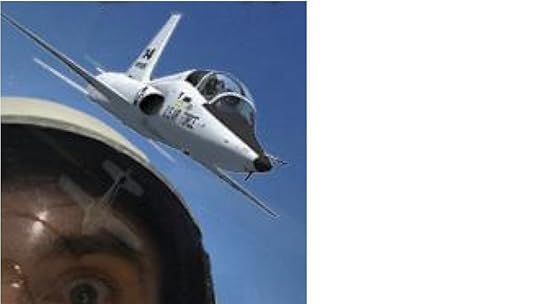
Greg Gannotti, my-brother-in-law, designed the awesome cover for If You Ain’t a Pilot…. Miss Rachel took the picture of my surprised eyes and furrowed brow.
The cover design follows the same rules given to the student pilots of UPT class 88-07 at Columbus Air Force Base, Mississippi, way back in July of 1988. That is, it doesn’t have to have aircraft, but if it had a T-38, it had to have a T-37 (and vice versa), and it needed to say “14 STUS” for the 14th Student Squadron to which the class was assigned.
[image error]
As told in Chapter 5, “Behavioral Disorder,” the class opted for a pink flamingo instead of any aircraft, and as shown above, “14 STUS” is printed on the surfboard.
In the cover design, the T-38 is easy to spot. Can you find the T-37? Is “14 STUS” really included, too? (Psst! Check the tail number.)

The post 10 Year Anniversary Blog Post – The IYAAP Cover Design first appeared on Welcome.
April 7, 2026
Legacy Blog Post 10 – Always Sound Cool on the Radio
“Always Sound Cool on the Radio”
UXBRIDGE, MA – March 20, 2019 – IYAAP Blog – As a student pilot in the Air Force, I learned that one of the three rules of flying was to always sound cool on the radio. The sky could be crumbling around me. Flames could be shooting from my engines. But because I was broadcasting a signal that would likely be recorded and played for my surviving family and friends if I crashed, at least at my memorial, they’d all agree: “This guy was one cool pilot.”
Fortunately, most of my in-flight emergencies were not life-threatening. But years later, even though I thought I’d cultivated a cool radio voice, when I tried recording my memoir about my time as a student pilot, I heard intermittent nose-whistling, frequent sniffing sounds, and every extended gasp for breath between my words. Definitely not cool!
I sat on my audio project for nearly two years before offering up my manuscript to narrators and producers in the Audiobook Creation Exchange. That’s where I connected with Robert Ferraro, narrator and producer for the audio version of If You Ain’t a Pilot….
An Emmy award winning television news producer with extensive experience at the NBC and ABC television networks, Mr. Ferraro has earned distinction and multiple awards as a writer/editor, and long form and documentary producer. He is also a published writer and poet with magazine, online, and newspaper credits.
Mr. Ferraro served in the U.S. Peace Corps in Panama, and has taught News Production at Purchase College, NY, and currently at the New York Film Academy. And he sounds cool. I have truly enjoyed our collaboration.
If You Ain’t a Pilot…, the audiobook, is available for download on Audible, Amazon, and iTunes. To learn what readers have thought of the book, please check its reviews on Amazon and Goodreads. For more insight on the antics of UPT Class 88-07 at Columbus Air Force Base, MS, please visit my website: www.raymondjwright.com.
Happy listening!
Ray
Preview my audiobook here.The post Legacy Blog Post 10 – Always Sound Cool on the Radio first appeared on Welcome.
Legacy Blog Post 9 – Gravity and Granite Walls
Gravity and Granite Walls
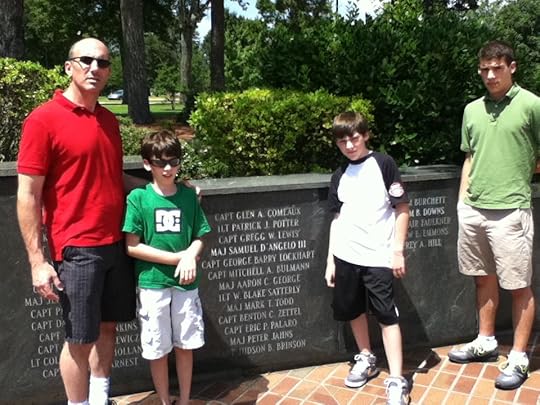
UXBRIDGE, MA – May 25, 2018 – IYAAP Blog – Gravity culled a training jet from the skies above Columbus Air Force Base this week. Fortunately, both pilots ejected and rode their parachutes to safety as their T-38C Talon II was pulled to an uncontrolled impact with Earth. No one on the ground was hurt. Gravity’s impact isn’t always so forgiving.
The Gene Smith Plaza memorial wall at Columbus Air Force Base honors the lives of pilots who flew at the base and were killed in military aircraft accidents. Although the list of names has grown since our family last visited in 2011, as pictured above, we are lucky that no names will be added as a result of this week’s incident.
Last Memorial Day, I was given the great privilege and even greater responsibility to address a hometown crowd at the ceremonies of the day. I wanted to tell the story of my classmates, friends, brothers, and sisters, whose names are carved into granite walls on military bases and hometowns across the United States. Sadly, I know far too many.
I chose to share a combination of my memories and words that others have written about two of my Air Force Academy classmates, who were killed in combat, and Captain Gregg Lewis, my brother-in-law, uncle to my three sons and godfather to the one in the middle, who died in a helicopter accident in 1998. I wanted people to know more about these men than where their names have been chiseled into granite walls.
Below, I am sharing the text of my address from last Memorial Day. Please read. Please share. Please never forget the ultimate sacrifice that these brave souls have made to ensure the freedoms the rest of us enjoy. Gravity and granite walls – they both suck.
Memorial Day Address, 2017, Uxbridge Town Common
We gather on this Memorial Day to remember and honor our fallen heroes. I have walked alongside our annual Memorial Day parade for the past decade or more, following the Uxbridge middle school and high school bands in which all three of my sons have marched and played. For the past five or six years, my son Jackson has been one of our trumpeters playing “Taps” when we pay our respect to the dead. But this is my first time participating in the parade, itself, and I thank you for having me.
I received my commission as a second lieutenant in the Air Force 30 years ago this very weekend at the United States Air Force Academy in Colorado Springs along with nearly 1,000 other young men and women. Most of us went off to flight school upon graduation to become pilots. Today, I’d like to share the stories of a couple of my classmates and one other fellow alumnus who followed us several years later.
Captain Pat Olson, was a big, tough kid with a great sense of humor from Washington, NC. My roommate had introduced us our sophomore year, and we became friends. We hung out in a big group of best buddies on weekends in downtown Colorado Springs.
Pat drove a red Delta 88, a giant boat of a car, that had no top, and he loved to torture his passengers in the back seat by treating them to the bone-chilling air of the Colorado night sky at 60 miles an hour. I remember screaming, “It’s cold! It’s cold!,” at Pat for an hour on a drive back from a road trip to Denver, 60 miles north of the academy. The guys in the front seat were kept warm by the windshield and the heater. Pat just laughed at me and the other freezing fools in his back seat. Whenever Pat drove for the night, there was always a fight about who had to sit in the back of the Delta 88 after sundown.
After graduation and flight school, Pat was assigned to fly the A-10 Warthog, and after Iraq invaded Kuwait in 1990, Pat’s unit shipped out to the Persian Gulf. During his deployment, Pat had been “adopted” by fourth-graders at St. John Parish School in South Milwaukee, WI, and in these pre-internet days, he spent much of his time in the desert penning letters to the children.
“I live in a tent with four other pilots and we have very little privacy,” Pat told his young pen pals. “However, the food and showers are both hot. The Army isn’t so lucky.”
On February 27th, 1991, while on his 38th combat mission in Saudi Arabia supporting Operation Desert Storm, Pat’s role as a Forward Air Controller was directing other warplanes toward the Iraqi tanks. The weather was cold, and there was an overcast cloud deck about 3,000 feet above the ground. Pat had to fly in and out of the clouds, low to the ground, to spot enemy movement and then pass the information to the fighters.
Upon receiving a radio call from Army troopers, who believed Iraqi tanks were about to pull an end run on their position, Pat dove his Warthog beneath the clouds, banked sharply, and threw his 57-foot wing almost vertical to the ground to aim at the Iraqi armor to prevent them from gaining a battlefield advantage on our troops. Pat diverted the Iraqis’ attention. Gunfire erupted around him, and the Iraqis shredded his jet.
Pat’s jet had taken so much damage, he had to fly on one engine and the third backup flight control system, but he was able to maneuver back into the clouds and escape the battle toward friendly lines.
Pat attempted to land his crippled jet on a sand airfield, but the damage was too great. With no hydraulic pressure left to support his landing gear, his wheels collapsed, his OA-10 flipped over and cartwheeled down the runway. Pat did not have time to eject.
Captain Olson’s name is etched on the Air Force Academy War Memorial in Colorado Springs for his sacrifice and dedication to this country during the Persian Gulf War. He left behind a young widow, Robin, his high school sweetheart.
Major LeRoy Homer, Jr. was another classmate of mine. I didn’t know LeRoy like I knew Pat Olson, but we both studied the same major in school, and we had many of the same classes. You may not recognize his name yet, but all of us here today know part of his story.
LeRoy was a soft spoken guy from Plainview, NY, and his close friends describe him as having a heart of gold. He had dreamed of flying since he was a young boy and began flying lessons at age 15, working part-time jobs after school to pay for them. He completed his first solo at 16, and by the time he entered the Air Force Academy, he had a private pilot license.
LeRoy began his military career flying large cargo jets at a base in NJ. He served in Operations Desert Shield and Desert Storm and received commendation for flying humanitarian operations in Somalia, an assignment that put his life at risk. He received many awards and medals during his military career and was even named the 21st Air Force Aircrew Instructor of the Year in 1993. After resigning from active duty in 1995, LeRoy continued flying with the Air Force Reserves and as an airline pilot with United Airlines.
That same year LeRoy met Melodie, his future wife. Introduced by friends, they communicated by phone and eventually met for the first time at LAX airport. Melodie wondered if she would recognize LeRoy on their 3,000-mile blind date.“Easy,” LeRoy told her, “I’ll be the one in the pilot’s uniform.” Two years later, they were engaged and married in 1998.
On the morning of September 11th, 2001, LeRoy was flying as the co-pilot with Captain Jason Dahl on United Flight 93.There were 37 passengers on board the flight that day, including the two pilots, five flight attendants, and four hijackers.Once airborne, the pilots received messages from United Airlines dispatch that said “beware of cockpit intrusion. 2 ac [aircraft] have hit the wtc.” Melodie also sent a message to her husband through the cockpit computer system.
When the cockpit door was breached, FAA’s air traffic control center in Cleveland could hear LeRoy declaring “Mayday” amid the sounds of a physical struggle in the cockpit. The plane was turned toward Washington, DC, and it was later determined that its target was the US Capitol.
As the hijackers attempted to fly the aircraft, what they didn’t realize was the automatic pilot had been manipulated in a way that made it difficult for them to fly the Boeing 757. They are heard on the cockpit voice recorder saying “This does not work now.” and then a minute later “Inform them, and tell him to talk to the pilot. Bring the pilot back.” Meanwhile, the passengers and flight crew found out about the other attacks and came up with a plan to take back the plane. The pilots, the crew, and the passengers of United Flight 93 all fought back, and in doing so, they saved Washington, DC, from an attack. United Flight 93 was the only hijacked plane that day not to hit one of its intended targets.
LeRoy received many awards and citations posthumously, for his actions on Flight 93, including honorary membership in the historic Tuskegee Airmen and the Congress of Racial Equality’s Dr. Martin Luther King, Jr. Award. Major Homer’s name is etched on the Air Force Academy War Memorial in Colorado Springs for his sacrifice in the Global War on Terror. His name is also etched into the National September 11 Memorial in New York City and on a monument in a field in Shanksville, PA. LeRoy left behind a young widow, Melodie, and a young daughter, Laurel, just five weeks before her first birthday.
The last person I’d like to tell you about today is Captain Gregg Lewis. A 1992 graduate of the Air Force Academy, I didn’t meet Gregg until he attended pilot training in Columbus, MS, where I was stationed as an instructor. We met in a social setting, and we became friends through the girls we dated: sisters, who both attended a local college.
Gregg graduated from Clarke Central High School in Athens, GA, in 1988. He was a popular student leader and co-valedictorian of his class.He played football and was elected captain of the track team his senior year, running the mile and two-mile events. Gregg was known for his drive, determination, and his unselfish desire to put the team first.
Gregg graduated from the Air Force Academy in the Top 100 of his class in 1992. As a flight school student, Gregg told me that unlike most Air Force pilots, who dream of flying fighter jets to shoot down bad guys, he wanted to fly helicopters so that he could rescue good guys. Gregg went on to become a helicopter pilot in the elite 66th Rescue Squadron, whose motto translates from Latin to “These things we do so that others may live.”
After having served a 20-week tour of duty in Kuwait on just three days’ notice, Gregg rotated back to Nellis Air Force Base in Nevada, where his squadron trained when they weren’t deployed to Areas of Conflict. They practiced flying low and fast to evade radar, anti-aircraft artillery, and surface-to-air missiles. They practiced flying through fierce weather to simulate desert sandstorms. And they practiced at night, using the new night vision goggle technology to find and rescue downed Air Force crews.
On the night of September 3rd, 1998, Captain Gregg Lewis set out in one of two Pave Hawk helicopters to practice a full-scale rescue of a downed pilot. The four-hour mission took both six-man crews about 55 miles north of Las Vegas in a mountain region that reaches heights of 6,800 feet, where they simulated having to fight their way into and out of the battlefield. The weather was bad. There were no lights. All 12 men involved used night vision goggles. Both 65-foot long helicopters were fully loaded with ammunition.
To this day, some 19 years later, nobody really knows what happened that night. Flying at low altitude, there was no radar contact with Nellis Air Force Base. There was not believed to have been any emergency signal. The helicopters were due to return from their mission shortly after midnight… but they didn’t.
Around 4:30 a.m., search crews found the wreckage to both aircraft and determined a mid-air collision had occurred. All twelve crew members were killed in one of the worst training accidents in recent Air Force history. Because of the fuel and ammunition on board, the wreckage burned for nearly three days.
For his service and dedication to this country, Captain Lewis’s name is etched into a monument at Nellis Air Force Base, Nevada, and on a granite memorial wall at Columbus Air Force Base in Mississippi. Gregg left behind a young widow, Laurel, my wife’s sister. They did not have any children, but they did have family who loved them.
That week, Rachel and I flew to Las Vegas to pay respect to our fallen brother-in-law, and we brought the two sons we had in 1998, Ben and Jackson. In addition to being our sons’ uncle, Captain Gregg Lewis was Jackson’s godfather. The trumpeter who has played “Taps” at this very parade for the past five or six years to pay tribute to the honored soldiers from Uxbridge, and who, like his uncle, ran the mile and two-mile for his high school track team, had to say “goodbye” to his godfather at four months old before they ever met.
For each name engraved on our town’s memorial monuments, there is a story of a man or a woman whose life ended much too soon. Today, celebrate the freedom that the sacrifices of our heroes has provided. Enjoy a holiday cookout with your family. Take a ride in a convertible – but not after sundown. Fulfill a lifelong dream – like learning to fly. Tonight, remember these men and women in your thoughts and prayers. Remember their service and their sacrifice. And think about the families they’ve left behind. Then, tomorrow, I ask you to do something more. Tomorrow, I ask that you honor them in your deeds.
The Air Force teaches three Core Values: Integrity First, Service before Self, and Excellence in All We Do. My classmates, Pat and LeRoy, and my brother-in-law, Gregg, exemplified the value of “Service before Self” in how they lived and how they died. I am not asking you to run out and join the military, but I am asking you to honor the sacrifices our soldiers have made for you by making time to serve others.
After your cookouts today, donate non-perishable food items to the People First Food Pantry – especially with summer coming when families with children who typically eat meals at school are home for the summer. Visit the Senior Center to lend a hand and brighten someone’s day. Coach a baseball or a soccer team. Send a letter to a soldier. Participate in town government, and take pride in fulfilling your civic duties. And in closing, I ask that you do these things with the intent to serve others, to make our community better, to make our country better, and in doing so, you will be honoring the sacrifices of our fallen brothers and sisters.
May God bless you all, and God bless the United States of America.
Thank you.
Click here to see this Memorial Day presentation on the YouTube.The post Legacy Blog Post 9 – Gravity and Granite Walls first appeared on Welcome.
Legacy Blog Post 8 – Descent Planning
Descent Planning
UXBRIDGE, MA – Sep 19, 2017 – IYAAP Blog – Being of Italian descent, I wear an undershirt beneath my dress shirts as a comfort for myself and as a courtesy to others. For me, wiry hairs rubbing against medium-starched garments are way too itchy. For others, my nipple-and-fiber tribute to Michael Faraday’s experiments with magnets and iron filings is not the most aesthetically pleasing sight to behold. Thus, the undershirt. But on a recent business trip to New Jersey, I forgot to pack one. Having not realized this until after my morning shower, my first option was to put on my dress shirt without an undershirt.
No! Definitely not.
Other options? I could shave my chest hairs, but I’m a bleeder. One cut and I’d ruin my shirt. I could manscape using my electric nose hair trimmer, (again, being of Italian descent, this travels with me), but what if it ran out of charge once I’d started? I didn’t bring the power cord. With only two hours until my first meeting, I didn’t like any of my choices.
I tapped “Walmart” into the Maps app on my smartphone. If ever I needed some smart- and some -mart, this was the time. And there it was! Only 3.7 miles away – en route to my business meetings, and it opened at 7AM.
I skipped breakfast, and drove straight to Walmart, dressed in my suit with no tie and no undershirt. New option 1: Buy an undershirt, and finish getting dressed in the Walmart bathroom. New option 2: If Walmart had no undershirts, buy a gold chain necklace, and wear it instead of my tie with my dress shirt unbuttoned and chest hairs exposed. (After all, I was in New Jersey.)
I had no problem finding a 3-pack of undershirts in my size. I had no problem getting dressed in the Walmart bathroom. I even had time to pick up a cup of coffee from the café at the front of the store. I had time to finish the coffee in the parking lot of my client’s office. But on my last big sip, I spilled my coffee on my shirt.
With thirty minutes until my first meeting, I didn’t like any of my choices. Next trip, I’m packing an extra shirt, and being of Italian descent, I’ll pack an extra undershirt, too.
The post Legacy Blog Post 8 – Descent Planning first appeared on Welcome.
Legacy Blog Post 7 – Hearing Protection
Hearing Protection
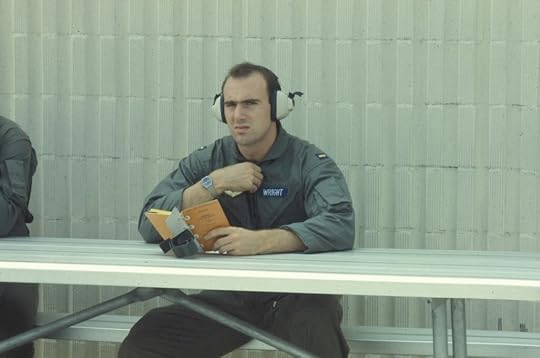
UXBRIDGE, MA – Apr 9, 2017 – IYAAP Blog – Prolonged exposure to jet engine noise can cause long-term hearing damage. That’s why pilots wear hearing protection on the flight line. Years after hanging up my flying gear for the last time, I still have trouble understanding what people say in a crowded room above an irksome din or after riding my lawn mower for a couple hours on a hot summer day.
“I’m sorry, Rachel. What was that?”
“I said, ‘We have money in our Health Care Spending Account that we’re going to lose if we don’t use it before the end of the year. Go get your hearing checked,” my wife repeated.
Sometimes, I didn’t think she believed me about my hearing. I scheduled the appointment. Maybe the doctor would give me some drops or a discreet hearing aid I could use when I felt like I was having a problem. And then, Rachel would believe I wasn’t just telling a story about my hearing.
I had to take a hearing test as part of my annual flight physical in the Air Force. I never liked taking them, because the testing booth at the base hospital was no more soundproof than the snack bar at the base bowling alley. I would nervously hold my breath and push the headphones against my ears in anticipation of the beeps. Fail the test…lose my wings.
BEEP, BEEP, BEEP.
I squeezed my controller and clicked the button with my thumb.
(Softer): Beep, Beep, Beep.
Click.
(Softer): Beep, beep, beep.
Click.
In the Air Force, once I picked up on the beeping pattern, I’d just count, “One, two, three,” along with the beeps, and when they got so quiet as to be inaudible, I’d continue counting and clicking until I heard the gears of the beep machine spin to reset to a different frequency, which was the signal for me to reset my counting and clicking, too.
But this method didn’t work for me in the soundproof confines of the modern audiology stress chamber. Straining to hear the beeps, I held my breath and pushed the headphones against my ears, clicking uncertainly to anything I perceived to be a sequence of sounds.
“Tell me why you’re here again, Mr. Wright,” the doctor asked me as she looked over my test results.
“Prolonged exposure to jet engine noise can cause long-term hearing damage,” I began, sharing with her that sometimes at a party or after mowing the lawn, I don’t always understand what’s being said. “My wife suggested that I make this appointment.”
“I see,” she nodded, scratching her doctor-scribble onto her prescription pad.
“Maybe some drops or a discreet hearing aid,” I thought.
“Read that to me, please,” the doctor said, handing me what she’d written.
“I can’t read this,” I told her.
It wasn’t that I couldn’t understand what she’d written. I could. I just couldn’t say it.
“Read it,” she ordered.
“‘Pay attention,’” I read.
“Again.”
“‘Pay attention,’” I repeated.
“That’s right,” the doctor smiled and again picked up my test results. “Mr. Wright, your hearing is so good, you can hear a pin drop at a cocktail party from three rooms away.”
“But, I used to fly jets, and now, when I mow the lawn…” I protested.
“Stop!” the doctor interrupted. “You bring that note home and show your wife, and you tell her what I just said.”
“Doctor, can you at least give me some ear drop samples?” I pleaded. “Just for when I have trouble?”
“I’m sorry, Mr. Wright. What was that?”
The post Legacy Blog Post 7 – Hearing Protection first appeared on Welcome.