
Gerry Adams's Blog
March 23, 2026
London Civil Case - Thank you for your support | Dolores Keane – A Great Voice
London Civil Case - Thank you for your support
The Civil Case against me in London came to an end last Friday when the Claimants and their lawyers accepted a ‘drop hands settlement of the extant claim on the conditions that:
1. the Claimants file and serve a Notice of Discontinuance by 10 am 20 March 2026; and
2. that there be no order for costs’
In other words, they accepted an offer, made by me the previous evening, that they discontinue their claim. I instructed my legal team to make the offer because it was apparent at the end of day eight of the trial that the claimants case, as presented by McCue and Jury, the lawyers for the claimants, was in serious trouble. I gave them a way out.
After hearing from 11 witnesses, and my two days of evidence, it was clear that the claimants case was not built on evidence but relied on rumour, speculation, opinion, belief, and propaganda. It was a rehash of last years’ BBC case in Dublin and of the worthless drivel that is sometimes presented as investigative reporting.
No documentary or forensic, or direct evidence was produced linking me to the three bomb attacks that were at the heart of the case. The claimant’s lawyers went so far as the rehearse my family’s long involvement in republican politics going back to my great-grandfather’s membership of the Irish Republican Brotherhood in the 19th century. I learned things i never knew before. If they’re true.
At times it all verged upon a show trial. Anonymous agents of the British state hidden behind a screen, and others who were up to their necks in the subversion and collusion that was part of parcel of Britain’s counter-insurgency strategy in the North, making preposterous claims with no evidence to support them.
The former intelligence and security witnesses, admitted under cross examination that intelligence is not evidence and that the British and RUC intelligence services often told lies, colluded with and supported the murderous actions of their agents and spies, and frequently produced misleading and erroneous claims.
It was even claimed in court that I had conspired to kill John Hume! One former Special Branch officer – Witness B – went so far as to claim that in all the years he worked on loyalist gangs he never saw any evidence of collusion. He finished his contribution by alleging that the IRA was responsible for the Omagh bomb.
My legal team challenged them on all of this, producing evidence from a series of official reports – the three Stevens reports; the De Silva report into the murder of Pat Finucane and the recent Kenova report – all highlighting the extent of British state collusion with murder gangs and the lies they told to cover-up their actions.
Following the collapse of their case McCue and Jury tried to explain away their decision by blaming the Judge who they accused of “an extraordinary and, in our clients’ view, unnecessary late intervention by the Court.” They claimed that the Court directed in the “final stages of the trial that it wished to consider whether the proceedings might amount to an abuse of process.” The claimants’ lawyers also accused the Court of ‘unfairness’ and said that their decision was related to possible costs that might fall to the claimants.
If the judge concluded that it was there was an abuse of process, he could order a ‘wasted costs order’ requiring the claimants’ solicitors to pay costs. I had made it clear that I wasn’t going to burden the claimants with my legal bill.
In fact, contrary to the claim by McCue and Jury the Judge’s remarks on abuse of process were not a last minute intervention. He had raised the issue a week earlier on Thursday 12 March. McCue and Jury made no protest at that time. The judge raised the issue again last Wednesday and asked both sides to again address this issue.
In his closing submission my senior Counsel, Eddie Craven explained: “It is well recognised that proceedings may be an abuse of process where they have been brought for the purpose of seeking some collateral advantage beyond the scope of the action and where the proceedings are conducted in a way designed to cause the Defendant expense, harassment or prejudice beyond the scope of what is ordinarily encountered in the course of properly conducted litigation.”
He pointed out that the claimants were seeking "vindicatory" damages of £1 each but on their Crowd Funding platform and in the case documents it was clear that they were seeking to compel the High Court to undertake a protracted, wide-ranging public inquiry examination of the claims being made against me. They stated that their claim was brought for the purpose of “seeking genuine truth and reconciliation through a competent and compelling judicial process.”
On their Crowd Funding page which is titled ‘Time for Truth’ the real purpose of the case is spelt out. It is to procure “a proper inquiry into the Defendants alleged role in the Troubles” and an “exploration of the truth” which will “compel Adams to engage in an effective truth and reconciliation process” before the High Court.
The High Court case is not a public inquiry nor does it have the powers and procedures necessary to fulfil that role and consequently my counsel pointed out that “this claim is a clear example of the ‘Courts processes being misused to achieve something not properly available to the claimants.”
He also addressed the issue of limitation. This essentially deals with the long delays in taking the case beyond the normal three years for cases of compensation. He also spoke about the burden and standard of proof required; the extent of hearsay and opinion evidence heard during the trial; and the evidence provided by the witnesses. For example, Witness A confirmed that he had no evidence to give in relation to the three bombings. As did Witness B. Shane Paul O’Doherty - an amadán and a fantasist - admitted that he had no information on the three bombings, had never met me or spoken to me and had never been in the same room as me. – until the trial. And so it went on through the claimant’s witnesses.
As the case drew to a close, and while I am very sympathetic toward the victims who have clearly suffered, it was nonetheless increasingly evident that the case was in serious trouble. In my view they were badly advised by their lawyers McCue and Jury.
Four years ago when this case first emerged I determined to defend myself against the false accusations being made. Throughout almost two weeks in London I asserted the legitimacy of the Republican cause and the right of the people of Ireland to freedom and self-determination. I also reiterated by belief that the Good Friday Agreement provides a peaceful and democratic route to a new Ireland. That needs a renewed focus, especially by the Irish government.
Finally, I want again to thank all of those who have expressed their solidarity and the Sinn Féin team which worked closely with me. I especially want to thank Colette and our family. And buiochas mór to my legal team for their exemplary work.
Those who supported this case, with the honourable exception of the claimants, have one thing in common. They are against the changes that have been won as a result of the peace process. And the changes which are coming. They lost this time but they haven’t gone away you know. The British Establishment continues its efforts to undermine those of us who made a stand against it in support of Irish freedom. So until the next time thank you dear readers for your support.
Dolores Keane – A Great Voice
I have always loved music. All kinds of music but I have a particular fondness for Irish traditional and folk music. I think by the time I heard De Danann’s first album, with Dolores Keane’s amazing voice leading the vocals, I was probably in Cage 11. That first Dé Danann album was incredible and over the subsequent years I never stopped being astonished by the uniqueness of Dolores Keane’s magnificent voice.
All of this came back to me while in London last week when I heard the news of Dolores’s death. It is an indescribable loss to her family but also to Irish music and to all of us who loved her music and her voice.
Dolores has been rightly described as a pioneer who led the way for other women in the music industry. For many she will be especially remembered for her contribution to the 1992 album, A Woman’s Heart , which she recorded along with Eleanor McEvoy, Maura O’Connell, Mary and Frances Black, and Sharon Shannon. She was a musician and singer extraordinaire who captivated audiences and lifted our hearts with her ability to connect the words and the music with the audience. This was never more evident than on Caledonia. Dolores will be greatly missed.
Photo John Finucane MP Gerry Adams and Paul Maskey MP outside Court in London


March 16, 2026
London Civil Case coming to an end | Time for Diplomacy in the Middle East | More Schools needed for Irish speakers
London Civil Case coming to an end
This week I spent Lá Féile Pádraig in Derry/London. As you read this my time in the Royal Courts of Justice should be coming to an end. Regrettably, the court case prevented me from joining in the St Patrick’s festivities in Belfast or here. I am assured the London Irish have a vibrant, hugely enjoyable celebration of Irish music, culture and language so good luck to all the Paddys and Patricias.The civil case is expected to conclude on Thursday, although, that could slip. The case is based on hearsay and alleged intelligence claims made by witnesses who could provide no documentary supporting evidence. So far it has provided a platform for some highly offensive, insulting and untruthful commentary. What the Judge makes of all of this we will know when he delivers his judgement; although that might not be for some time yet.I want to thank my legal team and all of those who have offered their support and solidarity over recent weeks.As I said on the first day I arrived at the court, I am here to defend myself and to challenge the allegations being made against me. I am here also out of respect for the claimants who had suffered grievously in the bomb explosions.
But the only thing that I am guilty of is being an Irish republican committed to ending British rule in our country and seeking to unite the people of Ireland on the basis of freedom, equality, peace and solidarity.
So, I hope you all had a great St. Patrick’s Day. Tá súil agam go raibh Lá Fhéile Pádraig iontach agaibh. Ádh mór daoibh go léir.
Time for Diplomacy in the Middle EastThe illegal Israeli attacks against Lebanon and the equally illegal Israeli/US assault on Iran continue to dominate the media agenda. The financial cost to the USA of over a billion dollars a day and the rising cost of oil, petrol and gas are also major talking points. The cost of living crisis is set to get worse.The number of Lebanese and Iranian citizens killed as a consequence of the massive bombing campaign barely rate a mention in a western media that has largely become a propaganda wing of the aggressors - Israel and USA.There have of course been exceptions, especially around the missile attack on the 28 February on the Shajarah Tayyebeh primary school in Minab in Southern Iran. Media investigations into the attack, which left around 150 people, mainly school girls, dead have expressed their confidence that the school was hit by a US Tomahawk missile.The international focus should be on ending the war and finding a diplomatic solution. However, it is difficult to see any end soon. Israel is getting what it has sought for decades – a US led assault on Iran. Netanyahu is not interested in a diplomatic solution. And President Trump seems more than willing to support him in this. In an NBC interview he declared that although the Iranian facilities on Kharg Island have been demolished he may order further attacks “a few more times just for fun.”Moreover, under cover of this wider conflict Israel continued its genocidal war on the people of Gaza and the ethnic cleansing of the west Bank and East Jerusalem.Thankfully, some are standing up against the Israeli genocide. Last week Iceland and the Netherlands joined the South Africa v Israel genocide case at the International Court of Justice. This expands the number of states supporting this case to 18.The South African case was initiated in December 2023 and accuses Israel of violating the 1948 Genocide Convention. In September last year a UN commission of inquiry, using evidence and methodology similar to that of the ICJ, concluded that Israel has committed genocide .
Two weeks ago former Taoiseach Bertie Ahern and I addressed the Oireachtas Foreign Affairs Committee on the Irish peace process and its lessons for the Middle East.
I made clear my view that the Peace Committee set up by President Trump will not bring about a just peace. That will only be possible through a process of inclusive dialogue: “Such a process must be based on the right to self-government of the people of Palestine. Adherence to the UN Charter must be paramount. It must uphold international law.”
I urged the Irish government to encourage “international opposition to Israel’s illegal actions” and in this context to deliver the Occupied Territories Bill and the Illegal Israeli Settlements Divestment Bill 2023.
I also called on the Palestinian leaders and organisations to unite behind a single focussed strategy, with clear end goals, and a united leadership speaking with one voice… National Unity - unity of action – unity of politics – unity of leadership for the Palestinian people is now needed more than at any time since the NAKBA in 1948.
More Schools needed for Irish speakers
The Irish language has more than two thousand years of unbroken history behind it. Apart from Greek, it has the oldest literature of any living European language. It is the badge of a civilization whose values were vastly different from the one which has sought to subjugate us. Of course, Irish culture is wider than the Irish language and wider than Gaelic games, music, dance and story-telling.
Add to this the myriad traditions of urban and rural Ireland, of ancient and modern customs, of Protestant, Catholic and other religious tendencies, of the influence of the new Irish who have come to our shores from all parts of the globe – and we have some sense of the diversity of our island people. All of this is great cause for celebration and is as thoroughly Irish as any other aspect of our society.
However, there huge challenges confronting the Irish language, Irish speakers and Gaeltacht communities. In a recent article in the Irish Times Conchúr Ó Giollagáin, a Gaelic Research Professor from Scotland, and Brian Ó Curnáin, who is an Associate Professor in the Dublin Institute for Advanced Studies, are scathing of the Irish establishment and its failure to support the language.
In their article, entitled: ‘Ireland’s power class has a colonial attitude to the Irish language’ they write that the: “State’s perspective on the Irish language and its speakers has become indistinguishable from that of British colonial rule… The socio-political indifference about the social challenges of speaker communities is as evident today as it was in the pre-independent era. When it comes to Ireland’s struggling native culture, the State’s institutional power class are the new colonialists.”
The two Professors conducted an 18 months review of the effectiveness of language-planning schemes in the Gaeltacht. They assert that what is going on is “official disregard for the demise of the last remaining Irish-speaking communities.”
If the Irish language is to have a future they believe, and I support them, that those “who cherish Irish” have to find a way to challenge this.
One place the Irish language is growing, although not without difficulties, is the North. Recently released figures by the Department of Education have revealed an almost 400% rise in the last 25 years in the number of pupils attending Irish medium education.
In 2001 there were just over 1600 pupils. Today that figure is close to 8,000 and the numbers keep growing each year. However, the Irish medium education sector is facing a crisis. Currently there are only two secondary level schools in the North – one in west Belfast and the other in Dungiven. There are several post primary schools that have Irish streams but these are insufficient to meet the demand for places.
More schools are needed at all levels to meet the needs of the sector but this is especially important in respect of post primary.
The Department of Education has failed to properly plan for Irish medium education. The strategy proposal it is currently preparing will not be ready until next year. And even then it will take several more years to put into effect.
Pat Sheehan MLA is trying to short circuit this by bringing forward legislation that will help ensure there are enough staff to support this growth. Its also up to the Education Minister to provide proper investment in Irish-medium education.
March 9, 2026
Dia daoibhse from London | Moore St Bill wins Unanimous Backing | Seachtain na Gaeilge
Dia daoibhse from London
I’m writing this week’s column in London. Today, Monday, I’m in the Royal Courts of Justice in a civil case that has been brought against me by three claimants, innocent victims, who were injured in three IRA bomb attacks in 1973 and 1996. They are alleging that I was party to those attacks.
There was a small crowd of former British soldiers outside the Court and some in the court room itself. There were also some people with tricolours showing their support.
Today the legal teams for the claimants and for me made their opening submissions. My legal team set out logically and clearly my position. In summary, they said that I have consistently rejected claims that I was in the IRA. In this case I am also stating emphatically and unequivocally that I had no involvement in the three bomb attacks.
There will inevitably be a lot of media reporting of the case but it is important to point out that the case against me does not contain a single piece of direct witness evidence or contemporaneous documentary evidence. There is no forensic evidence to connect me to these attacks. And importantly, there is not a single witness at this trial who claims to have any actual, first-hand knowledge of my alleged involvement in any of the bombings. The ‘evidence’ as set out against me relies on a mishmash of hearsay evidence – mostly from British and RUC sources based on anonymous hearsay.
As my barrister Eddie Craven said: “The mainstay of the Claimants’ case consists of bald allegations and assertions based on statements allegedly made by third parties many years ago. In many instances the individuals who allegedly made those statements are unidentified. In many instances they are patently unreliable – individuals, for example, with an overt hostility towards Mr Adams and a track record of lies. “
So, the first day is over. Tomorrow, Tuesday the witnesses for the claimants will commence their evidence. I expect the case will continue until Wednesday or Thursday of next week. I will be making it clear that I am guilty only of being an Irish Republican committed to ending British rule in our country and uniting the people of Ireland on the foundation of freedom, equality, peace and solidarity. Asked by the media at The Old Bailey why I travelled to the court I told them it was to defend myself and to challenge the allegations against me. It was also out of respect for the claimants who had suffered grievously in the bomb explosions.
Moore St Bill wins Unanimous Backing
Meanwhile the legal challenge being taken by the Moore Street Preservation Trust against the plans by developer Hammerson, to destroy much of the historic 1916 Battlefield site in Dublin, is up for mention shortly in another Court. This time in Dublin. However, the case itself is unlikely to be heard until the autumn.
Last week an important draft piece of legislation - An Bille um Cheathrú Chultúir 1916, 2021 - the 1916 Cultural Quarter Bill – to designate the Moore Street 1916 battlefield site as a Cultural Quarter, received unanimous support when it was discussed at the Oireachtas Committee on Housing, Local Government and Heritage. This was an important moment in the campaign to save the Moore St Battlefield site. Among those who supported the Bill were Cathaoirleach Mícheál Carrigy TD (FG), Paul McAuliffe TD (FF), Senator Maria McCormack (SF), Seamus McGrath TD (FF), Senator Aubrey McCarthy (Independent) and Tommy Gould TD (SF).
The Bill, which is proposed by Sinn Féin’s Aengus Ó Snodaigh TD, was supported in testimony by James Connolly Heron on behalf of the Relatives of the Signatories of the 1916 Proclamation and by Stephen Troy, of Troy’s Butchers, representing traders on the street. The Bill would help to ensure the full restoration and preservation of Moore Street as a heritage site, celebrating our history, culture and language.
In his submission to the Committee, James Connolly Heron, urged support for the Bill on the basis that it will help transform the city. He said: “Through this proposal we will walk in the very footsteps of those who made history - in the very buildings in which the Irish Volunteers - our best and brightest - made their last stand. An area of preserved streets and laneways - an outdoor classroom - making history come alive in a city centre freedom trail.”
He quoted former Uachtarán Michael D Higgins who after walking the battleground site described it as “belonging to no one individual, group association or party - It belongs to the people.”
More recently Uachtarán Catherine Connolly said that, “Moore Street is not just a collection of old buildings - it is the last living battlefield of 1916, a place that tells the story of courage, sacrifice, and the struggle for Irish freedom. It belongs to the people of Ireland, not to developers or speculators.”
The next stage for the Bill is at Dáil Select Committee where amendments can be made.
Seachtain na Gaeilge
We are in the midst of Seachtain na Gaeilge. It used to run for one just week, but its popularity is now such that it has been extended to cover the period from March 1 to 17 – St Patrick’s Day.
It is very appropriate that it has been officially confirmed that Fleadh Cheoil na hÉireann, which will take place this August, is already slated to return to Belfast next year. Fleadh Cheoil na hÉireann is the world's largest annual Irish traditional music festival and is expected to attract tens of thousands of visitors to Belfast.
Is í Seachtain na Gaeilge an ceiliúradh is mó den Ghaeilge agus cultúr na hÉireann ar domhan. Bhí an oiread sin ráchairt uirthi gur síneodh amach chuig coicís í. Bíonn sí ar siúl ashan bhliain ó Márta 1 go dtí 17 - Lá Fhéile Pádraig.
Seachtain na Gaeilge was founded in 1902 by Conradh na Gaeilge as part of the Gaelic revival of that time. Initially it was limited to the island of Ireland but today it is a global phenomenon and the largest celebration of our language and culture here and overseas.
Whether you have a cúpla focal, are fluent in the language or want to enjoy yourself and find out more, there is an extensive programme of events taking place across Ireland and beyond for the next couple of weeks.
To read what's on in the festival, go to https://snag.ie/
Seachtain na Gaeilge was launched last week at Stormont by An Ceann Chomairle -the Assembly Speake Edwin Poots who said the Irish language and culture was “intertwined with the identity of many in the Assembly and the wider society.” Ciarán Mac Giolla Bhéin, president of Conradh na Gaeilge, was there also.
Language is not a spectator sport. Language requires learning, whether it is done as a child, in school or as an adult. The key to growing the use of Irish is to use whatever Gaeilge you have no matter how limited. All of us can say ‘Go raibh maith agat, le do thoil, fáilte romhat or cad é mar atá tú.’ And numerous other little phrases. Why would we ever say ‘Cheeeio’ or ‘Bye Bye’ ever again when we can say ‘slán’ or ‘Chifidh mé thú’?
There is still a lot of work to be done. Seachtain na Gaeilge is a part of this. Maith sibh to everyone who is organising and participating.
March 2, 2026
War of Aggression in the Gulf | A Turning Point in Irish History | International Women’s Day | Showcasing Republican Women in Struggle
War of Aggression in the Gulf
As I write this, the war declared by President Trump last Saturday against Iran, and his avowed aim of regime change, is continuing as the death toll rises. The US and Israel had clearly been planning this attack for some time. The USA did this as negotiations involving it and Iran were, according to the Oman mediators, making progress.
This war must be condemned. Diplomatic efforts had not ended. There was still hope. President Trump and Benjamin Netanyahu broke international law, ignored Iran’s sovereignty, and destroyed that hope with bombs.
Under the UN Charter, states are prohibited from using unilateral force, except in two cases: (1) when authorized by the UN Security Council or (2) in self-defence. The US and Israel did not go to the UN Security Council ahead of Saturday’s strikes. That only leaves self-defence and that is absent in this case.
President Trump’s first year in this Presidency has been marked by separate attacks on seven countries – Yemen, Iran, Somalia, Syria, Nigeria, Venezuela and Iran again. He is currently starving the people of Cuba and has given the green light to more attacks on Palestinians by Israel. His actions are a fundamental breech of international law and a violation of the United Nations Charter. Regrettably, governments, like Britain and Germany which have collaborated in the genocide in Gaza, are backing Trump’s regime change strategy. An Taoiseach Micheál Martin in his response chose to ignore the aggressor role of the USA and Israel and criticise Iran. There is a lot to criticise about Iran but it is a fundamental mistake to be ambiguous about this latest USA aggressive action.
Peace and security in the Middle East will not be achieved by unilaterally and without warning attacking another nation. A cessation and diplomacy is the only way forward.
A Turning Point in Irish History
50 years ago on Sunday past I was in Cage 11 in Long Kesh prison camp. It was a Monday. It was also 1 March 1976, the date on which the British Labour government’s decision to end political status took effect.
Political status had been introduced in June 1972 after a hunger strike by republican prisoners and as part of the context for negotiations that were to take place between republicans and the British.
In March 1974 a Labour government, led by Harold Wilson, came to power and embarked on a new strategy to defeat Irish republicans. Ending political status was only one part of it. Laws were changed to allow for ease of convictions in the non-jury Diplock Courts, particularly using beatings and forced confessions. New cellular special control units called H-Blocks were constructed in 1975 in another part of Long Kesh, to house the expected new influx of those who were now to be designated ‘criminals.’
Merlyn Rees was the British Secretary of State with responsibility for the new ‘Ulsterisation, Criminalisation, Normalisation’ strategy. Its aim was simple; reduce the number of British soldiers getting killed, and replace them with the locally recruited RUC and UDR. In the British mindset local forces were expendable and their deaths less likely to cause a political fuss In Britain and internationally.
Criminalisation was about trying to convince people, especially the nationalist section of our people, that republicans were motivated by greed. That we were ‘gangsters’ involved in a ‘criminal conspiracy. We were, in the new language of the 70s, – godfathers – mafiosi – out for what we could make personally. The British hoped that this new spin on an old propaganda theme would reduce support in Ireland and the international community.
Normalisation was a PR campaign intended to persuade people that life in this part of Ireland was normal – except for the bad republicans.
In a, sarcastic piece I wrote in Cage 11 that was published in Republican News that week, entitled ‘Beware the Ides of March’ I wrote about this … “British Direct Ruler Merlyn Rees’s new act came into being at twelve midnight, and suddenly we stopped being political prisoners. That’s as clear as day. As soon as the legislation came into effect, Irishmen and women in the jails all over the North became criminals. It was like an act of God … Merlyn knows he has the power to change people’s motivation, people’s reasoning, people’s attitudes. All he has to do is get a law passed and we are all compelled to obey it. It’s as simple as that. After all, you can’t support criminals, and there is nothing we poor Irish can do if the mighty British government passes legislation to prove it. Haven’t Merlyn Rees, Harold Wilson, Gerry Fitt, Thomas Passmore, Cardinal Conway, William Cosgrave, Conor Cruise, Ian Paisley, Uncle Tom Cobley and all told us so?”
Unsurprisingly to those with any grasp of Irish history, Rees’s strategy backfired. Seven months after republican political prisoners were labelled ‘criminal’ Kieran Nugent, the first republican to be sentenced under Rees’s new laws, bravely told the prison officers who were trying to force him to wear a criminal uniform that they would have to nail it to his back.And so began five years of the blanket protest in the H-Blocks and in Armagh Women’s prison. A difficult, challenging five years for the POWs, their families and those of us who worked on their behalf.
On another 1 March, this time in 1981, Bobby Sands commenced the hunger strike that would result in his death and those of nine others.
It was a turning point in Irish history. Another example of a disastrous policy by a British government that underestimated the courage and resilience of Irish republicans.
International Women’s Day
This Sunday is International Women’s Day. For over one hundred years the 8 March has been set aside to specifically celebrate women who are active in society; in their communities, trade unions, voluntary organisations, in their families and the political institutions.
It is also an occasion when the inequalities, injustices and violence still suffered by many women are highlighted. According to one UN report nearly 70 per cent of countries surveyed revealed that women continue to face more barriers than men to accessing justice. And for the 676 million women who live within 50 kilometres of an active conflict zone “justice systems are largely absent and perpetrators act with impunity.”
The reality is that millions of women and girls around the world are confronted by violence, discrimination, and abuse. The United Nations defines violence against women and girls as: “Any act of gender-based violence that results in, or is likely to result in, physical, sexual or psychological harm or suffering to women, including threats of such acts, coercion, or arbitrary deprivation of liberty, whether occurring in public or private life.”
Last Saturday 150 primary school girls were killed in a US/Israel attack on their school in Iran. The United Nations estimates that over 28,000 women and girls have been killed in Israel’s genocide against the Palestinian people. Tens of thousands more have no access to health care or personal care because their health service has been destroyed.
Nor should we forget that much of women’s work today is still undervalued and underpaid.
Irish women are still disproportionately concentrated in low-skill, low paid and part-time employment. Older women are more likely to live in social isolation. Traveller women face higher poverty, mortality and unemployment levels, and lower levels of educational attainment than their settled counterparts. Internationally girls and women continue to face additional issues like female genital mutilation and arranged marriages.
Women on the island of Ireland and all over the world have won many battles for equality over the past century, but there are further battles ahead. The struggle for justice and equality and equal rights will continue.
Showcasing Republican Women in Struggle
This International Women’s Day, An Fhuiseog, at 55 Bothar na bhFál, is proud to showcase a powerful collection of books celebrating revolutionary women and authors who have helped reshape history. From fearless activists to inspiring thinkers, these women challenged the world around them and paved the way for generations to come.
It’s important that we take time to reflect on the women who came before us, to honour their courage, recognise their impact, and continue the conversations they began about a future that embraced equality and independence.
February 23, 2026
I am against Monarchies | Conradh na Gaeilge Votes for Unity | Micheál Martin out of step on Unity
I am against Monarchies
Currently, the British state is convulsed around allegations surrounding a member of its Royal family. Norway too is in the midst of a crisis around its monarchy. The law of both states will take their course, as is right.
However, these controversies raise for me the very existence of monarchies. A family elite which through past colonial conquest and patronage, and in alliance with business and societal elites, continues to enjoy a place of wealth and privilege and influence. Given that the British state includes a part of Ireland, at least for the time being, this is more than an academic issue for those of us who are captives of this undemocratic system of privilege.
I am instinctively against monarchies. Of any kind. Constitutional or otherwise. Monarchies are bad. The late Tony Benn put it well when he said that “the existence of a hereditary monarchy helps to prop up all the privilege and patronage that corrupts our society; that is why the crown is seen as being of such importance to those who run the country - or enjoy the privileges it affords.”
I am for power for the people and for the rights of the individual. People have to be sovereign. Monarchies are an insult to humankind.
People are citizens, not subjects. One thing which I have come to value more and more the older I become is a basic belief in people. Given a choice, the vast majority will do the decent thing. But human behaviour is hugely influenced by the conditions in which we live. Some people have very limited life choices because of their race, gender, social status, education limitations, disability or poverty. Their entire lives, especially if they are women, are spent seeking the basics for living, so they spend their lives trying to survive or trying to ensure that their families survive.
This is grossly unfair. There are certain rights which people require if they are to have the basics for living, including the right to food, to water, to a home and work and to health and education services. Society must be shaped around these rights. Society must be shaped around people – citizens – not elites, not monarchies or hierarchies.
The people of Ireland have the right to self-government and the right to have maximum control of that government. No British monarch or politician could ever govern Ireland in Irish interests. The British elites rule, in their own interests.
However, history teaches us that societies can be changed. Not too long ago political unionism dominated the northern state and shaped its institutions in its own self-interest. No longer. Once slavery was acceptable, as was the disenfranchisement of women. Discrimination was legal. Apartheid was legal in South Africa. No longer.
So, change is possible. It rarely comes of its own accord; it has to be organised. This is rarely accomplished without struggle or sacrifice.
All of this is an argument for democratic systems of government; that is, systems in which the people are sovereign and equal. Such a society has to be tolerant. It must reflect and include the entirety of its people, not part of them. Inclusivity is vital to the well-being of any community, whether a nation community, the global village or a local populace.
And if citizens have rights, why not all-encompassing rights? Should the right to the basics for life not include economic rights as well as political and social rights? If society is a two-tiered one in which people are subjects, that is how people will be treated. As subjects they will be afforded only such concessions as the privileged deem adequate for them. This is unacceptable.
All human beings have the right, as a birthright, to be treated equally. I am for a rights-based, citizen-centred society in which citizens fulfil their obligations for the common good. I am for a form of government in which the wealth of the nation is used for the benefit of citizens.
The peace process has shown that a better republic, a genuine all-Ireland republic, more equal and fair, is possible; that we can roll back the decades of political failure and build a new Ireland. Without royalty.
Is this possible? Yes it is. That’s why I am an Irish republican.
Conradh na Gaeilge Votes for Unity
At the end of last year Oireachtas na Samhna in Belfast was a huge success. Thousands of Irish speakers, including Uachtarán Catherine Connolly, spent several days enjoying the music, dance, culture, arts, craic and discussions that are part of the oldest Irish language and arts event on the island of Ireland. In August Belfast will host the Comhaltas Fleadh Cheoil na hÉireann, the world’s biggest celebration of Irish music and culture.
All of this is evidence of the change that is taking place. I was pleased to attend An Conradh’s Ard Fheis. The conference was alive and vibrant with a new generation of young gaeilgeoirí determined to assert their Irishness, proud of their language and determined to stand up for their language and national rights. They were articulate, positive, funny, hopeful and generous.
Conradh na Gaeilge was founded 133 years ago. Since then it has been consistently in the forefront of defending the rights of gaeilgeoirí while promoting our culture. It is very community orientated working closely with language activists across the island. This was most evident in recent years through its alliance with An Dream Dearg and their campaign to repeal the 1737 ban on Irish in Courts, and to secure an Irish Language Act.
In the 26 counties Conradh has been active on campaigns around housing provision in the Gaeltacht areas as well as seeking greater investment in and emphasis on the teaching of Irish in education.
The organisation is very conscious of the broader political and social context in which it exists and this year especially it was looking to the future. Conchúr Ó Muadaigh of Belfast addressed this directly during the debate on Saturday. He described the motion as evidence of the “ambition and courage” of its members. He added: “We are not a small, marginal community, we are a living movement that is growing, changing and creating a future for ourselves, we are a community full of enthusiasm and imagination.”
The vote when it came was overwhelmingly positive. It changed Conradh’s constitution and restored its historical objective of working “towards a united Ireland in the interests of the Irish language and the Gaeltacht”.
At a time when momentum is increasing daily around the demand for the Unity Referendums provided for by the Good Friday Agreement, and the need to prepare for this, Conradh na Gaeilge is now committed to joining that conversation and advocating for Unity. Tír agus Teanga. Well done Conradh na Gaeilge.
Micheál Martin out of step on Unity
Last week, An Taoiseach Micheál Martin, in an interview with TG4, claimed that there is not much substance behind Sinn Féin’s campaign on Unity. The Fianna Fáil leader, who has consistently rejected any common sense suggestions to prepare for unity, returned to his favourite and bogus argument that we need reconciliation before unity.
Martin’s comments are out of step with the political reality and popular opinion North and South. He also misses entirely the point that the demand for unity is not simply being put by Sinn Féin. Former leaders of Fine Gael and the SDLP, as well the SDLP leadership, Ireland’s Future, the Irish Labour Party, the Joint Oireachtas Committee on the Good Friday Agreement and others are part of the growing demand for the Irish government to prepare for unity.
Last weekend Conradh na Gaeilge, as we report above, changed its constitution to allow it to advocate for unity. In Cork and South Belfast well attended public events discussed the economic, health and political advantages of unity for the people of the island of Ireland.
Regrettably, once again Micheál Martin, steps outside the growing consensus on unity and chooses to ignore the imperative of the Good Friday Agreement which provides for unity referendums.
It is a fact that the need to prepare for constitutional change rests with the Irish Government. In this it has failed. Of course, reconciliation matters. But it is not a strategy for constitutional change. Preparing for unity means addressing the core questions evident in all of the public meetings held on this issue; healthcare, taxation, public services, rights protections, pensions and economic transition in a new Ireland.
Martin’s assertion that there will be no referendums before 2030 also ignores the reality that this is a matter for the people to decide.
In the meantime, support for unity referendums continues to grow. And despite Micheál Martin’s rejection of this, that momentum is set to continue.
February 16, 2026
Remembering Frank Stagg | Holy Smoke | The death of Nora Comiskey |
Remembering Frank Stagg
Last week marked 50 years of the death of Frank Stagg on hunger strike in Wakefield Prison, in England. Events, including a black flag vigil and a march and rally were organised to remember the Mayo man. Gerry Kelly who was on hunger strike in England in the 1970s for over 206 days, during which he was force fed 167 times, gave the main oration in Ballina and spoke of Frank’s great courage and commitment.
I was in Long Kesh when Frank died on 12 February 1976 after 62 days on hunger strike. Britain’s intransigence and in particular the obduracy of the then Home Secretary Roy Jenkins, ensured that Frank’s fourth hunger strike would result in his death. As we walked around the Cage or sat in our cells the talk from when Frank embarked on his fast, was about his resolve and strength of character as on his own he faced the brutality of a British system determined to break him.
Two years earlier we had watched as Frank’s friend and comrade Michael Gaughan, another Mayo man, had died on hunger strike.
Although our conditions of imprisonment in Ireland were much different from those being held in the solitary and hostile atmosphere of English prisons, nonetheless there was a connection between us. We were political prisoners who in our own way and our own time had battled against the conditions under which we were held. We could identify with and understand the motivation and impulse of Michael and Frank, and others in Parkhurst and Albany and other English prisons, refusing to accept criminalisation.
Within the Cages in Long Kesh there was a deep sense of sadness when the news of his death broke that Thursday. The image of a fragile, weakened Frank dying alone in Wakefield prison touched all of us.
That sadness turned to anger and outrage when the Irish government hijacked Frank’s body as it returned to Ireland. His remains were kept from his family as it was flown to Ballina by helicopter and buried in an unmarked grave. Frank had wanted to be buried next to Michael Gaughan. But the Fine Gael government chose instead to exclude the family. They buried him in an unmarked grave, poured concrete over his coffin and placed a 24-hour guard on the grave.
Frank’s brother George later described how, when he took his mother to visit the grave, Special Branch officers took photographs of her.
George later discovered from Jane Ginty, who worked in the cemetery, that no one had bought the grave they had placed Frank in, so he bought it and the one next to it. For a year the Gardaí stood watch but by the following summer they pulled the guard off. George and five others, waited until 5 November 1977 and then began the challenging task of removing Frank’s coffin.
They carefully carried the coffin on a sheet of plywood, fearful it might break, as they moved it to the Republican Plot. There George and his comrades buried Frank Stagg beside Michael Gaughan. They saluted both Volunteers and returned to their homes. George had fulfilled a great sense of personal duty to his brother. As he headed home he recalled his words to the Garda superintendent at Shannon airport when Frank’s coffin was stolen. He said: “‘I’m telling you now, I promise you. A day will come and I’ll have him back.”
George was true to his word.
Holy Smoke
I used to smoke. I was very addicted to it. I smoked everything that was legal. I smoked a pipe for years. I liked the pipe. There is a certain ritual attached to pipe smoking. Filling your pipe requires special skills. It takes time. And care. Fill it too loosely and it will not last long. Too tightly and it will not burn at all. Most pipe smokers had a number of pipes. But there was always a favourite one. My favourites were invariably Kapp and Petersons. Particularly the bendy ones, favoured by Sherlock Holmes. Kapp and Peterson still have a shop in Dublin. Kapp and Peterson gets honourable mention in Samuel Beckett’s Waiting For Godot. In Belfast Miss Morans in Church Lane, which is still doing business, was a favoured supplier of pipes and good tobacco.
Pipe tobacco is of course a matter of choice and taste. And addiction. I was inclined towards heavier brands like Condor. The I graduated to War Horse, particularly War Horse plug tobacco. The preparation of this type of pipe filler requires a pen knife for cutting off little slices of tobacco. These were then rubbed between your hands until they were reduced to the desired consistency. This added to the ritual. It was probably theraputic. If thats not a contradiction. Ditto with the smell of pipe smoke. Back in the day pipe smokers were a fixed presence in pubs and at most social gatherings. Many people, barely visible in the clouds of smoke, would declare how much they liked the smell.
Nowadays a pipe smoker is a rareity. So too are clay pipes. It was common to find old clay pipes, usually white with broken stems, in old houses or outhouses. Duidíní. Woman as well as men smoked them. They also used snuff. But that’s another story.
I smoked Cigars and Cigarettes as well, including roll ups. I even had one of those little contraptions that allowed you to put the cigarette papers into a little roller filled with loose tobacco, and after a wee twiddle out popped a feg. In those days before the advent of tipped cigarettes I mostly smoked Gallagher’s Blues, Senior Service and Park Drive or Woodbine. Some shops sold single cigarettes. And packets of five. That’s what sparked this recollection. I found an empty five packet of Wild Woodbine in a drawer at home.
Looking back on it, it was sheer madness to suck smoke into our lungs. But we did. Or many of us did. Maybe most of us. Even people who didn’t smoke inhaled the clouds of smoke which filled every room where people gathered. At home or in social gatherings outside the home. When I was a curate in the Duke of York pub we used to regularly wash down the paint work and mirrors. The water soon turned brown as the nicotine washed off. Soon our buckets of water were coffee coloured. Somebody always said, ‘I wonder what our lungs are like’. But it made no difference. We puffed away.
Then came the years of enlightenment. Children in particular were educated in school about the health risks of smoking. It made little difference to the big tobacco companies. They continued their saturation advertisement campaigning. Our Gearóid played a big role in persuading Colette and me about the dangers of smoking. He was at Saint Finian’s Primary School at the time and a diligent teacher, and his own common sense, made him an anti-smoking advocate. So first we were persuaded not to smoke at home. I was trying to stop by this time. But it wasn’t easy. I did it so often I got quite good at stopping. Once Gearóid caught me smoking in the toilet after I told him I had stopped. He was so let down I never smoked again. It was one of the best things I ever did.
Go raibh maith agat Gearóid.
The death of Nora Comiskey
It was with sadness that I heard of the death last week of Nora Comiskey. Many Dublin republicans and some of us from Belfast and other parts knew Nora over many years. She was a former president and long-time activist in the 1916-1921 Club. This was a unique institution founded in the 1940s whose aim was to try and bring together some of those who fought on the pro and anti- Treaty sides in the Civil War. Many did, including Nora who had been in Fianna Fáil. Its founding charter is the 1916 Proclamation and among its objectives are a commitment to honour those who fought for Irish Freedom and who work for its achievement. It also seeks to contribute to the cause of an Ireland — united, independent and sovereign.
In 1989 a group of well-known activists including Nora, artist Bobby Ballagh, trade union leader Matt Merrigan, Fr. Des Wilson, and others established the Irish National Caucus. Its aim was a united Ireland and to that end it held public meetings, lobbied the Irish government and organised for the 75th anniversary of the Easter Rising. In later years Nora was a supporter of the efforts to protect the Moore St. 1916 Battlefield site from the developer’s plans to demolish much of it. She was a sound republican and a patriot.
Nora will be sadly missed. Especially by her children. I extend my condolences to them, to Joe, Susan, Dervala, and Sinead, her grandchildren and her wider family circle.
February 9, 2026
Mandelson was Unimpressive | Goodbye Dearest Heart | We Are Not Numbers
Mandelson was Unimpressive
As I write this column the future of Keir Starmer, as British Prime Minister, is a topic of conversation because of his mishandling of the Peter Mandelson affair. I know nothing about the ongoing scandal around Jeffrey Epstein other than what I read or see in the media. But the evidence of his serial abuse of young women going back many years is plain to see. My heart goes out to the victims and survivors of this despicable cabal.
However, I was surprised by Starmer’s appointment last year of Mandelson to the job of British Ambassador to the USA. He had already resigned twice from a Labour government. Once in December 1998 over the securing of a loan that he had not declared in the Register of Members’ Interests and a second time in January 2001 over allegations of impropriety in a passport scandal.
His track record as Secretary of State for the North was equally unimpressive. Less than a year after his first resignation, in December 1998, he was appointed by Tony Blair as Secretary of State for the North. He replaced Mo Mowlam. Mandelson lasted just 15 months in the job before his resignation from Blair’s Cabinet in January 2001. One of the shortest stints by any of the 25 largely mediocre British politicians who have occupied Hillsborough Castle since 1972.
During his time in the North he refused to intervene when David Trimble blocked Sinn Féin’s two Ministers, Martin McGuinness and Bairbre de Brún, from attending the North-South Ministerial Council. And when Trimble threatened to resign and collapse the institutions Mandelson unilaterally and illegally did the job for him by suspending the institutions. Later he ordered the union flag flown on designated days in breach of the Good Friday Agreement.
When he left Danny Devenney, our master muralist and all round good guy and artist, produced a very fitting cartoon based on Pinocchio. I sent Mr Mandelson a copy as a ‘Slán Abhaile’ gift.
Mandelson’s focus, as has been the case for most of those who occupy Hillsborough, was to pander to unionism. This approach by successive British governments, including Mr. Starmer’s, ignores this elephant in the room.
In the decades after partition political unionism dominated the political landscape. Both in votes and through gerrymandering of electoral boundaries and restrictions on the franchise, they held an unassailable position. But that has now changed.
Consequently, ten years ago in the 2015 and 2016 elections the overall pro-unionist majority came in at around 20,000 votes. But in the 7 elections since then the non-unionist vote has emerged well ahead. In the last three elections the gap has been on or over 100,000 votes each time.
The DUP are determined to replace Michelle O’Neill as First Minister in next year’s Assembly elections but to do that unionism must agree an electoral pact or unionist voters must move in huge numbers to one of the unionist parties. The DUP want them to vote DUP. Jon Burrows, the new leader of the Ulster Unionist Party is making a pitch for them to vote UUP. But his message is no different from the DUP and TUV. The unionist parties seem intent on fighting for votes in a diminishing pool of unionist voters.
Whatever decisions are taken by political unionism over the next year the strain on the political institutions is set to grow. Our task is to hold on to the position of First Minister. In the meantime, we all watch the political machinations playing out in Westminster. As we were taught in Religious Education at school, its’ only a sin if you take pleasure from it.
Goodbye Dearest Heart
This week sees the republication of Jim McVeigh’s excellent book – Goodbye Dearest Heart - on the life of Joe McKelvey who was executed by the Free State in 1922 aged 24. It tells not just the personal story of Joe McKelvey but also the remarkable times in which he lived.
Joe McKelvey was born in Stewartstown in county Tyrone but moved to the Falls area of west Belfast as a teenager. He was a committed Gael who in 1916 was a founder member of the O’Donovan Rossa CLG in Beechmount.
Jim McVeigh tells how McKelvey joined the Irish Republican Army in Belfast and quickly rose through its ranks to become O.C. (Officer Commanding) of the Third Northern Division which had responsibility for Belfast. McKelvey’s time as O.C. coincided with the partition of Ireland.
In April 1922 he was one of the anti-Treat IRA leaders who occupied the Four Courts in Dublin. The pro-Treaty forces attacked and after three days of shelling, using artillery pieces provided by the British government, the IRA garrison surrendered. They were imprisoned in Mountjoy prison where McKelvey was appointed as O.C. of the republican prisoners.
On 6 December 1922 Sean Hales a Free State TD was shot dead in Dublin. The Free State cabinet determined on an act of reprisal. Four IRA prisoners, Joe McKelvey, Rory O’Connor, Liam Mellows and Richard Barrett were told they were to be executed. On the morning of 8 December the four were taken to the prison yard. Joe McKelvey and Richard Barrett were still alive after the volley. A Free State Officer shot them as they lay wounded.
The Civil War was part of the counter revolution which witnessed the abandonment of nationalists in the North and the establishment of two deeply conservative states on the island of Ireland. Speaking earlier during the Treaty debates Joe McKelvey’s comrade Liam Mellows had warned of the danger of accepting The Treaty. He said:
“Men will get into positions, men will hold power, and men who get into positions and hold power will desire to remain undisturbed and will not want to be removed, or will not take a step that will mean removal in case of failure.”
His remarks were prophetically accurate.
Goodbye Dearest Heart by Jim McVeigh is available now online at An Fhuiseog; in An Fhuiseog 55 Bóthar na bFál, Beal Feirste, BT12 4PD: https://sinnfeinbookshop.com/
We Are Not Numbers
Late last year I came across a book written by young people living in or exiled from the Gaza Strip - ‘We Are Not Numbers: The Voices of Gaza’s Youth.’
Through their words it gives testimony to the horror that the Palestinian people face daily in Gaza under Israeli occupation and blockade. The book spans ten years. It tells of the experience of young people and their community trying to survive against a ruthless enemy that does not see them as human beings
The organisation We Are Not Numbers (WANN) was founded in 2015.
In their introduction Ahmed Alnaouq and Pam Bailey explain: “Our members write about everything from death, homelessness and the search for scare electricity …”
In her 2023 poem ‘My Home’ Eman Alhaj Ali writes:
What is home?
The place where a wall can explode,
A table fly and spin,
Glass shatter faster than a flinch …
Noise of the drones disturbs our dreams
Our beds and couches turn to rubble.
Our wedding plans morph into funerals.
What is home?
Roaa Missmeh describes in her poem, ‘The sight of stars makes me dream,’ how her family fled their home in Khan Younis in January 2024 not knowing where they could go. “Survival was the only thing on our minds,” she writes”. They made a ‘sort of home’ in a tent on some land on which there was a swing. She would sit on the swing and gaze at the stars. One night her father joined her:
“He was smirking, like he usually does.
He said: ‘Well, that’s one dream achieved.’
It didn’t take me long to work out what he meant. I’d always told him that I wanted to go camping and star gaze from a tent. Obviously I hadn’t meant a situation like this. But it was funny that he remembered that…
Vincent Van Gogh once said: ‘I don’t know anything for certain but the sight of the stars makes me dream.’ And he was right.”
In “I miss you, my brother” Mahmoud Alyazji writes about loss and his brother:
“Before I sleep, I see your body under the rubble. It flashes into my mind and makes my heart sink. Then I pick up my phone and look at your photos. I look at you carrying a water melon on the beach and smiling, in the hope that it will wipe out the image of your body buried under the rubble. But my chest is tight. I am angry. I want to scream loudly – loud enough for the whole world to hear me. I want to pierce their ears …”
There are stories to amuse and amaze, to terrify and bring tears, as young people write about their dreams of the past and their hopes for the future. Some of the contributors were dead by the time the book was published last year. Others may have died in the interval since. It is a book worthy of their story and of their lives.
We Are Not Numbers is edited by Ahmed Alnaouq and Pam Bailey and is available online through Penguin Random House.
You can get more information on the WANN website at https://wearenotnumbers.org/
February 2, 2026
London Case - Not about Truth and Accountability | Stand-up to a Genocidal Bully | Streets of Minneapolis
London Case - Not about Truth and Accountability
In May 2022 a civil case was launched against me in England. The civil trial will begin on 9 March in London, and conclude on St Patrick’s Day.
There are some aspects of the case I can comment on and others I cannot at this time. Suffice to say that this is an unorthodox claim against me about events which occurred 29 and 53 years ago. In short, three Claimants, seek to hold me personally liable for three bombings committed by the Irish Republican Army (IRA) in February 1973 (at the Old Bailey), in February 1996 (at London Docklands) and in June 1996 (at the Manchester Arndale Shopping Centre).
Many innocent people were seriously hurt, three were killed in the bombings. The Claimants were injured and have suffered as a result. They deserve nothing but sympathy for what they have gone through. So do all those who were killed or injured in the conflict. And their families. I regret all the deaths and injuries.
People are entitled to use the law. However, this case is brought decades after these incidents and decades after the Good Friday Agreement brought peace to us all. I anticipate, from public statements made by the Claimants’ solicitors, that a number of former British Army, and RUC/PSNI witnesses will give hearsay evidence that because I was a senior republican during the conflict I must be responsible for these specific events.
I had no direct or indirect involvement in these explosions and I will robustly challenge the unsubstantiated hearsay statements that are the mainstay of the Claimants case which is for symbolic damages of £1.
I am honoured to have served the republican struggle as Uachtarán Shinn Fein for almost thirty-five years. In that time, we created a peace strategy, and with others a way out of conflict which led to the Good Friday Agreement. We supported and assisted the search for peace in other parts of the world.
At the same time successive generations of activists and increasing numbers of voters have built Sinn Fein into the largest political party on the island of Ireland.
The British establishment and some veterans of the British Army, the RUC and British Intelligence services remain deeply hostile to Republicans, to Sinn Fein, and to me personally. Recently, the British PM Keir Starmer, in defending the unlawful internment of hundreds of innocent prisoners without trial in the 1970s, pledged to deny me (and thereby other victims of unlawful internment) the right to redress in what amounts to an official campaign of demonisation. Others in the military establishment see Republicans as the enemy they failed to defeat. The recent comments by the British Secretary of State Hilary Benn MP on this case, in a statement on 20 January, underpins this view.
This civil action has support from British Forces veterans, from English Tories, the DUP and other unionist parties and elements of the Orange and Loyal Orders.
I wish to thank those who have pledged their support to my defence. Míle buiochas.
In my view it is no coincidence that this case is set against a febrile political atmosphere where British Army veterans and other personnel are doing everything they can to prevent scrutiny of their past actions in Ireland and potential prosecutions for the murder of innocent civilians and even their own agents, as revealed in successive reports by John Stevens, Judge Peter Cory, Desmond De Silva, many Police Ombudsman reports, Inquests and last month’s Kenova Report.
I wholeheartedly share the Claimants stated objectives to “establish the truth” and “an effective truth and reconciliation process.”
Over many years I have sought, in national and international meetings and negotiations, the establishment of a truth and reconciliation process that would allow all victims of the conflict to achieve truth and accountability. I was among those who successfully negotiated the Stormont House Agreement in 2014, agreed by all of the parties and two governments, which was intended to address this issue.
Mechanisms to deal with the legacy of the past have been agreed, then reneged upon, then subverted by successive British governments, including agreements with the Irish government.
I remain committed to the establishment of a truth and reconciliation process in which all victims of the conflict can achieve truth and hopefully some measure of closure for the hurt they have suffered.
This civil action is not a truth and reconciliation process. It is a highly political and strategic legal action. Those establishment figures who support it aim to blame republicans for the conflict while diverting attention from their role, policies, repression, repeated law breaking and interference in Irish affairs.
Whereas, I offer no criticism of the Claimants, those people who support this case from the shadows, are wedded to the past and unable to accept the new reality of our island moving towards self-determination and unity.
Stand-up to a Genocidal Bully
As the world ponders the implications of US President Trump’s talk of an ‘armada’ heading for Iran; or his latest threat of tariffs against Canada; or his ongoing threats against Cuba, Greenland and Europe; the so-called ceasefire in the Gaza Strip which he brokered in October has been breached over 1300 times by the Israeli apartheid regime. 509 Palestinians have been killed.
In just one morning last week, Israeli attacks on Gaza City and Khan Younis left 31 Palestinians, including six children, dead. The limited medical facilities were overwhelmed with the dead and wounded.
Two weeks ago Israel’s war against the Palestinian people entered a deadly new phase when the Headquarters of UNRWA in East Jerusalem was demolished by the Israeli government. Under the ceasefire agreement proposed by the USA four months ago humanitarian aid, led by the United Nations and the Red Crescent was supposed to be able to enter Gaza without interference. That is not happening. The amount of aid currently getting into the Gaza Strip is inadequate to meet the needs of a population enduring a catastrophic humanitarian crisis.
At the weekend Sam Rose, the head of UNWRA in Gaza, graphically described the current situation; “Winter rains have turned displacement camps into seas of mud, exacerbating suffering and significantly increasing the risk of disease outbreaks. This month alone, seven UNRWA school compounds in eastern Gaza have been demolished by Israeli forces.”
Israel has ignored the international condemnation of its demolition of UNWRA’s headquarters. Is anyone surprised by this arrogance? After almost two and a half years of genocide and no meaningful response from many in the international community, Israel feels emboldened to continue its actions.
Words of condemnation are insufficient when standing up to a genocidal bully. The Irish government has the opportunity to take the international lead on this by passing into law the Occupied Territories Bill. That Micheál Martin continues to prevaricate while two million Palestinians struggle to survive is a disgrace.
Streets of Minneapolis
I have been very fortunate over the years to see Bruce Springsteen live. The concerts and the music are amazing. The Boss’s lyrics are sharp and he is unafraid to sing about the politics that anger and outrage him. ‘Born in the USA’ is an anthem against the War in Vietnam. ‘Streets of Philadelphia’ highlighted the aids crisis.
Last week he turned his ire on the behaviour of the Immigration and Customs Enforcement (ICE )agents.
Springsteen dedicated the song – Streets of Minneapolis - to the “people of Minneapolis, our innocent immigrant neighbours and in memory of Alex Pretti and Renee Good”.
Well done Bruce.
January 26, 2026
Self-Determination and Democratic Rights | Mickey Brady – A Cheerful Change Maker. | Report on Rural Health in a New Ireland published
Self-Determination and Democratic Rights
For decades now I have argued that self-determination is one of the big issues of our time. In 2005 I wrote: “In my view the big international struggle of our time is to assert democratic control by people over the decisions which affect their lives. This does not mean retreating behind existing borders and refusing contact with the outside world, but it does mean reasserting the primacy of democracy and working together in order to pursue this objective.”
The world we live in is dominated by national struggles. The right of people in different parts of the globe to self-determination; to be able to determine their own future, shape their own societies, pass their own laws, agree their own foreign policy, democratically and in the absence of outside interference.
In the decades from the end of the Second World War to the beginning of the 21st century countless millions died in these wars as former colonial powers – for example, Britain, France, Belgium and Portugal - tried to hold on to their colonies.
It was also a time when USA backed coup d’état’s in central and south America led to a succession of ruthless dictatorships in Brazil, Argentina, Chile, Bolivia, Ecuador, Guatemala, Nicaragua, Panama and others.
Today the denial of self-determination remains at the heart of most conflicts. The people of Palestine are being denied their right to self-determination by an apartheid Israeli state supported in the main by the USA and former colonial powers in Europe. Russia’s occupation of the Crimea, and its four-year war against Ukraine is about denying the people of Ukraine the right to determine their own future.
The United States invasion of Venezuela and the multiple threats by the Trump administration of military intervention and/or economic sanctions against Greenland, Europe, Canada, Cuba, Mexico, Colombia, Nigeria and others all reflect the ongoing centrality of self-determination today.
The centuries long colonisation of Ireland by our nearest neighbour has shaped our world view and our opposition to bullies. Consequently, Irish people opposed the wars in Iraq and Afghanistan and we are overwhelmingly supportive of the Palestinian people as they face Israel’s genocidal aggression. US President Trump’s Board of Peace is colonialism. It has no other purpose. It denies the Palestinian people their right to self-determination. They and only they have the right to govern themselves. Only they should determine their, future.
Irish Republicanism is built on this world-view.
This also shapes our determined opposition to ending Irish neutrality; a shift that is currently being promoted by the Irish government and others. Partition subverts our right to take a fully national view but notwithstanding this are we to surrender decision-making on Irish foreign policy to the big powers, or will we continue to pursue our own course?
The answer for me is simple. We must stand fast in support of self-determination and in defence of neutrality. We must seek to advance self-determination in the context of ending partition. That is our right. No British politician could ever govern Ireland in Irish interests. British ministers rule in the interests of the British government. These interests are not our interests. How could they be?
So, our focus has to be on achieving self-determination through maximum societal change, including ending partition and winning the unity referendums that are part of the Good Friday Agreement. It also means having a positive view on international affairs based on international law, the right to self-determination and peace.
Mickey Brady – A Cheerful Change Maker.
Mickey Brady, former Sinn Féin MLA and MP for Newry and Armagh died last week. His sudden death came as a great shock to his family and to all of us who knew and respected him. I had the great fortune to work closely with Mickey in the Assembly and I often campaigned with him during elections. Some people are really good canvassing during elections. They have that way of engaging with people on the streets and at the doorstep and Mickey was a master at it.
He was always positive. He knew the issues impacting on people and he could speak from his years of experience as an elected representative and as a champion for their rights through his work in the Newry Welfare Rights centre.
Mickey was a cheerful Newry nyuck. He was a decent human being deeply committed to his republican and socialist values. He was steeped in the very best values of his working class community of Ballybot. He rose above the deprivations, above the poverty and the divisions. But Mickey Brady didn’t rise out of his class. Mickey rose up with his class and brought many of his neighbours with him.
Mickey’s work on welfare rights is legendary. His benefit take-up campaigns helped thousands of families and his ability to represent people at tribunals was celebrated. In 2002 Cherie Blair, the wife of former British Prime Minister Tony Blair, referenced a case Mickey brought to Appeal. He won the case and the argument he made was used extensively as case law and precedent in the North and in Britain. Later an official report into Social Security tribunals stated that Mickey represented in one year more people than all of the legal professionals in the North.
Mickey was also a trade unionist who firmly believed in Connolly ‘s maxim that the cause of Ireland is the cause of Labour and the cause of Labour is the cause of Ireland. Mickey understood the cruelty of partition and the opportunities which Irish unity will create.
He was avowedly anti-sectarian. He knew that poverty is the greatest restrictor on human development and a direct consequence of the British connection and the lack of national and economic democracy.
He believed that by virtue of being born, that people have inalienable birth rights. So women have rights – workers’ have rights – children have rights – there are LGBTQ+ rights and rights for citizens with disabilities. He campaigned for all of these.
Mickey loved his work with Sinn Féin. His wife Caroline told me he loved all the people he worked with in the office in Newry and was a respected mentor to younger and not so young comrades.
He loved Martin McGuinness. The two of them were cut from the same cloth though Mickey had a much better head of hair. Martin was quite jealous of the two of us, and our hair.
Mickey and I shared a love for music, the Beatles, Dylan, the Stones, Leonard Cohen, the Dubliners, the Chieftains, Christy. I didn’t know this until quite recently but one of our claims to fame is that we both met Luke Kelly – separately away back in the 60s. Mickey loved the writings of Brendan Behan and Oscar Wilde. Mickey was a dedicated follower of fashion. His dapper and stylish dress sense, much admired, was very influenced by Wilde.
Mickey was a good son, a good brother, a good father, uncle and grandfather and a loving husband to Caroline and in her time to his first wife Rose. Thanks to them he also had a good life.
In the not too distant future there will be a referendum on the future of our country. Sadly, Mickey didn’t live to fight that campaign or to see the new Ireland but he can rest content that his efforts will ensure that outcome. A free and united Ireland.
As W B Yeats put it;
“think where men (and women’s) glory most begins and ends
And say our glory was that we had such friends.”
Slan Mickey.
Report on Rural Health in a New Ireland published
Sinn Féin’s Commission on the Future of Ireland last week published its latest report - ‘Delivering Rural Health and Care in a New Ireland.’ The public event took place in Enniskillen in November.
A packed hall heard from a panel of health activists, including Pat Cullen MP, Fr. Brian D’Arcy – writer and broadcaster, Paula Leonard, CEO of Alcohol Ireland and Denzil McDaniel, author and former editor of The Impartial Reporter. The discussion and report examines the challenges faced by rural communities trying to access all-Ireland cardiac services, autism services, cancer provision, suicide support services and A&E.
It makes no sense that we run two entirely separate health systems trying to solve the same problems. The report of the Enniskillen Assembly can be accessed in English and Irish here: www.sinnfein.ie/futureofireland
January 19, 2026
Public Media Ireland | Kitson Praises Paras in Ballymurphy | A Raffle for Jim Fitzpatrick limited edition print | Mickey Brady. RIP.
Public Media Ireland
Last week a report entitled, ‘Public Media Ireland: a New PSM (Public Service Media) Organisation for a New Country’ was published in Belfast. The report – a joint project by Dublin City University and Ulster University – recommends the setting up of a new public service media organisation, Public Media Ireland, if citizens ote yes in the referendum for constitutional change.
Susan McKay, the Press Ombudsman, chaired the event. The four authors of the report, Dawn Wheatley, Roddy Flynn, Stephen Baker and Phil Ramsey, shared their vision of a Public Service Media, PSM, in a new Ireland.
The report recommends a single island public media structure and the values and ethos underpinning it. It does so on the basis that the debate on a new Ireland is underway. The authors are offering their report as a contribution to this debate.
The Report asserts that it is possible to harness all the media that is currently available across Ireland and to shape the Public Service Media to reflect the influence and experience of these mediums.
It also recognises the importance of the Irish language media and Ulster Scots broadcasts and the growing numbers of ethnic people now living in Ireland.
The report argues that Public Media Ireland should reflect a much broader view of Irishness and diversity, not merely multicultural but intercultural. It poses some pertinent and immediate questions for advocates of a new Ireland.
Can a space be created in which nationalist and unionist identities are reconciled? How can unionist and loyalist identities be maintained and respected in a post-union context. How can the Good Friday Agreement contribute to achieving this? And what compromises might advocates of reunification be willing to make?
The values of the new medium should reflect the six key values of the European Broadcasting Union: universality, independence, excellence, diversity, accountability and innovation.
The report touches on many other aspects of a public service medium including how it should be funded.
The report makes it clear that this is only the beginning of the conversation. And it is a very good beginning. Many thanks to the authors of this important contribution to the discussion about the future.
The link to it is: https://www.dcu.ie/communications/public-media-ireland-new-psm-organisation-new-country
Kitson Praises Paras in Ballymurphy
I recently came across the autobiography of British General Sir Frank Kitson which was published last year shortly after his death. It is titled ‘Intelligent Warfare’ an oxymoron in any language. In truth it is an account of British military failures through several colonial wars in which Kitson fought, including in Ireland. It is also a reflection of Kitson’s enormous personal ego.
Kitson came to prominence within the British military hierarchy in the 1950s during its efforts to crush the independence rebellion in Kenya. He established counter-gangs that tortured and killed Kenyan civilians. The groups were made up of British soldiers, including Kitson on occasion, and former members of those fighting against British rule. Tens of thousands of Kenyans ended up in over 150 detention camps where they were brutalized. An estimated 30,000 Kenyans were killed; one and a half million were interned; torture was commonplace and 1090 were hanged.
While Kitson boasts of his role in the counter-gangs he ignores the human rights violations that underpinned British strategy in that African country.
In 1970 he took command of the 39th Brigade – which covered Belfast and surrounding region. In the same year he published ‘Low Intensity Operations’ which quickly became the standard text book for the British Army’s counter-insurgency strategy in the following decades.
Kitson’s autobiography spends two chapters on his time in the North. In keeping with ‘Low Intensity Operations’ and his use of counter-gangs, Kitson facilitated the merging in 1971 of a series of loyalist paramilitary groups into the Ulster Defence Association (UDA). This organisation was run by a succession of British agents and informers.
In August 1971 Kitson was a key figure in the planning for internment, which he presents as a success. He claims that by Tuesday 10th August 1971 the British Army had cleared Ardoyne, on Wednesday they “cleared out the markets areas, Ballymurphy and Turf Lodge and on Thursday we cleared the remaining barricades in Falls Road and Springfield Road … Early on Friday 12 August a few isolated pockets were tied up and by midday the whole city was opened up and quiet.”
Nowhere does he detail the Paras actions in Ballymurphy. He writes about clearing out the area by the Wednesday 11th August but in the 36 hours up to then 10 civilians, including Joan Connolly, a mother of 8 and Fr. Hugh Mullan, a local priest, were shot dead by members of the 1 Para (First Parachute Battalion). An 11th man died of a heart attack after a rifle was put in his mouth and the trigger pulled.
Kitson enthusiastically records his admiration for the Paras; “It was a great stroke of luck that at this testing time we had such splendid Battalions in the most difficult places. As always 1 Para, which Derek Wilford, had taken over from Mike Gray in June, had done wonders, helping out in one trouble spot to the next.”
Kitson ignores the numbers killed, or the hundreds of families who were forced to flee their homes. His one reference to the Hooded Men – victims of British torture - is of a “few people that had been interrogated after the operation” using techniques “allegedly based on Those used by the Chinese in Korea.” Kitson claims that he “knew little about it.”
Nowhere does Kitson mention the UVF attack on McGurk’s Bar, in North Belfast, in December 1971. Fifteen people were killed. Kitson, as Commander of the 39th Brigade, was one of those who sought to blame republicans for what the Brits and RUC described as a republican ‘own-goal’ despite forensic evidence available within hours proving that loyalists were responsible.
Kitson writes about Bloody Sunday. He ignores the findings of the Saville Inquiry which concluded that the 14 civil rights marchers killed on Bloody Sunday by the Paras were innocent. He doubles down on the lie that the IRA was involved. He claims that Wilford told him that “his men had been shot at and that in the ensuing action a number of presumed gunmen had been killed.” Kitson’s concern was that, “1 Para would become less effective for a time because of the number of men that would have to give evidence to the military police investigating the incident.”
Kitson also admits that in 1971 he established the Military Reconnaissance Force (MRF) a secret unit made up of soldiers and former republicans which went on to kill civilians.
Kitson’s autobiography provides an interesting insight into the British military mind-set. More importantly and ironically it reveals why the British Army lost in Ireland.
Intelligent Warfare – The Memoirs of General Sir Frank Kitson published by www.pen-and-sword.co.uk
A Raffle for Jim Fitzpatrick limited edition print
Well done to the Moore St. Preservation Trust which has announced a new Raffle to raise funds for his legal action to save the iconic 1916 Moore St. Battlefield site in Dublin.
The Trust faces an expensive court hearing this year in its efforts to challenge the plans of the developer Hammerson which would destroy buildings and a cultural landscape linked to the historic events of the Easter Rising 1916.
The Moore Street Preservation Trust is raffling our hugely popular Elizabeth O’Farrell print - a unique, framed print designed and signed by the renowned Irish artist Jim Fitzpatrick. Míle buiochas Jim. The draw will take place on Good Friday, 3 April 2026.Tickets are €5 / £5 and they can be bought at: msptshop.myshopify.com
Mickey Brady. RIP.
Finally, condolences to the family of former republican MP and MLA Mickey Brady. News of his sudden death has saddened and shocked all of us who knew him. My solidarity to Mickeys wife Caroline, his children and grandchildren, comrades and friends. He will be deeply missed by us all and especially the good people of Newry and Armagh who he served diligently and enthusiastically through a lifetime dedicated to Irish republicanism and activism. Tá Mickey ar slí an fhirinne anios.
Gerry Adams's Blog
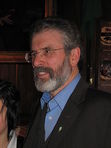
- Gerry Adams's profile
- 31 followers

