
Dikkon Eberhart's Blog: The Longer View
March 16, 2019
see ya later
Dikkon Eberhart
I am delighted with you readers!
I am especially grateful to those of you who write me back by email or comment on my posts or on my Salem Web Network articles, but…I am closing my writing down for a period of months .
For closer communion in truth via the Holy Spirit with God, for authenticity in my relationships with others whom I love, and for my future honesty with you readers, I need to concentrate on plain truth and not hide behind the walls of my laptop.
A lot of you readers are writers. I hope you don’t suffer from my malaise. If you do, then pay attention to your suffering. Don’t merely endure it. Fix it.
My malaise is word-smithing. I’m good at word-smithing. I grew up learning it and hearing it and seeing it honored while I lived among the scores of poets and other writers who peppered my parents’ literary dinners. Later, during 28 years as a salesman on the road, I perfected it.
Any evening, at the hotel, I’d prepare my sales calls for the next day and then gladly enter within the walls of my laptop and, until 2 or 3 in the morning, polish and polish and polish my words written the previous night.
Maybe 100,000 pages—30,000,000 words—who knows?
Ten years it took, but then I had a book. Sold about 4,000 copies—well received; good reviews; hours I spent on national radio shows. (More word-smithing, verbally this time.) Sales are trickling off now, but the book is still in print after 3 years.
And there’s also a new book, now, three-quarters done. It’s waiting within the walls of my laptop to tell me, at last, what it is about…which I don’t know yet.
Its final mystery needs to be anointed with a drop of literary and sacramental chrism. But that can’t happen until I live the book out, in life, and discover what it is about.
And that’s why I’m closing down for a time. To concentrate on living my life out with authenticity, humility, and succinctness.
We are all of us made in the image of God. God did not make us in His image in order that we should merely endure. Sacramentally, we are created beings who must struggle against our sin natures for the purpose of reflecting the glory of God.
Each one of us possesses some of the attributes among all the attributes that are available as the total image of God.
For example, I’ve said that one of my skills is word-smithing, but one of my sins is my habit to hide behind the product of my word-smithing. Sometimes what people I love experience of me is not authentic of me—instead it’s the product of my word-smithing.
Please leave your subscriptions active. That means—don’t do anything about them. They’ll remain active automatically. They cost you nothing, and I am not requesting any time from you…since I’m not sending you anything to read during this time.
I’ll see ya later.
I look forward to it!


March 1, 2019

February 22, 2019
not napoleon

Dikkon Eberhart
Two weeks ago, I posted a short fairy tale under the title Once Upon a Time. I posted it under the WRITING heading. You can read it by backing up to The Longer View tab and selecting WRITING. It's what will come up, being the most recent.
I received compliments about it, which I appreciate because it was enjoyable to write, and I was happy that its point pleased others.
Since posting it, I’ve thought about its point as I have observed the world around me. The boy in Once Upon a Time is a creation of my imagination, but I have five grandchildren and some of them are about the same age as that boy.
The boy in the fairy tale is baffled at why a thing that he perceives to be true—for example, the color of the sky—why that can’t be left to be true but must be stripped of its obvious truth and made into something slippery instead.
His step-mother tells him that there is no truth about the color of the sky. She asserts that all people must make the sky’s color in their minds into whatever color they think is true. The boy hopes to discover a new location in his countryside where truth is allowed, even encouraged, to remain truth.
As many a grandfather might do, when I watch my grandchildren, I wonder what they will have enjoyed, and what they will have suffered, in the year 2100. For example, my grandson Devar will be eighty-one in the year 2100.
In the year 2100, will western culture have learned that the glorification of its own immediate desires leads to hollowness and to self-destruction?
Or, in the year 2100, will western culture have re-discovered that sublimation of the self to a higher principle glorifies the higher principle and leads the self to fulfillment and to joyful life?
Who can predict?
All I can say at this moment is that that cultural selection between these two pathways is vital and choosing the second over the first is what will be salvific for us all.
Much pain and much suffering will come to those who either promote glorification of the self, or who become the victims of those who glorify themselves, and who then force others to support their self-glorification.
By some today—the self-glorifiers—what ought to be considered fundamental principles of culture, and even of life itself, are increasingly despised. To them, these principles are unsuitable any longer in a world busy to glorify its immediate desires.
Once, western culture turned for authority to biblical mandates and revelations. Turning that way was western culture's salvation. Once, the individual spoke and was accorded integrity based on his or her disclosure of fact and of principle. Once, too, the safety of the family unit was considered paramount for the successful raising of children.
Now, we seem to be trending in a different direction. Many of our public intellectuals consider these fundamental principles to be suspect. The principles are suspect—socially dangerous—because a person who bases his or her behavior on those fundamental principles is much more difficult to be motivated by, or to be controlled by, the self-glorification of the trendy.
The trendy need the glorification of the masses because some of them (and I suspect the most astute of them) probably understand that there is no factual basis for their own glory.
Hollow inside, some of them must fill themselves inside, and they demand adulation. And, being vengeful, some of them set out to destroy the livelihoods and the families of those who do not adulate them.
Their glorification of themselves in the modern moment is urgent. Consider the headliners who have become media candy by strutting their stuff as exemplars of something they are not.
At Devar’s age now, he (his family considers him to be a boy—as, particularly, both he and his big brother do especially) he looks at us out of the picture and is completely happy with his maleness.
He knows that his mother and father are married, and that both of his grandfathers and both of his grandmothers are married. Those oldsters live as couples in houses of their own. He has different toys to play with at their different houses and eats different food in their houses.
All of these things, he knows, are TRUE THINGS.
Fortunately there are still some in western culture who view this information that Devar has as being properly true, since it is true. And yet there are some in western culture—and they get lots of face time and adulation in media and in social media—who would consider Devar benighted. The fact he considers himself to be a boy is absurd. He should be informed that he is no more a boy than he is a girl. After all, he should choose.
This energy from some in western culture is itself absurd. It’s akin to the story about the crazy man who goes around announcing that he is Napoleon. Of course, as everyone knows, he is not Napoleon.
The proper thing for society to do with the man who thinks he is Napoleon is to inform him that he is not Napoleon, to express sympathy that he thinks such an absurdity, and to offer him counseling to help him find his way out of his delusion.
That proper thing is not what the self-glorifiers do today. What they do today is to agree with the man who thinks he is Napoleon—"Yes, you are Napoleon"—and then they demand that all of society must view the poor fellow as Napoleon from that day forward.
As the self-glorifiers gain more social acceptance, and then more political power, they will do what self-glorifying tyrants have done in hundreds of circumstances during human history. They will demand total allegiance to their self-glorification by everyone they can control…or else.
If western society successfully champions this method of self-glorification all the way through until Devar’s eighty-first birthday, all of us will have become insane.
February 16, 2019
confined by the walls of our sin

Dikkon Eberhart
My Kairos Prison Ministry brothers and I, who visit with inmates and have fellowship with them, have freedoms because we are on the outside that they do not have since they are on the inside. But—just like them on the inside—we are confined by walls. Just like them, we are confined by the walls of our sin.
Yes, we can walk out our front doors, get in our cars, and drive up into the mountains in order to walk miles through a forest and listen to birds sing. They can’t do that.
But I tell you, readers, we may drive back to our houses and park our cars and walk back in through our front doors and find ourselves confined by the walls of our sin.
Inside our houses there may be relationship problems with our wives or our children that are persistent. There may be a health problem that frightens us. There may be a financial problem that wears us down. There may be a work problem we have no knowledge how to fix. There may be an addiction problem that forces us to act in a way that is disrespectful of God.
Inside our houses, inside that wide world that appears to be open and free to us, we are confined by the walls of our sin.
WHY ARE WE CONFINED BY THE WALLS OF OUR SIN?
We Christians know that Satan exists. He’s why we are confined by the walls of our sin. Satan has existed since the Garden of Eden, and he will exist until he is thrown down in fire by Jesus at the end of the world. His purpose is to create pain and discord and hatred—and then, having been successful, to create even more pain and discord and hatred—among all of the people.
Ultimately he seeks to overthrow God Himself. He wants to BE God.
He cannot overthrow God because God wins. He cannot BE God because God already IS…and because God wins. But in the meantime, Satan can make us writhe with pain and misery and make us blast out at one another in sin-filled ways.
Satan’s power is formidable. But ultimately he is a loser.
All he can provide is hatred and fear and pain. Hatred and fear and pain LOSE in the face of what the Christian Trinity provides, which is love and forgiveness and peace.
So why are we confined by the walls of our sin?
Because there is—and there will be—a struggle within us to do good when we are enticed by Satan to do bad.
Until we find salvation in Christ Jesus, we feel an URGENCY to do bad. It is an URGENCY to hurt—either other people, or ourselves, or God Himself. When we do find salvation in Christ Jesus, immediately our URGENCY disappears.
We still sin—I DO—but our URGENCY to sin disappears.
We are still confined by the walls of our sin—but we are safer, as saved people, within those walls than we were before we were saved.
February 9, 2019
once upon a time

Dikkon Eberhart
A child went into the forest and became lost. It seemed to him that he had been lost for days. The child tried to follow what appeared to be pathways through the trees, but each pathway came to its end at an impenetrable place, just when the pathway seemed that it might open up further and lead to an exit from the forest.
What the child imagined would be the case when an exit from the forest was found was that a landscape of openness and beauty would be revealed. This landscape, as imagined by the child, would be a place where the child’s difficulty of escaping from the forest would be forgotten and instead happiness would reign.
It would also be a place where whatever was real was actually, really, real .
What would be important about this new landscape would be its provision of truth. If the day were sunny, then the actual sun would actually shine, and the sky would be blue—actually blue—and the sun would not be named something other than “sun” and the sky would not be colored chartreuse, which no one would be able to spell nor to define as a color.
The child had gone into the forest originally because the mother of the child had died and the father of the child had married another woman who was mean-spirited and who would not tell the child the truth.
This woman came from a different part of the country where different things were believed—in fact, some people in that different part of the country believed in nothing at all—and so trouble existed everywhere in that different part of the country. The trouble which existed there in that other part of the country explained why the step-mother had become mean-spirited in her maturity, although she was beautiful, which is what had impressed the father.
One time the child asked the step-mother, “What color is the sky?”
“The sky is whatever color you think it is.”
“The sky is blue.”
“You are a fool. The sky is whatever color anyone wants it to be.”
“But it can only be the color that it is .”
“No, fool. It can be whatever color anyone wants it to be. There is no such thing as it is . The sky does not have a color. You are free to make up its color to suit yourself. You are the authority. Not it.”
The child and the father and the step-mother lived in a small cottage next to the forest, where the father went each day to cut fire wood to sell at the market.
The child had sometimes gone into the forest with the father during the work day, particularly after the mother had died. Now, with the step-mother not telling the child the truth, the child was all the more inclined to go inside the forest and to speculate about finding what might be a more truthful landscape on the other side of the forest, if a way to such a place existed and could be found.
So one day the child went into the forest with the father. As the father was setting out his axes and saws, the child asked, “Father, what is on the other side of the forest?”
“I have never been to the other side of the forest, but I know men who have been there, and I believe the tales they tell. They tell of a place that is what it is —truly what it is. I am told it is a beautiful place where men and women, as well as children, can be safe because power exists there for rightness. It is power for the truth.”
“Father, I should like to go there sometime.”
The father chuckled. “So should I. But now I must work. You go along and play, but don’t wander off.”
The child did wander off and soon became lost.
Days seemed to pass. The child felt hungry and tired. The child missed the father. The child did not miss the step-mother. The child hoped soon to break through a final barrier and to emerge in the beautiful place of rightness and truth on the other side of the forest.
One evening, the child, who was exhausted, lay down and slept. In his sleep, he dreamed a dream. In his dream, a barrier at the end of a pathway through the trees did, at that moment, open up. What once had been confusion and difficulty for the child—what had been scratching and thorny to push through—suddenly broke open, and the child was able to step out from the forest and, in his dream, to stand where bright white sun shone in the blue sky.
A spirit being appeared. The spirit radiated light and truth and love and a deep urgency of welcome.
“Welcome Home, boy,” the spirit being said.
“Is this my home? I must return to my father.”
“This will be your Home, in time. For you and for your father.”
“I cannot abandon him.”
“Of course. But first, before you go back, look around. What do you see?”
“I see….” The boy looked around and thought. “I see…what I see is what always has been. What always has been…and is true.”
“Is it true now?”
“It is true now.” The boy looked around some more. He took a breath. “It is true for always and forever.”
“Good! That is good, boy. I will send you back to your father, who otherwise might miss you and worry you are lost.”
“I was lost.”
“No longer. Here’s what I charge you with. Help your father talk to his wife about what is true, here, on the other side of the forest. Your step-mother is lost as well. Perhaps all three of you may someday come Home.”
The child stretched and rolled over and opened his eyes. He was in the clearing where his father was cutting wood. His father smiled at him. “Nice nap?” he asked.
“Let’s go home and talk with Mama,” the boy said.
February 3, 2019
Muscle Memory
 Stay with me now…
It’s cold outside while I write this. Apparently, it’s cold everywhere while I write this. When you read this, on Saturday or after, it’s not going to be as cold outside as it is today. Today at dawn it was 9 degrees here on the Blue Ridge.
But here’s the thing. I’m thinking about the cold because our son Sam and I are attending another Special Olympics ski meet next Monday and Tuesday in northern Virginia—time trials Monday; races Tuesday. Hoping forward, I’d love some of this cold air to hang around until then, to keep the snow harder, easier to turn on, faster.
But no. The current prediction for those two days is high 50s/low 60s and showers about 40% of the time.
Now, Sam has done well on wet, sloppy snow that clogs his skis on the slalom turns—three weeks ago in North Carolina, on that same sort of snow, he came away with a silver medal at his competition level.
But skiing in that kinda snow just ain’t any fun.
Now, maybe you are a reader who doesn’t care a fig about skiing, but hang on a moment—I’m getting to something.
At many times in my past life, particularly before our children were in their teens and needed me to ski with them as they improved, I skied by myself very aggressively, although I never formally raced.
Here’s the “something” I am getting to. Many of you readers—skiers or not—you may have had similar pleasures, when you were young. But now you have put them aside, and they have gathered dust—as my skis did—in the barn. There was never quite enough time to drive to the mountain. There was never quite enough money to afford the expense.
Here’s what I conjure for you. I conjure that you stop. I conjure that you come with me on a trip to the mountain—to your mountain—wherever that is, right now. Reach out—let’s do it—right now, let’s reach out for muscle memory.
I snapped my ski boots shut, stamped into my bindings, and poled/skated my way to the lift at the bottom of the mountain. The chair swung round—I was a solo this time—and I sat. I pulled down the bar, settled my skis on the footrest, and looked around. The sky was clear in northern Maine, and the trees all around were rimed thick with ice. It was cold, cold, cold—ten degrees and a twenty mile NW wind, making it seem as though it was about fifteen below. I pulled my balaclava up over my nose and cheekbones, glad I had my ear warmer snug round my head under my woolen watch cap. Loved my minus-twenty parka and mittens.
I reached the top and dismounted smoothly, slowed to a stop. There was an operator inside the upper hut, secured away, maybe with a kerosene heater. His eyes and mine met for a second. Yes, I tried to signal to him, I’m good for this. Hope you are, he seemed to answer, and his eyes shifted away.
I studied the trail map—black-diamond trail or a more moderate blue? I’ll return for that black diamond, I thought, but I need the slower beginning, the reaching for muscle memory, the remembering that my next big birthday is seventy now and no longer thirty-five. And the blue trail winds along the ridge to the north, seems to dip and then flatten, dip and then flatten—that would be good.
I picked blue. I started down. It was a long, broad run, a good one to wake up upon. Muscle memory is a wonderful thing: if you had it once, you’ll have it now.
Halfway down that first tentative run all diffidence blew away. Deliberately, I set my downhill inside edge, forced my knees into the hill, bore forward with my downhill ankle…and steered a course closer to the fall-line, shot forward, nearly doubled my speed. From then on, with my mind plucked out, it was a dance, every muscle falling familiarly back into its racing place, attacking the hill.
I reached the bottom, winded and sore of thigh. But I had been relieved also of quotidian duty, for a moment, which had been plucked away from me, this once. I was relieved that I could still carve five or six perfect turns, each one increasing my speed by a percentage, each turn wrenching out a fear and leaving it behind me to shiver in the snow.
Do—you—the same, my friend.
What do you fear? What bears you down, as you age? What brings you despair? What leaps out at you when you encounter it and, this time, shrieks at you—‘NO YOU CANNOT!’
That is Satan.
He may have been the greatest of the angels, but he is FALLEN.
He wants to—
TAKE
YOU
DOWN.
Don’t you let him. He is fallen. God is on YOUR side.
…and God wins.
Reader, I want to look behind me on our next ski run together and to see you, smiling as broad as heaven, carving your turns, transported, over your wall of limitations!
Ah! Won’t that be blessed!
Reader, go ski your own mountain. Attack your own hill.
January 25, 2019
Thank you for your suggestions!

Dikkon Eberhart
Last week I asked for recommendations of good memoirs for me to read…since I’m writing another one which I desire to be good. Who knows if my new memoir will turn out to be good, but recently my wife Channa gave me excellent critiques, on two levels.
So there’s hope!
One level of Channa’s advice was structural. That is the easier critique to address. The other level posed a greater challenge. Her advice was conceptual. Here's the advice. Take out anything—and she pointed to some things—take out anything that is, in the end, self-indulgent.
Hoist with my own petard!
When I mentor writers who struggle to produce their own memoirs, the first exercise I assign to them is to tell me what their memoir is about--in a single, short, snappy sentence. I don’t want their story at this point; that’s not what I want to hear. I want a billboard, not a book report.
In my experience, this is the single hardest piece of writing for many of them undertake. Me, too. However, when successfully undertaken, that single, short, snappy sentence becomes the memoirist’s lodestar. ANY writing that DOES NOT fall under its direction—however delightfully personal and engaging to the taste of the writer—is SELF-INDULGENT.
It must be taken out!
And here I was writing happily along while being guilty of that same fault! Bah!
Good on Channa!
You readers answered with suggestions—in Comments and on FB, or when we ran into one another during the past week—for which generosity, I thank you! Last night, one reader expressed curiosity about the list of books, so I said I’d present it in this next post. I’ve edited it a bit. Several of you listed one book among your lists…some strange book whose title begins with The Time Mom Met Hitler .
I’ve excluded that one. I wasn’t looking for lurid histories about discreditable social events!
What I also received were delightful statements from you among your suggested titles. For example, here’s a favorite--
Regarding the list of suggestions, one person characterized them as “All non-whiny memoirs of challenging childhoods with deeply flawed but not cruel parents.”
How enticing a blurb is that!
So here’s the list. (So far: you’re welcome to send more suggestions, anytime!)
Jesus, my Father, the CIA, and Me: A Memoir of Sorts – Ian Morgan Cron
All Over but the Shoutin’ – Rick Bragg (mentioned twice)
Through the Eyes of a Lion – Levi Lusko
The Fire of Delayed Answers – Bob Sorge
As Soon As I Fell – Kay Bruner
A Man Called Ove – Fredrick Backman
Educated – Tara Westover
Don’t Let’s Go the to Dogs Tonight – Alexandra Fuller
Glass Castle – Jeanette Wall
Liar’s Club – Mary Karr
Just Mercy – Bryan Stevenson
…and add one historical fiction – Becoming Mrs. Lewis – Patty Callaghan.
January 18, 2019
your reading suggestions, please

Dikkon Eberhart
I write memoirs in order to bring religious seekers closer to God and to gratify believers who wish to be re-enthused.
Most readers of my recent memoir are Christians, but some are not. The same applies to readers of my blog posts. Some are; some are not.
My point is that, irrespective of the religious stance of readers, I write from the perspective of a believing Christian who happens to be a Lutheran by denomination.
A memoir is a variety of writing that differs from, but is a sub-category under, autobiography. At a higher level, each is non-fiction.
Autobiography is an organized, factual, narrative recounting of the events that comprise the writer’s life, usually presented in order as they occurred. On the other hand, while a memoir also draws from the writer’s life, the word memoir has been traced back to a Persian term for “that about which we ponder.”
That Persian word is mermer .
The person who writes a memoir does relate factual events, indeed, but he or she devotes attention not so much to the events themselves or to the order in which they occurred, but to the ponderings which arise from the events.
The ponderings may be happy or sad. The pondering reveals the book’s theme.
The reader of memoirs experiences something that is more subtle and more nuanced than the reader of autobiography. Memoirs are closer to poetry than they are to general non-fiction. The reader of a memoir is engaged with the writer’s mind, imaginings, and soul.
During past centuries, published memoirs generally were written by persons of high achievement, or who had encountered some event of great significance as viewed by their entire culture. Near the end of the last century, and into our own, with self-publishing available, memoirs have exploded as a variety of published writing.
(My Amazon search just now, using the single word memoirs , pulled up over 60,000 titles…of course, my search was not nuanced, but that’s a lot of books that Amazon’s algorithm categorizes as having some relationship with memoirs!)
What is lamentable in our age of social media me-me-me-ism is that many persons who have lived their lives are stirred to write and to publish their memoirs, whether of general interest or not.
As a man who has written one memoir (and who is nearing completion of another), I am aware that I might be chided for deciding on my own authority that it is important to the world that I ponder in print on the truths of my life.
Who do I think I am, after all?
All I can say is that, manifestly, some memoirs rise above the ordinary into the significant. Since I write anyway, and am always working on another book, writing memoirs ought at least to be worth a try.
As a writer of memoirs, I am hungry to read them. What I want to gain from the reading of any memoir is two things. One, what is the story about? Two, how does this writer do the memoirist’s job?
I ask for your suggestions. What should I read?
As I select memoirs, especially I like to read--Christian memoirs by believing Christians;Jewish memoirs by committed Jews;Memoirs by religious seekers who avowedly pursue Christianity;“Spiritual” memoirs by religious seekers who view multiple religions phenomenologically with no struggle to select one over the others;Skeptical memoirs that don’t desire to select any religion at all;The “almost theres.”
I am eager for suggestions from you regarding memoirs you recommend, memoirs which have moved you, memoirs that are significant . Please give me a title or two and a sentence about them.
Particularly, coming from those of you who are Christian readers, I’m interested to read the “almost theres.”
In my language, an “almost there” is a memoir written by a serious-minded, skilled writer, who is pondering on the page about the nature of his or her life. Often there is a tone of anxiety. There may be an illness, or a relationship problem, or something else that produces a sense of wretchedness or emptiness of the writer’s soul.
A Christian reader of such a memoir may have a sensation that the writer suffers from lack of hope.
As a Christian, that reader has hope due to redemption provided by God through Jesus Christ. See, for example, 1 Peter 3:15 , which speaks of that same hope.
When I finish reading an “almost there”, I may admire the writer’s skill, but I am left with sadness. The book is over. The life that the book depicted does not climax with the hope that is in me as a Christian, and which is available, through Christ, to all.
Of course, anything can happen for the Lord’s glory, and Channa and I ourselves came late in life to Jesus Christ. To those who knew us beforehand, perhaps our progress would have been judged unlikely, too.
I am left only with hope that another memoir might come from that same writer, whose craft I admire. I would welcome a new memoir that would reveal that the writer is no longer almost there, but there .
And still pondering….
So, my friends, what should I read?
January 10, 2019
mainer potatoes, fire baked

Dikkon Eberhart
[Here in the Blue Ridge, I am thinking of the Maine coast this morning, where our family lived for 27 years. I'm thinking of Maine because, here, it is cold this morning--about 18 degrees--and it is going to snow in the next day or so. I'm thinking of Maine because when it snowed in Maine, our children and I skied regularly, and also because our son Sam and I have just returned this week from a Special Olympics ski meet in the North Carolina mountains, near Blowing Rock.
[This was Sam's and my third year at this invitational meet, along with four other Virginia skiers, a smaller Virginia contingent than usual. I was pleased for Sam that he duplicated his success from last year--he took a silver medal in slalom, which was particularly impressive because the snow was difficult to ski, being wet, and warm and slushy.
[I'm also thinking of Maine because Channa and I have been married a long time, and I mostly lived on the Maine coast when I was courting her. Takes me back....
[Here's a piece I originally posted in 2014.]
Mainer Potatoes, Fire Baked
Recipe by Dikkon Eberhart
Ingredients:
1 13’ Whitehall Pulling Boat, with anchor
2 oars
some tinfoil
1 match – just 1
coupla potatoes and a chunk of butter; salt
good heavy knife
Mise en scene:
Go down to my shore and shove off in the boat. Row to the island. Anchor the boat so she stays afloat. (Tide falling; half.) Oh, yeah, bring along a heavy coat because it’s December, three o’clock, and clear. Gonna be cold. There’s wind from the northwest. Also a blanket, a hat.Below tide line, dig a shallow depression among sand and rock, and ring it with stones. Find some down wood and sit by the pit stripping the wood with your knife until you have a few feathery pieces and some other small stuff. Watch the sun set. Don’t think about it; just watch. Construct a fire, a careful cone of dry twigs with the feathery bits inside. Lie down real close to the sand and the shale, so you can smell it, even in the cold, and, while protecting the wood with your body, light your match. This is a test. You’re twenty-nine and mythic. Intentionally, you’ve brought only one match.If you fail, go home and try this test on another night. But this night turns out to be the right night. Some things, at least, you can do well.
Method:
Keep feeding your fire with small stuff and then bigger stuff. Notice that it’s dark now except for a sheen on the sea—we have a quick twilight in winter. Wind’s from the northwest and steadier than you thought it would be. Low waning moon chasing the sun. Faint, lambent shoreline: one gull patrols then settles for the night. Listen to the cold sea water gurgling in over rocks and snails, gurgling out over rocks and sails, gurgling in, gurgling out. The fire tends itself now, and the sky darkens. The moon is yellow: then gone. Overhead is an appearing of stars. The meander of the Milky Way is a pathway between here and the other place. Mostly by feel, cut your potatoes in half, smash some butter between the parts, salt them heavily, close them, wrap them in foil, and push them into the coals with your stick. Clean your hands on your pants, wrap the blanket around your legs, tug down your cap, lie still. Alone; no muddle. In, you breathe, and out again. In, and out again. Feel your chest as it fills with air and empties. In, you breathe, and out again. In, and out again.There’s a woman you want to marry, but you’re scared. No real snow yet. The last marriage hurt.Alarmed at your fire, a squirrel chitters from the wood behind. Allow your imagination to enter into the earth. Feel the to-ing and fro-ing of all her parts. The tug of tree roots in soil as their limbs swing back and forth in the wind. The tide’s pull on rockweed as it swishes on stone. The flicker of barnacle webs sweeping plankton in. Allow your imagination to rise. The cold steam of your breath, invisible now, streams eastward on the air, over meadow, over shore, over sea. It takes you to an island that is further out than ours. Out and out, allow yourself to spiral through tree and stone, through squirrel and gull, through earth and sea—from star to star—until you find the entire awesome ponderousness that is God. Devil and angel, you find, devil and angel there.
Chef’s note:
Don’t burn your fingers when you grub the potatoes from the ash, open them, and, while they drip with butter, you eat them in the dark.
Clean-up note:
Pour water on the coals until they are really out. Toss everything into the boat. Drag the boat down the beach to the sea. Wade out beside her and pull her farther until she’s afloat. Stare off for a time at the black horizon.
Await revelation.
What if I ask her?
Maybe I’ll dare.
January 5, 2019
Did bonhoeffer get it right?
Dikkon Eberhart
I have a question for you. Remember Christmas? This post’s question for you is prompted by a discussion that came up at our house just before Christmas and that is based on two considerations.
One consideration is related to the way that early Christians experienced the anniversary of Jesus’ birth during their own time. The second consideration is not about what you might suppose. It is NOT about how differently we today encounter the anniversary of Jesus’ birth.
Of course there’s a difference between then and now. After two millennia, how could there not be a difference? But my question today is not to explore that difference.
In order to tell you what the second consideration is, I need to describe how this discussion arose in the first place.
My wife Channa and I host a weekly dinner and Bible study at our house on Thursday evenings, dinner being provided on a rotational basis among our group. We are eleven Christian men and women of approximately the same age and family status.
Our evening’s discussion usually begins by reviewing the sermon of the previous Sunday. However, on the Thursday before Christmas we suggested each person—who cared to do so—might bring along a Christmas-related essay or poem or song, and we would focus our discussion around those.
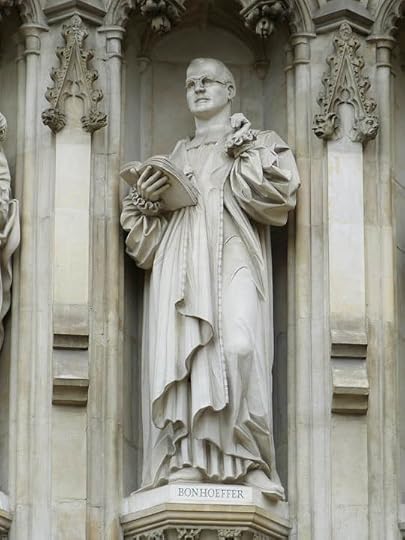
Searching for my own contribution, I found a short passage from a book of Advent readings by Dietrich Bonhoeffer entitled God is in the Manger: Reflections on Advent and Christmas . I’ll provide the gist of Bonhoeffer’s passage below and then articulate the second consideration that powered my question for the group and engendered our discussion.
Here’s Bonhoeffer’s quote--
When the old Christendom spoke of the coming again of the Lord Jesus, it always thought first of all of a great day of judgment. And as un-Christmas-like as this idea may appear to us, it comes from early Christianity and must be taken with utter seriousness. …. The coming of God is truly not only a joyous message, but is, first, frightful news for anyone with a conscience. …. God comes in the midst of evil, in the midst of death, and judges the evil within us and in the world. And in judging it, he loves us, he purifies us, he sanctifies us, he comes to us with his grace and love. He makes us happy as only children can be happy. (Emphasis mine.)
So here’s what I asked our group, related to the two considerations.
The first. Bonhoeffer articulates what I believe are correct cultural and theological conditions concerning believers and their encounter with the birth anniversary of Jesus during the early church—their encounter is one of fright and judgment. Not—in the modern sense—very Christmas-like.
The second. Note that Bonhoeffer is speaking to us, to his contemporary audience. He reminds us—again correctly—that God’s love for us purifies and sanctifies us despite the evil of the world. But my question arises from what Bonhoeffer says next, which is bolded above.
Is it possible that God’s sanctifying grace and love makes us happy…as only children can be happy?
I acknowledge that children have the capacity in their innocence to experience total and unalloyed happiness. However, I do not believe that we adults have such a capacity, due to our mature acquaintance with doubt, misery, and sin.
Further, I believe that our limitation may remain with us even after God’s loving gift to us of purification and sanctification.
Yes, we are saved—thank the Lord!—but we are still aware that once we were not saved, that we are guilty of past failings (though God has mercifully un-remembered them), and that we retain our inherent evil inclination.
Does God’s sanctifying grace make us happy? Yes. But at a level at which anyone who has children and grandchildren has seen them attain, and which Bonhoeffer states is only available to them?
I don’t think so.
On the whole, the rest of the group did think so. I’m glad that I was in the minority—that fact testifies happily for the happiness of the others!
What do you think?
Let me know, if you care to….
The Longer View

Many excellent bloggers concern themselves with what is happening right now. That is important. My blog is called The Longer View. I attempt to report how the past or the future impacts me as I live i
...more
- Dikkon Eberhart's profile
- 11 followers

