Scott Depalma's Blog
May 5, 2017
Contentment After Trauma
I agree with the premise it's possible to recover from trauma and emerge stronger than ever.
Stronger because once you've swam through bitter waters you can navigate sweet ones with the knowledge you've survived an extreme experience. No one has anything on you. You've tasted bitter, and made it to sweet – or at least satisfying – and not everyone can say that.
It makes the huge accomplishment of achieving contentment possible.
And living through trauma in the past can bring with it a high degree of empathy for others that feels warming and motivating. A reason for living. A drive to help others swim out of the bitter waters. This also fuels contentment.
I don't believe life is easy for anybody. "Born to die" is not a warm-and-fuzzy baseline concept. But it is our shared price of entry.
I sometimes envy people who carry the confidence of a lifetime of smooth sailing. But jealousy is a nasty state that ultimately eats its owner.
Instead, I am thankful for my own resilience. I'd like to help others find theirs.
For me the key is learning to control negative thought patterns still dominant since childhood. And being open to recognize when I am repeating a negative pattern so I can break it. This is the tough part and my therapist helps me a lot.
The discovery of old patterns corroding present interactions – especially at work – can be scary and worrisome. But it's also a breakthrough. It's exciting to recognize when negative thoughts and interpretations of events, learned long ago, create internal havoc today. To really see. It's the first step toward stopping the thoughts and reframing them more accurately.
I feel resilient and hopeful when I recognize an old thought pattern and then stop it and force it into another form.
I feel good to be out of bitter waters.
I see contentment as a goal and possibility.



April 25, 2017
Rainbow Book Fair
Excited to be exhibiting at the 9th Annual Rainbow Book fair Saturday, April 29 in New York.
Here are the details:
John Jay College of Criminal Justice
524 W. 59th Street (just west of 10th Avenue)
Saturday, April 29, 2017
12:00pm – 6:00pm
If you are in the city, please stop by my (half) table and enjoy the book fair!

April 1, 2017
Hurt Feelings? 5 Questions That Help
Someone I really care about recently abruptly upset our work balance. I was stunned then hurt then angry. In an attempt to mitigate the damage and move forward, I came up with five questions that helped me to reframe the conflict in a healthier light:
1. Would s/he really want to hurt me? This one was easy. Clearly, no. The answer had a calming effect.
2. What might be her/his perspective of the situation? I imagined he was probably stressed, so the brusque emails and attempts to take control of a mutual project were possibly misread on my part as hostile, when they may have been neutral. Or simply a symptom of his anxiety. I realized he may have his own imperfections, too. Perhaps cryptic email communication skills. Something I hadn't considered. This realization helped to humanize him, and again had a calming effect.
3. What was really at the heart of the hurt? In this case, it was the feeling that my work was being rejected without a fair opportunity to revise it myself. Also, the fear that my work was simply not good enough. Both of these answers did nothing to assuage my hurt and anger. Which lead to the next question.
4. What past circumstances may also be at play? I learned from my past work in the magazine industry that the greatest insult was to have a project pulled from you and given to someone else to complete. It signified failure and instilled fear. I realized it wasn't fair to apply those feelings to this situation, even though it was natural to want to link them. But it did help calm me to realize my alarm had roots that intensified what I felt.
5. Could the last communication be read without hostility? I initially saw the email as unfriendly, imperious and dismissive. But if instead I saw it as simply rushed – if flawed – on his part, I didn't have the same sense of rejection and betrayal.
These five questions calmed me enough to not say or do anything stupid, at least until we had an opportunity to meet and talk about the incident. It was then that I realized my own hurt and anger had actually caused some damage: I had been so sure my work had been deemed irrelevant that I failed to report I had uploaded a revised file that fixed a small design flaw. If he was redoing my work anyway, what was the point? I would be seen as pathetic for thinking my file still mattered when it was already extraneous.
But without telling me, he had approved my work and the design flaw wasn't detected and went to production. The revised file now needed to be reintegrated, after the fact and in several instances, creating more work for the team. I should have simply sent word of the file swap – just in case – but I was too angry and sure my work was being redone anyway.
During our meeting, I unfortunately unleashed an assessment of what I deemed his poor management skills and inarticulate feedback. The Five Questions had helped to calm me before our actual face time. But I regret they didn't stop my outburst in person.
I learned it was much worse to cause hurt than to feel hurt.
Next time I'll do better. I'll answer a Sixth Question: Can you find a way to verbally express hurt and anger calmly? Perhaps the key lies with remembering Question One.

March 9, 2017
Let's Talk About Stigma
"Get over it."
"What happened wasn't that bad."
"Lots of people have it worse than you."
These phrases crept into my mind for years before I finally sought help.
Many people hear the same phrases but rationalize away any possibility that what troubles them could be the root cause of their continuing unhappiness. Because the stigma of seeking assistance with mental health remains a powerful force in society.
Part of the problem: Just living life is often a struggle, even under the best of circumstances. So it's hard to tell the difference between "normal" struggle, and struggle exacerbated by anxiety, depression or trauma with roots in experiences swept below the surface long ago.
It doesn't help matters, in my opinion, that these conditions are labeled Mental Illness. The name sounds creepy. There's a stigma attached because it's so broad and undefined. Cancer, diabetes, and high blood pressure aren't folded into Physical Illness. To me, it is more accurate and helpful to use specific terms (anxiety or OCD or narcissistic personality disorder or depression or PTSD etc.) instead of lumping vastly differing conditions together under the umbrella term of Mental Illness. A cold and cancer are both Physical Illness.
I've learned in psychotherapy that my daily interactions are filtered through a (sometimes harsh) lens colored by my past childhood trauma. My self-imposed isolation was a result of negative thought processes and led to anxiety and depression. I'm learning to recognize when I'm misreading or reacting negatively to situations that are not, actually, threatening. Also, catching myself when destructive thought patterns, learned long ago, stealthily invade my outlook.
So while I suppose I may be labeled Mentally Ill because I suffer from the residual effects of childhood trauma – which include anxiety, irritation, self-doubt and depression – I'd argue the label is overly dramatic and sinister. Its coldness doesn't invite societal empathy or curiosity or advance the cause of demystifying psychotherapy or other treatment options.
It's important to fight the stigma associated with mental health so people feel free to explore their inner world. A task sometimes far too difficult to tackle alone.
I've been astonished by my friends' differing reactions to my book. Some write me heartfelt notes and our relationship takes on fresh importance with a renewed sense of connection. Others I never hear from again. Did they hate the book? Are they afraid of me, now? I don't know. But my therapist said it's about them, not about me.
I think it's about stigma.

February 1, 2017
Learning to Connect
Anyone who avoids looking back on their childhood because something makes them feel glum may greatly benefit by not ignoring what they feel.
Late in life I learned this.
For years I shrugged off bad memories, thinking what happened couldn’t possibly be consequential. No one’s life was perfect, anyway, right? And what could things that happened so long ago have to do with the person I had become in adulthood?
And so I plodded along. Worked on my career. Eventually managed to maintain a relationship. Still, something inside ate at me. Sometimes there were memories with unsettling emotional ferocity that I pushed back down every time the flashes surged to the surface. I often felt depressed, but that was normal, too, right? Apparently half the country was on Lexapro, Xanax or Wellbutrin.
It was only after I found myself every weekend trapped in a cycle of binge drinking and depression that I started to piece together that something wasn’t right and wasn’t going to magically correct itself. Why was my behavior stuck on infinite loop?
Of course I never shared my worries with my spouse because I had long established that I was the “strong, silent type” so it was perfectly normal to keep my feelings to myself. I’d never even realized that hiding myself from others had been a pattern I’d established in childhood. It was simply who I was.
To my credit, I did muster the courage to share with my spouse my intention to start seeing a psychotherapist. The news was met enthusiastically. I explained I wanted help escaping the bouts of depression and knew my weekend behavior was beyond what I could curb on my own.
I started the sessions. Eventually I opened myself to the psychotherapist and shared things I had never told a soul. We built trust. We began to dig into my past and exposed buried secrets to the light of day. I learned many of the things about myself that I took for granted were routed in childhood abuse. Low self-esteem. Hiding myself. Constant vigilance.
I’m still working with the psychotherapist, and making progress. For the first time in my life, I’m opening to others – including my spouse – and learning how to share. Forcing myself upward. I’m finding human connection to be the most helpful, healing prescription of all. But first I have to dare.
January 5, 2017
The Impact of Childhood
The main theme of Grandson of a Ghost is how childhood experience resonates throughout a lifetime. Late in life I came to understand this — through the work with my psychotherapist — and the realization was profound.
My self-discovery became the impetus for writing the book, with the hope others could be inspired to begin their own exploration, to expose the repercussions of childhood trauma they may have shrugged off for decades.
I wrote a blog piece for Goodtherapy.org that explained my initial ambivalence to seeking therapy, and my motivation for writing the book:
http://www.goodtherapy.org/blog/escape-from-fog-how-therapy-changed-my-life-0912167
One of the commenters to my piece shared a post from her own website. Her article stunned me with its relevance to my own discoveries:
Regarding traumatic childhood experiences, my eyes opened wide reading this excerpt: "...anything that feels like family betrayal can actually be worse, long term, than cataclysmic events. The theory is family betrayals, or betrayals by an intimate, go to your very core and make you feel unsafe."
Being aware of how the past impacts the present — and how the path to adulthood unfolded — can be instrumental to personal growth. The knowledge gleaned from its exploration becomes a tool to moderate and understand why certain events or social interactions elicit powerful reactions — like anxiety, hostility, or pulling away from people.
There's no shame in exploring and exposing hurtful events from the past. There may be pain, but it does less damage unearthed than buried. It's the way to move forward.

December 6, 2016
Excerpt from Chapter Two: Gift of an Ornament
Every year I find a prominent spot on the Christmas tree for one special ornament. It's laden with heavy memories from a difficult time, but for me the ornament now symbolizes strength, forgiveness and growth. It's no longer hidden away on an inside branch.
Here is an excerpt from Chapter Two, when my mother first gives me the ornament:
“You don’t deserve this, but here’s one for you,” Ava said and handed a box to Scott.
He took the present and sat on a corner of the sofa. He was afraid to open it. He watched as Pamela unwrapped and opened her box, revealing a gold-plated star ornament with her name engraved on it.
Scott picked at the paper on the corner of his box. Ava would not have given it to him if he couldn’t have it, he decided, so he unwrapped the paper. Inside was a gold-plated ornament in the shape of a Christmas tree with his name engraved on the front.
He stared at it and listened as Pamela thanked Ava and Robert and walked to the tree to find a perfect spot for her star. He felt undeserving of the present and guilty about being in trouble and shame for missing the first half of the tree decorating.
What remained was joyless. He meekly thanked Ava and Robert, walked to the tree, and searched out a spot on an inside branch where no one would see his ornament.

A gift from Ava in 1973, the ornament hangs on the 2016 Christmas tree.
November 30, 2016
Progress in Paris
My last trip to Paris – more than a decade ago – I found myself terrified of the café culture. I was completely alone with my inner demons and low self-image. I imagined the patrons seated outside, facing forward toward the street, to be looking at me with disdain. Watching to see if I would dare to enter. Sizing me up. Wondering if I had the gall to consider myself good enough to join them.
I remember one night being so hungry that I eventually had to muster the courage to eat dinner. I had memorized a phrase to tell the host – je suis seul (I am alone) – and he smiled and brought me to a table.
Last week, I was back in Paris and was amazed at how differently I perceived the patrons seated in front of cafés, facing the street. After more than three years of therapy, my self-esteem had improved. I saw the patrons as connected to their community and enjoying the street theater in front of them. It startled me to recognize that I had previously interpreted certain looks or postures as threatening or condescending. This time some of the expressions were exactly the same as years before, but harmless. People simply enjoyed watching the passerby. No negative meaning could fairly be assigned to any particular gaze or expression. I was viewing the world through a more accurate lens, one not clouded by an old, irrelevant pattern formed in childhood.
I happily joined them in the seats in front of a café. I ordered a drink and felt comfortable in the group. I marveled at my progress as measured by a return visit to Paris.
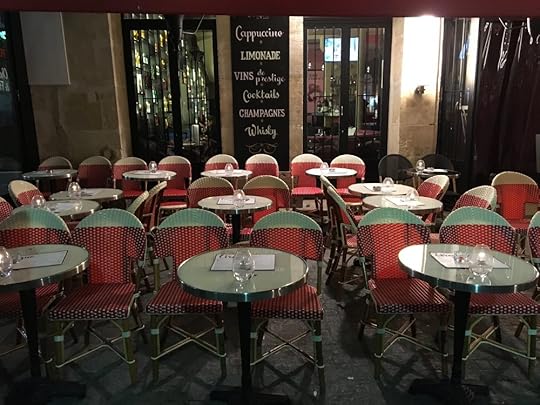
A cafe in Le Marais, Paris
October 29, 2016
Stumbling Into a Book Launch Party
Grandson of a Ghost launched this week. It feels great to simply have the book out in the world with multiple vendors in multiple formats. As I wrote in an earlier post (The Disconcerting State of Hiding in Public), this book is not "normal" in that I have no plan for an announcement or celebration of the book's release with any of my friends or family. I'm keeping it secret.
But it so happens the graduating class of my MFA program decided to hold an impromptu 5-year reunion Thursday, exactly the day my book went live on Amazon, Kindle, and the Apple Store. I was feeling good about it. Naturally my classmates wanted to know what I was up to, and it felt simply wrong to hide the book from them, especially since we had been through four grueling semesters together, sharing intimate details of our lives in the process. I trust this group.
I started by showing only the cover, which offered a glimpse of the subject matter, but nothing specific. After a few beers, I pulled up the website and shared the book's synopsis, which I imagine came as quite a surprise. I ended up explaining that part of my motivation for starting psychotherapy came as a result of the graduate program, where I discovered my reaction to criticism was much more pronounced and severe than everyone else's reaction.
Towards the end of the evening I choked up — crying briefly, no more than five seconds — because I was suddenly overwhelmed by the magnitude of what for me was a milestone. I had finished a book after two years work, published it, and was now actually sharing the tough subject matter with a group of my peers. All of this was unimaginable not long ago. And quite by chance I was now participating in my own sort of book launch party.
I'm still not sure what they think about my abuse background, but I am glad I trusted my classmates enough to share. The whole point of my work with my therapist has been to come out of hiding, and I did so Thursday night. It was scary. I am still nervous about what they think. But I feel it was the right thing to do.

September 16, 2016
Behind the Dedication: Mining for Buried Memories, Together
The final chapters of Grandson of a Ghost describe the psychotherapy sessions that inspired me to write the book. I never could have done it — nor could I have sustained the effort — without the encouragement and continuing emotional support of my therapist.
All characters in the book have fictionalized names, and I write under a pen name to protect the privacy of my family. But the book is dedicated to Jacob Ham, Ph.D., a real-life person. And it's not much of a stretch to conclude the psychotherapist in the book — a character named Ken — is based on Jacob and the last two chapters are based on our sessions together.
Jacob observed I was finding it helpful to write down trauma memories as a means of digging out things from my past that I'd kept buried away. I still didn't understand how pulling memories up to the surface could possibly help matters. In fact, in the short run, digging deep made me feel much worse. At times I resented digging. But he explained to me that exposing memories to the light of the present day would — over time — lessen their power over me. Exposing them would allow me to file the memories away properly, instead of feeling a vague, vast pit of pain inside that I felt forbidden to access, but at the same time fueled my feelings of low self-esteem, shame, sadness and the need to hide myself.
I was fascinated by the idea that life unfolds in a sequence like falling dominoes. My childhood impacted future events because of the way I grew to perceive the world as a threatening place where I was defective — much worse than other kids — and I needed to be constantly on guard to protect myself. Abuse from a primary caregiver in turn made everything in the world very scary.
This now makes sense to me, but I wanted to put words on paper to cement the idea and have something to use as a permanent reference to keep me pushing forward. I outlined the book in sequence so that I could literally follow the narrative as it unfolded. That meant starting when the abuse began, the most difficult memories first. Jacob suggested I save the first chapters for later, so I could work up to them with some momentum. But I wanted to know if I could actually face and record the pain. The whole project would collapse if I couldn't. I needed to know.
The first chapter took months to write. I trembled at the keyboard while typing. I found it particularly difficult because I had to imagine and create the mindset of my mother and how she could have been plausibly driven to beat her child. Often stories never attempt to explain the reasons behind the perpetrator's actions. Jacob and I would discuss the portrayal of my mother often. He observed I was taking care to not portray her as a one-dimensional monster. But was I going too far to justify her actions? I didn't know, but it was the only way I could complete the chapter. I had to have a reason she did it. The story would be too painful without one.
The second chapter was somewhat easier to record because I was old enough as a character to have my own thoughts and motivations. I could wrest the perspective of the story away from my mother, and work with stronger real-life recollections because my character was now age 10 instead of 5. In sessions, I told Jacob how I found myself switching to "detached reporter mode," focusing on an accurate description of the narrative, instead of reliving the scenes as a reader or participant. The technique helped to remove me from the keyboard, but I still trembled. I had to text Jacob a few times while writing for moral support. A no-no, I know, but he tolerated my process. When I finished a chapter, I would send it to him to discuss at our next session. I paid a small, symbolic honorarium fee for his time to read.
As the chapter-writing process unfolded, Jacob told me I was mining deeply into crevices — much deeper than I would have been able to dig talking face to face because of the amount of time I spent at home: typing, reflecting and recording minute details. Extracting buried memories. Finding new relevancy in past actions long forgotten because now I had greater self-awareness.
We continued the cycle of my sending a chapter, followed by discussion. At first I attempted to just sit in our sessions, trying to make Jacob recount to me what he found interesting about the newly uncovered material. Things I had never shared. I wanted to test him so I could be sure he had read it, and didn't simply skim it. But he quickly caught on and turned the conversation to how I felt about writing it, what revelations surfaced, or what were the difficult parts. In between new chapter completions, we talked about other areas of my life: work, parents, partner. Sometimes real life would reflect or mimic events in the book, such as my avoidance of confrontations at work. The book started to become illustrative and educational.
I took special care in recounting the last two chapters. The prior chapters each cover time periods of three, five or even 10 years. But the final two chapters each cover only one. They serve as a record for me — and I hope as a general guide for others — of how Jacob was able to reach me and pull me out of hiding. How, working together, he got me to forge a connection with the world.
For that, I will always be grateful. For that, I've dedicated the book to him.