
Slaven Vujic's Blog
June 10, 2025
The Last Diocletian’s Dream (1/3)
Intro:
They called him a god.
Diocletian, the builder of empires, the breaker of men, the ruler who carved his will into stone and flame. But when the purple robes were folded and the armies no longer marched, what remained was a man — aging, silent, and staring into the sea.
In the quiet chambers of his palace, amid gardens and granite, came a final dream.
A dream not of Rome’s glory… but of its reckoning.
The Last Diocletian’s Dream is not a tale of conquest. It is a whisper of conscience, carried on the wind that moves through the ruins he left behind. A night when the sea refused to be silent — and the past came calling with a flaming sword.
The scent of salt and the restless sea filled the cryptoporticus through which the emperor walked during his usual evening ritual. He had likely chosen this bay of yellow flowers and deep blue waters for a reason; he wished to spend his retirement far from fickle politics, tending to cabbage in his small garden nestled within the grandeur of a palace. He had conquered much of the known world, and now found joy in a few square meters of soil. The irony of life. A great emperor — turned farmer.
He sighed wearily, as if mourning the sun that had once again escaped into the depths of the sea. In front of him stood the Island of Deer — not large in appearance, but inexhaustible in treasure. The treasure of stone. He thought, just for a moment, that his soul was like the soul of this kingdom of stone — divinely white at its core, worn and battered on the outside by the world.
“Master, dinner awaits in the triclinium. This evening you have…”
A hand rose slowly toward the sea.
Loyal Licinius fell silent, took a few steps back, and withdrew to his quarters, silently in tune with the late afternoon maestral breeze.
But the sea did not obey.
It continued its tale, its undulating iamb.
The emperor slowly walked back toward the triclinium — the glamorous dining hall with a large marble table at its center.
The Emperor.
The son of a god! Iovius.
Whom the sea does not obey.
“If only they knew what kind of cabbage grows in this palace, they would never have offered me the throne,” he whispered with an ironic smile, before pouring a cup of sabbaia.
Of all the Roman offerings on the table, the strongest in spirit was the ancient Illyrian beer. Illyrian.
Yes, that’s what we called all those we conquered in this rugged Dalmatia.
That’s what we called… my roots.
My villages beyond Salona.
My cradle.
As he set down the foaming cup of sabbaia on the cold table, he realized that nothing grandly Roman around him had the soul of that rustic beer — even his white mane resembled the tongues of the sea more than any Roman wine ever could.
In sabbaia, veritas.
He picked up a green apple from the table and examined it from all angles. With soldier’s precision, he took his seax and sliced it into four nearly identical pieces. In an instant, the whole became four — just like his empire.
Five years ago, he had established the Tetrarchy — the rule of four emperors. He and Maximian were Augusti, and Galerius and Constantius were Caesars. Four emperors, one empire.
Was it yet another brilliant idea from his utopian treasury?
Rome. What is Rome? Glory? Power? The scepter of the gods? Cabbage?
No.
Rome is the sword.
Nearby, rhythmic strikes of gladius echoed — the military camp was in the palace’s northern quarter, near the Golden Gate. The legionaries entertained themselves creatively within the peaceful walls of the palace, perhaps forgetting that the man who lived here was the only emperor in history to willingly relinquish his throne.
The sunset was most beautiful along the long covered portico on the palace’s southern facade, but somehow the night sky always felt most alive in Jupiter’s heart. The Peristyle was dominated by columns of African red granite, brought by ship from Egypt as war spoils. Two black granite sphinxes guarded the entrance to Jupiter’s temple — in that pharaonic setting, the emperor once greeted the people from the portico.
The emperor as demi-god, the reincarnation of Jupiter on earth.
But tonight, the Peristyle was walked by a tired old man in search of meaning.
Though the night resembled countless others before it, something kept the emperor awake. Something not made of stone or any earthly material. Something that passes through walls and time.
The divine Jupiter?
Or perhaps…
a conscience?
“Dioooocleees…” whispered the red darkness.
“Diocleeeeeessss…” it repeated.
Chapter II
The emperor awoke from half-sleep. His back ached with the chill of African red granite from the column against which he’d slumped.
He knew that somewhere nearby were his personal guards and loyal servant Licinius, yet his gaze drifted toward the temple’s portico. Slowly, he rose and walked toward the red darkness as the night sky shimmered with a thousand stars.
“Who are you?” asked the once-mighty master of the world.
“I am you,” answered the red darkness, taking the form of a giant Roman soldier with a flaming gladius glowing like embers from the shadows.
“Only true gods wield such power,” replied Diocletian.
“And that is why you are but an old man, Diocles.
A faithful servant who thought himself a god,
who believed he could shape the world.
A god!”
That final word seemed to erupt from a nearby crypt, voiced by thousands of slaves who had lived the darkness of the substructures after long days of labor.
“All my strength on earth is in you, O mighty Jupiter!” cried Diocletian.
“Jupiter? Is that what you call me?” hissed the red darkness, its tongue flickering like a serpent as it extinguished the flaming gladius.
“This kind of power is yours alone,” answered Diocletian, bowing his head in reverence.
“And your power was once great. You conquered many. You took the world and cast it to its knees.
But even you fell to your knees, O son of Jupiter!” hissed the darkness, then surged through Diocletian’s body and across the entire Peristyle like a youthful storm.
Diocletian felt a sharp pain in his chest. He clutched at it and collapsed, curling into the fetal position on the temple portico. Only in that posture did the pain subside. Any movement — a hand, a leg — brought paralyzing agony.
But nothing hurt as much as his own thoughts.
He had to follow the red darkness.
Bracing on his right elbow with a grimace, he eventually stood, gripping his seax. Pain twisted through every line on his face. He moved back toward the Peristyle, now glowing dark crimson, as if bathed in blood.
To his surprise, it was empty.
From the north side of the palace came drunken soldier songs — though with each step, the songs began to sound more like the howling of wolves.
His thoughts raced like a wounded boar.
He remembered the prophecy of a rustic tavern woman back when he was just a respected soldier — she had told him he would become emperor when he slew the fateful boar.
And he had killed that boar, many times over.
The one on four legs with a spear.
And the one on two legs, with a sword — and stepped into history.
The thought was interrupted by the sphinxes, blocking his entry to the Peristyle. The two black androsphinxes stared with their pharaonic eyes, growing ever larger. In the end, he stepped into their gaze — and saw the Peristyle in flames.
All the beautiful Corinthian columns lay shattered.
The crimson imperial robe flapped in the wind, burning atop a spear pierced through the heart of a crucified man.
Everything burned in bloody red darkness, accompanied by the voices of the underworld, as mighty Rome died in agony.
The man on the cross grew smaller.
The flames grew louder.
Until nothing remained — not even stone upon stone.
The post The Last Diocletian’s Dream (1/3) appeared first on Slaven Vujic.


One Week in Dalmatia: A Storytelling Journey Through Sea and Stone
By Slaven Vujić – Cultural Storyteller of the Adriatic
Most travelers come to Dalmatia with a checklist: beaches, sunshine, old towns, seafood.
But those who stay a little longer — who listen, walk, and wonder — discover something else.
They begin to hear the story the land is trying to tell.
This is a journey not for the rushed tourist, but for the curious soul.
A week where ruins speak, saints linger, and stones remember.
You don’t arrive in Split. You descend into it.
You step through the Iron Gate, and suddenly you’re inside a city that was never supposed to live this long. Stone corridors wind beneath laundry lines. Teenagers sip coffee on Roman thresholds. Grandmothers lean from Venetian windows carved into imperial walls. And the voice of the past? It doesn’t echo — it mutters, it whispers, it laughs.
Once, this was Diocletian’s retirement fantasy — a Roman emperor’s grand retreat from power. He filled it with columns from Egypt, limestone from Brač, and the finest architects in the empire. But Diocletian died. The empire fell. And the palace?
It survived — not as a relic, but as a refuge. When nearby Salona burned, the people fled into the palace. They built homes in its courtyards. Churches in its temples. Life in its bones.
And so it continues today.
Sit in the Peristyle at dusk when the stones start glowing like old embers. Walk the substructures beneath the palace and imagine the emperor pacing above your head. Touch a column that has seen everything — and still holds up the sky.
Day 2: Salona and Trogir – Cities of Silence and StoneIn Split, nothing is gone. It’s just layered.
Even time.
If Split is a survivor, Salona is a ghost.
You walk through wildflowers and ruined amphitheaters, past sarcophagi cracked by earthquakes and time. Salona was once the Roman capital of Dalmatia, home to 60,000 people — senators, bishops, martyrs. It had theaters, forums, baths, and basilicas. Now it has wind. Memory. And you.
Stand in the middle of the amphitheater and close your eyes. Hear the roar of the crowd. Then the silence. Then, maybe, a whisper from the past — “We were here.”
In the afternoon, drive toward Trogir, where history didn’t die — it calcified.
A small island wrapped in marble and myth, Trogir is a place where time didn’t pass. It folded.
You cross the bridge and enter a city of labyrinthine alleys and lion-guarded gates. Every stone house is a paragraph. Every courtyard — a pause in the sentence. The Cathedral of St. Lawrence rises at the center like a stone prayer.
If Salona broke your heart, Trogir will hold your hand and say: “Some stories are never lost. Just softened.”
Day 3: Brač – Stone, Saints, and Salted AirThe sea between Split and Brač is not wide, but the silence that greets you on the island feels like a different century. Here, the wind carries no rush. It tastes of pine, of salt, of something old that doesn’t care to explain itself.
You arrive in Supetar, where time takes its first step backward.
Follow the inland roads through olive groves and dry-stone walls, past villages where men still shape stone with their hands and women bake bread by memory. The road leads you to Pučišća — a place so white, so carved, it looks like it was built by the marble itself.
This is where the stonecutters live.
And not metaphorically.
In Pučišća, young students still train at Croatia’s only stonemasonry school, chiseling Brač limestone the way their ancestors did — carefully, rhythmically, almost reverently. You don’t just see tradition here. You hear it. In every tap of the hammer.
From there, rise up to Vidova Gora, the highest peak on any Adriatic island. Below you, like a crescent of gold drawn by Poseidon’s fingertip, lies Zlatni Rat — the Golden Horn, a beach that shifts with the tide like a creature breathing.
Brač is not loud. It doesn’t need to be. It was here before Rome, and it will be here after us.
Take a stone in your hand before you leave.
Not as a souvenir. As a reminder.
You approach Hvar by boat, and it greets you the way a noblewoman might — smiling, radiant, but with something hidden behind her eyes.
Most travelers see only the brightness: the sun-drenched cafés, the lavender shops, the yachts. But if you look closer, you’ll see the shadows — and that’s where the real story lives.
Climb to the Fortica, the 16th-century fortress that watches the harbor like a sleeping lion. Its walls have seen pirates, plagues, wars — and still stand. From up there, Hvar looks like a stage. But what played here was real.
Descend into the Franciscan monastery, where the hush wraps around you like seawind through pine needles. The monks here still walk the cloisters, still pray, still tend to the silence as if it were a garden.
Then — if the season is right — find a lavender field. Not the touristy ones, but the wild ones, high in the hills. Stand in it. Breathe in a memory that was never yours… and yet feels familiar.
Hvar is a contradiction — light and shadow, sacred and seductive.
It doesn’t just charm you. It studies you.
Let it.
Day 5: Cetina Canyon – Where the River RemembersBy now, the sea is in your blood. But today, you turn inland. Toward the river that carved a kingdom, fed villages, and whispered to monks in the dark.
The Cetina does not rush. It slides between cliffs like a story that’s been told a thousand times and still isn’t finished.
You arrive in Omiš, a coastal town once ruled by pirates — not romantic ones, but hard, brutal men who knew the wind better than prayer. Their strongholds still crown the rocks above, and if you climb the staircases carved into the mountain, you can see what they saw: a river hiding in stone, and the sea beyond it like a promise or a threat.
Deeper inland, where the canyon narrows and the green gets thicker, the story changes. You raft or walk along the Cetina’s quieter parts, where old mills sleep and dragonflies trace spirals in the sun.
There’s a spring here — they say it’s sacred.
The kind of place where you don’t talk. You just let the water speak.
Day 6: Badija and Korčula – Islands of Silence and StoneThe Cetina does not just flow through Dalmatia.
It flows through its memory.
Some islands are loud — full of crowds, cocktails, hashtags.
Badija is not one of them.
You sail early, when the sea is still silver, and the island rises like a secret from the mist. There’s only a monastery here, a forest, and deer who stare at you like they’re guarding something sacred.
Walk the coast path slowly. The Franciscan monastery still holds mass in the chapel. You might hear it if the wind is right. You might feel it even if you don’t.
Then sail to Korčula, that proud walled city often called the “Little Dubrovnik.” But unlike her more famous cousin, Korčula doesn’t perform. She waits.
You walk under the Land Gate, and the stone streets curve upward like a spine.
They say Marco Polo was born here.
Whether or not that’s true doesn’t matter.
Because this is a place of departure — for explorers, for pilgrims, for those chasing meaning.
Some islands feed your body. These feed your inner quiet.
Let them.
Day 7: Return, Wander, or Begin AgainBy now, something has shifted.
You don’t check your phone as much.
You listen more.
You notice things — the shape of old doorways, the way the sky blushes before sunset, how salt smells different in morning light.
Today, you return where your heart pulled hardest.
Or you find a small village you’ve never heard of.
Or you sit by the sea and simply do nothing — which in Dalmatia, is an ancient form of meditation.
Because this was never about “seeing everything.”
It was about hearing the story behind what you saw.
Dalmatia is not a destination.
It is a storyteller.
And if you let it —
it will tell you something you needed to hear.
The post One Week in Dalmatia: A Storytelling Journey Through Sea and Stone appeared first on Slaven Vujic.
Game of Thrones in Split: When Fantasy Walked Through Roman Stone
There are places in the world where fiction borrows from history. And then there is Split, where history is so alive, so textured, that fantasy simply steps into it.
When HBO chose the ancient cellars of Diocletian’s Palace as a key filming location for Game of Thrones, it wasn’t just because the stones were old. It was because they were alive — layered with memory, scarred by centuries, and still whispering the ambition of an emperor.
A City Beneath the PalaceIn the series, the cellars of the palace became Daenerys Targaryen’s throne room in Meereen, where dragons were chained and rebellion stirred. But long before dragons, this was the foundation of a real empire.
These massive substructures supported Diocletian’s private quarters above and mirrored their layout. Roman engineers designed them to be practical — strong, elevated, watertight. And yet today, they feel mystical: echoing chambers of cold limestone, pillars holding up both past and present.
When film crews arrived, they changed almost nothing. The space didn’t need CGI. It already looked like it belonged to another world. And it worked.
Dragons screeched in chains where Roman aqueducts once ran. Guards walked through shadows once cast by imperial slaves. And Split’s cellars, once forgotten and buried under centuries of debris, became globally iconic.
Dragons and DiocletianIn many ways, the two rulers — Diocletian and Daenerys — are not so different. Both were powerful, divisive, visionary. Both believed in control, in order, in symbols.
Diocletian built a palace on the edge of the empire to watch the sea and retreat into divinity. Daenerys stood in that same palace (albeit as fiction), trying to tame her dragons and rule through fear and justice. The stone made the transition seamless.
And for viewers who visited after the episodes aired, there was a thrill in discovering that this place wasn’t made for TV. It was made for eternity.
The Unsullied and the Streets of MeereenSeveral other scenes were filmed above ground, within the stone alleys and narrow corridors of Diocletian’s Palace itself.
In Season 4, the battle between the Unsullied and the Sons of the Harpy was filmed in the very heart of Split’s palace district. Viewers watched as the disciplined army of Daenerys clashed with masked assassins in brutal, intimate combat. But locals knew these streets well: they walk them every day.
The ancient alleyways where tourists now wander with gelato in hand were, on screen, filled with blood, fire, and vengeance. And when Ser Barristan Selmy, one of Westeros’ most beloved knights, fell in battle during that scene, he died not in a set—but in an alleyway behind a 4th-century temple.
The death of a fictional knight became forever tied to a real place.
A New Wave of PilgrimsGame of Thrones brought a new kind of traveler to Split: fans. People from around the world who came to stand where scenes were filmed, to walk the same stones as their favorite characters. But often, something deeper happened.
They came for Westeros. They left talking about Rome.
Because once you enter the palace, you feel the weight of real history. You notice the wear on the steps, the ancient drains, the limestone that glows gold at sunset. You hear street musicians playing beneath arches that once heard imperial orders.
You realize: this isn’t a film set. It’s a foundation.
Where Fantasy Meets LegacyThe success of Game of Thrones didn’t rewrite Split’s story. It simply revealed a new chapter.
Tourists now take “Game of Thrones walking tours”, exploring the palace, the basements, nearby Klis Fortress, and even local stone quarries used as filming sites. But the best part? They often leave those tours not only with photos — but with questions:
Who was Diocletian?Why did he choose Split?How did this palace survive?Fantasy, then, becomes a gateway to curiosity. And Split, with its living history, becomes more than a backdrop. It becomes a teacher.
Visiting the Thrones of Two WorldsIf you’re walking Split as a fan of Game of Thrones, don’t just look for dragons. Look for the emperor. Look for the people who lived here, died here, rebuilt it again and again.
Visit the cellars, and notice the stone.
Stand in the Peristyle, and imagine ceremonies not of fire and blood, but of incense and empire.
Climb to Klis Fortress, and realize it wasn’t fantasy — it was resistance, faith, and survival.
In Split, fantasy and reality share the same throne room.
You don’t need special effects. You just need to listen.
The post Game of Thrones in Split: When Fantasy Walked Through Roman Stone appeared first on Slaven Vujic.
Split: A City Built for an Emperor, Living in Every Stone
When Emperor Diocletian made the unprecedented decision to voluntarily leave the throne of Rome, he didn’t fade into obscurity. Instead, he returned to the shores of his childhood – to Dalmatia, where the sea was clearer, the winds gentler, and the stones older than memory.
But he didn’t come to rest. He came to build. And what he built would never die.
He chose a bay just south of Salona, the Roman capital of Dalmatia, and ordered the construction of a vast seaside palace. A fortress-temple-villa hybrid, designed not for future emperors, but for a man who had ruled the world and now wanted to retire among gods and sea foam.
A Palace, Then a CityConstruction began around 295 AD. The palace was no mere pleasure house. It was a vision carved in Brač limestone, reinforced with Egyptian sphinxes, Greek marble, and the finest Roman engineering.
It was divided into two halves:
The southern section, open to the sea, held the imperial apartments and temples.The northern half housed soldiers, servants, and storerooms.Each of the four gates had a name:
The Golden Gate faced the land and symbolized imperial power.The Silver Gate opened toward Salona.The Iron Gate led to the mountains.The Bronze Gate, closest to the sea, served as a secretive imperial entrance.Diocletian died within these walls. But he left behind more than marble. He left behind a structure that would never become a ruin.
The Living PalaceAs Salona fell in the 7th century, refugees poured into the palace for protection. They didn’t just seek shelter — they made it home.
They bricked up arches, turned corridors into alleys, temples into churches, and mausoleums into cathedrals. And so, Diocletian’s mausoleum became the Cathedral of Saint Domnius, now considered the oldest Catholic cathedral still in use in the same structure.
No other palace in the world has undergone such a transformation: from imperial residence to living urban heart.
Today, more than 3,000 people still live inside the palace. Washing hangs between Roman pillars. Cafés nestle in ancient courtyards. Cellars beneath the Peristyle echo with both footsteps and festival drums.
A Story in Every StoneWalk Split with eyes open, and the past speaks softly:
In the Peristyle, emperors were worshipped. Today, musicians play beside ancient columns as tourists sip espresso.In Vestibul, once the entrance to the emperor’s private quarters, the circular echo of a capella singers lifts upward like incense.Climb the bell tower of Saint Domnius, and you rise above centuries — with views from Roman foundations to medieval rooftops to modern ferries crossing the Adriatic.Visit the Cellars, which once supported the emperor’s quarters. Forgotten for centuries, they are now restored and open, revealing the genius of Roman engineering.The Temple of Jupiter, repurposed into a baptistry, still guards its ancient bronze doors.Step into Papalić Palace, and enter a noble 15th-century home that whispers of Venetian rule.Beyond the Palace WallsSplit grew outward like the rings of a tree. Every century left a layer:
Pjaca (People’s Square) became the medieval and Renaissance heart of the city.The Prokurative, built in the 19th century, reflect the influence of Venetian and Austro-Hungarian rule.The Riva, the waterfront promenade, transformed from a defensive Roman wall into a place of coffee, conversation, and sunsets.Just a short walk away lies Marjan Hill, the city’s green lungs, sacred since pre-Christian times. Climb it, and you see the whole city — not as a skyline, but as a storyline.Split is Not a RuinUnlike many ancient sites, Split is not an echo. It is a conversation between past and present.
You can feel it in the way locals touch the walls as they pass. In the way children play soccer beside 4th-century columns. In the smell of grilled fish rising beside Roman stone.
Split doesn’t ask you to observe. It asks you to enter.
If You VisitTake time at the Golden Gate — not just for photos, but to stand where emperors once passed.Wander the Green Market outside the palace, where trade has continued, in one form or another, for 1700 years.Visit Galerija Meštrović, where Croatia’s greatest sculptor speaks in marble, not unlike the Romans before him.Sail to Veli Varoš, a once-poor neighborhood now rich in charm and character.ConclusionSplit was built for one man. It became home to thousands. It began as a fortress. It became a city. It was once the end of a journey. Now it is the beginning of many.
Come not just to see the palace — come to hear its heartbeat. Because in Split, every stone has something left to say.
The post Split: A City Built for an Emperor, Living in Every Stone appeared first on Slaven Vujic.
Stone Whispers: A Sacred Craft Older Than Empire
There is a silence in stonework — the kind of silence that holds memory, not emptiness.
In Croatia, that silence is everywhere.
It lingers in the cracked walls of ancient fortresses, the polished thresholds of Roman palaces, the abandoned quarries of Brač… and even in the quiet chiseling of a teenage apprentice in Pučišća today.
This is not just the story of Croatian stone.
It is the story of a sacred craft passed from hand to hand across thousands of years — from forgotten builders of megaliths to Roman imperial architects, to modern students still learning to listen to the stone.
Let’s follow the trail together.
The Prehistoric Origins of a Hidden ArtBefore Diocletian ruled.
Before Caesar marched.
Before Latin ever echoed in Dalmatia…
There were other hands.
On hilltops like Varvaria (modern-day Bribirska Glavica), prehistoric builders raised massive stone walls, forming an acropolis that predates written history. Their purpose? Unknown. Their identity? Forgotten. But their work remains — stone blocks carefully positioned without mortar, still standing after thousands of winters.
Further inland, in what is today Bosnia and Herzegovina, lies Daorson, the ancient capital of the Daorsi tribe. The site stuns archaeologists with its Cyclopean walls — limestone blocks so enormous and perfectly aligned that many compare them to Mycenaean Greece. How this technique reached the Balkans is still debated. The tools? The knowledge? The vision? All remain part of the mystery.
And even on Brač, long before Roman ships arrived, early inhabitants were already building enclosures and ceremonial sites with stone — signs of an indigenous tradition of stonework rooted in the rhythms of the island itself.
This was no simple labor.
It was a language, an intuitive science, a ritual.
When the Romans arrived, they didn’t just conquer — they absorbed.
They recognized excellence when they saw it.
The island of Brač became one of the empire’s most prized sources of stone.
In the quarries of Rasohe and Plate, Roman engineers supervised the extraction of limestone so white, so fine, it became a preferred material for palaces, temples, and city gates across the empire.
Around 295 AD, an emperor born in Dalmatia — Diocletian — ordered a monumental palace to be built near the sea. His builders turned to Brač.
Stone by stone, block by block, the Palace of Diocletian rose. Not just a home for retirement — but a fortress, a statement, a sacred geometry carved in limestone.
Brač stone didn’t stop there.
It was shipped across the Adriatic to Venice, where it became part of Saint Mark’s Basilica.
It found its way to Vienna, to royal buildings.
And some even say it crossed the Atlantic — becoming part of the White House in Washington, D.C.
Empires rose and fell.
But the stone — and the craft behind it — endured.
What made these builders different?
The Roman mason wasn’t just a laborer. He was a geometer, an engineer, and a mystic.
He knew how to read the fault lines in limestone.
He understood how to balance tension and compression before physics had a name.
And most of all, he respected the stone — carving not to dominate, but to reveal what was already hidden inside.
But he was also part of a much older chain — a tradition that had already been alive on these lands for over a thousand years.
And that chain is not broken.
Pučišća – The Last Living School of StoneOn the northern coast of Brač, nestled in a sheltered bay, lies the village of Pučišća.
Here, the past is not buried in ruins — it lives.
The Stonemason School of Pučišća is one of the last institutions in Europe where students are taught to carve by hand, using traditional tools and ancient techniques. No shortcuts. No machines. Only limestone, a mallet, a chisel — and time.
They learn not just how to cut, but how to listen.
To read the grain.
To feel the tension.
To dialogue with the stone, as the megalith builders did, as the Roman masons did, as their island ancestors did long before history began.
In Pučišća, the line is unbroken.
Here, craft becomes legacy.
When you visit Croatia, you’re not just walking through ruins.
You’re walking through living stone — a tradition that connects the prehistoric to the imperial, the forgotten artisan to the student of today.
From the mystery of Asseria’s walls, to the grandeur of Diocletian’s Palace, to the quiet tap-tap-tap of a chisel in Pučišća… this land is more than just scenic.
It is sacred with skill.
And in that sacredness, you’ll discover that the oldest stories of the Adriatic were never written in books.
They were carved — with patience, precision, and purpose — into the bones of the earth.
The post Stone Whispers: A Sacred Craft Older Than Empire appeared first on Slaven Vujic.
June 8, 2025
Olive Trees and Time Travel: A Story Beneath the Branches of Brač
There are trees that shade you — and trees that know your name.
On the island of Brač, the olive trees are more than just part of the landscape. They are elders. Witnesses. Storytellers of stone and silence.
I’ve often wandered through these groves, especially in the golden hush of afternoon. The scent of wild herbs clings to the air — rosemary, immortelle, and sage — while the cicadas sing like ticking clocks. But time doesn’t tick here. It folds.
Some of these trees are over a thousand years old. Imagine that. Their roots have gripped this rocky island longer than most nations have existed. They’ve seen pirates, monks, empires, saints. They’ve watched wars come and go, and they’ve outlived the ones who planted them.
Sometimes I think of them as Ents, Tolkien’s wise tree-shepherds from Middle-earth. Their branches speak in creaks and sighs, and though their voices are slow, I believe they talk to one another. In the quiet of these groves, you get the sense that the trees are keeping council — whispering about the changes in the wind, the stories buried in the soil, and the curious humans who walk among them.
A Legacy Rooted in AntiquityOlive cultivation on Brač dates back to antiquity. The Greeks and Romans planted the first groves here, recognizing the island’s limestone terrain and Mediterranean sun as perfect for olives. Over time, the people of Brač turned the olive into more than just a crop — it became a companion to life itself. Every household had a few trees, and many had groves. Olive oil wasn’t just used for cooking; it lit the lamps, blessed the sacraments, soothed wounds, and honored the dead.
These trees, like Ents, have watched over us from the very beginning of our life on the islands. Theirs is a patience we no longer understand. While we measure seasons and news cycles, they measure eras. And yet, they still give: shade, fruit, peace.
The Olive Oil Museum in ŠkripOne of the best places to understand this legacy is the Olive Oil Museum in Škrip, the oldest settlement on the island. Tucked into a stone house that once held an active oil press, the museum still smells faintly of crushed olives and cold-pressed life. Inside, you’ll find wooden beams blackened by time, iron levers worn smooth by generations of hands, and stories passed down like heirlooms. Here, olive oil is not just a product — it’s a witness.
A Family Tradition: The Harvats of BračI remember one moment clearly: a lunch in a dry-stone field near Škrip. We sat on a low wall built by someone centuries ago. My friend poured us oil straight from his family’s press — green-gold and peppery. We dipped bread in it and said little. You don’t need many words when the oil speaks of labor, lineage, and land. That family, the Harvat family, has been producing olive oil for generations. They carry the tradition with quiet pride, still harvesting by hand, still pressing with care.
What Makes It Extra Virgin?And the oil? It’s not just any oil. It’s extra virgin, a term that often gets thrown around but is steeped in meaning. To be called extra virgin, olive oil must be made only from the first cold pressing, without the use of chemicals or heat. It must have low acidity and retain its natural aroma, flavor, and nutrients. It’s the purest essence of the fruit — uncorrupted, unfiltered by time or technique. It’s a taste of the tree itself.
It is said that extra virgin olive oil holds the soul of the tree. And when it comes from a thousand-year-old olive, that soul runs deep.
Wisdom in the WindWhen I walk beneath these twisted limbs, I don’t just feel calm. I feel humbled. These trees aren’t trying to be anything. They just are. They bend in the wind, stretch toward the sun, and carry on — wrinkled, wise, and quietly alive.
They remind me that storytelling doesn’t always require words. Sometimes it lives in roots and bark, in the spaces between wind gusts, in the crackle of leaves at dusk. The trees are telling their tale — not to be heard quickly, but to be understood slowly.
More Than Just BeautifulAnd that’s the thing about Brač. The land isn’t just beautiful — it remembers. It remembers every stone wall built without mortar, every back bent in the harvest, every meal shared in silence. If you sit still long enough, under an old olive tree, it might just share something with you too.
Because here, in these groves, you’re not just passing through.
You’re passing into something older than history, and maybe deeper than time itself.
The post Olive Trees and Time Travel: A Story Beneath the Branches of Brač appeared first on Slaven Vujic.
Forski Pjat: A Taste of Memory, a Spoonful of the Sea
There are meals that nourish the body — and there are those that feed memory. In Dalmatia, we call it forski pjat: not just food from the island of Hvar, but a phrase that evokes soul, tradition, and the rhythm of the sea. To sit at a stone table overlooking the waves, a glass of local wine in hand, and a steaming plate of gregada before you — that’s not lunch. That’s heritage.
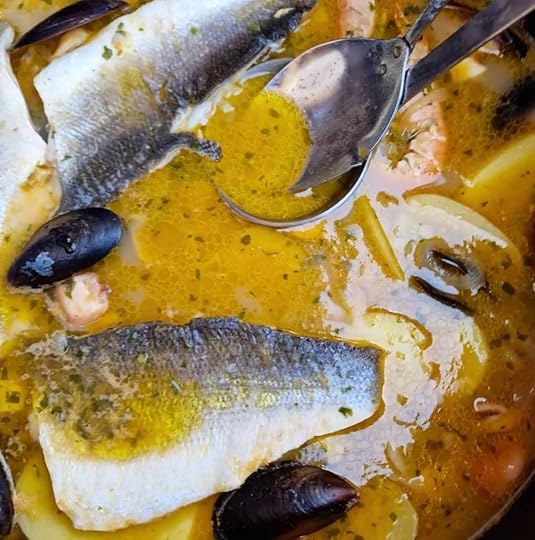
What Is Gregada?Gregada is one of the oldest known fish stews in the Adriatic. A humble dish made with white fish, potatoes, garlic, olive oil, and a splash of white wine, it’s slowly cooked in a single pot. But the real ingredient is time — not the minutes on the stove, but the centuries behind the recipe.
Every family has its version. Some add capers or tomatoes, others insist it must be monkfish or scorpionfish. What never changes is the principle: simple, fresh, honest.
In the fishing villages of Hvar, gregada was once made on open fires, eaten by hand, and served without pretense. It was a fisherman’s reward after a long day at sea, a celebration of the catch, and a quiet prayer to the gods of tide and time.
 The Meal as Memory
I still remember the first time I had gregada that tasted like it came from the stories. It was in a friend’s courtyard in Stari Grad — a warm, sunlit lunch with no rush, no plans, no phone calls. Just good company.
This time, I was not alone. My wife Ira walked beside me through the cobbled streets of Hvar as we made our way to the family restaurant Casablanca. It’s run by my dear friend Ivo — a wizard of Dalmatian cuisine, a man who knows how to turn the sea into song. Ivo is more than a chef; he’s a keeper of flavors, a guardian of forgotten recipes.
He greeted us with a grin, a glass of prošek, and a pot already bubbling in the corner. As the scent of garlic and fish danced through the air, Ira picked up her camera — her way of remembering. We sat, laughed, and simply let the afternoon stretch, the way Dalmatians do when they know time is not an enemy but a companion.
The gregada arrived with no grand gesture — just warmth. The potatoes melted like childhood. The broth carried whispers. The fish? Honest, fresh, forgiving.
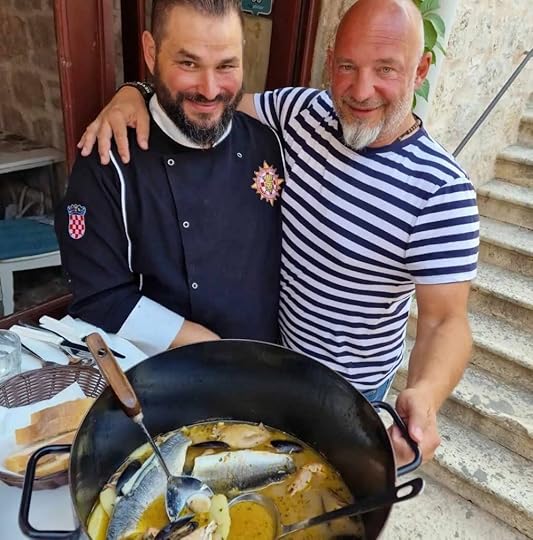
No Michelin star in the world could replace that moment. Not because of the fish, but because of the feeling — of being part of something ancient and alive. Of honoring a deeper tradition: that friendship and food deserve unhurried hours.
Beyond the PlateTo guide a tour through Dalmatia is to guide people not just through landscapes, but through flavors. When I include gregada on my Hvar storytelling tour, it’s not just to showcase local cuisine. It’s to offer a glimpse into identity.
I tell guests: you’re not just tasting fish — you’re tasting the rhythm of nets cast at dawn, the hands of grandmothers who knew no recipe books, the resilience of an island that learned how to survive with little but turned it into much.
And so forski pjat becomes more than a dish. It becomes a story — one that lingers long after the spoon rests and the sea breeze cools the table.
A Spoonful of StoryIn every corner of Dalmatia, food and folklore walk hand in hand. You cannot tell the story of a place without tasting it.
So if you ever find yourself in a quiet bay on Hvar, and someone offers you gregada, don’t just eat it.
Ask them about it.
Who taught them? When did they last cook it? Who was missing at the table that day?
Because in Dalmatia, every spoon carries more than flavor. It carries the memory of someone who stirred it before you — and the unspoken promise that the story will go on
The post Forski Pjat: A Taste of Memory, a Spoonful of the Sea appeared first on Slaven Vujic.
The Lion of Saint Mark: Stone, Symbol, and Story in Dalmatia
Walk through the sunlit alleys of any Dalmatian town — from Zadar to Hvar, Trogir to Kotor — and look up. Above fortress gates, on the facades of public buildings, or even crumbling on abandoned village wells, you’ll find him: a majestic winged lion, frozen mid-step, sometimes holding a book, sometimes a sword. He is the Lion of Saint Mark, and his story is older, deeper, and more layered than most passing travelers could ever guess.
A Gospel’s RoarThe origins of the Lion lie not in politics, but in scripture. Early Christians assigned symbols to each of the four Gospel writers, based on their narrative style and spiritual themes. Saint Mark was given the lion — winged, bold, and unrelenting. His Gospel begins with a voice crying in the wilderness, echoing Isaiah: “Prepare the way of the Lord.” That cry was seen as the lion’s roar: powerful, urgent, awakening. The wings were later added to represent divine inspiration.
But Mark wasn’t just a writer — he became a wanderer. After accompanying both Peter and Paul, tradition says he founded the Church of Alexandria. Centuries later, in 828 AD, Venetian merchants stole his relics from Egypt, hiding them beneath pork to avoid Muslim inspection, and brought them to the rising city of Venice. There, Mark replaced Saint Theodore as the city’s new patron. And the lion, his symbol, became the emblem of Venetian identity.
This transformation of Mark from a Biblical figure to a civic emblem wasn’t instant. It took generations for the people of Venice to embrace the lion as their protector. Over time, as the city grew into a naval and mercantile superpower, the lion took on new layers of meaning: courage, protection, divine favor, and cultural pride.
The Peace of MarkAccompanying the lion is often a Latin phrase, carved into stone beneath or beside him:
PAX TIBI MARCE EVANGELISTA MEUS
“Peace to you, Mark, my Evangelist.”
According to legend, this was the message delivered to Mark by an angel as he arrived in a storm on the Venetian lagoon. It became more than a greeting — it was a blessing, a prophecy, and later, a declaration of dominion.
Lions with open books bearing this inscription were often placed during peacetime. But when Venice went to war, the book closed — and a sword sometimes replaced it. The lion shifted from saintly protector to roaring conqueror.
This duality — peace and power — was not accidental. Venice prided itself on being both a cultural beacon and a strategic force. The lion, with his scriptural blessing and silent authority, embodied that paradox perfectly.
From Lagoon to Limestone: Venice in DalmatiaDuring the height of its maritime power, the Venetian Republic extended its reach across the Adriatic. Dalmatian cities and islands fell under Venetian control from the 15th to the 18th century. And wherever the Serenissima went, the lion followed.
Dalmatia, with its stone towns, strategic ports, and deep-rooted Catholic identity, was both a prize and a mirror for Venice. Here, the lion was carved into gatehouses, wells, columns, clock towers, and coastal fortresses.
In Zadar, he perches over the Land Gate, a grand welcome to what was once a key Venetian stronghold. In Trogir, he watches from the Kamerlengo Fortress. In Hvar, he sits silently atop the Arsenal. And even in remote villages on Brač and Vis, smaller, humbler lions remind passersby of centuries of Venetian order.
Sometimes fierce and sharp-toothed.
Sometimes weathered and weary.
Sometimes barely visible, as if fading with time.
These lions were not just decorative — they were claims. They asserted ownership, legacy, and continuity. Venice was here. Venice ruled. And Saint Mark, its heavenly advocate, watched over it all.
Lions Across the SeaInterestingly, the Lion of Saint Mark is not exclusive to the Adriatic. From Crete to Cyprus, from Dalmatia to Corfu, the Venetian lion roamed. But in Dalmatia, his presence feels especially resonant.
Perhaps it’s because this coast was never truly subdued — always distinct, always proud. Dalmatian identity adapted Venetian rule without losing itself. The lion became part of the landscape, but the soul of the land remained deeply local.
In some cases, locals even resisted the lion. During times of rebellion, lions were defaced or torn down. In the 20th century, under different regimes, some were removed. But others survived, often because they had become part of the town’s own story.
Today, they’re sometimes restored, sometimes ignored. But they are never meaningless.
Symbols That ShiftTo some, the Lion of Saint Mark still represents colonial rule — a symbol of centuries-long Venetian dominance. To others, it’s just a familiar fixture, part of the aesthetic of old towns.
But to those who walk these streets with eyes open to story, the lion is more than a relic.
He is a reminder that history is layered — that meaning changes over time.
A symbol of an empire became, in time, a part of the stone.
A mark of dominance became a witness of resilience.
The lion, like the cities he guards, has changed. He no longer roars. But he still watches.
The Echo of the RoarI often find myself standing below one of these lions, wondering: how many people have passed beneath him, unaware? How many glances, prayers, weddings, farewells, revolts, invasions, and returns has he witnessed?
He has seen the rise and fall of empires, the comings and goings of rulers, the steady heartbeat of human life. Children once played in his shadow. Soldiers once marched beneath his gaze. Priests blessed him. Rebels cursed him.
And now tourists photograph him.
But that’s the beauty of carved stone — it doesn’t care who looks, only that someone does. It’s there to endure.
Legacy in LimestoneIn the end, the Lion of Saint Mark isn’t just about Venice, or power, or even religion. He’s about memory. About how we carve our stories into stone, hoping they’ll last longer than we do.
He’s about the blending of myth and history, the way symbols transcend their original purpose.
So next time you walk through a Dalmatian town and look up, pause.
Look the lion in the eyes.
He has something to tell you.
And if you listen carefully beneath the sound of church bells and sea winds, you might still hear the echo of that Gospel’s cry:
Prepare the way.
The post The Lion of Saint Mark: Stone, Symbol, and Story in Dalmatia appeared first on Slaven Vujic.
May 27, 2025
What Makes a Blurb Sell a Book?
“You had me at the back cover.”
Said no one ever — but it’s exactly how readers choose.
The truth is: most people don’t buy books.
They buy promises.
They buy feelings.
They buy the story they think they’re about to live.
And that decision?
It happens in seconds — right there, in the blurb.
A blurb is not a summary.
It’s not a synopsis.
It’s not a laundry list of plot points or features.
A blurb is a hook with soul.
A sales page in 120 words.
A conversation starter between you and the reader.
Done right, it does four things:
Captures curiosityCreates emotional tensionPromises transformation or payoffLeaves just enough mystery to demand the next stepWhy Most Blurbs FailToo many authors write blurbs like this:
“Sarah is a young woman living in post-war Europe. She meets David, a journalist from London. Together they uncover a mystery that changes both their lives.”
Okay…
But why should I care?
There’s no voice. No tension. No emotional stakes. No urgency.
It’s an outline, not a reason to read.
In a world flooded with books, that kind of blurb is a whisper in a hurricane.
Anatomy of a High-Conversion BlurbLet’s break it down. A great blurb has:
1. VoiceThe tone of the blurb should match the tone of the book.
Is it witty, brooding, romantic, epic?
The blurb should feel like the first page in disguise.
2. Conflict“She steals identities for a living. But this time, her own name might be the one that kills her.”
What’s the central tension? What’s at stake?
3. Emotion“Two sisters. One inheritance. And a buried secret that someone’s still willing to kill for.”
Make the reader feel something — curiosity, danger, sadness, joy.
4. Mystery“After losing everything, he wasn’t looking for redemption. But it found him anyway — in the form of a broken violin and a girl who refused to leave.”
A question left unanswered. A door slightly ajar.
That’s what turns a browser into a buyer.
Fiction vs. Nonfiction: Blurbs that Do BothFiction blurbs sell story and mood“She remembers the accident. But not the man who says he saved her.”
Your job is to tease the emotional journey — not explain the entire plot.
Nonfiction blurbs sell transformation and clarity“In a city where shadows talk and memories bite back, one detective must solve a case that’s already inside his head.”
Show the reader what problem you solve — and why you’re the one to guide them.
The Secret Ingredient: Reader Desire“Tired of shouting into the digital void?
This book helps authors build a real audience — not with trends, but with trust.”
A blurb doesn’t have to impress.
It has to trigger a want.
Your ideal reader is standing in a virtual bookstore, scanning blurbs at lightning speed.
What will make them stop scrolling?
Not how clever you are.
Not how complete your outline is.
But how clearly they see themselves in what you’ve written.
Bonus Mistakes to Avoid“This book feels like it’s speaking to me.”
That’s what you’re aiming for.
 Overwriting.
Keep it under 150 words. Under 120 is even better.
Flat beginnings.
Start with a bang. First sentence is everything.
Ending with a plot point.
End with tension, a twist, or a haunting question.
Writing like you’re trying to prove something.
You’re not defending a thesis. You’re starting a fire.
Before:
“This is a story about a young knight who is sent on a quest to find a lost relic. Along the way, he meets allies and enemies and faces difficult decisions.”
After:
Final Thought“The kingdom chose him for the quest — not because he was ready, but because he was disposable.
Now, with a cursed sword and a traitor in his shadow, he must decide what he’s truly fighting for: duty, or the truth that could burn the realm down.”
Your book is a living world.
The blurb is the invitation to enter it.
Write it with purpose.
Edit it like a poem.
Test it like a headline.
And most importantly — make it impossible to walk away from.
Need help crafting a blurb that actually sells?
That’s where I come in.
[Let’s Write Your Blurb Together]
[See Blurbarian Services]
The post What Makes a Blurb Sell a Book? appeared first on Slaven Vujic.
May 26, 2025
Words with Soul: Why Your Brand Needs Story, Not Just Structure
“You can have a perfect website structure, SEO-optimized headlines, and flawless design.
But if your words don’t carry soul, no one will stay. No one will care.”
Every brand has a logo.
Every service has a price.
Every website has a navigation bar.
But not every brand has a voice.
Not every offer has a story.
And not every business leaves a memory.
In a world flooded with content, the brands that stand out are not the ones that say the most —
but the ones that say what matters.
Let’s clear something up:
Story isn’t decoration. It’s not fluff or filler.
It’s not “once upon a time” copywriting for dreamers.
It’s not poetry pretending to sell.
Story is structure.
Story is strategy.
It is the spine of meaning behind everything your brand says, writes, or publishes.
When used right, story:
Builds emotional connectionCreates clarity around your purposeMakes you memorable — and trustworthyGuides your customer’s journey like a mapThink of story not as art — but as architecture.
Structure Tells Them Where to Go.Story Tells Them Why to Stay.
You can have the cleanest website on the internet.
You can follow every UI/UX best practice.
You can nail mobile responsiveness, loading speed, and scroll flow.
But if the words on your homepage don’t resonate, you’re building a cathedral of silence.
Your structure may invite them in —
but your story is what makes them want to stay.
And in business, staying leads to trusting.
Trusting leads to buying.
We often think customers are rational.
But emotion drives 95% of decision-making. Logic just justifies it afterward.
When you infuse your brand’s copy — your homepage, your product descriptions, your about page — with emotional truth, you unlock a deeper layer of connection.
You stop “pitching.”You start relating.You stop sounding like everyone else.You start sounding like someone real.What Happens Without Story?People don’t want more information.
They want to feel something.
They want to feel you.
You get:
Websites that are “fine” but forgettableAbout pages that sound like CVsTour descriptions that list locations but say nothingAuthor bios that feel like LinkedIn, not literatureSales pages that perform… okayYour content becomes content — instead of a conversation.
Real Examples:Let’s say you run a travel agency.
Without Story:“Join our 7-day Croatia tour with luxury hotels, guided excursions, and local cuisine.”
Okay.
But why should I care?
“For seven days, walk the same cobbled paths where emperors ruled, poets wandered, and the sea told stories of ships long gone. Stay in family-run villas where tradition meets comfort. Eat meals prepared from recipes older than the maps that guided your journey. This is not a tour. It’s a tale. And you’re part of it.”
Now it’s not about what you’re selling.
It’s about what they’ll feel.
If you’re a writer launching a book, story should not just be inside your book.
It should be in how you present it.
Don’t describe your book.
Position it.
Make your blurb a hook, not a summary.
Bad blurb:
“This is a novel about two brothers dealing with war and trauma in a Balkan town.”
Strong, story-infused blurb:
“In a town cracked open by war, two brothers take opposite paths — one toward duty, the other toward darkness. But as the ruins around them deepen, so do the choices they can’t take back. This isn’t a story of war. It’s a story of what war leaves behind.”
Same book.
Different power.
If you want to bring soul into your copy — use these tools:
1. VoiceYour brand should sound like a person, not a policy document.
Find your tone: Warm? Witty? Soulful? Fierce? Calm?
Great stories have tension. So does great copy.
What problem are you solving? What’s at stake for your customer?
What changes after working with you, visiting your place, reading your book?
Show the journey.
These are not fluff — they’re memory triggers.
They help abstract concepts feel tactile, real.
If you’re:
A travel company selling cultural or luxury experiencesA tour guide who wants to stand out from “informative” competitorsA spiritual brand or coach wanting to connect more deeplyAn author needing blurbs, bios, and personal brandingA business built on passion and meaning, not just productThen your brand needs story as much as it needs structure.
Final ThoughtStructure will help your visitors find your website.
Story will help them find themselves in your message.
And when they do —
they won’t just become clients.
They’ll become believers.
They’ll come back.
And they’ll bring others with them.
Because people forget bullet points.
But they don’t forget how your words made them feel.
Ready to bring story to your brand?
Let’s craft something that sounds, sells, and stays with your audience.
The post Words with Soul: Why Your Brand Needs Story, Not Just Structure appeared first on Slaven Vujic.


