Sam Westhoek's Blog
November 30, 2020
Tears of a Clown
I got hit between the eyes by the confession of a 20-year-old songstress from New Zealand, named Benee. In a Public Radio interview, she divulged she’s had her share of mental and emotional challenges, her fill of anxieties. She talked about how people try not to show themselves crying, yet she posted 10 photos of herself doing so. She stated “I just think it’s so important to be honest, and to not trick people into thinking that it’s all perfect and everything’s a highlight.” Sage wisdom from someone so young!
Take a moment to hear her for yourself, then come back…
[image error] Click to Listen to Broadcast
It is all too easy, in this age of technology, to edit out our undesirable elements and only showcase “the perfect me” we want others to see. Photo filters and ‘selective sharing‘ of only those bits and pieces we deem flattering make it to the light of day. All those sketchy, unattractive, even ‘suspect‘ qualities of our human nature get tucked into lidded boxes or swept under the rug.
If I shared with you my thoughts and feelings, the dark malignant ones, would you still see me as the kind, gentle, amicable person I’ve displayed most of my life? Because I have been angry. I have been frustrated to the point of seething. I have been rent asunder by loss, and knelt weeping on the lawn. And after each such emotional upheaval, I took time to sort through the situation, determined what went right and what went wrong, and then gauged my role in it and how I could affect a change for the better going forward from that point.
Let me show you three examples:
[image error] Click for a brief Overview of Ocean Springs
1)
It was 1978, in the little town of Ocean Springs on the Gulf Coast of Mississippi. I’d failed my Senior year and was in summer school classes. While attending, I struck up a talking relationship with Carolyn, a Junior, a pretty girl who’d grabbed my attention. The other attention she was getting was from another Junior named Gary, who just wanted to cause trouble. He’d insinuate himself into our conversations, and belittle both Carolyn and me.
I’ve always been a reserved and quiet individual, more contemplative than outspoken, and always a bit smaller than other kids of my age. Not only that, I was older than my peers, because I’d been held back one year to learn English before starting First Grade, because I had come to the United States from Germany.
During the early weeks of the summer school class, Gary wouldn’t let up. He continued to pester us and—at one point—I told him off quite plainly. He threatened to beat me up, but I laughed him off.
After class, I was in front of an ice cream shop across from the school, waiting for a ride home. Gary had his own car, spotted me, and pulled into the parking lot. He laid into me again, with a friend of his as an audience. I put up with it for a bit, then he began to shove me around.
I snapped. I grappled with him in order to keep him from punching me. We hit the ground and wrestled in the gravel for a few moments until I managed to get the upper hand. (Most of my friends were taller and stronger than me. I’d learned the advantage of leverage versus size.) I caught him off-balance and got behind him, slipping my arm around his neck, and cinched my grip tight.
[image error]
His strength began to fade and his friend was about to jump in to help. I warned his buddy to back off or I’d snap his neck. Gary was losing consciousness from lack of air, so I laid down the law, whispering into his ear. “Gary, you’re going to leave Carolyn and me alone. I’m real close to killing you right now, but I’m going to let you go in a moment. When I do, you go home, and let’s not do this again. Next time, I may not hold back.“
I let him go, his friend helped him into his car, and he drove off. My ride showed up, and I was thankful for it. I felt completely drained—physically, mentally, emotionally. I don’t remember much of that evening, other than tending to bruises and scrapes.
2)
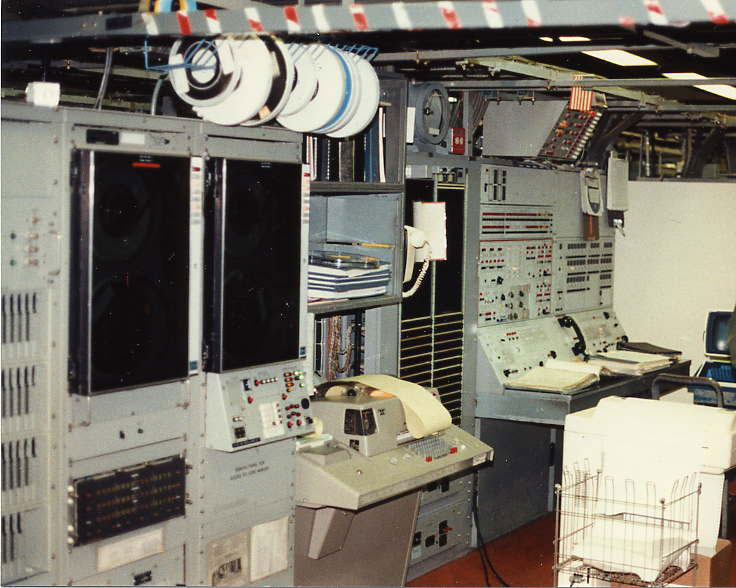
It was mid-1980, and I was a Sgt in the Air Force, working at the Schönfeld AUTOVON telephone switch, at Prüm Air Station, in Germany. My crew and I were working the night shift, maintaining the computerized and electromagnetic relay systems of the Switch. TSgt Flanagan, one of our senior ranking members, showed up and it was obvious he’d come from the Enlisted Club. He lit up the first of an endless chain of cigarettes (still allowed in the workplace back then), but it didn’t cover the stench of too much alcohol.
[image error]
He told me to stand watch in the Center Aisle (the monitoring station for the whole system), while he took the rest of the crew to one of the maintenance rooms with a chalk board. He was going to “teach them the System” because “none of them know how it works.” He spent several hours with them, then stumbled out, while we finished our shift.
The crew approached me as a group and complained about what had happened. We discussed it and they told me TSgt Flanagan had rambled on about various parts of the AUTOVON Switch, in such a circuitous manner that none of it connected nor made sense. The crew had come away from the ‘teaching session‘ no smarter than when he’d walked in. I apologized for allowing the incident to happen and promised I’d do something about it.
The next day, I came in early and caught both TSgt Flanagan and our shop’s Master Sergeant in the office. I recounted what had happened the night before and then told TSgt Flanagan he was never to repeat such behavior, taking a crew off-post and wasting their time. I reiterated to him one of our rules: If any technician was impaired in any way—due to alcohol, drugs, or lack of sleep—we were to report to a superior and refrain from coming to work. I reminded him it applies to the upper level of management, as well.
Word got around, and he was barred from entering the key-code doorways to the Switch. He was given other duties outside our work area. Several months passed, with him still outside the secure area, and it came time for my annual Rating Report. When it was posted, it was so low the Company Commander got involved and a series of domino effects occurred.
[image error][image error]
I was run through a series of interviews, the first of which entailed standing in front of my Commander, telling me I was forthwith demoted from Sgt to SRA. I was put on a probationary program, required to ‘show improvement‘ over the course of six months and then, if a consensus was reached on my status, I might receive my ‘star‘ back (inside the three stripes on my insignia). Meanwhile, I had to change all my uniforms and bear the stigma of a demotion.
I stewed on it for about a week, but I determined not to take it lying down. Enough of my peers pointed out I’d been in the right to accost TSgt Flanagan, and he had no real grounds to scuttle my Rating Report in order to take the heat off himself. I started a paperwork trail, writing out the details of the night of the transgression, and all the background conniving that got me demoted. As I talked with other personnel who had witnessed the incident, most of them offered up written statements to help my cause.
[image error]
The whole situation came down to a trip to the Judge Advocate General’s office at Rhein-Main. I let my management know I was taking the whole package of info there to get a resolution in my favor. When I arrived, guess who was coming out of the JAG’s office? My Commander and First Shirt. I still showed the evidence to the JAG, and he told me, “I see what’s happened here, but there’s nothing I can do to change this. Your Commander backs up his subordinates.“
It wasn’t until my next assignment, in Austin TX, until the whole thing got settled. I’d tested for Staff Sergeant and get the score. The Commander at the new base was hesitant to give me the promotion… until I showed him the documentation. He shook his head and sighed, “You’ve been through all this and are still plugging away, performing to your best? I grant the rank.“
3)
The suicide of my youngest daughter. That was the toughest thing I’ve ever faced in my life. I’ve shared some of it on this blog:
https://authorsamwesthoek.com/2017/09/29/just-up-ahead/ https://authorsamwesthoek.com/2017/10/13/righteously-indignant/ https://authorsamwesthoek.com/2017/10/21/are-you-a-book-lover/ https://authorsamwesthoek.com/2017/10/31/and-then-there-were-six/ https://authorsamwesthoek.com/2017/11/30/holding-on-letting-go/
I’ll leave it to you to decide if you want to read those entries. It’ll give you some sense of what transpired, as well as the emotional jolt it had on me and the rest of the family. I found solace in scripture and in writing out my feelings. The poem, “Just Up Ahead,” encapsulates most all of it, and it was cathartic in that respect. Therefore, I won’t belabor you with further details.
Each of these incidents had long-term repercussions in my life. With the treatment of the bully, I realized killing someone would be detrimental for me, as well. I determined to rein in any further anger, hold it in check, and channel it more appropriately with discussion. With the incident of having my rank taken away, I found there is safety in the counsel and backing of a community of friends. I have never again allowed an authority over me ride roughshod or take advantage of me. In the aftermath of my daughter’s suicide, I clung to the knowledge of a gentle, loving God who will keep her safe until a heavenly reunion. It takes the sting out of the loss of her from this world.
Here’s the kicker. Despite living through, prevailing over, and moving on from each of those situations, I still feel regret and sadness on occasion. I stand appalled at how close I came to snuffing out another person’s life. I shake my head in disgust at being taken advantage of by a chain of authority. I have moments where I pause, tears welling up in my eyes and my breath going ragged, because I won’t see my youngest daughter growing up.
[image error]
And those moments… those quiet, introspective, solitary moments… wash over me in palpable waves. They rear up and I bear their onslaught. Sometimes, they ravage me… with tears, with grinding teeth, with balled up fists aching to demolish a wall. Most times, I let the anger / frustration / sadness have its moment… then I stand upon the foundations of my experience, and move onward again, and leave behind those spent emotions. I step forward with my life, unburdened, free to live and love again.
I will believe with You, that any such troubles in your own life, you’ll find a way to negotiate to a place of peace and understanding, as well.
Bless you abundantly,
~Sam
P.S.: One last thing. If you’ve had the song “Tears of a Clown” going round in your head since you started this read, here’s the YouTube link for the music written by Stevie Wonder, with lyrics by Smokey Robinson:
Photo Credits:
Header Imagehttps://housegoeshome.com/2014/11/09/laughter-is-my-medicine/Vintage Radiohttps://www.shopgoodwill.com/Item/85247093Ocean Springshttps://oceansprings-ms.gov/about-us-ocean-springs/Choke Holdhttps://24.fandom.com/wiki/Knock-outs_by_Jack_BauerAUTOVON Center Aislehttp://www.bunkertours.co.uk/photo9.jpgFile Folderhttps://elements.envato.com/stuffed-file-folder-LQZJY7Sgt Insigniahttps://guide.alibaba.com/shopping-guides/usaf-patch.htmlSRA Insigniahttps://www.wikiwand.com/en/United_States_Air_Force_enlisted_rank_insigniaMan Cryinghttps://creativemarket.com/LightFieldStudios/3536468-man-sitting-on-couch-crying-and-and


November 28, 2020
Delay of the Game!
During the course of the CoViD-19 Pandemic, I spent a lot of time listening to National Public Radio, in order to keep tabs on the developments of the virus spread. Then came the painful process of the Presidential Election, and all the turmoil associated with it. I listened to all manner of folks and their respective patterns of speech and delivery, from the regular news anchors to those in the public eye who provided information and opinions.
And I caught something. I noticed quite a few of the voices on the airwaves prefaced their comments with “So, sure, {and then launched into their information}.” Another variant I picked up on was “Yeah, so,” which—to my ears—sounds even hokier than the first. I’ve even heard several people use “Yeah. So, sure…”
[image error]
My English / Grammar teachers would have been appalled! Me? I just shake my head to realize how many of these little anachronisms have crept into our daily vocabulary. Why are they there? They don’t add anything to the conversation, and all they do is delay the actual reporting the individual is tasked to perform.
I have some idea those who use these phrases are doing so as a way of ‘confirmation’ or ‘agreement’ to the news anchor that they are willing to provide the info. In other words, they’re stating “Yes, I’m ready and willing to spill my guts on this topic just for you,” in the span of two to three words, versus that whole thought, potentially wasting 5-7 seconds of air-time. The only thing is, it still wastes 2-3 seconds, when the person could simply start right into providing their report of the info in question. Imagine if they left off those few words every time they responded to a question.
[image error]
When I was a child and my Father caught me in the midst of an indiscretion, and I tried to hem-haw around the discussion of what happened, he inevitably told me “Get to the point. Just give me the facts, young man.” He didn’t want me to blather on with meaningless words or excuses. He wanted the straight info—with no delays—so he could weigh the transgression and make a swift judgment, in order to settle the matter quickly.
Let me circle back around to my English / Grammar teachers in school. How many of you were taught to Diagram Sentences? If you never have, go look that up in a New Tab on your browser. ……. Done? Okay, let’s move on with what you may have noticed.
[image error]
It’s an interesting exercise to make a writer understand the Components and the Structure of the English language. For me—a kid who came from Germany and had to learn a second language to survive in this new culture—it was like a game. We were taught the basic components (noun, verb, adjective, adverb, modifier, preposition, etc.). Then we were tasked with taking a given sentence and drawing ‘offshoot’ lines from the main idea, accounting for all the extra words (providing additional descriptive details), until we had a branching diagram encompassing all the parts of speech used. It was intriguing to note what was the ‘most important’ information, what added to the useful understanding of the main idea, and what extraneous words could have been easily left off without hindering the ‘intent’ of the sentence.
As a Writer, You are responsible for how your Readers perceive your writing style. There are certain patterns of expression you may use that can ‘make or break’ your story. In light of what I’ve told you about delaying the meaning, check if you use a bunch of these ‘filler’ words:
thatUsed to connote an object or a purposeIf not so used, it’s taking up useless spacewhichOffers an option, or shows a reasonDitto (go on a ‘which hunt’ in your story)justLegally rightIf used to mean ‘simply’, it is filler{adverbs}Use them sparingly (see what I did there?)Use base form, instead, and describe more{clauses}Legit, but minimal use recommendedStraight-line your thoughts, not circuitous
Those first three are easy enough to take care of in your writing. Invoke your Find & Replace function in your word processor and have at it! I do recommend you take each one of the occurrences of ‘that’ individually. If it’s a ‘filler’ word, delete it; if it denotes purpose or points to an object, keep it. You can bank on almost every occurrence of ‘which’ being unnecessary. And the word ‘just’ is right outta there, completely.
Adverbs are, inevitably, words that end in ‘ly’ and have a tendency to be a shortcut for a more broad-ranging meaning. My suggestion is to use the ‘root word’ of the adverb, plus more description, to impart the whole meaning you intended. This will give you practice in spicing up your writing, adding more context, and providing a greater word count. Think of how much closer to a Tolstoy novel it would put your writing. Big. THICK. Novel. I’m only kidding a bit. Change adverbs to more in-depth description, but be certain it doesn’t bog down the narrative.
Clauses aren’t as rare as Santa, but you should strive to minimize them for today’s Readers. Subordinate clauses do add information and descriptive power to a sentence; however, you should NOT do loop-de-loops with your clauses so your Reader gets confused with too many extraneous details. It’s up to you, the Writer, to determine how much or how little description is necessary to paint the picture without obscuring the main images in your story.
What I’ve imparted to this point is on a ‘micro’ level. The words and phrases you utilize to craft your tale are important in their immediacy as the Reader digests each word, each line. There’s also a ‘macro’ level you’ve got to consider. You have to be aware of the ‘pacing’ of the whole story line. You have to arrange the narrative so it continues to build the excitement and tension until you hit the final climactic ending.
[image error]
The best way to do this is through Story Boarding. Hollywood Directors depend heavily upon this process, because it allows them to visualize the key components of the story, and move certain ‘moments’ to an appropriate position in the timeline, so it keeps the Viewer engaged throughout the movie. Break up your chapters in such a way there’s something ‘pending’ at the end of each one, compelling the Reader to turn the page to find out what comes next. Consider it like putting a mini-cliffhanger into each one to propel the story forward.
So, yeah, I’ve given you a lot to chew on. And I hope I’ve kept you entertained in the process. Now it’s up to you to decide how you’re going to implement this knowledge. Go on, then. Get writing!
TJW
Photo Credits:
Teacherhttps://www.theclassroom.com/teach-direct-indirect-speech-8482676.htmlFather / Sonhttps://www.express.co.uk/life-style/health/726133/Teenage-boys-talk-mental-healthSentence Diagramhttps://www.theparisreview.org/blog/2014/02/27/a-most-searching-examination/Story Boardinghttps://boords.com/storyboard-examples
October 28, 2020
What are YOU Waiting For…?
Seriously. What…are…YOU…Waiting…For…?
If you’re like most folks across the globe, caught in the grip of the CoViD-19 pandemic, you’ve probably been practicing “social distancing” and chances are you’ve now been sequestered. What are you doing with all the hours in your day? If you’re not writing, you’re focusing on the negatives instead of the positives of this situation.
Since time immemorial, Writers have made all manner of excuses for not having the time or opportunity to sit down and write. We’ve all heard of those who insisted on seeking out a quiet haven, isolated, away from all the hustle and bustle, in order to be able to focus on their craft. Perhaps a cabin in the woods with a stunning overlook. Holed up in a monastery. Kicked back on the white sands of a tropical paradise with golden rays of sunlight dappling the azure waves. For the majority of us, it would suffice to have a small room all to ourselves, with all our writing implements, and the sure knowledge we won’t be disturbed while we pen the lives of our characters in the worlds we’ve created.
What makes you think you don’t have such a place available to yourself right now? Look around you. How many people are snapping at your heels, like they did before CoViD-19 spread its amoeba-like presence over the world’s landscape? And with the few people you’ve been sequestered with, how many of them would complain too much if you took time to craft a story you could share with them? Convince them you’ll let them read whatever you churn out in a day’s time, or promise to share yourself after each bout of writing by reading to them.
Remember, storytellers were all the rage back in the days when oral tradition mattered, as a source of information or simply to entertain. There’s nothing wrong with taking a step back in time to reacquaint yourself with this skill. Don’t think of it as “old-school.” Rather, consider it as forging a tighter connection with other human beings.
Here’s another reason to share what you’ve written: your Audience can help critique your work, making you a stronger, faster, better Writer. That’s not a new concept, reserved solely for such dire circumstances where you’re imprisoned with your family, isolated from the rest of the world. This is a process you should get comfortable performing, even after all the social restrictions are lifted, and life returns to the “new normal.”
A Writer should never work in a vacuum. You need input from people who read, people who will be honest with you on whether or not what you’ve penned is hitting the mark, making sense, and carrying your narrative forward. Yes, yes, you’re a good Writer. Yet, wouldn’t it be marvelous to get some more immediate feedback about what a Reader thinks of your work, instead of waiting for reviews after your story is published?
So… take this time to DO SOMETHING with your ideas, those stories clunking around inside your head, those characters you’ve wanted to stuff into a larger context because they have life, those worlds you’ve dreamt of and drawn maps of and populated and have considered sharing with the world so we can all be amazed. You’ve got the time. You’ve got the opportunity. Just Do It. Just WRITE!
~Sam
March 5, 2018
Pleased to Meet You!
If you’re a denizen of the Gulf Coast, come visit with me and my wife, AngieMae. We have a few personal plans to tour some more of my childhood stompin’ grounds, but–wait!–there’s more. Ms Yvonne Parton, Branch Manager of the Ocean Springs Library has been kind enough to book me for an Author Meet & Greet, on Saturday, the 17th of March 2018, from 10:00-12:00. Not just sales, this event will be a great time for Q&A, and opportunities to get to know each other–Writers and Readers alike. Come see me. Really. I’d love to chat about your works, too, so you’re energized to get your story out into the world.
[image error]
TJW
January 14, 2018
Let the Music Move You
https://authorsamwesthoek.files.wordpress.com/2018/01/01-10-dark-sun.mp3
Nigel Stanford – Solar Echoes – Dark Sun
There are Writers out there who prefer “The Sound of Silence”—literally—over any type of music, in order to mitigate distractions while they write. Then there are the rest of us.
As Writers, we often talk about the Playlists we use for inspiration and visualization. We seem to gravitate to music and songs that lend themselves to unveiling the emotions of the scenes we’re writing into our stories. Sometimes, we don’t even know why a particular tune meshes so well with our ideas. And the music may not even be from a style we normally listen to, yet it evokes a feeling we can’t shake off, becoming inextricably bound with a scene, an event, or a character we initially tied to it. So, let’s examine this symbiosis of music and writing.
From Time Immemorial
Music has been with us—with mankind—since our origin. There seems to be something in the rhythm of life, in the sounds found in nature, driving us to imitate, emulate, and extrapolate. The susurration of wind through the branches of trees, the burbling of water across stones, the steady pounding of waves upon breakers along the shore, the twitter and peeping and melodious lilting of birdsong. All these outside influences around us have drawn us to try to be part of the music, prompting us to reach deep within and fashion something worthy of the worldly concert.
[image error]And we’ve done so, in small steps and stages all throughout the ages. If you want to read a fairly thorough treatise on the subject, follow the link on the logo for History World. It’ll definitely make you pause and rethink how we got the sheer variety of musical entertainment we have today, based on the humble beginnings of percussion with hands and sticks, and only our voices in the twilight beside the embers of a fire.
Imagine the novelty a hollowed out bone flute added as accompaniment to the voices and hand-claps! The rattle of a rough washboard surface added a slight syncopation, while a hollow tube bull-roarer slung in circles gave an undercurrent of constant sound to the production. Did the first users of conch shells intend to call forth creatures from the sea? When someone realized a hide stretched over a hollow tube could thump out louder and more distinctly, who started driving the rhythm of the dance? The ingenious soul who figured out reeds of differing lengths with a notch cut in them could conjure whistling sounds was likely the idol of many generations. And the hunter who took note of the tension of the bow and its vibration during a shot paved the way for all stringed instruments. Harps and lyres; cymbals and bells; and a host of other innovations added to the variety as instruments kept coming, building momentum as each type of sound was tinkered with so it fit into the mix.
Written poetry became lyrics. Voices were categorized by octaves. Choirs were formed, both in the big-box churches and in the taverns. Bards and minstrels and troupes of performers traveled to share their multi-media presentations in far-off lands.
[image error]Stringed instruments morphed into harpsichords, then into the forerunners of pianos. Oratorios, odeums, and operas continually drew larger crowds; people whose emotions awakened with the kinetic performances, who walked away changed because of the beauty they’d witnessed. And the telling of those experiences made even more people seek out those arts. Chamber music and concertos and symphonies all came into being at the hands of musicians who paid attention to what stirred the soul, and the music of the world became more complex, more subtle, more desirable.
And the rush of invention has only added more choices of sound. Sometimes we’ve drawn upon the old sounds of aboriginal instruments. Other times, we’ve pushed the boundaries of technology to fashion artificial electronic noises that—somehow—still strike a resonating chord within our psyche because of the way they’re presented or mixed with analog instruments. And all of it, all of it, all of it is music, and it moves and flows and touches us, and as soon as it ends makes us crave more.
You’re My Type
Classical. Opera. Symphony. Show Tunes. Contemporary Pop. Country. Bluegrass. Jazz. Blues. Rock and Roll. Heavy Metal. Grunge. Euro-Trash. Emo. Electronica. Trance. Dance.
[image error]What different styles of music have courted you throughout your life? Which ones have you decided to go steady with? Consider for a moment how those songs and music have affected you, perhaps shaped your thinking about certain topics. Doubtless there are lyrics you’ve made your mantra to navigate some of life’s situations. And in your quiet moments, don’t you call upon the tunes and rhythms to keep you entertained inside your head? Yeah, you’ve got your own personal soundtrack, don’t you?
Playlists
[image error]As a Writer, you’ve likely developed a Playlist of songs / tunes as your go-to soundtrack to spark creativity. Something to run in the background as a moving unseen tapestry woven into the emotional content of your story. Perhaps you have several Playlists, depending on if you want to imbue your writing with sensual emotions for love scenes, or hard-punching percussion passages for the fight scenes and battles, or the airy lilting of ambient soundscapes to help you imagine and describe a foreign landscape. Different needs, different styles of music.
Me? I opt for tunes without lyrics. I want the music itself to impinge in such a way it opens the sluice gates of my imagination. I gravitate toward some classical, some jazz, but mostly I prefer ambient electronic melodies. Not the atonal shifting milieu of sounds; but rather, the free-flowing tunes that have a gradually building thematic element to carry my thoughts outward and back, causing me to imagine scenes, actions, characters in motion and interactions.
[image error]I know some Writers have capitalized on the use of lyrics or ideas taken from popular songs, and I’ve done so throughout my blogs to capture attention with similes for the ideas I present. I don’t typically do so within the context of most of my stories, especially those in fantasy and futuristic settings. However, I did write one short story, “Flesh of My Flesh,” where I put the the song “Janie’s Got a Gun” by Aerosmith on (Repeat <
Play Misty for Me
[image error]Now it’s your turn to regale me for a few moments. What’s your take on music as background / motivation while you write? What are your favorite styles? What are your favorite tunes? Drop me a line and let’s share some interesting anecdotes about how this kinetic ephemeral art has aided you in your craft.
TJW
P.S. If you’re interested in the effects of sound, consider these two offerings:
Nigel Stanford – Solar Echoes – Cymatics
January 4, 2018
New Year, New You
“New Year’s Resolution.”
[image error]You hear those words and you either perk up because of the adrenaline rush of the challenge, or you chuckle under your breath because you know the whole prospect is futile. People have a tendency to shake out into those two camps.
Here’s a deep principle to consider, though. There is a difference between a ‘resolution’ and a ‘goal.’ A resolution is simply a general idea of what you want to accomplish, stated in such a way you make it visible to yourself (and / or others) that you intend to accomplish something. Nice, but kinda vague. A goal, on the other hand, is a tangible result you want to work toward, with deadlines and commitments and steps laid out so you can measure your progress. Much more detailed, and more likely to meet with success.
Deciding Upon a Target
This is the ‘big brush strokes’ part of the project, the resolution, the goal-setting. Take a moment to decide what it is you want to attain or accomplish. In archery, this is the equivalent of determining which shooting range you’re going to visit. Indoor / outdoor; leisure sport / competition.
[image error]
Let’s take this into the writing venue. Are you planning to write the next Great American Novel? Then what genre will it fall into? Literary, Historical, Biography, Memoir, Sci-Fi, Fantasy, Horror, Thriller, Detective, Urban, Self-Help, et cetera, almost ad finitum, with so many new cross-over styles to choose from. What do you LIKE to write? Does a particular genre open the sluice gates of your creativity? Then why not let the Muse serenade you for a while, so you can sing the song for your Readers?
Once you’re in the right area—your frame of mind for the story you want to write—then you can work on the specifics.
What Are You Aiming At?
Goal-setting is actually a good thing. It solidifies a vision you want to attain; it gives you something concrete to shoot for. In scripture, this idea is presented this way: “And the Lord answered me, and said, Write the vision, and make it plain upon tables, that he may run that readeth it. For the vision is yet for an appointed time, but at the end it shall speak, and not lie: though it tarry, wait for it; because it will surely come, it will not tarry.” (Habakkuk 2:2-3) Notice it is imperative to write down the goal upon tablets of paper for long-term safe keeping. It gives the person trying to accomplish the goal a quick reference memory jogger if the details become hazy. Since some goals take time to come to fruition, one has to be patient and keep at it until every piece is settled and in place.
[image error]
In common parlance, the idea can also be rendered this way: “An archer cannot hit the bullseye if he doesn’t know where the target is.” (Anonymous) Imagine going to an archery range to gauge your skill, but the judges don’t tell you which target—of a hundred—is the one you can score points on. Or if you were only allowed to shoot at a target stationed more than a mile away. Or perhaps the competition entailed taking only a single shot at a thousand different targets in a 1-hour time limit. These scenarios are hyperbole, yet they help you understand their counterpoints. Namely, your target (goal) should be specific, attainable, and not cluttered with too many other obligations.
The main thing here is to write down as many specific detailed steps as you can muster, so you have a roadmap to follow. You can gauge your progress—not necessarily by percentage until completion—but at least by being able to check off each phase of your writing project as you move through it.
Tools and Equipment
[image error]
An archer needs to be outfitted with the correct gear for the task. A quiver, either slung over a shoulder or set at the feet within easy reach. Arrows: straight and true, proper fletching and nock, each with the correct head for the type of target. A style of bow suitable for the engagement; since target shooting is immensely different than trying to take down a deer, or for use in an actual battle. Sights, strings, grips, gloves—these and a number of other items play a role in success.
[image error] Click to Access
What tools and equipment do you use? Pencil, pen, paper? Laptop or desktop computer? Do you sketch out characters or scenes, or pull pix from the internet, in order to have a visual reference? Have you considered using a spreadsheet to keep track of your daily word count, or do you simply check off your ‘beats’ (specific aspects) of your story as you conjure them into being? How do you know you’re on-target to complete your work if you don’t have some structure, some accountability, some proof to yourself of the progress?
How many different ways do you save your story files? Do you keep a Journal file, filling it with your spontaneous ideas, referring back to it for those lost threads you want to weave together into a new and incredible tapestry? Do you keep reams of printed versions of a story, or just the first and the latest? How many thumb drives do you keep tucked into your desk, your nightstand, your lunchbox, your pocket, and how many versions of the same tale are on each one? Have you uploaded your compiled works to the cloud, or have you opted to stash it all into a hermetically sealed container, buried in your back yard, exactly seven paces south of the old elm tree?
Using Good Form
Archery is not simply point-and-shoot. Ultimately, the archer has to be in the right frame of mind. There’s a wealth of practice that goes into preparing for shooting. One must understand the capabilities and limitations of the bow and the arrows being used. There are fundamentals, basic skills, components that play a huge role in how to shoot.
One must be mindful of stance (body position relative to the target) so the space is aligned and used properly. There’s a key element of time (seeing the future, the perfect end result) so the aim becomes the bull’s-eye. Bow grip, finger grip on the string, divergence of focus, breath control, and clean release. Gauging distance, gauging windage, gauging the draw on the string, gauging the timing.
[image error]
As a Writer, you also have to train your mind for this work of telling a story. Try out your plot design, paint it in big brush strokes, add a little detail, then try to punch holes in it. Have sit-down dinners with your characters and let them tell you about their personal history and preferences. Take a walk in the landscapes you create—sketch pad in hand—so you can draw the fauna and flora and folks you encounter. Leave a trail of breadcrumbs for the actors, then step back and see if they follow, or if they find an alternate path to get to The End.
And if you really want a “check-up from the neck up” to put your mind at ease, get someone to critique your work and help fix the grammatical errors. Yes, other people are part of your tool set, as well! Consider them as leverage toward rolling over your manuscript so you can check it from all angles. It pays to be circumspect before you attempt to publish, so your story is clean, tidy, and flows with the ideas you imagined.
Hitting the Mark
[image error]At a range, an archer fires a series of arrows at a target. Then the archer has several ways to gauge the accuracy of the shots. Looking downrange to get a general sense of the placement and grouping. Or asking the range official to use binoculars to give an account of where the shots landed. Or the archer can wander downrange and examine the target firsthand.
Writers face the same sense of anticipation when they let fly their published work. Are the stories being noticed? Are they being read? Have they hit the target audience? Are they selling well enough to provide some revenue?
You can have a vague sense of whether or not you’re making a mark with your writing, “looking downrange” and simply hoping you’re making an impact in the world of stories. Or you could “use binoculars” to check the statistics provided by your publisher and the flow of revenue into your bank account. Or you could “wander downrange,” actively engage with Readers at a convention or a book signing, asking them questions to find out what they liked or what they thought could be done better.
End of the Tournament
[image error]The main take-away from this blog? It’s better to be more specific with your goals, your efforts, and your follow-up when it comes to your writing career. Be creative, yes! Dream the dreams, write the amazing prose that captures Readers’ imagination! Along the way—from start to finish with the process—be as specific as possible in planning, execution, and taking stock of the results. After all, your stories are packed with specific intimate details, beautiful descriptions, characters with depth, events that tug at the emotions. If your writing is this good, then you can set detailed goals, ride herd over the process, and check back on the outcome of all your effort.
Enjoy this New Year and all the new triumphs you’ll see along the way!
Bless,
TJW
[image error]
Most of the Archery photos courtesy of:
Nowhere Archery
Steven Scurry & Jonathan Hart
Noketchee Creek, Athens, GA
https://nowherearchery.com/
706-543-3150
Header Image by:
kellepics on Pixabay
fantasy-2770468_1920.jpg


December 24, 2017
Water for Horses
[image error]Apart from “Water for Horses” being the title of an excellent tune by Darshan Ambient, from the album Falling Light, it’s also the springboard for the central idea in today’s blog. If you’d like to have a soundtrack for your read, simply click the Play icon on the Audio Player bar below. As much as I love words and conversation, there are so many other forms of communicating ideas, it would be remiss of me to ignore something as invigorating as music.
https://authorsamwesthoek.files.wordpress.com/2017/12/11-water-for-horses.m4a
Since I’ve “led” you here, I wonder how many of you will actually “drink.” (Please pardon the tongue-in-cheek jibe.) The point I want to work with you—on several levels—comes from an old idiom, “You can lead a horse to water, but you can’t make it drink.”
Choosing a Course(r)
As a parent, I’ve come to realize the idiom holds true to a huge degree for children. I don’t care what anyone wants to blame it on, in this era it seems most all the good advice a parent wants to impart to their kids falls on deaf ears. In all honesty, though, it’s not Disney’s fault, nor all the distracting influences of the internet, or even peer pressure.
God gives us freedom of will. That’s a good thing. He doesn’t want us to be robotic, reacting like lemmings, blindly following him without realizing why. That freedom to choose him, to choose life, to choose good over bad, is an overarching aspect of all we have available. Then the question begs itself: What are You going to do with this versatility?
[image error]Even within the analogy of the horse and the water, there are options and alternatives. The horse does or does not drink. The horse may decide to wade into the water, or gallop along the strand to enjoy the breeze in its mane, or perhaps turn and nudge its guide into the water. The guide could decide to drag the horse into the water, force the horse to put its head down, or—as a last resort—put it out of his misery. If you give it a little thought, you could imagine a host of different scenarios that don’t lock the action into one of two disparate choices.
Remember in the movie, The Wizard of Oz, how the ‘man at the door’ wouldn’t let the quest team in at first? When they finally got honest and stated they were trying to get rid of the witch, he said, “Now that’s a horse of a different color!” And it was. It was an option that seemed reasonable to the events at hand, and it moved along the storyline in a spot it could’ve been stymied.
What Bit Fits?
Why have I brought you here? Because as a Writer, You have to make decisions throughout the whole process of crafting a tale. Ideas can suddenly drop into your lap from unexpected places and you have to decide what works and what doesn’t, to move the story along from its beginning to its ending scene. You are the one responsible to “drink” or “not to drink” from the resources made available to you. You have the final say-so of which inputs, ideas, concepts, characters, events, descriptions, or any other detail fits into your story.
[image error]
After all, does a Chief Engineer with a Scottish brogue really belong in a detective novel? Or should he be repurposed as a bad guy henchman, without a sense of humor, but rather with a decidedly malicious bent for torturing his boss’s debtors in ingenious ways? Does a mongrel dog that barks incessantly at the Main Character as he rides into the castle add to the effect of the scene, or could some other description of the surroundings be more fitting? Explosions and gunfire. Too much and over-the-top action? Or have you paced the scene in a way that it’s believable with the extent of the mayhem?
The Sound of Hoofbeats
You be the judge (initially), by reviewing it yourself. Wait until you’ve penned The End, give it a week or a month, then come back to your manuscript with a fresh set of eyes. Once you’ve read it through–just the words on the pages conjuring the scenes–do another reading, but this time aloud. You’ll be surprised at how the flow of words spoken can have a decidedly different rhythm than what you intended when written. Remember: You are a storyteller. Heavy on the telling aspect.
[image error]If you’re going to engage the Readers, you need to know the horse you’re loaning them is capable of the journey. That means nourishing it, caring for it, and checking that it’s physically capable to handle a ride by a stranger. Once you’re reasonably confident you’ve done all to prepare your manuscript for an outside reviewer, it’s time to let go the reins for a little while.
Judging the Merits of the Mare
Before you go Live with publishing the story, give it to a trusted Beta Reader(s) as a “check-up from the neck up” to determine if it works like it should. Your Reviewer(s) should use a checklist of basic items, just like a judge at an equestrian dressage competition. Don’t be afraid of this. Think how much easier the final task of publishing your story will be if you’ve already assured yourself it’s been honed to perfection.
[image error]With clipboard in hand, your Reviewer should determine if your introduction provides a suitable hook. Does the first sentence, first paragraph, the set of first few pages draw in the Readers and make them want to keep going to find out more? Have the Reviewer check the viewpoint in the story. Did you use a single viewpoint, or is your story told by several characters? Equally important, ask your Reviewer if you kept things in perspective. Did you maintain first-person or third-person perspective throughout, or did you stray from omniscient to limited if you used third-person? Your Reviewer should tell you if each of your characters voices stayed true as they talked. They are your actors on the stage of your story, so ask if each one sounded consistent delivering their lines. Is there a smooth story arc / character arc? Your Reviewer should provide an opinion that you can discuss, rather than just tick off boxes on the checklist.
This next bit could be handled by the same Reviewer, or you may want someone who’s more detail-oriented to perform the next step. Because there is a huge difference between asking someone to copy edit your work versus doing a line edit. Copy editing is checking for spelling, punctuation, and grammar (SPAG), to ensure there are no ‘physical’ errors in the document. Line editing entails all that, as well as suggesting rewording to make the information vibrant and easily digestible. Again, it comes down to a choice You have to make. Do you want a passing fair piece of work, or do you want your story to be on the lips of all who read it and recommend it to others?
A Final Grooming Before the Show
I’ll mention this last thing in a cursory manner, because I want to handle the final stages of self-publishing with Amazon Kindle Direct as a separate treatise. Besides, the song is about to end.
[image error]When Readers pick up your book, it’s their first impression. You need to ensure you’ve made it count. What’s the overarching word here? Formatting. In all its guises. The cover of your book needs to be eye-catching and enticing, not garish and unprofessional. The images should have an appropriate bearing on the story within, not overly cluttered with samples of each scene, but perhaps drawing upon a single highlight of the tale. Match the font styles with the genre and the topic of the story; get designer fonts if your word processor / publishing venue doesn’t have what you desire. And for goodness sake, have several people give you honest opinions on what works and what is off-putting between the combination of images and fonts. They must work together.
Your prospective Readers will likely move on to read the back cover and / or the slip cover synopsis. It’s where they get a sense of what you’re offering them, and a preliminary glimpse of how you use your words. Your synopsis of the story should be concise, not telling everything, rather whetting the appetite so they feel compelled to explore further. Wouldn’t it be great to watch a prospective customer be enthralled enough to then start flipping through the pages?
What will a Reader see at a glance? The formatting, the layout, the extra little touches you may have added to the entrance of each chapter. On a macro scale, their eyes will notice if the text is justified or ragged. They’ll take in how each chapter break is situated, whether it’s named or numbered, or if you’ve added filigree or pictures. Subconsciously, they’ll also note if the majority of your pages are narrative discourse or if there is an abundance of quoted conversation. They’re likely to peek here-and-there within the book, so it should look inviting and easy to read.
Corralling the Herd
[image error]Let’s do a quick recap of the concepts here. 1) You have a lot of latitude and flexibility with what you want to present to the public. 2) You are solely responsible for what your story contains. Make good choices about what fits and works well together. 3) Take your tale out for a test-run. Read it aloud and determine if it flows smoothly and sounds right. 4) Get some help. You won’t catch every little mistake, so having a trusted other set of eyes on the material will save you grief later on. 5) Once the words are right, spend some polishing the presentation. Formatting properly makes reading a breeze.
Finally, you still need to decide which way you’re going to publish. Will you go the traditional publishing route, with agents, editors, and a host of other support personnel, so you can showcase your book as if it were in a dressage competition? Or will you self-publish, doing most of the work yourself, and enlisting the aid of trusted Reviewers to help, then letting your story into the world to run like a wild stallion?
“Ride like the wind!”
TJW
[image error]


December 6, 2017
Do You See What I See?
Some Readers like a story told from the perspective of one Main Character. Other Readers prefer the variety of a slew of Characters and their interactions during a story arc. This session is dedicated to the use of Multiple Viewpoints within a novel.
[image error]Let’s first examine this concept from real-life examples. If you were described by your loved ones, by your friends, by your casual acquaintances, wouldn’t there be a host of differing opinions? Those differences are equivalent to what happens when getting information from a crowd of onlookers that witness an event. Depending on the vantage point and the personality of the individual asked, the details of the event are colored by the perceptions of each person who gives an account. Most of us know that—even in scripture—there are four books about Jesus Christ (Matt / Mark / Luke / John) that chronicle his life and ministry years. Each writer addressed who he was from the standpoint of his own understanding. Yet, with those views combined and taken as a whole, we have a much more detailed picture of this one man.
[image error]My wife and I witnessed this first-hand when our youngest daughter passed away. Though we knew her on a daily basis, she interacted with so many people, did so many other things, and held so many private conversations with folks outside our family, there was so much more to take into consideration. Hundreds of people came to us afterward, telling us how she’d affected their lives. Her friends from her school years shared stories of how she’d helped them, or the fun times they used to enjoy. Her co-workers at Walgreens remarked about her constantly up-beat attitude; and some of her customers actually approached us to let us know they appreciated her exactitude and congenial manners. We’ve also been able to see the broad reach of her relationships through recovering conversations and pictures from her social media connections. All these sources provided a broader, more well-rounded picture of who she’d grown to be as a young adult.
From these examples, you can see there are myriad things you’ll need to tackle when you write a story from Multiple Viewpoints. This can be a daunting challenge and it might seem you could be easily overwhelmed. Don’t let that scare you or stop you from writing a story in this style. I’m going to show you a handful of key aspects to make this achievable. Write them down, place them near at hand, keep them in mind as you work.
Switching Gears
[image error]
One of the most critical aspects of switching characters is to have a clearly defined break that’s evident to the Reader. That can be the start of a new chapter each time the viewpoint changes. You could also place a “horizontal line” across the page, or use “asterisks” centered between the sections, or any other distinctive markings to show the change-over. There’s nothing more aggravating to a Reader than to be chugging along the story line, watching it unfold from behind the eyes of one character, when there’s a sudden jarring “jump” into someone else’s head. Let your Reader know that you’ve shifted focus—from one character’s observations to that of another—by a simple visual cue.
Who’s on First? Who’s on Third?
Before you sit down to craft your tale, determine if the viewpoints are all going to be from a “third-person” or a “first-person” perspective. The difference is watching the characters from an “outside” vantage point (3rd Person) versus experiencing the action from “inside” the thoughts of one character at a time (1st Person). Let me provide a personal example from two of my novels, one completed, the other still in the works at the time of this blog.
[image error]In Chasing the Dragon, the viewpoint is 3rd Person Limited, focusing on one of the characters in each chapter, but seen from outside themselves, as if by an observer. In Seeds of Mankind: Universe 242, I’m devoting a chapter to each of ten characters, from behind their eyes and inside their heads. The first novel was a good Fantasy, but there was still a certain amount of “distance” between the character and the Reader, despite the fact I worked hard to “show” the events rather than just “tell” about them. In the Sci-Fi novel, I’m finding there’s more “immediacy” to the writing; the Reader experiences what the character sees—from that single viewpoint—in “real-time.” Each event unfolds in an even more limited perspective, colored by the personal biases, particular knowledge, and internal desires of each person.
That’s a short example, from my perspective. But you deserve more in-depth treatise on how this is handled in writing. Here’s a link to Reedsy, and a truly marvelous blog that gives even more detail to help you see (visually) how these viewpoints work.
https://blog.reedsy.com/third-person-omniscient-vs-limited/
Can You Guess My Name?
This next bit deals with your creativity as a Writer. If you change chapter or split the narrative with a visual cue, will your Reader pick up on “who” is now telling the story? You have to ensure each “person” in the novel has a distinctive “voice” while relaying the events, so your Reader doesn’t feel like it’s all one wallpapered milquetoast bland monotone recital that quickly puts them to sleep. You want your characters to have different accents, or patterns of speech, or catchphrases they typically use in their conversations.
[image error]
It’s akin to the effort you put into describing the physical attributes of each character. Have you visualized each one independently, noting their height, weight, hair color, eye color, strength or weakness, identifying tattoos or scars, choice of clothing or lack thereof? Then you should also invest in knowing the rhythm and pace of your speakers. What part of the world or country do they hail from, and is it easily discernable to the Reader whenever they’re “on stage.” Conversely, can you use similarities in speech patterns as a plot device to have one character “spoof” being another character?
That’s a little bit of a taste. I’ve included three links that do an even better job of helping you fashion the “voices” of your characters, but do come back here to finish this discourse, okay?
Now Novel = https://www.nownovel.com/blog/talking-character-voice/
Kristen Kieffer = http://www.well-storied.com/blog/unique-voice
Alicia Rasley = https://www.aliciarasley.com/index.php/9-kick-ass-exercises-to-find-your-characters-voice-free/
Waddaya Know?
This is something you’ll need to flesh out in advance of setting events in motion for your characters. What does each character “know” or “feel” and how did they come by those perceptions? Can you say “back story?”
[image error]Consider the way a detective novel must inherently be constructed. As the Writer, you have to absolutely know Whodunnit, and you have to know how each character is involved in the intertwining threads of the mystery. What bits of past history does each person carry into the story? What tidbits will be revealed in spurts and surges as the tale progresses? Why are some characters blind-sided by a revelation, while others already had some foreshadowing of what might happen?
As the Writer, you’re responsible for each one these people, their speech, their actions. So…you have to know what they know, and how it motivates them to act in particular ways. After all, if your hero has never picked up a longsword—until just now—how will dexterity, aim, and endurance factor into success or failure of this physical encounter? If a character has only ever used math to balance a checkbook, what are the chances calculations for a rocket trajectory is something that bubbles to the surface to save the day?
Venn Diagrams
[image error]
Since we were on the topic of math and interrelationships, I thought I might dredge up these handy little diagrams. Remember how they were used to represent the “overlap” of shared sets of information, as well as the areas that were separate, compartmentalized, and inaccessible from the other sets? Using Venn Diagrams might just help you determine what your characters have in common, and what pieces of the puzzle they’re holding onto, independent of the each other.
By using a visual representation, you will more readily be able to keep track of “who knows what” and then map out the “reveals” that can crop up at various points in your story. You’ll be able to remember who is surprised by certain events, and who can fake surprise (unconvincingly) so they don’t tip their hand. You can also use the diagrams as reminders to have back story elements come out at appropriate moments, as a character gets honest and shares a bit of info.
Summary
Your stories don’t always have to center on only one character, especially if the event is playing a major role in the story. When the circumstances actually become a driving force, almost like a character unto themselves, that’s a good reason to use Multiple Viewpoints. Because you may want to explore how differing personalities handle the same trials, and what success or failure each one encounters.
[image error]Remember to be explicit when changing from one character to another, by providing a visual cue for the Reader. Determine whether you’re using 1st Person or 3rd Person viewpoint, and stick to it throughout your story. Enlist beta readers and editors to help you spot when you stray, so you can fix it, BEFORE publishing. Imbue your characters with well-defined characteristics. They may change and grow during their story arc, yet they should still retain their individual personality. Be certain of what each character knows about the world, and have them share when appropriate, perhaps adding to the synergy of a team. If you don’t use some kind of diagramming system, you may lose track of the disparate threads you’re trying to weave together. Be smart: find something that works for you and use it.
Let me know if there any other tools you use to “herd a bunch of cats” from the opening sentence to the words THE END.
TJW


December 1, 2017
One for You, Two for Me
In an effort to be transparent, I want to show how your purchase of my books filters out in the real world. How often does an Author–or anyone else in the public venue–do that for their patrons? The reason I want to share the details is to show you this writing gig we aspire to is always a circumspect balancing act. Sure, there’s revenue. But an Author still has to be wise concerning the income. Take a look at the numbers for a moment…
[image error]
This snippet from a spreadsheet shows how each type of purchase is distributed. You’ll notice Amazon gets the lion’s share of the Paperback sales, garnering 70% of the price. I give 10% as a tithe and 10% to a charity (National Novel Writing Month). The remainder comes to me, and you can see I’m still a struggling artist, until thousands of you contribute to the stories I’ve crafted for you. When you consider my products as eBooks, the revenue stream gets flipped in my favor. Amazon only takes 30%, because a digital copy is cheap to store until purchased. Letting go of a 10% tithe and a 10% charitable donation then affords a much greater overall income for me. Do you see why eBook publishing has taken off like a rocket? It puts more of the revenue stream back in the pocket of the person who produced the work. As a Writer, ya gotta love that!
Some of you might wonder why I bother giving money to a church organization, as a tithe (one tenth of an increase). Pretty simple: I’d rather partner with God than try to do this on my own. Lord knows it’s tough enough to make ends meet these days, so I enlist every bit of help I can get. And–you know what?–stewarding that 90% becomes so much easier, because God adds more blessings from unexpected places, so I never come up short. Many other folks have found this principle from scripture to work:
[image error]Malachi 3:10-11 (KJV) — Bring ye all the tithes into the storehouse, that there may be meat in mine house, and prove me now herewith, saith the Lord of hosts, if I will not open you the windows of heaven, and pour you out a blessing, that there shall not be room enough to receive it. And I will rebuke the devourer for your sakes, and he shall not destroy the fruits of your ground; neither shall your vine cast her fruit before the time in the field, saith the Lord of hosts.
There are a number of interesting aspects to this passage of scripture. First, there’s a call to action to set aside a tenth of your increase in this world. Taking it off the top is also called the “firstfruits of your labor” and shows that you trust God enough to distribute to him first. Second, when you do so, he showers even more blessings upon you. I can’t tell you the number of times we’ve had extra stuff or cash come our way simply because we adhere to this principle. We have never yet lacked for anything we needed. (Psalm 37:25) Third, God also protects you from the ravages of our adversary, the devil. Light or Dark. Good or Evil. God or Devil. You see the opposing forces and their effects. Might as well partner with the winning team.
[image error]Okay, enough scriptural reasoning. I’ve laid it out for you; now you know. What about the charitable donation to NaNoWriMo? Why them? Gratitude. Yes, in a word, gratitude. I’m thankful to have stumbled upon the 30-Day / 50,000 Word / 0 Excuses challenge, because it gave me a deadline to crank out some serious verbiage. I already had some of the story written, with notes on each chapter still begging completion, but that extra 50,000 words put me over the top to finish the project.
[image error]I’ve mentioned before, this story took almost 40 years to complete. From the original pencil sketches given as a gift by a friend, to hastily scribbled notes in a spiral binder, to an outline of nothing but chapter headings as catchy phrases, to headings with a short paragraph about the incidents in each chapter, to keying in the outline framework on a Commodore 128, to almost losing the whole thing due to a “static / degaussing” incident, to pitching out the dead hardware and saving the software, to traveling with the data bits in a cardboard box for 15 years, to purchasing antique replacements, to transcribing from PetASCII to a modern Word document, to tinkering with the bones of it for another few years, to taking the NaNoWriMo challenge, through multiple revisions and tweaks, to figuring out how to self-publish with Amazon Kindle Direct, to the final tangible awesome paperback book with a cover I designed and interior fonts to act as window dressing, to the first book signings and sales…
[image error]OMG! What a fun ride this has been. And Chasing the Dragon probably wouldn’t have been finished even today, if not for the no-holds-barred approach to bustin’ out a novel in a month with the help of the NaNoWriMo process. Chances are, I would’ve let the story languish until it rotted, at which point I would have been completely dejected and thrown it out, thinking I could never be an Author. Yet…I did it! I wrote it and published it, and now I consider myself an Author.
And you can be, too. BE a Writer. Dream the dreams, do the work to organize the ideas, do the work to tell the tale, do the work to clean it up, do the work to get it published, do the work to market yourself and your stories, and do your best to enjoy every phase of the process. Be an AUTHOR! Challenging? Yes. Complicated? Some parts of it, so enlist help. Worth it? Yes, yes, yes!
[image error]Other things to consider? I made mention of this in a previous blog post, Time is Money. If someone asks for your time, ask them how much you’ll be paid. Once you start getting some small amount of recognition for what you do with this craft, people will want you to do speaking engagements, sharing the story of your success and explaining how you accomplished it. If you start considering this your JOB, you’ll begin to understand why a paid gig is part of the equation. This is a business once you get to the stage of making available a tangible product: your books. And you are then a commodity that comes at a price. Be sure to value yourself appropriately; not too much so people balk at hiring you, not so little you’ve devalued yourself in their eyes. Be fair and reasonable. But get paid. In my eyes, at least, You’re worth it.
TJW


November 30, 2017
Holding On & Letting Go
We often find ourselves in this dilemma. There’s something in our life we’ve—at one point—determined to hold onto, to steward, to keep safe, to hide as a treasure. Time goes by and we begin to realize we’ve got to loosen our grip, possibly even turn it loose completely. But how can we justify to ourselves it’s the right thing to do? Can’t we just hold onto it a little longer? What if…?
This can be a feeling of attachment for things we own, for relationships we are in, or even for ideas or ideologies to which we feel a kinship. It’s as if—once we’ve allowed them entrée into our lives—their presence becomes so intertwined with us, it is exponentially harder to extricate them. In many cases, when we do release our hold and let them go, there’s a pang of loss not easily quenched.
Stuff You Own
I believe my mother was the first person to help me work through this concept. We were German, back then, living in Wiesbaden, and I was doing something with my cousin, Mario. Evidently, there was a favorite toy I wanted to act ‘territorial’ over when he showed an interest in playing with it, too. Before it turned into a battle of wills, my Mom stepped in and told me, “Lass ihn jetzt damit spielen. Sie werden es später haben, weil es Ihnen gehört.” (Translation: “Let him play with it now. You’ll have it later, because it’s yours.”) And, you know, that worked for me; I let Mario have a blast with any of my stuff, knowing I’d still have it later. He did the same for me. Win-win!
[image error]Many years later, after moving to the United States, my Mom demonstrated another principle of sharing that would’ve cut a little deeper if she hadn’t walked me through the reason. It was near the holiday season and I was expecting a few new toys. Several weeks before Christmas, she asked me to take stock of the things I already had…and which ones I felt I could part with. What? “But, Mom! This is all my stuff!” She reminded me that some of what I owned, I hadn’t utilized in quite a while. I still didn’t want to turn loose of those things. Then she explained, in English laced with a German accent, saying my name with a long ‘ō’ and a drawn-out ‘ăh’, “Thomas, there are children who have nothing, get nothing, for this holiday. You have so much. Can you give of your excess to make them happy?” Oh. Well…yes, I could. And did.
Over a lifetime, it’s taken me lots of practice to quell my innate possessiveness, my territorial streak, in order to stop clutching at things and realize it’s just stuff. I’ve learned to steward the things most important and most useful to me, sharing or giving away those items I don’t really need to people who might. It’s allowed me to travel lighter, unencumbered within my surroundings and within my own mind.
Personal Relationships
Relationships are a lot trickier than dealing with stuff. After all, we never truly own another person, even if we marry them, or if they’re born into our family. Each person is unique and grows into their own individual personality, eventually fashioning a life separate from our own. Even friendships and acquaintances are in a constant state of flux. Whether you live in one town all your life, or if you’re a globe-trotting world traveler, you’ve got to remember you’re only given one life to live.
[image error]Losing loved ones is the hardest “letting go” I’ve ever experienced. My Dad passed away over a decade ago, ravaged by cancer. My Mom passed away a few years ago from complications of old age and surgery. Our youngest daughter passed away at the tender age of twenty years and fifteen days, leaving us to wonder why she thought this world was too terrible to remain in it. I’m sure each of you has similar experiences within your own families, tragedies and losses only you’ve been privy to.
Realizing none of us gets out of this life alive is a flippant way to express that truth, yet we’ve all had to acknowledge its veracity. Every single one of us dies. There’s no getting around it; if you’re born, you will at some point die. So, really, when this happens—not if—we shouldn’t be surprised. But…we are. Almost inevitably, we are caught off-guard by death. “I didn’t know she was sick.” “It was a tragic auto accident.” “I’m sorry, Ma’am. He was killed in the line of duty.” “She was so young…had so much to look forward to…why would she…?”
And we cry or get angry or try to figure out all the ways things would have been different if only we’d… Done what? Once someone we love passes away, we have to find some measure of peace about the finality of it. It can be terribly difficult to decide what mementos—part of the person’s life—we keep (because they help us remember them with fondness) and which we get rid of (because we know they’ll stir up emotions too forceful to deal with). It’s a balancing act, and we don’t always get it right.
[image error]This emotional tightrope walk also holds true among the living. I’m talking about personal relationships we either cultivate or choose to prune out of our lives. How many of you are still in the dating scene? You have to make decisions every time you’re with someone new, even with the one you’re starting to find some common ground. Keeper, or kicked to the curb?
With friends, the process may take years to manifest a change. You’ve known Joe ever since you were kids, but over the last few years he’s drifted into the drug scene, jeopardizing his health and lifestyle, as well as entangling you in the mess. Is it time to cut the ties, or to force an intervention to get him clean again?
Family and relatives are the hardest to handle when it comes to holding on or letting go. Ever seen a family where someone was labeled as a ‘black sheep’ and ostracized for years, maybe decades? Have you also seen parents who will go to any lengths to protect their kids, despite the fact their kids are breaking laws or harming themselves, and don’t intend to change their behavior…ever? Where do you draw the line? When do you say the idiocy is enough and things have to change, even if it means letting go?
Beliefs and Ideologies
[image error]Alright, that’s the bit about stuff and about people. What about our entrenched ideologies or traditions? Have you found yourself waking up to a dichotomy in the way you handle your lifestyle, suddenly aware there’s a disconnect between what you’ve been taught all along and the reality of a situation? Conversely, were you that rebellious one who refused to toe the line, wouldn’t conform, fought against authority…only to realize there’s a wee bit of safety in the establishment of certain rules? When you came to your senses, did you have a knee-jerk reaction and turn everything upside-down, and travel 180 degrees in the other direction? Or were you more circumspect, weighing all the information, judging the ‘what works’ against the ‘shit, that ain’t right’ so you could find a healthy middle ground? Again, decisions. Decisions only you can make. What to leave in and what to leave out.
Control of Your Writing
While we’re examining thought processes, let’s take this idea into the realm of you and your stories. Are you the kind of Writer who wants to be intimately involved with every aspect of the construction of your novel, because…like…OCD? Do you have a hard time divesting yourself of any responsibilities—even the smallest ones—because you fear someone else will screw things up? On the other end of the spectrum, are you the Writer who only wants to WRITE, handing over all the drudge work to the plebeians who get paid to prettify your work? Do you really trust them to leave your important ideas intact, so they go out into the world in all their glory?
[image error]In either case, let me recommend that when—not if—you enlist the aid of outside sources to bring your precious little baby book into the world, look for folks who have a similar focus and who you can trust. Do you think you’re such an immaculate writer there aren’t any SPAG (spelling, punctuation, and grammar) errors in your work? Trust me; there are. You can even go so far as to have checked it yourself dozens of times, felt like it was good to go, hit the PRINT button, and—lo and behold!—what’s this on page 217? The word ‘there’ instead of ‘their’, and the spellchecker didn’t catch it! What about plot holes, continuity disconnects, character descriptions you thought were consistent? (A close Reader friend informed me large ruminant animals, like horses and cows, don’t lap water. They suck it into their mouths. And I had written THREE occurrences in my Novel of a horse lapping water. Doggone it! Revision 2.) Get another pair of eyes on your manuscript before you send it to the publisher.
“A poet can survive everything but a misprint.” — Oscar Wilde
Book publishing these days comes in myriad shapes and sizes, and you’ve got to find your correct fit. You’ll need to make some very telling—sometimes radical—decisions concerning how much control to keep or let go for any given step of the process. Be prepared for some missteps along the way, but rest assured, most of them are recoverable errors. Be patient with the entire process. Be responsible for your choices. Be proud when you get through it all and your story is available for everyone who wants to read it. At every stage, at every turn, be cognizant of what to hold onto and what to let go.
P.S.:
When I started considering this idea, several classic rock & roll songs immediately sprang to mind. “Hold on Loosely” by .38 Special, and Bob Seeger‘s song “Against the Wind” that addresses the quandary of ‘what to leave in, what to leave out.’ I chose not to mention these tunes until the end, because they may have kept running through your mind as you read. Could’ve been distracting. Now, go ahead; reread the blog and use one (or both) of the songs for your soundtrack.
TJW


Sam Westhoek's Blog

- Sam Westhoek's profile
- 5 followers