Daniel Robledo's Blog
August 8, 2020
The 3 Commandments Of Social Relationships: 1# The Simple Kindness

By Daniel Robledo | Last Updated August 08, 2020

We all like having good social relationships, right?
It feels so good when you have a problem and you have friends, family, lovers… supporting you.
It’s also great to have someone on the reach to spend some time laughing and hanging out.
But there are certain times that it is not so easy to make friends as it was when we were kids — back then you just needed both to play “Pokemon” — or to maintain some of the friendships that are slowly falling apart.
Luckily for us, even tho this problem includes other people, most of the solution resides inside you, inside your habits.
In this three-part post, you are going to learn The Three Commandments Of Social Relationships, I promise you that if you put the effort and implement all of these commandments into your social interactions, you will get your relationships and happiness skyrocket.
This is a pretty long and slow-action process so I have divided it into three different posts, I recommend that you try to put one in action at a time.

The Importance Of Social Relationships
We, humans, are social beings, we’ve survived all of these years thanks to living in cooperation with others.
Now we no longer need others to survive — understanding the term “survive” as literally not dying — we could live all by our selves and have no contact with other human beings.
If that is what you want, it’s totally fine, if you are more of an introvert that’s ok too, you don’t have to be a full-on extrovert who talks non-stop with everybody, even if it is what society rewards the most.
Having that said, we can not negate that good social relationships give us tons of advantages in the emotional, physical, and professional fields.
And the first step in getting those relationships is to make people feel good when around you while making YOU feel good too, that’s where “The Simple Kindness” comes into place.

Social Relationships Commandment #1: The Simple Kindness
The first commandment you are going to learn is both the simplest and the most powerful of all of them. It is as simple as smiling more and using others’ names frequently.
This commandment is based on two psychological phenomenons: and .
Smiling
Even tho we use more than 10 muscles when we smile, it is one of the most autonomous responses to stimulus and one of the easiest things to start doing more if you want to both feel better and make others feel better.

The Psychological Effect Of The Smile
Smiling signals others that you are friendly and should not be identified as a threat.
When you are talking to someone and you are smiling, you are telling them: “I like being here, I like being around you“, this non-verbal message is more powerful than most of the things people say when small-talking.
There are also great benefits for yourself to smile since your mood tends to align with your facial expression, if you smile when bad things happen, you are reinforcing the neuron-paths associated with positive thinking.
The Mirror-Neurons
Another key point of smiling is linked with what are called “Mirror-Neurons“, this special type of neurons tend to mimic the behavior they see — just like a mirror —.
Keeping this in mind, if you smile more often you will make people smile more often too, greeting them with both kindness and the self-benefits of the smile.
Using Names
The second fundamentals of the SK commandment is the constant use of other people’s names.
It may seem weird that using someone’s name will strengthen your relationships but, as Dale Carnegie states in his book How to Win Friends and Influence People:
“A person’s name is to that person, the sweetest, most important sound in any language.”
Using a person’s name in conversation creates a culture of respect, recognition, and consideration for the discussion.

The Identity
Names are really connected to what is called “The Identity“. Essentially a person’s identity is what makes them who they are, the values, principles, family, friends, career, hobbies, work…
When you use someone’s name you are pointing right into their identity, making them feel connected to you since you are not talking to someone, you are talking to them, to their identity.
Keep in mind that using other’s names could be a double-edged sword, there is nothing worse than to hurt a person’s identity, be careful.
Dialogue Example
Alright, so now that you know about the first commandment, let me give you a dialogue example so that you can start putting it in practice.
We are going to hear two conversations on the same topic between Ellie and Riley, in the first one, Ellie is not applying “The Simple Kindness” but in the second one she is, notice the difference between the two.

Dialogue 1
Ellie: “Hey! How was your summer?”
Riley: “Hello! It wasn’t so bad, we went to the Niagara Falls, and yours?”
Ellie: “It was good yeah. Did you like it?”
Riley: “Well… the weather was not the best and we had to wait over 30 minutes for the taxi to come for us when we’re heading back”
Ellie: “I see, that sure was not fun, but you had 30 extra minutes to see the falls, right?
Riley: “Yeah… I guess so, the landscape was not bad but the wait was so boring that I even though of trying to paint the landscape hahaha.”
Ellie: “Hahaha, nice idea.”
Dialogue 2
Ellie: “Hey Riley! How was your summer?”
Riley: “Hello! It wasn’t so bad, we went to the Niagara Falls, and yours?”
Ellie: “It was good yeah. Oh! (smiling) that had to be great, wasn’t it?”
Riley: “Well… the weather was not the best and we had to wait over 30 minutes for the taxi to come for us when we’re heading back”
Ellie: “I see, but if you think about it Riley, you had 30 extra minutes to see the falls. And since you are a painter, you must have gotten tons of inspiration! (smiling)”
Riley: “Yeah… I guess so, now that I think about it, it was pretty awesome and since there were some clouds, it ended up being a pretty interest landscape. (smiling too)”
As you can see there is a big difference in the overall feel of the conversation even though the message is the same.
In the first dialogue, Ellie doesn’t point out Riley’s identity even once, making this interaction not personal at all and making Riley feels like she is not even talking specifically to her.
You may also notice that at the end of the conversation Riley is pretty down because of the long wait of the taxi and Ellie doesn’t even notice it.
Moving onto the second one, you may notice that Ellie points out Riley’s identity as a painter by talking about how she must have gotten inspiration from the trip, which leads to a deeper connection between the two.
To finish with, in the second dialogue, Ellie seeks the positive side of Riley’s story and smiles frequently. This causes Riley’s mirror-neurons to mimic hers and end up with Riley finding the positive side and smiling too, making both happy.

Putting “The Simple Kindness” Into Practice
Alright, now you have learned the first of The Three Commandments Of Social Relationships and I hope you are excited to put it into action.
What I want you to do for the next week is:
Whenever you talk to someone, write down their name and try to use it frequently
Smile when you want to emphasize the emotional value of what you are saying
When someone tells you about something, smile more.
These two habits may come unnatural at first — especially if you are an introvert — but don’t worry, once you start building them, it will become automatic in no time!
I hope you enjoyed this post and that you look forward to learning about the next commandment: “The Three Don’ts”
Thank you so much and I’ll see you next time.
Books Credits
Carnegie, Donna Dale. How to Win Friends and Influence People. Vermilion, 2005.
The post The 3 Commandments Of Social Relationships: 1# The Simple Kindness appeared first on Daniel Robledo.


July 5, 2020
How To Learn Any New Skill 10x Faster
By Daniel Robledo | Last Updated July 05, 2020

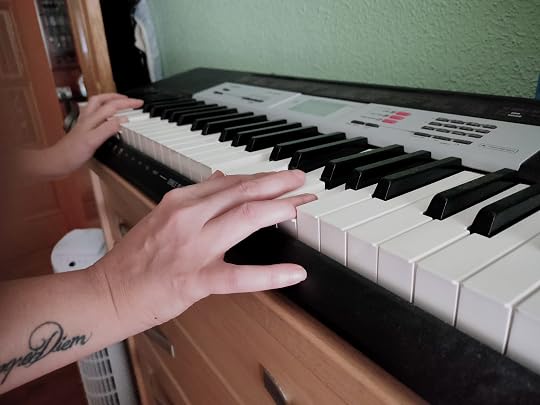
Have you ever been watching someone drawing, playing an instrument, skating, etc, and thought: “That looks fun, I want to do it”
If you are anything like me, you sure have.
But suddenly you remember all of the times you have started playing the guitar or taking Japanese classes and how you felt like you were learning nothing and stopped doing it at all.
It will be great if there was a strategy to learn new skills not only faster but also in a more fun way, you’ll be able to do pretty much anything you want.
Well, that strategy exits and it is exactly what we are going to see today, we’re going to learn how to learn.
If you apply this strategy to your learning process, you’ll be learning 10x faster in no time.
The “I Don’t Know What To Learn” Problem
Alright, before you start learning efficiently a new skill, you need to know what to learn in the first place.
This may come harder than you expected either because you don’t know what your main interest is or because you have so many interests that you can not decide on which to focus on.
What If I Don’t Know What My Passion Is
First of all, you should know that the term “passion” could not be more wrong because it assumes that everyone is born with some pre-existing big interest when in reality we humans are constantly looking for new ways to grow.
What you should be doing is looking for working on building skills and gaining experience instead of looking for a supreme-passion.
As Cal Newport states in his book So Good They Can’t Ignore You:
“Pick something you have an interest in and simply work as hard as you can to get good at it.”
The key here is that you need to understand that you are not born with some specific interset but with personality traits that make you more likely to like learning one thing or another.
The very best strategy, in this case, would be to find a thing that interests you and that can expand a little bit your Adjacent Bubble, commonly known as “Comfort Zone”.
Adding new skills to your set is not only good for your personal and professional growth but it is also one of the funniest things you can do in life.
If you want some suggestions, these are some examples of fun skills you can learn:
Coding
Public Speaking
Drawing
Animation
Video Editing
Photo Editing
Pixel Art
Writing
A Language
What If I Have Too Many Interests
Another common problem you may come across is having so much interests that you enter into a psychological phenomenon called “The Paradox Choice”.
“There are times when the presence of more choices can make us choose things that are not good for us.”
I have come with this struggle more than once in my life and let me tell you that the solution is not obvious but is so simple that you’ll be on the correct path in no time.
This idea comes from a post on James Clear’s Blog and it consists of four steps:
First, make a list of your main goals. (At least 25).
Second, highlight your top five goals of that list.
Third, focus only on those five goals until you accomplish them.
Finally, treat the remaining 20 goals as Avoid-at-All-Costs goals.
This process may seem weird at first because you may be thinking that the remaining 20 goals are also goals that need to be accomplished and that you should be working on them from time to time.
Although the reality is that you need to narrow your focus as much as possible to accomplish more, if you try to work on 25 different things you’ll both spread too thin that you’ll accomplish nothing and you’ll eventually burn out.
Now that you have your 5 priorities, write them down somewhere you can see them every day to remind you what your current focuses are.
How To Learn Any Skill 10x Faster
Well, now you have your priorities written down and before you jump into the learning process, let’s learn how learning occurs.
The 3 Cognitive Stages Of Learning
Learning is a psychological process that goes through 3 stages: The Cognitive, Associative, and Autonomous Stages.
The Cognitive Stage
The first stage on the learning model is the cognitive stage, this is the stage in which you start learning about the new contents, identifying sub-knowledge.
This is both the stage in which mistakes are most common and less important, don’t worry too much about making them and focus on learning from them.
The Associative Stage
Following with, the associative stage is that in which you already have general knowledge and you are starting to practice more the skill, making neuron-connexions in your brain.
Your focus on this stage should be to vary the stakes and challenge yourself, if you don’t want to get stuck you need to expand your comfort zone.
Keep in mind that researches have shown that the learning process is not linear, it is logarithm, i.e the more time passes, the lower the learning pace.
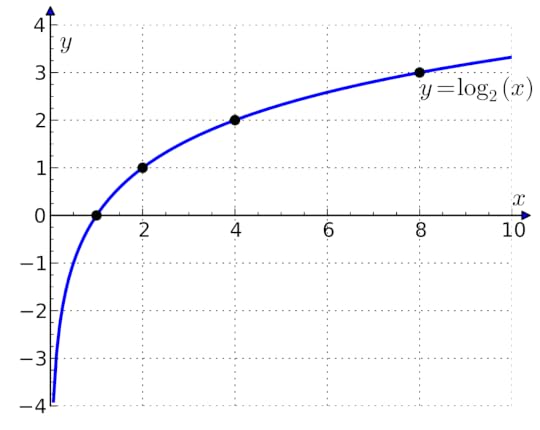 The X-axis would be the time and the Y-axis would be the learning
The Autonomous Stage
Finally, once you know the skill enough that you can do it almost automatically, you’ve reached the autonomous stage.
Now that you are here, you have two options:
You can move to another skill because you’re already more than capable of doing it at an above-average level.
You can try to master it, notice that being autonomous and being a master in a skill is not the same. Mastering a skill takes so much more time.
The 4-Step Learning Process
Alright, now you know how learning occurs in your brain and you are ready to get into the learning process.
I’m going to show you the 4-Step Learning Process that the author Josh Kaufram outlines in his book The First 20 Hours: How to Learn Anything Fast.
For the shake of understanding, I’m going to give you a personal example to follow along with the process.
The example I’m going to show you is what I’ve done when I learned Pixel Art.

Step 1: Prepare Yourself & Your Environment
The very first thing you should do is make it easier to learn the new skill than not to learn it.
This means, setting up a good environment, increasing your motivation as much as possible, and making your resistance almost non-existing.
Let’s start with the motivation, we’ve already talked about How To Increase Your Resistance To Procrastinate but let’s do a little review on the Motivation Equation:
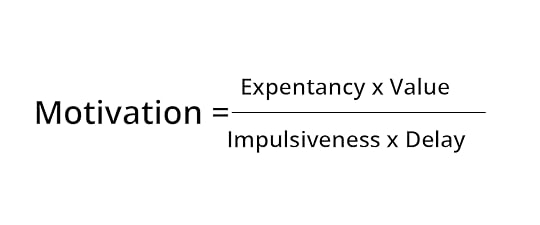
In this particular case, there are some specific great ways to adjust the four terms of the motivation equation to make learning easier for you:
Expectancy: Set little goals for your new skill to enter on a “Success Spiral”.
Value: Think about some practical use you’ll get from the new skill, if it is art-related, commit to making a little piece as soon as possible.
Impulsiveness: Apply the “20-Seconds Rule”, make the act of starting practicing take less than 20 seconds.
Delay: Set yourself both time constraints and deadlines.
Ok, now you need to take care of your environment, if you’ve already applied “The 20-Seconds Rule”, you are already good to go.
What you really should do is find either a good teacher or a good course to learn from, self-learning is fine also but having a great learning source will speed up a lot the process.
Talking about my example:
I increased my Expectancy and Value by committing to create one Pixel Art piece every week and by reminding myself that I was learning this skill to apply to my Game Development Career.
I lowered my Impulsiveness and Delay by setting the software I use on my Desktop and by setting myself a one-month deadline to learn the skill.
The resources I used were courses both on Skillshare and Youtube.
Step 2: Deconstruct the Skill
The next thing you should do when trying to learn a new skill is to deconstruct it into sub-skills that are easier to learn.
These sub-skills should be small enough that they don’t overwhelm you but bigger enough that you can spend at least one or two days on each of them.
Continuing with my Pixel Art example, I deconstructed the skill in:
The Fundamentals
Drawing
Anti-Aliasing
Dithering
Shading
Color
Character Creation
Top-Down
Lateral
Animation
Environment
Natural
Artificial
Level Creation
Tilesets
Step 3: Learn About Each Sub-Skill
Now that you have your sub-skills, all you need to do is to learn about all of them.
You should learn about each one until you are comfortable with it, you don’t need to be a master or learn everything related to them.
What I did here is to create a Pixel Art piece representing the learning I have acquired on that specific skill.
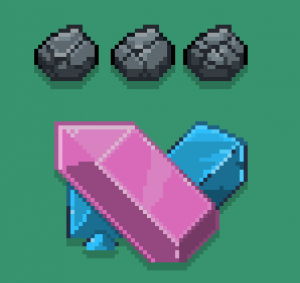
 Dithering Piece
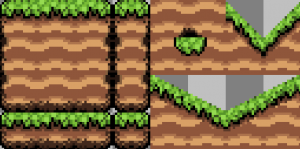
 Environment Piece
 Tileset Piece
Step 4: Apply The 3 Principles Of Practice
The final step is to practice the skill until you have either an above-average level or until you’ve mastered it.
The key here is to be smart when it comes to practice, as the authors PC, HLR & MAM state in their book Make It Stick, the practice should be spaced, interleaved, and varied.
Spacing your practice means setting up intervals between practice sessions in which you can either learn anything else or get into the theory of your new skill.
These intervals should be big enough so that practice doesn’t become a mindless repetition, including a little of forgetting into the learning process will boost the knowledge’s strength.
Setting up an interleaved practice is to simply apply the principle that the better your mastery, the less frequent the practice.
Learning more than one thing is a great way of interleaving your practice, you learn one day about one subject and the next one about another one.
Varying the practice underlies below the same idea, varying your learning makes you reach beyond memorization to conceptual understanding and application, building more round, deep, and durable learning.
How I scheduled my Pixel Art practice was:
Spacing it to one day of practice and one day of theory.
I interleaved it by not learning on weekends.
I varied it by learning Video Editing at the same time.

Leveling Up Your Learning
Alright, now you know the basics of how to make your learning process as effective as possible but, there certain little things you should know if you want to start learning at a non-human pace.
Common Mistakes To Avoid
ReReading
We all have been there, you sit in front of your textbook and you think that if you read it 5 more times, then you’ll magically understand, retrieve and master the information.
Well, I have bad news, rereading is just a waste of time.
You can make multiple readings you should — but you need to have a goal for all of them, don’t try to read multiple times to understand something.
Not Testing Yourself
Testing is one of the most powerful ways of checking whether or not you are understanding the new knowledge.
Don’t get me wrong, I don’t approve tests as a source of determining what you know and what you don’t. You should regularly test yourself to see which concepts need reviews later on but don’t stop if you don’t get a perfect score.
Not Preparing For The Dip
Keeping in mind that the learning process is not linear but logarithmic, you also need to be prepared for “The Dip”, a concept introduced by the author Seth Godin on his book The Dip.
The Dip is the time on any learning process in which your pace starts to lower and you need to put so much more effort to continue with than you had to at the start.
The key here is that once you’ve overcome The Dip, you have so much knowledge that you are ready to perform at an above-average level.
Crucial Tips
Imitate Masters
Let’s be honest, you don’t need to be 100% original to learn a skill, certain people have already put the tremendous effort to master a skill and it is totally fine to learn from them and even imitate what they do until you’re ready to develop your process.
Record Yourself
Keeping track of your learning process is a great way of both increasing your motivation and looking for mistakes.
You can compare the very first thing you did with the last one, I promise you that the progress you’ll see will make your motivation skyrocket.
 This was my first Pixel Art Piece
 This was my last Pixel Art Piece
Great Learning Resources
As I’ve said before, having some kind of teacher or course to follow along with your learning process is one of the most powerful ways of boosting your learning.
Here you have both Apps and Courses’ Resources that you may find useful:
Skillshare : Great courses about video and photo editing, programming, art, psychology…
Treehouse : The best platform for learning how to code.
Codecademy : Another code platform with some great free courses.
Brilliant : Problem Solving, Computer Science, and Math learning platform.
Wolfram Alpha : A must App if you are learning some math-related skills.
Anki : The best flash-cards App I’ve ever used.
iTalki : Great App for language learning.
Let’s Start Learning
Hopefully, you now have all of the tools you need to develop new skills faster and more efficiently.
My challenge for you this week is to apply this strategy to a new skill you want to learn for a month:
Make your top-five most important goals.
Find a skill that is either related to one of those goals or that it excites you.
Find a good resource to learn from.
Go through the 4-Step Learning Process.
Practice for one month and check out the results.
I hope you found this post interesting and useful and I will be so happy if you can share with your friends and let me know what you think in the comments and on Twitter.
Thank you so much and see you soon!
Books Credits:
BROWN, PETER C. MAKE IT STICK: the Science of Successful Learning. BELKNAP HARVARD, 2018.
Clear, James. “James Clear – Focus: The Ultimate Guide on How to Improve Focus and Concentration.” James Clear, 29 Feb. 2020, jamesclear.com/.
Godin, Seth. The Dip When to Quit (and When to Stick). Findaway World, 2007.
Kaufman, Josh. The First 20 Hours: How to Learn Anything …Fast. Portfolio/Penguin, 2014.
NEWPORT, CAL. SO GOOD THEY CAN’T IGNORE YOU. PIATKUS Books, 2018.
The post How To Learn Any New Skill 10x Faster appeared first on Daniel Robledo.
June 28, 2020
The Key To Controlling Your Life
By Daniel Robledo | Last Updated June 28, 2020
You wake up, you start going to your bathroom and the next thing you know is that you’re already in your office.
You just went from washing your teeth, having breakfast, getting your clothes on, and driving to work and you haven’t even realized.
That my friend, was a demonstration of the power of habits.
It would feel awesome if you can design your auto-pilot mode so that it make you as happy, productive, and healthy as possible right?
You wouldn’t be worried anymore of checking if you’ve done enough exercise, talked with your friends, or study for more than 5 minutes because you’ve already done all of it on auto-pilot.
I promise you that developing healthy habits and reframing bad ones is the single most powerful way of taking control of your life.
Today we are going to learn how to both build and break habits so that you can focus on what requires 100% of your attention and let the rest to your auto-pilot mode.
The Power Of Habits
You’ve probably already heard about Habits, and you’ve probably also thought: “Are they that important?”
Before we jump into some of the main reasons of why controlling your habits is the single most powerful way of controlling your life, let me show you a study made by the scientist Wendy Wood at the University Of California.
Wood wanted to study how many of our daily actions are based on habits, actions that we are not even aware that we’re doing them.
The results concluded that 45% of daily human actions are habits.
This means that almost half of the things you do in your life regularly are habits, it would be nice if you can make all of them to make your happiness increase, right?
The Habit
Luckily for us, habits themselves are not that complex, they are just a single chemical process in our brains.
As Charles Duhigg states in his book The Power Of Habit:
“A Habit consists of three steps; the first one is the cue, the signal that activates the habit; the second one is the behaviour, which can be mental, physical or emotional; and finally the reward, which helps the brain identify whether or not is it good to remember this process” – Charles Duhigg
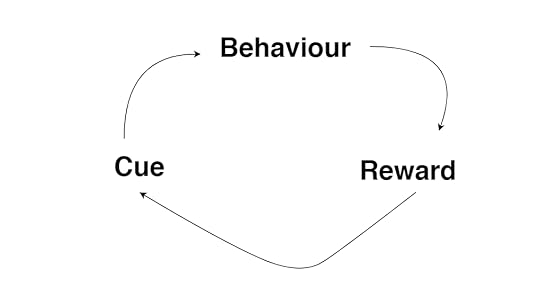
There is a bit of neuroscience behind why habits appear in the first place.
According to scientific researches, habits appear because human brains, based on a survival need, are constantly looking for ways to consume less energy and habits are the perfect way to do that.
Our brains are energy consumers, they weight 2% of the body’s weight but consume 20% of the total energy supply, whenever a habit is being built, neuron-connexions are also being built.
These connections lead to very low energy consumption when performing the habit’s behavior.
To finish with, keep in mind that “neurological anxiety” is the main reason why a habit is formed.
Neurological anxiety is a term that defines the feeling the brain goes through whenever it is anticipating a reward that is coming, i.e, whenever you get trigger by a cue (which will eventually lead to a behavior and, therefore, a reward) your brain automatically starts a chemical process in which you feel forced to perform the behavior to get the reward.
You expect the reward and your brain wants it, that’s why you feel pulled toward the behavior.

The Importance Of Habits
Now that you know that almost 50% of your actions are habits, you probably understand the importance they hold.
Well, apart from controlling half of your daily actions, habits are a crucial part of human life because they are co-influent, in other words, one habit leads to another.
It is so much easier to develop more specific and complex habits when you’ve already built key habits related to that field.
For example, let’s say that you want to build the habit of running every single day.
Wouldn’t it be easier to stick to that habit if you already walk every day or if you already exercise 30 minutes a day?
You can apply this conclusion to pretty much everything you want to start doing, start with the key habits and then build up from there.
How To Build (and Break) Habits
Hopefully, you now understand how important it is to control your habits.
Let’s continue by learning how to both build good habits and break bad ones.
Develop Good Habits
Building good habits is a process that requires time and effort, keep in mind that every habit you try to build requires an initial commitment of willpower that you weren’t having to spend before.
This leads to a necessity of working on building the habit for a long time, and I know what you are thinking right now. Yes, the “21-day-rule” is a fallacy, habits take almost 66-days to stick in the long term.
The Conditional Dependency Method
You know that a habit consists of three steps: cue, behavior, and reward.
So, developing a good habit is a process that involves choosing those three stages.

The Behaviour
Let’s start with the behavior because it is usually the part that represents the habit itself:
What do you want to do regularly?
If you are not sure what specific habit you want to build, here are some of my recommendations on crucial life habits:
Exercising
Talking Regularly With Your Close Friends
Reading
Meditating
Building a Positive Mindset
Developing a Focus Muscle
Waking Up Early and Going To Bed on Time
The Cue
Now that you have the behavior, let’s choose a cue for your new habit and form a “Conditional Dependency”
A CD is a statement that refers to the correlation of a cue and a behavior:
“If X happens, then I do Y”
Conditional Dependencies are a great way of building habits because they give you a clear, specific, and non-flexible order to build the habit.
When choosing a cue, keep in mind what Duhigg states as “The 5 Categories of Habit Cues“
A habit is trigger by a cue that consists of one or more of these categories:
Location
Time
Emotional State
Other People
Some Previous Action
Now, choose or create a cue for your new habit:
If I need to go to somewhere near then I will go walking instead of taking the bus.
If it is 11:00 am and I feel anxious to eat then I will go talk with a friend to distract myself.
The Reward
Alright, now that you have your new behavior, you need to reward yourself so that your brain wants to keep this new habit going.
Take care of rewarding yourself with something that contrasts your new healthy behavior.
Play some videogames at night after exercising.
Watch 5 minutes of Youtube for every study session you perform.
Let yourself eat junk food one time per one full healthy-eating week.
A Long Term Road
Do not rush on building habits, making these changes to stick in your life is a slow and long process.
That doesn’t mean that you won’t see results early, in fact, you will immediately feel like something “clicked” in your daily life the moment you start changing your habits.

Break Bad Habits
Alright, let’s get into the hard part of this path.
Breaking — or reframing — bad habits is probably one of the hardest things that you can do in your life, that is exciting, isn’t it?
Luckily for us, reframing a bad habit is a simple 4-step process.
According to Charles Duhigg in The Power Of Habit, to break a bad habit you need to:
Identify the behavior
Experiment with the rewards
Isolate the cue
Design a plan
Identifying The Behaviour
The very first thing you need to do to break a bad habit is to know what you want to stop doing.
This step is easier since if you’re already planning on stopping doing something, you already know which routine you want to stop.
For the shake of understanding, I’m going to give you a personal example to follow along with these steps.
Let’s say that the behavior I want to stop doing is constantly checking my Instagram.

Experimenting with the rewards
To follow with, now that you know the behavior, it is time to answer two crucial questions:
What is the cue, in general, that triggers that behavior?
What is the reward you’re getting for doing that behavior?
After you have a general idea of what the cue is — we will dive deeper into this in just a little —, it is time to understand what is the enjoyment you’re getting for this bad habit.
This step may be simple in some cases but eventually, it can be so tricky since rewards are not always that obvious.
For example, I could think that the reward I was getting for constantly checking my Instagram was the novelty boost that social media gives us (which helped to trigger the behavior but was not the main reward).
When in reality I felt inside me that if I knew what my friends were doing with their lives by checking their stories on IG, I felt connected to them, I knew about them even when I wasn’t even talking to them.
In conclusion, the reward I was getting is the feeling of friendship, feeling connected to my friends.

Now that you know which is the reward you are getting from your old behavior, try experimenting with different rewards:
Try different rewards for one week each.
After you’ve done the old behavior and tried the new reward, write on a piece of paper the first 3 words that pop in your mind.
Wait for 15 minutes and observe if you want the old reward.
If you don’t feel the neuro-anxiety we’ve talked about earlier to the old reward, then you have your new reward and hopefully, it is healthier than social media’s novelty boost.
For my example, I tried these rewards:
Checking some interesting documental, video, podcast… to give myself a little bit of novelty.
This didn’t work very well for me.
Talking to a friend whenever I felt like checking my Instagram.
This was when I discovered what the real reward was because I felt so good by talking with them that I was no longer tented to lose my time on social media.
Isolating The Cue
Alright, you are almost there, you have your behavior identified and you know both the old and the new reward.
Now it is time to isolate the cue, and let me tell you that this is easier than you may think because as I’ve told you before, every single habit cue belongs to one or more of these categories:
Location
Time
Emotional State
Other People
Some Previous Action
To identify the real cue of your bad habit, write down everything related to one or more of these 5 categories of the previous moment of you performing the old behavior.
In my case, it went like this:
Location: This didn’t matter for me.
Time: Time didn’t matter so much either.
Emotional State: I was so much more likely to check Instagram if I was in a bad or sad mood.
Other People: It didn’t matter with whom I was to perform my bad behavior.
Some Previous Action: If I was either taking a break or procrastinating, I was more likely to follow my bad habit.
Designing A Plan
Finally, you need to design an action plan — you can again base it on The Conditional Depency Method — to link your existing cue to your new behavior that will lead to your new reward.
This plan should look like a routine as much as possible and the more you do it, the easier it will get.
Don’t rush and permit yourself to fail, it is okay to not get a perfect 66-days streak on your new habit.
To finish with my example, I did the following things:
First of all, I took care of my environment, I deleted my IG App from my phone and erased my account info from my password manager. Increasing my resistance to the old behavior.
Then, I checked myself whenever I was either in a bad or sad mood after a non-work period to see if I wanted to check my IG.
After that, if I felt like doing my old behavior, I performed my new plan according to the CDM. “If I want to check my Instagram, then I will take the time to talk with a friend later on”.
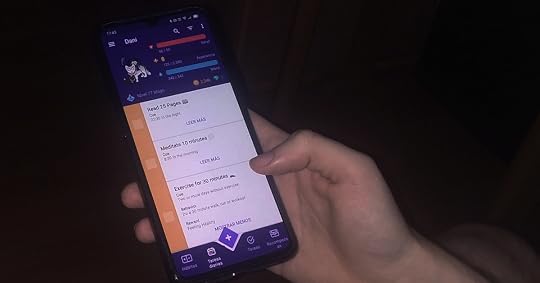
Finally, I tracked all of my progress on my Habitica account to see how good I was doing.
I did all of this process 3-months ago and it worked perfectly, I stopped checking social media and got almost 8 free-time weekly hours back to my life.

How To Make Your Habits Stick
To finish with, I want to give some great tips to follow and mistakes to avoid if you want your habits to stick in the long term.
Don’t Depend On Willpower
Even if you are the most powerful person alive in terms of willpower, you will eventually either fail or burn out if you depend 100% on your willpower to both stick to good habits and preserve against bad ones.
You must make your resistance as low as possible to your new desired behaviors and as high as possible with your old behaviors.
If you want to stop eating junk food, stop buying them, and get rid of the current one.
Do you want to start exercising? Then sleep in your gym clothes.
Wouldn’t if be nice to work more and with more focus? Turn off your internet while you’re working
Track Your Progress
You saw this one coming, right?
As I’ve said so many times before, tracking your progress and rewarding small wins is the way to go when you want new routines to stick in your brain.
Select a habit tracking system, either physical or digital.
Track your progress every time your cue appears.
Do weekly or monthly reviews to see how you are doing and polish your system over time.
Avoid Common Mistakes
There as some mistakes that happen to all of us earlier or later that can destroy our hopes of changing our habits.
Not Starting Easy & Small
Don’t try to run a marathon if you can not run even 5 minutes. Start small and be patient.
Assuming Everything Will Go Great
Let’s be honest, life is mostly unexpected, prepare for something either good or bad to happen that will make you lose a little bit of track of your path.
Just be prepared and don’t be hard on yourself.
Not Setting A Punishment
This one may not work for everyone but setting a little punishment to yourself whenever you stick to your old behavior is a good way of preventing yourself from doing your old pattern.
If you are interested in trying this technique, check out Beeminder, an App that charges you every time you fail on your new habit. A great idea would be to donate that money to some charity organization.
Not Having A Strong Reason
This mistake is both the most severe and most common of all of them.
Not having a strong reason of why you want to change your life is the way to go to failure, take the time to sit down and write down all of the reasons why you want to change, I’m sure you will find them in no time.

Take Control Of Your Life
I hope that you’re now full of motivation with all of this new knowledge and that you are already willing to start building those good habits into your life.
As always, change comes with action so I want you to start right now:
Find a habit you want to either develop or reframe.
Go through the identification of that habit’s loop.
Develop a plan and try to stick with it for the next month.
Track your progress and see how it went.
Keep in mind to be patient and be kind to yourself, the starting step is usually the hardest, keep it going!
Thank you so much for your time and let me know what you think both in the comments section and on Twitter, see you soon!
Media Credits
“The Habit’s Loop.” The Power of Habit, by Charles Duhigg, Random House Trade Paperbacks, 2014.
The post The Key To Controlling Your Life appeared first on Daniel Robledo.
June 21, 2020
The Secret Of A Great Day

By Daniel Robledo| Last Updated June 21, 2020

It is 8:30 in the morning and your alarm goes off.
You start hearing that annoying beep-boop and you know you should get your ass out of bed.
You stand up like a zombie, get to your bathroom and you question whether or not to attend that class you have in 30 minutes.
You wonder if you could start your days with more energy, motivation, and fun.
Does this sound familiar to you?
If you are anything like me, you’ve struggled more than you’d like with morning slump and you want to learn how to make your days start with happiness & productivity.
Let me tell you that is possible and the solution is more simple than you may think, it is to develop a Morning Routine.
Today we are going to learn how to develop a start for your days that provide you with happiness, fun, health, and productivity.
Trust me, once you put the time on your morning routine, you won’t want to go back to your zombie-scrolling mornings.
Why To Have A Morning Routine
Before we jump into the process of developing a morning routine, let’s review why a morning routine is important in the first place.
The No-Decision Advantage
Routines, in general, are important for many different reasons but, one fact that stands out from the rest is the decisions-relief.
Whenever you build a routine, you are developing a habit of performing a series of actions that lead to a specific result without you even noticing you are doing those actions.
This leads to a less stressed brain, your willpower and decision making power is a limited resource, the less you spend on mundane tasks, the better.
A perfect example is when you walk from your home to school, college, work… You’ve done this same walk so many times that you don’t even notice you are walking.
Productive Momentum
Focusing now on the specific benefits of a morning routine, it’s important to notice that a morning routine should contain as many quick wins as possible to build “productive momentum” into your day.
What I mean is that you need to start your day with some victories, even if they are as small as waking up on time, doing 3 minutes of exercise, or drinking a full glass of water.
These quick wins cause your brain to enter on a “Success Spiral” — a state in which you chain one win with the next and you start getting so much more done than if you did not start with some momentum.

The Perfect Moment Of The Day
Another great benefit of developing a morning routine is that you can implement tons of little healthy acts that over time will build up healthy habits (exercising, meditation, stretching, expressing gratitude…)
Also notice that if you wake up early enough, you’ll be up when everybody else is still sleeping and you’ll enjoy a time of no-distractions in which your productivity levels will skyrocket.
Scientific Evidence
To end up with the morning routines’ benefits, Harvard professor and biologist Christoph Randler surveyed a sampling of undergrads to find out when they had the most energy and how likely it was that they would take on challenges.
The results? Students who were more energized in the morning were more proactive when it comes to addressing issues than those who got energy spurts later in the day.
We will talk later about loads of science-baked suggestions that you can add to your morning routine, but for now on, let’s learn the principles of building a great morning routine.
How To Develop A Morning Routine
Developing a morning routine is a 3-step process that contains a lot of experimenting.
Not everybody is a morning person and there is no scientific evidence that humans are more productive in the morning than at any other moment of the day.
So, if you are not the kind of person that enjoys waking up very early and work in the morning, don’t worry, you can also develop a night routine before you start your work in the last hours of the day.
Finding Your “Why”
First of all, you need to find a reason to get out of bed, a motivation that drives you to jump out of bed the moment your alarm goes off.
If you try to start building morning habits, which may turn out to be more difficult than you’ve expected, without a very strong reason to be doing them in the first place, your motivation will go out of fuel in no time.
There are two main strategies of finding your morning routine’s “Why”:
Try to adapt your morning routine to your goals.
Try to find something fun to do in the morning apart from the productive & healthy stuff.
Deciding The Time You Wake Up
Now that you know why you want to start developing a productive morning routine, you need to decide the time you wake up.
Here, it is important to understand that you don’t need to wake up at 05:00 am every day to be productive — although it could be a great idea if you’d ask me — because the routine itself is what makes you productive, not the time you wake up.
Planning The Time
I would suggest that you write down the main activity that you want to do in the morning, it could be attending your classes, going to work, working on your project…
Now, think approximately how much you’ll need to do every little habit of your new morning routine and add some extra time as a buffer.
If you are bad at planning, you may want to check out my Ultimate Daily Planning Post
When To Go To Bed
Now that you have the time you need to wake up to accomplish everything you want, it is time to decide which time are you going to bed.
Because one of the worst things that you can do in your life is to sleep deprave, studies have shown that for every 1 hour you gain by not sleeping, you lose 3-4 hours of productive time.
I would suggest either sleeping 7 and a half or 9 hours — since sleep cycles occur every 90 minutes and you want to wake up at the end of one of them, not in the middle of one of them — and to sleep the same time every day, yes, including weekends.
If you want to easily calculate the time you need to wake up (or go to bed), I will suggest you check out the web Sleepyti.
Do Not Hit The Snooze Button
To finish this point, I have to tell you that your 1# goal when waking up is to not hit the snooze button.
When you hit the snooze button, you are accepting that the very first thing of your day is a defeat.
You’ve decided the night before to wake up at a specific time and you’ve failed, believe me, you do not want to start your days with a sense of defeat.
A great technique to help you get out of bed is to have an automatic wake-up response.
Something you do the moment your alarm goes off (hopefully jump out of bed), it can be anything as long as it wakes you up.

Building The Routine
Alright, now you know why you want to build a morning routine and you know when you are waking up, let’s start developing that routine.
To start with, let’s get the fundamentals right:
Take care of your environment (Make your bed, spray something that smells good, play some good music if you want…)
Do something that you enjoy.
Do something productive or healthy.
As you surely know, the key to building any habit is to start small, focusing first on these 3 fundamentals of morning routines, you will get the inertia you need to build a full morning routine.
The Essential
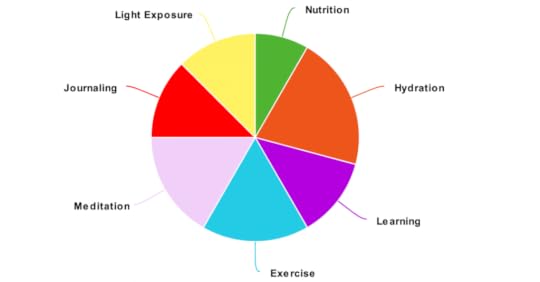
Let’s continue adding more activities to your morning routine, I think there are 7 essential activities that any morning routine should have:
Nutrition
Your body needs energy to function, and that energy comes from the food you eat.
Eating a healthy breakfast will give you the energy you need to start your day greatly.
There are certain people (including myself) that do not enjoy that much cooking & eating in the morning, for these people “Intermittent Fasting” is the way to go.
Fasting is the process of not eating, “Intermittent Fasting” is a food schedule in which you restrict anything you eat to an 8-hour window.
There are tons of scientific evidence that back up the IF’s benefits.
I have been doing this process for more than a year now and it works perfectly for me so I do not have breakfast in the morning.
Hydration
Continuing with, water is an even more important aspect that food in human life.
Although you are somnambulist-water-drinker, you probably wake up in the morning dehydrated and you need to refill your water resources.
Having a full glass of water first thing when you wake up is both a healthy habit and a great way to wake up quickly.
Learning
Next, learning is a crucial factor in human life, and implementing it in your morning routine will give you a consistent path of developing new knowledge.
You can find a lot of learning resources to implement in your morning, including:
Books
AudioBooks
PodCasts
Articles
Exercise
Science has shown us that exercise is the one activity that boosts the most our productivity, health, and overall happiness.
Including just a 10 minutes exercise circuit in your morning routine will boost your energy levels so much that you’ll even want to include a full workout routine into your mornings.
Meditation
Meditation has always been an activity saw as something just for gurus or monks but in the last years, scientific researches have shown all of the benefits that this activity brings us.
The great fact about meditation is that it is so simple to perform that you have no excuse not to do it.
Just sit down for 5 minutes, close your eyes, keep straight and focus on your breathing.
Whenever a thought pops up in your mind and distract you from your breathing, observe the thought, accept it, let it go away and come back to your breathing.
Practice this habit every day in the morning and gradually increase the time you meditate, I guarantee you that the benefits will blow up your mind.
Journaling
As I’ve told you other times, externalizing your feelings is a really powerful way to control and enjoy them.
Having a journal in which you can express your feelings, thoughts, and anything that pops up in your mind is a great stress-relief strategy and you should include it in your morning routine.
I have been journaling every day for more than a year now and I’ve discovered that journaling is all about asking yourself the right questions.
I will suggest that you start with these:
How am I feeling right now?
Am I happy with the things I’m doing?
Does anything have been bothering me lately? Why?
Light Exposure
The last essential activity that you should include in your morning routine is light exposure since it is a great way to wake up and D Vitamin is great for your skincare.
The perfect way to get light exposure is to go for a quick 15-minute walk in the morning, you may even put on some headphones and listen to some learning source.

Leveling Up Your Morning Routine
Hopefully, now you have a productive, fun, and healthy morning routine ready to go and you have already set an alarm for tomorrow morning to start practicing this new habit.
But, if you want to make your morning routine even more exciting and easy to follow, let’s see a couple of little things you can do to level up your morning routine.
Evening Routine
The very first thing that you should do once you have your morning routine is to try to reduce friction as much as possible when it comes to performing your morning routine.
This means, identifying any dependencies that your morning activities may have. They may be:
Using headphones to listen to music, audiobooks, or podcasts.
Changing clothes to workout in the morning.
Needing space for meditation.
Using some digital or physical media for your journal.
Now it is time to make those dependencies almost invisible, and the way to go here is to develop an Evening Routine.
You should take at least 15 minutes before going to bed to prepare everything you’ll need the next morning:
Put your headphones charged at your front desk.
Prepare your gym clothes and put them below your bed.
Take out that yoga pellet to meditate.
Bring a little notebook or download an App that you can use for journaling.
Developing an evening routine is as important as a morning routine since it provides you with almost the same benefits but with the addition of a good quality sleep.
Track Your Progress
The next thing I recommend you to do — as I do with every new habit that we build here — is to track your progress and reward yourself.
You’ve probably already known that tracking progress and gradually rewarding yourself is the most effective way to make a habit stick, and developing a morning routine is no exception.
So, starting tomorrow:
Track your daily progress, you may want to use some app like Habitica.
Reward yourself with some fun for every back and then that you get out of bed immediately.
Combine Activities
I know what you may be thinking right now: “This is great but, I do not have 2 hours every morning to do all of these things”.
You are completely right, not everybody has a flexible schedule in which to include a 30 minutes meditation and a full workout besides a walk to the park and a reading session.
But here we are people with a productive and problem-solving mindset, right?
The solution to this problem is what I like to call the “Tasks’ Intersection Process”, this means combining two or more tasks in one activity to reduce the time they consume in your morning.
I have been doing the “Tasks’ Intersection Process” with everything my morning routine includes and I have gone from a 2 hours morning routine to a 1 hour morning routine without taking out any activity.
Here are some suggestions on applying this technique:
Read while eating breakfast (This is where audiobooks are so useful).
Perform walking-meditation (Walk with only paying attention to your walk and your surroundings).
Listen to something educational while you exercise.

Morning Routines Examples
To finish this post, I want to show you some examples of how a typical productive & healthy morning routine looks like.
Oprah Winfrey
Oprah Winfrey is a successful businesswoman and the hoster of The Oprah Winfrey Show – which I highly recommend – that have told many times that one of the things that she hates the most is setting an alarm to wake up, even tho, she keeps a very productive morning routine that had helped her in her career.
She wakes up at 6:20 am and take a tea.
Then she workouts and afterward meditate.
Finally, she eats breakfast and gets to work around 9:00 am.
Thomas Frank & Matt D’Avella
Thomas Fran and Matt D’Avella are two productivity & personal development-content creators. Both have similar morning routines and have said that it has been one of the most productivity boost sources in their daily lives.
They wake up around 6:30 am and 7:00 am.
The exercise first thing in the morning and go for a walk afterward while listening to audiobooks.
Then they eat breakfast and get to work around 7:30 am and 8:00 am.
My Morning Routine
I have been experimenting so much with my morning routine a lot and I have found that this is the morning routine that works best for me.
I wake up at 6:30 am.
After basic hygiene, I prepare Coffee while listening to an audiobook.
Then I read for about 30 minutes.
Afterward, I meditate for 15 minutes and exercise for 10 minutes.
Then, I work on my projects for 1 hour.
After that, I spend 15 minutes walking and then I check my Email
Finally, around 9:00 am I get to my college classes or to work again if I don’t have classes.

Develop Your Morning Routine
Now that you’ve seen some great examples of how a productive morning routine looks like, I hope you know everything you need to start developing your morning routine.
Remember that not everybody is a morning person and that you can delegate your work and healthy habits to later in the day.
In case you want to start developing your morning routine right now, keep in mind to start small, track your progress and little by little develop a fun, healthy, and productive morning routine.
Start Right Now
I want you to start right now developing your morning routine and to give it a try tomorrow:
Decide right now one fun activity and one productive habit you want to develop.
Try to wake up 30 minutes earlier this week and do those two things.
Keep adding habits and build your morning routine.
I would be glad to hear from you in the comments below and you can hit me up on Twitter to tell me about the morning routines you are developing!
Thank you so much for your time, I really appreciate it and see you soon!
Media Credits:
Fernández, Marco. “Afternoon Sunshine” Marco Fernández Instagram, www.instagram.com/fdz.stories/.
Fernández, Marco. “Light Landscape” Marco Fernández Instagram, www.instagram.com/fdz.stories/.
Randler, Christoph. Christoph Randler, 2010, Defend Your Research: The Early Bird Really Does Get the Worm.
The post The Secret Of A Great Day appeared first on Daniel Robledo.
May 31, 2020
How to Create your Digital Brain
By Daniel Robledo| Last Updated May 31, 2020

Having two brains
For the last years, I have been experiencing the pleasure of having not one, but two brains.
Do you want to know how is that possible?
Picture an information warehouse in which you have clear, easy, and fast access to anything that you need for your work.
Sounds good, doesn’t it?
You wouldn’t feel discouraged and lost anymore whenever you are working on an essay.
You wouldn’t be mad at yourself for forgetting that important meeting, data, research, article, etc, that you need right now.
These are just some of the incredible advantages that come when you have two brains, one for creating, one for storing.
You are human (or I guess so) so your creative brain is already inside you and you live in the information age so you can create your second brain.
Today, we are going to learn how to set up a note-taking and file-management system in which you will be able not only externalize everything that pops in your mind – which, is one of our main purposes here – but to store tons of useful information and an easy and non-resistance way.
Your Note-taking system
We are going to start by building your note-taking system, a system in which you can capture everything that gets in your mind and in which you can save all of the information you learn over time.

Why are notes important?
Before we start building up a system for your notes, let’s think about why notes are important in the first place.
Having a good organized and efficient note-taking system is important for two major reasons: it removes resistance on your productivity and frees your brain from storing information.
Starting with the first main benefit of having a note-taking system, a well-organized note system makes you less likely to either procrastinate or get confused when taking notes.
As we have talked before, removing resistance (the force that prevents you from doing what you want to do) is one of the most important goals of any productivity system, and having a note-taking system is one of the most impacting ways to decrease resistance.
Following with, the second main benefit of having a note-taking system, scientific researches has found that the human brain is wired to create ideas, not to store them.
Have you ever feel like your brain is at its full capacity? That you literally can not think of anything else?
That was you trying to use your brain for something it was not designed for, the more ideas, thoughts, and information you try to store, the more likely you are to forget about them and the less efficient you will be when trying to work with this material.
All of these means that you need to externalize as much as possible all of the information that pop-ups in your mind, and taking notes in the fastest and simplest way to do that.
Physical vs Digital
The very first step on taking notes is to decide where are you going to take them, here you have 3 options: Digital, Physical and Digital-Physical media.
Let’s first talk about the digital and physical media, they both have their advantages and disadvantages:
Digital: They are usually more convenient and clean but require a digital device and a fast typing speed.
Physical: They are more natural to us and are more flexible but they are so hard to well-storage.
I would suggest using both systems depending on the situation.
If you need to go through large chunks of information with no conceptual representation (like history, math’s theory, or language), go for a digital device.
If you need to visualize the information, draw or the information is harder than extensive, it will usually be better to for a physical note.
To finish with, let’s talk about the Digital-Physical notes, they are a combination of both systems and I think they are the most efficient note-taking system, usually presented in the form of a tablet device.
I think the best device to take notes on this form is the IPad so I’m going to give you an example on it:
System: IPad (+ keybord + pencil)
Physical Advantages
You can draw to create flow notes and mindmaps
You can edit your notes as you may do with a pencil and eraser
Hand-made notes on digital devices are clearer than paper ones
You can make it feel like paper with a special screen-protector
Digital Advantages
You can carry it wherever you want
It is easy to create large chunks of information due to the typing speed
Easy large storage
Disadvantages
They are usually expensive
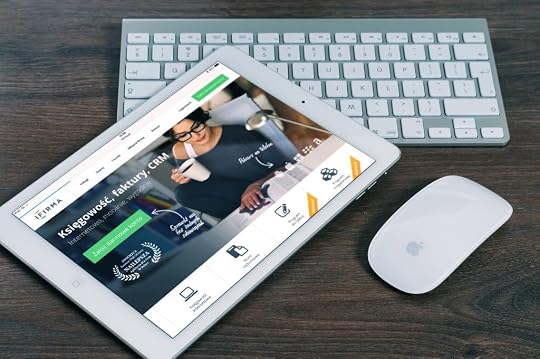
Now that you know all of the options you have for your note-taking system media, I would suggest going for a combination of all of them.
Take a look at your resources and needs and choose different media for different situations.
How to efficiently take notes
Let’s be clear, almost everybody knows how to take notes, but did you know all of the note-taking techniques?, do you use a specific system for a type of knowledge?, do you know that you may be turning your brain off while taking notes and not get a clue of what were you learning when you took those notes?
Creating notebooks
Before you start taking notes, you need a place to store them, you can not just simply put them all in one big hole.
Remember that you want to remove resistance as much as possible when creating and consulting your notes, and the best way to do that is by creating notebooks and stacks.
You have a lot of freedom on organizing your notebooks and stacks but I would suggest that you base your stacks on your life hot stops and your notebooks in your projects (if you don’t know what I am talking about, you should check out my time & attention management post).
The key here is to have a system in which your notebooks are representative of the project they belong to and that you can easily differentiate the different stacks from one another, i.e. you may have the following system:
Stack: Learning
Notebooks: Piano, Web Development & Writing
Stack: Personal
Notebooks: Journal, Finances & Fitness
Stack: College
Notebooks: AI, CIS, SDP, FDDBB & OS (One per subject)

Taking notes
Now that you have your notebooks and stacks system set up, you need to start creating the notes within those notebooks.
There are tons of different note-taking techniques out there, I am going to show you the three that work best for me and that I think are the most useful:
1. The outline method
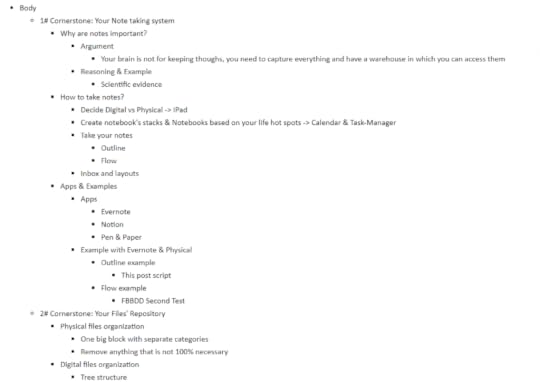
Let’s start with the simplest method, the outline method.
Taking notes on an outline method is pretty straightforward, you just write hierarchically.
You start having the main points up
Then start writing child-points
And you can create as many depth-levels as you need
This is so meta
I know right?
Outline notes are useful when you need to gather information without conceptual understanding, they are fast and don’t require much effort.
For example, I use the outline method when taking notes from my college classes, I found them useful since I can write them while I listen to my professors and I can easily transform them into flow notes, later on, I also use this method when creating posts’ outlines.
2. The mindmap method
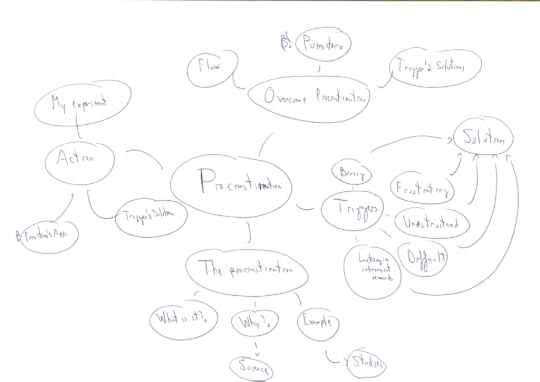
Continuing with, a mindmap is a physical (or digital) representation of how your mind understands a concept, create a mind map is a really simple process:
You start with a very general concept in the middle.
Then you start to create related concepts to that general one around it, you connect the little ones to the big ones with lines.
Repeat step 2 on every concept until you have written down everything you need to know about the general concept.
Mindmaps are useful when you need to know a lot of things about a general concept without going dive into each one of those specific concepts.
I usually use mindmaps for some posts’ ideas, projects brainstorm, and big general college concepts.
3. The flow method
The final technique I want to show is the flow method.
Flow notes try to recreate the process that the human brain goes when learning new information, this means that these notes will only work for you since they will be a representation of how you brain understand the information
Taking flow notes is the hardest process to master among any note-taking technique because it variates to much from one person to another.
Although you may indeed find them useful to:
Write all over the paper, don’t go left to right and up to down, just write the information in wherever feels more clear to you
Try to draw little sketches of any concept you want to remember
Link on concept to another using arrows
I use flow notes when I am studying, I usually take my outline notes and develop a flow summary note of every unit that I need to study before I start studying it, this way I interact with the content and create a resource I can look for that I fully understand.
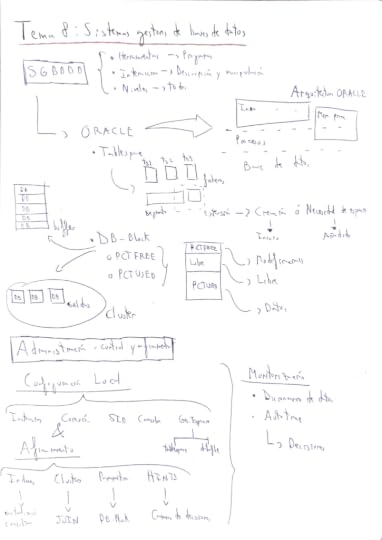
Note Apps, Tips & Examples
To finish with, I want to give you some Apps, tips, and examples that may be useful for you when you start creating your note-system.
Note-Taking Apps
The two most useful Apps I have found for note-taking are Evernote and Notion.
Evernote: In this Windows/MAC application you can create notebooks and stacks, templates, tags, and the free version is more than enough for a regular user.
Notion: This is an all-in productivity application, among all of its features, you can take notes and relate them with each other to create a fully responsive system.
These two applications are really good to create outline notes, if you want to create mindmaps I would recommend draw.io and for flow notes either the physical or digital-physical media we talked about before.
My note-taking system
Even tho I use both physical and digital media for taking notes, I store them all on Evernote (using the quick capture Evernote’s feature).
I have 8 different notebook stacks, within those stacks I have from 5 to 10 different notebooks that contain my notes:
Blog: I use this stack for my post ideas, scripts, and general blog notes.
Books: Here I write the notes I take from all of the books I read, each on its corresponding notebook.
Actual classes: I have one notebook for each subject I’m currently taking.
Classes: Here I store my past subjects in case I need to take a look at something.
Learning: I use this stack for anything I am learning, like Web Development or Psychology.
Personal: I keep here my finances, journals, and thoughts.
Projects: I store here the projects that are not so big that they need a full-stack.
Inbox & Templates: I use this stack for taking notes that I do not have the time to store, and to store the templates for other notes.
The process I follow when taking notes is different from one note to another but my most common and general process are:
Studies: I develop an outline based on my college’s material and my classes, then I create a flow note based on that outline, it usually contains one or more mindmaps.
Books: I usually highlight while I read and then write an outline based on those highlights.
Templates: When I feel like I’m writing the same structure more than once, I create a note to use as a template, i.e. my class notes or my post idea notes.
Hopefully, now you have your system set up and ready to start writing down everything you need, remember that it is important to maintain that organization over time, and now it is time to learn how to organize your non-notes files.
Your Files Organization
The second cornerstone of your information store are your files, both digital and physical.
You need to keep documentation about anything that will be useful to you in the future and you need to keep it in an organized and easy to access system.

Physical Files Organization: The 3 location system
Let’s start with your physicals files since you’ll probably have so much less than digital (or at least you should)
We are not going to spend so much time on this topic because physical files don’t present any advantage over digital ones and you should keep them to the minimum.
For those files that you need to store on a physical form, I’m going to summarize a system created by the content-creator Thomas Frank, “The 3-location system“.
The 3-location system
The 3-location system consists of having three main places in which you store your physical files, each with one purpose:
Main file box: Here you will keep everything that needs to be physically stored. I would suggest getting a multiple folder box for this location.
Inbox: You are going to use your inbox as a temporal store, you will place here the files that come up and you don’t have the time to organize them, you mainly use a simple folder as an inbox location.
Portable file folder: Finally, the portable file folder is a little version of your main file box in which you keep the files needed for a specific situation, for example, an interview.
If you want to dive deeper into this system, check out Thomas Frank’s Video about the 3-location system.
Digital Files Organization: The tree structure
If you are anything like me, you tend to keep more than you need when it comes to digital file storage.
This leads to a complete mess of archives, folders, and disks that makes no sense and in which navigating is as pleasurable as sitting on a college’s chair.
The Tree Structure
To get a digital file organization system that boosts your productivity and not the opposite, I’m going to recommend you to create a tree structure to your files.
Creating a tree structure is pretty simple:
Start with a general folder.
Create subfolders that represent more specific information.
Repeat step 2 until there aren’t two archives with different characteristics in the same folder.
Some useful tips when creating your digital files’ tree would be:
Separate the information that may cause trouble if it gets lost from what may not.
Be as specific as you need, it doesn’t matter if one archive is 10 clicks aways (we will solve this problem in just a bit).
Try to match your folders with your life’s hot stops.
If you take the time to organize your digital files, you will earn x4 hours in exchange for the value you have put in getting your files organized.
Remember that you will need to maintain that order when new files come so it doesn’t return to its natural state.
My Digital File Organization
To give you an example, I’m going to show how I organize my digital files so that I know exactly where is everything I need.
To start with, I divide my PC into two folders: Local & Google Drive
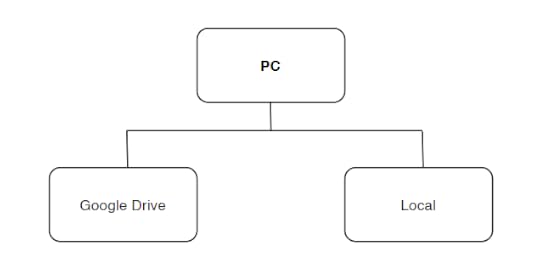
Then, I divide each one into more specific types of programs and archives that will be stored on them
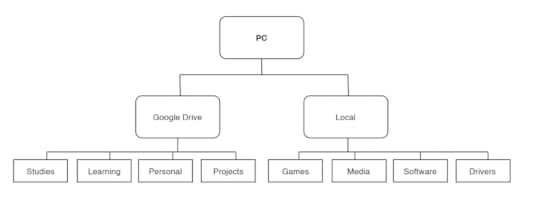
Finally, I keep creating new folders until I reach the pure archives
Taking your file system to the next level
Now that you have your files organized, I’m sure that you notice some drawbacks that it may have.
It is pretty hard to insert new information into this super-organized system.
If I want to access a specific file, I have to come across multiple folders until I get what I’m looking for.
What if I suddenly lost my PC disk? All of my information would be lost.
Here is where out productive-master skills come to place, let’s review the 3 most important features to add to your files-organization system.
Quick Access
The very first thing you should do is identifying your most commonly use archives and folders and create a quick access menu to access them.
On pretty much any app and operative system, you have access to the quick access feature, link the files you use the most there to remove resistance.
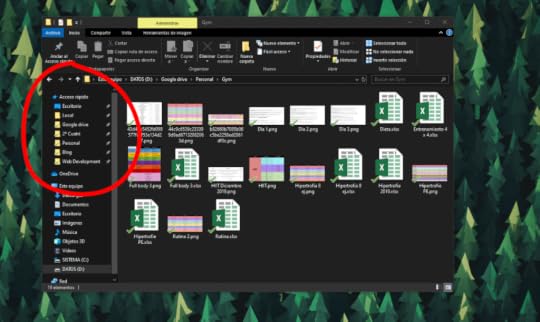
Cloud Synchronization
The next thing you should do with some to your files is to upload them to some kind of cloud service.
This way you will make sure that they don’t get lost if something happens To your primary manipulation device and you will have access to all of them no matter in which device you are.
Some very good Apps for cloud synchronization are:
Google Drive: With the free 15GB they give you should have more than enough for your important files, you can buy more storage if you want.
Dropbox: Pretty much the same as Google Drive and it has so many integrations with other applications, but it is a little more expensive.
If you are a college student, you probably have unlimited storage on your student account, just make sure you will be able to retrieve your files once you are done with your career.
Quick Capture
To end with, I highly recommend that you use some kind of quick-capture service to easily get any though or information into your inbox, so that you can organize it later on.
Some good free services for quick capture are:
Evernote’s Capture Feature: You can make photos of your paper and create notes based on them.
Word’s recorder: You can create written notes based on what you are saying to your microphone.
Scanbot: An Android/IOS App that lets you scan documents and them send right into your google drive system.
I use Evernote for everything, I scan my flow notes for my exams and I record any idea I have when I can not write it (90% of my ideas occur in the shower or walking with my dog).

A Long Term Road
Developing a system that works for you is a long-term task, you need to first set up what you’ve already have and then keep improving that system over time, eventually, you will end up with a perfectly organized system in which externalizing a though or checking out a file is just a click away.
Let’s get moving
I want you to start this road right now:
Choose a service for your notes and the next time you are learning something take an outline or flow note.
Insert that note on your system and keep it organized.
Create your tree structure for your digital files and upload the most important ones to a cloud service.
Get rid of any non-essential physical files and build a 3-location system with the remaining.
Keep your system updated over time and enjoy your new life.
I hope you found this post useful and that you started building your second brain.
It would be amazing if you share this post and let me know what you think.
Thank you so much for your time, I appreciate it. See you soon!
The post How to Create your Digital Brain appeared first on Daniel Robledo.
May 24, 2020
The 1# Strategy To Defeat Procrastination
By Daniel Robledo| Last Updated May 24, 2020
I will do it later
You just got another assignment to do, the deadline is far away and you think: “I will do it later for sure”
But then you don’t.
You sit down to get that work done and before you realize it has been 15 minutes and you haven’t even started.
You start to feel anxious and frustrated, “I should have started sooner”, you say, “What have I been doing all of this time?“, you ask.
If you are anything like me, this happens to you more than often, and we both know what we have been doing, we have been procrastinating.
We all dream of having more free time and one of the main things that prevent us from reaching that dream is procrastination.
Image if whenever you have to do something, you doing it right away. Can you imagine the tremendous amount of more free time you would have?
The solution you have been looking for
I have good news for you, even if procrastination is one of the biggest problems in human society, it can be solved.
You just need to know-how.
And that is exactly what we are going to do today.
We are going to learn what is procrastination, why does it appear in the first place, and how to completely overcome it.
I can promise you that if you work on all of the tips and strategies I am going to show you today, you are going to see results in no time, and those results won’t be small, I promise.
Every back and then I like to track my time to the minute for a week, to see how much I am improving and in which I spend the most time on.
Comparing the tracking I did before I knew these techniques with the last time I tracked my time (two weeks ago) my procrastination hours decreased from 22 hours to 8 hours per week, this techniques work, trust me.
Before we get right into the topic, I have to say that the fact that you are not accomplishing that much could be either because of bad time management or a lack of focus and self-discipline apart from the procrastination problem.
Today, we won’t focus on those topics, we are going to see how to stop delaying the things we have to do, not how to do them more efficiently once you have started, that will come in the future.
Procrastination
First of all, let’s define what is procrastination.
We all know when we procrastinate (or most of the time) but, to solve a problem we first need to fully understand the challenge we are facing and it’s causes before we start working on the solution.
What is procrastination?
The scientific definition of procrastination is the following:
“Procrastination has identified not just any delay but an irrational one—that is, when we voluntarily put off tasks despite believing ourselves to be worse off for doing so.”
In other words, whenever you are putting off something you know you should be doing, you are procrastinating.
This definition of procrastination does not help us much, so let’s take a look at the counterpart of procrastination, The Motivation Equation, a term created by the author Piers Steel in his book “The Procrastination Equation”.
The Motivation Equation
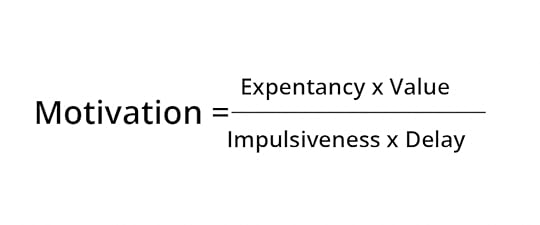
When we are talking about motivation, we are talking about that feeling that pushes you to do things, you do not necessarily need to be motivated to do something but motivation makes you less likely to procrastinate.
Let’s take a look at each term of the motivation equation:
Expectancy: Expectancy represents the expectations you are putting on the task’s reward.
Value: Value represents the actual value you are getting from this task.
Impulsiveness: Impulsiveness represents how likely you are to stop doing the task you are doing.
Delay: Delay represents the amount of time that you’ll have to wait to get the task’s reward.
As you can see, the higher the expectancy and value, and the lower the impulsiveness and delay, the higher our motivation will be.
So, to be less likely to procrastinate (remember that you don’t need to be motivated to do your tasks), we need to both increase and decrease the terms of this equation.
Some good and easy ways to do that would be:
Increase Expectancy: Have a strong “Why” on the things you are doing, you don’t need to make them fun, they just have to be high-impacting in your life.
Increase Value: Give yourself rewards for completing milestones of your tasks.
Decrease Impulsiveness: Eliminate all possible distractions, remove access to your phone, turn off notifications, and disconnect the internet when you are working.
Decrease Delay: This term is the hardest one to decrease and usually you won’t be able to since deadlines are pre-established but you may want to set self-milestones for you to make that big delay into little ones.
The 6 triggers of procrastination
Now that we know what we can do to be less likely to procrastinate, let’s see why does procrastination appear in the first place because even tho motivation is the counterpart of procrastination, the lack of motivation is not the trigger for the appearance of procrastination.
According with what Chris Bailey says in his book “The Productivity Project”, procrastination is a phenomenon that occurs whenever a task is one or more of these 6 characteristics, the higher the intensity and amount of them, the higher the chances of procrastinating:
Boring
Difficult
Frustrating
Unstructured
Lacking in personal meaning
Lacking in intrinsic rewards
We are going to see how you can counter each one of these triggers and let me tell you (based on personal experience) that it couldn’t be more simple and effective, you’ll see.
But to finish off with our understanding of what is procrastination, let’s dive into the scientific side of procrastination.
The science behind why we procrastinate
The science involving procrastination is pretty dense since it is a problem we humans have been struggling with over many years.
To understand better why we procrastinate, we need to understand that procrastination comes from three psychological phenomenons: The temporary motivation theory, the downward counterfactuals, and the problems with executive functioning.

The Temporary Motivation Theory
To start with, the temporary motivation theory is a theory that was created after so many researches and experiments in which chronic procrastinators were responsible for performing different tasks through a wide variety of circumstances.
After many years of research and experimentation, the temporary motivation theory was created:
“Procrastinators focus on how to make themselves feel better at the expense of drawing insight from what made them feel bad”
The Downward Counterfactuals
Related with the TMT, the most common reason why we tend to procrastinate is because of downward counterfactuals.
The downward counterfactuals are statements that reflect a desire to improve one’s mood in the short term.
For example, phrases like “I work better under pressure” or “I still have tons of time to finishing this assignment” are downward counterfactuals since they are statements that focus on getting us to feel better on the present moment even tho we are procrastinating, ignoring the long term consequences of being doing so.
The Executive Functioning Problems
To finish with, researches have shown that procrastination problems are very related to executive functioning problems, these last are problems that require high cognitive functions to control our behavior, such as reasoning and problem-solving.
This means that situations that involve solving an executive functioning problems are much more likely to be the ones that we procrastinate on.
There is no doubt now of why we all tend to procrastinate at work or school, right?
In case you want to know more about all of the reasons why we procrastinate, here you have all of the researches I have mentioned:
Temporal Motivation Theory: Temporal Motivation Theory: Formula or Folly?
Downward Counterfactuals: Procrastination and the Priority of Short‐Term Mood Regulation: Consequences for Future Self
The Association between Studies and Procrastination: Academic procrastination in college students: The role of self-reported executive function
The Executive Functioning Relationship with Procrastination: The Structural and Functional Signature of Action Control
Now that we clearly understand what is procrastination, why do we procrastinate and which are the main triggers that make it happen.
Let’s learn how to overcome it.
How to overcome procrastination
Overcoming procrastination is a process that goes through four different stages: the mental preparation, taking control or your environment, countering the procrastination triggers, and practicing.
We will see how to perform each of these stages and later on I will introduce you to the best strategy you can perform when you want to stop procrastinating, I guarantee you that the moment you start doing this technique, you will be amazed by how effective it is.
The Mental Preparation
The very first thing you need to do to avoid procrastination is to mentally prepare yourself to overcome it.
What is the first step to that? The first step is to forgive yourself.
If you are anything like me, you probably belong to the people who sometimes do not forgive their selves very often. We tend to base our identity on past actions both successes and failures and that couldn’t be more wrong.
Of course, it’s ok to be proud of your past successes and to learn from your mistakes but notice the difference between “learning” and “harassing”, even tho you have been a chronic procrastinator, that changes right now.
So, forgive yourself for all of those times you left an assignment to the last day, those times that you avoid doing the hard work or taking that difficult conversation because it’s ok, we are human, we are not perfect.
Identify the Causes of Procrastination
Continuing with the mental preparation, it is really important to identify the causes of your procrastination, because often they are not as clear as they may seem in the first place:
Maybe you procrastinate because you don’t like what you are doing
Maybe you procrastinate because you think it is a good thing, you perceive procrastination as a self-esteem boost.
Maybe you procrastinate because you live in an environment that encourages you to do so.
Whichever the cause, before you start working on solving the problem you need to know the source, because if you don’t solve the cause, the effect won’t disappear.
Having a “Why”
To finish with this very first step, as any other thing in life, you need a strong “Why” about stoping procrastinating because you won’t stick to the work you have to do in the long term if you do not have a strong reason to look at every day, at every moment of weakness.
The good news is that this “Why” could be anything, as long it is meaningful to you:
I want to stop procrastinating because I want to spend more time with my family, friends and couple.
I want to stop procrastinating because I want to start that personal project.
I want to stop procrastinating because I want to sleep more.
Take Control Of Your Environment
The second step in stopping procrastination is to take control of anything that involves the task that you are procrastinating on.
Taking control of your environment could be hard sometimes but let me tell you that it is the most impacting part of the process.
Usually, people work on an environment filled with distractions, that annoying coworker that won’t stop showing you puppy’s photos, that television next to your bedroom in which your parents are watching the new Game Of Thrones episode and that constant notification sound popping of your phone next to you.
All of these things do not help your chances of procrastinating decrease, they help them increase. That is why you need to take control of your environment.
Eliminate distractions: Get some noise-canceling headphones, go to a coffee shop or the library.
Eliminate choices: Turn off your phone, disconnect the internet if you don’t need it. Make not doing the task harder than actually doing it.
Avoid toxic people and situations: If you have specific persons whose presence makes you more likely to procrastinate, try to avoid contact with them while you are working.
Counter the procrastination triggers
We are almost done with our procrastination battle, the last piece of pre-work we need to do before we start building our workflow is to counter the six triggers of procrastination that we talked about before.
To illustrate this point let’s use an example.
Imagine that I want to stop procrastinating on writing for my blog.
I know that this task may be: boring, frustrating, difficult, unstructured, lacking in intrinsic rewards, or lacking in personal meaning. And that those characteristics are the cause of the procrastination.
What I’m going to do now is to counter each one of these triggers to be less likely to procrastinate:
Boring: I will go to my favorite coffee shop, listen to good music and get a nice looking drink so this activity is more fun
Frustrating: I will start by working just for 15 minutes on the outline of the post and continue only if I feel like to.
Difficult: I will write down all the things I would need to get help; other blog examples, my blogger friend contact…
Unstructured: I will develop a workflow to follow with different milestones of the process of creating a blog post and I will follow it step by step.
Lacking intrinsic rewards: I will allow myself to eat a yummy snack after I finish my work or I will take 30 minutes of breaks for every hour I work.
Lacking in personal meaning: I will both look at the long-term goal I am pursuing by performing this task and ask myself if this is really what I want to be doing.
Practice
Now that we know how to be prepared to avoid procrastinating, we have taken control of our environment and we have lowered as much as possible all of the procrastination triggers it is time to practice. And there is no secret here, as anything in life, the only way to get good at something is through practice.
Take the time to write down what you are going to do to avoid procrastination, what is working and what is not and develop a workflow that works for you, I guarantee you that over the long-term you will see tremendous results if you take the effort of working on a solution to your procrastination problem.
And, to make your practicing journey more efficient, I will share with you the most effective strategy against procrastination: The Pomodoro Technique.
The 1# technique to defeat procrastination: The Pomodoro Technique
The Pomodoro Technique is a technique developed by the student Francesco Cirillo in 1980 and it consists of breaking down your big task into little tasks, working on them for a specific amount of time, and then strategically taking breaks.
You can use the Pomodoro Technique for anything you want, from studying your next exam content, to writing that essay or for taking that course you want to take.
The Pomodoro Technique consists of four very simple steps:
Decide a task that you will be working on, this task need to be as specific as possible.
Work for 25 minutes only on that specific task and every time your mind wanders or you get distracted, write down what the distraction was about.
After those 25 minutes take a 5 minutes break, you can invest this time to reward yourself with the distractions you have written down.
Repeat the process 4 times and then take a longer break, after that long break you can perform the Pomodoro technique all over again if you want.

The main benefit of the Pomodoro technique is that it removes resistance on working on a task because the little task you have decided to perform is so specific and the time you are putting on it is so little that you are not likely to procrastinate on it.
Once you have started you have entered into “The Flow State” , that state in which you are 100% focus on a task, and time seems not to exist at all, and you are more likely to finish all of the tasks.
There are tons of experiments that have concluded the effectiveness of the Pomodoro technique, in case you want to know more about it:
The Science behind the Pomodoro Technique
Brief Diversions Vastly Improve Focus
The Flow State
I have been using the Pomodoro Technique on both my studies and personal projects for more than a year and it has been the most powerful improvement on my productivity levels. I achieve approximately 4x more than I did when I didn’t know about it.
All the time you need
To sum up, everything we have talked about today.
Remember that procrastination is the delay you put on a task that you know you should be doing and that the lack of motivation makes you more likely to procrastinate on a task, remember that procrastination a psychological phenomenon that is wired on the human brain, so forgive yourself and start solving it.
Keep in mind all of the triggers that produce procrastination and find ways to decrease their intensity. Try to increase your motivation as much as possible by modifying the motivation equation’s terms.
And try the Pomodoro technique, it has been a game-changer for many people, including myself, it may be it for you too.
Let’s kick out procrastination
As always, practicing is the way to go so let’s stop procrastinating right now:
Identify one task that you usually procrastinate on
Increase your motivation on that task as much as possible
Counter all of the triggers that appear with that task
Try the Pomodoro technique and check out the results
I hope this post was useful to you to procrastinate a little bit less, I’m sure that now you have a clearer understanding of what is procrastination and how to avoid it.
It would be amazing if you share this post and let me know what you think.
Thank you so much for your time, I appreciate it. See you soon!
Books Credits:
Bailey, Chris. “The Triggers of Procrastination.” The Productivity Project: Accomplishing More by Managing Your Time, Attention, and Energy, by Chris Bailey, Crown Business, 2017.
Steel, Piers. “The Motivation Equation.” The Procrastination Equation: How to Stop Putting Things off and Start Getting Things Done, by Piers Steel, Pearson, 2012.
The post The 1# Strategy To Defeat Procrastination appeared first on Daniel Robledo.
May 17, 2020
How To Get The Most Out Of Your Days
By Daniel Robledo | Last Updated May 17, 2020
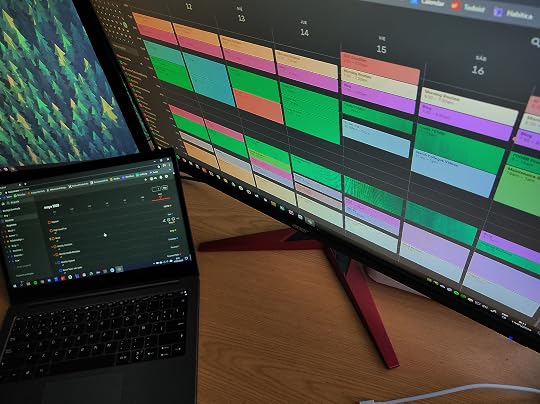
24 is not enough
Have you ever feel like 24 hours are not enough? That you just have not enough time on a day?
You’re not alone.
You just got another class assignment to do, added to the emails you have to write, and the articles you have to read. And all of that in just 24 hours!
You start feeling anxious and being frustrated while you see your days go by while not accomplishing what you would like to.
Does that sound familiar to you?
We all dream of days being as long as we need them to, to have infinite time to do everything we need to and to have more free time.
What would you think if I tell you that it is possible?
Some years ago I started building my Productivity System to have more free time for myself and I got so tremendous results that I want to share it with you so you can also get the most out of your little 24 daily hours.
The Productivity Equation
Before you start building your productivity system, you need to understand what is productivity.
The concept of productivity is so different nowadays from what it was 50 years ago.
Back then, people were in the industrial revolution, many people worked in factories. In that place, work was repetitive and not attention needed so productivity was measured on how much you Produced, that is why it is called “Productivity”.
But, now we don’t live in the industrial revolution anymore, so the concept of “Productivity” has changed and the equation “Hours of work = Productivity” is not true anymore.
Today, productivity is so much more about what you can accomplish that it is about how much you can produce.
This way, and as Chris Bailey states in his book The Productivity Project, the productivity equation has evolved to:
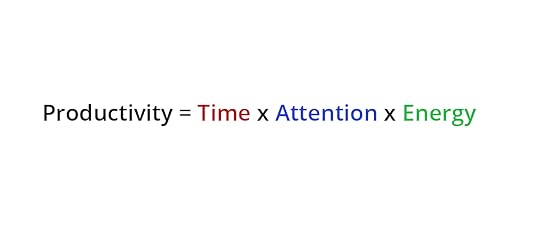
As you can see, time and attention are two of the terms of the productivity equation (we will talk another day about energy) and that is what we will be focusing on today.
Your Productivity System
Now that you know the productivity equation, you need to know what is a productivity system.
A productivity system is a set of tools that work altogether to help you boost your productivity, either by increasing your time, attention, or energy.
One thing you have to keep in mind when building a productivity system is that it should reduce Friction as much as possible
Friction: “A force that holds back the movement of a sliding object“. If we think about it in productivity-terms it would be the force that prevents you from accomplishing your work
Finally, and before we start getting to work, I need to tell you that the fact that you are not accomplishing what you want to could be because of other reasons, such as Procrastination, a lack of Focus, or a bad Self-Discipline.
We will discuss those problems in the future but for now on, let’s take care of your time and attention.
Your To Do List, your attention manager
First of all, we are going to start with your attention management, the best way to manage your attention is to manage what tasks are you focusing on, and the best tool to do that is a To Do List.
A to do list is a summary of anything you want to accomplish in a specific amount of time, it could be a day, a week, a year…
On that list, you should have easy access to:
What your current to do tasks are
What are your tasks’ due dates
The prioritization level of each task
Why to have a to do list?
The fact of having a to do list is founded in a really simple statement as Chris Bailey says in his book The Productivity Project:
“Not all tasks are created equal; there are certain tasks in your work that, for every minute you spend on them, let you accomplish more than your other tasks.” – Chris Bailey
This is true because in your life there are tasks that are making you unproductive either because they provoke a false sense of productivity or because they just consume a ridiculous amount of time compared to their value.
To illustrate this, I’m going to introduce you to a concept called “The Urgent-Important graph“, this is a concept created by Stephen Covey in his book The 7 Habits of Highly Effective People.
The Urgent-Important Graph
The Urgent-Important graph is a method of dividing your tasks into four different categories, based on their urgency and importance.
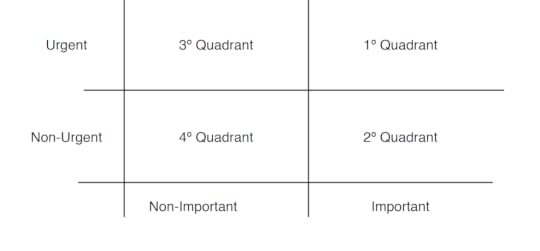
Urgent & Important tasks: Here you will find the most unexpected tasks, these are things that need your attention as soon as possible and that will have a high-impact on your life.
Every unexpected problem belongs to this category.
Urgent & Non-Important tasks: These tasks are requests that are urgent and that may look important on the surface but, if you take a step back and reflect on the value you are getting from them, you realize how much time they consume that could be used on anything else, they are one of the main reasons of why you can not accomplish what you want to accomplish.
For example, a phone call, message or an email may seem important (and 1% of the times it will be) but if you think what you are getting from responding to that mundane email conversation or laughing at that puppy cat’s photo, you will understand that you should be doing something that gives more value to your life.
Non-Urgent & Non-Important tasks: Continuing with tasks that you should avoid, here you will find your least productive tasks. These tasks are the reason why you procrastinate so often that you feel like everybody else gets 24 hours a day but you.
The good news is that these tasks are so easy to identify. Watching Netflix (when you are not supposed to, we will talk later about that), scrolling down Twitter or Reddit to see what your favorite influencer is doing with her life or checking out your friend’s last Instagram story, among others, are things that if you are anything like me, spend more time doing that you would like to.
Non-Urgent & Important tasks: The non-urgent and important tasks are those that give your life a high value over the long term, these are things that if you do them consistently over the time, you will get a tremendous amount of value to your life.
Some non-urgent and important tasks on life are: working on your projects, exercising, building strong relationships, working on your self… The problem with these tasks is that we humans are not that aware of our mortality, we think “I will do these eventually” but that “eventually” never comes and we keep trapped onto a cycle of doing urgent and important things in our life while taking breaks on the non-important tasks.
What quadrants should you be focusing on?
Now that you understand which categories your tasks are divided into, you need to apply three very simple principles on time management:
Focus on the second quadrant as much as possible
Leave some buffer for the first quadrant
Only get into the third and fourth quadrant when you are taking breaks
How to manage your tasks
I see task management as an algorithm type action, if you follow the next 5 steps correctly, you will find yourself suddenly working on what is important in your life:
Set your goals
Select a system for your to do list
Create your life’s hot spots
Identify your most important daily tasks
Work on your high-impact tasks and leave the rest of the time for low-impact tasks
1 – Set your goals
The most important step in this process is knowing what your goals are.
Maybe you want to finish your career, maybe you want to run a marathon or maybe you want to start that project you’ve been putting apart for years. Either the case the key is that you know where your life is going so you can divide those goals into little and manageable tasks
2 – Select a system for your to do list
Before you start managing your tasks you need to select a system in which your to do list will go onto, you can either choose the good old “Pen & Paper” or go for some App.
If you choose the digital field, here you have some To Do List Apps I consider amazing:
Todoist: I use this App every single day and it is one of the most valuable parts of my productivity system
Windows To Do List: This App is pretty good if you are a Windows user because it synchronizes between other windows services, such as Outlook
Google Tasks: The fact that I like about this App is that you can integrate it into your calendar if you are using Google Calendar, which is pretty sweet
3 – Create your life’s hot spots
Now that you have your system, first of all you need to divide your life into “buckets” to know which aspect of your life needs more attention (or less).
I could write an entire post about this technique but for now on let’s start small and divide your life into categories, you can add any sub-categories that you want.
Personal: Here you will have your mental health, physical health, personal problems…
Career: Here you are going to manage your studies, work, and personal projects.
Relationships: Here you have to set your social circle.
Pro tip: Use different colors for each hot spot, this way you will easily see which color is the less frequent and needs more attention.
4- Identify your most important daily tasks
From this point on, you need to repeat this step and the next one every single day, I suggest creating a routine or a habit.
There are many different ways in which you can set your tasks but I’m going to suggest the brainstorming technique.
The brainstorming technique consists of adding any task that pops into your mind into your to do list, it could be for today, tomorrow or next week. Then focus on your day (or tomorrow if you decide to do this the night before) and identify the tasks that are important and focus on them, they usually are the ones that belong to the first or second quadrant.
You should not have more than three important tasks for your day.
5 – Work on your high-impact tasks and leave the rest of the time for low-impact tasks
The final step is to deliberate work on your high-impact tasks, this is where having no more than three daily tasks comes into place.
You may have a 10 item list for today but if you accomplish your 3 high-impact daily tasks and leave 7 low-impact items unchecked, you will earn so much more value than if you’d tried to do the 10 items and only get done 2 or 3 low-impact tasks, because those three main tasks belongs to the important half of the urgent-important graph.

Example of task management
I’m going to show you what my current task management workflow is, I’m using Todoist for this process:
First of all, I’ve my current goals written down and they are:
Write consistently on GLG
Study my career
Keep my friendships healthy
Workout every day
Now, I need my life hot spots, I created those a long time ago and I have so many of them but, to make this easier, I’m going to show only the ones that involve this example
Personal
Career
Relationships
Other Tasks
Finally, I perform the brainstorming technique, I usually do this at night because I like to divide my planning-mode from my acting-mode but you can do this in the mornings too:
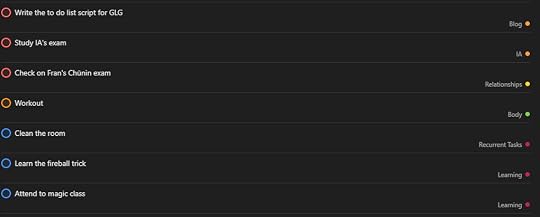 I like to use Todoist’s priority system to divide my tasks into high, medium and low impact tasks
This way, I know that the 3 high-impact daily tasks that I should be willing to accomplish today are:
Write this script
Study my test
Check on my friend
Repeat this process until you find the best workflow for you and you build the habit of managing your tasks, I guarantee that you’ll enormous changes in no time.
Now that you have your tasks managed and you know what should you be focusing on, let’s learn how to manage your time to accomplish those tasks.
Your Calendar, your time manager
Managing your tasks is important, you have to know what you need to do regularly to develop changes in your life.
But I’m sure you will eventually come to the question “How do I organize those tasks? How do I manage my time?”. That’s when having a calendar manager is the way to go
Why to use a calendar?
First of all, let’s define what your calendar manager’s purposes are:
Manage your time, decide when will you be doing your tasks regularly
Remind you of important events
The main benefits of having a calendar manager are that it gives you a general look at what your day will look like and that it separates, even more, your planning-mode from your acting-mode.
This happens because when you use a calendar, you are managing your time, you are diving your life into little manageable chunks of time in which you will perform a single or series of tasks.
For example, let’s say that you are a 20-year-old college student with a time-partial job of 2 hours per day.
If you’d have to divide your life into 3 priority levels I think it would be something like:
Prio 1 -> Collegue & Work
Prio 2 -> Relationships & Health
Prio 3 -> Breaks
Now, you can use a calendar manager to set the time chunks corresponding to everything you do on the day and solve the overlap problems based on your life priorities.
This way, whenever you start a day you will know that you will be spending more time on your high-priority field, working on your high-impact tasks.
How to use a calendar
I see the time management similarly to the task management but with a little more of creativity involved, you need to follow these three steps:
Create “buckets” calendars
Set you recurrent and important events
Create time chunks regularly
1 – Create “buckets” calendars
Before you start setting up your calendar, you need to separate your life into different “buckets”.
You should combine your task manager’s hot spots with your calendar’s life buckets.
For example, you may have a life hot spot called “Career” that may go into two different calendars: “College” and “Work”.
Or you may have a life hot spot as “Personal” that diverges into “Workouts”, “Routines” and “Health Treatment”.
2 – Set your recurrent and important events
Now that you have your life calendars, I suggested putting your time first on two main types of events:
Recurrent events: These are events that occur on specific days at specific hours like classes or job journals.
Important events: Here you will find events that usually are long term events and that you need to be reminded of.
3 – Create time chunks
Finally you have to create those chunks we’ve been talking about.
Just again, there are many ways in which you can create your daily based calendar and I’m going to suggest doing it by the recurrent overlap technique and on Sundays, this way you manage the whole wee’s time ahead and you can focus the rest of the days on doing what you want to do.
To start with, take a look at your most important life buckets and find the corresponding life hot spot.
Then check what tasks you want to accomplish for the first day of the week and approximately how much time you’ll need to accomplish it.
The Buffer
Here you will need to apply the principle of buffering. This principle states that you need to create some space between what you think will take to do a task and the time you create to accomplish it.
For example, if you have to study two units for your maths exam and you think it would take you approximately 1 hour and 30 minutes to do it, then set 2 hours on your calendar to do it. This way you won’t feel anxious about the fact that you may run out of time because you’ve set extra time ahead.
This is dangerous because it is true that deadlines increase our productivity and that when you put extra non-sense time on a task, you will probably take all the time available but because we are just starting, let’s allow ourselves some space.
If you want to know more about this I suggest checking out information about “The Fudge Ratio”
Repeat this step for every day of the week and once you have all of your life chunks for your most important life bucket, get to the next most important bucket and repeat the process.
If you feel like two events are overlapping, prioritize the one that belongs to the most important life bucket or the one whose tasks belong to the high-impact category.
Now, you should have your week planned with:
Chunks of time in which you will work on one of your life buckets
A to-do list that tells you what you should be doing in each chunk
A clear vision, by using the colors, of what areas of your life need more or less time
Example of calendar management
For this personal example, I’m going to use Google Calendar. It is free and it synchronizes with my other App, I recommend using it.
First of all, I have set 7 different calendars:
Routines: White
Classes: Dark Blue
Studying: Dark Green
Workouts: Purple
Personal Projects: Pink
Important Events: Orange
Personal Stuff: Light green
Recurrent & Important Events
To start with, I know that my recurrent events are my college classes and my morning and night routines.
I also know that my important events are both my college test and my practices’ deadlines.
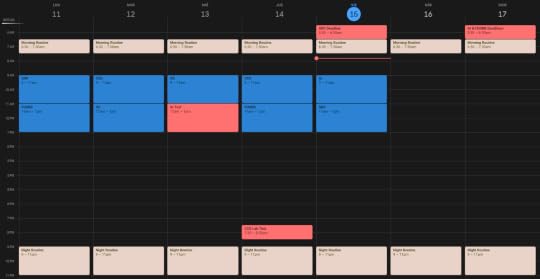 Some nice facts about Google Calendar is that you can set up a rule for an event so it automatically sets up the days you want on the time you want, this is especially useful in recurrent events since it reduces friction even more.
High-impact “buckets”
Continuing with, my most important life calendars are Studying and Workouts, and I know that the tasks I want to accomplish for each calendar take about 1 hour and 30 minutes for the study and 1 hour for a workout so I’m going to create the corresponding chunks of time, including the buffers.
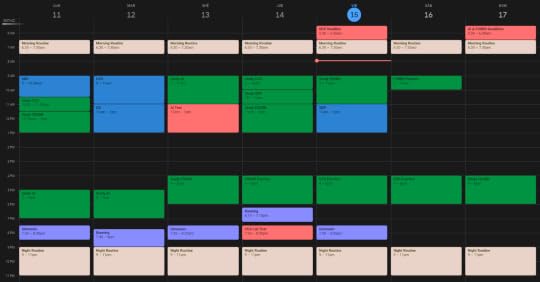 You may notice that I have removed some classes, this is because certain classes give me less value that I would earn by studying by myself, so I’ve decided not to attend to them. I don’t promote class-skipping, this works for me but may not work for you.
Low-Impact “buckets”
Lastly, I just need to add everything that is left into the free time between my most important chunks of time.
Here I will add my projects, hobbies, health insurance, and some long term tasks that I eventually want to do.
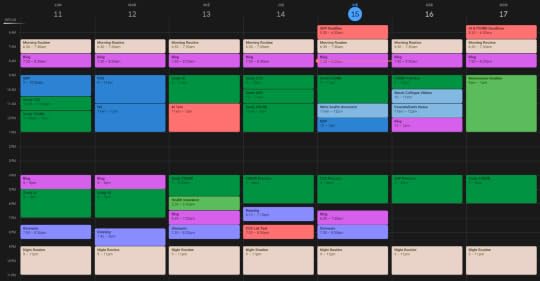 One thing I recommend working on is building up as many routines as you can, try to do the same thing at the same time over and over again until it becomes a habit. This way you are freeing your brain from thinking when will you be doing something, allowing your creativity to skyrocket.
After doing this, I can take a look at my calendar and my to do list and now that I will be working on today:
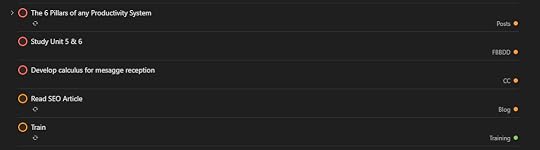
As I’ve told you, I usually develop my whole week plan on Sundays and every night I take a look at both my calendar and to do list and polish what I want to do, this way I’m only on planning-mode on Sundays and I can spend the whole week on acting-mode.
Developing a workflow that works for you takes time and practice but I can assure you that if you consistently try this process over time, you will start to feel a lot more in control of your life and you will notice that you both start to accomplish so much more and ironically you start having so much more free time, that is the magic of productivity.
24 is enough
Now that you have built your task and time managers, I’m sure you are starting to understand how some people accomplish so much more than others, they understand how productivity works, and now you do too.
Start right now
The last thing I want to tell you today is to start right now, get into work, and experiment on what works better for you.
Separate your life into hot spots and buckets
Set up your 3 daily tasks for tomorrow
Add their chunks of time to your calendar
Get into work

I hope I’ve helped you to get the most out of your days, let me know what you think on the comments section or hit me up on Contact and Twitter to show me your new productivity system, I will be glad to take a look at it.
If you liked this post, it would be amazing if you share it with your friends.
Thank you so much for your time, I appreciate it and see you next time!
Books Credits:
Bailey, Chris. “A New Definition Of Productivity.” The Productivity Project: Accomplishing More by Managing Your Time, Attention, and Energy, by Chris Bailey, Crown Business, 2017, pp. 12–15.
Bailey, Chris. “Not All Tasks Are Created Equal.” The Productivity Project: Accomplishing More by Managing Your Time, Attention, and Energy, by Chris Bailey, Crown Business, 2017, pp. 21–25.
Covey, Stephen R. “The Urgent-Important Graph.” The 7 Habits of Highly Effective People: Powerful Lessons in Personal Change, by Stephen R. Covey and James C. Collins, Simon & Schuster, 2020.
The post How To Get The Most Out Of Your Days appeared first on Daniel Robledo.
May 5, 2020
Welcome to Game Life Guide!
By Daniel Robledo | Last Updated May 12, 2020

Does it ever feel like you could be doing better than you do?
As if you know deep down th ere is a better version of yourself but you don’t know how to get it out?
Does it ever seem like people around you have more time than you do?
If you’ve answered YES to any of these questions, let me tell you that you’ve come to the right place.
Welcome to Game Life Guide, a blog in which all of those questions have an answer!
Who am I?
 I have to take more pictures of myself, I know
Hi! My name is Dani, I’m 20 years old and I was born in Madrid, Spain.
I’m a computer engineer student and I’m very passionate about videogames, productivity, and personal development.
My story with personal development started in my first year of college, the most important year of my life.
I was so excited, I loved the classes, I met a lot of interesting people, everything was great.
But in the second semester I started not to feel good anymore, everything turned black and I began to feel very sad and anxious.
You don’t even notice when you are crossing the line that separates an occasional bad time from a serious problem, you just normalize the fact of being sad every single day, every single moment, you start to think that nothing matters, not even yourself.
After feeling this way for several months I decided to ask for help and I couldn’t be more grateful to my past-self for doing so.
Thanks to all the help I got, friends, family, and my hard work I got over it and started my new life.
My new life
As a result of that, I realized that most of your life is about what you do, not what happens to you, so I decided that I would live life to its fullest and that I would really take care of myself and the people I love.
Those two pillars have been guiding my path for more than two years and I couldn´t be happier with my life.
Since then, I’ve been working on my self both physically and mentally, I’ve built tons of new habits, forged strong relationships, and have been happier than ever.
Even if I am studying a career, I still have time to work on other projects, have strong relationships, and give myself a break from time to time.
How do I do all of that you ask? You’d better keep reading…
Why am I blogging?
One of the things I enjoy the most in life is talk.
Whenever I have the chance I always enroll in big conversations with my friends.
There is nothing I enjoy more than seeing the eyes of someone glowing out of passion about what they are talking about, and, of course, getting mine.
I’ve always had the idea of sharing my ideas with other people and, as you can guess, I saw blogging as one of the most attractive ways to accomplish that.
That’s why I’ve decided to start GLG, I want to share with you all of you everything I can to help improve your life. If you find at least a little bit helpful one of my post and it helped you to improve your life in some way, even a 1%, let me tell you that I’m more than happy.
Another reason why I’ve decided to start this blog is to improve my own life. I think that going through this experience will improve both my skills and myself.
That is why I have to ask you, would you like to come this way with me so we can all keep growing?
What to expect here?
When I decided to start GLG the two main topics I wanted to talk about were personal development and productivity. Among other things, here you will learn about:
Increasing your productivity. How to set up efficient routines, manage your time, and not miss anything while keeping your attention on the tasks that give the most value to you.
Discovering yourself. What to do in order to build the best version of yourself, understand your emotions and increase your happiness.
Improving your life. Discover new habits, passions and tools, build strong relationships, and enjoy the game that life is.
Videogame Development. Learn how to design games, how to code them, and how to create art to give life to them. You’ll also see some “serious” videogames’ reviews here.
One of my dreams in life is to build a community in where we all help each other to be happy, so, If you are one of those people who want to give all out on the game that is life, you want to get the 100% of yourself or you just want to have a good time, you have come to the right place!
How to get involved?
I hope this was a good start for your journey through Game Life Guide, if you want to ask me anything or just talk, you really should go to my Twitter.
I would love that you give me your thoughts in the comments section below, and if you want to know anything else about me or my work, you definitely have to check out the rest of my web page.
Thank you so much for giving me the chance of sharing with you what I’m really passionate about.
Let’s make something great!
The post Welcome to Game Life Guide! appeared first on Daniel Robledo.
Welcome to Game Guide Life!
As if you know deep down there is a better version of yourself but you don’t know how to get it out?
Does it ever seem like people around you have more time than you, even if we all get the same amount of hours?
If you’ve answered YES to any of these questions, let me tell you that you’ve come to the right place.
Welcome to Game Life Guide, a blog in which all of those questions have an answer!
Who am I?
Hi! My name is Dani, I’m 20 years old and I was born in Madrid, Spain. I’m a computer engineer student and I’m very passionate about videogames, productivity, and personal development.
My first year of college was the most important year of my life. I was so excited to start college and the first semester was so fun, I loved the classes, I met a lot of interesting people, everything was great. But in the second semester I went through a really sad age full of anxiety and depression, thanks to my friends, family, and my self-work I went over it and started to really live my life.
It was back then when I realized that most of you life is about what you do, not what happens to you, so I decided that I would improve my life every single day, that I would focus on reaching my goals and that I would take care of my myself and the people that I love. Those three pillars have been guiding my path for more than two years and I couldn´t be happier with my life.
Even if I am studying a career, I still have time to work on other projects, have strong relationships, and give myself a break from time to time.
How do I do that you ask? You’d better keep reading…
Why am I blogging?
One of the things I enjoy the most in life is talk. Whenever I have the chance I always enroll in big conversations with my friends about either their interests or mine. There is nothing I enjoy more than seeing the eyes of someone glowing out of passion about what they are talking about.
I’ve always had the idea of sharing my ideas with other people and, as you can guess, I saw blogging as one of the most attractive ways to accomplish that.
That’s why I’ve decided to start GLG, I want to share with you all everything I can to help improve your life. If you find at least a little bit helpful one of my post and it helped you to improve your life in some way, even a 1%, let me tell you that I’m more than happy.
Another reason why I’ve decided to start this blog is to improve my own life. I think that going through this experience will improve both my skills and myself.
That is why I have to ask you, would you like to come this way with me so we can all keep growing?
What to expect here?
When I decided to start GLG the two main topics I wanted to talk about were personal development and productivity.
Among other things, here you will learn about:
Increasing your productivity. How to set up efficient routines, manage your time, and not miss anything while keeping your attention on the tasks that give the most value to you.
Discovering yourself. What to do in order to build the better version of you, understand your emotions and how to deal with them
Improving your life. Discover new habits, passions, techniques, apps, and anything that will make your life happier.
One of my dreams in life is to build a community in where everybody really wants to improve in where we all help each other to do so, so, If you are one of those people who want to give all out on the game that is life, you want to get the 100% of yourself or you just want to have a good time, you have come to the right place!
How to get involved?
I hope this was a good start for your journey through Game Life Guide, if you want to ask me anything or just talk, you really should go to my Twitter.
I would love that you give me your thoughts on either this or any other post in the comments section below, and if you want to know anything more about me or my work, you definitely have to check out the rest of my web page.
Thank you so much for giving me a chance of sharing with you what I’m really passionate about. Let’s make something great!
November 8, 2017
Fan-edited Batman V Superman fan edit improves movie
Justice League, a movie that has been set up in the recent Man of Steel and Batman V Superman movies, is only days away from releasing. Passionate fans and movie goers nervously wait for this new film, remembering the not too distant movie of Batman V Superman, though I hesitate to call that a movie, since it was more of a prologue for Justice League, crippling it’s story and characters in doing so. Will Justice League be a similar affair? I hope not, but in the mean time I went looking for a version of Batman V Superman that answered my criticisms. That’s when I stumbled across the BVS No Justice Cut, a fan edited version that does away with all Justice League set up, Doomsday, and more. I found this version to be a definitively better version, and while this is certainly not saying a lot, and it still has nagging problems, it is an admirable work, and one that you need to watch for these reasons.
Seventy minutes shorter
The first advantage of this cut, and one that very simply summarizes why you need to watch the Batman V Superman No Justice Cut, is the shorter run-time. From the three hour Extended Edition, seventy minutes of footage has been gutted, making the movie a much smaller time-commitment.
Gone are stupid dreams
There are things in the original movie in which excuses could be made, but the two dreams scenes have no good one. Thankfully, the man behind this cut simply sliced them out (a very appreciated change that probably took him less effort than most other changes).
Gone is the unnecessary (but still cool) Wonder Woman
Gal Gadot’s Wonder Woman was cool, but in terms of narrative she offered little, so she as well, is gone from this cut. (But if you want Wonder Woman, than you can just go see her movie.)
Gone is Doomsday
Doomsday in the original was a CG abomination that likes of which we rarely witness. Created without an ounce of imagination or passion, he has gratefully disappeared, and the movie benefits a lot from this, sticking to it’ early established grit..
Lex Luthor less insane
While I didn’t loathe Jessie Eisenberg’s Luxor, I still felt that he belonged in another movie. While he still has a lot of verbal quips and facial quirks, there are two or three scenes in which his insanity is significantly turned down.
Batman’s reduced mass murdering
I liked Ben Affleck’s monstrous in the original (in fact he was, and still is, my favorite character ), the creator of No Justice decided to tone down his killing, something that at the very least can be seen as understandable.
Batman’s emotional arc is heightened
Now that we’ve gotten through everything negative that this cut fixed, I would like to bring up a couple of things that were made even better. Because of the chopped nonsense that I mentioned before, Batman as a character stands more center stage. It’s a case of more is less, and by having less other stuff, there is a higher ratio of Batman.
Martha moment makes more sense
What the original BVS wanted to say with the Martha moment was this: Batman realizes that Superman has a mother, that he is about to take someone’s son from them, and that he is just killing Superman to feed an internal demon of his. What it ended up looking like in the original, was a man being spared for their mothers having sam first names.
But…
There is only so much that one passionate person can do with a certain amount of available footage, and there are somethings that lose coherency when chopped out. While you still need to watch the Batman V Superman No Justice Cut, there are few things wrong with it.
Some of the editing is awkward
The gaps left from the huge cuts tooth’s film, while handled well, are still sometimes very noticeable (the biggest being Lois Lane’s transition from being rescued by Superman, to her appearing during Batman and Superman’s duel.)
Super Man’s Arc deadpans
Superman struggled to be compelling in the original. While there are scenes in No Justice that shouldn’t have been in there, his arc as a character totally deadpans without them, especially the Doomsday sacrifice. Every big question and moral dilemma he’s given earlier in the movie… totally tossed away.
Political themes are cut off in finale
If there is one thing that still remains as equally disappointing for all versions, official and fan constructed, it’s that the political themes about a God-like deity and a man taking the law into his own hands, are never explored once the fists start flying.
Get Monthly Updates and Articles
 We value your privacy and would never spam you
The Result…
This version might not come to be known as a masterpiece, but for those of you who thought the original had potential, you need to watch the Batman V Superman No Justice Cut (check it out here) .
The post Fan-edited Batman V Superman fan edit improves movie appeared first on Daniel C Robledo.