Joe Moss's Blog
December 7, 2015
Bondage
 Licence Renewed by John Gardner
My rating: 3 of 5 stars
John Gardner was chosen to continue the print version of the James Bond franchise (dread word!) and ended up writing more novels that Bond's own creator: Ian Fleming. A total of fourteen novels and two novelisations of Bond films.
Licence Renewed was his first effort. Whilst critical opinion was at best lukewarm, the book sold in good quantities and that was all the publishers wanted.
Apparently Gardner was given the task of modernisng Bond, bringing him into the eighties. As a result he has some grey on the temples but this token gesture to Father Time does not affect his drinking, womanising, fighting skills, love of speed and gadgets or anything else. So it does end up being rather an empty gesture.
The plot is Bond-by-numbers. There is a megalomaniac - a Scottish laird of murky origins who, handily, happens to be one of the world's top nuclear scientists as well as being completely barking - a young and endangered beauty (the laird's ward) and a huge villain, a Scottish giant called Caber. No, Bond does not toss him. Suspicious meetings between the Laird and one of the world's top terrorists are monitored by the secret services and Bond is unleashed on the cispirators. It is no spoiler in any Bond-related product to say that this is an uneven contest which can have only one winner.
The writing is fairly humdrum, recognisably Bond but with few sparks or fireworks to lift this beyond the ordinary. The occasional attempts to update some of the language fails dismally in conversations, Bond ends up sounding rather crasser and would-be trendy than is his wont.
It isn't a patch on the originals but it will satisfy Bond fans wanting something featuring their idol which they haven't read before.
View all my reviews


November 22, 2015
August 12, 2015
Strange but true.
Just after the publication of "Atacama" the skies opened and the desert was flooded for the first time in a 100 years! What weird wonders will flower from those parched sands???
August 3, 2015
Onto the ark
Atacama going great guns! The full weight of Noah Patterson's talent as a publicist are now being trained on it! First we take Manhattan..... then????
June 19, 2015
Does the Sun Shine out of Bond's....
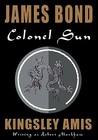 Colonel Sun by Robert Markham
My rating: 3 of 5 stars
A decent enough stab at continuing the Bond series, this was the first Bond novel to be published after Ian Fleming's death. Robert Markham was a pseudonym for Kingsley Amis who presumably, despite his enthusiasm for all things Bond (he had already published The James Bond Dossier, an analysis of the James Bond novels) did not want his literary legacy muddied by including a derivative thriller with a borrowed main character in it.
Amis/Markham brings in a new enemy - the Chinese military - into the series, and the plot involves Bond's supremo M to a much greater degree than the average Bond novel. Much of the action happens in Greece, the exotic locations being obligatory for every Bond novel bar Moonraker
The author's patrician fascination with violence and sex come to the fore, particularly in the description of tortures planned for 007 by his Chinese adversary. As you would expect there is sex although Bond is quite abstemious in this one, basically sticking to the one girl.
It lacks perhaps some narrative variety or surprise to lift it above the norm of the series, but Colonel Sun is a good read and Bond fans reading it should not be disappointed. The selection of Amis marked the way to the future of trying to give the books literary credibility, with recent entries into the canon having been penned by the likes of Sebastian Faulks and William Boyd.
View all my reviews
March 31, 2015
Weather or not?
An event which happens once in a hundred years? How do writers of fiction handle this? Do we write something which happens at a crucial time in history, a millennial event? Or should our kitchen sink dramas have dowdy Mavis bringing down the blinds when the deluge is just starting?
Actually numbers are used loosely. We all know (or should) the 100 Years War was fought over a much longer period, and we know the battlefield wasn't paid for in advance for the Thirty Years War. Humanity tries to make sense of events by naming and numerating, as our old friend Milton reminds us in Paradise Lost.
But back to the question, should writers use coincidences liberally? Unless we are in absurdist territory or in the realms of fantasy high or low, should we not construct a credible world within whatever limits we've set ourselves?
My thinking has been brought about by the recent events in the Atacama region of Chile. There have been floods so fierce that, sadly, they have even resulted in deaths. This is not a matter for levity but who would have thought of rain in a desert, let alone floods, and rain so heavy it causes flooding.
When I wrote my screenplay for Atacama which led to my current novel I actually gave much thought – as you do – to the landscape, the culture and the climate there and how it might affect my narrative. And an important issue was on whether it should rain in the novel. What was my conclusion. I'm afraid you'll have to read the novel; you may wonder, you may very well wonder but I couldn't possibly comment!
Actually numbers are used loosely. We all know (or should) the 100 Years War was fought over a much longer period, and we know the battlefield wasn't paid for in advance for the Thirty Years War. Humanity tries to make sense of events by naming and numerating, as our old friend Milton reminds us in Paradise Lost.
But back to the question, should writers use coincidences liberally? Unless we are in absurdist territory or in the realms of fantasy high or low, should we not construct a credible world within whatever limits we've set ourselves?
My thinking has been brought about by the recent events in the Atacama region of Chile. There have been floods so fierce that, sadly, they have even resulted in deaths. This is not a matter for levity but who would have thought of rain in a desert, let alone floods, and rain so heavy it causes flooding.
When I wrote my screenplay for Atacama which led to my current novel I actually gave much thought – as you do – to the landscape, the culture and the climate there and how it might affect my narrative. And an important issue was on whether it should rain in the novel. What was my conclusion. I'm afraid you'll have to read the novel; you may wonder, you may very well wonder but I couldn't possibly comment!
March 13, 2015
Out on the wiley, windy moors of melodrama.
Recently I read someone describe Wuthering Heights as the worst book to make the classical canon. Now I wouldn't dare to call any book the worst in the classical canon, because I haven't read all the canon. Nor, I suspect, has any member of Goodreads or Facebook because, if nothing else, "the canon" doesn't exist. Works slip in and out of it as scholarship evolves and tastes change. Hilaire Belloc anyone? Miss Bronte stands accused of being melodramatic. At this point Shakespeare, Dickens and the authors of all the myths and sagas start shuffling uncomfortably...
Novels are not reality shows. Any act of artistic creation involves a selection of what to include and what to exclude. So you end up with the turbulent moments in someone's life (real or fictional). The quiet days sitting by the fireside or lazing on a sunny meadow are generally excised. The average reader doesn't want to be bothered with them.
All this is to say that much fiction is melodramatic by its very nature in trying to attract a reader/viewer. Perhaps you have to have felt passions as deeply, irrationally and tempestuously as Heathcliff and Cathy in order to understand them. But if you don't get them that is grounds for subjective criticism, it does not make the novel bad let alone "the worst".
Emily Bronte's upbringing and story has been well documented. She was an untrained writer obviously and exposed to far fewer works than we are and she compensated for this by writing with energy and passion. The complicated narrative structure should baffle the average reader but it actually works.
For my taste it is a masterpiece, totally memorable. And the idea that a woman could have written this in her time and circumstances is simply subversive and amazing. Genius.
Novels are not reality shows. Any act of artistic creation involves a selection of what to include and what to exclude. So you end up with the turbulent moments in someone's life (real or fictional). The quiet days sitting by the fireside or lazing on a sunny meadow are generally excised. The average reader doesn't want to be bothered with them.
All this is to say that much fiction is melodramatic by its very nature in trying to attract a reader/viewer. Perhaps you have to have felt passions as deeply, irrationally and tempestuously as Heathcliff and Cathy in order to understand them. But if you don't get them that is grounds for subjective criticism, it does not make the novel bad let alone "the worst".
Emily Bronte's upbringing and story has been well documented. She was an untrained writer obviously and exposed to far fewer works than we are and she compensated for this by writing with energy and passion. The complicated narrative structure should baffle the average reader but it actually works.
For my taste it is a masterpiece, totally memorable. And the idea that a woman could have written this in her time and circumstances is simply subversive and amazing. Genius.