
Beth Partin's Blog
August 2, 2022
A Small Space for Joy?
In my last post I wrote about small griefs. And now I have a small garden plot, stuck between a church with a small congregation and a parking lot.
After the six of us urban gardeners dug in compost, I felt no urgency to plant. I wagered the weekend of May 14 would be safe to put out my “tender” plants: tomato, peppers, basil, and parsley (the only perennial of the bunch). Broccoli would be okay regardless. I installed them in the earth, but then it was really hard getting the water to sink into the soil because I didn’t rake it first. It got better after I’d been watering for several days.
And then, a week later, surprise! Freezing temps on Friday and Saturday. One of the latest snow dates I remember—after a snowless April.
Of course it wasn’t safe. We are never really safe.
After keeping my plants covered for several nights, I finally took off the covers and left them to brave the cold Monday night of May 23. It went down to forty degrees that night, and for several nights didn’t get out of the fifties.
Now it is July and my plot, along with the other five sandwiched between concrete, is flourishing. My golden pear tomato plant is as tall as I am. A tomatillo and three cherry tomatoes sprouted from seeds left by last year’s gardener, as well as two calendulas, not the orange color I am used to, but paler petals tipped with orange and red.
What lovely surprises, all of them.
Every time I visit I gain purpose and peace from watering my motley collection of vegetables and flowers. And a little weeding.
Maybe DUG is right, maybe Gardening Will Save Us.
From industrial agriculture, that is. I dislike IndAg. But the fact is I’ve lived off it for much of my life. How many small plots like mine will it take to turn IndAg around? But maybe that’s not what DUG’s gardeners are trying to do. Probably most of them live off IndAg as well.
Like me, they have claimed a small space to feed themselves according to their lights, to grow the food they want.


January 31, 2021
Grief and the Environment
. . . though in all lands love is now mingled with grief, it grows perhaps the greater.
—Haldir of Lothlorien, The Fellowship of the Rings
I’ve had a large helping of grief the last five years, though it was broken down into many smaller griefs: my father’s death, the dissolution of my marriage, the end of a long friendship, my brother’s death from brain cancer even as the tumor was shrinking.
All these sharp griefs have dulled.
What’s neither dull nor sharp, but powerfully present and deepening, is the sense that environmental degradation is now the norm.
It seems a little silly to say “is NOW the norm.” As if I’d forgotten nuclear tests and the extinction of the passenger pigeon and the BP oil spill in the Gulf of Mexico. As if I’d never read about desertification of the Sahel or the Colorado River Delta drying up. As if I didn’t know that oil refineries and mines poisoned the people living around them, who were mostly Black, Indigenous, and People of Color.
After all, we’ve got wolves in Yellowstone, right? And whooping cranes are making a comeback. And there are about a million environmental organizations, and the environmental justice movement seems particularly inspiring…
But the fires, and the hurricanes, and that weird wind in the Midwest whose name I can’t remember, and the Antarctic about to break…
Even if we meet the emission goals that will keep global warming under 2 degrees Centigrade, these climate events will not stop. I don’t think I’ll ever spend another cold November in Colorado. Or a slowly warming spring in the Midwest. Daily temperatures run up and down like a recurring low-grade fever, but always up a little more.
Those are relatively small things that I can get my mind and my words around. Small pools of grief among all the larger devastating ones.
November 14, 2018
For the Professor: Working Toward Zero Waste at MiddleMoot 2018
Park University hosted the 2018 MiddleMoot in Kansas City, the first in the metro area and the second after a moot in Waterloo, Iowa, in 2017. I was fortunate enough to be allowed, and even encouraged, to make the event zero waste. What does that mean, you ask? And why does that make me fortunate? (I’ll get to that later.)
Reducing waste at the conference was in keeping with its theme, which strove to answer questions such as “How is the corruption of Nature a focus in Tolkien’s works?” and “How does Nature answer the problem of industrialization?”
The event organizer, Tolkien Society of Kansas City president Robbie Park (pictured below), thought that Tolkien would be pleased with our efforts to avoid plastic trash and food waste going to the landfill.

That is essentially what it means to host a zero waste event: Don’t throw anything away—not the leftover food; not the plates, cups, lids, and utensils; not the napkins; not the programs. As you may have guessed, the term zero waste is a goal rather than a reality in most cases. We can get close to zero waste, but right now, with the profusion of plastic disposables in our society, it’s difficult to get to 0 percent waste, or to put it another way, 100 percent composting and recycling and reuse.
The best approach is to set out reusable plates, silverware, and napkins for an event. Another way is to use compostable plates, cups, and napkins and make sure those items, plus any leftover food or food waste, actually get composted. There are establishments in Kansas City that use compostable cups, for instance, but then throw them in the landfill, where they will break down and produce methane, a potent greenhouse gas.
We went with the second option, since the catering staff at Park University wanted to accommodate us but weren’t able to provide reusable items for this event. After shopping at a couple of stores in the Kansas City area—Nature’s Own Health Market in River Market and Whole Foods in Brookside—I bought plates, napkins, and cups (cold cups, and hot cups with lids). I didn’t buy flatware because the catering staff had told Robbie they would provide metal flatware, as well as condiments that didn’t come in little plastic packets.
Upon arrival, I was surprised to find a long table laid out with black Styrofoam plates for breakfast, and hot cups and lids that would have to be thrown away after use. (Paper packaging that has had food inside is not recyclable because there is not really a way to separate the usable paper from the food residue, and most coffee cups are whitened with chlorine bleach, so they can’t be composted.) The staff took the disposable items away on their cart, assuring me those items would be saved for another event. I hope the items on the bottom shelf of the cart were not thrown away.
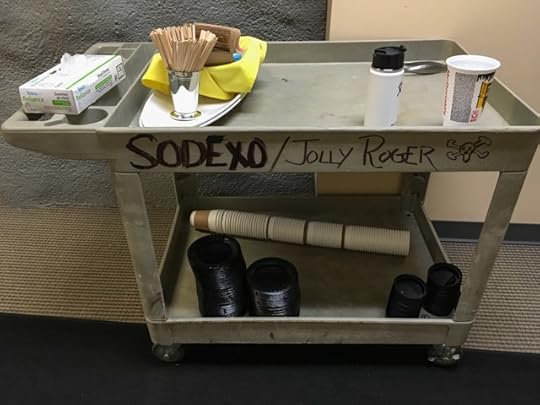
Apparently, the facilities staff who had set up the rooms for the conference had laid out the tables, and they weren’t aware of the zero waste focus of the event. So there’s a lesson for the future: If you are planning a zero waste event, make sure to ask who will be setting up the rooms. Will it be the people you are emailing, or will they delegate setup to someone in a related department?
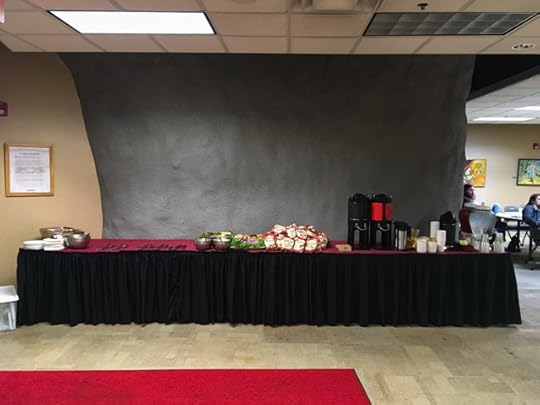
Here’s a very wide view of what the breakfast table looked like after the food had been set out. Plates and napkins flank the platters containing (yummy) pastries. Hot cups and lids are stacked to the left of the coffeepots, and clear cold cups are set out to the left of the water dispenser on the right side of the table.
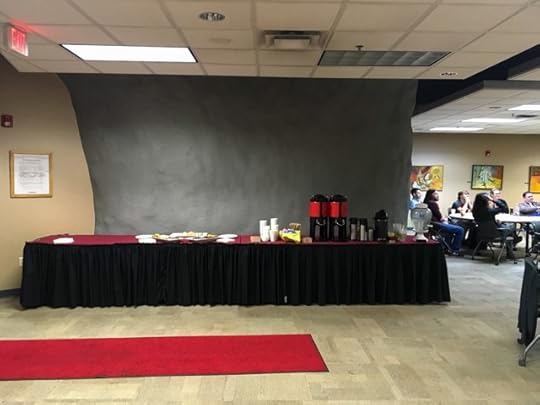
Both types of cups were Repurpose brand, and the plates (Natural Value) and napkins (365 brand from Whole Foods) were made from recycled paper not bleached with chlorine. When I was searching for a place that would take a small load of compostables, I was told that paper plates break down better in compost piles than plates made from starchy plants. So I went with paper.
Before the conference started, we set up a makeshift “materials processing” area by the door. We chose the trash can with a plastic bag for the compostables, because the food waste, including coffee cups, would mess up the carpet beneath the blue recycling bin (which has holes in the bottom).
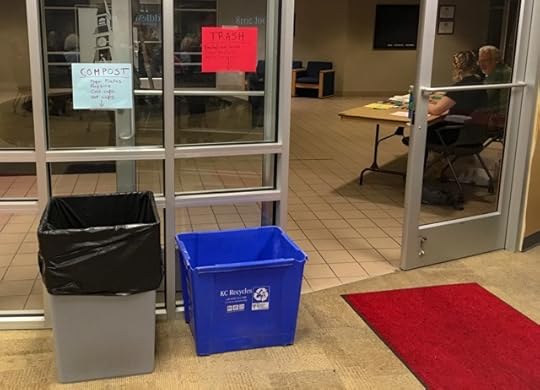
As the day went on, we added to the list of items that had to be thrown away.
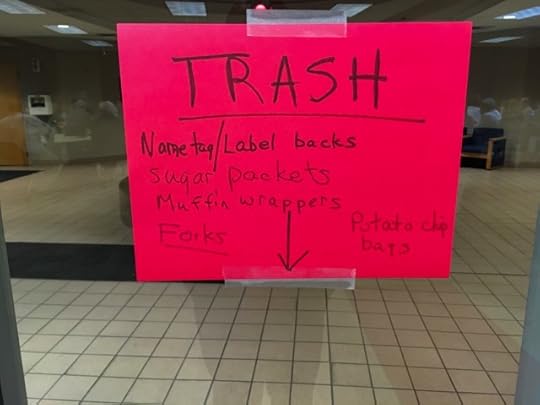
People at MiddleMoot did very well at following the directions on the signs. Believe me when I say I’ve attended many events with much more elegant composting/recycling/trash setups that people didn’t even look at.
Lunch was more complicated, since it included salad, sandwiches that still needed condiments, and potato chips. On the far left below, the plates and napkins we provided can be seen in front of metal bowls of salad and dressing. Moving right in the picture, the staff laid out metal tongs for picking up the sandwiches that would shortly be arriving, as well as metal bowls of mayo and other condiments; a platter with lettuce, onion, tomatoes, and pickles; and bags of potato chips. To make room for all that, we moved the hot cups to the other side of the coffee dispensers.
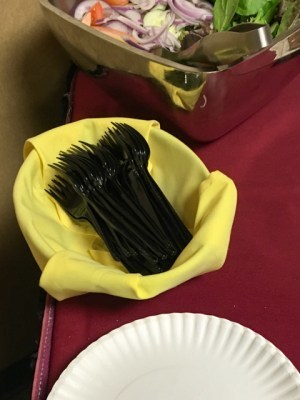
Unfortunately, the flatware provided for the salad was plastic. I ended up fishing it out of the trash bin, taking it home, and washing it. So now I have a lot of black plastic forks. Some Whole Foods locations recycle the plastic flatware they offer in their dining areas, but I don’t think they’d want these forks because of the color. I will have to check at a local store. (My housemate said she sometimes bundles plastic utensils and take them to a thrift store, or uses them at an event she’s organizing.)
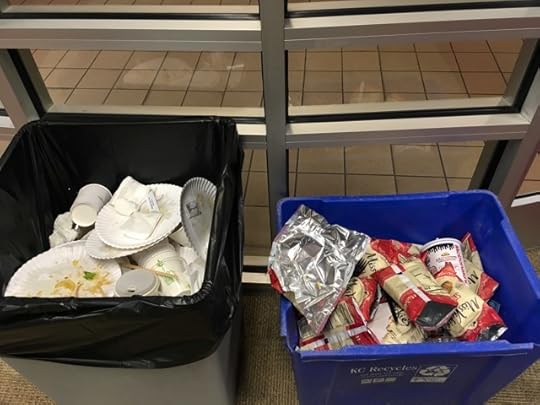
Here’s how the materials processing facility looked at the end of the conference. I confess I did a lot of dumpster diving throughout the day, as surreptitiously as I could, to make sure discards were in the proper bin. I didn’t mind, though; I often have to restrain myself from plucking recyclables out of trash cans, so this conference gave me a chance to indulge for a good cause.
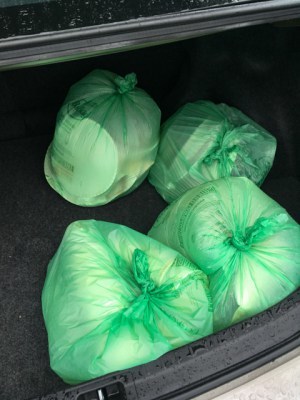
And here are the compostables from the conference, all collected in biodegradable bags and ready to go to the Missouri Organics compost bin at a business I patronize. (Yes, I did get permission before I dropped off those four bags. And no, individuals can’t just show up at Missouri Organics with compostable plates. MO picks up from businesses and organizations only. But individuals can take compostables to Urbavore Urban Farm.)
At the beginning of this post, I said I was fortunate to be encouraged to make this a zero waste event. I’m grateful to Robbie for being so receptive to the idea and working with catering to make it happen. Usually, the response to a request to reduce waste at an event is something like, “Well…” And with good reason. Because American society is accustomed to using disposable plates, cups, and flatware at events, any movement toward zero waste seems like a pain in the neck. For zero waste to work on a large scale, to the point at which it is convenient, companies and schools must incorporate into their goals and planning from the beginning.
On a related note, does anyone need two dozen lids for hot cups? For some reason I ended up with a lot of lids.
***
Featured image: Dr. Corey Olsen, the president of Signum University and one of the leading forces behind the Mythgard Institute, gives his keynote address at MiddleMoot 2018.
August 21, 2018
Shorelines: An Introduction
Edges have always compelled me to go and stand on them, even if they scare me. My favorite word is liminal (on the threshold, intermediate, transitional).
One question I’ve been asking myself lately is, Does a shoreline have to be a place of sand or mud, that is, where water meets land?
So what did I do? I went down to the river, but I had a hard time getting to the water from the River Market.
I think the picture below (looking west, toward the confluence of the Kaw/Kansas and Missouri Rivers) shows shorelines, but they have been constructed by humans. Or does it show mere edges? I guess I’ve always assumed shorelines were natural.
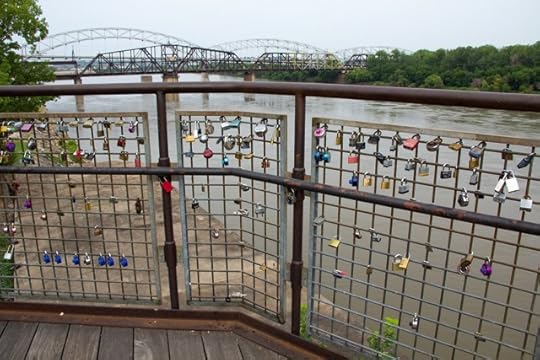
Here’s a way to get to the water.
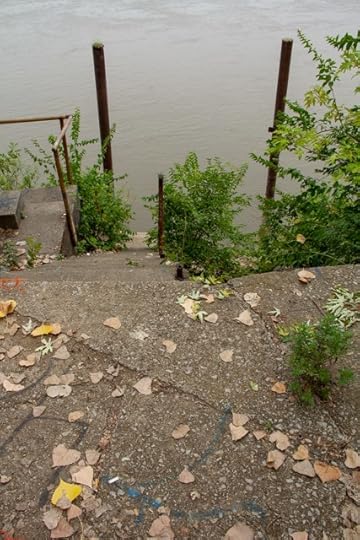
But as you can see, the only way to get to the other side is by swimming, and the orange netting means this stairway was meant to be blocked.

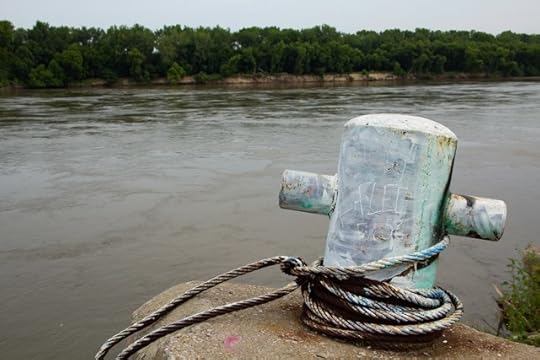
I’ve been in Kansas City for two and a half years now, and lately I’ve been feeling restricted. Maybe I need to follow the advice on this hitching post.
If you’d like to see a few more of my images, please go to Society 6 or to Fine Art America.
July 20, 2018
Boulder Changes, or, DSLR Girl
Boulder, Colorado, can be a delightful place to live—if you just moved there with buckets of money, or if you relocated years ago when housing prices were more reasonable. This month I visited Colorado after more than a year away and was lucky enough to stay with friends who live just off the West End of the Pearl Street Mall.
One day I walked down to the East End of the mall and back to see if any shops or restaurants remained from my graduate school days in the late 1980s. I found a few, including the featured photo of Tom’s Tavern, now reimagined as Salt. I’ve been to Salt and liked the food, but I can’t help feeling nostalgic about the vinyl booths, square hamburgers, and scoops of macaroni salad of Tom’s Tavern. If I had a Tardis, I would definitely go back there.
Click to view slideshow.
I ran into my old friend the Boulder Bookstore, where I bought some Neuhaus chocolate and picked up a few extra bookmarks. I still have a plastic bag from the Boulder Bookstore that I cherish. When I saw the “For Lease” sign in the window, I panicked, thinking that the bookstore had done a Tattered Cover and gotten rid of its upper floors. But I went up the stairs and found everything as it used to be—the windows of the “in-between” floor look out on 11th Street, not on the mall.
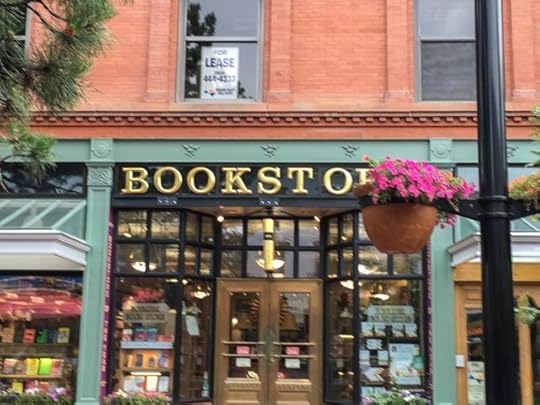
I took all these pictures on my cell phone, and as I was editing them I realized some were truly bad. For some reason all the pictures I took of bookstore exteriors were blurry. The interiors turned out better.
Click to view slideshow.
That got me thinking that I’ve never striven for excellence in my cell phone pictures. It’s too basic for excellence—I use it to capture something for FB that I will never think about again or record something as a reminder. The only cell phone pictures that I try to make interesting are food pictures.
When I shoot with my DSLR, I pay attention to the lighting and check the corners for any distracting elements. I work at getting a good composition. But cell phone photography is so easy that I seldom think about making my pictures excellent—or even a little better.
I did get a couple of apps to diversify my cell phone photography. Here’s a Hipstamatic picture of Rocky Mountain National Park.
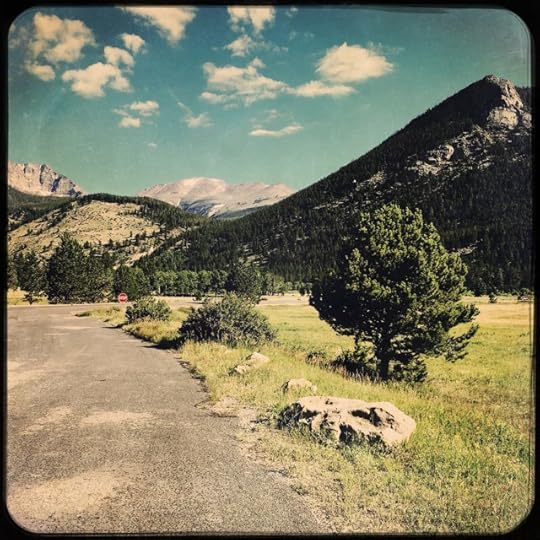
Which establishments do you remember fondly from the Pearl Street Mall of the 1980s and 1990s?
June 5, 2018
Imaging India
India was a place I’d wanted to visit since I was in my twenties, and when I finally arrived at age fifty-three I had a difficult time getting used to it.
Almost all the public spaces I passed through in northern India (the Golden Triangle, plus Amritsar, Chandigarh, and Rishikesh) were 90 percent male. Or more. The featured image for this post shows that.
For the first two weeks I felt profoundly uncomfortable, and then I relaxed somewhat. Compounding the problem was the fact that I love to walk around by myself, but people in India generally go down the street with others. Men, women—they were almost always in company.
I don’t think my then-husband truly understood how it felt. How could he? All the men, and boys, addressed themselves first to him and ignored me. (I don’t know if it was out of “politeness” to him or to me, or if it was their sexism that made them ignore me.) Men on the street would strike up conversations with him. I had to interrupt to be “included” in those conversations.
But I captured other scenes that may bely this conclusion: this young man selling bel puri, a popular, crunchy street snack. I don’t recall, one and a half years later, if any of the snack vendors were female.
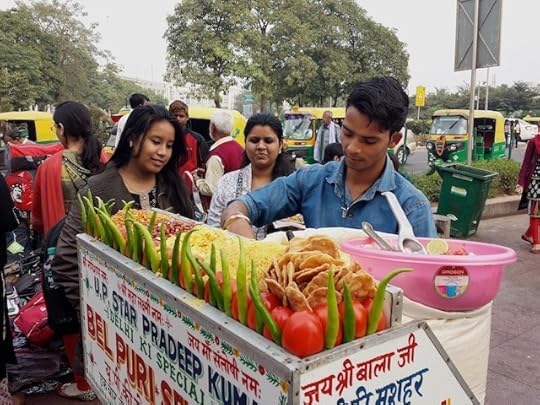
Most of my images from India show streetscapes (one of my favorite things to photograph), monuments, or items from daily life. I’m shy about photographing people on the street, though I’d like to overcome that.
If you’d like to see a few more of my images, please go to Society 6 or to Fine Art America, which is more landscape-oriented.
March 18, 2018
What’s Missing
Today was a long day. I woke up and thought, as usual, that I really must buy some cereal.
—Senior year journal, Georgetown University, 1984;
photograph from Epiphyte B&B, Cow Bay, Australia, 2015
January 8, 2018
Hillary, Keep Talking and Doing
I bought What Happened by Hillary Rodham Clinton right after it came out, but I didn’t read it until the end of 2017. It seemed like a fitting way to evaluate 2017 and usher in 2018, I guess.
But most of all, I put off reading the book because I knew it would remind me of all the momentum we lost when the election was stolen from her by James Comey’s obsession with her emails, and voter suppression in several states.
For example, momentum for the feminist movement:
I was born when everything was changing for women. Families were changing. Jobs were changing. Laws were changing. Views about women that had governed our lives for millennia were changing—finally! I came along at just the right moment, like a surfer catching the perfect wave.
Or women’s ability to control what happens to their bodies:
I believe that our ability to decide whether and when to become mothers is intrinsic to our liberty.
Or appreciation of women’s strength (about her mother Dorothy):
I marveled at the mental strength it must have taken to keep believing that a better day was coming, that she would find her place, that hard work would see her through, that her life had meaning despite how unfair fate had been to her.
Will we ever have a real accounting of the ridiculous focus on her emails?
Heading: “There is no question that former Secretary Clinton had authority to delete personal emails without agency supervision.”
—Department of Justice court filing, September 2015
…
A few months later, during the fall of 2014, the State Department, in an attempt to complete its record keeping, sent a letter to each of the four previous Secretaries of State—me, Condoleezza Rice, Colin Powell, and Madeleine Albright—for copies of all work emails we might still have in our possession. None of the other Secretaries produced anything. Nothing about weapons of mass destruction and the deliberations that led up to the Iraq War. Nothing about the fallout over the mistreatment of the detainees at Abu Ghraib prison or the use of torture. Nothing at all. Madeleine said she never used email at the State Department. Neither did Condi, although senior aides of hers used personal email accounts. Powell said he didn’t keep any of his emails. [Maybe we should ask the Russians to find Colin Powell’s missing emails?]
I directed my attorneys to collect and provide to the department any messages I had that could conceivably be considered related to official business. That came to more than 30,000 emails. … Another 31,000 of the emails I had were personal and not related in any way to my job as Secretary of State. I got a lot of grief for saying they were about yoga sessions and wedding planning. But these messages also included communications with lawyers and doctors, information about my mother’s estate, reports from family and friends about things happening in their personal lives, both happy and sad—in short, clearly private personal content.
After all that, I admire her ability to pick herself up and carry on:
I can carry around my bitterness forever, or I can open my heart once more to love and kindness. That’s the path I choose.
It meant the world to me to vote for her.
March 29, 2017
My Resolve to Avoid Plastic—and How I Sometimes Choose to Fail
Recently I bought a facial cleanser in plastic packaging. I didn’t want the packaging, but I did want the exfoliating cleanser.
I had been using a bamboo washcloth to clean and exfoliate my face in the mornings, but my skin was looking rather dry, and I worried that by scrubbing my face, I was further damaging my already-stretched-out middle-aged skin.
So I bought the Aveda product again. I really can’t stand this kind of crimped packaging (and its sharp edges!), but this product has worked well for me, and I know I can take it to the Aveda store to recycle it.
For the next few weeks I’ll be obsessively examining my nose and cheeks to see if the cleanser is REALLY doing a better job than the bamboo washcloth (which I will relegate to scrubbing my calves).
I suspect it doesn’t really matter which one I use, and that if I want to dramatically improve the look of my skin, I need to do chemical peels or microdermabrasion or laser treatment.
Lighten Up, Perhaps?
I still feel guilty and want to explain all the things I do to reduce plastic use: carry utensils and a water bottle and cloth bags with me, buy clothes and furniture second-hand.
But still, I’m no Beth Terry (see My Plastic-Free Life for hard-core tips on eliminating almost all plastic use).
Plastic Smog
Why do I write about this? Because there is a lot of trash on the streets of Kansas City, and when it washes into the storm drains, it ends up in the Missouri River, which flows into the Mississippi River, which flows into the Gulf of Mexico. Our oceans are filling up with trash that breaks down into “plastic smog” and drifts down from the surface to the depths. So I try to minimize my contribution to that trash flow.
March 8, 2017
Why You Don’t Need to Own a Car in Kansas City
Last year I moved back here after living in Colorado for thirty years. One day I was standing at an intersection on the east side of town. A man across the street in a large vehicle yelled, “Do you want a ride?”
That made me angry, so I marched over there and told him not to yell at women on the street. We got into an argument. (Going up to him like that was not my smartest move ever.) The argument ended when he said, “You’re an asshole because you’re on foot!” Then he drove off.
The Typical Kansas City Attitude
There’s no doubt Kansas City is a car-oriented city. People here wonder about you if you don’t have a car, and they’re always wanting to give you rides. For all I know, that man was genuinely trying to help, but I would never accept a ride from a man I didn’t know—though I did once take a ride from a woman who was a complete stranger. She saw me chasing a bus, picked me up, and drove me to the bus stop ahead of the bus. It was awesome.
Kansas Citians can be so nice.
But if you’re not part of their car culture, you may sometimes feel like a ghost. Or like someone who has failed at adulting. Or like a weirdo.
Don’t worry!
Things Are Changing in KC
You can take a bus from downtown to the airport (the 129—see the picture above).
On weekdays, buses run every 10 to 15 minutes on Main Street and Troost and across town on 31st and 39th.
ZipCar is expanding. Uber is here, and Lyft is in Kansas (KCK), waiting to cross to the Missouri side when they work things out with KCMO. And there is a streetcar that runs from River Market to Union Station—a whole 2 miles!
Okay, KC has a long way to go to rival Denver’s public transit. But if you live (and work!) in the neighborhoods running south from River Market to the Plaza, you can get along fine. You could even live in Waldo, which has a library, places to work out, Aldi’s, and more and more cool restaurants.
Last spring I read an article in one of the newsweeklies about a man who lives around 31st on the west side: he walks everywhere or takes Uber. Downtown’s apartment boom is attracting people who want to drive as little as possible, or not even own a car.
The key, really, is where you work. When I lived in KC in 1986, I lived waaaay out south (but still on the Missouri side) and worked near Crown Center. That was an hour-long commute by bus (which I did for a while) and at least half an hour by car (after one of my co-workers started picking me up). It was not fun.
But now I work at home. I could live anywhere in KC within walking distance of a grocery store, gym, library, and coffee shop. Or even within an easy bus commute (say, up to 15 minutes).
The Most Walkable and Transit-Oriented Neighborhoods in KCMO
Downtown, Crossroads, and Westport, definitely. In Westport, there are four weekday buses that can take me downtown, three buses that can take me east to Troost and one that can take me west to State Line, and several that can take me south. One bus (the 47) will take me to Royals Stadium. And those are the buses within easy walking distance.
In downtown, the 71 and 108 go to the east side of town, and many buses go south and even out to Kansas or Independence.
River Market has fewer options, though you can still take the Main Max, the 85, and the streetcar to points south.
When in Need, Rent a Car
For those times when you need to run a slew of errands, get the weekend special at Enterprise, which is the car rental company I use, or rent a car by the day or by the hour from Enterprise or ZipCar.
Without a car, you’ll get to know your city and its denizens better—because you have to walk down the street or sit next to people on the bus. Sometimes that is really fun—and sometimes, especially for women, it isn’t. The biggest problem, for me, is walking west along 39th Street from Main to Southwest Trafficway, but I’ve learned that I have fewer unpleasant encounters if I walk along the north side of 39th.
So go down to the street all alone—and get started.

