September Williams's Blog
May 29, 2023
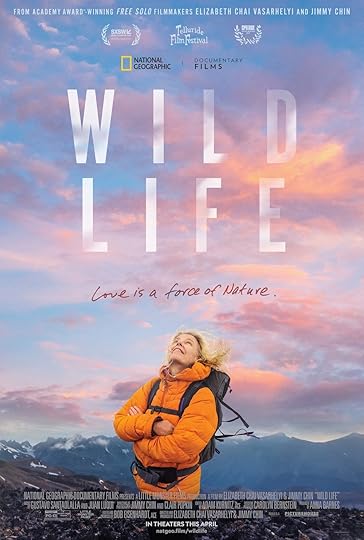
WILD LIFE Meets Love as a Force of Nature April 27, 2023
Film Review by September Williams /Bioethics Screen Reflections
WILD LIFE is a documentary by Oscar® winning filmmakers Elizabeth Chai Vasarhelyi and Jimmy Chin. It shows the rigors, pitfalls, and love required to protect and preserve what is the best of nature. A National Geographic Documentary, WILD LIFE opened in the USA in April of 2023 .
WILD LIFE is also a Bioethics Film for many reasons. Among those is the setting, i.e. the geography. Both Chile and neighboring Argentina lay claim to the region of Patagonia. Patagonia holds some of the world’s regions untouched by humans.
The back story of WILD LIFE is, Chile and Argentina are nations’ whose economies are tightly linked to mineral extraction and forest wood exports. As it happens, the same geographical region is also important for providing a significant portion of the earth’s atmospheric oxygen through tree and plant photosynthesis full September Williams full review click— here .


February 1, 2023
Paula Farmer's Annual Race in America Series At Book Passage, Marin
Join Us - - in Person or on the Book Passage Website

Paula Farmer is force of nature. Looking for a guide to reading and watching relevant new literature. Paula Farmer is a one stop shopping on paper, brick and mortar book store (Book Passage Marin), film commentary, regular Instagram shows with noted Authors and Activist in their films. And I’m not biased because she supports all of my creative work — but cause she’s really good at what she does.
I’ll be there virtually — join us— 3 Days of RACE IN AMERICA She has for several years done a major review of new books and dialog —with authors and readers, live or online. This includes a number of pop up type Instagram shows monthly — you can join in person , or often the chats available after online on the Book Passage website. This is already one of hardest few months of violence in my lived history related to race and class… and its only January. You don’t wanna go there? It means you really should Join us.
Paula Farmers Annual Race in America Series At Book Passage, Marin
Join Us - - in Person or on the Book Passage Website
Paula Farmer is force of nature. Looking for a guide to reading and watching relevant new literature. Paula Farmer is a one stop shopping on paper, brick and mortar book store (Book Passage Marin), film commentary, regular Instagram shows with noted Authors and Activist in their films. And I’m not biased because she supports all of my creative work — but cause she’s really good at what she does.
I’ll be there virtually — join us— 3 Days of RACE IN AMERICA She has for several years done a major review of new books and dialog —with authors and readers, live or online. This includes a number of pop up type Instagram shows monthly — you can join in person , or often the chats available after online on the Book Passage website. This is already one of hardest few months of violence in my lived history related to race and class… and its only January. You don’t wanna go there? It means you really should Join us.
January 28, 2023
LIVING (2022) A Film by Director Oliver HERMANUS
Bioethics, Alienation, and Leveling the Playing Field Film Review by September Williams MD-Writer Bioethics Screen Reflections
LIVING is an example of why brick and mortar movie theaters shall not parish from the Earth. South African Born Director Oliver Hermanus' LIVING (2022), is an exquisite feature film. It gives us another view of the coexistence of classic bioethical principles in a state of tension.
The reader should know there is no pretense of impartiality by this film reviewer. I don’t have time to review films I dislike, nor those I am disinterested in understanding. That is someone else’s job. My want is that the reader should grab a mask, check you are fully up to date with your Covid and Flu vaccines, and maybe find a baby sitter. Next, you should buy tickets for a brick and mortar theater screening with a very high ceiling and good ventilation. All this because, LIVING is a film born to be viewed on the biggest, boldest, quality screens, and heard through the best sound systems.
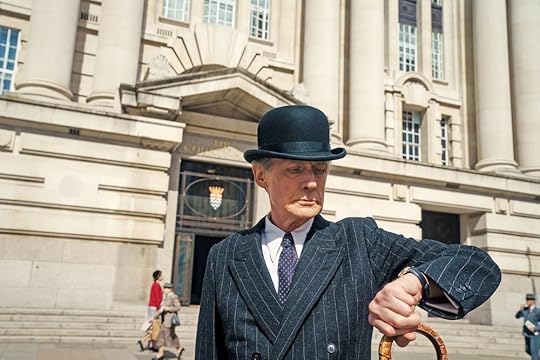
LIVING’s main character, is portrayed by Bill Nightly. His performance in symbiosis with South African born Director Hermanus, draws every ounce of blood out of the character that is Mr. Williams. These moments on screen will be noted as not just outstanding in both of their careers but perhaps in this century. We learn to see a world through Williams’ psyche as he attempts an escape from one life to another. The place is England, less than a decade since the Blitz and the mass civilian death tolls of civilians on English soil during World War II. Yet, the trains are running on time again.
The opening images are London, circa 1950. Like the tint of a good set of name brand sunglasses, everything is wrapped in a soft sepia— protecting the beauty of the morning from the disturbance of glare. It is an idyllic cinematography that releases us from reality. An astounding classical score floats our souls. We want to be with the characters on that train leaving a station en route to London. Perhaps we fantasize riding on the roof then leaping up to kiss a steeple.
That morning, as many others before, a group of young men board the train together. Sitting in facing seats, they talk as would a gaggle of goslings. The train platform and cars are a sea of the Bowler hats. It’s the head wear associated with the British civil service since the nineteenth century. The newly minted young workers banter is playful and gossip riddled.An older drawn man, in his Bowler hat enters the gosling’s car. He moves deliberately through them down the aisle. A new inductees to the civil service “goslings” kindly but naively clears a nearby seat for the elder gentleman senior colleague whom they (and we) may come to know as Mr. Williams. With nary an acknowledgment of the potential kindness, the sallow, past middle age, civil servant that is Williams walks through to the adjacent car. The other members of the gaggle of goslings know that man would never sit with them
So it is, we initially meet Bill Nightly as Mr. Williams an aging, worse for the wear civil servant. On that train, we do not know yet that that Mr. Williams is in an arena adjacent to ITS A WONDERFUL LIFE (1947) or DARK VICTORY (1939). We certainly don’t know that Mr. Williams— born from the mind of Nobel Literary Laureate Kazuo Ishiguro, exist in homage to the 1952 Japanese film Ikiru directed by Akira Kurosawa. Though, the work might quickly recall a collegiate term paper I wrote inspired by the 1886 Russian novella The Death of Ivan Ilyich by Leo Tolstoy, whom writer Ishiguro also acknowledges. It could be easily argued that the main characters in LIVING are more related as third cousins once removed than they are literary sibling twins.Apparently, they live in a house passed down through generations.
We know nothing of Mr.Williams before the day we met him on the train except— his speach is nearly monosyllabic and his face inanimate. His character note from first flash on the screen is Alienation, ie. a stunned sense of detachment from his own needs— never mind those of others. Alienation is notably a common phenomenon now recognized in combat veterans and others with post traumatic stress disorder. Well, the place of LIVING is London, a decade past WWII. Mr. Williams has lived through. He likely has survived the Blitz —up until now. Yet, His wife has died. His son and daughter in-law live in his house. His son’s wife seems to be waiting for the elder man to die as well.This though she is oblivious to that actual possibility.
Mr. Williams’ character arc starts with his inability to receive, perceive, or disseminate goodness.He is apparently a dead man walking, insensate and disconnected. So stilted is Williams that he doesn’t even have a first name. Often, screen works aim at the low hanging fruit of a subset of Bioethics— Clinical Medical Ethics. This subset relies on the trappings of the clinical arena—hospitals, ERs, surgical suites, morgues, even autopsy slabs—think Ben Casey through the most recent addition to the Good Doctor.
The film LIVING dares to go where clinicians are loathe to tread. Instead of staying in the clinical lanes, of beneficence (doing good with medicine) and autonomy (doing what is in a persons own best self interest )—this film wades into the deep muck of justice. It’s a principle that can rarely be actualized in a hospital— but rather in the street. In fact, any clinical medical data in LIVING is dismissed in less than three minutes and two shots in the whole film. None of those minutes occur in a hospital but only in Mr. Williams’ head.
Though it is a long journey in LIVING, our protagonist Mr. Williams is able to recognize that others are playing their game of life on an uneven field. It is a field scarred by ruts and war debris—much as is his character. He is handicapped by emotional and physical circumstances. Escaping the monster of a life of hard earned alienation—leaves Williams’ trying to level the playing field through justice. That would be justice for himself and others for whom he has learned to care. In that turn, this film eschews the pedantic medical ethics storylines, set in medical environments with attendant props and costumes.
Mr. Williams’ character arc recognizes his need to act beneficently by doing good for those in need. Finally, he embraces, autonomy by defining what his own interests actually are. LIVING is a candidate for the pantheon of Bioethics Films but it deals with the field’s common themes and principles in an entirely new way.
Director Oliver Hermanus' handling of the pivotal relationship between actor Bill Nightly, —Mr. Williams,— and the character Miss Margret Aimee Lou Wood is significant. It breaks away from any cliches and introduces a unique relationship between a young woman and an older man than seen on film of recent. In the end, Ishiguro’s script, and the Hermanus have made a truly unique film. That is, the climax of the effort lay in Ms. Margret and the mothers of children become the primary turnkeys for change in the main character.They made Mr. Williams a star.
As with any film, LIVING’s life blood is the matching of extraordinary actors and their director, with engaged film professionals working as a team. Living has very rich blood.
Bioethics Screen Reflections and September Williams, MD-Writer, acknowledges and thanks Larsen Associates for their continuing access to Independent Films, filmmaker interviews, screenings and background materials, including permission to use photographs of films including LIVING.
LIVING (2022) A FILM BY OLIVER Hermanus
LIVING (2022) A Film by Director Oliver Hermanus Bioethics, Alienation, and Leveling the Playing Field A Bioethics Screen Reflections Film Review by September Williams MD-Writer
LIVING (2022) A Film by Director Oliver Hermanus
Bioethics, Alienation, and Leveling the Playing Fielby September Williams, MD -/ Bioethics Screen Reflections January 27, 2023
LIVING is an example of why brick and mortar movie theaters shall not parish from the Earth. South African Born Director Oliver Hermanus' LIVING (2022), is an exquisite feature film. It gives us another view of the coexistence of classic bioethical principles in a state of tension.
The reader should know there is no pretense of impartiality by this film reviewer. I don’t have time to review films I dislike, nor those I am disinterested in understanding. That is someone else’s job. My want is that the reader should grab a mask, check you are fully up to date with your Covid and Flu vaccines, and maybe find a baby sitter. Next, you should buy tickets for a brick and mortar theater screening with a very high ceiling and good ventilation. All this because, LIVING is a film born to be viewed on the biggest, boldest, quality screens, and heard through the best sound systems.
LIVING’s main character, is portrayed by Bill Nightly. His performance in symbiosis with South African born Director Hermanus, draws every ounce of blood out of the character that is Mr. Williams. These moments on screen will be noted as not just outstanding in both of their careers but perhaps in this century. We learn to see a world through Williams’ psyche as he attempts an escape from one life to another. The place is England, less than a decade since the Blitz and the mass death tolls of civilians on English soil during World War II. Yet, the trains are running on time again.
The opening images are London, circa 1950. Like the tint of a good set of name brand sunglasses, everything is wrapped in a soft sepia— protecting the beauty of the morning from the disturbance of glare. It is an idyllic cinematography that releases us from reality. An astounding classical score floats our souls. We want to be with the characters on that train leaving a station en route to London. Perhaps we fantasize riding on the roof then leaping up to kiss a steeple.
That morning, as many others before, a group of young men board the train together. Sitting in facing seats, they talk as would a gaggle of goslings. The train platform and cars are a sea of the Bowler hats— the head wear associated with the British civil service since the nineteenth century. The newly minted young workers banter is playful and gossip riddled.
An older drawn man in his Bowler hat enters the gosling’s car. He moves deliberately through them down the aisle. A new inductee to the civil service “goslings” kindly but naively clears a nearby seat for the elder gentleman/senior colleague whom they (and we) will come to know as Mr. Williams. With nary an acknowledgment of the potential kindness, the sallow, past middle age, civil servant that is Williams walks through to the adjacent car. The other members of the gaggle of goslings know that man would never sit with them.
So it is, we initially meet Bill Nightly as Mr. Williams an aging, worse for the wear civil servant. On that train, we do not know yet that that Mr. Williams is in an arena adjacent to ITS A WONDERFUL LIFE (1947) or DARK VICTORY (1939). Nor do we know that Mr. Williams—born from the mind of Nobel Literary Laureate Kazuo Ishiguro— exist in homage to the 1952 Japanese film Ikiru directed by Akira Kurosawa. Though, the work quickly recalled a collegiate term paper I wrote inspired by the1886 Russian novella The Death of Ivan Ilyich by Leo Tolstoy,whom the screenwriter also acknowledges. It could be easily argued that the main characters in LIVING are more related as third cousins— once removed— than they are literary sibling twins. Apparently, they live in a house passed down through generations.
We know nothing of Mr.Williams before the day we met him on the train. But we quickly learn his speech is nearly monosyllabic and his face inanimate. His character note from first flash on the screen is Alienation, ie. a stunned sense of detachment from his own needs— never mind those of others. Alienation is notably a common phenomenon now recognized in combat veterans and others with post traumatic stress disorder. Well, the place of LIVING is London, a decade past WWII. A war that Mr. Williams has lived through until now. Yet, his wife has died. His son and daughter in-law live in his house. His son’s wife seems to be waiting for the elder man to die as well.This though she is oblivious to that actual possibility.
Mr. Williams’ character arc starts with his inability to receive, perceive, or disseminate goodness. He is apparently a dead man walking, insensate and disconnected. So stilted is Williams that he doesn’t even have a first name. Often, screen works aim at the low hanging fruit of a subset of Bioethics— Clinical Medical Ethics. This subset relies on the trappings of the clinical arena—hospitals, ERs, surgical suites, morgues, even autopsy slabs—think Ben Casey through to the most recent addition to the genre, the Good Doctor.
The film LIVING dares to go where clinicians are loathe to tread. Instead of staying in the clinical lanes, of beneficence (doing good with medicine) and autonomy (doing what is in a patients own best self interest )—this film wades into the deep muck of justice. The latter is a principle that can rarely be actualized in a hospital— but rather in the street. In fact, any clinical medical data in LIVING is dismissed in less than three minutes and two shots in the whole film. None of those minutes occur in a hospital but only in Mr. Williams’ head.
Though it is a long journey in LIVING, our protagonist Mr. Williams is able to recognize that others are playing their game of life on an uneven field. It is a field scarred by ruts and war debris—much as is his character. He is handicapped by emotional and physical circumstances. Escaping the monster of a life of hard earned alienation—leaves Williams’ trying to level the playing field through justice. That would be justice for himself and others for whom he has learned to care. In that turn, this film eschews the pedantic medical ethics storylines, set in medical environments with attendant props and costumes.
Mr. Williams’ character arc recognizes his need to act beneficently by doing good for those also in need. Finally, he embraces autonomy by defining what his own interests actually are. LIVING is a candidate for the pantheon of Bioethics Films but it deals with the field’s common themes and principles in an entirely new way.
Director Oliver Hermanus' handling of the pivotal relationship between actor Bill Nightly, —Mr. Williams,— and the character Miss Margret, Aimee Lou Wood is significant. It breaks away from any cliches and introduces a unique relationship between a young woman and an older man than seen on film of recent. In the end, Ishiguro’s script, and Hermanus have made a truly unique film. That is the climax of the effort lay in Ms. Margret, and the mothers of children, becoming the primary turnkeys for change in the main character. They made Mr. Williams a star.
As with any film, LIVING’s life blood is the matching of extraordinary actors and their director, with engaged film professionals working as a team. LIVING has very rich blood.
***
Bioethics Screen Reflections and September Williams, MD-Writer, acknowledges and thanks Larsen Associates for their continuing access to filmmakers, interviews, screenings and background materials related to independent and timely independent films— for Bioethics Screen Reflections and for the audiences whose world views are confirmed or changed by seeing those films Larsen Associates bring to our consciousness. LIVING is one of many of those screen works. (Below are the opening dates for LIVING in the San Francisco Bay Area and the film is still running in theaters at the time of review.)
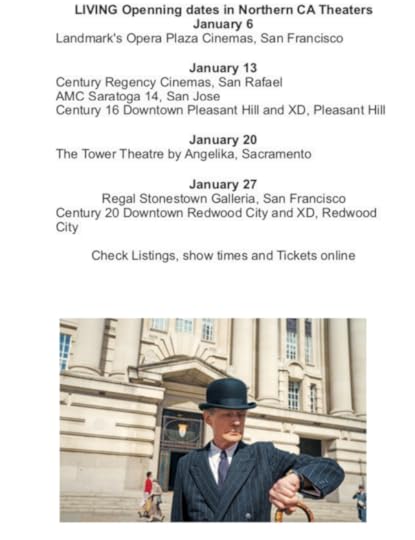
Bill Nightly as Mr. Williams in the film LIVING (Courtesy of Larson Associates
October 21, 2022
AN ACT OF UNITY by Cedric O'Bannon at SF International New Concept Film Festival

FOR IMMEDIATE RELEASE: AN ACT OF UNITY AT San Francisco New Concept Film Festival
AN ACT OF UNITY (AAOU) is a Flash Documentary by African American Director Cedric O’Bannon, Video Journalist and Media Consultant, Cedric O’Bannon with co-producer writer September Williams. Both filmmakers are NWU and IFJ members. The film was selected by the San Francisco International New Concept Film Festival. The festival runs Thursday, October 27 through Sunday, October 30, 2022.
The last day of the festival includes a Red Carpet, the awarded films will be revealed and screened in their different categories. AN ACT OF UNITY trailer is already on the festival website in the “short documentary” section. Over the past year AN ACT OF UNITY has been recognized in festivals in Singapore, India, Canada, and now in the filmmakers home region the USA, San Francisco Bay area. The location of the screenings is the Herbst Theater/War Memorial at the San Francisco Civic Center.
AN ACT OF UNITY shows demonstrators memorializing Micheal Brown’s life by protesting against police killings of specifically unarmed Black people, unarmed poor people, and any other unarmed people in the USA. The film focuses on the Demonstration that occurred at Oakland’s Ronald V. Dellums Federal Building in Oakland, CA in 2015. Part of Micheal Brown’s legacy is that because of him now death by fire arms including fatal police shootings are being studied by race, ethnicity, wealth disparities and access to guns. Numbers don’t lie only people do.
Filmmaker and video journalist Cedric O’Bannon, realized that he was still holding in his archives video footage of the aforementioned demonstration. It did not escape him that mainstream media rarely shows different peoples of color supporting the dignity of others. AN ACT OF UNITY shows that in Oakland it can, does, and did. Eight years later O’Bannon’s footage and film is still and even more relevant.
Please join the Filmmakers of AN ACT OF UNITY at the San Francisco New Concept Film Festival—and plan to support them in the future. (By the way the “new concept” is that the festival is more than just films with new concepts.) This is the 9th year of this festival. Tickets available for 10/30/22 Awards ceremony which includes winning films screening. Wish us luck! Check the festival website for the Trailer of AN ACT OF UNITY.
December 29, 2021
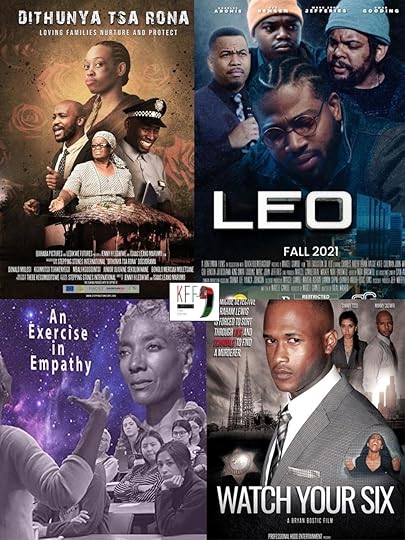
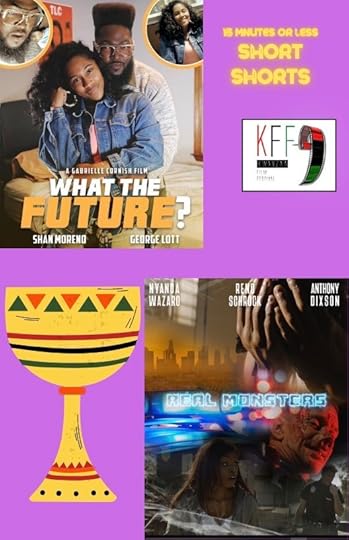
12/29/2021 5PM PST/8PM EST: Cedric O'Bannon's An EXERCISE IN EMPATHY at Kwanzaa Film Festival, Harlem
Since I Know you want to go to the Kwanza Film Festival Page, Browse and like it. It’s also were you will find information about workshops and other activities and screenings. https://www.facebook.com/KwanzaaFilmFest — All the best for the season!

[image error]







November 16, 2021
NATIVE HERITAGE MONTH COMMEMORATION@Book Passage/Thurs 11/18/2021, 5:30PM
Thurs, November 18th • 5:30pm PT • Live •
Online https://www.bookpassage.com/event/spe...
Featuring Calvin Crosby, Denise Low, Georgina Marie, Kim Shuck, Martin Smith & David Weiden - Read the comparative writings at the website as well as hearing the authors present. See you there.

Featuring Calvin Crosby, Denise Low, Georgina Marie, Kim Shuck, Martin Smith & David Weiden
Moderated by (the inimitable )Paula Farmer!
September 8, 2021
September Williams, MD-Writer Talks Film at Stanford Center for Biomedical Ethics
So — later this month, on 9/21/2021, I will talk about complex screen works, not just medical TV, where we try to make it all “real” but the producers don’t care to. What is most important in my story (to me) is that 25 years later, Dr. Franklin is still making me think about things more deeply — just as he had when I was on call in the Cook County Hospital, Chicago, ICU as a resident.
Films are made of serial photographs. However, a single shot can tell a whole story itself. I call this particluar single shot: “Permission to Breathe.” It is a sunset over Lake Merritt, Oakland. Like this photo, complex screen-works can help you go places at times when you are least likely able to do so. That tall white building with the flag pole on top, in the background, that’s the Alameda County Courthouse. It is where members of the Black Panther Party stood more than once in protest of racism and poverty. If we aided a frame of that image — we would have the beginning and ending of a complex screen narrative.
Please join us later this month while I try to explain what I’m thinking.

June 18, 2021
September Williams Reads “ A Love Letter to My Juneteenth Baby” at Book Passage
Join us this: Sat., June 19th • 4:00pm PT • Online The written works are already available on line. And each author will be reading their works on line. Featured Authors are : Kia Corthron, Julie Lythcott-Haims, Rhonda V. Magee, Jason Mott (submission read by Ernest Jolly), Zach Norris (submission read by Chris Bass), Anna Malaika Tubbs & September Williams, and Moderated by Paula Farmer (@paulawritesreviews)