Cameron Loris's Blog
July 23, 2017
Traveler in the Dark
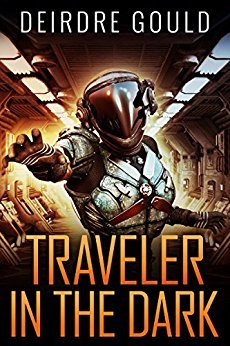 I read Deirdre Gould’s Traveler in the Dark and I’m here to announce:
I liked it.
Every character in this book has doubts about their mission. Most of them fear what will happen if they fail to find a new home for humanity. But for a few, another question is just as terrifying: what if they succeed?
The situation is dire. What remains of humanity limps through the stars in a collapsing vessel called the Keseburg. It was never meant to last this long and neither, it seems, were its inhabitants. With each successive generation in low gravity, a crippling affliction called Spindling spreads further. Every time the survivors find a potential new home, it yields nothing more than dust and rock. Until now.
A new planet is within reach. It has water. It has air. And it has life—of a sort. But as a small crew investigates the planet’s dark history, questions emerge about their own past. Will they treat this new home any better than they did Earth? How many centuries until humanity sets off again in a new Keseburg, leaving the spent planet behind in search of something else to destroy? Their answers will tear the crew apart.
“‘We’ve forgotten what makes us human. We’ve forgotten how to overcome. Whatever happens— the Keseburg needs this place, or one like it. And we need it soon.”
It’s a common theme in science fiction, but usually it arrives in hindsight, well after our characters have made a mess of things. Not here. These shockingly conscientious colonists ponder the morality of their actions before they take them. They spend far more time debating than they do pillaging, which, when you think about it, is actually pretty wild stuff.
Gould dedicates many, many pages to dialogue and deliberation, so it’s a good thing that this crew of bleeding-heart imperialists contains a number of standout characters. I wanted to see so much more of Dorothy Hackford, a geologist who suffers a complete mental breakdown because she has to go outside. This is a woman after my own heart.
But in her absence, I was grateful to follow along with the ship’s anthropologist, Rebecca Emery, as she applies her boundless empathy to the book’s moral quandaries. And then there is the brilliantly realized Issk’ath, an indigenous AI who harbors as many doubts as the settlers. Without Issk’ath, the book would be infinitely poorer.
“‘‘A season, a hundred seasons, I will still be here, unchanged. I wish to change. I wish to acquire new data.’”
Of course, there are flaws here and there. The villain has more contradictory motivations than the novel has named characters, which is to say: far too many. I couldn’t decide if she was a militant environmentalist, a doomsayer who wants humanity to go extinct with dignity, or, like poor Dorothy and I, someone who just really doesn’t like going outside. It’s all a bit muddled, and her motivations, as numerous as they are, still never manage to justify her actions.
But who cares! I certainly didn’t. I was far too busy swooning over Issk’ath, highlighting depressing quotes about the nature of humanity, and admiring the subtle worldbuilding. Even as the plot—and the body count—ratchet up, Gould never lets the focus drift from the part of her story that matters most: the doubts that make us human. Even when we’re actually a robot.
P.S. Including my notes at the bottom of a book post is something I have done a single time before. I’m pretty sure that’s the precise dictionary definition of a tradition, so here you go:

The post Traveler in the Dark appeared first on Cameron Loris.


July 15, 2017
Graphing The Downcast Wolves
I’ve long wanted to try to make a visual graph for the plot of my novel, but something else always seems to take priority. Now that the book is out, maybe it’s finally time! I’m surely not the first person to try this (as a few seconds on google confirms), but I think it’ll be more fun to figure the methodology out for myself.

I won’t argue that this is an essential—or even all that valuable—way of writing a book. Despite my computer science background, I’m not convinced that quantitative methods are always best. When it comes to a story, trust your gut over Excel. That said, I’m the kind of boring person who finds graphs entertaining, so here we are, you and I.
Arc Breakdown
We’re going to divide the plot into small arcs, parabolas whose sum should be a larger arc that spreads across the whole book. These might be something short-lived like “Harry Potter is mistreated by the Dursleys,” or longer-term like “Gollum wants to recover the ring.” Each of these arcs will be introduced, rise to its own climax, and then fall as the conflict is resolved.
At a given page, we can pick a number to represent the intensity of that arc. If you’re arcs are constructed “perfectly” (whatever that means), I imagine the graph would look something like this:

Because each arc starts before the previous one is finished, they overlap. Each plotline compounds, drawing you further into the story. You can see this in the sum line (blue), which builds until it hits the overall climax of the book and then falls.
Let’s try it out for The Downcast Wolves (mild spoilers ahead).
Graphing The Downcast Wolves
I put each arc, 22 in total, into a column and indicated the intensity value (between 0 and 1) of that plotline at the specified page. Wherever there were gaps, I filled in with a constant value (the numbers in italics).

Graphed out, it looks something like this:

Or as stacked bars:

Not bad! We’ve got a general upwards build, with a strong peak at the climax where a large number of plotlines converge. If you’ve read the book, this is when Erich and Johanna try to take Heinrich through the doorway.
But on the negative side, the graph has a trough in the middle. This lull comes as the plot is transitioning out of the first year and into the interlude with Erich in the Wehrbären. After that it picks up again, moving more briskly into the winter ball and Frau Murr’s accidental assassination attempt. Perhaps that could have been a candidate for some cuts.

If you’d like to try this on your own book, or look more at the data, you can find both the sample graph and the graph for Downcast on Google Sheets. Give it a shot and leave a comment if you do!
The post Graphing The Downcast Wolves appeared first on Cameron Loris.
July 12, 2017
What It Means When a Man Falls from the Sky
 I took Lesley Nneka Arimah’s short story collection What It Means When a Man Falls from the Sky with me on vacation a few weeks ago and:
It’s good. It’s really good.
Disappointment is everywhere in this book. You can feel it like a weight on your own back. Exasperated mothers lament the daughters God has given them. Ada is too willful, Nwando too pugilistic, Glory too unmarried. In subtle and not-so-subtle ways, they make their dissatisfaction known. One mother vents her displeasure in the way she walks, “shoes clipping her anger on the tiles.” Another packs her regrets into the pitch of her voice. “In that timbre resonated my every fuckup,” her daughter says.
These daughters have disappointments of their own too. They sag under the burden of unfair expectations. They grow up and watch childhood hurts sour into resentments. In “Second Chances,” when a mother returns from the grave exactly as she was in 1982, her daughter, Uche, is the only one not thrilled to see her. In “Windfalls,” Graceline wishes to be more than just accomplice to the con-artist who raised her.
All throughout the collection, parents and children throw the same painful shadows across each other’s lives, but Arimah tempers it all with real love and joy and yearning. The characters, though their scars feel familiar, are a varied bunch, animated by a crafty storyteller who knows how to surprise. They make mistakes. They are selfish, lazy, or spiteful and I love them for it.
“‘Who is he? Praise God! What is his name?’
‘Thomas Okongwu,’ and at Okongwu her mother started praising God again. Glory couldn’t help but laugh and felt a blush of gratitude. It had been years since any news she’d delivered over the phone had given her mother cause for joy.”
Some of the tales are wild and fantastical. The titular story sees a woman using a mathematical formula to eliminate other people’s grief like a redundant coefficient. In the inspired fable, “Who Will Greet You at Home,” a would-be mother must craft her own baby from whatever materials she can scrounge up. She hopes that Mama, a witchy hair salon owner who could give Spirited Away’s Yubaba a run for her money, will transmute it into a real child.
Others are more grounded but no less vibrant. “The Future Looks Good,” opens the book with a knife through the heart. “Buchi’s Girls” explores power dynamics by way of a beloved chicken. And best of all, “Wild” introduces us to Grace Ogige, a Nigerian socialite who does not need magic to achieve her ends. She will break you with a few words and a knowing smile. I could not get enough of her.
“Grace Ogige did some society math in her head—1 social climber + x = whose mouthy child is this—then smiled.”
The only story I found anything less than stellar is “What is a Volcano?”, an origin myth that I was probably too stupid to enjoy. I doubt you’ll have that problem nor any other problem with these stories. They are just. that. good. I cannot recommend the book enough.
Please, give it a read and let me know if you agree! And if it turns out you don’t like it, then maybe let someone else know instead, because I don’t think I can handle that kind of disappointment.
P.S. Please enjoy the notes I took for this post. I am a very professional person:

The post What It Means When a Man Falls from the Sky appeared first on Cameron Loris.
Review: What It Means When a Man Falls from the Sky
I took Lesley Nneka Arimah’s short story collection What It Means When a Man Falls from the Sky with me on vacation a few weeks ago and:
It’s good. It’s really good.
Disappointment is everywhere in this book. You can feel it like a weight on your own back. Exasperated mothers lament the daughters God has given them. Ada is too willful, Nwando too pugilistic, Glory too unmarried. In subtle and not-so-subtle ways, they make their dissatisfaction known. One mother vents her displeasure in the way she walks, “shoes clipping her anger on the tiles.” Another packs her regrets into the pitch of her voice. “In that timbre resonated my every fuckup,” her daughter says.
These daughters have disappointments of their own too. They sag under the burden of unfair expectations. They grow up and watch childhood hurts sour into resentments. In “Second Chances,” when a mother returns from the grave exactly as she was in 1982, her daughter, Uche, is the only one not thrilled to see her. In “Windfalls,” Graceline wishes to be more than just accomplice to the con-artist who raised her.
All throughout the collection, parents and children throw the same painful shadows across each other’s lives, but Arimah tempers it all with real love and joy and yearning. The characters, though their scars feel familiar, are a varied bunch, animated by a crafty storyteller who knows how to surprise. They make mistakes. They are selfish, lazy, or spiteful and I love them for it.
“‘Who is he? Praise God! What is his name?’
‘Thomas Okongwu,’ and at Okongwu her mother started praising God again. Glory couldn’t help but laugh and felt a blush of gratitude. It had been years since any news she’d delivered over the phone had given her mother cause for joy.”
Some of the tales are wild and fantastical. The titular story sees a woman using a mathematical formula to eliminate other people’s grief like a redundant coefficient. In the inspired fable, “Who Will Greet You at Home,” a would-be mother must craft her own baby from whatever materials she can scrounge up. She hopes that Mama, a witchy hair salon owner who could give Spirited Away’s Yubaba a run for her money, will transmute it into a real child.
Others are more grounded but no less vibrant. “The Future Looks Good,” opens the book with a knife through the heart. “Buchi’s Girls” explores power dynamics by way of a beloved chicken. And best of all, “Wild” introduces us to Grace Ogige, a Nigerian socialite who does not need magic to achieve her ends. She will break you with a few words and a knowing smile. I could not get enough of her.
“Grace Ogige did some society math in her head—1 social climber + x = whose mouthy child is this—then smiled.”
The only story I found anything less than stellar is “What is a Volcano?”, an origin myth that I was probably too stupid to enjoy. I doubt you’ll have that problem nor any other problem with these stories. They are just. that. good. I cannot recommend the book enough.
Please, give it a read and let me know if you agree! And if it turns out you don’t like it, then maybe let someone else know instead, because I don’t think I can handle that kind of disappointment.
P.S. Please enjoy the notes I took for this post. I am a very professional person:
The post Review: What It Means When a Man Falls from the Sky appeared first on Cameron Loris.
July 9, 2017
The Downcast Wolves
The book is done.
There’s no avoiding cliché here, so let’s get it all out of the way. I am a different person than I was when I began writing this novel. If I were starting it today, I don’t think this is the sort of thing I would choose to write about. Big projects are strange like that. It’s as if you’re watching your own life with a tape delay.
A part of me is prouder of this book than of anything I have ever done. Another part wants to lock it in an iron box and cast it out to sea never to be opened or seen. I’ll get to that later.
Let me first stop and talk about the book itself. Cart, horse, etc.
The Downcast Wolves is the story of Erich Fiehler, an eleven-year-old boy who has seen almost nothing outside of life in Hitler’s Germany. Shipped from his hometown to an elite school in the Austrian Alps, he thrives on a diet of potent magic and Nazi propaganda. For a time.
But as the other student’s grow more powerful, Erich weakens. His power, what they call patronage, drains away.
On the hunt for answers, he finds Heinrich, a fugitive being sheltered by Erich’s best friend. He plans to turn him in, but the closer Erich draws to Heinrich the more his patronage returns. As Erich uncovers the dark underpinnings of both school and Reich, he must decide if he is willing to let his ill-gotten patronage go or if he will stain his conscience to get it back.
I had three goals for The Downcast Wolves:
First, I wanted to use the unifying fantasy of my generation (that letter from Hogwarts) as a way of understanding the fantasy—delusion, really—that brought together the Hitler Youth generation. Both promise that you are different, that you are unique in a way neither parents nor peers can understand. You are special, and by implication, superior. As much as the message is one of tolerance, how many named muggle characters are there in the Harry Potter series?
“In this blood was a future. It was the trumpets and the drums and the joined song of a thousand boys just like him. It was the voice that called down from above to say, you are my favorite; you are my chosen. It was a paradox—specialness and community at the same time.”
Second, I wanted to invert the way supernatural power is so often used as a metaphor for oppression. As the canonical example, take the plight of X-Men’s mutants, usually thought of as representative of either the struggles of queer people or the American civil rights movement. But why, then, are the mutants the ones with the dangerous and easily-abused powers. Should it not be their oppressors? 1 In Downcast, it’s Erich who has the power, along with all its potential for abuse. The moral choice for him would be to relinquish it, but he struggles to do what’s right. He can’t let go.
“The gift from below the mountain no longer felt at all like something that had been bestowed on him. Rather it seemed as if it had grown from within. He couldn’t remember what it was like before he had it. Integral and identifying, his patronage had swelled until it could no longer be separated from his person. There was no Erich Fiehler without it. To lose it would be to die.”
Lastly, I was tired of seeing so many genre books, movies, and television episodes about Nazis that deliberately sidestep nuance and complexity. See Marvel’s Hydra for this one. The imagery of Nazism is plundered as a shorthand for evil, but there’s no willingness to confront the scariest thing about them: that they were human beings.
I say this not to absolve Nazis, but to implicate myself. The thing that made so many people subscribe to this odious worldview was not their cartoonish evil, but rather the very human flaws that are present in so many of us. Racism and xenophobia, of course. But also fear of losing privilege, the desire to help oneself or one’s family over others, and commonplace, everyday greed. I wrote Erich as a representation of the things I hate in myself, but he is, like me, human. You will feel for him.
“He imagined that if he stayed on the platform long enough another train would arrive. It would chug to a stop and out would come a fresh crop of nervous boys with callouses on their necks. Erich could hide among them. He could start over, make new friends, and discover Rouhhenberg like it were his first time, unburdened and unashamed.”
Years ago, when I started this book, I had a theory: creators who want to tackle Nazism in fantasy should either go deep or steer clear entirely. I went deep. Now, I’m not sure what I believe. I’m very proud of what I’ve written. I think it’s polished, engaging, and nuanced. I really doubt you’ll regret reading it. But I don’t know about my original theory. I don’t know if all those positives are enough to outweigh the danger and hurt of dredging up that kind of story. Or if I—a gay, but not Jewish man—have the right to tell it.
Either way, it’s done now. I’ve decided not to pack it in an iron box and push it out into the waves. Instead, I put on Amazon, which is more or less the same thing. I don’t expect I will write anything like this again. But at least on a personal level, I’m glad that I did. I learned more than I ever expected to, even if one thing I learned was to maybe steer clear next time.
So please, go, read it. Try the sample. Figure out what you think for yourself. Then let me know.
1 To refute myself here: “hasn’t enough been written about them“.
The post The Downcast Wolves appeared first on Cameron Loris.