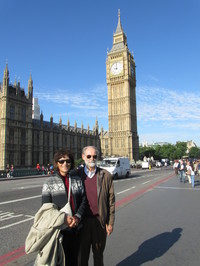
My wife Linda and I travel the world doing research for my books. Our home is in the lovely Shell Point Retirement Community near Fort Myers, Florida. I was born in Clinton, Vermillion County, Indiana. For many years, my father and I fished and trapped on the Wabash River for a major portion of our family income. My teenage years were spent on a farm in Sullivan County. As an adult, my degrees include a BS in Electrical Engineering, an MS in Engineering Management, an MBA and a PhD in Economics. I served 23 years in the U.S. Air Force. I had another 22-year career as a scientist and engineer, building weapon systems for the Department of Defense. My publications include six books and a number of papers in scientific journals. I traveled to My wife Linda and I travel the world doing research for my books. Our home is in the lovely Shell Point Retirement Community near Fort Myers, Florida. I was born in Clinton, Vermillion County, Indiana. For many years, my father and I fished and trapped on the Wabash River for a major portion of our family income. My teenage years were spent on a farm in Sullivan County. As an adult, my degrees include a BS in Electrical Engineering, an MS in Engineering Management, an MBA and a PhD in Economics. I served 23 years in the U.S. Air Force. I had another 22-year career as a scientist and engineer, building weapon systems for the Department of Defense. My publications include six books and a number of papers in scientific journals. I traveled to and lived in many places around the world, but I am still a Hoosier at heart. ...more
Frank L. GertcherI don’t know; I’ve never had it. Sometimes I wish I could turn off the flow of ideas and get some sleep. Quite often, I am awake at two or three o’clo…moreI don’t know; I’ve never had it. Sometimes I wish I could turn off the flow of ideas and get some sleep. Quite often, I am awake at two or three o’clock in the morning, writing down ideas that keep coming. My wife Linda is very tolerant of my distracting use of napkins to write down ideas while we are having lunch or dinner at a restaurant. When I am beginning a new story, I accumulate a collection of annotated napkins.
The key, I think, is to follow through on your ideas. Decide on the genre. Is your story science fiction based in the future? Is it a murder-mystery based in the past? Is it a romance? Is it some combination? For example, is it a science fiction story with a murder-mystery? You decide. Sit down with a pencil and paper and write a concept paragraph for your story. Begin with a well-crafted topic sentence (the idea, or concept). Add supporting sentences. Keep the paragraph short, almost always less than a dozen lines.
Once you are satisfied with the concept paragraph, build an outline for your story with an introduction, a body and a conclusion. Keep filling in the outline with more and more detail. Decide on a story ending.
As you fill in the outline, characters will emerge. On a separate sheet of paper, list the characters by name. Identify where they appear in the story. Write a paragraph or two about the personality of each character. Decide on the main character. The main character should have a detailed history before your story, during your story, and afterwards. Key supporting characters should also have histories, but with less detail.
Decide on a story timeline. I like to keep mine straightforward with no ‘flashbacks,’ but some writers can do flashbacks successfully. If you decide on flashbacks, make sure it is deliberate and the reader can ‘follow the bouncing ball.’
Have fun by embellishing the flow of your main story with little stories. Be careful not to detract from the main story and don’t spin off into unnecessary tangents. For example, the main story might be a traditional ‘whodunnit’ murder-mystery, but you can weave in a little romance between a couple of characters as the main story progresses. For another example, if your story takes place in the past, you can weave actual historical events and characters into your fictional story to add realism.
After you have a detailed outline and an annotated list of characters, decide on the point of view and voice to be used in your story. Do you want a narrative told by the main character? Another choice is an independent, all-knowing narrator. Some writers can successfully change the point of view from one character to another during the story, but I find this to be very difficult. Usually, such an approach confuses the reader.
Decide on the mix of narrative story (setting the scene, describing action, etc.) and dialogue between characters. Also, if the story is told from the point of view of the main character, it’s appropriate to let the main character, who is telling the story, share private thoughts with the reader. I like to write in first person, active voice. Whatever you choose, be consistent.
Do your homework. This means intense research. Get your facts and dates straight.
As you finish sections of your story, have someone proofread for the story, grammar and punctuation. Readers of your finished product will always find your mistakes and inconsistencies.
Writing a story is an iterative process. Write, edit, write more, edit more, and so on. The story will change and evolve as you write.