Erik Christensen's Blog
November 6, 2019
Quebec City is In My Soul
I took a trip to Quebec City recently that reminded me how much my writing is influenced by my travel experience.
One of the oldest cities in Canada, at least as far as European settlements are concerned, I hadn’t visited since my high school years. Apparently I hadn’t been paying attention back then, because the city was far more charming than I remembered.
If you’re ever in Quebec city, la Musée de la civilisation is well worth visiting, especially the main exhibit on the history of Quebec City and the Province of Quebec thrilled me. I was born in Montreal, but we left when I was young, so I missed that part of my education that would have grounded me in the history of my province of birth. My Ontario and British Columbia schools gave me the highlights, but not in a way that brought the story to life.
The museum corrected that. In a few short hours, I followed the story of Quebec from its pre-Western indigenous cultures, through the exploration expeditions of Jacques Cartier; the founding of Quebec City by Samuel de Champlain in 1608; the building of the town; the traders who explored the interior; the First Nations peoples who both competed and cooperated with the French settlers; the taking of Quebec City by the English in 1759 led by General Wolfe; the attempts to “Britishize” the citizens, and the eventual decision to allow people to retain their culture in exchange for loyalty to the British crown.
Quebec’s modern history is no less fascinating for me, having lived through one of its more violent episodes. La Belle Province has always had its separatist factions, one of which resorted to kidnappings and bombings to force their point of view. Luckily, cooler heads prevailed, and an agreement was brokered between the leading separatists and the federal government (led at the time by a Quebecois) to allow for peaceful debate and an eventual referendum on what was called “sovereignty-association”, essentially meaning home rule. Although narrowly defeated, the vote solidified in some people’s minds the idea of an independent Quebec, a vision that for many remains a viable concept today.
Later, I walked alone around the old city while my spousal unit attended her conference, past old hostels, restaurants, and signs proclaiming which famous person lived in this historic building. My first destination was the Chateau Frontenac, a gorgeous and magnificent hotel first opened in 1893, and built in the “chateauesque” style (hence the name, I suppose). Hardly the oldest building in the neighborhood, it is, nonetheless, one of the most impressive.
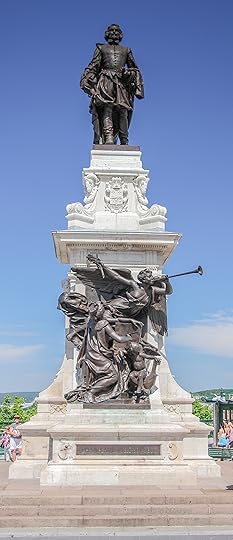 de Champlain, looking over the city he founded in 1608
The area in question is the so-called “promontory”, the headland that overlooks the St. Lawrence river, making it the ideal defensive location for de Champlain’s fledgling settlement over hour hundred years ago. A fifty foot statue of him stands in a square, gazing over his city in an eternal vigil. Maybe he should have been looking over the river though, because only one hundred fifty years later, his successors watched the English fleet sail upstream in preparation for the battle of Quebec.
At the Plains of Abraham Museum, I was steeped in historical detail of Canada’s most famous battle. An offshoot of the Seven Years War between France and Great Britain, it was the seminal event for Canada as a nation, as it was then that the territory fell into British hands. Following the time line of the battle, and the history that followed, I gained a deeper insight into what makes my country unique, and how integral Quebec is to its culture.
A path, whether through space or time, implies two things: a point of origin, and a desired destination. Events with specific dates—battles, votes, discoveries—serve well as markers along those paths, but they say little about why the path is there in the first place. What social pressures pushed history along that route? What desires led people along that road? Was it inevitable, or were there choices and sacrifices involved? The two museums I attended did an excellent job in describing what life was like not just for the people who get mentioned in the history books, but also for the everyday person just trying to survive: the trappers, the soldiers, washer women, children, the farmers. It was their desire to prosper and their will to survive that first blazed those paths.
The history of Quebec encapsulates many of the same themes I enjoy writing about. In fact, it hits all the right notes: exploration, pioneering, survival, clash of societies, language, emergent industries, governance, and battles. And, of course, heroism, the idea that a single person can, with just an idea and the charisma to deliver it, change the course of history.
The discovery of a planet and its subsequent colonization is the premise behind the world in which William Whitehall lives, a premise echoed in the trans-Atlantic voyages of Cartier and others, and the settlements their successors founded. The sheep farms and iron trade with the dragons parallel the fur trade and maple syrup farms of les habitants of old Quebec. And the collision course between Zander Bertrand and the current regime mirrors that of the British and French, albeit for different reasons.
But more than this, the fate of everyday people caught in the middle of momentous historical forces is something I’ve tried to capture in my own stories. The poor farmer who loses a child to starvation; the young man seduced by revolutionaries to unwittingly fight against his own interests; the trapper who seeks the solitude of the wilderness to find his fortune.
These themes are, of course, universal. They are the story of humanity itself. But where else are they put on such elegant display? Where else do we see all these colorful threads woven together at once? Perhaps all our homelands have similar stories, and I’m simply unaware of them, but my visit to this beautiful city reminded me—no, taught me—that I’m much more a product of my country’s history than I once believed.


January 8, 2019
Release date for The Skyrider of Renegade Point
I have exciting news today.
In a little under a week, The Skyrider of Renegade Point will be officially released! This has been a long time coming, and I couldn’t be more excited. My heart is pounding so hard that my Fit-bit actually thinks I’m exercising!
Pre-orders will be available on some retail sites within a day or two, and to celebrate the release the price will be reduced from 4.99 to just 2.99 for the first two weeks.
In case you missed it the first time, here’s a picture of the cover:
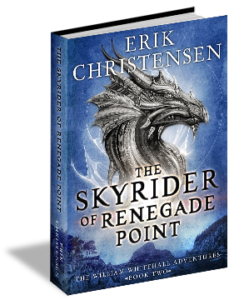
I plan on making a couple more posts before the release, so if you have any questions about the book, add a comment below and I’ll do my best to answer it in my next post.
Happy Reading!
Erik
December 22, 2018
Cover for The Skyrider of Renegade Point
Greetings from stormy British Columbia,
The weather continues to be challenging for us here in the Pacific North West. A series of storms has battered the coast, wiping out a pier that I used to enjoy walking on, and forcing us to cancel our Christmas plans to visit friends on the Island of Mudge (yes, that’s a real place. I’m really not making it up.)
Even without inclement weather and sudden itinerary changes, December is a busy month for us. Along with Christmas, we also celebrate Hanukkah, my wife’s birthday, and the anniversary of our first date. But this year, I’ve added one more reason to celebrate.
The new cover for The Skyrider of Renegade Point has arrived!
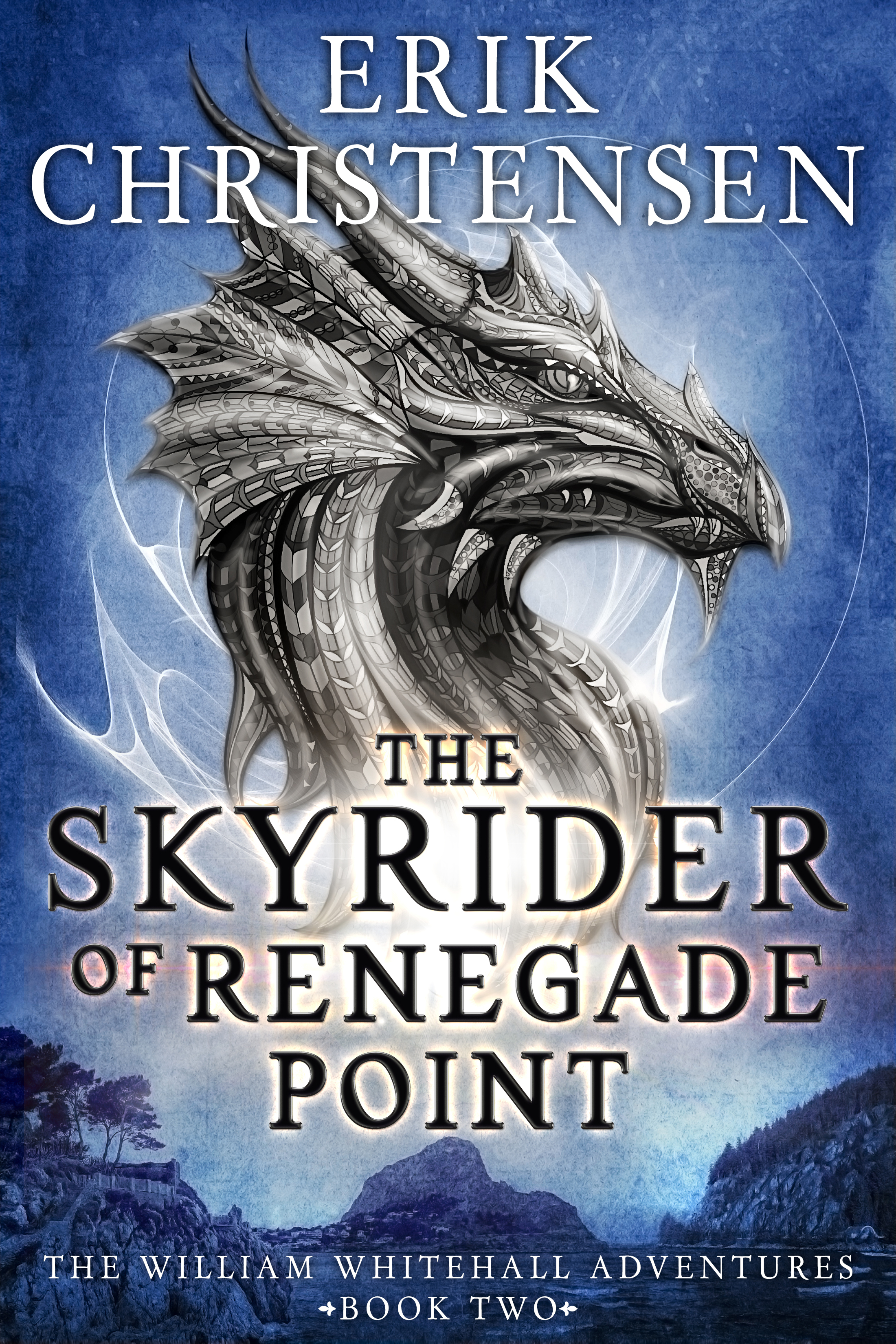
A great big thank you to Karri, whose simple but elegant design sense matches my own perfectly. She took my rambling descriptions of what I wanted, and turned it into the perfect representation of what was in my head—or perhaps a better version of it. Art, in my mind, is about turning a vision into reality. Doing so with words is one thing, but to do so with images is something far beyond my capabilities, so I always admire those who can do it. Especially when it’s this good!
There’s still plenty for me to do before I can release Skyrider next month. I have to write the front matter and back matter, format the book, update my web site and Facebook page with new graphics, write my Amazon author profile…well, the list goes on. Fortunately, these are all things I can do inside.
Happy Reading,
Erik
November 15, 2018
Book Review #1
One of the great things about being an indie author and publisher is the great community of like-minded people I get to talk to. As with any group, there are a few bad apples out there, but for the most part, my fellow authors are terrific people, and would far rather support each other than drag each other down in order to climb to the top. The prevailing attitude is that a rising tide floats all boats, and that readers devour books far faster than we can put them out—so why not help each other?
It’s my turn to do the same, and at the same time hopefully introduce my readers to some new authors they might enjoy. I’ll be reviewing some of the indie authors, not with a view to rating them, but to give you an idea of what their books are like so you can decide whether or not you want to give them a try. A lot of the books will be free, as a common marketing tactic for indie authors is to get the first book of a series into as many hands as possible, and hope that enough readers will enjoy it enough to buy the rest.
My first review is of J. F. Mehentee’s “Hotsuka’s Story,” book one of his “Dragon Pearl” series.
Imagine that you’re a god, or at least a being so superior to humans as makes no difference, with powers of creativity, knowledge, and movement to rival that of any being in the universe. Now suppose that you are punished for certain transgressions by being forced to live as a human, with all the limitations of sense and ability that entails.
Who wouldn’t feel trapped by such a turn of events? Yet this is Hotsuka’s fate, and he soon finds himself being used as a pawn by the most powerful member’s of his race, for reasons he can’t quite fathom. Slowly, he learns that he retained one power, one he never suspected he had previously: the power to bring about the existence of a new race, one with the strength to overcome the corruption of its predecessor.
This is not your typical fantasy story. A British ex-pat, Mehentee calls upon his Asian heritage to weave a tale that is at once both foreign and familiar. In place of terrestrial urgency, the reader senses great cosmic powers maneuvering around a lonely, central figure trying to find his place in a vast universe he can no longer understand–an oddly human problem for such a being!
The story unfolds over the course of decades, and depends less on frenetic action than on a compelling and potent unveiling of truths. If you enjoy fantasy with an Asian flair, especially one with a bent toward myths and legends, give Hotsuka’s Story a try. It’s free on Amazon as of November 2018.
February 1, 2018
Draft Complete!
I haven’t posted anything since the middle of December, but I promise my reasons are excellent. Well, perhaps acceptable. Okay…just shy of questionable.
Late December, as always, is a crazy time, and I spent much of it in Washington, D.C. and Long Island, New York visiting friends and family over the holidays. As for January, my only excuse is that I’ve been writing. A lot.
And it has paid off. I am happy to announce that the first draft of book two in the William Whitehall series is complete! It took me just under five months to write 113,000 words, but that will likely increase as I go back and add sub-plots that occurred to me along the way. It’s nearly impossible for me to write without generating new ideas, and some of these are just begging to be woven into the story. Don’t worry though–I won’t inflate it too much. I simply want to make sure there’s enough action and intrigue to keep things entertaining.
I don’t want to give away too much, but it’s fair to say William’s life has changed since book one. How could it not? In the opening of book two, we find that William was promoted to the nobility and given a barony of farms to oversee—but someone is sabotaging his efforts. As he struggles to avoid ruin, he becomes entangled in the largest crime in the history of Esper, one that threatens the livelihood of nearly everyone in Azuria. He solicits help from the dragons, as well as his old friends, but it’s not enough. Before it’s over, he will have to put his life on the line, or allow the unthinkable to happen.
My working title so far is “Book Two”. Thrilling, right? But I’m thinking of duplicating the pattern of the first book’s title with something along the lines of “The Hero of Faywater Bay”. Let me know what you think!
If you want to get a sneak preview, your chance is coming up in a few weeks. I’ll be writing another post with an invitation to join my beta-readers group. I’m looking for a few hard-core fans who are willing to read an unpolished version and give me their feedback. So if you’re interested, keep watching for future posts! Who knows…you may end up suggesting something that changes William’s life again!
Happy Reading!
December 17, 2017
9 Things I Learned Doing NaNoWriMo
For most of November, I posted very little except for my progress on NaNoWriMo. For those of you who don’t know what that is, November is the month during which writers—especially those who aren’t full time professionals—attempt to write an entire novel. The premise is that the smallest novel is about 50,000 words, which can be achieved by averaging “just” 1,667 words per day. Those of us who write in genres that call for larger books will simply apply their 50,000 words toward a larger novel, which is what I did, seeing as my next book will weigh in around 120k.
I’m delighted to announce that I wrote 50,092 words in November, bringing me to over 80,000 for the book so far. It wasn’t easy. In fact, I was pretty sick on the first of December, having given up more sleep than I should have in order to make my goal. But I’m glad I did it, not just because I’m that much closer to finishing book two, but because it made me a better writer. Here are nine things I learned from NaNoWriMo.
1. Patient partner
I have to start off with this one, because it’s the most important. Simply put, my partner is the most supportive and patient person I know. Juggling a full-time job, household duties, and daily writing can put a dent in quality time, but she didn’t complain once, and even adapted her schedule a few times to allow me more writing time. I’m a lucky guy!
2. Too much free time can be a bad thing
This one seems counter-intuitive, but I have evidence. Due to my partner’s work schedule, I had Wednesday evenings to myself, and made grand plans of pounding out two or three thousand words during my alone time.
Yeah, right. Not once did those plans come to fruition. For whatever reason, those unstructured hours were magnets to all sorts of other activities: shopping, work projects, household chores, video games. Writing got crowded out because everything else was looking for a spot in the schedule too. It turns out my most productive writing times were the small morsels of time that I grabbed on the fly—five minutes here, twenty minutes there. Those moments felt precious, so I made the most of them. Yes, I also wrote almost every morning, but at least half of my words were written during those “stolen” moments. Maybe it’s because they were unexpected that I took advantage of them.
3. You can’t get behind, hoping to make it up later.
One thing I’m most proud of was never ending a day behind schedule. I often missed my daily quota, but I always had enough “in the bank” to stay ahead of the game. It’s rare for me to catch up on a long term project once I fall behind, so I try very hard never to let it happen. My logic is that catching up is harder than keeping up, so if I can’t make my daily quota, what makes me think I can do more the next day?
4. I can’t write when I’m hungry
This is fact. A rumbling belly short-circuits my brain, and my powers of concentration go right out the window when my blood sugar is low. I found I was better off spoiling my meals by eating early than trying to force myself to type through hunger.
5. Having an outline is a must…at least for me
I know some people simply sit down and write with no more than a general idea of their plot and characters, but I need more structure. Otherwise I spend too much time sitting and daydreaming about ideas, and that’s time I could be spending writing. I applaud those who can do both simultaneously, but I can’t pretend to be one of them.
6. Knowing all my character’s motivations is also a must
For that matter, I also need to know what my characters want. There’s nothing more boring in fiction than agreement. Even allies have to argue about what to do and how to do it, even if they have the same long term goals. If they don’t then at least one of them is unnecessary. And like with the plot, I need to know my characters’ view point before I start to write, otherwise the words won’t come—or if they do, they won’t be good.
7. I must give up the search for the perfect word
Every writer wants to write beautiful prose. To that end, word choice is critical. It’s not enough for a character to walk from one place to another—they must hike, stomp, trudge, limp, or sashay. Even skipping is acceptable. But deciding which one should not be my primary goal during the first draft. I’m better off waiting for the editing phase before looking for that exact shade of blue, the precise facial tic, or the perfect description, because writing and editing require completely different creative muscles. It’s like trying to juggle and bench press at the same time—you’ll just drop everything, and probably hurt yourself in the process.
8. Given enough time, I can enter a state of flow and bang out thousands of words in one sitting.
If everything works out—if there’s no one to interrupt me, and my belly is pleasantly full, and I’m well rested, and I have an outline and character sheets, and I’m being smart about not looking for the perfect word, I can sometimes enter a phase psychologists refer to as “flow” during which I can pump out a couple thousand words in under an hour. It’s a beautiful thing when it happens, and the best part is it rarely needs much editing because it comes from a part of the brain that has internalized everything I know about writing.
9. You don’t have to have flow to write. But it sure helps.
The vast majority of what I wrote was not done in a state of flow. If I had waited for perfect conditions, or for inspiration to strike, I would never have gotten any writing done at all. Most writing is a struggle. It’s rough, it’s dirty, and it needs a lot of polishing before it’s ready for an audience, but it’s a heck of a lot of fun anyway. You have to fill a lot of pails full of sand before you can build a sand castle, and that’s all a first draft should be.
So I promise this is the last I’ll write about NaNoWriMo, at least until next November. December won’t be quite as productive for me, mostly due to traveling commitments. But when I do find the time to write, I’m getting a little more done than I used to. And that was really the whole point.
For those of you who enjoy free books, here’s another batch for you: the Kick Ass Heroes Instafreebie Giveaway runs from December 17 to 31, and features several volumes of varying genres, all with strong, heroic protagonists. I’ve already picked a few to read myself!
Happy Reading
Erik
November 15, 2017
Why The Next 10 Years of Science Fiction Will Smash The Last 10
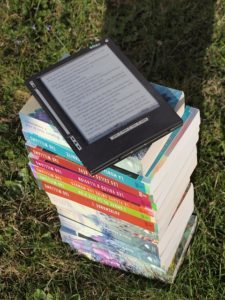 The Golden Age of science fiction is dead.
You were probably already aware of this, but if the news never reached you, allow me to offer my condolences. Depending on who you talk to, the time of death was sometime between 1950 and 1960. It was survived by its offspring, New Wave sci-fi, which included some of the old authors, as well as new ones. The cause of death was a maturing of both author and audience, after which simple stories of rocket ships and aliens no longer satisfied any but the most juvenile of readers.
Publishers, however, didn’t change. Sure, they got savvy to evolving tastes, but they were still the gatekeepers. No author could be published unless they said so, which meant writing to a specific audience, staying within narrow word counts, and avoiding anything controversial. And you can’t really blame the publishers—it’s a tough game. Every one of them would love to discover the next Asimov, Heinlein, or Le Guin, but the sad fact is that most books—especially those by new authors—will lose money, and there are only so many risks you can take before you start calling it gambling. To offset the inevitable risks, they published as many formulaic, predictable, highly salable books as possible just to keep the doors open and printers rolling.
Retailers—the brick and mortar kind—faced similar challenges, albeit for different reasons. Even the largest stores have finite square footage, only so many prime display locations, and unpredictable but limited foot traffic. The pressure to keep looking fresh drives new books off the front displays onto back shelves after just a short stay, and from there it’s often a quick jaunt to the bargain bin, which is the last stop before getting boxed up and returned to the publisher. This means most books, even great ones, have little time in the spot light to grow into a bestseller.
Enter the digital age. It’s relatively early days, but I believe the advent of inter-connected digital devices will end up changing publishing even more than the printing press did. We’ve already seen huge changes, but some of these trends are only just beginning, and with some surprising effects.
The most obvious change is the movement from print to ebooks. With no printing costs, ebooks can be profitable at lower prices and in smaller batches. This isn’t a new phenomenon, but ebooks have reached a steady 25% of the market, and could go even higher. That’s not to say print is dead, or even on life support. In fact, self-published ebooks may even help the print market by being a testing ground for new authors, allowing traditional publishers to offer contracts to successful indie authors instead of risking development costs and marketing dollars on unproven authors.
Lower prices have also vastly increased the potential buying audience, opening markets in countries where printed books are a luxury. There’s an English-speaking audience in almost every country, but if people can’t afford twenty bucks plus shipping, they’re not going to buy many books. Ebooks can be read on devices they probably own already, so the initial cost of an e-reader isn’t a deciding factor.
However, the real benefit of ebooks is that by lowering the barrier to publishing and reducing the break-even point to much lower sales volumes, writers can now create in very specific sub-genres that would never otherwise have a chance of succeeding on the crowded display shelves of book stores. Readers in these sub-genres are often hungry for this sort of work, having been deprived for so long by a risk-averse industry. I’ve met indie authors who make a steady income in genres I’ve never even heard of before, something possible only in recent years.
The flip side, of course, is that readers can search for very specific types of books. Amazon and other ebook retailers have copied Google’s success by improving search relevancy, and including qualified reviews as part of their algorithms. The result is that the reader ends up with what they want, at least most of the time anyway. Try searching for a coming of age story in medieval science fiction with dragons in your local book store. If you happen to find one, there’s no way to tell whether other people liked it or not, because the only reviews are the ones the publisher chose. Do the same thing on your Kindle or Kobo and you’ve got dozens of options, some good, some bad.
Readers have more options for sharing now, too. Few people are likely to talk about their love of erotic steampunk at the water cooler, for instance—but in the safety of their Facebook or Goodreads group? Not a problem. This further expands a niche-writer’s audience, as well as an avid reader’s list of authors to check out.
If technology has benefited writers in narrow niches, then it’s done wonders for those from less economically successful countries. I correspond regularly with writers from Sri Lanka, Nigeria, Brazil, and other far away places who make a decent living on their writing. This wasn’t possible a decade ago, at least not in the numbers they are now. It’s great for them, but it’s wonderful for readers too, as we are constantly introduced to new stories and ideas incorporating different cultures, mythologies, witticisms, language, characters, and so much more. It’s often said that reading is the cheapest form of travel, and doing so with a native guide instead of just another tourist makes all the difference.
Indie publishers have developed strategies to take advantage of these changes, in many cases borrowing from other forms of entertainment. Just as viewers love binging on entire series on Netflix, so too do readers love to binge on series, and it’s the rare author who isn’t writing one now. It makes sense from both sides: as a writer, someone who loves book one is almost certainly going to enjoy books two through ten, which means not having to find a new audience for each book. For a reader, sequels represent a known quantity, a safe choice for cheap entertainment.
To get readers hooked, authors often make the first book of a series either very cheap, or even free, knowing that they’ll reach a much bigger audience in the hopes that a percentage will become true fans. The psychological barrier to “buying” a free book is much lower than even a low price like 99 cents. After all, if you don’t like it after three chapters, there’s no guilt removing it from your e-reader because it cost you absolutely nothing. And if you liked it, then there’s probably more (or will be soon—trust me, I’m working hard on book two!)
What about the risk for the writer though? Writing a novel is no simple feat. The Defender of Rebel Falls took me ten years to finish, and the thought of never making a dime on it scared me. But going the traditional route could easily be so much worse, because if no one publishes it, I don’t even get a reader out of it, aside from a few friends and family. In both economic and emotional terms, a reader is more valuable than a sale, and having an unpublished manuscript collecting dust or clogging a hard drive gives no satisfaction at all.
What this means for you is a smorgasbord of free books to try. Some won’t be to your taste, others will be garbage (there are some real clunkers out there—just because anyone CAN self-publish doesn’t mean they should). But you could easily find someone whose work you love, someone whose writing would never have made the light of day ten years ago.
So I was wrong. It looks like the golden age of science fiction is just beginning.
Speaking of free books, Freebie Books has a new list of—you guessed it—free books. Check them out—you may find a new favorite author (besides me, of course.) At the very least, you’ll be giving someone a chance.
Happy Reading!
Erik Christensen
November 1, 2017
NaNoWriMo and Free Books!
Today marks the beginning of NaNoWriMo, or National Novel Writing Month. Despite its name, it’s a world-wide phenomenon, and the premise is that writers challenge each other to write a 50,000 word novel during the month of November. Authors coalesce into groups to share word counts, hold each other accountable, and offer support and encouragement.
It seems like an unlikely goal, writing a whole novel in just thirty days. But broken down, it requires an average of just 1,667 words per day. The real trick is to be consistent about it. Most aspiring writers have day jobs, and many of them have spouses, kids, friends, and hobbies with claims on their spare time—not to mention game seven of the World Series (that’s tonight, by the way). So banging out almost two thousand words in one sitting isn’t something most of us can do on a daily basis. My own approach is to start in the morning, cup of tea by my side, and get five or six hundred words down. If I’m lucky, I can squeeze a couple hundred more on a lunch break, and maybe another hundred or so before or after dinner. That makes a thousand words on a work day, which leaves about seven thousand more words on the weekend. That should be easy to do, except for shopping, visiting friends, traveling, etc. And if you already have a book out, there’s marketing, blogging, and the other activity that goes along with it.
It’s easy to see why a support group is necessary.
Since I’m already writing a book, I’ll obviously be participating, even though I expect to end up with over a hundred thousand words by the end. I’ll simply count how many words I write in November and ignore the fact that it doesn’t constitute a full work (NaNoWriMo is flexible in that respect; the only “requirement” is 50k words). If successful, that would mean about half the book done, putting me ahead of schedule for completion of book two. (I still haven’t thought of a decent title for it yet. I’m thinking of calling it “Book Two.” Catchy, isn’t it?)
Most NaNoWriMo participants are authors who have never published before, or are only recently published. As such, they—or we, I should say—need all the support they can get. As a reader, you can help. I recently joined a group of authors with a giant giveaway promotion on Instafreebie with over 175 free books. This is a great way to find new authors before they get famous and start charging full price. If you’re looking for a new sci-fi or fantasy to read, and don’t have much money to spend, take a look. I’ve already found a few that I’ll be reading—although probably after November.
I’ll be busy in November.
Happy Reading!
Erik Christensen
October 29, 2017
Salmon Have Quite the Adventure
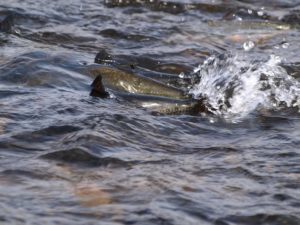 We took our dog for a walk along a nearby creek yesterday, and we were rewarded with a view that we’ve waited for since moving to the suburbs: the annual salmon run. We were originally told that it happens in September, so we’ve been going every weekend since late August hoping to catch a glimpse. Someone did eventually tell us that they actually run in October, but we were starting to think we’d missed out, especially since the city celebrated Salmon Homecoming last weekend (yes, they really call it that.)
Well, yesterday was the day! The creek finally subsided to normal-ish levels after a brief lull in the west coast rains, and I guess the salmon decided it was now or never. They weren’t the bright orange color I expected, so I suppose that’s limited to certain species. They sure did look out of place though—big fish in a small creek, their fins and tails poking out of the water. A few of them would huddle together, resting before a thrashing leap over a rock or submerged log to reach the next quiet section of water. Here and there, pairs of salmon took turns undulating in the gravel creek bed to hollow out a spot to lay eggs, and as I delighted in my inter-species voyeurism, it struck me that this was a a heroic adventure story.
A hero has a quest, and somebody—or possibly everybody—is trying to stop him or her. Along the way there are allies who have their own ways of doing things, rivals who want to beat the hero, competitors who plunder scant resources, opportunists ready to swoop in and take advantage of any mishap—and finally, a relentless foe bent on defeating the hero. The hero encounters obstacles, and either overcomes them or suffers setbacks. There are moments of frenzied activity, periods of rest and contemplation, and the constant nagging thought that maybe the final prize is forever out of reach (okay, I may be projecting a little on that last one). And for some salmon it truly was unobtainable, and all they got for their efforts was to drift lifeless to wherever the current deposited them.
Many did achieve their final goal, but in doing so they made a hero’s sacrifice, because bringing forth the next generation is a salmon’s last act. A hero, too, often loses something in victory—although not always—but they are always changed by the journey, a part of them dying to make room for a new, improved version of themselves.
As I write this, it occurs to me that my own adventure as a writer echoes this journey. Writing my first book changed me. Not only did I live through William’s adventures, I also shared his epiphanies and overcame his weaknesses. I had to in order to write convincingly (and I hope I did that). But I also had to swim through the unfamiliar waters of the publishing process, which was a well outside of my comfort zone. Like writing itself, it involved periods of frenetic activity followed by anxious introspection, and without the allies I’ve gained throughout my journey, I could not have made it this far up the river.
So with your help and encouragement I will continue swimming against the current, and with luck and hard work my stories will find their way past the rocks and eddies and reach the open sea.
Happy Reading!
P.S. The first draft of book two is about a quarter done. Watch for my invite to the beta reader team in the next few weeks!
October 15, 2017
An Odd Source of Inspiration
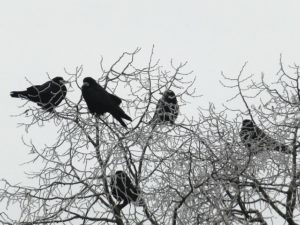 The crows are going nuts outside my window.
Dozens of them, flitting in and out of one particular tree, all screaming their heads off. And I have no idea why.
Normally this would bother me. After all, I was in the middle of writing the second book of the William Whitehall Adventures, and a massive clamoring of crows is hardly conducive to good writing.
Or is it? I must admit I was intrigued. Crows are interesting creatures at any time, and a lot like humans in many ways: they can be social or solitary, they’re smart, they can carry a grudge, and they love to play jokes. But when they start behaving bizarrely it’s hard to look away. Seriously, it was like an angry town hall meeting, and I wondered who or what they were angry about. Do crows have politicians? Trials? Public auctions?
Anyway, it struck me that this is how aspiring writers are taught to begin a story. Show something a little out of the ordinary, and leave out just enough information to leave the reader curious to know more. As a writer, this sort of event is gold, because it really gets the imagination going. I don’t need to know the real answer behind the mystery, because I can just make up my own.
I suppose I should try to tie this to some Important Message, but honestly I just found it interesting. No agenda to share—except that maybe my next series will be about crows.
Happy reading!