Chuck Wendig's Blog
April 16, 2026
Steven Gellman: Five Things I Learned Writing Somewhere in Nowhere
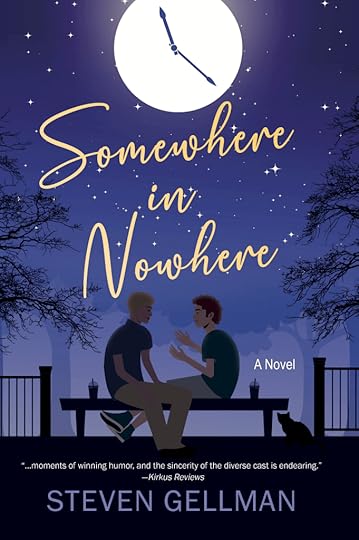
Have you ever wanted to eat stinky tofu while binge watching reruns of the Bionic Woman? Or fall in love with a boy named Pajamas? Have you ever thought there was an alien in your stomach trying to kill you?
Coming out is hard when you have two gay moms. At least it is for Simon Bugg. It’s his senior year, and nothing’s going as planned. When his mom scores a dream job, Simon’s world is turned upside down. Stuck at a new school in a strange town, he spirals, torn between the only friends he’s ever known and a growing circle of freaks and geeks who welcome him in.
Things start to look up for Simon when he meets the handsome PJ in drama class. That is, until he derails their first date in spectacular fashion. With a little help from his friends, Simon finds his way back to PJ. But how can he have a relationship with the boy of his dreams when he’s convinced he’s going to die?
No one knows about the nightly alien attacks at 11:22. Why then, and why are they getting worse? Simon must face a dark secret before he loses his chance with the boy he loves.
1: Stinky tofu is pretty damn tasty…in fact, it’s delicious!
Everyone deserves to see themselves represented in books. So, when I set out to write Somewhere in Nowhere, I made diversity a priority. I wanted my cast of characters to be as colorful and vibrant as the friends I had growing up in Montgomery County, Maryland. This approach opened doors to new experiences as I did research for my characters.
When I first learned about stinky tofu, I was obsessed.
This can’t really be a thing, can it?
Turns out it is.
Okay, but people don’t really eat this, do they?
Yep. They do!
And how bad does it really smell?
Pretty bad!
I had to know more. I investigated its history and the intense fermentation process it goes through to become the odorous, night-market delicacy beloved across Taiwan, Hong Kong, and mainland China. But one thing was missing. I had to try stinky tofu for myself.
It wasn’t easy, but when I found a restaurant with stinky tofu on its menu (East Dumpling House in Rockville, MD if you’re asking), it was steps away from where my protagonist and his merry band of misfit friends go to high school. A stinky match made in heaven.
For the big, taste-testing night, my spouse and I took friends to East Dumpling House. I don’t want to give too much away, because I put it all in the novel, but I’ll tell you my spouse sort of liked it, but it was a gag-worthy moment for our friends. What about me, you’re wondering? I loved it! Every stinking bite. The fun part for all of us, though, was experiencing a new culture and trying foods out of our comfort zone.
I’ve since learned about hairy tofu. Who’s up for the challenge?
2: Sorry, Ripley. The only alien in my stomach is a-n-x-i-e-t-y.
At the risk of sounding clichéd: it’s okay to not be okay. This is a lesson I’ve had to learn more than once in my life, and it was never more poignant than when I was writing Somewhere in Nowhere. I was in the throes of crippling anxiety and panic attacks. I would be up all night. Then, in the morning, I would lay my experiences bare on the page. What Simon was feeling and going through was what I was feeling and going through.
I needed to take my own advice, and I wanted to share this message with readers who may be going through their own mental health struggles. (Spoiler alert: the alien isn’t real.) Simon’s challenge is my challenge. And it may be yours, too. Though his story is fiction, the anxiety and panic Simon experiences is very much my story and my truth. And writing this novel was way cheaper (and did more to help me) than all my years of therapy.
3: Are you there, Hector? It’s me, Simon, and I can’t breathe.
When I set out to write my debut novel, I knew it had to be three things:
a classic LGBTQ+ coming-of-age storyabout a boy dealing with mental health challengeswritten in the vein of Judy Blume (my favorite childhood author!)Judy Blume’s books were everything to me as a kid. They were the ones that kept me reading. I learned about the world from her—things my parents didn’t tell me. She also helped me feel not so alone, and she inspires the books I write today. YA that deals with tough, real-life issues. I think this was where the seed was planted for my dark-meets-light writing style. I want my readers to feel all the feels. To laugh, and to cry. That’s real life, after all.
4: How a 20-sided die made me a better storyteller.
The idea for becoming an author came about at the Gaithersburg Book Festival. As I passed The Writer’s Center booth, someone asked if I was a writer. When I said no, they probed further, asking what I did for a living. When I replied, “singer-songwriter,” they said: You’re a writer. It’s in your title. It was a light bulb moment for me.
I thought about that conversation a lot over the next year andwhen the pandemic wiped out my work as a performing songwriter, I decided it was time to sit down to write that novel. But I still wasn’t sure I could do it. After all, I drew cartoons and daydreamed during school. I got Cs and Ds in English class. I loved books my whole life, and escaped into them, but never thought about myself as an author. And I certainly didn’t know how to write a book. Or so I thought.
Then it hit me, I’ve been telling stories for most of my life. Most recently, it’s been through four-minute folk songs, but before that, it was as Dungeon Master for countless Cheeto-dusted D&D games. As a kid, I never wanted to be a playing character, I wanted to create the world and tell the story of the game. This is where I learned about pacing, foreshadowing, and planting clues. Turns out, I’d been preparing for novel writing my whole life. Let’s go!
5: My Jewish family guilt has nothing on your Taiwanese family guilt.
“I swear to God, Mags, you have the nagging skills of a middle-aged Jewish mother.”
“Fine! Make fun of the weird girl! Who just happens to be worried about you! Also, you should know better than to bring up this old feud. You know very well that your Jewish family guilt has nothing on my Taiwanese family guilt. My mother’s guilt, and her mother before her, and her mother before her, and so on and so on, is steeped in a long lineage. It’s basically science. How many times are we going to have this argument?”
I mentioned earlier, representation matters. And own voices in literature are important. That’s why it was clear to me that Simon needed to be gay and Jewish. These are things I know and can write about from an honest place. A place of lived experience. That doesn’t mean Simon and I are the same person, we’re not. But we share a common denominator in lifestyle and experiences. These identities have not always been easy in my life. I had my own struggles coming out as a teenager, and I have never been a religious person. But I discovered in writing this novel that we tend to fall back on our traditions when times get tough. I realized there’s comfort and lessons to learn in accepting these truths about ourselves and our community.
Bonus Thing: Bread and water can so easily be toast and tea.
Sure, you might open a mostly empty refrigerator and see nothing to drink and only stale bread to eat. Or you could brew a cup of delicious tea and make that stale bread all hot and toasty. Mmmm.
Sure, you might lose your work and not know how to pay your bills. But you were also given a gift of time. How will you use it?
Sure, you haven’t slept all night because your anxious mind was trying to kill you. But you can pour this trauma into your art and write about it from an honest place.
So, to sum it all up, the main thing I learned was: put the kettle on, toast the bread, and write your truth.
Steven Gellman is an award-winning songwriter turned author. Inspired by his early love for Judy Blume’s groundbreaking stories, Steven has found his passion for writing coming-of-age fiction that centers LGBTQ+ voices and the real-life challenges of navigating adolescence in an ever-changing world. He has long championed authentic queer storytelling — first through song, now through fiction.
When he’s not writing, Steven can be found sipping a cup of Dark Rose tea and plotting new adventures for his book club, Tea & Peril. Steven lives in Maryland’s Piedmont region with his husband and a houseful of rescued companion animals. Somewhere in Nowhere is his first novel.
Steven Gellman: Website
Somewhere in Nowhere: Bookshop.org | Amazon | (or through your favorite indie bookstore)


April 3, 2026
HAROLD GOLDBERG: FIVE THINGS I LEARNED WHILE WRITING THE SKINNY
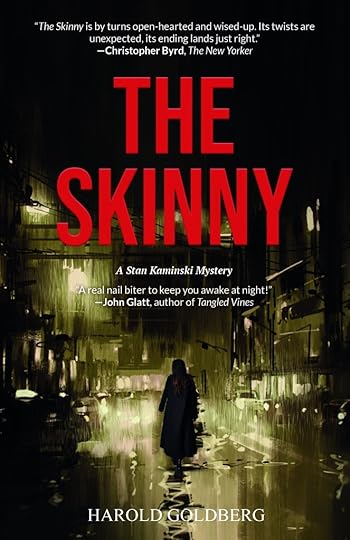
Stan Kaminski, a down-on-his-luck Polish immigrant, tries to scratch out an existence in 1990s New York City while avoiding the colorful, nefarious characters he encounters at every turn.
When Stan is asked by one of Manhattan’s wealthiest landlords to find a lost woman, he refuses at first. But money lures him in. As Stan searches for the brilliant but troubled Charmaine, he becomes ensnared in a waking nightmare full of mystery, multiple murders and the sword of a serial killer.
“The Skinny” is about the conflicts that come with change as one New York vanishes and another appears to take its place. It explores the constant struggle between the rich and the poor, how the addicted mind battles itself for answers, the way one mystery is solved only to open the door to another, and what hope actually means.
The evils of Gilles de Rais make their way into the plot of “The Skinny.”
Some years ago I co-authored a book with Dr. Helen Morrison called “My Life Among The Serial Killers.” Dr. Morrison is kind of like the real life Clarice from “Silence of the Lambs,” except she is a doctor and a lawyer. During that book, we wrote psychological profiles of serial killers from the past.
The story of Gilles de Rais, who fought alongside Joan of Arc, had a lasting effect on me. For research, I read a translation of his trial by the Catholic Church. It was tough going, shocking, and because his violence was against children, his misdeeds kept me up at night. Even during the day when I read what de Rais had done, I had to take a break to go to Bar 6 around the corner from my apartment at the time.
He used a short, sharp sword called a braquemard. That antique sword is important to the story I tell in “The Skinny.” There’s a twist regarding the blade that I hope you don’t see coming. I think that’s why Christopher Byrd, who writes for The New Yorker, said “The Skinny is a book about flawed, vulnerable people that is by turns open-hearted and wised-up. Its twists are unexpected, its ending lands just right.”
New York City is full of dead bodies, everywhere.
I’m certainly not the first to say that New York City is a dark character in my book. Stan Kaminski, my flawed sleuth, feels the grit and grossness of 1990s New York with every step he takes. He hates the smell of Macanudo cigars, big with the newly rich at that time in history. He worries that a rat might bite him if he falls asleep on the street while waiting to find Charmaine Kasimierz, a troubled but super-smart young woman who finds late winter in the city too much to take.
In my research, I found New York City to be full of dead bodies. Depending upon whom you ask, there are 10,000 to 20,000 bodies buried under Washington Square Park, and a violent scene in “The Skinny” occurs there, within the fabled Washington Square Park arch. In the 1800s, Corlears Hook Park along the East River was rife with malaria, violence and murder. Even recently, a car plowing through the park on July 4th killed four people. In “The Skinny,” Stan feels like he’ll be murdered in the park, and he has reason to think that way. And a scene in a small Irish cemetery in Queens leads Stan to think about his life in Krakow, and how he once slept on the one of the graves in a Jewish cemetery because he felt he had nowhere else to go, and maybe nothing to live for.
New York City, often beautiful and magnificent in the sunlight, is called the greatest city in the world. But at night, or even on a windswept, rainy afternoon, everything and everyone in New York can feel foreboding, from the rustling of a bird in a bush to footsteps trailing behind you, even if they’re a few steps away.
How video games were an inspiration, like Sam Lake’s Alan Wake series.
Video games can inspire the plots for books. During the day, I write reviews and features about games as a columnist for the New York Times. So the idea of immersion I felt in the better game narratives crept into my story. The dark nature of New York City is partially inspired by Sam Lake’s frightening Alan Wake horror series. While “The Skinny” is not a horror story per se, it has that Sam Lake vibe. Lake himself is inspired by everything David Lynch, so much so that many photos show him drinking coffee, like FBI Agent Dale Cooper in “Twin Peaks.”
From the first paragraph in “The Skinny” onward, I hope readers will feel that Sam Lake/David Lynch vibe. In fact, many of my Instagram posts feature music by Angelo Badalamenti. It’s the right music.
There’s a nod to Grant Theft Auto as well. Later in the book, there’s a frantic car chase that begins across the river from Manhattan in Jersey City. It’s fraught and it’s frantic, and it’s inspired by the minds at Rockstar Games.
I was influenced, too, by L.A. Noire, another game published by Rockstar. When that game was released in 2011, it felt like you were deep in a sometimes grimy, always sunny Los Angeles where everyone seems on the take, from bad cops to horrible politicians.
Another inspiration was Walter Mosley’s vivid “Devil in a Blue Dress” novel, in which every character, even those who exist only on one page, were wonderfully rendered. I mention that here because I hope that memorable piece of print fiction is turned into a game at some point in the future.
Polish Culture is so deep and compelling.
As Stan Kaminski moves through downtown New York City’s underbelly, one constant is Polish culture. This Polish immigrant is on a mission to find Charmaine, a young woman who’s dealt with some very bad people. The horrible sight of a school-age child being attacked by a falcon makes Stan think of folktales and myths that were even more violent than the Grimm Brothers could conceive. But generally, Stan sees things through the lens of all things Polish, like pop music from polkas to Bobby Vinton. He uses the words of his mother country for emphasis. He likes New York, but he wishes he could be in Poland.
The East Village was a bastion for Polish (and Ukrainian) immigrants from the mid-20th century onward until the 1990s. It was a tight knit enclave. By the time Stan begins his sketchy work for a rich Polish landlord, Poles (and Puerto Ricans) were being driven out of Manhattan by the high real estate prices that come with gentrification.
Stan salivates over Polish food like pierogi and sausage at his favorite East Village bar on Avenue A, and he has a soft spot for Bertha, the old, baseball bat wielding woman who runs the bar.
Before arriving in 1990’s New York City, Stan worked security for the Polish movement Solidarity, particularly for Polish union leader Lech Walesa. But he has nightmares about something his wife almost unwittingly did that made him leave Poland, shaken and embarrassed. While Stan’s English isn’t the greatest, he knows his culture well from the greatest authors to the dazzling salt mine sculptures in Wieliczka.
I didn’t think it would be, but going small was the way to go.
“The Skinny” is an immigration story and bigotry is a sad, pervasive fact here. It’s told from the perspective of someone for whom English is a second language. I think you’ll find some beauty in the writing and in the characters you meet.
But two of the bigger publishers wanted me to change Stan, the narrator, so that the occasional Polish word wasn’t used. If I did that, the book would be published in a bigger way. That, in itself, felt prejudiced, at least to me. So I put my draft in a drawer. Eventually, Measure Publishing asked if I had done any fiction. They liked “The Skinny” as it was written. But I polished up the draft a few times before it went to press. I had input on everything from the cover to the kind of paper that would be used to the number of books in the first run. The contract was structured so that royalties are much more than the going rate, and they will come sooner rather than later.
This is the beginning of what I hope will be a trilogy. I like Stan Kaminski as a nuanced character, and I feel there can be more books written through his eyes. But the second book will be told from the perspective of Charmaine Kasimierz – because her real story will be even more compelling than the Charmaine which Stan has so carefully observed.
Harold Goldberg: Website Facebook Bluesky
The Skinny: Bookshop Indiebound B&N Amazon
Harold Goldberg has written for the New York Times, The New York Times Book Review, Vanity Fair, Esquire, Boys’ Life and elsewhere. His narrative history of games is “All Your Base Are Belong to Us (How 50 Years of Videogames Conquered Pop Culture)” Random House, and he co-wrote the bestselling “My Life Among the Serial Killers” (Morrow) with Dr. Helen Morrison. “The Skinny” is his first novel.
March 31, 2026
The Pixel Project: Five Fantastic Reasons to Give to the 10th Annual Read For Pixels CAMPAIGN
*Straightens up and strides onto the stage of Chuck’s Terrible Minds blog.*
*Chuck holds up a sign: “And ACTION!”*
*Nods at Chuck and clears her throat*
Warmest greetings, everybody! Is this mic working? *Taps on mic. Winces at the high-pitched squeal coming from the speakers.* Ack. Right – let’s get this started:
The Pixel Project, a 501(c)3 anti-violence against women nonprofit, is proud to announce that our Read For Pixels campaign has reached its 10th annual International Women’s Day Edition in March 2026.
Read For Pixels has come a long way since September 2014 when Chuck himself, Joe Hill, Sarah J. Maas, and nine other award-winning bestselling SF/F, Horror, and YA authors helped us reach out to their readers and fandoms about violence against women (VAW) and raise funds to keep our anti-VAW work alive. Just over a decade on with almost 300 author livestreams, over 100 AMAs, 23 fundraisers, and 1 Shirley Jackson Award- and Audie Award-nominated charity anthology under our belt, we are continuing to expand our archive of globally accessible resources about VAW for geeks, book lovers, fandoms, parents, teachers, and kids, as well as leveraging the power of genre fiction and storytelling to educate people about VAW. Authors, editors, publishers, and agents have also helped us raise approximately $10,000 per year by providing exclusive goodies as thank-you treats for readers, fans, and book collectors who donate to support our work.
You’re probably thinking: “Sweet! I’ll go scope it out. So why the guest post on Chuck’s blog?”
The short answer: “Because we need your help to reach our $5,000 goal for the 10th annual International Women’s Day Edition of Read For Pixels and keep our work alive in this [insert expletive of your choice] year of 2026.”
Fighting the good fight while grappling with the effects of increased geopolitical turbulence worldwide in 2026 is taking a toll on our organization, as it has with many small grassroots-run nonprofits. Women’s organizations have experienced decades of scarce funding for the overall women’s rights movement and women’s human rights are often one of the first casualties in turbulent times such as these. In fact, UN Women sounded the alarm in summer 2025 that the funding situation is so dire that up to 60% of nonprofits and charities working on women’s rights are at risk of shutting down. Thanks to the War on Iran which has sent global inflation further spiraling, our 10th annual International Women’s Day fundraiser is progressing so slowly even Treebeard can outpace it. It’s been almost a month and we’re stuck at $3,355, which is just 67% of the way to our very modest $5,000 in a single fundraiser so you can imagine our growing concern. While we are 100% volunteer-staffed, we do have bills to pay so that we can keep our campaigns, programs, and services running.
Chuck, who has been a stalwart supporter of our work for years, received our SOS and leaped into action by publishing this blog post to boost the signal for our fundraiser.
So here my team and I are, with Sexual Assault Awareness Month 2026 just around the corner, presenting five fantastic reasons why you should consider giving to our fundraiser to help get us to our $5,000 finish line by our extended deadline of April 15th 2026:
Fantastic Reason to Donate Now #1: Support accessible information for victims and survivors of VAW… while turbo-charging your summer reading
One of the core services that The Pixel Project provides is bridging the information gap that victims and survivors encounter when trying to get help. Our daily helpline retweet session, which posts domestic violence and rape/sexual assault helplines for women in 205 countries worldwide from 8.00PM to midnight Eastern Time, 24/7, 365 days a year, has now transitioned to Bluesky. Additionally, we continue to respond to individuals contacting us for help, doing the research legwork to provide them with information about specific victim assistance services in their part of the world, and incorporating this life-saving information in the books, videos, social media posts and other awareness-raising tools we deploy.
THE WIN-WIN FACTOR: Donate to our fundraiser and stock up your stack of summer 2026 reads at the same time! From signed rare/limited/luxe editions to goodie bundles stuffed with books and swag to single signed titles, we have book-filled treats for every donation level from luminaries such as Carrie Vaughn, Charlaine Harris, Delia Pitts, J.C. Cervantes, Kelsea Yu, Kristy Park Kulski, Libba Bray, Linda D. Addison, Nicole Kurtz, Subterranean Press, and more. And while you’re savoring the satisfaction of ensuring you don’t run out of great stories to fill your summer days, also savor the fact that your donation will support our programs and initiatives that connect victims and survivors of VAW with the help that they need.
Fantastic Reason to Donate Today #2: Support resources for educating folks about VAW… while getting help for your writing
We have built an ever-expanding archive of nearly 300 resource articles to date about everything from how to stop street harassment to lists of organizations tackling everything from child marriage to MMIW (Missing and Murdered Indigenous Women). Additionally, our website has beginner-level primers about different types of VAW, including violence against trans women, online violence against women, bride trafficking/kidnapping, and obstetric violence and our Facebook page is an excellent just-in-time source for the latest headlines and articles about VAW.
THE WIN-WIN FACTOR: Whether you are a budding writer or experienced author who is considering making a donation, we have a stellar line-up of Read For Pixels author alumni offering critique bundles for WIPs (works-in-progress) and/or 1-to-1 video chats focused on the craft of writing and/or tips about the publishing industry. Participating authors include Dorothy Koomson (Crime/Thriller), Geneve Flynn (Horror), Juliette Wade (Speculative Fiction), Karen Odden (Historical Mystery), and Sarah Tantlinger (Horror and Poetry). Enjoy knowing that while you are getting expert help for your WIP or fixing a seemingly intractable writing challenge, you’re also supporting the creation and expansion of online resources for educating folks around the world about VAW.
Fantastic Reason to Donate Now #3: Support online platforms for people to speak up about VAW… while being immortalised by your favorite author
A key pillar of our activism and advocacy work is providing digital platforms that are safe spaces for people from different walks of life to speak up about VAW. Every October for the past 10 years, we have hosted the “People and Pets Say NO!” photo statement campaign via Facebook and Instagram for people and furbabies from all walks of life to step up publicly to call for an end to VAW during Domestic Violence Awareness Month. We also offer VAW survivors and dads who are male allies opportunities to speak up via blog interview initiatives such as the Survivor Stories blog interview series and the Voices of Dads Against VAW interview series.
THE WIN-WIN FACTOR: While your donation keeps our platforms available for folks to speak up about VAW, you can enjoy being immortalised by your favorite author, all in the name of supporting a good cause. For this fundraiser, award-winning authors J.C. Cervantes and Premee Mohamed are each happy to tuckerise you or gift you the honour of naming a minor character in their next book or short story. You can even donate to get it as a unique and lifelong birthday present for a friend or family member!
Fantastic Reason to Donate Today #4: Help us boost the signal for anti-VAW activists and advocates worldwide… while gifting your geeky loved ones with terrific treats
A longstanding part of our work involves spotlighting how anti-VAW advocates, activists, and organizations worldwide are changing the world for women and girls, as well as their ideas about what people can do to help stop VAW in their communities and countries. Our Inspirational Interviews series has been running for a decade and counting. We also run topical sessions with anti-VAW advocates and activists speaking about their work and educating people about VAW.
THE WIN-WIN FACTOR: If you have a geeky friend or family member and you see a Read For Pixels goodie offered by their favorite author available on our fundraising page, donate to snag that unique treat (such as Bram Stoker Award-winning Horror poet Linda D. Addison writing an acrostic poem based on your name and acclaimed Fantasy author L.Penelope writing a micro-story for you) and delight them while supporting signal boosts for anti-VAW activists and advocates. BONUS: You’ll have an interesting story to tell them about where the gift came from. It might even be a great opener for chatting with them about VAW.
Fantastic Reason to Donate Today #5: Support the right of women and girls to live a life without violence
Nearly 1 in 3 women and girls worldwide experience some form of violence in their lifetime. In terms of domestic violence alone, over 1 in 4 women under 50 have experienced physical or sexual violence from a male partner.
So donate to our fundraiser because you believe in supporting efforts to prevent, stop, and end VAW. Whether you can give us $5 or $50 or $500 to help us reach our $5,000 goal (or even zoom past it to a stretch goal), every cent counts.
(And when you donate to us, please also consider donating either cash or supplies to your local women’s shelter or rape crisis center. Like us, they need all the help they can get.)
It’s time to stop violence against women. Together.
Interested in checking out The Pixel Project’s anti-violence against women work? Visit us at https://www.thepixelproject.net/
Interested in checking out our Read For Pixels fundraiser and making a donation to help keep our work alive? Go here .
Regina Yau is the founder and president of The Pixel Project, a virtual volunteer-led global 501(c)3 nonprofit organization on a mission to raise awareness, funds and volunteer power for the cause to end violence against women at the intersection of social media, new technologies, and popular culture/the Arts. A Rhodes Scholar with a double Masters in Women’s Studies and Chinese Studies, she has a lifelong commitment to fighting for women’s rights. In addition to running The Pixel Project, Regina also teaches English to middle-schoolers and high-schoolers, writes stories about cheeky little fox spirits and terrorist chickens, bakes far too many carb-and-sugar-loaded goodies, and can be found artistically posing upside down in Aerial Yoga class.
March 28, 2026
Cheap Evil Apple Alert: Black River Orchard
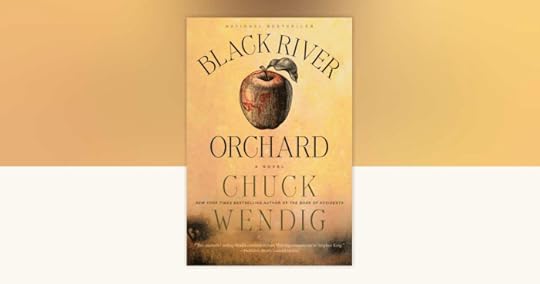
If you like
a) apple agriculture b) suburban folk horror c) cults
Then boy howdy do I have a book for you — Black River Orchard is just shy of two bucks on your favorite electromagic bookreaderplatformbuyer, which is to say, “wherever you buy your e-books.”
That means: Bookshop, Kobo, Amazon, B&N, Apple, etc
It’s a book I’m quite proud of! So go try it out if you haven’t. Tell everyone. *cue Gary Oldman in The Professional* EVVVVERRRRYOOOONNNNE
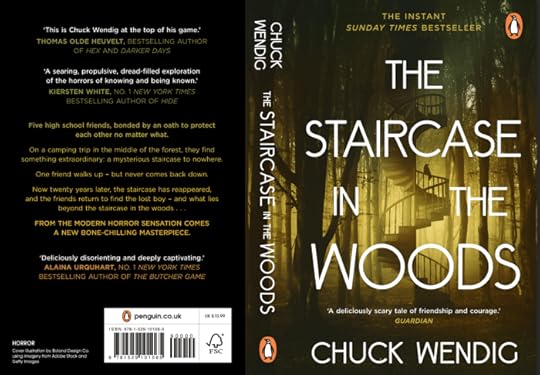
Also a reminder that The Staircase in the Woods is out in paperback now, and The Calamities launches in August, and you can preorder at Doylestown Bookshop for a bunch of goodies and unique personalizations where I personally name your DEMONIC PROGENITOR allllll for you, Damien. All for you. I’m working with an artist whose name might rhyme with Matalie Netzger to do some more cool sticker art stuff too.
Oh! And if you haven’t seen the Calamities cover under the cover…
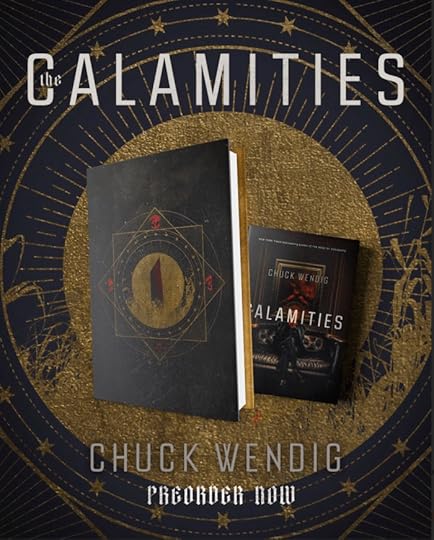
Okay love most of you, bye!
March 27, 2026
On Aging, Dying, Butter Melting, Crafting Legacy and Punching Robots
Let’s get this out of the way at the fore of the post: I am not, to my knowledge, actively dying. I do not — again, to my knowledge! — suffer under any particular malady besides the passage of time and the steady nibbles of entropy that will eventually lead to my demise.
But! I am about to turn 50 in *checks watch* just under a month, and that means that I’ve been thinking a lot about death and dying recently, which is to say, the same as usual, probably. It’s not that 50 is old — though when I was a kid, I certainly would’ve believed that a 50 year old was basically a walking mummy, some antediluvian creature who had just slithered up out of the mucky swamps. Now turning 50 just feels normal!
Ha ha just kidding it totally fucking feels old. It shouldn’t! It’s not — not really. But it sometimes literally feels old as I wake up with more creaks and crackles and weird bumps and barnacles and now comes the steady drumbeat of, welp, time to get on statins and/or a blood pressure medication and/or hey have you heard of these GLP-1 drugs and you should be eating less and exercising more and don’t forget to get this cancer screening and that cancer screening and do you have your retirement figured out and where is your grave plot don’t you have a grave plot yet well jesus christ have you at least picked out an urn wait what do you mean you just wanna be swaddled in organic cotton and buried in the yard with an apple tree planted over your carcass so that people can one day eat apples powered by the decay of your inert corpse goddamnit what is wrong with you.
Anyway. It’s fine! It’s fun. New stage of life and all that. I’m wiser and beardier and sexier than ever even if my knees make weird noises.
That’s not precisely the point of this post — which I’ll get to, admittedly after a very long and ambling walk, which I hear old people enjoy! — but rather, in this hastening parade of deathly thinking, I came to a series of small but impactful revelations.
(Small but impactful to me, not necessarily to you. Your mileage may vary.)
So the other day I made waffles for the family, and instead of just using maple syrup, I like to richen the syrup with melted butter, which lets me use less syrup because fat carries flavor quite nicely. (Don’t worry, I’m not eating the waffles, I make eggs for myself like a good little nearly-50-year-old boy. I say this in case my doctor is reading. It’s fine, doc! Really.) Which means part of the process involves melting butter in the microwave, and because I’m weird, I sometimes stand in front of the microwave and watch the butter go from “cube” to “goo” as the, I dunno, nuclear-powered kitchen-box pelts it with lasers or whatever the fuck goes on inside a microwave. Today, while watching the dissolution of the butter chunk, I thought–
That’s death.
I mean, death for the pad of butter, obviously.
But, metaphorically — it’s death for me, to me, as well. For you. For all of us!
If you ever watch the Colbert Questionnaire on his show, that’s one of the questions — what do you think happens to us when we die.
And I think that’s what happens to us.
I think we’re like butter melting.
I suppose it sounds horrible, this bubbly and seemingly final dissolution — but I don’t see it that way at all. Watching the butter go from solid Minecraft block to soft puck to active ooze, I thought, well, the butter hasn’t gone anywhere. It’s simply changed forms. It’s still butter. It lost its shape, but it remains what it was, but now in an interesting new container — an un-container, in a way. And then you’re going to eat the butter and maybe that seems horrible, too, also final, but it’s not. The butter gets spread on toast or poured into the gridwork of waffle sockets and eaten. And still, it remains butter, until it doesn’t — then it gets broken down, absorbed by the eater, used not just to fuel them in terms of energy and nutrition but also to make them happy in some way, because butter tastes delicious. Its constituent parts have come apart, yet remain to serve the body. And eventually that body will take what it can from the butter bits and then get rid of it, or, if they’re over the age of 50, that butter will lodge in their heart in an oleaginous lipo lump fatberg and probably kill them at some point, and then that person — plus the butter they’ve consumed! — will melt, too, a corpse into the corpus, gone to the earth, still a body for a time until it too is consumed and broken apart, all the parts of it used. The one who is fed becomes the one who feeds.
It’s kind of beautiful.
We’re all just melting butter.
But, okay, okay, that doesn’t really account for what is probably the scariest part of death and dying — the existential part. Like, that’s fucking great if all my special boy butter molecules* go back into the universe, but those aren’t me, not ME-me, not the thought-avatar that is me, not the wants and needs and peccadillos and ideas and anxieties that add up to me, it isn’t the memories or the awareness or any of that shit. That all just goes to vapor. All the identity parts of Chuck Wendig are in the bonds of the molecules and aren’t the molecules themselves, and when the molecules separate and the bonds break, so does the Chuck Wendig part of the equation.
Which is why of course we we like to envision an afterlife, right? Sure, the crass body remains behind, stuck in the ground or turned to kitty litter, but the us part, the thought part, all that soul business, it floats up into the sky or sinks down into the chthonic channels. It escapes the hungers of birds and earthworms and flits up to Heaven or oozes into Hell or escapes to some Third Space, like a cosmic Starbucks or an End Times Regal Cinemas.
The afterlife presents us with comfort. The You part, the Me part, the identity part, gets to live on. You know. On a farm. Upstate.
It’s just…
I don’t know if I believe in any of that — okay, I don’t disbelieve in it, sure. If there’s something After, then it’s going to happen regardless of whether I believe in it — if my lack of faith in a particular entity displeases that entity enough that he/she/it doesn’t wanna hang out with me for all eternity, well, so be it, that’s unlife in the big city, baby. If I don’t get get into the post-death VIP section due to some moral quibble, well, I guess that’s on me. I fucked around and once I’m cooked, I find out. Presuming the cosmic order is not subject to such fickle pissery, whatever’s coming is coming whether I know it or not.
What I do believe though is that yes, the process of death and dying breaks down the physical body and leaves a physical legacy — and there is an equivalent breakdown and legacy that happens when the WHO WE ARE slash identity slash soul portion of our existence.
That, too, is left behind as a legacy. Once we’re gone we are left still as a strong impression on those who knew us and loved us, and just as the butter eventually is absorbed into the eater, so too are we absorbed into those we knew, those we affected. And they go away, too, but that doesn’t really mean we’re gone when they’re gone — we leave behind little idea threads, little pieces of ourselves, little jokes and japes and notions, little quirks and questions, and those I think carry on in some form, evolving and devolving as needed. All these pieces of ourselves, living pieces, put out there in the universe, and then cascading out there, fractally, forever. Stones thrown into cosmic ponds.
Ripples going out, hitting the shore at the end of the universe, rippling back.
I love that a lot.
And it makes me think about writing and storytelling.
For a very long time I’ve advocated for just leaving it all out there on the narrative field, so to speak — put it all on the page. Bleed there. Cry there. Crack open your chest and take out your heart and smoosh it into the story like you’re leaving behind a primal signature. I’ve advocated for this in part because it’s practical, good advice — stories are not particularly original, but the thing that’s original about any story is the teller. You’re a confluence of unique elements that has never been repeated, and so part of the value you bring to the page — or really to any creation you make — is the YOU part.
I’ve also advocated for this because, honestly, it’s good for you. It’s good for your heart and soul to be in conversation with it. It’s good for you to find a place for your anxieties and your dreams. It’s good to use all the parts of the pig; the pig being, well, you and your big weird meaty brain. And again: it’s practical! It’s so much easier to use YOU and YOURSELF and ALL YOUR WEIRDNESS instead of, like, trying to get away from all that. You have all these ingredients close at hand — grab them. Use them.
(And this is to me the true value of write what you know, by the way.)
But I see now how that advice, that advocacy, goes beyond just the practical and the narratively-useful and becomes… well, a kind of spiritual advice, really. You’re putting yourself in the work knowing that one day that work is what will be left of you. It will outlive you. It is a legacy. It’s part of the narrative molecules that remain in the universe — not just in physical form, like a book, and not just as 1s and 0s, like in an ebook, but in that anyone who reads that work has taken part of you into them. You’ve affected them. Often subtly, sometimes profoundly. You’re part of their intellectual and emotional flora, same as how someone’s gut has a choir of bacteria that informs them — you’re now singing in their choir, whether as a loud voice or a little one, you’re in there. Your song, your story, is in them. Which meant it’s in the universe. These discordant notes, these beautiful echoes.
And then that’s when I think, this is why you don’t use AI.
First, I know, I know, I’m a broken fucking record with this AI thing, I really am, and I get that it’s probably annoying. (Sorry not sorry too bad.)
Second, I know, there are an unholy host of reasons to not use AI.
But one that hadn’t really hit me was this — your work is part of you and your legacy, but if you let AI touch that, it really isn’t yours. It isn’t you. It’s like stolen existential valor. You just put a You Mask on a mannequin and threw it out of a plane. You’ve done nothing, you’ve contributed nothing, you’ve offered no legacy, your life has cast no shadow. You’ve done no one any favors. Not readers, for sure. Certainly not yourself. That Things You Didn’t Make doesn’t carry you forward. The best it does is carry forward a lie — it carries forward someone else, not you.
Dead echoes. Flat ripples.
A stone that doesn’t skip across the surface of the pond–
It just fucking sinks.
AI is soulless — so don’t let it sub in as your soul.
And when you write, or make art, or do anything, put yourself into it. As wholly as you can. Without reservation. Be unabashedly yourself. Because that’s what goes out into the world. That’s the song you sing. Those are the echoes in this great cave. You’ll live on in others if you allow yourself to.
We’re all just melting butter. Glorious, tasty, melty butter.
Anyway. This is all very silly and probably up its own ass. I just mean, separate from whatever we consider the soul, when we end, the parts of us go out into the universe once more — we get to borrow this mortal shell and ride it around like a robot, and that shell returns to the cosmos in its constituent parts. But also while in this fleshbot encasement we do a lot of things and meet people and make stuff, and that stuff is stuff we also leave behind, and I think all the more reason then when we make art and tell stories to make it as human — and as personal — as we can.
OKAY BYE
p.s. if you want to get me a birthday present, get yourself a present by buying a book — ideally a book by me, because hey, I need to pay this pesky mortgage thing the bank keeps telling me about, but honestly, any book, because books are awesome and do your soul good**
* I promise to never again type the words “boy butter molecules” ever again
**if they’re written by a human
Jeremy Szal: Five Things I Learned Writing Wolfskin
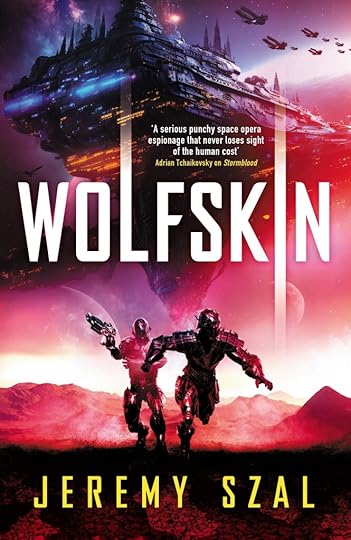
Vakov Fukasawa is trapped.
Captured by his ruthless and cruel enemies, the House of Suns, he has been broken in body and mind, tormented until he is something less than human. And yet, Vakov and his brother Artyom are the Common’s last hope.
The war against the Suns has grown to swallow the galaxy. Entire systems rattle with violence. Planets are burning. Species are hunted to extinction. And now that the genocidal alien Shenoi have been successfully summoned, billions of lives are staring into the abyss.
To save his friends and his home, Vakov will need to work with his brother to build a great intergalactic army. He will need to become the hero, the legend, his people believe him to be. He will need to draw on his every last ounce of courage to gain the loyalty and fury required to survive. He will need to become The Black Wolf.
But is Vakov willing to pay the price that victory demands?
Allow the scenes to guide you
Blindspace, the sequel to Stormblood, was the first book I ever wrote under contract. I developed an outline and kept to it pretty strictly, not wanting to let myself get side-tracked with ideas that did not fit my self-imposed narrative.
But that caused me problems. A lot of them. So I learned to loosen things up for Wolfskin. Sure, the overall shape of the story fits my vision, but I allowed myself to be a little faster and looser with how things swerved to reach that point. Certain side characters introduced themselves to me, demanding to be written, and write them I did. There’s a scene in this book that I genuinely did not think I’d get away with (you’ll know it when you see it). And there’s also a chapter just before the middle-point that I completely pantsed. I threw in several new characters and alien races and funky world-building details, set them interacting with each other, all against the backdrop of a very cool set-piece.
Neither of those things were in the outline, or the first draft. And yet, they turned out exceptionally well, because I allowed the characters and the scene and the story’s momentum to guide me. And I had enormous fun in doing so.
Trusting your own voice.
For a variety of reasons, I had a bad experience when working on Blindspace, Book 2, where I was exposed to a slew of very negative feedback about my work. And it left me doubting everything about my story. My voice. My style. My storytelling. The direction I wanted to go and the method in which I wanted to go there. I struggled to even get a single paragraph down, already imagining the inevitable criticisms and dissecting that it would be exposed to, and how I might be forced to change things.
I’ve always known that I was neurodivergent. But all this made me realise how deeply it was impacting me.
So I had to learn, all over again, how to give myself permission to do what I wanted to do. To remind myself that, yes, as the creator and CEO of this savage little world of mine, there was no objective right or wrong way for me to tell this story: only the way I wanted it to go.
But this did not happen overnight. It took at least a whole extra year of sitting down everyday and pushing, forcing myself to stick with my goals, my voice, my vision. And I’m hella glad I did, because there are a lot of risks and bold decisions that I had to take in order to finish Wolfskin, and I don’t think I could have done it if I hadn’t built up that muscle.
Good writing is not necessarily fun or easy writing (and that’s okay!)
Most of us aren’t writing to get rich (ha!) or for untold fame. We do it because we enjoy telling stories and putting our thoughts on paper. And ultimately, yes, the act should be enjoyable.
But does it mean it will be easy? Or always fun? Absolutely not.
It’s easy to write one word after another, to do what one feels like in the moment, with little thought given to craft or layering or larger story arcs. I used to write fanfiction when I was younger, and the experience was both immensely enjoyable and immensely easy.
But writing professionally, for publication, is much harder. It’s harder to show up day after day, writing hundreds and hundreds of pages with a close attention to craft and detail, making sure every scene is working as hard as it can, scraping entire chapters and characters if they do not fit, and sculpting a story arrows towards a conclusion that is logical and surprising and satisfying and half a hundred other things.
It’s much harder. And there will be days when you won’t love it, where it won’t always be fun, and where writing will feel frustrating and difficult and overwhelming (if someone says otherwise, they’re lying!). The more ambitious the project, the more intense these feelings can be.
And that’s okay.
As someone with ADHD, all this is especially true. And I’ve had to learn the hard way not to beat myself up when a given day’s writing does not rock the world, or when I’m not jumping out of bed to get to work everyday. You are allowed to have those days. You should not feel terrible if some projects are tougher to get done than others.
You’re allowed to be human.
Crank up those bad-ass moments
Sure, I write for myself. But I also write to be read, to leave an impact on the reader. And so I invested heavily in writing some epic “stand up and cheer moments”, where there is a feeling of catharsis and liberation and satisfaction.
Where we see the characters shrugging off the limits imposed on them by their tormentors and go after them with their fangs bared and wild fury in their eyes. When all the pieces fall into place and the curtain is whisked away and a grin starts slowly spreading across the face of the reader as it all dawns on them all that has been in play behind the scenes.
It’s not easy, writing these scenes. But pulling them off successfully and making everything sync up together like clockwork? Immensely satisfying. And it showed me that, when done right, how they can raise a novel to new and riveting heights!
The darkness comes from within.
For plot-related reasons that I do not wish to spoil, there’s a lot of dark emotional ground that is explored in Wolfskin, through the main character Vakov, especially at the start of the novel. Anxiety, depression, rage, hatred, self-loathing, hopelessness.
I did have the option to cut through these, and it would have been much better for the pacing. But I couldn’t. It would have been a betrayal, both to the main character, and me. These issues were things that I myself had either endured, or was currently working on, and seeing them there, as part of my story, was hugely cathartic for me.
Was it hard to channel up that darkness, to expose myself on the page like that? Yes. Unquestionably. But it also taught me a great deal about my own mind, and allowed me to have a higher level of empathy, both for my character and even for myself, as strange as that may sound. And I think it has added a depth to my writing that readers will appreciate.
Bonus thing: I couldn’t not do this.
As you may have guessed from the above, writing and publishing these books have come with some significant challenges, during a time that was already challenging (COVID, anyone?). I wrote Stormblood when I was 21 years old, and sold it at 23, and publishing can be baffling for anyone of any age.
But I could not not write them the way that they had to be. All my life, I’ve been seeking a way to be a writer. To get my vision and voice into the hands of other people. To rise above the limits imposed upon me, either by others or myself, and to let my fury shine.
In many ways, this is my story.
And now, that journey that I’ve been on, the ups and downs, has been worked into these books. Crystallized in flawed memory. Every description, every insight into human nature, is mine.
And I hope you’ll come on the adventure with me, because, like life, we cannot survive it on our own.
Jeremy Szal was born in 1995 and was raised by wild dingoes, which should explain a lot. He writes epic fantasy and dark space opera of a character-driven, morally grey nature. His main series is the Common trilogy from Gollancz/Hachette, which includes STORMBLOOD, BLINDSPACE, and WOLFSKIN, about a drug harvested from alien DNA that makes users permanently addicted to adrenaline and aggression. He’s the author of over fifty short stories, translated into sixteen languages, many of which appear in his collection BROKEN STARS. He was the editor for the Hugo-winning StarShipSofa until 2020 and has a BA in Film Studies and Creative Writing from UNSW. He carves out a living in Sydney, Australia with his family, where he loves watching weird movies, eating Japanese food, exploring cities, learning languages, cold weather and dark humour.
Jeremy Szal: Website
Wolfskin: Bookshop.org | Amazon
March 20, 2026
Shy Girl, AI In Writing, And A New Perniciousness
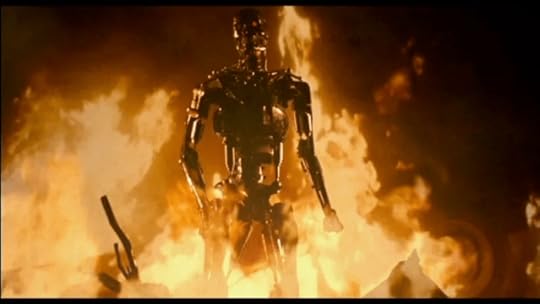
I wanna talk about Cameron’s The Terminator and Carpenter’s The Thing, but first, let’s get it out of the way —
If you know anything at all about me in this Current Era, it is that I am vehemently opposed to generative AI. I do not use it. I will not use it. It does not exist for me in any form — the only “use” I had of it recently was writing my Vital Cat Update, which copied from Google’s search engine AI off its main search page. Otherwise, I don’t touch the stuff. I don’t even know how to access it. I couldn’t tell you how to use Chat GPT or Claude or any of that. My copy of Word is one with Copilot not inside it, and I had to change my subscription to get there. I turn off Apple Intelligence in every instance I can. I am against AI because it steals our work, which it then uses to steal our jobs, which it further uses to steal our water and our electricity.
Which is to say, it is here to steal our future.
So, I’m against it! It sucks moist open ass.
But there’s a delightful (read: not at all delightful!!) new perniciousness afoot, and that requires us to talk a little about the novel Shy Girl, by an author who I won’t even name because whatever she did or did not do, I do not think directing theoretical harassment toward said author is really valuable, nor is it the point. The problem isn’t one book. The problem is the whole system.
To keep it as brief as I can, what happened was, to my understanding:
Shy Girl was a self-published novel. A horror novel. It came out a year or so ago, on its own, I think? It did well enough, I guess, though I don’t know that it set the world on fire — but somehow a publisher, Hachette, picked it up for traditional publication and it was to come out soon. Ten months ago, there appeared to be accusations that the book read like it was written by generative AI in whole or in part. Those conversations continued and appeared to boil over right around now-ish, and the current narrative is that the author did not herself use generative AI, but employed an editor who made changes to the book using generative AI, changes that the author did not — review? Did not catch? I don’t know for sure.
Certainly some aspect of this may be wrong, or new details may come out, and if you have corrective details, please sling ’em in the comments below.
That is the situation currently.
To switch tracks a bit, though you’ll soon see (or already can predict) where this is going: I’ve in the last several months seen an uncomfortable number of instances, usually on Threads, where someone will look at a photograph or a video or a piece or art or graphic design and they will assert, with dogmatic certainty, that is AI.
And sometimes, it is, or appears to be.
And other times, it definitely isn’t.
I’ve seen people look at a beautiful, very real but also very-processed photo, and say with their whole chest, that shit is AI, and sometimes that’s started a small little avalanche of people asserting similarly. And in more than one instance, I’ve seen the creator come back and post how that photo predates the current generation of gen-AI — it’s just a photo that looks either really good because of Lightroom or really overprocessed because someone wanted a slick HDR effect, or whatever.
This has also happened with writing.
It started with the emdash.
It was asserted, with Great Authority, that emdash use was a strong signifier of a piece of writing being AI.
The artbarf robots, they said, love that little emdash sumbitch so much, so so much, that they just can’t help themselves.
Needless to say, that made my bowels go to ice water because —
Holy shit, I love the emdash, too.
In fact, most Current Era writers I know love love love a fucking emdash.
But instead of making me sympathetic toward the artbarf robots — “Aww, it loves the same things I do!” — it only made me hate the artbarf robots more, because the reason the piece-of-shit AI loves an emdash is because it stole all our work, and all our work features a lot of goddamn emdashes.
It doesn’t use emdashes.
We use emdashes, and it stole our work and then mimics us.
Emdashes and all.
So now, with Shy Girl, what do I see?
I see some folks putting forth the “signs” that told them that Shy Girl was very obviously AI-written, and those signs include a number of stylistic choices.
And when I say stylistic choices, they are not choices that generative AI made, because generative AI doesn’t make choices. It just eats and regurgitates.
We make choices, as authors. Narrative ones, stylistic ones, and so forth.
But this list of signs and symptoms and AI portents included stylistic choices that I myself absolutely one hundred percent make. Same as the emdash. I’ve seen people say that AI loves metaphors, AI loves certain kinds of repetition, it loves adjectives no wait it loves adverbs no wait it loves alliteration no wait–
Of course, again, as with choices, AI doesn’t love a fucking thing, because AI isn’t alive, it isn’t intelligent, it isn’t aware. The key word is always artificial. It fakes it. It fakes choices. It fakes preferences. It fakes love. And it is able to fake it because it stole those choices and preferences from us.
I saw The Terminator last night on the big screen. I’ve seen it before, obviously — seen it many, many times. Seen all of them! Even the stinky ones. But I think this was my first seeing that one on the big screen. (It’s of course excellent, if occasionally a little corny and showing its age.)
But one place where it isn’t showing its age is how it still issues a sharp warning about AI — it’s long been held as a kind of bellwether for that particular threat, right? It’s an early iteration of the Torment Nexus meme. That warning has told us, hey, AI is going to get smart, get mean, it’s going to inhabit robots who want to kill us, it’s going to tangle itself up in our systems and decide that we’re a threat and drop a batch of nukes on our heads.
But I think one of the warnings in the movie(s) didn’t really register for me back then, but it damn sure registers now —
What happens in the movie? The AI is going to pretend to be us, and it’s going to be get harder and harder to tell the difference. It’s going to wear our faces. Only dogs will be able to sniff it out. It can steal our voices — so when we call home to talk to Mom, maybe the Mom we think we’re talking to us actually dead, and it’s a soulless Cyberdene drone on the other end there.
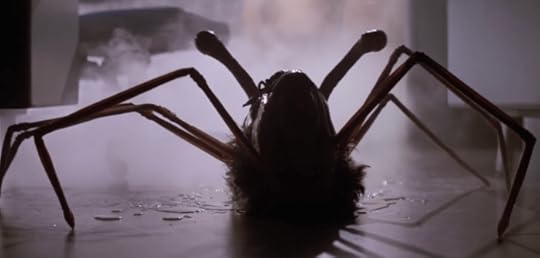
That makes me think of John Carpenter’s The Thing, because it, too, understands that same threat, but worse — it understands the fear of being amongst your people except one of those people isn’t your people. Ohhh, no. It’s an Impostor, an alien being clothed in the raiment of your friend’s flesh, and soon you’ll be paranoid about who is alien and who is human, and you’ll have to work very hard to find a way to figure out just who is who — all that without accidentally killing a friend, or failing to kill the thing that wants to eat your face and then wear it.
Sound familiar?
The AI — artistically! — is us.
It steals our artistic skin.
It wears it, pretends to be us.
And it gets harder and harder to tell what’s us, and what’s it.
I’ve long said that one of the threats of AI is that it damages the fidelity of our information. Of truth and reality itself! It’s not just that it pumps out misinformation and disinformation — digital illusion and virtual legerdemain! — but rather that its mere existence makes it harder and harder to tell what is truth and what is fiction.
And we’re seeing that now with Shy Girl.
We’re seeing it with photos and videos and artwork.
People are right to hate AI — and the pernicious, insidious presence of AI has made them like the men trapped in that Antarctic base.
They are paranoid that it’s everywhere.
Because, ostensibly, it is. Or they (they being the techbros who are really the man behind the wizard curtain) want it to be. And it has a deleterious, corrosive effect on all that we do and all that we see. It’s like Paramount taking over CBS, or Musk taking over Twitter — it doesn’t matter that it becomes successful, it just matters that they ruin the ability to disseminate good information. To ruin truth.
So, what the fuck do we do about all this?
I have no idea. I mean, the obvious thing on the face of it is to keep your own garden free of it. Pledge to use no AI. In all the ways you can avoid it? Avoid it. But that won’t stop someone in the future telling you you’re using it. Or even using an AI detector — which is itself AI! — from “detecting” it. And it won’t stop others from assuring you that this photo or that video or this logo is AI, even when it’s not. That certainty has been ruined.
More to the point, I don’t know what this means for writers, for readers, and for publishing at large. Ideally, publishing gets ahead of this problem and tries to get commitments from writers to not use AI — but therein lies a rub, too, wherein a “no AI” contract looks like a “morality clause.” Without clear definitions, if enough people were to accuse you and your book of being AI — whether at the authorial level, the editorial level, or in some aspect of publishing — they can get it tanked whether or not AI has ever even chastely kissed the work in question. And it doesn’t inspire confidence when a publisher like Hachette published Shy Girl… when already the accusations of AI were afoot. Did they do their due diligence? I don’t know. Maybe! But given the lack of editorial oversight… ennnh, maybe not.
Do I think AI should be published? I do not. I think using AI at any of those levels is not only problematic for the reasons listed above, it also takes opportunity from an Actual Human doing the Actual Work of Being Human. A contract given to some slopwrangler is a contract not given to an actual writer. A fake book will take the place of a real one. It’s stupid fucking robots all the way down when it should be humans.
So, this is a snarled nightmare tangle — one where the existence of AI en masse is becoming its own problem, regardless of whether it’s presence in a single instance of art of writing. We’re just going to have to do our best going forward. We must pledge not to use it — but also try to be very, very cautious kicking other people under the tires of this bus without knowing for absolute sure what we’re accusing someone of doing. As AI gets better, the environment in which it exists is only going to get noisier and more confusing. And we can’t just stick a copper wire into the blood of the book to make it transform into the monster, revealing its True Self.
We just gotta do our best. Be vigilant, be cautious.
And don’t use the AI slop-shitting artbarf techbro bullshit.
SIGH.
I do not care for this era of writing and publishing, lemme tell you.
The faster we pop this bubble, the better off we will all be.
Good luck, friends!
And fuck off, robots.
Buy my books or I die in the abyss.
March 18, 2026
Cover Reveal: Stephanie Feldman’s The Night Parade
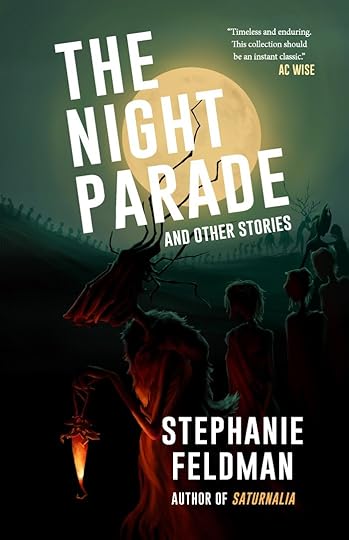
A teenage girl realizes her lifelong best friends are being seduced by a supernatural force, and must choose between being alone and being ensnared together. A young woman in a troubled relationship finds herself caught between two versions of the same boyfriend—one volatile, and one too good to be true. A lonely mother fears her young child’s best friend is a witch. And, in the titular novella, a new widow must decide how far she’s willing to go to steal her husband back from the dead.
From Stephanie:
I started writing short stories after I moved back to my hometown—or rather, to the suburbs outside my hometown of Philadelphia. I felt strange and out of place after a lifetime of living in cities, and embarking on a new stage of life. Part of my acclimation process was looking for the strange, the weird, the haunted in this lovely little town, and the region beyond. And of course, you can find weird stuff everywhere, if you have the right eye: power struggles among small children, stairs leading to roads that no longer exist, nearly forgotten histories of ghosts and hermits. I wrote about more familiar legends, too, like creatures stalking the New Jersey Pine Barrens and Pennsylvania’s own miniature hominid trickster, the albatwitch. Through all these stories crept women who can’t quite figure out how to be friends, girlfriends, wives, mothers—who know something is wrong, but can only sometimes explain what it is. I’m so excited that Artemis Swenson, the artist for The Night Parade and Other Stories, captured the atmosphere and mystery of these stories, and created this procession of strange figures, a nod to the destructive ghostly parade of the new title novella. Part of me wants to run from them, but part of me wants to join them. Which I think is what the best scary stories are all about.
In The Night Parade and Other Stories, Stephanie Feldman revisits the mid-Atlantic’s eerie legends and settings to epxplore complicated friendships, romantic entanglements, motherhood, and grief with a deft hand, a piercing eye, and a feminist twist.
“The Night Parade explores the horror and magic to be found in the mundane and the everyday, inviting readers to look deeper at their own world and discover the wonder and terror it holds. A wonderful and effortless blend of genres, strange, haunting and lovely – this is a collection that will stick with you long after you’re done reading.”
— AC Wise, author of Wendy, Darling and Ballad of the Bone Road
“Stephanie Feldman is a weird fiction wizard. This is a perfect collection of tales that burn right to the cold heart of our doomed relationships, our secret fears, our terrible lonelinesses. How do we sink into or run from the mundane terrors of our everyday lives? Join The Night Parade, and Stephanie will show you.”
— Sam Rebelein, Stoker-nominated author of Galloway’s Gospel
“Eerie, beautiful, fierce, and elegant, The Night Parade and Other Stories haunts. Steeped in folklore, urban legend, old magic, and horror, Feldman’s incisive prose grapples with grief, power, and womanhood in all its forms. From the Pine Barrens and the Jersey Devil to strange creatures in the woods, Stephanie Feldman is an important voice for the weirdness of the Mid-Atlantic, and this is the rare collection that demands to be read and reread immediately.”
— Erika Swyler, National Bestselling author of The Book of Speculation
Stephanie Feldman is the author of the novels Saturnalia, a Locus Award finalist, and The Angel of Losses, a Barnes & Noble Discover Great New Writers selection, Crawford Fantasy Award winner, and Mythopoeic Award finalist. She is co-editor of the multi-genre anthology Who Will Speak for America? and her stories and essays have appeared in Asimov’s Science Fiction, Catapult Magazine, Electric Literature, Flash Fiction Online, The Magazine of Fantasy & Science Fiction, The Rumpus, Vol. 1 Brooklyn, Weird Horror, and more. She lives outside Philadelphia with her family.
March 4, 2026
Ruth Knafo Setton: Five Things I Learned Writing Zigzag Girl
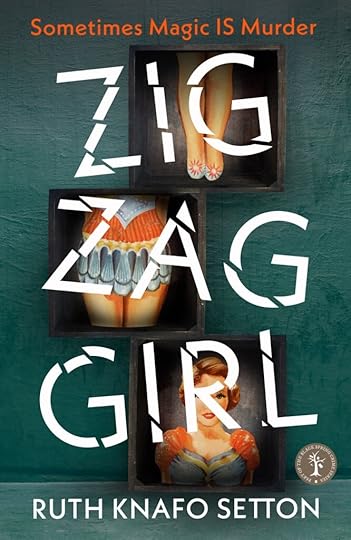
To catch a killer who knows her secrets, magician Lucy Moon must perform the most dangerous trick of her life—discovering who she really is.
A murdered woman inside a magic box. A black rose in her mouth. And a secret that won’t stay buried.
Lucy Moon performs nightly at a crumbling Atlantic City theater, a gifted young magician hiding a past she’s never told anyone. When she discovers her best friend’s body during the infamous Zigzag Girl illusion — staged to mirror an unsolved killing from decades ago — Lucy is drawn into a web of deception that reaches from the town’s criminal underworld to the mist-shrouded Pine Barrens.
With a killer who knows her secrets closing in, Lucy turns to the only people she can trust: a fierce band of female magicians and mystics with powers that blur the line between stage craft and something older. But as the suspects multiply and the murders echo forward from the 1940s, Lucy faces the most dangerous performance of her life — unmasking the truth about who she really is, while keeping her distance from the enigmatic man at the center of the investigation. A man who may be a killer. Or the only one who can save her.
1: I got locked in a real straitjacket for this book…
Picture this: a basement in Philadelphia, thirty male magicians watching, and me—the only woman—strapped into a regulation Posey straitjacket, the kind used to restrain the patients in a mental hospital. Canvas so thick it feels like punishment, collar choking my throat, arms pinned crucifixion-style, and the ultimate insult: a crotch strap. No gimmicks, no tricks. The real thing.
I’ve been sawed in half, and then sawed in thirds, but the first time I truly felt terror was when I was strapped, buckled, and locked inside this straitjacket. I’d absorbed a few vague clues from watching magic, but as I stood under bright lights facing the audience, I couldn’t remember a single one. Getting to this secret magicians-only Escape Workshop was a wild journey; getting out would be another, one for which I had no experience, tools, props, or map. All I knew was that one way or another, I had to break free.
No one had told me a straitjacket was so hot, its rough canvas an insult to the flesh, and the neck so goddamn tight. I itched everywhere. I wanted to go home. I wanted to cry.
“Tell me what to do,” I whispered to the magician who’d organized this workshop.
He shook his head. “It’s a three-dimensional puzzle, and you are part of the puzzle.” He added softly, “The only interesting part is the story. Find the story and act it out.”
I squeezed my eyes shut. The story. Why was I here? Why did magic fascinate me to the point of obsession? Why had I spent the past three years studying magic? Teller—the silent half of Penn & Teller—said, “I love wallowing in magic.” Yeah, so do I. But why? And what was my story?
Once upon a time a little girl dreamed of becoming a writer because every time she opened a book she entered an enchanted garden where anything was possible…. and years later, when she studied magic she found herself back in that enchanted garden, and lo and behold, everything was possible. As a magician assured her, “If you can imagine it, we can make it happen.”
2: Atlantic City Is the Perfect Place to Hide a Body (and a Soul)…
Writing Zigzag Girl taught me that Atlantic City provides the perfect backdrop for a story about magic, mystery, and murder. But I grew up going down the Jersey shore, and I watched Atlantic City transform herself year after year. Atlantic City has a past.
Actually, many pasts, and none of them are past.
Somehow they all live in the shadows of the present. The signs are painted over, but traces of the originals remain. The shadows under the boardwalk always made me believe another world existed beneath the rafters, a parallel world.
In Zigzag Girl, I traveled back to WWII, when Atlantic City was taken over by the US Army and turned in Camp Boardwalk. It was an amazing period of danger and desperation, of heroism and glory—and almost no one knows about it! My characters in the present are haunted by secrets from that era that were never resolved. In Atlantic City, past and present bump into each other on the legendary boardwalk that stretches between glittering casinos and the indifferent Atlantic Ocean—a liminal space where anything might happen. It’s a town that exists in the space between dreams and disappointment. She’s been battered by bankruptcies and hurricanes, yet every dawn the Atlantic still crashes against her pilings, and the wheel still spins at Steel Pier. She’s a dame who’s been knocked down in the ring too many times to count.
But as Jinx, my 90+ year old journalist says, “A dame picks herself up, puts on Carmine Red lipstick, and gets back in the ring.”
Atlantic City is the kind of town where people come to reinvent themselves, to escape their past, to believe in the possibility of transformation. Naturally, it’s also where they come to kill and be killed.
3: Jersey Magic runs on Aqua Net and attitude…
So… a town like Atlantic City needs a different kind of magic, the kind that is both seedy and grand, and that perches between Woowoo and Fuggedaboutit, between the spiritual and the streetwise. My protagonist Lucy Moon creates illusions using Aqua Net hairspray—the purple can, because she’s got standards. She performs card tricks with press-on nails that could double as weapons, makes cannolis from the Italian bakery on Arctic Avenue disappear (into her mouth, usually). Her magic smells like espresso and sounds like Springsteen. It’s the kind of magic that says, “Yeah, I just made that quarter vanish. You got a problem with that?”
And then there’s Elvis Jones, the mysterious bird whisperer who does amazing magic with his seagull (trained, not tamed), magic so powerful it spills from the stage to the street (or boardwalk), and makes Lucy almost—not quite, but almost—forget that he is a prime suspect in her friend’s murder.
Lucy’s “Jersey magic” is her armor, her origin story, her way of controlling chaos. Creating illusions for Lucy, her friend Stormie Weather, and Elvis Jones set me free from boxes I hadn’t even realized I’d locked myself into. But that’s what magic does—it shows us that our imaginations set us free.
4: Love is the most dangerous magic of all…
Murder exposes the lies society tells itself; love exposes the lies we tell ourselves. I’ve always been fascinated by the dance of frustrated desire between two strong, flawed characters. When Lucy finds herself falling for Elvis Jones, the prime suspect in the murder investigation, sparks fly and danger erupts.
The dance of desire across mysteries, secrets, risk—my therapist has notes, but I love reading it, and I love writing it. Passion, desire, love—they lead us to do things we never thought we’d do. It’s the one thing we can’t predict or force; the spark is there or it’s not. And it’s there in Zigzag Girl, where the danger a woman faces when she trusts a man is heightened by the suspicion that he might be the murderer. Those sparks—they are life, but they can also lead to death. Some tricks you can’t rehearse. Some escapes you survive only once.
That tightrope, that moment when a man and a woman face each other across a gulf of mistrust, suspicion, fear, and desire… Will she take a chance and leap across that gulf? And what will she find if she does? The vulnerability required to love in a world already full of danger.
That moment.
I live for that moment.
5: To Write Dark, First Find the Light…
To write dark, first find the light—that glint shining in the distance, a streetlight beckoning from a corner, the glimmer of a woman’s smile, a child’s eyes raised in hope. Writing dark doesn’t mean erasing tenderness, love, and humor.
Think of black humor, gallows humor. Every Jewish holiday in three sentences: They tried to kill us, we survived, let’s eat. Same rule for murder mysteries: someone tried to kill us, we survived, pass the cannoli.
The shadows are real, but the punch line insists on ordinary life continuing anyway. Because life does go on. People fall in love, work, carry on with the business of being a human in the world.
I also go back to the great existentialists, Camus and Sartre. Yes, the world is absurd. That’s a given. But if that’s the case, then why write? Because we must. It’s Sisyphus pushing the boulder up the hill, getting to the top, and for an instant reveling in his success, and then watching it fall back down to the bottom. And there he is pushing it back up the hill again. Is he a fool? Are we all fools? Or do we all carry the faint hope that this time will be different?
I imagine the version where Sisyphus gets to the top, stands in the sun for one perfect second, then walks back down whistling. Because life—like Atlantic City—keeps dealing another hand.
Bonus Thing: The Story That Finally Set Me Free…
The magician in charge refused to tell me how to escape the straitjacket, but he showed me. He jerked one shoulder; I jerked my shoulder. He slid and wriggled; I slid and wriggled. I squirmed inside the jacket and tried to push my way out but my head was completely submerged. I choked on stale air, and I felt sudden terror: I could suffocate to death inside the canvas prison and no one would know—they’d think I was “telling a story,” the way he had suggested. In raw desperation I tugged the jacket, squirmed and stretched, and magically, miraculously, tore that mother off.
I gulped air. It had taken me ten minutes. With a war whoop, I tossed the jacket to the floor. The magicians cheered and whistled, and I beamed, proud as a kid riding a two-wheeler for the first time.
It wasn’t till later that I realized: that is my story. The girl who dreamed of an enchanted garden, who wrote at age 9 in her first diary: “I want to be a writer,” who grew up and wrote and traveled, and worked, and lived… and became the woman who never gave up, who keeps freeing herself from visible and invisible chains, and who’s still writing.
Zigzag Girl is proof: no lock, no chain, no jacket can hold us if we remember the story and refuse to stop struggling.
Thank you for reading. Now go put on Carmine Red lipstick and deal yourself back into the game.
Born in Morocco and raised on tales of wonder, Ruth Knafo Setton is the author of the novels, The Road to Fez, and Zigzag Girl—which is a finalist for the International Thriller Writers Award for Best Standalone Book of the Year. Zigzag Girl also won Grand Prize in the ScreenCraft Cinematic Book Competition and First Place in the Daphne du Maurier Awards. Her TV pilot for Zigzag Girl won First Prize at the LA Crime and Horror Film Festival, and her screenplays have been recognized by Austin Film Festival, Sundance, and CineStory. A multi-genre author, her award-winning fiction, poetry, and creative nonfiction appear in many journals and anthologies. An NEA fellow, she has taught Creative Writing at Lehigh University and with Semester at Sea.
Ruth Setton: Website | Instagram
Zigzag Girl: S&S | Bookshop.org | Amazon
March 3, 2026
Out Now: The Staircase In The Woods, Paperback Edition

The day is upon us when The Staircase In The Woods achieves its final form, which is to say, trade paperback. (Okay, no, I don’t literally know if it’ll be its final form — I only mean, when this happens, the hardcover edition phases out, and the paperback edition becomes the dominant edition they reprint as long as said reprinting is deserved.)
Let’s just get procurement portals out of the way now —
First, if you want a signed and personalized copy from me whereupon I provide you with your VERY OWN LIMINAL ROOM AT THE TOP OF THE STAIRCASE, hey, you can order a copy from Doylestown in the next few days and I’ll be signing and getting those shipped out next week.
There’s also your local indie, or bookshop-dot-org as options.
For the paperback, there’s also AMZ, B&N, Powells, BAM, and of course in audio and ebook the book is still existing at all the expected places.
And all that being said —
Maybe instead you just wanna come find me and grab the book at The Twisted Spine this Thursday the 5th, where I will hang out with Clay McLeod Chapman. (Details here.) Orrrrr Thursday the 26th where I get to hang with Eric LaRocca at Thrillerdelphia for his newest, Wretch. (Deets here.)
It’s taken a while to get to paperback release, in part because the hardcover sold very well. I’ve talked about this before, and I say it not to brag, but in hardcover it’s sold more than the full current HC + PB runs of Wayward and Black River Orchard. (Er, not combined.) Something about this book is hitting with people, and I think it’s a polarizing read for some folks, and I think that was true of this book’s spiritual cousin, The Book of Accidents, too. (If TBOA was about family, TSITW is about friendship. And they’re both ostensibly very oblique looks at The Haunted House genre.)
It’s been a nice journey with this book — though I don’t know that I’ve had any really not-nice journeys with a book, barring maybe the Star Wars books, and perhaps the disappointment that Wayward didn’t quite get there in terms of sales or even awareness levels. Staircase has lived a good life so far and I hope it keeps getting to live that life — I’ll admit a small little sad-face-emoji that it didn’t get love at the Stokers this year, but that’s just me feeling Peppermint Petty, because the books that did get recognized are beyond deserving. (And I’ll further admit that my sad-face-emoji turns to the angry-face-emoji when I see that books like When The Wolf Comes Home, Coffin Moon, Victorian Psycho, Vanishing Daughters, Bat Eater, At Dark I Become Loathsome, Crafting for Sinners, all failed to get noms, but that’s life in the big city, and you should check out all those novels ASAFP.)
I’ve had many folks ask me about a sequel to this book, and I’ll say there are no plans for one — while there’s a sort of open door at the end of this, I do think the story for our characters concludes, and sequels to books like this just don’t hit in the marketplace the way I’d hope. (See: Wayward.) That said, if something really tickles me, I’d consider it.
I’ll note that I’ve had in mind for a good year or more now a book that actually gathers a number of characters from my other books — Miriam Black’s daughter, Lulu; Oliver, from TBOA; a character from Staircase that I won’t mention; Pete Corley from Wanderers/Wayward — and kind of sends them on a strange adventure together, sort of an oops our universes discarded us and now we’re here thing, with a great evil to confront in a mad world. That’s a maybe-one-day thing, but I can’t imagine there’s a market for it or that my publisher would be hot to trot for it.
In the meantime, there miiiiight be some loose little threads — like diaphanous spider strands, drifting on the wind — catching on the story in The Calamities and forming a new, gleaming web.
(That book is coming out in August, and you should definitely preorder a copy through Doylestown Bookshop, and I’ll sign and personalize it and tell you who the ancestor is of your fiendish demonic brood, you know, for funsies.)
Ooh, one last piece of trivia —
So, this book has been living in my brain for a long time — many of my books do that, and I often note that when I have ideas I generally try to chase them away, and it’s the ones that keep fucking pestering me that get written down. And this particular idea is actually the very first one that starts my Notes-app BOOK IDEAS file I’ve been maintaining for years and years — and so when it came time to pitch a new middle grade book, I pitched Staircase first as a middle grade book. I know. I know. I aged down the characters to middle-grade, and there was no “grown-up” component (i.e. the POV that dominates this book now), and I pitched it and my editor was like ha ha what the fuck this is too dark, no, nooo, no no no, and so we ended up with Monster Movie! instead — and that became a kind of spiritual cousin to this book, in its own way. Books about friendship and fear! I think if you read both you’ll find some connective tissue.
But somewhere out there is an alternate universe where this book was…
For kids.
*shudder*
Anyway! Paperback is out!
Tell your friends!
Tell your family!
Use it to torment your foes!
And if you’ve read the book, please leave a review in a reputable review receptacle, thank you.
OKAY COOL, ENJOY THE BOOK, LOVE YOU, BE SAFE AND SANE OUT THERE, BYE
p.s. the book also comes out in the UK on Thursday the 5th, where it was a Sunday Times Bestseller (!?) — cover here: