Barry Joseph's Blog: Seltzertopia Blog
August 7, 2025
Book talk in Luna Park, Coney Island
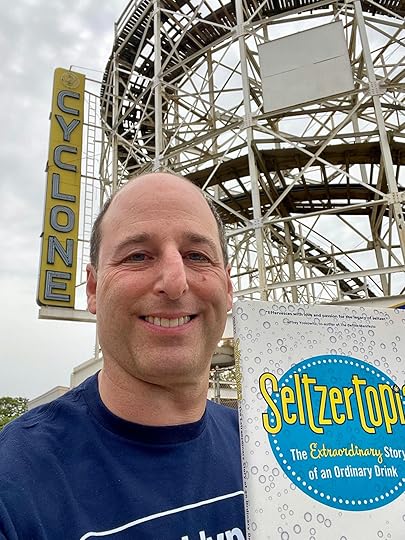
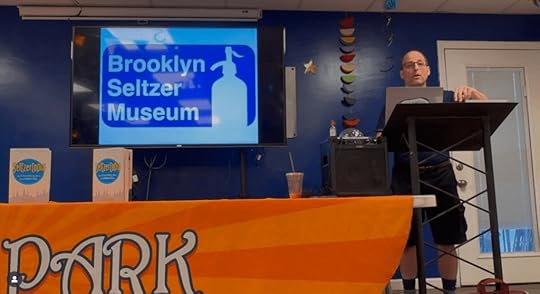
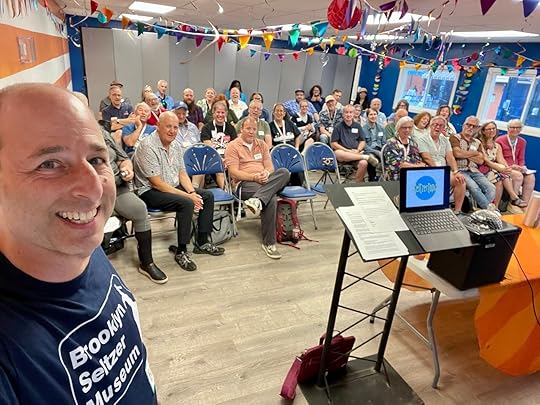
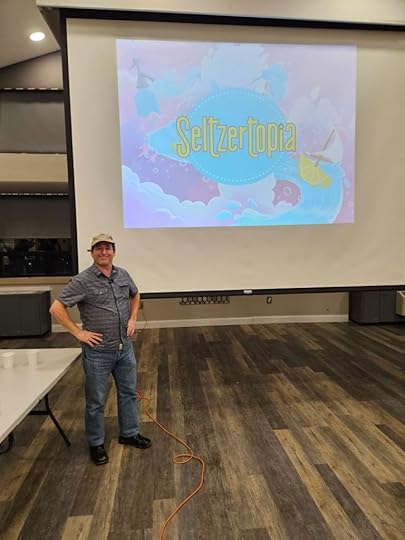
Last night I had a blast giving my SeltzertopiaLive! presentation in Coney Island, with the screams from the Cyclone just feet behind me. The occasion was the monthly meeting of GANYC, the city’s association of independent tour guides. It was a treat to speak to an audience about what a gift it is to feel passionate about something and share it with others when that very audience lives this truth through their very work.
They also send me some lovely feedback afterwards: “Thank you so much for a fantastic presentation! We really enjoyed it so.much. You are a phenomenal presenter.”
You can check out some photos below and even watch a recording they made.


June 16, 2025
Smithsonian Magazine Features Brooklyn Seltzer Museum
Smithsonian is a magazine covering science, history, art, popular culture and innovation. They recently published an extensive article on seltzer, covering both the factory where we are located–“Their seltzer is the punk band of effervescence”–and, of course, the Brookyn Seltzer Museum.
You can read the entire, excellent article from Liza Weisstuch here or highlights about the Musem and the factory below.
The Effervescent History of Seltzer, From the Early Days of Home Delivery to Today’s Trendy CansA century before LaCroix or Spindrift were refrigerator staples, factories in New York City were carbonating gallons and gallons of tap water each dayJune 12, 2025
Seltzer is a high-pressure business. And you can see it—all 65 pounds per square inch of it—at the filling station at Brooklyn Seltzer Boys, New York’s last remaining seltzer factory, located in Cypress Hills.
On a Friday in April, a worker in thick rubber gloves and waterproof overalls stood at a hulking iron and steel machine, a century-old piece of engineering. He placed one heavy glass bottle at a time onto a spigot on a rotating belt and removed it once it was filled with a powerful surge of chilled, highly pressurized water, straight out of the old carbonator. He packed them by six into wood crates, their siphon heads sticking out like little chrome bird beaks. Each week, up to 5,000 bottles like these are filled and packed in a truck for delivery.
A century ago, New York City was a hub of manufacturing—from the clothing factories that gave Manhattan’s Garment District its name, to the headstone makers that dotted the Lower East Side when it was a Jewish enclave, to the shipbuilding operations in the Brooklyn Navy Yard and the iron foundries of the Bronx. In the 1930s, dozens of seltzer plants filtered and carbonated city tap water and filled it into airtight siphon bottles. Today, Brooklyn Seltzer Boys is the sole survivor in the five boroughs, and one of only three seltzer plants in the country.
In a moment where pop-culture trends have a blink-and-you’ll-miss-it evanescence, and every beverage or bite du jour seems to outdo the last when it comes to innovation, seltzer endures as a giddy paradox. It’s historic, but it’s perpetually trendy. It’s natural, but you can manufacture—or even enhance—it without cheapening it. It’s healthy, and its contemporary popularity owes a lot to public health campaigns’ warnings against sugar, but pair it with Scotch or vodka and it’s a sneaky vice. It’s the little black dress of drinks—suitable for any occasion. And that’s all palpable inside a brick building across the street from a car repair shop in Brooklyn.
[image error]Each week at Brooklyn Seltzer Boys, up to 5,000 bottles like these are filled and packed in a truck for delivery. Christina Horsten/picture alliance via Getty ImagesThe origins of seltzerBrooklyn Seltzer Boys, a fourth-generation-run business, is part of a 2,500-year-long history that’s outlined on plaques at the Brooklyn Seltzer Museum, housed at the front of the space. Here you learn that Hippocrates wrote about naturally carbonated water’s medicinal properties in his seminal work “On Airs, Waters, and Places,” and that spring water from Niederselters, the German town where seltzer got its name, shipped its elixir around the world in the 1700s. The museum notes other highlights in seltzer’s timeline, like how, in 1837, the modern glass seltzer siphon bottle was patented and, in 2015, seltzer got cheeky when “La Croix over boys” was introduced as part of a marketing campaign.
…
In 1858, Gustavus D. Dows created an ornate marble version, a Rococo apparatus complete with eagle-shaped handles, for his pharmacy in Lowell, Massachusetts, patenting the device in 1863. With that, the soda fountain had arrived.
“The democratization of seltzer had begun,” says Barry Joseph, author of Seltzertopia: The Extraordinary Story of an Ordinary Drink and the pre-eminent—arguably, only—seltzer historian in the United States. He is also the co-founder and director of the Brooklyn Seltzer Museum.
…
From Jewish dinner tables to mainstream America“Seltzer” is a Yiddification of “szelters,” the word appropriated from Niederselters, the German spa town that first made fizz famous. But natural springs were abundant around Europe, so how seltzer became a staple on Jewish dinner tables colloquially referred to as “Jewish champagne” is something scholars have made a sport of conjecturing.
[image error]The Three Stooges spray each other with seltzer during a scene from one of their short films. Bettmann/Getty Images…
For Joseph, it’s multifaceted: It was inherently kosher and a healthy complement to heavy food, he says. But he points out the bigger picture.
“Jews moved from country to country and developed practices to maintain tradition. What you consumed was part of defining your identity,” says Joseph. “After World War II, Coke symbolized the beginning of the American century and cultural dominance. Others abandoned seltzer, but Jews held onto it longer.”
Brooklyn Seltzer Boys is the contemporary iteration of Gomberg Seltzer Works, founded in Brooklyn’s Canarsie neighborhood in 1953 by Moe Gomberg, a Russian Jewish immigrant. Before opening his own seltzer factory, Moe was one of hundreds of seltzermen who schlepped crates of fizzy water to people’s front doors, explains Kenny Gomberg, Moe’s grandson and the current president of the company. Each seltzerman had his own branded bottles—typically his name, often embellished with a Star of David, menorah or other Jewish insignia. They’d fill them at a factory in the morning, then head to make deliveries and collect the used bottles on their own route. When a seltzerman retired or passed away, another could buy his route and his bottles.
Gomberg Seltzer Works operated as a production and filling plant. But in the 1970s, business began to change, as people took to buying carbonated drinks in plastic bottles. Immigrants who shaped the city’s early 20th century culture were dying or moving to Florida, including seltzermen themselves, and an increasing number of women were joining the workforce, leaving nobody home to receive deliveries. At that point, Gomberg was under the stewardship of Moe’s son, Pacey, who shifted his focus from delivering freshly bottled bubbles to beer and soft drink distribution. It would remain a filling facility for the city’s dwindling number of seltzermen on through Pacey’s son Kenny’s tenure, though.
Seltzermen delivered to immigrant neighborhoods and beyond in major cities, but the drink only claimed its spot in the mainstream marketplace because of an aquifer in southern France: Vergèze, source of Perrier.
“When Perrier came to the U.S. in 1977, it introduced expensive single-bottle servings of water,” says Joseph. “It came with marketing campaigns targeting yuppies. The trend exploded and opened opportunities in the marketplace. Flavored water all started with Perrier.”
…
In this renaissance of seltzer, its universal appeal is indisputable. “Jews have affinity for seltzer, but it’s everyone’s,” says Joseph.
The big business of little bubbles…
Alex Gomberg, 38, joined the family business in 2012, newly minted with a master’s degree in higher education administration. He changed the name to Brooklyn Seltzer Boys, moved the operation to its current location, and got back into the delivery service. Today, the company delivers to more than 700 clients. He chalks up the success to the ecofriendly perks, unapologetic nostalgia and an epicurean taste for a more powerful fizz than a can of fancifully flavored LaCroix can provide.
[image error]Alex Gomberg, 38, joined the family business in 2012. He changed the name to Brooklyn Seltzer Boys, moved the operation to a smaller location in Brooklyn’s Cypress Hills neighborhood, and got back into the delivery service. Christina Horsten/picture alliance via Getty ImagesMention the LaCroixs and Polars and Spindrifts of the seltzer world to the Gombergs, and it’s a nonstarter, akin to suggesting to a third-generation Camembert maker in Normandy that Kraft cheese is worthy of discussion. The issue with seltzer from a can or a bottle is that it loses its vigor the moment you pop it open. Seltzer in a glass siphon bottle stays fresh for months.
Today, Kenny, 67, is “retired.” He gestures air quotes, explaining that he stays busy as the company’s resident handyman. He learned to fix the antique machines from repairmen who stopped by the shop when he was a kid. Now he’s focused on teaching his son, Alex, the company vice president, how to maintain them. It’s critical to keeping the business running. Replacement parts are hard to come by. Specialized mechanics, even more so.
“It’s all about pressure,” Kenny says. “There’s a valve in the head of the cap. You pull the trigger to squeeze out, and when you let go, the valve seals and the pressure remains. On the contrary, with a twist cap, you lose pressure once you open it. With a spigot, the pressure remains in the bottle until the end, you get that massive whoosh of remaining pressure.”
The Gombergs’ seltzer clocks in at 65 pounds per square inch, a testament to the Seltzer Boys’ motto: “Good seltzer should hurt.” Seltzer attacks and bites. Any Gomberg will tell you, you should feel it in the back of your throat. (Kenny says he polishes off a few 26-ounce bottles each day.)
How should I put it? Their seltzer is the punk band of effervescence—a Clash album played on a turntable through deluxe Wharfedale W90 speakers. If you’re looking for the equivalent of an anodyne Top 40 hit to stream on your iPhone, head to the soft drink aisle of your local supermarket.
Real seltzer requires heavy-duty glass bottles that are a quarter-inch-thick on the side and a half-inch-thick on the bottom. The best were handblown in Czechoslovakia in the early 1900s. They’re the bottles that the Gombergs largely use in their business today. Alex estimates they have thousands, many of which have been acquired from seltzermen when they retired, or estate sales. There’s also a very good chance that a bottle that Alex Gomberg packs into his truck today was handled by his great-grandfather during the Eisenhower administration.
“It feels like everyone has a story when they see a seltzer bottle—even people who didn’t grow up in New York,” says Alex. “But we have customers who’ve had seltzer delivered to their home for three generations. The bottles are just beautiful. People really like to have them in their home.”
On the afternoon I visited the Brooklyn Seltzer Museum, Joseph, its director, was giving a tour to a dozen museumgoers, some of whom had stories of their own to share about seltzer-bottle water fights among siblings, seltzermen they knew as children or Friday night Shabbat dinners washed down with bubbles. Standing in front of tarnished vintage machines on display, he explained how local tap water is triple-filtered through sand, charcoal and paper, then blasted with 120 pounds per square inch of carbon dioxide in a carbonator, chilled to 43 degrees Fahrenheit and bottled. The kid-friendly tour, which includes interactive displays that explain the vintage machinery on exhibit and a variety of carbonation-centric comic strips and old illustrations, wrapped with a fresh egg cream, the erroneously named classic New York City drink that contains neither egg nor cream. Just milk, chocolate syrup and seltzer, though iconoclasts argue that vanilla syrup is acceptable, too.
“Yes, once you add chocolate syrup and milk to the equation, there are a thousand different ways to make an egg cream, but there’s not a lot to say about how to combine water and CO2 [to make seltzer],” says Joseph, who teaches museum studies at New York University.
“It’s iconic, but it’s so generic and elusive that you can really read into it,” he adds. “You can talk about seltzer as it relates to health or comedy or nostalgia or identity. That’s part of its power. It’s like a mirror reflecting back at you.”
May 27, 2025
Northwestern University Features Profile on Brooklyn Seltzer Museum Director
In their People and Profiles column, the magazine for Northwestern University featured the Brooklyn Seltzer Museum in a piece on Wildcat class of ’91 alum Barry Joseph.
Read it here in the original or copied below:
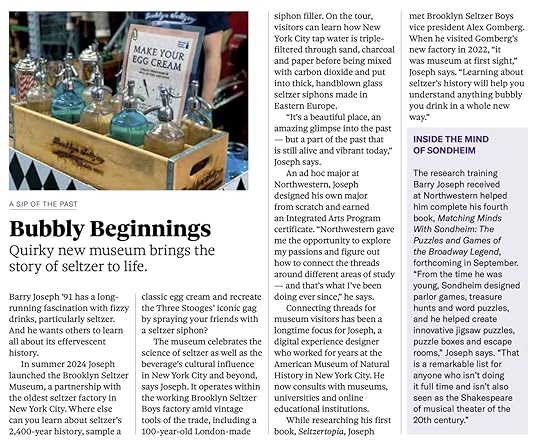 Bubbly Beginnings
Quirky new museum brings the story of seltzer to life.
arry Joseph ’91 has a long-running fascination with fizzy drinks, particularly seltzer. And he wants others to learn all about its effervescent history.
In summer 2024 Joseph launched the Brooklyn Seltzer Museum, a partnership with the oldest seltzer factory in New York City. Where else can you learn about seltzer’s 2,400-year history, sample a classic egg cream and recreate the Three Stooges’ iconic gag by spraying your friends with a seltzer siphon?
The museum celebrates the science of seltzer as well as the beverage’s cultural influence in New York City and beyond, says Joseph. It operates within the working Brooklyn Seltzer Boys factory amid vintage tools of the trade, including a 100-year-old London-made siphon filler. On the tour, visitors can learn how New York City tap water is triple-filtered through sand, charcoal and paper before being mixed with carbon dioxide and put into thick, handblown glass seltzer siphons made in Eastern Europe.
“It’s a beautiful place, an amazing glimpse into the past — but a part of the past that is still alive and vibrant today,” Joseph says.
An ad hoc major at Northwestern, Joseph designed his own major from scratch and earned an Integrated Arts Program certificate. “Northwestern gave me the opportunity to explore my passions and figure out how to connect the threads around different areas of study — and that’s what I’ve been doing ever since,” he says.
Connecting threads for museum visitors has been a longtime focus for Joseph, a digital experience designer who worked for years at the American Museum of Natural History in New York City. He now consults with museums, universities and online educational institutions.
While researching his first book, Seltzertopia, Joseph met Brooklyn Seltzer Boys vice president Alex Gomberg. When he visited Gomberg’s new factory in 2022, “it was museum at first sight,” Joseph says. “Learning about seltzer’s history will help you understand anything bubbly you drink in a whole new way.”
March 10, 2025
What is the Brooklyn SeltzerFest?
The Event of the Season, of course!
Brooklyn SeltzerFest 2025 celebrates everything related to (non-alcoholic) seltzer water and related effervescent topics, an event filled with vendors, activities, dynamic presenters, music, and exciting competitions.
Brooklyn SeltzerFest is produced by the Brooklyn Seltzer Museum, a new non-profit cultural institution dedicated to preserving and promoting the effervescent history of seltzer water.
Located within the oldest seltzer works in New York City—a local, family-run business now in its fourth generation—the Museum celebrates the manufacturing of seltzer, the science of seltzer, and seltzer as a cultural force in New York City and the world beyond.
So what exactly IS Brooklyn SeltzerFest?
Here’s a hint, looking at the schedule of activities:
11:00 More than 2 dozen booths open and run through 5pm.
11:30 Welcome / The Opening Spritz / The Little Siphon That Could
12:15 Fizzing into the Future–The Next Generation of Jewish Bubbly Beverages
1:15 The Spirit of Eli Award
2:00 Egg cream Invitational
3:45 Klezmer music
4:15 Award ceremony (egg creams and seltzer)
5:00 End of event
Sure, you might ask yourself, but what does all this mean?
It Means History
At the Brooklyn Seltzer Museum booth, explore seltzer culture through exhibits, games, puzzles, art, and antique machinery.From The Spirit of Eli Award, come learn about New York’s great seltzer delivery men and get to hear first-hand stories from one of the city’s greats.At Brooklyn Pop, dive into this immersive exploration of the iconic pop cultural of Brooklyn, featuring their collection of Brooklyn celebrity seltzer siphons.It Means Egg Creams
Drink old fashioned egg creams from The Brooklyn Seltzer Boys.Shop the NYC premiere of a special egg cream hard candy by Lofty Pursuits.Cheer for your favorite soda jerks from ten restaurants, both local and from around the country, competing in the 2nd Annual Egg Cream Invitational, to learn who will win this year’s Golden Siphon!Sample egg cream-adjacent food from vendors like Peter Pan Donuts, an interactive bagel experience from BagelUp, and the manufacturer of U-Bets Chocolate Syrup.It Means Merch
Shop at the The SeltzerFest Store for unique event merch, custom items from the Brooklyn Seltzer Museum, and old favorites from the Brooklyn Seltzer Boys.All the way from Philadelphia, check outlast year’s winner of the National Egg Cream Invitational, the Franklin Foundation, and their unique flavor offerings.Participate in the raffle, drawn over the course of the day, with amazing prizes.It Means Art
Dance and sing seltzer-themed Kelzmer tunes.View the seltzer-themed paintings of Meridith McNeal.Meet photographer Michael L. Horowitz, who explored America’s industrial heritage in a breathtaking—and moving—photo book, featuring the Brooklyn Seltzer Boys.Watch Ken Rush, the author illustrator of the picture book The Seltzer Man, do hand drawn, seltzer images of old bottles.It Means Innovation
Fizzing into the Future: The Next Generation of Jewish Bubbly Beverages (with post-session tastings), presented by The Neighborhood, offers a panel conversation and live demonstration featuring industry experts, mixologists, and tastemakers on the past, present, and future of carbonated Jewish beverages.This demonstration will explore the history and the future of bubbly drinks within Jewish culture, with a special focus on contemporary and innovative sparkling beverages.Don’t miss our panel of pros as they experiment with flavor, giving you a sip of the future. Followed by a Q&A and tasting session.It Means Family Fun
Hear the premiere of a new seltzer children’s story: The Little Siphon That Could.Take the Flavored Seltzer Challenge, sampling flavored seltzers in a blind taste test.Tackle seltzer-themed jigsaw puzzles.View original water color seltzer paintings and create your own seltzer bottle paintings.Enjoy The Workers Circle’s seltzer-themed carnival game.Explore the arts and crafts projects by the Museum at Eldridge Street.Finally, It Means Seltzer
Sample seltzer from brands like Le Seltzer (from Montreal), Topo Chico, and nearly two dozen more.Rate the seltzers along-side our official seltzer judges to help crown the winner of the 1st SeltzerFest Competition. Which seltzer brand will walk away with awards for best tasting, most unique, sharpest bubbles, and overall champion?And of course, removed from competition, the Brooklyn Seltzer Boys (home to the Brooklyn Seltzer Museum) will be serving seltzer (2 cents plain) and egg creams all day.We hope to see you there. Learn more about the event here.
October 22, 2024
SeltzertopiaLive! at Congregation L’Dor V’Dor
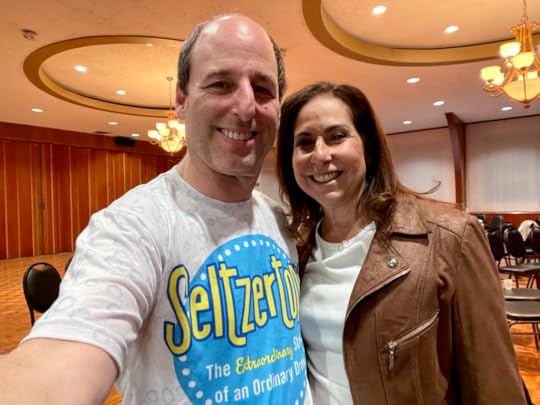
Last night I had a first – I was invited to present SeltzertopiaLive! at Congregation L’Dor V’Dor (Oakland Little Neck Jewish Center) in their sukkah!
During this week of Sukkot, the temple had a lovely sukkah constructed outside their social hall. We had dinner outside (on this crazy warm mid-October night) but then returned inside since it was too challenging to configure a screen, projector, and audio system within those temporary walls!
Fun was had by all.
June 3, 2024
Brooklyn Seltzer Museum Featured Interview on Podcast Series
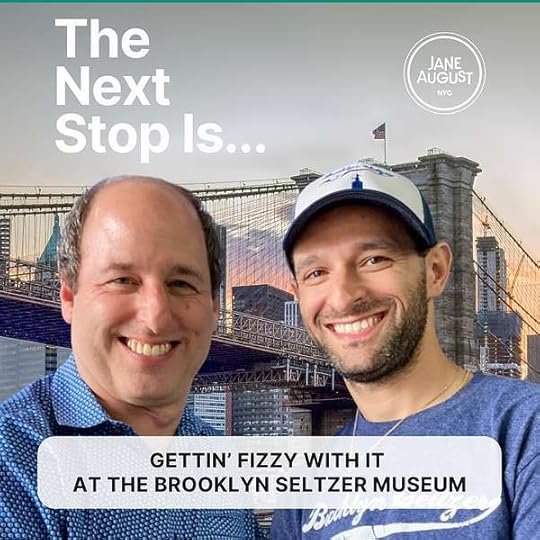
Jane August’s new podcast, “The Next Stop Is…“, recently featured the Brooklyn Seltzer Museum. Hurrah! Have a listen below or read the full transcript.
Jane August
Hello and welcome to the next stop is with me, Jane August. This is my podcast where I talk to cool New Yorkers and today we’re talking about seltzer among other things. I’m joined by Alex Gomberg and Barry Joseph, the team behind the Brooklyn seltzer Museum. Alex is a fourth generation seltzer man and the Vice President of Brooklyn Seltzer Boys, which is the last seltzer factory in New York City. And Barry Joseph is a digital experience innovator and consultant having worked in nonprofits, museums and education programs. Barry is also the author of Seltzertopia: the extraordinary story of an ordinary drink, which I believe is the only comprehensive history of seltzer water. Right,
Barry Joseph
Right! Cue the sound of seltzer.
Jane August
Thank you for being here.
Alex Gomberg
It’s a pleasure. Thanks for having us, Jane.
Jane August
Before we get to talking about the museum, I think we should kind of figure out how we got here. So the company started as Gomberg seltzer works?
Alex Gomberg
Right. So my great grandfather started the company in 1953. And he was a seltzer man for many years. And then he kind of got out of the delivery aspect of the building, you know, schlepping those heavy cases of seltzer all over the place. And then he opened up Gomberg’s Seltzer, which is like a one stop shop for all the seltzer men to come to, and have their bottles filled. And he was doing that for, you know, many years, until my my grandfather and my dad and uncle came into business. And then in 2012, we opened up Brooklyn Seltzer Boys, which is the delivery company of Gomberg’s and now basically, everything is just Brooklyn Seltzer Boys these days, and we’re just delivering cases seltzer anywhere we can get to.
Jane August
The company existed basically your entire life.
Alex Gomberg
Yeah. I’ve been there my whole life. I’m growing up, you know, going to the factory, seeing the seltzer bottles getting filled, not having any idea who’s gonna be in the business. I went to school for sport management, and then got my Master’s in higher education. As a graduate, I said, I want to do something kind of on my own. And that’s when I created this new company, Brooklyn Seltzer, and we had zero customers, we had zero customers that we’re delivering to and now we’re in the hands of many hundreds of customers and, you know, home delivery bars, restaurants, office buildings, and stuff like that.
Jane August
So you never really planned on becoming a seltzer man.
Alex Gomberg
No, not at all. I mean, I thought I was going to work somewhere in sports and kind of just, it just naturally happened this way. And it’s good because I like to have my own business. And I also love the history, you know that about it. And people just like the fact that we’re still here. And we are now the last in all of New York that have these, you know, siphoned bottles, we fill the bottles for everybody that gets the seltzer here, and one of only three in the entire country that do you know, syphon bottling, and we’re really the only ones that do it in the beautiful glass bottles, you know, with the old fashioned logos. And, you know, from from many seltzer many years ago, we use the same bottles over and over and over. And that is old fashioned. They’re old. They’re old. They’re some of the bottles are about 100 years old, you pick up any bottle, it says some the year on it, we have a lot of 30s 40s 50s I think they stopped making them in like the 60s, early 60s.
Jane August
You kind of led this rebrand of Gomberg Seltzer Work into Brooklyn Seltzer Boys. What was like the idea behind that? Why did you kind of take that direction?
Alex Gomberg
Nobody really knew what Gomberg is, we wanted to create a separate company because we wanted to know that the business I’m starting is going to be able to stand on its own and not just like live off of the business. That word existed Gomberg. So we kind of had to start fresh, and I still partnered up with my dad and my uncle who had a piece in this business also, each on the third, we just wanted to create a new identity. And what’s funny about it is that a lot of the customers that we get, I say, Oh, I had to sell two years ago from Brooklyn, seltzer. No, you didn’t because Brooklyn seltzer didn’t exist. It started in 2012. It’s just, this is where we are. We’re in Brooklyn, and it is seltzer. It just makes sense. And people just think that we’ve been always here.
Jane August
So how does a seltzer factory work? Like what is the day in the life of working in a seltzer factory? What do you do at Brooklyn? Seltzer boys?
Alex Gomberg
Yes. Okay. So what we do is, we have our own, we have our own trucks and all of the bottles that we use are have been passed down from generation to generation, many different seltzer men, they all originally had their own bottles and whatnot. They kind of all trickle down to us. So when we get in, we have a filler, his name’s Tony. He comes in and he fills in whatever, whatever we need for the day. So the bottles get filled and you’ve came to our museum. You saw the way the machine works. It’s a Barnett and foster siphon filling machine. It was I believe, we got it from London from the early 1900s. So we’re talking about century old equipment here. All of the equipment is essential, and the bottles get filled, then they get loaded into the trucks. The drivers will drive and make deliveries to whoever’s, you know, whoever we route for that day alongside that happened. We also have a bottle fixing station, we constantly have to keep up with the upkeep of these bottles. I mean, we have to replace different parts and make sure that everything’s working properly. Because people are paying a premium for the seltzer. We want to make sure it works. So they’re either cleaning the bottles fixing the bottles, and there’s just a constant rotation of fixing, filling, loading, delivering. And then the cell Turman, who’s delivering those cases 10 bottles, they pick up an empty case. So very similar to the the milkman style a business, we deliver a case of 10, we pick up the empties, and then they just constantly get circulated over and over. And where’s the cell to come from? Oh, let’s let’s let’s go. Let’s go to that. So the seltzer is simply water and co2, the water we get his New York City Water, which we know is very good water. Many residents in New York City, drink it from tap, we then take that water and we triple filter it through sand, charcoal, and paper. We’ve been doing it this way for forever. We want to make sure that the already clean water is even cleaner, supposedly, and we do this on our tours, we tell everybody that there are these baby microscopic crustaceans in the water, these baby little shrimp that make the water on kosher, that triple filtration takes care of that. So now that we have our clean water gets filtered, then it gets chilled, we want to make sure we have cold water. Then it gets carbonated. We introduce co2 into the water in a carbonator. And then from the carbonated it goes into the bottling process or our machine. The bottles are then placed upside down inside our machine. They rotate around this carousel one time around the bottles filled and it goes right back into the wood seltzer box.
Jane August
Have people said that New York City seltzer is better than other seltzer because of the water. Is that something that you can taste like with bagels?
Alex Gomberg
I mean, I’ve just been told I don’t go around drinking water in other states or anything. But Sydney Seltzer, purest New York water is it’s just good water. And you hear all these stories about these companies in Florida and, you know, all over shipping water from New York to make their bagels or pizza better. I mean, it’s a it’s a thing. People people actually do it and they pay for truckloads of water because it’s from New York. So whether it’s real or not, I mean, people are doing it. So we definitely pride ourselves on on having good water. And, you know, making sure it’s clean. One of the reasons we were in a location in Canarsie for about 70 years. And we moved during the pandemic, one of the reasons we stayed in Brooklyn was for the water. We wanted to make sure that nothing changed in the entire process. We could have gone to New Jersey, which is where I live, don’t love that commute, but it is what it is. And also are a lot of our customers are in New York, New York City. So it just it just makes sense that we’re here anyway.
Jane August
What’s the farthest you deliver shelter to right
Alex Gomberg
Now? We have Suffolk route. We’re going pretty far out Long Island. out on Long Island. I think Long Island and in Jersey, we go as far south as Asbury Park. So I think we’re about 50 miles.
Barry Joseph
There’s a great pinball museum there. In Asbury Park.
Alex Gomberg
So we’re, we’ve kind of spread out a little more and more. And when I got in the business, I know I’m jumping all over. But when I got in the business, there were about 12 salesmen. Right. And when we started delivering, I didn’t really want to go into their areas of delivery, because they all had their little zones. And I didn’t want to take away business from them. Plus, they’re coming to us to have their bottles filled and not looking to take over their business. So we really just promoted more towards restaurants and bars as their salesmen were getting out of the business. Taking over those routes. I started taking all these areas. So most recently, I took over Long Island. I have one of the salesman, unfortunately passed away he was in Jersey, I took all of his jersey routes, Rockland County, he had a route there. Most recently, I’m in the process of taking over another route in Brooklyn. There’s only two guys left other than me. Independent seltzer men that come in, they have their own bottles. And, you know, we fill them in, they have their own businesses, their own trucks.
Barry Joseph
And they’re all twice your age.
Alex Gomberg
They’re all more than twice my age. I think Walter is got to be in his 70s at this point. And Larry has got to be in his 70s as well.
Barry Joseph
So that means Alex is the future of seltzer.
Alex Gomberg
I think in your book, you say I’m the youngest seltzer man in the world. And Barry would know he’s the seltzer historian.
Barry Joseph
Yeah, it was true 10 years ago,
Alex Gomberg
Aidan is now. Didn’t even say he’s a seltzer man now? My son.
Barry Joseph
Oh, we’ll talk about Aiden. We’ll discuss that later.
Jane August
So are you trying to train other people to be seltzer men or are you just know it’s gonna be you?
Alex Gomberg
Well, I don’t make all the deliveries anymore. I’m really in the office running the show. I have you know a couple of drivers that are that are still doing it and you know, yes, I’m training them to be proper seltzer men. We we haven’t changed the style of business. Much Other than the fact that we take a credit card and we have a website, which is like unheard of in the seltzer world, you know that seltzer men are very much pen and paper, word of mouth kind of kind of business.
Barry Joseph
I’m laughing remembering the seven hours I spent with Walter, who you just mentioned, which was one of the most amazing seven hours of my life. And looking at his list of whose clients were these, I don’t know how you decode this, it was some kind of, you know, remarkable language he’d made up with, with pages and pages. And Eli was the same who who passed away who, before when he did it was the oldest one in the country and his papers in his Was this his car was his office.
Alex Gomberg
Do you remember the route cards? When I took over all these businesses, you know, I bought bought them from them. I had to decipher these coding, you know, situations. And they literally have like little route cards with the customer’s name and the address, sometimes only first name, like, you know, Joan, at, you know, 420 8/4 Street or something.
Barry Joseph
We shoiuld put one in the museum.
Alex Gomberg
It’s hard to read because Eli, Eli after a certain time, how old is he like when he passed 83 or something? I took over the route with him. And that was a really cool story. So I took over his route. And I looked at his route cards. And you know, he got shaky as, as the years went on, and his it’s like chicken scratch. It’s hard to read. But what’s really cool about ELI, and Eli had a book written about him is his children’s book was The Seltzer Man by Ken Rush, who was a customer of his. And when I took over Eli’s route, that was the coolest thing, because at that point, I think he was like the most famous seltzer man. At the time, it was very important to him, because he’s been delivering such a long time that he introduced me to his customers, right? So he took me on the route with him a couple, maybe two or three days and introduced me to all of his customers. A lot of his customers met him downstairs because he couldn’t carry the cases anymore. They were so heavy. They came downstairs to switch it at his truck. It was crazy. So but you know, I took it into their apartments and you know, we were sitting down for a glass of seltzer he would he would climb up the stairs, you’d be out of breath and sit down at the table and they would serve them a glass of seltzer. And they would just be kibitzing talking
Barry Joseph
They all would tell you how much they love the Eli.
Alex Gomberg
Hhe served he served people for you know, three generations. He knew grandchildren. And he went to Bar and Bat Mitzvahs.
Barry Joseph
The people we were delivering to – it was so beautiful, and getting to travel with him. And see that was amazing. And again, to be connected with you, Alex, as you’re maintaining those kind of relationships, is so beautiful, and then getting to document them within the museum. So other people can see, to see this is still going on. It’s just remarkable.
Alex Gomberg
Yeah, I mean, we do have a nice relationship with a lot of our original customers. Unfortunately, there’s so many now I can’t speak to every single one of them. We now have like a text messaging system that goes out. I can’t call every customer for every delivery like Eli did. You know, he like called all of his customers, hey, I’m coming tomorrow. And, you know, the conversation might be 30 minutes, and I don’t have that kind of time.
Barry Joseph
Eli would say: Seltzer’s not the product. It’s me. Eli! Which is to say it’s all about the relationships he built.
Alex Gomberg
Right. And to that we you know, when we took over the route some of the customers like I was really only just doing it because of Eli. So I was like okay, yeah, that’s that’s fine. But it was it was really nice to to take over his route and Steve Levine which is which is another seltzer man, you know, at some point in the future I’m sure if Walters kids don’t do it I’ll take over his to and you know, have everything but isn’t at the end of the day. It’s it’s still a small business in relation to like a Coca Cola Pepsi. It is more of that intimate. You know, we still speak to all of our customers whether it’s, you know, through email or text or you know, phone call, I still have the customers that just even though I send them a text, they don’t text me back they call me because they want to just make sure Hey, Alex the bottles are gonna be outside the check is going to be in the box. It’s I’ll make it out to Brooklyn Seltzer and there’ll be a $5 tip I have messages on my phone that just go on and on about the same thing every single time I keep them in my phone because I love them so much.
Barry Joseph
So people still do that? They will leave these expensive 100 year old glass bottles in these beautiful wooden crates right outside for you to pick up and will you drop them off the same way you’ll drop off these now, full, even more expensive, where anyone could pick them up but this trust relationship is still there?
Alex Gomberg
Yeah. I mean, there are certain areas if it’s if they’re, you know, entrance to the houses on the main street and you know, they’re not feel they don’t feel comfortable leaving the bottles there. You know, that’s okay. But most people have like a side side of the house or under the stupor in the vestibule. We have some keys and codes to people’s houses. We take it in some customers we bring it inside their their kitchen, even though they’re not home and the dog comes and greet Is the seltzer man and they put a bottle in their refrigerators that it’s cold when they get home, you know, we have a lot of different you have to learn the route once you’re, you’re on the route to know, you know everybody’s needs and where they want the bottles because the whole part of the services, we want to leave the bottles exactly where they’re going to be stored in the house. You know, we do the schlepping, you don’t have to do that. That’s that’s the fun about all this. You know, there’s there’s a lot of different, different ways we deal with customers. And we’re gonna keep doing it as long as we can.
Jane August
That’s so unique, especially in this modern day like Amazon shipping and having no interaction with the people who are delivering the things you order.
Alex Gomberg
Right. And especially during COVID. I mean that, you know, I don’t think we were done done. But we lost a lot of business because all the bars and restaurants closed. Well, what do people what are people looking for at this point, when they don’t want to go out into the world and go shopping, they want to home delivery service. So we didn’t change anything, we do exactly that. We take it exactly to where the bottles need to be, you know, and make sure they’re, you know, sanitized clean and whatnot, we had invested in this very expensive commercial dishwasher to, to to make sure that the bottles were sanitized properly. Before that we were washing all the bottles by hand. That might not have been so acceptable COVID times but we’re really, we strive to make sure we have a clean product for everybody to use.
Jane August
And then seltzer has a 15,000 year history, or 1500 50 100 year history. That’s right. What do you write about in your book when you two met while you’re writing your book? Barry right?
Barry Joseph
There was no way to write this book without discovering the Gomberg family. I mean, it was incredible to start this process of trying to understand this culture that Alex is talking about right now. I imagine for many of your listeners who did not know about growing up having seltzer delivered. Maybe they heard you’re talking with people about seltzer they might be thinking about white claw, they might be thinking about Lacroix with flavored seltzer. But it isn’t just about the product you can hear there’s a culture connected with those relationships with a local business with a family, sometimes over generations and having this locally made locally produced product. I didn’t know any of this when I started, all I knew was that I wanted to SodaStream it had just come to the US in 2004. In fact, it was called soda club at the time. And I thought if I could write a review in the newspaper, I could get a free reviewer copy, which I did, which was great. And I thought that’d be the end of the story. But when that piece came out this tiny, tiny review, so many people were excited to share their own stories that someone suggested, you know what, there might be a book in this. I never written a book before and I could barely write the article because there was nowhere to go to find out more about seltzer. There was no websites about seltzer. There was no other books about seltzer even academic papers. They’re the kind of research and carbonation but I want to know about this culture. So when I started investigating Who can I talk to, to learn about seltzer? Very quickly, the Gomberg family appeared, especially Alex’s dad, Kenny, Alex, at the time had not started building the business. It was about eight or so years away. But I took a long time to get the book off the ground trying to figure out what the story was. So by the time I really understood what the core of the book would be about, following this story of one new seltzer man in Pittsburgh, who picked up 120 year old sells your business, that I then was able to start talking with people who are in the business locally here. I live in New York City. And that’s where I met Kenny. And once he met Kenny, he became such a key resource for me for the book, he appears throughout the book because he has that history. And then by the time the book was almost done, his son was getting into the business. So if you read my book, seltzer topia, you’ll see the epilogue is about the future of seltzer, which is really asking the question, is there a future for seltzer? And when someone like Alex, the answer was, yes, of course, look at what Kenny son is doing the newest and youngest seltzer man in the country. And so through the connection with Kenny, and then with Alex, I feel so grateful to be connected with the Gomberg family to tell a little bit of their story in the book, which in many ways is what Seltzertopia is about. It’s not my story. It’s the story of the seltzer men that Alex has been talking about about Walter and Eli and about the customers for generations who were buying it and receiving it and being part of, of what it meant to be part of that cycle of the bottle is coming and going and coming and going, and kids getting older and moving out of the house. So that when my book came out in 2018, I was so excited that the business was still going he’d done it, like it wasn’t just like a one or two year thing and now been, you know, six or seven years into it. So when I did my first reading, remember that in Manhattan, and you were there making egg creams, you were there with your your palette of the bottles, and you were making which are always my favorite egg creams that I can have anywhere else. And so we kept running into each other because now that he’s promoting his business, I’m promoting my book. Everyone’s so wild people would bring us together whether it was at a talk or news. So of course when Alex told me during COVID that his dad and his uncle had decided it was time to retire. And that meant in part closing The business that physically been in Canarsie since 1953, which I documented in the book with photos, and I wrote about it. And if you’re making something new, anything new in this space is, you know, the front page news because no one’s doing new stuff. So you made a new space. And it’s still in Brooklyn, fantastic. But you’ve designed it from scratch, you built everything you rebuilt, quote, unquote, of the line, how all the water comes in, out of it come Seltzer, how the liquid co2 comes in, like everything, and physically built it out. They don’t hire as many people they do it themselves are so handy. Of course, I want to come see it. So as soon as the pandemic had retreated enough, and I can come visit it, I was just blown away walking into this space. At the time, it was beautiful white long hallway. That’s enormous, because it had to be big enough for the cellphone trucks to drive in. And after you get through this long hallway, in the back, you turn the corner and there it is revealed its machinery, like what is what are these wires? And what are these tubes? And what is it? How is it connected? And if it’s running, then it’s loud. And there’s water spurting everywhere. It’s just so exciting. And what amazed me wasn’t just the machines at the end. But the entrance walking in the interest to left was just a wall. And the other side of that was Alex’s offices. But on the right was kind of like, what do you call those metal structures?
Alex Gomberg
Pallet racks?
Barry Joseph
Yeah, like pallet racks, right, and things for the seltzer works, but they actually look like museum exhibit spaces. And on top of it were storage items that he needed.
Alex Gomberg
We keep bottles, you know, up there that we’re probably never going to use. I have enough for my lifetime. I always say I’m trying to collect for my son.
Barry Joseph
But underneath it in each one, right? Were the same types of machines you would see in the factory. But it was just other copies. But now you’re looking at these machines that are like 5080 100 plus years old. They look beautiful. And then there were wrenches that were lying on the wall. It was like he was decorating his home. It was just gorgeous. And he also started telling me that he was having some young people come in at you know, he mentioned that, yeah, there were tours that sometimes would happen. But there were also elementary schools that would come in and they would take up, take the siphons apart, learn how to put them together filled in was certainly you’re doing educational programming, and you’ve designed this kind of artistic display of old machines. Have you thought about doing a museum? And as I often say, people when I saw it, and we talked about it, it was Museum at first sight? Because he was like, Yeah, that sounds interesting. And one of the things I love about being connected with both the Gombrich family and specifically Alex is he he’s 1000 ideas. So when he heard the idea of museum, he can speak for himself. But it seemed like to me, it was a new thing for him to say, oh, what what crazy thing can we do now. And he knows me, I love to have crazy ideas. And with my background and experience design, in museums, and having spent at this by now 20 years writing about Seltzer, the two of us together, knew that story. We knew the science of it. We knew the history of it as a business, we knew the technology, and we knew the culture. He had the space. And I’ve I will always be so appreciative that he was willing to say, I am willing to take our current space, which is an active live factory, and let’s put the museum layer on top of it. And we’ll figure it out along the way, one step at a time. And we’re now a year into the soft launch. And it’s been that nonstop. He has crazy ideas I build on them. I have crazy ideas. He builds on them. And together each month we’re figuring out what does it mean to make a new culture institution around seltzer? That’s about the history of seltzer, the culture of seltzer in the world, in New York, about the technology, about the science, but do it in a place that’s a live factory where you can come in and see it happen. But it’s not written in stone. Each month, we’re figuring out what do we do next? How do we engage people here? How do we help a two year old have fun? How do we help a 92 year old have fun, and it’s an adventure every day,
Alex Gomberg
And not all the ideas of ours. We get people that come in and say you know, I want to have a dinner party here because I create you know, Shabbat dinners or something in different interesting spaces and they want to rent you know, just like a factory and host like a like a party, okay?
Barry Joseph
Or like have an art gallery. I’m going to make original art and I want to sell it through the through the museum on the wall and we’ll have an event and they’ll run the event and we’ll have it up there for a month. Right?
Alex Gomberg
We did that one of my customers Meredith McNeil made all these paintings, about a dozen was about a dozen or 15 paintings and post them on the wall. And we had a really nice gala event where she invited all her students and friends and you know, tried to sell some paintings.
Barry Joseph
They want to do Rave Party. People said they want to do some kind of you know, taster mixology event, people said they want to do street party where people can be you know, throwing seltzer balloons at each other, it’d be better to have all sorts of ideas and tell them to us come to us. Let us know how you want to use the space, how we can work go to activate it and bring people from all around New York because it tells you museums.
Alex Gomberg
These bottles are just so- the visual like of it, just attract attention. Do I want to spray it? I want to feel it. I want to touch it. You know stuff like that.
Barry Joseph
They’re pink. They’re green. Yeah, blue. They’re yellow, some glow in the dark. Yeah. There’s just and some are little baby bottles, larger bottles, and those called stand ups from hotels are called send up the little seven ounce baby siphons and what Alex will do is work with young people on a table to get little, little soda jerk hats. And they’ll get a bottle of you Betts chocolate syrup on the table. And of course, some cold milk, the cups and the mixing and the seltzer so they can make their own egg creams, which if you don’t know is Seltzer, cold milk, and chocolate syrup. Usually you bet. But they it gives them these little tiny bottles. So it’s children sized bottles, and they’re meant for hotels, where people would have them come up for their room to make the drink. They’re really tiny. They look so cute when the little kids are making egg creams was so cute.
Alex Gomberg
Yeah, I got that idea from my my kids school, they asked me can you do a show and tell like what you do. So I brought it in, and the kids went crazy. They went cuckoo. So since I’ve done it for all my kids, and I’ve done it for my my, my my nephew, I bring into the class and they don’t know what an egg cream is. They don’t know what they, you know, there’s no eggs, there’s no cream and egg cream. But they, they just they just like to spray it. They like to feel like it’s just like a new little thing and experiment. And then I go to the class and I read the children’s book, Eli this ultimate, it’s a cute little thing that I bring to the class.
Barry Joseph
And we love bringing the classes into the museum, we are placing your school teacher in New York City, kindergarten up through sixth, maybe even middle school, come on by we’re part of the whole system in the city to go visit cultural events. And we’d love to host you for a few hours.
Jane August
It’s so unique that you have it in an active factory. Like how do you navigate that with having the work be done, but also having groups come in?
Alex Gomberg
Yeah, that is a little bit of the challenge. But we knew kind of that going in, we have to close the factory in order to host anybody there. It just we want to create a safe space for everybody when they’re when they’re there. And closing it means what closing it means that we shouldn’t have any trucks coming in and out of the building. Because what what we what we do is the sell to them and they would come and they would back into our building and load in our basically loading area. That’s that’s like basically our museum area. So we can’t have any salesman going in, we can’t have any seltzer going out. We can’t load our trucks. That doesn’t mean we can’t still do what we need to do inside the factory, Tony could still fill bottles, we just purchased a long rope to make sure that nobody gets too close or anything like that. So the factory can still be running, the factory could still be running, we just were not nothing’s going in and out of the doors, you now see the the seltzer being filled, you can definitely anything, anything you need to see visually, you could still see.
Barry Joseph
So as the co-founder and co-curator with Alex of the museum, I have nothing to do with the business. But at the museum. I’m so fortunate that they figured out how to keep so much of it alive. So people can come in and see it. I mean, I think about factory tours for me, Ben and Jerry’s factory in Vermont, or the mint. In Philadelphia, you’re always in this, you know, self contained hallway with glass, looking at the actual factory, you’re not really in the factory. When you come to the Brooklyn seltzer Museum, you’re in the Brooklyn seltzer boys factory, you’re a few feet away from the machines, you can get sprayed in the face with the water that’s coming out of them. And in fact, you get to spray the bottles, you get to take the siphon and spray them at your friend at yourself. You can drink from it. I think it’s probably the most number, the most popular thing people do.
Alex Gomberg
Yeah, oh, that’s my favorite. Because what we did was we set up along the conveyor belt, we have this little plexiglass and we don’t even tell anybody what we’re doing at that time. We don’t really advertise that we do it. We have somebody with their phone come behind. And I think you did this too. When you were at the at the at the museum. I don’t know if the glass was there was it we kind of we kind of you know, revise as we go to get there. And we’re not even aware I would like it to be I want to hold booth. But anyway, right now right now the way we have it is we have this Plexiglas hanging from this, we have a whole Kinder system, somebody gets behind the prexy, Plexiglas and we set up a little, you know, stage area where somebody takes a bottle, and they’ll spray it at the glass. Meanwhile, the person behind the glass has their phone, I usually tell them to put in slow mo, because I just think it’s the coolest thing. They put it in slo mo and they get this gush of water just rushing at their face. And it’s the coolest video, right? So they get to spray the bottle, they get to, you know, they, they shake it and spray it. And it’s it’s just so much fun to watch their faces light up as they’re like, oh my god, this is the coolest thing.
Barry Joseph
And that’s such a great example of why I love working with Alex, and why I love getting to work on this project. Because we really have the space and time to do it right. But we had at the beginning, which I should say let me step back a moment. We worked with graduate students at NYU, and at Teachers College Columbia to build out most of the exhibits and configure how to activate the space. That’s why we can have 3d models you can manipulate and we have a treasure hunt that was originally on paper but now it’s also digital and so many other things, but one group made us work with Ken He had to make a stand, that we would stick a full siphon in, and there was a sign that would explain, go ahead and spray it in your mouth. And there were glasses people could wear so that, you know goggles so that no one hurt themselves. But the focus was on spraying it to yourself and spraying it in your mouth. And you’d have to read the sign, right? So it was and facilitated. So that’s how it started. And what we saw over time is that some people like to do that. But some people like to spray each other. And now the Ultra is getting everywhere.
Jane August
Yeah, that’s what we did. We went and I Miss Jessie’s mouth. So maybe one of the best videos of me spraying her in the neck. That’s so funny. And I just like slowed it down. And then we just watched it on repeat.
Alex Gomberg
I don’t follow this. No, it’s even funnier because somebody came the other day for a tour and was like, I literally came to get sprayed. So it’s like now You’re kidding, right? He says, No, spray me. It’s like you gotta be out of your mind. He says now the whole bottle. So he stood there and took it like a man and I sprayed the entire bottle doused him in Seltzer and he was like, that just made my day.
Right now we do the tours on Fridays, right? So we do we do we know that we have a tour every Friday. You know the general public can buy tickets on online and they can they can buy. But what we what we’d really like to do and we’ve been doing really is once a month we have like an event, a main event. You know what it is? And we have usually on a weekend on a Saturday or Sunday. We had kids events.
Barry Joseph
We had the seltzer family party. It sounds a family seltzer family. So we did open house in New York last November. In January came in March. It was national egg cream Day, which we’re not responsible for but said we got to do something a national egg cream day. And we had the 2024 National egg cream Invitational right? That goes again, like what are we gonna do this day, we kept iterating ideas till we landed on this one. Let’s bring restaurants and local restaurants to mix and creams and compete to have the best egg cream of 2024. And have judges like Jane there to say, this is the best ice cream. This is the best tasting, best performance, best presentation. And one of those judges of course was segue to Aiden Gomberg. He’s a fourth grader. If you’re lucky to come to an event at the museum on the weekend, he will be there mixing the egg creams.
Alex Gomberg
He has the Aiden Specia. Hel loves making making them now.
Jane August
He’s gotta be in the Invitational next year.
I tried all the egg creams. My favorite one was the one made by the House afterwards. I got a strawberry one. Okay. I was like, I was like, don’t tell anyone. I think this was the best one I had.
Barry Joseph
So let’s turn the tables for a moment. What was it like for you to come be in an event at the Brooklyn Seltzer Museum? What was it like to be judged at the egg cream Invitational.
Jane August
It was very exciting.
Alex Gomberg
Well, it was sold out. That was the event. Like if you go to Comic Con, people know comics, like this is where everyone knew egg creams. It was crazy. Just leading up to the event. It was really invitation only. And then we had a couple spaces left. We were like we could hold this many people in our building, right? Like 25 tickets. So we added 25 tickets. They were sold in one week, in a day. And there were people calling saying, oh, please, I’ve come in town. I’m only here for this. I really want to come to this event. We let a couple people slide. But then it was just- I think if we kept kept it open, it would have been another 100 People easy.
Barry Joseph
I also underestimated the power of that community. I knew they loved egg creams for some they said that’s why we made the business. But the connections between them. I had no idea was kind of a thing under the surface. I think Pete from pharmacy and cobble hills and Brooklyn said it’s like you’re on an island when you’re making an egg cream. Because you’re doing in your own business. You don’t see everyone else. And one of our judges says you can’t compare them the cream is only good for a few minutes. It’s highly carbonated. And it’s the cremation is dying. As soon as it’s mixed. You have like two or three minutes to drink at tops. You can’t go from business to business and taste them. So for both of them whether they were the egg cream lovers, or the egg cream makers, they never got to be around so many egg creams being made at the same time. And we didn’t realize I certainly don’t think I didn’t Malik’s maybe not the same that bringing them together itself was almost like doing good for their community and what added how energizing it was going to be for them. And that energy came out and everything that they did well for sure. So those are kind of events we’re doing. What’s the next big thing we’re gonna do? We don’t know. We’re trying to figure it out.
I appreciate especially during today’s challenging times, having something just makes people happy. People who are like the older generations, it’s just they’re watching the stylish and when they come for younger generations, they don’t even know what this is about. They know there’s something about seltzer how quirky let’s check it out. And it’s just so effervescent. It’s just so fun, and light and playful. And you get to see the kind of things we’re talking about at the beginning of the podcast, those relationships between Alex and his company and the customers. Those aren’t just in the background, we put them to the foreground, we have a customer storybook, and it’s been right, and each page in the storybook, one side has a customer saying what it means for them to get shelter from the broken seltzer boys. And then the flip side of it is Alex talking about his relationship with the customer. So every page is a document of those relationships. So we’re inviting people to come in and explore those relationships, we put it right in people’s faces and say this is a really special thing. Seltzer itself is special, what we choose to do, and connect with seltzer is special. And what it means to have a family business that goes back four generations is special, we wrap it all into one package, and everyone just leaves with a smile on their face
Jane August
So they can visit the broken seltzer museum on Fridays. Right?
Barry Joseph
Right. And if they can’t come on Fridays, we have much of it online, we have the virtual seltzer museum. So when you come to the Brooklyn seltzer museum.org, there’s a whole virtual section where we’ve reproduced digitally, the physical puzzles that we give people, you can do them online, there’s the timelines that you referenced, Jane that goes back, you know, back before zero BC, and you can explore all of that you can leave your own memories and read other people’s memories on the seltzer memory wall. And we’re going to continue to add new aspects to that as well.
Alex Gomberg
Right, but they could, if anyone wants it physically calm, they can buy tickets on our website, Brooklyn seltzer museum.org. They could purchase as many tickets as they want. And then we also do offer an option to have your own private tour like Santa’s weekend. So that that is a phone call. You can get our number on the website,
Barry Joseph
we push out new content all the time on Instagram and on Facebook. And when we’re lucky to meet people like Jane and
Alex Gomberg
Jane, thank you very much for your Tik Tok video.
Barry Joseph
From the New York Times we got email followers. You got us visitors.
Alex Gomberg
Definitely. I mean, they came out a nice time because it was right before one of our events. And we sold quite a bit of tickets off that TikTok was really great.
Jane August
So is there anything else you want to share before we wrap this up?
Barry Joseph
I just appreciate that you’re taking to the mic. I love that you’re doing podcasts. I’ve been doing podcasts myself for 20 years. And I love that you’ve had an impact in the museum space. You’re helping bring people into museums into exhibits, think about them and experience them in new ways. And I’m excited for what you can do now in the podcast space.
Jane August
Thank you. So this has been the next up is with me, Jane August. If you liked the podcast give us a review because if TikTok gets banned this might be all I have.
December 16, 2023
Fun Times in Melville
A good time was had by all last night, at Temple Beth Torah, in Melville. That’s Long Island, NY for the uninitiated. A lovely crowd of 50 came out for a post-service dinner and talk. Thank you Ben’s Deli for the amazing pastrami sandwich! I gave the standard spiel and mixed it up, literally, with an egg cream mixing right in the middle of the talk. Everyone was lovely and it was a great way to end this seltzertopic year.
December 9, 2023
SeltzertopiaLive! for Baltimore Teenagers
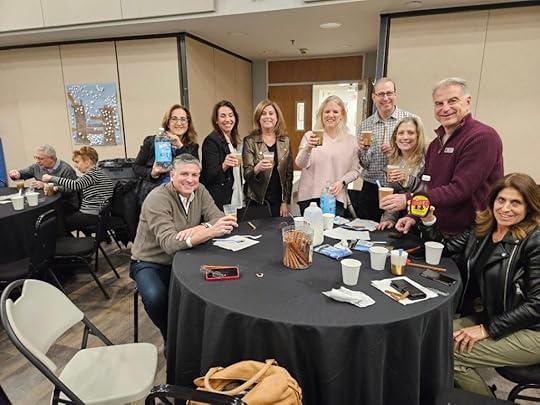
This week I traveled to the Chizuk Amuno Congregation, which is right outside Baltimore. A special event was prepared for around 50 high school students, all for SeltzertopiaLive!
It was fun to revisit all of my material from a youth lens. All the hard seltzer material, about White Claw – removed. Some of the younger material I don’t include for older audiences, like The Simpsons – back in. And I could no longer rely on nostalgia to engage the audience. When I showed the clip from The Mary Tyler Moore Show (“A little song, a little dance…”) I had to explain what strong cultural resonances that has for their parents and grandparents.
Planning began when I received an email from their rabbi, Rabbi Seltzer. Of course, with that name, how could I not love him. But I was not prepared for what came next. His father had died earlier that summer. Sitting by his bed, he decided to read to him (as I had done back in 2020 with my own dad). What did he decide to read to his father to comfort him while he passed away? Seltzertopia. Rabbi Seltzer now wanted to host an event for their teens to honor his dad.
Of course I had to do it.
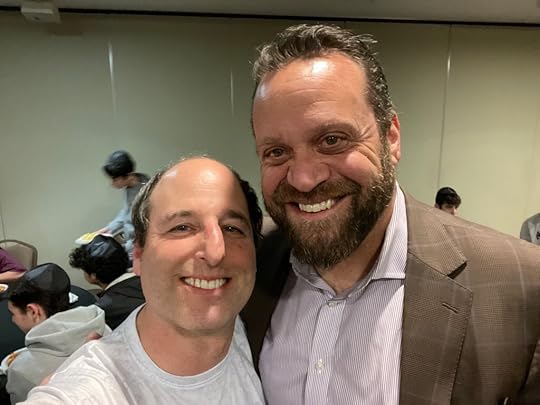
And once I got there I was surprised, as always, by the power of “Jewish geography”. Their other rabbi (in the photo) grew up half a block from my mother-in-law; while he was a teen, and I was courting my now-wife, I often went to his home for Passover seders. He then introduced me to two of the teens, both friends with my nephew in Philly. And finally, I got to connect with a friend of my youngest child who moved there from NYC during the pandemic. I could not have felt more welcomed.
Along with the after-event egg cream, we held a seltzer tasting competition. The flavors – cherry vanilla, watermelon, raspberry, coconut, and mango – were confounding, as is usually the case, making the competition quite fun.
I never imagined five years ago, when my book was first published, that after all of these years there would still be such interest in SeltzertopiaLive! But there we are. I need to run now – I have to go finish my presentation for Temple Beth Torah in Melville this friday…
September 13, 2023
NYU Produced-Video about Brooklyn Seltzer Museum
As you might know, I recently founded the Brooklyn Seltzer Museum with Alex Gomberg and his family. We developed many of the exhibits with graduate students from New York University and Columbia University Teachers College. Below is a fantastic video that was just released by NYU promoting the space and our collaboration with their students. Check it out!
September 9, 2023
Video from New SeltzertopiaLive! at United Federation of Teachers Day at the University
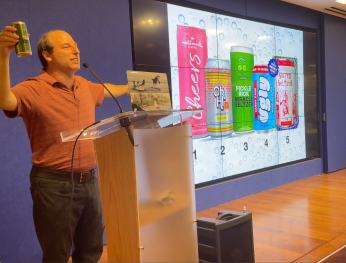
This week I had the pleasure of speaking to an audience of over 200 retired NYC public school educators who are all members of the United Federation of Teachers. Each year they hold a day of professional development – even the retired appreciate self-improvement – at what they call Day at the University.
As the closing keynote, I was thrilled to present my updated SeltzertopiaLive! for only the second time since March 2020 (due to covid). The update included for the first time the launch of the Brooklyn Seltzer Museum (and it was so exciting to get to share that from the stage, at last!).
We concluded the day with a giant egg cream toast (which I will add in once they are share those photos with me).
I filmed it myself and you can watch any or all of it below. Enjoy!
Seltzertopia Blog