
Matthew Outerbridge's Blog
July 23, 2022
This Alternative Beats The Classroom Model Hands Down.
 Look at all these happy students with their happy teacher, learning happy things.
 Takeaways:
The classroom model works for socializing kids and helping them develop basic skills like reading and writing. The one-on-one tutoring model is the most effective method for learning just about anything, but is economically challenging to implement. The coaching model is ideal for helping students identify personal goals, develop self-discipline and create a vision of their future. It helps students learn how to use the most important tool at their disposal: their minds. Back in 500 BC, when Confucius was running around in sandals instilling virtues and the iPhone was still a few millenia away, teaching happened privately, or in small groups. Wealthy families in ancient Asia and Greece would hire individual teachers to instruct their children. Lessons in reading, writing, archery, or wrestling would be led by an experienced guide, and students would learn firsthand, instead of from some old dusty textbook. Whatever level they were at, the teacher would meet them there, and plot a route towards mastery for them. In short, the education model was perfected, people ate grapes while lying down, and everyone lived happily ever after.
Compare that to today, where 30 students sit together through mind-numbing boredom while their teacher rattles off roll call (“Bueller? Bueller?”). After a lecture about ionic bonds that somehow takes longer than the known universe has existed, someone in the back farts, and there is a bit of comic relief. All the students are thinking precisely the same thing: “It’s no wonder they call him “Gassy Jack”’.
Okay, schools aren’t that bad. Literacy rates were only about 1-2% in ancient Greece, as opposed to today where it’s 90% globally. In terms of equipping students with basic skills that society needs, the current education model does prettayyyyy, pretty well. B+, maybe?
How about for advanced subjects: calculus, chemistry, creative writing, interpretive dancing? Not so great. A lot of students lose all motivation. Let’s say a generous D+.
But it turns out that the educational psychologist Benjamin Bloom discovered in 1984 that another method of learning is better. A lot better. Two standard deviations better, to be exact. The average student using this method performed better than 98% students in a traditional classroom.
What is this revolutionary learning method that can disrupt the traditional classroom model? It’s called…
one-on-one tutoring.
Why hasn’t it caught on like wildfire if it works so well? Because, economically speaking, it’s hard to provide one-on-one tutoring to 2,000 high school students in eight different subjects. You would need hundreds of teachers per school. Or, perhaps just one really smart, time-traveling teacher…
Benjamin Bloom called this discrepancy between classroom learning and individualized learning the two sigma problem. He asked educators to see if they could find any alternative to tutoring that produced the same results. They couldn’t. They still can’t. When it comes to learning difficult skills quickly and efficiently, individual tutoring is both the bomb and the bee’s knees.
Which brings me to my main point:
Main Point
Classroom teaching is a functional (albeit suboptimal) way for lots and lots of kids to learn basic human skills (reading, writing, arithmetic, punctuality, obedience, staring off into space) at a steady pace, while being socialized in groups. When it comes to specialized skills (chemistry, entrepreneurship, crypto, wizardry) there is no substitute for individualized instruction.
Of course, this doesn’t mean that great teachers can’t make a difference. Engaged, passionate teachers can captivate students and inspire them to make discoveries in areas that they had little interest in previously.
However, the marketplace rewards those with rare and valuable skills. For the most part, classrooms are not the place where those skills are cultivated. If we want to solve the skills gap, one-on-one tutoring is a great place to start.
The Third Model
There is another model that is underexplored in educational contexts. The coaching model is one that allows the student (or coachee) to take the reins of their future and plot a course towards goals that they have identified for themselves. Instead of following a prescribed curriculum, the coaching model allows for the coachee’s individual interests and aptitudes to take center stage.
Life coaching can help to establish accountability and self-discipline. It helps individuals to recognize their strengths, and how they can use them to generate value for others in an ever-changing global economy. It can help people truly become “themselves” and fulfill their potential, which is surely one of the most gratifying human experiences possible.
Here’s an idea: what if students had a learning coach, who met with them once a week (or twice a month), and helped them design their own learning goals, related to their own inclinations. Students would identify steps they could take towards their learning goals, and make progress at their own pace. Students would own the process each step of the way: planning, design, implementation, and revision. This might just prepare them for the world outside of school, where drive and initiative are sorely lacking.
I’ll be here looking for pies in the sky if you need me.


The Classroom Model (Kind of) Sucks. Here's What Works Better.
Look at all these happy students with their happy teacher, learning happy things. Takeaways:
The classroom model works for socializing kids and helping them develop basic skills like reading and writing. The one-on-one tutoring model is the most effective method for learning just about anything, but is economically challenging to implement. The coaching model is ideal for helping students identify personal goals, develop self-discipline and create a vision of their future. It helps students learn how to use the most important tool at their disposal: their minds.
Back in 500 BC, when Confucius was running around in sandals instilling virtues and the iPhone was still a few millenia away, teaching happened privately, or in small groups. Wealthy families in ancient Asia and Greece would hire individual teachers to instruct their children. Lessons in reading, writing, archery, or wrestling would be led by an experienced guide, and students would learn firsthand, instead of from some old dusty textbook. Whatever level they were at, the teacher would meet them there, and plot a route towards mastery for them. In short, the education model was perfected, people ate grapes while lying down, and everyone lived happily ever after.
Compare that to today, where 30 students sit together through mind-numbing boredom while their teacher rattles off roll call (“Bueller? Bueller?”). After a lecture about ionic bonds that somehow takes longer than the known universe has existed, someone in the back farts, and there is a bit of comic relief. All the students are thinking precisely the same thing: “It’s no wonder they call him “Gassy Jack”’.
Okay, schools aren’t that bad. Literacy rates were only about 1-2% in ancient Greece, as opposed to today where it’s 90% globally. In terms of equipping students with basic skills that society needs, the current education model does prettayyyyy, pretty well. B+, maybe?
How about for advanced subjects: calculus, chemistry, creative writing, interpretive dancing? Not so great. A lot of students lose all motivation. Let’s say a generous D+.
But it turns out that the educational psychologist Benjamin Bloom discovered in 1984 that another method of learning is better. A lot better. Two standard deviations better, to be exact. The average student using this method performed better than 98% students in a traditional classroom.
What is this revolutionary learning method that can disrupt the traditional classroom model? It’s called…
one-on-one tutoring.
Why hasn’t it caught on like wildfire if it works so well? Because, economically speaking, it’s hard to provide one-on-one tutoring to 2,000 high school students in eight different subjects. You would need hundreds of teachers per school. Or, perhaps just one really smart, time-traveling teacher…
Benjamin Bloom called this discrepancy between classroom learning and individualized learning the two sigma problem. He asked educators to see if they could find any alternative to tutoring that produced the same results. They couldn’t. They still can’t. When it comes to learning difficult skills quickly and efficiently, individual tutoring is both the bomb and the bee’s knees.
Which brings me to my main point:
Main Point
Classroom teaching is a functional (albeit suboptimal) way for lots and lots of kids to learn basic human skills (reading, writing, arithmetic, punctuality, obedience, staring off into space) at a steady pace, while being socialized in groups. When it comes to specialized skills (chemistry, entrepreneurship, crypto, wizardry) there is no substitute for individualized instruction.
Of course, this doesn’t mean that great teachers can’t make a difference. Engaged, passionate teachers can captivate students and inspire them to make discoveries in areas that they had little interest in previously.
However, the marketplace rewards those with rare and valuable skills. For the most part, classrooms are not the place where those skills are cultivated. If we want to solve the skills gap, one-on-one tutoring is a great place to start.
The Third Model
There is another model that is underexplored in educational contexts. The coaching model is one that allows the student (or coachee) to take the reins of their future and plot a course towards goals that they have identified for themselves. Instead of following a prescribed curriculum, the coaching model allows for the coachee’s individual interests and aptitudes to take center stage.
Life coaching can help to establish accountability and self-discipline. It helps individuals to recognize their strengths, and how they can use them to generate value for others in an ever-changing global economy. It can help people truly become “themselves” and fulfill their potential, which is surely one of the most gratifying human experiences possible.
Here’s an idea: what if students had a learning coach, who met with them once a week (or twice a month), and helped them design their own learning goals, related to their own inclinations. Students would identify steps they could take towards their learning goals, and make progress at their own pace. Students would own the process each step of the way: planning, design, implementation, and revision. This might just prepare them for the world outside of school, where drive and initiative are sorely lacking.
I’ll be here looking for pies in the sky if you need me.
July 10, 2021
5 Ways to Build Better Learning Habits

This article covers:
The links between habits, identity, and learningA two-step process for building your learning identityHow to use habit stacking to learn moreTim Ferriss's DiSSS MethodThe basic principles of environment designA foolproof way to avoid missing your learning goals
The Importance of Habits
You set a morning alarm. Your digital calendar reminds you when important dates draw close. When you run the hot water, a boiler kicks into gear.
So much of our lives and environment are automated.
So why should learning be any different?
An astonishing fact: almost half of our day-to-day behaviours are not deliberate. They are the product of habits.
These habits are us on autopilot. They can bring us closer to our learning goals, or take us further away from them. It's just a question of engineering them to serve us well.
Good learning habits are the linchpin of both skill and knowledge acquisition.
Before you can learn a new language, get better at a musical instrument, or work on your coding skills, you need to master the habits that underlie learning: like consistency, presence, and focus. If you have ever embarked on a new self-directed learning project, you will recognize that showing up and paying attention are much harder than they sound.
The good news: there are systems and routines that you can implement TODAY that will ensure that you make rapid, continuous progress.
Even more importantly, they can also help you avoid failure and lapses of practice.
This article uncovers the secrets to building bulletproof learning habits.
Use them, and you will have a powerful framework that you can deploy when learning anything new. They will give you a tailwind that you can leverage to learn new things faster and easier.
Ignore them, and learning will feel like an uphill battle. Unnecessary friction will make the acquisition of new skills feel out of reach.
Read on to discover how you can apply the art of habit design to become an unstoppable learner.
1) Develop a Learning Identity
In Atomic Habits, James Clear points out that most of the time, we change our behaviours by focusing on outcomes and processes. We want to learn how to draw (outcome) so we enroll in courses or watch Youtube videos (process). We rarely focus on the most important part of habit formation: our identities.
Identity is one of the core drivers of behaviour. We will do almost anything to remain in alignment with our self-image. The athlete won’t miss a workout, the chess player wakes up early to study old games, and the learner spends time every week picking up new skills.
But how can we shift our identities to make learning a lifelong habit?
Clear writes: “the most practical way to change who you are is to change what you do.” He proposes a two-step process for shaping your identity:
“1. Decide the type of person you want to become.
2. Prove it to yourself with small wins.”
To develop a learning identity, all it takes is a chain of small achievements across time. Each small victory adds up to make you a self-directed learner.
Reading five pages of a non-fiction book each day doesn’t seem like much, but doing so consistently over the course of several weeks shows that you are committed to learning. One page of daily journaling will fill a journal notebook in half a year, and provide evidence that you are a writer.
Think of your identity and beliefs as under construction. Each action you take contributes to the kind of person you are.
Ask yourself: what is the minimum amount of evidence that would it take to demonstrate that I am a learner?
2) Link New Habits to Old Ones
One of the best ways to build a new routine is to link it to an existing one.
This is called habit stacking, and it works exceptionally well for learning.
You take a behaviour that you perform frequently—like entering a room or brushing your teeth—and create a new routine that occurs right after the initial behaviour.
Let’s say you want to learn the guitar. Every morning, you make yourself make coffee. After you make coffee, you can tack on 10 minutes of guitar practice. Coffee now serves as a convenient cue for you to practice guitar. Even the smell of fresh morning brew will cue the desired routine.
Before you know it, the link between the two behaviours has become strong, and the desired action becomes automatic.
You won’t even have to think about when you will practice. Your morning routine will take shape around the transition between old and new habits.
The habits of successful students are often centred around the practice of habit stacking. Here are some examples of how learning can be facilitated by using solid routines as anchors for new ones:
“After I get home from class, I will open my textbook to the right page and place it on my desk.”
“Once I clean my dishes after dinner, I will memorize 10 vocabulary words in Spanish.”
“After I brush my teeth at night, I will journal about 1 new thing I learned today.”
To use habit stacking effectively, it can be helpful to make a list of all of the automatic behaviours in your day-to-day life. Where can you insert your desired learning routines? Mornings and evenings are particularly ripe for automation.
The less you have to think about where and when you are going to learn, the more you can focus on learning and getting better.
3) Practice Metalearning Habits
Some habits of thinking are powerful learning catalysts. With training, you can use these metalearning (i.e. learning how to learn) techniques to accelerate your rate of progress.
One such habit is questioning. Let’s say you are learning the piano. As you sit down to practice, you can ask yourself:
Am I working on the right part of the piece?Am I using deliberate practice?How can I be as present and focused as possible during this time?What barriers are preventing me from making progress?
Cycling through questions like these will help to sharpen your learning abilities, and help you make the most of your limited practice time.
Another important metalearning habit involves using the right system. This is especially important when you are learning multiple skills across shorter periods of time.
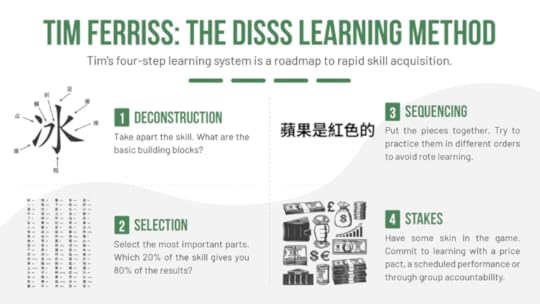
Tim Ferriss is a prime example of someone who uses ultra-effective metalearning techniques to learn a lot in the shortest possible time.
His system, called the DiSSS Method, is the ultimate learning hack. If you make a habit of using it, it will transform the way you learn forever.
The method is fourfold:
Deconstruct a particular skill. Salsa dancing is largely comprised of hip movement, spins, footwork, and timing. By breaking down it down into manageable chunks, you can eliminate a lot of the anxiety that comes with facing complex, overwhelming learning tasks. When you first start learning a skill, it helps to ask: what are the fundamental building blocks involved? Select the important stuff, and focus on it. Often, it’s the 20% input that leads to 80% of the output. In rock drumming, this would be the basic groove of a song, and not the little fills and embellishments that accompany it. Drills can be highly effective during this stage. A guiding question: what is this skill's most essential component? Sequence the learned material. Try putting the basic elements together. If you are learning a new language, then you can begin to arrange difficult vocabulary words into sentences. You can also practice interleaving by mixing up the order. This study shows that variation in practice can lead to significantly more retention of learning than one type of practice alone. Stakes are great for keeping you accountable. This is because humans are inherently risk averse. You can leverage this aversion to make rapid progress. Having to perform in front of a crowd, using a commitment contract where you have to donate money to a charity that you hate in the event that you quit, or making a pact in a group setting are all ways to ensure that you reach your learning goals.
Each new skill that you pick up provides an opportunity to use this system, and strengthen the habit of using it. When cycling through the four steps becomes automatic, then you have reached a significant level of mastery over the learning process.
4) Become a Learning Habit Architect
Bad learning habits are usually the product of a sub-optimal environment. When physical (and digital) spaces are set up poorly, it becomes almost impossible to learn effectively. Conversely, setting up an ideal space for learning is one of the most underrated interventions you can use to improve the rate at which you learn.
Understand: when the environment around you promotes the learning behaviours you want to engage in, they become a lot easier.
In Atomic Habits, James Clear writes: “stop thinking about your environment as filled with objects. Start thinking about it as filled with relationships.”
This shift in thinking allows you to see deeper truths about what your surroundings are designed to get you to do.
Is the TV the centrepiece of almost every room? That will determine how you spend much of your time. Are books and magazines placed strategically around the house? If so, they will nudge you towards a different set of behaviours.
Here is a list of ideas for designing an environment that is ideal for learning:
Put your learning materials (e.g. guitar, flash cards, textbooks) in obvious, high-traffic areas.Hide distractions (e.g. phone, TV, Star Wars memorabilia) from sight.Have a designated space for learning (e.g. a desk in the bedroom)Have a warm-up routine that you associate with a particular place (3 deep breaths when you sit down to work at your desk)
5) Use a Failsafe
We all slip up and miss a workout or a learning session once in a while. That’s to be expected. The real question is: what do you when you miss once?
Persistence of learning involves anticipating errors, and having a failsafe system in place to prevent further ones. A simple strategy can help overcome guilt and get you back on track quickly: avoid the second mistake.
The day after slipping up is a huge inflection point. It is where you decide whether to maintain a habit or let it go. It works for almost everything: exercise, meditation, reading, and learning new skills. Creating a chain of practice sessions across time is how you build the muscle of habit. And it all starts with consistency, and not missing days.
It seems simple, and it is. But it is one of the most effective “algorithms” I have come across for learning and behaviour change.
Further Reading
If you are interested in unlocking the power of your habits further, I recommend these three books:
[image error] [image error] [image error] [image error] [image error] [image error]
For more on learning about consistency and systems for mastery, you might be interested in John Danaher’s 5 lessons on learning or Benjamin Franklin’s deliberate practice method for writing.
June 24, 2021
How to Be the Best: 5 Mental Models from John Danaher
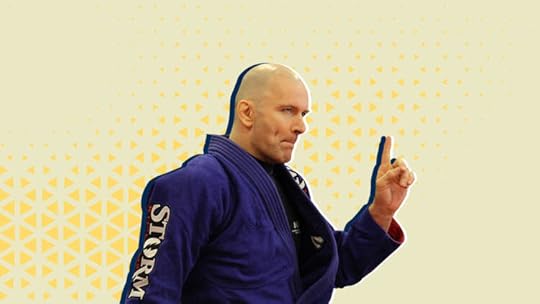 John Danaher is one of the most distinguished grappling trainers of all time. He has coached such legends as UFC world champion Georges St. Pierre, Gordon Ryan, and Garry Tonon.
Moreover, his contributions to the sport of jiu jitsu are legendary. Danaher's innovative leg lock system has fundamentally altered the way athletes train, and has contributed to a massive shift in competitive practice.
Given these accolades, it may come as a surprise that Danaher himself has never competed. After living with severe knee problems and enduring multiple surgeries, he recognized early on that he would never be able to compete at a world-class calibre. What he could do, as a former philosophy PhD student, was to use his mind and superior thinking skills to develop cutting edge strategies and tools to offer his pupils.
More than just components in a philosophy of martial arts, these strategies can be repurposed to suit almost any skill, and can accelerate your own personal journey towards expertise.
Here are five mental models that Danaher uses to propel his disciples to mastery.
1) Opportunity Cost When making a choice or pursuing a particular path, you give up the rewards and benefits of the alternative.
By choosing to spending thirty minutes watching The Bold and the Beautiful, you forego the option of spending that time casually reading up on quantum mechanics. While you may not discover whether Justin gets arrested after letting Thomas out of the cage he was keeping him in(...say what?), you may learn something new about the Mach-Zehnder interferometer.
All joking aside, Danaher uses the concept of opportunity cost to great effect. In a London Real interview with Brian Rose, Danaher explains how he optimizes training time by having students work techniques—but only up until a certain point of proficiency:
Opportunity cost is about asking yourself the question: is this the most valuable thing I could be doing with my time?
Let's say on a scale of 0 is the worst double leg in the world, and 100 is the most perfect double leg in the world, you could invest a lifetime in trying to get to a level of 100, but if your opponent only requires a skill level of say 40 to be taken down, what's the point of getting a double leg all the way up to a 60 or 70? You're not really getting any return on the investment there.
You'd be better off learning how to integrate that double leg with another technique and switching the focus of your training to something else, and then focusing on integration rather than just continuing to work away at getting a better and better double leg, when it's at a point where it's already good enough to get the job done, and it's not going to make any difference. At that point, you're wasting training time you could be investing more wisely somewhere else." (1)
When you are learning something new, you can make incredible progress in a surprisingly short period of time. As you progress, significant gains become harder and harder to come by. Sometimes, moving across disciplines or combining what you've learned with another area is more productive than mastering a small slice of a single subject.
Most important of all, opportunity cost can help you to establish clear priorities, and stick with them.
2) Leverage
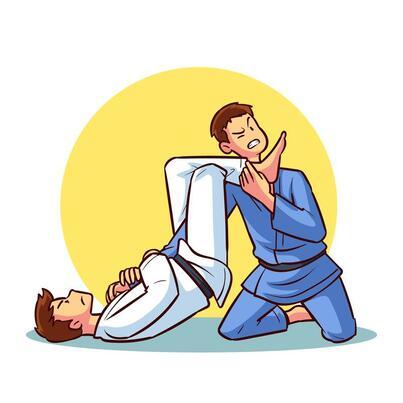 Fight vector created by freepik - www.freepik.com
 Applying force with leverage magnifies the output significantly. Using a lever, you can exert a few hundred pounds of force to generate several thousand pounds of force. Analogously, in the investing world, experts use risk/reward asymmetries to generate 10 or 100 times their initial investment.
On the Lex Fridman Podcast, John Danaher succinctly explains how the principle of leverage applies in jiu jitsu:
Let's say we have two athletes: athlete A and athlete B. Athlete A has 100 units of strength, however we define that overall. Athlete B has 50. Ostensibly, athlete A is twice as strong as athlete B.The world is full of examples where the principle of leverage can be applied.
But athlete B can maneuver his body into a set of positions focused around a critical point of his opponent's body, where he can apply 40 units of strength out of his total of 50, while his opponent can only defend with 20 units of strength out of his total of 100. You have now completely reversed the strength discrepancy." (2)
A thoughtful, well-timed marketing campaign often yields remarkable results. A single social connection can help you reach new levels of professional success. New technology allows you to reach millions of people that you couldn't reach before.
Using leverage wisely is an art form.
What will you use it for?
3) Metalearning Simply put, metalearning is learning about the learning process. Danaher places an extraordinarily high value on deliberate training, and seeks to avoid passive practice at all costs.
He remarks that a lot of drilling ends up as rote learning, which impedes progress:
Drills have diminishing returns. Once you get to a certain skill level, if you just keep hammering on the same thing, in the same fashion, for the same amount of time, you stop getting better...Danaher's approach to instruction is to build skills from the ground up, and incrementally increase the level of resistance and difficulty.
Ultimately, any movement in the gym that doesn't improve the skills you already have or build new skills is a waste of time." (2)
He also does something that other coaches rarely do—carve out time to explicitly cover the purpose and methodology of drilling:
One of the first things that I do when I coach people is that I teach them how to drill. That's a skill in itself." (2)Engaging his students in the practice of metalearning allows Danaher to extract maximum value from every available minute of training. When students know how to drill, their confidence increases. They feel assured that the formula they are following is effective.
Incidentally, metalearning is what lead me to discover an incredible method for developing one's writing skills.
4) Kaizen (Continuous Improvement)
 Danaher is a proponent of Kaizen—a Japanese system of thought that encourages incremental daily improvements, which add up over time. Books like The Compound Effect and Atomic Habits point out that success almost never happens overnight. More often, it comes from a gradual accumulation of gains.
 Expecting major progress in a short timeframe is a recipe for frustration and failure. It is better to find one small thing you can get better at today, and bring that wisdom with you tomorrow.
Danaher captures the essence of Kaizen beautifully:
The whole notion of Kaizen crystallizes this idea that if I can improve my performance in any given area of my life, by even a small percentage point, and then add day by day, you get this compounding interest effect, where at the end of 5 years something quite remarkable may have happened—you may have literally reinvented yourself in 5 years." (2)To harness the power of Kaizen, long-term thinking and daily reflection are necessary. Think of it as charting a course across a vast expanse of months or years. At times, you will have to course correct, and you may even find yourself swept away by the occasional storm.
What matters is that you seek to continually close the distance between where you are and where you want to be.
Until you get a sense of one day building upon another towards a goal, you'll never achieve anything." (2)5) Persistence of Thinking
Kaizen only works if you keep at it, day after day.
But persistence alone is not enough. Steadily moving towards the wrong goal, or moving in circles, won't get you to where you want to be. It is only through continually rethinking your approach to improvement that you can begin to build up real skills.
Part of Danaher's edge lies in his willingness to question assumptions in the sport of jiu jitsu. Recently, he has started examining parts of the sport that have been neglected in the past—most notably the standing game.
Making a habit of consistent reflection is critical. It can be as simple as a single page of a journal each night, where you ask yourself: "what did I learn today?".
Add up the lessons over time, and you will reach new heights of achievement over the course of years.
Most people see [persistence] as a kind of simplistic doggedness where you show up every day. That's not it. The most important form of persistence is persistence of thinking, which looks to push you in increasingly efficient methods of training. People talk about the hardest work of all is hard thinking. And they're absolutely right. (2)As John C. Maxwell wrote, "Experience isn't the best teacher; evaluated experience is." Always thinking about ways to improve is one of the best ways to set yourself apart.
If you want to learn more about John Danaher and his unique blend of philosophy and coaching, his Instagram page (danaherjohn) is brimming with amazing content.
For a more comprehensive exploration, The Danaher Diaries make for great reading as well.
Sal Khan on Creativity and Mastery Learning
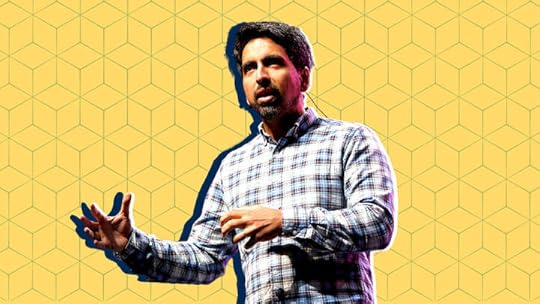 Salman Khan is a true pioneer of online education. The Khan Academy videos he started making in 2005 have been viewed over 1.8 billion times, and his work has helped to accelerate the learning of more than 100 million people. His creative approach to distance education—removing long-winded lectures from the equation and focusing on mastery learning—has revolutionized the way people acquire new knowledge and skills.
How does Sal Khan generate his creative insights while maintaining a feverish pace of productivity? What approach has helped Khan to redesign education from first principles, while larger institutions have struggled to adapt?
Finding EquilibriumFresh out of business school in 2003, Sal Khan joined Wohl Capital Management, a small hedge fund outside of San Fransisco. Fund managers are notorious workaholics, so Khan rolled up his sleeves and prepared for an onslaught of 14 hour workdays. He was getting ready to stay late one evening, when his boss, Dan Wohl, took him aside. He told him that he should go home, and leave his work at the office. During this exchange, Wohl shared an important insight: his job wasn't to burn himself out working around the clock—it was to make a few key strategic decisions and avoid a bunch of poor ones.
During this found time at home, Sal Khan began tutoring his cousin, Nadia, in mathematics. He also started writing the algorithms that became prototypes for Khan Academy's educational platform. Sal credits this 20-30% time as where he came up with many of his creative insights.
 By carving out time to engage in tasks that are seemingly unrelated to your line of work, you can free up your mind to think divergently and approach problems from new angles. Barbara Oakley, creator of the massively popular Learning How to Learn course, refers to this process as diffuse mode thinking.
 It can feel counterintuitive at first. We've learned—both through experience and education—that working on a problem requires a constant barrage of effort until it is completed. However, the best ideas often arise when you shift between intense focus and creative mind-wandering.
Sal Khan also believes that having blocks of time to pursue individual interests can ignite one's desire to learn. In an interview for the Harvard Business Review, he cites one transformative example:
Every day, starting in second grade, they took me out of class for an hour, and I would go to another room, with a mixed age group. The first time I went, I thought it was the biggest racket. I walked up to Miss Rouselle’s desk, and she asked, “What do you like to do?” I was like, I’m seven years old—shouldn’t you be telling me what to do? But I said, “I like to draw. I like puzzles.” She said, “OK, have you used oil paints? Have you done Mind Benders?” Soon I looked forward to that hour more than I did to spending the night at my friend’s house. And I learned more that applies to what I do today than in the five other hours of the day combined."(1)When it comes to learning, autonomy fuels discovery—which ignites curiosity. This is true whether you are in second grade, or just starting out in a competitive career.
One of the principal missions of Khan Academy is to provide the raw materials and structure to support self-paced learning. This offloads much of the rote, lecture-based pedagogy that takes place in the classroom, and frees up valuable class time to work on creative, exploratory projects. More children deserve the opportunity to discover the world around them on their own terms, as Sal did.
Learning for Mastery
 Image by FelixMittermeier from Pixabay
Under the traditional classroom model, teachers deliver instruction for a given unit over the course of weeks or months. Students are tested, and then it's on to the next unit—regardless of student performance. Over the span of many successive units, students develop gaps in their understanding that compound until they aren't able grasp new concepts at all.
Mastery learning is different. When students aren't able to attain levels of proficiency in a subject, progress is halted, lots of feedback gets generated, and students have multiple opportunities to try again. Only once they demonstrate a solid understanding of the idea of skill at hand can they continue to the next lesson.
Sal Khan captures the efficacy of mastery learning in a conversation with Jennifer Gonzalez, the author of Cult of Pedagogy:
Arguably it’s the oldest way of learning, that you should learn at a pace that’s comfortable for you and then master concepts as you go on. Benjamin Bloom famously coined this in the ‘80s in his famous 2 Sigma study where he showed that if students are able to learn at their own time and pace in a mastery learning framework, which to him he defined as a framework where if the student’s at 70 percent or 80 percent correct, that they should have as many chances as necessary to get to 90 percent-plus correct.
That if students learn in that type of framework, personalized and mastery-based, that the same student at the 50th percentile could now be two standard deviations higher than that. And that was a big seminal study. It’s taught in ed schools. Everyone knows about it. But I think it was just kind of shelved, and there’s been over 300 studies since then about mastery learning. It’s actually one of the most robust views in education. No one really intellectually disagrees with it. (2)
If no one disagrees with the premise of mastery learning, why is it so rarely implemented in the classroom? Sal Khan points out that, until now, mastery learning has faced serious logistical challenges. How can you ensure that 30+ learners in a classroom are able to proceed towards an in-depth understanding of content at their own pace?
This is where Khan Academy excels. With their latest Mastery challenges, the process of reaching mastery can be systematized to a considerable degree. As students watch videos, complete practice quizzes, and take unit tests, they earn mastery points which allows them to visualize and gamify their progress. Once they accumulate enough points, they achieve proficiency and can move on to the next topic.
Mastery is not a one-size-fits-all intervention. Just as the creative process happens by alternating between focused and diffuse modes, the future of education lies in alternating between in-class engagement and technological coursework.
Self-Directed MasteryWhat does all of this mean for self-directed learners?
Benjamin Bloom's work on The Two Sigma Problem was an effort to find something that worked as well as tutoring. The upshot? Nothing really comes close. It comes as no surprise that Khan Academy uses a one-to-one model to facilitate learning.
The benefits of working one-on-one with an expert tutor are unparalleled. They can target instruction to your individual level, conduct effective drills with you, and offer you continuous streams of personalized feedback. Writers, musicians, artists, sculptors, poets and even doctors can benefit from a tutor or coach—regardless of skill level.
Are you looking to learn something new or improve at a skill? Here are some more resources on rapid skill acquisition and mastering new skills.
May 28, 2021
Try These 6 Super-Effective Learning Methods
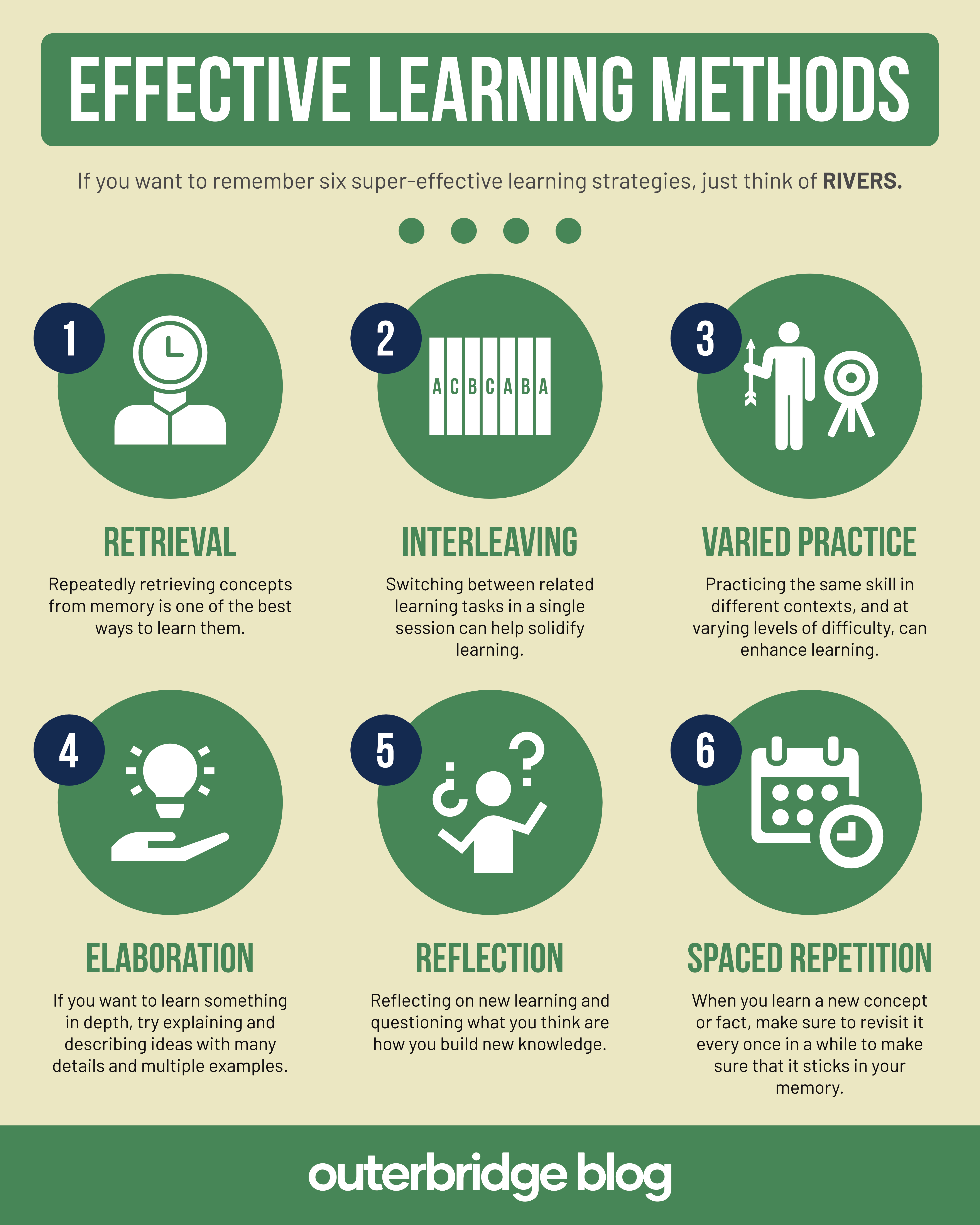 Here's a mini-infographic with 6 super-effective learning methods that can help you learn better.
 I first wrote about the mnemonic in my summary of Make it Stick: The Science of Successful Learning.
It's a super helpful way to commit these methods to memory. When in doubt, just think of RIVERS:
RetrievalInterleavingVaried PracticeElaborationReflectionSpaced Repetition
Do you know a teacher or learner who would benefit from these science-backed learning techniques? Click below to share:


April 22, 2021
How to Remember What You Read: The URL Strategy
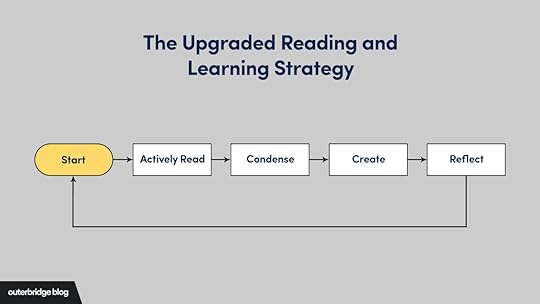 Have you ever read through a book, only to discover that you can’t remember more than a few main points?
The problem isn’t you. The problem is your reading methods.
Many people learn the basics of reading in grade school, and add a few more tricks, like underlining and rereading, in high school.
And then they stop developing their reading abilities altogether.
They don’t learn time-tested methods and strategies for becoming better readers. These methods can help you remember more, build deeper understanding, and synthesize knowledge.
This article outlines a system, which I call the Upgraded Reading and Learning (URL) Strategy, that will level up your reading skills.
With this system, you will retain more of what you read, and be able to master difficult subjects more easily.
Disclaimer: this is not a “reading hack” or a shortcut. In fact, it involves more effort and thought than just flipping through a book.
However, if you are willing to put in the work, the rewards will be greater than your inputs.
Let’s get started!
The Problem With Cursory Reading
When you read instructions on how to assemble a piece of furniture, or look through a magazine in a waiting room, you probably scan or skim the text.
You are looking for the most important details, and the minimum amount of information needed to get the job done. Doing this saves you time, and you still manage to achieve your intended outcome.
However, your working memory gets rid of the information quickly after you are finished.
Which is efficient, from an evolutionary perspective.
Holding on to every piece of information paralyzes you. You wouldn’t be able to act in a world of constant uncertainty and change. Unfortunately, this evolved tendency towards forgetting works against you when you want to transfer something into long-term memory.
You need a method to bypass this automatic forgetfulness, and selectively remember information that matters to you.
Passive vs. Active Reading
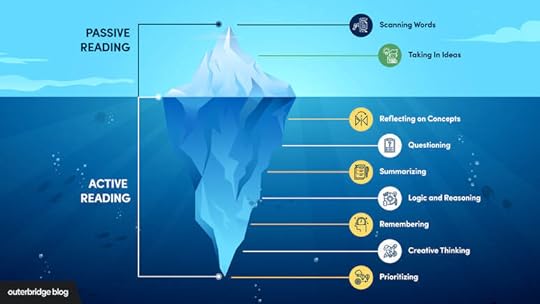 When you are reading a book, you probably don’t scan or skim as much. You may slow down at points where the information is dense.
 You end up paying more attention than you would when reading a magazine or instruction manual.
We can call this type of reading focused reading.
This is the type of reading that is most prevalent today. Focused reading is fine if your goal is to read for pleasure. But, there is a much better way to remember what you read.
Even during focused reading, your limited working memory prevents you from retaining concepts and details.
This is because focused reading can still be passive reading.
In passive reading mode, you aren’t interacting with the book. The ideas flow in one direction: from the author, to you. You aren’t doing the work, because the author already has.
If you sit in on a lecture, you may be enthralled by the speaker’s oratorical skills and mastery of the material, but you probably won’t be able to recall more than 10% of what they said after one week.
The same is true for reading.
Here’s a graph that shows how quickly we forget new information:
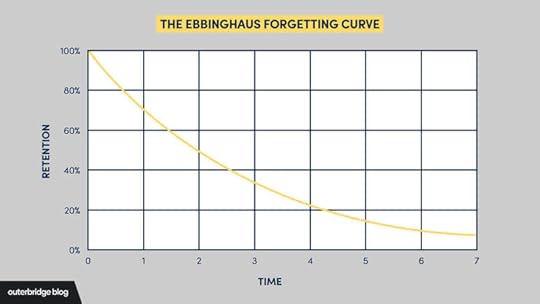 As you can see, remembering is an uphill battle.
Luckily, there is a solution: active reading. It is essential for improving retention and comprehension.
It attacks the root cause of forgetting, by deliberately strengthening memories and connecting them to existing knowledge.
Let’s take a look under the hood and see how some of the best active reading strategies work.
How to Read Actively
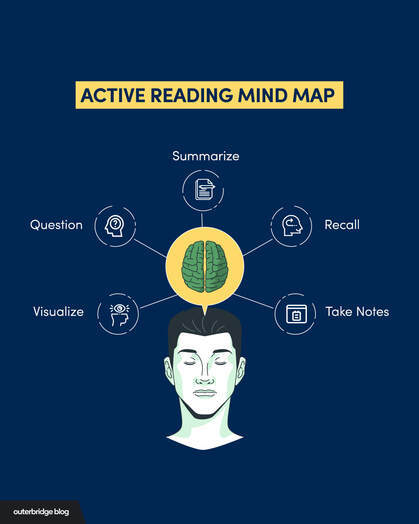 When you read actively, you do more than just process the information a single time. You engage and interact with the book.
If passive reading is like listening to a lecture, active reading is like having an open conversation with the professor. An active reader asks questions, clarifies important concepts, and gets critical feedback.
To read better, you need to look for weak points as well as areas where you should update your knowledge. This process is key to learning more effectively.
While highlighting parts of the book may draw your attention to important passages, it can also cause you to think that you understand more than you do.
In an article called Highlighting with Reservations by The Learning Scientists, Althea Need Kaminske notes this trend towards self-deception:
Highlighting draws our attention to the highlighted word, making it easier to read. The concern is that ease of reading can be interpreted as ease of knowing. That instead of thinking, “oh, that was easy to read” we think, “I must really know/understand this concept.” This is referred to as an illusion of knowing."Instead of passively highlighting tons of key details, I recommend writing in the margins.
In academic jargon, this is called marginalia. It pushes you to become more engaged in your reading.
Some questions that lead to high-quality writing in the margins:
Where do you agree with the author? Where do you disagree? What claims do they make that you are curious about? What have other authors said about the subject?
By responding to these questions and coming up with your own, you will find that your mind begins generating more and more new ideas about the material. This is a promising sign that you are the path towards active reading. Recall and Summarize
After reading a chapter, you can take a five minute break to stretch your legs, or listen to some music.
When you come back, try to recall as much pertinent information as possible.
I find that writing down notes can help to summarize key information. A paragraph or two is fine per chapter. If you prefer, you can create flow charts, drawings, or mind maps that illustrate what you’ve read.
This process only takes about five to ten minutes, but it taps into a powerful learning mechanism.
This is because remembering something is an active process.
By dredging up recently acquired knowledge from your long-term memory, you are strengthening the connections behind those memories.
As a result, recall makes it easier to access the desired information later.
Testing yourself on what you have just read also helps you avoid the illusion of knowing—that pervasive sense that you already understand concepts based on mere exposure to them.
Testing yourself often is by far one of the best ways to read a book and remember it.
At first, you might discover that you don’t know as much about the topic as you thought. This can be painful, but necessary for expanding your knowledge. It also offers excellent immediate feedback.
As you repeat the process, you accumulate notes that you can refer to later. These can be used to safeguard against forgetting.
Harness Your Visual and Spatial Memory
Multiple studies (two examples: here and here) have shown that we have an easier time remembering pictures as opposed to words.
We also have excellent spatial memories.
To test this out, take a few seconds and try to visualize your childhood home.
Go ahead, I'll wait.
I bet you can do so, with considerable detail.
When we combine the two, we can create nearly indelible memories. This mnemonic tool is known as the method of loci, or creating a memory palace, and has been used for more than 2,500 years.
You can take the material you are reading, encode it in visual form and place it around a visually imagined space that is familiar to you.
I used this method to memorize 29 mental models from Farnam Street’s The Great Mental Models Project (Volumes 1 and 2). Having immediate access to powerful concepts like these has radically changed my thinking.
If you want to hold onto visual images for a long time, remember this trick: the more bizarre or funny the image is that you create, the better you will remember it.
Which is why Thomas Sankara, the socialist revolutionary and former president of Burkina Faso, is lighting a match in the fridge of my old house (activation energy), and a broken wine glass is sitting on the Great Wall of China under the sink (thermodynamics)!
By taking the time to actively commit concepts to memory, you can use them more easily. If you are wondering how to retain what you read, this is one of the most effective methods at your disposal.
You can even begin right now. What are some tips from this article you want to remember? How can you represent them visually? Which familiar location can you mentally store them in?
If you struggle to visualize things, don’t stress. I do too. Some people have stronger visual faculties than others. However, if you keep trying, you will find that your visual powers can increase over time.
 Condense
You have actively read through a chapter, and summarized the details in a couple of paragraphs. Great!
Now it is time to distill those paragraphs into a single sentence.
What is the most important information? The key idea? If the author had to sum up several thousand words from the chapter, how would she do it?
Thinking through these questions will leave you with the core concepts from the book.
You will be able to remember it much more easily than if you tried to recall every detail and anecdote across 20+ pages of a chapter.
This process works so well because you are doing the work of deciding what is important.
An example of the power of condensing is the Twitter account of entrepreneur and investor Naval Ravikant. His tweetstorm called "How to Get Rich (without getting lucky) gained a ton of traction. The tweets are principles that he read about (and lived), and then distilled into 140 characters each.
By doing this, Naval determined what was most important and got rid of all the extraneous information. After all, less is more.
By collecting these chapter summaries as you read, you will have a short list of key concepts by the time you are finished. You can read through the list in less than a minute, and it ends up representing the skeleton of the book itself.
Commit these key points to memory, and you will begin to impress others with your thoroughness and deep understanding of any book that you pick up.
Create
This is the magic ingredient that many people miss.
By taking what you have learned or read about and transforming it into a diagram, a product, or a piece of art, you end up internalizing it.
You manipulate the concepts, and discover the relationships between them.
When I started doing book summary infographics, I realized that arranging my notes into design points gave me a much better grasp of what I had read.
For example, when I worked my way through Adam Grant’s book Think Again, I really liked the four thinking modes he outlined in chapter 1. So, I came up with this infographic:
 Now, these four thinking modes are stuck in my head. Forever!
Taking ideas you’ve read about from one medium—in this case, print—and transforming them into another medium is a form of remixing.
World famous artists like David Bowie, Thom Yorke from Radiohead, and Grandmaster Flash have all used the principles of remixing to produce their renowned art.
When you think about it, creativity is a superpower. It involves taking familiar elements and producing something unique.
If you want to remember more of what you are learning, creativity can help there as well; it turns out that memory and creativity are interconnected .
 Reflect
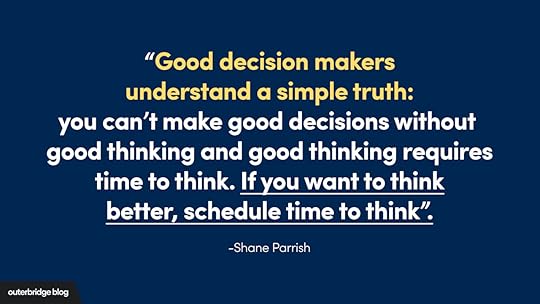
The final part of the URL strategy involves thinking.
While reading, we tend to home in on the author’s position, as well as the evidence that he or she might provide. But we often don’t consider the larger context of the work, or how we can apply what we’ve learned to real-world situations.
In the popular online learning course Learning How to Learn, Professor Barbara Oakley differentiates between two core types of thinking: focused and diffuse.
In focused mode, you have tunnel vision. Your awareness is on the task at hand. In this mode, you attempt to develop a narrow slice of understanding, whether it be in a skill or a course subject.
However, in diffuse mode, your connections loosen up, and you are able to form more wide-ranging associations. You begin to think in ways that you couldn’t before.
The key to switching into diffuse mode is developing a state of relaxed awareness.
In an article about how to have great ideas, I outline a method that uses diffuse mode and deliberate breaks to generate new insights. It really works.
One part of the method involves coming as close to sleep as possible (without actually falling asleep). This frees up your mind to explore uncharted territory, and reexamine what you've learned.
Diffuse mode may look like daydreaming or mind wandering to others, but it is essential to processing what you read, and making varied connections.
 Wrapping Up
Passive reading leads to low rates of retention. If you casually read through a book, you won’t be able to use what you’ve learned unless you put it into action.
When reading a novel or strictly for pleasure, you don’t have to focus on remembering salient details (unless you find it fun!). But if you want to master the material, the URL strategy can guide you.
First, actively read. Write notes in the margins, ask questions, and visualize the concepts.
Then, summarize and recall what you’ve read in each chapter. This cements ideas in your long-term memory.
After that, condense your notes into a sentence or two that capture the essence of the chapter.
Then, create something new with your notes. This helps broaden your perspective.
Lastly, spend some time thinking about what you’ve read. This is where you make new connections, and see where you can apply what you’ve learned.
I hope you are able to elements of this approach to help you read and learn more effectively.
Happy reading!
Further Resources:
Reading Better — Farnam Street Science Says This is the Easiest Way to Remember What You Read — INC Active Reading Strategies: Remember and Analyze What You Read — Princeton University Critical Reading Techniques — The Open University The SQ3R Reading Strategy — University of Manitoba How to Read a Book — Mortimer J. Adler Do The Real Thing — Scott Young Reading Faster and Better — Glendale CollegeHow to Be a Better Reader — Mark Manson (if you're fine with F bombs) 7 Ways to Retain More of Every Book You Read — James Clear Start Learning Better.
Subscribe to the 2 x 2 Newsletter and get your free, in-depth learning guide.
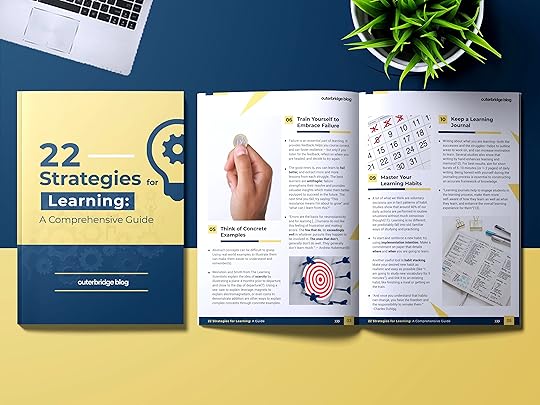 Download my Free PDF
Unsubscribe at any time. Your information will never be shared with anyone.
Built with ConvertKit.formkit-form[data-uid="4cbbc183c1"] *{box-sizing:border-box;}.formkit-form[data-uid="4cbbc183c1"]{-webkit-font-smoothing:antialiased;-moz-osx-font-smoothing:grayscale;}.formkit-form[data-uid="4cbbc183c1"] legend{border:none;font-size:inherit;margin-bottom:10px;padding:0;position:relative;display:table;}.formkit-form[data-uid="4cbbc183c1"] fieldset{border:0;padding:0.01em 0 0 0;margin:0;min-width:0;}.formkit-form[data-uid="4cbbc183c1"] body:not(:-moz-handler-blocked) fieldset{display:table-cell;}.formkit-form[data-uid="4cbbc183c1"] h1,.formkit-form[data-uid="4cbbc183c1"] h2,.formkit-form[data-uid="4cbbc183c1"] h3,.formkit-form[data-uid="4cbbc183c1"] h4,.formkit-form[data-uid="4cbbc183c1"] h5,.formkit-form[data-uid="4cbbc183c1"] h6{color:inherit;font-size:inherit;font-weight:inherit;}.formkit-form[data-uid="4cbbc183c1"] p{color:inherit;font-size:inherit;font-weight:inherit;}.formkit-form[data-uid="4cbbc183c1"] ol:not([template-default]),.formkit-form[data-uid="4cbbc183c1"] ul:not([template-default]),.formkit-form[data-uid="4cbbc183c1"] blockquote:not([template-default]){text-align:left;}.formkit-form[data-uid="4cbbc183c1"] p:not([template-default]),.formkit-form[data-uid="4cbbc183c1"] hr:not([template-default]),.formkit-form[data-uid="4cbbc183c1"] blockquote:not([template-default]),.formkit-form[data-uid="4cbbc183c1"] ol:not([template-default]),.formkit-form[data-uid="4cbbc183c1"] ul:not([template-default]){color:inherit;font-style:initial;}.formkit-form[data-uid="4cbbc183c1"] .ordered-list,.formkit-form[data-uid="4cbbc183c1"] .unordered-list{list-style-position:outside !important;padding-left:1em;}.formkit-form[data-uid="4cbbc183c1"] .list-item{padding-left:0;}.formkit-form[data-uid="4cbbc183c1"][data-format="modal"]{display:none;}.formkit-form[data-uid="4cbbc183c1"][data-format="slide in"]{display:none;}.formkit-form[data-uid="4cbbc183c1"][data-format="sticky bar"]{display:none;}.formkit-sticky-bar .formkit-form[data-uid="4cbbc183c1"][data-format="sticky bar"]{display:block;}.formkit-form[data-uid="4cbbc183c1"] .formkit-input,.formkit-form[data-uid="4cbbc183c1"] .formkit-select,.formkit-form[data-uid="4cbbc183c1"] .formkit-checkboxes{width:100%;}.formkit-form[data-uid="4cbbc183c1"] .formkit-button,.formkit-form[data-uid="4cbbc183c1"] .formkit-submit{border:0;border-radius:5px;color:#ffffff;cursor:pointer;display:inline-block;text-align:center;font-size:15px;font-weight:500;cursor:pointer;margin-bottom:15px;overflow:hidden;padding:0;position:relative;vertical-align:middle;}.formkit-form[data-uid="4cbbc183c1"] .formkit-button:hover,.formkit-form[data-uid="4cbbc183c1"] .formkit-submit:hover,.formkit-form[data-uid="4cbbc183c1"] .formkit-button:focus,.formkit-form[data-uid="4cbbc183c1"] .formkit-submit:focus{outline:none;}.formkit-form[data-uid="4cbbc183c1"] .formkit-button:hover > span,.formkit-form[data-uid="4cbbc183c1"] .formkit-submit:hover > span,.formkit-form[data-uid="4cbbc183c1"] .formkit-button:focus > span,.formkit-form[data-uid="4cbbc183c1"] .formkit-submit:focus > span{background-color:rgba(0,0,0,0.1);}.formkit-form[data-uid="4cbbc183c1"] .formkit-button > span,.formkit-form[data-uid="4cbbc183c1"] .formkit-submit > span{display:block;-webkit-transition:all 300ms ease-in-out;transition:all 300ms ease-in-out;padding:12px 24px;}.formkit-form[data-uid="4cbbc183c1"] .formkit-input{background:#ffffff;font-size:15px;padding:12px;border:1px solid #e3e3e3;-webkit-flex:1 0 auto;-ms-flex:1 0 auto;flex:1 0 auto;line-height:1.4;margin:0;-webkit-transition:border-color ease-out 300ms;transition:border-color ease-out 300ms;}.formkit-form[data-uid="4cbbc183c1"] .formkit-input:focus{outline:none;border-color:#1677be;-webkit-transition:border-color ease 300ms;transition:border-color ease 300ms;}.formkit-form[data-uid="4cbbc183c1"] .formkit-input::-webkit-input-placeholder{color:inherit;opacity:0.8;}.formkit-form[data-uid="4cbbc183c1"] .formkit-input::-moz-placeholder{color:inherit;opacity:0.8;}.formkit-form[data-uid="4cbbc183c1"] .formkit-input:-ms-input-placeholder{color:inherit;opacity:0.8;}.formkit-form[data-uid="4cbbc183c1"] .formkit-input::placeholder{color:inherit;opacity:0.8;}.formkit-form[data-uid="4cbbc183c1"] [data-group="dropdown"]{position:relative;display:inline-block;width:100%;}.formkit-form[data-uid="4cbbc183c1"] [data-group="dropdown"]::before{content:"";top:calc(50% - 2.5px);right:10px;position:absolute;pointer-events:none;border-color:#4f4f4f transparent transparent transparent;border-style:solid;border-width:6px 6px 0 6px;height:0;width:0;z-index:999;}.formkit-form[data-uid="4cbbc183c1"] [data-group="dropdown"] select{height:auto;width:100%;cursor:pointer;color:#333333;line-height:1.4;margin-bottom:0;padding:0 6px;-webkit-appearance:none;-moz-appearance:none;appearance:none;font-size:15px;padding:12px;padding-right:25px;border:1px solid #e3e3e3;background:#ffffff;}.formkit-form[data-uid="4cbbc183c1"] [data-group="dropdown"] select:focus{outline:none;}.formkit-form[data-uid="4cbbc183c1"] [data-group="checkboxes"]{text-align:left;margin:0;}.formkit-form[data-uid="4cbbc183c1"] [data-group="checkboxes"] [data-group="checkbox"]{margin-bottom:10px;}.formkit-form[data-uid="4cbbc183c1"] [data-group="checkboxes"] [data-group="checkbox"] *{cursor:pointer;}.formkit-form[data-uid="4cbbc183c1"] [data-group="checkboxes"] [data-group="checkbox"]:last-of-type{margin-bottom:0;}.formkit-form[data-uid="4cbbc183c1"] [data-group="checkboxes"] [data-group="checkbox"] input[type="checkbox"]{display:none;}.formkit-form[data-uid="4cbbc183c1"] [data-group="checkboxes"] [data-group="checkbox"] input[type="checkbox"] + label::after{content:none;}.formkit-form[data-uid="4cbbc183c1"] [data-group="checkboxes"] [data-group="checkbox"] input[type="checkbox"]:checked + label::after{border-color:#ffffff;content:"";}.formkit-form[data-uid="4cbbc183c1"] [data-group="checkboxes"] [data-group="checkbox"] input[type="checkbox"]:checked + label::before{background:#10bf7a;border-color:#10bf7a;}.formkit-form[data-uid="4cbbc183c1"] [data-group="checkboxes"] [data-group="checkbox"] label{position:relative;display:inline-block;padding-left:28px;}.formkit-form[data-uid="4cbbc183c1"] [data-group="checkboxes"] [data-group="checkbox"] label::before,.formkit-form[data-uid="4cbbc183c1"] [data-group="checkboxes"] [data-group="checkbox"] label::after{position:absolute;content:"";display:inline-block;}.formkit-form[data-uid="4cbbc183c1"] [data-group="checkboxes"] [data-group="checkbox"] label::before{height:16px;width:16px;border:1px solid #e3e3e3;background:#ffffff;left:0px;top:3px;}.formkit-form[data-uid="4cbbc183c1"] [data-group="checkboxes"] [data-group="checkbox"] label::after{height:4px;width:8px;border-left:2px solid #4d4d4d;border-bottom:2px solid #4d4d4d;-webkit-transform:rotate(-45deg);-ms-transform:rotate(-45deg);transform:rotate(-45deg);left:4px;top:8px;}.formkit-form[data-uid="4cbbc183c1"] .formkit-alert{background:#f9fafb;border:1px solid #e3e3e3;border-radius:5px;-webkit-flex:1 0 auto;-ms-flex:1 0 auto;flex:1 0 auto;list-style:none;margin:25px auto;padding:12px;text-align:center;width:100%;}.formkit-form[data-uid="4cbbc183c1"] .formkit-alert:empty{display:none;}.formkit-form[data-uid="4cbbc183c1"] .formkit-alert-success{background:#d3fbeb;border-color:#10bf7a;color:#0c905c;}.formkit-form[data-uid="4cbbc183c1"] .formkit-alert-error{background:#fde8e2;border-color:#f2643b;color:#ea4110;}.formkit-form[data-uid="4cbbc183c1"] .formkit-spinner{display:-webkit-box;display:-webkit-flex;display:-ms-flexbox;display:flex;height:0px;width:0px;margin:0 auto;position:absolute;top:0;left:0;right:0;width:0px;overflow:hidden;text-align:center;-webkit-transition:all 300ms ease-in-out;transition:all 300ms ease-in-out;}.formkit-form[data-uid="4cbbc183c1"] .formkit-spinner > div{margin:auto;width:12px;height:12px;background-color:#fff;opacity:0.3;border-radius:100%;display:inline-block;-webkit-animation:formkit-bouncedelay-formkit-form-data-uid-4cbbc183c1- 1.4s infinite ease-in-out both;animation:formkit-bouncedelay-formkit-form-data-uid-4cbbc183c1- 1.4s infinite ease-in-out both;}.formkit-form[data-uid="4cbbc183c1"] .formkit-spinner > div:nth-child(1){-webkit-animation-delay:-0.32s;animation-delay:-0.32s;}.formkit-form[data-uid="4cbbc183c1"] .formkit-spinner > div:nth-child(2){-webkit-animation-delay:-0.16s;animation-delay:-0.16s;}.formkit-form[data-uid="4cbbc183c1"] .formkit-submit[data-active] .formkit-spinner{opacity:1;height:100%;width:50px;}.formkit-form[data-uid="4cbbc183c1"] .formkit-submit[data-active] .formkit-spinner ~ span{opacity:0;}.formkit-form[data-uid="4cbbc183c1"] .formkit-powered-by[data-active="false"]{opacity:0.35;}.formkit-form[data-uid="4cbbc183c1"] .formkit-powered-by-convertkit-container{display:-webkit-box;display:-webkit-flex;display:-ms-flexbox;display:flex;width:100%;z-index:5;margin:10px 0;position:relative;}.formkit-form[data-uid="4cbbc183c1"] .formkit-powered-by-convertkit-container[data-active="false"]{opacity:0.35;}.formkit-form[data-uid="4cbbc183c1"] .formkit-powered-by-convertkit{-webkit-align-items:center;-webkit-box-align:center;-ms-flex-align:center;align-items:center;background-color:#ffffff;border:1px solid #dce1e5;border-radius:4px;color:#373f45;cursor:pointer;display:block;height:36px;margin:0 auto;opacity:0.95;padding:0;-webkit-text-decoration:none;text-decoration:none;text-indent:100%;-webkit-transition:ease-in-out all 200ms;transition:ease-in-out all 200ms;white-space:nowrap;overflow:hidden;-webkit-user-select:none;-moz-user-select:none;-ms-user-select:none;user-select:none;width:190px;background-repeat:no-repeat;background-position:center;background-image:url("data:image/svg+xml;charset=utf8,%3Csvg width='162' height='20' viewBox='0 0 162 20' fill='none' xmlns='http://www.w3.org/2000/svg'%3E%3C... d='M83.0561 15.2457C86.675 15.2457 89.4722 12.5154 89.4722 9.14749C89.4722 5.99211 86.8443 4.06563 85.1038 4.06563C82.6801 4.06563 80.7373 5.76407 80.4605 8.28551C80.4092 8.75244 80.0387 9.14403 79.5686 9.14069C78.7871 9.13509 77.6507 9.12841 76.9314 9.13092C76.6217 9.13199 76.3658 8.88106 76.381 8.57196C76.4895 6.38513 77.2218 4.3404 78.618 2.76974C80.1695 1.02445 82.4289 0 85.1038 0C89.5979 0 93.8406 4.07791 93.8406 9.14749C93.8406 14.7608 89.1832 19.3113 83.1517 19.3113C78.8502 19.3113 74.5179 16.5041 73.0053 12.5795C72.9999 12.565 72.9986 12.5492 73.0015 12.534C73.0218 12.4179 73.0617 12.3118 73.1011 12.2074C73.1583 12.0555 73.2143 11.907 73.2062 11.7359L73.18 11.1892C73.174 11.0569 73.2075 10.9258 73.2764 10.8127C73.3452 10.6995 73.4463 10.6094 73.5666 10.554L73.7852 10.4523C73.9077 10.3957 74.0148 10.3105 74.0976 10.204C74.1803 10.0974 74.2363 9.97252 74.2608 9.83983C74.3341 9.43894 74.6865 9.14749 75.0979 9.14749C75.7404 9.14749 76.299 9.57412 76.5088 10.1806C77.5188 13.1 79.1245 15.2457 83.0561 15.2457Z' fill='%23373F45'/%3E%3Cpath d='M155.758 6.91365C155.028 6.91365 154.804 6.47916 154.804 5.98857C154.804 5.46997 154.986 5.06348 155.758 5.06348C156.53 5.06348 156.712 5.46997 156.712 5.98857C156.712 6.47905 156.516 6.91365 155.758 6.91365ZM142.441 12.9304V9.32833L141.415 9.32323V8.90392C141.415 8.44719 141.786 8.07758 142.244 8.07986L142.441 8.08095V6.55306L144.082 6.09057V8.08073H145.569V8.50416C145.569 8.61242 145.548 8.71961 145.506 8.81961C145.465 8.91961 145.404 9.01047 145.328 9.08699C145.251 9.16351 145.16 9.2242 145.06 9.26559C144.96 9.30698 144.853 9.32826 144.745 9.32822H144.082V12.7201C144.082 13.2423 144.378 13.4256 144.76 13.4887C145.209 13.5629 145.583 13.888 145.583 14.343V14.9626C144.029 14.9626 142.441 14.8942 142.441 12.9304Z' fill='%23373F45'/%3E%3Cpath d='M110.058 7.92554C108.417 7.88344 106.396 8.92062 106.396 11.5137C106.396 14.0646 108.417 15.0738 110.058 15.0318C111.742 15.0738 113.748 14.0646 113.748 11.5137C113.748 8.92062 111.742 7.88344 110.058 7.92554ZM110.07 13.7586C108.878 13.7586 108.032 12.8905 108.032 11.461C108.032 10.1013 108.878 9.20569 110.071 9.20569C111.263 9.20569 112.101 10.0995 112.101 11.459C112.101 12.8887 111.263 13.7586 110.07 13.7586Z' fill='%23373F45'/%3E%3Cpath d='M118.06 7.94098C119.491 7.94098 120.978 8.33337 120.978 11.1366V14.893H120.063C119.608 14.893 119.238 14.524 119.238 14.0689V10.9965C119.238 9.66506 118.747 9.16047 117.891 9.16047C117.414 9.16047 116.797 9.52486 116.502 9.81915V14.069C116.502 14.1773 116.481 14.2845 116.44 14.3845C116.398 14.4845 116.337 14.5753 116.261 14.6519C116.184 14.7284 116.093 14.7891 115.993 14.8305C115.893 14.8719 115.786 14.8931 115.678 14.8931H114.847V8.10918H115.773C115.932 8.10914 116.087 8.16315 116.212 8.26242C116.337 8.36168 116.424 8.50033 116.46 8.65577C116.881 8.19328 117.428 7.94098 118.06 7.94098ZM122.854 8.09713C123.024 8.09708 123.19 8.1496 123.329 8.2475C123.468 8.34541 123.574 8.48391 123.631 8.64405L125.133 12.8486L126.635 8.64415C126.692 8.48402 126.798 8.34551 126.937 8.2476C127.076 8.1497 127.242 8.09718 127.412 8.09724H128.598L126.152 14.3567C126.091 14.5112 125.986 14.6439 125.849 14.7374C125.711 14.831 125.549 14.881 125.383 14.8809H124.333L121.668 8.09713H122.854Z' fill='%23373F45'/%3E%3Cpath d='M135.085 14.5514C134.566 14.7616 133.513 15.0416 132.418 15.0416C130.496 15.0416 129.024 13.9345 129.024 11.4396C129.024 9.19701 130.451 7.99792 132.191 7.99792C134.338 7.99792 135.254 9.4378 135.158 11.3979C135.139 11.8029 134.786 12.0983 134.38 12.0983H130.679C130.763 13.1916 131.562 13.7662 132.615 13.7662C133.028 13.7662 133.462 13.7452 133.983 13.6481C134.535 13.545 135.085 13.9375 135.085 14.4985V14.5514ZM133.673 10.949C133.785 9.87621 133.061 9.28752 132.191 9.28752C131.321 9.28752 130.734 9.93979 130.679 10.9489L133.673 10.949Z' fill='%23373F45'/%3E%3Cpath d='M137.345 8.11122C137.497 8.11118 137.645 8.16229 137.765 8.25635C137.884 8.35041 137.969 8.48197 138.005 8.62993C138.566 8.20932 139.268 7.94303 139.759 7.94303C139.801 7.94303 140.068 7.94303 140.489 7.99913V8.7265C140.489 9.11748 140.15 9.4147 139.759 9.4147C139.31 9.4147 138.651 9.5829 138.131 9.8773V14.8951H136.462V8.11112L137.345 8.11122ZM156.6 14.0508V8.09104H155.769C155.314 8.09104 154.944 8.45999 154.944 8.9151V14.8748H155.775C156.23 14.8748 156.6 14.5058 156.6 14.0508ZM158.857 12.9447V9.34254H157.749V8.91912C157.749 8.46401 158.118 8.09506 158.574 8.09506H158.857V6.56739L160.499 6.10479V8.09506H161.986V8.51848C161.986 8.97359 161.617 9.34254 161.161 9.34254H160.499V12.7345C160.499 13.2566 160.795 13.44 161.177 13.503C161.626 13.5774 162 13.9024 162 14.3574V14.977C160.446 14.977 158.857 14.9086 158.857 12.9447ZM98.1929 10.1124C98.2033 6.94046 100.598 5.16809 102.895 5.16809C104.171 5.16809 105.342 5.44285 106.304 6.12953L105.914 6.6631C105.654 7.02011 105.16 7.16194 104.749 6.99949C104.169 6.7702 103.622 6.7218 103.215 6.7218C101.335 6.7218 99.9169 7.92849 99.9068 10.1123C99.9169 12.2959 101.335 13.5201 103.215 13.5201C103.622 13.5201 104.169 13.4717 104.749 13.2424C105.16 13.0799 105.654 13.2046 105.914 13.5615L106.304 14.0952C105.342 14.7819 104.171 15.0566 102.895 15.0566C100.598 15.0566 98.2033 13.2842 98.1929 10.1124ZM147.619 5.21768C148.074 5.21768 148.444 5.58663 148.444 6.04174V9.81968L151.82 5.58131C151.897 5.47733 151.997 5.39282 152.112 5.3346C152.227 5.27638 152.355 5.24607 152.484 5.24611H153.984L150.166 10.0615L153.984 14.8749H152.484C152.355 14.8749 152.227 14.8446 152.112 14.7864C151.997 14.7281 151.897 14.6436 151.82 14.5397L148.444 10.3025V14.0508C148.444 14.5059 148.074 14.8749 147.619 14.8749H146.746V5.21768H147.619Z' fill='%23373F45'/%3E%3Cpath d='M0.773438 6.5752H2.68066C3.56543 6.5752 4.2041 6.7041 4.59668 6.96191C4.99219 7.21973 5.18994 7.62695 5.18994 8.18359C5.18994 8.55859 5.09326 8.87061 4.8999 9.11963C4.70654 9.36865 4.42822 9.52539 4.06494 9.58984V9.63379C4.51611 9.71875 4.84717 9.88721 5.05811 10.1392C5.27197 10.3882 5.37891 10.7266 5.37891 11.1543C5.37891 11.7314 5.17676 12.1841 4.77246 12.5122C4.37109 12.8374 3.81152 13 3.09375 13H0.773438V6.5752ZM1.82373 9.22949H2.83447C3.27393 9.22949 3.59473 9.16064 3.79688 9.02295C3.99902 8.88232 4.1001 8.64502 4.1001 8.31104C4.1001 8.00928 3.99023 7.79102 3.77051 7.65625C3.55371 7.52148 3.20801 7.4541 2.7334 7.4541H1.82373V9.22949ZM1.82373 10.082V12.1167H2.93994C3.37939 12.1167 3.71045 12.0332 3.93311 11.8662C4.15869 11.6963 4.27148 11.4297 4.27148 11.0664C4.27148 10.7324 4.15723 10.4849 3.92871 10.3237C3.7002 10.1626 3.35303 10.082 2.88721 10.082H1.82373Z' fill='%23373F45'/%3E%3Cpath d='M13.011 6.5752V10.7324C13.011 11.207 12.9084 11.623 12.7034 11.9805C12.5012 12.335 12.2068 12.6089 11.8201 12.8022C11.4363 12.9927 10.9763 13.0879 10.4402 13.0879C9.6433 13.0879 9.02368 12.877 8.5813 12.4551C8.13892 12.0332 7.91772 11.4531 7.91772 10.7148V6.5752H8.9724V10.6401C8.9724 11.1704 9.09546 11.5615 9.34155 11.8135C9.58765 12.0654 9.96557 12.1914 10.4753 12.1914C11.4656 12.1914 11.9607 11.6714 11.9607 10.6313V6.5752H13.011Z' fill='%23373F45'/%3E%3Cpath d='M15.9146 13V6.5752H16.9649V13H15.9146Z' fill='%23373F45'/%3E%3Cpath d='M19.9255 13V6.5752H20.9758V12.0991H23.696V13H19.9255Z' fill='%23373F45'/%3E%3Cpath d='M28.2828 13H27.2325V7.47607H25.3428V6.5752H30.1724V7.47607H28.2828V13Z' fill='%23373F45'/%3E%3Cpath d='M41.9472 13H40.8046L39.7148 9.16796C39.6679 9.00097 39.6093 8.76074 39.539 8.44727C39.4687 8.13086 39.4262 7.91113 39.4116 7.78809C39.3823 7.97559 39.3339 8.21875 39.2665 8.51758C39.2021 8.81641 39.1479 9.03905 39.1039 9.18554L38.0405 13H36.8979L36.0673 9.7832L35.2236 6.5752H36.2958L37.2143 10.3193C37.3578 10.9199 37.4604 11.4502 37.5219 11.9102C37.5541 11.6611 37.6025 11.3828 37.6669 11.0752C37.7314 10.7676 37.79 10.5186 37.8427 10.3281L38.8886 6.5752H39.9301L41.0024 10.3457C41.1049 10.6943 41.2133 11.2158 41.3276 11.9102C41.3715 11.4912 41.477 10.958 41.644 10.3105L42.558 6.5752H43.6215L41.9472 13Z' fill='%23373F45'/%3E%3Cpath d='M45.7957 13V6.5752H46.846V13H45.7957Z' fill='%23373F45'/%3E%3Cpath d='M52.0258 13H50.9755V7.47607H49.0859V6.5752H53.9155V7.47607H52.0258V13Z' fill='%23373F45'/%3E%3Cpath d='M61.2312 13H60.1765V10.104H57.2146V13H56.1643V6.5752H57.2146V9.20312H60.1765V6.5752H61.2312V13Z' fill='%23373F45'/%3E%3C/svg%3E");}.formkit-form[data-uid="4cbbc183c1"] .formkit-powered-by-convertkit:hover,.formkit-form[data-uid="4cbbc183c1"] .formkit-powered-by-convertkit:focus{background-color:#ffffff;-webkit-transform:scale(1.025) perspective(1px);-ms-transform:scale(1.025) perspective(1px);transform:scale(1.025) perspective(1px);opacity:1;}.formkit-form[data-uid="4cbbc183c1"] .formkit-powered-by-convertkit[data-variant="dark"],.formkit-form[data-uid="4cbbc183c1"] .formkit-powered-by-convertkit[data-variant="light"]{background-color:transparent;border-color:transparent;width:166px;}.formkit-form[data-uid="4cbbc183c1"] .formkit-powered-by-convertkit[data-variant="light"]{color:#ffffff;background-image:url("data:image/svg+xml;charset=utf8,%3Csvg width='162' height='20' viewBox='0 0 162 20' fill='none' xmlns='http://www.w3.org/2000/svg'%3E%3C... d='M83.0561 15.2457C86.675 15.2457 89.4722 12.5154 89.4722 9.14749C89.4722 5.99211 86.8443 4.06563 85.1038 4.06563C82.6801 4.06563 80.7373 5.76407 80.4605 8.28551C80.4092 8.75244 80.0387 9.14403 79.5686 9.14069C78.7871 9.13509 77.6507 9.12841 76.9314 9.13092C76.6217 9.13199 76.3658 8.88106 76.381 8.57196C76.4895 6.38513 77.2218 4.3404 78.618 2.76974C80.1695 1.02445 82.4289 0 85.1038 0C89.5979 0 93.8406 4.07791 93.8406 9.14749C93.8406 14.7608 89.1832 19.3113 83.1517 19.3113C78.8502 19.3113 74.5179 16.5041 73.0053 12.5795C72.9999 12.565 72.9986 12.5492 73.0015 12.534C73.0218 12.4179 73.0617 12.3118 73.1011 12.2074C73.1583 12.0555 73.2143 11.907 73.2062 11.7359L73.18 11.1892C73.174 11.0569 73.2075 10.9258 73.2764 10.8127C73.3452 10.6995 73.4463 10.6094 73.5666 10.554L73.7852 10.4523C73.9077 10.3957 74.0148 10.3105 74.0976 10.204C74.1803 10.0974 74.2363 9.97252 74.2608 9.83983C74.3341 9.43894 74.6865 9.14749 75.0979 9.14749C75.7404 9.14749 76.299 9.57412 76.5088 10.1806C77.5188 13.1 79.1245 15.2457 83.0561 15.2457Z' fill='white'/%3E%3Cpath d='M155.758 6.91365C155.028 6.91365 154.804 6.47916 154.804 5.98857C154.804 5.46997 154.986 5.06348 155.758 5.06348C156.53 5.06348 156.712 5.46997 156.712 5.98857C156.712 6.47905 156.516 6.91365 155.758 6.91365ZM142.441 12.9304V9.32833L141.415 9.32323V8.90392C141.415 8.44719 141.786 8.07758 142.244 8.07986L142.441 8.08095V6.55306L144.082 6.09057V8.08073H145.569V8.50416C145.569 8.61242 145.548 8.71961 145.506 8.81961C145.465 8.91961 145.404 9.01047 145.328 9.08699C145.251 9.16351 145.16 9.2242 145.06 9.26559C144.96 9.30698 144.853 9.32826 144.745 9.32822H144.082V12.7201C144.082 13.2423 144.378 13.4256 144.76 13.4887C145.209 13.5629 145.583 13.888 145.583 14.343V14.9626C144.029 14.9626 142.441 14.8942 142.441 12.9304Z' fill='white'/%3E%3Cpath d='M110.058 7.92554C108.417 7.88344 106.396 8.92062 106.396 11.5137C106.396 14.0646 108.417 15.0738 110.058 15.0318C111.742 15.0738 113.748 14.0646 113.748 11.5137C113.748 8.92062 111.742 7.88344 110.058 7.92554ZM110.07 13.7586C108.878 13.7586 108.032 12.8905 108.032 11.461C108.032 10.1013 108.878 9.20569 110.071 9.20569C111.263 9.20569 112.101 10.0995 112.101 11.459C112.101 12.8887 111.263 13.7586 110.07 13.7586Z' fill='white'/%3E%3Cpath d='M118.06 7.94098C119.491 7.94098 120.978 8.33337 120.978 11.1366V14.893H120.063C119.608 14.893 119.238 14.524 119.238 14.0689V10.9965C119.238 9.66506 118.747 9.16047 117.891 9.16047C117.414 9.16047 116.797 9.52486 116.502 9.81915V14.069C116.502 14.1773 116.481 14.2845 116.44 14.3845C116.398 14.4845 116.337 14.5753 116.261 14.6519C116.184 14.7284 116.093 14.7891 115.993 14.8305C115.893 14.8719 115.786 14.8931 115.678 14.8931H114.847V8.10918H115.773C115.932 8.10914 116.087 8.16315 116.212 8.26242C116.337 8.36168 116.424 8.50033 116.46 8.65577C116.881 8.19328 117.428 7.94098 118.06 7.94098ZM122.854 8.09713C123.024 8.09708 123.19 8.1496 123.329 8.2475C123.468 8.34541 123.574 8.48391 123.631 8.64405L125.133 12.8486L126.635 8.64415C126.692 8.48402 126.798 8.34551 126.937 8.2476C127.076 8.1497 127.242 8.09718 127.412 8.09724H128.598L126.152 14.3567C126.091 14.5112 125.986 14.6439 125.849 14.7374C125.711 14.831 125.549 14.881 125.383 14.8809H124.333L121.668 8.09713H122.854Z' fill='white'/%3E%3Cpath d='M135.085 14.5514C134.566 14.7616 133.513 15.0416 132.418 15.0416C130.496 15.0416 129.024 13.9345 129.024 11.4396C129.024 9.19701 130.451 7.99792 132.191 7.99792C134.338 7.99792 135.254 9.4378 135.158 11.3979C135.139 11.8029 134.786 12.0983 134.38 12.0983H130.679C130.763 13.1916 131.562 13.7662 132.615 13.7662C133.028 13.7662 133.462 13.7452 133.983 13.6481C134.535 13.545 135.085 13.9375 135.085 14.4985V14.5514ZM133.673 10.949C133.785 9.87621 133.061 9.28752 132.191 9.28752C131.321 9.28752 130.734 9.93979 130.679 10.9489L133.673 10.949Z' fill='white'/%3E%3Cpath d='M137.345 8.11122C137.497 8.11118 137.645 8.16229 137.765 8.25635C137.884 8.35041 137.969 8.48197 138.005 8.62993C138.566 8.20932 139.268 7.94303 139.759 7.94303C139.801 7.94303 140.068 7.94303 140.489 7.99913V8.7265C140.489 9.11748 140.15 9.4147 139.759 9.4147C139.31 9.4147 138.651 9.5829 138.131 9.8773V14.8951H136.462V8.11112L137.345 8.11122ZM156.6 14.0508V8.09104H155.769C155.314 8.09104 154.944 8.45999 154.944 8.9151V14.8748H155.775C156.23 14.8748 156.6 14.5058 156.6 14.0508ZM158.857 12.9447V9.34254H157.749V8.91912C157.749 8.46401 158.118 8.09506 158.574 8.09506H158.857V6.56739L160.499 6.10479V8.09506H161.986V8.51848C161.986 8.97359 161.617 9.34254 161.161 9.34254H160.499V12.7345C160.499 13.2566 160.795 13.44 161.177 13.503C161.626 13.5774 162 13.9024 162 14.3574V14.977C160.446 14.977 158.857 14.9086 158.857 12.9447ZM98.1929 10.1124C98.2033 6.94046 100.598 5.16809 102.895 5.16809C104.171 5.16809 105.342 5.44285 106.304 6.12953L105.914 6.6631C105.654 7.02011 105.16 7.16194 104.749 6.99949C104.169 6.7702 103.622 6.7218 103.215 6.7218C101.335 6.7218 99.9169 7.92849 99.9068 10.1123C99.9169 12.2959 101.335 13.5201 103.215 13.5201C103.622 13.5201 104.169 13.4717 104.749 13.2424C105.16 13.0799 105.654 13.2046 105.914 13.5615L106.304 14.0952C105.342 14.7819 104.171 15.0566 102.895 15.0566C100.598 15.0566 98.2033 13.2842 98.1929 10.1124ZM147.619 5.21768C148.074 5.21768 148.444 5.58663 148.444 6.04174V9.81968L151.82 5.58131C151.897 5.47733 151.997 5.39282 152.112 5.3346C152.227 5.27638 152.355 5.24607 152.484 5.24611H153.984L150.166 10.0615L153.984 14.8749H152.484C152.355 14.8749 152.227 14.8446 152.112 14.7864C151.997 14.7281 151.897 14.6436 151.82 14.5397L148.444 10.3025V14.0508C148.444 14.5059 148.074 14.8749 147.619 14.8749H146.746V5.21768H147.619Z' fill='white'/%3E%3Cpath d='M0.773438 6.5752H2.68066C3.56543 6.5752 4.2041 6.7041 4.59668 6.96191C4.99219 7.21973 5.18994 7.62695 5.18994 8.18359C5.18994 8.55859 5.09326 8.87061 4.8999 9.11963C4.70654 9.36865 4.42822 9.52539 4.06494 9.58984V9.63379C4.51611 9.71875 4.84717 9.88721 5.05811 10.1392C5.27197 10.3882 5.37891 10.7266 5.37891 11.1543C5.37891 11.7314 5.17676 12.1841 4.77246 12.5122C4.37109 12.8374 3.81152 13 3.09375 13H0.773438V6.5752ZM1.82373 9.22949H2.83447C3.27393 9.22949 3.59473 9.16064 3.79688 9.02295C3.99902 8.88232 4.1001 8.64502 4.1001 8.31104C4.1001 8.00928 3.99023 7.79102 3.77051 7.65625C3.55371 7.52148 3.20801 7.4541 2.7334 7.4541H1.82373V9.22949ZM1.82373 10.082V12.1167H2.93994C3.37939 12.1167 3.71045 12.0332 3.93311 11.8662C4.15869 11.6963 4.27148 11.4297 4.27148 11.0664C4.27148 10.7324 4.15723 10.4849 3.92871 10.3237C3.7002 10.1626 3.35303 10.082 2.88721 10.082H1.82373Z' fill='white'/%3E%3Cpath d='M13.011 6.5752V10.7324C13.011 11.207 12.9084 11.623 12.7034 11.9805C12.5012 12.335 12.2068 12.6089 11.8201 12.8022C11.4363 12.9927 10.9763 13.0879 10.4402 13.0879C9.6433 13.0879 9.02368 12.877 8.5813 12.4551C8.13892 12.0332 7.91772 11.4531 7.91772 10.7148V6.5752H8.9724V10.6401C8.9724 11.1704 9.09546 11.5615 9.34155 11.8135C9.58765 12.0654 9.96557 12.1914 10.4753 12.1914C11.4656 12.1914 11.9607 11.6714 11.9607 10.6313V6.5752H13.011Z' fill='white'/%3E%3Cpath d='M15.9146 13V6.5752H16.9649V13H15.9146Z' fill='white'/%3E%3Cpath d='M19.9255 13V6.5752H20.9758V12.0991H23.696V13H19.9255Z' fill='white'/%3E%3Cpath d='M28.2828 13H27.2325V7.47607H25.3428V6.5752H30.1724V7.47607H28.2828V13Z' fill='white'/%3E%3Cpath d='M41.9472 13H40.8046L39.7148 9.16796C39.6679 9.00097 39.6093 8.76074 39.539 8.44727C39.4687 8.13086 39.4262 7.91113 39.4116 7.78809C39.3823 7.97559 39.3339 8.21875 39.2665 8.51758C39.2021 8.81641 39.1479 9.03905 39.1039 9.18554L38.0405 13H36.8979L36.0673 9.7832L35.2236 6.5752H36.2958L37.2143 10.3193C37.3578 10.9199 37.4604 11.4502 37.5219 11.9102C37.5541 11.6611 37.6025 11.3828 37.6669 11.0752C37.7314 10.7676 37.79 10.5186 37.8427 10.3281L38.8886 6.5752H39.9301L41.0024 10.3457C41.1049 10.6943 41.2133 11.2158 41.3276 11.9102C41.3715 11.4912 41.477 10.958 41.644 10.3105L42.558 6.5752H43.6215L41.9472 13Z' fill='white'/%3E%3Cpath d='M45.7957 13V6.5752H46.846V13H45.7957Z' fill='white'/%3E%3Cpath d='M52.0258 13H50.9755V7.47607H49.0859V6.5752H53.9155V7.47607H52.0258V13Z' fill='white'/%3E%3Cpath d='M61.2312 13H60.1765V10.104H57.2146V13H56.1643V6.5752H57.2146V9.20312H60.1765V6.5752H61.2312V13Z' fill='white'/%3E%3C/svg%3E");}@-webkit-keyframes formkit-bouncedelay-formkit-form-data-uid-4cbbc183c1-{0%,80%,100%{-webkit-transform:scale(0);-ms-transform:scale(0);transform:scale(0);}40%{-webkit-transform:scale(1);-ms-transform:scale(1);transform:scale(1);}}@keyframes formkit-bouncedelay-formkit-form-data-uid-4cbbc183c1-{0%,80%,100%{-webkit-transform:scale(0);-ms-transform:scale(0);transform:scale(0);}40%{-webkit-transform:scale(1);-ms-transform:scale(1);transform:scale(1);}}.formkit-form[data-uid="4cbbc183c1"] blockquote{padding:10px 20px;margin:0 0 20px;border-left:5px solid #e1e1e1;} .formkit-form[data-uid="4cbbc183c1"]{box-shadow:0 2px 15px 0 rgba(210,214,220,0.5);max-width:700px;overflow:hidden;}.formkit-form[data-uid="4cbbc183c1"] [data-style="full"]{width:100%;display:block;}.formkit-form[data-uid="4cbbc183c1"] .formkit-header{margin-top:0;margin-bottom:20px;}.formkit-form[data-uid="4cbbc183c1"] .formkit-subheader{margin:15px 0;}.formkit-form[data-uid="4cbbc183c1"] .formkit-column{padding:20px;position:relative;}.formkit-form[data-uid="4cbbc183c1"] .formkit-column:nth-child(2){border-top:1px solid #e9ecef;}.formkit-form[data-uid="4cbbc183c1"] .formkit-background{width:100%;height:100%;position:absolute;top:0;left:0;background-size:cover;background-position:center;opacity:0.5;z-index:1;}.formkit-form[data-uid="4cbbc183c1"] .formkit-header,.formkit-form[data-uid="4cbbc183c1"] .formkit-subheader,.formkit-form[data-uid="4cbbc183c1"] .formkit-image{z-index:2;position:relative;}.formkit-form[data-uid="4cbbc183c1"] .formkit-field{margin:0 0 15px 0;}.formkit-form[data-uid="4cbbc183c1"] .formkit-input,.formkit-form[data-uid="4cbbc183c1"] .formkit-submit{width:100%;}.formkit-form[data-uid="4cbbc183c1"] .formkit-guarantee{font-size:13px;margin:0 0 15px 0;}.formkit-form[data-uid="4cbbc183c1"] .formkit-guarantee > p{margin:0;}.formkit-form[data-uid="4cbbc183c1"] .formkit-powered-by-convertkit-container{margin-bottom:0;}.formkit-form[data-uid="4cbbc183c1"][min-width~="600"] [data-style="full"],.formkit-form[data-uid="4cbbc183c1"][min-width~="700"] [data-style="full"],.formkit-form[data-uid="4cbbc183c1"][min-width~="800"] [data-style="full"]{display:grid;grid-template-columns:repeat(auto-fit,minmax(200px,1fr));}.formkit-form[data-uid="4cbbc183c1"][min-width~="600"] .formkit-submit,.formkit-form[data-uid="4cbbc183c1"][min-width~="700"] .formkit-submit,.formkit-form[data-uid="4cbbc183c1"][min-width~="800"] .formkit-submit{width:100%;}.formkit-form[data-uid="4cbbc183c1"][min-width~="600"] .formkit-column,.formkit-form[data-uid="4cbbc183c1"][min-width~="700"] .formkit-column,.formkit-form[data-uid="4cbbc183c1"][min-width~="800"] .formkit-column{padding:40px;}.formkit-form[data-uid="4cbbc183c1"][min-width~="600"] .formkit-column:nth-child(2),.formkit-form[data-uid="4cbbc183c1"][min-width~="700"] .formkit-column:nth-child(2),.formkit-form[data-uid="4cbbc183c1"][min-width~="800"] .formkit-column:nth-child(2){border-top:none;} .formkit-form[data-uid="4cbbc183c1"] .formkit-guarantee{font-size:12px !important;}April 18, 2021
Learning How to Learn: An Infographic
 Learning how to learn is a crucial skill for the 21st century. It's also a skill that few people fully understand.
 It can make you flexible, adaptable, and future-proof your career.
Beyond that, learning how to learn infuses life with more potential and excitement.
Imagine being able to acquire a new language, take up a new sport, or learn to play an instrument in less time, by using the most effective, research-backed methods available.
Learning How to Learn , The Massive Online Open Course (MOOC) led by professors Barbara Oakley and Dr. Terrence Sejnowski, lays out these methods and strategies in plain language.
While the course itself typically takes four weeks, I was able to complete it in just a few days, using some of the methods I picked up from reading Scott Young's book Ultralearning. You can too.
Because teaching and creating are such powerful learning tools, I distilled the main concepts of the course into a handy infographic.
While it doesn't include everything from the MOOC, it does offer a basic primer on the course content.
Hopefully, it gives you a framework to improve your own learning, and gives me something to look back at so that I don't forget too much!
Here it is:
 If you want a more in-depth perspective for improving your learning skills, or if you want to overlearn the concepts above, keep reading to see my detailed notes on the course.
Learning How to Learn: Course Notes
If you want a more in-depth perspective for improving your learning skills, or if you want to overlearn the concepts above, keep reading to see my detailed notes on the course.
Learning How to Learn: Course Notes
Focused Vs. Diffuse Modes
There are two main modes of thinking: focused and diffuse. The focused mode uses familiar thought patterns, methodical routines and fixed awareness, while the diffuse mode makes broader connections and usually occurs during a state of relaxation or mind-wandering. Switching back and forth between the two is essential for learning.
Abstract concepts can be more difficult to understand and manipulate than more emotional or concrete ones. To better grasp them, practice bouncing back and forth between focused and diffuse mode. It will help you strengthen the neural connections required to really understand new ways of thinking.
Rest allows you to work on problems in the background while you reset your focus (think of it like adding neural mortar).
At its core, learning is the process of creating new dendritic branches through practice, study bouts, and sleep.
When we wake up every morning, we do so with a different brain than when we went to sleep.
Procrastination
Procrastination is your brain’s way of avoiding the discomfort of challenging tasks by redirecting attention towards more pleasant activities. In the immediate term, this tendency is relatively harmless, but over time the habitual behaviour patterns prevent new learning.
It is important to keep in mind that these pain signals fade shortly after beginning a learning bout or engaging in an initially uncomfortable task. If you encounter resistance, just focus on getting past the first few minutes.
Our habits work much like a mindless zombie, and operate in four stages: cue, routine, reward, and belief.
The cue is a signal in your environmental or internal state that initiates a behaviour. A routine is the behaviour itself, while the reward comes after the behaviour has been completed. The belief is what you think is true about the habit: “I always procrastinate” or “I’m not good at getting motivated” are automatic beliefs.
Take a habit like checking Twitter while working. The cue could be a thought about what people think of your latest tweet, or whether a particular person has responded to it. The routine would be checking Twitter, and the reward would be seeing that there are new notifications.
If there is no reward, this may actually fuel the habit cycle even more, as intermittent rewards are more powerful in influencing behaviour than consistent ones.
After repeating this cycle several times, the belief may arise that you are not very good at focusing, when in fact you are just not implementing systems that could prevent distraction in the first place.
Sleep
Sleep is essential for learning. It clears out metabolic toxins that accumulate during wakeful periods, and strengthens new connections made during learning. It is also when our brains rehearse what we have been learning, and makes more loose associations about any problems we may be working on.
Chunking
Chunking is the processing of different bits of information into a more unified whole through meaning.
Instead of focusing on the independent pieces, we are able to store and encode information together. In infancy, the letters d, a, and d are chunked together as dad, instead of having to remember the letters themselves each time.
Chunks are more salient, and can be connected to other chunks more easily, which helps when constructing a scaffold of neural networks for learning. Once a chunk is formed, you don’t necessarily need to recall details about the solitary bits of information.
“Focusing your attention to connect parts of the brain to tie together ideas is an important part of the focused mode of learning.”Learning a song requires a fairly large neural representation. Breaking the song into chunks and mastering those can help you move towards playing the song as a whole.
- Barbara Oakley
Soon, the chunks that felt cumbersome and effortful to form initially become second nature, and you can combine chunks in novel, creative ways.
Language is a great example. Just pronouncing words correctly and forming simple connections between words is a challenge at first. As you progress, you become more capable of manipulating those chunks.
Chunking requires cultivating focus, developing understanding, practicing the skill or concept you want to learn, and paying attention to the larger context that the chunk fits into.
Expertise is the gradual accumulation of mental chunks. These mental chunks can be applied across disciplines in a phenomenon called transfer.
For example, problem-solving in physics can be put to use for business strategy. The diffuse mode is also helpful for connecting chunks in creative ways, but they should be rigorously examined during the focused mode.
Recall
Recall is when you look (or even walk) away from the material you are studying, and see what you can remember. Retrieving information is an active process that facilitates deep learning and helps form long-lasting chunks. It is great way to combat illusions of competence .
Neurotransmitters
Three neurotransmitters affect learning: dopamine, serotonin, and acetylcholine. Dopamine increases in response to rewards and the anticipation of reward. Serotonin is linked to social status, mood and risk-taking, while acetylcholine is involved in focus and concentration.
Overlearning
Overlearning is the process of spending more time than necessary when learning something, such as a new word, movement, or scientific concept.It can result in a familiarity and automaticity that is helpful for making a particular chunk more available to you, but it can also lead to forming neural ruts that make alternative chunks less accessible, and can be a waste of learning time.
Use it selectively when you need quick, reflexive access to a new chunk. Because it’s easy, people often gravitate towards practicing things they already know and overlearning them, when deliberate practice would help them improve faster.
Einstellung
Einstellung is the equivalent of installing roadblocks in your mind through the development of expertise. By developing set mental patterns for a particular discipline, you strengthen neural pathways that prevent alternative chunks from forming. It’s related to the curse of knowledge ; new patterns of thinking can get blocked by existing structures.
Interleaving
Interleaving is when you switch between multiple problems that require different skills, which results in several related chunks being formed. It is useful for avoiding the illusion of competence; by testing yourself in different areas, you improve at them and can (sometimes) transfer them to new problems.
Scott Young, who is interviewed by Barbara Oakley in week 2 of the course, recommends active bouts of learning, using test-yourself methods and avoiding low intensity, low efficacy study strategies.
MIT Opencourseware is also a useful resource for more advanced self-directed learning.
Process over Product
This mental model is useful for avoiding procrastination and developing better systems. If you focus on the product, your brain will perceive the start up process as painful and try to avoid it.
By focusing on the process, you take control over your actions and reward forward progress instead of completion. Non-procrastinators use phrases like “once I get going, I will feel better about it” or “procrastinating won’t help me move toward my goals.”
Changing your reaction to the cue of a habit can allow you to override behaviours that don’t help you. You can also modify the other 3 stages of "zombie" habits to design routines that work for you.
Over time, you can adjust to new routines, like studying in a particular place and using the pomodoro technique. Introduce new rewards for sticking to processes and finishing products. Gradually shift your beliefs to support your learning. “I am a capable learner” and “I am the kind of person who sticks with hard things” are examples of phrases you can use.
Planning is a crucial part of learning. Keeping a weekly list of learning tasks in a planning journal and writing in the evenings about plans for the next day’s learning processes can go a long way.
Schedules which include downtime, and with learning bouts that end at a certain time each day, will prevent burnout and help sustain progress over the long term.
Memory
Memory is essential to learning and storing mental chunks. Our brains have very powerful visuo-spatial memory abilities, which allow us to remember visual objects and locations with remarkable agility.
We can tap into this evolutionary adaptation, and use it to anchor more abstract ideas.
For example, you can place an object that represents an idea, like scissors for the concept of leverage, in the hands of an Eleanor of Aquitaine, who used leverage to gain political power in 12th century France, and then place them both inside the fridge of your childhood home.
The more silly, bizarre, or striking the visual image you create and situate somewhere, the more likely you are to remember it.
You can use index cards or the Anki app to test your memory. On one side of the card, there is a prompt, while the other side has the explanation. The more you are able to recall a particular idea, process, word, etc. the less frequently you need to test yourself.
Reconsolidation is the phenomenon whereby memories change when they are remembered. By conjuring up a memory, we alter it, and can even plant false memories in the process.
You can remember important information by constructing meaningful pairs. The words momentum, inertia, and thermodynamics could be consolidated as MIT, so you could picture a catchers mitt, a winter mitten, or the prestigious school in Cambridge, Massachusetts.
A memory palace is also a powerful mnemonic tool that can help you remember extensive lists by placing objects representing each idea in a familiar place, like your house.
There are two essential facets of memory: working memory and long term memory. While researchers originally thought we could hold 7 items in working memory, the number is more likely closer to 4, although we chunk items to conserve energy and short term cognitive space.
Long-term memory is nearly limitless; we can hold billions of pieces of information and representations there.
Transferring things from working memory to long-term memory requires time and practice. Spaced repetition allows you to strengthen connections in long-term memory by resting and returning to practice sessions repeatedly over long stretches of time.
Metaphor and Analogy
These are useful tools for solidifying understanding of a topic, and overcoming Einstellung. They allow you to compare complex, abstract concepts to familiar, concrete ideas.
It can be helpful to associate concepts with phonologically related objects, like anions with onions or lumbar with lumber. You can also imagine yourself as the concept you are trying to understand, whether it is an equation, a physics theory or a new move in martial arts.
I often compare my experiences of making errors with a child touching a hot stove. I am trying not to get burned, I swear!
Having a larger working memory can mean you are better at focusing on tasks and have a higher intelligence, but it can also mean that you more readily succumb to Einstellung.
Having a working memory that can only hold four bits of information, and only under ideal conditions of silence and trained focus, means that you may have more creative, wandering thoughts. You might be better at putting together disparate ideas, and making connections that people with more elaborate working memories can’t.
The key to success if you are not naturally gifted is perseverance, flexible thinking, and the ability to admit errors and learn from them.
Often no matter how good your teacher and textbook are, it's only when you sneak off and look at other books or videos that you begin to see what you learn through a single teacher, or book, is a partial version of the full three dimensional reality of the subject, which has links to still other fascinating topics that are of your choosing. Taking responsibility for your own learning is one of the most important things you can do.”Brain Hemispheres
-Barbara Oakley
The right hemisphere is responsible for big picture aha moments, while your left hemisphere is largely more focus-oriented, but also rigid and dogmatic.
Breezing through a problem or learning session with the feeling that you’ve accomplished a lot may be the result of your left brain convinced that you have done great work. However, your right brain may be withholding big picture understandings that actually reveal learning blind spots.
Other people in a study group can act as an embodied diffuse mode, questioning your assumptions and ideas to better refine your understanding.
Checklist
Checklists can help you learn and prepare for tests. Did you make a serious effort to understand the text? Did you check the solutions with others? Did you outline every problem and solution? Did you discuss, ask questions and contribute ideas?
A checklist can be a powerful way to ensure that you have gone through the processes necessary for understanding a new concept. They are highly useful when preparing for tests or completing parts of a research project.
Hard Start - Jump to Easy Mode
When starting a test, it can help to begin with the most challenging problems, and then switch to the easier problems after only a minute or two. This way, your brain's diffuse mode can begin untangling the complex questions, while you steadily pick away at the simpler ones.
“Don’t fool yourself, and you’re the easiest person to fool.”Additional Resources:
- Richard Feynman
Learning How to Learn: Powerful mental tools to help you master hard subjects — Barbara Oakley and Dr. Terrence Sejnowski A Mind For Numbers: How to Excel at Math and Science (Even if You Flunked Algebra) — Barbara Oakley Learning How to Learn Ted Talk — Barbara Oakley Accelerated Learning: Learn Faster and Remember More — Farnam Street How We Learn: The Surprising Truth About When, Where, and Why it Happens — Benedict Carey Start Learning Better.
Subscribe to the 2 x 2 Newsletter and get your free, in-depth learning guide.
Download my Free PDFUnsubscribe at any time. Your information will never be shared with anyone.
Built with ConvertKit.formkit-form[data-uid="4cbbc183c1"] *{box-sizing:border-box;}.formkit-form[data-uid="4cbbc183c1"]{-webkit-font-smoothing:antialiased;-moz-osx-font-smoothing:grayscale;}.formkit-form[data-uid="4cbbc183c1"] legend{border:none;font-size:inherit;margin-bottom:10px;padding:0;position:relative;display:table;}.formkit-form[data-uid="4cbbc183c1"] fieldset{border:0;padding:0.01em 0 0 0;margin:0;min-width:0;}.formkit-form[data-uid="4cbbc183c1"] body:not(:-moz-handler-blocked) fieldset{display:table-cell;}.formkit-form[data-uid="4cbbc183c1"] h1,.formkit-form[data-uid="4cbbc183c1"] h2,.formkit-form[data-uid="4cbbc183c1"] h3,.formkit-form[data-uid="4cbbc183c1"] h4,.formkit-form[data-uid="4cbbc183c1"] h5,.formkit-form[data-uid="4cbbc183c1"] h6{color:inherit;font-size:inherit;font-weight:inherit;}.formkit-form[data-uid="4cbbc183c1"] p{color:inherit;font-size:inherit;font-weight:inherit;}.formkit-form[data-uid="4cbbc183c1"] ol:not([template-default]),.formkit-form[data-uid="4cbbc183c1"] ul:not([template-default]),.formkit-form[data-uid="4cbbc183c1"] blockquote:not([template-default]){text-align:left;}.formkit-form[data-uid="4cbbc183c1"] p:not([template-default]),.formkit-form[data-uid="4cbbc183c1"] hr:not([template-default]),.formkit-form[data-uid="4cbbc183c1"] blockquote:not([template-default]),.formkit-form[data-uid="4cbbc183c1"] ol:not([template-default]),.formkit-form[data-uid="4cbbc183c1"] ul:not([template-default]){color:inherit;font-style:initial;}.formkit-form[data-uid="4cbbc183c1"] .ordered-list,.formkit-form[data-uid="4cbbc183c1"] .unordered-list{list-style-position:outside !important;padding-left:1em;}.formkit-form[data-uid="4cbbc183c1"] .list-item{padding-left:0;}.formkit-form[data-uid="4cbbc183c1"][data-format="modal"]{display:none;}.formkit-form[data-uid="4cbbc183c1"][data-format="slide in"]{display:none;}.formkit-form[data-uid="4cbbc183c1"][data-format="sticky bar"]{display:none;}.formkit-sticky-bar .formkit-form[data-uid="4cbbc183c1"][data-format="sticky bar"]{display:block;}.formkit-form[data-uid="4cbbc183c1"] .formkit-input,.formkit-form[data-uid="4cbbc183c1"] .formkit-select,.formkit-form[data-uid="4cbbc183c1"] .formkit-checkboxes{width:100%;}.formkit-form[data-uid="4cbbc183c1"] .formkit-button,.formkit-form[data-uid="4cbbc183c1"] .formkit-submit{border:0;border-radius:5px;color:#ffffff;cursor:pointer;display:inline-block;text-align:center;font-size:15px;font-weight:500;cursor:pointer;margin-bottom:15px;overflow:hidden;padding:0;position:relative;vertical-align:middle;}.formkit-form[data-uid="4cbbc183c1"] .formkit-button:hover,.formkit-form[data-uid="4cbbc183c1"] .formkit-submit:hover,.formkit-form[data-uid="4cbbc183c1"] .formkit-button:focus,.formkit-form[data-uid="4cbbc183c1"] .formkit-submit:focus{outline:none;}.formkit-form[data-uid="4cbbc183c1"] .formkit-button:hover > span,.formkit-form[data-uid="4cbbc183c1"] .formkit-submit:hover > span,.formkit-form[data-uid="4cbbc183c1"] .formkit-button:focus > span,.formkit-form[data-uid="4cbbc183c1"] .formkit-submit:focus > span{background-color:rgba(0,0,0,0.1);}.formkit-form[data-uid="4cbbc183c1"] .formkit-button > span,.formkit-form[data-uid="4cbbc183c1"] .formkit-submit > span{display:block;-webkit-transition:all 300ms ease-in-out;transition:all 300ms ease-in-out;padding:12px 24px;}.formkit-form[data-uid="4cbbc183c1"] .formkit-input{background:#ffffff;font-size:15px;padding:12px;border:1px solid #e3e3e3;-webkit-flex:1 0 auto;-ms-flex:1 0 auto;flex:1 0 auto;line-height:1.4;margin:0;-webkit-transition:border-color ease-out 300ms;transition:border-color ease-out 300ms;}.formkit-form[data-uid="4cbbc183c1"] .formkit-input:focus{outline:none;border-color:#1677be;-webkit-transition:border-color ease 300ms;transition:border-color ease 300ms;}.formkit-form[data-uid="4cbbc183c1"] .formkit-input::-webkit-input-placeholder{color:inherit;opacity:0.8;}.formkit-form[data-uid="4cbbc183c1"] .formkit-input::-moz-placeholder{color:inherit;opacity:0.8;}.formkit-form[data-uid="4cbbc183c1"] .formkit-input:-ms-input-placeholder{color:inherit;opacity:0.8;}.formkit-form[data-uid="4cbbc183c1"] .formkit-input::placeholder{color:inherit;opacity:0.8;}.formkit-form[data-uid="4cbbc183c1"] [data-group="dropdown"]{position:relative;display:inline-block;width:100%;}.formkit-form[data-uid="4cbbc183c1"] [data-group="dropdown"]::before{content:"";top:calc(50% - 2.5px);right:10px;position:absolute;pointer-events:none;border-color:#4f4f4f transparent transparent transparent;border-style:solid;border-width:6px 6px 0 6px;height:0;width:0;z-index:999;}.formkit-form[data-uid="4cbbc183c1"] [data-group="dropdown"] select{height:auto;width:100%;cursor:pointer;color:#333333;line-height:1.4;margin-bottom:0;padding:0 6px;-webkit-appearance:none;-moz-appearance:none;appearance:none;font-size:15px;padding:12px;padding-right:25px;border:1px solid #e3e3e3;background:#ffffff;}.formkit-form[data-uid="4cbbc183c1"] [data-group="dropdown"] select:focus{outline:none;}.formkit-form[data-uid="4cbbc183c1"] [data-group="checkboxes"]{text-align:left;margin:0;}.formkit-form[data-uid="4cbbc183c1"] [data-group="checkboxes"] [data-group="checkbox"]{margin-bottom:10px;}.formkit-form[data-uid="4cbbc183c1"] [data-group="checkboxes"] [data-group="checkbox"] *{cursor:pointer;}.formkit-form[data-uid="4cbbc183c1"] [data-group="checkboxes"] [data-group="checkbox"]:last-of-type{margin-bottom:0;}.formkit-form[data-uid="4cbbc183c1"] [data-group="checkboxes"] [data-group="checkbox"] input[type="checkbox"]{display:none;}.formkit-form[data-uid="4cbbc183c1"] [data-group="checkboxes"] [data-group="checkbox"] input[type="checkbox"] + label::after{content:none;}.formkit-form[data-uid="4cbbc183c1"] [data-group="checkboxes"] [data-group="checkbox"] input[type="checkbox"]:checked + label::after{border-color:#ffffff;content:"";}.formkit-form[data-uid="4cbbc183c1"] [data-group="checkboxes"] [data-group="checkbox"] input[type="checkbox"]:checked + label::before{background:#10bf7a;border-color:#10bf7a;}.formkit-form[data-uid="4cbbc183c1"] [data-group="checkboxes"] [data-group="checkbox"] label{position:relative;display:inline-block;padding-left:28px;}.formkit-form[data-uid="4cbbc183c1"] [data-group="checkboxes"] [data-group="checkbox"] label::before,.formkit-form[data-uid="4cbbc183c1"] [data-group="checkboxes"] [data-group="checkbox"] label::after{position:absolute;content:"";display:inline-block;}.formkit-form[data-uid="4cbbc183c1"] [data-group="checkboxes"] [data-group="checkbox"] label::before{height:16px;width:16px;border:1px solid #e3e3e3;background:#ffffff;left:0px;top:3px;}.formkit-form[data-uid="4cbbc183c1"] [data-group="checkboxes"] [data-group="checkbox"] label::after{height:4px;width:8px;border-left:2px solid #4d4d4d;border-bottom:2px solid #4d4d4d;-webkit-transform:rotate(-45deg);-ms-transform:rotate(-45deg);transform:rotate(-45deg);left:4px;top:8px;}.formkit-form[data-uid="4cbbc183c1"] .formkit-alert{background:#f9fafb;border:1px solid #e3e3e3;border-radius:5px;-webkit-flex:1 0 auto;-ms-flex:1 0 auto;flex:1 0 auto;list-style:none;margin:25px auto;padding:12px;text-align:center;width:100%;}.formkit-form[data-uid="4cbbc183c1"] .formkit-alert:empty{display:none;}.formkit-form[data-uid="4cbbc183c1"] .formkit-alert-success{background:#d3fbeb;border-color:#10bf7a;color:#0c905c;}.formkit-form[data-uid="4cbbc183c1"] .formkit-alert-error{background:#fde8e2;border-color:#f2643b;color:#ea4110;}.formkit-form[data-uid="4cbbc183c1"] .formkit-spinner{display:-webkit-box;display:-webkit-flex;display:-ms-flexbox;display:flex;height:0px;width:0px;margin:0 auto;position:absolute;top:0;left:0;right:0;width:0px;overflow:hidden;text-align:center;-webkit-transition:all 300ms ease-in-out;transition:all 300ms ease-in-out;}.formkit-form[data-uid="4cbbc183c1"] .formkit-spinner > div{margin:auto;width:12px;height:12px;background-color:#fff;opacity:0.3;border-radius:100%;display:inline-block;-webkit-animation:formkit-bouncedelay-formkit-form-data-uid-4cbbc183c1- 1.4s infinite ease-in-out both;animation:formkit-bouncedelay-formkit-form-data-uid-4cbbc183c1- 1.4s infinite ease-in-out both;}.formkit-form[data-uid="4cbbc183c1"] .formkit-spinner > div:nth-child(1){-webkit-animation-delay:-0.32s;animation-delay:-0.32s;}.formkit-form[data-uid="4cbbc183c1"] .formkit-spinner > div:nth-child(2){-webkit-animation-delay:-0.16s;animation-delay:-0.16s;}.formkit-form[data-uid="4cbbc183c1"] .formkit-submit[data-active] .formkit-spinner{opacity:1;height:100%;width:50px;}.formkit-form[data-uid="4cbbc183c1"] .formkit-submit[data-active] .formkit-spinner ~ span{opacity:0;}.formkit-form[data-uid="4cbbc183c1"] .formkit-powered-by[data-active="false"]{opacity:0.35;}.formkit-form[data-uid="4cbbc183c1"] .formkit-powered-by-convertkit-container{display:-webkit-box;display:-webkit-flex;display:-ms-flexbox;display:flex;width:100%;z-index:5;margin:10px 0;position:relative;}.formkit-form[data-uid="4cbbc183c1"] .formkit-powered-by-convertkit-container[data-active="false"]{opacity:0.35;}.formkit-form[data-uid="4cbbc183c1"] .formkit-powered-by-convertkit{-webkit-align-items:center;-webkit-box-align:center;-ms-flex-align:center;align-items:center;background-color:#ffffff;border:1px solid #dce1e5;border-radius:4px;color:#373f45;cursor:pointer;display:block;height:36px;margin:0 auto;opacity:0.95;padding:0;-webkit-text-decoration:none;text-decoration:none;text-indent:100%;-webkit-transition:ease-in-out all 200ms;transition:ease-in-out all 200ms;white-space:nowrap;overflow:hidden;-webkit-user-select:none;-moz-user-select:none;-ms-user-select:none;user-select:none;width:190px;background-repeat:no-repeat;background-position:center;background-image:url("data:image/svg+xml;charset=utf8,%3Csvg width='162' height='20' viewBox='0 0 162 20' fill='none' xmlns='http://www.w3.org/2000/svg'%3E%3C... d='M83.0561 15.2457C86.675 15.2457 89.4722 12.5154 89.4722 9.14749C89.4722 5.99211 86.8443 4.06563 85.1038 4.06563C82.6801 4.06563 80.7373 5.76407 80.4605 8.28551C80.4092 8.75244 80.0387 9.14403 79.5686 9.14069C78.7871 9.13509 77.6507 9.12841 76.9314 9.13092C76.6217 9.13199 76.3658 8.88106 76.381 8.57196C76.4895 6.38513 77.2218 4.3404 78.618 2.76974C80.1695 1.02445 82.4289 0 85.1038 0C89.5979 0 93.8406 4.07791 93.8406 9.14749C93.8406 14.7608 89.1832 19.3113 83.1517 19.3113C78.8502 19.3113 74.5179 16.5041 73.0053 12.5795C72.9999 12.565 72.9986 12.5492 73.0015 12.534C73.0218 12.4179 73.0617 12.3118 73.1011 12.2074C73.1583 12.0555 73.2143 11.907 73.2062 11.7359L73.18 11.1892C73.174 11.0569 73.2075 10.9258 73.2764 10.8127C73.3452 10.6995 73.4463 10.6094 73.5666 10.554L73.7852 10.4523C73.9077 10.3957 74.0148 10.3105 74.0976 10.204C74.1803 10.0974 74.2363 9.97252 74.2608 9.83983C74.3341 9.43894 74.6865 9.14749 75.0979 9.14749C75.7404 9.14749 76.299 9.57412 76.5088 10.1806C77.5188 13.1 79.1245 15.2457 83.0561 15.2457Z' fill='%23373F45'/%3E%3Cpath d='M155.758 6.91365C155.028 6.91365 154.804 6.47916 154.804 5.98857C154.804 5.46997 154.986 5.06348 155.758 5.06348C156.53 5.06348 156.712 5.46997 156.712 5.98857C156.712 6.47905 156.516 6.91365 155.758 6.91365ZM142.441 12.9304V9.32833L141.415 9.32323V8.90392C141.415 8.44719 141.786 8.07758 142.244 8.07986L142.441 8.08095V6.55306L144.082 6.09057V8.08073H145.569V8.50416C145.569 8.61242 145.548 8.71961 145.506 8.81961C145.465 8.91961 145.404 9.01047 145.328 9.08699C145.251 9.16351 145.16 9.2242 145.06 9.26559C144.96 9.30698 144.853 9.32826 144.745 9.32822H144.082V12.7201C144.082 13.2423 144.378 13.4256 144.76 13.4887C145.209 13.5629 145.583 13.888 145.583 14.343V14.9626C144.029 14.9626 142.441 14.8942 142.441 12.9304Z' fill='%23373F45'/%3E%3Cpath d='M110.058 7.92554C108.417 7.88344 106.396 8.92062 106.396 11.5137C106.396 14.0646 108.417 15.0738 110.058 15.0318C111.742 15.0738 113.748 14.0646 113.748 11.5137C113.748 8.92062 111.742 7.88344 110.058 7.92554ZM110.07 13.7586C108.878 13.7586 108.032 12.8905 108.032 11.461C108.032 10.1013 108.878 9.20569 110.071 9.20569C111.263 9.20569 112.101 10.0995 112.101 11.459C112.101 12.8887 111.263 13.7586 110.07 13.7586Z' fill='%23373F45'/%3E%3Cpath d='M118.06 7.94098C119.491 7.94098 120.978 8.33337 120.978 11.1366V14.893H120.063C119.608 14.893 119.238 14.524 119.238 14.0689V10.9965C119.238 9.66506 118.747 9.16047 117.891 9.16047C117.414 9.16047 116.797 9.52486 116.502 9.81915V14.069C116.502 14.1773 116.481 14.2845 116.44 14.3845C116.398 14.4845 116.337 14.5753 116.261 14.6519C116.184 14.7284 116.093 14.7891 115.993 14.8305C115.893 14.8719 115.786 14.8931 115.678 14.8931H114.847V8.10918H115.773C115.932 8.10914 116.087 8.16315 116.212 8.26242C116.337 8.36168 116.424 8.50033 116.46 8.65577C116.881 8.19328 117.428 7.94098 118.06 7.94098ZM122.854 8.09713C123.024 8.09708 123.19 8.1496 123.329 8.2475C123.468 8.34541 123.574 8.48391 123.631 8.64405L125.133 12.8486L126.635 8.64415C126.692 8.48402 126.798 8.34551 126.937 8.2476C127.076 8.1497 127.242 8.09718 127.412 8.09724H128.598L126.152 14.3567C126.091 14.5112 125.986 14.6439 125.849 14.7374C125.711 14.831 125.549 14.881 125.383 14.8809H124.333L121.668 8.09713H122.854Z' fill='%23373F45'/%3E%3Cpath d='M135.085 14.5514C134.566 14.7616 133.513 15.0416 132.418 15.0416C130.496 15.0416 129.024 13.9345 129.024 11.4396C129.024 9.19701 130.451 7.99792 132.191 7.99792C134.338 7.99792 135.254 9.4378 135.158 11.3979C135.139 11.8029 134.786 12.0983 134.38 12.0983H130.679C130.763 13.1916 131.562 13.7662 132.615 13.7662C133.028 13.7662 133.462 13.7452 133.983 13.6481C134.535 13.545 135.085 13.9375 135.085 14.4985V14.5514ZM133.673 10.949C133.785 9.87621 133.061 9.28752 132.191 9.28752C131.321 9.28752 130.734 9.93979 130.679 10.9489L133.673 10.949Z' fill='%23373F45'/%3E%3Cpath d='M137.345 8.11122C137.497 8.11118 137.645 8.16229 137.765 8.25635C137.884 8.35041 137.969 8.48197 138.005 8.62993C138.566 8.20932 139.268 7.94303 139.759 7.94303C139.801 7.94303 140.068 7.94303 140.489 7.99913V8.7265C140.489 9.11748 140.15 9.4147 139.759 9.4147C139.31 9.4147 138.651 9.5829 138.131 9.8773V14.8951H136.462V8.11112L137.345 8.11122ZM156.6 14.0508V8.09104H155.769C155.314 8.09104 154.944 8.45999 154.944 8.9151V14.8748H155.775C156.23 14.8748 156.6 14.5058 156.6 14.0508ZM158.857 12.9447V9.34254H157.749V8.91912C157.749 8.46401 158.118 8.09506 158.574 8.09506H158.857V6.56739L160.499 6.10479V8.09506H161.986V8.51848C161.986 8.97359 161.617 9.34254 161.161 9.34254H160.499V12.7345C160.499 13.2566 160.795 13.44 161.177 13.503C161.626 13.5774 162 13.9024 162 14.3574V14.977C160.446 14.977 158.857 14.9086 158.857 12.9447ZM98.1929 10.1124C98.2033 6.94046 100.598 5.16809 102.895 5.16809C104.171 5.16809 105.342 5.44285 106.304 6.12953L105.914 6.6631C105.654 7.02011 105.16 7.16194 104.749 6.99949C104.169 6.7702 103.622 6.7218 103.215 6.7218C101.335 6.7218 99.9169 7.92849 99.9068 10.1123C99.9169 12.2959 101.335 13.5201 103.215 13.5201C103.622 13.5201 104.169 13.4717 104.749 13.2424C105.16 13.0799 105.654 13.2046 105.914 13.5615L106.304 14.0952C105.342 14.7819 104.171 15.0566 102.895 15.0566C100.598 15.0566 98.2033 13.2842 98.1929 10.1124ZM147.619 5.21768C148.074 5.21768 148.444 5.58663 148.444 6.04174V9.81968L151.82 5.58131C151.897 5.47733 151.997 5.39282 152.112 5.3346C152.227 5.27638 152.355 5.24607 152.484 5.24611H153.984L150.166 10.0615L153.984 14.8749H152.484C152.355 14.8749 152.227 14.8446 152.112 14.7864C151.997 14.7281 151.897 14.6436 151.82 14.5397L148.444 10.3025V14.0508C148.444 14.5059 148.074 14.8749 147.619 14.8749H146.746V5.21768H147.619Z' fill='%23373F45'/%3E%3Cpath d='M0.773438 6.5752H2.68066C3.56543 6.5752 4.2041 6.7041 4.59668 6.96191C4.99219 7.21973 5.18994 7.62695 5.18994 8.18359C5.18994 8.55859 5.09326 8.87061 4.8999 9.11963C4.70654 9.36865 4.42822 9.52539 4.06494 9.58984V9.63379C4.51611 9.71875 4.84717 9.88721 5.05811 10.1392C5.27197 10.3882 5.37891 10.7266 5.37891 11.1543C5.37891 11.7314 5.17676 12.1841 4.77246 12.5122C4.37109 12.8374 3.81152 13 3.09375 13H0.773438V6.5752ZM1.82373 9.22949H2.83447C3.27393 9.22949 3.59473 9.16064 3.79688 9.02295C3.99902 8.88232 4.1001 8.64502 4.1001 8.31104C4.1001 8.00928 3.99023 7.79102 3.77051 7.65625C3.55371 7.52148 3.20801 7.4541 2.7334 7.4541H1.82373V9.22949ZM1.82373 10.082V12.1167H2.93994C3.37939 12.1167 3.71045 12.0332 3.93311 11.8662C4.15869 11.6963 4.27148 11.4297 4.27148 11.0664C4.27148 10.7324 4.15723 10.4849 3.92871 10.3237C3.7002 10.1626 3.35303 10.082 2.88721 10.082H1.82373Z' fill='%23373F45'/%3E%3Cpath d='M13.011 6.5752V10.7324C13.011 11.207 12.9084 11.623 12.7034 11.9805C12.5012 12.335 12.2068 12.6089 11.8201 12.8022C11.4363 12.9927 10.9763 13.0879 10.4402 13.0879C9.6433 13.0879 9.02368 12.877 8.5813 12.4551C8.13892 12.0332 7.91772 11.4531 7.91772 10.7148V6.5752H8.9724V10.6401C8.9724 11.1704 9.09546 11.5615 9.34155 11.8135C9.58765 12.0654 9.96557 12.1914 10.4753 12.1914C11.4656 12.1914 11.9607 11.6714 11.9607 10.6313V6.5752H13.011Z' fill='%23373F45'/%3E%3Cpath d='M15.9146 13V6.5752H16.9649V13H15.9146Z' fill='%23373F45'/%3E%3Cpath d='M19.9255 13V6.5752H20.9758V12.0991H23.696V13H19.9255Z' fill='%23373F45'/%3E%3Cpath d='M28.2828 13H27.2325V7.47607H25.3428V6.5752H30.1724V7.47607H28.2828V13Z' fill='%23373F45'/%3E%3Cpath d='M41.9472 13H40.8046L39.7148 9.16796C39.6679 9.00097 39.6093 8.76074 39.539 8.44727C39.4687 8.13086 39.4262 7.91113 39.4116 7.78809C39.3823 7.97559 39.3339 8.21875 39.2665 8.51758C39.2021 8.81641 39.1479 9.03905 39.1039 9.18554L38.0405 13H36.8979L36.0673 9.7832L35.2236 6.5752H36.2958L37.2143 10.3193C37.3578 10.9199 37.4604 11.4502 37.5219 11.9102C37.5541 11.6611 37.6025 11.3828 37.6669 11.0752C37.7314 10.7676 37.79 10.5186 37.8427 10.3281L38.8886 6.5752H39.9301L41.0024 10.3457C41.1049 10.6943 41.2133 11.2158 41.3276 11.9102C41.3715 11.4912 41.477 10.958 41.644 10.3105L42.558 6.5752H43.6215L41.9472 13Z' fill='%23373F45'/%3E%3Cpath d='M45.7957 13V6.5752H46.846V13H45.7957Z' fill='%23373F45'/%3E%3Cpath d='M52.0258 13H50.9755V7.47607H49.0859V6.5752H53.9155V7.47607H52.0258V13Z' fill='%23373F45'/%3E%3Cpath d='M61.2312 13H60.1765V10.104H57.2146V13H56.1643V6.5752H57.2146V9.20312H60.1765V6.5752H61.2312V13Z' fill='%23373F45'/%3E%3C/svg%3E");}.formkit-form[data-uid="4cbbc183c1"] .formkit-powered-by-convertkit:hover,.formkit-form[data-uid="4cbbc183c1"] .formkit-powered-by-convertkit:focus{background-color:#ffffff;-webkit-transform:scale(1.025) perspective(1px);-ms-transform:scale(1.025) perspective(1px);transform:scale(1.025) perspective(1px);opacity:1;}.formkit-form[data-uid="4cbbc183c1"] .formkit-powered-by-convertkit[data-variant="dark"],.formkit-form[data-uid="4cbbc183c1"] .formkit-powered-by-convertkit[data-variant="light"]{background-color:transparent;border-color:transparent;width:166px;}.formkit-form[data-uid="4cbbc183c1"] .formkit-powered-by-convertkit[data-variant="light"]{color:#ffffff;background-image:url("data:image/svg+xml;charset=utf8,%3Csvg width='162' height='20' viewBox='0 0 162 20' fill='none' xmlns='http://www.w3.org/2000/svg'%3E%3C... d='M83.0561 15.2457C86.675 15.2457 89.4722 12.5154 89.4722 9.14749C89.4722 5.99211 86.8443 4.06563 85.1038 4.06563C82.6801 4.06563 80.7373 5.76407 80.4605 8.28551C80.4092 8.75244 80.0387 9.14403 79.5686 9.14069C78.7871 9.13509 77.6507 9.12841 76.9314 9.13092C76.6217 9.13199 76.3658 8.88106 76.381 8.57196C76.4895 6.38513 77.2218 4.3404 78.618 2.76974C80.1695 1.02445 82.4289 0 85.1038 0C89.5979 0 93.8406 4.07791 93.8406 9.14749C93.8406 14.7608 89.1832 19.3113 83.1517 19.3113C78.8502 19.3113 74.5179 16.5041 73.0053 12.5795C72.9999 12.565 72.9986 12.5492 73.0015 12.534C73.0218 12.4179 73.0617 12.3118 73.1011 12.2074C73.1583 12.0555 73.2143 11.907 73.2062 11.7359L73.18 11.1892C73.174 11.0569 73.2075 10.9258 73.2764 10.8127C73.3452 10.6995 73.4463 10.6094 73.5666 10.554L73.7852 10.4523C73.9077 10.3957 74.0148 10.3105 74.0976 10.204C74.1803 10.0974 74.2363 9.97252 74.2608 9.83983C74.3341 9.43894 74.6865 9.14749 75.0979 9.14749C75.7404 9.14749 76.299 9.57412 76.5088 10.1806C77.5188 13.1 79.1245 15.2457 83.0561 15.2457Z' fill='white'/%3E%3Cpath d='M155.758 6.91365C155.028 6.91365 154.804 6.47916 154.804 5.98857C154.804 5.46997 154.986 5.06348 155.758 5.06348C156.53 5.06348 156.712 5.46997 156.712 5.98857C156.712 6.47905 156.516 6.91365 155.758 6.91365ZM142.441 12.9304V9.32833L141.415 9.32323V8.90392C141.415 8.44719 141.786 8.07758 142.244 8.07986L142.441 8.08095V6.55306L144.082 6.09057V8.08073H145.569V8.50416C145.569 8.61242 145.548 8.71961 145.506 8.81961C145.465 8.91961 145.404 9.01047 145.328 9.08699C145.251 9.16351 145.16 9.2242 145.06 9.26559C144.96 9.30698 144.853 9.32826 144.745 9.32822H144.082V12.7201C144.082 13.2423 144.378 13.4256 144.76 13.4887C145.209 13.5629 145.583 13.888 145.583 14.343V14.9626C144.029 14.9626 142.441 14.8942 142.441 12.9304Z' fill='white'/%3E%3Cpath d='M110.058 7.92554C108.417 7.88344 106.396 8.92062 106.396 11.5137C106.396 14.0646 108.417 15.0738 110.058 15.0318C111.742 15.0738 113.748 14.0646 113.748 11.5137C113.748 8.92062 111.742 7.88344 110.058 7.92554ZM110.07 13.7586C108.878 13.7586 108.032 12.8905 108.032 11.461C108.032 10.1013 108.878 9.20569 110.071 9.20569C111.263 9.20569 112.101 10.0995 112.101 11.459C112.101 12.8887 111.263 13.7586 110.07 13.7586Z' fill='white'/%3E%3Cpath d='M118.06 7.94098C119.491 7.94098 120.978 8.33337 120.978 11.1366V14.893H120.063C119.608 14.893 119.238 14.524 119.238 14.0689V10.9965C119.238 9.66506 118.747 9.16047 117.891 9.16047C117.414 9.16047 116.797 9.52486 116.502 9.81915V14.069C116.502 14.1773 116.481 14.2845 116.44 14.3845C116.398 14.4845 116.337 14.5753 116.261 14.6519C116.184 14.7284 116.093 14.7891 115.993 14.8305C115.893 14.8719 115.786 14.8931 115.678 14.8931H114.847V8.10918H115.773C115.932 8.10914 116.087 8.16315 116.212 8.26242C116.337 8.36168 116.424 8.50033 116.46 8.65577C116.881 8.19328 117.428 7.94098 118.06 7.94098ZM122.854 8.09713C123.024 8.09708 123.19 8.1496 123.329 8.2475C123.468 8.34541 123.574 8.48391 123.631 8.64405L125.133 12.8486L126.635 8.64415C126.692 8.48402 126.798 8.34551 126.937 8.2476C127.076 8.1497 127.242 8.09718 127.412 8.09724H128.598L126.152 14.3567C126.091 14.5112 125.986 14.6439 125.849 14.7374C125.711 14.831 125.549 14.881 125.383 14.8809H124.333L121.668 8.09713H122.854Z' fill='white'/%3E%3Cpath d='M135.085 14.5514C134.566 14.7616 133.513 15.0416 132.418 15.0416C130.496 15.0416 129.024 13.9345 129.024 11.4396C129.024 9.19701 130.451 7.99792 132.191 7.99792C134.338 7.99792 135.254 9.4378 135.158 11.3979C135.139 11.8029 134.786 12.0983 134.38 12.0983H130.679C130.763 13.1916 131.562 13.7662 132.615 13.7662C133.028 13.7662 133.462 13.7452 133.983 13.6481C134.535 13.545 135.085 13.9375 135.085 14.4985V14.5514ZM133.673 10.949C133.785 9.87621 133.061 9.28752 132.191 9.28752C131.321 9.28752 130.734 9.93979 130.679 10.9489L133.673 10.949Z' fill='white'/%3E%3Cpath d='M137.345 8.11122C137.497 8.11118 137.645 8.16229 137.765 8.25635C137.884 8.35041 137.969 8.48197 138.005 8.62993C138.566 8.20932 139.268 7.94303 139.759 7.94303C139.801 7.94303 140.068 7.94303 140.489 7.99913V8.7265C140.489 9.11748 140.15 9.4147 139.759 9.4147C139.31 9.4147 138.651 9.5829 138.131 9.8773V14.8951H136.462V8.11112L137.345 8.11122ZM156.6 14.0508V8.09104H155.769C155.314 8.09104 154.944 8.45999 154.944 8.9151V14.8748H155.775C156.23 14.8748 156.6 14.5058 156.6 14.0508ZM158.857 12.9447V9.34254H157.749V8.91912C157.749 8.46401 158.118 8.09506 158.574 8.09506H158.857V6.56739L160.499 6.10479V8.09506H161.986V8.51848C161.986 8.97359 161.617 9.34254 161.161 9.34254H160.499V12.7345C160.499 13.2566 160.795 13.44 161.177 13.503C161.626 13.5774 162 13.9024 162 14.3574V14.977C160.446 14.977 158.857 14.9086 158.857 12.9447ZM98.1929 10.1124C98.2033 6.94046 100.598 5.16809 102.895 5.16809C104.171 5.16809 105.342 5.44285 106.304 6.12953L105.914 6.6631C105.654 7.02011 105.16 7.16194 104.749 6.99949C104.169 6.7702 103.622 6.7218 103.215 6.7218C101.335 6.7218 99.9169 7.92849 99.9068 10.1123C99.9169 12.2959 101.335 13.5201 103.215 13.5201C103.622 13.5201 104.169 13.4717 104.749 13.2424C105.16 13.0799 105.654 13.2046 105.914 13.5615L106.304 14.0952C105.342 14.7819 104.171 15.0566 102.895 15.0566C100.598 15.0566 98.2033 13.2842 98.1929 10.1124ZM147.619 5.21768C148.074 5.21768 148.444 5.58663 148.444 6.04174V9.81968L151.82 5.58131C151.897 5.47733 151.997 5.39282 152.112 5.3346C152.227 5.27638 152.355 5.24607 152.484 5.24611H153.984L150.166 10.0615L153.984 14.8749H152.484C152.355 14.8749 152.227 14.8446 152.112 14.7864C151.997 14.7281 151.897 14.6436 151.82 14.5397L148.444 10.3025V14.0508C148.444 14.5059 148.074 14.8749 147.619 14.8749H146.746V5.21768H147.619Z' fill='white'/%3E%3Cpath d='M0.773438 6.5752H2.68066C3.56543 6.5752 4.2041 6.7041 4.59668 6.96191C4.99219 7.21973 5.18994 7.62695 5.18994 8.18359C5.18994 8.55859 5.09326 8.87061 4.8999 9.11963C4.70654 9.36865 4.42822 9.52539 4.06494 9.58984V9.63379C4.51611 9.71875 4.84717 9.88721 5.05811 10.1392C5.27197 10.3882 5.37891 10.7266 5.37891 11.1543C5.37891 11.7314 5.17676 12.1841 4.77246 12.5122C4.37109 12.8374 3.81152 13 3.09375 13H0.773438V6.5752ZM1.82373 9.22949H2.83447C3.27393 9.22949 3.59473 9.16064 3.79688 9.02295C3.99902 8.88232 4.1001 8.64502 4.1001 8.31104C4.1001 8.00928 3.99023 7.79102 3.77051 7.65625C3.55371 7.52148 3.20801 7.4541 2.7334 7.4541H1.82373V9.22949ZM1.82373 10.082V12.1167H2.93994C3.37939 12.1167 3.71045 12.0332 3.93311 11.8662C4.15869 11.6963 4.27148 11.4297 4.27148 11.0664C4.27148 10.7324 4.15723 10.4849 3.92871 10.3237C3.7002 10.1626 3.35303 10.082 2.88721 10.082H1.82373Z' fill='white'/%3E%3Cpath d='M13.011 6.5752V10.7324C13.011 11.207 12.9084 11.623 12.7034 11.9805C12.5012 12.335 12.2068 12.6089 11.8201 12.8022C11.4363 12.9927 10.9763 13.0879 10.4402 13.0879C9.6433 13.0879 9.02368 12.877 8.5813 12.4551C8.13892 12.0332 7.91772 11.4531 7.91772 10.7148V6.5752H8.9724V10.6401C8.9724 11.1704 9.09546 11.5615 9.34155 11.8135C9.58765 12.0654 9.96557 12.1914 10.4753 12.1914C11.4656 12.1914 11.9607 11.6714 11.9607 10.6313V6.5752H13.011Z' fill='white'/%3E%3Cpath d='M15.9146 13V6.5752H16.9649V13H15.9146Z' fill='white'/%3E%3Cpath d='M19.9255 13V6.5752H20.9758V12.0991H23.696V13H19.9255Z' fill='white'/%3E%3Cpath d='M28.2828 13H27.2325V7.47607H25.3428V6.5752H30.1724V7.47607H28.2828V13Z' fill='white'/%3E%3Cpath d='M41.9472 13H40.8046L39.7148 9.16796C39.6679 9.00097 39.6093 8.76074 39.539 8.44727C39.4687 8.13086 39.4262 7.91113 39.4116 7.78809C39.3823 7.97559 39.3339 8.21875 39.2665 8.51758C39.2021 8.81641 39.1479 9.03905 39.1039 9.18554L38.0405 13H36.8979L36.0673 9.7832L35.2236 6.5752H36.2958L37.2143 10.3193C37.3578 10.9199 37.4604 11.4502 37.5219 11.9102C37.5541 11.6611 37.6025 11.3828 37.6669 11.0752C37.7314 10.7676 37.79 10.5186 37.8427 10.3281L38.8886 6.5752H39.9301L41.0024 10.3457C41.1049 10.6943 41.2133 11.2158 41.3276 11.9102C41.3715 11.4912 41.477 10.958 41.644 10.3105L42.558 6.5752H43.6215L41.9472 13Z' fill='white'/%3E%3Cpath d='M45.7957 13V6.5752H46.846V13H45.7957Z' fill='white'/%3E%3Cpath d='M52.0258 13H50.9755V7.47607H49.0859V6.5752H53.9155V7.47607H52.0258V13Z' fill='white'/%3E%3Cpath d='M61.2312 13H60.1765V10.104H57.2146V13H56.1643V6.5752H57.2146V9.20312H60.1765V6.5752H61.2312V13Z' fill='white'/%3E%3C/svg%3E");}@-webkit-keyframes formkit-bouncedelay-formkit-form-data-uid-4cbbc183c1-{0%,80%,100%{-webkit-transform:scale(0);-ms-transform:scale(0);transform:scale(0);}40%{-webkit-transform:scale(1);-ms-transform:scale(1);transform:scale(1);}}@keyframes formkit-bouncedelay-formkit-form-data-uid-4cbbc183c1-{0%,80%,100%{-webkit-transform:scale(0);-ms-transform:scale(0);transform:scale(0);}40%{-webkit-transform:scale(1);-ms-transform:scale(1);transform:scale(1);}}.formkit-form[data-uid="4cbbc183c1"] blockquote{padding:10px 20px;margin:0 0 20px;border-left:5px solid #e1e1e1;} .formkit-form[data-uid="4cbbc183c1"]{box-shadow:0 2px 15px 0 rgba(210,214,220,0.5);max-width:700px;overflow:hidden;}.formkit-form[data-uid="4cbbc183c1"] [data-style="full"]{width:100%;display:block;}.formkit-form[data-uid="4cbbc183c1"] .formkit-header{margin-top:0;margin-bottom:20px;}.formkit-form[data-uid="4cbbc183c1"] .formkit-subheader{margin:15px 0;}.formkit-form[data-uid="4cbbc183c1"] .formkit-column{padding:20px;position:relative;}.formkit-form[data-uid="4cbbc183c1"] .formkit-column:nth-child(2){border-top:1px solid #e9ecef;}.formkit-form[data-uid="4cbbc183c1"] .formkit-background{width:100%;height:100%;position:absolute;top:0;left:0;background-size:cover;background-position:center;opacity:0.5;z-index:1;}.formkit-form[data-uid="4cbbc183c1"] .formkit-header,.formkit-form[data-uid="4cbbc183c1"] .formkit-subheader,.formkit-form[data-uid="4cbbc183c1"] .formkit-image{z-index:2;position:relative;}.formkit-form[data-uid="4cbbc183c1"] .formkit-field{margin:0 0 15px 0;}.formkit-form[data-uid="4cbbc183c1"] .formkit-input,.formkit-form[data-uid="4cbbc183c1"] .formkit-submit{width:100%;}.formkit-form[data-uid="4cbbc183c1"] .formkit-guarantee{font-size:13px;margin:0 0 15px 0;}.formkit-form[data-uid="4cbbc183c1"] .formkit-guarantee > p{margin:0;}.formkit-form[data-uid="4cbbc183c1"] .formkit-powered-by-convertkit-container{margin-bottom:0;}.formkit-form[data-uid="4cbbc183c1"][min-width~="600"] [data-style="full"],.formkit-form[data-uid="4cbbc183c1"][min-width~="700"] [data-style="full"],.formkit-form[data-uid="4cbbc183c1"][min-width~="800"] [data-style="full"]{display:grid;grid-template-columns:repeat(auto-fit,minmax(200px,1fr));}.formkit-form[data-uid="4cbbc183c1"][min-width~="600"] .formkit-submit,.formkit-form[data-uid="4cbbc183c1"][min-width~="700"] .formkit-submit,.formkit-form[data-uid="4cbbc183c1"][min-width~="800"] .formkit-submit{width:100%;}.formkit-form[data-uid="4cbbc183c1"][min-width~="600"] .formkit-column,.formkit-form[data-uid="4cbbc183c1"][min-width~="700"] .formkit-column,.formkit-form[data-uid="4cbbc183c1"][min-width~="800"] .formkit-column{padding:40px;}.formkit-form[data-uid="4cbbc183c1"][min-width~="600"] .formkit-column:nth-child(2),.formkit-form[data-uid="4cbbc183c1"][min-width~="700"] .formkit-column:nth-child(2),.formkit-form[data-uid="4cbbc183c1"][min-width~="800"] .formkit-column:nth-child(2){border-top:none;} .formkit-form[data-uid="4cbbc183c1"] .formkit-guarantee{font-size:12px !important;}April 9, 2021
Learn How to Write Better With the Benjamin Franklin Method (v. 2.0)
 In his adolescence, Benjamin Franklin was acutely aware of his poor writing ability, and wanted to do something about it. And so, he gathered up copies of his favourite periodical, The Spectator, and began reproducing parts of it from memory, along with scraps of notes that he had taken.
 By engaging in this method, Franklin had unwittingly stumbled upon one of the most effective practice strategies ever conceived. It can be applied to any craft, and generates remarkable results.
Combined with computers and basic word processing software, you can use this strategy to dramatically improve your writing skills, and accurately document your progress.
Like a football player watching game tape or a chess master reviewing an endgame, Ben Franklin's technique allows you to see where your writing falls short through immediate feedback, and provides you with more elaborate mental representations of good writing that you can then use to write better sentences, emails, essays, and books.
Let's explore the method, updated to incorporate modern technology, that will unlock your latent power as a writer. Taking Notes
Franklin would begin by writing down, in a few words, the gist of each sentence from a passage. This would serve as a signpost for him to reconstruct the sentence later on. You can speed up this process even further by only writing a handful of abbreviated words.
Recently, I have been using James Clear's Atomic Habits as a source text for this technique. Let's take this passage as an example:
It is so easy to overestimate the impact of one defining moment and underestimate the value of making small improvements on a daily basis. Too often, we convince ourselves that massive success requires massive action. Whether it is losing weight, building a business, writing a book, winning a championship, or achieving any other goal, we put pressure on ourselves to make some earth-shattering improvement that everyone will talk about.If I am moving quickly, I will only write down short hints that point to what each sentence says. They might look like gibberish to anyone else, but they only need to make enough sense to me to help recreate each line. For example:
Meanwhile, improving by 1% isn't particularly notable — sometimes it isn't even noticeable — but it can be far more meaningful, especially in the long run."
 I invite you to try working through 1 or 2 pages of a book or article that you want to emulate. Once you have condensed the passage into key words and ideas, set aside your notes for the day, and revisit them when you are ready for a challenge.
Recall + Reproduce
Recalling the details of the text and attempting to reproduce them accurately is at the core of Franklin's exercise. Using the condensed notes as clues, Franklin would try to replicate the style and structure of The Spectator without looking at the original writing.
Research shows that using active recall when reading or studying helps significantly improve retention and understanding. With writing, the process yields similar results. By attempting to access the information that you read previously, you strengthen neural connections responsible for long-term memory and learning.
This part is not easy. There will be mistakes. But, the process of reaching and failing is vital to the learning process.
I have found that trying to express the spirit of each sentence, and focusing less on capturing the exact wording, often produces better results.
I also recommend using a Pomodoro timer to make sure that you don't exhaust yourself during this part.
Compare + Highlight Errors
This stage is where you realize just how many mistakes you have made in the previous stage. It is eye-opening, and presents the biggest opportunity for progress.
Over time, you can learn not only to value the negative feedback, but to associate the effort process with your internal dopamine reward systems.
Here is the passage from Atomic Habits that I attempted to recreate, along with the errors I made. Highlighted text was missing from my recall session, while the strikethrough text is what I included that wasn't correct:
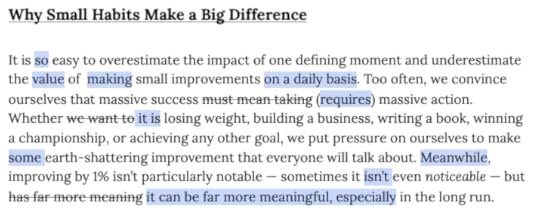 This is one of the best deliberate practice sessions that I've had. Many of the other passages I have used are filled with even more errors and inaccuracies.
 Once you have gotten to this stage, pay close attention to where you went astray. What is the original sentence structure like? What words did you miss, or include that weren't in the selected passage? How does the author's style differ from yours? Which 80% of errors could you fix with 20% effort?
From my experience using this method, I've noticed that I overcomplicate my writing, using too many big words where simple, spare language will do. I've also noticed that I use pronouns like "we" too much, instead of addressing the reader with "you", which is more direct and effective.
Collect your mistakes, and reflect on them. They are what will help nurture your capability as a writer.
Iterate
Doing this exercise once or twice might help you identify a few key pitfalls in your writing. However, the true benefits of this practice come from repetition and honing the process.
There is a reason I consider iteration to be a key mental model. The more you use the Benjamin Franklin Method, the more refined the method becomes, and the more you get out of it.
 The secret to getting better at anything is learning from each iteration.
 Final Thoughts
Writing is not a god-given talent that some people have and some don't. It is a skill like any other, and can be developed best through intentional practice.
The Benjamin Franklin Method gives you a framework to begin improving right away. However, it requires effort, discomfort and openness to being wrong repeatedly.
In a world where most of the advice offered to aspiring writers is to simply "read more", this strategy is an invaluable resource that will quickly set you apart from the competition.
March 28, 2021
Linkedin Learning: 9 Courses for Self-Development

The illiterate of the 21st century will not be those who cannot read and write, but those who cannot learn, unlearn, and relearn.”Linkedin Learning (formerly Lynda.com) offers more than 14,000 online courses that fall into three broad categories: business, creativity, and technology. Many of these courses are geared towards developing new, in demand skills, such as coding, marketing or web design. However, during my time exploring that vast catalogue of content, I came across nine great courses that focus on learning and self-development. And so I took them, got my nine crisp, shiny certificates of completion and gained new insights into time management, meta learning, accountability, habits, and decision-making.
- Alvin Toffler
Here are some of those insights that you can use to develop an edge in, well, pretty much anything.
What is Linkedin Learning?
1) Learning Agility
2) Holding Yourself Accountable
3) Motivation
4) The Six Morning Habits of High Performers
5) Time Management Fundamentals
6) Making Quick Decisions
7) Improve Your Thinking
8) Practical Creativity for Everyone
9) Extreme Focus for Effective Performance
Linkedin Learning: Pros and Cons 1 - Learning Agility: Gary Bolles
 This course covers the fundamentals of how we learn, and guides you through the process of prioritizing what you want to learn. It also offers helpful worksheets to formulate your own learning plan, and briefly touches upon what the future of learning may look like.
Learning Agility begins with a 4-phase model of learning:
Identify an interest in a subject or skill.Familiarize yourself with a topic. This usually occurs through following a learning plan and having a mentor or teacherPractice and test your knowledge. This involves trial and error, and iterated learning cycles.Apply knowledge, and transfer it to other disciplines.
Part of the course invites you to step into an imaginary time-machine and travel ten to twenty years in the future, and respond to three learning-related questions:
What have you learned for work?What have you learned for a hobby?What have you learned for fun or curiosity?
Here are some of my answers: web design, SEO, marketing, copywriting, meta learning skills, basic neuroscience, public speaking, mandarin, piano, guitar, singing, humour writing, jiu-jitsu, weightlifting, and mental models. Okay, maybe I went a bit overboard.
Another component of the course involves reflecting on an ideal learning experience with the person of your choice, anywhere in the world:
Who do you want to learn from? Where do you want to learn? What do you want to learn about?
For this section I came up with two utopian learning scenarios. In the first, I am at Tim Ferriss's house, and he is teaching me about his learning strategies and how he applies them to languages and entrepreneurship. In the second scenario, James Clear and I are at the Bodleian Library. He is walking me through his process of building his world famous blog, and writing the bestselling book Atomic Habits.
I found the course informative and helpful, especially for formulating a self-directed learning plan and reflecting on my current learning goals. It is brief, but still has a lot to offer.
2 — Holding Yourself Accountable: Dorie Clark
 This course offers a method for cultivating an accountability mindset, and is especially geared towards professional life. It covers what accountability is, how it differs from responsibility, how to prioritize projects, and how to overcome common obstacles that may prevent you from delivering on your promises.
Dorie Clark, the author of Entrepreneurial You, makes use of systems thinking in the course to help you navigate the labyrinth of accountability. Forcing mechanisms are part of that system; they are tools that require you to step up in order to follow through with a particular commitment. Signing up to give a talk at a conference, or deliver a project or product by a certain deadline force you to make the progress necessary to succeed. However, Clark also recognizes the dangers of overpromising, and addresses expectation management as part of the course content.
Holding Yourself Accountable also delves into boundary setting, which is another effective system for ensuring that you stick to your commitments. Using statements like “I always” and “I never” ensures that you are clear on your non-negotiable routines and expectations. James Clear calls this the never miss twice rule, and is practically foolproof way for sticking to habits and desired actions.
Fundamentally, Clark says that your identity is what contributes the most to how accountable you are. If you see yourself as an accountable person, you act in accordance with this self-conception, which leads to a virtuous circle.
I can tell that I will be coming back to my notes for this course many times in the future.
3 — Motivation: Daniel Pink
 Daniel Pink is the author of Drive: The Surprising Truth About What Motivates Us. In this Linkedin Course, he illustrates the power and limitations of incentives. Incentives are a common, highly effective way to motivate people. For employees, it might be money or status. For kids, it’s candy. And video games. And money.
However, incentives like these serve to narrow our focus on a particular problem. As a result, they work best for straightforward, linear tasks with clearly defined outcomes, like reaching a sales target or scoring a a certain number of points in a basketball game.
For more complex projects with many moving parts, monetary incentives aren’t the best motivators. In the course, Daniel Pink identifies three essential motivating forces that work more universally: purpose, mastery, and autonomy.
Having a clear sense of what you want to accomplish, as well as why it is critical for you to achieve it, will help you stay motivated to complete a task or project. Similarly, improving at something that is important to you and moving towards mastery will ensure that you don’t rely on temporary spurts of inspiration.
Lastly, being able to work on your own terms and having the freedom to complete tasks without constant scrutiny can keep you motivated during what Seth Godin refers to as the dip.
One of my favourite parts of the course is when Pink differentiates between two types of purpose. The first is Purpose with a capital P, which involves making a large positive impact. Contributing to a highly effective charity or helping to solve a societal problem would fall into this category.
On the other hand, there is purpose with a small p, which remains a powerful motivating force. Making a small contribution to your team at work or to your local community garden may not be groundbreaking, but it offers a firm sense of purpose. Recognizing these two types of purpose and using them strategically can help you to motivate yourself, your team, or your loved ones to take action and keep on course.
There are many more nuggets of wisdom in this Linkedin course, and I highly recommend watching the videos and actively engaging with them.
4 — The Six Morning Habits of High Performers: Hal Elrod
 Hal Elrod, the author of The Miracle Morning, outlines his morning routine in this course, which follows the SAVERS acronym:
Silence: starting the morning off with some meditation or quiet reflection can really set the tone for the day to come. If you are trying to come up with ideas or think through a problem, Elrod suggests using a 10 minute timer and pausing to take note of ideas you may have during the sitting session.
Affirmations: these are best framed as commitments. The self-help world has really done a disservice to affirmations. Don’t say to yourself: “I am a millionaire” or “I am a money magnet”. Rather, say things like “I am committed to becoming a millionaire, by working harder, making better decisions, saving more money, etc.”
Visualization: Many athletes use visualizations to get into the right mindset for performance, and to achieve a kind of internal victory before ever stepping onto the field. Picture yourself doing an important upcoming task, whether it is waking up early, making sales calls, or performing a song in front of an audience.
Exercise: Getting your blood pumping in the morning is an excellent way to raise your energy levels and achieve a small victory early in the day. Elrod suggests a seven minute workout like this one to get both cardio and some anaerobic movement in.
Reading: The ultimate habit of highly successful people. As Harry Truman said: “not all readers are leaders, but all leaders are readers.” Even if it’s only 5 pages a day, that still amounts to ten to twelve books per year. If you want to improve in any area in your life(e.g. relationships, money, work), reading can only help.
Scribing: Taking down notes and reflecting on your day is a fantastic way to learn and improve. Elrod recommends the 5 Minute Journal, an excellent journal book with gratitude and affirmation prompts, which I have adapted for my own journaling purposes. Writing in the morning is especially effective, as you can put down your thoughts on paper before the noisy whirlwind of life sweeps you away.
My Favorite Quote:
“Your level of success will seldom exceed your level of personal development, because success is something you attract by the person you become.” - Jim Rohn
5 — Time Management Fundamentals: Dave Crenshaw
 This course separates time management into three different sections: space, mind, and time. Mastering each of these three areas frees up ten hours a week of that you can then allocate in whichever way you choose.
 Dave Crenshaw introduces some new terms that help to uncover some common organizational inefficiencies. One such term is a gathering point, which is where unprocessed items in your life congregate. Pockets filled with receipts, drawers of clutter and even a mind occupied with to-do lists are all gathering points.
While some highly disorganized people have upwards of 100 gathering points, Crenshaw recommends that you trim the number of gathering points in your life to about five or six: a physical inbox, a portable inbox, an online inbox, a notepad, and an optional wildcard. I found the process of reducing the number of gathering points highly liberating, and it has helped me keep my workspace more organized and clear.
Another term introduced in the course is switch tasking (or switching costs). After establishing that multitasking is a myth, Crenshaw demonstrates an exercise showing that switching between tasks actually hinders progress and results in increased stress levels. By committing your attention to just one carefully-chosen task at a time, you can actually complete the task faster and more effectively, which allows you to move on to the next.
If you are struggling with organization or scheduling, this course may just change your life.
6 — Making Quick Decisions: Todd Dewett
 This course covers the various parts of the decision-making process, and offers a framework for making better choices given serious time constraints. It packs an incredible amount of actionable information into a very short time frame, and gives you tools you can begin using right away to start making high-quality decisions.
 Some of the insights I gained from the course include:
Identify the root causes of a problem by asking “why” several times.
Use intuition for decision-making when you have a lot of experience with a particular type of situation, but rely on it less when facing novel situations.
Have two different methods: one for the 80% of low-stakes decisions, and another more in-depth one for the 20% of high stakes decisions.
Avoid “analysis paralysis” by having a preset limit to the amount of research you will conduct before making a difficult choice.
Determine the urgency of a decision, and act accordingly.
High-quality decisions are made with the smallest possible data set.
It is often helpful to begin with the ideal solution, and then consider the constraints.
Asking for advice from more experienced practitioners or mentors is highly valuable when making important decisions.
Clocking in at under 22 minutes, this course is a great introduction to the principles of good decision-making, and perfect for someone who hasn’t done too much research into the subject already.
7 — Improve Your Thinking: Michael Shermer
 This course, offered by the renowned scientist and author Michael Shermer, commits itself to examining some of the faulty reasoning that leads people astray when thinking through problems. He addresses the human tendency toward thinking like a lawyer, thereby falling prey to confirmation and desirability biases, and reveals how to think more like a scientist.
While much of the information in this course may be familiar to those who have encountered Shermer’s work before, I found it helpful to review concepts like post-hoc reasoning, anecdotal vs. data-driven evidence, and ad hominem arguments.
Fundamentally, if we want to think like scientists, we need to be skeptical of our deeply cherished beliefs, dedicate ourselves to seeking out the truth wherever it may lead us, and understand our own fallibility. Behavioural economist Daniel Kahneman once said that despite his extensive awareness of human biases, he wasn’t much better than the average person at overcoming them. While this may seem pessimistic, recognizing that we aren’t perfectly reasoning beings can go a long way towards helping us rethink our beliefs and values.
8 — Practical Creativity for Everyone: Dave Birss
 This Linkedin Learning course covers the basics of creativity and idea-generation. It establishes that the traditional brainstorm which companies have used for decades to come up with new insights is woefully inefficient, and there are far better ways to come up with new ideas in organizations. For example, having individuals come up with their own ideas separately and then convening to build upon those ideas is much more effective.
 Another myth dispelled in this course is that creativity is a skill. In fact, it is a collection of abilities: organizing, remembering, imagining, and analyzing all fall under the umbrella of creativity. Improving at any of these can help you to generate better ideas and refine the ideas you currently have.
To improve at imagination specifically, David Birss offers a free, web-based story dice activity to flex your storytelling muscle.
In a previous article I wrote on how to have great ideas, I discussed the importance of alternating between states of focus, inattention, relaxation, and absorption in order to develop more dynamic and divergent thinking abilities. In David Birss’s course, he conveys an important concept that arises before those states even occur: inputs, processing, and output. In order for our outputs(ideas) to be of high-quality, we need to provide ourselves with inputs (media + habits) that feed out brain, instead of polluting it.
9 — Extreme Focus for Effective Performance: Bill Williams
 This course, while somewhat basic in its scope, discusses some important ideas about developing your concentration skills.
 There are different types of focus that are optimal for diverse goals and actions. Internal focus is primarily self-oriented and relates to individual thoughts, moods and states, while external focus is geared more towards the environment and the people in it. Narrow focus is when attention is primarily directed towards limited tasks with clear outcomes, while broad focus involves taking off the blinders and considering a problem more openly. As a result, there are four combinations of focus that can be employed depending on the nature of the project or task at hand.
Additionally, the course helps you discover what your distraction patterns are, as well as how to set up an environment that is conducive to distraction-free work. I particularly liked the parts about grit and mental rehearsal, two factors that lead to increased performance through deftly directed attention.
Linkedin Learning: Pros and Cons The Linkedin Learning platform is an invaluable tool, but it's not for everyone. Business professionals, small business owners and existing members of the Linkedin community all stand to benefit from the service. It is a great resource to give to your work team if you are a manager, and the short, segmented learning chunks are ideal for encouraging completion. It also has a lot of unique content that sets it apart from other online learning platforms.
However, it is fairly expensive at $29 a month (or $19 a month for a yearly subscription), and may not be the best choice for people looking to learn on their own accord. With a wide variety of free online learning options available, those on a budget might not find enough value in a Linkedin Learning subscription to warrant getting one.
Fortunately, you can sign up for a free 30 day trial which gives you unlimited access to the entire library of Linkedin Learning courses. You can browse through the courses, and see if the platform is worth it for you. As many of the courses are $50 when bought individually, you can get a lot of value from your trial in a short amount of time, with virtually no risk.
If paying money to learn seems too old-fashioned to you, Coursera, Udemy and edX are free(ish) alternatives. Just make sure the vet the courses well, as some of them may be run by less-than-reputable instructors.

Matthew Outerbridge's Blog

- Matthew Outerbridge's profile
- 8 followers
Matthew Outerbridge isn't a Goodreads Author
(yet),
but they
do have a blog,
so here are some recent posts imported from
their feed.

