Stephanie Feldstein's Blog
November 25, 2018
5 Tips for an Animal-friendly Holiday Season
 Photo via Max Pixel
Animals may not have to deal with Christmas cards and the stress of finding the perfect gifts, but they feel the pressure of the holiday season, too.
Between Thanksgiving and New Year’s, Americans throw out 25 percent more trash than the rest of year. Increased travel means more greenhouse gas emissions. Many holiday feasts traditionally feature meat dishes. And although your pets may enjoy extra treats and having more people around, decorations and parties can be full of potential hazards.
But your holiday cheer doesn’t have to leave animals out in the cold. Here are five ways to give back to animals this holiday season:
1) Give the gift of vegan food. Holiday eating doesn’t have to be all about turkey, ham, egg nog, and other foods that harm animals and the planet. In fact, there are tons of opportunities to share delicious, animal-friendly foods with others, from hosting plant-based meals to bringing vegan cookies to the office party. Share your favorite recipes with friends and family, and help create new traditions with dishes that benefit farmed animals and wildlife.
2) Give experiences instead of stuff. Americans spend $16 billion on unwanted gifts. That’s not just a waste of money, but also a waste of all of the resources that went into those gifts, not to mention their packaging and wrapping paper. And if those gifts wind up in the trash, they keep on posing threats to wild animals. So instead of giving forgettable gifts that come with a steep price tag for wildlife, give the gift of experiences that will create new memories with your loved ones. Bonus points if those experiences help animals, such as a vegan cooking class, a volunteer day at a farm sanctuary, or a hike in your favorite wilderness.
3) Give your pets what they really want. Most of us think of our dogs and cats as part of the family, so when it comes to holiday shopping, they tend to get caught up in the frenzy of gifts. But your animals don’t care about a big pile of red and green toys under the tree. Their wish list is much simpler — they want to spend time with you. Take some time away from the holiday rush to play with your cat, take your dog for long walks, and give them quality time instead of cheap toys or rich holiday treats that might make them sick.
4) Give wildlife decorations they can enjoy. Try decorating an outdoor tree for wildlife with ornaments made of birdseed and popcorn garland. Tinsel and plastic decorations can become choking hazards for wild animals (as well as the animals in your house), so opt for simple, meaningful ornaments indoors that you can reuse every year to cut back on waste and pollution. If you get a live tree for your house, look for an organic one to avoid the heavy pesticide use that often comes with growing “perfect” Christmas trees.
5) Give to animal charities. If you’re able to donate to charities that help animals, now’s the time to dust off your checkbook or donate online. This is the time of year when nonprofits count on a big chunk of their annual budgets coming in through holiday and end-of-year gifts. Donations in honor of your loved ones to charities that help their favorite animals make great gifts. And, if you have time to give, find out if your favorite animal nonprofit could use some extra help. By supporting animal charities during the season of giving, you can help them continue their life-saving work year-round.
For more holiday tips, check out THE ANIMAL LOVER’S GUIDE TO CHANGING THE WORLD.


June 5, 2018
Upcoming Book Events
The Animal Lover’s Guide to Changing the World is now out in the world! Here’s where you can catch me talking about turning your love of animals into action and signing books.
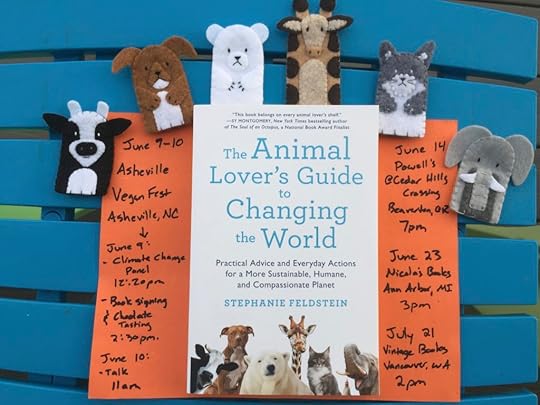
Saturday, June 9
1:30 p.m.
Asheville VeganFest, The Orange Peel, 101 Biltmore Ave, Asheville, NC 28801
Join me at the Asheville VeganFest for the Veganism, Environmentalism, and Climate Change Panel Discussion from 1:30-3:30 p.m. followed by a vegan chocolate tasting and book signing. The Animal Lover’s Guide to Changing the World will be available for purchase throughout the festival.
Asheville VeganFest (June 8-10), hosted by the largest no-kill animal rescue organization in North Carolina, Brother Wolf Animal Rescue, is quickly growing to be the largest vegan festival in the Southeast. All VeganFest events are free and open to the public, except for ticketed benefit shows on Friday and Saturday nights. The outdoor festival on Sunday will take place at Pack Square Park.
Learn more: https://veganfest.bwar.org/
Thursday, June 14
7:00 p.m.
Powell’s Books at Cedar Hills Crossing, 3415 SW Cedar Hills Blvd, Beaverton, OR 97005
Author talk and book signing. I’ll be joined by the Portland Animal Welfare Team (PAW Team) to highlight their important work providing free veterinary care to the pets of people who are experiencing homelessness or extreme poverty.
Event details: http://www.powells.com/eventdetail?popup=true&eventID=1697&rwndrnd=0.38918028382122793
Signed books available for pre-order: http://www.powells.com/book/the-animal-lovers-guide-to-changing-the-world-9781250153258/2-0
Learn more about PAW Team: https://www.pawteam.org/
Saturday, June 23
3:00 p.m.
Nicola’s Books, 2513 Jackson Ave, Ann Arbor, MI 48103
Author talk and book signing. 20% of the sales of the book will go to the Humane Society of Huron Valley’s Bountiful Bowls Program, benefitting Washtenaw County and Plymouth residents who are having difficulty meeting the nutritional needs of their dog or cat due to financial burden.
Event details: https://www.nicolasbooks.com/event/animal-lover%E2s-guide-changing-world-stephanie-feldstein
Learn more about the Bountiful Bowls program: http://www.hshv.org/site/PageNavigator/education/petfood.html
Saturday, July 21
2:00 p.m.
Vintage Books, 6613 E Mill Plain Blvd, Vancouver, WA 98661
Author talk and book signing. The event is co-sponsored by Clark County Green Neighbors.
Event details: https://vintage-books.net/
Learn more about Clark County Green Neighbors: https://clarkgreenneighbors.org/
May 21, 2018
Dog Blog Book Tour: May 22 – May 31
Pet bloggers are a particularly dedicated breed of animal lovers. In addition to caring for the animals in their lives (and their human family and day jobs and other commitments), they take the time to share their experiences and knowledge, from training challenges and solutions to the joy of adoption and the heartbreak of loss. Their insights provide incredible resources for other pet parents, while their compassion helps us realize that we’re not alone in whatever we’re going through as animal lovers and caregivers.
So, I’m honored and thrilled that a wonderful pack of dog bloggers is taking THE ANIMAL LOVER’S GUIDE TO CHANGING THE WORLD on a virtual book tour.
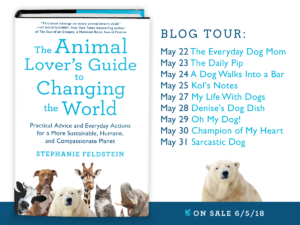
Please join me on tour by visiting these blogs throughout the next two weeks and sharing their posts.
There will be giveaways, so you’ll have lots of chances to get your paws on an advance copy of The Animal Lover’s Guide!
The links below will be updated throughout the tour as the posts go live.
May 22 The Everyday Dog Mom
May 23 The Daily Pip
May 24 A Dog Walks Into a Bar
May 25 Kol’s Notes
May 27 My Life With Dogs
May 28 Denise’s Dog Dish
May 29 Oh My Dog!
May 30 Champion of My Heart
May 31 Sarcastic Dog
Each of these sites is full of great information and adorable dogs. So don’t wait for the book tour to check them out.
May 18, 2018
Resources for Animal Lovers: Nonfiction Books for Your TBR Pile
Confession: I’m not good at choosing favorites. My favorite color changes depending on what we’re talking about. I could never pick just one favorite animal. Or a single favorite book. There are so many good books featuring animals, nature, and our relationship with both. So instead of choosing individual titles, here are a few nonfiction authors who should be on your *TBR list:
Sy Montgomery explores the uniqueness of animals from pigs to pink dolphins as a scientist and an animal lover, creating both a window into their lives and a mirror into our own. Her books include The Soul of an Octopus: A Surprising Exploration Into the Wonder of Consciousness and The Good Good Pig: The Extraordinary Life of Christopher Hogwood.
“I never met a pig I didn’t like. All pigs are intelligent, emotional, and sensitive souls. They all love company. They all crave contact and comfort. Pigs have a delightful sense of mischief; most of them seem to enjoy a good joke and appreciate music. And that is something you would certainly never suspect from your relationship with a pork chop.”
― Sy Montgomery, The Good Good Pig: The Extraordinary Life of Christopher Hogwood
Jane Goodall changed the way the world views chimpanzees, conservation, and women in science, and her work continues to inspire animal lovers around the world. Her books include Reason for Hope and In the Shadow of Man.
“In what terms should we think of these beings, nonhuman yet possessing so very many human-like characteristics? How should we treat them? Surely we should treat them with the same consideration and kindness as we show to other humans; and as we recognize human rights, so too should we recognize the rights of the great apes? Yes.”
― Jane Goodall
Marc Bekoff is an animal advocate and researcher of animal behavior, cognitive ethology, and compassionate conservation who writes about human-animal interactions and animal protection. His books include The Emotional Lives of Animals and Canine Confidential.
“Lacking a shared language, emotions are perhaps our most effective means of cross-species communication. We can share our emotions, we can understand the language of feelings, and that’s why we form deep and enduring social bonds with many other beings. Emotions are the glue that binds.”
― Marc Bekoff, The Emotional Lives of Animals: A Leading Scientist Explores Animal Joy, Sorrow, and Empathy – and Why They Matter
Jeffrey Moussaieff Mason reveals the emotional lives of animals and how that influences our relationship with them and their right to live free of exploitation and suffering. His books include When Elephants Weep and Dogs Never Lie About Love.
“Perhaps one central reason for loving dogs is that they take us away from this obsession with ourselves. When our thoughts start to go in circles, and we seem unable to break away, wondering what horrible event the future holds for us, the dog opens a window into the delight of the moment.”
― Jeffrey Moussaieff Masson, Dogs Never Lie About Love: Reflections on the Emotional World of Dogs
Ken Foster is a dog rescuer and pit bull advocate whose writing captures the heart of our relationship with dogs, especially those who are mistreated and misunderstood. His books include The Dogs Who Found Me and City of Dogs.
“When you let animals into your life, even as a foster parent, you are making a promise that you will take
care of them for as long as it takes, until they find a home of their own. When they finally do leave, there’s a part of them that stays with you and a part of you with them.”
― Ken Foster, The Dogs Who Found Me: What I’ve Learned from Pets Who Were Left Behind
Carl Safina is a conservationist who weaves observation and compassion to explore our relationship with the natural world and the other animals who we share it with. His books include Eye of the Albatross and Beyond Words: What Animals Think and Feel.
“Whenever we take the focus off ourselves and move it outward, we benefit. Life’s most fortunate ironies are that what’s best for the long run is best now, and selflessness serves our interests far better than selfishness. The wider our circle of considerations, the more stable we make the world—and the better the prospects for human experience and for all we might wish.”
― Carl Safina, The View from Lazy Point: A Natural Year in an Unnatural World
Elizabeth Marshall Thomas‘s observations and insights connect us to the hidden world of the animals around us. Her books include such classics as The Hidden Life of Dogs and The Tribe of Tiger.
“I saw that animals were important. I saw that plants were even more important. I was also to learn that compared to many of the other species, we weren’t important at all except for the damage we do. We do not rule the natural world, despite our conspicuous position in it. On the contrary, it is our lifeline, and we do well to try to understand its rules.”
― Elizabeth Marshall Thomas, The Hidden Life of Deer: Lessons from the Natural World
*TBR = To Be Read. For some of us, it’s a towering pile that grows faster than we will ever actually be able to read in this lifetime. But there’s no shame in supporting good books and knowing that they’re there for you to read when you need them.
Who are your favorite nonfiction animal and nature authors? Let me know @sfeldstein.
For more book recommendations and resources, check out THE ANIMAL LOVER’S GUIDE TO CHANGING THE WORLD.
April 22, 2018
Resources for Animal Lovers: Shrink Your Footprint
If everyone lived like Americans, we’d need five planets to sustain us.
We need to start living like this is the only planet we’ve got. Because it is. And we’re not the only ones who need it.
This is a common theme in THE ANIMAL LOVER’S GUIDE TO CHANGING THE WORLD: Everything we buy and consume uses natural resources that wild animals rely on. So, one of the best ways we can leave more for wildlife is to take less for ourselves.
There are tips on how to do this throughout THE ANIMAL LOVER’S GUIDE, but here are a few of my favorite resources on curbing overconsumption from the book, plus a few more:
Global Footprint Network: Find out your personal ecological footprint (and learn how to shrink it), explore national ecological footprint data, discover how policymakers use footprint information to improve sustainability, and join the movement to #movethedate of Earth Overshoot Day.
New Dream: From tips to simplify holidays to a gift registry for experiences, New Dream offers a vision and resources to buck consumerism and build community.
EcoChallenge: Created by the Northwest Earth Institute and based on the book Drawdown by Paul Hawken, EcoChallenge provides dozens of actions you can take to reduce your carbon footprint, while tracking your impact in real-time and competing against other teams.
Water – Use It Wisely: From the deserts of Arizona, this resource provides 100+ ways to save water, plus an online home water audit and guides to water-wise lawn and garden care.
Save the Food: We waste an astonishing amount of food — nearly 300 pounds per person each year. And when we toss food, we’re also throwing away all the land, water, energy, and everything else that went into producing it….which makes all that agricultural stress on wildlife for nothing. NRDC’s Save the Food campaign provides the facts on food waste and tips to help you shop smarter, meal plan, and use more of the food you buy to save money and save wildlife.
#NoApp4That: Post Carbon Institute takes a deep dive into whether technology can really save us from ourselves, no matter how much we consume. Spoiler: It can’t. We’re asking too much of our tech when we need to address our human-created problems on a human level first.
What are your favorite ways to curb overconsumption and shrink your footprint? Let me know @sfeldstein.
For more tips and resources on sustainable living, check out THE ANIMAL LOVER’S GUIDE TO CHANGING THE WORLD.
April 16, 2018
Resources for Animal Lovers: Meatless Monday 101
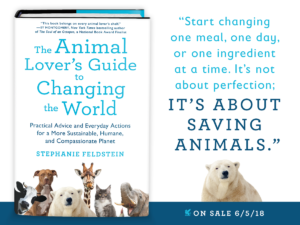
One of the simplest ways we can help animals is by changing what we put on our plates.
But simple doesn’t always mean easy, especially when it comes to changing the way we eat. Food is cultural, social, and emotional. Our diets are influenced by health and psychology, and by what’s available and affordable. And, of course, taste. If we’re not familiar with a dish or don’t know how to make it, we’re not as likely to eat it.
There’s good news, though: You don’t have to do it all at once. You can start small by switching out one ingredient, like using plant-based milk instead of dairy. Or you can start with one day a week…let’s say Monday. The beginning of the week is always a good time to shake things up a bit.
But, wait, there’s more. Much more. You don’t have to do this alone. There are lots of resources out there, from recipes to veganize just about everything to communities to support you as you navigate questions and cravings. In addition to the actions and recommendations in THE ANIMAL LOVER’S GUIDE TO CHANGING THE WORLD, here are a few more:
Meatless Monday: Learn more about the movement, who’s on board, and recipes to help you start off your week meat-free.
The Green Plate: Meal planning, personalized coaching, and an online community from Mercy for Animals will support you whether you’re thinking about trying your first veggie burger or have been vegging for a while.
Try Veg: Compassion Over Killing has a free guide to get you started, recipes, and tips to veganize everything from Easter baskets to classic comfort foods.
VegCurious: If you’re not sure what to do with your veggies, but think you want to do more, this could be the no-pressure resource for you.
Plant-based on a Budget: You can eat more plant-based foods without breaking the bank, and this site is full of money-saving, animal-saving meal ideas to show you how.
The Vegetarian Resource Group: As the name implies, this is a virtual clearinghouse of veggie info.
Your local bookstore is a great place to start exploring plant-based diets offline, from learning more about the benefits of eating less meat and more vegetables, legumes, and whole grains to digging into different cuisines from all over the world. Here are a few titles to kick off your book browsing:
Food Is the Solution: What to Eat to Save the World by Matthew Prescott
Eat for the Planet: Saving the World One Bite at a Time by Nil Zacharias and Gene Stone
Meatless: Transform the Way You Eat and Live — One Meal at a Time by Kristie Middleton
Eating Animals by Jonathan Safran Foer
The 30-Day Vegan Challenge by Colleen Patrick-Goudreau
Salud! Vegan Mexican Cookbook by Eddie Garza
Vegan Soul Kitchen by Bryant Terry
Vegan With a Vengeance by Isa Chandra Moskowitz
What are your favorite resources for plant-based eating? Let me know @sfeldstein or use the #meatlessmonday hashtag.
For more tips and resources on animal-friendly eating, check out THE ANIMAL LOVER’S GUIDE TO CHANGING THE WORLD.
December 24, 2017
Year-end Giving for Animal Lovers
 Photo by www.tradingacademy.com.
‘Tis the season of a lot of things — family, stress, too much food, too little time…and giving.
This final week of the year is a big one for nonprofits. A lot of people are in the spirit of giving, and in the spirit of getting in their last few tax deductions before January. Many nonprofits count on this last burst of donations to help balance their books and budget for the coming year. So if you haven’t yet, and you’re able to do so, spread some cheer to your favorite causes over the next few days. (If you’re reading this after the holidays, you can still get in on the action. There’s no bad time to donate.)
Cash (or check or credit card) donations are critically important for animal-saving organizations. Animal shelters have a clear need for food, blankets, and toys — and some animal lovers prefer to give these types donations, feeling like they’re supporting the direct care of the animals. But electricity and running water and staff paid fair wages to make sure all the animals are kept warm, clean, fed and comfortable until they find their forever homes are also needed to care for the animals. Those expenses may not feel as tangible or cuddly, but they’re necessary.
Trust your favorite animal charities to spend donations where the money is needed most.
And when you donate, tell people about it. You don’t have to share your bank account information, but let others know which organizations you care about. Word-of-mouth is a powerful way to build support for organizations doing good, essential work to make the world a better place.
Here’s the list of organizations I donated to this holiday season:
Center for Biological Diversity — Yes, this is where I work. But I also donate because I believe in this incredible, creative group of animal lovers dedicated to saving species. And that’s all wild animals, great and small. Sure, we fight for polar bears and elephants, but our staff is also full of people who deeply love bees and mussels and salamanders.
Mercy for Animals — There’s a lot of behind-the-scenes suffering in our food system, and Mercy for Animals fights to protect farmed animals through a combination of undercover investigations, legal action, corporate outreach for more animal-friendly policies, and excellent resources for anyone wanting to eat more compassionately.
Best Friends Animal Society — Best Friends runs its own animal sanctuary (which is on my bucket list to visit someday), but they also work nationwide to save companion animals through adoption and spay/neuter programs, as well as helping out with disaster relief and advocating for animal-friendly laws like ending breed discrimination and stopping puppy mills.

Humane Society of Southwest Washington — This is my local animal shelter and where my two cats, Edgar and Roland, came from. While national organizations play an important role, especially when it comes to advocating for laws that affect all animals, I also believe in contributing locally to care for the animals (and people) in my community.
Friends of the Columbia Gorge — This organization works to preserve the scenic Columbia River Gorge, including maintaining trails to help people get out and enjoy nature and wildlife. The Gorge was hit hard by a wildfire this year, and it definitely needs some Friends to make sure it’s given a chance to recover and be restored instead of exploited.
Signal Fire — This Portland-based organization works to connect artists and writers to wild places. Not only does this marry two huge parts of my life, but artists and writers have always been important voices for nature because they’re able to help others understand and love places (and the animals that live there) in powerful ways that can help save our remaining wild spaces.
Vote.org — If we’ve learned anything from 2017, it’s the importance of elections and the impact they can have on people, animals, and the planet. Vote.org works to strengthen our democracy and increase voter turnout.
Planned Parenthood — Access to reproductive healthcare, contraception, and our ability to continue living in a world that wasn’t foretold in The Handmaid’s Tale have always faced challenges, but recently the attacks on these basic rights have been relentless. Planned Parenthood’s continued existence is critical for women and families, as well as for wildlife.
Southern Poverty Law Center — There’s way too much hate in the world, and unfortunately, the worst haters are feeling empowered these days. SPLC fights against racial and social injustice through programs that monitor and expose hate groups, teach tolerance, and use the law to stand up for victims of discrimination. (While this one doesn’t have a direct link to non-human animals, all creatures benefit when there’s more tolerance and justice in the world.)
Pink Lemonade Project — My mom is a breast cancer survivor, so for her and all the other women and families affected by breast cancer, I donate each year to groups that are working toward a cure, to improve preventative care and education, or to support patients. There are a lot of groups out there with varying missions and varying impact. Pink Lemonade Project is a local group that provides the often-neglected emotional and psychological support that patients and survivors need.
It’s not easy to choose between all the organizations and causes out there, and this isn’t a comprehensive list of the things I care about or the organizations doing good work. Your list may have one organization or twenty — the amount of causes doesn’t matter. Nor does it matter whether you’re able to give a few dollars or a few thousand. What matters is that you’re doing what you can to support the causes that are important to you and to keep the lights on at those organizations so they can keep doing good in the world.
Not sure how your money will be used? Look up organizations on Guidestar or Charity Navigator. Check out their websites and annual reports. Give them a call and ask. Talk to your friends about which organizations they love and trust. Then donate generously.
Spoiler alert: Donating to animal charities is one way animal lovers can help change the world. Find out more in The Animal Lover’s Guide to Changing the World (coming June 5, 2018).
November 8, 2017
The Animal Lover’s Guide is Available for Pre-Order
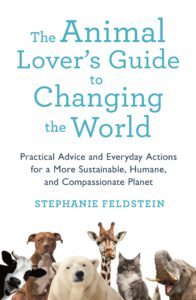
You can now pre-order The Animal Lover’s Guide to Changing the World from these sites:
IndieBound
Barnes & Noble
Amazon
You can also add it to your shelves on Goodreads.
Here’s what it’s all about:
“Too many animal advocates have a lot of passion, but they’re not sure how to actually make a difference. Stephanie Feldstein both wants to build a kinder world and knows how to make it happen. In fact, she’s been doing it for years. I can’t wait to tout her book when it’s out.” —Paul Shapiro, Vice President, Farm Animal Protection, The Humane Society of the United States
The Animal Lover’s Guide to Changing the World is the book for everyone who loves animals and wants to live a more animal-friendly life, even if they aren’t ready to join a movement or give up bacon. With Stephanie Feldstein’s guidance, just a few small lifestyle changes can have a huge impact.
The numbers are daunting. With 7.4 billion people on the planet — a number that’s doubled over the past 50 years as wildlife populations have plummeted by half, wildlife is going extinct at the fastest rate since the dinosaurs. Three to four million dogs and cats are killed in shelters every year; billions of chickens, pigs, and cows are killed for food; and countless animals are killed in research labs or their habitat. So what can we do?
THE ANIMAL LOVERS’ GUIDE TO CHANGING THE WORLD will show readers how to take action — online and in real life — to create a better world for us and the animals we love. It starts with changes as simple as taking a shorter shower, skipping meat once a week, wearing “this” not “that,” and extends to political action.
Stephanie Feldstein’s message is not one of doom and gloom. It’s inspiring and empowering. The animals need us; so let’s get on with some world changing!
August 7, 2017
New Article on Food Waste and Wildlife
I’ve just published an article in Biodiversity journal on why wildlife advocates must join the fight against food waste. You can read Wasting biodiversity: why food waste needs to be a conservation priority online or in the forthcoming special issue of Biodiversity on food and agriculture.
While you’re taking on food waste, check out the newly released public service announcement starring actor and eco-activist Ed Begley, Jr., brought to you by the Population and Sustainability team at the Center for Biological Diversity. Watch the video and discover actions you can take to fight food waste at BetterThanEd.org. (And don’t miss the PSAs on energy waste and unsustainable human population growth, too.)
May 8, 2017
Book News!
I’m thrilled to announce that my first book will be published in Spring 2018 by St. Martin’s Press. Whether you love dogs, cats, chickens, cows, whales, snails, all of the above or any animals in between, this one’s for you.
From Publisher’s Marketplace:
National animal advocate and population and sustainability director at the Center for Biological Diversity Stephanie Feldstein’s THE ANIMAL LOVER’S GUIDE TO CHANGING THE WORLD, a practical, far-reaching exploration of how anyone who cares about animals can take action in their own lives and beyond to create a better world for us and them, to Daniela Rapp at St. Martin’s, for publication in Spring 2018, by Rachel Ekstrom at Irene Goodman Agency.