Miriam Seidel's Blog
July 16, 2025
Nikola Tesla’s extraordinary love story
Most people know Nikola Tesla as an inventor. His breakthroughs in electricity and wireless transmission helped to transform our world; that’s why his name is associated with a well-known electric car (more about that later). But Tesla’s visionary side didn’t just express itself in the world-changing inventions he imagined into being. He also had actual […]
The post Nikola Tesla’s extraordinary love story appeared first on Miriam Seidel.


May 2, 2025
Tesla’s Opera has a cover!
Tesla’s Opera: The Real, Stranger-than-fiction Nikola Tesla is moving toward publication! We now have a cover design for the book I’m editing, which uses the opera inspired by Nikola Tesla’s life as a door to widening our understanding of the visionary inventor. The opera Violet Fire, with a score by composer Jon Gibson and my […]
The post Tesla’s Opera has a cover! appeared first on Miriam Seidel.
February 12, 2025
Celebrating Tesla
An opera turns into a book Years ago I became entranced by the visionary inventor, Nikola Tesla, and I began to imagine his extraordinary life as an opera. It seemed to me that only an opera, with its grand scale and intense passions, could do justice to Tesla. Tesla (1856–1943) helped create the bedrock of […]
The post Celebrating Tesla appeared first on Miriam Seidel.
January 17, 2024
Reclaiming the Monster
Women can be monsters too. From snake-haired Medusa to the horrifying mama-alien of the Alien movies, female monsters have often embodied male fears of women’s unchecked power. So it makes sense that women writers and artists have been changing the perspective on these archetypes. In her 2022 book Women and Other Monsters, Jess Zimmerman explores … Continue reading Reclaiming the Monster →
The post Reclaiming the Monster appeared first on Miriam Seidel.
December 1, 2022
Our Shared Futures
Can climate fiction help us see our way through the maze of possible futures we face? Can it help us move forward from our present moment? Andrew Dana Hudson’s slim novel, Our Shared Storm: A Novel of Five Climate Futures, engages these questions directly, by imagining how four characters’ lives would change in different climate … Continue reading Our Shared Futures →
The post Our Shared Futures appeared first on Miriam Seidel.
March 14, 2022
Message From the Future
Kim Stanley Robinson’s climate-fiction blockbuster, The Ministry for the Future, has galvanized readers both within and outside the science fiction community—riding the wave of anxiety catalyzed by last year’s extreme weather events, along with increasingly urgent warnings from climate experts and activists. The novel’s power relies on a two-pronged strategy: offering an imaginational way to … Continue reading Message From the Future →
The post Message From the Future appeared first on Miriam Seidel.
August 17, 2020
The Uncanny Valley of Zoom backgrounds
We’ve all been talking about the Zoom experience. How it’s slightly off from the in-person experience, in ways that can be disorienting and exhausting. Yet, in the months since COVID-19 changed everything, we’ve also embraced it, as something that’s not just useful, but offers a close substitute to being in the same room with our … Continue reading The Uncanny Valley of Zoom backgrounds →
The post The Uncanny Valley of Zoom backgrounds appeared first on Miriam Seidel.
October 2, 2019
Blobs, Orbs, and Starfish: Really Alien Aliens
Book blogger Shruti Ramanujam recently published a list of “oddly specific storylines” she loves in books, that made me laugh out loud. And it made me think about what storylines or tropes attract me in a book.
One of those tropes, for me, is “really alien aliens.” I find them fascinating, and I’m always checking my inner alien-o-meter: Are they convincing? What is their alien-ness telling me? I love that sense of looking out through unfamiliar eyes, and feeling the expansion that comes with considering other ways of being.
I remember the first really alien aliens I encountered: the disembodied energy beings that appeared as strange spheres of blue fire in Ray Bradbury’s classic short story, “The Fire Balloons.” The priests who traveled to Mars to convert them are themselves converted by the sphere-beings to a more open view of religion, sin, and humanity. On TV, I accepted the humanoid aliens of Star Trek—Klingons, Ferengi, Cardassians. But my antennae always buzzed for aliens so strange they couldn’t be seen, like the beings trapped in the ship’s innards in “Emergence,” an episode of Star Trek TNG. They sent distress calls in the form of Holodeck characters, embodying metaphors for the help they needed.
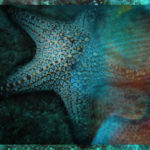
There are many, many such aliens in science fiction, going back to H.G. Wells’ leather-skinned blobs in War of the Worlds. As a trope, they’re recognized as Starfish Aliens—a term first used by H.P. Lovecraft (in At the Mountains of Madness, 1936). I’m less interested in them as dangerous space-opera foes or dread-inspiring monsters, and more interested in aliens that give us new ways to think about social structure, emotions, and the self. My interest goes even higher when these things are revealed from the aliens’ point of view.
Two recent books delivered this for me: Becky Chambers’ The Long Way to a Small, Angry Planet, and Ann Leckie’s Provenance, both refreshing takes on the space-opera sub-genre. If you haven’t read them: some spoilers ahead. Chambers’ small, angry planet is indeed occupied by fierce aliens whose way of thinking is hard to decode and puts the Galactic Commons at risk. On the spaceship traveling there, the human crew members work alongside a variety of aliens.
One character, Sissix, is an Aandrisk, a reptilian species. Sissix is friendly and naturally demonstrative, and Aandrisk culture features a complex, inclusive family structure that evolves over an individual’s lifespan—a nice departure from that of the usual cold-hearted Reptilian alien. On a supply mission, Sissix encounters an Aandrisk shopkeeper in the marketplace who’s old and alone, bereft of any kind of family. Feeling sorry for the shopkeeper, pulls her aside and they have a snuggle/make-out session The scene is weird, funny, and affecting, and leaves us with a more nuanced sense of Aandrisk culture.
In Ann Leckie’s Provenance, we hear about the Geck long before we meet one of them in the flesh. They’re water-dwellers and hate leaving their world, so they usually interact with other species remotely, through robot-like mechs. The single scene in which the main character, Ingray, meets the Geck ambassador floating in a pool is, for me, the strange heart of the book. The ambassador is a blob-creature whose skin telegraphs emotion by changing color. Her language is filled with poetic repetitions that suggest the lapping of waves: “I will tell you a thing. I will tell you. When humans first appeared, many things died. So much died…”
The story she tells Ingray reveals much about patterns of affection among the Geck, and how those patterns have been forced to shift by the humans among them. For that one scene, we see the world through her eyes. Her motives become clear, and the plot turns inside out.
This got me thinking about how hard it is to imaginatively get inside beings so different from us—especially when they have motives beyond simply wiping out humans. Is that why these very alien aliens make such brief appearances? I don’t know. One such very brief appearance has stuck with me. It’s from Octavia Butler’s Dawn, the first book in her series Lilith’s Brood.
Lilith, a survivor of the near-destruction of Earth, has been taken aboard a ship belonging to the Oankali. She needs a lot of time to get used to the Oankalis’ appearance, although they’re humanoid in shape, since their faces and bodies are covered in wiggling sensory tentacles. At one point, her Oankali teacher offers Lilith a glancing vision of his species’ deep past, before many generations of biological mixing with beings from other planets:
“Six divisions ago, on a white-sun water world, we lived in great shallow oceans,” it said. “We were many-bodied and spoke with body lights and color patterns among ourself and among ourselves…”
That’s all. But this short description—not even a scene—conveys a strange, Edenic world with haiku-like compactness, giving Lilith and the reader insights into the Oankali’s origins, how they understand themselves and each other.
Have I left out your favorite book, scene, or pet peeve about really alien aliens? Any thoughts are welcome.


The post Blobs, Orbs, and Starfish: Really Alien Aliens appeared first on Miriam Seidel.
Blobs, Orbs, and Starfish: Really Alien Aliens
Book blogger Shruti Ramanujam recently published a list of “oddly specific storylines” she loves in books, that made me laugh out loud. And it made me think about what storylines or tropes attract me in a book.
One of those tropes, for me, is “really alien aliens.” I find them fascinating, and I’m always checking my inner alien-o-meter: Are they convincing? What is their alien-ness telling me? I love that sense of looking out through unfamiliar eyes, and feeling the expansion that comes with considering other ways of being.
I remember the first really alien aliens I encountered: the disembodied energy beings that appeared as strange spheres of blue fire in Ray Bradbury’s classic short story, “The Fire Balloons.” The priests who traveled to Mars to convert them are themselves converted by the sphere-beings to a more open view of religion, sin, and humanity. On TV, I accepted the humanoid aliens of Star Trek—Klingons, Ferengi, Cardassians. But my antennae always buzzed for aliens so strange they couldn’t be seen, like the beings trapped in the ship’s innards in “Emergence,” an episode of Star Trek TNG. They sent distress calls in the form of Holodeck characters, embodying metaphors for the help they needed.
There are many, many such aliens in science fiction, going back to H.G. Wells’ leather-skinned blobs in War of the Worlds. As a trope, they’re recognized as Starfish Aliens—a term first used by H.P. Lovecraft (in At the Mountains of Madness, 1936). I’m less interested in them as dangerous space-opera foes or dread-inspiring monsters, and more interested in aliens that give us new ways to think about social structure, emotions, and the self. My interest goes even higher when these things are revealed from the aliens’ point of view.
Two recent books delivered this for me: Becky Chambers’ The Long Way to a Small, Angry Planet, and Ann Leckie’s Provenance, both refreshing takes on the space-opera sub-genre. If you haven’t read them: some spoilers ahead. Chambers’ small, angry planet is indeed occupied by fierce aliens whose way of thinking is hard to decode and puts the Galactic Commons at risk. On the spaceship traveling there, the human crew members work alongside a variety of aliens.
One character, Sissix, is an Aandrisk, a reptilian species. Sissix is friendly and naturally demonstrative, and Aandrisk culture features a complex, inclusive family structure that evolves over an individual’s lifespan—a nice departure from that of the usual cold-hearted Reptilian alien. On a supply mission, Sissix encounters an Aandrisk shopkeeper in the marketplace who’s old and alone, bereft of any kind of family. Feeling sorry for the shopkeeper, pulls her aside and they have a snuggle/make-out session The scene is weird, funny, and affecting, and leaves us with a more nuanced sense of Aandrisk culture.
In Ann Leckie’s Provenance, we hear about the Geck long before we meet one of them in the flesh. They’re water-dwellers and hate leaving their world, so they usually interact with other species remotely, through robot-like mechs. The single scene in which the main character, Ingray, meets the Geck ambassador floating in a pool is, for me, the strange heart of the book. The ambassador is a blob-creature whose skin telegraphs emotion by changing color. Her language is filled with poetic repetitions that suggest the lapping of waves: “I will tell you a thing. I will tell you. When humans first appeared, many things died. So much died…”
The story she tells Ingray reveals much about patterns of affection among the Geck, and how those patterns have been forced to shift by the humans among them. For that one scene, we see the world through her eyes. Her motives become clear, and the plot turns inside out.
This got me thinking about how hard it is to imaginatively get inside beings so different from us—especially when they have motives beyond simply wiping out humans. Is that why these very alien aliens make such brief appearances? I don’t know. One such very brief appearance has stuck with me. It’s from Octavia Butler’s Dawn, the first book in her series Lilith’s Brood.
Lilith, a survivor of the near-destruction of Earth, has been taken aboard a ship belonging to the Oankali. She needs a lot of time to get used to the Oankalis’ appearance, although they’re humanoid in shape, since their faces and bodies are covered in wiggling sensory tentacles. At one point, her Oankali teacher offers Lilith a glancing vision of his species’ deep past, before many generations of biological mixing with beings from other planets:
“Six divisions ago, on a white-sun water world, we lived in great shallow oceans,” it said. “We were many-bodied and spoke with body lights and color patterns among ourself and among ourselves…”
That’s all. But this short description—not even a scene—conveys a strange, Edenic world with haiku-like compactness, giving Lilith and the reader insights into the Oankali’s origins, how they understand themselves and each other.
Have I left out your favorite book, scene, or pet peeve about really alien aliens? Any thoughts are welcome.


The post Blobs, Orbs, and Starfish: Really Alien Aliens appeared first on Miriam Seidel.
January 23, 2019
Elephants and Radium Girls
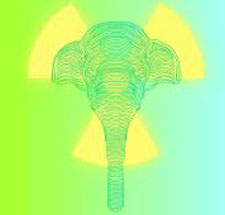 In The Only Harmless Great Thing, Brooke Bolander has taken on two strange and disturbing events from the early 20th century: the willfully negligent poisoning of young women painting radium-tinged watch dials for the United States Radium Company, and the public electrocution of Topsy the elephant at Coney Island in 1903. Bolander somehow burrowed into each story to find their shared DNA, and then performed some recombinant alchemy to merge them into one harrowing and resonant story, with a tragic and poetically just ending.
In its under 100 pages, the book brilliantly illuminates the dark side of our attraction to the shining, sparking effects brought by electricity and radioactivity. On top of that, it gives us fresh ways to think about how the DNA of our shared stories spirals through time and culture.
The book’s central story pairs Regan, a fictionalized Radium Girl, with the elephant Topsy, in a fragile cross-species friendship. In Bolander’s topsy-turvy alternate timeline, Topsy is one of a number of elephants bought and trained by the company to paint watch dials after the Radium Girls’ health issues have come to light. In one of the book’s sublime inventions, the elephants have learned to communicate through an ASL-like sign language using their trunks, so Regan and Topsy are able to converse. (I wish that development could be imported to our timeline.)
Regan’s ripe Appalachian twang brings the aspect of class into focus—she is a low-class rural outsider in the urban factory, able to get the elephants’ exploitation immediately. The slightly archaic idioms she uses make a strong vessel for her outrage as the story races forward.
Two other stories frame this one, and they carry meta-questions about how stories are made, how they take root, are preserved, and shape us. In the first one, happening in a slightly skewed near-present time, Topsy’s execution has made an indelible impression on the American psyche, and cemented a pop-culture association between elephants and radioactivity—to the point that a Dumbo-like Topsy has starred in a beloved Disney movie. In this story, a young researcher urges the elephants to agree to have their genomes altered so their skin will glow when it’s near radioactive waste—a signal of danger to humans in the far future.
The second story-layer gives full, mythic voice to the elephants. An elephant-mother recounts the legend of the revered long-ago ancestor who dove into a tar pit to retrieve the lost stories of her people. The storyteller, we realize, lives in that future time when she and her kind have agreed to be that glowing warning system for humanity. Their vast chain of memory, stretching eons backward and forward in time, shows humanity’s self-narrative to be pretty puny by comparison.
For me, coming in with a long obsession with Nikola Tesla, Bolander’s Radium Girls-Topsy remix hits a nerve. The electrocution of the real Topsy has been associated with Thomas Edison, mainly because Edison was known to have arranged public electrocutions of smaller animals during the Current Wars of the early 1890s. (These spectacles aimed to show how dangerous Tesla’s AC current was; but Tesla’s AC won the current wars, being superior in numerous ways to Edison’s DC.) Edison most likely didn’t have a hand in Topsy’s death, but the electric-powered public spectacle at Coney Island was surely inspired by his venal stunts.
Tesla, on the other hand, brought an almost utopian idealism to his electronic innovations. He even pioneered the medical use of electricity, believing that immersion in electromagnetic fields was good for human health. (We’ve learned to be more careful about the effects of such constant bombardment.) Tesla’s idealism took part in his era’s belief that nature existed as a resource for humanity, in service of the progress of civilization. In Bolander’s vision, both Edison and Tesla are caught, found complicit in a system that blithely digs up radium and conscripts the weakest members of society to handle it.
Yet the elephants’ understanding takes us beyond this stew of human, animal, and natural exploitation. Topsy recognizes electricity as a mutated form of lightning, and the far-future elephant mother shares that understanding. Even living with the poisonous aftereffects of the nuclear industry, she and her tribe persist, citizens of the natural world, protected by their collective, long-lasting, storied understanding.
The post Elephants and Radium Girls appeared first on Miriam Seidel.