
Gerald M. Weinberg's Blog
July 29, 2018
What do you do when a kid beats your solution?
We were asked, "Has a software engineering interviewee ever come up with a better solution than the expected best answer?"
The question told me that the one who posed it hadn't done many interviews. As an interviewee, I did this often, though it was often met with defensiveness from the interviewer.
As an interviewer, it happens to me all the time, and I've tried awfully hard not to be defensive as I'd seen so many interviewers become.
Once on the job, too, software engineers frequently come up with better answers than their managers, teammates, or team leaders knew and expected. Or, I must admit, better than their consultants.
When this happens in any of these situations, it's important for the interviewer, manager, team leader, teammate, or consultant to accept the answer graciously, thanking the person for teaching them something new.
Even if the new idea isn't "better," if it's new, it's an opportunity to learn, so you don't want to spend your efforts trashing the idea. Just take in into your mind and offer thanks.
When I was a little boy, my father challenged me to learn something new every day before allowing myself to go to bed. Learning new things all the time is perhaps the most important behavior in my life. It's certainly the most important behavior in our profession
 Generally, the most powerful learning occurs when someone produces a better solution than you had imagined. If your ego cannot deal with “better” or even “different” solutions to problems you pose, you have no business being in a leadership position in software engineering.
Or maybe anywhere.
Read: Becoming a Technical Leader
The question told me that the one who posed it hadn't done many interviews. As an interviewee, I did this often, though it was often met with defensiveness from the interviewer.
As an interviewer, it happens to me all the time, and I've tried awfully hard not to be defensive as I'd seen so many interviewers become.
Once on the job, too, software engineers frequently come up with better answers than their managers, teammates, or team leaders knew and expected. Or, I must admit, better than their consultants.
When this happens in any of these situations, it's important for the interviewer, manager, team leader, teammate, or consultant to accept the answer graciously, thanking the person for teaching them something new.
Even if the new idea isn't "better," if it's new, it's an opportunity to learn, so you don't want to spend your efforts trashing the idea. Just take in into your mind and offer thanks.
When I was a little boy, my father challenged me to learn something new every day before allowing myself to go to bed. Learning new things all the time is perhaps the most important behavior in my life. It's certainly the most important behavior in our profession
 Generally, the most powerful learning occurs when someone produces a better solution than you had imagined. If your ego cannot deal with “better” or even “different” solutions to problems you pose, you have no business being in a leadership position in software engineering.
Or maybe anywhere.
Read: Becoming a Technical Leader


July 21, 2018
Some Advice on Advice
I was asked, "I'm very bad at taking my own advice but love helping people with their own personal issues. Does that make me a hypocrite?"
You seem to equate “advice” with helping people, but there are many other ways to help people without offering advice. And, of course quite frequently, even the best advice doesn't help at all.
(Note that I wrote “offering,” not “giving.” You offer, but they need not accept. Nor do you have to accept your own advice. You test it in your mind, or with small actions, and either follow or not, depending on the test’s outcome.)
If you like helping, try asking people what kind (if any) help they want from you. Perhaps they merely want a friendly listener. Or a pat on the back. Or a kick in the rear. Maybe they want you to clean their house. Or carry their heavy package. Maybe they just want a smile.
Stop worrying about labels like “hypocrite,” and start seeking ways to help people the way they want to be helped. Forget the advice business. As Ambrose Bierce says in The Devil’s Dictionary, “Advice is the smallest common coin.”
You seem to equate “advice” with helping people, but there are many other ways to help people without offering advice. And, of course quite frequently, even the best advice doesn't help at all.
(Note that I wrote “offering,” not “giving.” You offer, but they need not accept. Nor do you have to accept your own advice. You test it in your mind, or with small actions, and either follow or not, depending on the test’s outcome.)
If you like helping, try asking people what kind (if any) help they want from you. Perhaps they merely want a friendly listener. Or a pat on the back. Or a kick in the rear. Maybe they want you to clean their house. Or carry their heavy package. Maybe they just want a smile.
Stop worrying about labels like “hypocrite,” and start seeking ways to help people the way they want to be helped. Forget the advice business. As Ambrose Bierce says in The Devil’s Dictionary, “Advice is the smallest common coin.”
July 15, 2018
What motivated you to learn to code?
I received an interesting question, today: "What motivated you to learn to code?"
Maybe it's old age, but my memory for ancient events seems to have improved. I remember quite clearly those days, back in the 1950s, when I worked as a "computer." That was my job title, computer. I did physics calculations with pencil and paper—and an eraser.
At that time,I had never seen a computing machine, nor another person who had ever seen one.
When I left graduate school, I went to work for IBM in San Francisco. Nobody else in the IBM office had ever seen a computing machine, at least not a stored program one. We had a machine with 10 wireable instructions (IBM 604) and one 10-digit word of data storage. I was motivated to learn to code that machine by a one-dollar bet that I could turn on all the lights on the console. I won the bet.
The first stored program machine (IBM 650, with 1,000 words of drum memory) was due in the IBM office two weeks after I started there. I was given the assignment of learning how to program it, as nobody else in the office had a clue. I learned to code by reading the machine manuals for two weeks.
Also, two weeks after the machine arrived, I had to teach a programming class to three other new hires. So, that assignment also motivated me. When the machine arrived, I was the only one who dared to touch it for two weeks, so I wrote programs for the sort of calculations I had been doing in my job as a computer.
It was the thrill of a lifetime.
Maybe it's old age, but my memory for ancient events seems to have improved. I remember quite clearly those days, back in the 1950s, when I worked as a "computer." That was my job title, computer. I did physics calculations with pencil and paper—and an eraser.
At that time,I had never seen a computing machine, nor another person who had ever seen one.
When I left graduate school, I went to work for IBM in San Francisco. Nobody else in the IBM office had ever seen a computing machine, at least not a stored program one. We had a machine with 10 wireable instructions (IBM 604) and one 10-digit word of data storage. I was motivated to learn to code that machine by a one-dollar bet that I could turn on all the lights on the console. I won the bet.
The first stored program machine (IBM 650, with 1,000 words of drum memory) was due in the IBM office two weeks after I started there. I was given the assignment of learning how to program it, as nobody else in the office had a clue. I learned to code by reading the machine manuals for two weeks.
Also, two weeks after the machine arrived, I had to teach a programming class to three other new hires. So, that assignment also motivated me. When the machine arrived, I was the only one who dared to touch it for two weeks, so I wrote programs for the sort of calculations I had been doing in my job as a computer.
It was the thrill of a lifetime.
July 7, 2018
What were some jobs that existed 50 years ago but have largely disappeared today?
We often hear that we're in a time of change, but this observation isn't really news. We've been in a time of change for my whole lifetime, and well before that. Many jobs that once existed are no longer available, and many have even disappeared from memory.
We were challenged recently to recall some jobs that have disappeared in the past 50 years, and it was great fun reading all the answers, many of which described jobs I once held back in my youth. I go back a bit more than 50 years, though, so I have a few more to add.
The first, most obvious omission that popped into my mind was the iceman. In the 1930s, my family had an icebox (not a refrigerator, but an actual box that held a block of ice). The iceman’s horse-drawn wagon would come around and be surrounded by us kids, hoping to get free shards of ice caused when he cut up little blocks to fit our iceboxes.
Another job only briefly mentioned was typesetting. I never held that job, but I was trained for manual typesetting for a semester in high school. At least I know where terms like upper-case and lower-case come from.
Someone also mentioned keypunch operator, a task (not a job) that was often done by prisoners who were literally chained to their keypunch machines. What wasn't mentioned, however, were key verifier operators. Not many people today have ever seen a verifier machine, let alone even know what one was.
Even before my time, there were jobs that disappeared, but which I read about in a nineteenth century book about jobs for women. The final two chapters in the book were about a couple of sure-fire women’s jobs for the future (1900 was then the future).
First chapter was about telegraph operators. The chapter “proved” that there was a great future for women because they could operate a telegraph key at least as fast as men (and the telephone had yet to be invented).
Second chapter was about picture tinters. There was, of course, no color photography, and it wasn’t really even conceived of. Women were supposedly much better at coloring photos because of their “artistic bent” and their more delicate hands. Though there are a few photo tinters still around today for special jobs, it’s not a career with a great future.
It's fun to think about these forgotten jobs, but they're also a source of important knowledge, or perhaps even wisdom. Job disappearance is not some new phenomenon caused by computers. It's always gone on through history. True, some jobs lasted a long time, so long that they were passed down from generation to generation, even becoming family names, such as Smith, Turner, Eisenhower, Baker, and Miller. (See, for example, <Some of those jobs still exist, though often modified by new technology. Do you still recognize Fuller, Chandler, or Ackerman? And many others have largely disappeared, remaining only in some special niche, like photo tinters. Do you know anybody named Armbruster who still makes crossbows? Well, you probably know a few Coopers, but how many of them still make barrels?
So, what's the lesson for your own future? If you're as old as I am, you probably don't have to worry about your job disappearing, but even my "job" as a writer is changing rapidly with new technology. Even if your type of job doesn't disappear entirely, you will be faced with changes.
I think your preparation for job changes will be the same as your preparation for changed jobs: increased adaptability. Today's market tends to reward specialization, but when you become totally specialized, you become the victim of change. Think what's happened to all those COBOL experts from a few years ago.
I'd suggest that you take advantage of the rewards of specialization but invest a small percentage of your time to learning something new. Always. Keep you mind flexible for a future none of us can predict.
p.s. Minutes after I posted this blog, several readers wrote:
Your first job, "computer" did also disappear. How long was that job around? (Kind of surprised you did not mention it in the blog post.)----Well, that's shows I'm a human being. What's that saying about shoemakers' children going barefuot? It never occurred to me to consider my 'computer' job as disappearing, but of course it has been largely taken over by machines. Thanks, readers.
Oh, and some more, including switchboard operator, another job I had.
Maybe you folks could add more via comments here.
We were challenged recently to recall some jobs that have disappeared in the past 50 years, and it was great fun reading all the answers, many of which described jobs I once held back in my youth. I go back a bit more than 50 years, though, so I have a few more to add.
The first, most obvious omission that popped into my mind was the iceman. In the 1930s, my family had an icebox (not a refrigerator, but an actual box that held a block of ice). The iceman’s horse-drawn wagon would come around and be surrounded by us kids, hoping to get free shards of ice caused when he cut up little blocks to fit our iceboxes.
Another job only briefly mentioned was typesetting. I never held that job, but I was trained for manual typesetting for a semester in high school. At least I know where terms like upper-case and lower-case come from.
Someone also mentioned keypunch operator, a task (not a job) that was often done by prisoners who were literally chained to their keypunch machines. What wasn't mentioned, however, were key verifier operators. Not many people today have ever seen a verifier machine, let alone even know what one was.
Even before my time, there were jobs that disappeared, but which I read about in a nineteenth century book about jobs for women. The final two chapters in the book were about a couple of sure-fire women’s jobs for the future (1900 was then the future).
First chapter was about telegraph operators. The chapter “proved” that there was a great future for women because they could operate a telegraph key at least as fast as men (and the telephone had yet to be invented).
Second chapter was about picture tinters. There was, of course, no color photography, and it wasn’t really even conceived of. Women were supposedly much better at coloring photos because of their “artistic bent” and their more delicate hands. Though there are a few photo tinters still around today for special jobs, it’s not a career with a great future.
It's fun to think about these forgotten jobs, but they're also a source of important knowledge, or perhaps even wisdom. Job disappearance is not some new phenomenon caused by computers. It's always gone on through history. True, some jobs lasted a long time, so long that they were passed down from generation to generation, even becoming family names, such as Smith, Turner, Eisenhower, Baker, and Miller. (See, for example, <Some of those jobs still exist, though often modified by new technology. Do you still recognize Fuller, Chandler, or Ackerman? And many others have largely disappeared, remaining only in some special niche, like photo tinters. Do you know anybody named Armbruster who still makes crossbows? Well, you probably know a few Coopers, but how many of them still make barrels?
So, what's the lesson for your own future? If you're as old as I am, you probably don't have to worry about your job disappearing, but even my "job" as a writer is changing rapidly with new technology. Even if your type of job doesn't disappear entirely, you will be faced with changes.
I think your preparation for job changes will be the same as your preparation for changed jobs: increased adaptability. Today's market tends to reward specialization, but when you become totally specialized, you become the victim of change. Think what's happened to all those COBOL experts from a few years ago.
I'd suggest that you take advantage of the rewards of specialization but invest a small percentage of your time to learning something new. Always. Keep you mind flexible for a future none of us can predict.
p.s. Minutes after I posted this blog, several readers wrote:
Your first job, "computer" did also disappear. How long was that job around? (Kind of surprised you did not mention it in the blog post.)----Well, that's shows I'm a human being. What's that saying about shoemakers' children going barefuot? It never occurred to me to consider my 'computer' job as disappearing, but of course it has been largely taken over by machines. Thanks, readers.
Oh, and some more, including switchboard operator, another job I had.
Maybe you folks could add more via comments here.
June 13, 2018
Why would anyone want to live past about 65?
We were asked, "Why would anyone want to live past about 65? Seriously, after 25 years learning and 40 years working, why would you want to live another 5-10 years when you're too old to do anything interesting?"
To the author of this question: many of these answers you received have been hard on you, unfairly, I think. I interpret your question as a genuine puzzle, not a judgment on older people.
My answer is this: Some people want to live past 65. Many do not. I’m 84, myself, and I’m one of those who wanted to live past 65. I think that’s because I enjoyed living before 65, so I looked forward to continuing the enjoyment.
It’s true I can’t do some of the things I did when I was younger, but on the other hand, there are things I can do now that were totally beyond my ability at a younger age.
Just yesterday, I experienced two examples of how being 84 is different than, say, 44. Dani and I drove past a neighbor's house and saw 6 cars parked in front. "Wow," she said. "That's a lot of cars." For me, though, it wasn't a lot of cars because when I was 15, I used to shuffle cars around for my father's auto painting business. At one time, I was responsible for more than 40 cars, so 6 cars doesn't impress me, even to this day. In other words, my life experiences have given me a calmer perspective today.
The second instance: A programmer wrote to me with a problem I was able to solve for him by using an example from my own programming about 50 years ago. First of all, I reassured him that his problem was solvable, which led him out of a state of panic into a state where he could listen to solution ideas. I would not have been able to do that forty years ago.
And, by the way, I've always managed my finances carefully, so that past 65, I no longer worry about how to survive until the next paycheck. And since there is no paycheck, I don't have to do the things some ignorant manager orders me to do. Being my own boss is a pleasure you may not yet have experienced. It's definitely something to look forward to.
Yes, I can no longer run triathalons or experience twenty-mile hikes in the mountains, but I experience similar examples of helping people every day, giving me great pleasure. I believe I’m wiser, more centered, and far more capable of helping others be more productive and enjoy their lives (which gives me great pleasure).
One of the things I do to help others enjoy their lives is teaching them how to find interesting things to do. That will prepare them for being “over 65” and wanting to keep on living. I hope you, also, will learn how to find things to do that interest you, so you will be able to enjoy your “golden years.”
When you’re older, you may not be interested in the same things that interested you in youth, but if you know how to discover new things, you’ll be happy you didn’t exit this world at 64.
To the author of this question: many of these answers you received have been hard on you, unfairly, I think. I interpret your question as a genuine puzzle, not a judgment on older people.
My answer is this: Some people want to live past 65. Many do not. I’m 84, myself, and I’m one of those who wanted to live past 65. I think that’s because I enjoyed living before 65, so I looked forward to continuing the enjoyment.
It’s true I can’t do some of the things I did when I was younger, but on the other hand, there are things I can do now that were totally beyond my ability at a younger age.
Just yesterday, I experienced two examples of how being 84 is different than, say, 44. Dani and I drove past a neighbor's house and saw 6 cars parked in front. "Wow," she said. "That's a lot of cars." For me, though, it wasn't a lot of cars because when I was 15, I used to shuffle cars around for my father's auto painting business. At one time, I was responsible for more than 40 cars, so 6 cars doesn't impress me, even to this day. In other words, my life experiences have given me a calmer perspective today.
The second instance: A programmer wrote to me with a problem I was able to solve for him by using an example from my own programming about 50 years ago. First of all, I reassured him that his problem was solvable, which led him out of a state of panic into a state where he could listen to solution ideas. I would not have been able to do that forty years ago.
And, by the way, I've always managed my finances carefully, so that past 65, I no longer worry about how to survive until the next paycheck. And since there is no paycheck, I don't have to do the things some ignorant manager orders me to do. Being my own boss is a pleasure you may not yet have experienced. It's definitely something to look forward to.
Yes, I can no longer run triathalons or experience twenty-mile hikes in the mountains, but I experience similar examples of helping people every day, giving me great pleasure. I believe I’m wiser, more centered, and far more capable of helping others be more productive and enjoy their lives (which gives me great pleasure).
One of the things I do to help others enjoy their lives is teaching them how to find interesting things to do. That will prepare them for being “over 65” and wanting to keep on living. I hope you, also, will learn how to find things to do that interest you, so you will be able to enjoy your “golden years.”
When you’re older, you may not be interested in the same things that interested you in youth, but if you know how to discover new things, you’ll be happy you didn’t exit this world at 64.
May 31, 2018
Can a Boss Take Corrections From Subordinates?
We were asked, "can a boss take corrections from subordinates?"
Certainly, some bosses can, but there are ways you can increase the chances of changing your boss, or at least your boss's mind.
I think that if the subordinate offers “corrections,” the leader is less likely to respond less well than if the offer is for “information.” That principle actually goes both ways. Most people are somewhat reluctant to take “corrections.”
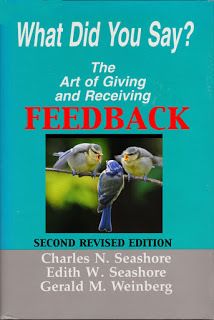 So, if you are asking how you, as the underling, can “correct” your boss, I suggest you learn how to offer (not “give”) information. The boss can then decide whether or not to act on this new information, and how to do it.
Again, this goes both ways. Leaders do better offering information than correction.
What Did You Say?: The Art of Giving and Receiving Feedback Revised Second Edition
So, study the feedback process and become proficient. That will be your best chance, but be prepared for failure. Some people simply will not change, even if banged on the head with a two-by-four.
 If your boss happens to be one of those frozen people, it will be up to you to do the changing.
Maybe change your behavior.
Maybe change jobs.
Becoming a Change Artist
Certainly, some bosses can, but there are ways you can increase the chances of changing your boss, or at least your boss's mind.
I think that if the subordinate offers “corrections,” the leader is less likely to respond less well than if the offer is for “information.” That principle actually goes both ways. Most people are somewhat reluctant to take “corrections.”
 So, if you are asking how you, as the underling, can “correct” your boss, I suggest you learn how to offer (not “give”) information. The boss can then decide whether or not to act on this new information, and how to do it.
 Again, this goes both ways. Leaders do better offering information than correction.
What Did You Say?: The Art of Giving and Receiving Feedback Revised Second Edition
So, study the feedback process and become proficient. That will be your best chance, but be prepared for failure. Some people simply will not change, even if banged on the head with a two-by-four.
 If your boss happens to be one of those frozen people, it will be up to you to do the changing.
Maybe change your behavior.
Maybe change jobs.
Becoming a Change Artist
May 27, 2018
The Anti-Esteem Tool Kit
The self-esteem tool kit consists of tools you can use to build your self-esteem. For instance, the wishing stick (or wand) reminds you that it's okay to think about what you want, instead of always deferring to the desires of others. Or, the thinking cap reminds you that it's okay to come to your own conclusions about what's going on in the world.
These tools all help you to raise your self-esteem, but there's another tool kit, one that helps you remember to put aside certain tactics that simply help you to maintain low self-esteem. Here's some examples:
The Bully Club: Low self-esteem people often think they can feel better if they hurt other people. Sometimes they think the Courage Stick is a form of bully club, but that's a mistake.
The Blame Pointer: Low-self esteem people are often found pointing the finger of blame at others.
The Blindfold: This tool enables a person to go through life not seeing anything they don't want to see.
The Earplugs: By plugging their ears, people are able to avoid hearing anything that might make them uncomfortable. Some Earplugs replace all sound with distracting music. Some just totally deafen to all sounds. Both the Blindfold and the Earplugs counteract the positive effects of the Golden Key, a tool that allows you to open any inquiry you're puzzled about.
The Nose Clamp: This double-duty tool keeps their wearer from remembering to breathe with their Oxygen Mask. It also prevents the wearer from smelling the stink that everyone else is aware of in a situation.
The Stupid Pill: A single one of these pills drugs one's mind to counteract the effects of wearing a Thinking Cap which would otherwise have you thinking as clearly as possible.
The Last Aid Kit: - Use this to bandage your wounds after agreeing to requests you can’t fulfil because you did not use your Yes/No medallion.
 Do any of these tools remind you of any politicians you know?
So, what other anti-esteem tools do you have in your tool kit?
For more on the Self-Esteem Tool Kit, get yourself a copy of More Secrets of Consulting: The Consultant's Tool Kit.
https://leanpub.com/moresecrets
These tools all help you to raise your self-esteem, but there's another tool kit, one that helps you remember to put aside certain tactics that simply help you to maintain low self-esteem. Here's some examples:
The Bully Club: Low self-esteem people often think they can feel better if they hurt other people. Sometimes they think the Courage Stick is a form of bully club, but that's a mistake.
The Blame Pointer: Low-self esteem people are often found pointing the finger of blame at others.
The Blindfold: This tool enables a person to go through life not seeing anything they don't want to see.
The Earplugs: By plugging their ears, people are able to avoid hearing anything that might make them uncomfortable. Some Earplugs replace all sound with distracting music. Some just totally deafen to all sounds. Both the Blindfold and the Earplugs counteract the positive effects of the Golden Key, a tool that allows you to open any inquiry you're puzzled about.
The Nose Clamp: This double-duty tool keeps their wearer from remembering to breathe with their Oxygen Mask. It also prevents the wearer from smelling the stink that everyone else is aware of in a situation.
The Stupid Pill: A single one of these pills drugs one's mind to counteract the effects of wearing a Thinking Cap which would otherwise have you thinking as clearly as possible.
The Last Aid Kit: - Use this to bandage your wounds after agreeing to requests you can’t fulfil because you did not use your Yes/No medallion.
 Do any of these tools remind you of any politicians you know?
So, what other anti-esteem tools do you have in your tool kit?
For more on the Self-Esteem Tool Kit, get yourself a copy of More Secrets of Consulting: The Consultant's Tool Kit.
https://leanpub.com/moresecrets
May 18, 2018
Why I'm a native American
I don’t know if I have any particular kind of ancestry, but I often claim to be “native American.”
Why? I do so when some institution is “surveying” so-called-race, which is a bogus concept to begin with. See Man's Most Dangerous Myth: The Fallacy of Race, by Ashley Montagu.
People say I should choose “White,” but I’m definitely not white. My skin is pinkish yellow, or yellowish pink, and it grows red and brown when I’m out in the sun. I can’t imagine why its color would be important to anyone, except maybe a fashion consultant.
So, when surveyed, I choose “native American (small n)” because I was definitely born in America, so I’m a native. It’s a protest. I would be proud to be a Native American (capital N), but as far as I know, I have no such ancestry.
An interesting sidelight. Years ago when the university insisted I make a “race” choice, they assured me that the information was completely confidential. A year later, when I returned from a trip out of town, I found a note on my desk from Russell Means, a prominent Native American who had visited the university.
I wondered why he would write a personal note to me, until I found out that the administration had sent him to see me, their token “Native American Professor.”
So much for confidentiality. So much for the trustworthiness of bureaucrats.
In such a world, I shall remain “native American,” and I hope Elizabeth Warren and other smart people follow my example.
Why? I do so when some institution is “surveying” so-called-race, which is a bogus concept to begin with. See Man's Most Dangerous Myth: The Fallacy of Race, by Ashley Montagu.
People say I should choose “White,” but I’m definitely not white. My skin is pinkish yellow, or yellowish pink, and it grows red and brown when I’m out in the sun. I can’t imagine why its color would be important to anyone, except maybe a fashion consultant.
So, when surveyed, I choose “native American (small n)” because I was definitely born in America, so I’m a native. It’s a protest. I would be proud to be a Native American (capital N), but as far as I know, I have no such ancestry.
An interesting sidelight. Years ago when the university insisted I make a “race” choice, they assured me that the information was completely confidential. A year later, when I returned from a trip out of town, I found a note on my desk from Russell Means, a prominent Native American who had visited the university.
I wondered why he would write a personal note to me, until I found out that the administration had sent him to see me, their token “Native American Professor.”
So much for confidentiality. So much for the trustworthiness of bureaucrats.
In such a world, I shall remain “native American,” and I hope Elizabeth Warren and other smart people follow my example.
May 5, 2018
What is the difference between a good manager and a bad m...
What is the difference between a good manager and a bad manager?
Because a previous blog of mine asked about good and bad managers, the question naturally came up about what's the difference.
There are, of course, many ways to be a bad manager. Or a good manager. But if I’d been asked for a single difference (and you didn’t use the plural) I’d say that the First Law of Bad Management is this:
If what you’re doing isn’t working, do more of it, faster and louder.
 For more on good vs. bad management, take a look at
Do You Want To Be A (Better) Manager?
Because a previous blog of mine asked about good and bad managers, the question naturally came up about what's the difference.
There are, of course, many ways to be a bad manager. Or a good manager. But if I’d been asked for a single difference (and you didn’t use the plural) I’d say that the First Law of Bad Management is this:
If what you’re doing isn’t working, do more of it, faster and louder.
 For more on good vs. bad management, take a look at
 Do You Want To Be A (Better) Manager?
April 28, 2018
Stumbles for New Leaders and Managers
We were asked, "What were your greatest stumbling blocks as a new manager?"
Paige’s article is a terrific introduction to this subject. <http://hiring.workopolis.com/article/4-rookie-manager-mistakes/>
These are the four rookie manager mistakes described in the article:
Rookie mistake #1: Creating a blanket policy for one bad apple
Rookie mistake #2: Embracing the mantra, “do as I say, not as I do”
Rookie mistake #3: Fixing things that aren’t really broken
Rookie mistake #4: Not taking an interest in your employees’ futures
In my career, I’ve made all four of those mistakes, and lots of others. But the one I most remember, and most regret, is micromanaging .
Somehow, I couldn’t believe that other people could solve problems as effectively as I (thought I) could. My mantra was something like “for your own good,” or “for the organization’s good.”
It took me far too long to learn that other people’s solutions were simply other solutions than mine. Some might be worse than mine. Some might even be better. But most of all, they usually solved whatever problems we were dealing with. There was no need for me to push in with my approach.
I’ve gradually learned to reduce this micromanaging behavior. (I’ve never learned to stop completely.) As I’ve succeeded, I’ve noticed:
 * people learn faster when allowed to make their own mistakes
* people listen to me more attentively on those few occasions when I do intervene
* I have more time for doing my own job
I strongly suggest that you loosen your grip on your own ideas and allow your employees and co-workers to implement theirs.
Do You Want to Be a (better) Manager?
Gerald M. Weinberg's Blog

- Gerald M. Weinberg's profile
- 372 followers
Gerald M. Weinberg isn't a Goodreads Author
(yet),
but they
do have a blog,
so here are some recent posts imported from
their feed.

