M.J. Downing's Blog
January 31, 2026
“Greg: A Survivor’s Story.”
M.J. Downing
To start with, this is more my wife’s story than mine, so all I really want to do is honor what she has done. These are not her thoughts. Those would be far more noble, I think, for this story starts with a loss, one from which I am slowly recovering. She is, too, I pray. I posted something about my little dog buddy, Grumpy, having to be euthanized back in July of this year. Our cat, Grey, went at the same time. I’ll save you the trouble of explaining their sicknesses, the timing, etc, and just lay it down. It was heavy, as all grief is. No wonder people try and rush through it—to no avail.
Anyway, we were grieving. We travelled in the Fall, thinking that to get away would do us good. It did, but we came back to find that our house wasn’t just empty. The absence of those warm little creatures made a cavernous void in our home. We kind of knew it would but basked in our recent travel memories. It was a bit helpful. We walked more, which was great and good for us in many ways. We talked about the loss of our boys, and we cried some more. I started working on my Halloween and Christmas stories. My wife, Amy, worked on the details of a church retreat she was planning and also began to clean out the pollinator plant beds. Those plants were the source of about fifty Monarch butterflies that she released before we went on our trip.
So, it was mid to late October when Amy found Greg, a miniscule Monarch caterpillar, feebly munching on the last of the swamp milkweed leaves. Those bushes were stripped almost bare by then, just stalks, really, hence Amy’s need to clean out the beds. On a whim, she brought this caterpillar, less than an inch long, indoors, for October was cooling. It was hard to tell if, left on his own, he would freeze to death before he starved. Amy put him in a flight cage, attached to the last of the milkweed stems with leaves, to see if he would survive.
Several times, we thought him dead, lying motionless on the floor of his flight cage, looking like he had given up, once inside, out of the swiftly cooling temps. Amy scrounged the last milkweed plants from around the neighborhood. The little guy rallied when she bought a brand-new plant for him from a nearby nursery. It was as though her kindness renewed his spark of life, and he grew. We put his flight cage in a spot in our living room that got the most sun and watched him grow, checking to see if he stayed healthy. Caterpillars are subject to much predation. They can go as far as forming a chrysalis and still die because of a parasite. But this fellow grew and grew. He was soon a fat caterpillar. In November, he made his chrysalis.
That was the start of a pretty steep learning curve about raising Monarchs. Just getting them ready to release is a picnic, compared to having one mature in the house. We could not release him outside, for he would soon die, even if he managed to start his migration. Just after Thanksgiving, we took him out of the front window and placed his chrysalis on a palm plant in the basement, partly to start decorating for Christmas, partly for him to have room to stretch his wings when and if he came out. And he did! He was, of course, beautiful, as are all Monarchs, and we knew his sex by virtue of the two small black spots atop his lower set of wings.
“What now?” I asked. “Do we keep him in a cage for the rest of his life? By the way, how long is that? Days? Weeks?”
“I don’t know how long he’ll live, but I think it’d be okay to just, you know, let him loose in the house,” Amy said, which I thought sounded pretty cool. I had yet to realize all the dangers the little guy would face in any confined area. Our Monarch wasn’t acting particularly “flighty,” for his top right wing was bent outward on the tip, which I figured would mess with his ability to control his flight. Besides that, we learned that they cannot maintain flight unless the temperature is in the mid to upper sixties, which is about where we keep our thermostat in Fall and Winter. He wasn’t going to have the warm air currents to push his tender wings into flight. There was no hope of it outside. He would have lived about a day with temperatures in the 40s and 50s.
And, of course, we had to determine what to feed him. To make a multi-day trial and error story short, we found that warmish sugar water and fruit punch Gatorade attracted him. Amy took this task on, though I managed to help out some. With a small square of cotton soaked in the sweet, red mixture, he spent his time with us, mostly sitting on a saucer on our kitchen breakfast counter. Monarchs, we learned, taste with their feet and antennae. My wife’s gentle fingers would place him on the saucer in a way to let him get a taste. Then, we’d wait for him to unfurl his proboscis and drink, which sometimes he did greedily, often barely at all. They eat, we found, sparingly, every other day or so, which can get a bit maddening for those watching. After all, our memories were still full of a cat who would barely eat anything, and a dog whose gastric condition had him ravenous at all times. Amy, though, gave the butterfly her attention daily, often hourly.
I told her that I had named him “Bucephalus,” ironically, because he was so fragile. That was the name of Alexander the Great’s battle stallion, a powerful and fiery horse, exactly the opposite of our Monarch. Maybe I was hoping that the name would lend him some strength. I don’t know. All I knew for sure was that I had to watch for him constantly, making sure that I didn’t step on him or drop something carelessly on a surface he chose as a landing place for one of his wobbling flights. One morning as I sat reading the news on my tablet, the less than mighty Bucephalus took off from his saucer and flapped to the top of the refrigerator, appearing to fall behind it. Back there, he would not have room enough to even open his wings, let alone fly. I gasped, hoping that he might come to rest on some water line, cord, or vent on the fridge back. All I could imagine was him getting crushed as I rolled the fridge out into the floor. Both of us held our breath as we pulled the fridge out and found him in the warm dark back there, seemingly okay.
See, by this point, little Bucephalus had taken to spending much time perched on Amy’s shoulder, head, or arm. He would stay with her, sometimes, when she got up and moved around, and at night, watching tv, he perched on her. I never though a human and a butterfly could bond, but Amy and this Monarch did. She told me, then, “His name is Greg,” which was a name that she would sometimes say when she called for Grumpy and Grey. I think it deepened their attachment, though it made me try and detach from him, from simple fear at another loss. I also worried that I would be the cause of a sudden, crushing demise for our little guest. We took precautions everywhere, but he could fly to places that were sources of immediate, deadly danger: a sink full of water; the stove, when we were cooking; the sideboard in the kitchen; or into the open top of a hot floor lamp—which he did once. It sent us scurrying to his rescue.
Greg must have been his name, because he grew even closer to Amy as the days of his short life passed. Some straggler Monarchs, we read, could live much longer that the early crop of butterflies, eight to nine months, rather than three to five weeks. Maybe, we thought, he could over-winter with us, and we could release him in April. It was a good thought.
When he did fly, though, it was towards the window in the kitchen or the living room. Rambling, wobbly jogs through the air, followed by a crash landing. Amy put towels down to soften his landings, give him good purchase. He flew toward daylight, driven by Monarch concerns, I’m sure: migrate and mate. “Do we give him freedom, even though it will kill him?” I asked her.
“I really don’t know,” Amy replied. “If we can keep him alive until spring…”
“Yeah, I know. If…” I said. I wanted to believe it was possible.
Monarch wings, though they look like stained glass, are thin as onion skin and even more delicate. The color comes off like powder if they are mishandled, though Amy knew how to cradle him with tented fingers, keep him whole. Greg, however, would flutter at the window, desperate to get out, so his wings began to tatter on the edges. On a couple of flights across the living room, Greg flew into the Christmas tree, and while it was beautiful to see him hanging in it like an ornament, the process of getting in and out was even harder on his wings. He banged around on the tough, artificial needles and wire branches until one of us could help him out. Once, he fell out of the tree and got wedged between presents on the floor. I guess he missed the padded windowsill on one of his wobbling flights across the room. Amy looked at his tattered condition and said in a quiet voice, “He probably doesn’t have long.”
Just a day or so before Christmas Day, Greg’s posture changed. His abdomen swelled, and we didn’t know why. We read that such things can come from overfeeding or a parasitic infection. The first was doubtful, for he would ignore his syrupy fluid for days. Also, most parasitic infections in Monarchs show up as they leave their chrysalis. He gave up flying and let Amy hold him when offering him food. If a butterfly can be patient, I’d say Greg was. He grew, by turns, more anxious to get out and more willing to sit on Amy’s warm hand. All I could think about was holding Grumpy as the vet eased his pain and put him permanently to sleep.
When Greg’s short live ended, it was sometime on New Years’ Eve. Greg did not make it into 2026. “Five weeks or so is a good run for a Monarch,” I said to Amy. And she agreed, nodding in silence. She laid him in a small gift box with a cotton wool liner, but he couldn’t sit on her shoulder soaking up her warmth. It seemed like a hard way to start the year, but Amy smiled when she remembered all that we had learned about butterflies, though I doubt she or I will be in a hurry to have one live in our house again. Sometimes, I think that sort of caring comes at too high a price.
My dog Grumpy was my best friend, and kind friends tell me that I will see him again, and I pray that it is true. Sometimes, though, I thought of myself as his jailer. I wouldn’t let him do what he wanted, go where he wanted, eat what he wanted. I told myself that my concern for him was born out of love, a need to keep him safe, even from himself, his choices. He never minded or held it against me, either. He was always there for me, for us, with a happy wag and a bark and licks on my face. I watched Amy give that same sort of thing to Greg, as she always had to Grumpy and Grey, but I could not.
Truthfully, I wondered if I am not in the same relationship with God, thinking that I have to do right to be accepted by my master. But that’s some “stinkin’ thinkin’” as folks in Twelve Step programs say. It was more like Grumpy was in the God spot, caring completely, loving without reservation one hapless creature. Amy’s time with Greg was like that too. Her love for him, care for him, led her to think about helping more Monarchs, with an even bigger pollinator garden this coming summer. Our house will be full of flight cages, and they, in turn and in time, will be full of those fat little j-hooks of butterflies to be.
Grey cat was with us for sixteen years, Grumpy for thirteen, and Greg from October to the end of December, 2025. We live in complex dependencies with our pets, and I am often torn by what that says about us as people. Is it loving? Is it just needy? Clearly, they need us—not so much butterflies but dogs and cats. Greg, I think, taught me that I’m not yet ready for another dog or cat to enter my life—certainly not another butterfly. However, watching Amy with Greg taught me that caring about another life is a precious thing, beautiful and fragile as a butterfly’s wings, even if a little tattered. And I think that is worth sharing.


October 28, 2025
“Finn, Tom, and Albert and the Shadow Man.”
M.J. Downing
Sometimes, when Halloween comes and the barriers between the worlds grows thinner, we get caught up in the changes, in the colder air, the falling leaves, in how those around us just aren’t like they used to be. It’s hard to see the changes in ourselves, too. Ghosts and monsters become just fun, kid stuff, though inside, we miss the magic of glimpses into the other worlds, those things we tell ourselves are only imaginary. Maybe what happens during these days when the world loses its summer green and prepares to undergo the death of winter, is that we get to see that we are ghosts who have yet to die, that monsters do live among us, and that this has never been kid stuff.
At sixteen, Finn McCoy stood one inch taller that his father, James, though a good fifty pounds lighter. Finn would gain weight, too, in time, for he was growing. He had found football, his friend Albert Miller having coaxed Finn to try out, and it brought on dramatic changes. Tom Doughty, Finn’s other close friend, found these changes unwelcome. He did not care for Finn’s and Albert’s new growth, especially with a new Halloween just a week away.
“It’s like he isn’t Finn anymore. He’s changing too fast,” Tom explained to Albert as they waited for Finn after practice in late October.
“You just jealous because he’s bigger than you now?” Albert asked. He, too, was filling out his large, awkward frame with new muscle, too. Albert was as heavy, though not as strong, as Professor James McCoy, who was Albert’s idol of strength and cool. Moreover, Albert was second string offensive lineman, though Finn had already become a starting linebacker.
“Size has nothing to do with it,” Tom replied. “I’m glad for his sake that he’s taller than Stacey now. For some reason, he never liked looking up at his girlfriend, so I know he feels better about walking with her, and she likes his muscles. That’s all good. I’m happy about that. But—”
“You don’t feel like you could take him now, Mr. Kung Fu?” Albert teased, though he knew better. Tom was of average height, short of six feet, unlike his two buddies, but training in Chinese martial arts had hardened his body and kept him trim. Albert, with his new size, had tried once or twice to push Tom around and lost swiftly in each encounter, winding up face down with one arm twisted up behind him in an unnatural position. Tom was close to lethal, but Albert’s perpetual uncertainty just would push him to tease.
“I mean,” Tom replied, not taking up the Kung Fu issue, “that Finn seems to have lost—or given up–his abilities. When was the last time you heard him say anything about ghosts or fairies?”
“Did he have those abilities, or was that all just…in his–and our–imaginations?”
“Oh, like we’re all grown up now? Like it wasn’t just last year that Finn had encounter with the Green Man?” Tom shot back. “You’ve read the stuff that we found on the Green Man, a very powerful force in the realm of Faerie. Just because you both went out for football and put on some size, the things we experienced with Finn are suddenly just stories we told ourselves?”
“Well, did those things happen? Did we just want them to happen?”
“What, like when Finn was kidnapped by fairies—or when we ALL fought the vampire?” Tom asked. “We were there. We saw it all. You were–.” Albert frowned and shrugged his heavy shoulders.
“Maybe,” Albert replied in a quiet voice. Tom looked hard at Albert, recognizing that his large friend remembered the vampire incident with shame, because he had nearly become its victim. Since then, especially at the adventure of the Green Man, Albert and Finn grew distant, until football drew them together. So, Tom studied Albert but did not challenge him. His training taught him to avoid pointing out another’s weakness or wrongdoing. People have to deal with their own issues, Tom knew, though he worried that his friend Finn had thrust aside a precious gift: seeing what was really there, in favor of simply getting bigger.
“Maybe I just miss the way Finn used to be, his enthusiasm, the way he looked at things,” Tom said. He knew that Finn was still fearless. Finn knew nothing about backing down from a challenge, and it showed when he played. Coaches loved his competitiveness, his growing physical skills. Finn was an exception as a freshman starter, first at safety and then linebacker, leading the team in solo tackles. But ghosts and fairies were things he just didn’t talk about anymore.
Tom, who was not ready to give up those marvelous things, saw greater differences in Finn: he argued more with his father, as well as with Stacey. Much of the time, Finn laughed and joked like he always did, but something about it was more physical, harder than it had been. They had always wrestled, as boys will, but now, pushing people around, even a little, had become Finn’s new way of relating. He liked shoving people, catching them off balance, which didn’t work with Tom. His martial art training taught him to flow like water, easy, balanced. Finn’s new strength made him more like a crashing wave. Tom knew how to avoid the wave-like power, using a gentle turn to let it go by, no matter how many times Finn tried to catch him unaware with a grasp or a shove. Finn’s new habits did not sit well with Tom.
Tom had retained his ability to talk with his father and explained his problem to him one evening after they had trained. Sgt Doughty had observed, “I’m sorry that Finn seem to have changed. I’ve always thought a lot of him. I will say, though, that I’ve seen many a curious and intelligent boy become a thick-headed goofball when he gets some size. I wish I could say that I had not, but that would be a lie. It does happen to some of us.” That thought horrified Tom. Even Albert, big as he was, retained his boyish sense of humor and some doubt about himself. For Tom, Finn was getting too full of himself, as though his on-field personality had become his new identity. He worried that Finn was on his way to being just another jock, when he had always been a great deal more special, gifted, in Tom’s eyes.
The gym door behind them burst open and Finn rushed out, his hair still wet from the shower. “Hey losers,” he exclaimed. “Bertie, where’d you go? You weren’t in the weight room today,” he said, dropping an arm around Tom’s neck as though to put him in a head lock. Tom ducked out of it but avoided responding with a move of his own. Finn turned to Albert and hit him with a shoulder block that almost took the bigger boy down. After his rough greeting, Finn was moving on. Tom trailed behind, frowning.
“Coach Austin had me doing footwork drills, jumpin’ rope and crap like that,” Albert said, righting himself and falling in beside Finn. Albert’s clumsiness was his weakness. He also hated that his teammates called him “Bertie,” for it sounded like “Birdie.” Team nicknames, too, tended to stick. When they had first tried out for the team, the older players called Finn, “Fish.” That had changed to “Shark” when he led the team in solo tackles.
“Yeah, you gotta learn to move your feet faster, bud, if you wanna start center,” Finn said, without a nod to Albert’s desire to overcome this weakness. Even Tom had worked with his larger friend on footwork, how to stay balanced and shift his weight. Finn urged them to hurry. “C’mon. I gotta eat!”
St. Francis, their high school, wasn’t far from their neighborhood, and they walked to and from it every day. Sometimes, like on away game days, Tom walked home by himself, which might explain some of his dissatisfaction with Finn’s changes. Before football, they would cut through the trees of the old park where they used to play. In the presence of grass, trees, and thickets, Finn always found wonders in things that Tom or Albert could not see. He would stop and stare at spots where he saw wandering shades or traces of the fay, hoping to share his gift with Tom and Albert.
Now, though, Finn was all about getting bigger. He went fast through the park, heading for home, to protein shakes and peanut butter or whatever leftovers he might find. A new hunger replaced his ability to see wonders. Tom had sometimes seen flashes of the things Finn would point out, though Albert claimed he never did. However, the need to feed his muscles replaced Finn’s attention to a greater reality. Now, they went fast, past the spots where Finn once tried to show them where ghosts wandered or fairies hid, the dark culvert where the creek ran under the main road on the park’s east boundary, the foundations of an ancient house that once stood on the property.
Tom missed those times, for they gave him a sense that he was part of history, that there were stories everywhere about people who had been there, like the ghosts that he figured were of some of the people whose family had settled in the park, donated their land, set it aside for others to enjoy. Finn’s ability to see traces of it, even if Tom could not, made it all the more real for him.
Tom looked up at the scudding clouds, pushed by a growing breeze that promised rain, Halloween weather. It was in that time of year that Finn had his first contact with the fairies, with another world that existed alongside the boys’ day to day reality. Even though Tom could not see them, he never doubted that Finn did. It gave him a sense that life was bigger, more marvelous, than people understood. Those dark, dangerous fays, those who lived deep within the culvert, thrilled Tom. Finn had said that an entrance to the realm of Faerie could be found deep down that midnight black passage. Their presence, which only Finn could detect, gave Tom a sense that any dream in life was possible, for wonders surrounded them. As they passed it, Tom gave the dark culvert a hopeful look and called to Finn, “Did you see movement in the bushes down by the culvert?”
Without turning, Finn said, “Nope,” and pushed on up the hill.
Tom cast a longing glance at the shadowed tunnel opening. Once, he had thought he heard deep laughter, voices calling them to venture into the darkness. Finn, of course, heard them first and stopped them all to listen. Now, Finn hurried up the steep hill in front of them, strong legs driving him fast. “C’mon, Tom! You know how much you like my mom’s protein shakes,” he cried over his shoulder.
At that moment, though, Finn stopped and turned, his face bright, and said, “I almost forgot. Stacey wanted me to invite you two to her family’s party the night before Halloween. Can you make it?”
“Sure…will,” Albert gasped, winded by the steep hill.
“You, Tom?” Finn asked.
“Yeah, sure…I mean maybe,” he replied a sudden anger filling his thoughts. “I guess they’ll have a lot of food, huh?”
“Chili, hot dogs, chips, cookies—you name it,” Finn said, turning to hurry up the hill.
Tom, at a hard hundred and fifty pounds, ran with his dad frequently. That and hours of practice and sparring had granted him speed and greater endurance. Driven by a sudden flush of anger, Tom sprinted to the hilltop outpacing both of them and ran the rest of the way to Finn’s house, despite Albert’s pleas to slow down. Finn followed on Tom’s heels, unable to catch up. He was winded by the fast half mile. Tom stretched in Finn’s yard. They waited for Albert.
“You…okay, Tom?” Finn asked, leaning on his knees, catching his breath. Tom looked at him without replying. It still looked like Finn McCoy, the blonde hair, the eager eyes, the face that Tom had always seen as more real than any other. Finn came toward him, gave Tom a shove on the shoulder, which he deflected with ease. Finn lunged toward Tom again, saying, “C’mon, man. You know you want a shake, right?”
Tom stayed out of range, dodging around to Finn’s side. “No. I don’t think I do,” he said. “Think I need to get home and work on the pads and the mook jong. Later.” He turned on his heel and started at a run towards his house. Finn called after him,
“So, are you coming to Stacey’s or not?”
“Maybe,” Tom called back over his shoulder. “Why not make a clean break with them both?” Tom thought as he ran. “I don’t want to just tag along, though it just doesn’t seem right, now, at Halloween.” Tom was not sure why, but he did not like feeling so angry. So, he ran harder. He ran past the lot where the vampire’s house had burned to the ground, recalling clearly that it wasn’t just the boys, but their father’s too, who had fought that evil. “Did any of that matter to Finn anymore? To Albert?”
At home, Tom worked on the mook jong, the wooden striking dummy, and practiced his forms concentrating on each movement as his father and his sifu, his coach, had taught him. With concentration and effort, eventually, his anger left him. He knew that such anger was foolish and was glad to be rid of it. As he calmed, Tom recognized that Finn was still his friend and that people changed, especially boys struggling to be men. In the place of that anger, though, a shadowy ache remained. Tom sighed, recognizing that change was hard, though he never dreamed it would lead to such a deep feeling of loss. It was something against which he had no defense, that no martial art could fight.
*
They all walked together to school the next morning, as usual, though Tom stayed silent. He did not wait for Finn and Albert to finish practice that day. Usually, during their practice time, Tom stayed in the school library and did his homework. That day, he simply went home, did his schoolwork, and waited for his father so that they could go train with Mr. Leung, their coach. Later, he helped his little sister with her homework. It was whaty his day to day life would look like if he didn’t hand around with Finn and Albert. Really. It was okay, Tom thought, but it just did not seem right as Halloween approached. Finn had been Tom’s touchstone for magic, the sense that there were greater—or at least other—realities other than their everyday lives. Tom, however, told himself that now it was just different, not bad. He took up the novel he was reading for English class and sat on his bed, letting Huck Finn’s reality take him away. He had read for about an hour when Albert’s large figure filled the door to his room.
“Where were you today?” the large boy asked. “We looked in the library for you, but it was locked. Did they close it early or something?”
“I don’t know. I came home. Dad and I went to train as soon as his shift was over,” Tom replied. “Why?”
“Well…you…you’re usually there, right?”
“Did you need me for something?” Tom asked. Tom wondered if, actually hoped, Finn had sent Albert. That wasn’t what Finn would have done, though. If he cared about what was bugging Tom, he’d have come himself. Well, at one time, that’s what Finn would have done. With a sigh, Tom tossed aside Huckleberry Finn, moved his legs off his bed, and invited Albert to sit down.
“You…you’ve read more of that than I have,” Albert said, gesturing to the book.
“Um hm,” Tom grunted and nodded. Albert had come on his own. “Almost finished, really. It’s a good read. I like it.”
“What’s it about?” Albert asked.
“A boy named Huck Finn, growing up, dealing with important changes, which you’d know if you read any of it…Bertie.” Tom replied with a wry smile. Albert’s head sagged on his wide shoulders. He sighed.
“Yeah, I know. I gotta hit the books more.” Albert paused before adding, “Guess I better get used to that name, huh?” he muttered, “though I wish I didn’t have to.”
“I reckon that’s the way changes go, pal. They happen, and we have to get used to them. Sometimes, like with Huck, we come to places where we have to face the consequences of change, especially in what we value. Maybe, if you don’t like that name, see what you can do about getting another, get as strong as you can and quicker on your feet and become Big Al, or something,” Tom said.
“Dealing with consequences? Maybe that’s what you were doing, skipping out on me and Finn, today? You know, getting used to the changes in him, maybe me, too?” Albert asked with a grin. Tom looked at Albert and returned his knowing grin.
“Good one, Albert. I guess maybe I am,” Tom said in a quiet voice.
“I don’t like Finn changing, either,” Albert replied, just above a whisper. “It’s like he’s moving away. He’s like part of a world that doesn’t include us, now. I don’t really mind that he’s not seeing…all that spooky stuff, like he used to. I just miss…us. We were the team before, even though I always felt like I was the weakest part of it. I guess I still am.”
“We all brought what strength we had to it, but Big Al, what can we do about it? Finn has changed, you’re changing, and I guess I am too.”
“Because you’re a better Kung Fun guy?”
Tom shrugged. “Maybe so. My coach says that my technique and power are getting really good. He’s introducing me to meditation and higher forms, now. He likes that I’m more focused, that my moves are second nature. It’s basic to me. I respond from its perspective and don’t have to think to do it. Dad sees it too.”
“That’s great, though, right?” Albert asked. “Like no one could take you by surprise, sucker punch you.”
“Well, no. That could happen, but training like I do gives me balance, gets me used to defensive encounters so that they don’t take me by surprise. That’s the goal of any martial art, I think, but it hasn’t stopped me feeling disconnected from my friend. I guess that’s as bad as a sucker punch. I have no defense against loss, which is what I feel about Finn, you too, really.”
Albert nodded his agreement, but he did not look Tom in the eye. “Yeah, sadness just sucks, is all, and that’s what I feel, mostly. I…I miss… how we were. Even when things got all scary, there was something really magical about them, especially since Finn…” Albert choked on what he wanted to say. “I mean, I miss his family, too, his mom and especially his dad, who’s so cool. I even felt close to his pesky sisters especially around the holidays, right?”
“Yeah. Me, too,” Tom whispered, “but we’ll be together like always when we go to Stacey’s party this year, right? It will almost be Halloween. Maybe we’ll learn how to be together—but in a different way. Maybe.” Albert nodded and left without saying anything more. Tom’s sadness did not go away, so he began to try and accept it and carry it as best he could.
Indeed, Finn didn’t seem to take any notice of Tom’s absence. He asked Albert, once, where Tom had gotten to and was told that he was just doing “more of that Kung Fu stuff.” Finn appeared to be okay with that. Albert wondered how long it would be until Finn stopped keeping company with him, too. All three were only in one class together, Algebra II, where they sat in alphabetical order, and Albert Miller was a little closer to Finn McCoy. Tom’s seat was in the front, so he left class before them, a fact that Finn didn’t seem to notice.
*
The day of the party came, and Tom, wearing his dad’s old navy blazer and jeans, called for Albert at his house and found that he had already left for the party. So, Tom walked to Stacey’s house alone, taking in the lit jack o’ lanterns on porches, the fake ghosts hanging from trees and moving with the cool breeze, the corn stalks rustling. Stacey’s street was full of cars, making Tom remember that this was a family party that would bring in many people he did not know, maybe even girls, classmates of Stacey at Ascension Academy. Maybe, meeting a new girlfriend would help him forget the loss of the vicarious magic he once experienced around Finn. Again, Maybe.
Conspicuous on the sidewalk in front of Stacey’s house was a black Harley Davidson. It stank of oil and gas and featured a long front fork and tall handlebars. Tom edged around it as others did. He joined people he did not know, Stacey’s extended family, walking up to the house past yard decorations. It certainly looked like Halloweens from their shared past. Stacey’s mother, stationed at the front door to greet people, was giving out candy and welcoming everyone by name, including Tom.
“Well, hello, Tom Doughty! You look all grown up in that sport coat, dear,” she said with a smile. “Albert, Finn and Stacey and her friends are all out back. There’s chili, chips, and drinks on the table in the kitchen. Help yourself as you go through.” She handed him a piece of candy. Tom pocketed it with a smile.
“Thank you, ma’am,” Tom replied. “Who’s motorcycle is that out there?”
“Oh, that belongs to my older sister’s eldest son, John. I asked him to move it an hour ago, though he hasn’t yet. He’s, well, different, these days, my sister says. Likely, he’s out back, too, sitting by the fire,” she explained. She used that half hushed tone that grown-ups reserved for difficult family members.
Tom passed through the crowd of relatives in the living room and dining area and that, too, was like going through Halloweens past. As he made his way through aunts, uncles, and cousins, big and little, chatting, Bobby “Boris” Pickett’s greatest hit, “Monster Mash,” played on the console stereo in the living room. Tom had not heard it this year, which gave him the sense that he was passing from his old ideas of Halloween to something new. With his hand on the back doorknob, he stopped as though touching the knob had sent a message through his hand: “What I see here, in this backyard, will tell me what Halloween is now.”
He had no preparation for what he saw. Indeed, just outside the door, he stopped in shock. Finn was there, in the growing darkness, standing just behind the fire, hands on his hips. He stared at a shorter man, who stood between Finn and Stacey. The shorter man’s right arm was over her shoulder, forcing her close to his side, his hand squeezing her hard enough to make her wince.
The man between them was shorter than Finn, slender to the point of being gaunt, hair black and slicked down to his head, a greasy ponytail hanging down in back, wrap around shades covering eyes that were fixed on Finn. The man’s left hand was behind his back. His stance, weight balanced and slightly back, suggested to Tom that he was ready to attack, that behind his back, there was a weapon, one he knew how to use—and would use with little provocation. Tom started towards them and said,
“Finn, step back, please,” for Tom saw something else, something other about the man in the shades: a shadow behind the man, like a darkness deeper than the dusk of the evening, moving in a way that shadows should not move. It was jagged and flickering, and there was nothing, no wall or fence onto which a shadow could be projected. The fire did not cause it, Tom saw, for its jerking motions shifted behind the man, going now toward Stacey, now toward Finn and back, its hands reaching, as it would tug both of them closer, keep Stacey in the man’s grasp, Finn where the weapon could be turned on him. Tom thought the weapon was likely a knife, since a firearm didn’t need to be close to kill. Something in the man’s bearing told him that this man had killed before—and would again.
Finn, shot a glance at Tom but didn’t budge. Finn looked uncertain, standing there tense in his St. Francis sweatshirt. The shadow man fit, somehow, with the motorcycle out front. He was family, and Finn was uncertain about what to do about a member of Stacey’s family. Tom saw the anger, as well, on Finn’s face. He would not back down but wasn’t sure about what to do. Finn took a deep breath and wiped his brow, as though he was sweating on a night that was quite cool. He was going to do something to stop the shadow man from hurting Stacey. Tom saw the man’s left hand tighten on whatever weapon he had. Tom watched the muscles of his arm tense. Tom said, “Finn, buddy, come here, please.”
Albert was behind Tom, just then, leaning towards his right side. “Th-that man, says he’s Stacey’s uncle, but he ain’t right, Tom,” Albert managed to whisper. “You should have heard him talk to Stacey and her girlfriends. It was sick, and Finn got mad, got up and started to go after him.” There were other kids around them, sitting by the fire, holding cups of drink or plates of food. They all stayed still, frozen in place by what was going on. They watched, unmoving, the man in the shades. They were frightened rabbits in the presence of a hungry snake. Albert whispered, again, in a tense voice, “Finn won’t back down.”
“Big Al, go in and see if you can get Stacey’s mom to bring her nephew a bowl of chili, okay? Go slow, like nothing is wrong,” Tom said. Albert moved away, drifting into the deeper shadows towards the corner of the house, away from the fire. Strangely, Albert did not trip over anything.
“No, Finn doesn’t back down,” Tom said to himself. That was one reason that Tom loved Finn as much as he did. Finn never feared doing what he thought was right. He ran toward danger, the unknown. In that way, he had not changed, but just now that might get him stabbed, maybe killed. Tom nodded and said, “Look, Finn. You need to see what only you can see.” Finn, then, took a step back, turned his angry eyes toward Tom, stopped, and nodded. He turned to look at Stacey’s uncle and took another step back. Tom moved towards the fire, as Finn backed away from it, away from the threat that Tom saw so clearly. The man in the shades kept his hand on Stacey’s shoulder, pushed her down into a lawn chair, and moved behind her. Her eyes were like saucers, like she was more scared than hurt, like she did not know why.
“Who’s the guy, looks like somebody’s dad? Looks like he can fight, too,” Stacey’s uncle muttered in low harsh tones as his stare took in Tom. He had shifted into a balanced neutral stance, offering no guard but ready to move. He had done so without thinking, but the man in the sunglasses noticed. Finn backed away from the fire, edging back toward where Tom stood.
“I’m Tom Doughty. You must be the gentleman whose motorcycle is blocking the sidewalk. You’re her Uncle John, I guess,” Tom said as he gestured to Stacey.
“T-Tom, this is John Ketcham, He’s—” Stacey stuttered, trying hard to be polite in a tough situation.
“Shut up, girl,” her uncle said, squeezing her shoulder again, making her wince. “Call me Ketch, boy.”
Tom nodded and touched Finn’s left elbow as he backed towards him. Tom whispered, “What is he, Finn?”
“He’s a dead man, if he doesn’t let Stacey go,” Finn rumbled in reply.
“No, why does he have a shadow that moves when he doesn’t,” Tom asked in a whisper that only Finn could hear.
“He—” Finn stopped. “I…I don’t know,” he whispered back to Tom. “You’re right but how’d you know?”
“I used to have this friend who could see what was really there,” Tom whispered. “Picked up a thing or two from him.”
Finn looked down at the grass, shook his head slowly. “Tom, I kn—”
“Now isn’t the time,” Tom replied. Finn nodded.
“I don’t know what’s going on with him, but he’s bad, like crazy, and that free form shadow might be what drives him. Maybe we need to help him get rid of it?”
“Is that what we do?” Tom asked. Finn turned a questioning look at Tom and did not reply.
“You two are doin’ an awful lot of whispering over there,” the man called Ketch said. “And why do I think it’s about me?” He let go of Stacey’s shoulder and the weapon behind his back and walked around the fire towards Tom and Finn. Stacey sagged in the chair and closed her eyes. Finn started to go to her, but Tom held him. The way Ketch moved, in Tom’s understanding, showed that he did not need a weapon to be deadly. He wore the remains of an olive drab uniform shirt, cut off at the shoulders. The name patch was torn to the point where it said only “Ketch.” He did not just walk: he moved into position. Sinewy arms relaxed in the black t-shirt under the old fatigue top. Tom knew that he would be close enough to strike either of them soon. Tom smelled the alcohol and cigarette stench that hung about Ketch as he stepped nearer. Tom stayed relaxed, balanced, but he recognized that Ketch wasn’t drunk, unless he always was.
Ketch gave him a slight left shoulder feint, and Finn lifted a hand, though Tom did not move. Ketch wasn’t close enough. He was just testing them. That Tom did not react made Ketch grin, though it had no joy in it.
“Stacey’s mom said you boys were real heroes, in a once upon a time sorta way,” Ketch said with a grin, “like you saved some folks from sort of spook or somethin.’” Tom was sure that the smile didn’t reach Ketch’s eyes, not that it was possible to tell behind the black sunglasses. He stood so still that Tom found him a bit unnerving. Ketch knew not to telegraph a strike. Only his shadow flickered and bounced, like an insane thing tethered to him. Finn moved uneasily at Tom’s side, folding his heavy arms over his chest. Ketch’s gaze, as far as Tom could tell, never left his face. He had dismissed Finn, which Tom knew was a stupid thing to do.
“More necessary that heroic,” Finn said his jaw tight.
“Not really talkin’ to you, muscle head,” Ketch replied. “I’m addressin’ myself to the only fighter here. What you got for me, boy?”
“Depends,” Tom said.
“Tom’s right,” Finn added. “We don’t know quite what to do with that shadow at your back, though we’ll figure it out.” Finn’s revelation that he could see the shadow hit Ketch like an unexpected blow.
Ketch staggered backwards with a sudden shake of his head, face muscles convulsing. For a second, the wrap around shades fell away from his eyes, small eyes, like a terrified child’s eyes. They darted this way and that, like the shadow behind him. Ketch hurriedly pushed the shades back into place. Tom and Finn watched Ketch’s shadow rise up as though it was screaming, though no sound came, except a strangled grunt from Ketch’s throat. And before Tom could blink, Ketch reached to his rear waist band and pulled a long knife. Its point wavered before them, just out of range.
“Whoa! That’s a knife!” Albert gasped. He was standing behind Tom. Back-up, though a bit unwilling. Things were about to start, and Tom relaxed, ready for whatever came.
Behind Tom, Finn, and Albert, the back door opened, and Stacey’s mom bustled out, holding a steaming bowl of chili before her, talking fast as she approached.
“Oh, John, I’m so sorry. I should have served you sooner. I guess I just—Oh, my! That is a big knife!” she finished in a rush.
“Yeah,” muttered Albert.
Ketch backed another step away, almost into the fire, glaring at her, at Tom and Finn. “Ahh…” he said with a shake of his head.
“Uncle John was just showing it to us,” Finn said, which, in a way, was true. “It sure does look sharp!”
“Well, it is a knife, right?” Tom said in quiet tones, at which Finn chuckled. Taking a quick step toward Ketch, Tom reached out and took the weapon from him, felt the man’s hand trembling, though it came away without a struggle. Finn passed the bowl of chili to Ketch, who took it with shaking fingers, his hidden eyed glance shifting between all three of them.
“Oh, I know how you boys like such things, but please be careful not to cut yourselves!” she exclaimed, turning to hurry back into the light of the kitchen. She left them in a deep silence, with Ketch staring at his chili. Tom tossed the knife up and caught it by its tip, the razor-like edge pricking his fingers. He proffered it to Ketch, handle first. who stared at it before he let the chili fall onto the grass and jerked the knife back.
Ketch stuck the knife back in its sheath, leaning back. His right heel landed in the fire pit. He gave a startled cry and sent a shower of sparks into the deepening dark. They engulfed his wavering shadow. It twisted as though it felt the heat. “N,no, No!” A gurgling scream of anguish forced itself out of Ketch’s throat, and he bolted away from the boys, heading for the side of the house. On instinct, Finn grabbed at him, and to his and Tom’s amazement, Finn caught the shadow. Its insubstantial matter twisted in Finn’s powerful hand. Tom saw it there in Finn’s grasp, a struggling, shifting thing, a monster caught by the boy who saw what was really there. Ketch staggered to the ground with a loud cry as the shadow detached from him. He clutched at his chest as though his heart was being torn free.
Yet Ketch reacted fast, though gasping and shaking. He pulled his knife, and lunged at Finn, in whose hand the shadow writhed. Tom did not stop to think, despite his amazement at seeing all this with his own eyes: his right foot lanced out and deflected the strike. Without obvious effort, Tom drew back his kicking leg and thrust a stronger kick which landed on Ketch’s hip, knocking him to the ground. Tom stood relaxed and ready, in case Ketch rose to fight again.
From the ground, where Ketch panted on his hands and knees, he cried, “No! I…I need it. It’s…human…It was…it is…me!”
Nothing, no one moved in that back yard, except the frenetic shadow in Finn’s grip.
“Is it his soul?” Tom asked in hushed tones. “How can that be?”
“What horrors would you have to see, do to warp your soul enough to have it outside your body?” Finn asked. A horrific thought rose in Tom’s mind. and he whispered,
“Maybe you have to become something like death itself, living just to make people hurt as much as…you can.” In that moment, Tom sensed that, whatever his soul was, it was enmeshed with Finn’s, with the souls of Stacey, Albert, indeed with the few other young people who sat around the fire unmoving, though, mercifully, they weren’t seeing what was happening. No other soul so much as touched Ketch’s. Tom said, “Finn, my brother, let it go.”
Finn nodded, and both boys stared at the shape of deeper darkness that fought in vain to escape Finn’s grasp. Its insubstantial hands pushed at Finn’s hands, its arms, legs, and head jagged in outline, jerked and jittered, desperate to return to the monster that Ketch had become. Finn released it, and it flashed back to Ketch, dissolving into him, around him. Ketch cried out in agony and jerked as though shocked. His body convulsed as though his soul’s reattachment wove pain through every nerve and muscle.
Ketch almost dropped his knife, but in a sudden grasping motion of his hand around the handle, he grew still again. “Heroes,” he said, spitting the name onto the ground. “You can’t kill. You’re not men, never will be!” With that, Ketch turned and bolted into the dark. Tom and Finn both sighed in relief. In another second, the sound of the motorcycle coughing to life on the front sidewalk reached them. They heard it roar away into the night.
Finn turned and went to Stacey’s side. One of her girlfriends was asking her what was wrong, as Stacy shed a few tears quietly and rubbed her shoulder. Finn gathered her into a gentle embrace and whispered, “He’s gone.”
“Wh…what was he, and how come Finn could grasp his shadow?” Albert asked as he came to sit with them.
“You saw that, too?” Finn asked. “I guess you two don’t need me to see things anymore.”
“I think maybe we do,” Tom said, “but we have to be together.” Finn looked at him and nodded and replied in subdued tones,
“We’ll need to talk about that.”
Tom patted his shoulder, a casual move but one that came in a moment of great relief. Finn was himself again and more, as gifted as he was and growing. Tom looked at Albert, who smiled and nodded, as though he read Tom’s mind.
“What shadow?” Stacey asked. “Wait. No. Don’t tell me. I don’t really care. I’m just glad he’s gone.”
“Was he always…you know…cruel…to you?” Finn asked her.
“A long time ago, when I was little, he was…okay, really. Sometimes he was mean, like, to pets. You couldn’t leave him alone with a small animal. He got in trouble at school for bullying…but never like he is now,” Stacey said in a soft voice.
“Um, Ketch was in the military?” Tom asked, getting a nod from Stacey.
“Yeah, and he was gone for a long time, maybe a couple of years, and no one knew where he was. Maybe it was that…that changed him, what happened in the jungle… that made him worse, but he’s been back for almost a year,” she said, “But my aunt says that she doesn’t…know him anymore.”
“We all change as we grow,” Tom said, and Finn turned to look him in the eye, “but we’re still the people we were—”
“As well as the choices we make,” Finn whispered. He extended his left hand to Tom, who grasped it and held it tight. They sat around the fire, which Albert fed from a nearby stack of wood. It’s friendly warmth embraced them.
*
The next night, Halloween,found Finn, Tom, and Albert out on the streets though not in costume. Without being asked, the shepherded Tom’s sister, Finn’s sisters, and several small children as they went door to door in colorful costumes. The trio talked to neighbors and stayed on the sidewalks in front of the doors which disgorged candy by the handfuls. And every small child in that group tried to be the one to hold Albert’s hand. They all offered Albert candy, which he refused, insisting that they keep their treats and enjoy them a little each day until Christmas. He was sure that there would be enough to last.
When the young ones had gone in, the three boys walked the neighborhood, watching for trickers who weren’t interested in treats. Finn showed them the places where he usually saw ghosts, and they even walked into the dark park, down to the culvert, going slowly so that Finn could spot fairie movement. He reported none, but that did not detract from the feeling of mystery and magic that pervaded their evening. Even Albert took a new interest Finn’s “spooky stuff.” In their eyes, the jack o’ lanterns burned with a brighter light, and the moon and stars on that cool, cloudless night waxed proudly in their brilliance. All three boys walked the street as protectors, trying to make sure that nothing too spooky marred the evening, and the magical feeling of the night helped them.
Tom and Albert, of course, walked with Finn to Stacey’s house when the last of the trick or treaters left the streets. “Stacey says that several of her girlfriends called today to ask about my two buddies,” Finn told them. Tom nodded and Albert blushed so much that it was visible in the dark. Everything, especially as they went towards Stacey’s house, possessed a glow under the moon and stars. Most folk would have attributed this feeling to young men’s fancy, brought on by the brisk air under the clear cold sky and the chance to meet girls. They had all experienced it before, though two of them had thought it was lost and one had mistakenly desired it to be so. This Halloween night, none of the three doubted idea that the barriers between worlds could grow thin.
As they were walking to Stacey’s house, Tom said, “So, maybe this is what we do now: be where we are needed to keep the bad things out.”
“Yeah, maybe so,” Finn said. “I thought, maybe I could be done with all that, you know?”
“Why would you want to?” Albert asked. “I mean, who can grab a shadow with his bare hands? That’s pretty amazing, right?”
“I don’t know how or why I could do that,” Finn said. “I just began to feel like I didn’t want to be…different, you know? I just wanted to be regular, just another guy.”
“Maybe that’s your cover identity,” Tom said. “Jock by day, supernatural protector by night?”
“Gotta be your’s too, though, right?” Finn replied. “Ol’ Ketch couldn’t take you!”
“Yeah, maybe, but I needed help from Stacey’s mom, too,” Tom added. “If Ketch was casting a spell, she broke it!” They all laughed, remembering her bustling around, bearing that steaming bowl of chili like a defensive weapon. She had been more than a bit offended that he did not eat her chili and left the party without so much as a “by your leave.” Stacey had said that she would try to explain everything to her mom later, hoping that cousin Ketch was not invited back—until he changed his ways, if he could.
As they rounded the corner onto Stacey’s street, the air in front of them began to shimmer. Finn put out his arms to stop them before Tom and Albert walked into it. The shimmering increased. They all saw it form as a vertical line of orange light in the air before them.
“St…Stacey? Is that you?” Albert stammered.
None of them dared to breath.
The fiery line widened, and a figure stepped into their world. She looked for all the world like Stacey and stood before them, her eyes glowing red as Stacey’s surely did not. She was dressed in crimson swaths of fabric that billowed around her, as did her long red hair, in a wind they did not feel. And she had wings, wide, long-feathered, snow-white pinions that spread out ten feet wide behind her, moving to keep her still in the wind they did not feel. Without preamble, she said, in tones that sounded as though they came from a distance,
“This is what you do, you three. You have been seen. You have been marked. You will know more when he discovers his gift. I will be in touch. See that you are, as well.”
A sizzling noise filled the air. The Stacey-shaped apparition stepped back through the glowing aperture. It closed with a popping sound, leaving the three boys standing there, mouths agape.
“What…Who…?” Albert sputtered.
“I am pretty sure that was not Stacey,” Tom said. Finn nodded, turning to look at his friends.
“No,” he said. “It was just how she—it—chose to appear to us. But Albert, when she said ‘he’ she pointed at you.”
“Oh…oh, my,” Albert said with a gulp, and Finn and Tom turned knowing smiles towards him. A fresh Halloween wind, bearing a touch of winter and Christmas to come, blew around them, ruffling their hair and chilling the new sweat upon Albert’s wide forehead.
As Halloweens go, it was a good one.
[There will be a break in the action, until Christmas, as the powers that be ponder just how to tell the next tale. Happy Halloween! M.J.]
October 2, 2025
My Good Boy, Grumpy.
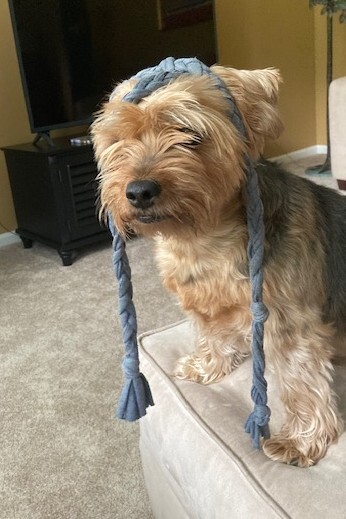
Yes, he really did walk around, sometimes, with his rope over his back or head. He would bring it to you like that when it was time to play. That was my Grumpy.
I delayed writing this for over a month. Losing my pal, Grumpy, pictured above, is one of the hardest times of grief I’ve been through, and I didn’t want to just bleed all over the page, so to speak. Now, a couple of months after we had to have him euthanized, I still miss him and think of him every day. My first thoughts were that he was the only creature in my life who loved me for just being me, which I have found is quite common among grieving dog owners. A dog’s devotion is unlike any other, for people have, by and large, not learned to love so simply. We tend to love our idea of a person, who we think they are, rather than who they really are simply as themselves. Grumpy, like all dogs devoted to the persons who care for them, had no expectations about who I am. Always glad to see me, always ready to walk, play, or nestle down beside my legs, Grumpy just wanted to be with me. He treated my wife the same way. We both feel the hole he has left in our lives and find it hard to do without the light of his presence.
Now, though, I am able to celebrate that light for its beauty, its impermanence, and the gift that it keeps giving me, even as I stumble through the darkness of his loss and hope begin to feel the gratitude for that little terrier, whose love language was always tugging on a rope and growling like a beast. He might have looked like a thirty-pound Yorky, but he thought of himself as a Mastiff in size. He was, we think, mostly Australian Silky. Really, he was just all heart, and Grumpy, who was almost seven when he came to live with us, brought play into our lives. A dog with opinions, I often thought of him, opinions about when it was time to eat and play and go for walks. He was no fawning lap dog, though. Mine was the only lap into which he would crawl, and then, instead of curling up to sleep, he would walk up my chest and lick my nose, standing there as though to get a better view of the room.
There was never much barking with Grumpy, though he was vocal, interacting with each of us through his small growls and barks. He listened closely when I spoke to him—which was all the time–and looked, with ears perked up, head tilted to one side or the other, as though he understood me—even though sometimes in disagreement. The quintessential terrier, he never gave up on me when my own foolish thoughts tried to force my mind elsewhere. He reminded me constantly that “now” is the only thing we have with one another. “Now” is all that ever have, especially to love or be loved—and to play tug.
Even though some disease had hold of him and began to sap the life out of him, Grumpy insisted on the “Now.” He could only tug and growl for short periods but was always willing to give it his best shot. A simple walk around the block became too much for him, though he would walk for miles and miles in his younger days. Even on the last night of his life, when he lay on the floor beside my bed and I stroked him to bring him comfort in his pain, he helped me know that the present moment is where life is, not in the past or the future, not in fears, regrets or expectations and vain hopes.
So, thank you, kind sir, for choosing me, even before I became your owner. Thanks for gift of your wonderful furry presence, your unconditional love, and teaching me that things in the “Now” that are the most precious can stay on. Someday, I believe, I will see you again, and I trust that we will be together in the “Now” that awaits us all. That alone is a gift worth celebrating, as I go from moment to moment seeking only to be present to the abiding love that surely brought us together.
M.J.
July 17, 2025
“One February Night.”
I learned a great deal in my few years in the Louisville Fire Department. One of the first and best and hardest lessons was that, unlike my father, I was not cut out to be a firefighter. I was shy, reticent, and mostly unconscious about what I wanted out of life. That’s quite common in young men of eighteen, I’m sure, but I was deeply unaware—of anything.
The realities of graduating from high school came as a bit of a shock to me. I mean, I’d seen it coming, looked forward to it, yet I had no idea what waited on the other side of that walk down the aisle. My dad told me that I should apply for the fire department, which I did as just the next thing to do, like going to another year in school. Possessing no idea of a career, no money for college, and no desire to join the military, for me, was a supremely stupid way to live, as a cold night in February, 1973 brought home to me in a unique way.
After excelling at Drill School, a sort of basic training camp for fledgling firefighters, I was assigned to Truck #3, a hook and ladder company. The old Seagrave aerial ladder truck was stationed then at Preston and Marret Streets in old Louisville. My father had been an “engine” man in all his on-company days. They bring water to put out fires. Trucks are about ladders, ventilation, and rescue. “Truck work?” my dad asked in a low voice. “That’s real dirty work, son, hard work.” Truck work includes cleaning up the burnt structure to ensure the fire did not start.
Men on Truck companies carried axes instead of hoses. We brought rescue and first aid equipment, and shovels, lots of shovels. I was intrigued by all the different ladders, especially those that allow you to scale the outside of a building. I never used one outside of drill school. I did, however, use shovels, big ones to scoop out water, smaller ones to scoop out debris—for hours and hours.
True, “Engine” men seem more like heroes, seeking out the fire to drown it. Then, for the most part, they roll up their hoses and head back to the firehouse to shower etc. They have to be ready if another fire starts. Its their job. “Truck” men shovel out, then wash out the remains of the burned structure. The best engine captains have at least their new boys help with the clean-up. Some are just out of there, ready to hit the next fire—or go back to the firehouse for coffee and leftover chili.
By February, 1973, I had seen enough of “truck work” to understand my father’s worries. Truck #3 in old Louisville fought more than its share of “working fires,” those that kept Truck men shoveling for hours. One particular day of cold drizzle, Truck #3 had gone on five runs with fires. Two of them were “working” fires, where fire gets into and destroys a structure. They had been old, Victorian era houses, each over two stories. We started soon after the eight o’clock morning roll call and shift change and did not finish until about nine that night.
After cleaning the truck and our equipment—and myself–I tried to watch some tv on the apparatus floor. My arms cramped so badly that they would draw up of their own accord, so I gave it up early and went upstairs to the icy bedroom of that hundred-year-old truck house. The frost froze on the inside of the windows. The cold breezed through from one end to the other, along with old ghosts, so I went to bed in my skivvies, socks, and an LFD sweatshirt. At my side were my “nighthawks,” insulated pants that were pushed down over a set of knee length boots. If a run came in, the knockout—a blaring claxon—would sound, and I was supposed to step into my boots, pull up the pants, and go. The wake-up alarm was called the “Knockout” for obvious reasons. It roared to sudden life as every light in the world came on. It was impossible to stay in bed when it sounded. That night, between 2 and 3 in the morning, the knockout got me out of bed, right enough, but—and here’s the bad part—did not wake me.
I had, from time to time, walked in my sleep as a child. One night, watching tv with my dad, I feel asleep with a pillow curled around my arm and tucked under my head. When he woke me to go to bed, I tried to stuff the pillow into the breadbox in the kitchen, much to my father’s amused astonishment. No, I do not remember why, but I feel as if this might have been taken into consideration before I joined the LFD. It was not, and the consequences ensued.
I rose from my cold bed, moving fast but still asleep, stepped around my nighthawks in my sock feet and headed for the nearest pole to slide to the apparatus floor below. I was first at the pole but could not pull the chain that opened the trap door around the pole. My hands weren’t working. I stood grabbing at it, missing every time. Somebody else pulled it for me, and I wrapped my arms around the cold brass and slid down, clutching the pole to my chest, still asleep. No, the friction of the brass pole on my naked legs did not wake me, nor did the drop to the pad at the bottom of the pole. And, though weaving on my feet, I reached the hook and ladder, shrugged into my fire coat, stepped into my regular boots which always stayed by the apparatus while I was on duty, stuck my black helmet on my head and stood in a daze, waiting to mount the jump seat. All the noises around me came from some distance—in the real world. I stood weaving in my place in dream land, incapable of understanding the odd sounds around me, especially the voices coming at me.
“What the hell is this?”
“Nice legs, sweetheart,” followed by a wolf whistle.
“Latest spring fashions in the LFD?” a clever one asked. I will spare the rest—for my own sake. Oh, sure. I can see the humor in it—now, but…
The next player in the drama I will mention by name: Michael J. Riley, my sergeant. At six feet six inches, two hundred and seventy odd pounds, he towered over all of us, though he took good care of me, always had my back. He liked me for some reason, although I would bungle his orders six times out of ten. I was hopeless as a firefighter, having inherited nothing of my father’s ability. But Mike Riley accepted me like a long-lost son, though I was a foot shorter, at least. He had seen me slide the pole without my nighthawks and had the presence of mind to scoop them up and come down the pole behind me. True, he was probably laughing at me, too. In truth, I sported a comical look: two thin, pale legs stuck into big black boots, showing beneath my wide black fire coat. Admittedly, I was worth a laugh, but no more so than Riley following me around, tapping my shoulder, trying to give me my nighthawks.
“Mark, son, you are gonna need these. Buddy?”
I remembered him saying it, and I remember thinking that all of this business had nothing to do with me. What I needed was sleep, and I was getting it, despite being out of bed with my eyes open, wandering around the hook and ladder.
By the grace of the Lord Almighty, Truck #3 did not go on that run. The Chemical Unit, housed beside Truck#3 and Engine #15, roared off into the cold night, the two men in its cab laughing and pointing at the ongoing pantomime of Riley following me with my nighthawks, trying with gentle taps on the shoulder to bring me back to full consciousness.
Yes, I remember every word I said, every step I took after watching the Chemical Unit roar away: “Leave me alone,” I said in sleep slurred tones. “I’m gonna go back to bed.” Still dressed in fire coat, helmet, and boots, I wobbled up the long metal stairs, Riley at my heels. And for the life of me, I could not understand what everyone was laughing about, though there were a dozen men chuckling like giddy children down on the apparatus floor. In the firehouse, men contrived all kinds of ways to deride one another with laughter. They were good at it. Some were mean, of course, but the men I left behind on the apparatus floor weren’t being mean, though. They were convulsed in deep, joyous laughter over something genuinely funny—which I just did not understand. Thankfully, I cannot remember their specific comments.
I got as far as my bed, took off my helmet and dropped it on the bed next to mine. My dad always claimed that a hat on a bed caused bad luck. Perhaps he learned it in the firehouse. I do remember Mike Riley’s booming voice of command ordering me back to the lights of the locker area outside the bedroom, which was dark and chill again. I desperately wanted to get back into bed, but I stumbled out to the locker room and mumbled, “What?—sir?”
Mike had a hundred pounds on me. His hands were immense. He gripped the front of my fire coat and lifted me off the floor, shaking me with each word: “You. Don’t. Have. On. Your. Pants!”
When he put me back on my feet, complete awareness hit me, ninety gallons a minute, like the blast of a charged inch and a half line. Nothing hit me but reality, waking up to what I had done and remembered in vivid detail. The reason for the laughter of the men down stairs was clear to me, as was every step I had taken, every move I had made from the second I left my bedside. Horrible clarity had me.
“Get your pants and shoes, please,” Mike said, in a softer voice, “and take your gear back downstairs to the hook and ladder. I’m going back to bed.”
He handed me my nighthawks, with me recalling how he had tried desperately to give them to me. Oh, how I wished that I could just stay in that locker room until role call the next morning. My thoughts ran riot about ways to avoid seeing any of those men again, yet there was no escape open to me. It was shame, silly, stupid shame that gripped me. I had no way to explain this away. It was time to face my fate. I crept back to the stairway door to see if anyone was still downstairs, though I knew that had to be the case. They had not come back to bed, so they must still be there, waiting. I cracked open the door—
And set loose a wave of laughter from the apparatus floor. It was pee-your-pants laughter, loud, joyous, roaring, so hard that men doubled over and had to sit on the floor. Twelve professional tough guys could not control themselves from just looking at the expression on my reddened face. That sound followed me, echoing around the cavernous walls as I took my helmet, coat, and boots back to place them at my spot on the jump seat. I said nothing. There was nothing to say in answer to their myriad questions. One by one, they got themselves off the floor and went back to bed, as I did, though it was some time before I was free from the chuckles that would erupt as they thought about my wounded expression when I looked out at them.
It would color the rest of my days as a fireman. I even told my girlfriend about it the next day, and she laughed. Naturally, I told my Dad, and he simply said, “Oh.” I tried to explain myself, but there was nothing for it but to own up to having looked foolish in front of the whole firehouse. They would never let me forget it. Dad, at least, told me tales of other firemen who had done it, which helped some. Several of those men had gone on to become really famous firefighters, leaders, captains, chiefs, even. I knew, though, that they were men with “firefighter” emblazoned on their souls. On my soul, in crayon, was the word “clown.”
Sigh.
I stayed on company for two more years and never got much better as a firefighter, even walked in my sleep again when I was supposed to be tillering—driving the back wheels of the hook and ladder. But that’s a story for another day. At least I can add this note to the event: as famous as he was, sliding the pole pant less was never something my farther managed to accomplish in his storied career. Luckily, I have learned to laugh at the event and even entertain people with its telling. They will chuckle and shake their heads, knowing that they are lucky to have escaped that fate. At least moments of chilling embarrassment like this one prepared me some for other gaffs I would make, though this one, was—is—a doozy. Stories for another day, I suppose.
May 4, 2025
Rest in Peace, Carlita C. Canfield.
Where did you go? You’re in the ground, now, I suppose, but it doesn’t feel real. How can you be dead? You were always so alive, so vital, like a flame, though you never burned me. I basked in your warmth, and I feel it still, though you are gone.
You didn’t want me to call you “mom,” or “mother.” You said, “Just call me Carlita,” and you gave me that smile and looked straight into my eyes. You always did. You married my Dad, and I was his son, and I guess that was always enough. Your openness shocked me, shook me up in my guarded place, showed me that there was something in your faith that gave you power to love, deliver care packages when I was hungry and alone, give me a place to which I could return.
And no matter how stupid or blind my actions, you were always there for me, especially when I was in the worst doubt of my life. We shared a faith, but you showed me how to make it work, depend on it, which you did time after time. Through your own losses, you showed me how tears heal us, an odd grace, leaking out from within. Just cry, make a cup of tea, and do what comes next. And what comes next is loving, God, self, others: then, trust that caring for another is the way through, the path of faith, the sodden steps we must take if we heal. Let it start.
My soon-to-wither flowers lay on that patch of dirt, made smooth and seeded. That will change, too, in time, with the small stone and your name and dates. It will be green and fresh, someday, like your faith, like your care for your broken step-son. I will love on in your memory, while you live on in mine and the lives of all you took under your wings. It’s not your loss I feel but the gain that I carry, having been loved in to your family. You always knew how to make family. It was a knack you had, always present, like the quick smile that was never far from your surprising face. If heaven is a reward, I cannot think how great yours will be. See you later, Carlita. Now, I must make my own cup of tea.
March 2, 2025
“Ray Grider’s Communion.”
M.J. Downing
Some time ago, now, Ray Grider sat at the front of his cardboard castle in the quiet alley behind the shoe repair shop, wondering of Mr. French, the owner, would bring him a meal tonight, not that he wanted one. His hunger faded after the diagnosis given him by young doctor, earlier that afternoon: “Tests you need cost lots,” the doc murmured, barely able to speak English, “and you have no money, no insurance. Tests only show, maybe, days, maybe hours you live. Sorry.”
Everything in him ached, but Ray had limped home, bereft of the desire for booze or some narcotic to take the pain away. They had taken his life, piece by piece already. He made it slowly back to his small pile, the plastic covered refrigerator carton. It sat atop two pallets, which Mr. French stuffed with straw—for insulation. With several dry, thick blankets, this was the most comfortable squat he could remember in his twenty years on the street. In the early spring warmth, Ray sat on his” porch,” the lip of the pallet, staring at nothing, thinking less, until a flash of light from above caught his attention. He saw that there were many flashes, tiny tongues of fire making an oddly bright net in the small square of sky he could see.
His narrow spot, though open to a clean alley way, was closed in by the back of Mr. French’s garage on his right and the auto parts warehouse building on his left. The view above him rendered his patch of sky darker, even during the day. Blinking, he studied the lights, which disappeared in seconds.
Ray gaped at the sky, wondering if the lights would return, wondering, too, if they were a sign of his approaching death. Hours, the doctor had said, and the idea calmed rather than startled him. It was not a bad thing, at all. He chuckled a little at his own fancy that those tiny flickers of flame knew he was there, saw him, that such a vision was a prelude to death. He blinked away a sudden, thankful tear.
A quiet movement near his feet made Ray look down, brush away a tear or two. There, before him, a small, pure white parcel lay, where none had been before. It had never been handled by soiled hands like his. As Ray stared, its folds opened by slow, graceful moves, like flower petals opening to the sun. Perhaps, he thought, someone had just wrapped it in a hurry and set it down. Ray saw, heard, no one, and the scent coming from the parcel made his mouth water. Ray wiped his grubby fingers on his shirt and leaned over to help the white wrapper unfold.
“Mr. French?” Ray called, folding the wrapper back to reveal one perfect fried chicken slider, with extra pickles, he was sure, “did you bring me this? Mr. French?”
His benefactor wasn’t there. Ray would have heard the gate behind him creak open, and no one had darkened the alley entrance to his spot. With the partially wrapped slider in his shaking hands, smelling like a little slice of heaven, Ray was startled by an even stranger thing: in front of him in the narrow opening onto the alley, a tongue of flame, perhaps half a foot high, hung in the air, as though watching him. Ray held his treasured slider in his hands and whispered “hello,” for the flame, despite its lack of a face, was looking at him.
It came nearer. Ray held out the opened package toward the flame and said, “if it’s yours, take it.” The flame flickered but made no noise. The small hovel grew darker in comparison to the brilliance before him, though the flame made no motion to take sandwich. Instead, speech echoed in Ray’s skull.
“It is for you, if you will help.” The voice, like a cunningly played violin or perhaps a flute, mimicked human speech.
“Help? Help who?” Ray whispered.
“Us. We are near.”
“You one of those lights in the sky, huh?” Ray ventured. The flame inclined its top portion to him, wavering. Ray took it for a ‘yes.’ “So, are you…some kind of …alien?”
The flame moved its top portion from side to side, back and forth, too. “Not…alien. We are not like you…we offer help,” it said, faltering over the words. Ray guessed that tongues of flame do not often converse with humans. More than anything, though, he wished to eat the slider in his hands. Its perfect aroma fueled his desire more than mere hunger.
“If this is your help,” he said, lifting the sandwich, “I am grateful.” He reached for it, but suddenly, it was not there. “Oh,” Ray ventured, “Is there a catch?”
“There is a question,” the flame replied.
“I get it right, do I get the sandwich?” Ray asked.
“Merely answering gives you the reward, which is greater than this food,” the flame said.
“What? Do I get fries with it, or, maybe a second sandwich?” Ray asked, his curiosity mounting with a newfound hunger. His reply appeared to confuse the flame, for, again, it swayed back and forth, side to side before saying,
“We seek no correct answer, only your answer. The food will offer…changes to anyone who consumes it. We require one of your kind to determine who will receive those changes.”
“So, I eat this, and I get taller, smarter? What? And why me? Why should I get to choose who gets this, this…sandwich?” Ray asked.
“The changes are many and will grow over time as the food enhances the life of the one who consumes it,” the flame replied, adding in slightly lower tones, like a sad violin, “You were chosen because you were the first to see my kind, and you fit the profile of the recipient we need: the changes will not extend your life, for you have entered into death, as it occurs for one of your kind.”
“I suspect a good many people,” Ray mumbled, “are dying right now.”
“They did not witness my kind and open themselves for contact,” the flame said. “They, like you, will experience the end of life soon. Many have done so as we speak.”
“But others who eat things like this, they will experience good things? Like what?”
“They will see, comprehend themselves differently, in new ways, know peace in their hearts, freedom from crippling fear. Harmful disease processes will be eliminated, and strength according to each one’s innate capabilities, will flow into them. Eventually, they will move as we do, from place to place through thought alone. Time and distance will no longer hamper them, though this will take generations,” the flame replied.
“Wow,” Ray said, and meant it.
“The changes will manifest slowly in some, quickly in others, according to their willingness to grow, evolve, in short, according to their imaginations and generosity. The changes will improve life for all, though not for you. Your death, however, will be peaceful, free of pain, and offer you a vision of what you have done for them.”
“And the question is…?” Ray asked.
“We observe that your kind place a great deal of importance on merit, on those who deserve reward. We do not trust our own capabilities to determine such merit. We have determined that one about to experience death can make the best decision. We observed it in the instant you saw us.”
The sandwich appeared again upon the pristine wrapper in Ray’s shaking hands. The smell rose to his nostrils, awakening his hunger, helping him understand that his last hours, minutes, maybe, were upon him. Still, he could not, now, eat the sandwich.
How to decide who should receive a miracle? He thought of those in power, those who ran the world, so to speak, the wealthy, the elite, the so-called beautiful people. For him, they had long lost any allure ever attached to them. Such were not worthy of such a gift. He thought of others in his situation, the homeless, the helpless, and considered them the neediest. But deserving? Ray shook his head. They were all just hurt, broken, like him, by the hard realities of the world, of living in society—or just below it. He thought, then, of those whose hearts were full of compassion for all, those who opposed violence and war, those who sought to help everyone, and found them even more deserving for simply believing. Some of them were church folk, many others just good souls, like Emil French, who gave him this safe place. Ray thought of such people as, truly, the salt of the earth. He could not count the number of people, the different occasions, when someone simply sought to help him, though he had never taken full advantage.
“Choose and eat,” the flame whispered. Ray shook his head, wishing to let the helpful flame know that he was not the one to make this choice, that there were many others, wiser, smarter, who should make the choice and get the greatest good out of this powerful gift. “Perhaps we have erred. Perhaps it is a question too large for the human mind,” the flame murmured.
Ray looked at it. It appeared to grow a little smaller, to darken a bit. In compassion for the fragile flame, a new thought occurred to him, one that arose first when the image of Emil French’s wrinkled visage came to him. He could do the best thing he could for people, who would never know that he had a hand in it. He would be gone.
“Can you give this gift to someone without them knowing that they have received it?” Ray asked.
“Yes. That is… in our power,” the flame said, wavering again, as though confused.
“Give it to everyone,” Ray said, “everyone alive now, even the dying, like me. Just don’t tell them. Let them all have it, every one of every station and ability, the just, the unjust, and the just plain folk. Let it be theirs because it was always so,” he finished with a smile. He picked up the sandwich and ate it, chewing it slowly, with relish, knowing that none of those who received this gift would track its origin to this hour, this day. And it was beyond delicious. Peace settled over him as the flame looked on and whispered,
“It is so.”
A warmth that had nothing to do with heat relaxed him. Pain drifted from him, and he saw that there would be trouble, as well as great peace, with this gift, that the powerful would misuse it–or try to. But this gift, as certain as the Gospel, would change everything. In his death, he found joy ungovernable that turned his last breath into quiet laughter.
January 13, 2025
Origin Story
M.J. Downing
Ed came in from work, grabbed a cup of coffee and the paper, and sagged down on the sofa. His small, brown-haired son played on the floor with quiet energy, doing something with his little trucks and cars, making them follow the circles in the rag rug. Ed patted him on the head before he balanced his coffee cup on the arm of the old sofa and opened up The Times to read what the idiots in DC were doing.
“Dad, watch this!” the boy called to him amidst his motor and tire screeching noises. “They need one of those metal things that keep them on the road, don’t they?”
“Um hmm. Sure do,” Ed murmured from behind the paper.
“What are those things called, Daddy?”
“Hmm? What things?” Ed replied, concentrating on some bleeding heart’s editorial on the need to help immigrants find a place in the economy. Ed hated that sort of thinking. He chewed over the old notion that no one ever helped him “enter the economy.” He was always in it, working, doing whatever he could to make a buck. Never help from anyone, not even now. Management was always laying people off. But you work because you want to eat. That simple.
“Those metal things that keep the cars and trucks on the roads, keep them from, you know, sliding off the road if they go too fast or, or, if the road’s slick with ice,” the boy asked from the other side of the rug.
The mention of roads made Ed think of the likelihood of his taxes going up when the city came out and put down new asphalt on his street. About damned time, too, though they would gouge him for the improvement.
“Huh, Dad?”
“Oh, uh, guardrails? That what you mean, son?” Ed asked behind the paper.
“Guardrails! Yeah! That’s it!” the boy cried. “I need me some guardrails! They’re made of steel, right Daddy?’
“Um,” Ed mumbled, lost to his son. The city, Ed read, wanted to set up shelters and kitchens for the homeless, as if the bums would appreciate it. Ed knew that no one values the things they are given for free. He’d seen the garbage the homeless leave behind when they pushed on to wherever they go. Blankets, coats to keep them warm, food given to them–good meals, too, not cheap crap—turned into so much garbage, which people like him had to clean up. Keep the city from becoming a pigsty, and here the city council and the mayor want to make it worse.
Ed’s eyes drifted over the page in front of him. He flipped from one page to the other, dimly aware that the boy had left the room, making no more sound that a soft breeze. Ed flicked the paper aside and glanced down at the trucks on the rug highway. They had spilled off the far edge. The boy had placed toy soldiers around the wreck, little green emergency workers—with automatic weapons and pistols raised, pointing at the tumbled truck. He grunted at the mess the toys made.
“Maybe that’s what we need, more armed response,” Ed mumbled before he turned to the sports section. Its pages were full of overpaid athletes giving excuses for their poor performances. In every article, there was mention of the sport star’s salary, many times the amount that Ed brought home every week. Just for playing a game!
Through his resentment and the paper’s thin veil, Ed saw the boy’s shadow pass in front of him. There was a clink of metal as the boy said, watch this, Dad! I’m making guardrails! Look, Daddy.”
“Um hmm,” Ed replied as he always did, concentrating on the crucial things in life. He sniffed because the acrid scent of raw, cold metal came to him, an odd, out of place smell. Still, it wasn’t strong. “Just be sure to get all that stuff picked up before supper, okay?”
“Yes, sir,” the boy said softly. “I won’t make guardrails for the whole thing, just this turn, where the road is, ugh, more dangerous,” the boy said, grunting a little. Ed heard the subtle screech of metal. It was an alarming sound, like something expensive getting broken, and Ed dropped the paper. He glanced at his son and drew in a sharp breath.
The boy had pieces of iron rebar in his small hands, bending them, twisting them together, making them match the outer contours of the rag rug. Ed had to stare again at his son’s actions. The boy was careful about his work, making it look as though the rug road had always had guardrails. He had two done and was bending the rebar in his tiny bare hands for the third and final one.
“Son?” Ed said, shock making his mind numb.
“They were extra, weren’t they, these metal things, from when you poured the new sidewalk, out back? I thought, since they were left over, I could just use them. Don’t worry, Daddy. I’ll put them back if you want me to.”
In a hushed voice, Ed said, “B, but you can’t do that. It’s…impossible.”
The boy hung his head, dropping his gray-eyed glance to the floor. “I’m sorry, Daddy. I, I won’t do it no more.”
December 28, 2023
“White Lights.”
M.J. Downing
It might have been on the fifteenth of December this year, or maybe the year before—or a hundred years before. Edward McKinney, in his heavy Irish sweater and flat cap against the chill, leaned toward his computer screen in the darkest corner of a coffee shop on Eastern Parkway. Lean and angular of feature, Edward struggled with a chapter revision of his latest novel, one he hoped might just, maybe, hopefully, please God let it, sell. The low buzz of conversations around him mixed with the easy holiday jazz of the coffee shop, and he searched in vain for a credible sentence to answer his beta reader’s comment in the midst of Chapter Six, “Is this passage relevant to your narrative demands?” His tired brain wondered, “What was a narrative demand when it is at home?”
He tried a couple of sentences in a row, thinking that maybe one would work, when a light, youthful voice at his side, interrupted his efforts:
“Those lights bug me; I don’t like them.”
Edward, who might still be called middle aged, gave a swift glance to a young woman who stood near him, staring hard at the artificial Christmas tree in the corner before him. It had, perhaps, one strand of tiny white lights wrapped in haphazard fashion around its bottle-brush branches. It bore evidence of being decorated in a hurry by four baristas, who each put on one ornament, an after-thought tree, in Edward’s opinion.
“I’m sorry, um, miss,” Edward said, turning back to his screen, “I’m very busy, and I don’t think I understood you.” That was a lie. He had heard her say the lights bugged her, but he also made it a practice to avoid talking to young women in public places. Idle chat with a young woman for a man of his years was creepy. He barely spoke to the girls who sold him coffee, though he came in often enough to be on a first name basis with two of the male baristas.
She stood there, hands on hips, studying the tree with squinted eyes that looked through a screen of bright red hair that swept across her pale forehead. Otherwise, her thick red mop came just to her shoulders. She was slender, clad in camo pants, ancient denim jacket, judging by its frayed cuffs and collar, and canvas shoes, “Chucks,” they were called in Edward’s youth. Her turned-up nose gave her an impish look, completed by the heart faced shaped he turned to him, freckled on cheeks and nose.
“White lights. Just white lights on the tree,” she said, demanding his censure by gesturing to the tree, as though it was an offense against nature. “Where are the red, green, yellow, and blue lights? The blues are my favorite, you know.”
Edward shook his head. He didn’t know, didn’t care to know.
“Um, yeah. Well, Merry Christmas anyway,” he offered, starting to type a sentence for which he had no ending, hoping she would take the hint and go away. She didn’t. This was a drawback about working in public places: local “characters” would sometimes decide to visit. This young woman scooted out the chair opposite him, removed his backpack, and slung it to the floor at his feet. She turned the chair to face the rest of the room. She didn’t exactly sit down, then. She perched, with her heels on the edge of the chair and turned an indignant gaze to him over her knees, which she hugged to her chest. Slender, pale arms sticking out of her sleeves showed her tattoos: holly leaves twined about her arms, red berries almost glowing beside the dark green. He thought but did not say aloud, “Faerie,” for which he chided himself as foolish.
“What do you need, huh? A coffee? Something to eat? I’ll be glad to get you something,” Edward said, sounding as indignant as she looked. Often a coffee and a scone would get rid of a pesky visitor. “It isn’t that I don’t like you. It’s just that I’ve got to get this finished, you see—”
“Got one, don’t I?” she said, reaching toward the floor to her left and bringing up a cup to eye level. She pulled off its top, letting steam escape. Edward wondered how he had missed seeing her with it. A shiver ran down his spine, and he thought that eldritch term again.
“Then what do you want, er, miss?” Edward asked.
“I will give you my name, if you give me yours.”
“Very well. I will be pleased to meet you, and I am sorry that my wife is not here, as I’m sure she would be delighted to meet you, too,” Edward replied, not liking the marital implications of giving her his name. One must take care with the fair folk.
“My name’s Drifa,” she said, “And I see you are a cautious man. Good. I do not suffer fools well.” She took a big gulp of steaming drink. Edward winced, thinking that coffee that hot would scald her tongue. “And, I suppose that what I want most are blue lights,” she said. Startled, Edward saw the white lights go blue. “Well, maybe with some green,” she added, as every other light went green.
“How’d you—?” Edward mumbled, then dismissed the fantasy that a faerie sat opposite him. There was a trick to it. Had to be. Just because he had not noticed it before did not mean that the lights were not on a timer and built to turn colors. He’d seen such things on artificial Christmas trees available at craft or home stores. There was an explanation, and as he looked back at the elfin face opposite him, she said, “But what is Christmas without red to go with the green?”
The lights changed again, and Edward’s resolve to dismiss the fantastic idea she was fae began to crumble, though he said, “Your timing is excellent, er, Drifa. What do they do next, flash on and off?”
“Would you like them to?” Drifa inquired, arching her right, slightly pointed eyebrow. The short mane of red hair covered her ears, which Edward imagined as slightly pointed. He decided to play along, see where this conversation went.
“My name, then, is Edward—”
“McKinney,” she finished for him.
“Yes, very well, then. How about only half of the lights, say on the left side of the tree?” Edward said, beginning to grin. If it was a con, it was a good one, though it startled him when the lights on that tree began to behave in strange ways, left half dark, then right, then the bottom, then the top, each time as Drifa pointed one thin finger at the tree. Of the ten or so people sitting at the tables near him or on the other side of the room, none of them noticed. In his dark, chilly corner, Edward sat with a person who was either the greatest con artist he’d ever seen, or she was a magical being, who could pour boiling hot coffee down her throat and manipulate her environment. He wondered if he said “faerie” outright, she would disappear in a flash or turn dangerous. As a writer of fantasy books, he knew a great deal about the fae, who love games, and detest lies though they are not above telling them, as long as they are not direct answers to questions. Still, there might have been some means of knowing things about him. Technological chicanery could manipulate the lights, which would mean she worked a con. He decided that the best course, with faeries or con artists is to remain silent, when possible, be attentive.
She took off her jacket, revealing more twined holly leaf tattoos running up her arms and disappearing under the sleeve of a faded red “Hawkwind” t-shirt that clung to her slender frame. She acted as though she did not feel the cold of that corner that chilled Edward’s fingers. Leaning toward him a bit, she said, “So, you know or are guessing what I am, and the fact that I gave you my name suggests that I mean you no harm,” she said, keen green eyes pinning him down. Edward thought, “If she is a faerie, I’d better treat her like one.”
On a sudden thought, Edward said, “Would you like to sweeten your coffee or tea with some honey?”
Her green eyes lit with sudden desire, and she gave him an abrupt nod. Edward rose and crossed the room to fetch some honey from the cream and sugar counter. When he looked back at her, he saw a woman to match his age, sitting demurely opposite his computer, reading a local newspaper. The impossible was happening. When he sat down again, elfin Drifa appeared again. He had read about faerie glamour, but he had never seen it before. No one had, outside of old stories told around blazing hearths in small cottages and inns, before the modern age, before technology, before the Age of Reason, which, in this situation, appeared to be an error in thinking.
With honey in hand, the viscous gold pouring into her drink without let, Drifa’s hungry eyes on the sweet stream, Edward decided to say something safe as he offered her a wooden stir stick. With half of the bottle of honey in her steaming cup, she lifted it to him in a toast and drank deep, eventually setting the empty cup aside, and licking the sweet remains off her lips, eyes closed in pleasure.
“I thank you for your visit, Drifa, and wonder about its purpose:” a safe enough response without demanding anything.
Fine lines appeared around her eyes as her eldritch face transformed with a smile. It was as though she became a human woman, indeed beautiful, with dazzling green eyes that could beguile a head strong human male. Faerie glamour, Edward knew, was designed to give humans what they want. He did not respond in kind with his own smile beyond a slight grin and a nod of his head, as though to say, ‘I see what you’re doing, and you’re doing it well.’
“Maybe I just wanted honey and needed someone to give it, rather than stealing it,” she said still smiling though without as much power in it. Edward saw that Drifa was okay with him seeing her as she was. He nodded, knowing not to question her about it. He could pay the baristas for the honey.
“Or maybe it was to offer you a gift. It is almost Christmas, is it not?” Drifa asked, her eyes widening.
“I think you probably know that better than anyone, and as to gifts, I need nothing,” he said, which wasn’t quite true. He realized his lie as soon as he said it, wishing that he could take it back and offer her a different response. That was the sticking point about this creature sitting across from him. She discerned his lie, even one meant to lend its speaker a better intention. He wanted a book to sell. He desired readers to talk to, converse with about the stories he wrote. A thing that he liked better than anything else was to learn what his story became in the minds of others, to share the twists and turns of his own thoughts and spirit and see the shapes that his tale took in theirs. However, were that done through a faerie’s power, it would never be truly human, never genuine, and would disappear with the return of the sun. What good would it be to have each reader charmed after the read, only to have that charm fade with the turning of the sun and moon? Some famous books he’d read, which got good reviews and sharked up a myriad of fans, were not memorable long after they were read. Yes, such immediate fame could vault his name in sales list, but would it be genuine?
Drifa grew calm and looked at him, her green eyes intent. She pushed her bangs aside revealing the alabaster forehead. “I know what you desire, and your books, which mention…important friends of mine…could be given a chance to reach miiiillliiiooons,” she declared in hushed tones, using her hands to expand the promise, as though creating a world.
“If they do so, Drifa, they must do so through efforts that are mine alone—with, of course, the help of my dear beta readers, whose comments force me back into the crucible of my imagination, my plain, broken, flawed human imagination, to seek the words and phrases to make a story really live, one reader at a time.”
“Yet, what if such a desire can be granted here at Christmas time? What if I can take just what you have there,” she said, tapping the top of his computer, “and have you send it to whoever you want and have it picked up, today, a contract in hand by tomorrow with a handsome advance?”
“No, dear child, especially not at Christmas. You ought to know that,” Edward replied with a sad smile and a shake of his head.
“But you’ve done me a kindness, you’ve spoken to me with respect, and you know who, what I am. How do you know that I have not done this for other writers, famous ones? Can you not see that this is a gift most precious?” she asked, leaning forward, so her green eyes peered at him above the screen, compelling eyes, alluring, filled with promise.
“Your name, Drifa. Can you tell me what it means without giving away its power?” he asked. She sat back, wary eyes on him, eyes, boardering on dangerous.
“It is a name of snowfall,” she whispered, “for I am as old as the first snows, yet I feel pity for those who suffer from it, and, in my own way, I seek to do them good. I am most active this time of the rolling year.” Her voice was guarded, simple, like that of a girl whose age she showed him in the form and manner in which she appeared, a child visiting her struggling father.
“Then you know that I must risk the life of each story, for each story lives through risk, like Christmas does, the day when we celebrate the great risk taken for us by the sending of the One, the redeemer, in the form of a helpless babe: the one who makes all things new. If I were to take your promise of easy profit, I would never be able to celebrate Christmas again.”
Drifa, ancient faerie of snow, locked eyes with him, a gaze which Edward dared not break, for her sake as well as his. At length, her gaze softened. She nodded, put on her light denim jacket and walked out of the coffee shop. Just before she walked away, she turned to Edward, smiled, and lifted her arms to the sky. She gave him a gift as sweet as honey. And though the temperature was just above freezing, Edward watched her standing in new snow that fell in downy flakes, shimmering on her outstretched hands and fiery red hair. She wore snow like a crown. Edward, like all the other people in the shop, stared out of the windows, watching the covering of white build up on the outside tables, the railings around them, on their cars, the grass and trees and on their delight for this Christmas season. Drifa looked at Edward and mouthed the word, “Grace.” He nodded, smiled, and she vanished in a sudden squall of powdery flakes. The lights on the tree went back to white, like the purity of the snow that covered everything, unaccountably, like Drifa’s last word to him.
Edward went back to his computer, looked at the comments of his beta readers again and struggled to find a credible sentence in time for Christmas.
The End.
June 13, 2023
Killer Collaboration: Jay Bonansinga and Stan Lee!
As those who follow my Instagram account know, I’m a fan of Jay Bonansinga. His images sizzle and pop on the page; his story lines demand I go on reading. The immediate connection he builds between a reader and his characters drives us forward, page after page. Don’t read him at bedtime!
In Stan Lee’s The Devil’s Quintet: The Armageddon Code, readers get more of Bonansinga’s driven prose around superhero characters of the like not seen before. This collaboration, like a Marvel movie that we cast in our heads as we leap from page to page, brings these two brilliant artists, Stan Lee and Jay Bonansinga, together for the first of what I hope are many more books.
See, the thing that grabs us, I think, about a superhero, isn’t just the power he or she has but the manner in which it arrives and the cost it exacts on the individual. Here, this team of elite Spec Ops warriors, nick-names Hack, Ticker, Pin-up, and Boo, under the tight leadership of Spur, are thrust into powers they do not seek, to which they must adjust in a hurry or be wiped out by the very source of evil that empowers the human foes they oppose. It isn’t enough that they face thechallenges and grave costs of combat and counterinsurgency; the powers, two edge swords, that have come to them could cost them their souls. No matter a superhero’s power, what saves or destroys him or her is the ability to make the next right choice. As elite operatives, their lives are already on the razor’s edge of split decision moments that could cost them everything. Their new powers could claim their souls.
Of all the things I like about this book, though, I think my favorite thing, played out more in the many characters interactions, is the sense that it isn’t solely their action that saves them but something about their individual commitment to fight evil. There, we see aspects of ourselves making the best of situations that demand our action and test our values. A superhero, after all, is only as compelling as his/her mission, the forces that oppose him/ her. Lee and Bonansinga take us deep into the costs of the superhero’s commitment to the mission that drives them and let’s us think, in our own small ways, about our need to be true to our missions. I invite you to read this book as well as Book Two in the Series, The Shadow Society, and talk to me about it.
by M.J. Downing
May 26, 2023
“The Man Who Hated Lovecraft.”
M.J. Downing
“But, surely, to make such a statement, you’d need to read the entire Lovecraft canon, Jared, which you haven’t,” Peter Hundt said as he and Jared Barlow walked through the crisp, wintery sunshine of early November, making their way back to their adjacent offices in the Humanities building.
“I’ve read all I need to,” Jared replied with enough volume to make an echo between the college buildings. His booming voice carried the same acidic edge to it as when he found an article that agreed with his negative opinion of Poe’s poetry and demanded that Peter read it. “And as one who teaches creative writing, I’ll not taint my mind—or my students’ minds, God help them–with Lovecraft’s appeal to the weak minded. That’s why I say that I hate Lovecraft. His constant pandering to the so-called dark aspects of human nature simply underscores a self-defeating attitude. And his woeful prose, Hundt? All that lurid detail, his lack of specificity, the telling rather than the showing? Mood without meaning, I tell you!” Students pointed at them, giggling, as Jared Barlow’s opinion thrust itself onto the world.
“Perhaps, Barlow,” Peter said in more reserved tones, reverting to his friend’s last name as he often did to show the man when he ventured too far, “but does your opinion need to be asserted over a student so forcefully? I just watched as that lad you lectured on the sins of Lovecraft lost enthusiasm for the work you assigned him. How is he supposed—”
“I saved him the trouble of finding that there is no decent research, no critical opinion or detailed analysis done on Lovecraft’s work, beyond the merely encyclopedic—”
“—supposed to develop a critical mindset of the fiction he loves?” Peter finished with force of his own. It stopped Barlow’s rant, though just for a few strides. As they neared the Humanities Building, an assembly of young women stood before the door, and Jared Barlow found his voice again:
“I simply will not stand by and see my student waste his time. Whose job is it, if not ours, to direct these poor, misguided students,” here, he waived in grand fashion to the listening co-eds, “into better, more worthwhile things? Besides, it makes a paper a tautological nightmare: ‘H.P. Lovecraft’s exciting descriptions makes his work classic horror.’ It turns what could be at least basic analysis into a recitation of lurid passages. God! I hope never to read such a thing again!” The young men shook their heads and walked away. The young women beamed at Barlow, who winked back at them.
“Guiding would be one thing,” Peter said as they entered the hum of the central Humanities offices. They stopped, each, at the door of his office. “Simply bulldozing that boy’s perspective does more harm than good, Barlow, regardless of his interests. Surely, we must guide as we allow room for growth? Why not simply suggest to him better writers, Bloch or Derleth, say? Readers must start somewhere. After all, by your own admission, you started with Kenneth Robeson and Robert Howard as a young reader, and you say that you can no longer stand to read either of them now.”
“True, Peter,” Jared replied, his hand on his office door, ready to shut out Peter Hundt’s opinion, “but those men I read, as flawed as their prose might be, both eschewed the weak-minded protagonist. Their characters, often rudely drawn, true, forged ahead, adapted to, thought and fought their ways through all obstacles with the strength of their minds as well as their fists or weapons. Lovecraft simply panders to the weak-willed fascination with hidden knowledge, the lure of occult fixes to human problems, Hundt. Lovecraft’s people delight in their own destruction. They are too ready to believe the fantasy that if something is hidden in the dark, it is worth more than what is presented, clearly, in the light. Puerility, Professor Hundt, is counterproductive to the development of the critical mind.”
Though his door did not slam in Peter Hundt’s face, it did close with a very final thud, signaling the end of the un-asked for lesson. Hundt sighed and dropped his head, partly in relief. These talks with Jared Barlow tired him, partly because he did not share Barlow’s sense of certainty about his own critical methods. Besides, Jared Barlow was something of a local star. Peter Hundt offered no creative writing courses, despite having studied in the same school, same degree program as Barlow. The latter did publish a poetry chapbook that won some award or other, so the creative writing courses went to him. Hundt taught only composition classes, and he cared, perhaps, too much for his students. They were, after all, so young and inexperienced, with a lifetime ahead of them, to work with the tools he sought to give them.
Hundt entered his own office, where, of course, a pile of papers awaited his attention. He set down to work, leaving his door open to the noise of the outer office, to the coming and going of students. Peter reflected for a short time on Barlow’s tendency to cleave to a single idea at the cost of all others. When Jared Barlow considered himself right, then all other positions were wrong. He had the force of personality, too, to carry off most debates.
With pencil in hand, Peter started to work on the essays, reading through each and detailing his first response on the final page, before he went back through and started his comments. Grading was an exhausting necessity, which Peter often tried to finish in his office or in a neighborhood coffee shop before he went home to his wife and children, his main priorities. With another hour or so until lunch, Peter sat and graded, listening to music on his office computer, having brief chats with other faculty and students who stopped by his door. They all could see him at work, so none of them stayed long.
Usually, when noon came, Jared would lean on Peter’s door frame and ask if he was ready to go to the cafeteria. Peter knew that they would not talk of their morning disagreement; whatever insult, threat, or condescension he’d uttered earlier would be forgotten, which was okay. There were movies, books, music—a world of entertaining things to chat about over a sandwich before their afternoon classes. Barlow, despite his stiff neck, was a good colleague, one who took his work seriously, a credit to his division. Had he not volunteered to rewrite all the English and Humanities course descriptions for the following semester catalogue and asked Hundt to proof and revise his copy where needed? Barlow was just…Barlow, a man always ready with an opinion that at least sounded well thought out.
Then, after lunch, he and Barlow would take seats on a courtyard bench, where Peter would finish his morning pipe and Jared several cigarettes. Those were good for Barlow’s humor would take center stage. Students, male and female, would stop, too, listen to Barlow’s jokes, especially his flirtatious ones, and none of the young ladies took him seriously. Peter, the inveterate lifter to Barlow’s distance runner, was dutifully married and would always call Barlow, a single man, back from the precipitate edge of humor, when he took things too far with the girls.
As Peter worked, the outer office got quiet for a time as students and faculty wandered off to their 10:40 classes, while dark clouds rolled in over the small community college campus. Peter, at home with his grading, lost track of the wind beginning to rattle his office window, whistling around its frame. Lost in his work and Mahler’s Fifth symphony, that majestic soundscape, Professor Hundt grew tranquil, even with a pile of essays on his legs, his feet propped up on the edge of his computer table. He lost his sense of time until the rattling of the wind stopped. He looked up, startled, by a dark shape that appeared suddenly in his doorway.
“Er, yes. May I help you?” he asked the figure who stood in the shadows of the darker outer suite and his well-lit office. His first impression was that she was clothed in black, from head to foot, in a flowing robe, a silent houri, who materialized out of nothing, for a strange woman stood there, sans books, backpack, and the other assorted accoutrements of the commuter students he served. With a blink of his eyes after his startled first look, Peter saw that it was her hair, not a cloak, which framed her pale, heart-shaped face, and flowed down over her shoulders to her waist. She was actually clad in a black t-shirt, black jeans, and black canvas shoes. Her attire accentuated her alluring shape, which was difficult to not notice, though Peter had long schooled himself on looking into a student’s eyes. A faded design, like vague tentacle shapes adorned her shirt front, but he dared not look closer to determine what it was. Besides, students wore the most incomprehensible t-shirts.
She stood with her pale hands clasped together below her waist. They held a single rectangle of paper, most likely a drop slip, Peter thought. It was late in the term for dropping a class, yet Peter often signed them upon request. Barlow would not, insisting that “An F is a better lesson than a Withdrawal on their transcript. More honest, all around.”
“Professor Barlow?” the strange woman asked. Her voice was low, though not loud at all, yet it filled Hundt’s office with a kind of power that made him listen, as though the very room was intended for its sound. Not to be outdone by feminine charms, Peter thought that English was not her first language. Her face, as she took a step closer, had an exotic, almond-eyed, high cheek boned look. Perhaps eastern European, Peter thought. He had several current students who came from Russia, Serbia, and the Czech Republic. Barlow often spoke of the beauty and allure of such female students and was rumored to date older students from time to time. This woman would fit Barlow’s usual type: not at all old, she was definitely mature.
Peter frowned. She didn’t know him from Barlow. She was looking for a man she had not met. An odd thought occurred to him: had the wind brought her?
“Ah, no ma’am,” Peter replied, shaking his head to dispel the stupid question. “He is in his office, I think, just to your left, there. I have not heard him for a while, though. Been workin’ you know?” Peter said, lifting his pen and an essay he marked to show that he was occupied. She stared at him and stepped into his office, which Peter did not expect.
“You are hard on them, yes?” the woman asked, nodding toward the papers and giving him a cautious smile, which he could see better when she brushed her hair away with a languid, long-fingered hand.
“Me? Hard on my students? Well, no, I don’t think so… I suppose some of them might say so…” Peter replied. “I use a pencil for my comments, see, so that I do not ‘bleed’ all over their papers.” She took yet another step into his office, close enough for her compelling scent to envelop him. Her eyes, which he could see clearly, then, appeared to be black like her hair, all pupil, though certainly, he told himself that they were just very dark brown. He wanted to tell her that she was standing close enough, but he thought that such a comment might be rude. Different cultures have different standards of acceptable personal distance.
“Do they do what you tell them?” she asked, her ‘vhat’ for ‘what’ and the ‘zem’ for ‘them’ suggesting to him that he was right about her East European origins. She came a step closer, close enough to touch, which made the pencil shake in his hand. Her beauty was undeniable, though something about her caused him discomfort, as though a swift static charge ran over his skin.
“They do what they can to…ah…address the assignments I give them,” he answered, gripping the pencil harder. He pushed his chair back an inch or two. Her smile widened. Bright, white teeth bit her lower lip. She cocked her head to her right, making the fall of her silken hair shimmer.
“What if I told you I could give you the power to…help them see that you are right and that they should do as you say?”
“Oh, well, Ms…?” Peter waited for her to give her a name. Her right hand moved toward him, as though she would touch his shoulder. He saw that what was in her other hand was not drop slip. The paper was older, yellowed, as though torn from a piece of parchment. He could not tell what words the handwritten letters made, though he thought he saw the ‘http’ of a web site address. She moved her hand so slowly, that Peter began to feel the sweat bead on his brow as it came nearer. Her heady scent made him dizzy enough that he had to look away and collect his thoughts before he pushed his chair back a little more and finished his reply: “You see, it isn’t that they need to do what I think is right, but that they use the…um…tools I try and…teach them…to do what they can.”
Her head cocking to the left, then, she took a step back, at his reply, and her right hand dropped back to grasp the piece of paper she bore. She smiled, still, and the intensity of her gaze deepened, as though to look deeper within him. Peter’s curiosity about the note grew markedly, and he had the strongest desire to do anything he could to have her stay in his office, despite his nervous discomfort. Her scent alone was…no. Peter could not indulge such a thought. He forced himself to think of his wife.
“You are good man,” she said in a whisper, like a sigh. “Barlow, he is in his office?” she asked.
“I… think so,” Peter replied around a gulp, as he mastered his sudden response to her. “If not, you can leave your note for him in his mailbox opposite the reception desk, or you could leave it with…me.” To know her name was his sudden desire, though he shook that thought out of his head and whispered, “his mailbox is…better.”
“I will check,” she said, turning from him abruptly. His desk phone rang, its jarring notes making him nearly drop the essays on his lap. Fumbling for the receiver, he brought it to his ear, hearing the soft knock on Barlow’s door and a muted, unintelligible reply from within. The Dean was on the other end of the phone line, asking him again if he could do her a favor with a difficult student. Barlow’s door opened and closed again. The Dean had to explain herself several times before Peter could understand what she was asking. At last, he said, “Well, okay, sure. Send him over with the necessary paperwork, and I’ll see to it.”
Hanging up the phone and putting his work aside, Peter rose on suddenly shaking legs and stepped out into the office suite. Barlow’s door was still closed. The woman was nowhere to be seen. He turned to the student assistant at the reception desk and asked,
“Margy, did you see the woman who was just here, looking for Barlow?”
“No sir,” came her curt reply, “Just walked into an empty office, until you stepped out.” Peter rapped lightly on Barlow’s door. From within, Barlow’s computer keys tapped hurriedly. “What is it?” came his quick reply. There came a low laugh, which Peter could have sworn came from the woman.
“We, uh, are we going to the cafeteria?” Peter asked.
“No. I’m busy.” The low laugh came again, followed by Barlow’s “shushing” hiss.
“Did your student find you just now?”
“Go. Away.”
Taking up his jacket, Peter closed his office and left the suite. The wind picked up again, blowing in his face from the east. As he walked to the cafeteria, that colder wind whipped down the main sidewalk of the campus, blowing at the already chilled students, who never dressed for the coming cold. Spotty, fat rain drops splattered on the sidewalk. They fell in odd patterns, making strange patterns appear before him. Those shapes hurt his eyes, but they ran and joined together in shapes, like many tentacles reaching towards him. He splashed through them as the clouds thickened over his head, joined by the steady timpani sounds of thunder all around him. Before he could reach the cafeteria, students were stopping on the cold, wet walkway to point and exclaim at something behind him. When he turned to see, Peter Hundt gasped, for it looked as though the heaviest clouds boiled above the Humanities building, joined together by bright, flickering threads of lightning. The flash-boom of the lighting striking down hit him like a weight on his chest. Insane thought as it was, Peter knew where the thunderbolt had fallen and by whom it was brought. Without checking his irrational impulse, Peter ran through the now driving rain back to his building. The lights in other buildings, Administration, Business, even Social Sciences, went out at the same instant as a long ululating cry, sounded with the thunder. Not a woman’s scream, but the wailing of a man from whom was exacted the last possible motes of pure terror. It stopped Peter in his tracks. It was as though the voice shouted something like a name, sounding like “Shoggoth!!!” in a long breaking wail that was hurled to the broken skies Students, staff, faculty bolted yelling, terrified, from the Humanities building, out into the driving rain, as though they, too, had lost their reason, dashing headlong away, only away.
Peter forced himself to run past them, into the darkened interior of the office suite which he had called his, just moments before. It would never wholly be so again. He knew exactly where to look. The door to Barlow’s office was opened just a sliver, a darker place in the new darkness that took away the midday.
“Jared, Jared! Are you—!”
Jared Barlow, the man who hated Lovecraft, still sat before his computer screen, his hands in a rictus of agony splayed above the keys, fingers broken, misshapen as though through their own energies. Jared Barlow’s eyes were gone, leaving only smoking orbits, and his teeth were clenched so hard behind lips bared in agony that they were broken in his mouth. A single stream of slow drool ran Barlow’s chin, onto his shirt and tie. The woman was not there, though Peter was sure he heard a lingering echo of her low laugh.
Hands over his mouth to keep his own screams in check, Peter Hundt backed out of Barlow’s office, sinking to his haunches in the dark of the outer office. Later, when the EMTs found him, Peter looked up at them as though looking on a human for the first time. They moved to lift him in a chair. He pulled away from them and hunkered back down on the floor where he held his head in his hands. One of them, a dark-haired woman, squatted down in front of Peter, her long hair falling around her face. Peter jumped back and cried out at the sight of her, though he saw it wasn’t the woman who promised things.
“Sir? Professor? Who are you? Will you let me examine you?”
“Me? I’m…of course. It wouldn’t be an object, not a glowing jewel or ceremonial artefact, would it?” he asked in a strained voice. “Now, they come through the internet!” He leapt from his seated position and ran into his own office to dash to the floor with wild energy, the force of madness itself, his computer monitor computer tower. They shattered, sending bits of plastic and broken hardware across the floor. The EMT screamed and ran out of the suite. Peter reached several more computer stations, smashing them to the floor, before security men were able to stop him. All the while, he shouted, “Lovecraft knew! They can reach us all, anywhere! Save yourselves!”
Later, Margy, the student assistant, found the slip of old parchment on Barlow’s floor, “http” the only legible letters left on the now burnt note. The power was back on, and Barlow’s body was taken away. Peter Hundt would never returned, Margy thought. She had always thought that English professors were crazy, ready to crack under the strain of their own weirdness. Now she had proof. She tossed the piece of parchment into the trash bin and locked Barlow’s door. The piece of parchment writhed, like short tentacles. Internet access came back first.
The End.