
Fiona Wood's Blog
March 31, 2019
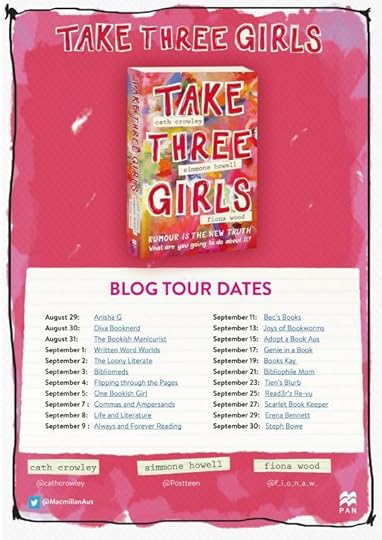
Take Three Girls Events

When St Hilda’s establishes a Year 10 Wellness Program in response to the rise of cyber–bullying, three girls are thrown together and an unlikely friendship is sparked. One thing they have in common: each is targeted by Psst, a site devoted to gossip and slander that must have a source within St Hilda’s.
The Take Three Girls Program:
Booked Out is offering the rare chance for your students to work with three of Australia’s most accomplished YA writers in a program that combines creative writing and collaboration with conversations around identity, respect and resilience.
This critically acclaimed novel is a springboard for opening up vital classroom discussion on the issues young people navigate growing up, with panel discussions and workshops designed to take your students’ insights to the next level. Along with detailed teaching notes and lesson plans supplied by the publisher, this program can form the basis of a term’s work on both writing and student wellbeing.
Best suited to students in Years 8-10.
TESTIMONIALS
“Take Three Girls is raw and deeply authentic tale which expertly prompts students to think about the destructive nature of gossip, the damage of sexist behaviour and language, the struggle to find your identity and power of unexpected friendships.”
—Rebecca Sparrow, bestselling author, columnist and speaker
“It was very empowering for our students to see the dynamics of such a passionate team of writers. Their combined insights surrounding the issues portrayed in the novel (so relevant to our students) was powerful and contagious.”
—F. Longfield & C. Hainstock, Fintona Girls’ School Senior Library


September 10, 2017
February 24, 2014
A cover from another mother
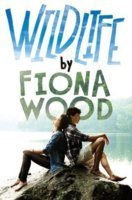
2014 is such an exciting year for Wildlife – it’s out in Germany in April, and in the US in September. And here are the covers.
March 18, 2013
settings
Reynje at Wordchasing has dreamed up a lovely series, A YA Guide to Melbourne exploring novel settings. She correctly identifies Fitzroy as my setting for Six Impossible Things, but it’s an imaginary not-quite-Fitzroy. I refer to places like Gertrude Street, and the Edinburgh Gardens, but whereas for example the real Fitzroy Secondary College is glam, new, architect-designed, I wanted Dan’s fictional school to be good and grotty, a strong contrast to his old private school, helping to make a point about the important things in life being friends, family and community – not money.
Of course money is important if you can’t afford food and shelter, but if those two areas are sorted, money (stuff) is never what makes you happy. So Dan goes from a cashed-up lifestyle and into straitened circumstances, from a flash school to a run-down school. But it’s in his new life that he finds friends, self-reliance, and happiness.
One of the early inspirations for this story was the image of two terrace houses, side by side, identical from the outside, but completely different inside. One renovated, one run-down. One family with money, one with no money, and the fact that to the kids that doesn’t matter in the slightest. These are Dan’s and Estelle’s houses. And their interconnecting attic is where Dan finds Estelle’s diaries.
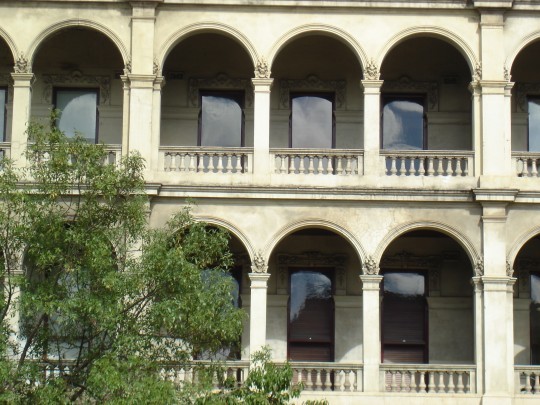
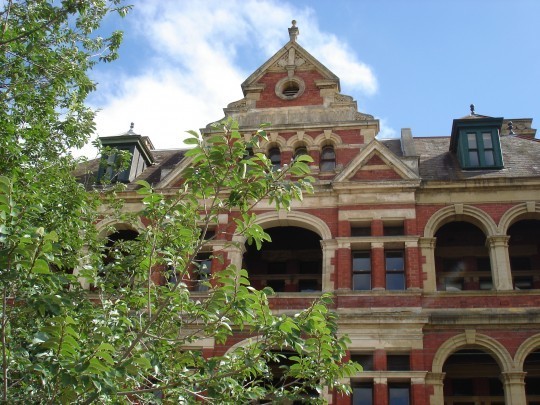
Dan’s house is imaginary – it only exists in my head and on the page, but these Melbourne terraces, one in Carlton and one in East Melbourne were vague inspirations.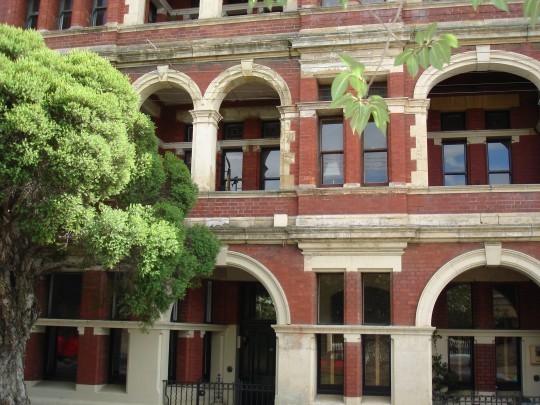
Random fact: When I remember dreams, they always involve exploring very detailed interiors.
Small setting cheat in Six Impossible Things: When Dan doesn’t quite kiss Estelle they are in the cactus glasshouse at the Botanic Gardens. These days, all the spikes are behind glass. A few years ago they were free range, and that’s the way I needed them:
“…I’m somehow leaning against a large spiky beast that’s hooked into my jumper.
‘Ouch.’
‘It’s trying to eat you. Even though you’re quite obviously not an insect,’ says Estelle, attempting to unhook me…”
For me, setting helps to convey theme. And it’s fun to write – you’re free to combine bits and pieces from real life and make up anything you like until you have a collage that fits with the world in your mind. I’m looking forward to following Reynje’s series…
January 3, 2013
the next big thing meme
Simmone Howell tagged me, and I’m tagging Melina Marchetta, Vikki Wakefield, Emily Gale and Penni Russon..but ONLY if you have time, feel like it, the time is right to talk, etc, etc.
Okay.
1. What is the working title of your next book?
Wildlife. This post talks about the working titles it has had along the way.
2. Where did the idea for the book come from?
Romanticism – love/death/nature/primacy of emotion/intuition/feelings, Iago, my lack of affinity with the great outdoors, jealousy, betrayal, mean-girl-friends, the specious charm of celebrity…
3. What genre does your book fall under?
Contemporary YA.
4. What actors would you choose to play the part of your characters in a movie?
I’d rather let readers create their own pictures of the characters. But I do have some actors I’d cast in a dream world.
5. What is the one-sentence synopsis of your book?
A story about first love and friendship at sixteen, fitting in, and staying true to yourself.
6. Will your book be self-published or represented by an agency?
Wildlife will be published by Pan Macmillan in Australia, June 2013, and is represented by Cheryl Pientka at Jill Grinberg Literary in the US.
7. How long did it take you to write the first draft of the manuscript?
Not quite sure. About a year, I guess. But there was a lot of faffing around to decide on the right form.
8. What other books would you compare this story to within your genre?
It links to my own book, Six Impossible Things, in the character of Lou, now 16, who is a minor character in SIT and one of two point-of-view characters in Wildlife. But it’s not a sequel.
9. Who or what inspired you to write this book?
This is answered in part in Q.2, but the setting, which is a wilderness boarding school, was inspired by stories people (including my husband) told me about their experiences in these sorts of schools.
10. What else about the book might pique the reader’s interest?
Sibylla is trying to understand her first romantic/sexual attachment; Lou is dealing with grief. They have a mutual friend, Michael, who is Sibylla’s oldest friend and Lou’s newest friend.
And if you want to read about the next big thing from Lili Wilkinson, Kate Constable and Will Kostakis they have responded to Simmone’s tag. (Sorry I’m late.)
October 1, 2012
Stonnington’s ‘[Untitled] Literary Festival’
Come along to a panel discussion on ‘Inspired Writing’ with Lisa Hill, Toni Jordan, Meme McDonald, Helen Brown and me on Saturday 17 November. Look at the whole program here for session times and booking information.
July 1, 2012
coming up with a title
*
My new book, ‘Wildlife’, will be out next year.
It is the second in an extremely loosely linked trilogy.
Lou, from ‘Six Impossible Things’ is one of two point-of-view characters in ‘Wildlife’, and the other, the protagonist, is a new character, Sibylla.
During its gestation ‘Wildlife’ has had a few working titles, and here’s why they didn’t last the distance.
1. Pulchritude
This was my original title idea, and the scene in which that word appears is still in the book. For: it delivers an appealing dislocation of meaning and form. It means beauty, and yet it sounds more like the noise you might make when you vomit. Beauty itself being an undoubted mixed blessing is one of the things the story looks at. Against: no one can pronounce it, and no one knows what it means – brilliant idea if you want to make buying the book, or borrowing it from a library, or even remembering the title as difficult as humanly possible.
2. Kisschasey
Before it was a band and a wine label, this was a game of playground tiggy in which the kiss was punitive. The kissed party became ‘it’: they lost. This suited the ambiguity of the main love story within the narrative. It’s a first love for Sibylla, an experience she finds wonderful, completely confusing, and by no means a simple happily-ever-after. So, the title relates well to the narrative, and it’s catchy. But I could not imagine a fourteen-year-old boy choosing it from a shelf. Overall, it felt a bit young, a bit ‘bubblegum’/cute, for a story that includes content about sex and desire.
3. The Fairweather Term
This was the shortest-lived working title. It split the field – classical/simple vs boring/ho-hum. The idea with this one was that the school campus is at a place called Mt. Fairweather, and the students are there for a term of the school year – uh-huh – but it also calls to mind the ‘term’ ‘fairweather friend’, which has resonance within the story, so it would have been a double entendre, geddit?
4. Wildlife
My friend Debi suggested this one, and I think it’s a stayer. It is a story about first love, and friendship, and it’s set in an outdoor education campus in the mountains. ‘Wildlife’, with its simple connotation of creatures living according to instinct within a habitat felt perfectly suited to this group of characters dealing with life away from the support structure of family. I look at jealousy and betrayal in this story, too, and have a (female) character very loosely based on Iago, from Othello, so the outdoor education camp can also be read as a ‘Cyprus’ vs the relative civilization of the city campus, ‘Venice’; it’s a place with fewer rules and greater extremes. Wild.
My first blog post here was about why I chose ‘Six Impossible Things’ as a title.
It’s possible I spend a bit too much time obsessing over things like this.
My third book, set back at the same school’s city campus at the beginning of year 11, has a working title which I won’t divulge too early, as I did with Pulchritude-Kisschasey-The Fairweather Term-Wildlife.
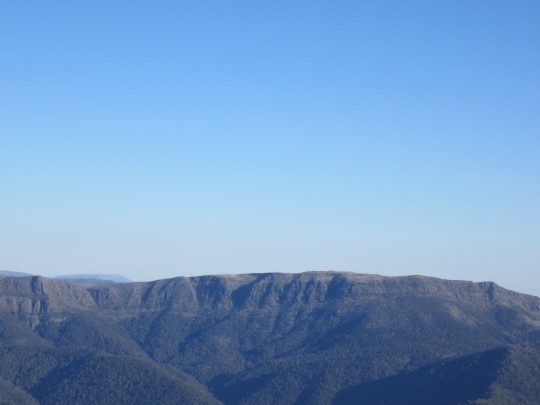
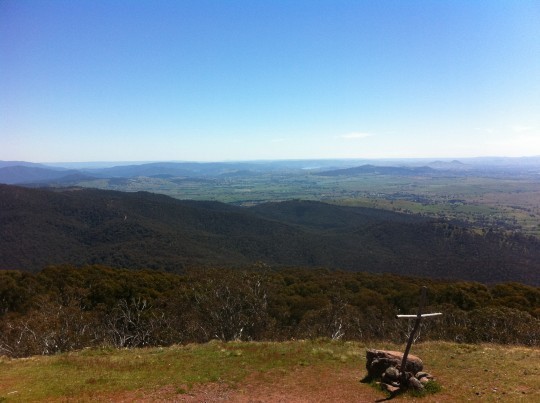
* I took this photo on Mt Timbertop. That’s right – my commitment to research knows no bounds. I put on the walking boots. I huffed. I puffed. etc. Great view.
May 6, 2012
reading about food
I love reading about food. I often pick up Jane Grigson or Elizabeth David and open at random for a comfort (re)read. I take cook books to bed with me. Last weekend I read ‘Love & Hunger, Thoughts on the gift of food’, by Charlotte Wood. As the title suggests, this is not simply a book of good recipes, although it contains plenty of those. It is an exploration of the psychological and philosophical layers of meaning that are folded into our relationship with food and cooking. So, it’s also a book about love, friendship, family, sickness, and death.
This book is full of practical hints and tips on everything from pantry staples, to why temperature is important when making pastry, to wrangling a perfectly cooked roast chicken. It’s a book for any skill level – from supercooks to beginners, and it’s a wonderful read, as visitors to Charlotte’s blog How to Shuck an Oyster would expect.
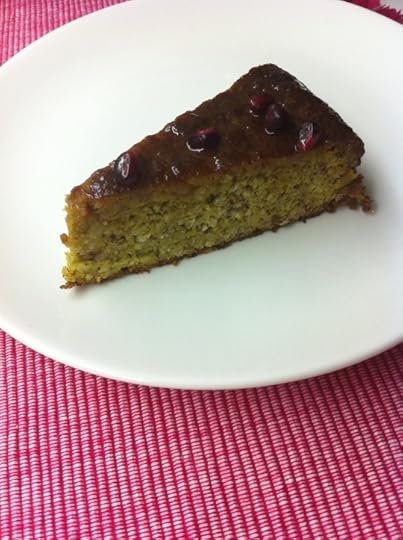
After howling with laughter at the stories of horrible Home Ec food, and plain old howling, remembering cooking for a friend during her chemotherapy treatment, I went back to page 81 – just the recipe I needed for the too-many mandarins sitting on my bench. This Whole Orange Cake is a classic; delicious, and not the slightest bit temperamental.
2 whole oranges (I used 5 mandarins)
250g castor sugar
6 eggs, beaten
250g almond meal
One and a half teaspoons baking powder (I used 1 teaspoon bicarb – for a gluten-intolerant family member)
I won’t reproduce the method word for word, but it’s very easy.
Put the whole oranges (or tangellos, or mandarins) into a saucepan of cold water, bring to the boil, simmer for 2 hours, large fruit, or 1 hour mandarins)
Drain, cool, cut in quarters, remove pips.
Preheat oven to 180.
Process fruit till smooth.
Add sugar, almond meal, baking powder, process to combine.
Add mixture to beaten eggs, stir well to combine.
Pour batter into a buttered, lined cake tin.
Bake for approx one hour, till skewer inserted comes out clean.
May need to cover loosely with foil after half an hour if browning too quickly.
Cool in tin before turning out.
I used a 27cm tin, the recipe calls for 24cm, which will give you a deeper cake.
(Charlotte uses a cooler oven, 150 degrees (aha! – and so probably doesn’t need to cover her cake w foil))
I made a quick syrup with mandarin juice, brown sugar, mandarin segments, teaspoon rose water, two teaspoons orange blossom water, and scattered some pomegranate seeds on the cake.
Can’t wait to try the pomegranate honey, p30.
And I have never brined a chicken before, but intend to try that soon, too.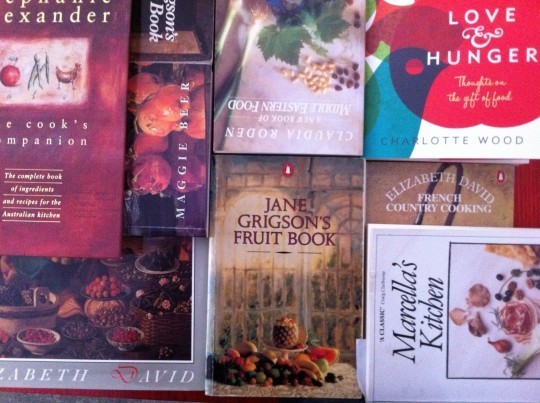
March 9, 2012
madeleines
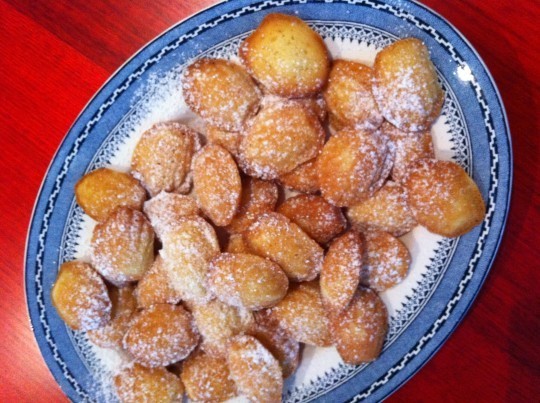
I made these madeleines for reading group recently; they are easy peasy. You do need a madeleine mould, though. I got an uncoated one, because it delivers a tiny bit more capacity and sharper detail in the moulding shape.
Despite a huge number of cook books in the house, a few of them specifically French, I could not find a madeleine recipe – very disconcerting – so I trawled the net and put together this one after reading about a dozen. It worked well.
It is such a pleasure when the form of food is not only pretty but functional – like a spiral pasta shape that invites sauce to cling to it. In this case the scallop-shell madeleine shape delivers fine crispy edges and a plump, buttery centre. Delicious.
Ingredients
100g plain flour + extra for dusting
three quarters of a teaspoon baking powder
100g castor sugar
2 eggs
1 teaspoon vanilla extract
1 teaspoon very finely chopped lemon or orange zest
125 grams unsalted butter, melted, cooled + extra for buttering tin
1 – 2 tablespoon icing sugar
Method
Sift flour, baking powder with pinch salt.
Beat sugar and eggs till thick and fluffy.
Gently fold in the flour, vanilla and zest.
Gently fold in the melted, cooled butter.
Cover with gladwrap and chill mixture for 30 minutes.
Heat oven to 200/C fan forced.
Butter well and lightly flour the madeleine tin.
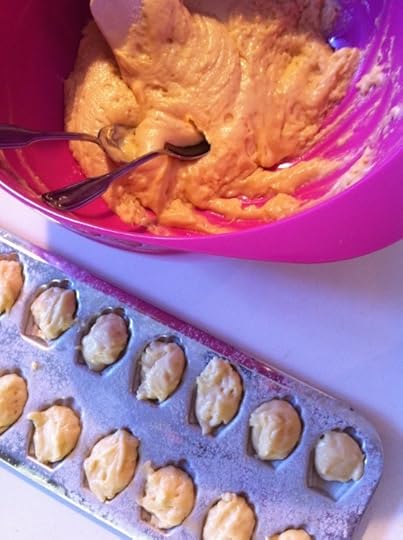
Spoon mixture into mould (small tin: approx one heaped teaspoon per madeleine.)
Bake for 6 – 7 minutes, until golden, and springy to touch.
Tap tin firmly to loosen; tip onto cake rack.
Dust with sifted icing sugar and serve warm.
The chilling step is important: the mixture thickens and aerates during this time.
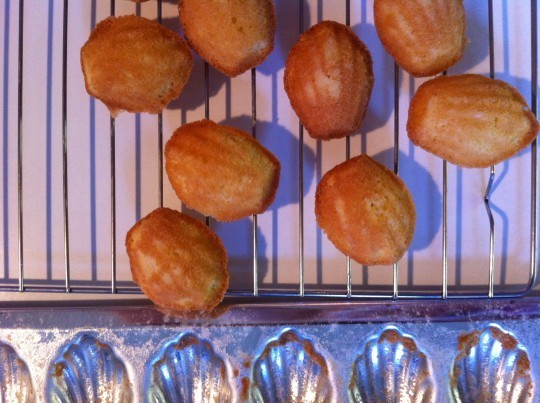
The occasion for making madeleines was a long-delayed discussion of our reading, and rereading, the first volume of Proust. It was so interesting to read a different translation this time around. Twenty odd years ago I read the C.K. Scott Moncrief translation revised by Terence Kilmartin (Remembrance of Things Past), this time the recent translation by Lydia Davis (The Way by Swann's).
Here, from the first translation, a little of the famous 'petites madeleines' dipped in lime-blossom tea passage:
'No sooner had the warm liquid mixed with the crumbs touched my palate than a shudder ran through me and I stopped, intent upon the extraordinary thing that was happening to me. An exquisite pleasure had invaded my senses, something isolated, detached, with no suggestion of its origin.'
And from Lydia Davis's:
'But at the very instant when the mouthful of tea mixed with cake-crumbs touched my palate, I quivered, attentive to the extraordinary thing that was happening in me. A delicious pleasure had invaded me, isolated me, without my having any notion as to its cause.'
Such different interpretations – in the first passage, the isolation relates to the nature of the pleasure itself; in the second, the pleasure isolates the 'I' narrator. What a daunting number of choices must be made on every single page. I preferred the more recent translation, and its editor's and Lydia Davis's introductions provide a fascinating discussion of translation in general, and her approach to Proust's language compared to that of Moncrieff in the earlier translation.
February 8, 2012
Why I don’t rank fellow-writers out of five
Since I’ve had one book published, and have another in train, the idea of sitting in judgement and ‘scoring’ a fellow-writer’s work makes me queasy.
It’s got nothing to do with being annoyed by the limitation of five-star ratings: they are, perforce, reductive, but we’re all accustomed to living in a cultural space that spits out these summary assessments of theatre, films, music, books, aren’t we? Apparently we might not be able to attend for more than a nanosecond. Grab that rating and run.
I read widely, I have my own taste, I’ve got a decent critical platform on which to base my opinions. I’ve served as a judge for the AWGIES, the writers’ guild awards, a couple of times. I’ve been in a reading group for twenty years, at which we have full and very frank discussion about everything we read. So it has nothing to do with having a critical by-pass.
It has everything to do with knowing how hard it is to write a book. Each person who manages to get a book published deserves a hug and a cup of tea and possibly a garland of some sort. It is heroic and painful and difficult and often under-appreciated or taken for granted, a bit in the manner of childbirth. And it’s definitely under-remunerated. In other words, it is hard enough, so to write about the limitations or the less-than-five-star-ness of a fellow-writer’s work in a public forum is something I just do not want to do. Whereas I do occasionally blog book love. So I’m guilty of inconsistent practice; I’m happy to sing praises, but don’t want to dis. With no logical reason really other than some sort of raw, amplified empathy.
Overall, I think a forum like Goodreads is a wonderful idea – a big public conversation about books and reading. What’s not to like? But it still gives me such a WTF smack in the forehead – sit down, strong beverage, shoulder massage, palm frond creating calming breeze – when I go onto Goodreads and see people throwing Lolita, A Visit from the Goon Squad or Pride and Prejudice three stars. Or fewer. Be still, my horrified heart. I do realise there are people in the world who don’t like the same books I do, but to see them out there in their zillions does my head in some days.
The idea of people rating my work is one of the things that didn’t even occur to me before my book was published. Coming across a dud rating is depressing, but I’ve found that if you avert your eyes really quickly, it’s sometimes possible to pretend you didn’t see it. The same strategy can work during scary movies. On the other hand, I love it when people give ‘Six Impossible Things’ a five-star rating. I will nevereverever get sick of finding out that it really hit the spot with an individual reader.
But I won’t be rating other writers out of five. Not while we’re out there in the arena together and they’ve just released the lions.
Fiona Wood's Blog

- Fiona Wood's profile
- 173 followers

