David A. Wimsett's Blog
November 10, 2025
Do you feel imposter syndrome?
Some people express the feeling they're not really writers and are just faking it. They fear readers won't like what they write. If they receive recognition, they may think they don’t deserve it. This can cause anxiety and rob you of any pleasure or feeling of accompaniment.
Here is the truth.
If you've completed a manuscript, whether it's been published or not, you’re not an imposter. Your a writer because you've done what writers do and achieved something many others never have or never will. Bask in that accomplishment.
If you've received a rejections from literary agents, editors or publishers, you're not an imposter. Rejection is a way of life for authors. Some best selling books have had over 100 rejections before they were published by someone. Agent and publishers carry their own prejudices and tastes. A rejection is about the work, not you as a person.
If some people criticize your story, you're not an imposter. Don’t worry about how people receive your work. There will be those who love it and those who condemn it. Write for yourself. The only obligation you have is to be honest and respect the people and places you write about, even yourself.
I've received 1 star reviews with nasty comments and 5 star reviews exalting my work. The best feeling is to have someone at a personal appearance say they enjoyed one of my books. Even if that was the only person who did, it was all worth while because we made contact through the book. If you have faith in yourself and your book, you'll have no regrets.
The surest way not to have your book published and read is to give.
Here is the truth.
If you've completed a manuscript, whether it's been published or not, you’re not an imposter. Your a writer because you've done what writers do and achieved something many others never have or never will. Bask in that accomplishment.
If you've received a rejections from literary agents, editors or publishers, you're not an imposter. Rejection is a way of life for authors. Some best selling books have had over 100 rejections before they were published by someone. Agent and publishers carry their own prejudices and tastes. A rejection is about the work, not you as a person.
If some people criticize your story, you're not an imposter. Don’t worry about how people receive your work. There will be those who love it and those who condemn it. Write for yourself. The only obligation you have is to be honest and respect the people and places you write about, even yourself.
I've received 1 star reviews with nasty comments and 5 star reviews exalting my work. The best feeling is to have someone at a personal appearance say they enjoyed one of my books. Even if that was the only person who did, it was all worth while because we made contact through the book. If you have faith in yourself and your book, you'll have no regrets.
The surest way not to have your book published and read is to give.


September 21, 2025
Book Fair in Mahone Bay
Come join me at the Fantastic Grown-Up Book Fair in Mahone Bay, Nova Scotia on Saturday, October 11, 2025. I'll there with my fantasy, science fiction, historical fiction, women's fiction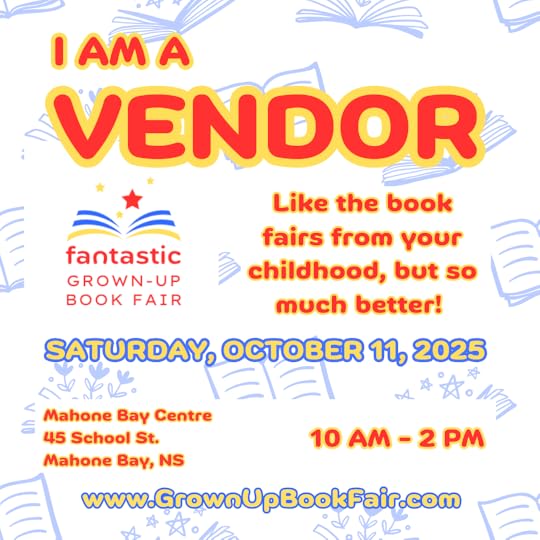 and children's picture books. I hope to see you.
and children's picture books. I hope to see you.
September 6, 2025
The Value of Failure
We’re often pushed to achieve perfection. Mistakes are taken by some as a sign of laziness or incompetence. Phrases like failure is not an option can set unrealistic burdens on people and lead to stress, which can result in more failure.
In truth, failure is a great teaching tool. Without the permission to fail, we become complacent and stagnant. This can cause us to repeat the same actions over and over in the fear we’ll overreach and be ruined.
No one is born knowing everything. We have to practice. This is a large part of childhood, testing ourselves and our abilities to understand how to live in the world.
In writing, we often yearn for praise. Criticism stings. Yet, it is in experimenting, failing and trying again that we expand our reach. Because our nature is to seek acceptance in the group, we can berate ourselves for not writing the perfect line of dialogue, struggling to give a character an emotional reaction or not finishing the word count we set for ourselves.
Yet, with each failure, we learn what doesn’t work and are free to experiment and find what does. If you fail, be kind to yourself and look for ways to improve.
In truth, failure is a great teaching tool. Without the permission to fail, we become complacent and stagnant. This can cause us to repeat the same actions over and over in the fear we’ll overreach and be ruined.
No one is born knowing everything. We have to practice. This is a large part of childhood, testing ourselves and our abilities to understand how to live in the world.
In writing, we often yearn for praise. Criticism stings. Yet, it is in experimenting, failing and trying again that we expand our reach. Because our nature is to seek acceptance in the group, we can berate ourselves for not writing the perfect line of dialogue, struggling to give a character an emotional reaction or not finishing the word count we set for ourselves.
Yet, with each failure, we learn what doesn’t work and are free to experiment and find what does. If you fail, be kind to yourself and look for ways to improve.
August 25, 2025
Pick a Writing Group Carefully
The process of writing is a solitary one. When I’m writing, all my attention is on the work. In a novel, that means keeping a multitude of threads in my mind to know what came before, how a character acts, what forces push from the outside and so on. I see the world I’m creating in my mind, but that vision doesn’t always come out on the page. Things that seem obvious to me may be confusing to others. Joining a writing group can help you see your material through different eyes.
In my short story “The Hell of It”, published in my anthology Unexpected Consequences, I had a clear theme in mind. When people in my writing group read it, they thought the theme was something else. I had to look at the story and find ways to make my vision clear. Without the members of the writing group, I’d never have known this.
As helpful as writing groups are, you must be careful in choosing one.
A writing group where everyone heaps praise on every work may satisfy you’re ego, but it won’t help you become a better writer. If the group just validates everything, you won’t know what needs to be changed. Find a group of writers who offer solid critiques. Don’t look for approval. Seek comments that help you improve
Yet, avoid groups where members are toxic and make comments to enlarge their own egos or act aggressively.
When giving a critique, only talk about the work, never the writer. Don’t try to psychoanalyze others or tell writers they aren’t qualified to speak on a subject.
Writers can fall into a trap where they begin to think they have to imitate the views of a fellow member or an instructor. Take all criticism in and consider if it can help, but don’t let it overshadow your own vision and voice. At the same time, if a piece of writing confuses too many, examine how you can make your story clearer.
Keep in mind, people in a writing group are trying to help make your story better. We all want to be accepted and praised, but don’t argue about or defend a point. Answer any questions asked. Still, the only thing you should say at the end of a critique is, “Thank you.”
In my short story “The Hell of It”, published in my anthology Unexpected Consequences, I had a clear theme in mind. When people in my writing group read it, they thought the theme was something else. I had to look at the story and find ways to make my vision clear. Without the members of the writing group, I’d never have known this.
As helpful as writing groups are, you must be careful in choosing one.
A writing group where everyone heaps praise on every work may satisfy you’re ego, but it won’t help you become a better writer. If the group just validates everything, you won’t know what needs to be changed. Find a group of writers who offer solid critiques. Don’t look for approval. Seek comments that help you improve
Yet, avoid groups where members are toxic and make comments to enlarge their own egos or act aggressively.
When giving a critique, only talk about the work, never the writer. Don’t try to psychoanalyze others or tell writers they aren’t qualified to speak on a subject.
Writers can fall into a trap where they begin to think they have to imitate the views of a fellow member or an instructor. Take all criticism in and consider if it can help, but don’t let it overshadow your own vision and voice. At the same time, if a piece of writing confuses too many, examine how you can make your story clearer.
Keep in mind, people in a writing group are trying to help make your story better. We all want to be accepted and praised, but don’t argue about or defend a point. Answer any questions asked. Still, the only thing you should say at the end of a critique is, “Thank you.”
June 22, 2025
The Right Word
Mark Twain wrote, “The difference between the right word and the almost right word is the difference between lightning and a lightning bug.”
Finding the exact word to describe something, add tension, express joy or communicate sadness can take effort. If you write, “He walked down the stairs”, it conveys a very different image from, “He flew down the stairs.”
The right word can eliminate the need for adverbs, which can make a sentence passive. “He quickly ate the pie,” could be better written as “He devoured the pie.” One word conveys the sense of haste and possession.
You can develop a command of vocabulary by reading. Still, there are times when the exact word eludes us. Then, a thesaurus becomes our friend.
A thesaurus is a collection of related words and phrases, each with subtle differences. You can find on-line thesauruses that give a few dozen examples. More complete guides with greater choices can be found in books, such as Roget’s International Thesaurus. This suggests hundreds of choices to express precisely what you intend.
Finding the exact word to describe something, add tension, express joy or communicate sadness can take effort. If you write, “He walked down the stairs”, it conveys a very different image from, “He flew down the stairs.”
The right word can eliminate the need for adverbs, which can make a sentence passive. “He quickly ate the pie,” could be better written as “He devoured the pie.” One word conveys the sense of haste and possession.
You can develop a command of vocabulary by reading. Still, there are times when the exact word eludes us. Then, a thesaurus becomes our friend.
A thesaurus is a collection of related words and phrases, each with subtle differences. You can find on-line thesauruses that give a few dozen examples. More complete guides with greater choices can be found in books, such as Roget’s International Thesaurus. This suggests hundreds of choices to express precisely what you intend.
June 12, 2025
Make Each Word Count
Every word in a sentence needs to be important, otherwise it has no place. This requires word crafting. This is a process that starts with the first draft and is thoughtfully combed through in subsequent drafts.
Think of the pictures and emotions words convey to readers. Look for action verbs to emphasize the feat.
You could write, “Firefighters ran quickly into the burning building to rescue the child.”
Though this sentence gives a sense of urgency, it’s generic. People run in races and “run to the store” for bread. The adverb quickly could paint different pictures to different readers.
To give a sense of firefighters risking life and limb to save someone, we can look for words that match urgency, danger and dedication. “Desperation consumed the firefighters as they fought through the inferno in hope the the child was still alive.”
Here, the word desperation shows their emotional states. The word consumed serves two purposes. It give the sense of the intensity of the emotion and hints at the flames that could consume them and the child. They don’t just run through the flames, they fight their way through. We again get an emotional reaction in the word hope. Both the danger and the possible failure of their mission is emphasized with the words still alive.
When a sentence conveys more than one thing, a deeper picture is painted and readers become more involved in the story and the lives of the characters.
Think of the pictures and emotions words convey to readers. Look for action verbs to emphasize the feat.
You could write, “Firefighters ran quickly into the burning building to rescue the child.”
Though this sentence gives a sense of urgency, it’s generic. People run in races and “run to the store” for bread. The adverb quickly could paint different pictures to different readers.
To give a sense of firefighters risking life and limb to save someone, we can look for words that match urgency, danger and dedication. “Desperation consumed the firefighters as they fought through the inferno in hope the the child was still alive.”
Here, the word desperation shows their emotional states. The word consumed serves two purposes. It give the sense of the intensity of the emotion and hints at the flames that could consume them and the child. They don’t just run through the flames, they fight their way through. We again get an emotional reaction in the word hope. Both the danger and the possible failure of their mission is emphasized with the words still alive.
When a sentence conveys more than one thing, a deeper picture is painted and readers become more involved in the story and the lives of the characters.
June 8, 2025
Writing a Crowd Scene
 Styled image of people gathered togetherScenes can concentrate on a few or even a single character. They can also contain large groups of characters, such as at a sports stadium or in a battle. In both cases, the story has to present people and not just the crowd to engage readers.
In describing a political convention, there will be speeches, cheers and chants. If you only concentrate on these, readers will see an overview but not have a character to anchor their attention to. Imagine the following scene at a political rally.
The delegates waved signs reading “Derrick” and “Bring it On” amidst a low rumble of voices. Smiles and laughter flowed in waves across the convention floor.
Jane’s eyes never strayed from the podium as she squeezed Fred’s hand. “He’ll announce funding for River Park. I just know it.”
A roar of voices blasted from the walls to drown out the band on stage as Governor Derrick stepped up to the podium accompanied by his wife and son. He fired his words in short blasts, emphasizing each with a fist smashed into his palm. “My friends, we will win this election.”
People in the crowd shouted in unison. “Four more years. Four more years.”
Derrick raised his hand for silence. “And when we do, there will be era of prosperity as never seen before. A new factory will rise on that vacant land next to the river to brings jobs and wealth.”
The political signs were thrust into the air as people erupted in applause.
Jane stood in shock. Images of the old oaks being ripped out of the ground engulfed her mind. This couldn’t be happening. He’d sworn the park would be built. She was too shocked to cry, yet her whole body shook.
Like the zoom lens of a camera, we start with an overview on the setting and the introduction of Derrick, but we don’t go into his point-of-view. This is at the grand level with no sense of individual wants and needs.
Then, we zoom in on Jane’s personal point-of-view.
The scene zooms back to Derrik’s announcement and the crowd’s large scale reaction. They’re all of a single mind with no individuality.
The zoom lens returns to Jane to see her shock and disappointment through both her actions and her inner thoughts.
I used this technique with battle scenes in The Carandir Sage where readers see the massing of troops, focus on a skirmish, then go into the point-of-view of a single soldier’s actions, determination and fears.
April 21, 2025
Creating Suspense
 Some writers try to create suspense by concealing information with the idea readers will be surprised when a character discovers something or an action takes place.
Cliffhanger endings are effective, but keeping details from readers and audiences doesn’t create suspense. It creates frustration. Suspense comes from revealing information a little at a time.
In a script I recently read in my TV writing class, a spec pilot opens with the discovery of a murder. The victim is not revealed.
The script then goes back a week in time and introduces several characters in conflict. Some of them we root for and others we despise.
The pilot ends where the police arrive at the dead body from the opening. The victim is still not revealed.
This writer thought viewers would be intrigued to tune in the next week and discover who was killed. Instead, they created frustration. By hiding the identity of the victim, audiences have no investment in the character. If they knew who was killed, they could feel an emotional connection and care about the deceased.
Consider a scene from a movie where a cloaked figure enters an office from a balcony, places something in a desk drawer and leaves.
A second person enters and sits at the desk.
A third person enters and sits in front of the desk.
They discuss an embezzlement by someone in the company. They don’t know who it is, but are waiting for a courier to being a letter with evidence.
The letter arrives. Before they can open it, they hear a car crash and go out on the balcony to see what happened.
As they leave, a bomb explodes in the desk. When they rush back in, the letter is destroyed.
The bomb explosion is shocking. It destroys the evidence, but the scene has no suspense because we don’t know the people are in the danger.
Imagine a rewrite. The cloaked person places a bomb in a desk drawer.
The other people enter and discuss who might be the embezzler. As they speak, we cut to the bomb where a timer is ticking down.
We move back to the conversation, then back to the bomb. The timer continues to tick down.
The people step out onto the balcony and we cut to the bomb. The timer reaches zero and the bomb explodes.
We now have suspense because we’re involved in the characters’ lives and the action.
April 20, 2025
Connect scenes where this causes that then is blocked with those
I’m sure you’ve read books where scene A is followed by Scene B which is followed by Scene C and so on. For instance:
1. SCENE A: Mary gets in her car and drives to the store.
2. SCENE B: She buys some pasta and sauce.
3. SCENE C: She drives back to her house.
4. SCENE D: Her mother comes over for dinner.
There’s a progression of action that leads to an incident, but the story lacks tension. Consider a rewrite.
1. SCENE A: Mary’s mother calls and says she’s coming over for dinner in two hours.
2. SCENE B: Mary frantically opens her refrigerator and cabinets to find she has no food to cook.
3. SCENE C: Mary charges to her car and drives off for the grocery store.
4. SCENE D: Mary left during rush hour and gets caught in a traffic jam.
5. SCENE E: Mary turns off on a side street and takes a route she knows because she’s a paramedic.
6. SCENE F: This delays Mary and the store is closed.
7. SCENE G: Mary slams on her horn in frustration.
8. SCENE H: This causes a man to come out of a new Chinese buffet she never noticed before.
9. SCENE H: It has take-out but just ran out of containers.
10. SCENE I: Mary grabs two empty containers from the back seat of her car from lunch the day before.
11. SCENE J: Mary charges back into the restaurant and throws food into the containers, making a mess.
12. SCENE K: The owner gets mad and shoves her out the door before she can fill the containers.
13. SCENE L: Mary’s mother will arrive in fifteen minutes so she weaves in and out of traffic.
14. SCENE M: The contents of one container spills out onto the front seat and down to the floor.
15. SCENE N: Mary runs into the house and divides the remaining container’s contents onto two plates just as the doorbell rings.
16. SCENE O: Mary’s mother comes in and suggests they go out to a Chinese restaurant because there isn’t enough food for the both of them.
The action in each scene drives the action in the next one. In this way, the story creates tension and situational humor that ties each of the different plot elements together.
1. SCENE A: Mary gets in her car and drives to the store.
2. SCENE B: She buys some pasta and sauce.
3. SCENE C: She drives back to her house.
4. SCENE D: Her mother comes over for dinner.
There’s a progression of action that leads to an incident, but the story lacks tension. Consider a rewrite.
1. SCENE A: Mary’s mother calls and says she’s coming over for dinner in two hours.
2. SCENE B: Mary frantically opens her refrigerator and cabinets to find she has no food to cook.
3. SCENE C: Mary charges to her car and drives off for the grocery store.
4. SCENE D: Mary left during rush hour and gets caught in a traffic jam.
5. SCENE E: Mary turns off on a side street and takes a route she knows because she’s a paramedic.
6. SCENE F: This delays Mary and the store is closed.
7. SCENE G: Mary slams on her horn in frustration.
8. SCENE H: This causes a man to come out of a new Chinese buffet she never noticed before.
9. SCENE H: It has take-out but just ran out of containers.
10. SCENE I: Mary grabs two empty containers from the back seat of her car from lunch the day before.
11. SCENE J: Mary charges back into the restaurant and throws food into the containers, making a mess.
12. SCENE K: The owner gets mad and shoves her out the door before she can fill the containers.
13. SCENE L: Mary’s mother will arrive in fifteen minutes so she weaves in and out of traffic.
14. SCENE M: The contents of one container spills out onto the front seat and down to the floor.
15. SCENE N: Mary runs into the house and divides the remaining container’s contents onto two plates just as the doorbell rings.
16. SCENE O: Mary’s mother comes in and suggests they go out to a Chinese restaurant because there isn’t enough food for the both of them.
The action in each scene drives the action in the next one. In this way, the story creates tension and situational humor that ties each of the different plot elements together.
Connect scenes with this causees that which is blocked with those
I’m sure you’ve read books where scene A is followed by Scene B which is followed by Scene C and so on. For instance:
1. SCENE A: Mary gets in her car and drives to the store.
2. SCENE B: She buys some pasta and sauce.
3. SCENE C: She drives back to her house.
4. SCENE D: Her mother comes over for dinner.
There’s a progression of action that leads to an incident, but the story lacks tension. Consider a rewrite.
1. SCENE A: Mary’s mother calls and says she’s coming over for dinner in two hours.
2. SCENE B: Mary frantically opens her refrigerator and cabinets to find she has no food to cook.
3. SCENE C: Mary charges to her car and drives off for the grocery store.
4. SCENE D: Mary left during rush hour and gets caught in a traffic jam.
5. SCENE E: Mary turns off on a side street and takes a route she knows because she’s a paramedic.
6. SCENE F: This delays Mary and the store is closed.
7. SCENE G: Mary slams on her horn in frustration.
8. SCENE H: This causes a man to come out of a new Chinese buffet she never noticed before.
9. SCENE H: It has take-out but just ran out of containers.
10. SCENE I: Mary grabs two empty containers from the back seat of her car from lunch the day before.
11. SCENE J: Mary charges back into the restaurant and throws food into the containers, making a mess.
12. SCENE K: The owner gets mad and shoves her out the door before she can fill the containers.
13. SCENE L: Mary’s mother will arrive in fifteen minutes so she weaves in and out of traffic.
14. SCENE M: The contents of one container spills out onto the front seat and down to the floor.
15. SCENE N: Mary runs into the house and divides the remaining container’s contents onto two plates just as the doorbell rings.
16. SCENE O: Mary’s mother comes in and suggests they go out to a Chinese restaurant because there isn’t enough food for the both of them.
The action in each scene drives the action in the next one. In this way, the story creates tension and situational humor that ties each of the different plot elements together.
1. SCENE A: Mary gets in her car and drives to the store.
2. SCENE B: She buys some pasta and sauce.
3. SCENE C: She drives back to her house.
4. SCENE D: Her mother comes over for dinner.
There’s a progression of action that leads to an incident, but the story lacks tension. Consider a rewrite.
1. SCENE A: Mary’s mother calls and says she’s coming over for dinner in two hours.
2. SCENE B: Mary frantically opens her refrigerator and cabinets to find she has no food to cook.
3. SCENE C: Mary charges to her car and drives off for the grocery store.
4. SCENE D: Mary left during rush hour and gets caught in a traffic jam.
5. SCENE E: Mary turns off on a side street and takes a route she knows because she’s a paramedic.
6. SCENE F: This delays Mary and the store is closed.
7. SCENE G: Mary slams on her horn in frustration.
8. SCENE H: This causes a man to come out of a new Chinese buffet she never noticed before.
9. SCENE H: It has take-out but just ran out of containers.
10. SCENE I: Mary grabs two empty containers from the back seat of her car from lunch the day before.
11. SCENE J: Mary charges back into the restaurant and throws food into the containers, making a mess.
12. SCENE K: The owner gets mad and shoves her out the door before she can fill the containers.
13. SCENE L: Mary’s mother will arrive in fifteen minutes so she weaves in and out of traffic.
14. SCENE M: The contents of one container spills out onto the front seat and down to the floor.
15. SCENE N: Mary runs into the house and divides the remaining container’s contents onto two plates just as the doorbell rings.
16. SCENE O: Mary’s mother comes in and suggests they go out to a Chinese restaurant because there isn’t enough food for the both of them.
The action in each scene drives the action in the next one. In this way, the story creates tension and situational humor that ties each of the different plot elements together.