Adiba Jaigirdar's Blog
May 4, 2021
Second Book Depression
My sophomore novel, Hani and Ishu’s Guide to Fake Dating, comes out in just a few weeks. And if there’s one thing I can truthfully say, it’s that I...am not excited about its release.
Don’t get me wrong: this does not mean I don’t love this book. It doesn’t mean that I didn’t work extremely hard on it. It doesn’t mean that I don’t appreciate everybody else who has worked hard on this book, or everybody who is excited about it.
All it means is that no matter how hard I try, I can barely conjure up a minuscule level of excitement about the fact that this book is going to be out in the world soon. And I had no idea why.
Except a few weeks ago, Alexa Donne, YouTuber and author of several books, released a video titled, “When Publishing Makes You Cry.” And since I love learning all the hard truths about publishing, obviously I watched it immediately. And when Alexa got to the part about second book depression, this was me:

Alt text: meme of Leonardo Dicaprio pointing at TV
Truthfully, I really didn’t expect to feel like this. When it comes to second books, I’d always heard authors talk about the “second-book slump.” And all my author friends were experiencing it. Where the writing of a second book felt like a mountain they had to climb, in a way the first book never did.
My second book never felt like that. I wrote it in a month, and it was the most enjoyable writing experience I ever had. So, I thought, I’m doing good! I’m out of the woods!
Apparently not.
When my debut, The Henna Wars, was about to release, I remember feeling a lot of things. Probably to the point where I was very overwhelmed. I used to have publishing-related nightmares all the time. I felt overwhelmed and overworked. I was on deadline for two books, we were at the start of a global pandemic, and I was fasting, like, 17 hours a day because it was Ramadan. Still, I felt inexplicably happy. Literally nobody and nothing could have taken away that joy. I am convinced somebody could have given me the worst news in the world (and isn’t a global pandemic pretty much the worst news in the world?) and it would have just blown past me like it was nothing. Because my book was coming out, and I was finally going to be an author with a capital A.
The experience for Hani and Ishu? Literally could not be any more different. I feel so strangely disconnected from everything surrounding this book. Like I wrote a book back in 2019, and now another book is coming out that I have had absolutely no part in. It kind of sucks feeling so apathetic about something that you actually love with your entire heart and soul.
I couldn’t tell you exactly why I feel like this, but I can hazard a guess.
Part of it is that I already know what “releasing a book” feels like. I know the process. I know the highs and I know the lows. There’s no excitement for the unknown that is spurring me forward like with my debut. And as I write this, I know that none of this knowledge that my mind and body thinks it has is actually true. I know, rationally, that every book is different, and I don’t know what the outcome of my second book is going to be. I don’t know if it will be as successful as The Henna Wars, I don’t know if people will resonate with it in the same way. I don’t know if it will earn out. I don’t know if in a year, I will get tagged in tweets and Instagram posts every day about Hani and Ishu like I do with The Henna Wars. Truthfully, I actually don’t know the highs and lows of this book. I don’t know anything. But this rational knowledge doesn’t help how I feel. At all.
I think a part of it is also this pandemic. I released The Henna Wars in the US in May 2020, and in the UK in January 2021. Six months apart, but still in the worst depths of the pandemic, during total lockdown. And obviously me and my team, and literally everybody else in the world has tried to make the best out of a pretty awful situation. That doesn’t mean it doesn’t kind of suck, and having a third book release during a pandemic doesn’t feel fun.
And the last reason is personal. Like most people, I have lost people since this pandemic started. And for the last 6 months, my only living grandparent has been in treatment. We recently discovered that she is terminally ill. It’s never a good time to have your grandmother who played a big part in raising you, and is a big source of connection to your culture be terminally ill. But it’s especially not a good time during a global pandemic, when she lives on the other side of the world.
So even though I love Hani and Ishu’s Guide to Fake Dating, and I’m so grateful that I get to publish it, and to everybody who has worked on it and everybody who is excited for it, I am not excited. At all. And I wish I was.
I’m not writing this to be like, “hey, I’m depressed, let’s cry about it,” but because there have been so many unexpected things during this publishing journey. One of them being how awful I felt right after my debut. These are the not-so-pretty things people don’t often talk about, but when they do, it does help you prepare mentally and emotionally for it. So even if you are hit with post-debut depression or second book depression, maybe you can handle it a little better.
To end on a less depressing note:
Since I have been feeling like this, and not wanting to feel like this, I’ve asked myself what can I do to find joy at a time when it’s very difficult to find joy? I don’t have all the answers, but I do have my answers.
Hani and Ishu’s Guide to (real) Dating, my fake advice column actually makes me feel very excited and happy. I didn’t know if anybody would be interested in participating, but I did know it would be fun to reach out to a few of my author friends and ask them to participate. Reading their hilarious letters and channeling Hani and Ishu’s voice once more to write their responses has been one of my favourite things over the last few months. And it also makes me really happy to hear that readers have enjoyed guessing who the letters are from.
My virtual launch, which is still in the planning process, but will be coming soon. For Bengalis, community is really important. For example, during this second lockdown ramadan, almost every single week one of the Bengali families in Dublin has dropped off iftar for us to break our fast. Throwing iftar parties or giving money for family and friends to buy iftar is very common in our culture (and probably across many, if not all Muslim cultures). So, when I was finding it difficult to find joy in my book release, I thought about reaching out to my South Asian community. I called out for South Asian content creators and so many of them reached out. And working with these content creators to plan my launch events have definitely been a source of joy for me.
And lastly, seeing anybody get excited about Hani and Ishu makes me happy, even if the joy is a little fleeting. But every Instagram post, tweet, blog post...all of it. Knowing that even though I’m not excited for whatever reason, there are people out there who are...that’s a really weird feeling, but in a good way.
So, if you’re an author with a book coming out, and you don’t feel excited about it, that’s okay. You’re certainly not alone. Both me and Alexa Donne have been there, confirmed. But I hope that you still manage to find some joy, because you worked hard on a book and you deserve to be happy about it.


September 11, 2020
Pitch Wars 2020 Wishlist!
Adiba: Though I have never been a mentee, I have been a mentor! I was an R7 mentor for Author Mentor Match, and a mentor for the inaugural round of Avengers Of Colour, a mentorship programme for authors of colour. Along with helping my mentees with their manuscripts, I have also aided them through querying and submission processes. I’m the author of THE HENNA WARS, which has been well-received by readers and has two starred reviews, and the upcoming HANI AND ISHU’S GUIDE TO FAKE DATING.
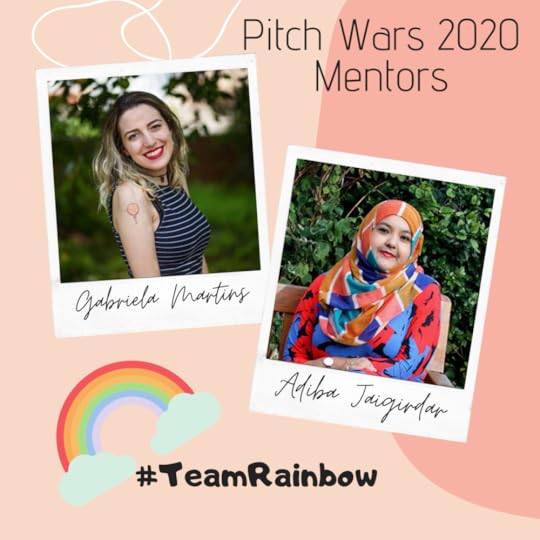
Image of Gabriela Martins and Adiba Jaigirdar on a pink background, with a rainbow image to one side
As a queer Bangladeshi Muslim author I also have a unique perspective on writing and publishing, and as a mentor to multiple marginalised writers I have experience in the hurdles that authors come up against in publishing.
When I’m not writing, I love reading extensively and playing video games. I’m represented by Uwe Stender at Triada US
Gabhi: Hi! I'm a kidlit author and linguist. My debut novel LIKE A LOVE SONG will be published by Underlined/Delacorte in summer 2021. I haven't had the experience of formally mentoring yet, but! I have been a teacher for the past ten years! Like Adiba, I am also a queer creator. I'm from the south of Brazil, and Latinidade is a topic very dear to me. I also have two cats, which is not super relevant for my CV, but I feel is extremely important to mention. Their names are Fitz and Simmons, they snuggle each other and me a lot, and we also spoon. They're the LOVES OF MY LIFE, along with languages and traveling, two things I love almost as much as my babies. (I am one of those women who call their pets children. I can't even pretend to be sorry.) I am represented by Chelsea Eberly at Greenhouse Literary
LET'S GO TEAM RAINBOW!!!!
Gif of Britney Spears smiling and dancing
Why You Should Submit To UsBECAUSE WE ARE THE BEST MENTORS. No jk. (Unless…?)
Gifs of Hayley Kiyoko raising her eyebrows suggestively
We've both been through publishing- and life-rejections enough times that we know what it's like. We want to hold your hand through the nerve-wrecking process of revising and querying, and hopefully going on submission as well. We've been friends for years, and during our friendship, we've cheered each other on hard. We want to extend that cheerleading to you, as well as offer our experiences in revision, querying trenches, and submission, to help inform your choices as well as possible.
#TEAMRAINBOW GO!!!!
March 8, 2020
Waiting For The Other Shoe To Drop...
A few weeks ago, I received some good news in regards to publishing and my writing. I was pretty happy, but that lasted for a few minutes, maybe. After those fleeting minutes of happiness had passed, I felt kind of dread in my stomach. Like because something good had happened, inevitably it would be followed up by something bad. I was just waiting for the other shoe to drop.
As I write this, I guess the other shoe hasn't dropped yet, but this is the way I have felt for a long time now. Ever since I got off the phone with the editor of my book in January 2019, knowing she loved The Henna Wars and was about to send us an offer. I still sometimes feel like someone is going to take it all away even though obviously very tangible things have happened between January 2019 and now.
So much of this irrational fear comes from being a woman of colour, and being a woman of colour in this industry specifically. It feels like even when I'm here, I'm not here. Like there is so little value ascribed to me, I might as well not be here at all.
A few weeks ago, there was...an incident.
As a writer on the Twittersphere, I have been added to many different groupchats. I have had to leave almost all of them because of racism. The only ones I haven't left are the ones which exclusively consist of women of colour.
A few weeks ago, in a Twitter groupchat consisting of writers, a quote was posted that contained exclusionary language. In my interpretation, it ascribed power and privilege to "men," which essentially does not take into account the fact that men from different spheres of life do not experience power and privilege in the same way. That, in many situations, cishet white women have power over men.
In a group that was overwhelming full of white women, my friend and I (both queer women of colour), suggested that perhaps there was more nuance needed in a quote such as that. We were, unsurprisingly, met with defensiveness from our white peers. Someone suggested that the person who had shared the quote (and - it turned out - the quote belonged to) knew what she was talking about and had an important message to share. As if we did not know what we were talking about and were not addressing anything of importance.
Then, like clockwork, we were accused of "pulling [someone] apart." Don't get me wrong, from the get-go, we were treated as aggressors, it was just that someone had now spoken it.
Someone apologised and mentioned how this place should be a "safe space." But I always wonder about what that means. How can there be a safe space where there are huge power imbalances, especially through numbers? Who is being silenced in those safe spaces? In that safe space, it was the women of colour.
We swiftly exited the chat. It was nothing that I hadn't experienced before, but I guess the discomfort of it came because everyone in that space was my colleague, and I would be expected to spend all of my career smiling pretty and pretending that they did not view me as an aggressor for simply existing.
It was after I exited that "apologies" came pouring in. I will paraphrase here, but they suggested that they had entered into the conversation without any awareness of what it was really about. They wished they had been a little more thoughtful. They wished they had read what was being said before saying anything. They wished they had worded things better.
Of course, when you come into a conversation with no knowledge and still think it's okay to attack the only women of colour and accuse them of aggression based off of nothing, that's a marker of your racism more than anything else. The only thing "apologies" proved to me was their attempts at washing their hands clean, their fear of being accused of racism, their need to say, "no, I'm a good person, I promise." Their apologies had nothing to do with me.
Then, there was the explanation that some of them were trying to "keep the peace." To quote Martin Luther King Jr: "I have almost reached the regrettable conclusion that the Negro's great stumbling block in his stride toward freedom is not the White Citizen's Counciler or the Ku Klux Klanner, but the white moderate, who is more devoted to 'order' than to justice; who prefers a negative peace which is the absence of tension to a positive peace which is the presence of justice."
The reason why I'm sharing this story is because this is what being a woman of colour in this industry is like. This is not the first time an incident like this has happened to me, and it certainly won't be the last. People who call themselves "allies," and "feminists," loud and proud but continually perpetuate violence against women of colour.
So, I suppose, is it any wonder that as a woman of colour, I am constantly waiting for the other shoe drop? Hasn't it already dropped? Is it not that feeling of never belonging? Is it not the racism at the root of it all, that will show up in your day-to-day life? Is it not the people who will get accolades for their "diverse" novels and smile proudly for being a fantastic ally but be bystanders as violence is enacted on you? Or worse, the violence they enact on you if you allow yourself to befriend them?
February 21, 2020
Writing “Bang-lish:” Honouring Your Mother Language While Writing In English
Growing up as a Bangladeshi, there is one thing that my parents always reminded me: you are from a country where people died for their right to speak their language.
Some people might know that International Mother Language Day is on the 21st of February, and it’s to celebrate and honour our mother languages. But Bengalis know the day as Ekushey February, the day we commemorate those who died for us to be able to speak our mother language. It’s not simply a day of celebration, but a time to honour the language that our predecessors fought and died for.
There is a lot of responsibility that comes with being a Bengali writer. My Dad always reminds me that, though I am writing in English, I should never forget my mother language is Bangla. As someone in the diaspora whose grasp of Bangla comes from studying the language in school until I was ten years old, and now only speaking it to my parents and relatives in the language, it’s a difficult thing to balance. How do we write in English and still portray our mother language? How do we share our stories with the world and still honour the language of our people?
Writing a book is no easy feat, but when I first sat down to write a book with a Bangladeshi character, I found myself up against an unprecedented challenge: I had never read a Bangladeshi character in a book before. I hadn’t seen a Bangladeshi character on a TV show, or in a film. Though I had grown up with, and surrounded by, Bangladeshi people, I had no idea how to tell a story about people like us. So as I sat down to write, it wasn’t the idea of writing a novel that was daunting, it was the challenge of doing something that I had never seen done before: writing about someone like me.
Writing as a person of colour often means writing with no blueprints set out in front of you. It means navigating new territories in writing. Navigating the responsibility—and burden—of representing not just yourself, but everyone who shares your culture, religion, language, ethnicity. Along with this, comes the difficulty of navigating a new linguistic landscape.
In my everyday life, I speak in different languages. With my parents, and most of my older relatives, I speak in Bengali. With my siblings, and Western cousins, I speak in “Bang-lish,” which is essentially a mixture of Bengali and English. With non-Bengali people, I mostly speak in English
As I began writing a book with a Bangladeshi and Irish immigrant character who went through life with a similar linguistic experience as me, I had to ask myself how do I translate my real-life experience with language and expression into a book form? How do I do it, while still being true to my lived experience, and engaging to an audience that doesn’t necessarily share the same experience?
Firstly, I tried it exactly how I had learned non-English languages should be presented in books: I italicised everything that wasn’t English. I wrote footnote explanations or direct explanations right there on the page. I essentially circled every non-English word in my writing with a red pen and screamed, “here’s something different!” It was as unauthentic as I could make it. After all, when I think in a jumble of Bengali and English, when I speak to my family in Bang-lish, there are no italics to mark the difference between that and the English many of my peers speak. There’s my experience of language and their experience of it: different, but both as valid as each other.
After this failed experiment, I had an idea of exactly how I wanted to write my story: with me at the center of it. That is to say, without stripping back language or experience for someone who was not experienced in my language or my culture. I wanted to write characters who lived authentically in my story because they did not have to cater to someone with little to no knowledge of their language and culture.
At the time, I thought it was impossible to do this and still have some hope of being published. After all, for most of my life I had read books that did mark out languages and cultures that were “different.” Books that seemed to speak to the people living outside of the characters’ lived experience, rather than to those inside it.
Thankfully, I read two books that changed my mind. The first was When Dimple Met Rishi by Sandhya Menon. In the pages of this book, Menon had written out entire conversations in Hindi between her main characters and their parents. The second, Love From A To Z by S. K. Ali, where Ali includes Arabic script as one of the main characters—Zayneb, who is Pakistani, American, and Muslim—writes in Arabic inside her journal. These books are obviously far more than these small instances. But it was these small instances that emboldened me to write my stories, and my characters, as fully as they deserve to be written. Without the hindrance of a second gaze peering over my shoulder.
Growing up as a Bangladeshi, we are often hyper-aware of the history of our language. Every mother language day, as we celebrate our mother tongue and mourn the martyrs of the language movement, we remember the importance of our language. To speak a language with this history is a gift, but as an immigrant coming to terms with identity, and as a writer coming to terms with identity in the form of stories, it can be a heavy weight to bear. I can only hope that I’ve done my best to honour it in my work.
June 2, 2019
The Muslim Diaspora Experience
Welcome to Muslim Voices Rise Up, a month-long project taking place during Ramadan where Muslim authors and bloggers share their experiences on various topics! This project is dedicated to centering Muslim experiences and showcasing the diversity within our own narratives. You can find more info, along with other blog posts for this project, on this introduction post. This post features Muslims speaking about their experience in the diaspora:

Zoulfa Katouh
What does it feel being a daughter of many countries?
It’s like I owe each part of me somewhere. My loyalty and heart are divided all over earth, and everywhere and nowhere is home for me. It’s like a wandering soul, walking side by side with people who belong. It’s the raised eyebrows when I claim Canada as my country because that’s where life was given to me, and the oh’s when I tell them of my Syrian ancestry. It’s the subtle racism, an infection spread further than I could bear. It’s the narrowed eyes, confused stares, defensive glances and all the secret conversations spoken. It’s the hurtful words towards my hijab and ethnicity.
It’s watching my non-diasporic friends speak of their family homes, family vacations, family celebrations and family stories with nothing of my own to share. It’s me seeing my grandparents once every four years if I’m lucky. It’s the feeling of never truly belonging. It’s people thinking I’m ungrateful for all the opportunities I’ve been given, not knowing how much I had lost in the process. It’s me never knowing what Syria’s soil smells like today or how the sun looks setting over the mountains. It’s the surprised happy jolt in my chest when I see other girls who look and dress like me. Whose Arabic accents aren’t a jigsaw puzzle put together from the many people they met. It’s all the cultural history I was deprived from. It’s me, an anomaly to both Arabs and non-Arabs.
It’s me, forever searching for a way back home.
Twitter: @zeereadsbooks
AdibaOne of the first thing I noticed when I moved to a country without a Muslim majority, is how everybody believes in the lie of secularism. Making me pronouncedly Muslim.
In the country where I was born, I got to be a person who practices a religion. I got to pray five times a day (or four, or three, or two…), fast during the month of Ramadan, celebrate Eid with my family, and never have to explain myself or my humanity.
In my new “secular” country, it feels like I’m Muslim first, and a person second. Suddenly, the things that are second nature to me, an every day part of my life, are things that need constant explanations. Things that are scrutinised, and pointed out for being strange. If I speak about my religion, I’m accused of “preaching,” at best. At worst, I’m attacked for having faith at all.
I live in Ireland, which has a really complicated history with religion. After a lifetime of living under the thumb of a corrupt Catholic system, which operated in some really horrific practices, many Irish people have a grudge against religion. Something I guess I can’t blame them for. The problem is, a grudge against their religion, somehow translates to a grudge against all religion. At the same time that many of them will berate people of faith, they will practise a culture that is totally reliant on Catholicism, and not even realise it.
For me, this means that at a young age, practicing my faith was also…complicated. Even though I had spent ten years living between two Muslim majority countries—Bangladesh and Saudi Arabia—where I experienced the two Islamic cultures and communities, I still internalised a lot of Catholic grudges about religion, even though it had nothing to do with my faith.
Being a person in the Muslim diaspora comes with a lot of baggage. For me, it meant not just having to sift through a crisis of identity of my own religion, but also to have to figure out a crisis of identity of another religion completely.
Upcoming author if The Henna Wars
Twitter: @adiba_j
Instagram: @dibs_j
I hope you enjoyed reading about The Muslim Diaspora experience!
Thank you to the contributors of this post, and to Aimal for the beautiful graphic!
May 26, 2019
The LGBTQIAP+ Muslim Experience
Welcome to Muslim Voices Rise Up, a month-long project taking place during Ramadan where Muslim authors and bloggers share their experiences on various topics! This project is dedicated to centering Muslim experiences and showcasing the diversity within our own narratives. You can find more info, along with other blog posts for this project, on the introduction post. For this post, Fadwa and I sat down to have a little chat about queer Muslim experience:

Fadwa: We’re here, we’re Muslim AND queer!... I’m nothing if not one for dramatic entrances...To the folks reading this, I’m Fadwa, a Moroccan greyromantic bisexual med student and book blogger who has been waiting for a while for the perfect opportunity and platform to talk about my queer Muslim identity as well as its representation in media, and it’s finally happening! Adiba and I have decided to have conversation just about that and share it for Muslim Voices Rise Up in the hopes that it might be relatable or bring a new perspective to whomever might read it!
Adiba: Hi everyone! I’m Adiba, a queer Bangladeshi/Irish teacher and writer! I’m beyond excited to have the opportunity to talk about queer Muslim identity with Fadwa, especially since it’s almost a taboo subject, and definitely missing in discussions in both queer and POC circles!
Fadwa: That’s very true! We’re just here to break the taboo as best as we can and try to get the conversation going, and what better way to do that than to talk representation and gush about our favourite queer Muslim characters in media even if...those are rare to non-existent, but still there’s progress in the type/amount of rep we’re getting, and that counts for something, right?
Adiba: Definitely! Honestly, I remember when I was a teen and I picked up Ash by Malinda Lo, which was perhaps the only YA book out by a QPOC at the time, and probably one of the only YA books with queer characters. I was astonished because until then it hadn’t quite dawned on me that Asian people could be queer, which sounds totally ridiculous now but until you see it, you don’t really believe it, do you? But now, we still have Malinda Lo writing obviously, but then we also have new QPOC voices joining in, too. I was especially excited to read Girls of Paper of Fire by Natasha Ngan, which is an amazing #ownvoices East-Asian f/f fantasy. Recently I also read It’s Not Like It’s A Secret by Misa Sugiura, where being queer and Asian is explored quite well.
Fadwa: Ah you have no idea how happy this makes me! I’m glad you have queer Asian characters to -relatively- relate to and look forward to. My story is a bit different, since queer North African characters are non existent, and queer African ones in general are like unicorns. But a book DID help me come to term with my sexuality and that was How To Make a Wish by Ashley Herring Blake, I read it when I was questioning and the way Grace, the MC, experienced her bisexuality and felt attraction was so relatable to me that I just had a “That’s it!” moment. Other than that, I’m still looking for that QPOC experience that will feel like *me*. Although, I feel like we can both agree than Adena from The Bold Type hits pretty close to home.
Adiba: I'll definitely have to check out that book now! I'm definitely with you on still looking for the QPOC experience that feels like *me*. I mean, it's lovely to see East-Asian queer rep which often intersects with my identity, but there are still vast differences! Adena definitely hits so close to home and I'm glad The Bold Type created a character like her. I feel like her existence is already making people aware that Muslim people can be, and are, queer. Do you think that's an awareness that'll come to the book world anytime soon though?
Fadwa: I felt SO emotional the first time Adena showed up on The Bold Type, her character was done with so much care and realism, seeing a woman like me on screen owning all parts of her identity and the way they intersect, having so much confidence and faith in herself even when the rest of the world fails her, it’s empowering in a way, you know? I also think you’re right, the fact that she’s out there, and her faith being as much a part of her as her sexuality makes us almost more real, I guess, to people who thought we are either or. And I feel like that awareness is definitely going to reach the book world soon. At a slow pace, but it’s happening.
There are already two 2019 books, that I know of, with queer Muslim girls, The Love and Lies of Rukhsana Ali by Sabina Khan, and Tell me how you Really Feel by Aminah Mae Safi, as well as YOUR BOOK!!! The Henna Wars coming 2020 that I’ve already read and absolutely adored! And it warms my heart that Muslim teens now will get to read these books and see themselves because I feel like if I had them when I was a teen, I would’ve realised a lot sooner that I’m as queer as they come haha. Because I had a couple phases when I briefly questioned but I shut it down quickly thinking that I couldn’t be, not having the proper terminology nor representation to think that it’s possible.
Adiba: Yes, I’m so excited to see these books coming to the fore, and I’m super excited that I’ve been given the opportunity to write and publish a book where I have written about these experiences! I’ve definitely had the same struggle as you, questioning whether or not I am queer, especially because everybody always acts like being Muslim and queer is a paradox, and it definitely isn’t! I think they’re also going to be important in making us “seen,” so to speak, to other people, which includes Muslims! As much as the non-Muslim world can be ignorant to queer Muslims, I think the Muslim world is just as ignorant to us so it’s great to see avenues of dialogues being opened by these books.
Fadwa: I feel like non-queer Muslims can be almost more ignorant to us than non-Muslims folks, especially older generations who grew up removed from queerness and being told all sorts of wrong things that they didn’t have the right tools to question, which is something our generation is definitely better about, because I think we are a lot more accepting and less judgmental of others, not just sexuality and gender wise but on all fronts. And I think media plays a big role in that. Going from my personal experience, I know that social media, books, movies, etc… helped me come to term with my own queerness, and it helped me unpack a lot of the wrong notions I had growing up. So the more representation there is, the easier it will be for queer Muslims to accept ourselves and for other people who thought us nonexistent to see that there is a non-negligible number of us out there.
Adiba: I totally agree! Media definitely acts as a kind of mirror to us and the world around us. So it really helps us come to terms with a lot of things, especially when we're not necessarily exposed to it in “real” life (like we can even separate real life from online life anymore). On that note, what kind of Muslim, and specifically queer Muslim, representation would you like to see in upcoming books?
Fadwa: All kinds of it! But I’m gonna be selfish and say f/f stories. Even better if there’s bisexual representation thrown in there as well, because I REALLY want to see myself as a whole in a story not just bits and pieces, either the Muslim or the queer. And in a happy setting because my personal situation isn’t ideal so even though there is a lack of ALL kinds of stories that represent us and I will read all of them, I’d rather read books that would help me escape that situation and see genuinely happy sapphic Muslim girls. Maybe even coming out stories? I want them, especially since there aren’t nearly enough QPOC coming out stories, let alone Muslim coming out stories. What about you? Is there a specific type of representation you’re hoping to read in the near future?
Adiba: I'm definitely with you on happy settings. I think, when it comes to queer stories, we've been exposed to the sad, tragic stories for so long and we really deserve some happier endings. Especially for QPOC. I'm also with you when it comes to wanting more f/f stories, they always seem so underappreciated. I'm working on trying to write us into the narrative here as well, with f/f happy stories. The Henna Wars can definitely feel a little bittersweet when you’re reading it, but I hope readers will come out of it feeling happy and content!
I would also really love to see Muslim men in stories, queer and non-queer ones. I feel like Muslim men and women carry two different types of stereotypes with them. Women as the oppressed, meek, voiceless in need of white saviours, which many authors are working to deconstruct and to write Muslim women who are real and honest representations. So we've had, for example, Janna from S. K. Ali’s Saints and Misfits and Maya from Samira Ahmed’s Love, Hate, and Other Filters . They're both very different but very honest examples of young Muslim girls. Men, on the other hand, battle different stereotypes all together that's totally rooted in violence, terrorism, being the oppressor, having backwards and “traditional” masculine values. But they haven't really been written into the narrative yet, so I would really love to see that.
Fadwa: Oh! I’ve never really consciously thought about Muslim men representation because, it’s even more nonexistent but now that you’re pointing it out, you’re absolutely right. Muslim men have their own set of stereotypes that need debunking. Now that you’ve mentioned Love, Hate and Other Filters, I really love Karim in that one, he’s far from being a MC but I loved how his character was removed from all toxic masculinity. That being said, we need them as main characters, it saddens me that young Muslim boys don’t have those kinds of characters to hold on to when the world seems to be against them. I know the representation is lacking on all fronts but as of right now, girls have it a little better and I hope that changes soon.
And about The Henna Wars, I can definitely confirm that the feelings that ultimately sticks is happiness, even though it’s not happy from start to finish and Nishat faces hardships both related to her sexuality and completely removed from that, what stuck with me once I finished the book and sat with it for a little while is a hopeful, genuinely happy feeling that I still get every time I think about it again. And I feel like that’s really important, you know? Hopeful QPOC stories can sometimes be the only thread holding you together when your own story as a QPOC and especially as a Muslim one seems to be going down a less than favorable path. Especially when said stories have those dark times and the main characters surmounts them, it tells queer Muslim teens that their stories aren’t over and that they can overcome those hardships too. Maybe not in the same ways, but they’ll find their own way. I’m really grateful as a reader and proud of you as a friend for paving the way and probably also giving queer Muslim writers the courage to write their own stories.
Fadwa is a 22 year old book-devourer and 5th year medical student based in Morocco. She basically runs on books, tv-shows and music. She’s dedicated to championing diversity and inclusivity is all types of media. She loves travelling, taking pictures and food -both eating and cooking it, as well as all things science related.
Twitter: @wordwoonders
Instagram: @wordwoonders
Blog: https://wordwoonders.wordpress.com
Adiba is an Irish and Bangladeshi writer and teacher who lives in Dublin, Ireland. She loves drinking too much tea, reading diverse books, and listening to Hayley Kiyoko and Janelle Monáe on repeat. Her debut novel, The Henna Wars will be published by Page Street in 2020.
Twitter: @adiba_j
Instagram: @dibs_j
May 19, 2019
Experiences Wearing The Hijab
Welcome to Muslim Voices Rise Up, a month-long project taking place during Ramadan where Muslim authors and bloggers share their experiences on various topics! This project is dedicated to centering Muslim experiences and showcasing the diversity within our own narratives. You can find more info, along with other blog posts for this project, on this introduction post. This post features Muslims from various backgrounds writing about their experiences with the hijab:

Neelam
I’ve been wearing a hijab since I was 12 years old and now I honestly can’t imagine a life where I don’t wear it. Over the years I’ve grown and developed as I’ve studied more about the hijab and Islam which has just made me more confident in wearing it.
Everyone has their own experience but mine has been generally positive I love wearing it. I love how I feel wearing it, it’s my comfort place when I go out. That’s not to say that I haven’t felt uncomfortable or felt out of place or even afraid, I have and still do but for me I still know that there is no way I can not wear it.
Wearing a hijab makes me visibly Muslim, makes me stand out and there have been times that I felt like I don’t belong, people stare, they don’t know how to speak to me. Assumptions have been made about me, from people thinking I don’t speak English or I’m just a submissive little housewife, all because of the way I dress. I’ve also had people compliment my hijab, people saying how they love it and how it looks so beautiful.
Then there is the reactions of other Muslims, from people telling me I won’t get a job or a husband if I dress like that to my friends supporting me in my decision to wear a hijab and later an abaya. Sometimes the scrutiny of Muslims can make me feel as uncomfortable as those who know nothing about my religion. I am expected to perfect at all times, I can never slip or make a mistake because I wear a hijab. It would stifle who I was, I felt I couldn’t be myself and any time I was less than perfect stressed me out. But as I got older I realised something as I was learning more about Islam. It’s a hijab not a halo. I’m human, I’m not supposed to be perfect. I just need to try my best.
For me a hijab is a part of me but it is not all of me. It doesn’t define me but it is an act of worship, something I do for Allah and nothing else. I have fought to be able to wear my hijab and never let it be a barrier to achieving what I want. I have convinced my coach that I can play netball wearing it, I have spoken to my manager about being able to wear it and cover my arms while working in the hospital. My hijab makes me visibly Muslim but that doesn’t mean that you can see how passionate I am about certain topics, what my hobbies are, who I am. The more I study and learn about Islam the more confident I get in being able to look visibly Muslim and not feel uncomfortable and I feel more confident in speaking about my hijab and the fact that I am unapologetically Muslim.
Twitter: @thetsundokuc
Instagram: @thetsundocuchronicles
Blog: The Tsundoku Chronicles
FatimaI started wearing the Hijab when I was in 10th grade. I was 15 years old. Before that my family didn’t practice Islam. We said the occasional prayers here and there but that was about it. One day I was in the food court with a friend and my mom called. We always spoke to each other every week day but this time she made a request. She asked me to start wearing the Hijab.
I was really surprised by this question. I had never quite liked the idea of covering my hair. I’m not exactly sure why that was. I think like many other Muslim girls who I’ve come across it was because I really liked my hair and didn’t see the point or the need to cover it.
Regardless I agreed because she asked me to. My sister was asked the same question but only agreed if we (she and I) got to choose colorful Hijabs. Not black or grey that we’d seen so many other Muslim women wear. Rather blues and pinks which oddly enough at the time was a rarity. As I’d never really seen many Muslim women wear that much color. My mother wasn’t happy that this was the condition to both of us wearing that Hijab. Despite this she agreed.
We bought so many beautiful Hijabs! In many different colors. Of course, my sister and I were now excited to start wearing them. We chose our first Hijabs of the school week as a family. And paired our clothes to match.
Before the school week started, I wasn’t sure how our classmates would react. Would they ghost us? Stare at us with weird looks on their faces. As it would turn out I didn’t need to worry. The only people that seemed to care about the Hijab were the females. Teachers and students alike. The two of us received lots of compliments for a few weeks. Eventually people started asking us questions regarding the Hijab. The most common one was “Do you have to wear that all the time?”
We didn’t get any bad reactions. Maybe that’s because I live in Canada and not in America. And it certainly helps that I live in a white rich town. So, the most that they do is glare. They don’t say or do anything that could harm us. Obviously, whatever the reason, I’m happy and lucky that nothing bad happened to my sister and me.
Our family members and close friends were very impressed. They were so proud of our decision to wear the Hijab. They came over and had us try on all the Hijabs we got. This went on for some time. Our white friends just loved that we chose colorful Hijabs. Depending on the color we wore we would receive lots of compliments from them.
I’m not going to lie: it was hard at first. My Hijab kept slipping and revealing all my hair. There were so many times when I would take it off because I didn’t think any males would see me, and they did. I also felt hot with it on. Specifically, during summer. Looking back on it now it was worth it.
Like I mentioned earlier, my family didn’t diligently practice Islam. This didn’t change for awhile. My sister and I didn’t feel much of a difference with the Hijab on. We continued to live our lives without any thought about Islam.
It wasn’t until my mom had told us that one of the conditions with wearing the Hijab was to say daily prayers. My sister and I were too pleased with our Hijab collection to take them off just because we didn’t say prayers. Our family then banded together to educate ourselves in all aspects of Islam. The history, how to say prayers, what was and wasn’t permitted, how did Ramadan work, etc.
Before I wore the Hijab, I didn’t realize how beautiful Islam is and how you really must be committed to follow the religion. I never thought that I would fall in love with it all! And the only reason I was able to experience any of this is because of my mother and Allah. I will never stop being grateful!
I want to stress that my mother never forced me against my will to start wearing the Hijab. At the end of the day it was my choice. And I chose to listen to her.
All in all, for me personally wearing the Hijab has been a beautiful experience. Which I will always be grateful for and never trade for anything.
Twitter: @Fafasbookcorner
Blog: Fafa’s Book Corner
HanaIn her book, Hidden Figures (inspiration for the Oscar-winning film of the same name), Margot Lee Shetterly writes of mathematician Katherine Goble: ‘Katherine understood that the attitudes of the hard-line racists were beyond her control. Against ignorance, she and others like her mounted a day-in, day-out charm offensive: impeccably dressed, well-spoken, patriotic, and upright, they were racial synecdoches, keenly aware that the interactions that individual blacks had with whites could have implications for the entire black community.’
A synecdoche is ‘a figure of speech in which a part is made to represent the whole’. And although the above quotation was written to describe black women in the mid-1900s, feeling they represent the whole black community in the eyes of their co-workers and struggling to be taken seriously, it perfectly sums up the exact feeling that I have every minute of every day, as a headscarf-wearing Muslim woman in 2019.
I spend my life striving to be perfect. To attempt to dress presentably, no matter how tired I am; to always be polite, no matter how annoyed or upset I am; to follow rules, and work hard, and smile. Not just because these are good things to be, though of course they are, but because I'm terrified that the people around me will see my headscarf and judge the entire world's Muslim population based on my actions. Of course, I’m only human and it’s inevitable that I regularly fail at this. But it’s a huge burden to carry nonetheless, and it consumes my every speech and action.
With the state of the world the way it is; with the news and its never-ending cycle of low-level (or high-level, depending on which outlets you follow) Islamophobia, everyone thinks they know who Muslims are. A study from Cardiff University found that between 2000-2009, references in the British press to Islam as a threat outnumbered references to moderate Muslims by seventeen to one. The most common nouns and adjectives used to refer to British Muslims included terrorist, extremist, militant and radical.
And in the face of that, what am I supposed to do? Despite anything anyone thinks they know, it’s entirely possible that the people I interact with have never before met a Muslim. So it’s my responsibility to show them what Islam really means – or at least it feels like it is. And I don’t just mean friends and acquaintances: my headscarf signals my Muslim-ness to everyone I so much as walk past on the street. Which means I can never, ever make a single mistake. If I take too long fumbling with my purse at the front of a queue, or inadvertently make the wrong comment for the situation, my anxious self isn’t just worried about what people will think of me, but also how my actions will reflect on the other 1.8 billion Muslims across the Earth.
In a 2016 article for the website muslimgirl.com, writer Hana Malik said, ‘Anytime I leave my home, I carry an invisible weight of defence because I am a Muslim woman’. That was the first time I’d seen such a sentiment articulated and, at the time, I identified with that one sentence more strongly than anything I had seen before. But I’ve since come to realise that what I personally feel isn’t defensiveness. It’s just anxiety and stress – a constant, nagging voice in the back of my head reminding me that everything I do has an impact on something much bigger than me. 1.8 billion times bigger, to be specific.
But then I also have a voice that says ‘this is ridiculous, Hana, no one’s paying you that much attention. You’re just anxious and insecure and projecting – no one notices or cares what you do.’ But I’ve spoken to friends who also feel this pressure: it’s definitely not just me. And regardless of whether or not it’s justified, the perceived weight of having to be a perfect example at all times is one that would overburden even the best of us.
I love my hijab and wouldn’t trade it for anything. But, in a world that seems determined to blame all Muslims every time a single disturbed individual does something wrong, it does single me out from the people around me. Muslims aren’t a monolith, and nothing I do could possibly represent the beliefs of all of them, or even most of them. But if people are going to treat me as if it does, what choice do I have but to lean into that and do the best I can?
Twitter: @linh_hermione
Instagram: @linh_hermione
FitriyantiWhen I first decided to wear hijab, it was out of necessity. I was so sheltered by my parents growing up that a single glance from a man would traumatize me. Until I got to high school, my body shape was like a boy. But since then, I expanded to my feminine side. That period unfortunately, didn’t come with a code of conduct. So I decided the easiest way to survive hungry gazes from men was to neglect my body but that didn’t work out so then I covered up my body.
Later unfortunately, it also brought another consequences that tied to our identity as the country with the biggest Muslim community in the world -Indonesia. It created hungry men who saw beyond your clothing and got sexual urges just by looking.
When I was in college and later in the work environment I started to notice, a girl who wore a hijab have more chance to be molested than a girl who didn’t. The men around me who studied or worked with me were all wolves, for a lack of better label. I got stories and tips from my friends or coworkers about how this men would use my figure as a material for their “locker room talk”. Or how they created false stories that thankfully never harmed me.
Did it deter me from wearing hijab? Nope. As time goes by I just learn to live with it. Things that couldn’t kill you, will make you stronger.
Twitter: @FY_Tapri
A.M. DassuI remember it as clear as day. The moment I decided to wear a hijab. I was fresh out of university and looking for a job. September 11 had just happened and for some insane reason, when women were taking off their hijab for fear of being attacked, I thought it was the right time to put one on. But it was the right time for me. Just not for society.
No one in my family wore one. I always thought I would one day, but worried it would ‘change me’ by somehow making me more quiet or submissive. But as I got more frustrated with life, I soon realised that if I wanted to better myself and represent Muslims in public life, I had to wear one.
I recall during one of my first interviews as a hijabi, being sternly questioned by a senior female Magistrate and asked about my commitment to the judiciary. The elderly, white haired gentleman sat next to her, was extremely amiable in comparison and viewed me in astonishment. He said that he had never met anyone who was as articulate. I knew this meant he’d never heard someone who wore a hijab speak. I let it go, smiled and reassured him there were many more of us. I knew then I would have to prove myself to every colleague I met, that I’d be judged for the piece of fabric on my head, and I was right. Each time I sat on the bench, I had to prove my worth, without question–it became a tiring auto response.
When I was younger, I used to walk down the streets like I owned them. My feet would tread pavements like they belonged. Years on and after such a drastic change in people’s perceptions of Muslims, I walk with a lot less confidence.
As I walked out of the local supermarket this morning, I passed an elderly gentleman. He looked at me with disdain; like I was a foreigner, a troublemaker. To him I was probably the stereotypical immigrant who was draining the ‘system’ and putting nothing back in. Yet I was on my way to work, to make a difference in the world we share. He didn’t know that. His gaze seemed to denote I had no right to be there, simply because of the way I choose to look.
I was born and bred in England; I feel English to the core, yet my faith, which doesn’t happen to clash with my nationality, has caused a media sensation in the past decade.
People who claim to share my religion have hijacked it. Everything I believe in encourages me to behave better than I used to when I didn’t practice my faith properly. My hijab is a constant reminder to check myself.
Yet now I am afraid to wear it properly by draping the fabric around my face and chest as I’d intended to many years ago. When I attend writing events or when I travel on the train to London alone, I wear a hat or a turban-scarf covering my head. Being a lover of hats has of course made this decision more natural for me, but I do feel as if I’m constantly switching identities. Growing up, I never thought I would feel this way. I never thought I would be anxious to travel alone or have to worry about making progress in my career because of the way I look. I thought I was invincible.
Yet here I am - afraid.
Muslims are constantly misrepresented by the media. When I walk into a room, visibly different to the rest, from a religion that people now view as dangerous, as ‘the other’, I feel sad. I stand out and not for the right reasons, not for what the hijab is supposed to represent.
I fear for my children’s future. They may feel less inclined to strive for success or even to practice what they want to. They won’t have the luxury of being comfortable with who they are. They will be judged by their names and their religious identity.
I want to go back to knowing that people will judge my skills and ability and not my face, clothes or name.
I want to go back to feeling like I belong. After all, this is my country as much as it is anyone else’s. I invest in it, I believe in it, I love it.
Twitter: @a_reflective
Website: https://amdassu.com
FaridahI no longer wear the hijab, and in a lot of ways I felt like this choice was out of my hands. I didn’t feel like my body belonged to me, I had to think about others while practicing my religion. Which to me, is disturbing because religion is meant to be this personal thing but for a lot of Muslims we are forced to represent the entirety of our people. Everything we do is scrutinized, people are weary of us and our headscarves are the ultimate symbol to non-Muslims of Islam.
I will admit, I wasn’t an everyday wearer of the hijab before I permanently stopped wearing it. I wore it most of the time but not all the time, and when I did wear it, it was the turban style. I stopped wearing it all together in the year Brexit happened. For those of you who aren’t quite sure what Brexit meant for Muslims, I’ll explain. So, Brexit was a vote made in the UK about staying or leaving the European union. While this vote was meant to be purely based on economical factors, it was made instead to be a xenophobic campaign, whereby anyone who wasn’t white and British was no longer welcome in Britain. Before Brexit, there was of course islamophobia, racism and xenophobia, but British people used to be a lot more covert about their prejudice. You’d feel it as a background noise that wouldn’t go away, you’d see it in people’s eyes when you’re on the tube or walking down the street, but then Brexit happened and it unlocked this confidence in the white British population, whereby people felt entitled to attack Muslim people, black people, brown people, and even white non-British Europeans. I stopped wearing my hijab after three incidences.
The first being a friend of my mum’s who was black, being attacked. That shocked me, at the time I was still a teenager and I was really shaken by the idea of someone doing that to someone just because of their skin colour, and while that scared me, I knew I couldn’t take of my skin, I’ll always be black. And so, I became more paranoid. Then, my sister who was about 14 at the time, and her best friend got attacked on the bus on the way home. A man was yelling Islamophobic slurs and the bus watched in silence as they were berated by a bigot. Still, I wore my hijab. The last event was when I’d heard of the physical violence. Muslim women’s scarves being snatched away, Muslim women being pushed – hurt. I was suddenly scared to leave my house.
There is something sick about the reality and the options I had. I knew that I was not the Muslim stereotype. I was not brown, the only thing giving away my religion was the way I knew how to pray and the scarf I used to cover my head.
I knew that my best friend who is Pakistani who also stopped wearing the hijab would still face abuse, and I knew I wouldn’t face the same abuse. If anything, they’d hurt me because I was black. But, I felt that more so, they’d kill me if they knew I was a Muslim.
So, I took it off and I haven’t put it back on since.
Author of Upcoming Ace Of Spades.
Twitter: @faridahlikestea
Instagram: @faridahlikestea
Website: https://www.faridahabikeiyimide.com
I hope you enjoyed reading about all of these diverse experiences with the hijab! I know, as a hijabi, I definitely appreciated seeing all of the different views and experiences of it, especially during a time when many governments are trying to regulate the hijab, and the Muslims who wear them.
Thank you to all of the contributors to this post, and to Aimal for the beautiful graphic!
May 12, 2019
Why #Ownvoices Muslim Stories Are Important

Welcome to Muslim Voices Rise Up, a month-long project taking place during Ramadan where Muslim authors and bloggers share their experiences on various topics! This project is dedicated to centering Muslim experiences and showcasing the diversity within our own narratives. You can find more info, along with other blog posts for this project, on the introduction post. In today’s post, some Muslim folks in our community share the importance of #Ownvoices Muslim stories:
Farah Naz RishiThe first time I’d ever seen Muslim characters portrayed in a book—written by a Muslim author—was Khaled Hosseini’s The Kite Runner, written in 2003.
I was thirteen years old.
Consider that for a moment: I had never seen a character in any form of media who’d shared my faith until I was thirteen years old. An entire childhood without ever seeing another person on the page that prayed the way I prayed, or fasted during Ramadan each year (or tried to, at least), or celebrated the same traditions I did. I’d never seen another character say “asalaamualaikum” to another, or frantically whisper ayat al-kursi when they were frightened.
For thirteen years, I had never seen anyone even remotely like me beyond the walls of the mosque, my home—or within my own mirror.
Sure, beyond being Muslim, I didn’t really have much else in common with Amir, the protagonist of The Kite Runner: for example, I’m only about a quarter Pashtun, and I identify as a woman; I’ve never been to Afghanistan, and although I know how to fly a kite, I have no idea how to “kite fight.”
But that one similarity—our shared faith—meant everything to me, especially when I was first navigating the post 9/11 political and social landscape.
Islam had never really been at the forefront of my mind, prior to 9/11; as a middle schooler, my only focus had been on trying to survive the notoriously awkward preteen phase of zits and unibrows and one-sided crushes. But when 9/11 happened, my Muslim identity suddenly transformed into an unignorable red target on my back. I could no longer treat my religion as a single facet of my identity, a single color in a kaleidoscope of the Self, as most children could. To the rest of the world, I was now an emissary for my religion, and in a school where I was one of the only people of color, and the only Muslim, I was my religion, whether I liked it or not.
When the usual questions directed at me (You’re Muslim? Does that mean you worship cows or something?) began to sound more and more like loosely-veiled threats (Is your dad Osama bin Laden? Where are you hiding your bombs?), reading a book with a Muslim protagonist was a simple, yet impossibly powerful reminder, one the author had meant for me: that I was not alone, despite the world persistently trying to convince me otherwise, and that I too, despite everything, could be the hero of my own story.
Sixteen years later, every book I’ve read with a Muslim protagonist has served to make that message stronger, to embed that feeling of unseen unity, in a heart that would otherwise feel hopelessly abandoned in a country I called home. Without those stories, it would have been so much harder to shut out the whispers that called my family villains and monsters. Without those stories, I wouldn’t have the confidence to pick up a pen. That is the power of reading books written by authors who share your identity: only they can navigate through the dark labyrinth of doubts inside your head to reach you. It is, after all, a labyrinth they know all too well.
The #OwnVoices movement (as coined by writer Corinne Duyvis) is so much more than a hashtag. It’s about encouraging authenticity in the books we read, and ensuring those books reflect the real, diverse world we live in. It’s about boosting those marginalized voices who, at best, are made to feel small, and, at worse, are often silenced by the din of privilege. It’s about acknowledging the simple fact that no one can tell the stories of marginalized people better than us.
Part of being an effective writer is to come to terms with the fact that even with all the talent in the world, or an arsenal of all the research in the world, you might not be the right voice for that story. And that’s okay. If writers have a duty to deliver the best possible story to their readers, the reality is that not sharing the identity of the character you are writing will put you at a severe disadvantage. Authenticity means little without the backing of lived experience.
And honestly? Any less wouldn’t have reached that lonely thirteen year old girl.
Author of upcoming I Hope You Get This Message.
Twitter: @far_ah_way
Website: farahnazrishi.com
Maria HossainA few days before I wrote up my section of this topic, I was reading a political fantasy book by a white woman. She is also non-Muslim. When I found several Muslim characters from the Ottoman empire, I was curious. Soon I discovered one of the protagonists is Islamophobic. The protagonist subsequently falls for a Muslim man and their sibling also converts to Islam. But one wording in their letter to someone still sours my mind.
The wording is "the plague of Islam.”
I think, after all this time, non-Muslim people still view Muslims as a monolith. Whenever they think of any Muslim person, they visualize hijabi woman, niqabi woman, man in skullcaps and robes, and how men are depriving women of their rights by subjugating them. Whenever the non-Muslim folks think of us, they think we are all the same. We all do the same things, and think and speak the same things.
Which brings me to this topic. Why #ownvoices Muslim stories are important. Because whenever non-Muslim people think of us, they associate us with Middle Eastern, especially Saudi Arabian, cultures, when the truth is, 62% Muslims in this world are from Asia-Pacific regions. Islam is the second largest religious tradition in this world. How can people from a religion so widespread be a monolith? That's obviously impossible.
And yet most non-Muslim people think of us that way.
This is why we need more #ownvoices Muslim stories, from every single culture Muslim people are from. So others can see, we are NOT a monolith. We are as diverse as people from any religion or country. We have Muslims all over Asia (and I mean all over, even in East and North Asia), Africa, North America, every single continent. And we are not monolithic. We are diverse, we are just like you.
This is why, I think #ownvoices Muslim stories are more needed than ever before.
Twitter: @maria_writes
Blog: Maria Hossain
FarhinaWhat do I mean by "ownvoices?" Here, When I say the term “ownvoices” I am referring towards the phenomenon of being “represented” in media - seeing or reading about characters like one’s own self in books, TV, movies, etc. It means to have a source, medium, a character you could relate to, find solace in their existence. Representation pertains to many different aspects of identity. It can be about your culture, body type, race, gender, ethnicity, sexual orientation, religion, disability, class, age, and even issues/life circumstances, etc.
#Ownvoices books gives people a chance to be uplifted. See their circumstances being told, to be able to relate. As a human being we all strive to have a connection, to get that strand of hope that we aren’t alone in the world, that we matter and there are people like me around.
Representation, and why it matters? Growing up with characters that weren’t like me wasn’t a huge deal to me, as it is to most people. Up until last year I wasn’t into the whole I need representation deal personally. And hadn’t read most of the ownvoices Muslim books, because almost all of them are about romance or rebelling against religion and I couldn’t relate to that. But then I read City of Brass, and everything changed, I can’t tell you the joy I got from seeing myself, or somebody like me being there doing the things I would. Seeing the culture I could relate to. I can’t explain the feelings but it was delirious and amazing. And I understood in those numb feeling of being left gob smacked why everyone was going on and on about the importance of representation. And everything changed.
Yes, we need voices like us in our stories, to be able to relate, for that kid to see a brown super woman that looks like her, to grow up on stories. And to get that self believe that yes even she can soar and touch the sky.
Here is a quote I got from fellow Muslim reader @hamad and why own voices Muslim books mattered to him, to get another voice into the mix:
" When I started reading in 2015, I didn't notice diversity and representation and this stuff. I then as the time went on started to notice that the characters kind of fall into the same mold and that kind of made them flat, unrealistic and boring for me. I wanted to see myself in a book, I wanted to see more Muslims, more black people, more Arabs, more of everything other the typical YA character. I remember reading about a character of color in the shatter me series, his name was Kenji. He was so unique, the author is a Muslim and that made me appreciate the character even more! I started to look for more characters like him and found out that I have learned many things about different cultures and different people in the community. After the New zeland attack, I was kind of attacked on the internet because I am a Muslim and that's when I decided to host a Muslim readathon to expose others to more genuine representation that that in the media. Simply put: representation matters!”
Diversity is all around us, whether we like it or not. Your black neighbor, your Muslim best friend, your disabled cousin. They need to see themselves in books. And we need to see them to know that this is normal. Too see their stories, see life from their point of view and to learn from their experiences. Ownvoices books can be a huge and an important deal in bringing acceptance, tolerance and understanding of all the marginalized, understated and misunderstood communities.
Naima from @nerdsforbooks says:
“I’ve read many books which make me happy but the inexpressible joy that I get whenever I come across a Muslim character is something else entirely It’s an amazing feeling to be represented, to know there are people out there like me, and to know that people of other cultures are reading about us and maybe understand a little about us, other than just hearsay.”
In current day and time people can be so easily misinterpreted and voiced in stories in a way that they aren’t, and can have hostile environments created for them. Muslim representation matters because the media can trick people into false stereotypes. Many people think of Muslims as the Stone Age man, who is a terrorist now. That’s why Muslim stories need to be told. When they see Muslims in books. When they see us as their equals. Too see that we aren’t the barbarians the media portrays us to be. How we belong to the most peace loving religion. How the percentage of the world of people with messed up ideologies don’t represent us. How we are the same as them, with similar struggles that they would 100% relate with. How they see you, changes the society hopefully toward the better more accepting tomorrow.
Twitter: @shelovestoreaad
Blog: She Loves To Reaad
Instagram: @shelovestoread
Raghaad and ZahraAs Muslim girls growing up in the Middle East, we have been exposed to Western media ever since we were kids, whether it was books, TV shows or movies. But we never really felt connected to the stories we were consuming, the lavish life in LA, the busy rush of the big apple, or the tall gorgeous white girls who have their lives together just felt like something literally out of a movie, because they were. The media you consume, especially when you’re younger, really affects the way you think and look at life. For a while, it was not evident that the lack of representation was important as we could see people like us on the street and in our local communities. But after a while and as we grew a little older, seeing these girls who look nothing like us on a TV screen or in the words of a book, being successful and living a great life with no problems made us feel like we’re missing something, we felt jealous over things we couldn’t control, like the shade of our skin or the color of our eyes.
Raghad recalls 6th grade when they had an assignment to write a short story about anything they wanted. She first started writing about an Aisha that went to school like us, but couldn’t finish it because all the books that inspired her to write were based on girls that didn’t look or speak like us. She ended up changing the whole story to one that was filled with white characters that were not Muslim. This theme continued in our reading life and it started giving us a sense of detachment, like the world we are living in and the world we read about were two different things.
Yet as we grew older, and as the internet started making all of us more connected than anyone would ever imagine, we started to learned that the west has Muslims just like the Middle East has Christians, and yet we never saw a hijabi on a TV show until 2015 when Quantico first came out. It was a shock followed by pleasant surprise as we saw someone that resembled us in a normal setting doing whatever it is TV show characters did. And when we both first read our first books with Arab Muslim main characters, it was a life changing experience. We found ourselves laughing out loud and relating to the most mundane parts of a story, which is something that makes you appreciate and love a story even more than main plot points and character traits.
As time passed and we learned more about just how diverse the world is, we realized that the dominant media is not as diverse as the world really is. Even after we started to see Muslim and Arab representation in the media we consume, they still felt like strangers. They were not people we saw ourselves in, because they were not created by the people they were representing. When a story is not “own voices”, many misconceptions infiltrate the core of the story and a lot of mainstream ideologies get plastered all over the characters. The characters are also usually so westernized in order to “fit in” that they no longer represent what it is to be a Muslim or an Arab, which was mostly either a terrorist, lavishly rich, or someone trying to cut loose the strangling ties of Islam. We found this bewildering because just like we see a small fraction of what the west is like, they also see a very small fraction of what the Arab world is like, because they have not shared our history or lived our life.
Not everyone can become a writer and write their own story in order to find some content that they feel that they can relate to, and this is why “own voices” stories play a huge role in media. You always write best when you’re drawing inspiration from the world around you, the experiences you lived through, and your own life. It is the best way to keep it real and simple and accurate, and someone who has never even seen what an Arab or a Muslim household is like, can never give the correct adaption on a screen or on paper. We as Muslims and all the other minority groups should also have our chance to deliver to the world our stories and our culture. We need to help the next generation of minorities find themselves in books and TV, because our voice and stories matter.
Twitter: @LeBeard13 & @RaghadMHD
Instagram: @thebookishzebras
AzrahWhen books are your go to escape they mean so much more when they involve characters that you can relate to and #OwnVoices books have taken this to a whole new level.
The sheer ability to walk into a bookshop or library nowadays and to find a book centering on a Muslim character or solely a book written by a Muslim author is inspiring. From those that I have read, simply stumbling across subtle references to our beautiful religion in a narrative or coming across phrases or gestures that are familiar to my own culture fills me with joy. More so that we can share this with others, especially in a world where are our faith is still, quite too often, misunderstood.
My love for #OwnVoices books overall, stems from the teaching element that they provide. The fact that we have these books to allow us to learn about and embrace different cultures and backgrounds is wonderful and so so important!!
A question that was often thrown my way when I was younger, both out of ignorance and curiosity was “how can you be Muslim when you don’t even cover your head?” In more recent times I have had people, albeit indirectly, belittling the extent of my faith simply because I don’t seem like the type who truly practices.
Muslim stories when written by those in the position to tell them can help to break these misconceptions and stereotypes that the world cannot be without. Help us to look beyond the conventional opinions and prejudices that are still very prominent within our religion today. They are a step towards allowing those on the outside to gain a wider understanding of our religion and providing those of us on the inside the opportunity to reflect upon ourselves and our fellow Ummah (Muslim community).
Everyone has their unique story, a unique relationship with their faith and the #OwnVoices movement has provided a platform where Muslim’s from all walks of life are able to share theirs.
I’m always thinking how amazing it would have been for these stories to have been there for me to read whilst growing up so I’m just immensely grateful that they are starting to become more available now.
Twitter: @rahrahremus
Blog: Quintessentially Bookish Blog
This year has been an exciting year for Muslim authors releasing their ownvoices stories. It wasn’t until I got my hands on the first of many releases that I realized just how much I’d been missing seeing myself in characters that weren’t just there to further another character’s mission. Muslims are rarely represented in fiction unless they fall into a few stereotypes. It’s frustrating to see the culture that I love so dearly reduced to a handful of roles to drive the story along. Need a bad guy? Let’s make that guy a terrorist. Need a woman triumphing over evil? Let’s make her defy Islam, embrace “freedom” and turn away from her family. And then there’s the fact that nearly all Muslims portrayed in these stories are Arab by default. There is so much ignorance about Muslims and our diversity, and the ugly roles we are often given in stories is disheartening. Yes, there are bad people in every culture, but there has never been anything to balance the scales in our favor. This is one of the biggest reasons I set out to write my own books, but along the way, I found that there is a surge of ownvoices stories being released, and it’s beautiful.
Being able to read a story with elements that are uniquely Muslim is such a delight, and it makes me feel seen like nothing else can. We’re so used to everything being written under the white (and typically Christian) gaze that every little bit jumps out at me. The girls altering their steps, trying to have their right foot cross the threshold first while they giggle. The stories with djinn being treated as casually as other stories talk about angels and spirits. The diversity among us, and the familiar words that aren’t translated so non-Muslims know what they mean. There is something so uplifting about a book that gets us; a story that is unapologetically Muslim. And these stories are not just for us. They show others that we have lives that don’t have to center around our pain and discrimination. Muslims are “normal” people with problems like everyone else, and it’s so refreshing to see our realities reflected in ownvoices stories.
But it isn’t just this generation that benefits. Our younger generation deserves to grow up seeing themselves in books. And not just the girls that stand up for themselves and choose not to cover because they feel liberated. These stories are valid, too, but so many books with Muslim women and girls focus on shunning the practice of hijab. We need girls that embrace the hijab because that’s how they resist western oppression. In this modern world, resistance comes in many different forms and it’s time we celebrated that. We need characters that embrace Islam with honesty, humility, and a bit of humor. We need women and girls who wear hijab despite the dangers they may face, showing their strength and the fortitude that so many of our women have. And we need characters that are having adventures like all the other characters in millions of books without having to make a political statement. There is so much about our various cultures we haven’t explored, and I cannot wait for the years to come. The industry is changing and it’s beautiful to see. Yes, there are still problematic stories that crop up, but as people are educated and Muslim voices are boosted, we’re making sure these issues are addressed so that harmful stereotypes aren’t perpetuated.
As a Muslim woman who has experienced prejudice, hatred, and fear simply for the cloth on my head, ownvoices means that I’m not alone. And with each new book, I am building a sizable library of Muslim-positive stories for my own daughter. My dream is that she will have more books celebrating the Ummah without catering to western understanding. I’m doing my part to make that a reality, but I wouldn’t be on this journey without the trailblazing women who came before me. Seeing ownvoices books in print has inspired me like nothing ever has. I’m hopeful for the future of literature, and I’m grateful to be a part of this beautiful community of Muslim writers and readers. We’re changing the world one book at a time. Alhamdullilah.
Twitter: @GoodwinVianna
I hope everyone enjoyed reading about the importance of #ownvoices stories to Muslims in our community! It was certainly enlightening for me to read about so many different experiences and views on #ownvoices works. You can hop over to Fadwa’s blog on Tuesday for the next Muslim Voices Rise Up post.
A huge thank you to everyone who contributed to this post, and to Aimal for the beautiful graphic!
March 23, 2019
Writing A Twitter Pitch and A Query!
I haven’t done one of those, “the query that got me my agent” posts yet, but in the lead-up to April’s DVpit, I’m going to share the query that got me my agent, the twitter pitches which, while successful, did not get me my agent, and just some general advice. Okay, buckle in!
The PitchI think there are two important questions that every query and pitch should answer:
What is the goal of the main character?
What happens if the main character doesn’t achieve their goal?
As a contemporary writer, especially one that loves quiet books, it’s not always easy to answer these questions. Especially because a lot of SFF books have really big, splashy goals and stakes! But you don’t need the world on the brink of destruction, or someone risking their life, to write a compelling pitch.
Here’s my #DVpit pitch from the Oct 2018 event:
WHEN DIMPLE MET RISHI x SIMON VS.
— Adiba Jaigirdar [is away] (@adiba_j) October 16, 2018
2 teen girls with rival henna businesses.
1 school competition.
Add in sexual tension, sabotage, mean girls & overprotective sisters.
Who will come out on top?#DVpit #YA #CON #LGBT #OWN
My character’s goal here is pretty clear: Win the business competition!
Here’s another pitch for the same book that focuses more on the stakes:
WHEN DIMPLE MET RISHI x SUMMER OF JORDI PEREZ
— Adiba Jaigirdar [is away] (@adiba_j) October 16, 2018
Bengali teen Nishat faces backlash from her family after coming out. A school henna business competition against her crush forces her to make a tough choice—her culture or her sexuality? #DVpit #YA #CON #LGBT #OWN
This brings to my next point, which is…your book has a lot of different dimensions. It has different characters, themes, subplots etc etc. In #DVpit you get 6 chances throughout the day to pitch your book. When I was pitching I had three pitches, each looking at a different dimension—all of them capturing an important aspect of my book.
The first is the fun queer enemies-to-lovers business competition aspect. The second is a little more serious, focusing on an important theme of my book about intersections of culture and sexuality.
Don’t be afraid to try different pitches! And don’t be afraid to look at your book in several different ways!
The QueryThe questions you answer in your pitch should also be answered in your query. Of course, in your query you have a lot more space to dive deep into it!

This is how I started off my query. One of the reasons I had added him to my list was his #MSWL tweet that I had seen him post a few weeks before I was ready to query. It sounded like he was looking for exactly my book so I made sure to put that in at the beginning. I also have my word count, genre, and comps at the beginning. Some people prefer to leave these towards the end but that always felt a little odd to me, personally.

I followed up with a paragraph about my book! I start with the inciting incident—Nishat’s coming out leading to tension. I also make her goals clear: she wants to reconcile her culture and sexuality, even if she isn’t sure how. I end with the stakes: she feels she must choose between culture and sexuality, so she will lose one if she chooses the other!
The body of my query is actually…fairly short. A lot of the people who helped me with my query pointed this out to me. Some of them told me I should try to make it slightly longer, and some of them said it was perfect the way it was. I played around with it a lot before sending it out to agents, but I decided that if I could get my point across succinctly, that was fine for me.

I end with some information about myself! I’m personally not a fan of using #ownvoices as a hashtag in a query. Only because I think using simply the hashtag loses the nuances of the story, and of me! I wanted to make clear exactly how the story related to me on a personal level. But this is obviously a totally you decision. You don’t have to relate the story to you, or use #ownvoices.
…And that’s it! That’s the query that got me my agent and a book deal.
I hope this helps anyone out there thinking of doing #DVpit, or just anyone who is querying!
November 1, 2018
I…have…an agent!!!!
At the start of this year, I decided to write a novel. It was a novel about henna and being Bengali and being gay. It was a novel that was fun. It had been a rough couple of months and writing a romantic comedy seemed like the thing to make me feel better.
And it did! Writing this novel is probably the most fun writing I've had in a long time. While I was working on my first draft, I kept messaging my friend, Alyssa, to say, "I know nothing will probably come of this but I'm having fun," and, "I'm writing these jokes that are probably not funny but I'm laughing and that's the important part!"
I finished drafting in March.
GUYS I MADE IT