Allan Brewer's Blog
June 18, 2025
Is our Universe the Inside of a Black Hole?
The last couple of weeks has seen some interesting research and comentary on this proposal: The JWST has revealed that the vast majority of early galaxies are rotating in the same direction, whereas a random “Big Bang” would produce 50/50 directionalism – this asymmetry would be compatible with the universe being the inside of a rotating black hole. This is the “bounce” theory where all the matter inside a black hole converges in toward the centre but cannot form a singularity so then bounces/inflates outward again – effectively being the Big Bang of that Universe. Thus each black hole is our universe is the container of another smaller universe and so on. There is an implication here that there would be smaller and smaller universes as we dig down, although now there is a theory that “Extremely strong gravitational forces near this state cause an intense particle production, increasing the mass inside a black hole by many orders of magnitude and strengthening gravitational repulsion that powers the bounce.” (Poplawski). So he is suggesting that the mass inside the black hole could be vastly increased during the bounce. This theory does away with some of the unexplained issues in physics such as cause-of-inflation, dark energy etc. It also predicts a slight curvature to the universe rather than flat spacetime – so the thoery may be testable.
What fascinates me most about this idea is that because time dilation tends toward infinity at the event horizon of a black hole, matter moves slower and slower toward the event horizon, such that no black hole actually gets to form within the timeline of the parent universe – the matter just piles up as a shell on the horizon until infinite time has passed in the parent universe. Thus time in the baby universe does not start until after infinite time has passed in its parent universe. Mind-bending stuff!!


June 16, 2025
A new Dark-Matter ID suggested by Neutron Decay
The decay rate of free neutrons is a dilemma for physicists – there are beam experiments, that count protons left behind immediately after neutrons decay; and there are bottle experiments where protons are counted after ultra-cold neutrons decay. But the two two approaches give different results.
A paper now published by Oks suggests that taking a peculiar but valid solution to the Dirac equation in quantum physics, it is possible that a percentage of neutrons decay not into the expected proton, electron and neutrino, but into an exotic type of hydrogen in which the electron is located very close to the proton nucleus. Such an “atom” would not interact with light or electromagnetic forces. This would explain why the beam and bottle experiments give different results, and his calculations suggest this would explain the exact difference. But not only that – these undetectable or “dark” atoms might actually be the stuff of dark matter, arising in the early universe, and maybe explaining other conundrums such as the unexpected dip in ancient hydrogen radio signals observed by astronomers.
The beauty of this interpretation is that the identity of dark matter is explained without “inventing” any particles beyond the standard model, whilst also solving some of the outstanding discrepancies in physics.
Excitingly, experiments are being planned to test the veracity of this theory with results maybe only months rather than years away.
November 26, 2024
A New Mystery – Powerful Cosmic Rays
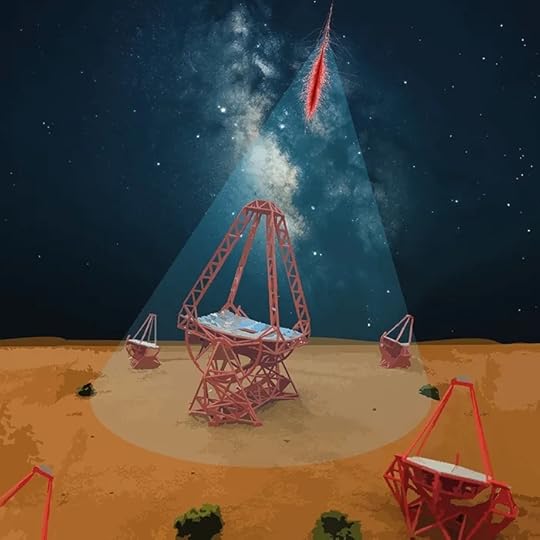
An artist’s illustration of a cosmic ray entering the atmosphere above H.E.S.S. (Image credit: MPIK/H.E.S.S. Collaboration)
As Cosmic Rays travel through space they lose energy interacting with magnetic fields and light. Thus, it is theoretically rare that very high-energy cosmic rays reach Earth.
A new observatory in Namibia -High Energy Stereoscopic System (HESS) is specialised for detecting cosmic rays by observing and analysing the Cherenkov radiation from showers of particles produced as the cosmic rays hit the atmosphere. Surprisingly they have detected electrons and positrons with such high energy (<40 TeV) that they must have originated nearby – calculated as within a few thousand light-years i.e. within the local part of our galaxy.
At present it is unknown what and where the source of these rays could be – they can be produced by highly energetic objects like supernovas and pulsars and presumably other unknown objects, but…
September 26, 2024
Black Hole Jets of Massive Size
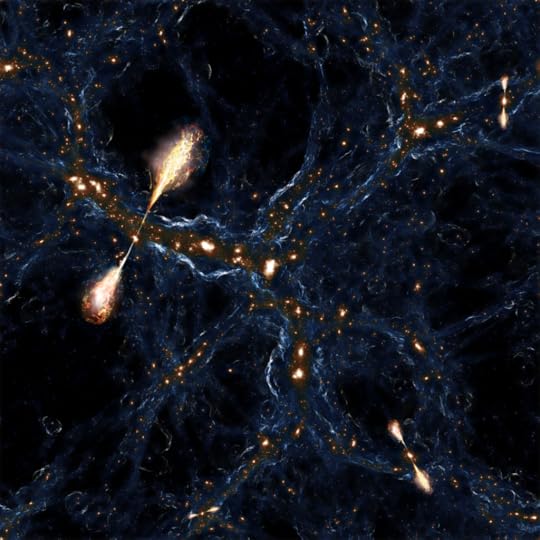
(Image credit: Martijn Oei (Caltech) / Dylan Nelson (IllustrisTNG Collaboration). Some details were made using AI.)
Starting with radio arrays, and then using a combination of telescopes, astrophysicists have discovered a large number of super-massive jets from black holes at the centre of old galaxies. The latest and biggest stretches for 23 million light-years – that is 140 times the diameter of our Milky Way, so that the jets extend into voids in the cosmic web, as depicted in the above artist’s impression. Discussion and research are now aimed at defining the role that these structures might have in the evolution of the universe, and in magnetisation of the web.
Dark Matter – made of lots of little black holes?
One of the perhaps least popular theories about the nature of dark matter is that it simply consists of lots of smallish primordial black holes – those that were created in the early stage of the universe, just within the first second or so after the big bang.
Now a publication has suggested that this theory could be tested – they estimate that the probability of such black holes passing through the inner solar system is in the region of once in a decade. Such a passage would give a tiny kick to the orbit of Mars – which would be measurable given that the orbit of Mars is known to a very high degree of accuracy. They will now trawl the data to look for such a deviation – but they will also have to rule out that the deviation was caused by an asteroid.
June 18, 2024
What created the heavier elements?
We are all fairly familiar with the idea that “in the beginning” there was only mostly Hydrogen and a little Helium, and that fusion in stars then creates other elements up to iron. That’s because fusing releases energy up to iron – whereas to make elements heavier than iron requires energy to be input. And, we are mostly familiar with the further paradigm that heavier elements are created in kilonovae and supernovae (technically the rapid neutron-capture process driven by their gamma ray bursts [GRB]).
But some doubt has now been cast on whether that last paradigm is sufficient… Kilonovae have been well studied – particularly one in 2017 – which confirmed the production of heavy elements. However, kilonovae are rare events – insufficient to account for the production of all heavy elements. What about the GRB from a supernova – well the “Brightest of All Time” was recently studied by the James Webb Space Telescope which found no evidence of heavy element creation!
So it is now thought that there must be another completely unknown source/process for the creation of heavier elements – in addition to the GRBs from kilonovae and supernovae.
October 7, 2023
A new Cosmic Mystery
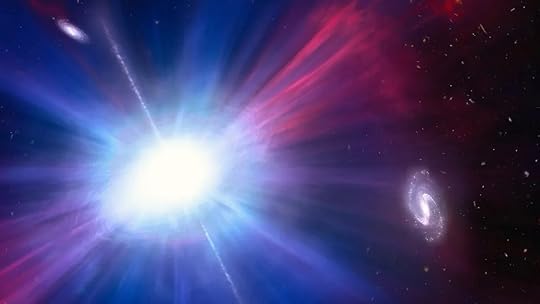 (Image credit: NASA/ESA/NSF’s NOIRLab/M. Garlick/M. Zamani)
Now that the mystery of FRBs (Fast Radio Bursts) has been largely explained, it’s satisfying to get a new Cosmic Mystery to wonder about.
This new one is called a Luminous Fast Blue Optical Transient (LFBOT). The first was observed in 2018 and new ones are observed at the rate of only about 1 per year. They are massive explosions but not typical of a supernova, being an order of magnitude or so brighter (in light, ultra violet, X-rays and radio waves but not gamma-rays) and lasting just a few days – whereas a supernova stays bright for weeks or months. Nor does the spectrum match a supernova – the latest was measured at 20,000 degrees Celsius – which is not as hot as some stars and way cooler than a supernova. The latest LFBOT was observed as not located in a galaxy – also surprising, and again mitigating against a supernova since a massive star ejected from the nearest galaxy would not live long enough to get to that observed position.
The two most likely theories are that either the LFBOT results from a star being ripped up by an intermediate-mass black hole, or that it results from a neutron star collision (kilonova) – unfortunately LIGO was not operating during the event so could not record any gravitational wave signature (thought it may have been too distant anyway).
July 5, 2023
The Gravitational Wave Background Detected
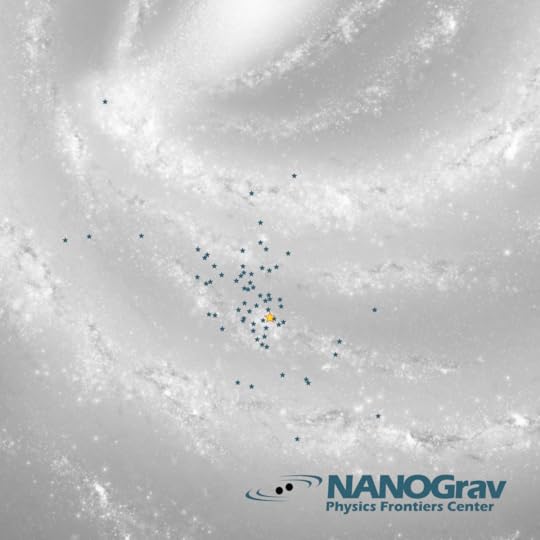
An illustration of positions of Milky Way’s pulsars included in NANOGrav’s 15-year dataset. Blue stars indicate pulsars, while the central yellow star represents Earth’s position. (Image credit: NANOGrav)
On Earth, gravitational wave detectors have in recent years enabled the detection of specific gravitational wave events such as mergers of black holes and neutron stars. However Earthbound detectors are nowhere near sensitive enough to detect a background of gravitational waves, though such background has been theorised.
Now, a collaboration worldwide has enabled detection of that background by an ingenious use of a “galaxy-wide antenna”. Observations of 70 pulsars in our galaxy over the last 15 years have amassed sufficient data to extract this background signal. These millisecond pulsars are dead stars that are spinning up to a 1000 times a second and send a pulse of light with each rotation – they are incredibly accurate clocks at different known places within the galaxy. If the space between Earth and the pulsar was empty and “still” then the pulse would be detected with total regularity. But gravitational waves lengthen and contract the space between us and them, and therefore lengthen and contract the time taken for the pulses to arrive.
It is the pattern in these timing-variations that has been teased out of the data which shows the gravitational wave background “hum” – it is presumed to arise from the mergers of supermassive black holes throughout space and throughout the age of the universe.
Mysterious Magnetic Pulses on Mars

It was previously though that Mars had no significant magnetic field. However, NASA’s InSight Mars Lander has found the surface magnetic field to be 20x stronger than expected. But even more mysteriously the magnetic field tends to fluctuate in strength or direction at precisely midnight (- that is Mars Lander’s midnight on Mars, not ours). The lander has also found an unexpected electrically conductive layer about 2.5 miles thick, well below the surface.
May 21, 2023
Unusual Star Statistics around Galaxy-Centre Black Hole
In our local environment, about 70% of stars exist as one of a binary system, and for massive stars the percentage is close to 100%. (Study of binary systems is done by observing the Doppler shift in their combined spectra.)
However, it has just been revealed that near the black hole at the centre of our galaxy, the percentage of stars as binary pairs is only about 47%. Moreover, most of the massive stars are singletons!
Even more strange, around half of these stars are very young – less than 6 million years old. They couldn’t have migrated to the black hole vicinity in that short a time-period, so there might be some unknown mechanism facilitating star formation in that relatively hostile environment.
The conjecture is that either the extreme gravitational effects are flinging the lost binary twin out of the vicinity, or causing the binaries to collide and merge into a single star – this would also make the star appear younger which might explain the “very young” anomaly described above.