Jean M. Roberts's Blog
October 10, 2026
The Ancient Roots of the Pentagram: A Symbol of Power, Protection, and Mystery

TheAncient Roots of the Pentagram: A Symbol of Power, Protection, and Mystery
Fewsymbols carry the history and mystery of the pentagram. Its five interwovenpoints appear in ancient inscriptions, medieval manuscripts, magical texts, andthe practices of modern witches. Today, it is often associated with witchcraftand pagan spirituality, but its story began thousands of years before themodern image of the witch took shape.
AnAncient Symbol
Thepentagram is a five-pointed star drawn with a continuous, interlacing line. Itsearliest known uses reach back to ancient Mesopotamia, where five-pointed starsymbols appeared in writing and on artifacts around 3000 BCE. The precisemeanings of these early symbols varied, and they should not automatically beunderstood as having the same magical significance the pentagram carries today.
Inancient Greece, the pentagram became associated with mathematics, harmony, andthe philosophical teachings of the Pythagoreans. They were fascinated by theproportions of the star, particularly the geometric relationships found withinits intersecting lines. For them, the pentagram could represent the order andharmony underlying the natural world.
Thesymbol also appeared in other ancient cultures, sometimes in religious orprotective contexts. Its meaning was never entirely fixed. Like many enduringsymbols, the pentagram gathered new associations as it passed between culturesand generations.
FromHarmony to Protection
 Overthe centuries, the pentagram acquired associations with health, protection, andspiritual power. In medieval Europe, it appeared in Christian as well asmagical contexts. Its five points could be interpreted as representing the fivewounds of Christ, while its geometric perfection lent itself to ideas of divineorder.
Thepentagram also became associated with protective magic. In medieval magicaltraditions, signs and symbols were sometimes used to guard against harmfulforces, and the five-pointed star could serve as an emblem of spiritualauthority or protection. Its meaning depended upon the text, practitioner, andcultural setting in which it appeared.
Itis worth remembering that the pentagram was not always considered a symbol ofwitchcraft. For much of its history, it existed across religious,philosophical, and magical traditions, without belonging exclusively to any oneof them.
Whenthe Pentagram Became a Witch's Symbol
 Theconnection between the pentagram and modern witchcraft developed over time,particularly through Western esoteric traditions of the nineteenth century andthe growth of modern Pagan religions in the twentieth century.
Occultwriters explored the relationship between the five-pointed star, the elements,the human body, and the spiritual world. In some systems, its five points cameto represent earth, air, fire, water, and spirit: the four classical elementsjoined by a fifth, unifying principle.
ModernWicca and other Pagan traditions helped establish the pentagram as one of themost recognizable symbols of contemporary witchcraft. When enclosed within acircle, it is commonly called a pentacle. The circle may be understood asrepresenting unity, continuity, protection, or the interconnectedness of life,although interpretations vary between traditions.
Thesymbol's reputation has not always been favorable. Popular culture hassometimes portrayed the pentagram as sinister or threatening, particularly wheninverted. Yet these associations do not tell the whole story. An uprightpentagram remains a meaningful and often sacred emblem for many modernpractitioners.
Whatthe Pentagram Represents Today
 Formany contemporary witches and Pagans, the pentagram is a reminder of therelationship between humanity and the natural world. Its five points mayrepresent the elements, while the enclosing circle suggests that all thingsbelong to a greater whole.
Forothers, it is a symbol of protection, balance, personal power, or spiritualidentity. Some wear it as jewelry, place it on an altar, or incorporate it intoritual practice. Others appreciate it as a reminder of the enduring humandesire to understand the mysteries of existence.
Thereis no single interpretation shared by everyone who uses the symbol. Its meaningis shaped by personal belief, cultural tradition, and spiritual practice.
Perhapsthis is part of what makes the pentagram so enduring. It has moved throughthousands of years of human history, gathering new meanings without entirelylosing its old ones.
Asymbol once explored through geometry and philosophy became associated withprotection, religious devotion, and eventually modern witchcraft. Today, it canserve as a reminder that the natural world is interconnected, that humanity ispart of something larger, and that some symbols continue to speak to us longafter the worlds that created them have vanished.
Forthe modern hedgewitch, the pentagram can be more than an emblem of witchcraft.It can be a small, enduring reminder of the old mysteries: the elements beneathour feet, the air we breathe, the fire that warms us, the water that sustainsus, and the spirit that binds the living world together.


October 9, 2026
Narcissi: A Novel by Babette Fraser Hale
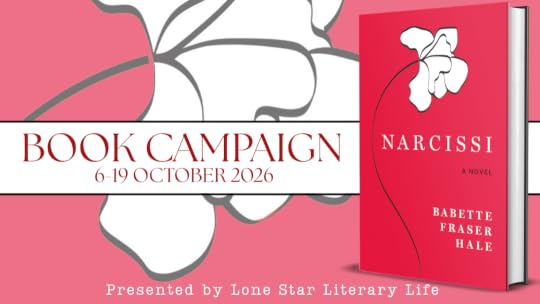
Narcissi: A Novel
By Babette Fraser Hale
Women’s Fiction/ Texas Fiction
Publisher: Winedale Publishing
Publication Date: October 15, 2026
SYNOPSIS
 Ten women fall for Cole Burnett, a traveling Texas writer. He is the kind of man whose need for freedom should send lovers running in the opposite direction. But he has a lanky charisma and the gift of listening, rare enough at any time. The women he encounters in Narcissi, a novel-in-stories, find his attention compelling, and they all get hurt, or cause hurt. But hurt is never the whole story.
Each woman brings her own complicated life into her time with Cole, conflicts with husbands, traumas survived, needs postponed, children. And children grow up with questions.
Burnett understands that loneliness compels him toward the women he meets. But none of them seems to reach where the loneliness resides, where whatever’s missing pushes him to keep moving, to find a purpose for his future. Later, after the death threat, traveling becomes a way to stay alive.
CLICK TO PURCHASE
Amazon ◆ Barnes& Noble ◆ TAMU Press ◆ Brazos Bookstore


ABOUT THE AUTHOR

Babette Hale is the author of A Wall of Bright Dead Feathers, winner of the 2022 Troncoso Award for debut fiction from the Texas Institute of Letters, and a memoir, This Familiar Heart, about her relationship with her late husband, Leon Hale. In addition to writing fiction, she has been a magazine feature writer, columnist, book editor, publisher and part owner of a bookstore. She lives in Texas and is a member of the Texas Institute of Letters.
REVIEW
ShortStory: Howfar can a man run before he finds the right woman?
Wefirst meet Cole Burnett, Texas writer and novelist, as he’s sneaking out of thehouse he shares with his second wife. He’s afraid of her, and probably withgood reason. He’s in his sixties, has only a typewriter and a talent forpenning interesting stories. He doesn’t sound like much, but he does have onething than most men lack: an effortless charm that boldly proclaims, I’minterested in you, you matter, and I want to hear your story. Women eat it up.Cole makes no outright promises, so whether it’s the right diet for them it is for hispartners to decide.
Coleis a complicated man who, surprisingly for a man of his age, still doesn’t knowwhat he wants and sometimes those who love him pay the price. He could be aloyal lifelong friend but he can also be a coward who strings along womenbecause he can’t bring himself to hurt them until he does.
Thestory is told from both viewpoints; Cole’s and the women he meets. Some arebrief hookups, some of the women actively pursue him. He just seems happy to goalong for the ride. I am glad we got the woman’s perspective of therelationship, how they viewed him and how he fit into their lives.
Ienjoyed riding along with Cole as he cruised around the state, looking for anew story. His interest in birds, country roads, nature and all the littlethings that make Texas well, Texas was great, but it’s a lonely story. I foundCole a lost and rather sad man-child, using women to keep the night at bay.That doesn’t make him a bad man. They used him as well, but it did make himfeel kinda pathetic.
Iwasn’t sure what to think when I started the book, but I really enjoyed it. Ithas a slow easy pace and you really get to know the characters. The ending issatisfying as Cole finally slows down long enough to realize the heart wantswhat the heart wants and for once he gets it.
Irecommend this to readers who enjoy a deep dive into a complex emotionalcharacter.
To learn more about the book, look for #LSLLNarcissi on your preferred social media platform.
CLICK TO VISIT THE LONE STAR LITERARY LIFE CAMPAIGN PAGE
FOR DIRECT LINKS TO EACH REVIEWER PARTICIPATING.

October 3, 2026
Samhain: The Ancient Celtic Festival

Samhain:The Ancient Celtic Festival of the Dead
Asautumn deepens and the nights grow longer, we approach Samhain, one of the mostsignificant seasonal festivals in the Celtic calendar. Rooted in the ancienttraditions of Ireland and other Celtic-speaking regions, Samhain marks the endof the harvest, the beginning of winter, and a time when the boundary betweenthe living and the dead was believed to grow thin.
WhoCelebrated Samhain?
Samhainwas observed by the ancient Celtic peoples, particularly in Ireland, Scotland,and parts of Britain. For these communities, the turning of the seasons wasmore than a change in the weather. It marked a fundamental shift in the rhythmof life, when the abundance of summer gave way to the hardship and uncertaintyof winter.
Thefestival was associated with the supernatural, the spirits of the dead, andotherworldly beings. In Irish tradition, Samhain appears in medieval literatureas a time of great gatherings, feasting, and encounters with the Otherworld.
WhatWas Samhain?
Samhainmarked the end of the pastoral year, when livestock were brought in from summerpastures and some animals were slaughtered to provide food through the winter.The final harvests were gathered, stores were prepared, and communities facedthe long, dark months ahead.
Itwas also a time of spiritual significance. Folklore associated Samhain with theaos sí, the supernatural beings of Irish tradition, and with the returnof the dead. Bonfires, feasting, offerings, and protective customs became partof the festival's wider traditions, although specific practices varied acrosstime and place.
Whereand When Was It Celebrated?
Samhainoriginated in the Celtic world, with particularly strong associations inIreland and Scotland. Traditionally, it began at sunset on October 31 andcontinued into November 1, following the ancient custom of counting a new dayfrom sundown.
Ratherthan being a single, uniform celebration, Samhain traditions evolved overcenturies. Much of what we know about early Celtic seasonal festivals comesfrom medieval Irish texts and later folklore, so it is worth remembering thatnot every custom associated with modern Samhain can be traced directly toancient times.
HowIs Samhain Celebrated Today?
Today,Samhain is celebrated by many modern Pagans, Wiccans, witches, and others drawnto the old seasonal traditions. For some, it marks the final harvest and theturning of the Wheel of the Year. For others, it is a sacred time to rememberancestors, honor the dead, and reflect on the cycles of life, death, andrenewal.
Moderncelebrations may include lighting candles for departed loved ones, preparing anancestor altar, sharing a seasonal feast, telling traditional stories, makingofferings, or sitting quietly in remembrance. Some practitioners lightbonfires, gather autumn herbs, carve pumpkins, or perform rituals forprotection and release.
Manyalso observe Samhain as a time for divination and introspection, when thedarkening landscape invites us to turn inward and consider what we wish toleave behind as the year draws to a close.
Samhainhas also influenced Halloween, which developed through a complex blending ofolder seasonal customs, Christian observances, and later folk traditions.Although Halloween and Samhain are not identical, both carry echoes of theancient association between autumn, the dead, and the mysterious things thatemerge in the darkness.
Asthe last leaves fall and the garden settles into winter, Samhain offers amoment to pause between what has passed and what is yet to come. Whethercelebrated through ancient-inspired ritual or quiet remembrance, it remains apowerful seasonal observance, reminding us that darkness is not simply anending, but part of the natural cycle of renewal.
September 29, 2026
Autumn Healing Herbs from the Hedgewitch's Journal
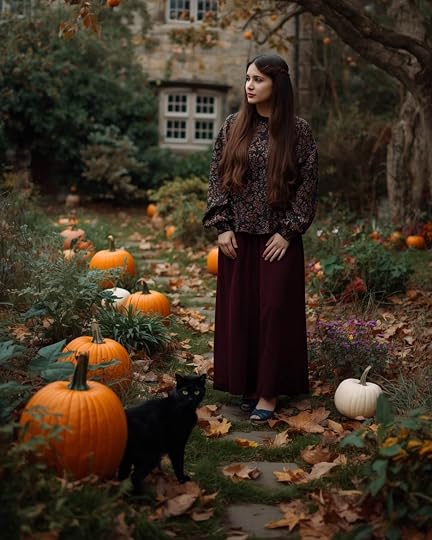
From the Hedgewitch's Journal: AutumnHealing Herbs
Autumnis the season when the hedge gives up some of its secrets. The bright abundanceof summer begins to fade, the leaves darken, and the plants that remain seem tobelong to an older, quieter kind of magic. A hedgewitch gathering herbs inautumn would have known that the changing season brought its own ailments:coughs brought on by damp weather, aching joints, tired bodies, troubled sleep,and the first chill of winter settling into the bones.
Someof the most useful plants of the season are not the ones that immediately cometo mind when we think of a healing herb. They are humble plants, growing alongroadsides, hedgerows, woodland edges, and forgotten corners of the garden.Their medicine is gentle, practical, and deeply connected to the turning year.
Elder
 Elder has long carried an air ofmystery in European folklore. Its flowers appear in summer, but its darkberries arrive as the year begins to turn toward winter. The plant wasassociated with protection, spirits, household magic, and healing, making it particularlyappropriate for the hedgewitch's autumn gathering basket.
Elderberrieshave traditionally been prepared into syrups, wines, and other preparations.They have a long history in European folk medicine, particularly in remediesfor seasonal respiratory complaints. The raw berries should not be eaten inquantity, however, and properly prepared elderberry is preferable to raw orundercooked berries.
Mullein
 Mulleinis one of those plants that looks almost enchanted when encountered along anautumn road. Its tall flower stalk and soft, silvery leaves give it anotherworldly appearance, and its association with the respiratory system hasmade it a familiar plant in traditional herbalism.
Theleaves and flowers have been used traditionally in preparations intended tosoothe coughs and irritated throats. A hedgewitch might have valued mullein notbecause it was exotic or rare, but because it was readily available and couldbe gathered from the wild. Its soft leaves also made it a remarkably usefulplant for practical household purposes.
Agrimony
 Agrimonyis a less celebrated herb today, but it once had a respectable place inEuropean herbal tradition. Its small yellow flowers grow along roadsides, fieldedges, and hedges, and the plant was traditionally gathered for preparationsassociated with sore throats, coughs, digestion, and minor wounds.
Agrimonyalso carries a touch of old folklore. Medieval and early modern herbaltraditions sometimes attributed protective or almost magical qualities toplants that were considered especially useful. Its reputation reminds us thatthe old herbalist did not necessarily separate medicine from magic as neatly aswe tend to do today. A plant could be valued for what it did to the body andfor the stories attached to it.
Meadowsweet
 Meadowsweetis another plant with an old relationship to healing. Its creamy flowers appearin summer, but its presence in traditional European herbalism makes it worthremembering as the seasons change. It has been used historically for aches,fevers, and digestive complaints, and its pleasant scent made it useful inhousehold preparations as well.
Thereis something particularly fitting about meadowsweet for an autumn journal. Itbelongs to that world where medicine was gathered from the landscape ratherthan purchased from a shelf. A woman who knew her local plants would havecarried an intimate knowledge of which herbs grew where, when they flowered,and which parts were useful.
Rosehip
 When the roses have finishedblooming and their petals have fallen, the hedge is left with somethingunexpected: brilliant red rosehips glowing among the fading leaves. Theseautumn fruits were valued as a source of nourishment and have traditionally beenused in preserves, teas, syrups, and other preparations.
Rosehipsare especially rich in vitamin C, although preparation and storage can affecttheir nutritional content. They are a reminder that the hedgewitch's medicinewas not always about curing illness. Sometimes it was simply about preparingthe household for the difficult season ahead.
TheAutumn Hedgewitch's Basket
Anautumn gathering basket would have contained more than herbs. It carriedknowledge of the landscape and an understanding of the seasons. The hedgewitchknew that summer plants were disappearing and winter was approaching, and shegathered accordingly.
Therewas medicine in the hedgerow, but there was also memory. The same plants mighthave been gathered by a grandmother, taught to a daughter, and eventuallypassed to another generation. Their names could change, their stories couldbecome tangled with Christian prayers or older folklore, and their uses couldshift over time, but the plants themselves remained rooted in the same earth.
Perhapsthat is one of the oldest forms of magic: knowing what grows around you,knowing when to gather it, and remembering what those who came before you knew.
Anote from the Hedgewitch Journal:Traditional herbal knowledge is not automatically safe simply because it isold. Some plants can interact with medications, cause allergic reactions, orbecome toxic when prepared incorrectly. Research each herb carefully and usemodern herbal-safety guidance alongside historical sources.
September 21, 2026
Rocket Girl by Diane Vallere a Review

RocketGirl by Diane Vallere
TheShort Story: A super blend of historical fiction and murder mystery
It’s1961 and Kick Johnson, a young woman, recently widowed, is left with a mortgageand a car payment, and is in desperate need of a job. Despite her lacklusterskills, she applies for a secretarial position at the Center for Rocket ScienceResearch and to her delight, gets hired as a math aide doing research for NASA andthe space program. Unfortunately. on her first day of work, she all but tripsover a dead body, that of an engineer, but one she recognizes under puzzlingcircumstances. Of course, she has to investigate!
Ireally enjoyed this book, part murder mystery, part historical fiction, andpart women’s fiction. The book is set in the 1960s Dallas and the space race hasreached a fevered pitch. It has a Hidden Figure’s vibe as women do the gruntwork of working out highly complex equations for the engineers. I thought theauthor nailed the setting right, the social norms and attitudes of the era, andit’s clear that a ton of research went into this book.
Iloved the MC, Kick Johnson. She’s theright amount of spunk, while still fitting in with her time. After her briefmarriage, she comes to realize it was not really what she wanted. She’s slowlylearning who she is, what she wants from life and love and how to reach her goals.She has to fight the suffocating expectations of women and push through thebarriers erected to keep them boxed in, while blazing her own trail. It’salmost like a coming-of-age story for her.
Ihighly recommend this book to lovers of historical fiction and historicalmysteries. I look forward to the next book in the series.
Igive this book ⭐⭐⭐⭐⭐stars
September 18, 2026
Vacancy by Jann Alexander: Review and Giveaway
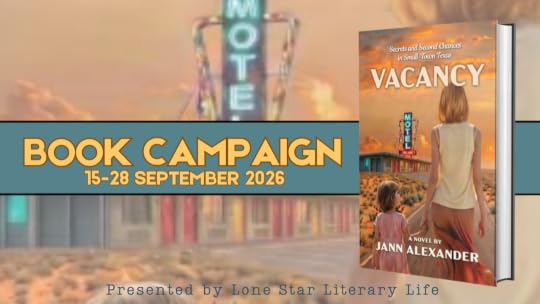
VACANCY: Secrets and Second Chances in Small Texas Town
By Jann Alexander
Women’s Fiction / Mystery and Crime
Publisher: Black Rose Writing
Publication Date: September 24, 2026
SYNOPSIS
 A struggling single mother and a suspicious widow, at odds. Both have a habit of hiding from hard truths.
INSPIRED BY REAL EVENTS
Helen is childless and widowed after a long marriage and gets a second chance with a long-lost love. But she’s grieving her hidden regrets. She bonds with her quiet kindergarten student and doubts the girl’s struggling single mother, Charlene, is fit to parent.
Charlene’s hiding a secret of her own, and she resents Helen’s interference. She’s determined to make a better life for her young daughter, the teenage boy her ex left behind, and the baby on the way when a scarred veteran offers to lend a hand.
A tragedy no one sees coming forces the two women to unite, as small-town bias threatens to destroy innocent lives. But first, Helen and Charlene must confront the vacancy in their hearts. As they do, can they find new strength, acceptance, and a second chance at love?
CLICK TO PURCHASE
Amazon ◆ Barnes & Noble ◆ Bookshop.org


ABOUT THE AUTHOR
 Jann Alexander is an author, photographer, and public speaker on all things Texas history. She's a 22-year resident of central Texas and creator of the Vanishing Austin photography series. Her lifelong storytelling habit and her more recent passion for Texas history merged in 2025 to become the historical novel Unspoken, set in the Texas Panhandle during the Dust Bowl and Great Depression, and is her first book in The Dust Series. Vacancy, releasing in September 2026, is the second novel in the series. She holds a B.S. from the University of Maryland. When Jann is not reading, writing, or creating, she bikes, hikes, skis, and kayaks. Jann always brakes for historical markers.
 WEBSITE ◆ BLUESKY ◆ INSTAGRAM ◆ BOOKBUB
AMAZON ◆ GOODREADS ◆ FACEBOOK ◆ YOUTUBE
REVIEW
Helenis a middle-aged schoolteacher. She is processing her life and marriage afterthe unexpected death of her husband, sorting out her feeling for him in whatseemed to have been a cold marriage to a much older man. She becomes attachedto one of her students, Jilly, whose mother is not living up to Helen’sexpectations.
Charlene,the young mother of Jilly, is barely keeping her head above water. Her partneris an abusive alcoholic with a fifteen-year-old son. Without the help of loyalfriends, she’d lose everything.
Whentragedy strikes, Helen and Charlene must work through their problems, prejudices,and preconceptions to survive their emotional trauma.
Ireally enjoyed this book by Jann Alexander, the first I’ve read from her. Thefar West Texas setting, the building tension, and the excellent characterdevelopment gives life to this story of women trying their best to do the rightthing, stumbling, falling but never giving up. It’s also a story about secondchances and finding love where you can at any age.
Iadmit I was not quite prepared for the ‘tragedy’ and was pretty taken aback, butit worked really well as a catalyst. The resolution was satisfying for bothHelen and Charlene, which added a happy ending to a sad story.
Irecommend this book to readers who enjoy women-centered stories about strength,resilience, forgiveness, and empowerment.
Igive this book: 5 ⭐⭐⭐⭐⭐
To learn more about the book, look for #LSLLVacancy on your preferred social media platform.
CLICK TO VISIT THE LONE STAR LITERARY LIFE CAMPAIGN PAGE
FOR DIRECT LINKS TO EACH REVIEWER PARTICIPATING.

From the Hedgewitch’s Journal: Mabon a Modern Take on Ancient Autumnal Celebrations

Fromthe Hedgewitch’s Journal: Mabon a Modern Take on AutumnalCelebrations
Mabonand the Old European Autumn
 Today,many witches celebrate Mabon at the autumnal equinox—a season ofharvest, balance, gratitude, and the slow descent into darkness. But Mabon isnot an ancient European festival by that name. The term was popularized inmodern Paganism in the 20th century.
Thatdoesn't mean the season was without meaning to earlier Europeans. Quite theopposite. Autumn was a powerful threshold: grain had been gathered, fruitsripened, livestock prepared for winter, and the days were visibly shortening.Across Europe, communities marked the harvest through feasting, offerings,processions, fires, and customs surrounding the last sheaf or the final fruitsof the field.
Thefascinating question is how much of this can actually be connected to theequinox itself.
Sometraditions provide strong evidence for ancient or medieval harvest customs,while others are much more speculative. The further we move backward in time,the more careful we have to be about calling something an “equinoxcelebration.” A harvest festival occurring around the autumn equinox isnot necessarily evidence that people were celebrating the astronomical equinox.
Tradition / Culture
Evidence for Autumn Equinox Celebration
Confidence
Mabon
Modern Pagan observance dating from the 20th century
🟢 Certain
Ancient Greek autumn festivals
Festivals connected to harvest and agricultural cycles, but not securely identifiable as equinox festivals
🟡 Possible
Roman harvest traditions
Strong evidence for agricultural and harvest observances; direct equinox connection is uncertain
🟡 Possible
Celtic harvest traditions
Strong evidence for seasonal harvest customs, particularly Lughnasadh and later harvest traditions, but the equinox connection is uncertain
🟡 Possible
Anglo-Saxon / Germanic traditions
Evidence for seasonal and agricultural observances, but no secure evidence for a named autumn equinox festival
🟠 Uncertain
Irish and Scottish folklore
Abundant later folklore surrounding harvest, thresholds, and the changing season; ancient equinox observance cannot be established with confidence
🟠 Uncertain
 Thedistinction matters because it is tempting to look backward and assume thatmodern Pagan holidays simply preserve an unbroken ancient calendar. Thehistorical evidence is rarely that simple.
Whatdoes seem remarkably ancient is the human response to this particularmoment of the year.
Theequinox brings a literal balance between light and darkness. Afterward,darkness begins to claim more of the day. For agricultural societies, this wasalso the time when abundance began its transformation into preparation: foodwas stored, animals were considered, seeds were saved, and people looked towardwinter.
Perhapsthat is why modern Mabon resonates so strongly with older European traditions.Even when we cannot prove that a particular ancient people celebrated theequinox itself, we can see the same seasonal themes emerging again andagain—harvest, gratitude, endings, preparation, and the knowledge that nothingremains in summer forever.
Mabonmay be modern.
Butthe feeling of standing at the edge of autumn is very, very old.
September 15, 2026
And the Walls Came Tumbling Down by WM Gunn

AND THE WALLS CAME TUMBLING DOWN
By W.M. Gunn
Alternative History/ Historical Fiction/ Family Saga
Publisher: Atmosphere Press
Publication Date: August 11, 2025
SYNOPSIS
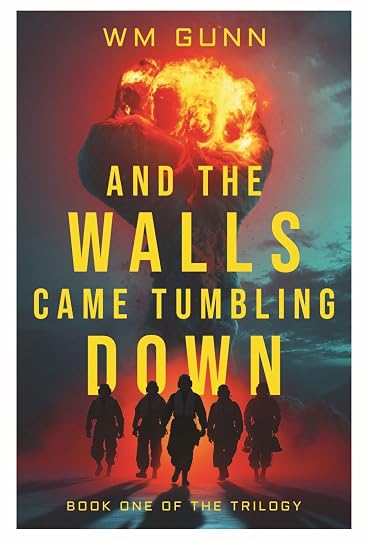
And the Walls Came Tumbling Down reimagines the twentieth century as it might have unfolded if fate had shifted—and mercy had not.
Two families, one American and one German, collide across World War I, the Great Depression, and a radically altered World War II, shaped by hatred, sacrifice, and forces that feel uncomfortably divine. As twin brothers choose opposing paths within Nazi Germany and a Texas farm boy takes to the skies, history veers off course. D-Day collapses in disaster. Britain faces annihilation. Volunteer pilots launch desperate missions, and a single flight toward Berlin carries the weight of ending the war at an unimaginable cost. Biblical echoes of Jericho haunt every turning point, raising unsettling questions about destiny, justice, and intervention.
Blending military history, family saga, and psychological tension, this gripping alternative history challenges readers to ask what if history changed, and what the cost of that change would be.
CLICK TO PURCHASE


ABOUT THE AUTHOR
 WM Gunn is a native Texan who spent many years in the pharmaceutical industry and is now focused on writing. He is active in writing groups and volunteering with non-profit groups. He lives in his hometown in Texas with his high school sweetheart bride of many years. To date, he has published hundreds of short stories, two novellas, and two full-length novels. Holmes, Moriarty, and the Monkeys and Chasing the Sun were two novellas released in 2024. His debut novel, The Two Terrors of Tulelake, was released in 2024. The Calendar was his next novel, published in 2025. Now, And The Walls Came Tumbling Down, the first book in an exciting trilogy, will be published in September.
WEBSITE ◆ INSTAGRAM ◆ YOUTUBE ◆ FACEBOOK ◆ BOOKBUB ◆ AMAZON ◆ GOODREADS ◆ NEWSLETTER
REVIEW
And the Walls Came Tumbling Downby WM Gunn.
The short story: Highly detailedalternative WWII history
And the Walls Came Tumbling Downis a condensed history of WWII that begins in the dying days of the Great War.Immediately the author introduces an element of paranormal influence on theoutcome of the war. In its aftermath, we meet Manfred and Wolfgang Kretz, twinsons of a WWI flying ace who are raised by their Jewish grandparents and Allen Maxwell,a Texas boy reared by a single father with a passion for flying. We follow theboys as they become young men, Wolfgang and Manfred traveling vastly differentroads. Each resolved to fight for their country for their own reasons, culminatingin an eventual showdown.
Each chapter is a snapshot of amoment in history from the war years, focusing mainly on the European Theaterand the creation and detonation of the atomic bomb. Many chapters heavily ladenwith historical figures, weaponry, and technical jargon, which I found weighed downthe actual plotline. I admit to skimming some details to get to the meat of thestory. I especially enjoyed the chapters that focused on the individuals ratherthan on a particular battle. I thought the death of Wolfgang and Manfred’s grandparentsin a concentration camp particularly touching.
In Gunn’s alternative history,the Normandy invasion is a disaster for the Allies, losing hundreds ofthousands of men. This loss set the German brothers on a collision course withAllen Maxwell, the Texan pilot who had risen through the ranks and is taskedwith a heartbreaking solution to the bombing of London.
I enjoyed the book, and beingfamiliar with the real historical details, was intrigued to see where Gunnwould take his readers in his ‘what if’ story of the war. I think readers whoenjoy military history and alternative military history would really love thisbook.
I give this book 4 ⭐⭐⭐⭐
To learn more about the book, look for #LSLLAndtheWallsCameTumblingDown on your preferred social media platform.
CLICK TO VISIT THE LONE STAR LITERARY LIFE CAMPAIGN PAGE
FOR DIRECT LINKS TO EACH REVIEWER taking part.

September 5, 2026
From the Hedgwitch's Journal: When the Old Gods meet the New Religion and the Hedgewitch
.png)
Whenthe Old Gods Met the New: Healers, Cunning Women, and the Changing Faith ofMedieval England
Longbefore the word “witch” carried the dark meaning it would acquire in latercenturies, women who knew the properties of plants, understood childbirth,treated wounds, and tended the sick occupied an important place in theircommunities. They might be called healers, wise women, cunning women, or simplylæce—a word associated with healing. Their knowledge was practical,inherited, local, and often deeply intertwined with the spiritual world.
Butthe faith of the people who practiced these traditions was changing. AsChristianity spread through Anglo-Saxon England, older Germanic beliefs did notsimply vanish. Instead, Christian prayers, biblical figures, pagan ideas, plantlore, charms, ritual actions, and older concepts of supernatural illness couldexist side by side. The surviving medical manuscripts offer a remarkableglimpse into this complicated religious landscape.
.png) Oneof the most important sources is Bald's Leechbook, a tenth-centurycollection of medical remedies preserved in Old English. It contains recipesfor everything from wounds and infections to digestive problems, fevers, eyeailments, and women's illnesses. Some remedies are recognizably herbal andpractical, while others include spoken charms, ritual actions, amulets, orreligious invocations. The manuscript belongs to a Christian literary culture,yet it preserves material that reaches back into much older traditions.Scholars have also identified evidence of cultural exchange with Irish andLatin medical traditions within the Anglo-Saxon healing corpus.
Oneof the most important sources is Bald's Leechbook, a tenth-centurycollection of medical remedies preserved in Old English. It contains recipesfor everything from wounds and infections to digestive problems, fevers, eyeailments, and women's illnesses. Some remedies are recognizably herbal andpractical, while others include spoken charms, ritual actions, amulets, orreligious invocations. The manuscript belongs to a Christian literary culture,yet it preserves material that reaches back into much older traditions.Scholars have also identified evidence of cultural exchange with Irish andLatin medical traditions within the Anglo-Saxon healing corpus.TheLacnunga, meaning “remedies,” takes this mixture even further. Compiledaround the late tenth or early eleventh century, it contains medical recipes,prayers, charms, herbal knowledge, and ritual instructions. It is particularlyfamous for the Nine Herbs Charm, one of the most intriguing survivingexamples of Anglo-Saxon healing. The charm names nine plants and gives thempowers against illness and poison, while also invoking Woden. Yet Christianelements appear within the same healing tradition. The result is neither simplypagan nor simply Christian. It is a record of people attempting to understandand combat illness using every source of power available to them.
TheNine Herbs Charm is especially revealing because Woden and Christ appearwithin the same broader healing tradition. Woden is associated with the defeatof a serpent, while Christ is invoked elsewhere in the charm. The text waspreserved in a Christian manuscript, and scholars continue to debate exactlyhow its pagan material should be understood. Rather than imagining a cleandividing line between “pagan magic” and “Christian medicine,” the manuscriptsuggests something much more complicated: old ideas could be retained,transformed, or placed within a Christian understanding of the world.
Thesame blending appears in other remedies. A healing recipe might begin withherbs and a physical treatment and then require prayers to be spoken over themedicine. One Anglo-Saxon medical recipe, for example, instructs the healer tosing Christian prayers including the Benedictus, the Magnificat,and the Credo, along with an invocation of the four Evangelists, beforeapplying the remedy. Here the plant, the preparation, the spoken word, andChristian prayer all become part of one act of healing.
Thistells us something important about the women and men who practiced healing.Their worldview was not necessarily divided into the categories we use today. Aperson could believe that a particular plant possessed a special power becauseof its nature, inherited lore, or relationship with the supernatural world,while also believing that God ultimately possessed the power to heal. A spokencharm could be accompanied by the sign of the cross. A herbal remedy could beprepared according to generations-old custom and then blessed with Christianprayer.
Evensupernatural explanations for illness could become Christianized. SomeAnglo-Saxon charms speak of elves or other supernatural forces as causes ofsickness, yet Christian prayers and the Mass could be employed to drive thoseforces away. One influential study of the charms argues that these texts shouldnot automatically be regarded as surviving pieces of pagan religion; instead,they can reveal how older popular traditions were incorporated into a Christianworldview.
.png) Theevolution was not always peaceful or seamless. By the time of the BenedictineReform in the tenth and eleventh centuries, learned churchmen increasinglydistinguished legitimate læcedom, or learned healing, from practicesdescribed with words such as galdor and drycræft, which couldcarry associations with charms or sorcery. Some of the practices that had oncebeen part of ordinary healing could therefore acquire a more suspiciousreputation, particularly when associated with women.
Theevolution was not always peaceful or seamless. By the time of the BenedictineReform in the tenth and eleventh centuries, learned churchmen increasinglydistinguished legitimate læcedom, or learned healing, from practicesdescribed with words such as galdor and drycræft, which couldcarry associations with charms or sorcery. Some of the practices that had oncebeen part of ordinary healing could therefore acquire a more suspiciousreputation, particularly when associated with women.Yetthe manuscripts themselves preserve the evidence of this older world. The OldEnglish Herbarium, Leechbook III, Bald's Leechbook, and the Lacnungaall demonstrate that medieval healing was an extraordinary mixture of inheritedplant knowledge, classical medicine, folk traditions, ritual, prayer, andChristian theology. Four major medical collections from Anglo-Saxon Englandsurvive, and scholars increasingly view them not simply as collections ofprimitive folk remedies but as products of learned literary and ecclesiasticalculture.
Perhapsthis is where the idea of the medieval cunning woman becomes most interesting.She did not necessarily stand outside Christianity, nor did becoming Christianrequire her to forget everything her grandmother had taught her. The hedge, theherb garden, the household shrine, the spoken charm, the prayer, and thehealing recipe could occupy the same spiritual landscape.
Theold ways did not simply disappear. They changed names, acquired new prayers,lost old gods, gained saints, and sometimes survived quietly inside Christianpractices. A healing woman might reach for mugwort, whisper an inherited charm,invoke Christ, and trust the remedy all at once.
Forcenturies, this blending of traditions was simply part of how people understoodsickness, nature, faith, and healing. It is only from a much later perspectivethat we try to separate these practices into neat categories such as “pagan,”“Christian,” “medicine,” or “magic.” The manuscripts tell a more complicatedstory—and perhaps a more human one.
Themedieval healer lived in a world where the sacred was everywhere: in the herbgathered from the roadside, the spoken word, the turning of the seasons, thechapel bell, the written prayer, and the mysterious powers believed to movethrough the natural world. Her faith, like her medicine, was somethinginherited, adapted, and continually transformed.
Buried Dallas-Ft. Worth : A Review

There was a time when graveyards were a part of the community. Not just a place to bury the dead, but to remember, commemorate, and celebrate. Families would take an evening stroll or have an afternoon picnic amongst the stones. Forest Hills Cemetary in Boston, where my grandparents are buried, is full of sculptures, fountains, and other works of art. It is a destination, not a place to be avoided.
Graveyards are also a source for history and lord knows Texas has its share of heroes and villains. Texas boneyards are full of politicians who shared our state, murderers and their victims, rogues, celebrities, and of course the average everyday joes.Snider's book profiles multiple cemeteries around the Dallas-Ft. Worth area complete with photos, directions and bios of some of their most interesting burials. This is a great travel companion if you're out and about and pass one of these spots or make a day trip to visit one or more.I really enjoyed the book and would recommend it to lovers of Texas history and those who like to visit unusual places.
I give it five ⭐⭐⭐⭐⭐