Meaghan Wilson Anastasios's Blog
April 24, 2026
Understanding Anzac Day: Lessons from Gallipoli
 ANZAC graves, Gallipoli. Photo: M. Wilson Anastasios
Want to understand Australia?
Then find your way down to a local war memorial before dawn on the 25th of April.
Anzac Day.
As you stand there in a sombre huddle with a group of people gathered beneath an Australian flag unfurling in the morning breeze, the sun will peek above the horizon, and a lone bugle will play the Last Post.
There will be tears.
And you need to remember one thing.
Anzac Day is Australia’s most significant national holiday. And you’re there to commemorate an epic military failure.
Yes, you read that correctly.Anzac Day recalls the day our soldiers were handed their backsides on a plate by a Turkish army hellbent on defending its homeland.
If you can begin to unpick whatever the fuck that says about us, you’ll find yourself much closer to understanding the things that make us who we are as a nation.
This is all said with the caveat that what I’m talking about here is post-European Australia. Not the mind blowingly expansive history of the First Australians who have called this place home for at least 65,000 years.
They have their own origin stories. And they’re a hell of a lot older than the ones I’m talking about.
This is the story of the birth of modern, post-colonial Australia, and the forging of the Anzac legend.
It’s a story I have a personal connection to. And probably not in the way you imagine.
Disclaimer: I’ve got skin in this game.A little while ago, I wrote a novel that became a bestseller, based on a script my husband had written. That script was picked up by Russell Crowe. It became the film, “The Water Diviner.”
It came about after my husband and I spent a huge amount of time in the place now known as Türkiye working as archaeologists when we were younger (a story for another time).
But it took a while for us to find our way to the place that’s as close to a pilgrimage site as any for young Australians.
As I watched busloads of Aussie tourists take off for day trips to the memorial park in the Dardanelles where the ANZAC troops landed, I was a Gallipoli sceptic. It had a whiff of nationalism and jingoism that didn’t sit well with me.
But one year, we happened to be passing by on the way to visit a friend in the beautiful seaside village of Assos. So, we took the plunge.
My only regret was that I hadn’t done it sooner.
What I saw there changed me forever. Because it helped me understand why that place is so important to us as a nation, and how it helped shape our identity.
The year is 1914.When Britain declared war on the 4th of August, 1914, it was only 13 years since Australia had federated. Although independent in many respects, we remained part of the British Empire, and we considered ourselves at war too, even though the frontline was half a world away.
When King George V called for volunteers, hundreds of thousands of young men across the continent saw it as a chance to see the world.
By the end of the war, one in ten Australians had enlisted to serve.
Australian soldiers would go on to distinguish themselves on the Western Front, and in Palestine and the Sinai.
But it would be a battle that ended in tragedy and defeat, at the place in Turkey known in Greek as “beautiful city”—Kallipolis, or Gallipoli—that would come to define us as a nation.
“The adventure of a lifetime.”It certainly would be that.
But not as they pictured it.
Jim Martin was born on the 3rd of January, 1901, just two days after the Federation of Australia itself.
By 1915, Jim was 14. And he was about to lie about his age.
Who hasn’t bullshitted to get into a club, or buy a slab of beer, right? I know I have. But Jim Martin lied to go to war.
His mother begged him not to.But he did it anyway. Because, kids.
It was April 12, 1915, when he fronted up to the enlistment office to join up.
After a month or so training, he was shipped off to Egypt, and from there, he was sent to Gallipoli.
At 2.00am on the 8th of September, Jim landed in Anzac Cove. He went with his platoon to a battlefield that was locked in a brutal and bloody stalemate.
Jim would later write to his family that they shouldn’t worry, because “I am doing splendid over here.”
For that, I read: “Yeah, whatever, mum. You’re worrying about nothing. I’ll be right.”
Because what kid of 14 wants to admit that maybe mum was onto something?
Playthings of EmpireBritain had its eyes on Turkey for a number of reasons.
For a start, the man who was First Lord of the Admiralty, in his first outing at the helm of power, Winston Churchill (yes, that Winston Churchill), wanted to get his hands on the Ottoman Empire’s oil fields. If British troops took the Gallipoli peninsula, it was a short hop to Istanbul, then known as Constantinople.
And then there was Russia. Turkey had a stranglehold on the Dardanelles Strait (yes, Straits have been causing trouble for a very long time) that cuts its way between the European and Asian continents and feeds from the Black Sea into the Mediterranean. That meant Russia’s Black Sea fleet couldn’t join forces with its allies in the Med and, beyond that, the Atlantic.
A plan was laid. And troops were sent into action. Their mission was to seize the northern side of the strait.
Problem is that it was a shitty plan.It was also overseen by armchair warriors.
One in five of the 75,000 soldiers who landed in the Dardanelles on April 25 were from Australia and New Zealand. The Australian and New Zealand Army Corps… ANZAC.
Amongst those soldiers were Indigenous Australian troops who hid their ethnicity to sign up, because as non-citizens (yeah—don’t get me started), it was illegal to enlist.
But the ANZACs were sent on a fool’s errand.
While the British and French landed at the flat end of the peninsula, the ANZAC troops were beached a kilometre off-course, on a tiny cove carved out of vertical cliffs.
It was meant to be an easy march across flat ground. Instead, it became a scramble to safety, as Turkish troops fired at the soldiers from above.
It was a disaster. The ANZACs didn’t stand a chance.
Barely any of the 16,000 Australians and New Zealanders had any experience of combat. By the end of the first day, one in eight of them were dead or wounded.
The commanders of the ANZAC forces both advised the British commander-in-chief to withdraw their troops.
He decided to dig in instead.
Because, of course he did.
Australia changed in an instant.Official War Correspondent, Charles Bean, became the poet laureate of the Anzac legend. His words, more than any other, shaped our idea of who these soldiers were.
Bean landed with the troops on 25 April. His photos from the front perpetuated the legend of the bronzed Aussie superhero as suntanned soldiers defied enemy fire, and stripped off to swim in the waters of Anzac Cove.
Bean added them to the Classical pantheon, describing the ANZAC soldiers as “…These bronzed giants with the strength of Hercules and the winged sandals of Perseus.”
It’s from Bean that we get the portrait of the resolute Aussie larrikin who’s tough and faces adversity with gallows humour. Bean’s ANZAC soldier is reckless in the face of danger. Most of all, respect is earnt. Egalitarianism became the foundation of what it means to be Australian.
The other thing Gallipoli said about us? We’re not too keen on taking orders.
Unlikely alliesFor eight months, the ANZACs gained no ground.
As the conflict dragged on, in places the Turkish and ANZAC trenches were only metres apart.
Life in those trenches was next-level ghastly. 25,000 men were crammed into an area no bigger than Sydney’s Olympic Park.
When winter came, it was bitterly cold. And in summer, it was a cauldron.
Rations were scarce and barely edible, and there was no fresh water supply.
As fallen bodies stacked up in no-man’s land like bloated, rotting dominoes, an armistice was called to allow time to bury the rotting corpses.
As Turkish and ANZAC soldiers worked side-by-side in unimaginably awful conditions, bonds were formed. And when the soldiers returned to their trenches, as legend has it, their hearts were no longer in it.
They began tossing each other gifts. Cigarettes. Cans of bully beef. One Gallipoli legend tells of the time a can of vile bully beef was thrown back from the Turkish trench with a note on it: “cigarettes, yes, bully beef, no.”
Why let the truth get in the way of a good story?The legacy this myth left behind was an enduring bond between Australia and Türkiye.
Just as 53,000 Allied soldiers died invading a sovereign nation, at least 87,000 Turks died defending their homeland.
On both sides, the takeaway was the same.
War is hell.
And the men at the top calling the shots could go to hell with it.
For Australia, that gave birth to a stubborn determination to forge our own path.
News from the frontlineIf it was so fucking awful, why did boys like Jim Martin jump at the chance to go to war?
And, more to the point, why didn’t the Australian government pull its troops out of what was quickly becoming one of the worst places on earth?
Problem was, nobody other than those at the front really knew what was going on.
You’ve got to remember that this was long before social media and citizen journalism.
It wasn’t until the Vietnam war that conflict-zone journalism began showing the unvarnished truth of what was really happening on the battlefield.
There were no iPhones or drones. News came in the form of heavily censored newspapers, or silent, heavily curated newsreels played in cinemas.
Letters home were piecemeal affairs after the censors did their bit and went all Epstein Files and redacted anything referring to… well, anything other than the most mundane personal information.
So, nobody in Australia knew what their boys were going through.
Until Keith MurdochYes, you know that name. Father of Rupert.
Only Murdoch Senior did a good thing. So, yeah. Apparently the apple sometimes falls half a mile away from the tree.
Murdoch spent four days in Gallipoli and met with Charles Bean and the embedded British journalist, Ellis Ashmead-Bartlett. His assessment of the conditions the ANZAC soldiers were enduring was scathing.
In a letter to his friend, Australian Prime Minister Andrew Fisher, he said: “I write of the unfortunate Dardanelles expedition in the light of what knowledge I could gain on the spot…It is undoubtedly one of the most terrible chapters in our history. Your fears have been justified.”
The letter, which is now recorded in the UNESCO Memory of the World Register, was the trigger that ended with the withdrawal of ANZAC troops from the Dardanelles.
Beating a retreatIn late 1915, the British Cabinet decided to retreat from the Dardanelles.
The ANZAC troops did so under cover of an ingenious plan to dupe the Turks. They set up rifles with cans full of water suspended from their triggers. Holes drilled into the cans meant the water dripped out at varying rates. Once the can was empty, it activated the trigger, and the rifle fired.
The covering fire meant the ANZAC soldiers escaped with very few casualties.
The last of the troops were gone by 4:00 AM on the 20th of December, 1915.
But although the Australian troops had left Anzac Cove, they would never be forgotten.
Blood and boneFertiliser ain’t what it used to be. Once upon a time, tens of thousands of bodies left after battles including the Battle of Waterloo were ground down into fertiliser.
Ashes to ashes, funk to funky… Funky, indeed.
At Gallipoli, things changed. An Imperial War Graves Commission was established. Officers returned to the peninsula and, with Turkish assistance, retrieved the bodies of the lost.
Those fallen soldiers were identified and buried with full honours and grave markers in cemeteries on the land of the people whose shores they had invaded.
“They have become our sons as well.”A charismatic and brilliant Turkish military leader distinguished himself at Gallipoli.
His iconic command, “I do not order you to fight, I order you to die,” inspired his men to hold the heights until reinforcements arrived.
Kemal Atatürk went on to lead modern Turkey out of the ashes of the Ottoman Empire. And he never forgot his time on Gallipoli, and the brave ANZAC combatants.
Today, a memorial at Gallipoli records Atatürk’s words to the families of the men who died invading his homeland.
“You, the mothers, who sent their sons from far away countries, wipe away your tears; your sons are now lying in our bosom and are in peace. After having lost their lives on this land, they have become our sons as well.”
I challenge you to read that without tearing up.
I know I am.
But was it even Atatürk who wrote those words? Even that has been challenged.
Hit or a myth?Many historians question the truth behind these stories. They point to clear examples of antipathy between the Turks and Australians to counter the prevailing belief that the two sides became best mates.
Let’s face it. After months stuck in fly-blown trenches taking potshots at each other, neither side would have been feeling very positive about the enemy.
But that’s not the way myths and legends work.
The tale I’m telling here has been evolving for more than a century. It’s a legend that has grown to serve many masters.
A young nation was crying out for a foundation story.
Australia needed to define itself as distinct from our Imperial motherland.
And Gallipoli, where Australia’s sons made a stand and distinguished themselves for their unique character, did the job.
Anzac is the legend Australia needed.Is the Gallipoli legend lacking in nuance, and does it overlook many uncomfortable truths? Undoubtedly.
But myth transcends reality and becomes something much greater than the sum of its parts.
That’s because human beings are storytellers. And sometimes real life just doesn’t cut it. It needs a bit of a do-over.
For example… if you ask me, Jesus was a charismatic and spiritually evolved dude who had some great ideas about looking after each other and making the world a better place.
Cleopatra definitely picked her nose. She may even have eaten her boogers.
Elvis laid curly ones in the toilet just like the rest of us.
Marilyn got her period every month like all people with lady parts all around the world, and would have had plenty of hormonal breakouts to go with it.
But who wants to think about that? Definitely not me.
Myths and legends are things people can hold onto.They serve a higher purpose than pure fact.
We spend all day, every day, wrestling with the itty, bitty, gritty facts of everyday life.
Fantasy allows us to dream of a more perfect existence. Something that elevates us above reality.
It reflects who we want to be, what we aspire to, and how we hope the world will remember us.
And it makes the unimaginable, bearable. It gives meaning to the impossible.
It shapes the future in a way it wouldn’t if the rough edges hadn’t been sanded off.
That’s why it seems fitting that Gallipoli and the Dardanelles—itself the focus of human mythmaking for many thousands of years—has assumed such an important role in Australia’s own post-colonial foundational legend.
Fantasy becomes realityBy the Second World War, the myth of the Aussie soldier as a devil-may-care, irreverent, brash, laugh-in-the-face-of-danger force-of-nature as forged in the crucible of Gallipoli had inspired a new generation of young Australians on the frontline.
They also took with them our suspicion of authority, and “yeah, nah, mate, steady on” attitude to anyone who got a bit too big for their own boots.
The Australians who headed off to WWII did so with the Anzac legend in mind. They had something to live up to and inspire them.
My favourite quote from the Australian military brass in the Second World War is the following from Brigadier George Vasey to his troops: “Here you bloody well are and here you bloody well stay. And if any bloody German gets between your post and the next, turn your bloody Bren around and shoot him up the arse.”
But the best assessment of our Aussie troops in WWII belongs to the enemy; namely the legendary German Field Marshall, Erwin Rommel, known as the Desert Fox: “If I had to take hell, I would use the Australians to take it and the New Zealanders to hold it”.
My first visit to Anzac Cove was transformative.As I stood on the perfectly manicured green lawns between the modest headstones of the young men who died there serving an Empire’s folly and looked up at the impossibly steep cliffs they were expected to scale, I started weeping.
I didn’t stop until I boarded the ferry to cross the Dardanelles Straits.
I’ve returned several times since, including once for the centenary of the Gallipoli landings in 2015, and once with my own two children.
My son, at the time, was just shy of the age Jim Martin was when he landed there.
AftermathOf the half a million Australians who served in the First World War, over 60,000 were killed. That was somewhere between 10-15% of the male population aged between 18 and 44.
It was a shocking blow. We had the highest death-rate relative to our population of all the countries in the British Empire.
That was why we needed the Anzac legend. We needed to believe that something positive had come out of the tragedy; that the terrible losses counted for something.
One of those we lost was Private Jim Martin.On the 25th of October 1915, he was diagnosed with typhoid fever and evacuated from the front. He died the same day and was buried at sea, just three months shy of his 15th birthday.
Legend has it that his mother’s hair turned white when she heard the news.
She never recovered from the shock of losing her son.
Anzac Day lives onOnce upon a time, the powers that be were concerned that the Anzac Day service would dwindle as veterans of the two world wars disappeared.
There are bigger numbers now, than ever. Thousands of Australians also gather at Anzac Cove in Türkiye for the dawn service held there every year.
Don’t get me wrong. I’m all about peace. War can go to hell… quite literally.
But that’s the point of Anzac Day. It’s not about celebrating war.
It is anything but a display of military might. There is no parade jam packed with phallic missiles, squeaky tanks, and goosestepping troops.
Anzac Day is a day of remembrance for all of us.Anzac Day is a solemn tribute to the making of a young nation.
It’s also a reminder of how war resonates through generations, and an expression of gratitude for those who fought and died to defend the things we hold dear.
Underpinning it all is a silent plea that perhaps we will never have to experience anything like Gallipoli again.
With the shitstorm engulfing the world right now, and cosplaying warriors calling the shots, it couldn’t come at a better time.
Think of that, as the Australian flag unfurls in the chill morning air, and the immortal lines from the Ode of Remembrance ring out:
“They shall grow not old, as we that are left grow old;
Age shall not weary them, nor the years condemn.
At the going down of the sun and in the morning
We will remember them.”
Lest we forget.
The post Understanding Anzac Day: Lessons from Gallipoli first appeared on Meaghan Wilson Anastasios.


April 15, 2026
Meaghan on Meaghan in Mamamia
The hormonal rollercoaster of being a woman of a certain age comes with the erosion of the foundations of who you think you are as a person. I was completely unprepared for that.
How is that possible? How many utterly cringeworthy videos about what to expect from puberty did we have to endure? Where’s the ‘how-to’ guide for the other massive hormonal shift half the world’s population goes through?
For me, it isn’t just about the physical symptoms, although they certainly are a thing. What is it with the itchy ears? And the waking up at 3am? I swear that’s where the idea of witches came from.
It was just a bunch of perimenopausal women grabbing a broom and doing a bit of housework in the dead of night.
The biggest issue for me, though, has been the erosion of my sense of self.
For an article just published on Mamamia, I write about how the midlife mess I navigated while on my dream holiday in Europe became the raw material for my latest novel, Sunday Reilly is All Out of F*cks to Give.
If you’re a woman of a certain age like me, I reckon you’ll relate.
The Gap Year I Took at 50, and the Breakdown I Didn’t Post on InstagramI went to the Mediterranean looking for inspiration. Instead, I found a reckoning.
Read more here…The post Meaghan on Meaghan in Mamamia first appeared on Meaghan Wilson Anastasios.
April 12, 2026
LEGO’s Role in Viral Anti-War Propaganda
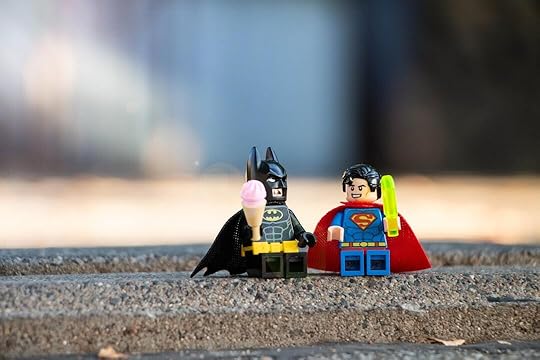
Have you noticed?
The war isn’t just in Iran. It’s in your feed.
But who would have thought the weapon of choice would be LEGO?
I, for one, never thought I’d see the day when we weren’t just consuming propaganda, we’d be distributing it.
Willingly.
With accompanying emojis.
But, here we are.
“Explosive News!”In 2025, a new YouTube channel was launched.
Akhbar Enfejari, or “Explosive News!” was about as explosive as a fart in a bathtub. It barely made a blip amongst the 120 million channels competing for eyeballs.
The message from its Iranian creators was consistently anti-Western. “Send this video to filthy America so it explodes,” it urged its 2.5 viewers.
Then, in February this year, something changed.
And the world changed with it.
That something was that America and Israel attacked Iran. And the brains behind Explosive News struck on a winning formula, co-opting an animation style nicked from the LEGO movies, and adopting Western pop-culture tropes to communicate their anti-American and anti-Israeli message.
Now, it’s a smash hit.While Trump and his limp-dicked armchair warriors send Americans into battle, millions of viewers tune in to rapid-fire, scathing responses to the war that isn’t a war created by what the New Yorker describes as a group of students with a background in social activism.
The creators’ original intention was modest. They wanted to reach Iranian viewers. But now, they’ve gone—can I say “ballistic,” given the circumstances? Probs not.
Let’s just say they’ve gone “global.”
Their clips have been reposted on X not only by Iran’s Tasnim News Telegram, but also by the Russian state media agency, RT.
Their messaging isn’t particularly nuanced or sophisticated. They align themselves and the Iranian people with other groups who have suffered at the hands of American hegemony: Vietnamese; Native Americans; Afghans.
One of their more potent recent clips set against a catchy reggae tune digs into Trump’s connection to the child-rapist, Jeffrey Epstein… allegedly, as they are careful to point out.
The team can produce a two-minute clip in just 24 hours; a feat that would be impossible without the pre-mix, pre-fab, ready-to-wear visual tool that is generative AI.
Since they first appeared, there have been many pretenders attempting to replicate their success. Those pale imitations lack something vital. Perhaps it’s the fire in the belly.
But the Iranian Revolutionary Guard are not the good guysLet’s be absolutely clear. The men at the helm of the Iranian regime are not the good guys. Quite the opposite.
I do not, by any measure, support a political apparatus that hangs people from cranes for fancying someone of the same gender. That’s right. They use construction equipment to murder their citizens.
Amnesty’s human rights report on Iran makes for sobering reading.
Its penal code includes flogging. Blinding. Amputation. Crucifixion. Stoning.
Iranians who fall foul of the law… things like peacefully protesting, letting a lock or two of hair escape from under a headscarf, or daring to drive a car if someone is unfortunate enough to have been born with a vagina… are disappeared into torture facilities colloquially known as “fingernail factories.” And it goes without saying that the brutal torture dished out in those prisons includes sexual violence.
And women aged 13… actually, let’s call them what they are: 13-year-old children are deemed old enough to walk down the aisle. Although fathers can apply for an exemption if they want to marry off their baby girls even younger than that.
So, yeah.
Getting stoned.Getting stoned in Iran does not mean what it does in the West.
Roll in the hay with someone you’re not married to?
Stoned to death.
Sneak a cheeky alcoholic beverage?
Stoned to death.
Same-sex snogging?
Stoned to death.
Just last week, an 18-year-old musician, Amirhossein Hatami, was convicted of moharabeh – enmity against God – and executed after months of torture following his arrest during the anti-regime protests in January.
So…
The mullahs are not good people.No argument from me on that.
But that’s not what I’m talking about here.
Where I’m going with this is to look at what’s being called “slopaganda.”
This is a canary in the coal-mine moment for the world. And right now, that bird is gasping for air.
Because even if the brains behind Explosive News claim they’re completely independent of the Iranian regime, thanks to slopaganda, they have achieved the impossible.
They have made the bad guys sympathetic.
“If truth isn’t flashy, it’s kinda lonely.”Explosive News knows its audience. “Let’s face it,” they say. “If truth isn’t flashy, it’s kinda lonely.”
And their punchy, on-point clips are certainly flashy. They go viral because they’re so fucking shareable.
The Trump administration’s counterpunch?
Cringeworthy, triumphalist mash-ups of real-life footage from America’s attacks in Iran with Call of Duty clips. I almost called the paramedics to revive me from a crippling case of second-hand embarrassment.
It’s the equivalent of whacking a block of marble with a soggy facecloth.
Explosive Media’s efforts achieve everything Trump’s resident thumb-in-a-suit aka “communications” director, Stephen Cheung, has been unable to do via the White House’s amateurish attempts to win hearts and minds online.
So, what’s the difference?
It’s LEGO, for fuck’s sake!I can tell you exactly why Explosive Media’s videos are making such a mark.
For a start, it’s LEGO. Who doesn’t have brilliant childhood memories of LEGO? Other than finding a piece with your foot in the shagpile.
Straight away, you’re hooked. Even though you’re watching bombs and flames and women and children fleeing in fear, it’s LEGO!
It’s co-opting an iconic and much-loved brand to communicate an idea. The warm-fuzzies it inspires make us drop our guard.
It’s the one guaranteed way of getting the attention of all those people out there who aren’t political; who don’t want to be confronted with grim scenes of death on the frontline.
It’s casting Mel Brooks as Hitler in The Producers.
The question, of course, is whether recasting psychopathic warmongers as bobble-headed and foolish toys diminishes the very real threat they represent.
That’s the payoff, I guess. Eyeballs on screen, yes. But at the cost of turning an existential crisis into a bit of a chuckle to like and repost.
But that’s what satire is all about.
Society stripped bareComedy and satire work because they pull back the curtain and reveal us for who we really are, not who we pretend to be.
Want to understand somebody? Learn what makes them laugh. It reveals more than you can imagine.
It’s even more true of an entire society. Find out what makes a community’s collective side split and you expose its soft underbelly.
Plato knew that. When a friend asked for a book recommendation so he might understand Athens, the philosopher recommended Aristophanes’ comedies.
Exposing our soft bitsSatire and humour have an important role to play in society.
Power takes its place on the podium. Humour’s job is to be the acid that eats away at the plinth while satire shines a light on its flaws. Neither is expected to offer a solution. Their job is to point out what’s not working.
There’s a long and noble tradition of comedians speaking truth to power with a brutality and frankness forbidden to others.
The court jesters of old were permitted to mock rulers without fear of retribution. They got away with quips against the rulers of the day that would have landed another’s head quite literally on the chopping block.
Jesters were given the fool’s cap and marotte mimicking the monarch’s royal crown and sceptre in acknowledgement of that unique right.
Even the deathly serious Martin Luther—he of the Reformation—used jest when he was ripping into the Catholic Church. He went so far as to call himself a court jester. And I’d like to believe that’s why he gave us the Diet of Worms, which will never not be funny to me.
Can you laugh at yourself?That’s why a good measure of a person is their capacity to laugh at themselves.
With that in mind, it’s worth revisiting the 2011 White House Correspondents’ Dinner, when then-President Obama ripped the tangerine blowhard a new one.
Donald Trump—at the time nothing more than a civilian in the audience—was pushing the “birther” conspiracy; the furphy that Obama was born in Africa, rather than Hawaii.
Obama roasted Trump to a crisp and served him on a platter with sides and condiments. You can see Trump steaming. It would be a wonderfully satisfying scene, if you didn’t also know that this was reported to be the moment at which the Great Fatsby decided to run for office.
In a fit of pique, Donald boycotted the dinner entirely during his first term. He’s planning to attend for the first time on 25 April this year.
Instead of a comedian, the 2026 dinner will feature a TikToker who reads minds. So, the Donald should be safe, as he appears to have lost his.
Laughing your head off… no jokesTop of the list on a society’s health report card is how well it deals with satire when it’s turned inwards.
Take a look at the French Revolution. It was a very serious affair. When the short-lived people’s uprising was pushed aside by Napoleon—a small man with imperial ambitions—and the French monarchy made a return in the first decades of the 19th century, an artistic revolution took place that inspired a blossoming of caricature and satirical drawings.
Cartoonists like Honoré Daumier became superstars; the 19th century equivalent of Jon Stewart and Stephen Colbert. Their work criticising politics and morals spread across the nation like wildfire in the publications, La Caricature and then Le Charivari.
But then, the monarchy turned. In 1832, Daumier was thrown into prison for depicting King Louis-Philippe as a grotesque, pear-headed monster.
By 1835, political satire was banned outright.
Sound familiar?
That’s why fascists fear humour most of all.Autocratic regimes see humour as an existential threat for good reason.
They control the populace with fear, division and anger. Violence is the lingua franca of fascism. Come at a Nazi with a baton, and they know how to fight back.
But tackle them with a well-placed quip, and it stops them in their tracks.
That’s because they laugh at people. They love a pratfall… a bit of slapstick.
But laughing with others? The nuance of irony? Self-deprecation? Satire? Deadpan? May as well be speaking a foreign tongue.
The art of satireThere’s a distinction between two of the main forms of satire, both dating back to Roman times.
The Roman satirist, Horace (65-8 BCE) was known for gently mocking social vices and human follies. Horatian satirists aim to inspire smiles, rather than fury.
Think the gentle ribbing behind The Simpsons, or Saturday Night Live, which spotlights politicians’ personal quirks through good-natured mimicry, rather than painting them as evil.
Juvenalian satire is the flipside of the same coin. Juvenal was another Roman satirist who lived in the second century AD. His humour was abrasive and razor-sharp. If he was around today, he’d find a spot in South Park’s writers’ room
It’s tempting to see the two satirists as reflecting the times in which they lived. Horace was working during the dying days of the Roman Republic, while Juvenal lived through the birth pangs and power struggles that characterised the early Roman Empire. Juvenal used parody and exaggeration to make monsters out of the men who expected to be worshipped as gods.
Sound familiar?
Mary, Mary Quite ContraryThe Explosive News LEGO clips work so well because the best satire finds its way into our homes and everyday life. We understand it because it speaks our language.
And it survives. That’s why despots despise it. More often than not, satire makes more of an enduring mark than they do.
Case in point? Nursery rhymes. What better way to spread a message than to dress it up in bunting and deliver it to a baby’s crib?
Here’s just one example.
Mary Mary Quite Contrary isn’t a song about a woman who loves gardening. It’s a ditty about Bloody Mary, Henry VIII’s daughter. She’s also the “Bloody Mary” who gave us the drink.
Mary was a wild-eyed Papist as Britain was being torn apart by religious wars between the Protestants and the Catholics. Her “garden” in the nursery rhyme is about the graveyards she was filling with Protestant martyrs.
“Silver bells”? They were thumbscrews.
And “cockleshells”? Well, they were torture instruments used on male genitalia. And I don’t want to think too hard about that. But any man who heard his wife singing Mary Mary Quite Contrary to their wee ones back in the day would have been left with an enduring impression of the murderous queen.
Truth or fiction?How much of that was truth? Who’s to tell?
Things like nursery rhymes, cartoons, and YouTube clips are effective because they’re woven into our social fabric. They have the potential to be Trojan horses; delivering a sucker punch to powerful forces that are too preoccupied with other business to see what’s going on in our living rooms.
That’s why they’re such a deadly instrument for propaganda.
Propaganda is the manipulation of beliefs to achieve a political end. As a term, it first cropped up in 1622, when Pope Gregory XV came up with the term Congregatio de Propaganda Fide, or “Congregation for Propagating the Faith,” to describe the papacy’s mission to spread the Catholic doctrine across the globe.
SlopagandaIn 2025, a trio of scholars used the word “propaganda” to coin the fucking genius term, ‘slopaganda’ for the unholy mash of generative AI slop and propaganda we’re grappling with today.
To demonstrate just how far up to our necks in slop we are, the authors quoted the following figure: News Corp Australia is currently dishing up 3000 stories generated by AI a week. That’s right. 3,000. Stories. A. Week.
With four out of every five Australians turning to News Corp for their news, that is terrifying.
And not just because it’s a media company that peddles the Murdoch family’s narrative and world view.
The long-term impact of what this saturation-level of AI-generated slop means for all of us is next-level horrific.
Because it goes deeper than just selling ideas.
It’s changing the way our brains work. And in the digital age, there’s no escaping it.
Spreading the wordPropaganda has always been linked to technology. When the printing press made its first appearance in Renaissance Europe six-hundred years ago, it was a big win for those with an agenda to push.
It gave us pamphlets. Gazettes. Posters. Then, as literacy improved and there were enough people who could read them, newspapers like the ones printed in post-Revolution France appeared.
But with the 20th century, things really took off. Hitler’s poisonous mouthpiece, Joseph Goebbels, invited himself into Germany’s lounge rooms and cinemas, and spread the Nazi doctrine far and wide across film and radio.
Then the 21st century dawned.
“Flood the zone with shit.”That was Steve Bannon in 2020 during his impeachment trial.
Whatever else he is, Bannon doesn’t miss much. He knew then that the fact more people were tapping into online news sources was a potential goldmine for those wanting to shape the political narrative.
As “mainstream media” became a slur and “fake news” entered the vernacular, trust in the Fourth Estate was undermined. Today, most people rely on unregulated social media sources for their news.
Don’t have to look far to see how this can play out.
Remember the Cambridge Analytica scandal, where political advertising assisting the 2016 Trump campaign was created using data drawn from 67 million Facebook accounts without the users’ consent?
Cambridge Analytica is also believed to have helped sway the Brexit campaign.
Know who was one of the company’s vice presidents? Steve Bannon.
Yeah.
Amateur hourBut that was ten years ago. With the advent of generative AI, it’s amateur hour compared to what’s possible today.
Slopaganda can be produced and customised to target specific demographics at speed and in vast quantities.
We’re drowning in it.
And the means of digital dissemination available to flood the zone with shit makes the deluge almost impossible to stop.
Made to measureBut it’s more insidious than that.
Because the stories you encounter online are tailor-made to fit you.
This is something very new. And something we’re still grappling with, psychologically. Most of us are completely unaware of how comprehensively the things that appear on our screens are being filtered to fit whoever the algorithm thinks we are and, more ominously, what it wants us to think.
It used to be that you’d buy the same newspaper to read on the train into work as your mum, your neighbour, and the guy who had the desk beside you in the office. Sure, you’d all read the same article through a lens coloured by your unique life experience. But journalism back then was governed by a series of principles that held it apart from influence or opinion peddling. “Without fear of favour,” the saying went.
Today, you get news tailored to fit your beliefs, based on your online behaviour. This is a new form of propaganda.
It’s feeding you a party line you’ve already signed up for.
Attention economySlopaganda feeds you the same narrative, over and over. It confirms what you already believe, whether that’s based in fact or not.
And it works because there’s comfort to be found in the familiar.
The deluge of information available online is overwhelming. When we’re wading through the slop, we grab on to anything that seems familiar or looks entertaining.
That’s why Explosive News’ LEGO clips work so well. With limited time available to us, we’re careful about where we direct our attention.
Why so negative?Bad stuff always does well online. No surprises there.
It’s an evolutionary survival mechanism. Remembering negative events might have saved your ancient ancestor’s life back in the days when they were wandering in the wilderness.
That’s why stories that trigger horror, fear, outrage, and grief have such an impact on us. Negative news worms its way into our brains because, subconsciously, we think one day it may save us.
Slopaganda taps into this.It’s what Roland Barthes described as ‘exnomination.” It’s a “divide and conquer” method as old as the hills that reinforces negative stereotypes to create fear and suspicion between demographic groups. So, for example, reporting on crime committed by white people as “crime,” while at the same time describing crime by people of colour as “Black crime,” or “immigrant crime.”
By profiling you through your online behaviour, slopaganda will send content your way that magnifies your biases, preferences, and beliefs.
You’ll be ushered into a silo where all you ever hear are things you already think you know.
Microtargeting slopaganda will mean you never see anything that challenges your beliefs. And with what we now know about neuroplasticity, that is never going to work out well for us.
A divided population is a compliant population.There’s a reason that works for would-be autocrats.
The people holding the reins of power would prefer us to waste our energy squabbling amongst ourselves rather than turning our attention to the shitfuckery going on upstairs.
That’s why there are no real moves to monitor and control the tsunami of slopaganda that’s drowning us. Why would they send us the lifeboats when it’s keeping us in check?
It’s bread and circuses for the modern era.
Bullshit Asymmetry PrincipleAnd now, the world is doing Explosive News’ job for them. Gone are the days of having to head out in the dead of night with clag and brushes to whack propaganda posters up on billboards.
We’re posting and reposting their political rhetoric for them.
We’re all unwitting and unpaid promoters of Iranian propaganda.
I did not have that on my bingo card for 2026.
Last week, Explosive News’ YouTube channel was banned.
A short time later, it was resurrected on Instagram.
The Bullshit Asymmetry Principle.Which leads us to “Brandolini’s Law,” or the Bullshit Asymmetry Principle.
In 2013, programmer Alberto Brandolini declared that the “amount of energy needed to refute bullshit is an order of magnitude bigger than that needed to produce it.”
But there’s nothing new under the sun.
Jonathan Swift got there first in 1710 when he wrote “falsehood flies, and truth comes limping after it.”
Strange days, indeed.
What do you think? Are you drowning in slopaganda? Or are you managing to stay afloat? Let me know in the comments.
The post LEGO’s Role in Viral Anti-War Propaganda first appeared on Meaghan Wilson Anastasios.
April 2, 2026
Thou shalt not steal (unless you’re filthy rich)
 Photo by Priscilla Du Preez
  on Unsplash
Change of pace today, inspired by the coming of Easter. If only because by the time you’ve finished reading this, you’ll understand why Jesus’ middle name is “Fucking.”
And, yes. Consider yourself warned. If that poor-taste joke upsets your sensibilities, perhaps skip this week’s newsletter.
Because today, I’m bringing you true crime of biblical proportions.
It’s the tale of an unholy alliance between Christian fundamentalists and Muslim extremists… where cash channelled out of the coffers of one of America’s wealthiest Trump-supporting evangelical Christian families ended up in the hands of Islamic terrorists.
A disclaimer, first.I’m a committed agnostic. Not atheist, meaning “no god.” Agnostic. As in “no idea what’s going on… pretty sure there’s something bigger than us, but yet to find anyone who can explain what it is.”
How agnostic?
My son once asked me whether Jesus was a zombie.
Reasonable question, given the whole ‘rising from the dead’ thing.
And the way things are going, I’m OK with that position.
Less “turn the other cheek” than “an eye for an eye.”While hypocrites in the White House brandish crucifixes like weapons, and co-opt prayer as hate speech, everything’s feeling a bit too Old Testamenty for me.
Maybe that’s it. So much “eye for an eye-ing” is going on, they’ve all gone blind. Because even I can see that if their Christ were to reappear anytime soon, he’d run himself ragged, what with all the smiting and overturning of tables in the temple they have coming to them.
I’m sure I’m not the only one who wonders how the paid-up members of Happy Clappers Inc can justify their worship of the most false of all idols currently occupying the White House.
As far as I can see, Trump’s only observance of the Ten Commandments is to see how many times he can break them all before taking his afternoon nap in the Situation Room.
But Evangelical Christians are not your garden-variety church-goers.I worked that out for myself while I was working on a TV series I created and wrote a little while ago. One of the stories I investigated put the god-botherers front and centre.
Loot, or Looting History as it was called when it was screened internationally, is my take on the multi-billion-dollar black-market nobody wants to talk about. As a one-time archaeologist, this one was personal.
Nobody wants to think too hard about the source of the ancient treasures adorning the walls of the fabulously wealthy or perched on podiums in the world’s greatest museums.
Ancient treasures are ripped from the soil at a rate that beggars belief, from the cradles of Western civilisation in the Middle East, to the ancient cultures of Greece, Rome and Egypt and the empires that flourished in Africa, Asia and the Americas.
The trade in stolen antiquities is a major source of income for criminal syndicates, gangs, and terrorists across the globe. It’s a crime wave where the cash ends up in the pockets of the world’s worst criminals.
Everybody from Islamic State terrorists to Chinese triads and the Calabrian mafia have muscled in on the act.
But, in their defence, they’re just crooks being crooks. If there’s a market in something dodgy, they’ll go there.
Human beings. Drugs. Weapons. Antiquities. Same-same.That’s why my fury is reserved for the billionaires, tastemakers, and art dealers who fuel demand.
Because no demand, no looting. And looting means stealing history.
It’s also a vile crime committed against the people who call these regions home. I’ll write about the impact on them another time. There’s not enough space here to cover it.
Today, it’s a story about the toxic sense of entitlement that so often seems to go hand-in-hand with the new breed of Christian.
What makes antiquities so appealing for criminals?Well, think about it. You’ll never see a child slave on display in a Fifth Avenue art gallery, or a brick of cocaine on a Sotheby’s podium.
But a Roman marble bust? Sure. Why not? It’s ART, after all.
When ancient treasures are ripped fresh out of the ground, or hacked off a wall, they’re different because there’s no knowing where they came from. Once an artefact is given a good spit polish and passed through the elaborate network that creates a backstory for stolen treasure, it can migrate from the black market to pride of place under the spotlight.
What was black market loot, becomes a priceless treasure. And cashed-up collectors can turn a blind eye and buy it with a clear conscience. Provided they don’t ask the right questions. Which they rarely do.
An unholy alliance.It was a routine day for the customs officials at Memphis airport when they pried open a crate labelled ‘tile samples.’
What they found inside was a priceless collection of antiquities stolen from archaeological sites and museums across ancient Mesopotamia, the kingdom that once straddled modern Iran, Iraq and Syria.
The discovery kicked off a wild chase across continents to the source of the loot—Muslim extremists in Iraq. The scandal that followed shook the foundations of one of America’s most powerful business dynasties.
It seemed like a righteous idea… at first.A fancy new home dedicated to the Good Book, just a stone’s throw from Washington’s National Mall. The Museum of the Bible. It was to be home to the Green Collection: “the newest and largest private collections of rare biblical texts and artefacts in the world.”
But the museum would be plagued by a PR disaster of biblical proportions.
All hell would break loose when the most important commandment of all was overlooked.
Thou shalt not steal.The story begins with a man named Steve Green.
Steve is an Evangelical Christian and the Museum’s founder. He is also richer than Croesus.
Ironically, he has America’s flower-power movement of the 1970s to thank for his vast wealth. When his parents, David and Barbara, opened their first arts-and-crafts store in Oklahoma City in 1972, the hippy craze for beads, macramé, and tie-dying everything that didn’t move made him a fortune.
That first shop became the Hobby Lobby empire.
With over 1,000 stores across America that sell such gems as Jesus cross-stitch kits, and posters that read: “This Girl Runs On Cupcakes and Jesus,” today Steve’s family controls a fortune just shy of US$14 billion.
The Green family uses that money for “good works”. Things like supporting anti-LGBTQ legislation and winning a long-running legal fight that gave God-fearing companies the right to deny their employees medical coverage for contraception.
In 2016, family scion David Green wrote an op-ed in USA Today that backed Donald Trump: “For Americans who value freedom of religion, we must elect a president who will support a Supreme Court that upholds not only this freedom, but all that have emanated from it. That president is Donald Trump.”
As for Steve, dude has lots of hobbies, beyond meddling in women’s rights.
He probably should have stuck with macrame.Not that Steve was worried about it at the time. Because Steve has God on his side. That’s what Steve’s Pentecostal faith tells him, anyway. The Green family has prospered thanks to the grace of God.
Here’s his father’s view on that. Steve Green’s father, I mean. Not God’s. Pretty sure God didn’t have a father.
According to his reading of the Holy Book, money in the bank means God’s smiling upon you. Pentecostal believers hold that capitalism and Christianity are intertwined. It’s called the prosperity gospel.
Because Jesus = cha-ching.Evangelical Christians like the Green family also believe that the Bible is a truthful, and literal, account of historical events.
Jesus, as described in its pages, with the walking on water, raising the dead, and turning water into wine (got to admit, that would be a very good party trick) happened exactly as written.
Logical next step for a true believer like Steve was to acquire a collection of biblical artefacts that prove its factual basis. How else could he sway non-believers and doubting Thomases like me?
And the best place to find biblical artifacts? You got it… the place the Bible is set. The Middle East.
It ain’t called the Holy Land for nothing, after all.But Steve Green had a business to run. He didn’t have time to chase after biblical treasures.
Enter Scott Carroll.
Carroll was not a run-of-the-mill academic. According to media reports, his peers described Carroll as a “circus act”; more ringmaster than scholar. No prizes for guessing the dial tone on his phone: the Indiana Jones theme.
But Carroll was a true believer. That’s all that mattered to Steve Green.
A very excellent, big ideaThis was the man Steve Green put in charge of bringing his very excellent, big idea to life. Because Steve wanted a museum of his own to house all the biblical treasures he planned to accumulate. And like all the great museums of the world, he wanted it to be big.
But he was man in a hurry. Divine salvation waits for no man, after all.
He let Scott Carroll off the leash.
The Hobby Lobby feeding frenzy was big news.The good word spread. Scott Carroll was waylaid by strangers trying to hustle artefacts in restaurants, lecture halls, and even supermarkets.
It was a feeding frenzy for antiquities dealers and looters alike.
It was less curating, than a shopping spree.
Scott Carroll was on a mission from God.And Steve Green left everything in his hands. He was the expert, after all.
Big mistake. Because Scott was about to lead Steve and his museum into an unholy mess.
The trouble began in Dubai.
Over five-and-a-half-thousand antiquities were spread on the floor, stacked on top of each other on a coffee table, and packed loosely in cardboard boxes.
Alarm bells should have been ringing.Steve flew home and consulted with Hobby Lobby’s lawyer. Before they committed, he wanted to hear from an expert in cultural property law from Chicago’s DePaul University.
Even putting aside the pretty fucking serious ethical considerations of stealing ancient treasures from their rightful home, it was illegal to export antiquities out of Syria and Iraq.
Why? Because the money changing hands was funding the insurgents who were killing American troops.
Professor Gerstenblith put her concerns in an email to Hobby Lobby’s lawyer.
“I warned him,” Gerstenblith later said, “and he proceeded anyway.”
The lawyer would later say that Gerstenblith’s email was not passed on to Steve Green.
Steve Green and Scott Carroll were not asking the right questions.Or, if they were, they weren’t paying enough attention to the answers.
Yeah. Right. It was a provenance with more holes than a colander.
But in December 2010, Steve Green signed a purchase agreement for the collection.
The final price?
It was a steal. Literally.When the invoice arrived, it falsely identified the artefacts’ source country as Israel.
There were more red flags waving than at a semaphore convention. Even the pathologically optimistic Scott Carroll was beginning to have doubts.
With the deal signed, the tricky part began…Getting the loot into the country.
Any shipment over US$2000 had to be sent to Hobby Lobby’s broker to clear US customs. Steve Green’s executive assistant sent the Israeli dealers instructions to split the collection and keep the value of each under $2000.
The dealers had their own twist: they used multiple addresses for the shipments to put customs off the scent.
The parcels arrived in the US in January 2011.
The first three made it through.
The others? Not so much.The connection with Israel would have been a red flag to customs agents.
As the only country in the region that allows antiquities sales, it’s known as a clearance point for loot from other Middle Eastern countries.
So, there was a reason that the dealers Steve Green met in Dubai said the collection dated to the 1960s. Israeli law mandates that objects bought before 1978 can be bought and sold.
“Tile samples”?Back in the US, when it was discovered that the “tile samples” were not destined for splashbacks and bathroom floors, the wheels of justice started turning.
News of the seizures first surfaced in The Daily Beast in 2015.
When judgement day came in April 2017, Steve Green was forced to forfeit the antiquities he bought in Dubai, and Hobby Lobby copped a $3 million fine. Given the scale of the Green fortune, it was chump change.
At the time, Green said that “the company was new to the world of acquiring these items and did not fully appreciate the complexities of the acquisitions process. This resulted in some regrettable mistakes.”
But then there’s this.
As put by the anti-illicit-antiquities-trade crusaders at Chasing Aphrodite, “Green and his advisors were given detailed guidance from one of the leading legal minds on antiquities acquisitions, and then chose to ignore it.”
Professor Patty Gerstenblith later had this to say “I can’t rule out it was all the opposite…that they used my advice to evade the law as opposed to follow the law.”
The news couldn’t have come at a worse time.It hit the headlines just before the Museum of the Bible’s grand opening.
Steve Green tried to hose down the scandal, delivering a public mea culpa: “We should have exercised more oversight and carefully questioned how the acquisitions were handled… We have accepted responsibility and learned a great deal.”
The scandal didn’t seem to dint the museum’s enthusiastic reception, though. Guests paid a staggering $50,000 a table to attend the black-tie gala fundraising event.
As for where the launch of the “non-political” museum was held”? … The ballroom of Washington’s Trump Hotel.
It was a controversial choice.The museum denied it was trying to curry favour with the Trump administration. But Eric Trump and then-wife, Lara, turned up to lend their support anyway. Charlie Kirk was there as well, along with Judge Jeanine Pirro.
In 2025, Donald Trump gave the museum the Bible he used to take his oath of office in 2025.
Heavy hitting support like that counts for a lot. Because events like that are the lifeblood of the museum sector.
Never forget that the megastar-studded Met ball isn’t just about making a splash on the red carpet. It’s a massive money-spinner for the museum.
And the Museum of the Bible needs all the help it could get. It’s housed in a $450 million, eight-storey building that, at almost half a million square feet, is as big as the Smithsonian’s National Museum of African American History and Culture.
Museums like that don’t just build themselves. And they certainly don’t keep the doors open with entry fees alone.
They need donors. In the US, museums have a powerful weapon in their arsenal to bring big collectors on board.
Tax write-offs.Let’s take the heavily discounted collection Steve Green bought in Dubai as an example. Theoretically, if it had made it into the Museum of the Bible, the Greens would have written off the full value of the antiquities: $12 million… a collection Steve Green acquired for just $1.6 million.
According to the authors of the best-selling book, Bible Nation: the United States of Hobby Lobby, the financial perk was the thing that convinced the Greens to start their own biblical antiquities collection in the first place.
The other downside for the world in general is that those tax perks mean that cut-price, stolen loot with dodgy provenance can be more appealing to collectors than legitimately acquired antiquities. They buy an undervalued object, then claim a tax break for the full price.
But it doesn’t end there.The difference between Steve Green and collectors who donate antiquities to other not-for-profit American museums is that when the Green family donates to the Museum of the Bible, they’re donating to their own non-profit organisation, with Steve Green at its helm.
If an antiquity’s value jumps after its purchase, the tax-write off balloons.
According to the authors of Bible Nation, it’s one of the main reasons the Greens launched a project they called their Scholars Initiative.
The research program of over a hundred academics across fifty universities study the 40,000 objects in what was then known as the Green Collection. If those scholars discover something significant about any of those objects, guess what? That object’s value goes up.
Oh, did I mention that the scholars who sign up for it are compelled to sign non-disclosure agreements?
I’m sure it’s all just being done in the interest of furthering knowledge and scholarship though…
Steve Green wanted the focus of the Museum of the Bible to be on the Lord’s word.Only everyone was more interested in the hot-take on his collecting activities.
So, strategic decisions were made to distance the Green name from the Museum of the Bible.
The museum’s deputy director said the board felt short-changed on the facts. They weren’t told about the government investigation until Hobby Lobby was close to signing the settlement.
The director at the time said it felt like the museum was paying for the sins of the father.
So, Steve learnt his lesson, right?Well, let’s just put it this way. There is a coda to this story.
As federal investigators continued to pick over the collection, there’s one artefact Steve was absolutely sure would pass muster.
It was a highpoint of his collection. And it certainly didn’t come from a cardboard box delivered by a trio of shady dealers in a hotel conference room. It came from Christie’s, no less.
Meet, the Gilgamesh Dream Tablet.
It’s not much to look at…… a clay tablet the size of a paperback. It’s also three-and-a-half-thousand years old. And at $1.7 million, that single object cost more than the entire collection from Dubai.
But in the world of biblical antiquities, it’s a superstar.
It is another chapter in the Epic of Gilgamesh; a five-thousand-year-old tale that may be the oldest written story on the planet, complete with gods, beasts, and prophecies.
The Mesopotamian saga gets biblical scholars excited because it has many parallels with the Old Testament, including its own version of Adam and Eve, and Noah and the Flood. The similarities are so close, it’s been suggested they draw from the same sources… though Gilgamesh got there a thousand years before the Bible.
By the time he bought it, Steve’s shipments from Dubai had been seized. So, he must have been feeling a little gun-shy.
But this was Christie’s… what’s not to trust, right?Wrong.
Because here’s the catch. Auction houses are best known for selling antiquities through public auction.
The Gilgamesh tablet was offered for sale privately.
That meant it never appeared in a public catalogue. Unless word trickled out, very few people would even know it was on the market.
For many in the know, that often means one thing.
Don’t touch it with a barge-pole.It turned out to be a masterclass in how loot makes it to market.
The tablet was unearthed in 1853 in the ruins of an Assyrian king’s library in northern Iraq. Sometime after the First Gulf War in 1991, it was snatched from an Iraqi museum.
From there it made its way to London, where a dealer allegedly saw it in an apartment belonging to Jordanian antiquities trader, Ghassan Rihani.
After buying the tablet from Rihani in 2001 for $50,000, the dealer posted it to the US. Needless to say, he didn’t declare it to customs.
In the US, an unnamed professor at Princeton worked on it while the dealer concocted an allegedly fake provenance letter saying the tablet came from a Butterfield & Butterfield auction in 1981.
A journal article written by a foremost scholar then gave the tablet its academic legitimacy… and in 2007 it turned up for sale at a Californian bookseller.
The asking price? Almost half a million dollars.
Next stop? Christie’s in 2014 … at more than three times that price.
“I trusted the wrong people.”There’s no suggestion that Steve Green and Hobby Lobby set out to buy stolen antiquities. As Steve put it himself, he “trusted the wrong people to guide me, and unwittingly dealt with unscrupulous dealers.”
But as the Bible puts it, the simple believe anything, but the prudent give thought to their steps.
In 2019, US Homeland Security investigators seized the Gilgamesh dream tablet from the Museum of the Bible.
Two years later, law enforcement officials officially returned the tablet to the people of Iraq.
Then-director-general of UNESCO, Audrey Azoulay, said: “This exceptional restitution is a major victory over those who mutilate heritage and then traffic it to finance violence and terrorism.”
It was just one of many. Steve Green has since been in the process of repatriating eleven-and-a-half thousand stolen antiquities to the Iraqi and Egyptian governments.
Steve Green had big dreams.He wanted the Museum of the Bible to tell the story of the good book.
But he wasn’t thinking about the impact his holy quest was having on the people born in the lands that were home to his Bible.
For the people living in these archaeologically blessed conflict zones, the damage caused by the loss of their cultural heritage is beyond measure.
If buyers like Steve Green started to think about ancient artefacts the same way they think about ivory, or blood diamonds, then demand will dry up.
And the looting will stop.
What would Jesus do?
Definitely not this.
Like what you’ve read here? Well, there’s plenty more where that came from.
Subscribe now so you don’t miss a thing. I’ll only bother you once a week or so. I promise.
The post Thou shalt not steal (unless you’re filthy rich) first appeared on Meaghan Wilson Anastasios.
March 24, 2026
Out of f*cks to give? Yeah. Me too. Think we need a holiday…
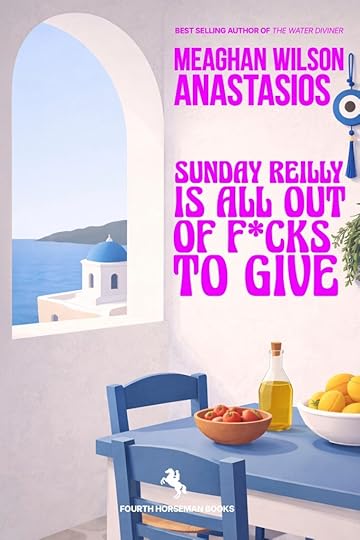 Try out some sample chapters first…… or jump right in and read the whole thing now
The post Out of f*cks to give? Yeah. Me too. Think we need a holiday… first appeared on Meaghan Wilson Anastasios.
March 23, 2026
My Tomato Theory: How We Were Trained to be Good Little Consumers
 Photo by Chiara Guercio on Unsplash
Want to fight enshittification? Start with tomatoes.
Last week, I took delivery of fifty kilos of them.
That’s right. Fifty.
No, I’m not stocking up for a Trump visit Down Under. That would be a criminal waste.
They were destined for passata and tomato soup, jars of which now line my garage wall.
Am I saving myself any money?Not on your fucking life. I can buy perfectly serviceable jars of passata at the local grocer for $3.99. And cans of soup? Under two bucks.
I don’t want to work out what mine cost me. Factor in labour, and I won’t be planning a stall at the local farmers’ market anytime soon.
But that’s not the point.
I do it because it makes me feel powerful and useful.
Yes, really. Might sound a bit weird unless you’ve done it yourself. But those jars make me feel invincible. If the world spirals any further down the septic system, at the very least, I know I’ll be able to keep the family alive for at least a month.
Provided they don’t tire of tomato soup and pasta.It’s all about keeping self-sufficiency alive and maintaining archaic skills largely gone the way of the dodo in the West.
My grandmother preserved fruit and vegetables as I do, and as her grandmother did before her. And her grandmother before that. Et cetera, et cetera, et cetera.
And each year, I crack out the Vacola preserver and the Fowlers jars with my husband, son, and daughter, and we do it together.
As I was up to my elbows in tomatoes, it got me thinking about a brilliant and very funny Norwegian clip I posted a week or so ago that went a little viral.
Why did it speak to me?
Because it’s a powerful visual embodiment of a thing I’ve been banging on about for years. And it’s the reason I persist with my annual passata endeavour, even though it makes no economic sense.
I call it my tomato theory.Yes, another of my theories… sorry about that. But bear with me. I reckon you’ll like it.
Wind it back a couple of decades, and the tomatoes we greeted in the supermarket fruit and veg aisles were things of wonder. Sweet, juicy, and red. Most of all, they tasted and smelled like… tomatoes.
Let’s say they cost $2.99 per kilo back then. No idea if that was the actual price, and I can’t be bothered looking it up. That’s not the point of the exercise.
But suddenly, something happened.
The things stacked in piles became nasty, firm pink things that looked more like sun-bleached cricket balls than tomatoes. They were flavourless, firm, and smelled of absolutely nothing.
Price? $2.99.
Disappointing tomatoes. Disappointed Meaghan.Things rolled along like that for a while, and I gave up buying tomatoes unless I was lucky enough to find myself at a farmers’ market, where the real deal was still available.
It was also what inspired me to get a few tubs and start growing my own in the small space at the back of the apartment I was living in at the time. I’ve continued to do that ever since, so I suppose I should be grateful.
But I digress, as I so often do.
Back to the supermarket tomatoes.One day, the OG tomatoes reappeared.
They were red, sweet, and juicy, just the way I remembered them.
Though this time, they had stalks still attached (all the better to make them smell more tomatoey).
They had themselves a fancy new name: “Truss Tomatoes.”
They also had a fancy new price. $7.99 per kg.
Yes, but REAL TOMATOES! Huzzah!
See what happened? It only took a year or so for us to happily hand over twice as much for something we used to take for granted.
We are slaves to a system that can manipulate us because we are utterly dependent upon the things it produces.If we want something that tastes like a tomato, we have to pay more for it.
We have no choice because we’ve surrendered our ability to provide for ourselves.
And it’s designed that way. You’re not supposed to be self-reliant, because that means you’ll spend less money. A lost skill is another uptick in sales. Lose a button on a shirt, and if you don’t have a sewing kit, or don’t know how to sew it back on, what are you going to do? Well, most of us will toss the shirt away and buy a new one.
But I’m lucky enough to know how to do those things.My mother, and both my grandmothers, taught me how to darn, how to hem, how to knit, and how to sew a button back on. At one point when I was at university and things were a bit tight, I even had a go at making my own clothes.
For so many of us in the West, those skills are a dead art.
I know that because when my daughter and her friends wanted to remodel their school uniforms for their last day of high school, they had to come over to our place, because we were the only household with a sewing machine. And, most importantly, someone who knows how to use it.
I don’t say that to be a smartarse. I was fortunate enough to be raised by country women who were forced to be self-reliant.
For my grandmothers, they weren’t choices.They weren’t luxuries. They weren’t “hobbies.” They were survival skills.
I used to tease one of my grandmothers affectionately as she pleaded with us to open our gifts carefully at Christmas so she could salvage the wrapping paper. Each year, her gifts came to us in slightly wrinkled gift wrap, with spots where sticky tape had lifted the pattern.
Both my grandmothers raised families through the Second World War.
In a can beneath the sink, they saved “dripping” (just a nice way of saying “fat”) from frying chops and bacon to reuse in their cooking and to eat on toast.
They raised animals on their farms.
Vegetables were grown in the veggie patch; fruit in the orchard or on the vines. My grandmothers grew or made everything they needed. Wool, milk, eggs, meat, hide, and fertiliser. Not a scrap was wasted.
Mealtime when I went to stay could be a lucky dip, with liver, kidneys, tongue, and tripe… let’s not mince words – it’s stomach… on the menu. And let’s not forget the sausage casings made out of, yeah, intestines. That’s right. Poo pipes.
I was a spoiled city kid.I didn’t grow up during the war. No amount of “white sauce” with parsley could convince me that eating cow guts and poo pipes was a great idea. The only meat I was interested in eating was muscle.
But I did understand why my grandmothers did what they did, because I was also involved in the story of life on a farm. When you see what’s involved with bringing that meat to the table, it makes you look at things differently.
Yes, it could have turned me into a vegan. It did my sister. But not me. It did make me appreciate how important, and how precious, food is.
Imagine helping a cow deliver her calf, which I have done many times. One particularly memorable birth had me holding together the walls of a cow’s uterus after a caesarean birth as the vet stitched the muscle back together. Both mother and calf survived and thrived.
Farmers love their animals, no matter what their ultimate destination may be. I saw a neighbour weep when one of his steers—an animal ultimately headed for the BBQ—got caught in a fence and broke its leg. He wept as he raised a gun to its head to put it out of its misery, not because he was losing a source of income, but because he hated seeing a creature he had raised and cared for in pain.
That’s why people who tend the land don’t waste.Because they know what it takes to stock the fridges and mile upon mile of shelves in the supermarket.
Meanwhile, we grab a trolley and stack it with far more that we’ll ever need.
There’s such a disconnect between production and consumption, that we don’t stop and think about what it is that we’re tossing out when the bread gets a bit dry round the edges, or one of the strawberries in the punnet is a little fuzzy.
Anyone who has ever grown or made something from scratch—from a pot of basil, to a handknitted jumper—knows what a tragedy that is.
I learnt from my grandfather a deep love of growing my own vegetables.Sure, there’s the economic consideration… I just can’t with the $4.95 packet of parsley when I just need a sprig or two and the rest will end up going to green water in the bottom of the veggie drawer.
So, I have pots of all the herbs I regularly use. Oregano, thyme, parsley, spring onions, rosemary, plus basil in spring, and coriander in winter.
And don’t get me started on the lemons that are now worth their weight in gold. What the fuck is that, Australia? Since when did we get rid of the lemon tree in the back yard?
But it’s a lot more than the money.It’s the deep satisfaction I get from gathering cherry tomatoes, beans and cucumbers off the vine.
And then, there’s the flavour. Nothing like it.
There’s a reason for that. As soon as a tomato is picked, its sugars start converting to starches.
Back to my tomato theory, wholesale fruit and veggies are picked when they’re underripe. That means they’re firmer and less likely to spoil, which reduces wastage and handling costs. But then they’re kept in cold storage, and treated with gases and temperature control to ripen them when it’s time to take them to market. https://www.growveg.com.au/guides/the-secret-to-growing-great-tasting-vegetables/ Which is why those “new” tomatoes had as much flavour as Styrofoam.
Taste a bean or a cucumber picked right off the vine, or a potato dug out of the earth, and you’ll struggle to go back.
Modern consumerism has turned us into dependents.And it’s not just the food industry.
That clip I posted was all about making things shitty. I felt that to my core, because for a while there, I ran the art department in one of Australia’s biggest auction houses. Yeah, I know. I’ve done lots of silly stuff.
But one of the things I learnt there was how distressingly cheap antique furniture is nowadays.
You could buy a two-hundred-year-old oak table solid enough to dance on for less than the cost of a flat-pack IKEA bench that will struggle to support the weight of a chubby domestic cat.
And when that depressingly awful chipboard sandwiched between Laminex thing loses a leg, your only choice is to toss it out. It’s designed that way.
IKEA doesn’t want you to repair it.
IKEA wants you to replace it.
You see this enshittification everywhere nowadays.It’s even more insidious than inbuilt obsolescence.
Another example? Streaming services. It’s the tomato theory all over again.
Used to be we “paid” for free-to-air TV with our time—the time we spent watching ads. Those ads gave the free-to-air broadcasters the money they needed to make the programmes we wanted to watch. It was a healthy symbiotic relationship.
Then came the streamers. Sure, we had to pay for a subscription. But Netflix was so cheap, right? And—guess what?—no ads! Got to be worth it just for that.
Only, what happened next? Yeah. Ads. If you want your streaming service ad-free, you’ll have to pay more.
So now we pay to watch… ads.
But, hang on. Didn’t we once watch ads for free?We in the West have been bent over a barrel and done without lube.
And we’ve gone there willingly.
Look at subscriptions. Was a time when even if things went bad and you lost the roof over your head, you’d have your CD and DVD collection and photo albums to take with you.
Today, they’re all in the fucking cloud, whatever that is.
Can’t afford your Spotify or Netflix subscription anymore? There goes your favourite album and TV series.
Bit short this month and can’t pay your iCloud bill? Goodbye family photos.
We’ve willingly locked ourselves into a system that rewards complacency, discourages self-reliance, and encourages profligate waste.
I’ll never forget the day I went into an office supplies store to buy two replacement ink cartridges for my printer.
$38 each.
I made a comment about the cost to the helpful man at the counter, who suggested I consider the new printer on sale that cost less than the two refills I was about to purchase.
A printer that came with two cartridges.
Sure, he was just being helpful. But what the actual fuck?
I know it’s all part of the plan… the hardware is cheap to lock us into the hamster wheel that has us throwing money at them on a regular basis for essential parts.
The cheap razor = expensive blades.
The cheap printer = expensive ink refills.
So, where did it all go so wrong?The 20th century was meant to be when the industrial and technological revolution really paid off for humankind.
First, there were all those fabulous “labour-saving devices.”
Guess what, ma’am?
We’re setting you free! Less time spent chained to the sink!
No more wasted hours heating the copper to wash the family’s filthy gear!
And throw away those pegs, because we’ve got this thing called a “clothes dryer”!
No, it’s not witchcraft, ma’am! It’s technology! Praise be!
And how about those cars? What a convenience! Imagine all the things you’ll be able to do with all that spare time and the means to get from A to B in a jiffy! Just marvellous!
If only.Because that’s not quite how it worked out, is it?
Now we’re working to pay for those devices and technology to do things we once did for ourselves.
Pay-in-4, lease-hire labour-saving devices. We’re working to pay for things that were invented to save us from working… Can you see how ridiculous that is?
And now we have AI.We’re outsourcing intelligence.
We’re paying a machine to think for us.
Not only is it ridiculous, it’s dangerous.
Because this system has made us utterly dependent which means we lack the skills we need to be self-sufficient. Which, in troubled times like these, are more important than ever.
So, what am I doing about it?I’ll start by confessing that I do have the luxury of choice. I’m lucky enough to be able to afford to do many of these things.
That good fortune means I also feel obliged to do them in acknowledgment that there are many who would do the same, but don’t have the same advantages.
For one thing, I avoid the big three supermarkets here in Australia—Coles, Woolworths, and ALDI—unless absolutely necessary and support small, local businesses instead. Because when the small suppliers go, the big guys have us over a barrel. Choice goes out the window.
I also buy most of our fruit and vegetables from a not-for-profit social enterprise called Ceres that home-delivers produce purchased from local farmers.
If we need to purchase something, we check FaceBook marketplace first to see if it’s available second-hand. My last two acquisitions were a food processor… and more jars for my tomato bottling enterprise.
Most of all, I’m passing all this onto my kids.Sure, there are days I’m sure I drive them bonkers with the nagging about how “best before” and “use by” dates are not the same thing, and that nature gave us a nose and taste buds to detect things that will kill us.
They also see it in practice. When I strong-arm them into helping me make bottles of tomato sauce that probably cost just shy of $50 a bottle, they understand how much work goes into it.
It’s not like the $3.99 bottles you get at the supermarket. With those, you’re happy to use half the bottle, then toss the rest a month later when it looks like a science experiment gone wrong.
Not my passata. If I have any leftover from a bottle, I put it in a ziplock bag and freeze it.
As for the packaging, I wash the jars, lids and clips, and put them away in the garage to reuse next year.
Maybe one day they’ll thank me.
Let me tell you the story of one of my favourite woollen scarves.When I was a little thing, my mum and dad gave me and my sister a black lamb. We raised him in the backyard of our inner-city house in Melbourne. Used to walk him around the block on a lead.
Yeah, the ‘70s. Crazy times.
Eventually, he outgrew our backyard and retired to my grandmother’s farm, where we gave him a small harem of lady sheep for company. Every year, a neighbour came in to take the clippers to “Lambie” (no prizes for originality), his ladies and their offspring… turns out Lambie was quite the Don Juan.
It was beautiful Merino wool, so grandma paid the neighbour in kind with a share of the wool. She did the same with another friend who washed and spun it into skeins that still smelt of lanolin.
Fast-forward a few decades, and the time came to clean out my grandma’s house.She was gone by then, and the time had come to sell the family farm.
In the top cupboard of a wardrobe, I found a plastic bag stuffed with Lambie’s wool. It was still beautiful. And it still smelled of lanolin.
I gave the wool to my husband’s grandmother; another fine, tough country woman who wielded a good knitting needle.
She used Lambie’s wool to knit babies’ booties and jumpers to donate to a local charity in the country town of Holbrook.
She also made me a scarf.Each winter, as I tuck it beneath my coat, I think of her. I also think of my grandmother, and I think of Lambie, and the very long journey it took for that scarf to find its way to my winter woollies drawer.
My mum is still with me, although both my grandmas are long gone. So is my husband’s Nanna, although she made it to 101.
Their gifts live on in me.I don’t save the wrapping paper. Not yet. But I do rescue any ribbon that makes it through the unwrapping onslaught, and the lengths of coloured bunting that come with bunches of flowers.
Every time I unpack the Vacola from the garage and start rinsing the crates of tomatoes in the kitchen sink, I honour their legacy.
I will always be grateful for the things they taught me that I am passing to my own children.
And I plan to be that grandma to their children.
The post My Tomato Theory: How We Were Trained to be Good Little Consumers first appeared on Meaghan Wilson Anastasios.
March 11, 2026
The Iran War Didn’t Start This Year
Wondering what’s going on with Iran?
You wouldn’t be alone.
Every time the Middle East explodes into the headlines, people ask the same question: What. The. Actual. Fuck?
If you want to understand the Middle East, start with a map.
Notice the borders.
When borders are straight lines, it’s a safe bet they weren’t negotiated by the people who live there. They were drawn by someone powerful sitting somewhere else, ruler in hand, deciding the fate of millions.
The war in Iran dominating global headlines right now has been more than a thousand years in the making. The fault lines currently exposing the Middle East’s underbelly reach back centuries. They’re based on religious strife, imperial borders, and local and imported rivalries that never truly disappeared.
I’m going to walk you through some of them. So, settle in and make yourself a cuppa.
What would I know? Fair question.For a start, I’m a historian with a PhD. Yes, really. Not that this is my area of expertise. Middle Eastern politics is one of my “pet” subjects (for want of a better word) and has been since I was in my early teens. That, and the rise of Nazi Germany. Yes, I was a peculiar child.
Want proof? Here are some books I borrowed from the school library when I was 13 and never returned…

Mea culpa, Miss Richmond. But that was in the 1980s, and Shirer’s “The Rise and Fall of the Third Reich” hadn’t been borrowed since 1962. Figured it wouldn’t be missed.
I’ve often wondered why those two subjects took my fancy. The best answer I can come up with is that even then, without being conscious of it, I could sense they were the two key events that were shaping my world.
I stand by that.
My fascination with the Middle East (and Indiana Jones, because… yes… Harrison Ford) led me to study archaeology at university. I then spent many seasons working in the region.
Since my shift into writing and working in the film and TV industry, I’ve created and written documentary series that focus on the history and culture of the Middle East.
Jack of all trades…that’s me.So, this is not even close to an exhaustive account. If you’re an expert in the field, you’ll have quibbles about things I’ve left out.
Sure, I could do a granular thing that would stretch to the length of a set of Encyclopaedia Britannica (remember them?). But that’s why I abandoned my academic career… yes, once upon a time, I was a lecturer at the University of Melbourne. I deeply admire the people I used to work with who dedicate their lives to acquiring expertise in a specific field and advancing knowledge in that area.
That’s not me. The thing that floats my boat is condensing bigger concepts into digestible portions to share with people who are interested in expanding their knowledge. It’s not about “dumbing” things down. It’s simply taking a complicated subject and making it accessible.
To strain a metaphor, you can enjoy having a hit of tennis without acquiring the skills and expertise of a seeded player at Wimbledon. I’m here to help you learn how to hold the racquet and hit the ball over the net.
Let’s start by having a look at a map of the Middle East.
First problem?
The name. “Middle East.”
The term was coined by the British in the late 19th century. Why “Middle”? That’s because when you stand in Britain and Western Europe and look east, the region is located in the “Middle” relative to the “Near” East, as the Balkans (and sometimes) Turkey were known, and the “Far” East of China and beyond.
So, yes. Right away, those of us educated in a Eurocentric education system are coming at it from a jaundiced perspective.
Everything about the region was modelled on the Western idea of what we saw as an all-encompassing “Arab” culture.
For the West, “Arab” was shorthand for “Muslim.”
Western European thinking didn’t accommodate the myriad people living in what is a vast and diverse region.
Yes, those people were—generally, but not always—united by the Muslim faith. But that’s not allowing for the large numbers of minority groups, including Alawites, Druze, Zoroastrians, Samaritans, Copts, Assyrians, and, of course, Jews. And it’s certainly not acknowledging the two very distinct branches of Islam: Sunni, and Shiite.
Now, let’s look back at that map.
The myriad problems of the Middle East can be neatly summarised with just two words:
Straight.
Lines.
Look at those borders.
When you see a border and it’s a straight line, it’s a recipe for disaster. Because you know it’s been imposed upon the people living there.
Not negotiated. Imposed.
Nationhood and cultural identity naturally evolve around geographic features. Mountain ranges. Rivers. Lakes. Coastlines.
Human beings gather in valleys and fields. We construct fortresses on mountaintops, ports in deep harbours, towns beside sources of freshwater. We share common languages… beliefs… cuisines… sporting traditions… songs… architecture… dance… stories. Those things develop over thousands of years. They bind us together and make us strong. It’s how communities evolve.
But it’s not all rainbows and unicorn farts.It also leads us to share the same common enemies. The people over the mountains who want to steal our cattle. The tribe upstream that dammed the river and took our water. The bloke who wants to build on that sweet spot on the hill with a great view over the bay.
That leads to us developing the same prejudices. The same fears. So, we gather with people who think the same way we do and exclude those who don’t. Often, to our detriment.
It’s not always pretty, but it’s been the way of the world since our ancestors swung down from the treetops and decided to take off across the African savannah and see what was going on out in the wider world a hundred thousand years or so ago.
Because we’re a fundamentally weak species, other than our opposable thumbs and outsized brains, the tight bonds that hold us together have been the secret to our success.
Unfortunately, the flipside of that is our fear of the “other” that comes with it, and the competitive spirit that makes us lose our shit with tiresome regularity.
Back to the borders.Those lines did not evolve naturally. They come from a ruler and a pen, drawn by men sitting at a conference table deciding the fate of millions of people.
And we’re dealing with that decision today. Because it completely ignored the truth on the ground.
We in the West are extremely good at casting non-Westerners in the role of the “other.” A group of people kind of look like each other and live vaguely in the same area, so they’ll pretty much be the same, right?
As we say here in Australia… yeah, nah. That’s not the way it works. Nobody making a call about where, exactly, to draw lines on that map thought for a minute about the cultural boundaries they were chopping through when they carved up the Middle East.
But, I digress. As I often do.
Where did those lines come from?In a way, it started in 1453 when Mehmet II (Mehmet the Conqueror) marched into Constantinople and put an end to the Byzantine rule in that part of the world. The empire he headed up would one day find itself perched on top of the world’s largest oil reserves.
The locals knew the oil was there. As early as 4000BC, natural surface bitumen in Mesopotamia—modern-day Iraq—was used to waterproof boats and as mortar for construction. But they had no idea what it would ultimately be used for.
When German engineer Karl Benz (yes, that Benz) invented the first motor car in 1885, and Henry Ford worked out how to mass produce them in 1908, demand for oil went through the roof.
Meanwhile, the Germans knew where the world was headed, and had been working the room. In Turkey, they backed the Young Turks (the political party, not the Rod Stewart song) who took power in 1908. The Germans offered them the capital and expertise to build a railway linking Berlin and the Mesopotamian capital of Baghdad. In return, they were given the right to drill for oil 20 kilometres either side of the track.
The Germans were quick off the mark and began converting their coal-powered naval ships to oil-fired engines—increasing their speed, range and manoeuvrability.
The British were behind the eight-ball.The Empire upon which the sun would never set, as the saying went, had many things, but it was a little lacking in oil.
Enter Winston Churchill, back then the First Lord of the Admiralty. In 1913, just a year before war was declared, he told Parliament that the acquisition of oil should be a priority. His solution? Seize control of the Ottoman oil deposits.
(As an aside, for the Australians and New Zealanders following along, that’s the one of the main reasons we ended up at Gallipoli. Churchill’s desire to tap into Ottoman oil.)
With war looming, the Ottoman Empire tried to forge a peace deal with the British. It was rejected, because of course it was. Why make an alliance when you’ve got heart set on a bit of pillaging?
The “Sick Man of Europe.”
At its greatest extent, the Ottoman Empire spread from its heartland in Turkey and covered most of southeastern Europe, including Greece, the Balkans, Romania and Hungary, the entire Red Sea coastline of the Arabian Peninsula, and much of the African Red Sea coast as well through its control of Egypt.
That meant it had oversight of the crucial Suez Canal, which joined the Mediterranean and Red Sea. Without it, Europe’s only sea-route to Asia and Australia was the long, and perilous, journey via Africa’s west coast and the Cape of Good Hope.
The Ottomans also controlled Africa’s Mediterranean coastline, almost to the Straits of Gibraltar. Their reach was so extensive that as recently as 350 years ago, Ottoman troops were knocking at Vienna’s doors.
But by the first decade of the 20th century, the Ottoman Empire was in trouble. Its territory had shrunk to a third of what it had been at its peak.
The “Sick Man of Europe,” as it was called, was forced to side with Germany.
 Ottoman Empire in 1914 at the start of the First World WarIt was a bad move.
When war broke out, the British were so cocky about their prospects, they negotiated a secret agreement with France that sliced the Ottoman Empire up into pieces.
The 1916 Sykes-Picot Agreement gave the Syrian coast and Lebanon to France. Britain took central and southern Mesopotamia, and its vast oil reserves. And Palestine would have an international administration.
The rest of the territory—the rest of Syria, northern Iraq, and Jordan—would be placed under compliant Arab chiefs, with France supervising the north, and the British keeping an eye on the south.
If you want a cinematic interpretation of what happened after the war, you could do worse than to revisit “Lawrence of Arabia.”
That’s where all the lines came from.
Back to the map, and you’ll notice that Iran still has lovely, wiggly, natural borders. It escaped the big carve-up.
That’s largely thanks to a conflict that dates back 1,400 years and is the ancient mess that underpins the ghastly mess the world is dealing with today.
It started when Prophet Mohammed died in 632AD. He left no male heir.
So, a bitter rift split his followers.
The Shia, known as the Shiat Ali, or “followers of Ali,” believed that the Prophet’s cousin and son-in-law, Ali, was part of a divine order, and that Mohammed’s heirs should come from his bloodline.
Most of Mohammed’s followers chose Mohammed’s close friend and father-in-law, Abu Bakr, as the Prophet’s successor. They were known as followers of the sunna, or “way,” hence, “Sunni.” The Sunni are opposed to political succession based on Mohammed’s bloodline.
“Let there be no compulsion in religion.” (the Quran, Surah Al-Baqarah 2:256)Less than a hundred years after Mohammed’s death, the Islamic faith had spread from its roots in the Middle East, to Central Asia in the east, and Spain in the west.
Sunnis called most of the shots across the Islamic world for the first nine hundred years of its existence and enthusiastically took to the persecution and execution of their Shia rivals.
But that changed in 1501 when the Safavid dynasty emerged in Persia and made Shia Islam the state religion.
For the Shia, it was a big thing. It gave them a base to push back against their Sunni rivals in the Ottoman Empire.
What followed was two centuries of fierce fighting between the Sunni Caliphate in Constantinople—modern-day Istanbul—and Shia Persia. That’s an important thing to remember – because back then, the Ottoman Empire in Turkey, not the Arabian Peninsula, was the seat of Sunni power.
When a treaty between the Sunni Ottomans and the Shia Safavids of Iran was signed in 1639, it gave the Ottomans control over Mesopotamia (today’s Iraq), and Persia kept its territory to the east of the rugged Zagros Mountains and the Shatt al-Arab river in the south.
So, when the Ottoman Empire fell, Persia didn’t fall under European control.
Hence, no straight lines.To get their claws into Iran, the British, French and Americans, had to go in the back door, propping up a pro-Western monarchy, the Pahlavi Dynasty, which reigned from 1925 until the Islamic Revolution in 1979.
The Islamic Revolution ousted the Pahlavi Shah, and with it the West’s influence in Iran. With the Shah gone, Shia cleric Ayatollah Khomeini was given carte blanche to set up his Shia Islamic government.
While the Ayatollah Khomeini transformed Iran into a Shia powerhouse, across the Persian Gulf, Saudi Arabia saw it as an existential threat. It was a reboot of the ancient rivalry between Sunni and Shia Islam.
Saudi Arabia, on the other hand, is ruled by followers of Wahhabism, a strict interpretation of Sunni Islam that emerged in the 18th century. The al-Saud family, who became the country’s rulers around the same time, rose to prominence alongside the discovery of oil in the region in 1937.
Today, the accumulated wealth of the al-Saud family is estimated to be worth trillions of US dollars.
And the thing Wahhabists despise more than almost anything? Shias.
So close…So much so, that in late 2023, Saudi Arabia was ready to make peace with its sworn enemy, Israel, to undermine Shia power in the region.
In 2020, Israel had signed the Abraham Accords with the United Arab Emirates and Bahrain. It was the first formal normalisation of Arab-Israeli relations in thirty years.
The Saudis were set to join the fold.
But what happened then?
The 7 October 2023 attacks in Israel.
The enemy of my enemy is my friend,Their hatred of each other extends to militant groups that butt heads in conflicts across the Middle East, Central Asia, and Africa.
The 1980-1988 war between Iran and Iraq? Saudi Arabia (with US support) backed Iraq’s Saddam Hussein in the brutal fight against Shia Iran.
Russia’s 1979 invasion of Afghanistan? Saudi Arabia sponsored militants fighting the Russians, but as a side quest, attacking Iran-backed Shia movements in the region. One of those militants was a Saudi mujahideen named Osama bin Laden… who also received backing from the CIA.
Then there’s Iraq. After the American invasion, Sunni fundamentalists flooded the country, and began murdering Shia civilians in the hopes it would spark a civil war that would force the Shia Iraqi majority to capitulate to Sunni extremist violence.
Let’s not forget the Syrian civil war.Tens of thousands of Syrian Sunnis joined forces to fight the al-Assad regime that had been propped up by Iran and Russia for decades.
Why Russia?
Because Russia’s only way into the Mediterranean and, beyond that, the Atlantic Ocean, is via Turkey’s Bosphorus. Their only other way? Via Syria’s main Mediterranean port, Latakia, and its adjacent military base. Mediterranean access means Atlantic access, and a route to the east coast of the US. Russia wasn’t going to let that go in a hurry.
Along with Russia, the Lebanon-based Shia militant group, Hezbollah, sided with Bashir al-Assad while Iran pumped billions of dollars in aid and loans into training and equipping foreign militants to fight the Sunni insurgency.
On the other side, Sunni al-Qaeda in Iraq moved in and became Islamic State. Their brutality was so extreme, that al-Qaeda expelled them from the fold in 2014.
It was a slaughterhouse. More than half a million Syrians are estimated to have died, and half the country’s population was displaced.
So, how things stand today?
Iran is being hammered on all sides.
In Syria, the Sunni founder of the militant Al-Nusra Front and former member of al-Qaeda in Iraq, Ahmed al-Sharaa, has reinvented himself and been appointed president. Bashir al-Assad has fled to—you guessed it—Russia. And Al-Sharaa has torched Syria’s relationship with Iran.
Gaza, the stronghold of Iran’s proxy in Palestine, Hamas, is flattened.
Hezbollah, the Iranian-backed Shia militia that became the strongest political party in Lebanon, is under attack from Israel.
In December last year, Israel became the first nation to recognise the breakaway African state, Somalialand. The United States has already established informal diplomatic engagement with the self-proclaimed nation. Why? Because it’s the perfect place to lob potshots at the Houthis.
Meanwhile, Saudi Arabia and the Gulf States have been in a race to see who can pour the most gold into the outstretched Trumpian palm.
The quid pro quo?
America is spending at least US$1 billion a day waging war on the Saudi’s sworn enemies.
And Iran’s Supreme Leader, Ayatollah Ali Khamenei, who was described by Saudi Arabia’s Crown Prince Mohammed bin Salman, as “the new Hitler,” is dead.
In summary, yes, it’s about the oil.But forget history, and you’re missing the big picture.
Because this is a story that has been playing out for centuries. This is just the latest chapter.
It’s also not the last word on it.
Got something to add? Please throw your thoughts into the mix in the comments. I’d love to hear from you.
Because knowledge is power. And we could all do with a little more of that at the moment.
The post The Iran War Didn’t Start This Year first appeared on Meaghan Wilson Anastasios.
February 23, 2026
Why the West Is Terrified of Death
 Photo by Aron Visuals on Unsplash
It’s a strange thing to be living through a timeline during which you can ask the question, “is the fucker dead yet?” and everyone knows who you’re talking about.
Meanwhile, every second of every minute of every hour of every day, decent human beings breathe their last, including my fine father-in-law, who embarked on his final journey on the weekend.
Tragically for a man who embodied dignity, kindness and strength his entire life, he didn’t give up easily, even though it was well beyond time.
His body was a husk. But his spirit wouldn’t let go.
As I watched him battle forces he would never defeat, it reminded me how ill-equipped so many of us in the West are to confront life’s last adventure: death.
“Life is a sexually transmitted, inevitably fatal, disease.”My dad was a surgeon.
His favourite saying?
“Life is a sexually transmitted, inevitably fatal, disease.”
Because there are just two things that you can absolutely count on if you’re fortunate enough to take a turn on this great, big, spinning ball of rock we call home.
You will be born.
And you will die.
The “being born” bit is pretty much out of your hands. Although many spiritual traditions would disagree.
But there’s no quibbling with the fact that the death side of the equation is coming for you.
I know that for a fact because my first career out of the blocks was as an archaeologist. Yes, I know. If you’ve met me here before, you’ll know I’ve also done time as a historian, a university lecturer, an art auctioneer, and a journalist, and am currently doing the rounds as an author and screenwriter.
What can I say? I bore easily.
And I’ve seen things. Lots of things.
I also hate NazisYou’ve seen Indiana Jones, right?
We archaeologists spit in death’s eye and flip it the bird.
We laugh in the face of mortality.
Nazis, not so much. We hate Nazis.
But death? A doddle.
I was fascinated by death as a child and couldn’t get enough of long-dead civilisations. It was inevitable I’d end up knee-deep in the dust wielding a trowel.
Top that off with a childhood crush on Han Solo which evolved into a teen obsession with Indiana Jones… and my fate was sealed.
Yeah. You’re sensing a common theme.
Harrison Ford.
Probably not the wisest way to plan a career path. Intergalactic piracy was off the cards. Because, physics. And count me lucky the crush didn’t persist into adulthood, or I may have ended up a shrink.
Instead, I got myself a degree in archaeology and headed off to the Mediterranean.
Along the way, I dug up my very own, real-life Indy. We were wed in a crusader fortress on the Aegean and have been blissfully happy together ever since… but that’s a story for another day.
This is about confronting the inevitable.
The end of all…. **this**
Archaeologists aren’t afraid of deathFirst, a ghost story…
It’s not that archaeologists don’t believe in the spirit world. We just don’t think about it too much.
We’re not superstitious, and we’re not squeamish.
But something happened one day that made me think differently about what I was doing.
We were excavating a Hellenistic burial—so, around 2,300 years old—in far-eastern Turkey. It was just one of many in an ancient burial ground. But what made it special was that a man and woman were buried together in the grave, side by side.
They were spooning; the man’s arm resting over the woman’s waist. We were witness to the final expression of love between the couple, and the people who laid them to rest.
Yes, I wept. It was impossible not to.
There were five of us working on the grave, and we all took photos, including the dig photographer, who had three professional cameras. The rest of us had our own SLR film cameras (yes, kids, that was what we had to do back in the days before mobile phones.)
We gathered up the bones and the two silver coins from the soil beneath the man and woman’s hips (the fee for the ferryman across the River Styx that would have been tucked into their clothes when they were buried) and packed them away in the dig house in plastic bags… yeah, I know.
As I said. Tears aside, it’s a very pragmatic profession.
That night, I was in a deep sleep in the room I shared with two other archaeologists.
A freezing blast of wind woke me.
I sat up. Both my roommates were also jolted awake.
“Hey, shut the window, would you, Lisa?” I said.
Lisa checked. “Not open,” she replied.
The door and the window were both closed, and there was not a breath of wind outside.
Weird enough.
But when we got home and developed our photos from that day, none of us had a single shot of the burial on our cameras.
Not. A. Single. One.
Decades later, I still get goosebumps when I think about it.
Why so squeamish?In the West, we’re so fucking squeamish about death. Sure, we’ll line up to see slasher pics on the big screen and beat our breasts about the loss of innocents in wars far outside our borders.
But as for the thought that death will one day be knocking at our own door?
No thanks. Move along.
I’ve got a theory about that.
Nothing unusual about that. I’m full of them. Theories, I mean.
Hear me out.
During the Renaissance, the big brains of the day tapped into the wisdom of the Ancient Greeks and Romans.
From that, the West got humanism, which places humankind at the centre of the universe.
Human beings made in God’s image.That gives us the idea that the planet is our plaything. We are masters of all we survey.
It seeped into all aspects of our lives. For one thing, artists were no longer just craftspeople… talented people who made beautiful stuff. They became “geniuses,” channelling God’s creative spirit here on earth. So, Michelangelo, Raphael, Leonardo and Donatello became household names. They also became Teenage Mutant Ninja Turtles.
This couldn’t be less like Islam, where under the strictest interpretation of the law, it’s seen as blasphemy to paint anything from nature because it challenges Allah’s divine power as creator of all things on earth.
Christianity, by contrast, applauded human achievement as a “gift from God.”
This thinking also set scientists off the leash. Armed with new technology—microscopes (invented in 1590) and telescopes (invented in 1608)—they started asking “why?” to questions that had, until then, been answered with the catch-all response: “because it’s God’s will.”
I mean, human beings were God’s favourite children, so, sure. What could possibly go wrong?
The blink of a cosmic eyeThe scientific advances since that time have been truly extraordinary.
But from a chronological perspective, four hundred years is nothing… The blink of a cosmic eye.
It’s no wonder the reality of the 21st century world we’ve created for ourselves in the West has given us all a chronic case of whiplash.
Think about it this way. If you’re fifty or so, your grandparents were probably born in the first decades of the 1900s.
Presuming you knew them, imagine you high-fived your grandma when she was still around. That’s you “touching” 1900.
If your grandma knew her granddad and high-fived him, it takes her back to 1800 or so. Do that another two times between generations, and it takes you back to 1600.
So, just four high-fives, and you’re in the Age of Enlightenment. The person you’re connected to back then may have been peeling apples with Isaac Newton.
See what I mean? Blink of an eye.
The greatest puzzle of allEven though it’s only been four hundred years since western science started strutting its way across the global stage, we’ve thrown all our hats in that particular ring.
Got a problem? No worries, friend. Science will find an answer.
But there’s one puzzle that’s stumped us. Not because we’re missing a piece or two.
Because we’ve got nothing.
Death.
We have a fair idea why it happens.
We can even have a guess when it’ll happen.
As for a cure? Forget about it.
That terrifies us. Because even people of faith don’t really know what happens afterwards.
And the rest of us have replaced faith in God with faith in science. Yet neither can give us an answer.
That’s troublesome. Because most of us suspect that death is not the end.
Life is brief, but we all make a markEven if you don’t believe our souls persist after our bodies wind down, we all leave pieces behind in our wake.
When I was an archaeologist, I saw it in the thumbprint of the potter who, four-thousand years ago, shaped wet clay into an urn.
I felt it in the chisel mark in the block of stone chipped by a stonemason from a quarry hundreds of kilometres away then carted to a hilltop to become one of thousands in a vast temple built to a god long since forgotten.
And I sensed it in the worn leather of a sandal we discovered; its sole rubbed to a dull patina by whoever abandoned it on the plaster floor of a home two-and-a-half-thousand years ago.
Those people were here. They made their mark. And then they departed.
One day, it will be me.
And one day, it will be you.
Regardless of what you believe happens to our soul after we migrate from our body, that is all that remains: the marks we made while we were here.
Our suit of skin will be a car abandoned by the side of the road.
Without a driver, it will simply rust away.It might sound odd, but I find that comforting.
Death doesn’t frighten me. Perhaps, in part, because my husband and I fell in love as we used dental picks and trowels to scrape dirt away from the mortal remains of a girl laid to rest five-thousand-years ago.
She was around ten when she died. She lay on a straw bed on top of a slab of flat stones. A spiral of bronze the girth of your forefinger lay in the dirt behind her; a fastening for what would have been a braid of hair long since disintegrated into the soil.
Beside her head was an ornate painted pot, burnished black with geometric designs, crushed flat from the thousands of years of pressure from the soil above her.
We’ll never know who she was, or who buried her with such care and love. And it doesn’t really matter. She was just a girl passing through a fertile river plain with her nomadic family in the far east of what is now known as Turkey.
But she was a human being, no different to you and me in a physical sense.
What did she dream?
Was there a flower she particularly loved that grew beside the stream her people returned to, year after year, on their migration to the summer mountain pastures?
Did she seek out the sweet taste of wild honey on her tongue from hives tangled in the top branches of the poplar trees?
No idea at all.
It’s enough that she was here.Butterfly wings, and all that.
Who knows what her birth—and death—meant for the people around her, and what small things she may have done that reverberated through time to reach us today? In the smallest way, she may have changed the world.
What I learnt most of all that day was that humanity—the connection between people—is universal and eternal.
It was there in the effort it took to hack a hole in half-frozen soil deep enough to make sure scavengers didn’t disturb the grave.
It was there in the grave gifts; they were prized and valuable possessions. Yet they were not carried away and used as exchange for food, or beasts of burden. They were left, instead, for the girl they buried that day.
Most of all, it was there in the way she was curled up with her hands tucked carefully beneath her head.
Not dead. Just sleeping.
Whoever did that for her loved her. And would miss her.
We need to talk about death.Because without death, there is no life.
Everything on our planet is in a state of constant flux. Glance down at your hand for a moment. You are looking at atoms that may once have been a dinosaur’s hide… a falling star… a chill wind… a boulder tumbling down a mountainside… the breath of someone you love.
No matter how you feel about the idea of reincarnation, the truth is that even if we put the human spirit to one side, we are literally walking around in a case made of atoms that have existed since the beginning of time.
We borrow these bits and pieces from the cosmic tub of Lego and form them into something else for the time we are here.
After that, we return them to the planet and they are transformed again.
And again.
And again.
And they will be forever more.
That is what living for eternity means.
So why all the mystery?We know that Neanderthals were burying their dead 70,000 years ago. We’ve since come up with almost as many ways of disposing of human bodies as we have had civilisations.
In sky burials, our bodies are fed to vultures.
We expose our flesh and bones to the elements, or bury them beneath the soil, then gather what remains and stack bones in charnel houses.
We ritually consume pieces of flesh to preserve the spirit of our ancestors, then burn what remains.
We remove the organs and dry our bodies in salt, then wrap our remains in linen bandages and store them in decorated caskets.
We use plaster to reanimate our skulls, and set the eyes with shells, setting them in altars in our homes as shrines to our ancestors.
We burn everything and hold the ashes in Chinoiserie urns on mantlepieces.
We section bodies and inter them in terracotta urns… alabaster jugs… hollow painted timber logs.
But human beings are much more than animated skin suits.That’s why we need to let go of our fear of death.
Think of someone you love. Those physical bits are not the first things that come to mind. It’s the intangible things that exist within.
Where do those things come from? No fucking idea. Just as I know that no matter how much science has given us, it is still a long way from mapping the human soul, much less explaining where it goes after our body taps out.
Because one thing is certain.
Life is an extraordinary thing.I still marvel every time I take a seed and drop it into the soil.
It’s been sitting in a paper sleeve for months. Years, even.
Yet add water, sun and light, and it knows it’s time.
Something magical happens as it bursts through its desiccated skin and sends a green tendril reaching for the sky.
Life never dies. It just changes form.
This is true no matter your faith. Or lack thereof.
The closer we westerners come to embracing this, the less terrified we’ll be about shedding our skin.
And wherever my wonderful father-in-law is now, I trust his spirit has found peace with his departure from his earthly woes and discovered a lasting peace.
The post Why the West Is Terrified of Death first appeared on Meaghan Wilson Anastasios.
February 12, 2026
Who Owns Women?

Valentine’s Day. Love it or hate it. It’s almost upon us.
Colliding as it does with a moment in time when the ghastly truth about a global enterprise in the rape, exploitation and disposal of girls and young women seeps out from between the cracks of a silo built of rotting lies and decaying carcasses… Well. What can I say?
It made me think about the whole girl-meets-boy thing.
Then, I hear about Moya. An AI-powered robot “designed for human companionship,” apparently. She’s biomimetic, which as far as I can tell means she can walk, has micro-expressions – hey, look! she can wink! – plus, she keeps herself at an oh-so inviting body temperature of between 32 and 36 degrees Celsius, and has “dense” skin, whatever the fuck that means.
For just US$173,000, she can be your very own, uncanny, pink-haired best friend.
Because, yeah. I’m sure all the cashed-up incels lining up to get their hands on Moya are looking for a bot to share “meaningful conversations” with.
There’s not enough Lysol in the world to clean up the mess they’re going to leave behind. Unless, like an oven, Moya comes in a self-cleaning version.
Why go plastic, when real women are amazing?Given technological advances, it was inevitable.
Like we need a reminder that for most of our time on earth as a species, women have been possessions. Objects to be traded. Used till worn out. Then discarded.
The truth is that it has been a purple patch for women in the west of late. And, when I say “of late,” let’s be quite clear. I’m only talking fifty years or so. My lifetime, basically.
I’m mother to a daughter. One day, I may be grandmother to granddaughters. I also think women are fucking amazing.
So, looking at what’s going on through the lens of my expertise as a historian and student of human nature terrifies me.
Because the release of an influential report last month from the same people who gave us Project 2025 shows they’re playing hardball.
If they have their way, we’re headed back to the dark ages.
We ignore this at our peril.
You think Valentine’s Day today is an ordeal?Unless we push back it’s just reverting to form, unfortunately.
I’m sure it all stems from women’s unique ability to… well… create life.
Take THAT, fellas!
No wonder they get shitty with us. Went to the moon? Discovered the Theory of Relativity? Yeah, whatevs. I can grow a human being inside me.
Back to Valentine’s Day. As with so many other festivals, it all comes down to procreation.
But you think Valentine’s Day today is an ordeal?
Could have been worse. Trust me. You could have been celebrating it in Ancient Rome.
Valentine’s Day as we know it began with the Roman fertility festival of Lupercalia.
Young men and women would start off by drinking a fair amount and getting naked. Yeah, that sounds familiar.
Not so much the next stage.The men would then sacrifice a dog and a couple of goats and cut thongs from the dead animals’ skin.
They’d chase the women and try to smack them with the bloody (and, I do mean bloody) thong. A successful strike would make a woman fertile.
Next would be the Ancient Roman equivalent of the ‘70s key party, as the young men drew women’s names out of a jar. The couples would pair up for the duration of the festival and let nature take its course.
When two men, both named Valentine, were executed in the third century on the same day as Lupercalia, and a pope merged the two festivals in the hope it would drive out the pagan tradition, we got ourselves St Valentine’s Day.
The weaker sex?Ever since, the story we’ve been told is that human relationships are all about women succumbing to men’s needs and desires.
Because, science.
But is it really that simple?
The late 1960s gave us the theory that prehistoric men were doing manly things like running across the plains hunting woolly mammoths while women were doing ladylike things such as giving birth, breastfeeding, and crawling through the undergrowth gathering seeds, nuts and berries.
Both were crucial to the early evolution of the human species. But recent research suggests it might not have been that straightforward, and that child rearing may have had a more communal dimension to it so that women could hunt as well.
Either way, there’s no questioning the crucial role played by women as primary caregivers to newborn children in prehistoric human societies.
For one thing, the human brain is only able to develop to its disproportionately large size because babies are born utterly useless. A baby antelope will be up on its legs, drinking from its mother’s teats within minutes of being born. That’s where its energy goes.
Not a human baby, though. Without a mother to pick it up, point it in the direction of her boob, and lug it around with her, that baby would be picked off by predators in seconds. If the first human mums had dumped their babies and run, it would have been a very short human race.
But because human beings look after their babies, most of a newborn’s energy goes into brain development. That energy comes in the form of supercharged, sugary breast-milk. The bonus of that? The vocalisation and eye contact that passes between the baby and the person doing the breastfeeding (because, yes, prehistoric humans did the whole wet-nursing thing, so it wasn’t always the mother).
There’s a good chance that this exchange laid the foundation for the beginnings of complex oral communication we enjoy as human beings. Without that, we’d still be hanging around in trees grunting at each other.
So, the connection between mother and child is primal and important.
Sowing the seedBecause so much effort and energy goes into raising a human child, because the little buggers are so dependent for so long, even in prehistoric times a man wanted to make sure the kids running around the cave were going to be carrying his genetics, rather than the DNA belonging to smooth-talking Grug from across the way. Because, I mean, have you seen the pecs underneath that mat of hair on his chest? Dude is ripped.
That attitude has persisted through the ages.
It’s why chastity belts.
It’s why “no, you can’t leave the house to go shopping unless one of the blokes in the house goes with you.”
That’s why “no, you can’t get a licence and drive a car.”
As for a passport without your husband or father’s permission? Forget about it.
Underpinning it is the idea that women are untrustworthy, soft-minded creatures who are easily led astray.
Meet, the female orgasm.Once experienced, never forgotten.
Women have been chasing the orgasm for tens of thousands of years. That’s the reason dildos date back as far as 40,000 years (yes, really), with double-ended variants appearing 19,000 years ago.
But the female orgasm is not so wonderful for a man who wants to control what goes into a woman’s womb. Because if she heads out in search of an orgasm because she’s not getting what she wants at home, who knows where she might end up?
It’s why there are religious extremists who hack off a woman’s external genital organs, including the clitoris. Because without that, she’s not going to have much fun in the sack. So, the reasoning goes, she’s less likely to step out on “her” man.
Are you my mother?Between ladies exercising their rights to sample the menu, and the whole rape thing, it’s why some human societies are based on a matrilineal heritage.
Most of us know who our mother is. But our father? Given that can be a simple case of dump and run, that can be hit or miss.
It’s thought that a woman takes a husband’s surname to signal her fidelity to her spouse and his paternal grandparents in the hope that they will then invest emotionally and materially in her children.
Women as chattelsAnd so we end up here.
With women running around desperately seeking the big “O,” is it any wonder men started treating women as possessions? Why would you give your lady free rein if she was at risk of stepping out on you and filling her womb with another man’s child? (In case you didn’t get it, that’s me being sarcastic. What can I say? I’m Australian. Sarcasm is our third native language. Swearing is our second).
Even as a little thing, I couldn’t understand why my mother wrote her name as “Mrs William Wilson.”
But that’s the other reason for the tradition of taking your husband’s name. It’s like changing the name on a vehicle’s registration when you buy it. It marks that thing as taken. Owned. Possessed.
Love and marriage… horse and carriage?Well, that didn’t age well, did it Mr Sinatra? Guess “marriage” isn’t an easy one to rhyme. Also… “disparage”? Props for working that into a song, though.
You know the other thing that went together with marriage until distressingly recently? Rape.
Because: see prev. “Ownership.”
Yeah.
It starts, of course, with the troublesome “obey” bit of the 500-year-old traditional marriage vow. You know the one. The thing the woman has to say. Not the man.
Remember when Whitney Houston released “I’ll Always Love You”? That was in 1993.
Until that year, married women were compelled to “Always Love” their husbands in America, whether they felt like it or not. Because it wasn’t until 1993 that all U.S. states had removed formal marital rape exemptions.
Why? Because…
How do you steal something you already own?The word “rape” comes from the Latin, rapere, meaning “to steal.”
The basis for marital immunity from rape prosecution is traced back to 1736, when Sir Matthew Hale ruled that: “The husband cannot be guilty of a rape committed by himself upon his lawful wife, for by their mutual matrimonial consent and contract the wife hath given up herself in this kind unto her husband, which she cannot retract.”
The laws weren’t amended in the west until the 1980s and ‘90s.
What rights?It was more than the right to turn down a roll in the hay.
Until recently in the west, a woman gave up all legal rights as an individual when she walked down the aisle.
In America, she couldn’t get a credit card in her own name until 1972.
Until 1974, a woman needed a male co-signatory for a mortgage and signed permission from her husband.
No Australian woman could list her occupation as ‘farmer’ on the census until 1994.
Women seldom appeared on juries until the 1960s… the film was called “Twelve Angry Men” for a very good reason.
“Covered woman”All this was a hangover from the legal doctrine of coverture, dating back to Norman times.
It also affected a woman’s right to work.
Thanks to the so-called “Marriage Bar,” married women were barred from the Australian Public Service until 1966. A woman who walked down the aisle had to hand in her resignation papers the next day or keep her marriage secret.
Nine states had work bans on married women. Bear in mind, this isn’t even a hundred years ago.
It’s always been about controlEven if a married woman was permitted to earn a crust, her income went to her husband.
And she didn’t inherit property, because what was the point? She wasn’t allowed to own it.
Women needed to marry to make sure they had a roof over their heads. But once they did, they owned literally nothing. Not even the clothes on their backs. If a woman left her husband, she wouldn’t see her children again.
And good luck getting that divorce. It wasn’t legally available to women in America until the mid-19th century. And even then, a woman had to approve “aggravated” adultery.
So, not just the garden variety version. We’re talking bigamy, incest, sodomy, or bestiality.
You read that correctly. Bestiality.
“The disintegration of family life”In Wisconsin in 1935, lawmakers said married women who dared get a job were the “calling card for disintegration of family life.”
“The large number of husbands and wives working for the state raises a serious moral question,” they continued, “as this committee feels that the practice of birth control is encouraged, and the selfishness that arises from the income of employment of husband and wife bids fair to break down civilization and a healthy atmosphere.”
After creating a situation where a married woman was completely dependent on her husband, and had no rights as an individual, is it any wonder where we ended up?
Who’s the boss?How could women not be viewed as “the weaker sex”?
It was first posited in… surprise, surprise… the Bible, when the Apostle Peter ordered husbands to bestow “honour on the woman as the weaker sex.”
Coupled with the whole Garden of Eden and apple thing, what chance did we have?
But it’s not as if it’s a thing in all animal species.
Many of the most impressive creatures on earth, including lions, big deer, elephants, and orcas, live in matriarchal societies. They wisely recognise that although it’s useful having a man around for their sperm, and to help defend the tribe, their furious competitive spirit sees them end up in punch-ups with other fellas over mating rights.
They’re just not seen as level-headed or trustworthy enough to lead. They’re too competitive to think of the good of the tribe, rather than holding onto the chance to impregnate a whole herd of women.
So, the role of leader falls to an older female member of the herd.
If only.
Heritage FoundationWhich brings us to this. Because all the things you’ve just read that had you gasping in horror would have the Heritage Foundation leaping with joy.
It should strike fear into the heart of every woman who has ambitions to be anything other than a Stepford Wife, because it’s a direct attack on women’s rights, as well as marriage rights for same-sex couples.
The report declares the family as the “foundation of civilization, and marriage—the committed union of one man and one woman… its cornerstone.”
As for the greatest threat to western civilisation? That would be “a decline in stable married households headed by a father and mother.” It is “a menace to the future of every developed country.”
“[T]o restore the nation’s health, society must return the family to its pride of place.”
The report’s writers bemoan the loss of the “incentives” for large families in recent times, including the fact that fewer Americans live in rural areas, meaning the “labor potential” of children on farms and coal mines has been lost.
For sure. Such a shame we’ve moved beyond children labouring in coal mines…. (yes, that’s sarcasm again).
Every child gets a prize!Their solutions? Financial incentives for couples to marry earlier, to remain married, and to procreate. Early, and often.
It’s a cash bonanza! Every child gets a prize! Literally.
A big part of it is to unpick the damage done by those troublesome feminists, who, according to the authors, “commanded a crusade that promoted sexual, financial, and familial “freedom” for women. Women were encouraged to “liberate” themselves from a patriarchal culture that insisted they stay at home and raise a family. In their worldview, a husband and children were limitations on a woman’s freedom to truly express her authentic self.”
“According to contemporary feminists, marriage and motherhood are traps created by men, not gifts granted by God.”
“Over-credentialling”According to the authors, the way around this is to discourage women from “over-credentialing.” In case you missed it, that means no more university degrees for women, because, babies.
Perish forbid.
Sweeteners will be offered to keep families together, as divorce laws are tightened to make separation next-to impossible.
Suggested incentives include an “official commendation” from a governor… yeah, because if I’m stuck in a miserable marriage, a signed certificate from a politician is sure to keep me from walking out the door.
Proving their break with reality, the ideal, frugal, prolific American family they hold up as an example, is the Brady Bunch.
Yes, really. They use a fictional TV family to illustrate their point.
No words.
A Brave New World…?There is one thing I agree with in the Heritage Foundation’s otherwise horrifying report.
That’s their stand against what they call the “pro-natalists.” They’re the people working towards automated factories with artificial wombs that can gestate made-to-order human babies from the moment of fertilization.
Think Brave New World.
There’s no doubt at all in my mind that Moya, the pink-haired “companion” bot, is the first step towards making women redundant.
I may violently disagree with almost everything the Foundation has to say about women and the family.
But I do wholeheartedly agree with that.
Because who wants a world where a select group of wealthy men sit in their high castles and grow babies in bottles?
Definitely not me.
Tell me what you think in the comments. Because this is a conversation we need to be having.
Now.
Before it’s too late.
The post Who Owns Women? first appeared on Meaghan Wilson Anastasios.
February 8, 2026
Thank you!
Thank you for embracing her and choosing to join her on her journey!
Fingers crossed you love it as much as I've enjoyed bringing it to life.
And in answer to the many of you who have been asking, yes, a sequel is in the making. Sunday's whispering in my ear and telling me where she wants to go next as we speak.
Cheers,
Meaghan