
Amelia Nagoski's Blog
July 3, 2020
covid prep list
I’ve got the ‘rona.
It’s “presumed covid” because my test came back negative, but the latest research shows the tests are less reliable indicators of infection than symptoms, and my symptoms are covid all over. My symptoms are very mild, I’m in no danger. I’m quarantined on the second floor of my house with my husband downstairs.
Emily and I talk about a lot of the process of having covid on the Feminist Survival Project, but my main suggestion there is to prepare. Be ready. Make a plan for what you’ll do if each person in your household gets sick — who stays in which room? Which bathroom do people use? If you must share a bathroom with a covidite, what is the plan for bathroom sanitation? (Pro tip: close the lid before you flush.) Who feeds the fish?
If you’re healthy, but you have to quarantine with a covidite, make sure you’re stocked up on food you like so it feels like less of an imposition when you’re cooped up for what will seem like no reason. Grocery delivery is awesome but expensive.
If you’re sick, you’ll want supplies ready. If you’re living basically in one room for two weeks, what do you need in that room? Here’s what worked for me:
EQUIPMENT IN MY ROOM
tiny fridge for milk for tea and shakes
tiny electric kettle
smoothie blender
two mugs (one for tea, one for soup)
tall drinking glass
collection of disposable flatware from the junk drawer & trash bags
at least two fans — one to circulate air in the room, another blowing out a window
masks
thermometer
pulse oximeter
laptop & phone & chargers
baby wipes for hands and between-shower refreshing
saline wipes for nose
extra pillowcases if not sheets
at least five pajama tops/nightshirts
at least three pajama bottoms
at least eight (but if you have fifteen or twenty that’s not overkill) super comfy underdrawers you’d gladly wear regardless of menstrual status
EQUIPMENT IN THE BATHROOM
antimicrobial wipes for bathroom surfaces (you could just use cleaners and a rag, but that’s more contaminated laundry!)
antimicrobial spray
laundry soap for washing clothes by hand if necessary
menstrual supplies
at least four bath towels just for you
at least six hand towels or your own roll of paper towels for hand drying after washing if you’re sharing a bathroom
separate toilet paper if you’re sharing a bathroom?
FOOD/DRINK:
tea bags
shelf stable foods like freeze dried soups and meal replacement shake powders
ginger things for nausea
tiny single-serve cans of prune juice for constipation
DRUGS:
anti-diarrheal pills because that’s also a thing
NSAIDs for aches and fevers! Big economy size bottles.
cough drops
all my prescriptions I take every day, plus something for sleep
STUFF MY HUSBANDS LEAVES ON THE STAIRS FOR ME MOST DAYS:
disposable cups of milk
take-out deliveries
Here’s the micro kitchen I set up in the bedroom.
 covid-ready bedroom microkitchen
I could easily live like this for two weeks, with the help of my husband bringing me milk for tea and shakes, and the occasional single-serving, individually-packaged take-out meal. It’s a little like camping, but with way more cleaning.
Our cat has free roam of the house, but her food and litter are upstairs so I take care of that. I don’t touch her, though, because she could carry my germs downstairs. Our dogs stay downstairs, so my husband is taking care of them.
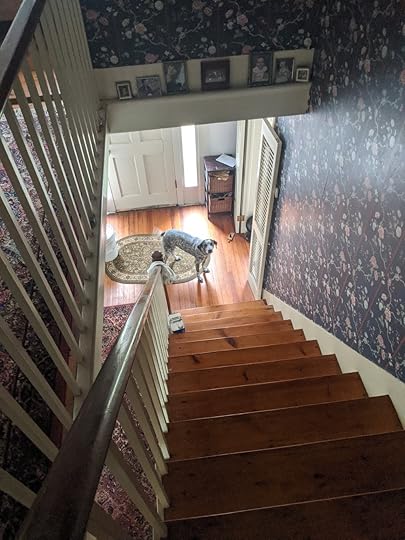 Lucy knows she’s not allowed upstairs. She’s a very good dog.


April 1, 2020
listening to music during a pandemic
I teach Music 101 at a small private university in New England. The primary skill I teach, starting from day one, is non-judgement. For most students, the only thing standing between them and competent musical analysis is judgement: they hear a song, and it can cause an emotional response, and that emotion impedes their ability to do the work I ask them to do.
Let’s be more specific about that moment of emotional response.
An emotion is a a cycle that happens in your body. That’s it. It’s a physiological response of neurotransmitters and electrical signals that has a pattern, a beginning, a middle, and an end. Most emotion happens below the level of conscious awareness, which is why I teach my students explicitly to notice their immediate emotional responses to music. I don’t ask them to change their immediate judgments, because it doesn’t matter to me whether they love or hate any particular piece of music. What matters is that they can recognize the response, and keep listening anyway. What they’re really doing there is practicing non-judgement not just of the music, not also non-judgement of their own response to the music. Love it? Hate it? Fine. That’s your nervous system suspecting that stimulus is either safe or unsafe, approach or avoid. But the reality is no music is dangerous. All music is approachable.
The reason they need this skill in MUS 101 is that some of those neural patterns interfere with other patterns your brain is usually in charge of. For example, when we are stunned by something, we literally get speechless. The parts of our brain in charge of language gets shut down by the parts of our brain that are dealing with whatever the shock was. That’s an extreme example, but it happens in more subtle ways, too.
Let’s say you hear a song you love. Your brain fills with activity! Intense neural activity changes how you feel, and even what kinds of decisions you make. We know from one experiment, for example, that students experiencing high allostatic load (the feeling that your brain is full) are more likely to choose cake as a snack rather than fruit, whereas fruit was the nutritious choice made by students in the “control” group who had space in their brains for making an intellectual choice of snack.
A lot of music is designed to evoke an emotional response, a physical response (again: emotions are in your body). We want to move, dance, clap, sing along. Or it makes us smile or cry or gasp. “OMG I haven’t heard that song in forever!” That’s our nervous systems telling us “there is an incoming stimulus that resonates with our familiar patterns.” And now your nervous system is busy flooding you with those feelings, and it has no interest in completing the assignment from you Music 101 professor.
I anticipate that some of my students will be listening to a lot of music while they’re sequestered. For many of them, music is a safe place for emotions. It reflects their feelings back to them, or it coaxes them into feelings they didn’t know they had. If you didn’t use music as stress relief before now, you may find that it’s really effective not just at entertaining and distracting you, but potentially for guiding you all the way through the cycles of emotions.
But this is also the reason some of my students may find listening more difficult.
Music floods your nervous system with the chemical and electrical activity that is emotion. If you’re already in a state of heightened emotion, and your nervous system suspects more emotion might be dangerous or exhausting, it’s going to want to avoid music. You’ll sit down to do your MUS 101 assignment, and your nervous system will say, “wouldn’t you rather check social media or play a game or shop for fun socks or do your taxes or wash dishes or really anything else?!?!??!!!”
If that’s happening, here’s what you need to know: we’ve already learned the skill that will get you past that hurdle. It’s non-judgement. Your nervous system is telling you the music and/or the emotions it evokes are dangerous. But they’re not. Your nervous system is even more likely to be suspicious of intense emotion if you:
have a trauma historyexperienced of childhood adversityare in an insecure financial and/or housing situationyou don’t have a solid network of emotional support at the moment…Yeah, let’s be real: almost all of you have at least one of those things going on. Which is why I’m writing this. I recognize that I’m asking you to engage with an internal experience that might have been no problem a few weeks ago, but is much harder now.
Remember that emotions are cycles that happen in your body. Only if you keeping ignoring them, stopping them in their tracks, never letting them go all the way through their cycles will emotions cause problems in your life, damage your health, or influence your decisions and behavior in negative ways. If you let an emotion go all the way through its cycle, you’ll probably feel better afterward, no matter how uncomfortable the emotion itself was. Your protective, helpful, lovely nervous system might be shouting DANGERDANGERDANGER but it’s a scared little hedgehog, freaking out and trying to keep you safe. You’re a grown up human who knows better. Turn toward that hedgehog and tell it, “I know you think this is dangerous, but it’s okay. It’s just an emotion, and once its cycle is complete, we’ll be comfortable again… as comfortable as we can be under the circumstances.”
Here are instructions for what to do when your subconscious is telling you to avoid intense emotions, or when you’re flooded with emotion.
Complete the emotion’s cycle. The first step is non-judgement.
Notice the feeling, let yourself feel it even if it’s uncomfortable.Notice the discomfort and let yourself feel that, too. It’s not dangerous, it’s a cycle, and it will end.Notice the physical sensations: heat, chills, tension, tears, fatigue, pain, etc.Observe those sensations without evaluating them, because they’re not good or bad, they’re just sensations. The important trick is to notice when you’re tempted to feed the sensations thoughts. Emotions thrive on thoughts, and they will keep going past your capacity to complete the cycle if you keep feeding them. So, for a few minutes, when you notice the thoughts about how mad your are, or how sad, or angry, or what someone said, or how someone acted… set the thoughts aside. You can think about them later, or vent about them to a friend on the phone in a little while. For now, go back to observing the sensations. Heat, chills, tension, etc. Observe until it fades. It will just go away on its own. Because that’s what emotions do. And if you’re still overwhelmed after, like, ten minutes? Ask for help. Reach out to someone who will turn toward your feelings with kindness and compassion. For my students, that includes the mental health providers at school. They are available for exactly this kind of help, for exactly this reason.
If the emotion comes on in response to music, you might find it helpful to keep listening while you observe the physical sensations brought on by the emotional response. Or you may need to turn it off, then come back to it after the cycle is complete. If you turn it off, cry yourself out, then turn it back on and start crying again, then maybe the music is acting as a thought and feeding the sensation. In that case, try listening all the way through while noticing the emotion. But maybe do it after a break. You might need a nap or a snack to refuel all those chemicals and electricity.
Be gentle with yourself. Take your time. Ask for help. Do the best you can with the resources you have available. That’s enough.
Bonus content: a photo of my dog, Thomas, when he was about two months old. Because puppies are soothing.
 Thomas as a puppy, chewing on a toy bigger than his head
January 14, 2020
Amelia’s trauma song
I write little songs for the Feminist Survival Project podcast, and this is one of them. The sound quality on this one didn’t come out quite as we hoped, so if you can’t understand the words but are curious, here they are! (The words in quotes are references to sci fi/fantasy/supernatural/superhero/magicky stories used to illustrate just how ubiquitous these metaphors are. Can you identify them all???)
“Wonder Twin powers, activate!”
How does it feel when you crawl out of trauma?
What is it like? Is it captivating drama?
“One does not simply walk into Mordor”
No! It’s mostly waking up every day and imitating what you think normal people do,
going to therapy, taking your meds, and faking sanity.
“I volunteer as tribute!”
This is why the stories are full of magic.
Nothing in nature is sufficiently tragic.
Stories can show you for the hero you are.
Stories can show you for the hero you are.
“Bah, humbug!”
People think a hero is someone who helps strangers
They can’t see survivors’ work won’t make them entertainers
“Winter is coming.”
No, the goal is just normality, and that doesn’t look impressive from the outside.
But your experience of the struggle is so much bigger on the inside.
“Luke, it is your destiny.”
This is why the stories are full of magic.
Nothing in nature is sufficiently tragic.
Stories can show you for the hero you are.
Stories can show you for the hero you are.
“You’re a wizard, Harry!”
Suffering and pain can leave your soul in tatters
It can be hard to believe that you matter
“Let it go. let it go!”
Yes, it’s easy to infer that it’s not enough to help just yourself
But actually it’s incredibly valuable and important that you’re taming that lion in your wardrobe.
“I am Moanna!”
Yes, we can see you are full of magic.
You have defeated the evil and tragic.
Now you’ll remember what a hero you are.
Now you’ll remember what a hero you are!
“Sometimes you have to be a little bit naughty.”
Yes, we can see you are full of magic.
You have defeated the evil and tragic.
Now you’ll remember what a hero you are.
Now you’ll remember what a hero you are!

October 21, 2019
Scorsese & Coppola & Bigotry (oh, my)
Francis Ford Coppola is allowed to dislike comic book movies. So is Martin Scorsese. They’re allowed to criticize and critique. But when they dismiss an entire group of movies as “despicable” and “not cinema,” that’s straight up bigotry.
Yeah, they’re just talking about movies. But if they think it’s okay to categorize and dismiss anything in this thoughtless way, they are saying that sometimes prejudice is okay — that, you know, there’s a time and a place when maybe it’s appropriate to express strong opinions against things that aren’t familiar to you.
Hate works because individuals feel like they have permission to hate something that is different, because they assume they are superior. If Coppola and Scorsese don’t participate in it, don’t appear to know much about it, and don’t cultivate any curiosity about something that’s foreign to them, they assume it is inferior. Imagine if, instead of movies, this was a religious group, or racial or ethnic group. We’d all (I hope) not just be defending the groups, we’d be disgusted by the perspective, the blatant discrimination. And it is discrimination, not discernment, because they judge the whole group by its reputation rather than the merit of each individual.
It’s unacceptable for cultural leaders to demonstrate this pattern of thinking. Even if it’s “just movies.” Movies, like music and other arts and expressions of cultural values, make a statement about who we are. It’s not just ignorant and rude to dismiss that statement as invalid; it’s bigotry.
I require my students to do better than this. My teenage college students know better than to express judgments like this without supporting them with specific, objective examples. Maybe they begin my class thinking things like “Opera sucks. How can something so loud be so boring?” but in a matter of weeks they have learned to tell the difference between things they don’t like and things that are bad.
And, yeah, Marvel movies are largely for the white dudes, of the white dudes, by the white dudes. The Marvel movie population is not generally oppressed. They don’t need me to defend them. But just because a target is sturdy doesn’t make it okay to attack it. And it’s not just that I don’t like this kind of attack. Attacking is bad. We know this from history. Nobody in 2019 thinks maybe Hitler had a point about jazz. Nobody in 2119 will think those two genius directors really understood something profound about the film industry that the rabble were too ignorant to perceive.
BTW, you know what art form really explores questions about when attacking is necessary, and when and how we decide to fight to protect and defend others? Comic book movies. Martin and Francis could probably benefit from witnessing Tony Stark’s journey, and maybe debating the ethical implications of Thor interfering in Earth’s fate. I mean, maybe the Frost Giants are misunderstood and just need some love?
Not for nothing, it also demonstrates a lack of artistry that is quite shocking from men who are revered for their artistic genius. The best artists I know are always curious, always learning, always able to honor and respect new things. They are humble in the face of the unfamiliar. They encourage each other to discover and explore beyond what they expected.
So: poorly done, white dudes. Open your minds, make some popcorn, and try to watch Guardians of the Galaxy II without reflecting on what family means to you. I bet you’ll learn something.
 FAMILY FEELS
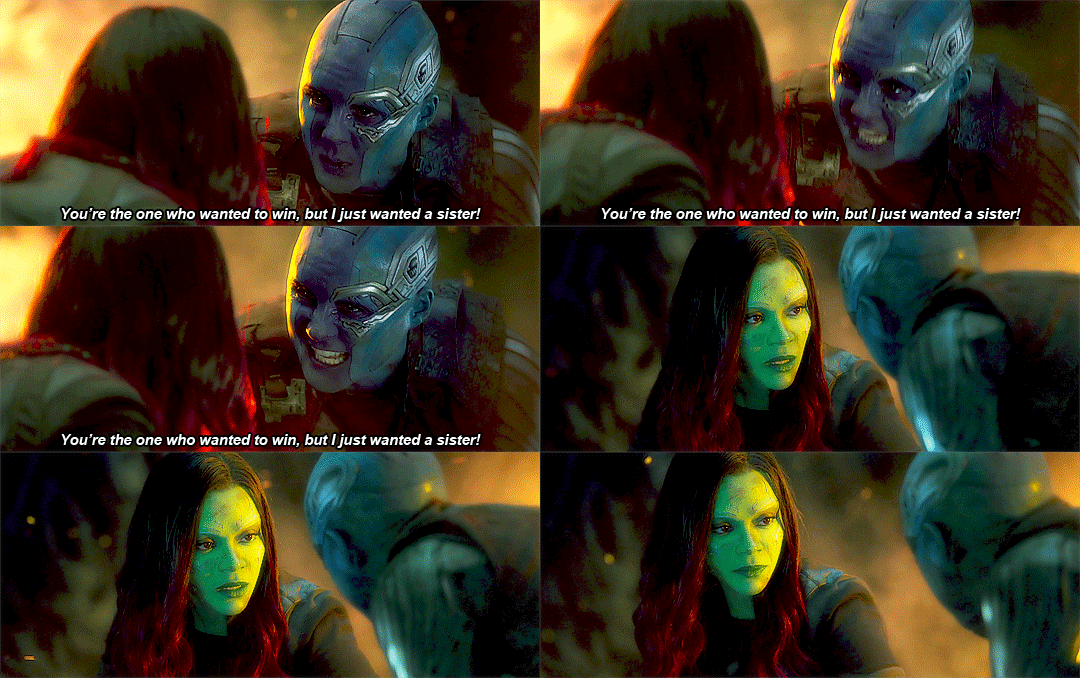 ALL THE FAMILY FEELS
September 21, 2019
horror to hero: rewriting trauma
I’m here to write my way out of a mini traumatization, because re-writing the stories we tell ourselves about our lives is an evidence-based intervention for improving mental health.
This is a tiny story of minor fear. It definitely gave me some intense feelings, but not so many that I’m uncomfortable writing my way through them in public as a model for how to write our way through larger scale pain.
What happened was this: my worst nightmare came true.
I’m camping. I’m half asleep, listening to the nighttime woods: insecty noises too ambient to notice how near or far they are, coyotes howling as a pack far away, human footsteps walking toward my tent then past my tent then into their own tent.
As a woman alone in the woods, I listen to approaching footsteps with a heightened level of alertness. The alertness recedes as the footsteps do.
There are small animal noises outside the tent. Or large animal? Hard to discern. But they are behind the tent, coming around the front. My alertness heightens. It’s one of those gigantic tents set up on wooden decking, like you see army generals working in on the front lines of WWII movies. Tommy Lee Jones has meetings with Agent Carter in tents like this. The noise goes from the front to the back, half way around, and stops right in front of my tent.
“If I hear I zipper,” I think, reaching for my phone just in case I’m about to be in a flashback from Mindhunter, “I will scream bloody murder.”
Worse than a zipper, I hear animal footsteps on the wood decking inside the tent and the scream that comes out of me isn’t remotely voluntary. It’s the instinctive horror-struck response to my worst nightmare coming true.
My worst case scenario of that particular moment had been realized. I heard the noises, they came around the tent, but that’s all fine, I thought. Unless it comes inside, I’m safe and cozy here in my Tommy Lee Jones nest. Unless it comes inside. Lying in the dark, listening and waiting. And then it’s inside with me and my nest is a place where anything can happen, and my body screamed without my making the choice to do so.
But it did. And that moment was horror like I haven’t felt maybe ever.
It was a skunk, and harmless, and the story has a happy ending, but in that moment all I had was the darkness, my wariness preparing me for fight or flight, and then the thing was worried about actually fucking happened.
And that’s where that scream came from. That slasher-movie scream came from the understanding that the thing I fear can happen. That I’m helpless, there was never anything I could to stop it. It feels like the night my husband came to bed muttering, “Looks like Trump’s gonna win. Electoral college.” And my mind rejected it as impossible. The world can’t be that bad. Voters can’t be that gullible. I felt so unhinged by it that I sought out a new therapist that week. (My therapist said she got a flood of new clients that month.) It was the same feeling when Kavanaugh was confirmed. For me, it was confirmation that the world is full of as much evil as I imagined it might be.
That moment of confirming my worst fears is the moment that is sticking with me today, the moment I need to purge from my psyche, the story I need to rewrite. Because it’s not about the stressor. It’s not about the skunk,* though it was what started all this. Today, I’m dealing with the stress itself.
So here’s the ending:
The worst had happened. It was inside with me, and my body said “Oh Hell No” by contracting my vocal apparatus into an instrument of unmistakable communication. The scream was the duration of a complete exhalation, then I inhaled and screamed again, but the second time I was aware that it was going to happen, and knew I could stop it if I wanted. I let the second scream happen.
Somewhere in my subconscious I assumed a nighttime woodland creature would be more afraid of me than I was of it, and to skitter away, shocked and awed by the volume and ferocity of me. But it didn’t. It walked toward me as I screamed, and then past behind the head of the bed.
This was the loudest sound I could make, and it didn’t even startle the thing, didn’t make it veer from its course in the slightest.
My first thought in response to this was “Oh, god, there’s nothing I can do; I have no control.” So after the four seconds it took me to scream twice, I decided not to scream again. It didn’t do any good. I switched on a light and, phone in hand, rolled away from the animal now behind the bed, and I perched on a low stool while texting the campground managers.
Now I’m pretty sure I’m not in any immediate danger. The animal didn’t stalk me or attack me. It went to the garbage can behind the bed and started digging out food scraps. It’s clearly occupied by that and definitely not interested in giving me rabies or having me as a midnight snack.
I immediately start blaming myself for this. I knew it was a bad idea to keep food scraps in the tent — why didn’t I take the garbage out? I knew there was a rip in the zipper by the front — why didn’t I mention it to the campground manager? I remember that victim blaming is wrong, that I had done the best I could with the resources I had available, that this wasn’t my fault.
The only fear left in me now comes from the fact that I don’t know what it is, and that leaves the field of Worst Case Scenarios wide open. I start narrowing down the list in my mind, but none of them comes true. It’s the same process I went through waiting for this situation to happen: I wait and prepare for every possibility, only this time I know more deeply than I have ever known before that the worst really could happen.
But it doesn’t. My stupid subconscious thought screaming was the best response, but what actually worked for me was that moment I had reached for my phone. It meant I was prepared. It meant I wasn’t alone.
My raw fear hadn’t protected me, but my alert wariness had. Yes, the scary thing had happened, but I wasn’t going to have to face it alone because my intellectual, calm, knowing self is good at protecting me. Help was on the way because I really had known what to do.
There remained the unanswered question as to what the threat actually was, which was the only scary part remaining. But as I watch, I see it snuffle away from the bed to the back corner of the tent. It is a skunk. Why didn’t it spray when I screamed?
In addition to my intelligent preparation, I was also very, very lucky.
This skunk had probably been coming in and out of this tent every day for weeks. That rip in the zipper was plenty big enough for a small mammal to crawl under. Probably Tommy Lee Jones and other campers before me had been sleeping through this animal’s nightly rounds. Now that I’ve called management, and the poor night shift guy had to evict a skunk at 2 a.m., they are definitely going to fix that hole. This skunk will not get into this tent again.
My hyper vigilance and experience of terror probably helped ensure that no one else would have to go through this again.
Next time the worst happens, I’ll freak out again. But I know I’m as prepared as I can be, and if I can see myself through it by getting the appropriate help, I may even be able to protect someone else from experiencing it or something worse.
You’re welcome, Tommy Lee Jones.
 Tommy Lee Jones begrudgingly approves
*Feel free to replace “skunk” with “Trump” or “Kavanaugh” or any other representative of white supremacist cisheteropatriarchal capitalist oppression.
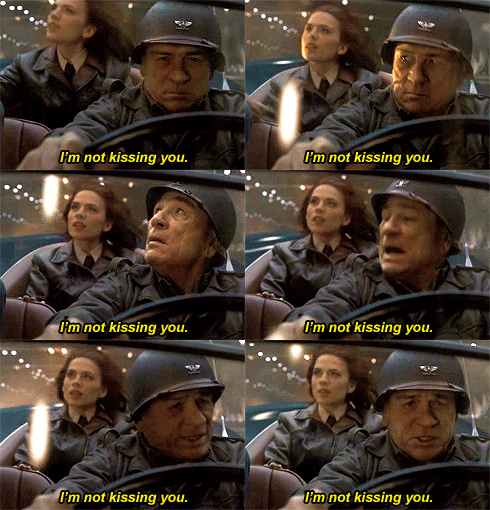 Tommy Lee Jones is not kissing the hero
August 9, 2019
Pessimist’s guide to positive reappraisal
I had a colonoscopy recently, and it was true what they said, that the prep of hard core laxatives is worse than the procedure itself. Of course I googled advice on how to make the prep less horrifying and discovered two types: 1.) practical tips like “drink the laxative chilled,” and 2.) reminders that it’s worth it because CANCER!!!!!!!!!!!!!! And drink it all because CANCER!!!!!!!!!!!!!!
That second thing is an attempt at positive reappraisal, which I recognize and appreciate because it’s in the second chapter of my book. But I feel like I can do better. So I’m going to explain why this advice is ineffective, especially for pessimists like me; and then I’ll give you the positive reappraisal I came up with, which worked better for me.
If you want to skip to the advice, scroll to the bottom. (I think it works better when you know why it works, but not everybody needs to know why.)
Okay, here’s the context. Burnout begins with the idea that modern society requires us to separate our stress from the things that cause the stress. Chapter 1 is all about how to deal with the stress itself, and Chapter 2 focuses on managing the stressors.
When we talk about the book IRL, lots of people ask us about managing specific stressors.
There’s not much I can say about most people’s specific stressors, because most of the time you just have to write the lists and fill out the forms and stand in the lines and get the shit done.
And also manage the stress it causes separately.
But there are some meta tools that apply to all kinds of stressors that can minimize the stress they case. The two main categories of colonoscopy prep advice fit them:
Planful Problem Solving. For colonoscopies, you buy the laxative and lots of ginger infused clear beverages. Chill the stuff. Drink the stuff. Get your husband to watch the dogs, make him stay downstairs with them for two or three hours. Poop until it runs clear, like when when you rinse hair color. But that’s all very unpleasant, and you want to quit, so you need the second category to help you complete the checklist…Positive Reappraisal. Remember, this sucks but it’s worth it. If I go all the way through this tunnel I’ll get to the light at the end! Positive reappraisal works because it’s genuinely true that, hardship often causes growth. Or at least learning opportunities. Physical activity increases muscle strength! Crying in your therapist’s office helps you resolve past conflict! Stuff that sucks can result in stuff that’s better.However.
The “do it because: cancer” colonoscopy prep reappraisal doesn’t work for pessimists, partly because it’s so fear-mongery. I mean, okay, cancer. What does that mean? Death? We’re all gonna die anyway, it’s just a matter of how and when. The pessimist in me knows for a fact that this is all basically a gamble, and all the hope or fear in the world won’t change that fact. I invest time and suffering and $50 in kombucha and coconut water, and maybe the test will end up with a result that helps me. Maybe. It’s a big bet on small odds, and the pessimist in me sees through the cancer scare tips for what they are.
Where optimists assume that bad things are passing and the universe is basically fine, pessimists assume that pain is the default state of human existence, and joy has to be manufactured through active intervention despite the odds. Some research suggests optimism and pessimism are fixed traits, not really changing over the course of your life. My therapist says that’s bullshit, but I think she’s an optimist, so seeing challenges as opportunities for growth (AKA positive reappraisal) is easier for her.
Anyway, whether my pessimism is fixed or an opportunity for growth, it definitely means I have to work harder to benefit from positive reappraisal. You can’t just tell me “big picture, you might not die as soon if you go through this!” because pessimists know that’s meaningless. We can spot bullshit like that from a hundred paces.
So here’s my bullshit-free version of how you can do better than tapping into cancer fear when positively reappraising colonoscopy prep:
It’s a day or two of discomfort, yes. But you have had years on earth and suffered mightily in that time. There has been joy, too, thanks to your awesome powers of Making Joy Happen. This misery is small potatoes compared to your life and your potential. A day or two of discomfort? Those days are bugs beneath your shoe. You’ll walk away from this like a superhero in slow motion not looking back an an explosion they caused.*This huge investment of time and suffering is worth it because you and your wellbeing are worthy of huge investment. You are worth it. You are worthy.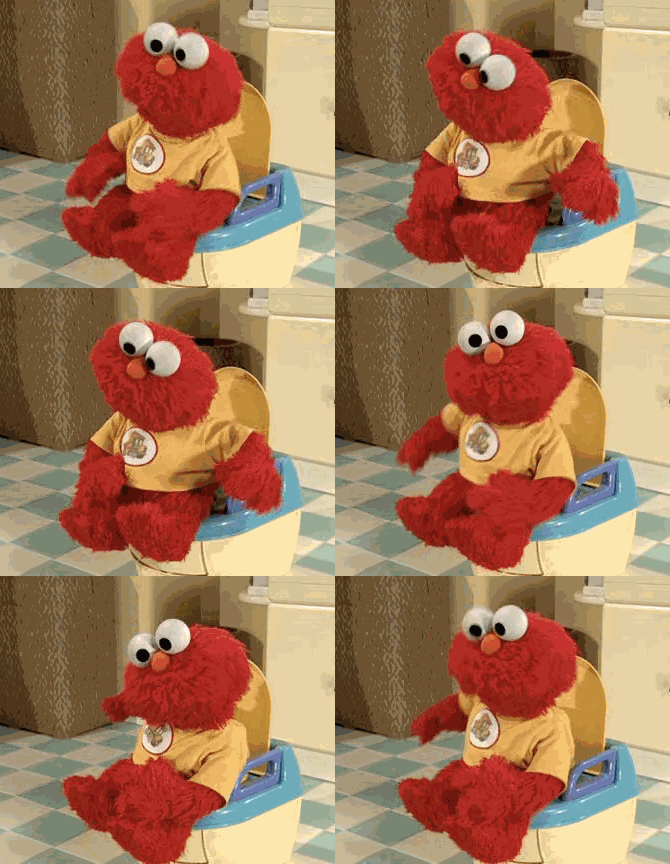 elmo potty dancing
*The explosion in this case is poop.

August 7, 2019
No, no, Norman
Sexism isn’t just sexual harassment and slapping nurses on the ass. It’s the different ways we talk about and treat women just because they’re women. For instance, an obvious example is in the 2016 presidential campaign, and how often Hillary Clinton’s appearance and clothes were remarked upon. But apparently not everyone learned that very simple lesson.
Enter Norman Lebrecht, old white dude who writes about music in a way that would earn him a C+ in my Intro to Music class. He presents a clear perspective, but is sloppy with facts, conflates his his subjective experience with objectivity, and doesn’t know enough about music to describe it in an accurate and compelling way.
But I’m not here to be an academic music snob. I’m here to be a feminist and a conductor calling out casual sexism in the mainstream media. He published this today on slippeddisc.com, and I fixed it.*
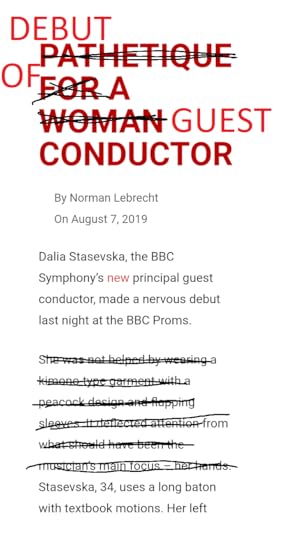
In case anyone is unclear on why this is bad, here’s a primer on how to write about women conductors:
It is sexist to talk about a woman’s attire, because women’s clothes are part of a long history of the policing and oppressing of women’s behavior. Clothes have been blamed for women being sexually assaulted. Clothes have prevented rapists from being convicted. Even if you would talk about a man’s clothes (which… why? that’s just dumb.), don’t talk about a woman’s clothes unless you want to be perceived as a sexist ass hat, because you’re always talking about a woman’s clothes in the context of a system that punishes women for their bodies and how they clothe them. Google “rape culture,” Norman. Google #metoo.Don’t assume that you know how a woman feels, or what she should feel, or how she should express it. Yes, even in the context of conducting. Limit your discussion to the music itself and your personal experience of the performance. Unless you have a graduate degree in conducting, in which case you are allowed to talk about technique.**It’s that easy.
Wikipedia says Richard Taruskin (all hail the great overlord of musicology) described Norman as “sloppy but entertaining.” But I think it stops being entertaining when the writing perpetuates an unexamined understanding of women as objects.
+
*No, I’m not gonna link to the page because if you want to read a cheap, shallow review of classical music, you can google it yourself. I don’t recommend it.
**This isn’t sexist, it’s just a misunderstanding of how conducting works: an ensemble’s focus is not on a conductor’s hands. Ensemble members perceive the whole of a person, which is why conductors with weird technique create great performances. Seriously, have you ever even heard of Leonard Bernstein??? This is why you shouldn’t talk about technique. You just get stuff wrong, and make real musicians roll their eyes.

July 30, 2019
Rory’s rape, and how I fixed it
CW: sexual assault
This is gonna end with hope, but it’ll get dark first. I encourage you to skip this one if you’re gonna get triggered. If you just want to read the part where I re-write the ending of Black Mirror episode 1 to make it feminist and healing, scroll to the italicized chunk at the bottom.
Here’s a soothing gif of Moana turning toward Te Ka (a symbol of her own internal struggles) with kindness and compassion to cushion you from the rest of the post while you go click something else.
 soothing moana gif
I’m writing this post because I got triggered, and writing through my feelings helps me get to the end of those feelings so I don’t get stuck in PTSD-land.
Okay here we go.
I know I’m late to the party, but I finally clicked Black Mirror on Netflix. I didn’t notice it went straight to Season 5, and I watched those three and really liked them. I mean, that cast, amiright? Wow! The acting, so amazing. And the not-too-distant future sci-fi-ness is right up my genre alley. So then I noticed these were the latest episodes, so I thought okay I’ll go back and watch from the beginning.
That was a terrible idea. Look, I’ve been writing a book for several years, and in doctoral school before that, so I’ve been living under a rock. I didn’t know about the… pig. I thought, like the Season 5 episodes, the ending of the first episode would be surprising in some twisty way, but not a misogynist misunderstanding of how trauma works.
In case you were under a rock, too, the premise is this: a kidnapper threatens to kill a British princess unless the Prime Minister has sex with a pig on live TV. I expected it to turn into some technological twist. Nope. The PM is coerced into having sex he doesn’t want to have (which is the definition of rape), and I don’t enjoy watching that kind of thing, so I fast forwarded through what I thought was an unnecessarily long montage of the PM crying and the television audience reacting in a variety of ways. And then when I saw the PM on a bathroom floor puking into a toilet, I thought, “that’s correct.” and continued watching.
The actor who plays the PM is Rory Kinnear, whom I saw play Macbeth at the National Theater last summer. He was amazing on stage: so thoughtful, so specific. He went all the way to the end of each feeling, so the theatricality felt complete rather than overblown. And in his performance in Black Mirror, I saw all that thoughtfulness and understanding of where feelings lead. When his character is told that he’s going to have to go through with it, he’s not only disgusted, but also afraid and ashamed and not telling anyone how he feels because that would be “weak.” And then that turns to just dread and horror. It’s a beautiful performance. And then I fast-forwarded through most of the “during” part and I’m not going to watch it just so I can confirm that it was a good performance. But I can tell you that him on the bathroom floor felt 100% true and right.
But then the episode ends a year later with the PM’s wife being cold and distant. You see, earlier in the episode, she had asked him to make sure it doesn’t happen, because it would be humiliating for both of them. And the general consensus is that the event was art because it made a statement about people’s voyeurism that kept the streets empty while the princess was roaming free.* And then the episode was over. And then I was triggered. Because Rory and I thought through where the feelings go, but no one else making the show did.
Because this man is a rape survivor, and his trauma is ignored. Rory Kinnear’s portrayal made me think they were going to recognize and acknowledge the human violation that had taken place, the pain he would carry. Nope. If we see him as a victim at all, it’s of a prank, not sexual assault. He’s the butt of a joke. “Can you believe this guy is still in public life even though he did that????” His approval rating has only risen 3%, the doofus.
Since I was now triggered, I ruminated on the rest of the episode. In hindsight, I could see what bothered me, and there were lots of things,** but one problem showed me how to fix it:
No one walked away from their TV during the broadcast! A few women looked away from the screen, but the whole point was the streets were empty, so no one discovered the princess had been released half an hour earlier. Because everyone was glued to their screens. Because apparently humanity is 97% callous jerks and 3% silent enablers, and no one else would be retraumatized or need to step away???
In reality, I think at least 10% of people would be incapable of being in the same room as a screen showing that broadcast.
If the writers had asked some women, they would have seen that this huge plot hole undoes their whole premise! Any group of women would recognize that a significant number of people are not going to stare mindlessly at a screen portraying non-consensual sex. We would know that, in fact, what would have happened is this…
Amelia Fixes the end of Black Mirror, episode 1, “National Anthem”
An announcement comes over the air that viewers are advised to turn off their TVs, that owning a recording of the broadcast is illegal, that the broadcast will commence after the loud, high tone. Lots of people wait it out and stare, but —
Cut to a single woman, alone in her shabby flat, switches off her screen with shaking hands, and starts to cry.
Cut to a large, posh living room, where a woman is sitting with her husband, her face drained of blood, sweat beading up on her face. She can’t speak — she can barely breathe — but her head twitches in a minute shake as she leans away from the screen. The husband hurriedly smashes the OFF button and puts his arms around his wife, who closes her eyes and breathes deeply as her tension drains little by little.
Cut to the studio, where the broadcast has just begun. The PM is trembling, breathless, frightened. He says, “I’m here to ensure the safety of the princess.” He can’t hold back tears as he reluctantly removes his jacket.
Cut to the PM’s wife standing outside the studio door, being restrained by guards, thrashing and hyperventilating, hissing through her teeth at the PM’s advisers in the hall with her, “Don’t. Don’t make him do this. You can’t.”
Cut to a medical facility, where a teenager in a hospital gown is sobbing with her face in her hands. A group of nurses wheel her away, and we see that they are gathering groups of patients. Several of the nurses are also clearly disturbed, but all of them are business-like, efficient, knowing what needs to be done and just fucking doing it. A crowd of patients waits outside the hospital front doors, hold hands. A doctor with a young boy in her arms starts to sing. “I know it’s hard sometimes/and it’s okay not to be okay…”
On the street, we see that all through the neighborhood, survivors are standing outside in huddled groups, crying and hugging each other. They notice others around them, and bring them into their circle.
Someone notices a very young woman in a green dress stumbling down the street and says, “Are you okay? Do you need help?” And she instantly recognizes it’s the princess. “Call 999!” she cries, guiding the princess to a bench.
Phones ring. Emergency services are contacted. Cut to the PM in the studio, unbuckling his belt with a sob when suddenly his adviser flings the door open. The look on her face tells the PM that the princess is safe, and that he, too, has been saved.
He whimpers and stumbles toward the door. His wife rushes into the room, catches him from falling, and they cling to each other.
The end.
See? He’s rescued by other survivors looking out for each other.
That would have been awesome. And now we have an ending to the story that honors the reality of human experience!
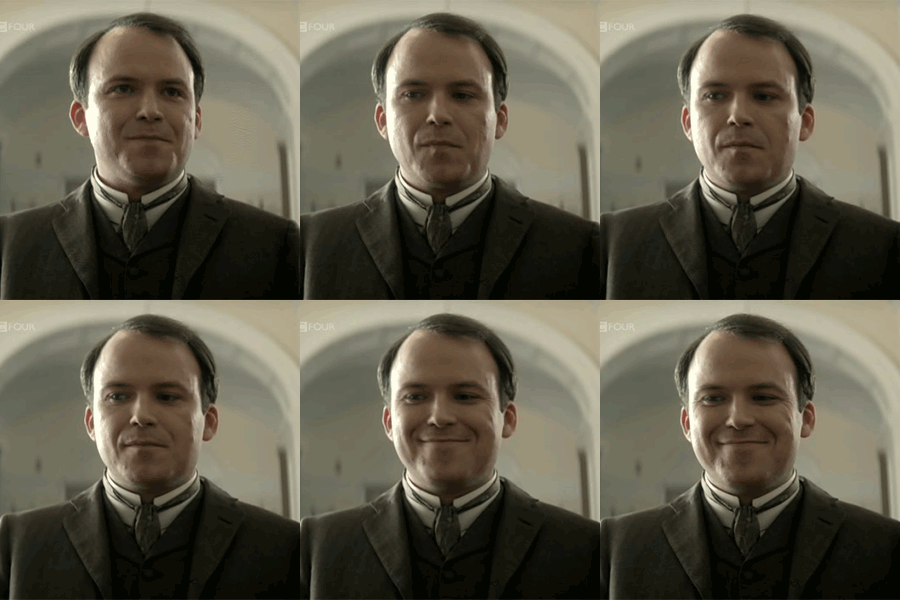 Rory thinks about it and is glad
*This isn’t the point of my post, but the whole “is it art” angle is total bullshit. I’m an artist, and claim expertise in art. Yes, sometimes, art is uncomfortable or even painful for an artist and for an audience. I think this show counts as art. It’s not good art, it’s shitty stupid petty trite cheesy manipulative trash full of ego. It’s bad because the purpose of art is to say something true about humanity, and this work misses truth. I think Rory Kinnear’s performance is good art because it is true. But is the kidnapping/rape portrayed in the show art? No. Of course not. It’s not even a debate, like, “I know it when I see it,” or “art is art when an artist calls it art.” No. Consent is part of art. The maker chooses to make it, the audience chooses to see it. It’s not art if anyone is part of it against their will. Then it’s just crime.
**1. Everyone’s worried about the PM’s humiliation, like he’d just been asked to do the chicken dance or eat pudding with his hands.
2. His wife is worried about her honor and dignity, not about his, ya know, bodily autonomy.
3. His wife WATCHES the broadcast! She stares blank-faced b/c apparently she’s a sociopath???
4. Humans are so degenerate we’ll be drawn like magnets to watch non-consensual sex, but not degenerate enough to think “hey, everyone’s inside watching that broadcast; the streets are empty, so this would be a great time to go out and loot some stores!” ???
5. A lot of people will feel uncomfortable, upset, or even disgusted by this episode. But the episode gets all meta and points to the audience: “you just watched this, so you’ve proven that you are the problem we illustrated here!” It blames the viewer for their own discomfort, gaslighting them so they are afraid to turn toward that discomfort, to offer their pain kindness and compassion.
6. There are a lot, but I don’t want think about them anymore. I’m just going to use my version and imagine a world like this one, where survivors are heroes.

July 11, 2019
Buffy’s Madwoman©
Season 6 of Buffy the Vampire Slayer starts with Buffy being raised from the dead by her friends.
Relatable, amiright?
Remembering that when I analyse fiction, it’s with the frame that a story is an analogy for a psychological journey. This is not a stretch in Buffy, where season 4 ends with the four main characters acting as extensions of a single being, to the point that they share dreams in the finale. Joss Whedon was just like, “just in case you didn’t know this story is a metaphor for the self, I’m going to tell you explicitly which part each one of them is.”
So I put this resurrection in context by reminding you that Buffy sacrificed her core self to allow a new, unusual, unexpected part of her life to grow (depicted in the story by her sister, Dawn) at the end of season 5. Super relatable. Who hasn’t felt like they had to give up on who they used to be in order to become something new? And of course there’s some part of us freaking out because that kind of change is scary. So they resurrect us, whether we like it or not.
We talk in Burnout about the Madwoman© in the Attic,* the self-critical voice in our heads telling us no one will love us unless we fit in, unless we meet external expectations. In Victorian literature, she is presented like Bertha from Jane Eyre, Rochester’s insane wife he keeps in his attic. Because that’s where we all put our Madwomen©.
If that doesn’t make sense to you, let’s take a look at Spike the vampire, Buffy’s Madwoman©.
Spike, like any Madwoman©, is not a complete person unto himself. He doesn’t have a soul. He’s just a creature of fear and revenge and disorganization. The Madwoman© wants us to be safe, but her ideas about what that entails are not good, and that’s the role Spike plays in Buffy’s life in season 6. All her other friends expect her to be happy and grateful not to be dead, but Buffy’s feelings are much more complicated than that. But in order not to hurt their feelings, she hides those feelings. She only tells Spike. Who doesn’t give her sage advice, which would be something like, “be honest, they love you and they want to understand.” No, Spike is 100% on board with Buffy keeping this secret between him and her because, yeah, of course she should hide herself because of course she can’t trust the world to love her as she is.
Buffy treats Spike the way we all treat our Madwomen©. Actually, this reaches back into season 5, in which Buffy ignores, rebuffs, and rejects everything Spike does or says. Eventually she accept that he really does want to protect her — Spike hasn’t been reliable, but Buffy at least trusts his strength and intentions. This is a reflex for a lot of us! When we are afraid the world isn’t going to be able to accept our difficult feelings, the Madwoman© does not trust the world to let us be vulnerable. She is content when we keep our secrets between her and ourselves, and our fear drives us to listen to her advice. Which is how Buffy and Spike begin season 6, and how they continue through the first third of the season, conspiring to hide her feelings from her friends.
Until “Once More, With Feeling,” which might be one of the best television episodes of any series ever.** It culminates with Buffy involuntarily blurting out the truth to her friends, who are, yes, heartbroken and devastated and ashamed. Immediately afterward, Buffy throws herself at Spike. Her worst fears are now realized, and that drives her toward someone who already knows her, toward thoughts and feelings that are neurotic as hell but allow her to avoid facing other people’s difficulties accepting her for who she is.
This is not what good self-compassion looks like. No, you can’t just ignore the Madwoman© forever, you need to turn toward her eventually; but it’s a terrible idea to buy into what she offers. She doesn’t trust, she is full of fear. She wants to protect us, but only if we hide all of who we are, believe that who we are is unacceptable to the rest of the world.
Spike and Buffy have this fight over an over in the middle third of season 6, (Eps 9–15) during which their relationship is built on confusing hate-sex:
Spike: your friends don’t really know you; you’re dark and evil like me.
Buffy: shut up, I’m not evil! ….Am I?
Two-third of the way through the middle third (Lucky Ep 13) Buffy turns toward a character who represents a wiser part, Tara, to admit that she’s been consorting with Spike, that she’s not sure it’s good for her, that she suspects it means she’s bad or gross or wrong. And Tara’s all like, “it only means what you think it means,” and that helps Buffy think it through more clearly.
In the final third of the season, Buffy turns away from her Madwoman©, cutting off the relationship with Spike (Ep 15), eventually (Ep 17) giving him a beating in which she is explicitly taking out her self-hatred on him. Which he accepts gladly. Because that’s the Madwoman©’s job. She’s glad you’re turning toward her. And she believes you deserve punishment, or at least that punishment is inevitable.
And Spike doesn’t heal for the rest of the season. Instead, he does what Madwomen© do when you try to ignore them: he acts up. He throws a tantrum and disturbs Buffy’s life even more. He has a drunken hook-up with a revenge oriented character, and makes sure Buffy’s friends know she had this secret thing with him (Ep 18). At the midpoint of the next episode, he sexually assaults Buffy in her bathroom, and here’s where my interpretation breaks down.
In the show, Spike recognizes that he is wrong, feels remorse, and runs away to face his own torment in order to transform himself into a complete creature with a soul.
In a person, the Madwoman© doesn’t have individual motivation to see her own flaws. She needs you to show her if she is capable of more.***
I’m not sure it would have worked in the show for Buffy to have turned to Spike in that moment, offering him compassion for his fear and sorrow, giving him hope that she can protect herself, allowing him to let go of his drive to shame her into solitude. Maybe Joss could have made it work if he had still been writing episodes, but alas, all we have is the text as it stands. I can only speculate what Buffy could have said that would have inspired a real Madwoman© to transform into something trusting and stable:
Wow, Spike, you just got that totally wrong. I can see that you really believe that if I continue to be myself and trust other people, they will abandon me or hurt me and I will die alone and unloved. I recognize that you think vulnerability is going to be the death of me. But you’re wrong. The people who love me will keep loving me no matter what. And if they do leave me or hurt me, I’ll still be okay. I see that you’re desperate and tired, and I’m grateful you for wanting to protect me. But you’re doing it wrong, and if we do this your will, we’ll both get hurt. So have a seat. I’m taking a path of trust and love. Maybe you can watch and learn and grow, and then join me when you feel like you understand.
Because in season 7 Spike begins the season out of touch with reality, unable to cope with remorse for all his past wrongdoing. But eventually he gets clear, resumes his helpful advocate role, and ultimately sacrifices himself so Buffy can go on. Which is also what a Madwoman© can do.
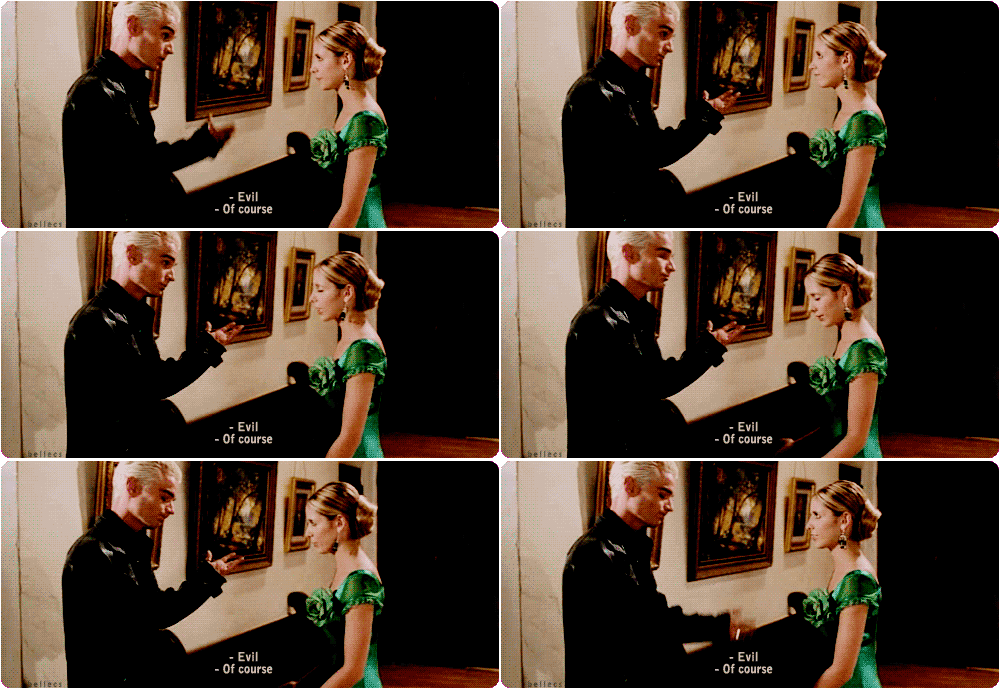 Evil. Of course.
*I’m using the Madwoman© label, because this isn’t about actual women or actual issues of mental illness/”sanity”/madness. I’m using an old archetype as a metaphor for a psychological process. The Madwoman© isn’t a person, and I’m not stigmatizing her mental illness. I know, I worry continuing to use the term maybe perpetuates something bad… but as a personal with multiple mental illness diagnoses and treatments in my life long term, under the care of a psychologist and a psychiatrist, AKA someone who would suffer from the stigma if it were perpetuated by me, I claim the right to use the term.
**This is largely due to its context rather than simply its content. The content is clever and witty, but the context is where the power lies. Beyond its core of moving the season’s plot forward, it’s a self-aware parody of musical theater. Within that layer, it references different musical styles to illustrate the characters and their relationships. This is so effective that you have to know the characters and understand the context in order to appreciate how good it is, which is annoying to me as a teacher of music appreciate because I have to provide too much context to my students to make it worth using as an example in class. Damn your character specificity, Joss Whedon!
***I don’t know if all madwomen are capable of change, of becoming productive and positive contributers to a personality. But I suspect they are.

June 10, 2019
women conductors at Eastern ACDA!
I’ve been keeping track of representation of women conductors at conferences of the American Choral Directors Association, and the Eastern Region just announced their choirs for the next conference.
There are thirteen of them, and five of the conductors are women — almost 40%, which is a significant improvement over the usual 25–30% that has been standard for all of ACDA’s history.
The thrill comes when we look for the continued ghettoization of certain choirs as “women’s work.” As I’ve described before, in the choral world, the older the singers get and the more training they have, the more likely the choir is to be directed by a man. The younger they are, the more training they require, the more likely a woman is a conductor. Choirs of older singers with more training perform more difficult repertoire, and are generally associated with greater prestige for the conductor. The divide happens at high school. There are way more men conducting high school choirs than any other pre-adult choirs, and the vast majority of elementary and middle school choral directors are women.
In addition to the age divide, there’s a repertoire divide. Women tend to conduct treble choirs — whether the treble repertoire is advanced music for adults with treble voices, or simpler music for children with high (unchanged) voices. Even very sophisticated repertoire for women isn’t associated with as much prestige as the SATB repertoire that dominates the history of choral music.
So, the “women’s work” category includes choirs that sing music for sopranos and altos only, or include tenors/baritones younger than 14. There are five* of those on ACDA East’s list, two conducted by women. Typical. Men are more likely to enter the “women’s world” ghetto than women are to break out of it. However…
There are two mixed-voice high school choirs, one directed by a man, the other by a woman — woo-hoo! 50/50 for the first time I’ve ever seen! This is awesome.
Okay, now we get into the choirs that carry the most prestige: adult singers. There are six of them, five colleges and a community choir. The community choir is conducted by a woman! This is a big deal, and represents forward progress that makes me really glad. Of the five colleges, one choir is conducted by a woman, which is more than usual and another good step forward. Not good enough, of course, but progress.**
So, it’s not a result to hail as victory of the equality of women on podiums, but it’s a clear improvement. Yay!

*The Choir School of Delaware (OMG hi, Delaware!!! I’m from you!) is a complicated case to evaluate for these purposes. It’s a school for all grades, and they don’t specify whether the choir they’re bringing to the conference is made of older or younger kids, treble or mixed voices. But their website describes them as a school for “at risk” kids from Wilmington (the most urban community in Delaware, which is just more code for the place where the most Delawareans of color live. I know this because I lived in Delaware for 22 years, and I went to school in Wilmington when bussing was first instituted in order to make schools more diverse AKA give the kids from downtown Wilmington access to the richer, whiter suburban schools, and let the richer, whiter suburban kids know that people of color exist.) and the pictures of kids of color in their image gallery shows us that this isn’t a school dominated by white people, as all of the other organizations at the conference are. And there’s an intersection between gender and race, where working with singers of color lacks prestige the same way working with treble singers does. To make it more complicated, it is a Choir School, which does carry prestige among musicians. To make it still more complicated, their conductor is an African American man married to a man (I googled him to check for pronouns and a top hit was about his wedding, and it’s soooo adorable!), so now we’re intersecting gender, race, and sexuality, and this level of sociological analysis is beyond my pay grade.
**#whentherearenine


