Jonathan P. Thompson's Blog
January 13, 2021
The Land Desk: A public lands newsletter
With the dawning of a new year comes a new source of news, insight, and commentary: the Land Desk. It is a newsletter about Place. Namely that place where humanity and the landscape intersect. The geographical center of my coverage will be the Four Corners Country and Colorado Plateau, land of the Ute, Diné, Pueblo, Apache, and San Juan Southern Paiute people. From there, coverage will spread outward into the remainder of the “public-land states” of the Interior West, with excursions to Wyoming to look at the coal and wind-power industries and Nevada to check out water use in Las Vegas and so on.
This is the time and the place for a truth-telling, myth-busting, fair yet sometimes furious journalism like The Land Desk will provide. This is where climate change is coming home to roost in the form of chronic drought, desertification, and raging wildfires. This is where often-toxic politics are playing out on the nation’s public lands. This is the sacrifice zone of the nation’s corporate extractive industries, yet it is also the playground and wilderness-refuge for the rest of the nation and the world. This is the headwaters for so many rivers of the West. And this is where Indigenous peoples’ fight for land-justice is the most potent, whether it be at Bears Ears or Chaco Canyon or Oak Flat.
The Land Desk will provide a voice for this region and a steady current of information, thought, and commentary about a wide range of topics, from climate change to energy to economics to public lands. Most importantly, the information will be contextualized so that we—my readers (and collaborators) and I—can better understand what it all means. Perhaps we can also help chart a better and more sustainable course for the region to follow into the future, to try to realize Wallace Stegner’s characterization of this place as the “native home of hope.”
 http://landdesk.substack.com
I’ve essentially been doing the work of the Land Desk for more than two decades. I got my start back in 1996 as the sole reporter and photographer for the weekly Silverton Standard & the Miner. I went from there to High Country News fifteen years ago, and that wonderful publication has nurtured and housed most of my journalism ever since. But after I went freelance four years ago, my role at HCN was gradually diminished. While I have branched out in the years since, writing three books as well as articles for Sierra, The Gulch, Telluride Magazine, Writers on the Range, and so forth, I’ve increasingly run up against what I call the freelancer bottleneck, which is what happens when you produce more content more quickly than you can sell it. That extra content ends up homeless, or swirling around in my brain, or residing in semi-obscurity on my personal website.
I’m not messing around. The Land Desk is by no means a repository for the stories no one wants. It is intended to be the home for the best of my journalism and a place where you can find an unvarnished, unique, deep perspective on some of the most interesting landscapes and communities in the world. My hope is that it will give me the opportunity to write the stories that I’ve long wanted to write and that the region needs. If my hopes are realized, the Land Desk will one day expand and welcome other Western journalists to contribute.
That’s where you come in. In order for this venture to do more than just get off the ground, it needs to pay for itself. In order to do that, it needs paying subscribers (i.e., you). In other words, I’m asking for your support.
For the low price of $6/month ($60/year), subscribers will receive a minimum of three dispatches each week, including:
1 Land Bulletin (news, analysis, commentary, essay, long-form narrative, or investigative piece);1 Data Dump (anything from a set of numbers with context to full-on data-visual stories); and,1 News Roundup, which will highlight a sample of the great journalism happening around the West;Reaction to and contextualization of breaking news, as needed.Additionally, I’ll be throwing in all sorts of things, from on-the-ground reporter notebooks to teasers from upcoming books to the occasional fiction piece to throwbacks from my journalistic archives.Can’t afford even that? No worries. Just sign up for a free subscription and get occasional dispatches, or contact me and we can work something out. Or maybe you’ve got some extra change jangling around in your pocket and are really hungry for this sort of journalism? Then become a Founding Member and, in addition to feeling all warm and fuzzy inside, you’ll receive some extra swag.
I just launched the Land Desk earlier this week and already subscribers are getting content! Today I published a Data Dump on a southwestern indicator river setting an alarming record. Also this week, look for a detailed analysis tracing the roots of the recent invasion of the Capitol to the Wise Use movement of the early 1990s. In the not-so distant future I’ll be publishing “Carbon Capture Convolution,” about the attempt to keep a doomed coal-fired power plant running by banking on questionable technology and sketchy federal tax credits. Plus the Land Desk will have updated national park visitor statistics, a look back on how the pandemic affected Western economies, and forward-looking pieces on what a Biden administration will mean for public lands.


December 4, 2020
Riding out the pandemic with the strays of Sofia
I’m not even a dog person, I thought, as I stared into the murk on a cold, late-autumn night. But right then, I had no choice but to do my best imitation of one. Somewhere down the dimly lit dirt road a gravely wounded canine shivered in pain and fear. This neighborhood, on the dilapidated fringe of Sofia, Bulgaria, was as foreign to her as it was to us. Leaving her would be to abandon her to a slow and miserable death from her injury, or a more violent one at the teeth of other feral dogs surely lurking nearby. Yet if we tried to catch her she might lash out, possibly exposing us to rabies.
“I’ll go get the car,” Wendy, my wife, who is a dog person, said. “You walk back there and see if you can find her and catch her.”
“But I…” I’m not even a dog person!
[image error]Liska and Mecho
Just short of four years before that night, Wendy had called me from a job fair for international teaching gigs to tell me that we were moving to Bulgaria.
“Bulgaria? What the hell’s in Bulgaria?”
“A job.”
“Oh. Okay.”
We were living in Durango at the time, my hometown. Life there was way out of our price range, but it was pretty good. I had a great job. Our friends are there. The climate’s good, and I could go trail-running right out my back door. When Wendy had suggested trading it in for life abroad, I had assumed she meant southern Italy, maybe, or Provence. But Bulgaria? After hanging up I tried to imagine the country, and all I could conjure were visions of drab, gray buildings, drab, gray skies, and drab, gray boiled cabbage. I Googled: “Where is Bulgaria?” “Typical Bulgarian cuisine.” “Trail running in Sofia.” “Wine in Bulgaria.”
Initially, the search results brought relief. Bulgaria wasn’t in the cold north, but in the temperate south, bordered by Greece and Turkey. Bulgarians didn’t eat boiled potatoes and cabbage and gray, rubbery sausages, but grilled meat and fish, fried potatoes with cheese on top, and tomato-cucumber-salads accompanied by high-octane brandy called rakia. Sofia wasn’t surrounded by dreary plains at all, as I had imagined, but sat at the foot of a trail-addled forested mountain. It sounded great.
But there was a hitch. Lurking in nearly every rosy account of the rich history, the thriving trail-running scene, the delicious Mediterranean cuisine, the affordable wine, was a warning: Watch out for the dogs. Bulgaria, it turns out—at least according to the always-reliable internet—is stray-dog central. Packs of feral canines roamed every corner of the city, hungrily eyeing humans. Nearly every Bulgarian’s been bitten at least once, resulting in the requisite round of painful rabies shots (I’m not a needle person, either). In 2012 a pack attacked an elderly academic and author, ultimately killing him, the second fatal mauling in the city that year.
I comforted myself with the knowledge that I could always give up running and going outdoors in general, and simply stay inside and become the world’s expert on rakia, instead. Besides, it’s not like we were going to be there for very long—a year or two, tops. Or so I thought.
If you’d told me then that I’d still be here four years later, I would have laughed. If you’d told me then that I’d be riding out a gnarly pandemic in an Eastern European country, I would have scoffed. And if you would have told me that one of those vicious Sofia stray dogs would have stolen my heart, I would have whacked you in the head for your preposterousness.
And yet. Here I am.
In August of 2016 we arrived at our apartment on the campus of the school where Wendy teaches. The school was built a century ago on a gentle hill that at the time sat in the countryside between the city of Sofia and Vitosha Mountain. Urban sprawl has since metastasized its way up to the foot of the mountain, and the campus is now a part of the city’s outer neighborhoods. Yet it remains a sanctuary from the outside world, grassy at its center, rife with trees, including pears and apples and wild plums, a few towering redwoods, and several elegant old oaks with sweeping limbs reaching gracefully into the blue, their skyward hands filled with fire-hued leaves in the autumn.
Just a few minutes into my first neighborhood run I encountered a pack of four feral-looking dogs lounging around on a quiet street. As I approached, they rose to their feet. I slowed, but refused to be cowed, knowing that they can smell fear, and continued moving forward, ready to leap over a wall or throw a rock or just run like hell in the other direction. But without a growl or bark they skittered calmly to the side, looking at me curiously. I saw more strays that day — one on the walk to the grocery store, and two well-fed mutts lying outside the market’s sliding doors — and they all treated me with the same aloofness. Even the school had an official stray, Mama, an ancient longhair whom had been taken in by a teacher years before and then left behind.
The internet, in other words, was correct: Feral canines are ubiquitous here, cruising down alleyways, lounging in front of shops, and hanging out in in the common spaces at the foot of the towering, brutalist panelkis, built en masse during the communist era. Sometimes they do attack. A friend got bit in the leg while running, and had to go through the rabies rigamarole. A few of the dogs are aggressively affectionate: I once had a gangly tail-wagger follow me on a run and demand frequent pets. Mostly, though, the Strays of Sofia are gentle, skittish, and scared of humans.
Wendy, who finds it very difficult to pass an animal in distress without doing something to help, has a hard time with the stray situation. Once, while driving along an empty highway in California, she came across a very young, lost calf, coaxed it into her car’s backseat, and delivered it to the nearest high school’s Future Farmers of America. She tries to do the same with the Sofia Strays. But I remind her that most of Sofia’s ъездомни кучета, or “homeless dogs,” are not full-blooded strays or even completely homeless because they have people who feed them and even put out dog houses and cozy, warm beds.
Mama, for example, had the campus community to keep her fed and sheltered (she died of old age not long after we arrived), and a steady stream of hot-dog-dispensing customers cared for the supermarket dogs. The two campus dogs who arrived after Mama’s death, however, had no one. One was a large, mangy, dreadlocked creature that lurked near the dumpsters, darting off when humans approached. The other was a frisky, black and white, bushy-tailed mutt with a hefty dose of border collie in her genes. The old pensioners who guard the campus had named them Mecho (Bear) and Liska (Fox), respectively. Wendy started taking them table scraps, then dry dog food, then a gourmet stew that included chicken broth and olive oil. We had “adopted” a couple of strays, Sofia-style.
I have found that human love can be bought with good food. The same apparently is not so with skittish strays. The dogs were quite taken with Wendy’s stew and soon grew comfortable enough that they’d eat jerky from our hands. But neither would let us pet them, and when we did manage to sneak in a touch, they’d yelp as if in pain. At least they were reliable, showing up every single night at stew-time, waiting patiently if we were late.
So we were worried when Liska skipped dinner for two chilly nights in late October of 2019, and even more so when she reappeared, moving slowly and with a limp. Without any of her old temerity, she approached me and allowed me to pat her head and to get a better look at what was wrong. A large flap of fur and skin had been sliced loose on her chest, leaving a gaping wound revealing blood and bone and muscle and cartilage underneath.
I fell backward in horror—I am not a blood and bone and muscle person—and, quivering and on the verge of tears, ran to the house and summoned Wendy. Without a plan we went in pursuit, and Liska darted into the night, presumably to die alone. We watched her go, helpless and heartbroken. When she returned two days later, this time clearly ill, her glassy brown eyes looking imploringly at us, we were able to cajole her into the backseat of our old Fiat Panda, and we rushed her to the 24-hour veterinary hospital in a semi-rural area on the city’s outskirts.
After we put a muzzle on Liska, Wendy wrapped her in a blanket and lifted her out of the car. At first Liska was calm, but her internal vet-alarm must have sounded, because as Wendy approached the hospital doors, the dog shook the muzzle off, squirmed out of Wendy’s arms like a fish, and dashed across a busy road and down an unlit dead-end lane.
We looked to the vet imploringly. She shrugged her shoulders and gave us the Bulgarian head-nod (Bulgarians nod for “no” and shake their heads for “yes”). Her job was fixing animals, not chasing after potentially vicious, rabid strays—and we’d be wise to abandon our rescue attempt and head home, too, letting nature run its course.
That’s when Wendy sent me into the murk while she went back to get the car.
I walked timidly down the road, my phone-light unable to penetrate the darkness. A dilapidated abandoned warehouse sat on one side of the lane, a group of new Bulgarian McMansions on the other, protected by a high wall. This juxtaposition of privilege and poverty is common here: The median salary is about $8,000, but the streets swarm with late-model BMWs, Porsches, Audis, and even Maseratis and Bentleys; people burn car tires to stay warm in the winter, contributing to the hazardous levels of air pollution, but gated, luxury condo complexes are going up everywhere; thousands of friendly strays roam the streets, yet the pet stores do brisk business in pricey purebred puppies.
The beam of the Panda headlights revealed a flash of white appeared off to my side — Liska’s “socks”–and I slowly approached the dog, shivering in the darkness next to a bush. Wendy hopped out of the car, blanket in hand. While I tried to soothe Liska, Wendy threw the blanket it over her like a net, and then hugged her, as if she were swaddling an unruly infant. As I moved in to put the muzzle on, Liska flailed her head violently and her teeth whacked my knuckles, breaking skin. That’s it, I thought, as I jumped backward, I’m dead. Liska took the opportunity to wiggle loose again, and ran across the road into the brambles. We walked slowly toward her and sat down and softly explained that we didn’t want to hurt her, and that she needed to come to us. She looked out at us with sad brown eyes, her shiny black snout dusted with white, and seemed to understand. Her body went slack. Wendy approached and lifted her up. She did not struggle.
The vet opened up the wound, cleaned it out, stitched it up, put in a drain, and put her on a hefty dose of antibiotics, but he told us it might not be enough. The wound was too deep, the infection too far along. Yet Liska made it through the first night, then the next. I did not die of rabies. Every evening we drove through smog and rush-hour traffic to the vet, where we took Liska on little walks in the tiny, fenced outdoor space, petted her, and got to know the vets and their assistants, all of whom were lovely, caring people, surely getting paid a pittance by American standards to work ungodly hours and deal with hopeless cases. And finally, after three weeks in the hospital, Liska was strong enough to come home — or, rather, to come to our house, where she would spend her convalescence.
Honestly, I really wanted leave Liska in the hospital. I was certain she’d freak out in our house, tear her stitches loose, pee all over the rugs, chew up the furniture, scratch the veneer off of the doors, and possibly even bite me. That was not an option, though, and I shuddered at the thought of putting her in the dog-rescue place that we’d visited once in order to give a bunch of the cooped-up mutts a walk and some companionship. So we made her a bed in the hallway, where she’d do the least amount of damage, closed all the doors to the other rooms, and tried to go to bed. But Liska couldn’t settle, and her claws clicking against the tile floor and the plastic lick-prevention lampshade banging against the walls would not let us settle, either. I got up and made a bed for myself next to hers on the tile floor, lay down beside her, and stroked her black fur until she calmed down and I fell asleep.
On our first morning walk, Mecho made an appearance. He was clearly bewildered by the bandage-wrapped and lamp-shade-wearing FrankenLiska, however, and he stood at a cautious distance. Liska took it in stride. To my surprise she was eager to finish the walk and get back to the house, and when we got back inside and I took off the leash, she bolted straight into the living room and pounced upon the sofa as if it were her prey, and thereby declared it her domain.
Maybe she had been house-, leash-, and couch-trained in a previous life, or perhaps she was just so damned smart that she figured out how to live with humans overnight. Whatever it was, she proved herself to be the best-behaved dog on campus. She learned to sit when told, so long as I said it in Bulgarian. She understood which furniture was hers to sit on, and which was off-limits. Without a whimper she succumbed to our incompetent medical care, which entailed cleaning and dressing her wound two to three times a day for more than two months after she got out of the hospital. And she shed her fear of human affection and now craved it, reveling in pets, ear-scratches, belly rubs, and snuggles. She slept on her couch without a sound all night, and as soon as she knew we were awake she ran in and jumped up on the bed, squeezing in between us and begging for love.
And just like that, Liska had gone from being a stray to a loyal and loving house pet. Or so it seemed.
[image error]
Liska’s wound finally finished healing in mid-February, just as outbreaks of the novel coronavirus began to appear outside of China, but before it was a full-blown pandemic. When Wendy and I went to Berlin for a weekend, we took the dog to the vet to stay in the “hotel.” The vets were happy to see Liska; she was not very happy to see them. We removed the lamp-shade for good, and even let Liska off the leash a few times during walks. Mecho had long since recognized his old friend, and joined us on our walks, frolicking and barking with Liska.
In late February I had to go back to the United States for a month or so for work — and to see family, friends, and get my slickrock and sagebrush fix. COVID-19 was spreading by then, but still hadn’t made it to Bulgaria or most of Europe. So I was only mildly terrified during my flight (I’m not an airplane person). But by the time I had landed in Colorado, twenty-four hours after leaving Sofia, Italy had become a viral hotspot. Each day — each hour, really — brought more bad news from around the globe. I was unable to hug or shake hands with old friends that I hadn’t seen in months. I developed a cough and panicked. The grocery stores ran out of toilet paper, then beans, then pasta. Our daughters’ East Coast colleges were getting ready to shut down, and none of us knew where they should or could go. Flights were being cancelled left and right.
Sofia remained virtually virus-free, but things weren’t going well with Liska. Since I work at home, I had spent nearly every waking hour with her for the previous three months, taking breaks from typing to give her belly rubs or take her on walks or tend to her wounds. Then I just went off and abandoned her, or so it must have seemed. She rebelled, peeing on the rug for the first time, refusing to go on walks, shirking away from our friends who were planning to stay with her when Wendy went on a work trip. When Wendy tried to maneuver Liska into the car and to the pet hotel, instead, the dog freaked and made a run for it. Wendy searched the campus frantically for hours. Nothing. After a couple of days of absence, Liska returned, but she wouldn’t let Wendy get anywhere near her.
“It’s okay,” I told her, over Skype. “Maybe she was meant to be a stray. Like Sting says, if you love someone, set them free.”
As if it were that easy.
“I bet she’ll come back when I return.”
As if that helped.
Life was normal in Bulgaria when I had flown out of Sofia in late February. When I returned three weeks later, the country was under complete lockdown. Businesses, schools, parks, trails, and the roads in and out of the city were all shut down. Like all incoming travelers I had to quarantine for two weeks, and the government took it very seriously (one guy got fined bigly for stepping outside his apartment for a smoke), but at least I was able to run and walk around campus. The dogs joined me, but Liska remained wary.
Liska and Mecho had become inseparable and rather busy. The lockdown had nearly emptied the campus of humanity, and a couple of stray dog packs — of the kind without caretakers, apparently — moved into the vacuum. Liska and Mecho stood guard vigilantly, keeping the strays at bay (and keeping us up at night with their barking). On one spring walk a pack of four or five large husky mixes crossed our path. Liska and Mecho went ballistic, darting through the woods in pursuit, and chasing them all the way off campus and then some. When Liska returned, her white-tipped tail wagged wildly and she sat down next to me, her big ears — one of which is torn from some ancient fight — perked up proudly. I reached down and petted her and, instead of shrinking away, she leaned into me.
Bulgaria made it through the spring and early summer with relatively few cases of COVID-19. The daily death toll rarely exceeded single digits, and the infection rate was one of the lowest in the world. As the temperature warmed and the fruit ripened, life began to return to normal. The virus had cancelled our usual summer trip to the States, so our daughters came here, instead, and we all hunkered down and enjoyed the bounty of Bulgarian summer: Eating Black Sea mussels outside under a canopy of green; throwing socially distanced movie parties in the backyard; hiking on the mountain; going to the bustling farmers markets and loading up on big, pink tomatoes, juicy peaches, eggplants, red peppers, and even trout, a specialty of the Balkans. The dogs showed up every evening for dinner, and while Mecho conversed with us in Wookie, Liska danced a crazy jig, leaping into the air in anticipation of Wendy’s stew. She’d stick around after for a dose of pets, but resisted our attempts to get her to return to her couch.
Our daughters went back to college, and the virus came back to everywhere, even Bulgaria. As summer became fall thousands fell ill. The test positivity rate climbed from below five percent in September, to nearly forty percent and rising in December, and the daily death toll has topped two-hundred on occasion in a country with less than 7 million people. Medical workers are coming down with the sickness at an alarming rate, hospitals are filling up, and only the government only recently shut down bars and restaurants and other non-essential businesses. Meanwhile America, where our daughters are and where my work is based, looks like an absolute tire fire from here in so many ways. I’m afraid of the future. I’m afraid of the present. I often snap awake late at night, anxiety pressing down on my chest, my brain whirling with uncertainty. I know I’m not the only one.
Several weeks ago, on a chilly, late-autumn evening, Liska and Mecho showed up for dinner and I sat outside and petted Liska, like I often do. When I stood to go inside, Liska looked back at Mecho as if to reassure him, and then she darted ahead of me, through the open door into the house, and headed straight for the couch, her couch, pouncing on it in her characteristic way. The next morning we took a walk and then Liska ran off with Mecho. She returned to her couch after dinner, and has followed the same routine every day since.
Maybe she came back because it was getting cold. Or maybe it was something else. As I sat last night and stroked her velvety ears, petted her generous, shiny black coat, and gazed at her big, battered paws (I still am not a dog person, but I am a Liska person), I realized that she had returned to her couch exactly one year to the day from when we had rushed her to the hospital with a nearly fatal, gaping wound. Maybe she came back inside to thank us for rescuing her. Or maybe, seeing us in distress, she simply is returning the favor.
###
Jonathan P. Thompson is the author of Behind the Slickrock Curtain: A Project Petrichor Environmental Thriller (Lost Souls Press, 2020); River of Lost Souls: The Science, Politics, and Greed Behind the Gold King Mine Disaster (Torrey House Press, 2018); and the forthcoming Sagebrush Empire: How a Remote Utah County Became the Battlefront of American Public Lands (Torrey House Press, Summer 2021).
View this post on Instagram
October 17, 2020
The Silverton Depot bombing, the 416 Fire, and the symbolism of the Train
On a pleasant, late summer’s day in Silverton, Colorado, San Juan County Sheriff Virgil Mason and local business owner Otto Smith sat at one of the outside tables at the Benson Hotel. To temper the harsh, September sunlight, Mason donned his trademark aviator glasses and short-brimmed, felt hat. Smith, under his head of thick, black hair, took long draws off a cigarette between sips of coffee.
The year was 1975, a tumultuous time for the state, the community, and the nation. Perhaps Virgil and Otto chatted about how tourist numbers were up that summer by quite a bit, or about the fight to remove the billboards blocking the view on the highway south of town, or the move, by Leighton Roberts, to build condominiums in the Jarvis Meadows on the extreme south end of the county, a development that would come to be known as Cascade Village.
Maybe Smith mentioned the recent layoffs at the Idarado mine, or the closing of another big mine in Rico. And perhaps Mason threw in a comment about the breaching of the Sunnyside tailings pond earlier in the summer that sent grey sludge coursing through the entire length of the Animas River, turning it opaque grey for several days, smothering countless trout, and inciting outrage among Durangoans.
“It’s about train time,” said Mason, looking down-canyon toward the tracks on which the locomotive would pull the the tourist-laden orange cars into town, wondering why he hadn’t heard it yet. “Only a few more days and it will be done for the year.”
But instead of the plaintive locomotive’s whistle, a sharp boom echoed through Baker’s Park. Debris flew like confetti into the deep, blue sky, visible over the rooftops from where Mason sat. He stood and, without saying anything to Smith, lumbered to his patrol car, his ample gut hanging over his belt. He swung open the sedan’s door, flopped down into the driver’s seat, and raced toward the explosion.
Seconds later, he arrived at the historic, unoccupied Denver & Rio Grande Western train depot. Dust still lingered in the air, pieces of wood littered the ground around the building, and the entire southern end of the building had been blown asunder. The roof on one corner was gone, and it sagged wildly on the rest of the long, narrow structure. A large timber sat on the railroad tracks.
As Mason surveyed the scene, Ron Pense drove up in the city’s front-end loader to see about the commotion. Others showed up, too. And by the time the whistle from the day’s train alit on the late-summer breeze, a dozen people were milling about. Mason ringed the area with police tape to keep evidence intact, while city workers removed the timber from the tracks so the train could pass.
Although the railroad had donated the depot to the San Juan County Historical Society years earlier, it appeared as if the train was the intended target. The train was late that day. Had it been on time, it would have passed the depot at just about the same moment when the explosives detonated, surely leaving casualties in its wake. Sometime later that day, a nine year old from Silverton surveyed the scene and asked the question on everyone’s mind: ”What’s anyone want to do a thing like that for?”
The question was never answered, the hunt for suspects ebbed, and most observers concluded that the great Silverton Depot Bombing of 1975 was merely a random act of vandalism.
This explanation has never sat well with me. Sure, those were crazy times, and bombings of various sorts weren’t that uncommon. But it seems a little off to think that someone would go through the trouble to acquire explosives, build a bomb, nearly destroy an historic building, and potentially injure train passengers in the process, all just to hear a big boom. That’s not to say that the perpetrators were trying to kill anyone, but they may have been making a statement. And what better way to do so than to target one of the most potent symbols of the region, the Durango and Silverton train.
I got to thinking about the depot bombing — and the symbolism of the train — after the 416 Fire, ignited by embers from the train’s smokestack, burned thousands of acres of north of Durango in June 2018. Critics of the train were livid that the owners had sent the coal-fired locomotives into the forest during a time of extreme fire danger, and defenders of the train were equally livid about the criticism. The reason for such strong feelings is obvious: The train is more than merely another business or tourist attraction. Rather, it is a powerful symbol, with both positive and negative connotations, and it elicits powerful reactions — such as the vitriolic verbal volleying that played out on social media in response to the lawsuits against the railroad relating to the 416 Fire, and maybe even such as the Silverton Depot bombing.
***
I first got interested in the bombing back in the early aughts, when I was the Silverton newspaper guy and had stumbled across articles about it in old copies of the Silverton Standard & the Miner. Curious, I went up to the courthouse and asked Melody, the dispatcher at the sheriff’s office, if she knew anything about it. She cackled her trademark cackle, rolled her office chair back to an old metal filing cabinet, opened a drawer, and whipped out the file from the three-decade-old case that had long gone cold and mostly forgotten.
It was a thick folder, filled with official reports, scraps of paper with notes jotted on them, newspaper articles on moldering paper. There was no particular order to any of it, and some of the notes lacked context. Flipping through the papers and photos was a bit disorienting, making me feel as if I were a time-traveling detective sent back to the age of disco to solve the case.
As if to drive the sensation home, there was a mysterious bulletin, typewritten (from some sort of teletype, I assume), and issued by the Colorado State Patrol just hours after the explosion: BOL RED/WHT LATE MODEL FORD PU W/ RED/WHT CAMPER SHELL ARIZ UNKN. 2 NEGRO SUBJECTS 1 POSS A FEMALE. SUBJECTS WANTED FOR INVESTIGATION OF A BOMBING IN SILVERTON. 1 TALL NEGRO MALE SEEN FLEEING THE SCENE OF BOMBING JUST 3 MIN BEFORE, WEARING BLU TRENCH COAT AND WHT GLOVES.
It seemed like a promising lead, particularly the description of the vehicle, and gave me, the wanna-be detective, something to work off of. But as I worked my way through the file, I found no other mention of these suspects, of the vehicle, and certainly nothing about a blue trench coat and white gloves. It was almost as if this purported eyewitness account were fabricated from thin air. Aside from this little tidbit, the other items in the file seemed legitimate and enabled me to get a sense of how the investigation unfolded in the hours after the bombing.
… one has only to look at the names over the boarded-up doors and dark windows on a winter night to know that The Train is the instrument of death.
— George Sibley, Mountain Gazette
Mason began his work just moments after the explosion. He immediately called in the Colorado Bureau of Investigation and the Federal Bureau of Alcohol, Tobacco, and Firearms. Bob Perkins from the CBI arrived in Silverton less than three hours after the bombing, and agents from the Denver office of the ATF arrived a couple of hours after him, taking charge of the investigation. Undercover agents from the D&RGW — the name of the railroad at the time — joined the search, as well.
Investigators discovered primer cord and fuses among the debris at the scene, leading them to believe that the bomber had removed the nitroglycerin from eight to ten sticks of dynamite, and put it in a can to make the bomb. Three fuses were attached to the can, each with its own blasting cap, to account for duds. They would have had to light the fuse by hand, and only had about three to four minutes before detonation.
Also on that first day, Mason received a tip: A psychic from California called Mason’s office and told the dispatcher that she had “seen” the culprits. Three men, she said, one in his thirties and two in their twenties, were responsible for the bombing. The leader, the psychic said, was a “violent, violent man who hated the people of this locale.”
It was about as close to a real motive as investigators would get.
***
The railroad has been tangled up with the identity of this locale since the early 1880s, when the steel rails first made their way from Alamosa to Chama to Durango to Silverton.
The train opened up a thick artery connecting Durango, rich with coal, timber, cattle and crops, with the mineral-rich veins around Silverton. The miners got access to heavy equipment that would have been almost impossible to haul over the passes with mules, and they could then send their ore by the railcar-load back down to Durango and the new San Juan & New York smelter built along the Animas River’s banks. Potential investors in the mines no longer had to brave sphincter-puckering wagon rides over steep passes to see future prospects.
In the lower areas, the pair of steel ribbons and the coal-eating, smoke-belching locomotives that rode on them rapidly transformed the entire region’s landscape, cultures, and economy. It enabled the white settlers’ encroachment onto and theft of Indigenous lands, along with the industrialization of the same land. The locomotives sucked up water from rivers and streams, and new coal mines were opened to feed the chugging beasts. Glades of tall, straight, and wise old ponderosas in northern New Mexico were sheared down en masse now that there was an easy way to haul them to market.
Towns and sawmills and cattle-loading chutes popped up along the tracks; subsistence farms and ranches morphed into commercial-sized operations. And in the high country, the mostly entrepreneurial mining trade transformed into an industrial-scale concern, funded by outside capital. The population of Silverton and surrounding towns ballooned into the thousands. The train was a literal lifeline for these communities and their industries.
… people that don’t like trains have no soul … perhaps more to be pitied than scorned
But it also reaped destruction. The smokestack of a coal locomotive is essentially a big spark dispenser, as anyone knows who has ridden on the open car of the train and had a cinder fly into their eye. The embers spew from the stack and flutter off into the surrounding trees, grass, or even buildings. Sooner or later, a cinder will ignite the grass or wood, and a fire will be born. Over the years countless wildfires sprouted along the D&RGW tracks, some of them causing serious damage. In 1904 a cinder from the locomotive ignited a lumberyard in Silverton, and around the same time another one burned the trestle near Rockwood. The same bridge burned again the following year. In December 1906 — yes, December — sparks from the railroad’s locomotives ignited dry grass along the tracks in the Annimas Valley north of Durango. The inferno spread rapidly, engulfing several pastures and haystacks. Four-hundred tons of hay, several outbuildings, and a couple of barns burned in the blaze, and the hotel at Trimble Hot Springs escaped the flames — barely.
In June 1909, the train going over Lizard Head Pass to Telluride threw off what the Telluride Journal referred to as “showers of live cinders” that lit the snowshed on fire, causing a dramatic blaze. Snowsheds and tunnels and even train-cars frequently burned up thanks to cinders and sparks, sometimes resulting in loss of life. Acres and acres of grassland burned out on the Great Plains in Colorado, Nebraska, and Kansas. Colorado even has a whole set of statutes on the books concerning trains and fires, including this language: “Every railroad company operating its line of road, or any part thereof, within this state shall be liable for all damages by fires that are set out or caused by operating any such line of road, or any part thereof, in this state, whether negligently or otherwise.”
So even by the early 1900s, the train was not only loaded down with ore and freight, but it was also laden with symbolism.
***
The frustration of the depot bombing investigators was apparent in the musty files. They’d get a solid lead, grab ahold, and follow it, only to see it dissolve.
Investigators determined that dynamite had gone missing from the Silverton City Shops — an indication of just how ubiquitous explosives were back then, and analysis of crime scene evidence showed that the stolen dynamite and fuses may have matched those used in the explosion. A town employee with motive — he had been arrested for stealing property from the D&RGW yard in Grand Junction — was given a polygraph test. But when he passed he was cleared as a suspect.
Durango police indicated in a note to Mason that, shortly after the bombing, “six hippies vacated a house near Durango” (hippies hadn’t been priced out of Durango, yet, and when one moved it apparently aroused suspicion). One of the “hippies” was tracked to Nucla and was subjected to the polygraph. He, too, passed. Three others were also given lie detector tests and all of them passed and taken off the suspect list. A week after the bombing, the Silverton Standard reported that 24 suspects, including a member of the Silverton Town Board, had been cleared.
By the second week of the investigation, with no real leads or suspects, Mason was getting desperate. He wrote this in a letter to the Silverton Standard: Now, a few words for the sickie who set the bomb at the depot … I personally think you are a creep, besides being a sick person and if I had my way when I catch you, I’d turn you over to the miners and the townspeople. So sickie, with law enforcement breaking their backs to get you and the reward offered for your arrest, look out. Your time is running out, believe me.
Not surprisingly, a “Mike from D.A.’s office” called shortly after the letter was run to chide Mason for writing the screed, noting that it could damage a case against anyone charged for the bombing.
Other suspects emerged in the months following the bombing. (We have chosen to change the names of the suspects since no charges were ever filed). In October, about a month after the bombing, Henry Theodore Miller became a suspect when he was cited for storing dynamite in his car and for harassing and threatening hunters on national forest land near Bayfield. Miller’s dynamite fuses matched those recovered by investigators at the depot. Miller was arrested for questioning on November 25. The police file contains no record of his interrogation. Charges were never filed.
A few months later, an “FBI Informant” named Patti Mcrae implicated her ex-husband, William Arnold McRae, in the depot bombing. She filed an affidavit the following spring, which included the following: “At the end of Sept, 1975 I received some dynamite and blasting caps from my husband, William McRae … William brought about 37 sticks of dynamite and a bunch of blasting caps to the trailer where I lived. He said he got the explosives from the mine (Buffalo Boy in Silverton). He said that when he took the explosives, Joe Barton, a fella he worked with, was with him … After he left the explosives at the trailer he stayed for a couple of days. He left and went back to Silverton. I’m not sure how he got back. Right around this time the depot in Silverton was blown up … William had recently given up heroin in favor of cocaine …”
It was compelling testimony, but ended up leading nowhere because all the events in it occurred after the bombing. This may explain why William McRae was never even questioned about the crime, let alone arrested or charged for anything.
***
The case file was filled with tidbits like these, and of tales of suspects considered and suspects crossed off the list. It contains very little about potential motives, however. In fact, both investigators and outside observers seemed intent on discounting motive altogether.
“As one ponders the bombing of the old depot in Silverton last week the senselessness of the act grows. Who was the target? What could possibly be the cause?” My father, Ian Thompson, wrote that in a Durango Herald editorial. “Even if the railroad were the target, the reason for such an act is difficult to discern. The old stream train, a national historical artifact, carries thousands of happy families between Durango and Silverton each summer. Nothing more menacing than backpacks and candybars ride as freight in its occasional baggage cars.”
Thompson concluded that the bombing was senseless vandalism, a conclusion echoed some 30 years later on an online narrow gauge forum by Fritz Klinke, who was president of the San Juan County Historical Society when the bombing took place: “Bored, something to do, wanted to see the explosion — it was never determined that there was an overt act against anyone or the train. Today there would be an immediate jump in conclusion to the terrorist connection, or a political/radical act, but it was generally agreed that it was an act of plain old vandalism.”
Hindsight may be 20/20, but it still baffles me that more serious consideration wasn’t given at the time to a political motive. It was, after all, a tumultuous time politically in the U.S., and people often used explosives to send political messages. The Symbionese Liberation Army had been wreaking havoc, activists bombed the Bureau of Indian Affairs office in Pine Ridge, and the Weather Underground bombed Kennecott Mining Corp’s Salt Lake City office just days prior to the depot bombing. In Durango during that era a 3.2 bar and a motorcycle shop got bombed in separate incidents. The bombings weren’t politically motivated, but they also weren’t motive-less crimes.
Without that train, Durango would just be an isolated college town.
— Duane Smith
Meanwhile, some residents of Silverton saw the train as carrying something far more menacing — at least in a symbolic sense — than backpacks and candybars: The New West economy, and with it, the destruction of the old economy, which had sustained the town for a century.
After World War II, as highways webbed their way around the West, the railroads struggled, and most lines were abandoned. But the Durango-Silverton line survived thanks to tourism and a Hollywood-fueled, global fascination with the Wild West of American mythology. The train starred in movies such as Rio Grande, Ticket to Tomahawk, and Across the Wide Missouri. It switched from hauling ore to carrying sightseers, from being a functional tool of the extraction economy into a living relic and tourist attraction, a conversion that was finalized when the rails between Durango and Alamosa were abandoned in 1969 and the Silverton Depot was donated to the San Juan County Historical Society, who planned to turn it into a museum.
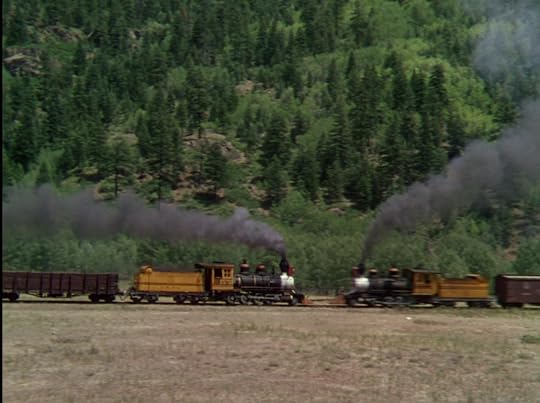
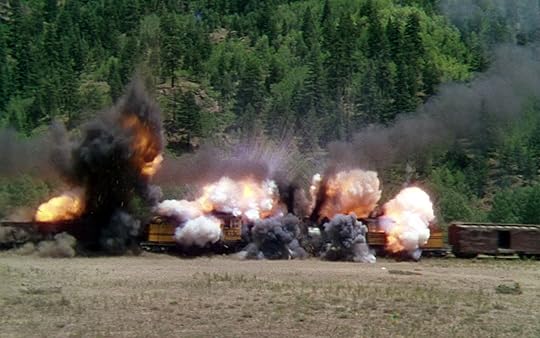 Stills from Rio Grande, featuring the Durango and Silverton train.
 Even though mining continued, Silverton began to morph into a tourist attraction, a phenomenon fueled by the horde of train passengers — nearly 100,000 in 1975 — dumped into town every summer’s day. Townsfolk who had once enjoyed the trappings of a strong, stable mining economy were reduced to peddling hamburgers or tchotchkes to a limited crowd of people that got off the train, spent a couple hours walking around, and then left again. It felt undignified and desperate to hawk a false version of history. The pay was lousy, the tourist season only a few months long, and the people’s labor produced nothing. The train’s growing economic dominance spurred the rise of summer-only, train passenger-oriented businesses, and the fall of locals-oriented year-round businesses such as grocery stores and insurance agents.
“Today, downtown Silverton is all but dead as a year-round community center, and one has only to look at the names over the boarded-up doors and dark windows on a winter night to know that The Train is the instrument of death,” wrote George Sibley in the November 1975 edition of Mountain Gazette. “Among the miners, still the core of what remains of the Silverton community there is an attitude ranging from bare tolerance to outright disgust toward The Train.”
Silverton Town Board members in 1975 complained about the air pollution caused by the train’s engines, and about the garbage strewn about in the streets after the train left each day. Meanwhile, down in Durango, residents of the then predominantly Latino South Side were blanketed nightly with coal smoke, since the locomotives’ boilers were kept hot around-the-clock in the railyard. Residents sacrificed health and comfort for a train whose sole purpose was to deliver tourists to chintzy rubber-tomahawk shops like cattle to the slaughter. The train was also, as always, prone to starting fires in forests that were becoming more and more valued for recreational opportunities.
Only three days before the depot bombing, a rock was intentionally rolled onto a D&RGW pop car near Hermosa, injuring its driver. And the last train of the season, traveling from Durango just days after the bombing, was delayed because someone greased the tracks near Shalona, as if preparing it for one of those cheesy Western train robberies. Over the course of just several days, the train was targeted three times, and yet observers and investigators alike seemed unwilling to see any sort of political motive.
***
Finding a motive behind the 416 Fire of 2018 was a bit more straightforward, even if it took federal officials an entire year before they announced the cause — a cinder from the Durango and Silverton Narrow Gauge train. There was no direct motive, of course. It was an accident. But the roots of the accident easily can be traced back to the profit motive — mingled with a hefty dose of hubris.
After all, why else would the railroad continue to send its cinder-spewing coal locomotives to Silverton during the spring of 2018, which followed one of the driest, warmest winters on record? The forest was a tinder box. Already that season the train had started nearly fifty fires along the tracks, all of which they’d suppressed before they became unmanageable. The luck was bound to run out.
It had before. The 1989 Fourth of July Fire in the Animas Canyon about ten miles downstream from Silverton burned fifty acres before it was doused. It was the 226th fire started by the train that year, alone. Others that grew large enough to warrant names include: the 1994 Mitchell Lakes Fire, the 1997 West Needles Fire, the 2002 Schaaf II Fire, and the Goblin Fire, which in 2012 burned about 1,000 acres in the West Needles.
And on the morning of June 1, 2018, after one of the trains had passed by on the way up the Shalona grade — the same segment of tracks that had been greased many years before — a blaze broke out along the tracks. The relatively inexperienced right of way crew on duty — the veteran crew had been laid off earlier that year — couldn’t contain the flames. The helicopter that normally followed the train didn’t arrive.
A stiff breeze whipped the flames into a fury and the conflagration raced up the hillside through the bitterly dry grass. The fire went on to char nearly 54,000 acres of forest. Hermosa Mountain, at times, looked like an erupting volcano, with billows of smoke and flame spewing into the clear blue sky. The region was blanketed by lung-searing smoke, forcing people indoors and even out of town. Highway 550 was shut down, causing severe economic harm throughout Silverton. The vegetation that tethered the earth was lost, making slopes vulnerable to catastrophic erosion. And when the rains came and helped douse the flames, it sent rivers of mud and rock and timber down the mountainsides and into homes and businesses.
And so, in the summer of 2018, the train became burdened with yet more symbolism, that of destructive greed. Critics demanded that the railroad be held to account. Property owners who were in the path of the flames or the debris flows filed a lawsuit against the railroad. And a year after the flames erupted the federal government finally laid the blame for the fire on the train, and filed a lawsuit of its own seeking reimbursement for suppression costs.
The reaction on social media and in the newspaper comment sections was swift and ugly. The most vehement defenders of the railroad, train trolls, insisted that the lawsuit’s plaintiffs, and the feds, and even the newspaper reporters who wrote about the lawsuits, posed an existential threat to the railroad — and therefore the entire regional economy. Durango will be a “ghost town” without the train, one commenter said. Historian Duane Smith told the Denver Post: “Without that train, Durango would just be an isolated college town.”
Other comments were less measured: “Kalif@ckedupia!” “Idiot!” “… people that don’t like trains have no soul…perhaps more to be pitied than scorned…” “… maybe you should find a different place to live.” Some train trolls even demanded a list of the lawsuits’ plaintiffs so they could seek retribution.
That the railroad is one of the region’s big economic engines is undeniable. That Durango or even Silverton would dry up and disappear without it is simply untrue. Some people come to Durango because of the train, yes. But many, many others ride the train because it’s in Durango, which has a bounty of other assets that draw people. If the train left, property values would not, unfortunately, plummet to a level of affordability. Silverton would have some adjusting to do, for sure, because the train is a big part of the tourist economy. But as the attitudes of the ‘70s show, that type of economy isn’t universally desired.
This summer the train never made it to Silverton, first due to COVID-19 and then thanks to a bridge getting washed out along the way — and Silverton did just fine.
I suspect even the train trolls understand that Durango’s economy would survive the train’s absence. But maybe Durango’s identity — for better or worse — would not. After all, the train is a symbol of Durango, its history, and what it is as a community.
And that’s why train trolls are so … trollish. And that, too, may just be the reason someone blew up the Silverton Train Depot in September 1975.
***
I was just a week away from my fifth birthday when someone bombed the Silverton Depot, but I must confess that I don’t remember hearing about it at the time. It’s odd, because like all Durango kids, I was enamored with the train: the hulking locomotive, the lonely whistle, the distinctive yellow orange cars, the steel tracks, and the creosote-smell ties that got gooey and sticky on hot days. I relished in the feel of the nickels and pennies after the train flattened the into shiny disks, the concentration required to balance on one rail as if it were the high beam, counting the rails as we walked along the tracks from fishing spot to fishing spot.
Back then there was a chain of dilapidated old freight and ore and cattle cars lined up along the tracks adjacent to what is now called Narrow Gauge Avenue. My friends and I used to climb around on those old rail cars, and I vividly remember the soft and menacing look of the giant splinters I would get in my fingers and palms.
About fifteen years ago, the railroad decided to remove the old train cars. I’m sure it made a lot of folks happy since it opened up some new parking spaces and removed what some might have considered blight. I, however, was bummed. I saw them as a symbol of a Durango of old, a Durango that was a little rougher, a lot more working class, and a heck of a lot less glitzy. The cars represented, in other words, the Durango of my childhood, and getting rid of them was confirmation that the Durango of old was no more, and all I have left of it is memories, memories that often involve, in one way or another, that steam-belching locomotive and the long row of cars strung out behind it:
… the precise feel that day in mid-summer when I put my ear to the track behind the fish hatchery to see if a train was coming, and when it wasn’t how we set out across the bridge, our eyes glued to the ties so as not to step into the void in-between, and the sickening sound of the whistle behind us, and knowing we’d never across in time. And the way my brother guided us over the edge, down to the top of the stone pillar, and how we huddled there laughing in fear as, below us, the cold rushing water of the Animas River flowed by, and above us the locomotive and cars and the clacking and the hissing and the clacking and hissing.
###
Jonathan P. Thompson is the author of Behind the Slickrock Curtain: A Project Petrichor Environmental Thriller (Lost Souls Press, 2020) and River of Lost Souls: The Science, Politics, and Greed Behind the Gold King Mine Disaster (Torrey House Press, 2018).
October 14, 2020
Behind the Slickrock Curtain is here!
In the not so distant future, as the planet burns, the nation reels from the effects of a pandemic, Truth is on the brink of extinction, and the late-president tweets madly from the grave, Durango artist Peter Simons heads into Utah’s Canyon Country to scout locations for his biggest project ever. When Peter fails to return on time, and mercenaries working for the federal government and reeking of Axe body spray start asking questions about him, Peter’s wife Eliza Santos launches a search. She calls on Peter’s old friend and her ex-lover, disgraced journalist and purveyor of fake news, Malcolm Brautigan, for help.
As they dip behind the Slickrock Curtain to search for Peter they unwittingly uncover a tangled scheme led by oligarchs, an alluring petroleum engineer, and corrupt government officials to ravage a sacred landscape with a tar sands operation. But the more they learn, the more they suspect that it is merely a smokescreen for a much bigger operation involving a long-lost deposit of high-grade uranium. But are the perpetrators trying to destroy the planet? Or save it? And why are they so interested in Malcolm’s memories?
Behind the Slickrock Curtain, Part I of the Project Petrichor Environmental Thriller Series, is a riveting, racy, irreverent romp through the Anthropocene. Author Jonathan P. Thompson provides readers with an insightful, humorous, and sometimes scathing exploration of eco-despair, disinformation in the post-truth age, love, friendship, and the power of memory and place.
Ask your favorite bookstore to order it now from Ingram distributors (ISBN-10: 1734655305; ISBN-13: 978-1734655308).
Available in paperback and Ebook from Maria’s Bookshop in Durango, other independent booksellers, and Bookshop.org, Apple Books, Barnes & Noble, Amazon, and other retailers.
October 1, 2020
“Power Madness” in America, the Big Buildup of coal, and a Senate hearing from five decades ago
Five decades ago, the US Senate Committee on Interior and Insular Affairs held a remarkable hearing. It was notable because it was held in Albuquerque, not Washington, D.C., because of its subject matter, “Problems of Electrical Power Production in the Southwest,” but mostly because of the impassioned testimony delivered by a diverse array of witnesses from the region.
I came across the transcripts for the hearing while doing research for an article for Sierra about what I call the Big Breakdown of coal that is in progress nationwide, dealing a big blow to the economies of places like Farmington, New Mexico, which has two gargantuan coal plants just down the road. At the time of the hearings, the Big Buildup of coal power plants across the Colorado Plateau was underway, with the Four Corners Power Plant churning out electricity and a plume of black smoke on Navajo land in northwestern New Mexico.
What struck me about the testimony was that it was mostly made by prominent community, state, and tribal leaders, and that by and large they expressed disdain and horror over what the power plant was doing to the air, the water, the land, and the people. “New Mexicans were shocked beyond measure when the Mercury astronauts reported from their capsule that the only evidence of man’s earthly existence noticeable from outer space was the cloud of black pollution rising from the smokestacks of the power plant in the Four Corners region,” said US Rep. Manuel Lujan, a Republican and the uncle of current New Mexico Governor Michelle Lujan Grisham. “In those few minutes New Mexico changed from a symbol of healthful atmospheric purity to an international villain as the largest air polluter on the globe. But it is not necessarily our international image that concerns us; it is the health of our children — of all of our people.”
Just two decades earlier, the home of this smoke-spewing behemoth was a quiet, agricultural region, and had been for millennia.
Three rivers come together here — the Navajo, or Diné, call it Totah, meaning “Between the Waters — among low cliffs of white sandstone, and the bottomlands bordering the streams provide flat and fertile areas for crops and plenty of sunshine. That’s what drew the Diné and, before them, the Pueblo people, who lived in the region for centuries before finally migrating south and east to the pueblos along the Rio Grande, along with Acoma, Hopi, and Zuni. And that’s what drew the first white settlers in the late 1800s. By the turn of the century tens of thousands of fruit trees were producing peaches and apricots and cherries and apples in and around the small town. The rail line that stretched up to Durango, about 50 miles to the north, was called the Red Apple Flyer after its primary cargo, which was sent to Denver, Chicago, and even Europe.
If geography, a steady supply of water, and a temperate climate had fated Farmington to be an agricultural hotspot, geology had different plans. Farmington sits near the center of the San Juan Basin, a 10,000-square-mile dish-like feature that for millions of years lay under and beside a vast, shallow inland sea, the shorelines of which advanced and retreated over the millennia. During the Cretaceous period, some 75 million years ago, the climate was warm and wet. Sultry, fecund swamps lined the seashore. Big bugs fluttered through the verdant canopy while possum-like marupiala, crocodilian scutes, and dinosaurs — from the “Bisti Beast,” a horned-headed tyrannosaurus-like creature to the Dineobellator notohesperus, a terrifyingly quick relative of the velociraptor — cruised through the shade among shallow, brackish ponds.
The ancient flora decomposed and decayed and was converted by time and pressure into a broad band of coal in what is now known as the Fruitland formation. That coal fueled the 19th century invasion of the West, the locomotives that pulled the Red Apple Flyer, and the machinery of the mines and sawmills that ravaged the surrounding landscape. “Coal is the fuel of the present,” crowed the author of a 1906 US Geological Survey report on the coal fields of the West, “and so far as can be seen, will continue to lead … for a long time to come.”
But geology had also planted in the San Juan Basin the seed of coal’s ultimate demise as the fuel of choice. As dinosaurs plodded around on the shore, billions of tiny sea creatures were dying and settling to the seafloor, getting mixed in with sediment carried in and deposited by huge rivers that flowed through the tropical landscape. The critters morphed into a mix of hydrocarbons — oil and methane — that are now tangled up in fossilized sediment, or sandstone and shale. Methane, or natural gas, is so abundant in the region that it seeps out of the earth unbidden and often built up in residents’ water wells and in coal mines, occasionally to calamitous effect.
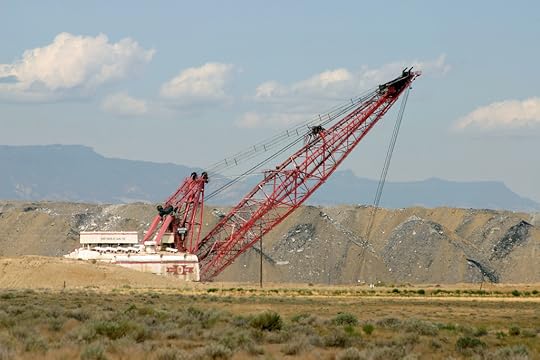


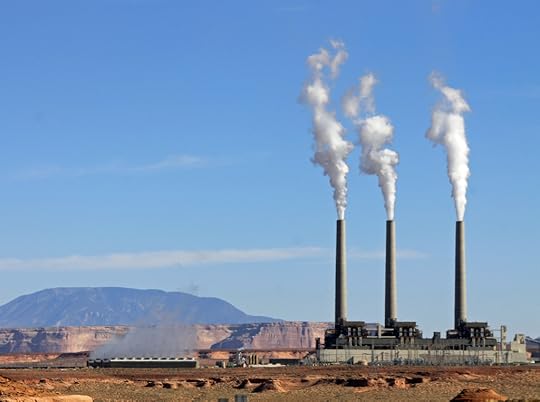
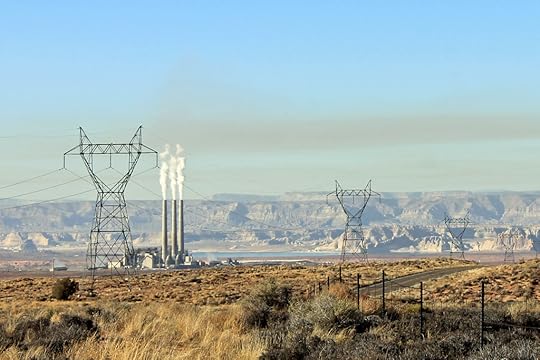
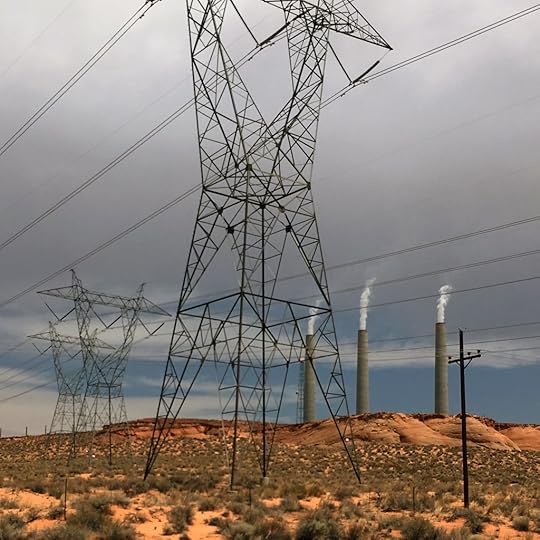 Smokestacks, Navajo Generating Station.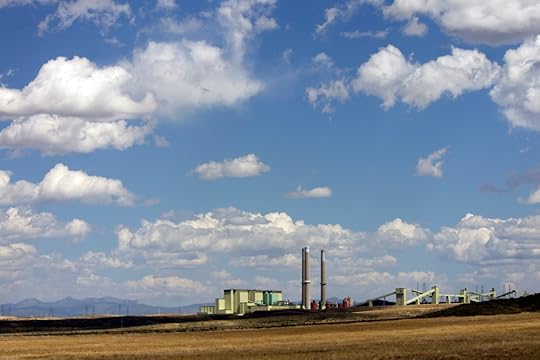
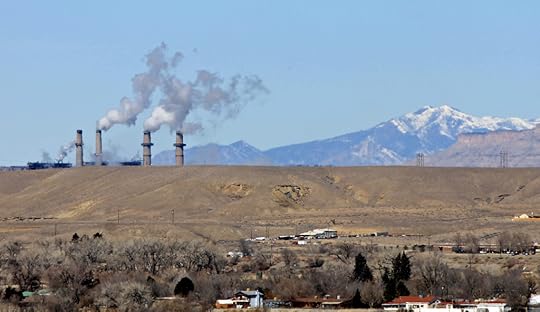
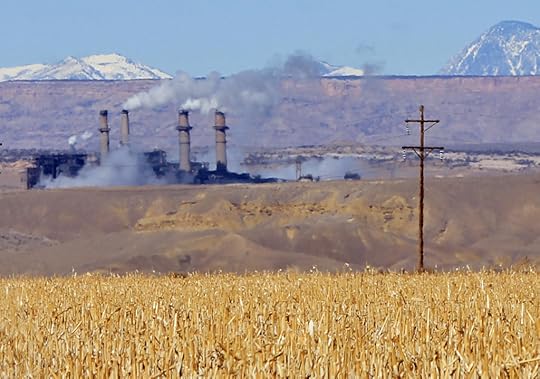
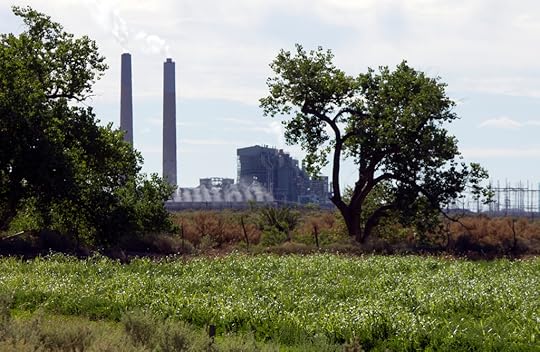 Cholla power plant, Joseph City, Arizona
Eventually people realized that this nuisance gas could be put to use, and the first commercial natural gas well in the San Juan Basin was drilled near Aztec, about a dozen miles from Farmington, in 1921. Oil was found on the Navajo Nation near the current site of Four Corners Power Plant at about the same time. More wells were drilled, pipelines were built, and a natural gas boom was on — as was the first War on Coal. Diesel locomotives pushed the coal-fired steam engines into the museums, and new highways and trucks forced railroads to abandon hundreds of miles of lines. When the bounty of the New Mexico and Texas natural gas booms spread via pipelines, homeowners switched to gas for cooking and heating, finally doing away with coal’s clinkers, stokers, and caustic smoke. Hydropower dominated the West’s power grids. New Mexico’s coal production fell almost to zero, and by the early sixties King Coal had not only been dethroned, but was headed for the dustbin of history, like whale blubber, steam-powered tractors, and the telegraph.
Or so it seemed. Yet, what coal lacked in usefulness it made up for in political heft. After all, the industry’s captains had been raking in profits for decades, and they had plenty of cash for lobbying, to fuel coal-friendly politicians’ campaigns, and to wage a marketing bid to imbue their fuel with symbolism and mythology. Coal is not just coal, the proto-branders argued. It’s abundant, reliable, and deserves a seat in the pantheon of American culture, alongside cowboys, guns, big automobiles, and even freedom. Besides, coal lends itself better to capitalism than, say, harnessing the flow of falling water or wind. There’s simply more money to be made, and coal — and the workers who labor to tear it out of the earth — are easier to control.
The mythology seeped into policymaking. In Colorado, which was the West’s leading coal producer up until the 1940s, lawmakers required public institutions to heat with coal, and the coal industry joined forces with environmental groups, including the Sierra Club, to try to block new hydroelectric dams from being built along the Colorado River. Congress created the Office of Coal Research to “encourage and stimulate the production of coal in the United States.”
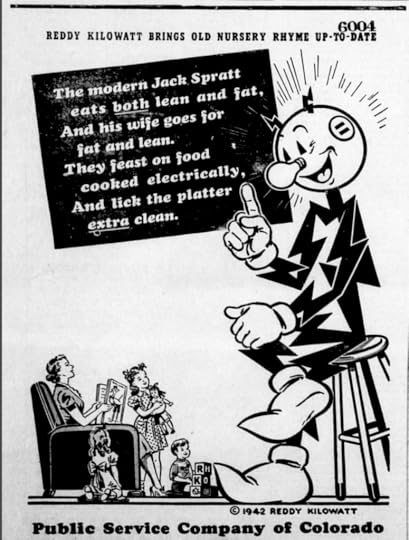
Meanwhile, vertically integrated, monopolistic electric utilities, in cahoots with the coal industry and the federal government, set about to manufacture demand for their product. Utilities employed the likes of Reddy Kilowatt and Miss Electra, “a charming personality you will like,” to help customers better understand the “miracle power medium … electricity,” and to convince them that their contentment depended upon them possessing electric blankets, security lights, carving knives, can openers, and, especially, energy-guzzling air-conditioners. Utah Power and Light served as a de facto Chamber of Commerce for its home state, waging ratepayer-funded marketing campaigns to attract big industry — new customers — to Salt Lake City. Arizona utilities subsidized sprawl by offering to extend power lines for free or at a low cost and offered deep discounts on “security lights.” General Electric teamed up with utilities — and Ronald Reagan — on the Live Better Electrically campaign. Public Service Company of New Mexico gave an electric blanket to everyone who bought an electric dryer. And every utility had an upside-down rate structure which incentivized power-gluttony. Power companies wrote off advertising expenses as a cost, which was then added to the consumer’s bill.




The federal Bureau of Reclamation — projecting a 3,000 percent increase in demand for the “universal low-cost servant, electricity,” — released a roadmap for the West’s power grid that called for the construction of dozens of giant generators in rural areas that would send juice hundreds of miles across high-voltage transmission lines to burgeoning urban areas. The Bureau, the nation’s dam-builder, said that this new power network only could run on coal, not hydroelectric power, natural gas, nuclear, or wind.
Utilities across the Southwest teamed up to create a cabal called WEST, or Western Energy Supply and Transmission Associates. They then set out to manifest the 1952 Bureau of Reclamation blueprint with what later became known as the Big Buildup, the first phase of which included the construction of six massive coal-fired power plants and accompanying mines across the Colorado Plateau, which would then ship power hundreds of miles to rapidly growing Los Angeles, San Diego, Las Vegas, Phoenix, and Albuquerque across high-voltage lines. Utilities would be able to produce large amounts of cheap power without running afoul of local and state air quality regulations.
Not only did the growing supply of cheap power — and air-conditioning and water pumping — help the population of the Southwest’s cities soar, but the marketing caused the average American’s electricity consumption to grow four-fold between 1946 and 1968. “We are, in short, on an energy binge,” Harvey Mudd, Director of the Santa Fe-based Central Clearing House told the congressional committee in 1971, “which, like all binges, can only end in disaster.”
That disaster turned out to be the Four Corners Power Plant, the first of the six to go online. It and its accompanying Navajo Mine were constructed about 15 miles west of Farmington in the early 1960s by a consortium of utilities led by Arizona Public Service, which supplies electricity to most of Arizona, and Utah Construction & Mining Co, a subsidiary of Kennecott, a global mining firm. The plant sprouted over just a few years on the edge of the Navajo Nation, atop the Fruitland formation. Jack Reeves, vice-president at Utah Construction & Mining Co., called the 31,000-acre site next to the Chaco River a “harsh and unproductive landscape” — at least until his company transformed it into something useful.
But just as the construction cast aside Navajo families who had lived and grazed their sheep and horses on that land for years, so did Reeves’ assessment discount the history and culture that had played out on the landscape for millennia. Construction of the mine, plant, and accompanying reservoir, Morgan Lake, destroyed and covered up remains of dozens of cultural sites, dating from Puebloan times through the present. A reminder of what was lost — a Chaco-era Hogback Great House — sits just two miles away from the eerily green waters of the plant’s evaporation ponds.
The relatively sparse population, along with the dearth of environmental regulations, allowed the mine and plant largely to be built under the radar. But once it started churning out juice, and pollution — to the tune of over 400 tons of particulate matter per day, along with sulfur dioxide, nitrogen oxides, and mercury — no one could miss the behemoth.
And that’s why Congress came to Albuquerque to hold hearings. Lujan was joined by the state’s governor, attorney general, community organizers, and environmental activists — including a part-time fire-lookout and freelance writer named Edward Abbey — in asking for a moratorium on any additional power plant construction, at the very least until the cumulative impacts of all the new plants be considered. Why, they collectively asked, should the people and landscapes and waters of the Four Corners Country be burdened to run the neon of Las Vegas and the air conditioners of Phoenix?
“The problems of the production of power on the Colorado plateau have been compounded by an encyclopedic ignorance of environmental consequences, bureaucratic ineffectiveness, and lack of focus to mitigate the national thirst for energy,” said Brant Calkin, Chairman of the Rio Grande Chapter of the Sierra Club. “Advertising for the purpose of increasing energy consumption should be banned.”
“A few years ago we had no smog in New Mexico. Today, our beautiful skies are hazy,” said Benny Atencio, the chairman of the All Indian Pueblo Council of New Mexico. “I don’t have to be an expert to see that the first victims of the manmade environmental crisis will be the American Indians.”
Peterson Zah, a Navajo community organizer who would later serve as tribal chairman, summed up the WEST plan in the early days of its realization:
“The formula is very simple and politically sound. Indian land, Indian coal, and Indian water will generate Indian power. The power will be shipped across Indian lands to Albuquerque, Phoenix, and Los Angeles. The cities will get more and more power at no cost to their environment. The result will be Indian pollution. But why should Indians be forced to suffer the consequences of the American public’s power madness? If the cities must have more power, let them put up with the filth which their power-greed produces.“
To be sure, the tribes did get a return in the form of royalties, which is really a euphemism for the payment for the privilege of pillaging a landowner’s resources. For the Navajo Mine next to the Four Corners plant, and for the Black Mesa mines that fed the Mojave and Navajo plants, the Navajo Nation and Navajo and Hopi tribes, respectively, were paid only about 2 to 6 percent of the selling price for their coal. It would be years before the rate was on par with what miners pay to pull oil, gas, and coal from federal land — a still piddly 12.5 percent — meaning that the tribes were shorted hundreds of millions of dollars.
The testimony just kept coming.
Sen. Joseph Montoya New Mexico: “This series of facilities is providing great amounts of electric power to a number of western metropolitan areas. It is also dumping more air pollutants on the Four Corners region than falls on New York City in a single day. Yet this is but the start.” The existing plants plus planned plants, strip mines, transmission lines coal slurry pipelines, he added, “combine to portend almost unprecedented environmental degradation. Everyone lives downstream or downwind from someone else, and we had better come to immediate grips with the realities of these statements.”
David L. Norvelle, New Mexico Attorney General: “The vast coal reserves underlying the Navajo and Hopi reservations offer a potential energy source unequaled for the production of electricity. But those same coal beds also are potentially the source of the worst air pollution problem in America.” He said that Mesa Verde park rangers had been forbidden from talking about the coal plant’s pollution with park visitors (the park sits just north of the power plants). “If the entire Southwest is not to turn into another Los Angeles, we need enlightened Interior officials to protect us. It seems rather sad to me that the beautiful State of New Mexico is to be sacrificed to give Los Angeles and Phoenix more air conditioners and Las Vegas more neon signs.”
Harvey Mudd, director of the Central Clearing House, an environmental lobbying group: “As recently as 10 years ago no one thought it necessary that a household have an electric toothbrush, lawn mower, pencil sharpener, carving knife, garage door, can opener. Madison Avenue has persuaded many of us … that the housewife who is without an electric can opener is undergoing hardship. … An irony of this situation is that as more electricity is generated by the burning of fossil fuels, there is more and more justification for an artificial environment, because the air outside is not fit to breathe.”
Eliot Porter, photographic chronicler of the Southwest’s wonders, in a letter: “The biggest polluters are the power producers — the utility consortium — and their ancillary coal strip mining associates. They plan a large proliferation in the four-state area of huge coal fired plants to supply electricity mostly for California where this new supply of power is advertised as smog free. Smog free for Californians but not for Southwesterners. These same plants would be outlawed in Los Angeles, but the operators, nevertheless, protest the application of effective emission control on the grounds of cost and feasibility.”
Even Edward Abbey wrote a letter: “I live in Kanab, Utah, and make my living as a freelance writer and fire lookout for the Park Service at North Rim, Grand Canyon. I first worked at North Rim in 1961. In the ten years since I have witnessed personally the steady degradation of the quality of air in northern Arizona. For example, it was always easy, ten years ago, to see the San Francisco Mountains near Flagstaff from my post at the North Rim. Now, except after storms, these mountains are usually obscured by haze and smog.”
Air pollution and outright theft were just the beginning. Abbey despaired over the devastation wreaked by strip mining. Others pointed to the vast amounts of water that would be taken from the Colorado and San Juan Rivers to be used for cooling and cleaning each plant. And it would take 1 billion gallons of groundwater annually, sucked from aquifers under Navajo and Hopi land, to slurry coal through a 275-mile pipeline from Black Mesa to the Mojave plant near Laughlin, Nevada.
But the impassioned rhetoric fell on deaf ears. After Four Corners came Mojave, Navajo Generating Station near Lake Powell, Huntington in Utah, and San Juan Generating Station, just across the river from Four Corners. They all had better pollution control systems than Four Corners did initially, but together they still kicked out thousands of tons of pollutants along with tens of millions of tons of planet-warming carbon dioxide each year, leaving the Four Corners Region to appear as if it had once again been inundated by a vast sea, only instead of water it was comprised of smog. Only the largest of all those slated to be built, the 5,000-megawatt Kaipairowitz plant, which would have sat on the western shore of Lake Powell, eating up coal from land that was later included in Grand Staircase-Escalante National Monument, was not constructed.
The beneficiaries of this plunder could be found to the west and south, where an abundance of cheap power lights up the neon of Las Vegas and the air-conditioners in Phoenix, while the Colorado River water pushed across the desert by pumps powered by the Navajo Generating Station’s electricity enabled Arizona’s suburbs to sprawl into the desert, enriching the operators of the Southwest’s growth machine: real estate developers, mass-production homebuilders, the automotive industry, the corporate shareholders, the ratepayers and the executives. Arizona Public Service, majority owner of Four Corners Power Plant, raked in half a billion dollars in profit last year. Peabody’s CEO is paid $20 million a year to run a company that just emerged from bankruptcy.
Now the coal plants are going down. Mojave closed in 2005, Navajo Generating Station shut down at the end of last year, San Juan Generating Station is slated to close in 2022, and Four Corners is likely to go dark by 2031. The Big Breakdown is upon us, and already the air in the region is cleaner — aside from all the wildfire smoke — than it was a year ago. But it will be decades for the region to heal from all the wounds that have been inflicted. In the meantime, a lot of people are being put out of work, government coffers are going dry, economies are withering, and the corporate bigwigs are still profiting.
Westmoreland, the owner of the San Juan Coal Mine near Farmington, paid out some $10 million in bonuses to its top executives in the years leading up to its 2018 bankruptcy filing. Then, even as it tried to weasel its way out of paying health benefits to retirees, the company handed out retention pay to 243 “valued employees” who are “critical to the Debtors’ business operations, efforts to preserve and maximize stakeholder value, and ability to implement the Debtors’ restructuring strategies.” The “valued employees” were mostly upper-level office workers and included a handful of mining engineers and three supervisors, but no actual miners. Just this week, the company laid off several miners at its San Juan Mine.
In closing, I leave you with the words of Peterson Zah, from 1971:
“The truth is that the ever-increasing use and demand for power is a sickness. Something has gone wrong somewhere with the American public’s value. This destructive, even suicidal, trend must be reversed at once for the sake of everyone, white men and Indians alike. But if the trend is not to be reversed, it should be the users of the power that suffers the consequences. The users should produce their own power in their own backyard and live with the resulting ruination of their own environment. Let the Indians alone. If the environmental destruction of parts of America is all but irreversible, as some scientists maintain, at least the Indians of the American Southwest may escape this fate and be able to survive an ecological disaster which was not their doing.“
###
[image error][image error]
Jonathan P. Thompson is the author of Behind the Slickrock Curtain: A Project Petrichor Environmental Thriller (Lost Souls Press, 2020) and River of Lost Souls: The Science, Politics, and Greed Behind the Gold King Mine Disaster (Torrey House Press, 2018).
September 28, 2020
Charting COVID’s effect on the energy sector
Nine months ago, as the coronavirus-related lockdowns and slowdowns were reaching their peak, we made some predictions (for High Country News and here) regarding how the pandemic and efforts to slow its spread might affect the energy world. We’re certainly not out of the woods yet — another wave of infections is expected this fall and winter — but we’ve now been in the grips of this thing long enough to get a better sense of how it has, and has not, hampered consumption and production of energy.
As expected, energy consumption across the board decreased this spring, as the strictest infection-prevention measures were put in place. Electricity use dropped as office buildings and other businesses went dark, and oil consumption plummeted as folks curbed flying and commuting. These changes reverberated throughout the energy sector in a variety of ways.
Oil seems to have suffered the most lasting consequences. Petroleum is a global commodity, meaning that it is propelled by the winds of supply and demand on the international level. China is the world’s second largest consumer of oil, after the United States, so when China first began locking down in the early days of 2020, it rippled through the global market, sending prices in a downward spiral. On the last day of 2019, the West Texas Intermediate price — the U.S. benchmark for a barrel of crude — hit $63, higher than it had been in eight months. A month later it was down to $50, and by late April, after dipping into negative territory, it stabilized at around $17 per barrel. As businesses re-opened and the economy started churning again, the price shot back up to about $40 in early June, giving the oil industry hope. It hasn’t budged from there, since, however, and that’s not high enough to make most drilling profitable.
One of the main drivers of the consumption decrease has been aviation. People stopped flying early this year, and with a number of travel bans in place, they are continuing to avoid airports and airplanes.
[image error]
Prices drive drilling, and drilling activity, as indicated by the active rig count, has crashed over the last nine months.
[image error]Astronomically high oil prices drove the drilling frenzy that began around 2005 and continued into 2014, when prices fell due to increased global supply and OPEC’s unwillingness to curb production. When prices recovered, the Western States rig count climbed back up, driven by a boom in New Mexico’s Permian Basin. But when COVID-19 hit, the count fell. As of late September, New Mexico had just 41 active rigs, all of them in the Permian Basin, and Utah and Wyoming both had no drilling activity whatsoever. Each active rig provides about 50 jobs. Source: Baker-Hughes.
It’s important to note that the rig count only applies to wells being drilled at the time of the count and not existing, producing wells, most of which continue to produce until prices get so low that oil companies plug the wells to stop losing money on them. It’s also worth noting that all oil and gas wells experience something called the decline curve. During the first weeks after they are first drilled and completed, the wells produce at a high rate, which lessens over time. That is, a new well might produce 200 barrels of oil per day during the first month, 150 barrels the second month, 100 the third, and so forth. The decline curve is especially steep for the newer horizontal, multi-stage fracked wells, which means that in order to keep overall production from a field stable, you continuously have to drill new wells. Once you slow down drilling, production will drop, as well, even if none of the existing wells are plugged.
[image error]When oil prices first started falling early this year, the rig count dropped and some wells were plugged to stem the loss of money. Oil production soon dropped as well. Source: Energy Information Administration.
The drilling phase of oil and gas extraction is the most labor intensive (a rig can employ 50 people or more, while a producing well only provides about five jobs), so when the rig count crashes, so does employment in the oil and gas fields.
[image error]On the far right end of this graph you can see the early effects of the pandemic on employment.
[image error]But this graph, from the Petroleum Equipment and Services Association shows far greater losses, because they widen their net to include all oilfield extraction, construction, and manufacturing jobs. It’s a far deeper look at the industry as a whole, in other words. According to PESA, Colorado has lost 5,000 jobs in the OFS sector since the pandemic began, and New Mexico has lost 4,500 jobs. The latter seems to jive with New Mexico State statistics estimating that the state has lost 10,500 jobs in the natural resources, mining, and construction industries.
The oil and gas industry wasn’t in such great shape before the pandemic hit. Many of the companies were saddled with debt that was about to come due. Coronavirus drove a number of those companies into the red.
[image error]
COVID-19’s impact on the electricity sector has been a little more nuanced, but significant nonetheless, particularly when it comes to coal consumption. During the first seven months of 2020, Americans used 3 percent less electricity than they did during those same seven months in 2019, in spite of the fact that many parts of the country experienced their hottest summers on record (air conditioners guzzle electricity). Most of the reduction came in April, when there was a 7 percent decrease in electricity use and a whopping 30 percent reduction in coal consumption for electricity generation.
[image error]
[image error]Americans used less electricity during the depth of the first wave of COVID-19. When overall demand drops, coal-fired power tends to take the biggest hit because it costs more than other power sources. Coal consumption was already on its way down when the pandemic hit, and for a brief moment in April solar and wind generation outpaced coal for the first time ever. When the record hot summer arrived, however, coal-burning increased to power the air conditioners that were running overtime.
[image error]As one would expect, when coal consumption drops, so too do the number of jobs in the coal mining industry. Although there has been a slight rebound, it is highly unlikely that employment levels will ever get back even to late-2019 levels.
Wyoming has been pummeled by the coronavirus, mainly because its economy is so dependent on coal and oil, as well as tourism, which also took a beating.
[image error]
[image error]
But it isn’t all doom and gloom in Wyoming. Notice in the map below that the coal and oil and gas-heavy counties such as Campbell County, Converse, and Sweetwater are suffering, along with tourism-based places like Teton County. And Sublette County, which has a combination of natural gas drilling and tourism, is hurting worst of all. But Carbon County is doing quite well. Why? Because some very large wind power projects are being built in Carbon County, providing one of the state’s only economic bright spots. Who knows, they may even
[image error]
###
[image error]
Jonathan P. Thompson is the author of River of Lost Souls: The Science, Politics, and Greed Behind the Gold King Mine Disaster (Torrey House, 2018), and the recently published novel, Behind the Slickrock Curtain (Lost Souls Press, 2020).
Images and articles on this site are available for reprint, with permission only, and Thompson is available to do freelance work and is now looking for permanent work in the American Southwest. Contact him at Jonathan@RiverOfLostSouls.com for details.
May 12, 2020
May 2020 SW Colorado Snowpack update
Snowpack levels in the San Juan Mountains of southwestern Colorado typically peak in April or early May, before starting a rapid downward slide as temperatures rise and spring runoff gets underway. This water year — which so far has tracked just below average in terms of snowpack — appears to be following the “normal” pattern. Yet it also continues a trend of earlier, and diminishing, snowpack-peaks.
Click to view slideshow.
For the last few years I’ve been following, graphing, and posting snow water equivalent levels at three high-altitude SNOTEL stations: Columbus Basin, located in the La Plata Mountains west of Durango; Red Mountain Pass; and Molas Lake (near Molas Pass). Looking back at the graphs one thing that immediately stands out is that there is no “normal.” Terrifyingly dry years (2018) are often followed by wickedly wet ones (2019).
However trends do appear. Notice in the graphs below that although the snowpack level for the first of April and May fluctuate wildly from year-to-year, the overall trend line is on a downward slope. Also note that in the ’80s and ’90s the levels on May 1 were as likely to be higher than on April 1, but as time goes on, the peak tends to be earlier. This would appear to be a sign of a warming, drying climate (at least for this admittedly small sample size and short period of record).
Click to view slideshow.
Something not seen in these graphs: A hot early May has melted a lot of snow. If the current melting rate continues, there won’t be any snow left by June. And that could mean that the Animas River already hit its peak, topping out at about 2,200 cfs on May 5. That would be a pretty disappointing spring runoff. The warm temperatures have also put most of the region into some level of drought conditions, despite the near-average-snowfall this winter.
Of course, you never know what might happen this time of year in the San Juans. Temperatures could fall, and big storms might still hit. But don’t count on it.
Click to view slideshow.
March 30, 2020
The Blackest Week: When the Spanish Influenza brought death to Silverton
James Edward Cole was thirty-six years old when he died. You might say he was in the prime of his life. He was born in Durango, but grew up in Silverton. After high school he started working under the tutelage of his father, William, at the family retail clothing store. He played on the Slattery’s Slobs baseball team. He married Adelia Bausman, and in 1916 they had a son, James.
They built a house just down Reese Street from the new, stately courthouse. As the nights grew cold and the days crisp in the Silverton autumn of 1918, Adelia’s belly started to show the signs of a second child. James, however, would never meet him. By late October 1918, James was dead, one of dozens who perished during the “Blackest Week Ever Known” in Silverton and the San Juan Mountains.
Soon after Europe became embroiled in a gruesome war in 1914, the impacts rippled into the Colorado high country. Demand for metals increased, as guns and mortars and tanks and planes rolled off the assembly lines. Metal prices shot up, giving the miners incentive to dig deeper in search of low-grade ore, and new technologies emerged for processing that ore. The county’s mines together produced metal valued at more than $2.5 million ($47.2 million in 2017 dollars) in 1917, close to a record.
[image error]In 1917 the United States entered the war, again sending ripples into mining country. By the time the war was almost over, in the autumn of 1918, at least 150 of Silverton’s young men, or around eight percent of the total population, were in the European trenches. Nearly half were immigrants or the children thereof, some fighting against brothers or cousins. The mass absence affected the community in obvious ways, and it also created a labor crunch at the mines. The American Mining Congress begged young men to resist the temptation to enlist and instead be “truly patriotic” and remain at their industrial posts, where they were sorely needed.
Even as the bodies of soldiers piled up on the battlefields of the first modern war, the planet was struck with something even more deadly, the so-called Spanish Influenza—perhaps the first modern pandemic. It might have originated, or at least gathered strength, in Midwestern pig farms before making a run through Fort Riley, a military camp in Kansas that housed nearly thirty thousand men, in March 1918. From there, this dastardly but rarely fatal first wave of the virus spread rapidly overseas along with soldiers and supplies, making life in the trenches even more miserable, and even altering the way the war was fought.
During the first week of October, the death counts climbed as a second, more deadly wave, crashed over the United States. As hundreds died each day in the nation’s cities, the U.S. Public Health Service set out to hire doctors and nurses to deal with the epidemic. It was a difficult task during war time, and may have been too little, too late, anyway. Geographically, the flu moved with terrifying speed and mobility. It hastily made its way across the country, across the oceans, and even to remote villages in Alaska and tiny Pacific islands.
Unlike other strains of flu, which typically break down the immune system leaving the bodies of the very young, the old, and the weak vulnerable to secondary infections like pneumonia, the Spanish Flu could fell a person all on its own. Because the virus turned the immune system against the body, it was harder on the young and healthy, people like James Cole, than it was on the old and frail.
One minute the victim would be sitting down for breakfast, feeling fine. Then, standing up from the breakfast table, he might feel a bit lightheaded, a little twinge of pain in the back, followed soon afterward by a fever and a general sense of fatigue. Maybe he would go to work down at the clothing store, anyway. After all, he had mouths to feed. But by lunch he has become so dizzy that he feels as if he can barely make the three-block walk home. By evening he is bedridden, his lungs filling with fluid, his breathing raspy, his mind haunted by delirium and terrible images. The next day he is retching up a pink bloody froth, but he cannot expel it quickly enough. He is dead by the following morning.
“While there have been one or two cases of this disease reported in our midst, there has not so far been any serious results,” noted the October 18, 1918, edition of the Miner. It’s not clear how accurate this statement is. The pages of the newspapers in the spring and summer of 1918 were filled with obituaries for people who had died of “pneumonia,” which seems to have been a catch-all diagnosis at the time, and sometimes used to describe such ailments as silicosis, or miner’s lung, and, perhaps, the Spanish Influenza.
By then the virus was wreaking havoc all over, but the Silverton newspapers — the Miner and the Silverton Standard, which would merge a few years later — seemed fairly blasé about it all. They barely even mentioned the flu in the first two weeks’ editions. Finally, during the third week, the sickness got some print: Postal workers in Durango were fumigating all of the Silverton-bound mail, because it had been exposed to the virus somewhere between there and Denver. Large public gatherings were banned across the state. Parents were urged to keep their kids home from school if they showed any symptoms. And two soldiers who were training at the University of Colorado in Boulder, which had 120 cases at that point, had perished. The soldiers were part of a group of 250 from Montana that had come to Colorado in September for training.
But the most disturbing news item had nothing to do with the epidemic — at least not on the surface. “Silverton Celebrates,” the headline read, and the accompanying article detailed a town-wide party that had taken place the night before — replete with a bonfire on the main drag, shared bottles of bootleg liquor, dancing, hugging, crying — in defiance of the statewide ban on public gatherings. Rumor had reached Silverton of the German’s unconditional surrender. They didn’t find out that it was false until it was too late. The next day the Standard sheepishly admitted to falling for the fake news, but praised the celebration, nonetheless, noting, “We had a celebration coming and all San Juan County is better off for her turn out.”




Within days, many of the people who celebrated that night would be dead.
For the next two weeks or so, Silverton became a living nightmare. At least one member of nearly every household in town was struck. Miners collapsed on the job, mothers at the dinner table. The hospital filled to capacity and then some, so Town Hall became a de facto clinic and then morgue, with the dead stacked next to the dying. The coffins ran out and the undertaker died. The burly Swedish miner who tirelessly dug the graves ended up digging his own. On October 25, the Silverton Standard heralded the “Worst Week Ever Known in History.” They had to issue a correction of sorts a week later, with a headline that read: “Past Week has been Blackest Ever Known …” So many died so quickly that a few went to their graves without being identified except as “Mexican from Sunnyside” or “Austrian from Iowa mine.”
Herman Dalla, an already fatherless six-year-old, lost his mom and two brothers. In another family a toddler, a teenager, and their forty-year-old mother died. One little girl was orphaned. Temperatures sunk below zero, making the earth at the cemetery nearly impenetrable. There was no way to dig one grave for every corpse, so long, shallow trenches were gouged into the earth, the bodies tossed in by the dozens. Some of the dead were later recovered by the families, but an untold number remain in the mass grave, unidentified.
When reading through the newspapers of the time, one is especially struck by how determined the editors — and the community as a whole — was to move on, to get things back to normal, even to forget the tragedy that had befallen them. In the Nov. 11 edition of the Standard, which brimmed with obituaries, a story noted that mines had suspended operations, not in order to slow the spread, but because the miners had died off or run off to escape the flu. And then: “While Silverton has been hit very hard in death rate, at the same time our little city has finally checked the disease, and … we are as well off in San Juan County as in any part of the state.”
Before November had ended, as the community celebrated the actual end of the war, the miners were returning to the boarding houses in the high country and to work, the town council allowed taverns and pool halls to open back up, and the classes resumed at the school. Meanwhile, people were still dying, even after the city had “checked” the disease.
As one might expect, the Spanish Flu returned to Silverton for another round, beginning in December. This time local health officials imposed a 48-hour quarantine on anyone coming into town from the outside, and the Sunnyside Mine, which was staffing up again, put a 24-hour quarantine on incoming miners. Whether it was effective or not is not clear. What is clear is that the Spanish Flu continued to sicken Silvertonians. It also killed them, though at a rate of a few people per week — enough to fill up the obituary pages, but not to warrant headlines — rather than a dozen per day, as was the case in late October and early November.
At least 20 million died globally from the Spanish Flu, and 500,000 or more perished in the United States. Colorado recorded 46,000 cases during the autumn 1918 wave, and some 3,000 deaths, making for a fatality rate of about 6%. It was far higher in Silverton. The Spanish Flu claimed at least 150 San Juan County residents, probably more. It was the hardest hit county in the state, and had one of the highest death rates in the Lower 48. Telluride and Salida and Montrose also experienced a rash of death.
Meanwhile, one Colorado mountain county escaped the worst of the pandemic virtually unscathed. Gunnison physician A.P. Hanson imposed a strict quarantine on the county in late October, which included barricades and armed guards on all incoming highways, and he stubbornly kept it in place for months. Residents could leave, but they couldn’t return without submitting to a quarantine. In February 1919 county officials finally bowed to public pressure and lifted the ban. Within weeks the virus had finally come to Gunnison County; dozens of people were infected and in April a handful of people succumbed to the disease.




After the sickness finally subsided, Silvertonians seemed intent on turning to denial as their collective coping mechanism. After the “worst” and “blackest” weeks had passed, the newspapers focused on the end of the war, on the resumption of mining, on the remarkable fact that the Caledonia Mine had managed to keep producing ore during the worst of it, thanks to a self-imposed quarantine. Then they stopped mentioning the Spanish Flu altogether. The community never came together afterward to hold a memorial service for the dead. Survivors were reticent to talk about it, even decades later, as if forgetting would make it all go away.
In Silverton, though, it is not so easy to forget, because the Hillside Cemetery, located just above town, provides a grim reminder of the disease and the death it brought to this valley.
Go there, to the cemetery. Walk among the graves and look at the dates. Before long you will see a death-date of October 1918. Then you will see another, and another, and another. On the far side of the cemetery, obscured by dried stalks of grass, you will see the flimsy plaques marking the graves of Joe and Christine Anderson. He died first and she went four days later. Underneath a big tree you will see the Wright stone — mother, daughter, and son killed within a few days of each other. And near the entrance of the cemetery’s lower road, if you look closely enough, you will see a long, straight indentation in the earth. It was here, during a cold and snowy October a century ago, that so many of Silverton’s sons, daughters, mothers, and fathers were buried in the frozen dirt.
###
[image error]Jonathan P. Thompson is the author of River of Lost Souls: The Science, Politics, and Greed Behind the Gold King Mine Disaster (Torrey House, 2018), from which this essay is excerpted and adapted, and the forthcoming novel, Behind the Slickrock Curtain (Lost Souls Press, 2020).
Images and articles on this site are available for reprint, with permission only, and Thompson is available to do freelance work. Contact him at Jonathan@RiverOfLostSouls.com for details.
March 26, 2020
Images from the Extreme Social Distance
I went back to the Home-country — i.e. the Four Corners — in February and March, and headed out to the Great Sage Plain along the Colorado-Utah border and to the Canyon Country of far-southeastern Utah. Spring is one of my favorite times to take photos in the region because of the way the light frolics with the landscape as clouds race across the moody sky.
Since we are all trying to stay home, and therefore can’t get out to these lands right now, I figured I’d share some of the images to provide a little escape from our collective isolation.
[image error]I’ve got many photographs of this particular windmill, which juts up from the Great Sage Plain in southeastern Utah. But never have I seen the air so clear as it was on a March morning after a storm. The formations of Monument Valley are about 60 miles distant, and typically they show up only as smog-obscured silhouettes, if they are visible at all. But now they reveal themselves clearly. That’s partially because of the storm, but also because Navajo Generating Station has stopped operating, and stopped spewing pollutants into the air. My aunt Charlotte, who has lived her whole life in the region, says that she noticed the change in air quality following the plant’s closure last year. Jonathan P. Thompson photo, March 2020.
[image error]March light is the best in the Four Corners, hands down. Here the snow-covered peaks of the Abajos are bathed in early evening alpenglow. Jonathan P. Thompson photo, March 2020.
[image error]Wondering where Bernie went? Behind the Slickrock Curtain, that’s where. Jonathan P. Thompson photo, March 2020.
[image error]When a guy has been social distancing in the extreme, he begins to see things in the rock formations. I call this Earthly Eros. Jonathan P. Thompson, March 2020.
[image error]A tower of Hovenweep on a blustery March day.
[image error]Yucca and Muley Point.
[image error]The potholes of Canyon Country were full this spring following some drenching storms.
[image error]Moody March sky over Valley of the Gods and Raplee Anticline in southeastern Utah.
[image error]Abajos and storm, from what’s left of Bears Ears National Monument.
[image error]Morning stormy light frolics brightly on Elk Ridge.
[image error]Stone and Shadow.
[image error]Ute Mountain bathed in springtime light.
###
[image error]Jonathan P. Thompson is the author of River of Lost Souls: The Science, Politics, and Greed Behind the Gold King Mine Disaster (Torrey House, 2018), and the forthcoming novel, Behind the Slickrock Curtain (Lost Souls Press, 2020).
Images and articles on this site are available for reprint, with permission only, and Thompson is available to do freelance work. Contact him at Jonathan@RiverOfLostSouls.com for details.
March 22, 2020
Meditation on trans-Atlantic travel in the time of COVID-19
I flew internationally yesterday. I got into a tube with a bunch of other people against all of my self-preservation instincts. Why? Because I had to get home in order to #stayhome.
Home for me and my wife, Wendy, is Bulgaria. We left the town of my birth in Colorado four years ago, and transplanted ourselves in a country that we knew very little about, so that Wendy could take a job as a high school teacher, our youngest daughter could finish out high school in a more interesting setting, and I could freelance. We’ve since settled in to our house in Sofia, an interesting and historically rich city that sits at the base of a forested mountain.
I guess that makes us expats, though I don’t really like the term. It implies some sort of glamour, evokes images of Hemingway scribbling away in a smoky Parisian cafe as he guzzles jugs of wine. But we just live here. We unglamorously work and unglamorously try to pay the bills, which is a bit easier here. Only then do we have a glass of wine or rakia. Fact is, we can’t really afford to go back to the United States for now. There’s not much glamour in that. So I guess we’re economic exiles as much as we are expatriates.
I work from home as a freelancer. But most of my work and clients are based in the Western United States. So in February I made one of my biannual trips to the Four Corners Country to do some reporting and get reacquainted with the lands and communities that I cover. I soon discovered that one of the quirks of this virus is that it compresses time.
When I left, early on the morning of Feb. 24, COVID-19 was not yet considered a pandemic. There were only a few dozen confirmed cases in America. Europe’s numbers were growing, but had yet to reach crisis levels. A few people on the plane wore masks, and I wiped down my seating area with wipes, but generally there was no panic. I was asked by an airline worker in Munich whether I’d been in China in the last two weeks. That was the only sort of health-screening or official COVID-19-prevention effort I encountered.
By the time I landed in Colorado hours later, the number of cases and fatalities in Italy had exploded, and the level of alarm everywhere had intensified. Still, most of America apparently felt immune. When I arrived, Colorado remained officially coronavirus-free and you could still buy toilet paper and hand-sanitizer at the grocery stores without going to fisticuffs with someone. Within days that was no longer true.
For a while, though, the epidemic seemed far away from the Four Corners Country, and I continued to go about my business: interviewing folks, compulsively washing my hands, doing research, visiting friends, compulsively washing my hands, and trying to diagnose and repair the malfunction that ailed my 31-year-old car — which I also live out of when in the U.S. I’ve been socially distant since long before it was cool, so that part wasn’t too difficult.
Back in those days — three weeks ago — a freelancer without a home of his own could still go to a coffee shop, hook into the free wi-fi, and set up his little office and crank out some words. When he saw an old friend he might even give him a hug or shake his hand, though he didn’t dare touch his face afterwards. Ah, those were the days!
And then all that was over, and I found myself confined to my other office, the front seat of my little car (which my friend had helped me repair) in a windstorm in Utah’s backcountry, getting weak internet signal off of my phone, with both gadgets plugged into the cigarette lighter. I had to remind myself to start the car from time to time, lest I drain the battery and have to deviate from extreme social distancing to flag someone down for a jump. That’s assuming anyone came around, which they mostly didn’t in the places I chose, since they lacked the recreational opportunities that tend to draw the masses.
I went back to town after a few days of camping to resupply at the supermarket. Everything had changed again. This time not only were the toilet paper and hand-sanitizers all gone, but so were the rice, beans, potatoes, flour, and pasta. Meanwhile, a lot of the other customers seemed to ignore — even defy — the social-distancing guidelines, crowding into aisles to snatch up the last cans of beans on the shelf, walking right next to me even when I tried to step aside to give them room. It made no sense. If people were worried enough to hoard food and toilet paper, shouldn’t they be worried enough to stay as far away from others as possible?
Our daughters, both in college in the U.S., were told to vacate their dorms and go home. Meanwhile, Bulgaria had reported its first cases of coronavirus, and immediately implemented a partial lockdown, canceling cultural activities and other public gatherings. Travel restrictions soon would follow. Wendy and I frantically got our youngest daughter on a flight back to Bulgaria, the other one went to a friend’s house in Arizona.
Yet I stubbornly remained. I was determined to save on rebooking fees and stay out my scheduled time so I could get some work done. As the virus spread, however, and meetings and events were cancelled, it became clear that I’d have to nix the remainder of my reporting engagements to reduce putting my sources at risk. The public lands that I had called home for much of my stay were being shut down to campers like me — for good reason. The supermarket was running out of Ben & Jerry’s. And my flight back through Germany was cancelled.
I panicked as I imagined riding out the pandemic far away from family while sleeping on generous friends’ floors and couches, and had terrible visions of what that might look like if I were to get infected. Surprisingly there were still a few flights going into Bulgaria, via Dallas and London. I booked one, despite knowing that with the rapidly deteriorating situation I could end up getting stuck in the U.K. or, worse, Texas.
In the few days before my flight, Bulgaria banned everyone except residents from coming into the country. The U.S. State Department urged Americans not to travel internationally, because if they did they could get stranded indefinitely. Friends told me I was crazy to fly; reckless, even.
I said I had to get home.
The Durango airport was eerily quiet when I got there on a snowy morning in March. I felt both guilty and fortunate to be armed with an N-95 face mask, which I had used to help a friend clean out a dusty and hantavirusy shed near the beginning of my trip and had kept on hand for this very occasion. I also had a baggie full of homemade wipes (normal wipes soaked in rubbing alcohol), a fear of getting anywhere near another person, and high-potency hand-sanitizer I was able to purchase in Bulgaria before my trip. Still, I felt vulnerable and scared.
The airline people collectively raised their eyebrows when they saw where I was going. Yet none of them were wearing masks, or seemed too concerned about the virus. Thankfully, the flight was empty enough that everyone could sit next to a vacant seat. The Dallas airport was also relatively uncrowded, and only two outgoing international flights were still scheduled that day. Restaurants and shops were open, but were pretty bare, customer-wise. I felt terrible for the airport employees who were putting themselves at risk for a paycheck, and probably would be out of work soon. I left the waitress a huge tip as my meagre thanks.
While most people adhered to safe social distances, others seemed oblivious. When we boarded an almost full plane, it was the same. I was reassured when the person that shared a row with me (with two empty seats between us, hallelujah!) wipe down her seat with a fervency that matched mine. I donned the mask, but still cringed whenever I heard someone clear their throat or sneeze. There were very few Americans on the plane to London. The passengers were mostly Brits or Europeans who were going home. It felt like globalization was being reversed.
London-Heathrow was busy with folks of all nationalities, normal-seeming except for the numerous face masks and the closed Starbucks (most other eating establishments remained open). I saw on the news that the Centers for Disease Control were recommending that in light of the shortage of personal protective equipment, American health workers should re-use old surgical masks, use bandanas, or sew their own masks. Then I watched a group of travelers who looked to be between the ages of 18 and 22 open up packages and pull out and don tyvek “bunny” suits over their street clothes, along with N-95 masks, clear plastic goggles, and gloves. One even wore, in addition to the goggles, one of those full-face shields.
At first I thought they might be health workers gearing up to screen passengers before they boarded the plane. But no, they were just passengers. All dressed up, a gaggle of them went into the Louis Vuitton store to do some shopping.
Upon arrival in Sofia, we were confronted with an entirely different scene. The relatively small airport was pretty much free of other passengers. All but a few flights to or from anywhere had been canceled. Before proceeding to passport control we had to pass through a health-control gantlet. Here, everyone was wearing masks, and some of the officials were wearing tyvek suits, just like the kids in Heathrow.
We had to fill out forms agreeing to self-quarantine in our homes for the next two weeks, and provide other information so that officials could come find us if need be. Then we were checked for fever, reminded again to stay quarantined, and then allowed to go to passport control one at a time, keeping our distance from one another.
Outside of the airport, public gatherings and parks have been shut down, and the military has been enlisted to ensure compliance. Only essential city-to-city travel is allowed, and police have checkpoints along the highways to enforce the ban. No one under the age of 60 is allowed in grocery stores or pharmacies for a two-hour period every morning, to give the vulnerable population a chance to shop in less crowded, and less dangerous, spaces.
As an American, I instinctively bristle at such draconian measures. And yet, I also find them strangely reassuring. In the U.S., so many people seemed blasé about it all. Here the government, at least, is taking it seriously.
That’s in part due to an acknowledgment that the Bulgarian health system is not equipped to handle a widespread epidemic, and perhaps also that Sofia residents are more vulnerable to COVID-19 symptoms due to the heavy air pollution on winter days. But then, the American health system isn’t necessarily up to the task, either, and its cities have pollution, too. And at least Bulgarians don’t have to worry about sickness-related health care bills forcing them into bankruptcy.
Bulgarians also don’t have to worry about a toilet paper shortage, at least not yet. Wendy went shopping this morning — I couldn’t go because I’m in quarantine, tensely waiting out the incubation period — and reported that the store was fully stocked. They’ve even got beans, potatoes, flour, pasta, and, yes, plenty of toilet paper.