Karla Starr's Blog
August 6, 2025
The Curse of Clarity: Why Numbers Experts Need Translation Help
You know that moment when you’re explaining something you understand perfectly and the person across from you just stares blankly? Welcome to the curse of knowledge—where expertise becomes the enemy of communication. Here’s what nobody tells you about being really, really good with numbers: the better you get, the worse you become at explaining them […]
The post The Curse of Clarity: Why Numbers Experts Need Translation Help first appeared on Karla Starr.


February 20, 2025
How to Think Like a Thought Leader: The Magic of Frameworks (And Why You Need One)
February 19, 2025
Use Real Numbers
June 11, 2024
Why “Just Do It” Doesn’t Work When You’re Depressed
July 12, 2023
The Actionable Advice Paradox: Why the most specific advice is the least helpful
March 24, 2023
Find Your Fathom: Explain Sizes Through Simple, Familiar Comparisons
November 28, 2022
The Life-Changing Magic of Letting Yourself Take Breaks
Why We’re Obsessed With Consistency
To Avoid Going Crazy, We Can Either Accept What Is or Change It
Dear readers: it’s been a while since I’ve posted anything online. And I mean a while. I felt guilty at first—I broke my semi-consistent streak, ran the risk of appearing unprofessional, and creates a gap in the newsletter archives. Plus, if the whole point of me writing online is to connect with like-minded individuals (anyone on a personal journey of self-discovery who also has a zero tolerance policy for bullshit; others who are tired of “That One Neat Trick,” the use of income as a proxy for success, overly simplistic self-help gurus, and rich white guys preaching that the real problem with the impoverished is a fixed mindset), shouldn’t I be writing weekly, if not daily? And I shouldn’t feel bad about my Big-Ass Break?
But to be honest, I don’t feel guilty or bad or weird or anything.
I feel great.Here’s what I’ve been up to:
I spent a month traveling around Turkey (including a week spent working as a bartender on a boat). In lieu of posting all of the things on social media, I went the other way and took a break from excessive pixel usage and writing.

The work/pixel break continued after my return, where I’ve been helping clients improve their internal communications and rewatched the entirety of Parks and Recreation while cooking and baking bread. I sold a table and obsessed over news and lifted weights and hiked and bought a sweater at REI and purchased aviation snips and cut a hole in a chain link fence that needed to be cut. I’ve read and played video games. I have spent an incalculable number of hours doing absolutely nothing and loving every minute.
I’ve lived, dammit. I just haven’t posted here.
Why We’re Obsessed With ConsistencyThe current cultural narrative—that any kind of improvement or achievement requires regular, diehard consistency—isn’t going to die easily for a few reasons.
For starters, who on earth is as consistent in every area of life where they wish they were? The mere mention of good habits usually directs our attention to wherever we crave improvement. We all know what it’s like to feel inconsistent at something, skip a few years months days exercising, practicing, reading, studying, creating. We’ve all broken streaks, gotten busy or bored or sick or just plain forgot, only to feel guilty and beat ourselves up for—gulp!!—being human.
Because we’ve all been a) inconsistent, and b) told that unbroken streaks are the way to go, it’s oh-so easy for us to imagine the counterfactuals: I’d have an entirely different life if I just did that one thing on a more regular basis.
It’s the impossible math of Atomic Habits: a few minutes a day is 1% better everyday, so that’s 37.78 times better in a year, and since I can say that I exercised after only a few crunches a day, then soon I will magically think of myself as The Kind of Person Who Always Works Out and turn into one of those people who get up at 7am to exercise before work.
I used to be one of those people. After a lifetime of feeling bad about my body, I joined a nearby CrossFit in NYC, working out a few times a week with no major improvement. And then, David Charbonneau became the head coach. I started working out more. For some unexplainable reason.
Bit by bit, I directed more energy to CrossFit. At the end of that crazy phase, I was consistent AF; my “rest day” was 30 minutes of horrible cardio. By then, I was weighing my food, working with a nutrition coach, doing things like carb cycling, and attending CrossFit events. I ended up winning my gym’s annual competition. I won a sports thing, people.
Consistently exercising was easy at the time because my entire life revolved around this one thing.A few months later, an old gym member returned after a year backpacking in Asia; before the trip, she would have crushed me. That did not happen. Instead, I won and had an epiphany: “the past year, she’s seen the world. I’ve seen the inside of the gym.”
The Flipside of Obsessive Consistency: You Can’t Simultaneously Be in the Middle of Something and Have Perspective of ItVery few missions on earth require such militant discipline, and the satisfaction from reaching your goals wears off. Getting your sense of self-worth from accomplishments is fragile, requiring shark-like never-ending activity just to stay afloat. Our attention is a fish-eye lens that distorts the importance of whatever is in front of us. Researcher Daniel Kahneman called this bias the focusing illusion: “Nothing in life is as important as you think it is, while you are thinking about it.” Psychologists are keen on the idea of “self-distancing” to get perspective, but having genuinely fresh eyes only comes when we give ourselves time to fully detach from our habits, goals, relationships, and surroundings.
Fitness isn’t just CrossFit: it’s running and eating well and doing pilates and stretching and resting and mental health and yoga and sweating and hiking. At the extreme end, serial killers have a meticulously organized and structured life—replete with consistent habits, no doubt—and its ensuing low tolerance for ambiguity and the unknown. A compulsion for order breeds neuroticism and anxiety; flexibility, after all, is a core component of mental health.
Resilience is “the degree to which a system can endure perturbations without collapsing or being carried into some new and qualitatively different state.”2 An inability to take your hands off the wheel out of fear that everything will crash and burn renders one’s goals fragile in the long run. If perturbations and disruptions are a part of life, it’s better to plan and prepare and figure out alternate routes on your way to the goal instead of pinning everything on the promise of every day. It’s important to bounce back and perhaps more important to know that you can bounce back at all. Being comfortable with change, life’s only true constant—not such a bad idea, right??
 The Psychologically Rich Life
Taking a break is not the end of the world. I did not get my “professional writer” card revoked after a few months off. Having a psychologically rich life with no shortage of stories to share has made me a better, more well-rounded human.
Resting, focusing on other adventures, learning new skills, or simply being pulled away by the other duties of life is not an indictment of your motivation or passion. Having children, a job, chores and errands that eat into your time doesn’t mean that you’re less serious, just that you have other stuff going on behind the scenes. YOU MUST DO THIS EVERYDAY TO SUCCEED was written by someone who is impatient, not the default parent, and wants to sell lots of books.
A few years ago, a pair of researchers came up with a framework that describes what I’ve spent a few decades aiming for: the Psychologically Rich Life, “best characterized by a variety of interesting and perspective-changing experiences… [brought on by] curiosity, spontaneity, and energy.”
We argue that psychological richness should also result in wisdom, characterized in part by flexibility of thought. Consistent with this… those leading psychologically rich lives tend to have more complex reasoning styles, consider multiple causes for others’ behavior, and do not believe that a few discrete categories can explain individual differences.
All of my trips, breaks, and experiences away from the screen—seeing the complexity of real life play out in multiple contexts—have made it impossible for me to believe that we’re all One Neat Trick away from fulfilling our dreams. Life is too complex, too weird, and too vast to think that a single answer or number or routine could work for anyone.
Giving yourself the gift of guilt-free breaks lets you see if your actions are still serving your goals (vs. just doing what you think you should be doing), and lets you see what your routines are preventing you from experiencing. I just spent a week working as a bartender on a boat in the Turkish Riviera—how can that not make me a better human, a better writer in the long run? If “getting in shape” was my goal, all I needed to do was eat better and workout a few times a week; thinking of myself as THE KIND OF PERSON WHO NEVER MISSES A DAY AT THE GYM was a competitive, ego-driven, and ultimately limiting belief. Leaning into identity flexibility over time does great things for your mental health.
Breaks allow me to nourish, reflect, and prevent a kind of scorched-earth burnout by realizing that the world won’t end if I don’t post this week or next week. Patience may be the most underappreciated value, and I’m in it for the long haul.
 Near Butterfly Valley, Turkey.To Avoid Going Crazy, We Can Either Accept What Is or Change It
An organism is compelled to take action when it wants things to change:
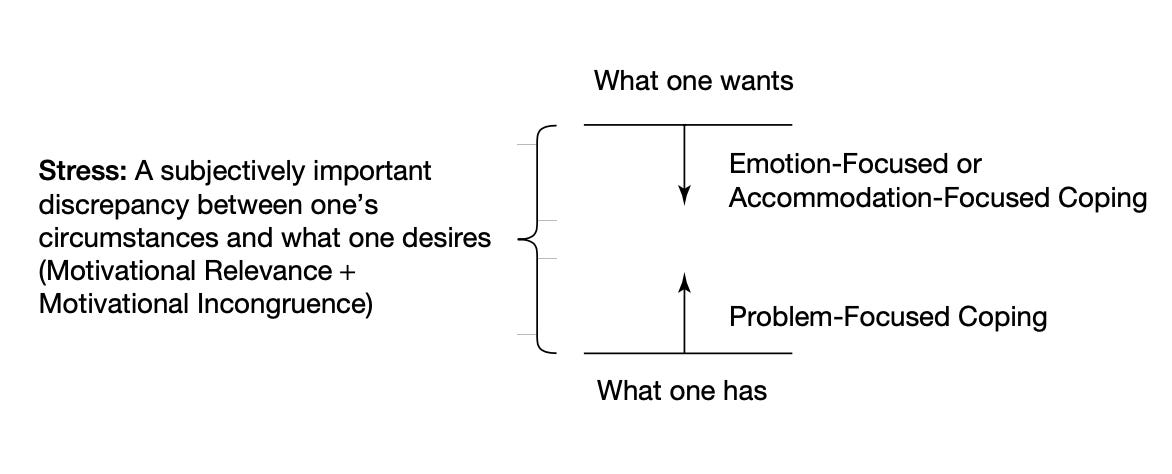 The serenity prayer in action; from The Handbook of Stress Science (Springer, 2010)
To avoid going crazy if we don’t like how things are, we can either take action to change things or simply learn to accept the present.
Constantly working towards something else is a zero-sum game, taking time away from the ability to learn acceptance and self-compassion, that full embrace of the present moment.
Maybe you’re happy with how things are. Maybe just being human is a full-time job. Maybe you’re being too hard on yourself. Maybe we all need to practice patience and trust the process. Maybe—God forbid—you have a well-rounded life.
The post The Life-Changing Magic of Letting Yourself Take Breaks first appeared on Karla Starr.
June 14, 2022
Big-ism: An Epidemic of Bad Communication
While speaking to Congress in February 1981, Ronald Reagan used this example to explain the national debt, $14.3 trillion:
“If you had a stack of thousand-dollar bills in your hand only 4 inches high, you’d be a millionaire. A trillion dollars would be a stack of thousand-dollar bills 67 miles high.”
Reagan was known as a brilliant and charismatic communicator, and at the time, he was trying to convince Americans that the national debt was too high. But it’s not just him solo trying to persuade the American voter because no modern President has to write a speech alone. Behind Reagan was a whole team of political scientists and policy wonks turned speechwriters (a team of the most articulate people in the nation) whose goal was to persuade the American public on an issue they felt was vitally urgent to the nation’s economy. And they chose to stack currency.
When was the last time you scrutinized the price of something by stacking bills in your kitchen? And when was the last time you saw a sign at the market that read: “Avocados – a pile of quarters measuring 1 / 6,665th the height of the Washington Monument.”
Whenever you measure things in Statue of Liberties, Empire State Buildings, elephants, or billions of dollars, only one message gets through: WOW, THAT’S BIG. Photo by Pixabay
Even when it comes to delicate topics, we get carried away with BILLIONS OF DOLLARS or THOUSANDS OF DEATHS that we forget about what’s really important: context.
Inflation is high—how high? At this rate, what will my lunch cost in a year?
Billions of dollars—compared to what?
Thousands of deaths—compared to what?
The Intelligence of Simplicity
The Intelligence of Simplicity
Why We Like Other People: The Art of Reinforcement
Presenting complex, detailed numbers prevents your audience from seeing the big picture as quickly and clearly as possible.
To illustrate: “honey, I went to the track and lost twice as much as half of our life savings” buys you a few seconds; “honey, I gambled away our life savings” does not.
Translating numbers into English—the subject of my most recent book—is the art of breaking down communication barriers and getting everyone on the same page. We don’t realize when we’re speaking the language of our profession with colleagues (marketer, aesthetician, or podiatrist), but we can spot it in others.
From your end, you might think you need to speak researcher to prove that you’re part of the tribe. You might think you need all of those columns in the spreadsheet so your boss knows that you did the work. We think it’s necessary. We think it’s how we prove and signal our intelligence.
And then we see someone doing it another way.
 Photo by Marcelo ChagasSteve Jobs: Not a Simpleton
In 2001, Steve Jobs introduced the iPod—a digital music player that could store music in the device. No more schlepping cassette tapes around, or rewinding them with a pencil when the tape got caught in the Walkman. No more worrying that your portable CD player would skip during a jog, or that your CDs would get scratched while being toted around town.
During its unveiling, Jobs could have listed a dozen ways the iPod trounced its competition—weight, size, decibel range, robustness against shocks, memory (5 gigabytes!). But Jobs stayed true to his history of crafting simple marketing messages. “This amazing little device holds 1,000 songs…” he said onstage. “And it goes right in my pocket.”
“1,000 songs”— it was surprising. Elegant.
And, even better, everyone got it.
The Intelligence of SimplicityThe intelligent brain is an efficient brain.1
A physically fit person has an efficient body: they can do more work with less effort. While you might get winded running around the track a few times or pull your back trying to lift 200 pounds, a competitive runner or weightlifter would see that as a warm-up.
Speed and a relative lack of effort—think of Sherlock Holmes coming up with the answer just like that, before you’re 100% certain what’s going on—are the hallmarks of intelligence.
We all understand the rush and satisfaction of understanding something intuitively—getting a new idea with minimal effort makes you feel smart. Wouldn’t you love to know how to make other people feel like geniuses? That’s the power of simplicity.
User-Friendly NumbersEveryone wants to hold on to their data, complexity, and nuance to come across as smart and show that you’ve done the work.2
But we need to start thinking about how our messaging comes across to others. Don’t you want to make your clients feel good?
Why We Like Other People: The Art of ReinforcementThe brain processes social rewards like any other reward—after all, we need them for survival. Think about the opposite of that: people who constantly question our every action, judge, criticize, mock, and belittle us are tiring, creating stressful interactions that attempt to knock us down a peg.
We’re drawn to people who reward us and make us feel good about ourselves. According to one of my favorite books on communication3, the main goals served by the skill of reinforcement are:
To promote interaction and maintain relationshipsTo increase the participation of the interactive partnerTo influence the nature and content of the contribution of the other personTo demonstrate a genuine interest in the ideas, thoughts and feelings of the otherTo make interaction interesting and enjoyableTo create an impression of warmth and understandingTo increase one’s own social attractiveness as the source of rewardsTo improve the confidence and self-esteem of the other personTo display one’s own power as the controller of rewardsIt’s How to Win Friends and Influence People in a nutshell: we create rewarding interactions, increasing the likelihood that others will want to be around us in the future, by making other people feel good about themselves.
Simple messages that evoke an “Aha!” moment are rewarding to others.Instead of just obsessing over their numbers, great communicators obsess over the point of their numbers: expressing an idea.
To find out how to make other people feel like a genius, book me for a workshop.
The post The Intelligence of Simplicity first appeared on Karla Starr.
1 Ian J. Deary, Lars Penke, and Wendy Johnson. “The Neuroscience of Human Intelligence Differences.” Nature Reviews Neuroscience 11, no. 3 (2010): 201-211. Link. 2 (You don’t really think of Steve Jobs as a simpleton, after all.)3 Owen Hargie. Skilled Interpersonal Communication: Research, Theory and Practice . Routledge, 2021.Why Your Message Can Always Be Simpler
In the 1700s, participation in the U.S. economy demanded little more than keeping good relationships with your neighbors; people were continuously in debt to others in the community for goods and services. Over time, a growing population of towns and villages demanded increasingly diverse goods and services.
Over time, social and cultural development created a need to standardize and share knowledge. The professionalization of the United States turned curiosities into diplomas, diplomas into specialized knowledge.
Doctors, lawyers, academically trained managers, engineers, teachers, and similar groups varied tremendously, yet they all also exhibited a set of common characteristics. This included an emphasis on specific competence and specialized functions as a basis for their sense of identity: numerical increases in and sharper delineation of the group; advanced eduction, increasingly with formalized degrees at the university level, as a standard prerequisite for membership; attempts to control entry and occupational behavior primarily by the profession itself (through associations, titles and licenses); rising claims to status and income. They introduced an alternative basis for status and self-esteem into a society whose dominant model had traditionally been the independent small businessman in town or on the land: that of the expert. In contrast to the jack of all trades image of the self-made man, the professional’s success and achievements were the rewards of a long course of specialized training.1
Allegiance to SilosFor generations, specialized professions and industries have developed within these silos—speaking the language, getting the references, using the tools. Without ever noticing, we become fluent in marketer, aesthetician, or podiatrist.
We think we need to speak researcher because it’s how we prove that we’re part of the tribe: we write and communicate the way we’ve learned after years of reading The Journal of Neuroscience.
We think it’s necessary. We think it’s how we prove and signal our intelligence.
And then we see someone doing it another way.
Photo by Marcelo ChagasSteve JobsIn 2001, Steve Jobs introduced the iPod—a digital music player that could store music in the device. No more schlepping cassette tapes around, or rewinding them with a pencil when the tape got caught in the Walkman. No more worrying that your portable CD player would skip during a jog, or that your CDs would get scratched while being toted around town.
During its unveiling, Jobs could have listed a dozen ways the iPod trounced its competition—weight, size, decibel range, robustness against shocks, memory (5 gigabytes!). But Jobs stayed true to his history of crafting simple marketing messages. “This amazing little device holds 1,000 songs…” he said onstage. “And it goes right in my pocket.”
CDs or cassette tapes held an average of 12 songs, were as bulky as an iPod, and required an additional playback device. Creating a device that put “1,000 songs in your pocket” was a seismic technological lurch forward—it held 50 times more music, and was half the size.
“1,000 songs”— it was surprising. Elegant.
And, even better, everyone can understand it.
The Intelligence of EleganceThe intelligent brain is an efficient brain.2 The clever brain is like a super fit body: lifting 200 pounds and running a few miles might be a warmup for a weightlifting runner, and reading that article and understanding it might be nothing for someone with certified smarts.
Think about when you feel smart: it’s when you get something without any effort.
Wouldn’t you love to know how to make other people feel like geniuses? That’s the power of simplicity.Everyone wants to hold on to their data, their complexity, and their nuance to come across as smart to others. But what about how your messaging makes other people feel?
Do you think of Steve Jobs as a simpleton?
To find out how to make other people feel like a genius, book me for a workshop.1 Jürgen Kocka. White Collar Workers in America 1890-1940: A Social-Political History in International Perspective. Translated by Maura Kealey. (London, UK: Sage Publications, 1980): 46.2 Ian J. Deary, Lars Penke, and Wendy Johnson. “The neuroscience of human intelligence differences.” Nature reviews neuroscience 11, no. 3 (2010): 201-211.