Luke Burgis's Blog
February 20, 2024
Culture War as Imitation Game
The French social theorist René Girard, born in 1923, is not quite yet a household name, but his work does occasionally make it into popular culture. Take the second season of the hit HBO show The White Lotus, where one main character suggests that his friend and former romantic rival has “a bad case of mimetic desire.” This would have made Girard laugh, since his theory partly explains how ideas become fashionable.
Mimetic desire was Girard’s central idea. It is the notion that humans don’t generate their own desires but rather mimic the desires of others — and that this is at the root of human conflict. Mimetic desire formed the basis for a theory of history and culture that captivated his students and thousands of scholars across disciplines as diverse as literature, sociology, philosophy, theology, and history. One of his most famous students, PayPal co-founder Peter Thiel, has said, “I suspect that when the history of the twentieth century is written circa 2100, he will be seen as truly one of the great intellectuals, but it may still be a long time till it’s fully understood.”
Girard passed away in 2015, after a long career as a professor of French language, literature, and civilization at Stanford. In 2005, he was inducted into the Académie Française, at which point his fellow member and Stanford colleague Michel Serres called him the “new Darwin of the human sciences.” The year 2023 is the centennial of René Girard’s birth, and since interest in his work continues to grow due to its explanatory power — for everything from makeup trends to love triangles — you should expect to hear more about Girard in the coming months. (I am hosting an anniversary celebration for him in Washington, D.C. in November.)
Once you see mimetic desire in everyday life, it’s hard to unsee. It helps to explain competition in college admissions, stock market bubbles, and why romantic attraction is often attached to social cues that signal desirability. But I also believe that Girard’s work can help us make better sense of the dynamics gripping American politics today, and might even offer a way out of our crippling polarization.
Originally published Summer 2023 at The New Atlantis.
The post Culture War as Imitation Game appeared first on Luke Burgis.


The Promise of Entrepreneurial Education
With school-choice initiatives proliferating, students struggling to make up for lost Covid time, and Americans pessimistic about the direction of the country, K–12 education is ripe for reform. But a national recommitment to educational basics should extend beyond the fundamentals of reading, writing, and STEM subjects. A key aim of school reformers should be to pursue what I call “entrepreneurial education”—helping students see themselves not as passive recipients of information but as creators, with the agency to shape the world around them. More than the acquisition of facts or the practice of solipsistic self-expression, such creativity is vital to individual and social flourishing.
Today’s students are hungry for this kind of educational experience. Eighty-six percent of young Americans say that they want to experiment with being a social-media influencer. Some invest more time in learning content creation than in the content of the classroom. But before labeling the trend toward social-media entrepreneurship superficial, consider why it has such a hold on young imaginations: it represents an opportunity to exercise creativity and make something that others want to connect with. Young people, this suggests, have entrepreneurial spirits that need to be exercised; our current education model gives them few opportunities to do so.
The word “entrepreneurship” usually denotes business ownership. But construed more broadly, it describes the contributory creativity that is less a commercial mind-set than a national identity. Scout troops, book clubs, and local churches—to say nothing of the enterprising spirit needed in a marriage and building a household—are every bit as entrepreneurial as businesses startups. This is the kind of entrepreneurship that helps people see problems as opportunities, exercise their gifts and talents in service of others, and gain rewards for doing so.
But this mind-set does not usually come naturally. It must be taught. And the nation faces a particular challenge today in forming entrepreneurs: the fragmentation of our society into discrete groups that don’t talk, or work, with one another.
Originally published Autumn 2023 at City Journal.
The post The Promise of Entrepreneurial Education appeared first on Luke Burgis.
December 13, 2023
How to know what you really want
Claire, a smart, ambitious student at Tulane University in Louisiana, was on track to have her pick of law schools, but she decided she’d like to get some real-world experience – and have some fun – in New Orleans first. She landed a job as a paralegal, spending her days researching expert witnesses to defend Big Pharma cases, and that’s when the crisis came. Claire had always loved cooking and learning about humanity through cuisine. She was like a female Anthony Bourdain trapped inside an overworked paralegal, and it was slowly making her life miserable.
She began to entertain thoughts of leaving the law firm and working in a kitchen or a coffee shop until she could figure out how to make a career out of her lifelong interest in food. But doubts haunted her. What would other people think? Maybe she’s not that driven. Maybe she’s not that smart, after all. Maybe she’s lazy. What other people expected her to want to do – and her ability to meet those expectations – began to determine her self-worth.
Many people face dilemmas like Claire’s. Each of us is occasionally overwhelmed by a multitude of competing desires: pursue job offer A or B? Start a new relationship or stay single? Sign up to run a marathon, or enjoy not getting up early to train? But life is full of marathons, and they don’t necessarily involve running. It’s good to know which desires to pursue and which ones to leave behind – to know which marathons are worth running. In this Guide, I aim to show you how.
Originally published on 15 December 2021 at PSYCHE.
The post How to know what you really want appeared first on Luke Burgis.
The Three-City Problem of Modern Life
NASA can land a probe on Saturn’s largest moon, 764 million miles from Earth—yet no one has been able to mathematically demonstrate the exact positions of the Earth, sun, and our own moon at a given point in the future. Scientists can make estimates, but these all rely on simplifications.
Two-body problems, like mapping the movement of one planet around one star, are solvable. These binary orbits are easy to predict. But a serious complication arises if a third body is introduced. Our moon, which has the gravitational forces of both the sun and the Earth acting upon it simultaneously, is part of an infamous three-body problem.
Trying to solve for the movement of three large bodies in one another’s orbit creates a circular logic. The calculations rely on the initial positions of the three bodies, but these initial positions are unknowable over time because the bodies always affect one another in unpredictable ways. In the 300 years since Isaac Newton outlined the dilemma in his Principia, diligent physicists have only been able to offer special-case solutions for restricted versions of the problem. “In a nonlinear system like the chaotic three-body problem,” writes Caroline Delbert for Popular Mechanics, “all bets are off, and our intuitions are scrambled.”
The three-body problem is the best metaphor I’ve found for a social complexity that affects us all today—a problem resulting from the interaction of three major centers of gravity. This dynamic is scrambling our intuitions and making us long for order in what feels like an increasingly chaotic world. We’re caught on the inside of a three-city problem.
Originally published on 28 August 2022 at Wired.
The post The Three-City Problem of Modern Life appeared first on Luke Burgis.
November 29, 2023
Mimetic Desire 101
Nearly everyone (unconsciously) assumes there’s a straight line between them and the things they want.
>> I wake up one day and “suddenly” decide that I want to run a marathon—amazingly, all of my friends had a similar realization when they hit their mid-thirties, too.
>>I get the brilliant idea that Substack is objectively the best publishing platform for my long-form essay writing, based on all the “data”—right around the time that everyone else and their mother seems to be arriving at the same conclusion.
>> I decide to get a dog during Covid because, well, I’ve been wanting a dog for a long time and now seems like as good a time as ever. (Nevermind that I’m the only one in my friend group who hasn’t, yet, and these guys share pictures of their puppies on Instagram along with the rest of the world on nearly a daily basis.)
In each of these cases, I’ve convinced myself that my desire is independent and autonomous. I want to pursue something because it “just makes sense,” or it’s the right thing to do, or it’s what I “authentically” want or need to be happy.
(This all happens beneath my conscious awareness. Very few people question why they want the things they want at all.)
This assumption that my desires are all my own—this story that I tell myself—is what the French social scientist René Girard calls “The Romantic Lie.” The Lie is that I want things independently, or that I choose all of the objects of my desire out of some kind of secret desire chamber in my heart— that I know a good thing when I see it; that I know what’s desirable and what’s not, unaided.
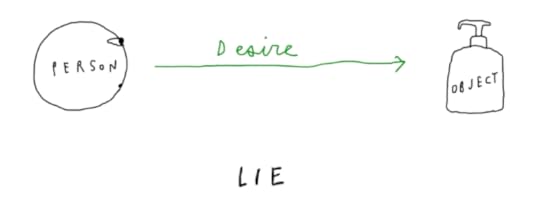
All illustrations by Liana Finck.
Julius Caesar was an excellent Romantic liar. When he won the battle of Zela, he famously declared: “Veni, vidi, vici” (I came, I saw, I conquered). If we translate these words into the language of desire, we see what he is really claiming: “I came, I desired, I conquered.”
Caesar would like all of us to believe he needs only to lay eyes on something to know whether it’s worth wanting. But Caesar is lying. He’s like the rest of us. The desirability of the particular land on which the battle of Zela was fought had nothing to do with the land itself and everything to do with the value that his rival, the Persian king Pharnaces II, had put on it—simply by being there.1
The value of objects is not objective—it’s subjective. And that subjective value is determined mimetically, based on our relationships with others. We could say that value is intersubjective: we assign value to things (and therefore desire them) according to what other people want.
Models of desire—those people who we look to for guidance about what to want (usually without knowing it)—literally transfigure objects before our eyes. Say you walk into a consignment store with a friend and see racks filled with hundreds of shirts. Nothing jumps out at you. But the moment your friend becomes enamored with one specific shirt, it’s no longer a shirt on a rack. It’s now the shirt that your friend Molly chose—the Molly who, by the way, is an assistant costume designer on the sets of major films. The moment she starts ogling one shirt, she sets it apart. It’s a different shirt than it was five seconds ago, before she started wanting it.
And it doesn’t have to be a shirt. It can be anything.
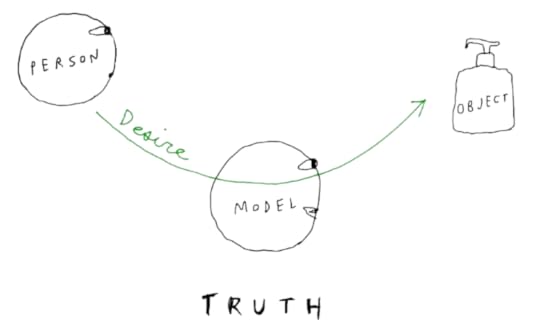
The path between us and the thing we want is never straight. It’s always curved. It goes through, or around, models.
Mediated DesireModels are people, groups, or things that help us know what to want.
“O hell! to choose love by another’s eyes!” says Hermia in Shakespeare’s A Midsummer Night’s Dream. It’s hell to know we have chosen anything by another’s eyes. But we do it all the time: we choose brands, schools, and dishes at a restaurant by them.

The art of Phillip Guston.
Humans have a built-in, instinctual radar for our most basic needs—just like animals do. If we’re trapped outside in the cold freezing, we instinctively seek shelter in the warmth.
Basic survival, sustenance, sex, warmth: these are all instinctual needs for which we have biological mechanisms to help guide us. If I’m starving and I see a juicy steak and a piece of wood in front of me, I don’t need much help to determine which one I should eat. My body tells me what to choose.
These things are not desires per se. It’s more appropriate to call them “needs.”
A desire, on the other hand, is an object that we pursue for which there is no purely instinctual basis. When it comes to desire, we don’t have a built-in mechanism (like instincts) to help guide us toward wanting one thing more than another. Which new model of car should we buy? What should we major in at college? What style of clothes should we wear? The more abstract the thing is, the more mimetic desire usually comes into play. Our central nervous system certainly isn’t going to give us any clear or intelligible answers.
But models can. Models are people who show us what is worth wanting.
Rather than an internal (biological) homing device that helps us make choices, models are external signposts that steer us toward the pursuit of certain people, places, things, even lifestyles.
Models are like people who seem farther up ahead on the path we’re on; they can see around a corner that we can’t see around. We assume that they have some insight into which direction to go that we do not. In short, we assume they have something that we do not—that they possess some quality of being that we do not. And so we follow them.
Mimetic desire means that we make many of our choices according to the desires of others—our models.
The Mimetic MartiniIf we choose something that nobody else seems to want, we begin to doubt that we made the right choice. If a high school student starts dating a classmate that none of her friends express even the slightest bit of interest in, she grows insecure. She begins to wonder whether she made the right choice. We seek validation in our desires. We look for social proof.
Desire always needs something to latch onto; it can’t stay free-floating. In this sense, it operates like a bicuspid that has to be attached to a substrate (a rock, or some other surface). As soon as it becomes detached from one thing, it immediately attaches itself to something else: another model.
There is no end to desire because there are always more models. The overnight Bitcoin millionaire doesn’t start wanting less, or even simpler things; he starts taking an interest in rare fish aquariums, Nordic cooking, and traveling to obscure places he reads about in his Monocle magazines.
Desire, according to René Girard, is always for something we think we lack—or else it wouldn’t be desire at all. Desire is not object-oriented, as we commonly assume. Desire never finds fulfillment in any particular “thing.” There is literally no object or achievement or person that would ever satiate our desire. If anything, we dream up new and strange things to want the more that we have.
Desire is unique to humans in this sense. Animals don’t have abilities of abstraction, which means they can’t want things beyond their immediate worlds. Humans, on the other hand, have learned to want the most obscure and trivial things. And our mimetic nature has made us a target of manipulation by those who understand how this mechanism works.
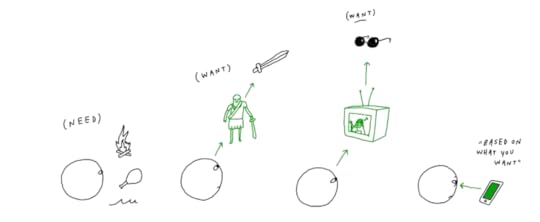
This continuum is an oversimplification. In reality, the lines are blurry. Our most basic needs are also driven largely by mimesis.
Even water has transitioned from the world of needs to the world of desires. Imagine you came here from another planet that was still in the pre-bottled-water stage of evolution (a critical stage). I asked you whether you preferred Aquafina, Voss, or San Pellegrino. Which would you choose?
Sure, I could present you with the minerality breakdown and pH levels of each, but we’d be kidding ourselves if we think that’s how you will make your choice. I tell you I drink San Pellegrino. And if you’re an imitative creature like me, or if you just think I’m a more highly developed being than you—because you come from a pre-Pellegrino people—you’re going to choose San Pellegrino.
It’s revealing to think of mimetic desire along a continuum. Certain people and organizational cultures are more prone to mimesis than others. And one thing is clear, on a societal level: any society in which people are no longer struggling with scarcity but coping with abundance will undergo an explosion of mimetic desire.
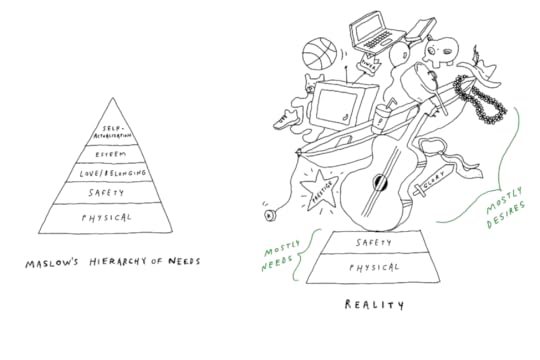
In this universe of desire that we find ourselves in, there is no stable hierarchy. Since desires are determined by models and not by instincts, we can begin to want something new at any given time if the right model comes along. The sociologist and philosopher Zygmunt Bauman referred to this kind of situation as “liquid modernity”—almost nothing is stable. Not least of all our desires.
None of this is to say that our evaluation of people and things is merely subjective. It is (hopefully) formed in part by the objective qualities of the thing itself. A baby banging on pots and pans, a high school punk band, and Mozart have different levels of musicality. Beauty is objective, but we perceive it subjectively—that is, mimetically. We perceive it through the lens of models who distort reality. The more we want to be like a model, the more we lose sight of the objective qualities of the things they have.
The things themselves don’t matter much when it comes to desire. We care about people (models), not things. They represent some quality of being that we think we lack.
This is what Girard calls metaphysical desire: desire of another’s desire—not of any particular object. One way to think about the word metaphysical is “after the physical.” Metaphysical desire is not concerned with physical things. It is concerned with being a certain way. It is concerned with identity.
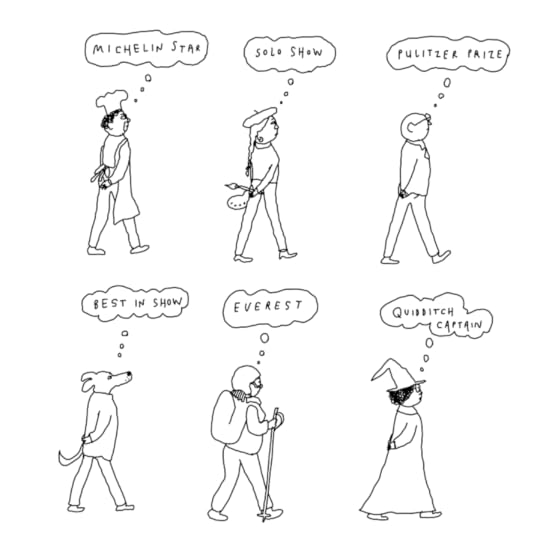
A chef who lusts for the elusive Michelin Guide stars does not want the silly red star that appears next to the name of his restaurant (like a blue verified mark on Twitter…)—he wants the prestige that comes with it. The credentials of universities, having bylines in certain publications, getting named to certain “lists”, or simply just being thought of as an “expert” by others are all forms of this mimetically-driven sense of identity.
I’ll re-iterate in slightly different terms: a model is someone, real or fictional, who mediates desire to us. We already call people who mediate desire for certain clothes or styles by their true name: “models.” Their purpose is not to model the physical articles of clothing but the desire to wear the clothes. Their purpose is to make us want what they have.
What you actually want is their face, their body, their withering stare—which don’t come with the clothes.
Two Types of ModelsThere are two major types of models with whom we have different kinds of relationships. Mimetic desire works differently in each of the two situations.
If the model stands at a great distance—not physically, but socially and existentially—then the model is an external mediator of desire. The model is external to the subject’s world. This means that no serious competition with the model is possible.
I like to call the world in which these types of models live Celebristan for short.
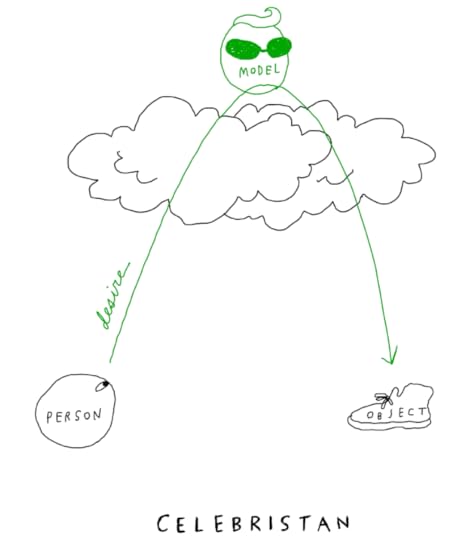
There is a barrier between the models in Celebristan and the people who take them as models. That barrier can be death, or time, or space, or simply status.
While everybody likes a feel-good story of a movie star or singer taking a high schooler to the prom, we all know that the high schooler isn’t on a real date—he or she has no chance of competing with the movie star’s real suitors. They live in Celebristan.
Don’t get me wrong. I don’t mean that a person literally has to be a celebrity to exist in this world. I am referring to situations where a person is simply an external mediator of desire—their desires cannot be directly challenged by their imitator because they seem to occupy a different plane of existence. Even the growing gap between rich and poor in the United States can put neighbors in the awkward situation of one person living in Celebristan while the other does not. (And that’s a recipe for resentment—and more.)
In the greatest novel ever written—Cervantes’ Don Quixote—the protagonist Don Quixote has his desire inflamed to be a knight (more specifically: a “knight errant”) merely by reading about the adventures of the famous knight Amadís de Gaula. The chivalrous knight, Amadís, was completely external to Don Quixote’s world. He existed in Celebristan.
Don Quixote sets out on his crazy adventure with his trusty sidekick, Sancho Panza. But even though they are side-by-side through much of the book, Don Quixote is still an external mediator of desire for Sancho Panza. They are separated by social class and their sense of identity. At no point in the novel does Sancho believe he is a serious competitor to Don Quixote—he doesn’t even dream about wanting or achieving the same things that Don Quixote does—even though they occupy the same physical space and time.
We all have people who are in Celebristan from our perspective. A Managing Director at an investment bank lives in Celebristan to an Analyst (an entry-level position); NBA players do to college players (college athletes can’t compete for the same championship and trophy); even a much older brother can seem to be in Celebristan to his younger brother. At least until they both make it through adolescence and the older brother doesn’t seem more like a man than a peer in the younger boy’s eyes.
It’s worth asking ourselves, honestly: Who in my life do I look at as if they live in Celebristan?
FreshmanistanThe other kind of model is an internal mediator of desire—one who mediates desire from inside the subject’s world. I like to call this world Freshmanistan for short.
Remember what it’s like to be a freshman in high school or college? Despite the “great differences” between the jocks and the nerds and the Thespians, they’re all far more alike than they are different: they sit next to one another in the same classes, they’re all roughly the same age, and they’re all vying to carve out an adult identity. None of them have that much power or money (I’m not counting mommy and daddy’s). They’re all, so to speak, in the same boat—as much as they try to deny it.
Most importantly, there is no barrier separating them from one another. They are in a situation where competition over anything and everything is possible.
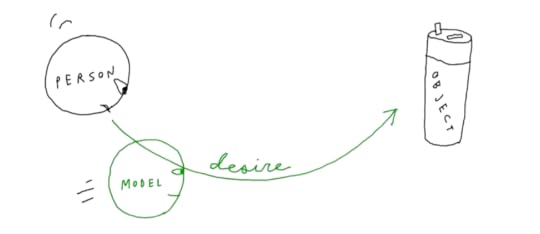
[Note: a model’s location in either Celebristan or Freshmanistan is always relative to the other person. The rapper Kanye West is in Celebristan to me—but he’s not to Jay-Z. The two of them exist in Freshmanistan together because they have a relationship in which real competition is possible.]
If you lived in 1954 and had 100 students in your class, that would be your Freshmenistan. In 2021, if you’re in a class with 100 students, your Freshmenistan is those 100 kids plus every other freshman you follow on Instagram, TikTok, and Snapchat. That’s a lot of modeling, comparing, and desire-shifting.
In Freshmanistan, things can get messy very fast. And all social media is Freshmanistan—we are surrounded by models of desire at all times.
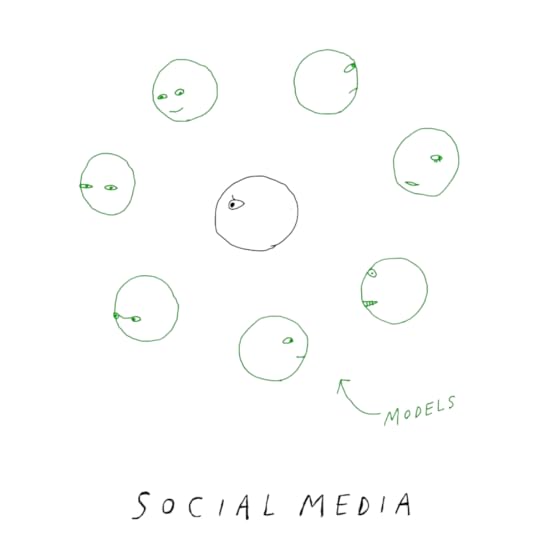
In a way, we’re all Freshmen again. Freshmanistan is characterized by a dangerous level of sameness, which leads to a crisis of undifferentiation—even as everyone is imitating their secret models, whom they profess to love (but secretly hate), they are desperately trying to carve out their own identities on a tiny raft, in the middle of stormy waters that threaten to swallow them up in a sea of sameness.
Go ahead, differentiate yourself. You have 180 characters.
Stay tuned and sign-up for the Anti-Mimetic newsletter to make sure you don’t miss the next installment in this Mimetic Desire 101 series.
1 The example of Julius Caesar as an excellent Romantic Liar is inspired by work of James Warren, who includes this ancedote in his excellent book, Compassion or Apocalypse: A Comprehensible Guide to the Thought of René Girard.
The post Mimetic Desire 101 appeared first on Luke Burgis.
March 21, 2022
Monday, March 21, 2022
Mimetic Monday emails were on a short haitus, but we’re back. Thank you for your patience as I learn how to support a growing community of people who are interested in all of the ways mimesis affects our lives and our world, and who are committed to building a healthy human ecology in whatever sphere of work you are engaged in. I appreciate you.
The MimeticReason, Belief, and Utility: these are the three horses that run in the soul, and they often fight for dominance.
Is it reasonable? Do I believe it? Is it useful? Three guiding questions. Unfortunately, these three faculties of Reason, Belief, and Utility, which I like to call “The Three Cities”—Athens (Reason), Jerusalem (Belief), and Silicon Valley (Utility)—are increasingly isolated from one another…and many times even at war.
In the modern world, there is a fierce mimetic rivalry between Reason and Belief: the modern mind has such a narrow and constricted view of little r ‘reason’ (narrow reason) that it is unable to see the vast domain of things, both theological and non-scientific, that it is able to and should probe. We’ve limited the domain of reason to a very narrow set of objects. Yet we all take certain things on faith, or we all have a ‘belief’ in something—even if it’s simply the sobriety of the airplane pilot whose jet we board. Other times, we do things based more on pure Utility—things that are both unreasonable and which are at odds with what we might truly believe. This entanglement between Reason, Belief, and Utility leads to confusion and anxiety.
The mimetic rivalry between the three cities is causing untold damage in our world and making it harder and harder to grasp what’s really going on. Everything from the Covid-19 pandemic to the Russian-Ukraine conflict could be better understood if we saw how they were interacting in each of the actors.
I am convinced that the best solutions to problems—and the healthiest human relationships—come when these Three Cities (Athens, Jerusalem, Silicon Valley), or these three faculties (Reason, Belief, Utility), are integrated and working together. United, they give height, depth, breadth. They allow us to approach problems with greater perception and approach people in a dignified way without confining them in any of these three places.
I’ll be talking and writing more about these three warring cities and the mimetic crisis among them in the coming weeks and months.
The Anti-MimeticI wrote an article this past week (titled Don’t Feed Your Conscience to the Dogs) about how ‘the free speech debate’ is often engaged in on a superficial level because what we’re really talking about when we talk about free speech is the conscience that the speech was born out of in the first place. The conscience is the sacred center of the human person, the seat of all speech (if it is good and true speech), yet there seem to be more attempts to compel speech—and in turn, compel the conscience—then at any other time in modern history, at least since World War II. I argue that the most anti-mimetic and healthy stance to take in the face of assaults on one’s conscience is not the reactionary approach to “speak one’s mind freely and openly and loudly”, but very often the opposite: to protect one’s conscience, to invoke one’s right to silence—to not manifest one’s conscience on every issue in the news cycle—and not throw what is sacred to the dogs.
Quote of the Week“It is often said that second thoughts are best. So they are in matters of judgment but not in matters of conscience.”
—John Henry Newman
The post Monday, March 21, 2022 appeared first on Luke Burgis.
February 14, 2022
Monday, February 14, 2022
The Mimetic, the Anti-Mimetic, and a Quote
The MimeticOften times “The Mimetic” portion of this email calls out something silly or destructively mimetic, but mimetic desire can (and should) be a positive thing. I want to highlight more of those examples. One of the greatest source of positive models for me has been literature. One example: I was deeply shaped by the Alessandro Manzoni novel “The Betrothed“, and I viewed Fra Cristoforo—a heroic friar who acts as a moral compass for Renzo and Lucia—as a character around which to model my own desires. I was more inspired by his generosity than anyone that I knew in the real world, for better or worse. And that’s the beauty of great art: the ability to shape the moral imagination or a person, and even of an entire culture. I must admit: I haven’t read a book in a very long time—certainly nothing contemporary—that has this kind of effect on me. Am I missing something that I should know about?
The Anti-MimeticLooking at the world with a healthy ambivalence—escaping the absolutizing tendencies of popular culture—and seeing that two different ways of looking at something may be simultaneously true. I wrote about this idea at length here. The core idea worth reflecting on could be summed up in this quote from René Girard:
“We easily say that everything people say about world is true: it is by the worst of all worlds. They say repeatedly—and this is not false—that no world has made more victims than it has. But the opposite proposition is equally true: our world is also and by far the best of all worlds, the one that saves more victims than any other. In order to describe our world, we must multiply all sorts of propositions that should be incompatible but now are true simultaneously.”
Holding two seemingly paradoxical things in our minds at the same time and wrestling with them is an anti-mimetic action in a world in which nearly all thought converges quickly onto one thing or the other without allowing two ideas, or two people, to co-exist long enough to see them for what they are.
Quote of the Week“Bullies, oppressors and all men who do violence to the rights of others are guilty not only of their own crimes, but also of the corruption they bring into the hearts of their victims.” —Alessandro Manzoni, The Betrothed
The post Monday, February 14, 2022 appeared first on Luke Burgis.
January 31, 2022
Monday, January 31, 2022
The Mimetic, the Anti-Mimetic, and a Quote
The MimeticThe French social theorist René Girard said that we didn’t stop burning witches because we invented science; we invented science because we stopped burning witches. Today, it seems that we’re burning witches again (Is Joe Rogan one?)—so the science necessarily has to suffer. And that is the supreme irony.
The Anti-MimeticI’m hosting a seminar with my friend, Dr. Joshua Miller, a lead developer of the MCODE (Motivational Code) assessment, on Feb. 24 at 6pm EST. The Motivational Code is an assessment that draws on narrative psychology to identify key motivational patterns in our lives and has helped me tremendously over the past 10 years. If you’re interested in joining us, you can register here. (The cost is $10 for the general public; it’s free if you are a premium subscriber to the Anti-Mimetic newsletter—simply sign-up and scroll down to the bottom of that post for the discount code.) Why do I believe that identifying your core motivational drivers is anti-mimetic? Because it gets at the essence of our created design, which is apriori the many mimetic forces in the world. I hope to see you there.
Quote of the Week“Victimism uses the ideology of concern for victims to gain political or economic or spiritual power.” — René Girard
The post Monday, January 31, 2022 appeared first on Luke Burgis.
January 24, 2022
Monday, January 24, 2022
The Anti-Mimetic, the Mimetic, and a Quote
The Anti-MimeticThe Rise of Anti-Influencers. My friend Bronwyn Williams shared with me this very fun read by The Hustle on “Anti-Influencers”, or the people who consistently buy doomed products. The more they buy a product early, the more likely it is to fail. Products like these gems:
Crystal PepsiWatermelon OreosFrito-Lay LemonadeCoors Rocky Mountain Sparkling WaterColgate Kitchen EntreesCheetos Lip BalmJimmy Dean Chocolate Chip Pancake-Wrapped SausageClairol’s Touch Of Yogurt ShampooCould these Anti-Mimetic buyers be a key counter-signals that we should identify and pay attention to? As I read the article, I couldn’t help but wonder if a similar dynamic works in the marketplace of ideas. Is there a person or group whose support of an idea is more likely to point to its shallowness or falsity than its depth and truth? Think about an idea—any idea, regardless of whether it’s good or bad, true or false—which has as its early adopters conspiracy theorists, or your political enemies. Are you more or less likely to take it seriously and grapple with it? Seems like this is something all of us should be paying attention to as the ad hominization of the world continues to blur the line between ideas and people.
The MimeticLast week I teamed up with the bestselling author of Atomic Habits, James Clear, and wrote this mash-up of his book with my book, Wanting. I reached out to James after hearing from dozens of readers about important connections they saw between choosing goals, habit formation, and the role of mimetic desire. I believe that books shouldn’t exist as independent entities; they are meant to be in dialogue with other books. James and I chat about three of the most powerful models when it comes to the development of new habits: the close, the many, and the powerful. These are three of the most important groups of people not only in the formation of habits, but also in the formation of desires. I hope you enjoy our collab. I hope to do more of these (non-rivalrous!) team-ups with other authors in the future, and I hope that they can be a small dose of positive mimesis.
Quote of the Week“In movies, there are no big parts or small parts. There are only long parts and short parts.” —Brian Cox, world-renowned Shakespeare actor (who plays Logan Roy in Succession), in his excellent new book titled Putting the Rabbit in the Hat. Cox has lived a fascinating life. When I read this line in his book I thought about how many different aspects of life it applies to beyond movies.
The post Monday, January 24, 2022 appeared first on Luke Burgis.
December 29, 2021
December 29, 2021 —New Year’s Edition
This is the first Mimetic Monday edition that isn’t coming on a Monday. My apologies—I’m scapegoating Christmas for the delay. It took me longer than I thought to unwind from the holiday revelries; by the time I knew it, it was Tuesday. So here is Mimetic Monday, on a Wednesday. New Year’s Edition. May the best of 2021 be the worst of your 2022.
The Mimetic“Goal-setting.” Goals, in the words of Bob Dylan, are blowin’ in the wind. It seems that the entire goal-setting industry and complex is reliant on unrestrained mimesis: people adopting other people’s goals as their own, and a willingness to pay big money to achieve them. I’ll never forget the night I went to a Comedy Club in NYC. The comedian introduced himself by sharing that he was thirty-five: “the age when apparently everyone starts running marathons.” He was lamenting the mimetic power of people’s solutions to mid-life crises. (“Every time I see them running a marathon, I wonder: what are they running from?” he continued. “I just got back from running my first one.”) It was funny at the time, at least. But it was also somewhat jarring to that 25-year-old version of me, trapped in the throes of mimetic desire as a young entrepreneur. I’ve reflected a lot on goal-setting ever since. So here is an adapted except from my book, Wanting, about the mimetic nature nature of goal-setting. I believe this aspect of goal-setting is important to think about as we head into 2022. I wanted to write about something that seems to get overlooked in all the New Year’s chatter about about goals—namely, how and why we choose them in the first place.
The Anti-MimeticHere is a list of 25 Anti-Mimetic Ideas for 2022. The one that has garnered the most reactions so far is the last: discover and live out your personal vocation in the world. The mimetic forces pushing and pulling us in a thousands different directions have a lot less power over us when we know what it is that we have to do. A vocation, a mission, is like a winnowing fan. Why did I make this the #1 Anti-Mimetic idea? Because it has been the case in my own life. I have a clearer sense of what contribution I am meant to make in the world than I’ve ever had, and it helps me decide on what to say no to and what to say to, and where to direct my time and energy. Or it could be just be that I made it #1 because we’re in the middle of marathon-watching The Lord of the Rings.
Quote of the Week“What do you fear, lady?” [Aragorn] asked.
“A cage,” [Éowyn] said. “To stay behind bars, until use and old age accept them, and all chance of doing great deeds is gone beyond recall or desire.”
-LOTR
The post December 29, 2021 —New Year’s Edition appeared first on Luke Burgis.