Deborah Teramis Christian's Blog
March 11, 2019
Big Changes Here at the Lizard Lair!

Yes, the display of this website is all messed up.
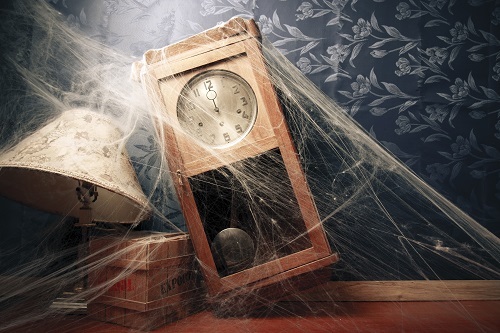
Yes, I haven’t posted here in ages! Lots of cobwebs and dust around the place (cough cough!)
And yes, this is all about to change drastically.
I am happy to say I have a new novel coming out from Tor Books later this year! – and I will be posting about that in more detail very soon.
That book release, plus several other publishing projects, plus my world building work, and Word Press’s continuous upgrade process that finally nearly broke my website–all these things have compelled me to roll up my shirt sleeves and whip this chaos into shape.
As some of you may know, I have been sick for a long time, and have been pretty much absent from the public world while I focused on getting better. I’m still not 100%, but am much better than I was, and man, I really need to make sense out of my work life, my writing life, my gaming and creativity and teaching and speaking, and and and….all of that. Everything that has basically gone neglected since I nearly croaked in 2014.
As usual, I still tend to overestimate how much energy I have or how quickly I can get things done, but I’m doing my best to remain realistic yet focused this time around so I can make the positive changes happen that I need to. So, stay turned, and this place will soon be looking much better, and I expect to be blogging again and updating you once again on my book writing and much more!
If you want to stay current with those updates, feel free to subscribe to my newsletter, here. And please don’t let my present web disarray bug you too much; this too shall pass.


July 2, 2015
4th of July Book Sale

Get World Building books and other good reads for 10% off through July 4th at my online bookstore!


June 9, 2015
Creeping up on a website revision
Well, I just spent a couple hours in geek hell trying to figure out why this wordpress sites no longer displayed correctly. Turns out the newest Jetpack plugin upgrade completely fubared my theme. (Am running the 5-yr old Producer theme). Plugin’s disabled, so display is back to normal, but I guess I need to start thinking about moving to a more current (and currently supported) theme. O Joy.
Don’t know when I’ll get to that, but be looking for some changes here in the future. Hopefully sooner rather than later; I don’t need plugins breaking my site. Sheesh.


June 7, 2015
Site 3: A Cold War Espionage Story Finally Ready for Telling

Army Security Agency uniform patch
When I was in my teens and early 20s I was a member of the Army Security Agency, translating East German intel for the National Security Agency on the cutting edge of the Cold War in West Berlin. Interesting times in one of the most amazing cities in the world, and sometimes bizarre things going on in the land of COMINT and HUMINT spooks.
I knew at the time that all this was narrative-worthy. I was sometimes conscious of being a human recording device, clocking things with special attention because I knew that some day later, I would write about it all. Indeed, the instant I came home I typed some chapters and an draft outline of the book I wanted to write about that time, and what I experienced, and some things that were, or could have been, or should have been. And then I reluctantly put that book away, because I knew–as we sometimes know these things–that it was bigger than me. My skills or my craft weren’t quite up to it yet. Yes, I could have written “a” book then, but it wouldn’t be THE book it needed to be.
Hanging on to the Bright Idea
The earliest date on my draft files that I can find now is January 1980–a manuscript that went from a 1920s Olivera manual typewriter, to a Commodore 64 disk, to an IBM PC disk, and somehow through all these transitions eventually ended up (still intact!) on my present machine. By various time/date stamps from different save files, I see I gave this fledgling draft a once-over three different times in the ensuing decades. Each time I poked at it a bit and put it away again. Nope. Teramis the Writer was still ripening.
Now Splintegrate is wending its way through editorial at Tor, and that book that too-long congested my narrative pipeline has left, leaving space for…what? For the fantasy novel I am writing because I want to read it (Queen Victoria’s Transmogrifier), and now…. This. Site 3.
The time is right. I just know it, and I just realized this tonight. The journey into the world of that story will take me to a different space and place than my fantasy or sf novels, but now– AT LAST! I just know this is the right time to tackle it.
I was writing QVT when I was blocked with Splintegrate. It was helpful to my process to have two books in progress at once, so I could work on one while the other percolated. An especially useful thing when I’d written up to a wall and needed a mental change of pace. So I’ve decided to add this second book to my WIP pipeline, and will be working on Site 3 from here on out in addition to, and as an alternation from, Transmogrifier.
Espionage Novel in Novella Installments
This is also an experiment. I plan to do this in a series of novella-length installments. Ultimately they could all be combined into one omnibus edition that equals a single full-length novel. But if I structure it properly, the novellas should each stand alone and yet collectively tell the tale of the whole book. I think. I hope. Well, like I said, this is an experiment.
It will also let me experiment with some stricter plotting approaches than I normally follow. Part of my snarl with Splintegrate was because of not tight-enough plotting up front in the conceptual phases of the novel. Site 3 falls into the espionage/suspense genre, so of course the plotting and pacing are especially critical.
We’ll see how that goes. If I get a wild hair I may sell this by subscription as I write it–a serialization of the book, as it were, that you can get on a subscriber basis. Does that sound like something you’d sign up for? Yeah, breaking a lot of new ground with this one, both in my writing (style, approach) and business model too.
Wish me good luck with this one. I think I’m finally able to do this story justice, and if things click here then I know I’ll be ready to also write another book that is likewise on the back burner for similar reasons. (That one’s an even bigger story than Site 3, and also based on bizarre true events). But one thing at a time.
I’ll probably be quiet about this while I brood over plotting and structure before I start writing, but when I’m ready to roll, you’ll hear a lot more about Site 3, especially if I open it up to subscribers. Let me know what you think about the subscription idea, ok?
To be continued! Huzzah. 
Originally posted 2013-03-03 03:24:14.


May 30, 2015
Ancient Egyptian Handbook of Spells Deciphered
Researchers have deciphered an ancient Egyptian handbook, revealing a series of invocations and spells.
I’d love to see a complete English language translation of this. This seems like great inspiration for role-playing game use, and also for world building. This is written in Coptic; nice to see what that looks like on the page. It also strikes me that if I didn’t know better, I would assume this was a made-up script made precisely for rpg prop purposes, with characters that almost look like something recognizable to an English language reader. Maybe our made-up stuff isn’t so far-fetched after all…
Source: Ancient Egyptian Handbook of Spells Deciphered


May 24, 2015
Three Problems to Avoid If You Publish a Fiction Ebook
 Today’s burgeoning ebook market has made something possible that used to be very frowned upon: self-publishing. It used to be that if you were a Serious Author, you would only sell your work to a Real Publisher, and do this the old-fashioned way: by honing your craft, acquiring an agent who liked your masterpiece, then selling the book to a publisher, and thus breaking into print. Those poor schmucks who saved their money to print 2000 copies of their masterpiece, and who still have 1880 copies sitting in boxes in their attic: well, those folks were rightly called “self-published” authors, their works put in print by vanity publishers. Those publishers printed (and still do) anything for a fee. The tacit understanding in the Real Publishing World was generally that you have to be vain to think your work was good enough to publish, and to pay for it yourself – especially when no Real Publisher would touch your work.
This lack of professional publishing engagement with your work meant something. It often meant your work had only niche appeal, thus not justifying a publisher’s expense of bringing something to market. But more often, it meant your work actually sucked. You had not yet mastered your craft; you wrote something no agent would touch and no publisher would buy. Sure, spend your money on vanity publishing: when you see how difficult it can be to market a work, and are unable to sell the many copies you thought would fly off the shelf – well, that’s when reality sets in, and you will look longingly at established publishing houses, and wish your work would be taken up by one of them.
Enter the Ebook
Now – quite suddenly, relatively speaking – all those barriers to getting one’s work out there are gone. Vanished, as if they’d never existed. There’s been a lot of discussion about how the publishing model has flipped around – not just from a business viewpoint but from the actual get-it-in-print viewpoint. It used to be that a lot was written, and specialists picked what they thought was marketable. This is what would see print. The new model is, everything plus the kitchen sink gets into print and is readily accessible everywhere (electronically): and out of this morass, the good stuff will (presumably) float to the top. This is also known as the “publish then curate” model, as opposed to its predecessor, “curate then publish.”
Tons of Garbage
The first and most immediate effect of this new model is the fact that it pushes tons of garbage onto the market. When the price of entry is a word processor, minimal (and I do mean minimal) ability to string words together on a page, a free ebook conversion program and free distribution services: well, if you envision it, and take time to write it, then you can have it in print, for any value of “it”.
 Where does this leave the good stuff? If the good work can’t find enough of a readership to elevate it from the muck at least by word of mouth, then it leaves that good stuff buried in the muck, lost in the noise of the absolute glut of cheap or free poorly written material that is flooding the market.
This is frustrating to anyone trying to get their stuff read. It is not only frustrating but I think a real tragedy when this is the fate of truly good writing that can’t get the hearing it needs. But most fiction ebooks do not even fall into that “good writing” category: they sink even further to the bottom of the heap, the really bad writing buried under reams of merely mediocre writing, because there is simply so much STUFF coming out now in ebook form, and the sad fact is, most “authors” in this market are not producing any work that warrants that job description. They are writing at a 7th grade level with stilted craft abilities, and their work is being avidly consumed by an audience with 7th grade reading skills.
This is all well and good if you aspire to write dross for ill-educated masses who aren’t especially particular about the execution of what they read. If, though, you want to write intelligent, insightful, entertaining things that intelligent, insightful readers can really appreciate and be entertained by, you have to up your game and write at a whole different level. This will not only elevate you out of the junk heap of ebook mediocrity, it will connect you with an audience that is the right audience for what you are trying to convey.
This brings me to my tip list of the three things to avoid like the plague if you want to successfully publish an ebook (in a way that distinguishes you from the dross, that is, and makes your work stand out for its merits).
1. Don’t Write Crap
Even the suckiest book will find some poor benighted soul who thinks it rocks. That one ignorant fool does not a market make. If you are writing, you have to be able to, well, WRITE. This means technical skills like good grammar and spelling. It means proofreading skills like getting rid of redundancies and using the right turn of phrase instead of some bastardized thing that misses the mark. And most importantly, it means (if you’re writing fiction) that you need to learn how to tell stories effectively. This means learning your craft. For every significantly flawed work you rush to market, you will lose readership: all those intelligent well-read readers who are potentially repeat book-buyers will trickle away and be almost impossible to win back, because they will have read your work and decided, “Hey. This is crap.”
2. Don’t Publish the First Book You Finish (or the Second, or the Third)
At the risk of being redundant, I’ll say it again: Learn your craft. Practice. Write. Join critique groups and get critiqued. Don’t think because you start here and end there you have told an effective story. Learn what an effective story is. Read voraciously, and listen to intelligent input about your writing. This does not mean asking for fen feedback from your favorite yaoi writing forum. It means finding constructive, detailed technical criticism and constructive input, ideally from other published authors. If not, then find a writing group populated by English Majors (Masters are even better). The kind of detailed critique skills they learn about writing in school is one of the only real-world uses that degree background will ever see. Work it for all it’s worth. And write a million words. Seriously. If you haven’t done that yet, you’re still learning the ropes. What you write at the end of that journey will be vastly different than what you started out with. There are relevant discussion comments in this thread here and more easily found if you google around on “a million words.”
 If it takes potentially years to master any major skill, why do we think writing would be any different? People who say, “Well I decided to start writing last year, and now I have three books out at Smashwords” – well, ok, good for you for completing multiple projects. But what’s the quality like? If you’re not a natural genius with the written word, I’m betting you have some craft honing yet to do. Probably years worth of it. And you know what? That’s ok, because it’s par for the course – but be aware of that need, if you want to have quality work on the market.
NOTE: I know the above two points are similar, however: the first is about quality on the page, the second is about the author’s learning process. I think these are two areas primarily responsible for all the drek posing as readable fiction right now, and so deserve being highlighted in this manner.
3. Don’t Sit Back and Let Your Book (Try to) Sell Itself
This last point is not about craft, but about the issue I mentioned earlier: that in this (still accelerating!) ebook revolution we are in, there is a growing glut of books on the market. Just releasing it at Lulu, Smashwords, Booklocker or Amazon is not by itself sufficient to guarantee sales. You need to take additional steps to draw attention to your work. This is a really necessary thing to do, just as much (or more so!) as in the days of hard-copy vanity publishing, when someone with a 1000-print run had boxes in their living room, relatives saying “No more, thanks!”, and yearning to sell the rest of their inventory so they could get their living room back.
 The actual sales tactics have changed, in this day of the interwebz and social media connections, but the problem essentially remains the same: how can you draw people’s eyeballs to your work, so they even realize it is there, much less want to pick it up and read it?
A discussion on marketing is waaay beyond the scope of this post, but this point is in this list because if your book is like 99.99% of those out there, you cannot simply leave it to chance that your book will “catch on” somewhere, or magically stand out in a publisher’s listing compared to all the other hundreds of books in their catalog. Give some thought to this challenge, and understand that when you choose to publish an ebook, you are also making a commitment to market your work – if, that is, you want to stand out from the trash heap and create a market for your work.
That’s it for now – some quick thoughts on big problems I see in today’s fiction ebook marketplace. Good luck to everyone aspiring to write, and LEARN YOUR CRAFT. You don’t just owe it to your readers: you owe it to yourself, to tell the best story you can.
_____
Here’s a little disclaimer: this is a not-so-disguised rant as well as cautionary “points to watch out for” commentary. I’ve been a professional editor and publisher since I was 24, so I’ve been at this for a while. My experience spans old-style print media from journalism to journals, including newspaper and magazine layout with galley proofs and a handy exacto knife for trimming layout edges, to web content, book editing, and *.mobi conversions for Kindle ebooks today. Still mastering that last, but my point is simply: I’ve seen a lot of styles of media production and distribution, and the content they purvey. Edited a lot of it, and written a lot of it as well. It is from that viewpoint that I share these observations, as well as from my deep dismay at the shear mass of unreadable garbage on the ebook market today. Don’t ask me to review your ebook unless you have zero doubts about the quality of your writing, because if it is not up to professional standards that is the first and (if you’re lucky) the last thing I will note about it in my review.
Originally posted 2011-09-22 08:00:42.


May 17, 2015
Gender Roles and Women in Power: An Uncomfortable Fiction
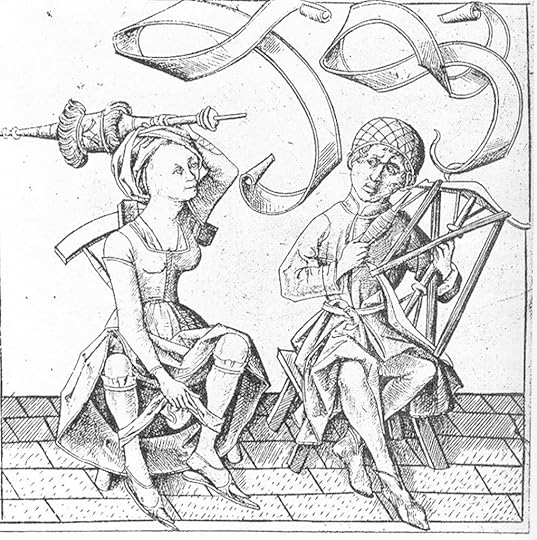
The Backwards World: Woman swings scepter while man spins thread - Israhel van Meckenenem 15th c
I know an indie game designer who is working on an rpg with a surprisingly radical premise: that women are the dominant force in a fantasy society.1 It is not that I personally found this so surprising, or even so radical; rather, I describe it this way because the very concept quickly became a lightning rod for criticism. A certain proportion of men reading about the game designer’s project simply could not get past the underlying premise of power-reversal in the fantasy setting.
The sharpness of that reaction, and indeed the vitriol in many of the remarks made, is what truly surprised me. But then again, it shouldn’t have. This designer unwittingly touched one of the third rails in game design – and for that matter, an unspoken rule in the construction of fictional settings in general, be it rpgs, books, or film. Namely, he blundered into the forbidden territory of power balance between the genders.
This designer proposed altering the power balance and some of the gendered expectations of behavior into the inverse of contemporary culture, where traditionally men hold most or all of the power. In his setting, it would be women in the power-dominant position. This concept, it turns out, was profoundly disturbing to a small but not insignificant percentage of men reading about this game. The negative reactions were varied, and when expressed, were often more harsh than not. There was curt dismissal (”I’d never play a game like that” – a declaration made on the basis of the premise alone, without knowing any other details about the game). There were rabid rapid flights of fancy down some ‘inevitable’ slippery slope to abuse of power (“Men are being forced against their will to be subservient and women will take advantage of having them in that position”; “Women would have to abuse men because men would never stay in that position willingly”). And the most red herring of dismissive attacks of all, ad hominem questioning of personal motivations and sexuality (”There’s something wrong with you if that you want to play a game like that. It could only be for personal fetishistic reasons.”)2
I thought the designer’s premise was an interesting thought experiment. As a sociologist and student of cultural anthropology, I consider gender roles largely socially constructed. The concept of challenging them, of altering power dynamics at this basic human social level, raises interesting questions and carries many intriguing possibilities. Not the least of which would be this question: what would it be like to live in (or play, in the gaming sense) in what is essentially a comprehensively matriarchal society? That is the beauty of casting this in a game-able form: it simply hasn’t been done before in the gaming genre, and is very rarely touched upon in fiction.
Yet there was a strong and argumentative outcry against this fascinating notion (“OMG, that would be terrible! Men would be treated like second-class citizens based on their gender! It would suck, and you’re a freak for even thinking it up!”) – a reaction from a small but vocal minority that went well beyond a simple “I don’t like your game concept.” From a sociological perspective, the backlash spoke to threatened identities – or the perception of threat – embedded in how people thought of themselves, and how they projected they would feel (comfortable, or not) in a game setting that challenged basic identity frameworks such as power privilege associated with gender.3
I am glad to note that the designer handled the criticisms with grace and poise. Encouraged by others who, like myself, are intrigued by the concept, he seems to be carrying on with development of that game setting. So in this case in point, perhaps a creative effort was not doomed to a stillbirth by outraged reactions before it even got off the ground.
The underlying issue, though, does not go away just because this one project is proceeding.
If some men think it would be abhorrent to live as second-class citizens in a world where the opposite gender holds all the power – well, I can only say, “welcome to the world most women live in.” By ‘most women’ I mean women all around the world. Certainly power is more equitably distributed in a place like America, relatively speaking, than it is someplace like Afghanistan. (See the movie Afghan Star for an eye-opening dose of restrictive gender roles and life-threatening backlash when they are transgressed.) And yet it was predominantly American men having the largest conniption fits about altered gender norms and the power-reversal concept in a game.
Do not misunderstand me, here: I am not saying, “Put the shoe on the other foot and see how you like it.” I am saying that in a game world, at least, we can do what we cannot do in the real world: turn these paradigms on their head, and see how they might play out if differently imagined. I think it is a great opportunity to play with and examine these all-but-invisible pieces of social encoding by challenging them in a fictional environment. For surely it is not new news that gender roles are deeply ingrained in us. Most people are relatively unaware of how gender messaging and assumptions color their thoughts on virtually every aspect of social life and personal identity. We are like fish in water, unaware of the water because it is the very air we breath. Yet threaten that environment, and the outcry sounds like an armoring-up, a stance reflexively taken to protect the core self.
As indeed, on some level, it is.
I guess I’m writing this commentary because I want to encourage people to be aware, to be mindful of the gender roles they have ascribed themselves and those around them, and how this translates into their creative works. If it feels “wrong” that women as a class run everything in a fantasy setting, the mindful person will ask him or herself why that is so. In the process of self-examination we garner more personal insights than we ever do by simply declaring that scenario anathema, and flailing at the one who dared to envision such a transgression.
The designer I mention in this post may not have been squelched by those negative reactions, but this is the kind of invisible social conformity pressure that helps keep other artists and writers in check.4 We don’t play much with the broad social implications of gender assumptions in most of our fiction and games, and certain approaches to this delicate terrain can obviously evoke strong backlash. Critics may not intend to “keep someone in line” with mainstream gender-think, but that is, in the end, very often the result of that process.
To anyone who thinks of creating gender-transgressive content, I can only encourage you to plug your ears to the (un)spoken mainstream expectations, and create the vision that drives you, however quirky it may be. If it is disturbing to some, then they’re obviously not the market for that work, but there are plenty of others who will be. As to the “disturbance” factor, I think the best art is the kind that unsettles and makes the person contemplating it feel moved, even if “moved” sometimes equals “downright uncomfortable.” Many of us never question our assumptions until we’re challenged in just such a manner. So go on. Challenge.
The ones who are disturbed by your work are the ones who need to be.
_____
1 rpg=”role-playing game”, in case you don’t follow the field and its shorthand.
2 These are not literal quotes from the exchanges referred to. I am summarizing and paraphrasing, rendered in a narrative form. To the best of my recollection this is the gist of what I read.
3 The text and assumptions about gender roles and power dynamics that are packed into these protests are so incredibly dense I will leave it to a women’s studies, sociology, or anthropology grad student to tease them out and offer a fuller critique on the issue. Such a level of analytical discourse is beyond what I’m prepared to get into right now for a humble blog post.
4 I’m not naming the designer because I want to keep the focus here on the underlying issue, not personal details in an internet exchange. Although, if he would like to identify himself and his project, I think it would be great to give his intriguing work more exposure, and from that viewpoint I encourage him to consider commenting on this post, since the aforementioned kerfluffle now lies somewhat distant in time.
Originally posted 2011-12-17 20:03:57.


May 10, 2015
How to Use Class in Historical Settings, Part 1

The chamber maid brings tea – Pehr Hillestrom 1775
Before our modern era of democratic equality, before school children growing up were routinely taught that “we are all equal”, quite a different calculus of social standing prevailed.1 There was a time when class and status created strict boundaries in a person’s life, as is still the case in parts of the world today. The strictures imposed by these forgotten frameworks had a far greater impact on historical lives than most contemporary writers are aware of.
Game designers who are ignorant of these limitations may unintentionally create worlds that mirror modern times and social equalities. Authors who give only passing attention to class and status in their fictional settings short-change the layers of interaction that can have a vital impact on characters and events. But when writers have a better understanding of these social factors, a great deal of dramatic tension and challenges for characters can be introduced to the setting, and in a way that makes cultural sense.
I don’t want to wax academic on the subject, but do want to examine some of the historical issues around class and status, and suggest some sensible ways to play up these factors in fictional settings.2
Class and Status
Class (socioeconomic standing) and status (prestige associated with one’s position, or the lack thereof) have colored human societies throughout history. For most of that history, distinctive classes with various levels of social standing were recognized to exist, with differences between them often enforced by law. In day-to-day life people might not have paid a lot of conscious attention to class and status, but a person’s “place” in society was much more sharply defined than ours (generally) are today in the modern western world. If someone tried to step outside their expected place, there was much harsher backlash than a person would normally experience today. This served to reinforce the expectation that everyone had a given station in society and would pretty much stick to it for most of their lives.
Today, class is associated almost exclusively with a person’s socioeconomic standing, and in our “land of opportunity” we have an underlying expectation that an enterprising individual can change that status if they work at it. It has not always been so. In past times the implications of class went far beyond socioeconomics. Each person was born into a social niche which itself conveyed a certain status, and this place in society determined pretty much everything about that person’s life.
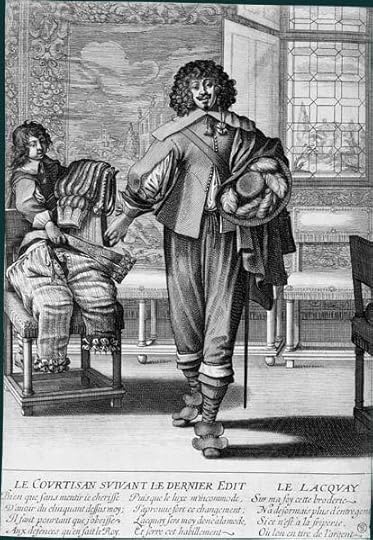
French courtier exchanging finery for more sober clothes following the Edict of 1633, by Abraham Bosse
Education, employment opportunities, marital connections, voice (or lack thereof) in politics, even down to details such as what clothing one could wear and what adornments were forbidden: all these factors and more became dictated not only by custom and common usage but also by codification in law, such as the sumptuary laws that dictated permissible attire depending upon one’s class.
It was much more difficult in the past to change class and status than it is today. Marriage, inheritance, success in trade (hence gaining wealth), and elevation to a notable position were perhaps the most commonplace ways of doing so, but beyond those methods the opportunities for changing social standing were fewer than in modern times. Many who hoped to alter their standing had to defy convention and possibly even the law in order to step outside the station society had fixed for them.
When we fail to reflect these layers of nuance in our representations of the past, we risk producing generic, essentially democratic, “everyone has equal rights”-hued interactions that bear a vague resemblance to present times. Another common pitfall lies in choosing just one or two factors from the past to stand as tokens for a class-based society: nobility are unsympathetic to the plight of the common man (unless they are our heroes); our always-literate adventurers do not stem from the lowest classes of society; we call one group lords and another group ladies and they always bow or curtsey and are very mannered.
While this shorthand representation of class factors succeeds in signalling “class plays an important role here”, this tokenism both misrepresents the reality, and gives a shallow and skewed impression of the real dynamics that existed in a more class-conscious era.
For writers who want more verisimilitude in historical settings, or who want to play with a multi-layered and rich set of social dynamics, here are some things to consider about class and status. (For convenience I may use these terms interchangeably. In doing so I am referring to the combination of both which was more restrictive historically than in modern times.)

“Learn your place in this town. Or soon enough you won’t be in it.”
Regina Mills (the Evil Queen) to Emma Swan in “Once Upon a Time”
“Know Your Place”
Throughout most of western history, most people had a sense of “place”. This awareness corresponded in part to geographical location, but even more so to where they fit in society: in family, clan, village, in the larger community and realm of obedience to authority.
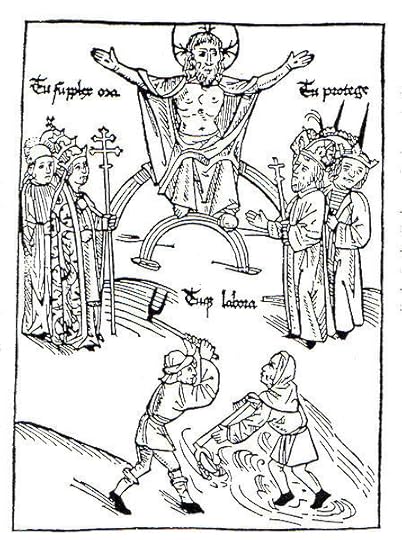
Estates of the Realm – Jacob Meydenbach, 1488. “You pray humbly, you protect, and you work.”
In the Middle Ages this was exemplified with “the estates of the realm”: a representation of the presumably heavenly ordained classes that a man could occupy during his lifetime. An example can be seen in this Renaissance-era (1488) woodcut by Jacob Meydenbach, which shows Christ on a rainbow blessing the three estates. Those groups are clerics, nobles, and peasants. The Latin captions say to the respective groups, “You pray humbly; you protect; you work.”
Governments were structured along these lines. Throughout Europe. evolving parliaments were arranged in ways to reflect the divisions of the lords spiritual, temporal, and commoners. Laws – or how they were administered – reflected these divisions, with multi-tiered justice systems often meting out different punishments and penalties depending upon one’s station of birth. Not everyone was considered “equal before the law” – that was a much later invention. For a long time it was considered important to support and reinforce the divinely determined differences in station of birth, and this was reflected in law and custom.
This notion of “knowing your place” lasted for centuries in Europe and the colonized Americas, and, it could be argued, continues to exist (in a diluted manner) today. For generations people were made aware that they had obligations to meet that coincided with their station in life – and even more pointedly, that to imagine themselves filling another’s place was an unacceptable flight of fancy. While a nobleman might choose (or be compelled, if a younger son) to dedicate his life to the church, it was only a minority who became churchmen, and it was highly unlikely for that process to happen in reverse (for someone to leave the church and live as lay nobility again). As to commoners and peasants, their lot in life was set: while an orphan taken in or the son of a well-off tradesman might gain entry to the clergy, by and large people born “to the land” would remain “on the land” for the rest of their lives.
In later times as economies diversified and cities grew, more opportunity opened up and economic mobility began to erode this restrictive estate structure. The habit of thinking of people as born into a place, though, continued for centuries. The last hurrah of this outlook in broad society probably came with the outbreak of World War I in 1914. The Great War caused social upheaval and adjustments in many regards, but domestic service provides a case in point. About 13% of women in England were in domestic service in the 19th century, and service work was the single largest employment sector for women on the eve of World War I. To aspire to a lifetime of service to one family was an honorable goal, and completely in keeping with having a sense of place and knowing one’s place. As a result, commoners from a lower-born class routinely took service with the higher-born. It seemed like a time-tested and nearly inevitable arrangement for a large chunk of the work force.
However, the needs of war opened up clerical employment and women filled industrial jobs by the tens of thousands, to take the place of men who went to the battle front. This forever changed the nature of women’s work and also dealt a fatal blow to the centuries-long definition of appropriate endeavors for men and women born into a certain class. The servant culture of the western world never recovered from this tectonic shift. The nobility and well-to-do had to adjust accordingly, and this all gave a huge impetus to the long slide into egalitarian relationships that dominated the 20th century. We have notable portrayals of this era and this groundswell of change in some entertainment media, most notably in the groundbreaking TV series Upstairs Downstairs, over the course of which the family and servants underwent great changes with the outbreak of WWI, and in the more recent production Downton Abbey.

Upstairs Downstairs
In part 1 of the documentary Maid in Britain (embedded below), you can see an installment of a great program about class and status and domestic service in the U.K.. It’s a very insightful production (the other installments are online at YouTube). Although focused strictly on domestic service, it delves into a microcosm that is a good example of the class consciousness and status I’ve discussed here.
In Part 2 of this post, I look at some guidelines for class-conscious behavior, their origins, and how to use them in fictional settings.
_____
1 “We are all equal” may not be the reality, but it is certainly an ideal today, and is commonly presented as such in school and cultural indoctrination in most ostensibly democratic nations.
2 Class and status have their outworkings in every society in the world throughout history. For purposes of this post I am focusing my remarks on America and western Europe over the last 1000 years, since this geography and time span plays a dominant role in our fiction.
Related Posts
How to Use Class in Historical Settings, Part 2
How to Use Socioeconomic Class in RPGs, Part 1
Originally posted 2012-02-06 14:05:20.


May 3, 2015
Writing with a split personality
I suppose it was inevitable. I get so immersed in my writing – must, because I “go there” and become part of these people, ride along with them like a ghost in the night or a spy-cam with night-vision – that I Become One With The Characters. It is long since a given that I run around in the quiet of The Garrett, talking and arguing with myself – and replying, too. Maybe even in voices, if not tongues.
But what am I to do with the rest of my brain left behind on Planet Earth?
I’m not sure, and it gives me little rest. It’s as if, once I am out of the communion zone with the muse, all the other aspects of ego start knocking on the door. Frantically. I’m so fried from writing I was nodding off at the keyboard a while ago, but now that I’m away from it (at another keyboard, the laptop, where I foolishly paused to write a personal note or two before going to bed)- it seems like every part of me that’s squashed out of sight while Writing now comes clamoring forth. I am caught up in left-brain thinky things; in geeky issues about php code, and curiosity about secret (now declassified) intelligence revealed by Steven Aftergood in his Secrecy News newsletter. My passion for futurism (think Toffler’s Future Shock and The Third Wave, and Naisbitt’s Megatrends, ground-breaking works all) is piqued by Patricia Martin’s new book Rengen: The Rise of the Cultural Consumer
 , about the emergence of a new cultural paradigm out of what old-wave folk perceive as a “cultural wasteland of reality tv and fast food.”
This is complemented by the provocative oddity of knowledge and information management expert Fred Nickols, a student of Peter Drucker’s teachings, and his two papers I found back to back in an info widget (see very bottom of sidebar): his 1983, revised for 2003, textbook classic piece, The Shift to Knowledge Work(I can no longer find this at the original link, but a summary of his main points can be found here) – and his rethinking of the issue a short 5 years later in Knowledge Work is a Myth.
Now these things have spawned several blog posts, or better said, essay topics I want to write about in this blog, or perhaps on a static page. But can I? NO. I daren’t, because I must chill out and recharge the batteries so I can get up again shortly and journey to a galaxy far, far away, with its own set of conundrums. There, I’m just as engaged with a different set of attention-grabbing issues: the internal politics of a criminal organization, the power vacuum left when a polity’s infrastructure is crushed along with the rebellion that sheltered there, and what products and slogans capture the essence of the consumer aspects of a foreign/alien culture.
That’s the short list at this moment, anyway. At the end of the day, I have to trust that my respective schizoid halves will run around without me and latch onto whatever they want and need to, pursue it as far as they desire, and that good will come of it. It usually does. The trick is in relaxing, and going along for the ride.
I’m still working on that.
I’ll let you know how it comes out.
Originally posted 2009-01-05 17:14:14.


April 26, 2015
Alternate History: Picking Out the Threads

Off in a Time Machine…
I love history. In another lifetime I am no doubt a professional historian, possibly a medievalist, but with a heavy emphasis on social history and sociological context as well.
In this lifetime, though, I am a novelist with amateur historian inclinations, a sociology background to throw into the mix, and an enduring habit of looking for the story arcs (such as they are) that lie within discrete historical events. They are there in abundance, but not as often recognized or remarked upon as one would think. Then again, perhaps this is no surprise, for people read less today (things of substance, that is) than in earlier eras, and as usual, tend to read things more current than old books and reference works from a bygone time. But I shall attempt to put the shortcomings of contemporary reading habits aside, and think of the bigger picture. For there is one here, I’m sure of it.
I have an interest in historical novels, and for some time have been doing the research for a story cycle set primarily in the American West. In the course of this research, I kept coming across fascinating information and events that don’t fit into my book plans, but seemed like they needed to appear somewhere, to be remarked upon and remembered in some way. But I don’t have time to become exhaustively familiar with these various eras, as a dedicated historian would. It seems to me that the facts and anecdotes that linger across time are like so many bits of kaleidoscope glass scattered upon a table top. Which shiny bit do I want to examine today? Is it worth my time to reassemble it into the larger mirror it once was a part of, or is that even necessary to appreciate the bright, unique thing I hold in my hand?
In fact, I often do reassemble the whole, or a good part of it, to satisfy my curiosity about the subject at hand. I did this on a small scale when I reconstructed the inhabitants of London’s Hanover Square in 1854 for my Lillian story. [1] I have done it with some genealogies, with diplomatic reports of an international incident in Asia in the 1870s, and the civic life of a 19th century town that interested me. But when it comes to creating (or recreating) an entire era and place on the page, there an author must make certain strategic decisions. How much research is necessary to tell the tale? How much must be done to create a believable setting that supports the story? And if the subject is historical, how much creative license can one take before aficionados of the era cry foul and throw the book across the room? (For the record, I hope never to push my readers to that point.)
And this, for me, is where alternate history comes in.
As a reader, I love it. I think it’s fascinating to explore the “what ifs” of history, especially because one theme that recurs in some of my writing is about the mutability of time, and our experience with it. I find it fascinating, for instance, to contemplate how the world would be different today if Germany had been victorious in World War II. What if the U.S. had entered a Cold War with Greater Germany instead of Russia? (Robert Harris asks that question in the gripping 1992 thriller Fatherland). What if the South had won the American Civil War? (see Harry Turtledove’s How Few Remain for some speculation on that line of events, how it may have come about, and where it might have led). What if Rome had never become an empire? To explore that possibility, see John Maddox Roberts’ treatment of a victorious Carthage and vanquished Rome in Hannibal’s Children.
I think it could be argued that today’s urban fantasy genre also got its start as a type of alt-history. In these settings, most notably established, I think, by Laurell K. Hamilton, the world is just like our own, but for one difference: monsters really do exist, and magic is real. This blending of fantasy with reality is what takes the otherwise-well-known-to-us historical events and gives them a twist.
Why Write Alternate History?
As a writer, alternate history is less (potentially far less) confining than historical fiction, in terms of the facts that must be mustered on the page. Inconvenient facts can be altered, and those which the author does not know, or is unable (for whatever reason) to research, can simply be invented. “In this world, this is how it happened…” Of course there is a limit to how much one can play fast and loose with real historical facts, and use invented “facts” in support of the fiction. The more one tips towards fabrication, the more the work reads like a fantastic invention. Not necessarily a bad thing, in and of itself (there is, after all, a whole genre called “fantasy” for that very reason) – but one moves ever farther from an historical setting if that is the path chosen.
If part of the draw is that setting, and what we understand to be “true” about that setting, the author can’t stray too far afield in that regard. To me, the more challenging and effective alternate history is the one which cleaves as closely as possible to our past reality, departing from that baseline only where the world’s internal rules and and events dictate differently.
This is the path I’ve taken with my other WIP, Queen Victoria’s Transmogrifier. It is partly alt-historical, partly paranormal; it makes a fantastic departure with the premise that magic is real. But to the greatest extent possible, the rest of it is pure Victoriana, and incorporates other bits of English history as well.
In my next post on alternate history, I’ll talk about the strange tale of Sir John D’Abernon, the real-world 13th century knight whose name lives on in the village place name of Stoke D’Abernon in Surrey, England. Sir John was once Sheriff of Surrey and Sussex; he suffered a late-career embarrassment that gives me the perfect foil for some events in my alt-historical version of Surrey in 1871.
____
NOTES
1. Reconstructed the neighborhood, that is, as best I could with limited resources. With better access to information I think I could have done a more complete job of it. This sort of exercise goes beyond historical research, I think, and straddles the line of anthropology, urbanistik, and a few other disciplines.
RELATED POSTS
Alternate History Part 2: Of Highwaymen, Ghosts, and Rural Surrey
My Other WIP: Queen Victoria’s Transmogrifier
Of Things Victorian: The Lillian Story

Don’t stop by the blog regularly? You can subscribe to posts by email with the form at the bottom right-hand column. If you prefer RSS feed, click the orange RSS logo in the top right corner of this page.
How do you feel about alternate histories? Have any books you care to recommend? Leave your thoughts in the comments below.
Originally posted 2011-06-25 17:49:47.