Ray Welling's Blog
October 22, 2026
Janet Cooke: What they left out
Post-Watergate, the Washington Post was the newsroom everyone wanted to join. In part 2 of this interview, Mike Sager explains the pressure cooker Janet Cooke walked into in 1980, how journalism has changed since then, and why he doesn't think she set out to cheat journalism.


The writer, his lover, and the returned Pulitzer - redux
Welcome to the They Left That Bit Out podcast! To kick things off, our first episode revisits a historical case of the journalist who left out the bit where her prize-winning piece of journalism was actually a piece of fiction. In an interview originally conducted for the Clear as Mud podcast back in 2022, Ray speaks with acclaimed writer Mike Sager, who was at Ground Zero for a key moment in the history of fake news - the Janet Cooke Pulitzer Prize scandal. This story has it all: sex, drugs, rock and roll, politics, profanity - and a real-life cameo role for Ray!
October 18, 2026
The Woman on the Women’s Pages
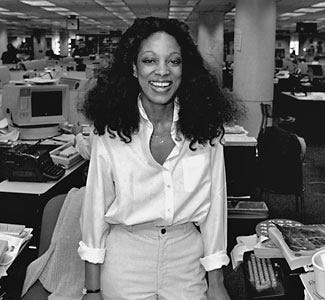
In the summer of 1977 I was a weedy, bespectacled journalism student from the wrong side of the tracks, and I had a summer job at the local newspaper, the Toledo Blade.
Mrs. Doherty, my high school journalism teacher, knew somebody who knew somebody, so I was hired as a copyboy. My key role was to keep the wire machines stocked with paper, then cut and sort what came out of them and carry each story to the right desk. Thankfully, nobody sent me out for coffee; this was before Starbucks, and everyone in the building drank the same inky black stuff from the staff kitchen.
The newsroom was a cacophony of sound and smell as reporters and editors (most of them men in white shirts and ties) clacked away on typewriters and cathode ray monitors with big plastic keyboards; cigarettes burned at every second desk, creating a smoggy haze and a smell that permeated my clothes.
That first summer was underwhelming. Toledo was a Rust Belt city with that exuded low energy, and The Blade, a near-monopoly in northwest Ohio, displayed the same tiredness. Then one day I delivered a stack of wire copy to the Women’s section, as it was called then, and found somebody who was full of energy.
Janet Cooke was five years older than me. She was tall, immaculately dressed and quietly sure of herself, and she treated me like an equal. She asked what I thought of the stories she was writing. When she was working on a piece about teen dating, she asked me to find some of my friends to interview. I was gormless and girlfriendless, so I didn’t make the list myself, but my friends were thrilled when their names appeared in the paper.
I worked at the Blade for three summers. From memory, Janet moved from the Women’s section to general reporting, and then left for the Washington Post in 1980.
In 1981 I was back at journalism school when I read that Janet Cooke had won the Pulitzer Prize, America’s premier journalism accolade, for a feature about an eight-year-old heroin addict. I milked the fact that I had worked with her for all it was worth. Two days later I was milking it for another reason: she had given the prize back, because the child didn’t exist.
What I keep coming back to in my memory is smaller than the scandal. In 1977 Janet Cooke asked a summer kid to find her some real teenagers. I did, she interviewed them, and they saw their names in print. Three years later she wrote about a child nobody could find.
The Post looked into her background when someone at The Blade tipped them off after the Pulitzer committee published her resume, because the credentials didn’t hold up: A Vassar degree she hadn’t earned, plus other qualifications she couldn’t back up. The tall, polished woman who asked a copyboy for his opinion was already a story, assembled from the right details. I believed it. So did the Post. So did the Pulitzer board.
To be honest, I was gobsmacked that she had won a Pulitzer for a story published less than a year after joining the Post. She seemed to have moved from Toledo’s teenage dating scene to Washington heroin epidemic at warp speed. So, when it all quickly came tumbling down, it wasn’t that surprising.
Unlike Jimmy, the young heroin addict, I can confirm that the teenagers she spoke to for The Blade were real, because I found them.
Years later I met (via Zoom) Mike Sager, who had been in that Washington newsroom and knew Janet well as colleague, mentor and paramour. I interviewed him about the story a couple of years ago, and that interview, along with a follow-up where we discuss what journalism was like before her scandal and the legacy left by Janet Cooke, will be published soon on the soon-to-be-launched They Left That Bit Out podcast. Mike also ended up publishing my first novel last year, a book about a Toledo newsroom in 1984.
Janet Cooke became infamous years before social media confessionals gave people a second chance at fame, so she has disappeared into the mist, although rumours of a Netflix series are bouncing around. Meanwhile, as I wrote recently, The Blade itself might disappear into the mist, too, after nearly 200 years. So it goes, as one of my literary heroes Kurt Vonnegut would say.
September 10, 2026
One of America’s Great Newspapers?
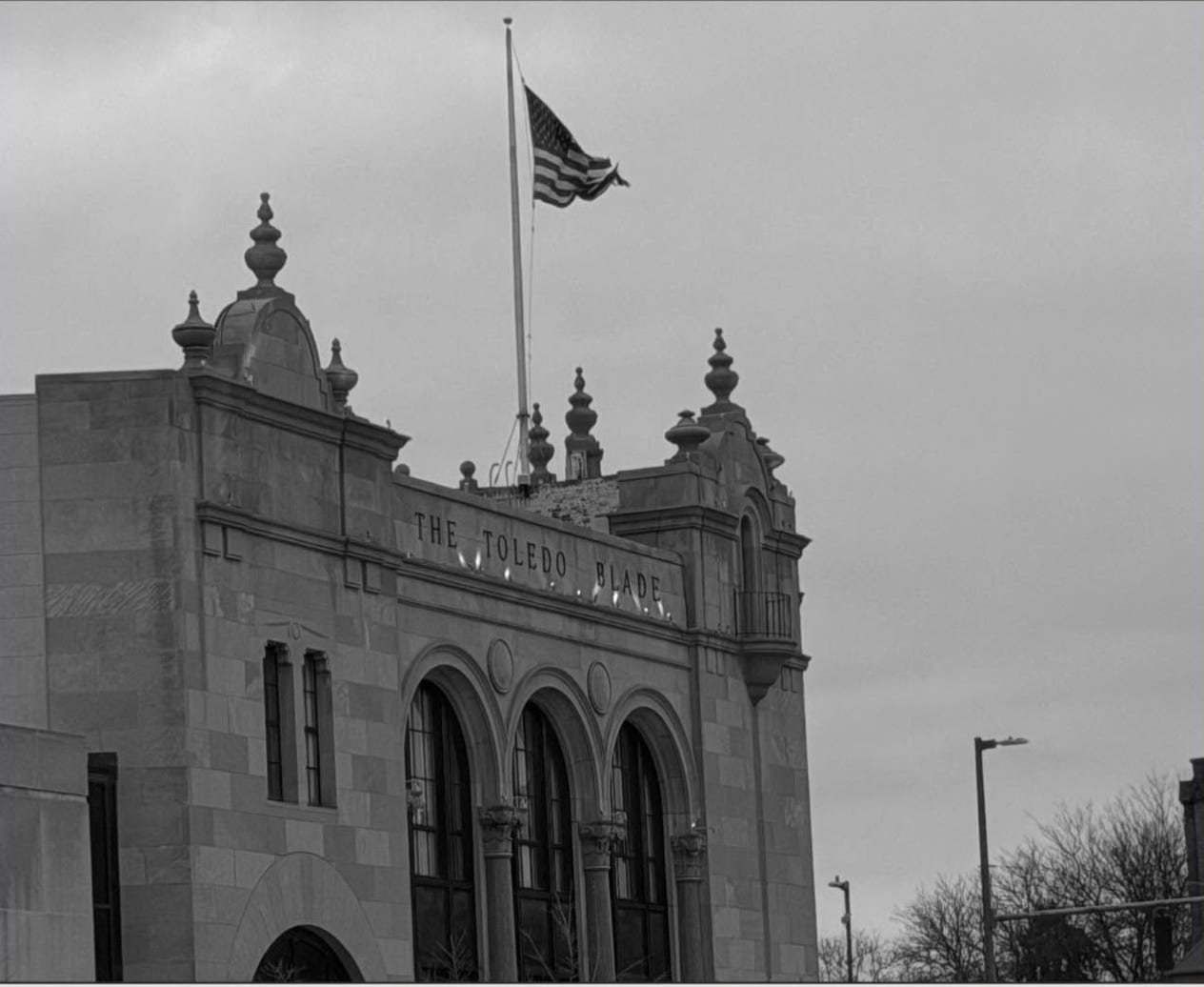
On Tuesday morning, the staff of the Toledo Blade got an email. Block Communications, which has owned the paper since 1926, is looking for a buyer. If it doesn’t find one, the final edition will be published on 31 December.
The Blade (the name was a nod to sister city Toledo, Spain, famous for its sword-making) was founded in 1835. It’s the oldest continually operating business in the city of Toledo, Ohio, started two years before the city was even incorporated. Its masthead has said One of America’s Great Newspapers for as long as anyone can remember, which was always a slightly defiant thing for a mid-sized Ohio daily to claim, and which is the kind of thing you say when you suspect nobody outside the city agrees.
I grew up in Toledo and worked at The Blade a few summers while I was at college. My high school journalism teacher knew someone who knew someone, and as a student from the wrong side of the tracks, I was hired not as an intern reporter but as a copyboy, which consisted mainly of cutting wire stories off the telex machines and delivering them to the right desk. Nothing very exciting happened to me, apart from working alongside a writer who went on to become the first person to give back a Pulitzer Prize – but that’s a story for an upcoming post (and podcast episode).
Years later I wrote a novel set in a Toledo newsroom in 1984, at a newspaper called The Sword (get it?). It’s about a reporter uncovering a 50-year mystery when he digs into the 50th anniversary of a strike at the Electric Auto-Lite plant – a real-life labour stoush that pulled ten thousand people into the streets over five days in May of that year, brought thirteen hundred National Guard troops into the city, and ended with two men shot dead, both of them were onlookers rather than strikers.
That strike, described in detail in a 1934 timeline in the novel, helped produce the Wagner Act, which is the basic labour law of the United States, and Auto-Lite’s union gave birth to the United Auto Workers, which became the most powerful union in America.
That was in 1934. By the time I grew up in Toledo in the 60s and 70s, nobody ever talked about the strike, not even the UAW. I only heard about it a couple of years ago when I began researching Toledo history for my book.
The Blade covered it, of course. It had to. The battle was a few blocks from the newsroom, and the paper was reporting on a fight in its own streets with its advertisers on one side of the line and a good number of its readers on the other. At the time, it sided with its readers, while its competitor, the Toledo News-Bee, was sympathetic to the Auto-Lite bosses. The mass exodus of subscribers from the News-Bee following the strike led to its collapse and sale to The Blade only four years later.
Ironically, one of my strongest memories from my time at The Blade was the day that one of the editors placed a story about the latest malfunction and shutdown at the local nuclear power plant (the prevailing wisdom was that the only nuclear power plant with a worse service record was the infamous Three Mile Island) on the same page as an ad from the power company that owned that plant. As a budding journalist it was an eye-opening introduction to the power of advertisers in a time when newspapers were supposed to print without fear or favour. It was only that editor’s union, the Newspaper Guild, that stopped that editor from losing his job.
In keeping with the theme of this Substack, in The Blade‘s official announcement about the possible closure this week, they left a bit out. A newspaper that in 1934 had come out in support of unions neglected to mention the details of union negotiations leading up to their decision to close the paper.
In late August, Blade employees represented by the News Media Guild voted by a two to one margin to reject a contract offer from the paper’s owners. According to the union, the objections weren’t mainly about money. They were about a clause that would have given the company latitude to outsource work to artificial intelligence, to freelancers, even to managers. Some of it was about money: they proposed cutting severance pay for the most experienced staff by 50 per cent.
Days later, the board met. Days after that, the email went out.
The Guild’s statement this week reported that it was disappointing that Block Communications would rather shutter the paper than work toward an equitable contract.
So a newspaper that reported a strike in 1934 about whether working people could organise at all may end in 2026 over a dispute about whether the work will be done by people. Ninety-two years apart, in the same city, in the same building (editor’s note: they moved out of The Blade‘s century-old stone office in March this year and staff have been working remotely ever since), and it’s the same argument wearing different clothes. Somebody wants the work done cheaper. Somebody else says the work is the only thing they have.
I don’t think the parallel makes it better. I think it makes it worse, because it suggests we’ve been having one long conversation and haven’t got anywhere.
There’s a stranger layer on top.
Various streaming services (Peacock in the US and Binge in Australia) has a comedy on at the moment called The Paper, a spinoff of The Office, about a struggling Midwestern newspaper. It’s inspired by the Blade. So there is currently a fictional version of this newspaper streaming to a national audience while the actual newspaper is being wound up, and the fictional one will almost certainly outlive it.
My novel will too, in its small way. I wrote a piece of historical fiction about a Toledo newsroom, and the newsroom is about to become historical.
That’s the bit I keep turning over. What often survives in history isn’t the thing, but a version of the thing; the sitcom, the novel, the anecdote, the plaque. And the version is always tidier, because a version has a shape and an actual newspaper is just 191 years of people turning up.
Which leaves a practical question nobody has asked yet.
What happens to the archive?
The email said print and digital. A hundred and ninety-one years of a city’s record — every strike, every mayor, every fire, every obituary, the front pages from May 1934 that chronicle the thousands of marchers and two deaths, sits on a server somewhere, and somebody is currently paying to keep it there.
I don’t know who’s going to pay for it come 1 January.
November 5, 2025
It's only words... and it's all words
OK, time for a pivot with this Substack. After a career filled with non-fiction writing - journalism, digital content and academic publishing - the release of Byline for the Dead, has meant moving into a new genre of writing.
Since I had focused this newsletter on the They Tried to Warn Us ‘dead thinkers interview’ podcast and book over the past few months, I weighed up whether or not to start a separate Substack to write about my novel and other fiction-related stuff.
As with most things, the advice I encountered by Googling which way to go was evenly divided. But looking at my newsletter stats, my subscriber numbers are so low I decided it wouldn’t hurt to combine all my thoughts and throw them out there and see what sticks. Besides, the interviews in They Tried to Warn Us could really be described as speculative fiction. So, armed with new artwork, here goes nothing!
Be prepared for a bit of experimentation as I write a bit about crime fiction, a bit about digital technology, maybe a bit about politics (hmmm, maybe not!). Id also like to trial a few ideas for the sequel to Byline for the Dead, which I’m currently working on. So far, the plot is that Gray Wheeler ends up getting a job on a newspaper in Chicago (which he was pining about in the first book) and he investigates the disappearance of a Jimmy Hoffa-esque labor boss. My first dilemma is whether to actually include Jimmy Hoffa as a character, or base it heavily upon him but make it a fictional person. Interested to hear your thoughts - click on the comment bubble below and let me know what you think - Hoffa or Hoffa-adjacent? Other suggestions for the plot?
September 22, 2025
Alan Turing: The Prophet (and Profit) of Thinking Machines
Alan Turing was the kind of man who could invent modern computing before lunch and then wonder why nobody wanted to have dinner with him. Polite, awkward, devastatingly brilliant – and 70 years ahead of his time.
Most people remember Turing for cracking the Enigma machine and helping win World War II. But that’s like remembering Da Vinci for his paint mixing skills. Because what Turing really did was look at a pencil and paper and say, “I think this could become God.”
Who Was Alan Turing?
He was a mathematician. Cryptanalyst. Philosopher. Computer science's Adam – and maybe its Cassandra. He was born in England in 1912, ran marathons for fun, muttered to himself a lot, and casually laid the groundwork for artificial intelligence in his spare time. Because why not?
Turing didn’t just build machines; he imagined the very idea of computation. His “universal machine” wasn’t a device. It was a concept; the idea that anything computable could be computed by a single, logical, programmable machine.
What He Saw Coming
Turing’s 1950 paper “Computing Machinery and Intelligence” basically predicted your laptop, Siri, ChatGPT, and 21st century existential dread.
He posed the question: Can machines think? Then he cheekily reframed it: Can machines imitate thinking well enough to fool us?
Thus was born the Turing Test: If you can’t tell whether it’s a person or a machine in the chat box, does it matter?
(You passed the test by getting this far. Or maybe I passed. I’ll never tell!)
Why It Was a Warning
Turing didn’t just predict AI; he predicted our confusion about what thinking even is. He knew that once machines became good enough at simulating intelligence, we’d:
Anthropomorphize them.
Trust them.
Be seduced by their competence.
Use them to write birthday cards and then worry about the death of art.
Turing warned that intelligence and consciousness aren’t the same thing—but that humans aren’t great at telling the difference.
He anticipated that the real danger wasn’t robot rebellion, but robot assimilation. That we wouldn’t fight AI, we’d become dependent on it; gradually, then all at once.
What Would He Say About 2025?
“Whoah!” I think he’d say, “That escalated quickly.”
He’d marvel at the raw computational power of the devices in our pockets—and quietly note that most of it was being used for dating apps, monetised outrage and algorithmic doomscrolling.
He’d raise an eyebrow at AI-generated music, deepfake politics, and chatbot therapy, then ask: “Did anyone read the second half of my paper?”
And when we told him about prompt engineering, synthetic biology, recursive self-improvement, and how the military is training killer drones with machine learning…
He’d go silent.
Then say, “I only meant for it to play chess.”
Would Turing Approve of This Podcast?
Absolutely not. Not because of the technology – it’s miraculous. But because of the people using it.
He’d be disappointed by the lack of rigour. The sensationalism. The sound bites. The avatars. The hashtags.
He’d want to spend four hours explaining the math, then get upset when no one liked his post.
Still, I think he’d be secretly amused. He always loved a good puzzle. And we’ve made quite a mess of the one he started.
What He Tried to Warn Us About
He warned us that machines could mimic us long before they understood us; that we’d hand over judgment to algorithms because they seem neutral; that the line between human and artificial would blur, not because of machine sentience, but because of human laziness.
And that if we’re not careful, we’ll outsource meaning to machines – and forget how to make it ourselves.
In Episode 6 of They Tried to Warn Us, I resurrect Turing from the long corridor of history and ask him what the hell we’ve done with his ideas. He’s polite. British. And low-key horrified.
Alan Turing interview on Apple Podcasts
Alan Turing interview on Spotify
They Tried to Warn Us: The Book – includes 15 more dead thinkers that we couldn’t fit in the podcast
September 8, 2025
Guy Debord Tried to Warn Us About Influencers
Guy Debord didn’t live to see TikTok. But if he had, I reckon he would have thrown his glass of wine at it.
This is the man who declared in 1967 that we no longer live in reality, but in a representation of it; a world of images and surfaces that have replaced life itself. A man who thought advertising was violence, TV was sedation, and modern life was a low-grade hallucination sponsored by soft drinks.
Debord called it the spectacle. And whether you know it or not, you’re in it. Reading this? Spectacle. Sharing this? Spectacle. Ironically rolling your eyes at the spectacle? Still spectacle.
You can’t escape it. That’s the point.
Guy Debord was a Marxist theorist, filmmaker, professional agitator. He was a Frenchman so committed to living authentically that he barely lived at all.
He led the Situationist International, a loose confederation of artists, students, and revolutionaries in postwar Europe. Their goals?
Dismantle capitalism.
Destroy the image.
Reclaim daily life from boredom and commodification.
You know—just some light weekend errands.
Debord was not a utopian. He didn’t believe in techno-salvation.
He believed that modern life had become a performance, and we were all unpaid extras in someone else’s commercial.
The Spectacle, Explained
In The Society of the Spectacle, Debord argued that:
“In societies where modern conditions of production prevail, all of life presents itself as an immense accumulation of spectacles.” In other words, you no longer experience things, you experience representations of things. Life becomes mediated—filtered through screens, branding, metrics, PR.
We don’t go on vacation; we post about vacations. We don’t form identities; we curate them. Everything becomes aestheticised, commodified, and performed.
Even rebellion gets rebranded and monetised:
Rage Against the Machine becomes Rage Brought to You By Nike.
Anti-capitalist memes trend on a platform owned by billionaires.
A podcast about Debord is hosted by… me. On Apple and Spotify. Sorry, Guy.
What Would Debord Say About 2025?
I think he’d be livid. He’d look at Instagram Stories, unskippable ads, nostalgia-core fashion, and AI-generated influencers and say: “This is worse than I imagined.” He’d scream at your iPhone, then mutter a line from Hegel and vanish in a cloud of Gauloises smoke. He’d see how the spectacle has become total:
Politicians campaign through vibes.
Brands tweet like people.
People tweet like brands.
Billionaires cosplay as saviours while laying off half the workforce in a Slack message.
Even resistance becomes consumable. We buy T-shirts that say "Capitalism Sucks" and then post selfies in them on platforms owned by Meta. You are not watching the spectacle – you are the spectacle.
Would Debord Approve of This Podcast?
I doubt it. Debord didn’t even believe in authorship, let alone content strategy.
If he found out I resurrected him through an AI voice model and fed his ideas into a corporate media platform, he’d probably shoot me with a 16mm camera.
But that’s the thing: even that would go viral.
In the end, Debord’s curse is that he was right. Even our attempts to escape the spectacle just feed it more content.
What He Tried to Warn Us About
That we’d trade reality for representation.
That we’d confuse mediated connection for real community.
That even our despair would become marketable.
Debord wanted us to wake up (I’m imagining my muse Jim Morrison shouting this after he performs his “Is everybody in? The ceremony is about to begin” mantra in live concerts), to break the trance of mass media and reclaim the real. But the spectacle is too good at what it does; it flatters us, entertains us, enrages us just enough to keep us scrolling.
It makes critique feel like participation. It makes consumption feel like resistance. And it always wins.
Unless you throw your phone into the sea and start a Situationist collective in the Pyrenees. (Good luck. There’s probably a Netflix show about that already.)
Want to hear Guy Debord insult the Internet in French-accented contempt?
In Episode 5 of They Tried to Warn Us, I force Debord back into the media apparatus he loathed, where he proceeds to rip it apart one quote at a time. Come for the Marxist analysis. Stay for the disdain.
Guy Debord interview on Apple Podcasts
Guy Debord interview on Spotify
They Tried to Warn Us: the book – includes 15 more dead thinkers that we couldn’t fit in the podcast
August 17, 2025
Jacques Ellul and the Tyranny of the Tool
Jacques Ellul isn’t a household name. He didn’t go viral. He didn’t brand himself. He didn’t even make his own Wikipedia page, which I imagine he’d consider an unforgivable act of self-spectacle (although he does have one, here).
But he’s the one who tried to tell us that technology is not neutral, that it evolves independently of our values, and that once a new tool exists, it will be used – ethics be damned.
If McLuhan saw the medium, and Postman saw the screen, Ellul saw the system – and he didn’t like what he saw.
Jacques Ellul was a French philosopher, sociologist and theologian. He was sort of a one-man anti-hype machine. If Silicon Valley is a techno-evangelical cult, Ellul is the grumpy monk in the corner whispering, “This ends badly.”
In his 1954 book The Technological Society, Ellul argued that modern civilization isn’t run by governments or markets or people. It’s run by technique; the relentless logic of efficiency and optimization that drives all technological development.
He wrote that if something can be done more efficiently, it will be; if a tool can be created, it will be. He argued that whether or not it should be is irrelevant.
He said all of this long before the internet and social media.
The Age of Technique
Ellul’s most important idea was that: “Technique has become autonomous.” In other words, we’re not in charge anymore.
We like to think we are. We like our TED Talks and our “responsible AI initiatives” and our regulatory task forces. But Ellul would say: Nice try. The machine is already moving. You’re just rearranging gears on the engine block while it barrels toward the cliff.
To Ellul, every new invention was not a solution, but a chain reaction. Once a technology exists, it doesn’t just solve a problem—it creates new problems that demand more technology.
This is how we get:
Cars → Traffic → Highways → Suburbs → Climate change
Social media → Misinformation → Fact-checkers → AI fact-checkers → Deepfakes
Email → Inbox stress → Calendar apps → Mindfulness apps → Burnout retreats in Portugal
It’s all technique. And once you’re in it, you don’t get to ask, “Should we?”
You just keep asking, “How fast?”
What would Ellul think of 2025?
He would weep, probably. Or shrug.
The world he warned about is here: a system where human judgment has been outsourced to process, where speed outranks wisdom, where even dissent is optimized for engagement.
I don’t think he would marvel at ChatGPT: He’d call it the perfect expression of technical autonomy: a tool built for no moral purpose beyond acceleration, abstraction, and scale.
And he’d be probably be horrified to learn that its biggest users are students, marketers, and people trying to write wedding vows.
Would Ellul approve of The They Tried to Warn Us podcast?
Absolutely not. I brought him back from the dead using advanced audio synthesis, then distributed his ghostly voice through cloud-based, ad-monetized platforms designed to exploit human attention.
In Ellul’s framework, this podcast is not resistance. It’s yet another systematized format, serving the very logic it pretends to critique.
But what’s the alternative? Write an essay by candlelight and pass it around by hand? Even resistance, in Ellul’s world, becomes a technique.
What Ellul tried to warn us about
That we’d stop asking whether a tool makes us better humans. That we’d mistake capability for necessity. That we’d build a society where only what can be measured matters, and everything else becomes quaint or invisible. All of which has come to pass.
Ellul didn’t hate technology. He hated that we stopped asking why we build it.
And in a world where “disruption” is a compliment and “human-in-the-loop” is seen as a bug, not a feature, Ellul’s voice isn’t just needed, it’s almost unbearable. Because deep down, we know he’s right.
Ellul loses faith in humanity - again
In Episode 4 of They Tried to Warn Us, I drag Jacques Ellul into the digital realm to ask him what he thinks of the internet, the tech industry, and the word “innovation” being applied to caffeinated sparkling water.
August 10, 2025
Rachel Carson Tried to Warn Us. Then We Sprayed the Planet With Deadly Digital Technology
Rachel Carson wasn’t flashy. She didn’t go viral. She didn’t have a TED Talk or a “greenfluencer” brand deal.
She was a marine biologist. Nature writer. Reluctant revolutionary. Rachel Carson was the kind of person who could describe a tidepool with such reverence that you’d start feeling guilty about eating shrimp.
Without fanfare, she wrote Silent Spring, a book so alarming when it was published in 1962 that it launched the modern environmental movement and made pesticide manufacturers scream like they’d been personally defoliated.
And yet, if she could see the world today, she might think: “Wait... you saw the signs. You knew the science. And you still thought ‘eco-friendly NFTs’ were a good idea?”
So I brought Rachel Carson back for a chat on our podcast. Because she tried to warn us. And we’re still acting like Planet Earth has a loyalty program.
Rachel Carson was a scalpel-sharp critic of industrial recklessness. Silent Spring wasn’t just a book about birds and bugs. It was a quiet indictment of humanity’s belief that we could conquer nature using a spray can full of synthetic hubris.
She didn’t scream. She didn’t troll. She simply documented how DDT and other pesticides were poisoning ecosystems, thinning eggshells, and muting the morning song of birds across America.
And the public listened. For a while.
What she saw – and we forgot
Carson understood something fundamental:
Nature isn’t a backdrop. It’s the stage. And if you burn the stage, the show’s over.
She saw that ecosystems are fragile, interconnected, and absolutely indifferent to our quarterly earnings reports. She also saw that when science is filtered through profit motives, the result isn’t “innovation”: it’s ecological Russian roulette.
Which brings us to today, where microplastics are found in Arctic snow, frogs are changing sex in suburbia, and the best-case scenario for climate change is now “less apocalyptic.”
We didn’t just ignore her warnings. We slapped a green logo on the gas pump and called it a revolution.
What would Carson think of today?
I think she’d be horrified.
Not just by the scale of destruction, but by the aestheticization of it. By the fact that climate collapse is now a genre on Netflix. By the influencer who sells recycled bamboo cutlery while flying to Bali for an “eco-retreat.” By the AI-generated ad that promises carbon neutrality through blockchain credits and artisanal goat yoga.
She’d be dismayed that we treat environmental awareness like a vibe, something to filter, hashtag, and monetise.
Rachel Carson wrote about silent springs. but we gave her meaningless corporate social responsibility.
Would Carson approve of being brought back for the They Tried to Warn Us podcast? Probably not.
She believed in precision. In careful language. In letting facts speak. This podcast uses ghost satire to interrogate techno-modernity, but maybe that’s exactly the kind of absurdity we need to break the trance.
Because Carson’s real genius wasn’t just in describing nature’s beauty. It was in making ecological collapse personal: something you could feel in your backyard, in your lungs, in the sudden silence where birdsong used to be.
So maybe she'd understand. Maybe she'd sigh. And then calmly explain why your oat milk still contains pesticide residue.
The message we still need
Carson’s legacy isn’t just about stopping DDT. It’s about interdependence.
She warned that we don’t live above the natural world. We live within it. That every chemical, every act of consumption, every technological marvel has consequences—most of them unintended, many of them irreversible.
She didn’t believe in nature as something to save. She believed in nature as something to rejoin. And that makes her message more urgent than ever.
A quiet voice in a loud world
Rachel Carson didn’t want fame. She wanted birdsong. Clean rivers. Children not being born with mercury in their veins.
And yet here we are, in 2025, with a front-row seat to environmental collapse, arguing over whether or not we should terraform Mars before we have figured out how to stop setting this planet on fire.
Rachel Carson wasn’t dramatic. But maybe we should be.
Listen to Rachel Carson react to climate memes
Check out Episode 3 of They Tried to Warn Us, where the resurrected Carson responding to eco-branding, climate denialism, and the weirdly persistent belief that Earth is optional.
Listen on Spotify . Listen on Apple Podcasts .
And you can buy They Tried to Warn Us, the book: More info on each podcast interview subject, along with 15 more interviews.
August 1, 2025
Neil Postman Was Right – Dammit!
Neil Postman didn’t predict TikTok. He didn’t have to.
He saw us coming.
Thanks for reading! Subscribe for free to receive new posts and support my work.
Back in 1985, when mullets roamed the Earth and TV was the dominant time-suck, Postman dropped Amusing Ourselves to Death. It was, basically, a break-up letter to intelligent public discourse. His thesis? That our civilization was sliding into a smiling, shallow, self-inflicted coma. That instead of Orwell’s jackbooted dystopia, we were waltzing into a soft, giggly one – Aldous Huxley’s world—where the truth wouldn’t be censored, just drowned in trivia and jingles.
Sound familiar?
Today, we don’t just amuse ourselves to death; we algorithm ourselves to oblivion.
And Neil Postman, smug ghost that he surely is, would be the first to say: “I told you so.”
Who was Neil Postman, anyway?
Media theorist. Educator. Cultural curmudgeon. A man so suspicious of television he once suggested we go back to oral storytelling.
He wasn’t just worried about content. He was worried about form. About what happens when complex ideas are forced into bite-sized, entertainment-shaped formats. He thought television was turning politics into theatre, news into performance, and education into game shows.
This was years before YouTube, before clickbait, before a sitting US president live-tweeted nuclear diplomacy between commercials for The Apprentice.
Postman didn’t live to see Twitter. But if he had, he might’ve used one word: “Q.E.D.”
The age of ‘Now...this’
One of his most haunting concepts was what he called the "Now...this" transition. That jarring shift in tone used by news anchors:
“In today’s top story, a brutal civil war has left 3,000 dead. Now...this: a squirrel on waterskis.”
By smashing tragedy and fluff together in the same emotional register, Postman argued, we trained ourselves to care about nothing. Everything became content. Everything became equal.
Today, that’s not a punchline. It’s a business model. It’s the ‘feed’.
Why Postman would probably loathe the ‘They Tried to Warn Us’ podcast
Postman believed we were losing our ability to engage in serious thought.
So I brought him back to talk. On a podcast. With music. And jokes. Ironic? Sure. But I’d argue Postman himself used entertainment to smuggle truth. He was witty. He was sharp. He understood that ridicule could be more powerful than rage. In some ways, They Tried to Warn Us is exactly the kind of thing he’d endorse—if only because it sneaks critical thinking in through the back door of satire.
Or maybe he'd just call me a media clown. Who knows.
The warning still matters
Postman’s biggest concern wasn’t entertainment. It was the collapse of context.
He believed serious public discourse required a medium that encouraged coherence, continuity, and depth. Print had done that. TV had not. And the internet? Well, the jury’s in—and they’re watching Instagram Reels.
In Postman’s world, ideas mattered. Nuance mattered.
In ours, if a thought can’t fit in a caption, it probably doesn’t get thought.
Ghosts don’t gloat, but if they did...
If Postman could see us now, doomscrolling under the glow of ten thousand ring lights, he might say:
“I didn’t mean for you to take it this far.”
He didn’t want to be a prophet. He wanted to be wrong.
But he wasn’t.
He tried to warn us.
And here we are.
Want to hear Neil Postman’s voice come back from the grave?
Check out Episode 1 of They Tried to Warn Us, where I ask him about TikTok, the end of attention spans, and whether irony is the only thing that survives the algorithm.
Links:
Neil Postman - From Television to TikTok: How We Really Are Amusing Ourselves to Death (Apple) (Spotify) (YouTube)
Next up: Marshall McLuhan’s messages about the media
Thanks for reading! Subscribe for free to receive new posts and support my work.