
Andrew James Greig's Blog
November 23, 2025
The Grave Song
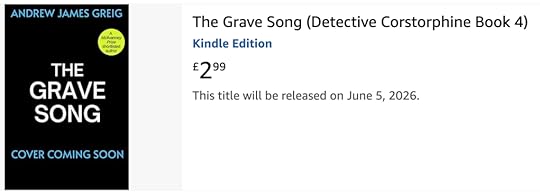
The next book is coming. The finishing touches are being applied and in the following week or so I’ll send it off for the editorial process. It’s like a trip to the book dentist: fill the plot cavities; extract unwanted chapters then give everything a quick polish. Painful but necessary.
Why the title? The short answer is you have to ask my publisher. The longer answer?
The story opens with a graveyard scene and it’s a motif that I return to several times throughout the book. I’ve chosen a song to sing at the graveside that has a resonance both within the story and yet also reaches beyond the pages, deep into Scottish history. Songs have that ability to time-travel; to take us back – sometimes to places we don’t want to visit or return to. That’s another aspect of this story but you’ll have to wait until next summer to find out.
Now the celestial clock approaches the witching hour, another year readies itself and we approach 2026 with all of our hopes and dreams. I’m not expecting to write another blog this side of 2025 so I’ll wish all my readers a very happy Christmas and a healthy, safe and wonderful 2026.


October 19, 2025
There’s many a good tune played on an old fiddle
Let’s start at the beginning. From the earliest age, before my own imperfect memories formed, I had always been painfully shy. An aunt once told me how I’d hid behind my mother’s legs on our first introduction and wouldn’t come out. I must have been two or three. At primary school I refused to ever go on stage for the annual nativity play, despite the real pressure teachers applied. Instead I’d be found other roles, turning the music for the piano player, pulling open the stage curtains, shifting scenery – anything but face the mortifying spectacle of appearing on stage in front of an audience.
Looking back on my early life with the accrued wisdom of many decades, I wonder why I was like this. There are genetic, medical and behavioural reasons for shyness. I can’t say either way about the first two – apart from some suspicion relating to my having social anxiety disorder or even ADHD, but I am beginning to realise, very late in life, that perhaps the real reason lay closer to home.
I’ve become a grandfather, which brings its own new world order, but apart from the joy of seeing a baby develop into her own little toddler, I’m in awe at the love she inspires. She is the recipient of those ready hugs, kisses, praise and cuddles we gave to our own children that were absent from my own early life. That belated realisation has come as a bit of a shock.
I’d always assumed as a child that our rather peculiar family unit with its sarcasm, cynicism and coldness was the norm – or that we’d found a way to cope with life’s vicissitudes that worked for us. There are reasons too many and varied to get into why we were the way we were, but I have no recollection of being held, kissed, cuddled, played with or praised. Like ‘the boy who lived’, I had a mostly solitary existence within a large family.
There is no blame to apportion here. I understand why this was. We are all victims of our own upbringing and with my father’s early death an already difficult situation was made manifestly worse. Hence I found it normal to be alone in the house at the tender age of seven; to make my own breakfast, go to school, return to an empty house. Then I stopped going to school.
So my upbringing wasn’t perfect but I didn’t doubt my mother’s love. This potted history isn’t here for sympathy – it’s simply the precursor to the main thrust of this article which is about the transformative magic of music.
I’ve always been drawn to music. My father left behind a fancy Grundig valve radio with a magic tuning eye and stations from Budapest to Moscow on the dial. This was my window on the world. He also left a tape player and 1/4″ tapes of The Mikado, Rosemary, Carousel and South Pacific which I played so many times Rodgers and Hammerstein must be embedded in my DNA. It was also my means of painstakingly ripping music off the radio onto tape before such a practice became widely known.
Fast forward and I find myself in Bristol, playing tin whistle as part of an Irish trio.
Fast forward again and I’m on a millennium TV Hogmanay show in Aberdeen playing with a group of friends.
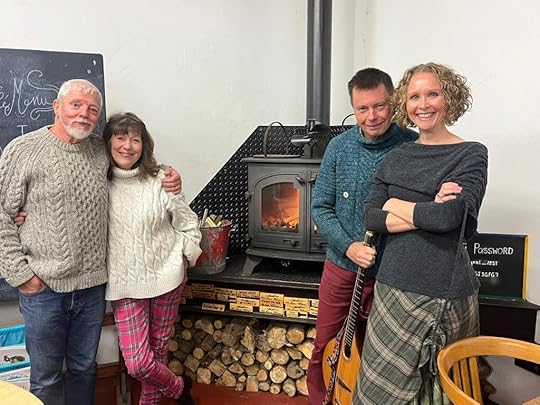
And now we find ourselves back playing together again.
Somewhere along the way I lost my shyness. Not entirely though – it’s taken me all this time to find the courage to play guitar and sing in public. I always hid in plain sight in a group, making myself part of the moving scenery. Whenever I fronted I made sure I had plenty of backup. This lack of confidence has been a curse that’s haunted me my entire life. I’d tell myself that I couldn’t write stories, that I couldn’t go to university, that I wasn’t of much use on the sports field. But countering that I had the confidence to start my own businesses, organise events, run massive live shows, solve complex engineering problems for world class companies, take myself off alone hitching around Europe and sleeping rough under the sky – and become a published author. It’s a strange dichotomy.
We don’t have to be shaped by our upbringing, by our learned values or the indoctrination of whichever society we are born into. It is possible to transcend all of this. I know my own children sometimes consider me wildly inappropriate and finding humour in the most unlikely situations – but they have always been loved, cuddled, respected and praised – and gone to school!
Last evening we performed our first gig in some twenty years. In the intervening time our children have grown into adults. Some of us made new lives in France, Australia, America.
I thought my musical days were behind me (I daren’t ask the small but packed audience in Kirriemuir for their opinion) but here we are, four survivors enjoying the musical gestalt and planning more gigs in the future.
This old fiddle is learning new tunes.
September 23, 2025
Bonne Journée
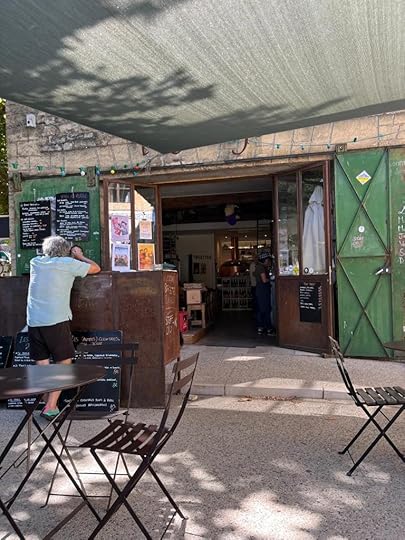
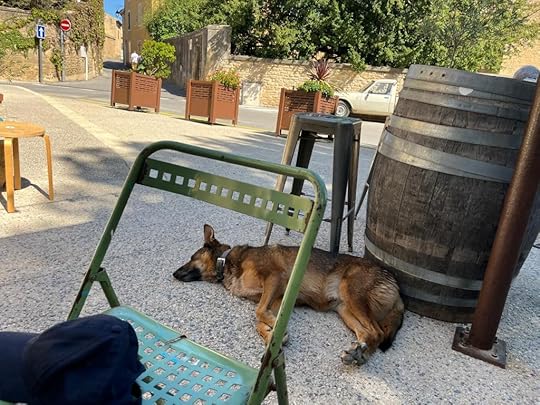
SCENE: OUTDOOR FRENCH RESTAURANT IN PROVENCE. LOCALS SIT AT TABLES, GLASSES OF ROSÉ IN HAND. A WAITRESS MAKES LEISURELY PROGRESS AROUND THE FEW OCCUPIED TABLES EXCHANGING NEWS AND GOSSIP. A LARGE DOG LIES FLAT OUT IN THE SHADE OF AN UPTURNED WOODEN BARREL, A SMALLER DOG WITH A FETCHING SCARF AROUND ITS NECK IS ON SCRAPS PATROL.
ACTION: The waitress approaches our table, indulges us in the conceit that we may be fluent French speakers (one of us is) then asks us if we are from England.
‘I’m from Scotland.’ I answer.
My face is red from the unnatural September sun and unhealthy amounts of wine. A large insect bite shines evilly on my cheek.
‘Oh! That’s not so bad!’ She refers to my nationality, not my bite.
I unpack her throwaway comment as we eat our lunch. I may be from Scotland but have only lived there for half of my life, the previous half split between England and Wales. My wife is fully Scottish and my cousin, Michael lived in Northern Rhodesia (now Zambia), then the Netherlands and has recently moved to Provence. We are a cultural mélange and difficult to deconstruct into ‘types’ or ‘characters’ or even ‘nationalities’. But it’s something we’re all guilty of, isn’t it? Applying labels to individuals, groups of people, even entire nations without knowing anything about them as people.
It’s an innate human condition, to see ‘others’ as somehow different from ourselves. Politicians work this shamelessly: illegal immigrants; muslims; LGBT+. They whip people into a frenzy of flag waving which at its worst results in genocide. But the first recorded Englishman – Cheddar Man – dates from the 8th millennium BC, had black skin and predated every religion known to man. We were all once immigrants and judging by the way the climate is changing, may all become immigrants again.
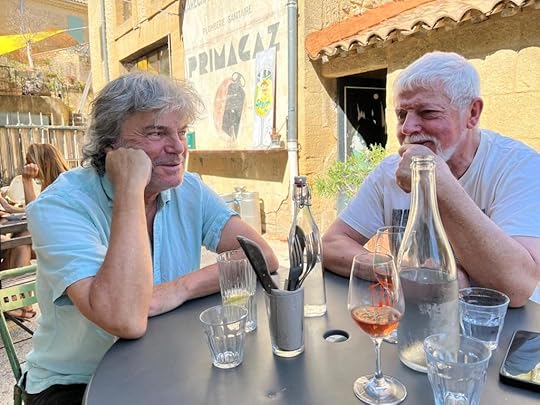
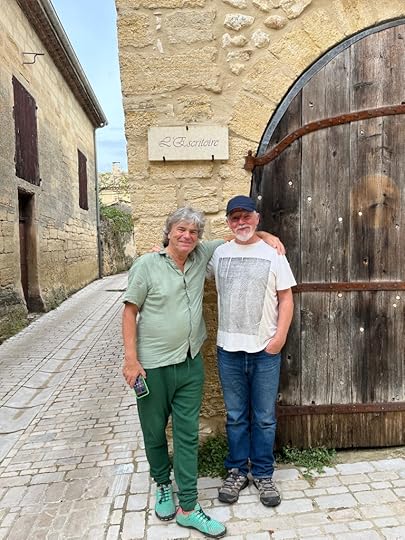
We chatted of field recordings along the Zambezi River, of family members no longer with us, our children and when we would meet again. We are on a journey and our paths cross too rarely. He plays his music, I write my books, we both grow older if not wiser and there’s an awareness of time where it once used to be infinite.
On returning to Edinburgh airport, jaded from our RyanAir sardine can flight, we were met by UK customs. In France we all shared the one, efficient and friendly queue: French, Germans, Italians – it didn’t matter. We were all treated with the same courtesy. Here those not in possession of a UK passport were snarled at. ‘That way, non UK line,’ as if they were less than human.
The waitress’s words haunt me still.
July 24, 2025
That ship has sailed
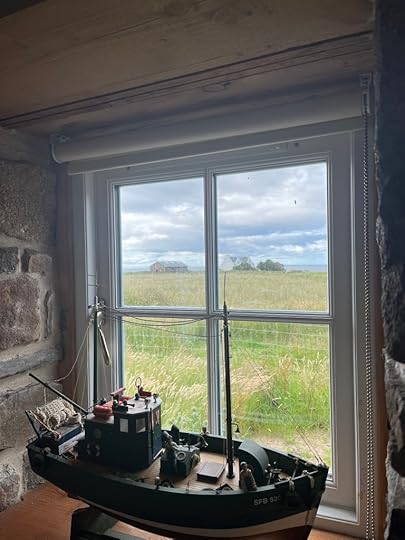
I’m in a little holiday cottage on the Applecross peninsular, just a single-track road (the infamous Bealach na Bà – pass of the cattle) away over the mountains from the rest of the world. I was last here in 2019, staying in the white house you can see through the window. I wrote a chunk of The Bone Clock (Whirligig) there without the conceit that I’d ever become a published author. Now I’ve just completed the edits for the third in the series and it’s available to pre-order on Amazon.
The weather has been changeable, but the cottage has no TV so when it’s too midge-laden to venture outside, I write: 6k words into Corstorphine book 4 (scheduled for delivery later this year), and 17k words into a new standalone about a ship.
Writing two books at once is an experiment for me. There are times in the process when I’m stuck on the plot and need to let the subconscious do some work in the background. What if I write something completely different during that break? I’ll let you know but so far I find my productivity has doubled. The danger is if I confuse the plot lines so if DI Corstorphine finds himself time-travelling across the Atlantic Ocean I’ve messed up.
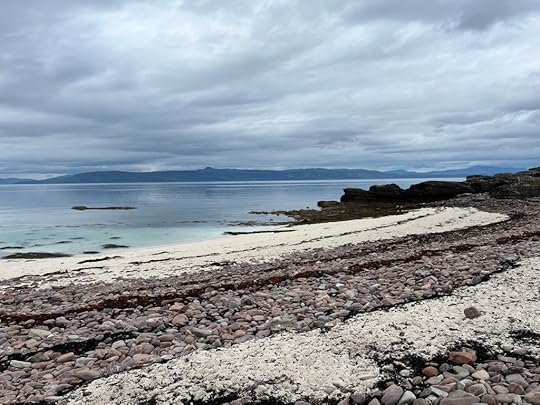
I count myself lucky to be published, and even luckier to be able to spend time in such a beautiful part of the world. Most of all I know how privileged I am to live in a country where, although far from perfect, I can live without the threat of persecution, war or famine.
I am, I guess, what is referred to as a bleeding-heart liberal. A phrase coined by an American journalist so right-wing that he used it to describe those members of congress who dared support a bill to curb lynching.
We live in an imperfect world. Our actions and lives help define this world and those creatures that share this oasis in space. If I could live my life again, I tell myself I’d have done more than the little I have accomplished to protect the environment and improve the lot of the oppressed and the weak. But that ship has sailed, and all I have left are my words. They will have to do.
March 31, 2025
The Bone Clock/The Devil’s Cut

Two of my DI James Corstorphine series are being re-released by Storm Publishing, The Bone Clock (previously published as Whirligig) will be available from all the usual outlets from April 17th 2025; The Devil’s Cut from May 1st.
I have just about finished a 3rd in the series, title TBD. This time it’s personal for the detective.
Publication date for book 3 will hopefully be later this year.
What next? I have my climate change thriller, A Song of Winter which is now unpublished as the wonderful Fledgling Press are sadly no more. My plan is to have an edit and then republish myself. I also have a story written about an adopted Iraqi girl who is abducted – it needs a complete re-write and again I’ll probably self-publish.
After that it really depends upon the sales figures and my publisher’s number-crunching, but I also have other ideas that I want to bring to fruition – not least my genre-breaking fairy-tartan-noir trilogy with Thomas the Rhymer who has been left stranded in book one for seven years! Again, a massive edit and I’ll try a few publishers but this also will probably end up as self-published.
Writing is like climbing a munro. You start with enthusiasm, eyes set on the summit and that early sprint turns into a hard slog with so many false summits that it’s only determination that keeps you going – that and seeing what the world looks like from the top. Trouble is, I can see other mountains emerging from the mist and I want to climb them too. So, take a deep breath, watch where you’re placing your feet and off we go again.
February 21, 2025
The Graveyard Bell

Official publication date 24th February, available as Kindle, Audiobook or paperback from all good bookshops.
This time Teàrlach and his team are on the Isle of Mull, one of the larger Hebridean islands off Scotland’s wild Atlantic coast. A wildlife photographer falls to his death on lonely Staffa; a fisherman goes missing and then a nature researcher is found drowned. Are these really isolated accidents as the local police assume, or is it something darker?
The team have their own problems to deal with but the case takes on a supernatural element when they hear the sound of a woman singing underwater.
Book 3 in the Teàrlach Paterson PI series, published by Storm Publishing.
November 27, 2024
Creative Writing Workshop

I recently supplied a creative writing workshop for writers at the Aberfoyle and Strathard Book Festival. This is the two-hour program which I’m happy for others to make use of or adapt as you wish.
Objective: Participants will gain a deeper understanding of how plot, character, and pacing interconnect in storytelling, and they will develop practical skills to enhance their writing.
Schedule:
Introduction (5 minutes)
– Welcome participants and introduce yourself.
– Briefly explain the workshop objectives.
CARE – Confidentiality, Attention, Respect, Enjoy
What is Creative Writing? Poetry, Short Stories, Essays, Novels.
– Prop: Have participants make a list of words they associate with a prop. Word bank.
Part 1: Understanding Plot (30 minutes)
1. Discussion (15 minutes)
– Define plot: structure, conflict, resolution and importance in storytelling.
– Introduce key plot structures (e.g., Freytag’s Pyramid, Three-Act Structure).
– Discuss common plot devices (e.g. conflict, climax, resolution).
2. Activity (15 minutes)
– Plot Creation Exercise:
– Provide a prompt (e.g. A character walks up Fairy Hill and never returns).
– Ask participants to write about the scene: sights, smells, sounds, time, feelings.
– Share insights in small groups for feedback/readings if comfortable.
Part 2: Character Development (30 minutes)
Prompt: Write about someone with an unusual job.
Setting: Set the scene in an abandoned house.
Exercise: Write a 5 minute scene where your character interacts with the setting.
1. Discussion (10 minutes)
– Explore the importance of strong characters.
– Discuss character types (protagonists, antagonists) and traits (flaws, motivations).
– Discuss character arcs, motivations, and relationships, how they drive the story.
2. Activity (10 minutes)
– Character Profiles:
– Have participants create a new character profile (name, age, background, goals, conflicts, a defining moment).
– Introduce this new character into your story.
– Encourage them to consider how the character influences the plot.
– Share your profiles in pairs or small groups for collaborative feedback.
Break (10 minutes)
Part 3: Mastering Pacing (30 minutes)
1. Discussion (10 minutes)
– Explain pacing: how it affects tension and reader engagement.
– Discuss techniques for managing pacing (e.g., sentence length, chapter length, action vs. reflection).
2. Activity (20 minutes)
– Pacing Practice:
– Provide a short passage with varying pacing (e.g., fast action vs. slow introspection).
– Ask participants to rewrite a scene from a story they know, adjusting the pacing to change the emotional impact. Share rewrites for feedback if comfortable.
Conclusion and Q&A (10 minutes)
– Recap the key takeaways about plot, character, and pacing.
– Encourage participants to think about how these elements interact in their own writing.
– Open the floor for questions or sharing insights.
– Suggest resources for further exploration (books, websites, writing groups).
Materials Needed:
– Handouts: Plot templates, character profile sheets, and pacing examples.
– Whiteboard or flip chart for group discussions.
– Writing tools (notebooks, pens).
Follow-Up:
Encourage participants to write a short story or scene incorporating the themes discussed and share it in a follow-up session or online group.
This structure balances instruction with interactive activities, keeping participants engaged while providing them with valuable tools for their writing!
Suggest participants set up a Crit Group between them.
Freytag’s Pyramid is a structural model for storytelling that outlines the typical progression of a narrative. Developed by German playwright Gustav Freytag in the 19th century, it breaks down a story into five key parts:
Exposition: This is the introduction of the story, where the setting, characters, and background information are established. It sets the stage for the plot.Rising Action: This part builds tension and develops the conflict. It includes a series of events and complications that lead to the climax, increasing the stakes and creating suspense.Climax: The climax is the turning point of the story, where the main conflict reaches its peak. It’s often the most intense moment, leading to a decisive change for the protagonist.Falling Action: After the climax, the story begins to wind down. The consequences of the climax are explored, and conflicts start to resolve.Denouement (Resolution): This final part ties up loose ends and provides closure to the story. It reveals the outcome for the characters and the implications of the events that have unfolded.Freytag’s Pyramid helps writers structure their narratives in a way that keeps readers engaged and invested in the story.
The Three-Act Structure is a popular narrative framework used in storytelling, particularly in screenwriting and literature. It divides a story into three distinct parts, each serving a specific purpose:
Act 1: Setup
– Introduction of Characters and Setting: The main characters, setting, and initial situation are introduced.
– Inciting Incident: An event occurs that disrupts the status quo, introducing the central conflict or problem that the protagonist must face.
– Establishing Stakes: The stakes for the protagonist are set, showing what they stand to gain or lose.
Act 2: Confrontation
– Rising Action: The protagonist faces a series of challenges and obstacles related to the conflict. This is often the longest act, filled with complications and character development.
– Midpoint: A significant event or revelation occurs that raises the stakes and often leads to a turning point in the story. The protagonist may experience a shift in perspective or strategy.
– Climax: The conflict reaches its peak, where the protagonist confronts the main antagonist or challenge. This is the most intense and crucial moment of the story.
Act 3: Resolution
– Falling Action: The aftermath of the climax is explored, addressing the consequences of the protagonist’s actions and the resolution of subplots.
– Denouement: Loose ends are tied up, and the story concludes. The new status quo is established, showing how the characters and their world have changed as a result of the events.
Purpose
The Three-Act Structure helps writers create a cohesive and engaging narrative by providing a clear framework for developing tension, conflict, and resolution. It’s widely used because it resonates with audiences and helps maintain narrative momentum.
Character Template
1. Basic Information
– Full Name:
– Nickname(s):
– Gender:
– Age:
– Date of Birth:
– Species/Race:
– Occupation:
– Place of Birth:
– Current Residence:
2. Physical Description
– Height:
– Weight:
– Body Type:
– Skin Color:
– Eye Color:
– Hair Color and Style:
– Distinguishing Features (scars, tattoos, birthmarks, etc.):
– Clothing Style:
– Posture/Gait:
3. Personality
– General Demeanor (introvert/extrovert, optimistic/pessimistic, etc.):
– Core Traits (brave, loyal, ambitious, etc.):
– Flaws and Weaknesses:
– Strengths:
– Hobbies/Interests:
– Fears:
– Likes/Dislikes:
– Habits (good or bad):
4. Background & History
– Family Background:
– Significant Childhood Events:
– Educational Background:
– Key Life Events:
– Career Path:
– Current Life Situation:
– Biggest Success:
– Biggest Regret:
5. Skills and Abilities
– Physical Abilities (strength, speed, endurance, etc.):
– Intellectual Abilities (memory, analytical skills, etc.):
– Talents (artistic, musical, athletic, etc.):
– Learned Skills (languages, combat skills, etc.):
– Magic/Power (if applicable):
– Limitations:
6. Relationships
– Family Members:
– Close Friends:
– Significant Others:
– Mentors/Role Models:
– Rivals/Enemies:
– Pets (if any):
– Relationship Dynamics (loyal, conflicted, strained, etc.):
7. Motivations and Goals**
– Short-Term Goals:
– Long-Term Goals:
– What Drives Them:
– Primary Motivation (fame, power, love, revenge, etc.):
– Secondary Motivation:
– Conflict (inner conflict, moral struggle, etc.):
8. Psychological Profile
– Mental State (stable, anxious, obsessive, etc.):
– How They Handle Stress:
– Triggers:
– Greatest Joy:
– Biggest Frustration:
– Values:
– Beliefs:
9. Character Arc
– Starting Point (Where they are at the beginning of the story):
– Transformation (What changes throughout the story):
– Ending Point (Where they are at the end of the story):
– Key Events for Growth:
10. Miscellaneous
– Voice Tone/Accent:
– Speech Patterns or Phrases:
– Items They Always Carry:
– Quirks (unique behaviors or habits):
– Theme Song or Quote:
September 5, 2024
Beer with Shona

As I drove out one September morning, I told myself I was looking for the ghost of Laurie Lee. We’d driven from Bristol, under Blade Runner skies and talked of consciousness and intelligence whilst the SatNav cheerfully slaughtered place names.
Our destination was the Cotswold village of Slad – the setting for Cider With Rosie and starting point for As I Walked Out One Midsummer Morning. Two books I devoured in my impressionable teens which set my feet to wandering and, eventually, my fingers to writing.
We parked close to the Woolpack pub. Opposite was the church and beside that what was once the school house. Three points of reference to geolocate by, three points anchoring the web holding Laurie Lee in this gravity well of a V-shaped valley.

Holy Trinity church stands at the centre of the village, surrounded by parishioners graves. So many graves that a winding path zig-zags up behind the church to a much higher level plot almost at steeple height. Here must lie the characters from his books: Cabbage-Stump Charlie, the local bruiser; Albert the Devil, a deaf mute beggar; perhaps even Percy-from-Painswick with his womanising ways. And his family: the brothers and sisters; his mother who single-handedly raised them all; perhaps even Rosie herself?
Inside the church is a tribute to Slad’s most famous son. Newspaper articles, photographs, anecdotes all cut and pasted haphazardly onto boards. We see Laurie dressed as John Bull aged around 6 surrounded by family. Mention is made of an egg juggling machine that he collected, (amongst other peculiarities), for an exhibition of the weird and the wonderful. Or perhaps it was an egg polishing machine, I forget. Faces stare out from the early 1900’s unaware that a Second World War is coming. The church waits patiently, like an old relative who nobody knows what to do with now his day is done. Outside, graves are being swallowed by grasses and briars. A wheelbarrow stands ready for someone to do something with it.
The village houses have been bought, extended, ‘improved’, gated, walled, sanitised. No simple sons of the soil these new Sladonians, no mere operators of wheelbarrows or shears or lawnmowers or haymaking equipment. But then Cider With Rosie was already an obituary for a lost way of life when he wrote it in 1959. Time to search for what time had left behind.

We intend to walk part of the Laurie Lee Wildlife Way. It was easy to find, less easy to follow. Every now and then one of his poems graced the faint outline of the path we traced across a field, or through old beech woods and past forlorn ponds. The valley was bereft of its children, left in an unnatural silence like one V-shaped empty nest being eyed by malevolent magpies.
What would Laurie have made of the absence of butterflies, the loss of flowers and birds, culled badgers and myxomatosified rabbits? Birdsong was sparse, drowned out by a passing helicopter and the incessant throb of homebuilding equipment. No Entry and No Footpath and Private Roads inform our halting progress through the ghosts of his memory. Climbing a steep road we spotted Slad’s answer to Banksy. Twenty, thirty fenceposts each with a badger drawn on it, performing some task or another. At least I’d found my badgers.

At one point we asked a woman for directions. Her horse watched us with equine amusement before backing out of the horsebox where she’d struggled to lead it. We left the two of them regarding each other, adversaries in a game they’ve played before.

We counted one bumble bee and one large white butterfly in total before heading past apple orchards and back to Slad, stopping off at the Woolsack for a non-alcoholic half and cheese toastie.
I struck up a conversation with the young barman. ‘Where did Laurie Lee used to sit?’ My question left him dumfounded, so a customer piped up from my side of the bar, pointing out his favoured spot in the snug. The piano and guitar suggests music is still played here – something Laurie would have appreciated remembering that he set off to Spain with only his fiddle and a pack of treacle biscuits.

Slad valley is no longer the bustling place it was when Laurie was a boy in the early 1900’s. Only his words remain, painting the picture of a way of life that he saw evaporating in front of his eyes. Now his charming T-shaped cottage has a building site next door, large enough to fly a plane in, and the new villagers have swapped haymaking for more lucrative pastimes.
We trod in his footsteps as gently as the first leaves of autumn, daytime vampires inhabiting the void of the working week. The valley he loved can be viewed from his pub seat window, but I had no sense of his presence.
There was an autumn day, almost forty years ago, when Shona and I walked hand in hand through Westonbirt’s tree-lined ways and exchanged greetings with an old man sat peacefully on a bench. He’d watched us approaching through dappled sunlight, and I had a strong sense of his reminiscing of when he too was young and in love. We were a mere 14 miles from Slad and Laurie Lee would have been close to my age now.
It wasn’t his ghost I’d been searching for.

June 28, 2024
McIlvanney Prize

Woke up to the amazing news that The Girl In The Loch has been listed for the McIlvanney Prize, along with eleven other brilliant authors. This is the second time I’ve made the list – first time with debut crime Whirligig which made the shortlist in 2020.
I once met William McIlvanney – the godfather of Tartan Noir – when I supplied the sound and staging for the first few Bloody Scotland events back in 2012. At that time I’d never imagined becoming a writer, much less finding myself on the other end of a sound desk at a major literary festival. That one short meeting in the Green Room when I clipped on his head mic gave me the inspiration to start writing.
Today is the launch of my latest – Silent Ritual.

The same team that you’ll discover in The Girl In The Loch are faced with a knotty problem to untangle in Glasgow. This time, the danger is closer to home…
April 26, 2024
All for St George

Seeing Vox pops of small groups of older men dressed in faux armour being asked the question ‘What does St George’s Day mean to you?’ elicits the usual responses. If distilled, our brave warriors express indignation, worry and an inability to understand that today’s UK is a different place to the unreality they hold close to their hearts.
The UK now is of differing nationalities, racial types, religious persuasions. The old order is broken, the weather has changed, we are all – for the most part – poorer and feeling under siege. Faced with an invasion of Turks, rivers of blood, funny-sounding foreigners it came as a shock to the liberal-minded that little-England raised the drawbridge and sought isolation in a confusing world.
The irony that St George was himself born of a Palestinian mother and a Turkish father is lost on our battle-weary troops. What’s at stake here is the notion of nationhood, and this is where it gets interesting.
I was brought up in a London suburb, schooled at a Catholic primary and then a Catholic secondary modern. Maps of the world were still mostly coloured pink in defiance of the inescapable fact that these countries had long since shrugged off empire. We had God on our side, the Queen and rank upon rank of serious men and women in the Lords and Commons who knew what was best for us. To be English (which is what British still means) was to be exceptional. Rulers of half the globe, bringing civilisation to the savages. Tea and crumpet, Christmas and holly. Did those feet in ancient times?
Here’s the thing – scratch away the fake gold paint that comprises English culture and whatever’s left has been eaten by moths. Anything truly remarkable or world-beating is in the past – hence the almost universal yearning to return to a world that never really existed. A land where policeman could be asked the time or the way home without fear of being beaten or raped. A land where politicians stood for ideals not corruption. A land where rivers flowed freely and weren’t poisoned with shit. A land where the King stood for dignity and tradition, not petulance and absurdity. Even God has lost his way – his priests more interested in power or abusing children than anything else.
I have lived in Scotland for half my life and that gives me a wider view of the differences between our nations. An Irish musician once told me a joke – ‘What’s the difference between the English and a tub of yoghurt?’ The answer was ‘the culture’s still alive in the yoghurt’. I disagreed of course, we have Morris Dancing, I said. It wasn’t a convincing riposte. Scotland has never really been taken in by the empire narrative, is comfortable in its tartan. In short, Scotland remains outward-looking and welcoming of new people, ideas and cultures – absorbing the lot and still retaining Scottishness. This constant state of renewal is essential to a nation’s health, otherwise we face senility and decline.
I sympathise with the faux St George warriors, clutching their beer bottles with the same desperation they hold onto an increasingly nebulous idea of Englishness. It’s not surprising they want to lash out. Someone has stolen something they hold dear and the usual suspects are cynically put up for blame by right-wing agitators. The immigrants, the Jews or Muslims, the LGBT, the sick and disabled. Parallels with recent history stare us in the face but one thing history teaches us is that history never teaches us.
It’s not just the UK suffering growing pains. The whole world is undergoing similar difficulties, and with climate breakdown this will only become a lot worse. Theresa May, onetime UK PM, quoted in 2016 ‘If you believe you are a citizen of the world, you are a citizen of nowhere.’ She is the product of a middle-class English upbringing, unwisely clinging onto the wreck of the Titanic. What are we if we are not all citizens of the world?
St George has new dragons to fight. They wear suits, talk earnestly to camera and lie with every fibre of their being to wreak havoc and war. They seek to repress, control, spread hate and fear between people. They have no care for the world they leave behind, nor for the children set to inhabit the spoils of their selfish ill-gotten gains. You can turn to God, to the King, to Parliament – none of whom will fight this battle for you. These dragons are cunning though, their scales line the eyes of the people – blinding them to who’s really taken their quality of life and diminished them.
When the scales fall, as one day they surely must, St George will sit up and take notice. When that day comes, I’m all for St George.


