Bianca Orellana's Blog
November 12, 2020
Writing Sad Scenes
Also known as Things I'm Not Very Good At.So, I'm not the most emotional person you'll ever meet. I've always been a relatively content person, optimistic in outlook and an ardent keeper of my own peace. When something sad or disappointing or unpleasant happens, my knee-jerk reaction is to spin it into something happy. I retreat into my own mind, play upbeat music, make up stories, go on a walk, eat some cake... anything to make the unpleasantness go away. I used to think this was the best thing. In fact, as recently as 2 months ago, when I conceived and began writing this blog post, I was poised to write, "That's just the way I am" without a single qualm. Lately, however, I've discovered some truths about myself and dug into my past a bit, sitting with some memories I thought I'd reconciled and long-buried. It's a long story that I haven't fully come to terms with (and usually speak with my therapist about, haha), but the short of it is this: my inability to be sad is a trauma response.Crazy, right?I don't cry. I kind of can't, really. It used to be a joke among my family and friends: "Bianca's a robot. Bianca doesn't get emotional. Lol, Bianca's devoid of feelings." It used to be seen as an attribute to strive for, by me and everyone who knows me. I had so many friends tell me, "I wish I could be as composed as you. I cry at the drop of a hat. I get emotional about everything." And I used to think, 'God, I would hate that.' In life there's too much to do and too many things to see and enjoy, and crying/feeling/being emotional gets in the way of that. That's what I used to think.But then a lot of stressful, sad, terrible things happened to me back-to-back, and when I needed release, there was none. I knew crying would get it out, help me to let things go, but I just. couldn't. DO IT. There have been times when I wanted and needed to cry, but couldn't even begin to approach the feeling. The moment I would tell myself, 'Here it goes. Do it. You need it. You want it. CRY,' my body and mind would immediately go into lifesaver mode without my permission, stopping me. It's like my mind is saying, 'Don't worry... I got you,' thinking it's doing a fantastic job, and all the while I'm screaming, "Wait! Stop! Not this time, brain!!!"Okay, hold on. This is not my diary. This is not a therapy session. It's a writing blog. What does any of this have to do with writing?!Actually, it has everything to do with writing. Writers need to be able to tap into certain emotions in order to be able to convey them to their readers. A good story is going to have conflict, sadness, and pain, because that's life. It's realistic, and it's human. Even high fantasy, stories with aliens and mythical creatures, stories with fantastical elements, show the ups and downs of the emotional roller coaster. Star Trek, for example, explores the sad backstory of Spock, who is a mixed race member of both the human race and an alien race known as Vulcan. Even though the Vulcan are known for being compulsively logical and having difficulty expressing love, hate, anger, or anything between, there are sad scenes not only surrounding Spock, but concerning him. Stories with non-human creatures emphasize emotional elements in writing even more, usually by pointing out the stark differences. That is because there is a human need to express emotion, especially sadness. Also, from a writing aspect, what book has ever been successful without conflict? Very few. Sad scenes connect us to characters, make us invested in a story, and make us feel seen.I recently read a manuscript from a friend in which the main character's mother dies suddenly. Obviously a sad premise, the funeral scene is further compounded by the fact that the protagonist cannot cry, as she's too overwhelmed by emotion for the tears to come. This resonated with me, someone who has lost her mother and couldn't cry at the funeral, unable to do much of anything but sit there and accept condolences for something that didn't feel real.Scenes aren't just made sad by the inclusion of crying; it's a perfectly effective, realistic, and logical way of showing the sadness of a character, of course, but there are many other ways to make a scene sad. Indeed, the absence of crying can be even more effective in a scene.In the 2019 movie Joker, starring Joaquin Phoenix, a particularly sad scene for me to witness was his character, Arthur, unable to stop laughing during an intense, serious moment. His character has a disorder that makes him laugh at very inopportune times, and the compulsion is exacerbated when he's under stress. How sad it is to see his character laughing maniacally, knowing he wants to stop, seeing the anguish in his eyes as he cackles. That's a complex, layered way of writing sadness, a skill I hope comes naturally to me one day.
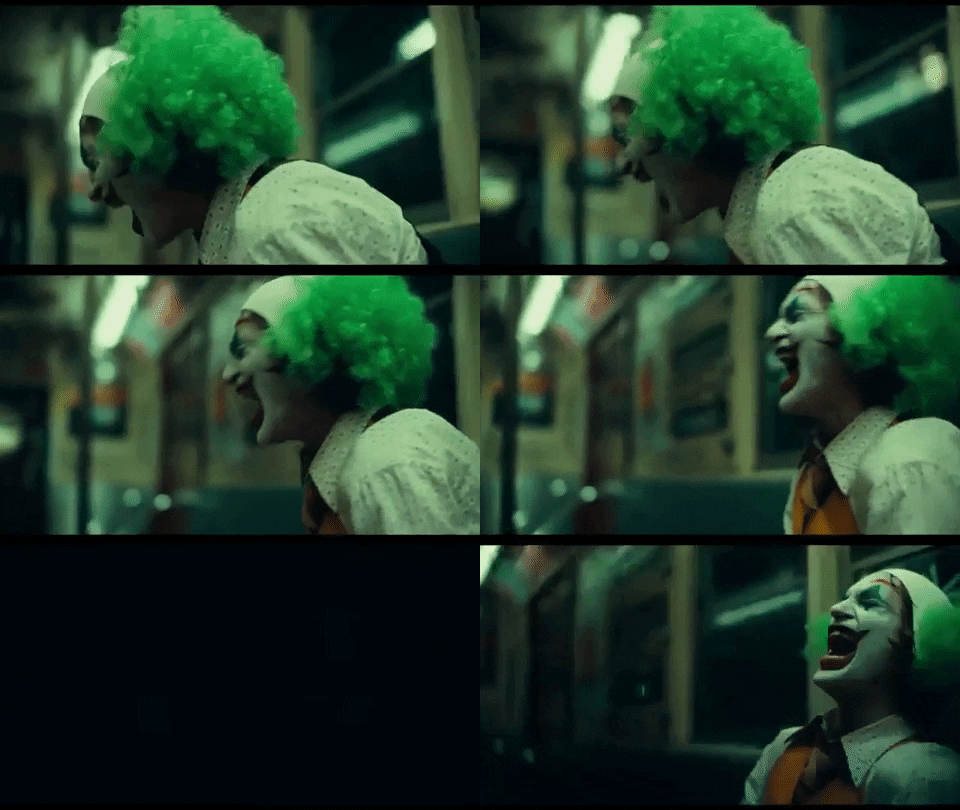 I am impressed and astounded by any good, gut-wrenching scene of sadness that I read. That's because it's an emotion I'm still working on mastering. When I was writing We Are Eternal, I did my best to tap into those scenes while fighting the urge to lessen the awkwardness and uncomfortable feelings they came with. My immediate instinct is to make things not so bad, cut with humor, or shorten a scene in some way. Really sitting with those scenes, exploring the five senses in relation to the sadness I was trying to describe, and making sure everything was laid out as thoroughly as possible, was very, very difficult for me. To be honest, I doubt I did the best job with it, but, hey, I'm still perfecting my craft.My biggest problem is the fact that I had to draw on personal experience when writing some of the saddest scenes. Olive's mother, Pamela, suffers a hemorrhagic stroke and is carted to the hospital in an ambulance. Olive comes home with York to find her mother sitting on the couch. Her mother had been walking around their home alone in a stupor for at least a day, slowly worsening without realizing it because of her consistent drunken state. This is a very similar experience to one I had with my mother about ten years ago. I drew on that scene because I couldn't have conceived something sadder and more stressful on my own, because, due to my handling of trauma, I don't explore those possibilities. Even so, while writing this scene, I tried remembering those moments as I actually experienced them. The feelings of fear, confusion, and disbelief are just on the outskirts of my brain to this day, as I've done my best to block it out, figure out the next step, keep it pushing. There's a particular moment from that experience ten years ago that immediately burned itself onto my mind as it happened (as I'm remembering now, in order to write these words, my mind is desperately trying to push it away so I don't feel it): as my mother was being taken down on a gurney to an ambulance after her stroke, she looked up at me with a mixture of helplessness and gratitude in her eyes, emotions she couldn't express because, on top of her being too drunk to form a coherent sentence, the stroke had robbed her of her ability to speak. I tried conveying this exact scene in We Are Eternal, because even from the safety of the fringes of my mind, I can recognize this as a very sad moment. Whenever I'm writing a sad scene, especially one that is based on a personal memory, I fight to explore every sensation involved with the sadness while simultaneously wanting to shut the whole operation down. This is my personal struggle. You may have a different struggle, or no struggle at all. If you don't struggle with this, I commend you; my "robotic" handling of things is not the way to strive for, as many of my friends think it is to this day. Being able to healthily explore how sadness makes you feel, get it out, let it go, and move on is the way to not create mental baggage. I've got a lot of it, and, trust me, it weighs you down, and it comes out in the most unexpected and inconvenient ways and moments -- you burst into tears in the drive-thru line of Chick-Fil-A, for example, or you realize suddenly that you're a thirty-one-year-old woman whose children's very minor struggles make you a basket case. What? Do you think I'm talking about myself in here? No, no, those were just examples....Okay, I was talking about myself.Writing sad scenes requires -- demands -- a deep dive into the most overwhelming parts of the human experience. It demands you sit down and bleed over your notebook or keyboard. It demands you to write until you're done, and be exhausted, drained, and confused afterward. When writing sad scenes, cut yourself off from everyone in your house that might want to distract you. (If you're alone, turn that phone off!) The bottom line: Don't hold back, writers. Don't shy away from the difficult, the awkward, the struggle. After all, writing is curative for most of us anyway; writing sad scenes is free therapy where readers are required to hang on your every word, much like a therapist. It's freeing, and it produces some content. Now that's a win-win.
Writers need to be able to tap into certain emotions in order to be able to convey them to their readers. A good story is going to have conflict, sadness, and pain, because that's life. It's realistic, and it's human. Even high fantasy, stories with aliens and mythical creatures, stories with fantastical elements, show the ups and downs of the emotional roller coaster. Star Trek, for example, explores the sad backstory of Spock, who is a mixed race member of both the human race and an alien race known as Vulcan. Even though the Vulcan are known for being compulsively logical and having difficulty expressing love, hate, anger, or anything between, there are sad scenes not only surrounding Spock, but concerning him. Stories with non-human creatures emphasize emotional elements in writing even more, usually by pointing out the stark differences. That is because there is a human need to express emotion, especially sadness. Also, from a writing aspect, what book has ever been successful without conflict? Very few. Sad scenes connect us to characters, make us invested in a story, and make us feel seen.I recently read a manuscript from a friend in which the main character's mother dies suddenly. Obviously a sad premise, the funeral scene is further compounded by the fact that the protagonist cannot cry, as she's too overwhelmed by emotion for the tears to come. This resonated with me, someone who has lost her mother and couldn't cry at the funeral, unable to do much of anything but sit there and accept condolences for something that didn't feel real.Scenes aren't just made sad by the inclusion of crying; it's a perfectly effective, realistic, and logical way of showing the sadness of a character, of course, but there are many other ways to make a scene sad. Indeed, the absence of crying can be even more effective in a scene.In the 2019 movie Joker, starring Joaquin Phoenix, a particularly sad scene for me to witness was his character, Arthur, unable to stop laughing during an intense, serious moment. His character has a disorder that makes him laugh at very inopportune times, and the compulsion is exacerbated when he's under stress. How sad it is to see his character laughing maniacally, knowing he wants to stop, seeing the anguish in his eyes as he cackles. That's a complex, layered way of writing sadness, a skill I hope comes naturally to me one day.I am impressed and astounded by any good, gut-wrenching scene of sadness that I read. That's because it's an emotion I'm still working on mastering. When I was writing We Are Eternal, I did my best to tap into those scenes while fighting the urge to lessen the awkwardness and uncomfortable feelings they came with. My immediate instinct is to make things not so bad, cut with humor, or shorten a scene in some way. Really sitting with those scenes, exploring the five senses in relation to the sadness I was trying to describe, and making sure everything was laid out as thoroughly as possible, was very, very difficult for me. To be honest, I doubt I did the best job with it, but, hey, I'm still perfecting my craft.My biggest problem is the fact that I had to draw on personal experience when writing some of the saddest scenes. Olive's mother, Pamela, suffers a hemorrhagic stroke and is carted to the hospital in an ambulance. Olive comes home with York to find her mother sitting on the couch. Her mother had been walking around their home alone in a stupor for at least a day, slowly worsening without realizing it because of her consistent drunken state. This is a very similar experience to one I had with my mother about ten years ago. I drew on that scene because I couldn't have conceived something sadder and more stressful on my own, because, due to my handling of trauma, I don't explore those possibilities. Even so, while writing this scene, I tried remembering those moments as I actually experienced them. The feelings of fear, confusion, and disbelief are just on the outskirts of my brain to this day, as I've done my best to block it out, figure out the next step, keep it pushing. There's a particular moment from that experience ten years ago that immediately burned itself onto my mind as it happened (as I'm remembering now, in order to write these words, my mind is desperately trying to push it away so I don't feel it): as my mother was being taken down on a gurney to an ambulance after her stroke, she looked up at me with a mixture of helplessness and gratitude in her eyes, emotions she couldn't express because, on top of her being too drunk to form a coherent sentence, the stroke had robbed her of her ability to speak. I tried conveying this exact scene in We Are Eternal, because even from the safety of the fringes of my mind, I can recognize this as a very sad moment. Whenever I'm writing a sad scene, especially one that is based on a personal memory, I fight to explore every sensation involved with the sadness while simultaneously wanting to shut the whole operation down. This is my personal struggle. You may have a different struggle, or no struggle at all. If you don't struggle with this, I commend you; my "robotic" handling of things is not the way to strive for, as many of my friends think it is to this day. Being able to healthily explore how sadness makes you feel, get it out, let it go, and move on is the way to not create mental baggage. I've got a lot of it, and, trust me, it weighs you down, and it comes out in the most unexpected and inconvenient ways and moments -- you burst into tears in the drive-thru line of Chick-Fil-A, for example, or you realize suddenly that you're a thirty-one-year-old woman whose children's very minor struggles make you a basket case. What? Do you think I'm talking about myself in here? No, no, those were just examples....Okay, I was talking about myself.Writing sad scenes requires -- demands -- a deep dive into the most overwhelming parts of the human experience. It demands you sit down and bleed over your notebook or keyboard. It demands you to write until you're done, and be exhausted, drained, and confused afterward. When writing sad scenes, cut yourself off from everyone in your house that might want to distract you. (If you're alone, turn that phone off!) The bottom line: Don't hold back, writers. Don't shy away from the difficult, the awkward, the struggle. After all, writing is curative for most of us anyway; writing sad scenes is free therapy where readers are required to hang on your every word, much like a therapist. It's freeing, and it produces some content. Now that's a win-win.


November 10, 2020
Not Another Hiatus...!
Man, have I been slacking! What happened to September and October?I wish I could say I've been burning up my keyboard, staying up at all hours of the night, waking with the sun, getting loads of writing done. In reality, so much life has happened, I've found myself behind on a lot of my writing goals. I talk a lot about life and its tendency to "get in the way" of writing. It doesn't feel right to say that anymore, considering a great deal of the free time I used to have has been filled with all the good things you could imagine: children, for example, and all the hustle and bustle involved with getting them places, making them healthy dinners, bath time and brushing teeth, reading them stories and putting them to bed. Finding time to engage in adult conversation with my husband and friends, and discussing mental health issues and the effects of COVID this year has put upon us has been more important than ever. All of my free time is filled with large responsibilities, and the tiny cracks left behind are also stuffed with smaller tasks.Then there's my job.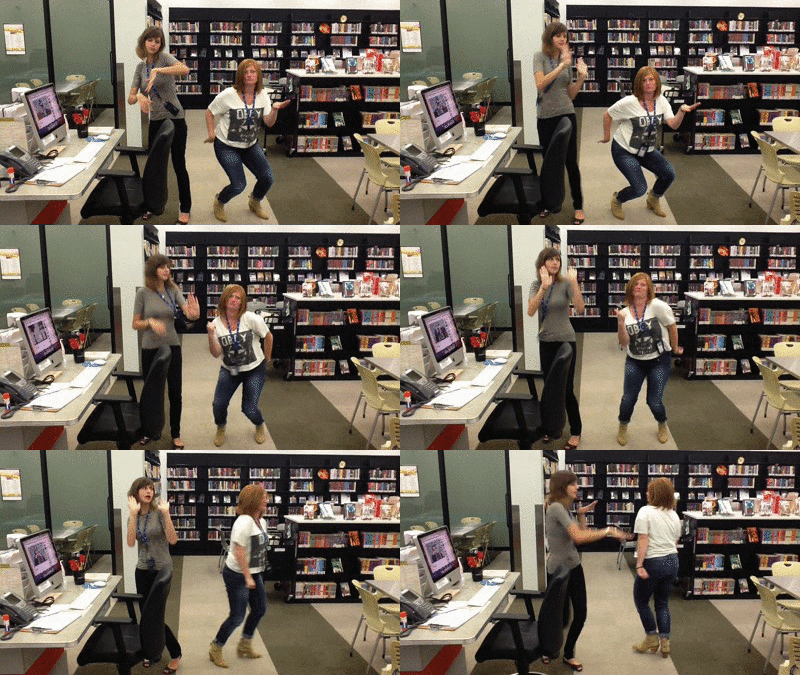 (*Obviously, neither of these ladies is me, but they are my spirit animals in so many ways.)I'm a working mother, as I've mentioned before, and I work at a public library. I love my job, but it's just another aspect of life that's gotten in the way of my craft. As can be imagined, working in any public sector right now is tough. Combine that fact with the high-contact, already germ-ridden environment that is working behind the reference desk of a public library, and you've got a recipe for one stressed-out mama. I plan to write more in-depth about what it's like working at a public library in a later post, but let me say this: people are exhausting. My job was closed to the public for three months, and not surprisingly it was during that time I was able to crank out the majority of the content this blog contains. We still, however, were tending to a curbside pickup operation, which meant pulling books, answering phones, and processing materials all day long. There was quite a bit more down time, but I still had a pretty stressful job to do. Now that my branch has opened back up to the public, there are more steps to everything: wiping books down, quarantining materials, shifting hours of operation on a bi-weekly basis, moving stuff around, hand sanitizer and gloves and masks and the rules changing every five seconds. As a nursing mother, I've had to fit gathering milk in between all of that. At night, I'm so tired I've barely been able to conjure the energy to write at that time, which is unfortunate, considering it's the only good chunk of uninterrupted time I have to write (even though, as I've mentioned in a previous post, I write better in the morning). Every nook and cranny of my time is filled with to-dos. Basically, I don't have the brain power to do it all right now.I'm okay with that. I'm giving myself a lot of grace this year, learning to let go of things I can't control. Being kinder to myself has been great for my mental state, but rough on my writing process. I'm a go, go, go writer, setting a goal and then completing it, no excuses. This blog post, for example, has been weeks in the making, and should have been done in an hour or less. The goals I had for 2020 were as follows: 1. Shop We Are Eternal to a publisher who takes already-published works (fell through)2. Complete second draft for Way Down Low (slow going) 3. Pick up where I left off in my story set in Ireland, using all the notes and experience I gained from my trip there last year(I... honestly don't even know where that manuscript is right now) As you can see, I'm failing in my goals. But am I failing as a writer? I don't think so. I think, given the conditions of this year -- both on a collective and personal level -- I'm actually doing pretty damn well. This blog has taken off and I've managed to produce content every month since picking it back up in April (we'll just ignore September and October). I'm fine with restructuring my goals, as long as I can stick with them... which I'm afraid I can't. I don't like setting goals if I don't think I can achieve them; I've got a slight perfectionist tendency, combined with the inertia that results from fear of failures small or large. Consequentially, I end up sitting around doing nothing, surrounded by well-curated, organized lists of things I need to do at a reasonable timeline that I still somehow fall behind on. It's frustrating being so organized and disorganized at the same time!Organized chaos -- that's the environment I find myself in over and over again. Do I prefer it? Not necessarily. Do I work best in it? Probably. I've always produced great content with a fire under my butt and a close impending deadline. Would I like to be more organized? Absolutely. I'll get there, once life gets a little more normal.In the meantime, I'm just glad I've been able to write these words.
(*Obviously, neither of these ladies is me, but they are my spirit animals in so many ways.)I'm a working mother, as I've mentioned before, and I work at a public library. I love my job, but it's just another aspect of life that's gotten in the way of my craft. As can be imagined, working in any public sector right now is tough. Combine that fact with the high-contact, already germ-ridden environment that is working behind the reference desk of a public library, and you've got a recipe for one stressed-out mama. I plan to write more in-depth about what it's like working at a public library in a later post, but let me say this: people are exhausting. My job was closed to the public for three months, and not surprisingly it was during that time I was able to crank out the majority of the content this blog contains. We still, however, were tending to a curbside pickup operation, which meant pulling books, answering phones, and processing materials all day long. There was quite a bit more down time, but I still had a pretty stressful job to do. Now that my branch has opened back up to the public, there are more steps to everything: wiping books down, quarantining materials, shifting hours of operation on a bi-weekly basis, moving stuff around, hand sanitizer and gloves and masks and the rules changing every five seconds. As a nursing mother, I've had to fit gathering milk in between all of that. At night, I'm so tired I've barely been able to conjure the energy to write at that time, which is unfortunate, considering it's the only good chunk of uninterrupted time I have to write (even though, as I've mentioned in a previous post, I write better in the morning). Every nook and cranny of my time is filled with to-dos. Basically, I don't have the brain power to do it all right now.I'm okay with that. I'm giving myself a lot of grace this year, learning to let go of things I can't control. Being kinder to myself has been great for my mental state, but rough on my writing process. I'm a go, go, go writer, setting a goal and then completing it, no excuses. This blog post, for example, has been weeks in the making, and should have been done in an hour or less. The goals I had for 2020 were as follows: 1. Shop We Are Eternal to a publisher who takes already-published works (fell through)2. Complete second draft for Way Down Low (slow going) 3. Pick up where I left off in my story set in Ireland, using all the notes and experience I gained from my trip there last year(I... honestly don't even know where that manuscript is right now) As you can see, I'm failing in my goals. But am I failing as a writer? I don't think so. I think, given the conditions of this year -- both on a collective and personal level -- I'm actually doing pretty damn well. This blog has taken off and I've managed to produce content every month since picking it back up in April (we'll just ignore September and October). I'm fine with restructuring my goals, as long as I can stick with them... which I'm afraid I can't. I don't like setting goals if I don't think I can achieve them; I've got a slight perfectionist tendency, combined with the inertia that results from fear of failures small or large. Consequentially, I end up sitting around doing nothing, surrounded by well-curated, organized lists of things I need to do at a reasonable timeline that I still somehow fall behind on. It's frustrating being so organized and disorganized at the same time!Organized chaos -- that's the environment I find myself in over and over again. Do I prefer it? Not necessarily. Do I work best in it? Probably. I've always produced great content with a fire under my butt and a close impending deadline. Would I like to be more organized? Absolutely. I'll get there, once life gets a little more normal.In the meantime, I'm just glad I've been able to write these words.
August 7, 2020
5 Things -- Places
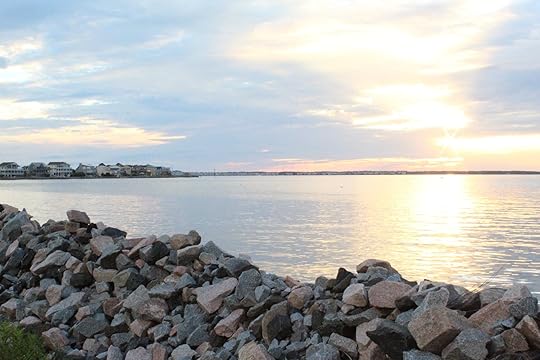
It's time for another 5 Things post! This is a series in which I let my readers get to know me, my writing process, and my influences a little better by listing my top five things in a particular writing-related category. Today I'm talking about PLACES. Specifically, places in which I write best, where I feel the most inspired and productive.Every writer has a head space they need to get themselves into in order to start writing. For some, the habit is so strongly developed that they need only to say, "I'm going to write right now," and they sit down and do it. Others need to have a morning, afternoon, or nighttime routine to get started. Some need to have a pot of coffee brewed and at the ready. There are endless ways to get the creative juices flowing. For me, atmosphere is everything. I'm a morning person, and I'm much more creative when the promise of a new day and new opportunities are upon me. Ideally, I like to get up as early as possible, make myself a cup of coffee the approximate temperature of molten lava (molten java, amirite? hahaha, I'm sorry), and settle down in front of a computer -- always a computer, because my brain works so fast, if I don't get my thoughts down quickly enough, they leave me. These are the tools I need at all times, and as long as I have them, I can take them into any atmosphere I want. So then, atmosphere: what is the best one for me? Like I said before, early morning light is what I need. The soft glow of a rising sun is peaceful and energizing at the same time, full of promise. As far as setting, I have narrowed down the five places I write best in. Give me a sunrise, a cup of coffee, a laptop, and plunk me down in any one of these five places, and you've got one productive writer on your hands.1. The Outer Banks, North Carolina
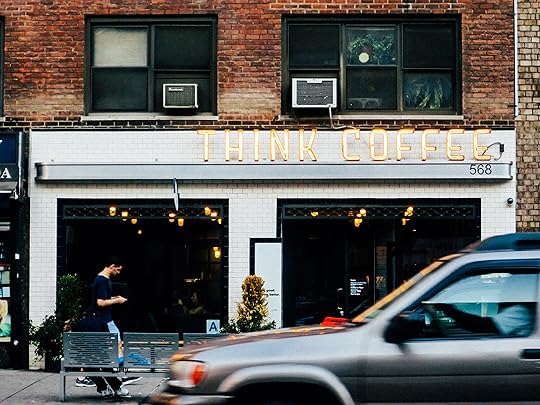
 2. A coffee shop
 3. A bookstore
 4. The library
 5. My officeWas this "5 Things" post helpful? Want to send me suggestions for future lists? Go to the "Contact Me" portion of my website and send me comments, or follow my Twitter and get at me!
This is a series in which I let my readers get to know me, my writing process, and my influences a little better by listing my top five things in a particular writing-related category. Today I'm talking about PLACES. Specifically, places in which I write best, where I feel the most inspired and productive.Every writer has a head space they need to get themselves into in order to start writing. For some, the habit is so strongly developed that they need only to say, "I'm going to write right now," and they sit down and do it. Others need to have a morning, afternoon, or nighttime routine to get started. Some need to have a pot of coffee brewed and at the ready. There are endless ways to get the creative juices flowing. For me, atmosphere is everything. I'm a morning person, and I'm much more creative when the promise of a new day and new opportunities are upon me. Ideally, I like to get up as early as possible, make myself a cup of coffee the approximate temperature of molten lava (molten java, amirite? hahaha, I'm sorry), and settle down in front of a computer -- always a computer, because my brain works so fast, if I don't get my thoughts down quickly enough, they leave me. These are the tools I need at all times, and as long as I have them, I can take them into any atmosphere I want. So then, atmosphere: what is the best one for me? Like I said before, early morning light is what I need. The soft glow of a rising sun is peaceful and energizing at the same time, full of promise. As far as setting, I have narrowed down the five places I write best in. Give me a sunrise, a cup of coffee, a laptop, and plunk me down in any one of these five places, and you've got one productive writer on your hands.1. The Outer Banks, North Carolina2. A coffee shop3. A bookstore4. The library5. My officeWas this "5 Things" post helpful? Want to send me suggestions for future lists? Go to the "Contact Me" portion of my website and send me comments, or follow my Twitter and get at me!
August 3, 2020
The Struggle Bus -- Motivation
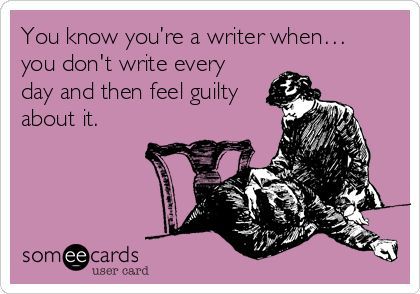
This is another post in the series I've titled...!!!The Struggle BusIn this series I discuss common struggles we all go through as writers. Sometimes I'll provide a solution that has worked for me, but I've found many of these struggles don't have a solution... and that's okay. The solidarity in the writing community is so strong, with many who have "made it" eager to tell you that their journey to success was not linear, was in fact full of setbacks, sleepless nights, self-doubt, and the desire to quit all together. I want to be one of those beacons that writers come online to seek out in the dark, scary, uncertain world of creative expression. Just hearing you're not alone is sometimes all the resolve you need. Today I'll be talking about motivation... or lack thereof. And boy, is this as good a time as any for me to post on this topic.Life: that little annoying but necessary evil. It happens, right? We as writers are trying to maintain a creative space in the midst of chaos, setbacks, and constant interruptions. Most of life is wonderful, of course -- family, celebrations, vacations, etc. are all things that contribute to the richness of life and -- bonus points -- make for some decent content for future writing projects. But life, the good and bad of it, can also get you out of your groove. This has been my struggle as of late.I rediscovered my passion for this blog once I decided I was finally ready to query my novel, which has already been published, to literary agents. The agency I'd zeroed in on looked promising, and then I discovered they, like most or all agencies, want fresh material proposed to them. I thought I'd done enough extensive research to tell me this agency accepted already published works, but alas... it's better not to go that route with them, which is fair and common to the point of almost being the rule.So now I'm editing my other completed manuscript, one I'm equally as passionate about, but which isn't ready to be seen yet. Getting the motivation to write in general is an uphill battle these days; as I write this blog post, I'm calling on every bit of inspiration I can muster. Currently I'm hindered by all those little bits of life I mentioned: lack of sleep because of my new baby, discouraging and scary world issues that are impossible to get away from, my mental health suffering because it isn't wise to do many of the things I normally do to reset (go to the gym, treat myself to a book store visit or quiet pedicure, etc.), and doubting myself and what will happen with my writing going forward since my aforementioned plans fell through.Motivation goes up and down. One day, I'm enthusiastic and energized, ready to tackle a writing project. Then a few lackluster writing days go by, and my library work gets in the way, or I'm too mentally exhausted to do anything but browse Pinterest for funny writing memes or something, and I've lost my drive. I'm at my best in the mornings, and the earlier I can get started, the better. If I don't get started early, it's a toss-up on whether or not I'll get started at all. And if I spend a day or two not writing, I feel like a fraud. Why would I call myself a writer if I'm not writing? What right do I have using the label "author" if I don't even feel like writing? Shouldn't I always feel like writing? I used to. Writing used to be my cure-all. Now I'm letting the things it used to cure get in the way of it.
 It is some consolation to know that every writer has these same feelings. When faced with a large task like creating something from the raw materials in your brain, it can be at once deeply satisfying and overwhelming. You can be excited and also dread it. Motivation is hyping yourself up to create anyway, to see past the work and toward the end result. Honestly, though, that end result is always more attractive than the work, even though writing is often a fun thing.I always fall in love with my characters, my scenes, and the stories I want to tell. I hope I never get into a position as a writer where I'm churning out stories just to produce content. I want to be passionate about everything that ever has my name on it. Because I'm in love with all my ideas, and because I'm an introvert who loves to be inside my own head, I spend a lot of time developing the story internally. I come up with scenes and get excited about them, imagining them with real live people attached to them. This is potent motivation to take the story from my head and onto the page in the hopes other people will one day get to see it, too. Ironically, it's also usually a major detour to actually writing.
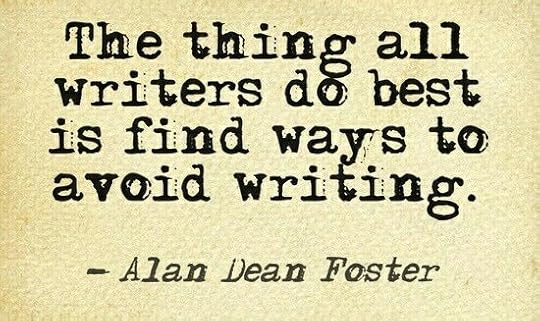
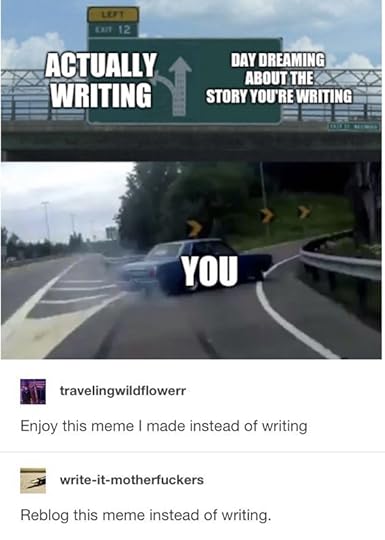 *I uploaded this meme instead of writing*. Seriously. I spent a lot of time on myWriterly Pinterest board looking for memes to accompany this post. Why didn't I write the post first, you ask? Right, because I was avoiding writing.Lack of motivation comes from many sources, just as motivation comes from many sources. It all depends on the writer and what habits you've formed (because writing is all about habit, after all, and very little about inspiration). I'm unmotivated to write because of self-doubt. I'm unmotivated to write because I can't get into the right head space for it. I'm unmotivated because I don't know how I'm going to get this bear of a scene/topic/[insert-your-issue-here] down on the page. I'm unmotivated because I'm tired. So, to combat these unpleasant feelings, I avoid writing all together. And we all know how easy that is. There are tons of distractions out there, especially when you're seated at a computer. Often I've had to disconnect my WiFi and throw my phone across the room in order to rid myself of any temptation to hop on social media, entertainment websites, or end up in any "I went to Google to do some research for my novel and ended up on the dark web" moments.
 I think the trick, then, is to turn those reasons for lack of motivation into all the ways you hype yourself up to write. Writers write because it makes us feel alive. It excites us. We love telling the stories that have been swirling around in our heads. We love our characters. We love the idea of introducing our stories to the world. Or, for nonfiction writers, it's cathartic, calming, or a way to write about something you've studied and in which you've become an expert.So when I'm tired, for example, forcing myself to write usually awakens my senses, my fingers, and my passion. If I'm feeling some sort of self-doubt, I go back to one or two incredibly eloquent or powerful passages I've written in the past and remind myself I'm capable of producing art. If I'm having trouble getting into the right head space, I might listen to some music or read a favorite chapter by an author whose career I aspire to have one day. I remind myself why I write. I remind myself I one day want to be more than what I am. I remind myself to keep reaching, that the only way I'll achieve what I want is by -- say it with me -- writing.Motivation is the key component behind habit, which -- to me --- is what lets a writer get things done. Not inspiration, but habit. When motivation is lacking, habit falls by the wayside. It's not always easy to stay motivated in a career as subjective, exhausting, and sometimes spirit-crushing as writing, but we persevere anyway. We push forward because we have no choice but to write. And having no choice is probably the biggest motivator of them all.
Today I'll be talking about motivation... or lack thereof. And boy, is this as good a time as any for me to post on this topic.Life: that little annoying but necessary evil. It happens, right? We as writers are trying to maintain a creative space in the midst of chaos, setbacks, and constant interruptions. Most of life is wonderful, of course -- family, celebrations, vacations, etc. are all things that contribute to the richness of life and -- bonus points -- make for some decent content for future writing projects. But life, the good and bad of it, can also get you out of your groove. This has been my struggle as of late.I rediscovered my passion for this blog once I decided I was finally ready to query my novel, which has already been published, to literary agents. The agency I'd zeroed in on looked promising, and then I discovered they, like most or all agencies, want fresh material proposed to them. I thought I'd done enough extensive research to tell me this agency accepted already published works, but alas... it's better not to go that route with them, which is fair and common to the point of almost being the rule.So now I'm editing my other completed manuscript, one I'm equally as passionate about, but which isn't ready to be seen yet. Getting the motivation to write in general is an uphill battle these days; as I write this blog post, I'm calling on every bit of inspiration I can muster. Currently I'm hindered by all those little bits of life I mentioned: lack of sleep because of my new baby, discouraging and scary world issues that are impossible to get away from, my mental health suffering because it isn't wise to do many of the things I normally do to reset (go to the gym, treat myself to a book store visit or quiet pedicure, etc.), and doubting myself and what will happen with my writing going forward since my aforementioned plans fell through.Motivation goes up and down. One day, I'm enthusiastic and energized, ready to tackle a writing project. Then a few lackluster writing days go by, and my library work gets in the way, or I'm too mentally exhausted to do anything but browse Pinterest for funny writing memes or something, and I've lost my drive. I'm at my best in the mornings, and the earlier I can get started, the better. If I don't get started early, it's a toss-up on whether or not I'll get started at all. And if I spend a day or two not writing, I feel like a fraud. Why would I call myself a writer if I'm not writing? What right do I have using the label "author" if I don't even feel like writing? Shouldn't I always feel like writing? I used to. Writing used to be my cure-all. Now I'm letting the things it used to cure get in the way of it.It is some consolation to know that every writer has these same feelings. When faced with a large task like creating something from the raw materials in your brain, it can be at once deeply satisfying and overwhelming. You can be excited and also dread it. Motivation is hyping yourself up to create anyway, to see past the work and toward the end result. Honestly, though, that end result is always more attractive than the work, even though writing is often a fun thing.I always fall in love with my characters, my scenes, and the stories I want to tell. I hope I never get into a position as a writer where I'm churning out stories just to produce content. I want to be passionate about everything that ever has my name on it. Because I'm in love with all my ideas, and because I'm an introvert who loves to be inside my own head, I spend a lot of time developing the story internally. I come up with scenes and get excited about them, imagining them with real live people attached to them. This is potent motivation to take the story from my head and onto the page in the hopes other people will one day get to see it, too. Ironically, it's also usually a major detour to actually writing.*I uploaded this meme instead of writing*. Seriously. I spent a lot of time on myWriterly Pinterest board looking for memes to accompany this post. Why didn't I write the post first, you ask? Right, because I was avoiding writing.Lack of motivation comes from many sources, just as motivation comes from many sources. It all depends on the writer and what habits you've formed (because writing is all about habit, after all, and very little about inspiration). I'm unmotivated to write because of self-doubt. I'm unmotivated to write because I can't get into the right head space for it. I'm unmotivated because I don't know how I'm going to get this bear of a scene/topic/[insert-your-issue-here] down on the page. I'm unmotivated because I'm tired. So, to combat these unpleasant feelings, I avoid writing all together. And we all know how easy that is. There are tons of distractions out there, especially when you're seated at a computer. Often I've had to disconnect my WiFi and throw my phone across the room in order to rid myself of any temptation to hop on social media, entertainment websites, or end up in any "I went to Google to do some research for my novel and ended up on the dark web" moments.I think the trick, then, is to turn those reasons for lack of motivation into all the ways you hype yourself up to write. Writers write because it makes us feel alive. It excites us. We love telling the stories that have been swirling around in our heads. We love our characters. We love the idea of introducing our stories to the world. Or, for nonfiction writers, it's cathartic, calming, or a way to write about something you've studied and in which you've become an expert.So when I'm tired, for example, forcing myself to write usually awakens my senses, my fingers, and my passion. If I'm feeling some sort of self-doubt, I go back to one or two incredibly eloquent or powerful passages I've written in the past and remind myself I'm capable of producing art. If I'm having trouble getting into the right head space, I might listen to some music or read a favorite chapter by an author whose career I aspire to have one day. I remind myself why I write. I remind myself I one day want to be more than what I am. I remind myself to keep reaching, that the only way I'll achieve what I want is by -- say it with me -- writing.Motivation is the key component behind habit, which -- to me --- is what lets a writer get things done. Not inspiration, but habit. When motivation is lacking, habit falls by the wayside. It's not always easy to stay motivated in a career as subjective, exhausting, and sometimes spirit-crushing as writing, but we persevere anyway. We push forward because we have no choice but to write. And having no choice is probably the biggest motivator of them all.
July 2, 2020
My Author Story -- "In a shot glass"
When I was eight years old, I saw the movie Titanic in theaters.I know what you're thinking, and... yes. Yes, there are so many questionable things about that statement. *Why was an eight-year-old watching Titanic? Did you even know what you were witnessing when the steamy car scene came up? Who allowed this?*(*1. I can't remember, but it was a movie everyone was talking about and looked beautiful from a cinematic standpoint so maybe someone saw some merit in my seeing it.2. I sort of knew, because my parents had been open with me about ~the goings on between a man and woman~, but I still never expected to see it on a huge screen like that.and3. I think mostly my mom allowed it, but I went with an aunt, and I don't think anyone involved expected everything I ended up seeing.)You're also probably wondering what any of this has to do with a writing blog. I have an answer for that, too. You see, that film got me into writing.An odd correlation, but let me explain.My eight-year-old brain was stricken by this film in every way. I found it visually stunning, emotional, fascinating (even at a young age I was a history buff), and incredibly romantic. Of course, I didn't have much to go on in the area of romance, but from what I managed to figure out, I fell in love with. After some asking, my parents, in an even more questionable move, bought me the film on VHS so I could watch it over and over again. And readers, I wore those two tapes out.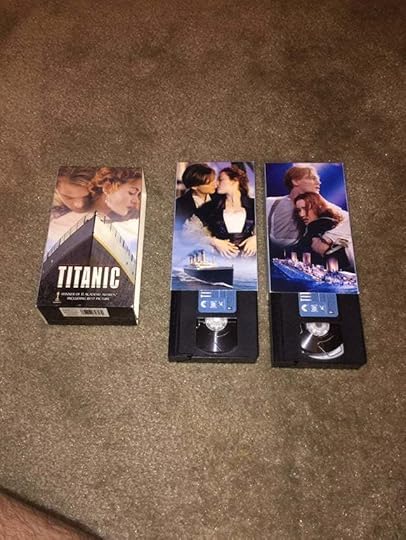 (This is not my photo... my box set is long gone. :( But this is what it looked like. DVDs had just come into existence and still weren't widely used, so I had this baby. For some reason, I'm laughing hysterically at the concept of this. Anyway.)This film not only fueled my still-young love for history and romance, but also my obsession with Leonardo DiCaprio. (I was definitely a victim of the Leo-mania pandemic of the late 90s, and the man still holds a special place in my heart today.) I began writing my own version of a story of star-crossed lovers who are total opposites at some point in the past, and at age 10, I finished my first short story. It was called "My Best Friend".Yes, I know -- Riveting. Original. Astounding.
 Set in the 1950s, it was the story of a young girl named Lucy and boy whose name I can't remember. She was white and he was Latino. Actually, now that I think about it, his name might have been Ricky... I was also a huge fan of I Love Lucy. I had odd tastes for a child.The story goes that Lucy and probably Ricky grew up together as best friends, fell in love, and then one of them -- I can't for sure recall which one, but I believe it was Lucy -- died tragically. She died in probably Ricky's arms, sort of à la The Notebook before The Notebook existed, only she died young and not old. It was all so very tragic and romantic. I loved writing it, loved imagining their world, even if much of it was borrowed from movies and other media I'd seen before. It was my first foray into telling a story, creating something and writing it down.I was hooked on storytelling after that.I'd also dabbled in verse before; for a fourth-grade assignment, my teacher had everyone in my class to choose an animal and write a poem about it. I chose the great grey owl. Want to read it? I thought you did.The great grey owl, lumbering through the dayHe flies about, he swoops and swaysHe sits in his tree and hoots awayAt night, by the moonlight, he eyes his preyAnd swoops down and gobbles it up and...Back in his tree he goes and staysWaiting... maybe for you, I sayFor some reason, I've never forgotten that one. I was told it was pretty impressive coming from a nine-year-old.I also wrote a poem about my life called... wait for it... "My Life". I joke about its title, but this poem was actually written as therapy, as my family had been going through a turbulent time. I mentioned in an earlier blog post that my mother, who has passed away, was an alcoholic for most of my life. I grew up watching her struggle with this addiction, learning to understand what I was witnessing largely on my own, processing things in a way only a child can. After my mom lost her job because of her addiction and we lost our house to foreclosure, I wrote "My Life"as a way to express my feelings. One stanza read:...I don't know where to beginI'm not as outgoing, I know that it's showingAnd I'm back where I started againWhen a small-time anthology (the name of which I can't remember now) published this poem, I became hooked on the idea of people actually reading my work, hearing my stories and getting a glimpse of my creativity, falling in love with my work the way I'd fallen in love with Titanic. At this point, writing was so many things for me: fun, therapeutic, addictive, and now a way to be seen. A career option.I was an introvert who liked a certain type of attention. I think that's the way to describe all writers. Author John Green explained it in a great way when he said, "[Writing is] a profession for introverts who wanna tell you a story but don't wanna make eye contact while telling it." I loved being alone, but as an only child with a large personality, when I decided to put myself out there, everyone knew it. When I discovered I had some talent for writing, and that I could turn that talent into a strength and that strength into a way of being known, I was thrilled.Even so, I didn't write much creatively between junior high and the end of high school. I became hooked on the idea that I would need to break into something a little more practical first, so I joined my high school's yearbook staff and wrote and photographed for them for two years. When multiple family members told me I had the personality and looks for television, I figured something like journalism would be a good way to write, be known, and also have a secure career going forward.When I applied to colleges in 2006, I sought all the ones that had a good communications program. The University of North Carolina at Charlotte appealed to me the most, both because of its program's reputation and its location -- Charlotte is the largest and most populous city in my state, more well-known by nationals and internationals than even our capital, and it's the entertainment mecca of North Carolina. I figured I would move to the city at some point, write for TV, a newspaper, or a magazine, and pursue creative writing on the side. It was a safe, practical plan.At freshman orientation every naive, bright-eyed new student received a badge with their name and major on it. Funnily enough, mine mistakenly said "English".
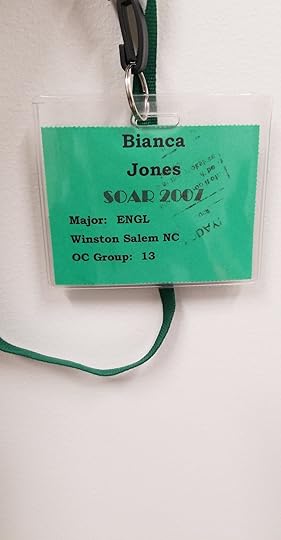 I remember noting how wrong it was several times, but otherwise I didn't make a big stink. Clearly I never changed it.I spent my first two years pursuing Pre-Comm, which required I take gen-ed courses like politics and economics (*shudder*) and speech writing (not the worst, but tiresome after a few weeks). I struggled through these courses, welcoming the slight reprieve of my English and journalism classes. And it was focusing on these classes that started to change my mind.As I've mentioned in a previous post, I began the first big creative writing project of my life during my sophomore year, and I became pretty obsessed with completing it. As my interest in creative writing grew, I became less interested in my journalism classes. I liked the freedom to be "flowery" (an actual criticism of a news article I wrote). Everything came together at the same time. My first semester of junior year, I signed up for Intro to Communications. It was the final class you needed to complete the transition from Pre-Comm to a full-on Communications major, and the class was huge, containing maybe 150 students. I wasn't intimidated by the size. I wasn't intimidated by the huge textbook. I wasn't intimidated by the promise of all the reading I would have to do. I wasn't even intimidated by my professor as he bragged about the 50% failure rate of his course. (He was charming.)But one day, I sat in this class taking notes on my laptop, staring at the whiteboard ahead and envisioning the career I would take on with a Communications degree. My top choices were broadcast journalism, television reporter, or public relations.As I was thinking, I clicked on the other tab I had open and put a few more finishing touches on my novel, the one I began my sophomore year. I was almost done editing it. I was very proud of it. I had written an entire novel, and every moment of writing it had been a rush.And I looked up after a few minutes, tuning back in to this professor droning on about... I honestly didn't care. I didn't care about any of it anymore. All I cared about was my novel, about reading, about my English classes, about creating, about being a novelist.So I opened a third tab, logged into my school's website, and changed my major to English.Like. Just like that.Then I called my mom after class was over and told her what I'd done. She was... not angry? But she was a little nervous. "What are you going to do with an English degree?" she asked. She was the first of many who would ask me that over the next two years.A month later, I finished my first novel. At the end of the semester, I became part of that 50% failure rate my professor had bragged about. Way to contribute to the statistic, Bianca.The next semester, I took up a host of linguistics, literature, history, and fiction writing classes, in addition to my journalism and Spanish classes. (I forgot to mention I was a double minor, the other being Spanish. Ahora sabes.) After failing my first ever college course the previous semester, I ended my junior year with excellent grades that put me on UNC Charlotte's Chancellor's List. It was proof I had taken the right path.I spent the next few years seeking advice and feedback on my novel. My first venture into publishing, I had no idea what I was doing and ended up contacting a vanity publisher. They offered to get my novel in print -- for $4,000. I was very confused. Weren't they supposed to be paying me? After some research and speaking with two professors of mine who happened to be published authors, I found out there are several different ways to get published, and the one I had stumbled upon wasn't... the most legit. So then I started querying literary agents.And they were not interested.They had no reason to be, either. I was a twenty-one-year-old woman with no writing credits, no online presence, and the only attributes I'd listed about myself was that I had taken a college-level fiction writing course or two. Believe it or not, none of those things make you an exciting contender out of up to thousands of other queries an agent will receive yearly. I didn't know that, of course.Also, I was trying to get a young adult paranormal romance novel published... which was what everyone else at the time was trying to get published, too. The market was saturated, I didn't know how to hook anyone, and I was pushing a weak, poorly-worded submission where I even admitted I was seeking representation for my "very green" efforts.
 10 years later I still cringe about this partEventually I shelved the story, realizing it didn't have a chance in that day's market unless I was already an established novelist. I took an unpaid internship at my college's literary arts magazine, hoping to gain experience and even get a short story published in the next edition. During my time with the magazine, I submitted a short story called "Mannequin" under a pen name. Luke, my protagonist, a bartender at an upscale lounge, narrates his experiences with seeing the same woman nearly every night. She comes in with different men and is dressed differently, using a variety of wigs, makeup, outfits, and even accents to pull off different personas. She fools everyone except Luke, and he begins to speculate why she's doing this: Is she running from someone? Is she running from herself? Are her intentions malevolent? Is she just trying to have fun? Is she crazy? When Luke eventually helps the woman out of a sticky situation, she realizes he can see her for who she really is, and writes a quick note of thanks on a napkin, signing her real name.The story made it through the first 3 rounds of elimination. I was psyched... no one knew it was me, and I was getting a lot of positive and usefully critical feedback. To be present at the final round of eliminations and hear unfiltered critique about my work was eye-opening, encouraging, and crazy. Unfortunately, my story didn't make it into the magazine, but at least I knew why, and I totally agreed with the reasons! I appreciated the experience, especially when faced with the real-world frustrations of rarely getting a reason for rejection from literary agents -- who, to be fair, have no time to provide feedback to every single query they receive. It's just not possible. I get it. It sucks, but I get it.After graduating college still with no major publishing credits under my belt, I started brainstorming new, fresh ideas that would get me noticed. It took me another two years to realize no idea was fresh or new enough to get me published without me doing additional work. I had to perfect my craft, make my writing stronger, get some professional feedback, and get with it on social media. I didn't do the social media part for a long time, because I felt with no writing credits there was no point. My ignorance and ego were really fighting for a top spot, there.I completed my next project, We Are Eternal, after a month-long, inspiration-fueled writing mania. I completed another project, Way Down Low, a month later, in similar fashion. I was working part time at a library, so I had a lot of time on my hands. I also had a desire to get better, and I could fully imagine for the first time an actual career as a writer.Life happened -- good life, thankfully, consisting of a marriage and a new baby -- and I let the projects sit for a while. When I decided to edit and try to market my work, I picked up We Are Eternal first; considering what I was going through with my own mother at the time, I felt like visiting with Olive, my main character, and fleshing out her struggles. I pitched it to a few agents without any luck and attended a few Writer's Digest webinars about marketability and self-editing before realizing that with my limited experience, I should probably be trying to appeal directly to publishers. Turns out I was right, as my story was picked up my a small publisher in January 2018. From my first time watching Titanic in theaters with my aunt at 8 years old,to keeping several diaries and journals,to writing my first story and the poetry, my stints on the high school yearbook staff and the college literary arts magazine, to finishing my first novel, to finally getting published, and all the stumbling blocks in between, I've grown exponentially as a writer and enjoyed the whole ride. I'm just as proud of that little girl who wrote "My Best Friend" as I am of the author of We Are Eternal. My story probably sounds like many other writers' stories out there....Theirs probably doesn't begin with a Titanic obsession, though.
(This is not my photo... my box set is long gone. :( But this is what it looked like. DVDs had just come into existence and still weren't widely used, so I had this baby. For some reason, I'm laughing hysterically at the concept of this. Anyway.)This film not only fueled my still-young love for history and romance, but also my obsession with Leonardo DiCaprio. (I was definitely a victim of the Leo-mania pandemic of the late 90s, and the man still holds a special place in my heart today.) I began writing my own version of a story of star-crossed lovers who are total opposites at some point in the past, and at age 10, I finished my first short story. It was called "My Best Friend".Yes, I know -- Riveting. Original. Astounding.Set in the 1950s, it was the story of a young girl named Lucy and boy whose name I can't remember. She was white and he was Latino. Actually, now that I think about it, his name might have been Ricky... I was also a huge fan of I Love Lucy. I had odd tastes for a child.The story goes that Lucy and probably Ricky grew up together as best friends, fell in love, and then one of them -- I can't for sure recall which one, but I believe it was Lucy -- died tragically. She died in probably Ricky's arms, sort of à la The Notebook before The Notebook existed, only she died young and not old. It was all so very tragic and romantic. I loved writing it, loved imagining their world, even if much of it was borrowed from movies and other media I'd seen before. It was my first foray into telling a story, creating something and writing it down.I was hooked on storytelling after that.I'd also dabbled in verse before; for a fourth-grade assignment, my teacher had everyone in my class to choose an animal and write a poem about it. I chose the great grey owl. Want to read it? I thought you did.The great grey owl, lumbering through the dayHe flies about, he swoops and swaysHe sits in his tree and hoots awayAt night, by the moonlight, he eyes his preyAnd swoops down and gobbles it up and...Back in his tree he goes and staysWaiting... maybe for you, I sayFor some reason, I've never forgotten that one. I was told it was pretty impressive coming from a nine-year-old.I also wrote a poem about my life called... wait for it... "My Life". I joke about its title, but this poem was actually written as therapy, as my family had been going through a turbulent time. I mentioned in an earlier blog post that my mother, who has passed away, was an alcoholic for most of my life. I grew up watching her struggle with this addiction, learning to understand what I was witnessing largely on my own, processing things in a way only a child can. After my mom lost her job because of her addiction and we lost our house to foreclosure, I wrote "My Life"as a way to express my feelings. One stanza read:...I don't know where to beginI'm not as outgoing, I know that it's showingAnd I'm back where I started againWhen a small-time anthology (the name of which I can't remember now) published this poem, I became hooked on the idea of people actually reading my work, hearing my stories and getting a glimpse of my creativity, falling in love with my work the way I'd fallen in love with Titanic. At this point, writing was so many things for me: fun, therapeutic, addictive, and now a way to be seen. A career option.I was an introvert who liked a certain type of attention. I think that's the way to describe all writers. Author John Green explained it in a great way when he said, "[Writing is] a profession for introverts who wanna tell you a story but don't wanna make eye contact while telling it." I loved being alone, but as an only child with a large personality, when I decided to put myself out there, everyone knew it. When I discovered I had some talent for writing, and that I could turn that talent into a strength and that strength into a way of being known, I was thrilled.Even so, I didn't write much creatively between junior high and the end of high school. I became hooked on the idea that I would need to break into something a little more practical first, so I joined my high school's yearbook staff and wrote and photographed for them for two years. When multiple family members told me I had the personality and looks for television, I figured something like journalism would be a good way to write, be known, and also have a secure career going forward.When I applied to colleges in 2006, I sought all the ones that had a good communications program. The University of North Carolina at Charlotte appealed to me the most, both because of its program's reputation and its location -- Charlotte is the largest and most populous city in my state, more well-known by nationals and internationals than even our capital, and it's the entertainment mecca of North Carolina. I figured I would move to the city at some point, write for TV, a newspaper, or a magazine, and pursue creative writing on the side. It was a safe, practical plan.At freshman orientation every naive, bright-eyed new student received a badge with their name and major on it. Funnily enough, mine mistakenly said "English".I remember noting how wrong it was several times, but otherwise I didn't make a big stink. Clearly I never changed it.I spent my first two years pursuing Pre-Comm, which required I take gen-ed courses like politics and economics (*shudder*) and speech writing (not the worst, but tiresome after a few weeks). I struggled through these courses, welcoming the slight reprieve of my English and journalism classes. And it was focusing on these classes that started to change my mind.As I've mentioned in a previous post, I began the first big creative writing project of my life during my sophomore year, and I became pretty obsessed with completing it. As my interest in creative writing grew, I became less interested in my journalism classes. I liked the freedom to be "flowery" (an actual criticism of a news article I wrote). Everything came together at the same time. My first semester of junior year, I signed up for Intro to Communications. It was the final class you needed to complete the transition from Pre-Comm to a full-on Communications major, and the class was huge, containing maybe 150 students. I wasn't intimidated by the size. I wasn't intimidated by the huge textbook. I wasn't intimidated by the promise of all the reading I would have to do. I wasn't even intimidated by my professor as he bragged about the 50% failure rate of his course. (He was charming.)But one day, I sat in this class taking notes on my laptop, staring at the whiteboard ahead and envisioning the career I would take on with a Communications degree. My top choices were broadcast journalism, television reporter, or public relations.As I was thinking, I clicked on the other tab I had open and put a few more finishing touches on my novel, the one I began my sophomore year. I was almost done editing it. I was very proud of it. I had written an entire novel, and every moment of writing it had been a rush.And I looked up after a few minutes, tuning back in to this professor droning on about... I honestly didn't care. I didn't care about any of it anymore. All I cared about was my novel, about reading, about my English classes, about creating, about being a novelist.So I opened a third tab, logged into my school's website, and changed my major to English.Like. Just like that.Then I called my mom after class was over and told her what I'd done. She was... not angry? But she was a little nervous. "What are you going to do with an English degree?" she asked. She was the first of many who would ask me that over the next two years.A month later, I finished my first novel. At the end of the semester, I became part of that 50% failure rate my professor had bragged about. Way to contribute to the statistic, Bianca.The next semester, I took up a host of linguistics, literature, history, and fiction writing classes, in addition to my journalism and Spanish classes. (I forgot to mention I was a double minor, the other being Spanish. Ahora sabes.) After failing my first ever college course the previous semester, I ended my junior year with excellent grades that put me on UNC Charlotte's Chancellor's List. It was proof I had taken the right path.I spent the next few years seeking advice and feedback on my novel. My first venture into publishing, I had no idea what I was doing and ended up contacting a vanity publisher. They offered to get my novel in print -- for $4,000. I was very confused. Weren't they supposed to be paying me? After some research and speaking with two professors of mine who happened to be published authors, I found out there are several different ways to get published, and the one I had stumbled upon wasn't... the most legit. So then I started querying literary agents.And they were not interested.They had no reason to be, either. I was a twenty-one-year-old woman with no writing credits, no online presence, and the only attributes I'd listed about myself was that I had taken a college-level fiction writing course or two. Believe it or not, none of those things make you an exciting contender out of up to thousands of other queries an agent will receive yearly. I didn't know that, of course.Also, I was trying to get a young adult paranormal romance novel published... which was what everyone else at the time was trying to get published, too. The market was saturated, I didn't know how to hook anyone, and I was pushing a weak, poorly-worded submission where I even admitted I was seeking representation for my "very green" efforts.10 years later I still cringe about this partEventually I shelved the story, realizing it didn't have a chance in that day's market unless I was already an established novelist. I took an unpaid internship at my college's literary arts magazine, hoping to gain experience and even get a short story published in the next edition. During my time with the magazine, I submitted a short story called "Mannequin" under a pen name. Luke, my protagonist, a bartender at an upscale lounge, narrates his experiences with seeing the same woman nearly every night. She comes in with different men and is dressed differently, using a variety of wigs, makeup, outfits, and even accents to pull off different personas. She fools everyone except Luke, and he begins to speculate why she's doing this: Is she running from someone? Is she running from herself? Are her intentions malevolent? Is she just trying to have fun? Is she crazy? When Luke eventually helps the woman out of a sticky situation, she realizes he can see her for who she really is, and writes a quick note of thanks on a napkin, signing her real name.The story made it through the first 3 rounds of elimination. I was psyched... no one knew it was me, and I was getting a lot of positive and usefully critical feedback. To be present at the final round of eliminations and hear unfiltered critique about my work was eye-opening, encouraging, and crazy. Unfortunately, my story didn't make it into the magazine, but at least I knew why, and I totally agreed with the reasons! I appreciated the experience, especially when faced with the real-world frustrations of rarely getting a reason for rejection from literary agents -- who, to be fair, have no time to provide feedback to every single query they receive. It's just not possible. I get it. It sucks, but I get it.After graduating college still with no major publishing credits under my belt, I started brainstorming new, fresh ideas that would get me noticed. It took me another two years to realize no idea was fresh or new enough to get me published without me doing additional work. I had to perfect my craft, make my writing stronger, get some professional feedback, and get with it on social media. I didn't do the social media part for a long time, because I felt with no writing credits there was no point. My ignorance and ego were really fighting for a top spot, there.I completed my next project, We Are Eternal, after a month-long, inspiration-fueled writing mania. I completed another project, Way Down Low, a month later, in similar fashion. I was working part time at a library, so I had a lot of time on my hands. I also had a desire to get better, and I could fully imagine for the first time an actual career as a writer.Life happened -- good life, thankfully, consisting of a marriage and a new baby -- and I let the projects sit for a while. When I decided to edit and try to market my work, I picked up We Are Eternal first; considering what I was going through with my own mother at the time, I felt like visiting with Olive, my main character, and fleshing out her struggles. I pitched it to a few agents without any luck and attended a few Writer's Digest webinars about marketability and self-editing before realizing that with my limited experience, I should probably be trying to appeal directly to publishers. Turns out I was right, as my story was picked up my a small publisher in January 2018. From my first time watching Titanic in theaters with my aunt at 8 years old,to keeping several diaries and journals,to writing my first story and the poetry, my stints on the high school yearbook staff and the college literary arts magazine, to finishing my first novel, to finally getting published, and all the stumbling blocks in between, I've grown exponentially as a writer and enjoyed the whole ride. I'm just as proud of that little girl who wrote "My Best Friend" as I am of the author of We Are Eternal. My story probably sounds like many other writers' stories out there....Theirs probably doesn't begin with a Titanic obsession, though.
July 1, 2020
I was almost published once before...
and buddy, was it a wild ride. Before I dive into this short story, I want to mention that lately I've been listening to a podcast called The Angry Therapist. A licensed therapist named John Kim talks on a particular self-betterment topic for no more than ten to twelve minutes, unrehearsed. He calls it "therapy in a shot glass," and I love it. He's not polished. He doesn't agonize over what he's going to say. Often his episodes are uploaded after one take. And the result is refreshingly real, honest, and uncomplicated.I say all this to say: I think that's the way I'm going to start running this blog.Of course, there will still be some production value, and I will definitely edit myself more than Mr. Kim does (because this is still a writing blog, and I have to show potential agents/publishers that I can, you know, write), but I won't agonize over everything so much. Since my previous plans fell through and I'm now frantically editing Way Down Low,months earlier than I expected to, the mindset to put a lot of pressure on myself to achieve perfection has bled into every project I try to put out, causing writer's block in this blog. I'm taking a cue from the angry therapist and "finding my flow state." Hopefully the words will flow too.All right, I'm unfolding myself from the padmasana pose and getting this post moving. Padmasana, or Lotus, pose. Very calming. Perfect for practicing mindfulness.So, the story behind my almost being published. Get ready to chuckle.Picture it: I'm in my junior year of college, and I've just finished my first novel. It's the first time I've ever finished anything, let alone something that was 110,000 words! (We won't mention the unspoken truth that you never, ever, cold query a literary agent with a first novel of over 90,000 words unless someone already knows who you are... if we did, the truth would no longer be unspoken.) I'd edited it, had a few people read certain chapters, and, most importantly, I'd imagined how it would look as a blockbuster movie. Surely, this was the next great and most popular young adult paranormal romance novel, and people would be clamoring to print it. I would be paid a six-figure advance, as this was the first book in a trilogy, and I would come out of college rich and never having to work a real job again for the rest of my life.I'll pause here so you can wipe the tears of laughter from your eyes and keep reading.Ready? Okay.Anyway. After a long five minutes of searching the internet, I chose the first result Google spat at me: a vanity publisher. I didn't know it was a vanity publisher, of course, because I hadn't done a lick of actual research. I just saw a company that would publish basically anything and said, "That was easy!"I sent them my entire manuscript, and I was ecstatic a few weeks later to receive a large envelope containing a letter of acceptance, a professionally crafted synopsis of my story, and a contract! The contract explained the royalties I would be paid and the $4,000 fee I would have to pay them to print my bo--HOLD UP.
 Four THOUSAND dollars?I thought they were going to pay me? Wasn't that how it worked?I was so confused. I was also so desperate to get published that I called my bank a couple days later and tried to apply for a loan. If this was what it took, I was going to do it.After a few days of feeling conflicted and embarrassed, I finally talked to one of the professors in the department where I was doing student work. He was a doctor of anthropology, but even he said what I was already thinking, what you're thinking, what anyone with a bit of sense would be thinking:"This sounds fishy."So I had to make one of the most difficult decisions I'd had to make in my twenty years of life. With a literal publishing contract in my hands, I had to think of the future of my beloved manuscript and any work I planned to produce going forward. I had to call the publisher back and say, "Actually... never mind."It hurt. Man, did it hurt. It was some consolation to find out later -- after thoroughly researching the world of publishing -- that while this particular vanity publisher was indeed a little "fishy" (the reviews were all over the place, dubious, and, per my research from a few days ago, the company went under soon after I turned the offer down), what they were doing is technically a legitimate practice. I just didn't know the difference between self-publishing -- and all its iterations -- and traditional publishing. I didn't know literary agents existed. I didn't know that going the traditional route was how you got that very rare "six-figure advance" I assumed just fell into your lap. I didn't know about queries, appealing to people whose job it is to represent you, building a platform -- none of that. I had to learn the long way, the hard way, but ultimately the best way for me.As I've stated in a previous post, when I want something, I want it now. I've always been that way and probably always will be. But if I hadn't said no back then, I don't think I would have sought to gain the knowledge I now have about publishing. I would have put a book out into the world that wasn't yet strong enough or polished enough to be seen. I would have gone into debt with the bank and never gotten my money back.A lot of good can come out of saying no, even -- or especially -- if you're young with a dream. If it's worth doing, it's worth doing well. I'm glad my younger self slowed her roll enough to figure that out.Namaste.
Padmasana, or Lotus, pose. Very calming. Perfect for practicing mindfulness.So, the story behind my almost being published. Get ready to chuckle.Picture it: I'm in my junior year of college, and I've just finished my first novel. It's the first time I've ever finished anything, let alone something that was 110,000 words! (We won't mention the unspoken truth that you never, ever, cold query a literary agent with a first novel of over 90,000 words unless someone already knows who you are... if we did, the truth would no longer be unspoken.) I'd edited it, had a few people read certain chapters, and, most importantly, I'd imagined how it would look as a blockbuster movie. Surely, this was the next great and most popular young adult paranormal romance novel, and people would be clamoring to print it. I would be paid a six-figure advance, as this was the first book in a trilogy, and I would come out of college rich and never having to work a real job again for the rest of my life.I'll pause here so you can wipe the tears of laughter from your eyes and keep reading.Ready? Okay.Anyway. After a long five minutes of searching the internet, I chose the first result Google spat at me: a vanity publisher. I didn't know it was a vanity publisher, of course, because I hadn't done a lick of actual research. I just saw a company that would publish basically anything and said, "That was easy!"I sent them my entire manuscript, and I was ecstatic a few weeks later to receive a large envelope containing a letter of acceptance, a professionally crafted synopsis of my story, and a contract! The contract explained the royalties I would be paid and the $4,000 fee I would have to pay them to print my bo--HOLD UP.Four THOUSAND dollars?I thought they were going to pay me? Wasn't that how it worked?I was so confused. I was also so desperate to get published that I called my bank a couple days later and tried to apply for a loan. If this was what it took, I was going to do it.After a few days of feeling conflicted and embarrassed, I finally talked to one of the professors in the department where I was doing student work. He was a doctor of anthropology, but even he said what I was already thinking, what you're thinking, what anyone with a bit of sense would be thinking:"This sounds fishy."So I had to make one of the most difficult decisions I'd had to make in my twenty years of life. With a literal publishing contract in my hands, I had to think of the future of my beloved manuscript and any work I planned to produce going forward. I had to call the publisher back and say, "Actually... never mind."It hurt. Man, did it hurt. It was some consolation to find out later -- after thoroughly researching the world of publishing -- that while this particular vanity publisher was indeed a little "fishy" (the reviews were all over the place, dubious, and, per my research from a few days ago, the company went under soon after I turned the offer down), what they were doing is technically a legitimate practice. I just didn't know the difference between self-publishing -- and all its iterations -- and traditional publishing. I didn't know literary agents existed. I didn't know that going the traditional route was how you got that very rare "six-figure advance" I assumed just fell into your lap. I didn't know about queries, appealing to people whose job it is to represent you, building a platform -- none of that. I had to learn the long way, the hard way, but ultimately the best way for me.As I've stated in a previous post, when I want something, I want it now. I've always been that way and probably always will be. But if I hadn't said no back then, I don't think I would have sought to gain the knowledge I now have about publishing. I would have put a book out into the world that wasn't yet strong enough or polished enough to be seen. I would have gone into debt with the bank and never gotten my money back.A lot of good can come out of saying no, even -- or especially -- if you're young with a dream. If it's worth doing, it's worth doing well. I'm glad my younger self slowed her roll enough to figure that out.Namaste.
June 19, 2020
No, I'm not on hiatus again...
...and this post proves it. So, I'm a huge procrastinator. When I've got an intimidating project hanging over my head, I will run away from it instead of tackling it... even a project I'm excited about! Case in point: the blog post I'm going to finally publish on Monday. According to the draft date, I started writing that post THREE WEEKS AGO. I was so focused on making it look and sound good and obsessing over the details, not wanting to leave anything out, that I became paralyzed. I stayed away from the whole thing for about a week before saying, "Screw it" and cobbling the end together over these past two days. However, it is done.As I breathe this sigh of relief, happy to finally be let off the hook, I wonder why I'm like this. The root, I'm realizing, has to be in my perfectionist tendencies. Yes, I've called myself "Type B to a fault" in a past post, and yes, I consider myself laid-back, but this is a writing blog. I want the writing to look good, because if it doesn't, my credibility goes out the door. Plus, when it comes to what I consider "my craft," I don't want to deliver something that is just slapped onto a page; that's how I get stuff done, but that's definitely not what I'm comfortable presenting as an end result.At any rate, I've finally broken past this wall of paralyzing inactivity and will produce two blog posts next week. Fingers crossed I'll get my mojo back and we can move forward at lightning speed from here!
June 10, 2020
Short Post -- rediscovering a great idea
I think all writers know the thrill of conceiving an amazing story idea. Your eyes light up, you smile, your heart starts beating quickly. It's a lot like falling in love. You grab the nearest sheet of paper or your phone and you scribble the idea down as quickly as you can. You say, "One day," and then pat yourself on the back for being such a freaking genius. Sometimes, though, other projects get in the way, or you take a writing hiatus, or something else comes up, and you forget all about that germ of an idea you scribbled down. It gets lost in the sea of other story notes on your phone or under a pile of other papers on your desk, and it's out of sight, out of mind.BUT THENTHE THRILL OF DISCOVERY! One day you're cleaning up or cleaning out, and you find that note with that long-forgotten story idea. Sometimes you say "Meh" and throw it away or delete it, not as impressed with it as you were when you first thought it up. But other times, you read the note, and you read it again, and again, and your eyes light up, and you start to smile, and your heartbeat quickens, and you say, "Man, this is GOOD." Then you start envisioning the plot, the characters, the storyline, and when you might have time to actually start writing the thing. And you get excited all over again. I've just had one of these moments, and happily, mine is the latter response. Yesterday, I found a note on my desk as I was straightening up. I must have written it at least a year ago -- maybe longer than that. I'm ridiculously excited about this story, but with three others ahead of it -- a complete manuscript that I'm editing, a half-done YA romance that at least deserves a horrible first draft status, and my Ireland story that's been patiently waiting long enough -- I'll have to shelve this one until at least 2022. This time, though, it's going in a much safer place. I'm not losing track of it again!
One day you're cleaning up or cleaning out, and you find that note with that long-forgotten story idea. Sometimes you say "Meh" and throw it away or delete it, not as impressed with it as you were when you first thought it up. But other times, you read the note, and you read it again, and again, and your eyes light up, and you start to smile, and your heartbeat quickens, and you say, "Man, this is GOOD." Then you start envisioning the plot, the characters, the storyline, and when you might have time to actually start writing the thing. And you get excited all over again. I've just had one of these moments, and happily, mine is the latter response. Yesterday, I found a note on my desk as I was straightening up. I must have written it at least a year ago -- maybe longer than that. I'm ridiculously excited about this story, but with three others ahead of it -- a complete manuscript that I'm editing, a half-done YA romance that at least deserves a horrible first draft status, and my Ireland story that's been patiently waiting long enough -- I'll have to shelve this one until at least 2022. This time, though, it's going in a much safer place. I'm not losing track of it again!
June 3, 2020
When your "sit down and do it" is broken
This post will not be long, and it will not be structured in any way. Sometimes it's okay to just wing it. Over the past few weeks, I've dedicated my time and energy to making this blog look and feel professional and pretty. Lately, though, I've been feeling a little down and overwhelmed, so I'm eschewing showmanship for some realness.I've got a lot of creative ideas that I'm still very excited about, but sometimes you just don't... wanna. You know? Writers experience all sorts of highs and lows -- one day or week or month you feel incredibly creative and motivated, and then you go through a period of not wanting to produce anything that can range from wanting to take a small break to total writer's block. Luckily, I'm not currently suffering with the latter. Life is hard, especially nowadays, and it gets the best of you every so often. With the negative state of protests, pandemic, and politics, I've become very discouraged. I know it's just a down moment, but for the time it's really affected my desire to create.In a very recent post, I listed ten tips that help me feel motivated and write my best. Tip number one said: Just do it. Getting over the hump of not wanting to write is your biggest obstacle, and if you make it over, the words will come out. Well, I put that bit of advice to the test this morning, and I'm proud to say it still works. I'm writing. I'm not writing what I really want, of course, but this is feeling very therapeutic, which helps.Before this moment, I hadn't written anything since... Friday? Probably Friday. I lost track of time. I have a draft of a post I've been working on since the last time I wrote, and for some reason I haven't been able to finish it. I'll get it done. Probably this week. Or something.I had plans this Monday to finally send my query for We Are Eternal. I wrote the entire submission this time last year, and I agonized over it for months, crafting it to what felt like perfection. And then, right before I sent it, I pasted the letter portion into the Hemingway App.Guys, DON'T USE THIS APP.Not because it's bad, but because it is the enemy of complex sentences. While it helped me see a few places I could improve -- sentence structure, omitting an adverb, and removing language that made my statements sound timid -- it also had me dumbing everything down to elementary-level sentences and questioning my ability as a writer. This is not realistic. (For comparison, I wrote a sentence from a blurb in the nearest best seller I could find in my work space, and Hemingway highlighted that one to hell, too. It made me feel a bit better.)On top of that, I did a little more research on the literary agent I planned to send my query to, to see if there was anything else I could add in my letter about my reasons for choosing her. Luckily (or unluckily), I found an interview on the most obscure blog where this agent stated that while she's definitely open to works that are self-published and published through smaller outlets (mine is the latter), she wants new work sent to her. That means my carefully crafted argument for why I wanted her to represent my already published novel went out the window. What a setback.Thankfully, I have a query letter for my latest novel, Way Down Low, already drafted. All it needs is polishing, as does the manuscript. So I suppose that will be my project for the rest of the year. I'm aiming to query with Way Down Low in September of this year.Don't get me wrong -- I'm very proud of Way Down Low, and I'm excited to get this story out there. With recent events surrounding the Black Lives Matter movement in our country (and the world... wow!), I think this year is the perfect time to push for this story to be heard. (I wrote a post about its concept, which you can find here.) My only reason for sounding so bummed about querying with Way Down Low is that We Are Eternal is 100% ready to go, and I didn't want to wait any longer. When I want something, I want it now. *(God, I love you, Freddie)*I told myself it would all be okay, and it will. We Are Eternal will technically be represented if I can get an agent -- after all, an agent represents you, and that includes your body of work. It's just that I still have such a vision for We Are Eternal, one that will have to wait a little longer. Waiting is not so bad, but this revelation threw me off my game.So, I'm writing this off-the-cuff post as a way to let out my feelings, iron out my game plan, and actually get something written. Another tip I wrote in my Writing Tips post was to not beat yourself up for whatever you've managed -- or not managed -- to write. Because the point is to write. This post isn't edited, isn't polished, and isn't organized, but I'm writing. This document's word counter to my right tells me I've written over 900 words. That's not only more than I've written in days, but it's more than I expected to churn out when I sat down and started typing 30 minutes ago.That's the point. That's progress. With all the letdowns and setbacks I've felt over the past week, I still have a twinkle of motivation. I still have options. I still have hope.I'll get back on the horse. One word at a time.
*(God, I love you, Freddie)*I told myself it would all be okay, and it will. We Are Eternal will technically be represented if I can get an agent -- after all, an agent represents you, and that includes your body of work. It's just that I still have such a vision for We Are Eternal, one that will have to wait a little longer. Waiting is not so bad, but this revelation threw me off my game.So, I'm writing this off-the-cuff post as a way to let out my feelings, iron out my game plan, and actually get something written. Another tip I wrote in my Writing Tips post was to not beat yourself up for whatever you've managed -- or not managed -- to write. Because the point is to write. This post isn't edited, isn't polished, and isn't organized, but I'm writing. This document's word counter to my right tells me I've written over 900 words. That's not only more than I've written in days, but it's more than I expected to churn out when I sat down and started typing 30 minutes ago.That's the point. That's progress. With all the letdowns and setbacks I've felt over the past week, I still have a twinkle of motivation. I still have options. I still have hope.I'll get back on the horse. One word at a time.
May 22, 2020
The Struggle Bus -- Can I Actually Write?
I don't know what I love to do more: discuss writing struggles or read about them. Knowing that well-known, lucrative authors experience the same letdowns and insecurities as I do is comforting. It's also quite cathartic to talk out my issues.The solidarity in the writing community is so strong, with many who have "made it" eager to tell you that their journey to success was not linear, was in fact full of setbacks, sleepless nights, self-doubt, and the desire to quit all together. I want to be one of those beacons that writers come online to seek out in the dark, scary, uncertain world of creative expression. That's why I'm introducing this new series on my blog called: The Struggle BusIn this series I'll discuss common struggles we all go through as writers. Sometimes I'll provide a solution that has worked for me, but I've found many of these struggles don't have a solution... and that's okay. Just hearing you're not alone is sometimes all the resolve you need.One thing I think nearly every writer experiences -- both in the beginning stages of pursuing a career and one, ten, or twenty-five years down the line -- is the conflict between believing in your writing vs. hating every word you've just churned out. Deciding to pursue a career in writing is always exciting at first, because all we see of our favorite authors is the end result: their work sitting on bookshelves and New York Times Best Seller lists; the interviews; the film adaptations; their cool, possessed smiles in their headshots that stare at us from the back flaps of their books.But then when the six-figure publishing contracts don't immediately fall in our laps and the literary agents don't respond to our queries, we start to wonder what we're doing wrong, start questioning our abilities. Every writer has been through it. And I guarantee you some big-time writer out there is currently going through it; success does not mean the erasure of self-doubt.Since this business is so subjective, I think writers are constantly having their egos checked. This must be especially true with professional writers -- one publisher may like your writing style, while another hates it; one editor might believe your work doesn't need much tweaking, while another sends it back littered with notes. Additionally, we never know where we're going to stand with readers, so we have to be optimistic in order to keep going.But how does a writer with no platform keep feeling like their writing is good enough? Outside validation is important when you're trying to keep your spirits up -- otherwise, you're in your own head too much and can get down on yourself.Take this hilarious picture from the Disney/Pixar film Tangled for example. Using stills from a scene where Rapunzel breaks free from her tower prison and proceeds to go back and forth between loving her newfound freedom and wondering what in the world she's gotten herself into, we see an accurate depiction of the average writer's constant inner monologue.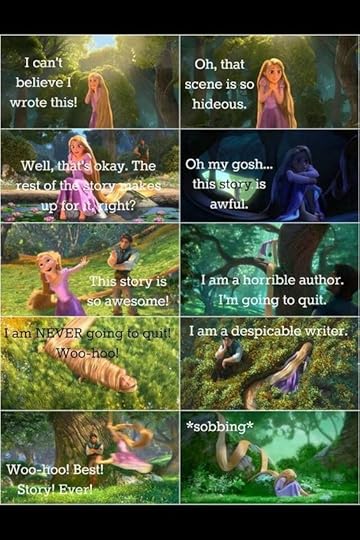 Exhausting, right? You're not alone! I can write something in a fevered frenzy and think it's fantastic, only to read back over it and wonder what I was thinking. Self-doubt is always right around the corner, trying to trip us up. Think questioning one chapter is bad? What about questioning your entire manuscript? Especially when you feel like you've edited it to death, only to receive negative feedback or crickets in response to your queries.So, how does one overcome this struggle? Can it be overcome?I think so.I have decided I have no choice but to write. I have too much story in me to ignore that desire. In coming to terms with my need to pursue as difficult a profession as this, I must come to terms with the fact that the question "Am I good enough?" will enter my brain from time to time.What's worked for me is mentally straddling the fine line between confidence and humility. Find the confidence to keep going every day, to believe in what you're writing, to say you're good enough and worthy of calling yourself a writer. But don't get so confident that you forget you can always improve and grow, so confident that you can't take constructive criticism and learn from rejection.For the record, I know this is certainly not the only trick, nor is it the best one. But this struggle will always be there, but this trick will stop me from spiraling. And adopting a mindset of inner peace certainly can't hurt, right?I hope you enjoyed the first post in The Struggle Bus series. Let's chat! Feel free to contact me through my website with your personal writing struggles. I'd be happy to commiserate with you. We'll get through this together, one page at a time.
One thing I think nearly every writer experiences -- both in the beginning stages of pursuing a career and one, ten, or twenty-five years down the line -- is the conflict between believing in your writing vs. hating every word you've just churned out. Deciding to pursue a career in writing is always exciting at first, because all we see of our favorite authors is the end result: their work sitting on bookshelves and New York Times Best Seller lists; the interviews; the film adaptations; their cool, possessed smiles in their headshots that stare at us from the back flaps of their books.But then when the six-figure publishing contracts don't immediately fall in our laps and the literary agents don't respond to our queries, we start to wonder what we're doing wrong, start questioning our abilities. Every writer has been through it. And I guarantee you some big-time writer out there is currently going through it; success does not mean the erasure of self-doubt.Since this business is so subjective, I think writers are constantly having their egos checked. This must be especially true with professional writers -- one publisher may like your writing style, while another hates it; one editor might believe your work doesn't need much tweaking, while another sends it back littered with notes. Additionally, we never know where we're going to stand with readers, so we have to be optimistic in order to keep going.But how does a writer with no platform keep feeling like their writing is good enough? Outside validation is important when you're trying to keep your spirits up -- otherwise, you're in your own head too much and can get down on yourself.Take this hilarious picture from the Disney/Pixar film Tangled for example. Using stills from a scene where Rapunzel breaks free from her tower prison and proceeds to go back and forth between loving her newfound freedom and wondering what in the world she's gotten herself into, we see an accurate depiction of the average writer's constant inner monologue.Exhausting, right? You're not alone! I can write something in a fevered frenzy and think it's fantastic, only to read back over it and wonder what I was thinking. Self-doubt is always right around the corner, trying to trip us up. Think questioning one chapter is bad? What about questioning your entire manuscript? Especially when you feel like you've edited it to death, only to receive negative feedback or crickets in response to your queries.So, how does one overcome this struggle? Can it be overcome?I think so.I have decided I have no choice but to write. I have too much story in me to ignore that desire. In coming to terms with my need to pursue as difficult a profession as this, I must come to terms with the fact that the question "Am I good enough?" will enter my brain from time to time.What's worked for me is mentally straddling the fine line between confidence and humility. Find the confidence to keep going every day, to believe in what you're writing, to say you're good enough and worthy of calling yourself a writer. But don't get so confident that you forget you can always improve and grow, so confident that you can't take constructive criticism and learn from rejection.For the record, I know this is certainly not the only trick, nor is it the best one. But this struggle will always be there, but this trick will stop me from spiraling. And adopting a mindset of inner peace certainly can't hurt, right?I hope you enjoyed the first post in The Struggle Bus series. Let's chat! Feel free to contact me through my website with your personal writing struggles. I'd be happy to commiserate with you. We'll get through this together, one page at a time.