Meike Torkelson's Blog
September 30, 2020
That "love thing"
This is inspired by a part of Melody Harper's Moon. I wrote the original chapter years ago, a frank look at what it means to love.
I realised as my son was leaving for abroad, we'd never really had a talk about it ...
Every day at home, there’s a couple of suitcases which get a little more packed, and a reality which feels a little more scary.
My son is getting ready to leave home, to move out to the UK for the rest of the year. Spending time with his grandparents, trying to find work, reconnecting with old schoolfriends.
It’s hard to imagine how quiet this bustling home will become, and it’s actually quite scary. I should be celebrating ‘getting my life back’ after parenthood. But truth be told, I don’t feel ready to let go.
Change is hard, and for parents watching their child going out, it’s a little anxious and lonely. You smile for them, you say “you’re going to have a great time”, but then you feel a little teary, and before you know it, you’ve selected a sad song from your MP3 player — it seems an appropriate soundtrack to your life right now.
Have you prepared them for everything?
That’s the thing going through your mind. You’ve seen them deal with levels of bullying at school, and cope well. You’ve talked to them about sex, sexuality, sexting, consent. Expressed so very strongly the importance of consent. You’ve seen how they behave with friends, how they can mix with almost anyone. How their sense of humour helps them to cope when people are nasty. You’ve encouraged them to talk to you when they have a bad day.
Over the years we’ve talked history, politics, my battle with mental health.
But one thing has bothered me in the last few weeks — he’s never had a girlfriend or a boyfriend. I’ve talked to him about sex, but not about love and relationships.
In so many ways, it’s a much harder conversation than sex. I’ve taught sex education at secondary school — you teach how you have sex, what happens, how babies are brought to term, birth control to prevent pregnancy and sexual disease. This is science, it’s all pretty well known.
But love? As a society we talk about it all the time, there are cards, gifts and movies dedicated to it. But what is it?
Can we promise to love someone without knowing what that truly means? And if we don’t, when we whisper to someone that we love them, isn’t it nothing more than a beautiful lie.
To me, love at it’s core is when someone’s well being means as much to you as your own. It’s the only definition which covers the spectrum of emotion I feel for my parents, my son and my partner.
Of course, when it comes to my partner there is that whole “sexual activities” that happen between consenting couples. But love is more than a word to use to get sex from someone you like. It’s the desire to support the other’s wellbeing which has got us as a family through tough emotional and physical hurts. My son has witnessed this every step of the way.
But maybe because love’s a feeling, and an intense one at that, it just cannot be pinned adequately down to words. It’s almost why we need art through painting and music and sonnet to help portray and express something we so struggle to express. Perhaps that’s the reason we fear the words “I love you”, because in a way those three words feel inadequate.
When Nina Simone sings “To Love Somebody”, you’re left in absolutely no doubt through the sincerity of her singing and the raw power in her voice that she knows what love is, and it’s something that moves her so deeply …
https://www.dailymotion.com/video/x13...
I’ve tried a couple of times to have this conversation with him. It’s either not been the right situation, or I’ve bottled out. To talk about love, is to talk about how it makes us feel, and that’s an awkward and vulnerable conversation.
So, we had that awkward, icky conversation about love. And his first reaction was to scoff “really, we’re doing this?”. Of course I should know I’ve raised him right, all I had to do was say “this is important to me”, and he went with it.
I told him that love can be intoxicating, it’s probably the most euphoric drug you’ll experience. And also the most dangerous.
Because there’s a dark side to it. Love can make us want to do crazy things, things we’d not normally consider. Sometimes it’s because we’re desperate to impress someone we love. And a sad reality is that when we love someone and either they don’t feel the same, or they hurt us, it feels like there’s no defense against it. It can make us feel angry or incredibly sad.
Sometimes from the hearts, flowers and cards you think love can only make you feel warm and fuzzy, but it can makes us feel other emotions, and all at a really loud intensity.
I asked him to remember everything he’d seen in my relationships. The times my partner and I didn’t speak to each other for days, but also that it didn’t last forever. That we got angry, but we had limits. But most of all, we could work through things. And heck, even such oddballs that my partner and me were, we’d found someone in each other who matched our weird. It took us a lot of dating, he’d find his odd match too one day.
I realised as my son was leaving for abroad, we'd never really had a talk about it ...
Every day at home, there’s a couple of suitcases which get a little more packed, and a reality which feels a little more scary.
My son is getting ready to leave home, to move out to the UK for the rest of the year. Spending time with his grandparents, trying to find work, reconnecting with old schoolfriends.
It’s hard to imagine how quiet this bustling home will become, and it’s actually quite scary. I should be celebrating ‘getting my life back’ after parenthood. But truth be told, I don’t feel ready to let go.
Change is hard, and for parents watching their child going out, it’s a little anxious and lonely. You smile for them, you say “you’re going to have a great time”, but then you feel a little teary, and before you know it, you’ve selected a sad song from your MP3 player — it seems an appropriate soundtrack to your life right now.
Have you prepared them for everything?
That’s the thing going through your mind. You’ve seen them deal with levels of bullying at school, and cope well. You’ve talked to them about sex, sexuality, sexting, consent. Expressed so very strongly the importance of consent. You’ve seen how they behave with friends, how they can mix with almost anyone. How their sense of humour helps them to cope when people are nasty. You’ve encouraged them to talk to you when they have a bad day.
Over the years we’ve talked history, politics, my battle with mental health.
But one thing has bothered me in the last few weeks — he’s never had a girlfriend or a boyfriend. I’ve talked to him about sex, but not about love and relationships.
In so many ways, it’s a much harder conversation than sex. I’ve taught sex education at secondary school — you teach how you have sex, what happens, how babies are brought to term, birth control to prevent pregnancy and sexual disease. This is science, it’s all pretty well known.
But love? As a society we talk about it all the time, there are cards, gifts and movies dedicated to it. But what is it?
Can we promise to love someone without knowing what that truly means? And if we don’t, when we whisper to someone that we love them, isn’t it nothing more than a beautiful lie.
To me, love at it’s core is when someone’s well being means as much to you as your own. It’s the only definition which covers the spectrum of emotion I feel for my parents, my son and my partner.
Of course, when it comes to my partner there is that whole “sexual activities” that happen between consenting couples. But love is more than a word to use to get sex from someone you like. It’s the desire to support the other’s wellbeing which has got us as a family through tough emotional and physical hurts. My son has witnessed this every step of the way.
But maybe because love’s a feeling, and an intense one at that, it just cannot be pinned adequately down to words. It’s almost why we need art through painting and music and sonnet to help portray and express something we so struggle to express. Perhaps that’s the reason we fear the words “I love you”, because in a way those three words feel inadequate.
When Nina Simone sings “To Love Somebody”, you’re left in absolutely no doubt through the sincerity of her singing and the raw power in her voice that she knows what love is, and it’s something that moves her so deeply …
https://www.dailymotion.com/video/x13...
I’ve tried a couple of times to have this conversation with him. It’s either not been the right situation, or I’ve bottled out. To talk about love, is to talk about how it makes us feel, and that’s an awkward and vulnerable conversation.
So, we had that awkward, icky conversation about love. And his first reaction was to scoff “really, we’re doing this?”. Of course I should know I’ve raised him right, all I had to do was say “this is important to me”, and he went with it.
I told him that love can be intoxicating, it’s probably the most euphoric drug you’ll experience. And also the most dangerous.
Because there’s a dark side to it. Love can make us want to do crazy things, things we’d not normally consider. Sometimes it’s because we’re desperate to impress someone we love. And a sad reality is that when we love someone and either they don’t feel the same, or they hurt us, it feels like there’s no defense against it. It can make us feel angry or incredibly sad.
Sometimes from the hearts, flowers and cards you think love can only make you feel warm and fuzzy, but it can makes us feel other emotions, and all at a really loud intensity.
I asked him to remember everything he’d seen in my relationships. The times my partner and I didn’t speak to each other for days, but also that it didn’t last forever. That we got angry, but we had limits. But most of all, we could work through things. And heck, even such oddballs that my partner and me were, we’d found someone in each other who matched our weird. It took us a lot of dating, he’d find his odd match too one day.


August 22, 2020
Hot editing tip - are you listening to what you're writing?
Yeah - editing continues! It's a slow process, and I'm okay with that.
I work in software, and I know for a fact that mistakes happen in anything you write, from structured computer code to your novel. Heck it always feels my more popular tweets usually contain a spelling mistake which makes me wince every time I read.
Getting a better product post-editing involves creating different ways to look at your writing. And there are a number of tools - from the basic spellchecker, to Grammar tools, to looking at what you've written a few weeks later, to getting someone else to edit for you.
Each pass helps, and ideally used right, it helps solve the 'low hanging fruit'. You'd feel dumb using an editor to check for items you could have used a spellchecker for, after all!
An additional tool in my editing arsenal is increasingly using text to speech functions, my preferred one is,
http://www.fromtexttospeech.com/
They're not perfect, and still sound a bit robotic in places. However it allows me to experience my writing a different way. Occasionally I'll write a sentence, come back to it and wonder 'does that read how I think it reads?'. Tools like this help.
Anything which shifts your perception is helpful. As I know through my software work, errors and mistakes often happen right in front of our eyes, but they're damn difficult to spot.
In studies it's interesting how little of a sentence we'll actually read - it's estimated to be as low as 28% (see references below).
As authors we can fool ourselves into reading a sentence as we think it should be read, we probably rate even lower!
This method is great for checking how a paragraph flows and general sense - I also find myself more attuned to overuse of words. But it won't pick up spelling. Or for me, when I'm writing a phrase I use a lot and not sure if it's "I cannot bare" or "I cannot bear".
But like I said, editing is not a single method or tool. It's about having a toolbox to make improvements. This is a fun one - it's also really lovely to hear what you've written spoken aloud.
References
https://www.nngroup.com/articles/how-...
https://www.independent.co.uk/news/sc...
https://www.sciencealert.com/word-jum...
I work in software, and I know for a fact that mistakes happen in anything you write, from structured computer code to your novel. Heck it always feels my more popular tweets usually contain a spelling mistake which makes me wince every time I read.
Getting a better product post-editing involves creating different ways to look at your writing. And there are a number of tools - from the basic spellchecker, to Grammar tools, to looking at what you've written a few weeks later, to getting someone else to edit for you.
Each pass helps, and ideally used right, it helps solve the 'low hanging fruit'. You'd feel dumb using an editor to check for items you could have used a spellchecker for, after all!
An additional tool in my editing arsenal is increasingly using text to speech functions, my preferred one is,
http://www.fromtexttospeech.com/
They're not perfect, and still sound a bit robotic in places. However it allows me to experience my writing a different way. Occasionally I'll write a sentence, come back to it and wonder 'does that read how I think it reads?'. Tools like this help.
Anything which shifts your perception is helpful. As I know through my software work, errors and mistakes often happen right in front of our eyes, but they're damn difficult to spot.
In studies it's interesting how little of a sentence we'll actually read - it's estimated to be as low as 28% (see references below).
As authors we can fool ourselves into reading a sentence as we think it should be read, we probably rate even lower!
This method is great for checking how a paragraph flows and general sense - I also find myself more attuned to overuse of words. But it won't pick up spelling. Or for me, when I'm writing a phrase I use a lot and not sure if it's "I cannot bare" or "I cannot bear".
But like I said, editing is not a single method or tool. It's about having a toolbox to make improvements. This is a fun one - it's also really lovely to hear what you've written spoken aloud.
References
https://www.nngroup.com/articles/how-...
https://www.independent.co.uk/news/sc...
https://www.sciencealert.com/word-jum...
August 10, 2020
The look of editing
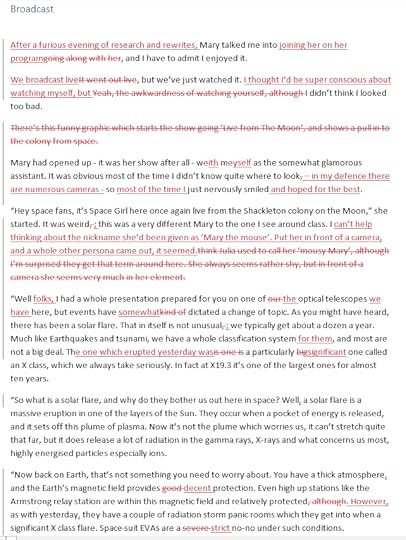
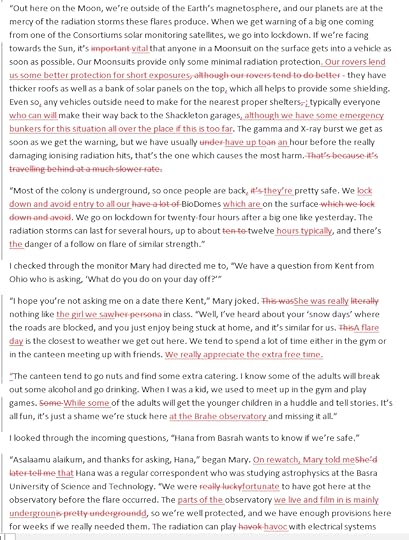
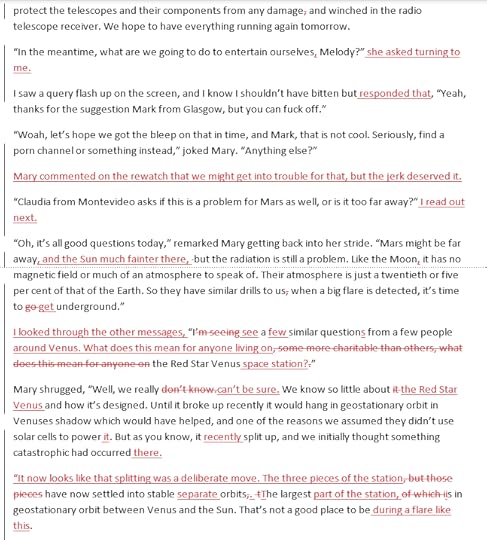
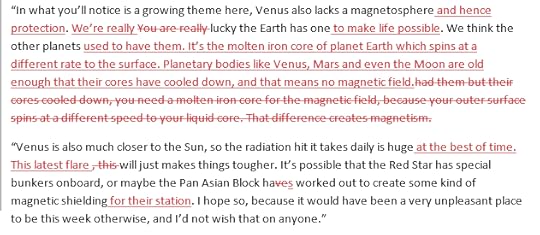
Some bits of my work in progress are in better shape than others. This is something I allow myself with the first draft - the goal is to get to the end.
Polishing up is the goal of ediitng.
Still, it's interesting to see how much does change in editing. Often I find a lot of what I've written works, I still like to mould it to try and read and flow as seemlessly as I can.
I'm a change addict!
Polishing up is the goal of ediitng.
Still, it's interesting to see how much does change in editing. Often I find a lot of what I've written works, I still like to mould it to try and read and flow as seemlessly as I can.
I'm a change addict!
August 6, 2020
Ethics discussion - a gem found while editing
I took almost six whole weeks off between finishing my first draft and starting editing of my third novel, Melody Harper's Earth.
I will be blunt, I opened up the opening, and felt like I was looking at a trash fire. If the whole book was like this, it was going to be a tough slog.
Fortunately, I always struggle with beginnings, and although there's a lot of work still to do, we're making progress.
Along the way, you find some gems which have slipped your mind. This chapter was a gem to discover last night, and I'd like to share it with you.
Editing is a particularly strange experience during these Covid times. Some parts of my book comes from late 2019, and yet there are elements which seem more relevant than I could imagine.
In this chapter (slightly edited for spoilers), Melody's mother ends up taking a class on ethics to a first generation class of teens on the Moon. It's something I feel strongly as an ex-teacher - we're force fed a lot of measurable things like science and maths, which are important. But there was less emphasis on things like 'making decisions' and 'voting'.
Some people will perhaps say that politics should stay out of writing. I feel that in writing you create (even when writing in a contemporary setting) a world where you say 'this is acceptable' and 'this is unacceptable'. It is the most political of things to be a writer.
If you enjoy this - consider checking out book 1, Melody Harper's Moon ...
I’ve said before that the school timetable can be a little crazy. Usually, it’s only when I check my CompPad in the morning that I know for sure what the day ahead will look like. Our teachers do it as their second job, so the scheduling is continually changing around their availability. Nevertheless, no matter how chaotic the timetable is, there isn’t much variation in the subjects on offer, until today.
We had a new class right before lunch, one I’d never seen before, ‘Ethics And Responsibility’. The class morning gossip was all around what that was about, and where it had come from.
Unfortunately, when the teacher walked in, I realised I was going to live out most student’s worst nightmare - I was going to be taught at school by one of my parents, my Mum, to be exact.
“Morning students, I’m Mrs Delia, and I’m going to be your teacher for the new subject of ethics,” Mum announced.
There was a lot of murmuring amongst some of my friends; Mum had said she’d try and find a way that we could talk more publically about how we wanted the colony to change. I guess this was her solution.
She went on to explain, “My husband and I had a conversation with councilwoman Claire about this class. So much of your education has been tightly focused on maths and science and engineering. But we’re not just physically building a colony here; we’re building a society. And an essential element of any society involves understanding what we as a group of people value and how we as individuals should act in accordance with that. As we’ll explore in these lessons, there are even at times where we should challenge the status quo.
“Our ethics and our values drive everything we do, and it’s essential to explore and understand them. Within the Atlantic Consortium we believe in principles of democracy, and how you exercise your vote whether for council positions or in elections in the countries back on Earth that you have recognised citizenship in will shape not just your future but that for others as well.
“So, who am I, and why am I teaching you? I’m of course Melody’s mother, and I work in habitat construction with my husband. But when I was not much older than you, I was in South Africa as a conscript soldier during the Uranium Wars, and I had a difficult choice to make. When Johannesburg was hit, we were given orders to advance into the fallout zone. We did not have adequate equipment for the task, and we knew it. But still, our orders were our orders.
“My unit were convinced to follow those orders was nothing short of reckless suicide. Our commanding officers disagreed. This, I hope, is a situation you never find yourself in. We chose to mutiny, we decided to retreat and evacuate as many people as we could with us.”
There was stunned silence.
With everyone’s rapt attention, she continued, “Those kind of decisions are tough ones. There are consequences if you follow your orders, there are consequences if you disobey them. We paid the price for our course of actions and faced a court-martial and possible execution. Even when we were finally cleared, we were villainised and hounded by some media, by some people who had family members who didn’t make it out, from people who just thought they would have done it better. It was one of the reasons I chose to marry and change my name so young, and move away from where I grew up, in the hope of some kind of normal life. And yet I stand by what we did, the decisions we made.
“Going into adulthood is all about making decisions, and being able to understand why you make them and being able to stand by them. I’m hoping the hardest decision you have for a while is whether you should ask out Veronica or Betty.”
There was some laughter to that.
“Okay, let’s start with a bit of a test,” and she showed a series of black-and-white pictures on the screen. The first was of a chemist in a white coat, replete with a goatee beard. The second a woman with short, sculpted wavey hair who wore a pleated V-neck dress. The third was a man with a receding hair and a somewhat ridiculous moustache, wearing a business suit.
“Okay, here is our lineup, and I just need you to pick out the criminal amongst them,” she said.
There were a lot of people who went for the scientist or the businessman; everyone had a bias at play. Mum let the guesses come in for a while before putting them out of their misery, “Okay, so in actual fact, they were all criminals. So which of them were bad people?”
Ganesh came out with, “Well if they broke the law, they all must have been bad people.”
Mum acknowledged his point, “In an ideal world you’re right. Laws should reflect our morality, and breaking them indicate that we are bad people. So let me introduce you to this group of hardened criminals who were unrepentant in their crimes.
“The scientist is Rudolf Weigl, who was Polish and created vaccines against typhus. But alas he lived under a regime called the Nazis in the twentieth century. Under Nazi law, all Polish citizens were supposed to report and turn in any Jewish people to the authorities so they could be sent to concentration camps where many would die in a mass genocide we call The Holocaust or Shoah. The hardened criminal that he was, Rudolf hid Jews and also helped them by providing them with vaccines and medicines. Had he been caught, he would have been executed as helping enemies of the state.
“The lady who’s looking incredibly well coiffured is Miep Gies. She lived in the Netherlands and tried to hide her boss Otto Frank, and her more famous daughter Anne. Again, criminal activity under the Nazis.
“And finally we come to the smartly dressed man, with what has to be one of the world’s worst moustaches. He is actually the worst of the bunch, Dimitar Peshev. A politician in occupied Bulgaria, he rebelled and prevented the 48,000 Jews in his country from being deported to death camps.”
Mary asked, “But surely there must be checks and balances which prevent a country from bringing allowing laws like that, which people don’t agree to? Surely it couldn’t happen any more.”
A few people murmured support for Mary’s sentiment.
“I know you focus more on the history of space,” Mum explained, “but Earth has a rich history of periods where people have gone through one travesty convinced it could never happen again, only to sleep right into another. There was The Great War of the twentieth century which was known as ‘the war to end wars’. We now know it as World War One, and barely twenty years later we found ourselves in World War Two. Was, it seems, had not ended as hoped.
“In a robust political system, there should always be some kind of supreme court or constitution to prevent radical shifts of policy, but opportunists have too often been able to sidestep them and game the system. Typically under the guise of an emergency. The sheer number of dictatorships which rose out of what were supposed to be democracies is staggering - even many of the Pan Asian Block countries started the twenty-first century as democracies.
“So let’s look at these three again, and I’m going to ask you to do some research on them. Are they all criminals? Without a doubt, they broke the law. But was it a just law? Were they right to defy it? Do we get to pick and choose the laws we obey?”
She set some reading assignments, and the class descended into a hush. She managed to flash me a smile as she helped Mary find some references. I guess in a way, our discussions as the Resistance are going to be able to be a lot more public.
I also figure we can look forward to such homework as ‘challenge the patriarchy in the Lunar colony’. I can hope.
I will be blunt, I opened up the opening, and felt like I was looking at a trash fire. If the whole book was like this, it was going to be a tough slog.
Fortunately, I always struggle with beginnings, and although there's a lot of work still to do, we're making progress.
Along the way, you find some gems which have slipped your mind. This chapter was a gem to discover last night, and I'd like to share it with you.
Editing is a particularly strange experience during these Covid times. Some parts of my book comes from late 2019, and yet there are elements which seem more relevant than I could imagine.
In this chapter (slightly edited for spoilers), Melody's mother ends up taking a class on ethics to a first generation class of teens on the Moon. It's something I feel strongly as an ex-teacher - we're force fed a lot of measurable things like science and maths, which are important. But there was less emphasis on things like 'making decisions' and 'voting'.
Some people will perhaps say that politics should stay out of writing. I feel that in writing you create (even when writing in a contemporary setting) a world where you say 'this is acceptable' and 'this is unacceptable'. It is the most political of things to be a writer.
If you enjoy this - consider checking out book 1, Melody Harper's Moon ...
I’ve said before that the school timetable can be a little crazy. Usually, it’s only when I check my CompPad in the morning that I know for sure what the day ahead will look like. Our teachers do it as their second job, so the scheduling is continually changing around their availability. Nevertheless, no matter how chaotic the timetable is, there isn’t much variation in the subjects on offer, until today.
We had a new class right before lunch, one I’d never seen before, ‘Ethics And Responsibility’. The class morning gossip was all around what that was about, and where it had come from.
Unfortunately, when the teacher walked in, I realised I was going to live out most student’s worst nightmare - I was going to be taught at school by one of my parents, my Mum, to be exact.
“Morning students, I’m Mrs Delia, and I’m going to be your teacher for the new subject of ethics,” Mum announced.
There was a lot of murmuring amongst some of my friends; Mum had said she’d try and find a way that we could talk more publically about how we wanted the colony to change. I guess this was her solution.
She went on to explain, “My husband and I had a conversation with councilwoman Claire about this class. So much of your education has been tightly focused on maths and science and engineering. But we’re not just physically building a colony here; we’re building a society. And an essential element of any society involves understanding what we as a group of people value and how we as individuals should act in accordance with that. As we’ll explore in these lessons, there are even at times where we should challenge the status quo.
“Our ethics and our values drive everything we do, and it’s essential to explore and understand them. Within the Atlantic Consortium we believe in principles of democracy, and how you exercise your vote whether for council positions or in elections in the countries back on Earth that you have recognised citizenship in will shape not just your future but that for others as well.
“So, who am I, and why am I teaching you? I’m of course Melody’s mother, and I work in habitat construction with my husband. But when I was not much older than you, I was in South Africa as a conscript soldier during the Uranium Wars, and I had a difficult choice to make. When Johannesburg was hit, we were given orders to advance into the fallout zone. We did not have adequate equipment for the task, and we knew it. But still, our orders were our orders.
“My unit were convinced to follow those orders was nothing short of reckless suicide. Our commanding officers disagreed. This, I hope, is a situation you never find yourself in. We chose to mutiny, we decided to retreat and evacuate as many people as we could with us.”
There was stunned silence.
With everyone’s rapt attention, she continued, “Those kind of decisions are tough ones. There are consequences if you follow your orders, there are consequences if you disobey them. We paid the price for our course of actions and faced a court-martial and possible execution. Even when we were finally cleared, we were villainised and hounded by some media, by some people who had family members who didn’t make it out, from people who just thought they would have done it better. It was one of the reasons I chose to marry and change my name so young, and move away from where I grew up, in the hope of some kind of normal life. And yet I stand by what we did, the decisions we made.
“Going into adulthood is all about making decisions, and being able to understand why you make them and being able to stand by them. I’m hoping the hardest decision you have for a while is whether you should ask out Veronica or Betty.”
There was some laughter to that.
“Okay, let’s start with a bit of a test,” and she showed a series of black-and-white pictures on the screen. The first was of a chemist in a white coat, replete with a goatee beard. The second a woman with short, sculpted wavey hair who wore a pleated V-neck dress. The third was a man with a receding hair and a somewhat ridiculous moustache, wearing a business suit.
“Okay, here is our lineup, and I just need you to pick out the criminal amongst them,” she said.
There were a lot of people who went for the scientist or the businessman; everyone had a bias at play. Mum let the guesses come in for a while before putting them out of their misery, “Okay, so in actual fact, they were all criminals. So which of them were bad people?”
Ganesh came out with, “Well if they broke the law, they all must have been bad people.”
Mum acknowledged his point, “In an ideal world you’re right. Laws should reflect our morality, and breaking them indicate that we are bad people. So let me introduce you to this group of hardened criminals who were unrepentant in their crimes.
“The scientist is Rudolf Weigl, who was Polish and created vaccines against typhus. But alas he lived under a regime called the Nazis in the twentieth century. Under Nazi law, all Polish citizens were supposed to report and turn in any Jewish people to the authorities so they could be sent to concentration camps where many would die in a mass genocide we call The Holocaust or Shoah. The hardened criminal that he was, Rudolf hid Jews and also helped them by providing them with vaccines and medicines. Had he been caught, he would have been executed as helping enemies of the state.
“The lady who’s looking incredibly well coiffured is Miep Gies. She lived in the Netherlands and tried to hide her boss Otto Frank, and her more famous daughter Anne. Again, criminal activity under the Nazis.
“And finally we come to the smartly dressed man, with what has to be one of the world’s worst moustaches. He is actually the worst of the bunch, Dimitar Peshev. A politician in occupied Bulgaria, he rebelled and prevented the 48,000 Jews in his country from being deported to death camps.”
Mary asked, “But surely there must be checks and balances which prevent a country from bringing allowing laws like that, which people don’t agree to? Surely it couldn’t happen any more.”
A few people murmured support for Mary’s sentiment.
“I know you focus more on the history of space,” Mum explained, “but Earth has a rich history of periods where people have gone through one travesty convinced it could never happen again, only to sleep right into another. There was The Great War of the twentieth century which was known as ‘the war to end wars’. We now know it as World War One, and barely twenty years later we found ourselves in World War Two. Was, it seems, had not ended as hoped.
“In a robust political system, there should always be some kind of supreme court or constitution to prevent radical shifts of policy, but opportunists have too often been able to sidestep them and game the system. Typically under the guise of an emergency. The sheer number of dictatorships which rose out of what were supposed to be democracies is staggering - even many of the Pan Asian Block countries started the twenty-first century as democracies.
“So let’s look at these three again, and I’m going to ask you to do some research on them. Are they all criminals? Without a doubt, they broke the law. But was it a just law? Were they right to defy it? Do we get to pick and choose the laws we obey?”
She set some reading assignments, and the class descended into a hush. She managed to flash me a smile as she helped Mary find some references. I guess in a way, our discussions as the Resistance are going to be able to be a lot more public.
I also figure we can look forward to such homework as ‘challenge the patriarchy in the Lunar colony’. I can hope.