L. Jaye Morgan's Blog
January 19, 2019
This is What Happens When Life Happens
This past week I had to make a very difficult decision. I stressed and obsessed about it for a week before I finally decided to cancel the pre-order for I Will Remember You.
Why? Life happened. I picked up a second class at the last minute and made some headway on my dissertation. I had a draft uploaded to Amazon but the simple truth is that it was not my best work. I could have allowed it to go live and made edits later once my schedule calmed down but that would have meant the people who pre-ordered would receive an imperfect draft. And while no novel is ever truly perfect, my goal is always to get as close as I possibly can. To that end, I pulled it.
So what happens next? Revisions and edits. Once those are done, the finished novel will go live. To those who pre-ordered, I apologize for the delay. To the rest of my readers, it’s on its way. Thank you for your patience!


November 17, 2018
My Love for Scary Things
If I had to pinpoint the exact moment I fell in love with scary things, it would be when I read The Babysitter by R. L. Stine.
Picture it. Stone Mountain. 1989. My mother drove ten-year-old me to the (now defunct) Waldenbooks on Memorial Drive. This was a treat for me because there was nothing more fun for me than getting lost in a good book.
I perused the children and young adult sections looking for the latest Babysitter’s Club or Sweet Valley Twins books. Those were light and fluffy stories that were kind of frivolous, but ten-year-old me liked them well enough. And then I spotted it. The cover of the book with the scared-looking girl being watched through a window. I was intrigued and a little creeped out, the perfect combination.
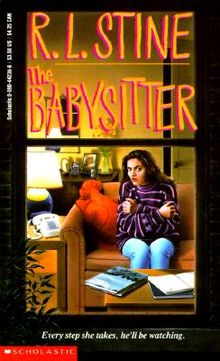
My mother bought it and I took it home and devoured it, probably in a day or two. From that moment, I was hooked. And then I discovered Christopher Pike and the Final Friends series, which I breezed through before reading nearly everything else Pike wrote.
I’m not sure what it was about the books that attracted me…maybe their accessibility for me, a young reader who wanted to be scared but not horrified. Or maybe it was the mystery/whodunit-ness of them all. But I fell in love and eventually extended that love to movies in the suspense/thriller genre. And now, of course, Investigation Discovery, which is solely dedicated to domestic thriller programming, is my favorite channel.
That I now write psychological thrillers is no great mystery. It’s obviously been a long time in the making!
October 6, 2018
Let's Talk About Sex
More to the point, sex in mystery fiction. Believe it or not, not everyone wants to read sex scenes. Surprised? Me, too. I mean we’re all adults, right?
There seems to be an even split between readers who don’t mind sex scenes and readers who do. The latter group confuses me a bit. Most books in the mystery/detective/crime genre contain graphic descriptions of crime scenes, blood, wounds, weapons, and other violence, but apparently sex is some readers’ hill to die on.
Let this serve as fair warning to anyone reading my work: I write sex into my stories. Why? Because sex is a natural part of life. Some readers feel sex scenes are irrelevant and gratuitous, but I think that sentiment can apply to many other activities we write in. My characters eat ( a lot!), sleep, bathe themselves, and exercise and sometimes these actions aren’t directly related to the plot. Still, I include them because my characters are fully actualized human beings.
September 30, 2018
Pantsing vs. Plotting

What difference does it make which method you use? The debate rages on among writers.
What am I talking about? In the writing world, pantsing describes a process wherein the author writes her story in a carefree manner, flying by the seat of her pants with no outline or predetermined path. Plotting is a writing method that relies on an outline and/or deep consideration about how the story will go.
So which one is better?
That depends on the author. I’ve tried both methods and found that plotting works best for me. However, I’m actually pretty loose with my plotting and my outline usually consists of a basic summary of what needs to happen in the story. I’m currently writing my second novel and my outline is a bit more detailed than the one I used for the first novel. I expect that my plotting will get tighter the more books I write.
Some authors swear by pantsing, and I can see how that might be preferable, particularly if you do writing sprints. I imagine sitting at a keyboard and typing with abandon, with no outline to constrain you, results in a very productive writing session.
There’s really no right or wrong answer, just what works best for you.
September 25, 2018
Black Serial Killers
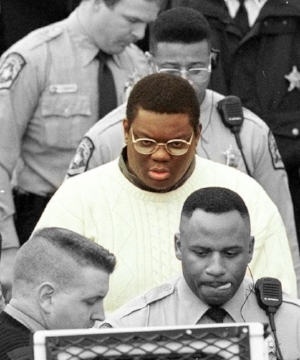
Henry Louis Wallace
I love the Investigation Discovery Channel (ID). In fact, I love it so much my husband calls it my “murder station" and shakes his head when he sees me watching my “murder shows.” I don't know what it says about me and I probably don't wanna know, but I watch faithfully every day.
One thing I've observed is that the vast majority of the shows feature white killers. That makes sense given the demographics of the U.S. but the sociologist in me finds it interesting that black perpetrators are underrepresented on the shows about serial killers.
This may surprise you as it did me, but according to Psychology Today, approximately 20% of the country's serial killers are black. The article also rightly points out that popular culture only lionizes white serial killers. The one exception to this rule is Wayne Williams, the man convicted for the Atlanta Child Murders.
If we let the media tell it, we might believe only white men are serial killers. I talked about this a bit in Of Things Unseen, along with the unconscious biases we (society) hold about serial murders. In addition to believing white men are the main perpetrators, we also believe white women are the main victims. And that’s just not the case.
The ID channel has done a pretty good job of telling the stories of black serial killers and their black female victims. Through their shows, I learned about Henry Louis Wallace (Bad Henry), Lonnie David Franklin Jr. (The Grim Sleeper), Carl Eugene Watts (The Sunday Morning Slasher), and Nathaniel White. And these men all had one thing in common:
Black Women as Victims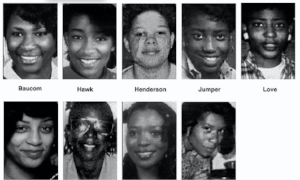
Henry Louis Wallace’s Victims
Most or all of their victims were black women, a demographic that has rarely been seen as innocent victims. The news media loves white female victims, particularly if they are blonde-haired, blue-eyed, and middle class (a phenomenon known as “Missing White Woman Syndrome”). This fixation leaves out other missing and murdered groups, including men and little boys, and especially black women.
I chose to write about this issue in Of Things Unseen. Although it’s a work of fiction, it shines light on a very real problem. Our societal biases have created a climate wherein police don’t view black women as true victims and are therefore less likely to spend time making important connections between cases. The Grim Sleeper was able to terrorize Los Angeles for 20 years because the LAPD categorized the deaths of his victims “NHI” meaning No Humans Involved. That’s a direct reflection of the way black women are viewed.
The black community shares a bit of blame here, too. The Grim Sleeper was protected. Not by police, but by the residents of his neighborhood. I was stunned to discover that there were people who knew he was killing women, but they either convinced themselves their good friend Lonnie wouldn’t do something like that or they turned a blind eye because they were benefiting from his largesse.
We need to do better. All of us. Black women’s lives matter but historically, we have been unprotected and disrespected (shout out to Malcolm X), expected to shoulder countless burdens without complaint or redress. I hope readers are able to empathize with the black women in my story who are not just victims, but fully-actualized human beings who deserve to be treated as such. They’re mothers, daughters, wives, sisters, coworkers, and classmates, and they deserve better.
black mecca
methods
plotting
race
sex
Novel Topics
Writing
Why Do I Write About Atlanta?
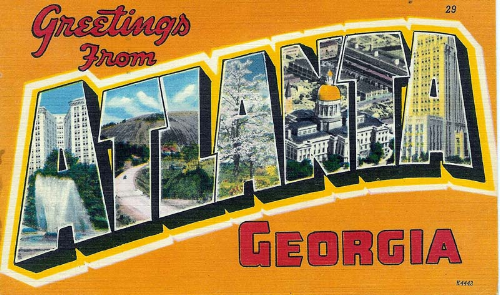
Why Do I Write About Atlanta?
Good question. Nobody’s asked it, but it’s a good question nonetheless. Full disclosure: I wasn’t born here. I was born in Indiana. I’ve been here for 36 years, though, and I think that qualifies me to call Atlanta home and to consider myself a Georgia Peach. Now, about this town:
The Black MeccaAtlanta has long captured the imagination of black folks throughout the country. I won’t bore you with a history lesson but the TLDR version of what happened is this: In 1865, after the Civil War ended, there were roughly 4.5 million African American descendants of slaves (AADOS) in the U.S. and 85% of them lived in the South. Between 1910 and 1970, about 6 million AADOS migrated to the North, West, and Midwest in search of opportunity. This is known as the Great Migration.
What does this have to do with Atlanta? The 1970s saw that trend reverse as African Americans began to migrate back to the South. Atlanta, in particular, was seen as a place where black folks could thrive, and Ebony magazine dubbed the city "Black Mecca of the South.” My own family was part of the reverse migration; my mother moved us down here in the early 80s.
I’ll be honest. I loved it. I still love it. It’s not perfect by any stretch, but the low cost of living, all-black suburbs, black schools, and black professional class are just a few reasons why I stayed here, and why African Americans continue to come here. However:
The City Too Busy to Hate?Nah. That’s been our mantra/slogan/ideology since the 60s but trust, it’s all PR. There’s plenty of hate. And tension. And inequality. And segregation. And elitism. But it’s all a part of this vibrant, dynamic city.
So why do I write about it?
Atlanta Is Its Own Character and It’s UnderrepresentedThere are still plenty of stories to tell about life in the Black Mecca.
Tom Wolfe and Margaret Mitchell, who are white, are perhaps the most famous novelists to set their stories in Atlanta (someone correct me if I’m wrong), and a cursory glance at Wikipedia’s list of Atlanta novelists shows that the vast majority of them are also white. That’s all well and good but we need a wider representation of perspectives.
I aim to add my perspective in a way that both honors and critically examines my beloved city. That means sometimes I will wax poetic, and other times I will drag Atlanta by its follicles. Either way, it’s all love.
race
methods
black mecca
sex
plotting
pantsing
representation
life
Novel Topics
Writing
Welcome!
So…I’m going to blog, and I would like to invite you to settle in and get comfortable. Make yourself a drink, put your feet up, etc. My aim is to post every day but if you’ve ever read a blog before, you know how that goes.
I’m going to talk about my life, including but not limited to novel writing, research, school, family, pop culture, and anything else I deem important enough to post. I’m a woman, I’m black, I’m a southerner, and I’m a black woman from the south, so content will be particularly geared toward those demographics. But everyone is welcome.
See you soon!