Joe DeShon's Blog
September 9, 2022
We Are All British Today

In the wake of the passing of Queen Elizabeth, I am reminded of my own British heritage. Despite my anglicized French surname, a DNA analysis tells me almost all my ancestry hails from the British Isles.
Still, as an American, it’s interesting to watch the British react to news from the Monarchy. This news wasn’t unexpected as was the news of Dianna 25 years ago, or even of King George VI in 1952. But it is rightly met with grief and sorrow. Ninety percent of the world population has never known a “King” of England in their lifetime. The notion of anybody except Elizabeth sitting on the throne will take some getting used to.
In America, we have no established “royalty”. Perhaps the Adams family or the Roosevelts or the Bushes or the Kennedys would come close. But their royal-ness pales in comparison to the crowns and titles and regality that subjects enjoy in Britain. (Indeed, Americans are not “subjects” to a crown; we are “citizens” -- and proudly so.)
But there is one institution that Americans hold as dear to our heart. There is one item that we hold in reverence, much in the same way as Britons revere the Monarchy.
It is the flag.
When we are young, we are taught to pledge allegiance to the flag. Not to the president, not to the government, but to the “flag”. Is there something special about a swatch of nylon or polyester that demands allegiance?
No, not the “flag” itself. In fact, we are constantly reminded that the fabric of the flag is ephemeral. When it is inevitably worn-out, it is not to be preserved; it is to be respectfully “retired”.
The flag is merely an image, a representation of something much greater. It represents a nation of vast resources, and the capacity and motivation to properly manage them. A nation that comes to the defense of our friends. A nation that, for the most part, fights wars of liberation, not of conquest.
The flag does none of the above, but it represents everything about the nation and the people who live here that make this country so great.
That was the purpose behind laws forbidding the wanton destruction of our flag. That’s why we respect it enough to forbid it from touching the ground. That’s why we salute it and fold it in a triangle.
Even our national anthem speaks to the power and meaning behind the flag. The “Star-Spangled Banner” is not a song about war (as has been claimed). It is about the enduring power of the flag. “The rocket’s red glare, the bombs bursting in air, gave proof through the night that our FLAG was still there.” Francis Scott Key was rejoicing not in the victory of the army, but in the resilience that was demonstrated by the flag.
Such it is with the British and their Monarchs. Kings and Queens are skin-and-bones -- basically carbon-based life forms, if you will. They may be long-lived, but not immortal. They may be regal, but not gods.
Just as America changes the flag with the addition of each new state, the national anthem of Great Britain will now be “God Save the King”. The Monarchy is above politics, and thus deserves and receives the blessings of God, in the minds of the Britons. The Windsors are thus royalty only in the sense that they represent the hope of the future for the great British Empire.
For the next few days, I think it would be appropriate for the entire world to consider themselves British. The Queen is Dead; Long Live the King!


We Are all British Today
In the wake of the passing of Queen Elizabeth, I am reminded of my own British heritage. Despite my anglicized French surname, a DNA analysis tells me almost all my ancestry hails from the British Isles.
Still, as an American, it’s interesting to watch the British react to news from the Monarchy. This news wasn’t unexpected as was the news of Dianna 25 years ago, or even of King George VI in 1952. But it is rightly met with grief and sorrow. Ninety percent of the world population has never known a “King” of England in their lifetime. The notion of anybody except Elizabeth sitting on the throne will take some getting used to.
In America, we have no established “royalty”. Perhaps the Adams family or the Roosevelts or the Bushes or the Kennedys would come close. But their royal-ness pales in comparison to the crowns and titles and regality that subjects enjoy in Britain. (Indeed, Americans are not “subjects” to a crown; we are “citizens” -- and proudly so.)
But there is one institution that Americans hold as dear to our heart. There is one item that we hold in reverence, much in the same way as Britons revere the Monarchy.
It is the flag.
When we are young, we are taught to pledge allegiance to the flag. Not to the president, not to the government, but to the “flag”. Is there something special about a swatch of nylon or polyester that demands allegiance?
No, not the “flag” itself. In fact, we are constantly reminded that the fabric of the flag is ephemeral. When it is inevitably worn-out, it is not to be preserved; it is to be respectfully “retired”.
The flag is merely an image, a representation of something much greater. It represents a nation of vast resources, and the capacity and motivation to properly manage them. A nation that comes to the defense of our friends. A nation that, for the most part, fights wars of liberation, not of conquest.
The flag does none of the above, but it represents everything about the nation and the people who live here that make this country so great.
That was the purpose behind laws forbidding the wanton destruction of our flag. That’s why we respect it enough to forbid it from touching the ground. That’s why we salute it and fold it in a triangle.
Even our national anthem speaks to the power and meaning behind the flag. The “Star-Spangled Banner” is not a song about war (as has been claimed). It is about the enduring power of the flag. “The rocket’s red glare, the bombs bursting in air, gave proof through the night that our FLAG was still there.” Francis Scott Key was rejoicing not in the victory of the army, but in the resilience that was demonstrated by the flag.
Such it is with the British and their Monarchs. Kings and Queens are skin-and-bones -- basically carbon-based life forms, if you will. They may be long-lived, but not immortal. They may be regal, but not gods.
Just as America changes the flag with the addition of each new state, the national anthem of Great Britain will now be “God Save the King”. The Monarchy is above politics, and thus deserves and receives the blessings of God, in the minds of the Britons. The Windsors are thus royalty only in the sense that they represent the hope of the future for the great British Empire.
For the next few days, I think it would be appropriate for the entire world to consider themselves British. The Queen is Dead; Long Live the King!
August 18, 2022
Who shot who?
I have often been accused of over-thinking.
But I believe I don’t over-think, I think just the right amount, which is usually a little more than the average person.
Case in point:
In Barry Manilow’s 1985 hit “Copacabana”, the climax of the lyrics states: “There was blood and a single gun shot, but just who shot who?”
Who shot who, indeed?
Did Tony off Rico for hitting on his girl Lola?
Or did Rico kill Tony in self-defense?
The song employs a technique known as “deliberate ambiguity”. During the ensuing chorus and instrumental interlude, the listener is forced to ponder the fate of both men. A sense of satisfaction develops as one comes to one’s own conclusion with the limited number of facts presented.
This sense of satisfaction is fulfilled in the final verse. We learn that Lola has “lost her youth and she lost her Tony, now she's lost her mind”.
Yes, it is now certain that Rico shot and killed Tony.
Or did he?
The lyrics only say that Lola has “lost” Tony. It doesn’t say she lost him to death.
Perhaps she lost him to prison?
Maybe, in the struggle, Tony got the gun away from Rico, turned it on him and shot him. Then Tony would have gone to prison for the death of Rico. And maybe that’s how Lola “lost” him.
On the other hand, that’s pretty shallow of Lola to “lose her mind” over Tony when she could easily visit him in prison.
Unless ... Tony received a death sentence and was executed!
Please don’t mention in the comments that a 1985 TV film (and subsequent musical) settled the issue. This isn’t a story about the star-crossed lovers Tony and Lola. It’s an essay about “deliberate ambiguity”.
It can be very effective when used as a plot device in a novel (or a song lyric). By not answering all the questions, it gives the reader (or listener) an opportunity to “fill in the blanks” for oneself. My version of Lola’s story will almost certainly be different from yours. And that’s okay, because that allows me to own my version.
January 24, 2022
Just Keep Playing! Fixing the NFL Overtime Rules
It’s actually a very elegant solution. If the score is tied at the end of regulation, whoever has the ball just keeps it, and the game continues until one team scores by touchdown, field goal, or safety.
The problem with the current NFL rules is that it places far too much importance on the coin toss. The winner of the toss gets to receive a kickoff – regardless of the status of the game when time expired. And the receiver of the overtime kickoff is the winner in an overwhelming number of games.
What about the argument that the defense is just as important as the offense? Well, nobody told that to the rule-makers. The rules of football overwhelmingly favor the offense (ostensibly for both player safety and for fan satisfaction). The poor defense in overtime has very little chance of holding their own and preventing a score from an offense who is already pumped for victory and has the rules stacked in their favor.
So, I propose: just keep playing.
Here are a few details:
The game would be played in as many 15-minute quarters as necessary to declare a winner. But the clock would never stop. Since it’s irrelevant, it would simply keep running, primarily for statistics-keeping purposes.
The play clock, however, would be enforced. Teams could not call a time-out; they would have to abide by the play clock. Officials could call time-outs for injuries or other official business.
No challenges from the bench; all challenges would be called from the booth. (That’s actually one overtime rule the NFL got right.)
And here’s a game changer: No punts in overtime! A team would get four downs to advance the ball ten yards or score. If they fail, the other team takes over on downs. (Just think of how much that would advance the tempo of the overtime!) In the case of a failed field goal, the other team takes over on the former line of scrimmage.
If regulation ends with a score which ties the game, overtime begins with the scoring team kicking off. Then the game continues with the above rules.
In the case of the divisional playoff game on January 23, 2022 between the Bills and the Chiefs, since regulation ended with a Chiefs field goal tying the score, overtime would have begun with the Chiefs kicking off to the Bills. And the game may have turned out differently. But at least every person on each team and every fan in the stands and every person watching on television would know what was about to happen. And nobody could blame the Chief’s win or the Bill’s loss on a coin toss!
The following could have happened: Chiefs kick off, Bills start on, say, their own 25. But after four downs, if they haven’t advanced ten yards – and without a punt available to them – the Chiefs could have taken over deep in Bill’s territory and won on a field goal.
There’s no way of knowing how it would have turned out. But one thing is for sure: There is no reason to have a coin toss at the beginning of overtime and start the game over completely from scratch. Simply start the game from the position that existed at the end of regulation and just keep playing.
It’s that simple.
October 3, 2020
Virology knows no political bounds
I have friends on the left who suggest that the president is faking his infection to receive more attention and sympathy from the press, as well as to avoid another debate appearance.
Politicizing a virus makes as much sense as politicizing a chocolate chip cookie recipe.
The virus has political implications, but not political intent.
Viruses are mini-microscopic. They are invisible and almost impossible to detect.
They are also difficult to study and their behavior is difficult to forecast. Conclusions based on the best research are aggravatingly ambiguous at best.
Masks, hand washing, social distancing, and other protocols are effective, but not fool-proof.
In spite of his outward bravado, the President exists in the most sterile environment possible for any world leader. But even that wasn’t enough to protect him. He was infected just as was Herman Cain, Boris Johnson, Placido Domingo, and Tom Hanks.
If he can get it, anybody can. Virology knows no political bounds.
Instead of making political statements, I’m asking my friends of both ideologies to join me in wishing and praying for a speedy recovery for the President and First Lady, and an end to this madness, hate, and divisiveness.
July 23, 2020
What About Your Child's Art?
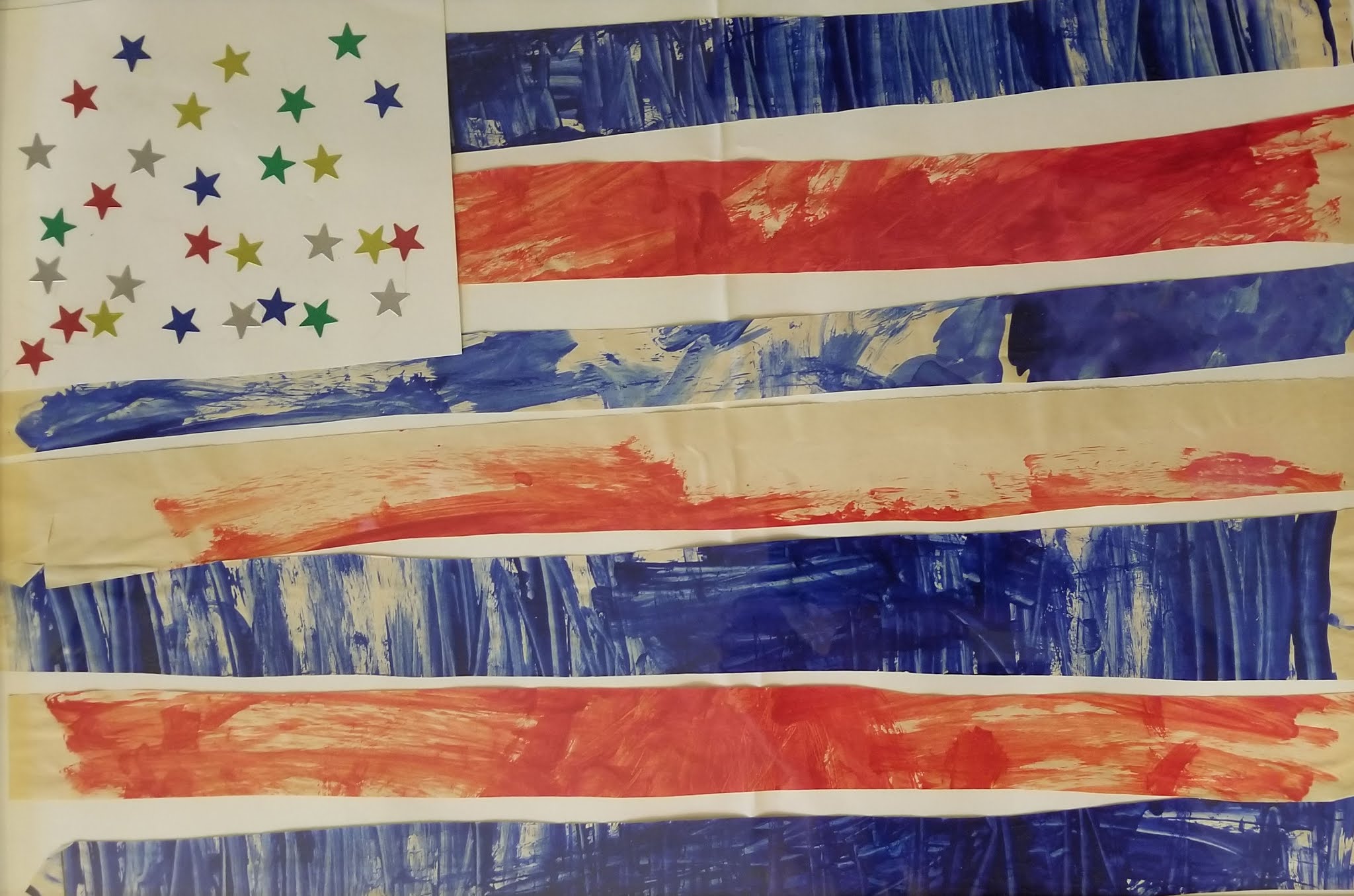
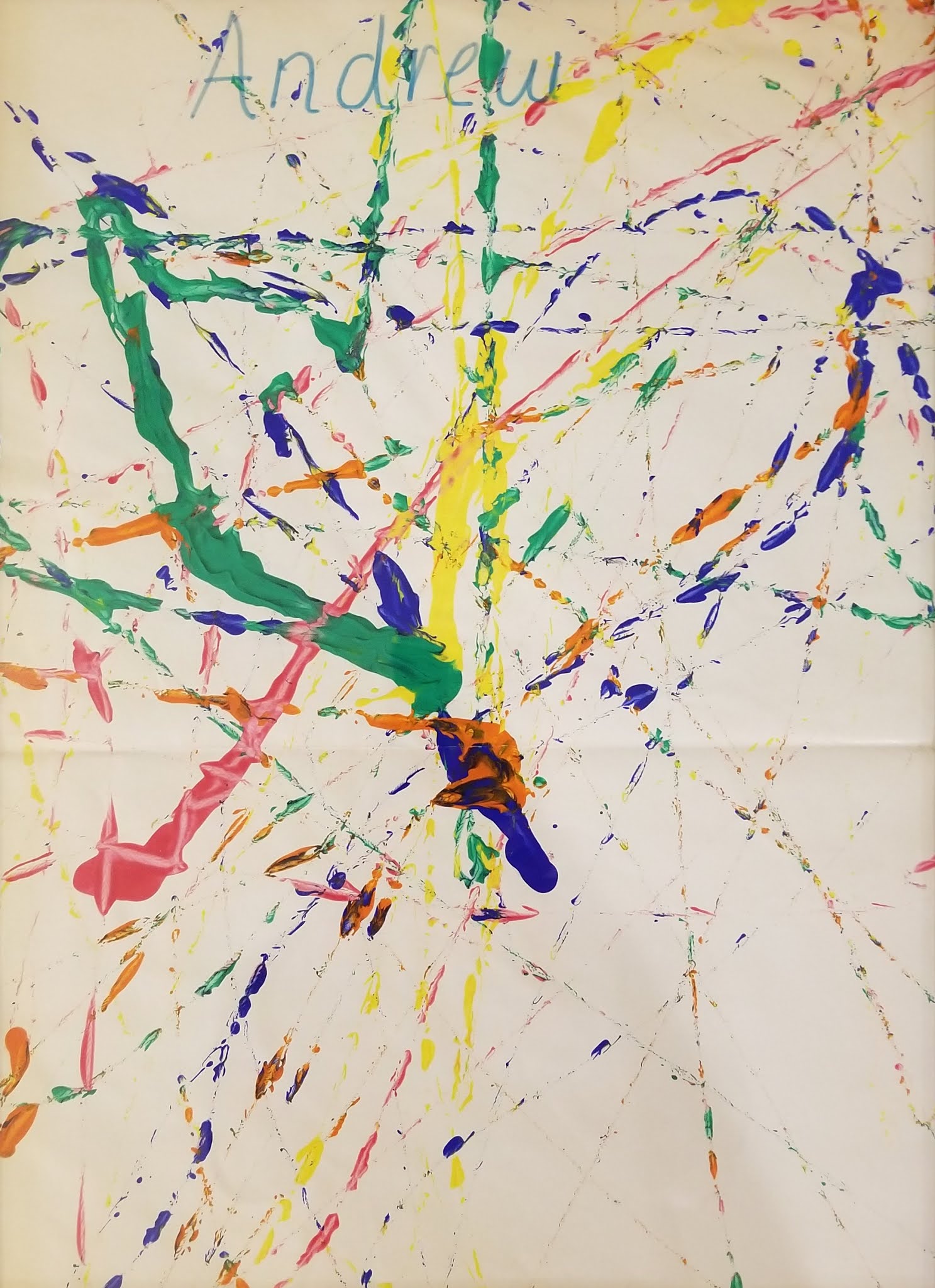
Label and date everything and store them in a large secure box somewhere. Then leave them there and let them simmer -- like a pot of good chili on a cold winter’s night. Let them simmer in that box for about twenty years or so.
By then, your child be in graduate school or starting a career of his own. At that time, you can take everything out of the box and go through it.Your reaction to many of these things will be, “Why in the world did I save this?!” Those things, you can throw away.
The few art pieces left over may be true masterpieces. At one time, they were precariously mounted on your refrigerator door with a kitschy magnet. But now, they are worthy of spending a couple hundred dollars on professional framing. Display them proudly!



February 20, 2017
Ranking the Presidents
As any good data geek would do, I threw all the data into Excel to see what I could discover. You can download my work here.
I’ve always been interested in these types of studies because, on the one hand they advertise themselves as being totally objective, it’s really hard to squeeze the subjectivity out of them.
After all, any historian — no matter what he claims — brings to the table a certain amount of historical bias. Today’s political climate tends to make that bias even more obvious.
For example, Glen Beck — admittedly nobody’s example of political objectivity — ranks Woodrow Wilson as the most evil man in all of American history. But the survey ranks Wilson a respectable 13th out of 45.
And James Polk — not on the general public’s list of great American Presidents — ranks number 16 — proof that the C-SPAN academic advisors sure know their pre-Civil War history.
To produce the rankings, C-SPAN asked a team from academia to rank all presidents using ten “qualities of presidential leadership”: Public PersuasionCrisis LeadershipEconomic ManagementMoral AuthorityInternational RelationsAdministrative SkillsRelations with CongressVision/Setting An AgendaPursued Equal Justice for AllPerformance Within the Context of His Times
It’s probably a good idea that such a panel is used and that they don’t ask me or Glen Beck to serve on that panel.
All those categories gave me plenty of data to load into Excel. Let’s see what I discovered.
I thought it would be interesting to measure the presidents on a combination of rank and “consistency”. I measured consistency based on the rank of the standard deviation of the rank in for that president in all the categories.
A consistent president is one who ranks the same in all categories. A president may be consistently good, consistently bad, or consistently mediocre. Is there anything to learn from this?
Here is a scatter plot of the results:
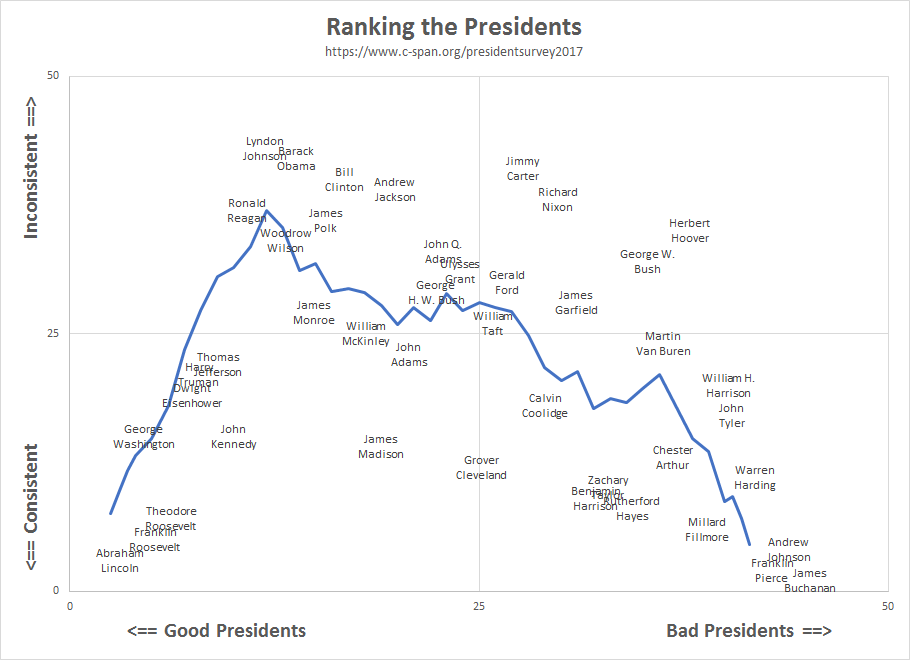
To validate the data, let’s look at a couple of corners. Yep, not only does Abraham Lincoln rank as the number one president, he ranks as the most consistent president. That places him in the lower left corner. A good president all around.
In the other corner are both Lincoln’s predecessor and his successor. Wow. We always knew that James Buchannan did more to cause the Civil War than any other individual. And we know that Andrew Johnson did more to screw up Reconstruction than just about anybody else. Bad presidents all around. Thanks for the legacy, guys.
Here’s another way of looking at things:
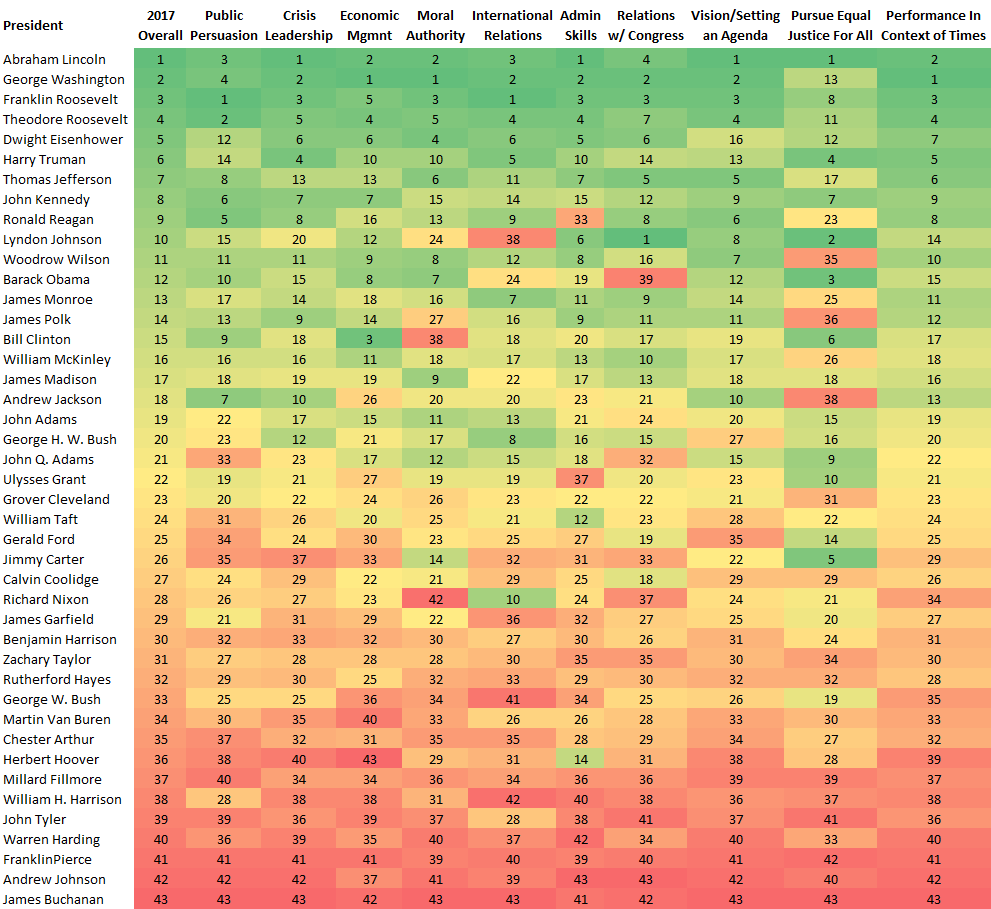
This graph color codes the presidents by their rank in each of the ten categories. Since they are ordered by the final score, any place you see “islands” of a different color, that’s an anomaly that’s worthy of discussion.
For example, Lyndon Johnson was a pretty decent president. He ranks at the top for “Relations with Congress” (he had to fight his own Democratic Party to get the Voting Rights Act of 1965 passed; a greater percentage of Republicans voted for the bill than did Democrats). But he rightfully ranks near the bottom for international relations for getting us deeper in the Vietnam war.
Bill Clinton ranks a decent number 15 overall, but comes in near the bottom in for “Moral Authority” because of his fondness for oral activities.
It’s a little harder for me to explain the person that I believe to be the nicest, worst president of them all: Jimmy Carter. A dreadful president who ruined both the American economy and our relations with Iran, I don’t know how he ranked as high as number 26. On the other hand, he’s a decent man in a strong, loving marriage, a Baptist deacon and Sunday School teacher, and a Habitat for Humanity volunteer into his 90s; doesn’t he deserve to be ranked higher than number 14 in “Moral Authority”?
And how did Barack Obama perform in his debut appearance? He came in at number 12, between Woodrow Wilson and James Monroe. That’s probably fair.
He ranked near the bottom in “Relations with Congress”. The only way he got ObamaCare passed was with back-door deals and a “gotta-pass-the-bill-before-you-read-it” mentality, even though his party controlled both houses of Congress at the time.
He also scored pretty low on “International Relations” by touring the world while apologizing for America’s past policies, weakened our position with Russia, and managed to worsen our relationship on both sides of the Middle East — quite an accomplishment!
He scored the highest in the category “Pursued Equal Justice for All”. That sounds about right for somebody who thinks “it’s good for everybody” to “spread the wealth around”.
We’ll have to wait a few years to see what historians think of our Mogul-in-Chief. My guess is his drain-the-swamp and build-the-wall dreams will score high in the “Vision/Setting an Agenda” category.
Fortunately for Mr. Trump, there is no category for “Relationship with the Press”.
February 17, 2017
On Being a Grammar Nazi
I’ve been especially troubled lately over the tendency of people to say “one of the only”.
“He’s one of the only people who can understand this policy.”
“Mary is one of the only people in the office that can program in COBOL.”
Ambiguity is a very bad thing. How many people in the office can program in COBOL? Three? Then Mary is one of the few. But is there really only one? Then Mary is the only one, not one of the only ones.
So I arrogantly proclaimed my Nazi-ness to the world, eager to rid it of this literary travesty.
Until I read on the Google-nets that it’s actually okay to say “one of the only”.
Rats.
My career as a Grammar Nazi can be traced to a 1977 episode of All in the Family. In “Michael and Gloria Split”, Archie tells Michael that he will “loan” him some money. Michael corrects him, saying he had to “lend” him money because “loan” is a noun and “lend” is a verb.
Yea for Meathead, I thought. Archie is just sooo uneducated! (Archie was not impressed. Our grammatical skills are so underappreciated.)
That is, until I discovered that Merriam-Webster — and who can argue with them? — says that “loan” has been a verb for 700 years — and still is.
The famous dictionary site has been wrong before. In my opinion, they completely missed the mark with the whole “try and” vs. “try to” argument.
On the other hand, they totally understand the concept of the extended meaning of the word “Nazi”. (You have no right to be offended if I use the word to describe myself.)
Being a Grammar Nazi is bad enough. Being a Closet Grammar Nazi is a fate I have chosen for myself, to avoid the slings and arrows of outrageous ostracism.
I think I need somebody to pat me on the head and say “there”, “their”, and “they’re”.
February 6, 2017
Citizen-in-Chief
So many people are talking about it, I have nothing further to say about it.
Instead, I’m going to analyze an exchange near the end of the interview.
Attempting to humanize the President, O’Reilly asked: “Do you ever say to yourself, ‘I can’t believe I’m here’?”
The President gave a typical Trump-esque ramble:
“The other day, I walked into the main entrance of the White House, and I said to myself, this is sort of amazing. Or you walk into Air Force One, it’s like a surreal experience in a certain way. But you have to get over it because there’s so much work to be done, whether it’s jobs or other nations that truly hate us; you have to get over it.”
I think he missed the chance to make a good point so I guess I’ll have to make it for him.
Much has been made of the fact that Donald Trump is our first President with neither previous political or military experience. Heck, most of our presidents had an abundance of both.
The fact that can even happen is a testament to the genius of our representative form of government.
In many countries, the head of state is actually required to be a member of Parliament, because the office is elected from their ranks.
In other countries, you have to be a member of a particular family or blood line to be King.
And in still others, the General of the victorious army becomes the de facto leader.
But in America, we can actually elect a Citizen-in-Chief. And that’s exactly what we’ve done this time. It’s amazing that it took us this long.
George Washington literally came out of retirement to become President. And he immediately returned to retirement at the end of his service. His concept of a perfect country was a party-less system run by a citizen administration.
Thomas Jefferson and John Adams screwed that up. They started a string of professional politicians in the form of diplomats, governors, senators, and congressmen to become President. Even in their private life, more than half of our presidents have been lawyers. Very few were successful businessmen (both Bushes, Carter, and Truman). One was even an actor.
Maybe this is the start of a trend. Maybe it’s a good idea to let our lawmakers be professional lawmakers, but demand our Presidents be professional administrators. Maybe that’s the kind of division in power the Founding Fathers had in mind.
So if I had been the President, and O’Reilly had asked me “Can you believe it?”, my response would have been:
“Bill, it’s an honor to be here. I am humbled that the voters of this great country put their trust in me. But yeah, I can believe it. Because this is what is meant to be. It’s the very nature of a Republic. The citizens hiring a fellow citizen to go to Washington and make sure that the government is administered in a fair and equitable way and that laws are enforced and that their money is well-spent. That’s what this office is about; and that’s why I’m here.”
Maybe some day Donald will hire me as his speech writer.
January 31, 2017
Exoplanets Obey Kepler
Even as we reached for the Moon, we stretched toward the stars. There were a few scientific dogmas that we learned, and we were taught that these truths were pretty much established as fact for all eternity.
First, in spite of the fact that we were reaching the Moon in about three days, other inter-planetary travel was expected to be much, much more difficult. Mars could take a year to reach. Other planets even much longer. And inter-stellar travel? Captain Kirk might be able to put the Enterprise into warp drive, and the Space Family Robinson could reach Alpha Centauri after a few years in suspended animation, but we shouldn’t expect it soon.
No, it would take hundreds or thousands of years to reach the closest stars given the technology available. Space is very large and very, very empty. That’s why they call it “space”.
The second fact we learned was that stars could never be imaged as a disk. We really don’t see the stars; we see the light emitting from the stars. There’s a difference. Remember that first rule about space being really big and really empty? Stars will never be anything more than a point of light.
And planets around other stars? (We now call them exoplanets.) Well, the Enterprise and the Jupiter 2 seemed to bump into them all the time. But their existence was only hypothesized.
Yeah, stars probably had planets orbiting around them — why should Sol be the only lucky one? But — remember the first rule about space being really big and really empty? — we would probably never see them. After all, the stars were too bright and the planets too small. Stars generated their own light, but planets only reflected back a tiny part of that light into space. Our lifetime could only hope for the possibility of planets, not the reality of them.
The first rule still holds; space is still really big and really empty. But the ability to see stars and planets beyond our Solar System’s influence has been greatly improved over the last few years. We can now "see" exoplanets, but most are observed indirectly; we can see them only as the brief dimming of a star if their orbit lines up exactly with the Earth. Consider watching a mosquito fly in front of a searchlight a hundred miles away. It’s like that.
But since 2008, we have been able to spot a few planets directly. New advances in things like adaptive optics and the ability to block out the disk of the star are just a couple of tools that can now be used to directly observe planets. Yes, they are real!
It’s easiest to spot exoplanets directly when three conditions are true:
1. The planet is very large in relation to its host star — dozens of times larger than Jupiter helps.
2. The planet orbits far enough from the host star that it doesn’t get washed out in the star’s light.
3. The plane of the orbit is close to a right angle to the plane of the Earth and the host star. Observing planets by transit is only possible when the planet is in the same plan. Observing directly is easiest when it’s in a 90-degree angle. It’s a three-dimensional geometry thing. Work it out for yourself.
Fortunately, all those factors have come together to give us one of the most remarkable astronomical movies ever filmed. Seven years in the making. But worth the time and effort. It’s a thing of beauty:

Check the original article to see the picture in motion.
There they are: four beautiful planets, just as hypothesized. Each orbit obeying Kepler’s laws of planetary motion exactly as they should. In every case, the square of the orbital period of the planet is proportional to the cube of the semi-major axis of its orbit. Beautiful.
It’s been a long time coming. I haven’t yet seen flying cars or hoverboards. My Roomba is the closest thing I have to Rosie the robot maid. And I’m still looking for my personal jet pack!
But, hey, I’ve seen a movie of a remote planetary system. My life is now complete.