Mark D.K. Berry's Blog
February 2, 2025
“Great Southern Land” – across the outback by bicycle
Out now on eBook. Paperback and Audiobook coming shortly.
This book is about the journey I took after moving to Australia – I decided to leave Sydney and go cycling across the outback in the top-end. Probably not the smartest thing I ever did, but I survived to tell the tale.
Here is an excerpt from the journal I kept during that trip. I’d just got out The Ghan at Katherine and was preparing to cycle into the oppressive heat for the first time. People were not as positive about my adventure as I was.
“The train station platform was soon empty but for me, and I was still building the bike as The Ghan continued its journey north from Katherine toward Darwin. It was humid and hot, even with the cloud cover. Pretty unpleasant, in fact. I walked my bike over to the stand and found a woman inside, closing up a small store. I walked in to fill my water bottles from the fountain I spotted there.
“You’re cycling?” she asked, her tone suggesting it had never been done before.
“Yup,” I replied.
“Where?”
“Maybe to Broome.”
“Jesus Christ, son! You’ll be murdered!” she exclaimed.
I stopped filling my canteen and looked at her. People telling me I was mad was one thing, but hearing negative comments that implied I’d die soon was another. But she wasn’t joking; in fact, she looked genuinely concerned.
“A lot of murderers in the outback, are there?” I asked.
“Enough,” she replied.
“When was the last one?”
She shook her head uncertain, but didn’t change her tone.
“You be careful of yourself out there,” she said. “It isn’t safe country.”
With that, she left, shaking her head. Okay, the way she had said that last line actually got to me. Dying from my stupidity was one thing, but being murdered was a whole other issue I hadn’t considered before leaving.”
Photo from the trip:
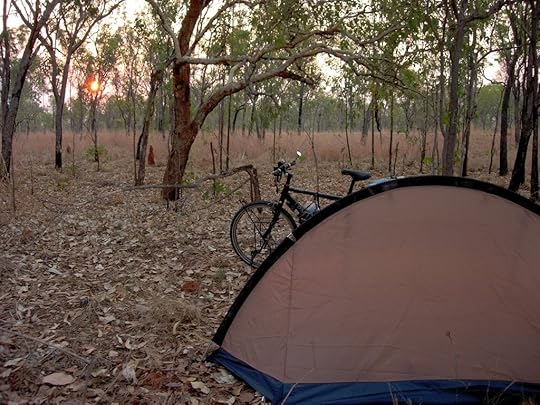
Camped somewhere west of Katherine in the outback. >100km from any other humans. +45 degree heat.
Follow me on IG here
on Facebook
or www.markdkberry.com
The eBook is out now on Amazon and trickling to other outlets over the next few days. The paperback and audiobook will be out soon, available either via the website or major outlets.


January 16, 2025
Incredible AI Music Video (Made on a home PC for free!)
Vive Le Revolution! Story-telling is back in the hands of the people!
The era of home made movie-making is here. (AMA in the comments here, on IG, or on Youtube video in comment section about how it was done, because you too can do this on a basic setup and it costs nothing but processing time).
The above video was made using AI text-to-video footage on a home PC for free (the music is 100% made by humans). The only cost was time and electricity. The results are incredible considering this is the first version of the AI model.
This is possible because of a new AI model released 5th Dec 2024 called Hunyuan and it is only going to get better. It was created using Comfyui and text-to-video prompts.
(The song in the video is Cafe by Mark DK Berry and is available on bandcamp as part of the recently released King EP.)
It took 4 days, including learning new tools. I avoided the 3-month rabbit hole I fell into making “Fallen Angel” using Unreal Engine and Metahumans.
(The above “Fallen Angel” made using Unreal Engine and Metahumans animated with Cascadeur took a gruelling 3 months in comparison)
This time, for “Cafe”, I stuck to a strict timeline of 5 days. I set a strict limit and I planned to see what I could get done. Amazingly I completed a decent enough draft that I could call it finished. (Watch “Cafe” in the video at the top of this post and tell me what you think.)
Rendering max 2 seconds (max my PC could do) of 512×416 video at 24 fps, took 5–8 minutes per render. Many prompts no tweaking would fix—so I kept to strict time limits to get it done within 5 days.
Day 1 was for main content, Day 2 for fixing ideas, Day 3 for tidying in DaVinci, and Day 4 for final edits and color grading (likely overdone—sorry, colorists).
Equipment & Tools:Software: ComfyUI AI (portable, free) with Hunyuan text-to-video models (GGUF for better results), DaVinci Resolve (free version), and FFmpeg for slowing clips and smoothing interpolation.
Hardware: A Windows 10 PC with an RTX 3060 (12GB VRAM). 512×416 resolution balanced quality with my PC’s capabilities. Bigger sizes caused issues, and smaller ones lost clarity.
Prompts worked best when kept simple, e.g., “hot female model in a red pencil dress walking away at an old English train station, realistic and cinematic, daytime.”
Current Challenges Of Hunyuan Model:AI generated max 2 seconds per prompt on my PC else it fell over, and prompts hit character limits around 350. While the results were clear, stretching 2 seconds to 8 via FFmpeg, which worked to buy time, added blur and distortion.
AI couldn’t consistently generate the same face or dress style, and aerial shots with women proved tricky. Ideas like morphing characters, cartoon seque ideas, or greenscreen effects often led to cheesy results, so I scrapped most of them. Despite these constraints, Hunyuan delivered fantastic results, even without advanced tools like ControlNet (still early days).
The journey has just begun, and this opens doors for more videos as the tech evolves. Hollywood is on notice, we can now make our own movies for free. This is where it all begins!
Follow Me Here:
markdkberry.bandcamp.com
IG: @markdkberry
YT: @markdkberry
Full music video back catalog: https://rumble.com/c/c-1331684
December 14, 2024
“I finished my 1st draft and I hate my book. What should I do? I want to burn it and cry!”
 You just experienced the first-draft blues. Don’t panic, I have a solution.
This question popped up with a new writer recently, and I decided to share my response here (it could apply to any creative skill; art and music too):
Writing is a hard gig. Take a break. The reasons for writing the book will return once you have had some distance from it.
I am still having to force myself not to delete my work even by 2nd or 3rd draft. I hate the book by the end of the 1st and usually think its awful. But that is the bane of the “creative” – we must learn to ignore our emotions after the main creative process is over and the real hard work and chore begins – making it readable/enjoyable for others.
I think people don’t understand how “creativity” works and everyone is different. You have to learn how to work to your particular nature. Well done, you have discovered your 1st draft threshold. Now go be creative on something else to re-fire your creativity and distract your mind. Or take a holiday and come back and read it again in a couple of months when you have forgotten it, and then do 2nd draft. And after do the same process at the end of that one too when you go into emotional reaction at the end of the creative cycle. This is normal, by the way.
A decent book – for most of us – takes a few years to finish. The 5th or 6th draft is usually where it starts to be what I wanted it to be then I often have to do another draft to catch mistakes and make minor changes after getting an unbiased reader to give me feedback (without arguing with them defensively). More than 7 drafts from start to end is not unusual. Less probably is, if you expect to end up with a product you can be proud of and is readable.
I hate the process. I could not even finish a book until I was 50 years old. A Chinese proverb – that I don’t recall precisely – said people should not write before 50 anyway.
Some rules to live by:
NEVER destroy your work however much you hate it.If you hate it, stop working on it, wait 2 or 3 months – enough time to lose all emotional attachment to it, then revisit it. Then apply #1.Learn about the emotional ups and downs of your nature and your particular timing of creative process. Mine works to 3’s: 3 days, 3 weeks, 3 months. I take breaks, or try to at those points.Remember there is being a “Creative” and there is “Selling” your work, and those two things need to be kept very seperate because the industry is a cold merciless beast that does not care about your emotions or creativity, only $ and product. Don’t make the mistake of thinking “creativity” and “the industry” can marry. You will lose to the industry every time. Therefore tl;dr: do it for the love. DO IT FOR THE LOVE. not for the sales or the money or the glory, because not many people get those from writing (or music, and I do both).DO THIS FOR THE LOVE of creating something you are proud of. In the end that requires hating it for a while – this is part of my creative cycle and I have learnt to allow for it. I have one book has taken me 16 years and its still not finished and only 60K words. I cannot tell you how many times that book has got me raging. But I know I’ll finish it eventually.You will come to eventually realise there is a knowing when a book is done. About draft 7, I noticed it happens. It’s actually done. And I experience a massive emotional drop then too and have to deal with it. I thought it would be joyous celebration, but no, I get depressed. The cure? Start my next work right away and forget about that book it is no longer my business. It is born and now has a life of its own.You aren’t just learning to write, you are learning about yourself as a writer. It’s a long road.
Good luck!
December 4, 2024
“Black Magic: The Musical” by Mark DK Berry Album on Bandcamp
“Black Magic: The Musical” is finally completed and released.
(click on the above image to stream or download the album)
Scored & scripted, the soundtrack album is now available to stream or download from Bandcamp.
I’ll be posting tracks from it over the coming days but I think my preferred track is probably “6. Only You”.
Please follow and share on Bandcamp
#musical #album #soundtrack #bandcamp #music
https://markdkberry.bandcamp.com/album/black-magic-the-musical
December 3, 2024
“Broke: Poetry & Lyrics” (Poetry Series Book 2) by Mark DK Berry
***DISCOUNT ON POETRY BOOKS UNTIL JAN 2025***
#poetry #writers #ebook #POEMS
***ALL POETRY BOOKS ON DISCOUNT UNTIL 2025***
ALTERNATIVE PREFERRED RETAILERS:https://www.barnesandnoble.com/w/broke-mark-berry/1133697233
https://www.smashwords.com/books/view/1133183
https://books.apple.com/us/book/broke/id1611386837
FOR ALL RETAILERS NOT LISTED:December 2, 2024
“Lost In A Sleeping Garden” (Poetry Series Book 5) by Mark DK Berry
***ALL POETRY BOOKS ON DISCOUNT UNTIL 2025***
ALTERNATIVE PREFERRED RETAILERS:https://www.barnesandnoble.com/w/lost-in-a-sleeping-garden-mark-dk-berry/1145045116
https://www.smashwords.com/books/view/1533977
https://books.apple.com/us/book/lost-in-a-sleeping-garden/id6479334158
FOR ALL RETAILERS NOT LISTED:November 1, 2024
The AI Unemployment Issue: Stop Focusing on UBI & Start Focusing on “Mindset”
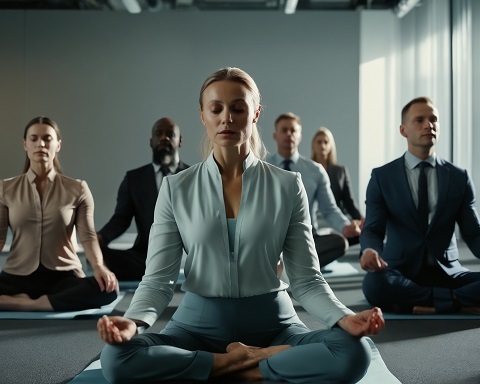
People claim UBI will solve the problem of AI taking all our jobs. It won’t. The real problem won’t be about money, it will be how to stay sane when we achieve Utopia.
“But Finland tested UBI, and it worked well”Finland? The place with one of the highest suicide rates in the world? It is nothing like the countries UBI is being suggested for.
UBI will not magically solve the issue of people needing to work to stay sane.
First we must understand how UBI would lead to mass depression & economic collapse. Africa has all the examples we need for what happens when free-money is handed out.
To understand the issue, read Dambisa Moyo’s excellent book on the economics of aid, and why it does not work long-term. All it creates is “handout culture”, corruption, and leads to localised economic collapse. Something denied by all the charity industries that benefit from $ passing through the country.
UBI will create parasite industries pretending to be “charities”.
Don’t focus on money focus on meaning and purposeAsk yourself this: What are you expecting to do with your life when you retire? Chances are you imagine putting your feet up and “doing nothing”. But is that realistic?
Have you ever tried to “do nothing” because it pretty quickly drives people insane with boredom. Go ask a retiree, and I have, because I foresaw this problem years ago and wanted to find an answer. The answer is that retirees stay busy.
Instead of asking where the $ will come from, ask how to find “meaning and purpose” when working no longer provides it.
AI is about to create Utopia. Why is that a bad thing?The irony is that AI will create the perfect world where we no longer need to work like slaves. So what is the problem?
Well, obviously we will still be slaves economically. Yet this is the opportunity for us to down-tools and go do something we prefer and enjoy doing instead. But that won’t happen. Why?
Because people need to stay busy, and people need meaning and purpose. Ironically working like a slave all our life gives us that. Take it away, and we will start to lose our minds.
People will always need to get busy. Really, this mindset should be considered an epidemic in humans; humans are obsessed with being busy. If you stop being busy you get called lazy.
There is a human expectation that everyone should behave like workers and struggle for a living. We need to break this mindset to survive Utopia. We need to stop doing and start being.
Unless we do that, another problem will arise, and to understand that we need to understand…
The Cobra Effect (also known as Perverse Incentive)So what will happen when humanity has nothing to do all day?
The Cobra effect will happen (also called Perverse Incentive). And parasite industries will spring up, and they will cause bigger problems. We must address this before it occurs to stop it happening. Our Governments will be the biggest offenders.
Understand the Cobra Effect, and you can predict what problems humanity will face. When work disappears, people will need to stay busy to feel they are contributing. (Look at the 6 basic human needs).
The Cobra Effect: What could possibly go wrong?“Okay genius, you have told us some of the problems, but what is the solution?”
I don’t know. And we won’t know until we get there.
But humans are resourceful and en masse we will collectively solve it. That is why I have less concern. If it was a small subset of society it would get ignored, but this effects the entire planet. We will find a solution, because we will have to.
What concerns me more, is the personal mental impact on people faced with doing nothing all day.
Our creatives have already predicted how to behave in a world without labour intensive work: Star Trek.One thing I would suggest – and this isn’t a joke – is to look at Star Trek. Those lazy bums just float around the universe in a space ship all day and night. They don’t concern themselves with making a living, growing food, or paying for a mortgage. They just drift around looking at interesting stuff. So, how are they coping?
It’s may seem like a joke, but it is important, because Star Trek is a predictive insight into our potential future.
Focus on meaning and purpose and work the rest out as it happens.I can say with certainty that my life purpose and meaning does not revolve around making money. I am an author, a playwright, and a musician. None of those things make me money nor do they get me much recognition.
I have had to address my “sense of meaning and purpose” in doing them. I now do those things for the passion and love of doing them, and not for monetary incentives. It was a difficult mindset to change, but it is exactly the issue humans will face with AI ending work as we know it.
So UBI and free-money is the answer then? You liar!Sort of. The point I have been making here is not being afraid of how we afford AI, or Utopia. The real problems will come when we have nothing to do.
Yes, we need money to survive, but understand that more important than money, is meaning and purpose. Without that, all the money in the world will not help us. But with meaning and purpose, then life will more easily fall into place.
So, I don’t have a direct answer, or a solution to the money problem. I do have an answer in finding meaning and purpose outside of money. Why is that important? If you can solve that, then the problem of AI will become less of an issue for your mental state.
How is this comment relevant? It makes no sense.
Actually it does make sense. Because what happens when you have nothing to do? You spend more money trying to keep busy and not go mad.
I believe the most important thing for humans to learn is “being not doing”. Because life in Utopia will be a lot cheaper if you can achieve it. “Being not doing” is where we all need to start out from.
One way to start to slow ourselves down is this…
Humans need to accept Utopia. To achieve it, we need to learn “Being Not Doing”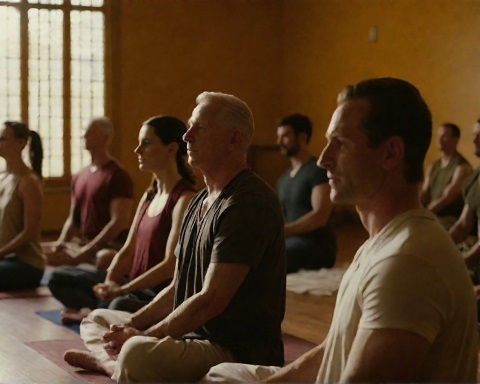
This isn’t me punting some pseudo-religious babble trying to get you into a cult. This is a practical and workable approach to learning to meditate and slow life down to observe it. I spent over 10 years learning it, and I understand how important it is to our future well-being. Nothing else comes close.
It would require a whole other post to explain Vipassana Meditation and others can do a better job. But Vipassana is a good starting point to learn to “stop doing and start being“.
Unfortunately – and proving my point – very few people have 10 days spare to learn it. But there is an alternative…
Make meditation your foundation stone for the coming UtopiaIf you don’t have time for learning Vipassana through the 10 day retreat, then this is your best bet to achieve “being not doing” outside of that…
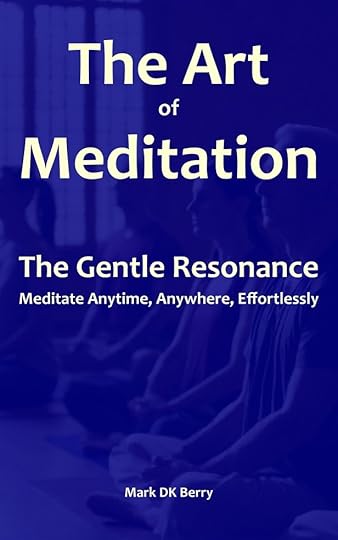
Click on the above image to get the e-book from Amazon.
It is also available as an audiobook, or from other distributors. Click here for the google search to find other sources.
UBI alone is not a solution. Finding meaning and purpose in our life without work, is the solution.
The problem of money will resolve itself because it has to. We need to eat. We need shelter. We need food. Collectively we will solve this issue.
But more importantly – and on a personal level – we need to survive the coming Utopia mentally, spiritually, and physically. And to do that, we need to slow down and start “being not doing”.
The Art of Meditation: The Gentle Resonance is the best way to mentally prepare for what is coming. Utopia does not need to be a bad or scary thing if we are able to handle doing nothing.

October 27, 2024
Under The Water (Chillout)
“Under The Water” by Mark DK Berry is available on Bandcamp (click the image to play)
It was written for the stage play “The Folly Of Poly Amore” to use in the Tantra scene. I liked it enough to publish it separately.
This is the full length version of “Under The Water” with full lyrics, running at just under 13 minutes.
This track is available now to stream or buy on Bandcamp
Also follow me on Spotify or visit the website www.MarkDKBerry.com
Lyrics to “UNDER THE WATER“:
Under the water
we’re free
you gave your heart
to me.
Under the water
we dream
of times we passed
secretly.
Under the water
unseen
we shared our love
completely.
Under the water
we find
a better life
divine.
Under the water
Lyrics and music written and produced by Mark DK Berry
Released October 7, 2024September 23, 2024
How To Make An AI Deepfake “Audio Drama” And Start A Revolution
I believe a revolution in story-telling is on its way, where creativity is going to become more important than monetisation.
I am testing out using AI deep fake software to create stage play audio dramas using famous actors voices. All the software is run locally on my PC and not online. I am not using any corporate AI services. It’s all open source and free to make. Instructions below.
When Creativity becomes more important than MonetisationIf creativity becomes more important than monetisation, then the large monster corporations like Spotify and Hollywood will no longer have a gate-keeping stranglehold. This will change what can be made. It will also affect how it gets distributed.
I am a big fan of the future of Open Source story-telling. Making it freely available to all creators and indirectly their audience. Imagine a world where a geek with a PC can turn his scripts into top-quality movies and audio dramas. Where no one controls the narrative the geek wants to present. That is true freedom.
Censorship and funding are limitations, but they also control the creative flow. AI will change this, when the audience realise there is an alternative to corporate-controlled content. The government already fear it.
Movies are a way off being good enough yet, but Audio Dramas are possible right now. Have a listen to this 1.5 hour AI deep-fake audio drama, it took one person just two weeks to complete for zero cost:
The Highwayman Audio Drama (click image to download or stream for free)Audio Dramas are here but most are not good
Audio Dramas are easy to make with AI using deep-fake actors voices. But no one is doing it much, which surprised me. Why is that?
I assume it is because monetising them in this way is not possible. Rightly so, this would be copyright theft of the actor’s voices. But making cash from it is where my ethical boundary line is drawn. Creative story-telling and distributing that freely, is another subject (I will discuss the ethics shortly).
Doing it my way (see The Highwayman audio drama linked above) allows me to get a feel for how the stage play flows when performed. I can then adapt or make changes to the script from the production-level audio drama.
It’s obviously just for demo purposes and not for re-sale. Nothing wrong with that, in theory. I can’t, and don’t, want to release these to audio drama distributors. YouTube and Spotify are companies I don’t particularly agree with. I don’t like the way those big tech corporations are gate-keeping creatives while not paying the small independent ones properly. I don’t want to use them. I pulled all my music from them because of it.
However, I believe we should encourage Open Source creation and distribution, and make it freely available to all. I think it is the best possible future for AI and creatives. As a creative, this helps keep my focus on the creative process and off the $$ obsession.
If giving it away freely allows me the artistic freedom I want, then I will consider doing it. This freedom helps me express my story. Is it theft? Well that is a big question and we have been here before…
The Questionable Ethics of AI“I’m an artist, and if you give me a tuba, I’ll bring you something out of it.” — John Lennon.
I don’t agree with the “AI is soulless” argument. AI is just a tool. Creatives know how to use it to benefit their creative flow. I do. My creative friends do. Like it or not, AI is here, and getting better every day. It is far from “soulless” when in the hands of a creative.
Yes, AI is going to steal actors voices and faces and people will use them to make audio dramas and movies. We are already seeing the power of it on tiktok. If you haven’t checked out these two, they are creating incredible results with video face-swap deepfakes right now.
@fake_dicaprioAre you waiting? @the same Barbie #fakedicaprio #leodicaprio #leonardodicaprio #hollywood #celebrity #fakerobbie #margotrobbie #robbie #barbie #wolfofwallstreet
♬ original sound – kardashianshulu
AI is going to disrupt the industry. People will lose jobs. Yes. Such is life. It has happened to me as an artist and in business. Maybe, it is time for that level of disruption to help change the current state of the story-telling industry. I believe this to be true. Nuke it. If you lost your career path to AI then join the club. Have a cry and a moan, then after that… get over it.
You cannot fight this revolution. Why? because the audience will want it. I believe it is a waste of our energy to try to fight it. And we have been here before too, not once, but twice…
This isn’t the first artistic revolution that blew up an industryMP3s in the 90s:Remember how .mp3 and torrent arrival changed the world of music in Y2K? No?
Napster gave music away for free, and the corporate bands hated it and fought to ban mp3s in court. Metallica won a big battle. Then the entire music industry lost the war. Fast forward two decades and mp3s are now everywhere. AI will have the same effect.
The Sampling Revolution in 80s:The sampling revolution in the late 80s had a similar effect. Rappers and music pirates started stealing professional music and using the clips to make songs.
I got hold of an Akai sampler in 1992 and made “What’s Freedom Babe?” album using my vinyl records and VHS movies. Shameless plugging, but it’s freely available to listen to on bandcamp here:
The point I am making is that creatives use these tools to create art. The problem is the industry doesn’t like it because the industry cannot monetise it. So, maybe we should stop trying to monetise AI.
By taking the open source and self-distribution route, it will become the next creative revolution. The story-telling narratives will benefit the most and that is a good thing. i.e. the audience will benefit.
Okay, so how do you make an audio drama for free, by yourself, and for no cost…
How to Create an Audio DramaIt’s pretty simple, and its free once you have a PC and a basic video graphics card.
It got more complicated as I worked on ways to streamline and improve the process. I made “The Highwayman” audio drama linked above in two weeks. It is only my second go at it. There were no instructions to follow. I messed with approaches until something worked. So there is much to improve upon, but it’s as good as any radio show. Here is the process:
(All the below software is open source, freely available to download and use).
First, I wrote the script. Luckily I already had one. “The Highwayman” seemed appropriate given it’s about an outlawed thief.Then I used Reaper for recording my voice for each part; narrators, actors, actresses. I found that recording it on a cheap Samsung phone was good enough for the AI then import that to Reaper. This sped up the process. The important thing was loudness and clarity of the wording. Background noise didn’t matter when AI converted it.I then chopped and positioned the talking parts on each track so the story flowed. It sounded horrible; I hate my own voice. But dont give up yet, AI will sort it.After that I bounced down each character out as an individual .mp3 stem.I then used python code (helped by the free version of ChatGPT) and ffmpeg to split the audio into chunks (optional, but it streamlined my process).I then had to find about 10 minutes of each actor speaking (male and female). Interviews were best. A bit of background noise didn’t matter, but a good full bass and treble spectrum of the voice was important. I got about 60 minutes gathered, and that would get me 10 minutes of their voice once I cut it up for the good bits using Audacity.After trimming the actor recordings into 10 minutes of constant talk from each actor, I then used ffmpeg and python again to chunk it into seperate mp3 files of less than 10 seconds each.I downloaded RVC to do the actor training to make each AI voice model (its a bit confusing, but one package download runs by itself is called “RVC-beta0717” find it and download it) I ran this on my Windows 10 PC, with 32GB RAM and a 12GB VRAM 3060 graphics card. I then ran batch processing on the chunked actor mp3s and you can find the best approach on the internet. I went for 500 epochs and it took 3.5 hours on my graphics card. Some worked out well; Alan Rickman was brilliant. Some were just awful; Christopher Walken I never got working right. But these are now re-useable anytime I want.I then loaded that back into Reaper and replaced my voice with the AI Actor. Suddenly everything sounded good. This was weird, maybe audio drama acting is all about the quality of the character’s voice.After that it was all foley and sound FX. This was by far the most time consuming hands-on part, and was actually hard to figure out. I have developed a lot of respect for sound editing guys from this experience. They are the unsung heroes of movies. I am a musician and thought I would “just get it”, but I didn’t. So, I have been learning about how to apply sound FX convincingly. It’s a challenge. Weirdly, making convincing reverb spaces I find very hard. Go figure.So, it took me two weeks of hard work to get “The Highwayman: A Stage Play“ into a convincing Audio drama that worked well, and it works well. Sure the script might not be to your taste but that is another subject.
Now what? Well. I don’t know. I just plan to work on more content and use it to see how the plays work in production. If you are interested, here was my first attempt…
My first go at an Audio Drama – The Snake Pit: A Stage PlayThis was my first go at an AI deepfake Audio Drama from a script I wrote called “The Snake Pit: A Stage Play”. It runs for 1 hour and 10 minutes and is free to stream or download too.
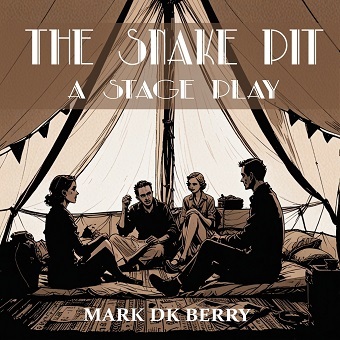 The Snake Pit (audio drama):
Click on the image to free listen or download
From creating this one and being able to hear it played out, I realised that the story needs more development between the characters in the last scene. Something for me to work on.
Any questions on the above stuff feel free to get in touch.
What Next?Next I have a play about Polyamory to finish which I might turn into an audio drama, and after that I plan to work on some musicals.
What I am really eager for is text-to-video AI. Talk to me about that if you have a process for it that is quick or easy and it must be open source. I have no interest in enabling the corporates to control creativity.
Incidentally, I spent 3 months learning Unreal Engine last year and created the below video, but I wouldnt do that again. I need much faster end results and better control.
Comment below if you have anything to say, or email me privately the email address is on my website markdkberry.com
July 27, 2024
Stageplay writing using Fountain and Scrivener
TL;DR: I am writing the stageplay in Fountain using any notepad on any device, and then importing it into Scrivener 3 using a US stageplay format. It needed some tweaking.
The Problem And SolutionThere is a difference between screenplay writing and stageplay writing. I needed software for the latter.
I then spent a long time trying to solve it without spending more money on software (other than my workhorse Scrivener). Most of the free, or freemium, software I tried did not handle the stageplay layout that I wanted (they are more for screenplays).
The best general solution for me as a travelling writer has been learning to work in Markdown format . I’ve come to use that with my novel writing, coding, and note-keeping using Pulsar, Notepad++, Kate, or Markor for Android. I work across multiple platforms, and so learning basic Markdown was by far the best way to streamline that process.
My novels, travel books, and ideas, start in Markdown but always end up in Scrivener 3 on Windows as the last stop before compiling for publishing.
Of late, I have started converting them back to Markdown so I can then apply AI tools on books for proof-reading. For this I use Ollama locally with Python code that I write (actually Claude.ai or Codeqwen LLM does the hard graft), and save it all to Gitlab for version control before exporting the final draft back to Scrivener for the spit and polish (I’ll do a blog post on this process some time in the future). I love Scriv, but it takes some learning to get to this level with it.
But my stageplays presented some other problems. Mostly because of the formatting. I’m not a professional, but I want to work to the standards. I am in Australia, come from UK, but will probably stick to US for formatting stageplays.
Funnily enough, having tried a lot of different software, I ended up back at Markdown in the form of Fountain because it was by far the simplest approach, and Scrivener was one of the few bits of software that offered stageplay templates… but getting the two to work together took a fair bit of hair-pulling. I still haven’t solved it perfectly, but I am close. Close enough to share it here.
Feel free to post solutions, or suggestions, in the comments and I will update the post. Here is where I have got to with it…
The Fountain Syntax written in NotePad++The below covers pretty much every syntax possibility using Fountain which is a form of Markdown styling. It is saved from any notepad software, on any operating system, to a filename.fountain file, but its basically a .txt file with the extension manually changed from .txt to .fountain. You could cut and paste this into a txt file.
Title: MacbishCredit: Written byAuthor: Mr AngryDraft date: 1/20/2024Contact: two spaces to start the line Globule Theatre London, England # Act## Sequence### Scene## Another Sequence# Another Act= This is a synopsis starting with equal sign..SCENE headings I already know work but do they force capitals on this lowercase part?.SCENES can also be numbered #1#Action is basically top and bottom line spaced words but I didnt know that I could tab indent them. this is the second line of indented tabbing. this is indented tabbing after a blank line.This is untabbed action after a blank line.!BUT ADDING EXCLAMATION MARKS LIKE THIS ONE ARE ANOTHER WAY TO DO ACTION. THIS TEXT IS CAPITALISED.@McCARTNEY (this works for parentheticals to be part of the character name)(This now works for parentheticals on its own)The above is a character name needing the @ sign in front, because it has lowercase text in "McCartney"(just confirming this is working as bracketed action with blank lines above and below.)JOHNsaying stuff in unison works but the names are vertical.MARY ^saying stuff in unison works but the names are vertical.~lyrics are nice~but my best advice~would be to get fountain~better documented.~~There was a blank line to start~but no idea how to art-~-fully put that in the formatting.>CENTRED becomes "general text" which is fine for me BADE THAT FITCH**bold** or *italic* or _underlined_. - just regular ol markdown init....what do three dots do at the start of a line? or at the end...I have no idea what this number would do even in normal markdown - **\*9765\*** huh.I shall now end this page with a triple equal sign to split the page. But it didn't work. ===>**Act Two**Importing the Above .Fountain File To Scrivener:So, the above .fountain file can be imported to Scrivener in two ways, drag and drop, or import it. I import it because I want to have the file split in the correct places. Drag and drop wont do that.
For the record, I have opened my Scrivener 3 project using the standard Stageplay US template that comes with Scrivener 3 in Windows. This works off the shelf, but when I import or drag and drop the fountain file in, it will only convert the Action, Characters, and Dialogue. Everything else gets turned to General Text.
I then read the Scriv manual on anything “fountain”, but feeling none the wiser, posted to the Scrivener Forum. Where I got told to read the manual. Fair enough. It was worth a punt. They probably just didn’t know. So, it was time for me to start hacking at this thing.
In Scrivener after opening the new project as stageplay US Format go to File/Import/Import & Split. Then import your .fountain file using UTF-8. See below (though I actually imported it into “Act I” by selecting “Act I” folder first, unlike the below image, where I seem to have selected the “Stage Play US Format” page).
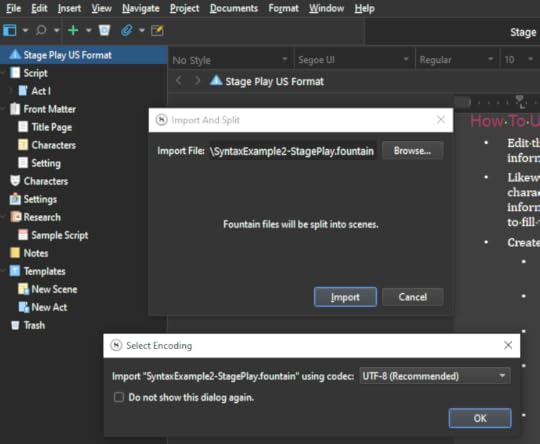
Like me, you’ll probably find that the only converted items were the ones I mentioned – Character, Scene, Dialogue. The UK stage play template worked a lot better, but I wanted to work in US style.
At this point you do need to read the manual and get your head around everything under the the Scriv menu – \Format\Scriptwriting
Then what seems to be the case – this isnt exactly stated anywhere – but you then start to add the missing Elements . Scrivener appears to work only when using the exact name they use for the syntax in Fountain. e.g. adding in Action, or Lyrics, will mean there is now an equivalent for the syntax formatting when you import the Fountain file. Adding in Scene Action, didn’t work presumably because there is no equivalent in Fountain. (But it doesnt work for Boneyard, so somethings are just not importing.)
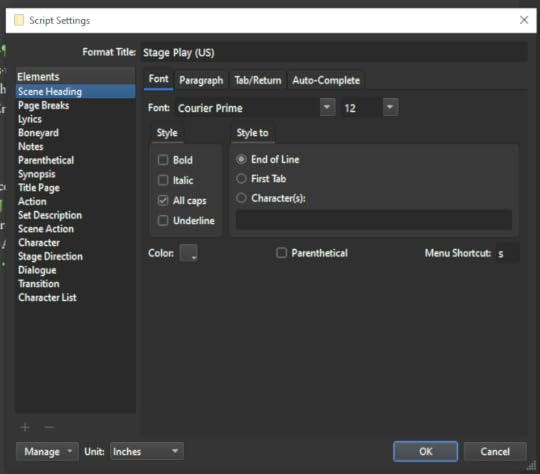
As you can see above, this is the window you get when you open Scrivener’s \Format\Scriptwriting\ScriptSettings page just with a lot less Elements populating that left-hand pane. Most of those Elements seen above were added by me in my attempt to get it all working.
A few things are still are not working, and I haven’t fully grasped what stuff under the tabs in the right window do, but I’ll worry about that later. First job was to get the Elements importing at all.
So, how much did I get working? Well, based on the previous text file I shared above with the fountain syntax code, the below are my results…
I imported the entire file using the “Import & Split” method mentioned, not drag and drop.
The Results So FarPosting the results and the code, as is…
The Macbish “Title Page” split off successfully, but doesnt indent the contacts, and didn’t cut off the page after the address, but only cut to a new page at the next scene in the .fountain script. I guess that makes sense. The hash tags also don’t work to create acts, scenes, or sequences, but I dont need them to, I can use the other approach. The synposis does work now because I added it as an Element, it just needs formatting in the script settings page in Scriv.
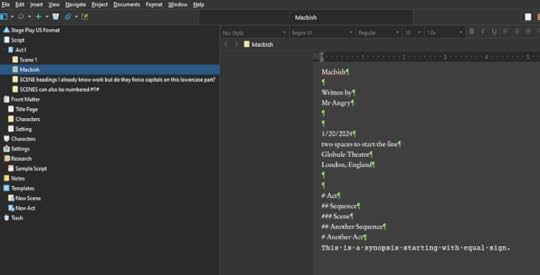 Title: MacbishCredit: Written byAuthor: Mr AngryDraft date: 1/20/2024Contact: two spaces to start the line Globule Theatre London, England # Act## Sequence### Scene## Another Sequence# Another Act= This is a synopsis starting with equal sign.
The next item to look at was “SCENE headings…” but it did everything I expected, was only the SCENE title, and split at the very next scene, which was on the next code line, so we will move onto that…
Below is the selected “SCENES can also be…” top of page, and beneath it is the relevant code for comparison.
I’d like to understand how to make the split dialogue names (John and Mary) show horizontally instead of vertically, and it is probably nothing to do with the import or markdown. But if you know, post a comment. Most things worked okay otherwise, and just need better formatting.
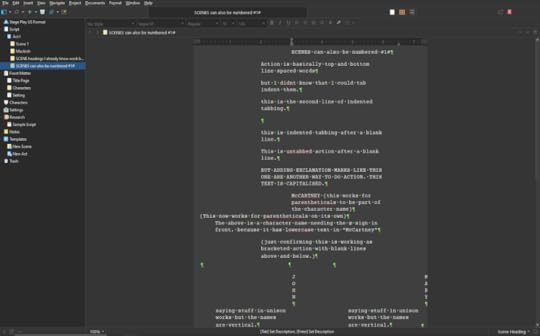 .SCENES can also be numbered #1#Action is basically top and bottom line spaced words but I didnt know that I could tab indent them. this is the second line of indented tabbing. this is indented tabbing after a blank line.This is untabbed action after a blank line.!BUT ADDING EXCLAMATION MARKS LIKE THIS ONE ARE ANOTHER WAY TO DO ACTION. THIS TEXT IS CAPITALISED.@McCARTNEY (this works for parentheticals to be part of the character name)(This now works for parentheticals on its own)The above is a character name needing the @ sign in front, because it has lowercase text in "McCartney"(just confirming this is working as bracketed action with blank lines above and below.)JOHNsaying stuff in unison works but the names are vertical.MARY ^saying stuff in unison works but the names are vertical.
Below is the bottom half of the selected SCENE page and code beneath it for comparison.
It shows the lyrics don’t honour a line-break after the characters talking in unison, again this is probably about my lack of knowledge and the formatting, also not a big deal, I can fix it in situ. I would like to figure out how to make the === page split work, though a work around is to put a “.SOMETHING” in the code which will cause the import to make a new page by treating that as a new scene break. Again maybe it is buried in the manual, but if you know how to get Scriv to honour the Fountain approach, let me know in the comments. The note between square brackets in the middle of the line of code is just chaos placing it underneath the line it was in, but I guess I wont be note-taking, so it doesnt bother me. And the /* Boneyard */ also doesnt work. This means I can’t use comments or hidden notes in the .fountain file. It might be nice, but also, not a big deal.
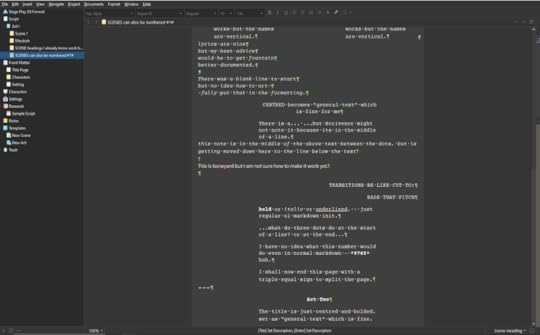 saying stuff in unison works but the names are vertical.~lyrics are nice~but my best advice~would be to get fountain~better documented.~~There was a blank line to start~but no idea how to art-~-fully put that in the formatting.>CENTRED becomes "general text" which is fine for me BADE THAT FITCH**bold** or *italic* or _underlined_. - just regular ol markdown init....what do three dots do at the start of a line? or at the end...I have no idea what this number would do even in normal markdown - **\*9765\*** huh.I shall now end this page with a triple equal sign to split the page. But it didn't work. ===>**Act Two**
This is as far as I got today. If you have any tips post them in the comments. I’ll update this if I stick with it, which I probably will because it suits my approach.