
Kim Stanley Robinson's Blog
November 22, 2025
In which we look at more things that happened
Despite the earlier post's list of lists, there was still a lot of catching up to do with all things KSR. Here is a list of interviews that were not covered previously, and as you will see they span the whole range from 2025 all the way to... the 1990s!
Oxford Ministry for the FutureThe Hertford College Oxford Ministry for the Future organized another event where KSR participated in earlier this year, Art, Nature and Science: Imagining other worlds.
On 28 April 2025, OMF hosted global cultural icon Brian Eno and environmental novelists and storytellers Kim Stanley Robinson, Laline Paull and JM Ledgard at the Sheldonian Theatre. We were treated to the premiere of ‘Life Wants to Live’: a braided reading underscored by original music composed by Brian Eno for this occasion. The performance stimulated interdisciplinary academic discussions about the biodiversity crisis and its solutions, with anthropologist Nayanika Mathur (of Crooked Cats), ecological economist Dr Nicola Ranger and political scientist Thomas Hale (of Long Problems).
The recording of both the reading + music part and the discussion part can be found on YouTube. Here it is for your enjoyment:
In the "Life Wants to Live" reading + music part, KSR read from The High Sierra, 2312 and The Ministry for the Future.
Another spoken word + music collaboration event between KSR and Brian Eno is planned for 2026 in Oxford: "A History of Utopia". So there's this to be excited about!
Past interviews: The post-Ministry era
Interviews from the prolific period following the publication of Ministry for the Future. Choronologically, and highlighting some of them:
2021/Feb Reversing Climate Change podcast (YouTube, Pocket Casts)2021/Dec Resources for the Future podcast (YouTube)2021/Nov KSR & Ken MacLeod in conversation (YouTube), a part of that conversation was used in the larger Cli-Mates: Climate Futures Conversations from Scotland by ASU & Shoreline of Infininty (YouTube)2022/Sep Laura Flanders podcast (Pocket Casts, YouTube)2023/Oct Create Tomorrow, The WGSN Podcast (Pocket Casts, YouTube)2023 interview for Fantastinet during Utopiales in France (YouTube) + the resulting text article in French2023 lecture and discussion at ETH Zurich in Switzerland, an institution referenced in many KSR novels (YouTube)2023 interview on live TV for Euronews Romania, with live English-Romanian translation! (YouTube) The Mars trilogy and MftF have been translated to Romanian.2023/Nov lecture and discussion at the University of Amsterdam's Room for Discussion (YouTube)2023/Dec Omega webinar (YouTube)2023 KSQD radio interview (YouTube)2024/Feb Your Undivided Attention podcast (YouTube)2024/Feb Energy vs Climate podcast (YouTube)2024/Feb My Climate Journey podcast (YouTube)2024/Apr online interview for Maynooth University (YouTube)2024/Apr online conversation for Plebity (YouTube)2024/Apr lecture for UC Santa Barbara students (YouTube, Libsyn), part of the English course Climate Crisis 101 taught by Ken Hiltner2024/? iinterview for the 2024 inaugural event of the Centre for Future Generations (YouTube), featured as "The future, accelerated"2024/Oct for City Arts & Lectures, Richard Powers in conversation with KSR -- a great conversation well worth your time! Click on this photo of Powers for a direct download.

Past interviews: things we missed
Then there are the interviews that fell through the cracks as I was covering this period on the website and were not featured here, or recordings of past events that have surfaced at a later date. Again, chronologically:
2009 KSR article on IEEE Spectrum: "My 10 Favorite Mars Novels", from 1897 to 1988!2011 intervew by Rudy Rucker for his podcast (YouTube)2015/Jul NPR's Capital Public Radio Insight for Aurora (link)2016 panel organized by the University of North Dakota: "Other Worlds", recording available2016 short quote in praise of NPR's Science Friday in the Mondavi Center Program Book Sept-Oct 2016 (archive link)2016/Apr NPR's Capital Public Radio Insight for the short story "Oral Argument", including a reading of the story by Blair Leatherwood (link)2016 interview for Neue Zürcher Zeitung, on the occasion of KSR's visit to Zurich (in German, paywall): "Willkommen im Kanton Mars" ("Welcome to the Canton of Mars")2016 interview for Utopia 2016, (in German): "Weltraumforschung ist eine Erdwissenschaft" ("Space research is an Earth science")2017 interview for ActuSF around Galileo's Dream (in French) (link)2017 panel with KSR interviewed by Ian Watson at CCCB in Barcelona (YouTube)2015/Apr recording of an event at the Sanford Consortium by The San Diego Union-Tribune (link) (sadly the video is no longer available?)2017/Dec KSR was one of the authors interviewed for this article in Nature: "Science fiction when the future is now": "3D glasses on reality"2018/Mar text interview for Frankfurter Allgemeine Zeitung (in Germany, paywall): "Wenn die Städte unter Wasser stehen" ("When cities are under water")2018/Mar text interview for Truthout2018/Jul audio interview for Areology, a part of the Ologies podcast series (KSR in part 2 from minute 27; includes transcript)2018/Jul text interview for The Huffington Post2018/Dec excerpts from a text interview for Locus Magazine (entire interview in the December 2018 issue): "The Good Anthropocene"2019/Oct text interview for The Brooklyn Rail, available in print in the fall 2019 issue "River Rail Colby": "Imagining a Flooded Planet"2019/Nov a piece written by KSR for The Institute for Anarchist Studies (in fact, an extract of "Mythmakers and Lawbreakers", a 2009 collection by AK Press): "Anarchism's Possibilities"2020/Apr audio interview for Recall This Book + an edited text version of the interview for Public Books: "The Realism of Our Times"202/Jun audio interview for Mendelspod202/Jul text interview for Dr. Fred Nadis's Cabinet of Curiosities: "Hold the Starships -- an Interview with Kim Stanley Robinson on Mars Settlement, Socialists in Space, Extraterrestrial Intelligence, Immortality, and the Purpose of Science Fiction"2020/Aug audio interview for WNYC Studios' On The Media: "Apocalypse Now"2020/Sep online conversation for Cloughjordan Ecovillage (also on YouTube): "The Future That Awaits Us"2020/Dec text interview for Poli-K in Greek, on the occasion of the release of a Greek translation of The Lucky Strike .Past interviews: the deep past
But wait, that's not all! Here are some findings from when the Mars trilogy was new -- actually, still on-going!
1993/Dec text interview originally for the magazine Vector #176, now available online courtesy of the intervewer Kev McVeigh, on Performative Utterance!1995/Jun interview for SBS, on the Australian television, on the occasion of KSR's visit to the Australian National Science Fiction Convention (YouTube) -- Red Mars is discussed!1997 video interview with KSR alongside David Brin, Mark Adler and Robert Zubrin for Sightings (S5E13), on the section "Mars: The Next Step" (YouTube, Mars section starts on minute 38)!Locus Mag posted an audio clip from a 1997 interview with KSR as part of their Patreon crowdfunding for digitalizing older content. This had formed the basis of a 1997 article (excerpt).
I think that's enough for now. But we will be back soon to report on KSR's visit to the climate COP30 in Brazil!


October 30, 2025
A long-expected update

It's been a while since this website was last updated! Between the lack of a new publication by KSR (but not, as we will see, a disappearance from public life) and this webmaster's real life, time passed. We start with a big announcement, followed by our customary list of interviews and odds and ends.
The Kim Stanley Robinson archive goes to The Huntington!Big news! The Huntington, a cultural and educational institution based in San Marino, California, has acquired the personal library and papers of Kim Stanley Robinson. It will join there the archive of such illustruous authors such as Octavia E. Butler, Hilary Mantel and Thomas Pynchon. The collection consists in "50 linear feet of papers, photographs, and manuscripts as well as thousands of digital files". What this includes:
Draft manuscripts, typescripts, and digital files for nearly all of Robinson’s novels, with extensive revisions that reveal his writing process and evolving ideas.Research materials and notes on subjects ranging from Martian geology and Antarctic glaciology to climate science and economics, which informed his fiction.Correspondence with scientists, policy experts, and fellow authors, offering insight into his collaborations and his role in climate policy discussions.Personal notebooks and journals documenting Robinson’s creative process, daily life, and reflections on environmental and political issues.Thousands of digital photographs related to his travels and backpacking expeditions as well as ephemera related to his public appearances.Annotated editions of works by authors who influenced him, including Henry David Thoreau, Virginia Woolf, and Ursula K. Le Guin.This gives a precious insight into KSR's creative process, both for his fiction and what impact it has on the real world, and is a historical and cultural heritage of great importance. Indeed, the Huntington aims to make the collection available to researchers by 2027.
“It’s a deep pleasure to have my archive go to The Huntington,” said Robinson. “I remember visiting from Orange County when I was in school; as a lifelong library lover, I was amazed there could be such a big and beautiful one. Since then, I’ve known The Huntington as the home of the Octavia E. Butler papers, and I’m proud to have mine join hers there. Science fiction is the genre best suited to expressing Southern California—as our work will show. I’m also honored to have my papers join the library that holds those of other authors I admire, such as Hilary Mantel and Thomas Pynchon.”
Here is the Huntington's official announcement. Already, the samples released with the announcement are extremely alluring: KSR's copy of The Dispossessed dedicated to him; a handwritten chapter outline for Ministry on what looks like a whiteboard (you can see that photo with this article); a handwritten draft of Green Mars; plus handwritten notebooks with plenty of stuff, lists, letters, photos, maps...
What does that mean for KSR? For one, it does not mean he wil stop writing. Although The Ministry for the Future was his last long novel for Orbit in 2020, he is currently working on a non-fiction book on Antarctica in the same vein as his 2022 High Sierra book. And there's more, as he expands to writing more than longform novels.
Interviews and live events
Listed chronologically:
16/Dec/24 interview for Nature:
What do you tell young people who worry about climate change?
I often talk to undergraduates about climate dread. They are the people of the future, because they’ll be here in 2075. Thinking about all the things that have to be accomplished by 2050 to avoid crossing tipping points into unavoidable catastrophe — of course you have climate dread.
The rise of eco-anxiety: scientists wake up to the mental-health toll of climate change
So I try to tell them that it means that your life has a project, you have existential meaning. You are not caught in the nihilism of meaninglessness that was capitalist realism. In the 1980s, you saw bumper stickers on US cars that said ‘he who dies with the most toys wins’. It was sarcasm, but it also pointed to a lack of meaning. Why live, what is it all about? Well, now we have that answered.
I also tell them: whatever you’re interested in, whatever your personal interests are, that can become climate work. Arts, public policy, psychology, the sciences, engineering, the humanities, they can all become part of climate work. Just find your angle. But, at the same time, acknowledge that we’re in an emergency, that something has to be done.
01/Jan/2025 interview with Akshat Rathi for Bloomberg Green's Zero: The Climate Race podcast. The podcast reposted it as one of its highlights of 2025. Also on YouTube:
17/Jan/2025 interview for Lin Weaver's Talking Point show at Davis Community Television, on The High Sierra (also on YouTube).
19/Jan/2025 interview for Richard Louis Miller's Mind Body Health & Politics program (also on YouTube).
22/Jan/2025 interview for the Danish podcast Langsomme samtaler ("slow conversations"); the conversation itself is in the original English (also on Pocket Casts).
23/Jan/2025 interview for ANWH's Frigate podcast (also on Pocket Casts).
28/Jan/2025 interview for the How My View Grew podcast (also on Pocket Casts).
29/Jan interview for the always-interesting Graham Culbertson's Everyday Anarchism podcast about Green Earth (also on Pocket Casts, Spotify, YouTube).
02/Feb/2025 discussion for a Mars trilogy book club organized by John Walter Knych (on YouTube).
13/Feb/2025 interview together with essayist Manjula Martin for Fossil Free California (on YouTube).
17/Feb/2025 second interview for Sam Matey's Weekly Anthropocene newsletter. This one is great, thanks to all the additional material! Some selected quotes:
One of the things about your column is this internationalist thing, the attention to what’s happening elsewhere. You and Mongabay do this, and it’s what we need to hear in America. We really need to know that the world is so complex that good things are happening everywhere, particularly on the biosphere front.
Full employment matters. A targeted 5% unemployment rate was established to instill fear in the heart of the poor, who will then take any job [...] more value of human beings, more ability to become themselves by having a certain amount of social security and probably a meaningful job rather than bullshit jobs. Better than that would be everybody thinking of their job as being meaningful in the larger human project of coming to terms with the biosphere, and that's another kind of utopian goal that needs to be put on the table time after time. It's not just a matter of making sure that you've got rent and water and food. It's a matter of having meaning. That doesn't get discussed enough.
Now, a group has come together. It's a combination of glaciologists and technologists from Silicon Valley, also financial people, and then also a group of internet and computer experts who are interested in doing things to help the world, which started a kind of a Saturday morning Zoom pandemic club amongst friends. They've all coalesced into a non-profit, a 501c3 now, called Ice Preservation. [...] Could we slow down those big ice streams to the point where West Antarctica was stabilized?
What I worry about is what has been usefully called hopium. You provide hope by showing us real things in the real world that are going on right now that, if they succeed, we will get out of this century without a mass extinction event. Now, we need hope and these things are real. I'm not saying what you and I are doing is wrong, as a kind of utopian political project of saying pessimism is wrong, cynicism is wrong. despair is wrong. What's right is fighting and pointing out how many other people are fighting for good things.
One thing I've been encouraging myself with is that even the president of the United States is limited in their power in the world civilization, and this is a century-long effort. You can't dismiss the loss of four years, but it won't even be a lost four years. The United States has never been, except under Biden, a climate leader. The rest of the world has done the things. The economics comes out of China. The EU is the political organization that cares the most. India is under immense pressure to get this right. Same with Brazil.
18/Feb/2025 interview for the Party Girls podcast (on Spotify, Pocket Casts). They also have extra content if you contribute to their Patreon -- here's a preview of that.
19/Feb/2025 live panel for the Praxis Peace Institute (recording on YouTube).
6/Mar/2025 seminar at the UCLA Institute of the Environment and Sustainability (recording on YouTube): "Optimism, Optopia, and Climate Change Stories", where he tried to motivate the younger generation for action.
+ some reporting on the event by Legal Planet and IoES itself:
You could quantify it and say that the damage done in the last 6 weeks to the National Institutes of Health means that all of us, on average, are going to have a shorter lifetime. You could then quantify that. There are 8 billion people on the planet. What if they’ve all lost a month? That’s 8 billion months that have been lost to death. So yes, people are going to die from the stupidities of the Trump administration’s attack on the federal government, I mean immediately from disease and from famine in the rest of the world.
What has to be responded to by all of us is ‘You cannot kill the future.’ Think about what they’re up to. There’s genocide, there’s ecocide, there’s futurecide. To kill the future means you see a trend in history that seems inevitable and going in a direction you don’t like because your privileges will be lost.
12/Mar/2025 panel with artist Ala Ebtekar, who is working on an upcoming edition of Asimov's Nightfall for Arion Press, which produces limited-edition fully hand-made books (on YouTube).
19/Mar/2025 talk together with public policy expert Stephen Heintz for the Long Now Foundation (Spotify, YouTube): "A Logic for the Future".
Even as we confront the new and returning challenges of this geopolitical moment, we also face a certain meta-challenge: the outdated assumptions, decades or even centuries old, informing our systems of international relations. The status quo — national sovereignty, neo-liberal economics, and zero-sum thinking above all — cannot be maintained in the face of shifting planetary conditions. What that status quo threatens to backslide into — imperialism, great power competition, and unfettered slaughter — is even less pleasant to countenance. Without a cohesive, intellectually rigorous effort to create new assumptions underpinning international relations, planetary thriving is itself at risk.
Three core shifts inform Heintz and Robinson’s thinking, cutting across ecological, political, and economic lines. First, they emphasize the need to recenter the value of all life, rather than the narrow-minded anthropocentrism of so much conventional moral accounting. Next, they propose a shift from national sovereignty to more collaborative modes of governance, taking the nation-state not as an essential unit of international relations but just one model among many on the planetary stage. Finally, they call on all of us to develop regenerative economic systems that can turn the tide on the regime of extractive economics that has become the dominant form of social exchange under contemporary capitalism.
21/Apr/2025 interview by painter David Brody for Painters on Paintings on the Chauvet caves and Shaman. Some selected quotes:
I had already begun work on my novel before the Werner Herzog movie “Cave of Forgotten Dreams” came out. I saw the movie twice in theaters, in 3-D, then bought a DVD of it so I could watch it frame by frame at home. It’s a very good movie, especially in the way Herzog trusts the cave and its paintings to be the items of interest, so that he pans back and forth across them repeatedly. His usual array of eccentric commentators don’t really impede the success of the film. Along with a great number of books on the Paleolithic and shamanism, that movie was one of my chief aids when writing my book.
[On the more organized packs of northerners taking slaves vs the small cooperative bands of southerners being hungry] Yes, I was speculating about these ideas, some of which I had read in the literature, and some of which were my own, including the notion that the domestication of wolves into dogs might have inspired a somewhat similar origin for humans enslaving other humans. Also, that when a surplus of food was created, in effect by refrigeration, this would begin the process of property, hierarchy, and patriarchy, shifting things from a more scarcity-based and thus egalitarian Paleolithic band society, to bigger Neolithic and agricultural town societies, where the split into classes began.
I did want to show that although gender roles were pretty defined then, and there were some separations in people’s social life and roles by way of gender (as in first people societies still living today), men and women were equal in social power.
I do think The Mind in the Cave, and the whole case for shamanic psychedelics that was made by Jean Clottes and David Lewes-Williams, with psychedelics of different kinds being one of the identifying features of shamanism worldwide—is pretty convincing, even though it must remain speculative, given the thousands of years separating us from the cave painters.
The Third Wind was particularly important. This narrator of the novel is some kind of spirit being. Early on I realized that the narrator of this novel needed to be not me but rather some entity from that time, explaining aspects of that time to its listener—who was listening, because the story was told, not written.
Also, I agree: the audiobook version by Graeme Malcolm is superb. That meant a lot to me.
24/Apr/2025 interview for the Public Books/Novel Dialogue podcast together with literary critic Elizabeth Carolyn Miller (also on YouTube, Spotify, Pocket Casts) + transcript in pdf format + of note, Miller, a professor at UC Davis, had KSR visit her English course in the past.
25/Apr/2025 interview for the International Peace Institute (on YouTube), on the side of a roundtable discussion on "The Declaration on Future Generations: Moving from Vision to Reality"
03/Jun/2025 interview for the Mongabay podcast + a preview on YouTube
10/Jun/2025 interview for the 2025 Public AI seminar (YouTube, AI-generated summary (!) on Google Docs)
29/Jul/2025 interview together with Oxford's Anette Mikes for Intesa Sanpaolo's Global Conversations with Global Leaders podcast (Spotify, YouTube, Pocket Casts).
26/Sep & 03/Oct/2025 interview with Tranen's Toke Lykkeberg for e-flux magazine, in two parts: "To Capture the Present Moment, You Either Write Historical Fiction or Science Fiction", Part 1, Part 2. A couple of quotes:
Instead of being a simple descriptor of our reality, the Great Acceleration is a complete mess. Some things are accelerating, others are already decelerating and falling apart. And this mess is what we call history. It can’t be named simply. That is also the point of your extemporary art, instead of contemporary art: an art outside of time.
Ministry takes on a rather grim topic. It could be a CoP report, it could be an IPCC report. These documents are thousands of pages long and they’re depressing. And yet I wanted to make a novel that was only five hundred pages long—a little long, but not very long compared to some of my other novels. And I wanted it to be fun, because reading a novel is for pleasure. So it’s Aristotle, it’s Brecht. Education can be fun and entertainment can be educational. It’s not either/or. The best art does them both. One of the ways I could think to make the novel entertaining was this play of genres, or play of forms. When you start a chapter in The Ministry for the Future, you do not know what form you are reading.
03/Oct/2025 interview for the New Indian Express: "Mars can't save you".
The idea of colonising Mars – the Muskian vision of a “multi-planetary species” – is, in Robinson’s words, “bad science fiction”. He explains: “We can’t breathe the air. We can’t touch the soil. The surface is laced with perchlorates – salts deadly to humans. You’d have to live underground, in radiation-shielded bunkers. Like a Motel 6 in a prison.”
“The Mars books were about building a better society on another planet,” he said. “But Ministry is about doing that here, now, under pressure, in crisis.” Even in Blue Mars, the message was never “let’s escape Earth”: it was the opposite. The Martians return to a ravaged Earth and say: “Mars can’t save you. We’re a mirror. If we can build a just society here, so can you.”
15/Oct/2025 interview for Natascha McElhone and Omid Ashtari's Where Shall We Meet podcast (also on YouTube, Pocket Casts).
22/Oct/2025 interview for the Financial Times' Tech Tonic podcast; transcript available (also on Pocket Casts): "Mission to Mars — Bad science fiction".
If you had a city on Mars and then something happened that killed every human on Earth, that community on Mars is doomed. Doomed to a slow death. They need Earth. They need everything that Earth provides. They would be an outpost only, utterly dependent.
More KSR news
On the occasion of the centenary of the publication of F. Scott Fitzgerald's The Great Gatsby, the Fitzgerald Society organized a reading of the whole work by prominent people, among them KSR together with Maxine Hong for a chapter (on YouTube) -- the whole thing is on their website!
As mentioned above, KSR is an advisor of the Ice Preservation organization.
KSR wrote the foreword to The New Possible: Visions of Our World Beyond Crisis, a 2021 collection of essays on a changing world, edited by Philip Clayton, Kelli M. Archie, Jonah Sachs, and Evan Steiner. Available from their website.
KSR contributed to the collection No More Fairy Tales: Stories to Save our Planet, edited by D. A. Baden and Steve Willis. KSR's stories, "The Carboni", "Drambers" and "Project Slowdown", are (presumably) excerpts from Ministry. Available from Habitat Press.
KSR is the judge to a short fiction contest by The Bulletin of the Atomic Scientists: "Write Before Midnight" -- winners to be announced in January 2026.
KSR appeared in a British documenary series on the history of science fiction, specifically exploring Ministry: Wonderland: Science Fiction in the Atomic Age. Available from Sky Arts.
For a survey on California literature organized by Alta, KSR recommends: "Cecelia Holland, who lives in Humboldt County, is one of our greatest living novelists".
Speaking of California literature, an essay on KSR's The Gold Coast was part of the 2025 collection California Rewritten: A Journey Through the Golden State’s New Literature by John Freeman, who has been running Alta's California Book Club.
Everything else
Some more reviews of Ministry:
Elizabeth Doerr (Cramming for the Apocalypse) for The Futurist Book ClubThe Hugonauts podcastClaudia Befu (Story Voyager) for a book club reading
Various articles mention Ministry for the Future or KSR in one way or another, and I'm sure this is just a partial list:
Pakistan's World Echo News on the climate crisisGlobal Citizen on carbon pricingOnlySky on climate action and democracyThe New Yorker on why we are tormented by the futureThe New Republic on the Los Angeles firesStory Voyager, in which Vlad the Impaler -- aka Dracula -- takes over the ministry for the Future and comes up with a plan for saving the worldMongabay on climate fiction's impact on climate actionEnvirotech Online on rewilding as a carbon capture technologyHarvard Business School's The Harbus on climate change economicsClean Technica on the gutting of NSF financingKen Rutkowski theorizes that Indira Gandhi could have had MftF on her bookshelfDelton Chen (inspired KSR for the carboni coin) on carbon rewardsDaily Kos on burning yachts and climate action against the wealthyThe Philipine Daily Inquirer on heat and healthScience News Explores on Antarctica's glaciers and Slawek Tulaczyk of UC Santa Cruz (KSR's inspiration for the glaciologist in MftF)Science Alert and Futura Sciences on (not) terraforming MarsSplice Today on looking back at Covid and changing our imaginationsThe Guardian on the all-new Climate Fiction prizeThe Independent on weather controlOpen Global Rights on emotion and climate change actionPublic Books on climate fictionJacobin on carbon pricingLow Impact on the money systemJohn Menadue on redirecting capitalA Stanford Law School project on blockchain-enabled carbon quantitative easingThe Observer on global sea level riseThe Ecologist on science fiction giving hope
Ministry for the Future is recommended in various reading lists:
The Guardian's readersETV Bharat (India)Times Now News (India) -- twice! -- no, thrice!Trellis GroupThe Mary SueThe Economist's The Intelligence podcastVocal Media
Well, that's all for now -- but there's so much catching up to do that a second update will follow shortly!
November 20, 2024
The Götterdämmerung Syndrome years
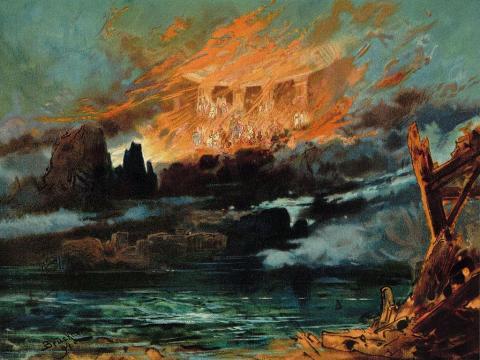
It's been a long time since the last update. Another year, another peak in greenhouse gas emissions, a "Götterdämmerung Syndrome" year before things get better, in Ministry for the Future parlance.
The Götterdämmerung Syndrome, as with most violent pathologies, is more often seen in men than women. It is often interpreted as an example of narcissistic rage. Those who feel it are usually privileged and entitled, and they become extremely angry when their privileges and sense of entitlement are being taken away. If then their choice gets reduced to admitting they are in error or destroying the world, a reduction they often feel to be the case, the obvious choice for them is to destroy the world; for they cannot admit they have ever erred.
We open by an obituary: recently, famous Marxist literary critic and KSR's PhD supervisor and long-time friend Fredric Jameson passed away (Locus Mag). He was in the acknowledgments of many of Stan's books.
Back in June, Kim Stanley Robinson was invited to the University of Oxford at the Hertford College for the official launch of the "Oxford Ministry for the Future" (OMF), which hopes to amplify voices for a sustainable political economy of the future.
Here's more background on the thinking that lead to this by Anette Mikes and Steve New: 'Our Ministry for the Future – Reshaping capitalism to help solve the climate crisis" -- a part of their academic article "How to create an optopia? - Kim Stanley Robinson's "Ministry for the future" and the politics of hope".
The inaugural event itself, titled "Inventing a Sustainable Political Economy for the Climate Crisis", featured Kate Raworth (author of Doughnut Economics) and KSR alongside some very, very interesting panellists: environmental historian Venus Bivar, climate litigation expert Ben Franta, corporate sustainability expert Mette Morsing Smith, author Laline Paull and environmental geographer Jamie Lorimer. Here it is below (YouTube):
Ministry directly engages with the functioning of international institutions, and this has gotten KSR invited in many venues. In September, he participated in the United Nations' Summit of the Future 2024 at UN HQ, New York City, an event where both world leaders and plenty of representatives of civil society participated. On the UN side, the event resulted in the Pact for the Future declaration.
As usual in such things, there were plenty of side events alongside the main political part of the event, during the Summit's Action Days: KSR participated in the one called "From Idea to Action and Impact: mobilizing the outcomes of the Summit of the Future", convened by the UNESCO-MOST BRIDGES Coalition:
This event will foreground proposals from the Wales Protocol for Future Generations, highlighting initiatives in community, national and international contexts demonstrating how the ambitions of the Declaration on Future Generations can be achieved.
Where there was an inter-generational discussion between KSR and Leonie Hoffmann, master’s candidate from HEC Paris. A recording of the event is on the UN's website.
See also side-event details at ASU; Summit UN News teaser; KSR interview in the UN's podcast The Lid Is On.
Some more interviews:
Berkeley: Berkeley Talks prodcast: Sci-fi writer Kim Stanley Robinson on the need for ‘angry optimism’ (from a 24 January 2024 event; transcript available)London School of Economics: talk at LSE Festival: Navigating the politics of the climate crisis (on YouTube); and interview: How science fiction can shape the futureAlta: Better Homes and Gardens (about Robinson's neighborhood Village Homes)Coda: Silicon Valley’s sci-fi dreams of colonizing MarsBBC: The Climate Question podcast: Can Science Fiction help us fight climate change?The Break Down: Utopia and Crisis (on YouTube and Spotify)
Ministry won the Best Foreign Novel award at the 2024 Grand Prix de l’Imaginaire, honoring the best SF/F work published in France in 2023 (Locus Mag).
Ministry keeps popping up in many articles here and there. For instance:
Ministry was recommended for Earth Day by The Seattle Times and The National NewsMinistry was recommended by a Slate culture podcastMinistry was read in a book club in Trinity College Dublin and is being read at NPR's KQEDMinistry was mentioned in articles about climate fiction in The Irish Independent, Perspsective Media and Ecowatch
Some reviews of Ministry:
Psychiatry Online: Michael A. Kalm: Climate Change and the Human PsycheClimate HopiumProgrammable Mutter
Plus, some academic articles entirely focused on Ministry:
Monticelli and Frantzen, 2024. Capitalist realism is dead. Long live utopian realism! A sociological exegesis of Kim Stanley Robinson’s The Ministry for the Future. The Sociological Review. https://doi.org/10.1177/00380261241261452Beke and Kiss, 2023. Planetary consciousness, biospherical governance, climatic rightfulness: interpretation and contextualization of Kim Stanley Robinson's novel The Ministry of the Future. Metszetek. https://doi.org/10.18392/metsz/2023/1/2 (Hungarian)As usual by now, here are some articles that are related to Ministry and make reference to it (some paywalled):The Asahi Shimbun: Climate change may remove spring from Japan’s calendarDaily Kos: April was the moistest on record, evidence of a long-predicted water vapor humidity feedbackThe Economic Times: Cruel Summer: Rethinking how to live, work in a world that is getting warmerMondaq: Airships: Exploring New Possibilities For An Old IndustryGeographical: The sci-fi world of climate changeThe Davis Enterprise: Per Capita: A(nother) cautionary taleThe Irish Independent: Colin Murphy: Hope and despair on opposing sides of the climate debateOODA Loop: A Dispatch from the Ministry for the Future: “Wet Bulb” Heat and Humidity Conditions in the U.S.Forbes: 3 Policy Approaches To Tackle Extreme HeatDevex: Opinion: Pakistan floods signaled watershed moment in climate and healthThe Quint: India Needs a 'Right to Cooling' to Continue GrowingForbes: Rising Temperatures Imperil India’s Growth ProspectsBloomberg: How Extreme Heat and Humidity Are Testing the Human Body’s LimitsThe Good Men Project: Death by a Thousand CutsBuilding Design + Construction: The growing moral responsibility of designing for shadeBocconi University: The Eyes from Space That Help Save EarthThe BMJ: Cli-Fi—helping us manage a crisisThe Christian Century: Preaching against the rich (Mark 10:17-31)Bloomberg: The Tech World Has a Radical Plan to Cool the PlanetSan Antonio Report: As temperatures climb, Texas must mitigate methane emissions
Some more "odds and ends":
KSR got an honorary doctorate from University of Zurich!KSR's editor at Orbit, Tim Holman, has been promoted to Orbit PresidentKSR was recommended as Class Day speaker at Princeton
That's all for now -- stay tuned for more updates soon, with more maintenance work on the website in particular.
(Photo: Max Brückner's depiction of Götterdämmerung, the twilight of the gods, for Richard Wagner's opera)
April 21, 2024
Musing about optopias

First of all, some sad news. Terry Bisson, fellow Bay Area science fiction author and friend of KSR, passed away recently. Coincidentally, KSR had recently chimed in about Bisson in a New Yorker profile. He also wrote an appreciation for Bisson in February's issue of Locus.
The High Sierra
We first start with things around the non-fiction The High Sierra: A Love Story, because we don't talk enough about it!
KSR was interviewed about it by the US Times Post: Sci-fi novelist Kim Stanley Robinson talks ‘The High Sierra’
There are many places on this planet that are incredibly beautiful and adorable. You don’t have to burn a lot of carbon to have a good time. The basics of Paleolithic contentment remain the same within us and are readily available. The technological sublime is indeed sublime, but like a drug rush – it’s expensive and can be tiring. The ordinary pleasures are better all around. Walking is one of those pleasures – we evolved to walk better! And hiking in the mountains is fun, but so is hiking in the city or pretty much anywhere else.
He spoke to The Tahoe Weekly: A science fiction writer’s love affair with the High Sierra
He discussed at the UC Davis Tahoe Environmental Research Center (YouTube video)
He spoke to the Pacific Zen Institute's podcast on The High Sierra: The Zen Luminaries
The High Sierra also won some awards! Here they are, with short online KSR interventions:
Commonwealth Club: 92nd Annual California Book Awards (award ceremony video on YouTube)California Independent Booksellers Alliance: Golden Poppy Awards: Glenn Goldman Award: California Lifestyle (award ceremony video on YouTube)Some book excerpts are available:
On John Muir, along with various other KSR quotes on John Muir:
The flooding of Hetch Hetchy was a knife thrust into the heart of the wilderness movement. [...] But the war is never over. And as I looked down on the scene that misty evening, I saw the water drain away. It will happen someday. There is no rush about this, and given the emergency century we are entering, it isn’t even close to the highest priority. But put it this way: if civilization gets itself in a balance with the planet, a day will come when we will drain that misbegotten death lake and let the valley go back to the way it was. It will be one of the greatest experiments in landscape restoration ever conducted.
A 1988 poem by KSR is included in the book: Night Poem:
Writing by starlight
Can’t see the words
Fill a page
Nothing there
Waterfall distant sound
Tree against stars Milky Way
Juniper Jupiter white rock
Wind dying my heart
At peace a Friday night
Big Dipper sits on the mountain
Friends lie in their tents
I sit against rock
Star bowl spinning overhead
Feel the movement
And soar away
Who knows how many stars there are
All those dim ones filling the black
Until it seems no black is there
And then you see the Milky Way
The sky should be pure white with stars
That’s black dust up there
Blocking the view
Carbon and hydrogen
All of us flung together
In just this way
A blank white page
I write and then
A blank white page
Story of my life!
Some recommendations for The High Sierra at The Atlantic, Visit California, and University of California.
The interviews
Now, on to the usual long list of interviews with Kim Stanley Robinson which are mostly about The Ministry for the Future -- catching up with several that I missed the last time, too, approximately chronologically:
KSR was interviewed for the inaugural issue of Solarpunk Magazine!
Interview at The Great Simplification podcast: Climate, Fiction, and The Future
Interview at the Rising Tide podcast: KSR's Science and Fiction
(Print) interview by Liz Jensen at Writers Rebel (of Extinction Rebellion): Q&A with KSR
We now need public action (government) to be driving all private actions that are relevant to the crucial project; what work gets paid for and done, what consumption patterns are allowed, etc. This is not ‘green fascism’ any more than the Allied response to Nazi aggression was ‘democratic fascism’; it’s more a case of democratically approved coordinated public action in strong support of the public good. Legal action is needed for that. But it’s also an “all hands on deck” situation now, so no one solution will suffice. We need action across all fronts of society.
(Video) interview with Grist's Looking Forward, following their book club on Ministry for the Future: "At least zombies aren’t eating my face" (video on Vimeo)
At a certain point, dystopia has run its course of what it can do usefully. So then you need the positive stories. I’ve been writing utopias since about 1987, so that’s adding up to a lot of years of just trying to do the positive because I think we need it more. And it’s harder, technically — it’s less dramatic. But it’s interesting because you get new stories that haven’t been told before.
KSR appearance at the 2023 Learning Planet Festival (YouTube video replay)
Interview by Madrid's La Casa Encendida: Nuevas ecotopías para estos tiempos (YouTube video, dubbed-over in Spanish)
KSR lecture at the University of San Diego's Kroc School Institute for Peace and Justice: KSR Talks Climate Change (YouTube video) (also in the podcast Is The World On Fire?)
UC Davis Environmental Humanities: "Ministries for Future" - Donna Haraway and Kim Stanley Robinson (video) (+ Davis Vanguard article on the event)
New Hope Network has some highlights from KSR's appearance at the 2023 Natural Products Expo West for Climate Day: Science fiction offers roadmap for our planet's future
BC Heights has some highlights from KSR's appearance at the Boston College Lowell Humanities Series: Robinson Outlines Ways To Fight the Runaway Greenhouse Effect
KSR talked again at the Bioneers conference and gives an update: What I’ve Learned since The Ministry for the Future Came Out in 2020 (YouTube video)
KSR was at two events hosted by the College of the Atlantic in Bar Harbor, Maine, here are the recordings on YouTube: Coffee & Conversation: Sci-fi and Our Climate Reality and Summer Institute: Space: Our Last Great Commons
KSR was interviewed by Bloomberg along with a TV writer and a podcaster on: How to Write a Climate Thriller Fit for Page or Screen
“Dystopia is too easy,” Robinson says. “It's even a kind of comfort food, where we imagine situations worse than ours, and then rest comfortably that we're not that bad.”
To avoid writing futures so optimistic they beggar belief, Robinson borrows a concept from the sci-fi author Joanna Russ: the “optopia.”
“It's not the utopia — the no place, the perfect place,” Robinson says. “It's the optimum that we can do given the situation that we're handed. If we dodge a climate catastrophe and a mass extinction event in this century, that's a utopian story.”
KSR was interviewed by the Centre for Science Futures' new podcast series in partnership with Nature: "Science as a political and ethical project" (see also Nature for a shorter version, with transcript).
While in the Netherlands, KSR spoke at the John Adams Institute: Kim Stanley Robinson and the Fight for Planet Earth (YouTube video), along with environmental scientist Heleen de Coninck and author Lisa Doeland.
KSR appeared on a short video by PBS Terra on Geoengineering
Hot Globe interviewed KSR: The Future of the Future (partly paywalled)
It isn’t going to be machinery that solves our problems. But on the other hand, it is going to be technology because language is a technology. Justice is a technology, law is a technology. They're software. And so any argument against technology misunderstands human beings. We were technological before we were human. We had fire. We had stone tools. We co-evolved with our technologies. And language is the crucial one. And I would agree with those people who say the crucial technologies right now are political economy and finance.
KSR was interviewed by the Possible podcast, on Ministry but also Aurora, Galileo's Dream and more: KSR on the Future of Civilization (on Spotify) + a transcript on their site
One of the things that has gotten stronger for me as the last 40 years have passed is a conviction that humanity coevolved with Earth. It will never prosper off of Earth. Our trips off of Earth are trips into the death zone, which is what climbers call the elevations above about 26,000 feet, where the body starts to break down [...] this information that now is common—50% of the DNA inside your body is not human DNA. Well, this is news, and it changes everything. Because you can’t take Earth with you when you go off, even to the moon or Mars, much less off into interstellar space, where I have actually written an entire novel suggesting we’re not going to the stars because we coevolved with Earth, and we’re only healthy here. And in my solar-system novels—where you can see some from the mid-eighties and some from the last 10 years—you’ll see a shift in that in the ones in the last 10 years, people always have to go back to Earth for their sabbatical. They have to go back and eat some dirt. They have to get connected with the biosphere of Earth, which is their extended body, in order to be healthy again.
KSR talked to the Carnegie Council for Ethics in International Affairs: Why does the world now need to consider solar radiation modification? (YouTube video)
The Economist interviewed KSR and Laurence Tubiana on the the need for fiction about climate change on their podcast Babbage: Climate fiction meets climate fact (on Spotify)
The Science in The Fiction podcast does one writer and one scientst episode: KSR talked about Ministry (on Spotify) and glaciologist Heidi Sevestre talked geoengineering
Sam Matey's The Weekly Anthropocene interviewed KSR: Kim Stanley Robinson, Science Fiction Maestro and Utopian
When I look at the timeline of Ministry for the Future I'm very pleased to report that there are some sentences in it that no longer conform at all to reality as it's going. One chapter begins, “the 2030s were zombie years.” And that is now wrong! [...] it's going so much faster that I think the timeline in Ministry for the Future is completely off. We're already in the ferment that in my novel I have happening in the 2040s.
The Everyday Anarchism podcast continued its coverage of KSR's works with the Mars trilogy and an interview with KSR: Revolution and Anarchism in The Mars Trilogy
The Futurists podcast talks with KSR on his Mars trilogy, economics, world building, science and climate: Minister for the Future (Part 1 and Part 2)
Berkeley Talks podcast...talks with KSR: Sci-fi writer Kim Stanley Robinson on the need for 'angry optimism' (including a transcript)
Having put a climate disaster that kills millions in India, I felt obliged to India. I needed to stay there. I needed it to be the solution and not just an excuse for an American to put the problems on the other side of the world and then we solve them. I needed Indians involved in solving it. They are in huge danger from a wet bulb event, although one of the hottest wet bulb events ever recorded was outside of Chicago.
So it isn't like we're not in danger, but India's in real danger. I mean more present, more immediate. And I wanted to stick with them. And the book has been well-received in India. I mean, aside from the occasional hate mail from BJP party nationalists, but by and large, the Indians have said to this book, "Oh yes, Farhanji is finally understood. We are the center of the story and we're going to solve the problem here."
Radio Ecoshock / podcast interviewed KSR about Ministry and The High Sierra: Climate Sci-Fi Gets Too Real
KSR gave a lecture at Stony Brook University for its special series on climate change, and the whole thing is on YouTube.
And finally (for now!), Palma podcast interviewed KSR: What We Imagine, We Make Possible (on Spotify)
The rest
We continue with some additional material:
The book clubs discussing Ministry for the Future continue with Trinity College Dublin and South Burlington Public Library (Vermont).
Recommendations continue with The Conversation (Five fiction books to inspire climate action), The New York Times (This Is the Way the World Ends; paywall), The National (Earth Day: 12 novels to read with an environmental protection theme), The Seattle Times (Dig into these 4 books for Earth Day), and The Washington Post (10 books that will transform how you see nature, paywall), where Nnedi Okorafor writes:
I read “The Ministry for the Future,” by Kim Stanley Robinson, as I was in the process of moving to Phoenix. The novel starts with a deadly heat wave in India. Issues of water shortages and extreme heat were very much on my mind. I knew of Phoenix’s brutal summers, but was yet to experience one. The stark step-by-step details of this catastrophic event that leaves millions dead was such a terrifying read that it nearly gave me a panic attack. I had nightmares. After reading the first part, I went on to take some very aggressive (and expensive) precautions. “The Ministry for the Future” opened my eyes wider to how the Earth is changing and alarmed me in a way that only great science fiction can.
Reviews and articles inspired by Ministry:
Henry Farrell on Ministry's political economy (in response to the NYT article above)Adventures with Psychologists: Tim Hall of Yale '62 discusses MinistryBen Shread-Hewitt (on Resilience.org) reviews Ministry and Stephen Markley's The DelugeOnce more the heat waves are upon us, and this opinion on Aljazeera mentions Ministry
What's next? KSR's next non-fiction book on Antarctica, in the same style as The High Sierra, is due out soon-ish -- he is turning it in to his publisher in July.
It's structured like my book The High Sierra: A Love Story— the same format, in that it will have a variety of modes, including lyric realism as you called it, memoir, history, geology, and this case, glaciology. I'm enjoying this kind of modular miscellany, or just the kitchen sink principle— just throw in everything. It helps me to do non-fiction.
And KSR will soon be heading to northern Italy, as he will be one of the residents of the Rockefeller Foundation Bellagio Center!
(Top image: from the poster of the fiction film How To Blow Up A Pipeline, inspired by Andreas Malm's non-fiction book)
February 6, 2024
Ministry still riding the (heat) wave

"Article 14 of the Paris Agreement Under the United Nations Framework Convention on Climate Change called for a periodic taking stock of all the signatory nations’ carbon emissions, which meant in effect the total global carbon burn for the year in question. The first “global stocktake” was scheduled for 2023, and then every five years after that. That first global stocktake didn’t go well."
Thus begins Chapter 3 of The Ministry for the Future. But it could very well be a headline of the coverage of COP28 in December 2023, in our very real world! 2023 was the hottest year of the Anthropocene, and the heat wave kicking off Ministry makes it a timely and obvious starting point for discussing these issues.
Kim Stanley Robinson has been talking tirelessly about Ministry for the past three years now with no sign of slowing down! In November, he visited several countries in Europe.
Dutch editor VPRO produced this nice short video that can serve as a layman's introduction to KSR and to Ministry (some parts are in Dutch but they are short): "Voorbij de klimaatcrisis met Kim Stanley Robinson"
While in Rotterdam, he was interviewed by the Financial Times (with a lot of detail about the menu!): "If the world fails, business fails"
Robinson tells me he has been invited to meetings about the future with central bankers and defence department officials, as well as associations of hedge fund managers, although he can’t share their names. “They don’t want to shake the confidence of the world by telling [everyone] that they’ve been consulting with a crazy science-fiction writer . . . They thought it might shake the stock markets.”
In Switzerland, Stan gave a talk at ETH Zürich (which has been featured in a few of his works): see a report with photos from that event.
Also in Switzerland, he gave a talk at the World Trade Organization, together with WTO Director-General Ngozi Okonjo-Iweala: "Harnessing the Power of the International Trade System to Respond to the Climate Crisis" (panel on YouTube)
In Germany, the German translation of Ministry was awarded the Carlowitz Sustainability Award (named after the "father" of sustainable forestry), see also publisher Heyne press release.
Several of Stan's interviews in French media are very interesting -- going beyond just talking about the issues around Ministry but more in general about his influences, his view on literature and science fiction, looking back on his career... Material in English is noted below.
Interview at Blast (alternative media): "Un ministère du futur face à l'urgence climatique" (in English):
Interview at the podcast C'est plus que de la SF ("it's more than science fiction"): "Le Ministère du Futur par Kim Stanley Robinson" (in English)
Interviews for purely French speakers:
Podcast at Le Book Club of France Culture (public radio): "Kim Stanley Robinson et le monde de demain" (all-French)Reporterre: "Chaque milliardaire est un échec politique" ("every billionaire is a political failure")Libération: "Ce roman fait de moi une sorte de ministre du futur" ("this novel makes me a sort of minister of the future")Usbek & Rica: "Chaque milliardaire est un échec politique" ("every billionaire is a political failure") & "Le changement climatique s’est emparé de la science-fiction de futur proche" ("climate change has taken over near-future science fiction")La Croix: "L’utopie est l’espoir de notre temps" ("utopia is the hope of our time")Socialter: "La science-fiction est le réalisme de notre époque" ("science fiction is the realism of our times")Ouest-France: Kim Stanley Robinson, un maître de la science-fiction écologique réaliste (a master of ecological realist science fiction)En attendant Nadeau: "Les romans doivent être un plaisir" ("novels must be a pleasure")Mediapart: "Nous vivons dans un monde de science-fiction" ("we live in a science fiction world") (paywall)Le Nouvel Observateur: "Je suis anticapitaliste, mais j’essaie d’être réaliste" ("I am an anticapitalist, but I try to be realist") (paywall)Philosophie Magazine: "Le ministère du Futur est une nouvelle utopie" ("the ministry for the future is a new utopia") (paywall)Plus, from French-speaking Switzerland, Le Temps: "C’est une fiction climatique où nous faisons de notre mieux et où ça marche" ("it's a climate fiction where we do our best and where it works") (paywall)And from French-speaking Belgium, Le Soir: "Pour s’assurer un avenir, nous devons dépasser le capitalisme" ("to ensure ourselves a future, we must go beyond capitalism") (paywall)And, last but not least, Stan's panel at the Utopiales science fiction conference in Nantes, France (that he had also visited in 2006) (in English):
I will catch up with more Ministry-related and High Sierra-related interviews in the next update.
Meanwhile, here are some reviews for Ministry:
Penelope Prime for Global AtlantaJim Reed for Global AtlantaAndy Pollak for Slugger O'TooleM.T. Bennett for the Good Men ProjectDean Spade for In These TimesLee Zimmerman for TikkunSteffen Vogel for Blätter (German)Stefan Sasse for Deliberation Daily (German)Hughes for Charybde 27 (French)Le culte d'Apophis (French)LAmiSelbon for Vive la SFFF! (French)Thomas for Constellations (French)Gromovar for Quoi de neuf sur ma pile? (French)L'épaule d'Orion (French)Nicolas Winter for Juste un mot (French)Les lectures du Maki (French)Erdorin / Blog à part (French)Lorhkan (French)Anthony Glinoer for Le Monde Diplomatique (French)Marjorie Adelson for BFM TV (video) (French)Pablo Maillé for Usbek & Rica (French)Sylvie Molines for Courrier Picard (French)And some sightings of Ministry in book lists and other recommendations:
International Institute for Management Development: Winter’s tales to thrill and chill youPLOS Early Career Research Community: A Christmas Climate Reading BooklistNiskanen Center: Suzette Brooks MastersArgus-Courier: Petaluma (CA) top selling titlesPortland Press Herald: readers recommendationsDigg: Five Underappreciated Sci-Fi Novels To Read This SummerThe Review Geek: Must-Read: 10 Best Books on Saving the PlanetThe Spinoff (New Zealand): The book Raf Manji wishes he never readThe National: Eight climate fiction, or cli-fi, books to consider before Cop28Forbes: 16 Must Have Books And Podcasts For Leaders In 2024EnergieWinde: Kleiner Kanon der Klimaliteratur (German)Freude der Zeit: Was Wir Lesen: Melika Forutan (German)James Cameron has read itThomas Piketty has read it too (and he met KSR in Paris)In addition, Ministry found its way in this interesting art-meets-science project: A Future Manual For Future Models: An Artist’s Guide on How to do Integrated Assessment Modelling Differently
And it inspired a short story challenge at the Spectator.
Then, Ministry book clubs! Here's one in Martha's Vineyard and I'm sure there are others out there. With this book club by Wonkette, there were several articles discussing aspects of it:
A (Climate) Change Is Gonna ComeHope To Do Some Good, No Matter How F*cked Up You AreHot And Cold Running CrisesClimate Dreams And Flying MachinesThe Everything Feeling And An Earthquake In The HeadA Future Up In The AirFinally, as the world continues to wake up to the reality of climate change and mobilize resources to counter it, lots and lots of articles make reference to Ministry in more or less detail. Here is a selection, the list is long and I'm sure there are more out there!
Mint: Private geo-engineers are just winging it to shade the planetNews Track (India): Could a global "carbon currency" save the world from global warming?Diálogo Chino: Geoengineering in Latin America may create more problems than it solvesOODA Loop: Another Daunting Dispatch from the Ministry of the Future: ConocoPhillips’ Project Willow Will Freeze Melting ArticReuters: Policy Watch: The IPCC has given us a roadmap to a safe future for humanity. But will we follow it?Grist: Radical eco-activists have made it into mainstream fiction. Is reality next?Campbell River Mirror: Look to science fiction to learn how to save the worldReactor Mag: Mid-Apocalyptic Fiction: Writing Against a Climate CatharsisBBC: Heatwave: Is India ready to deal with extreme temperatures?Wonkette: Climate Crisis Well Into 'Just Like Science Fiction' TerritoryEconomic Times (India) Energy World: A clarion call - The urgency of a Bharat Heat Action & Adaption PlanPajiba: Corporations Are Incompatible With the Future of HumanityThe Conversation: Increasing heat is already a factor in human migrationZeroHedge: Blocking Out The SunThe Mary Sue: No, Ben Shapiro, Air Conditioning Won’t Save You From Climate ChangeEl País Mexico: The heat that is coming for us / in Spanish: El calor que viene por nosotrosIISD SDG Knowledge Hub: Climate Change Has a Hitman: Responding to Extreme HeatCommon Dreams: It Isn't Nice, But Climate Activists Will Block the DoorwaysThe Michigan Daily: Consider the carbon coinLiterary Hub: On the False Promise of Climate FictionThe Main Monitor: Why climate fiction mattersNew York Daily News: Woodrow Wilson’s cautionary taleLong story short, Ministry is still being widely discussed. With this infodump out of the way, be on the lookout for a future update with more varied material!
(Illustration: Miguel Bucana for Socialter Magazine)
October 20, 2023
Catching up with Robinson

It's been a while, but I'm back with the usual list of links about everything KSR! On the program: MORE discussion of Ministry for the Future and some love for The High Sierra.
KSR wrote an essay on Noema: Paying Ourselves To Decarbonize
The people fighting to burn fossil fuels in this coming decade may be thinking they are doing their best to save their fellow citizens from ruin.
The petro-states will have to be compensated, or they will become desperate and turn into such a force of disruption that efforts to avoid a mass extinction event will fail.
We need to employ a kind of eco-realpolitik that refrains from too much righteous judgment, acknowledging that all nation-states are obliged to keep their citizens free from disruption, unemployment and starvation.
Some KSR quotes in this Grist article: The summer that reality caught up to climate fiction
KSR on Bloomberg CityLab Environment: Author Kim Stanley Robinson Has a Utopian Climate Solution: Cities
California’s housing crisis right now is terrible. Suburbia is the culprit, cities are the solution.
You need a space you can call your own. It needs to be functional. It doesn’t need to be a mini-mansion, as with the idea that a suburban house on a quarter-acre is like an English castle and you are a lord. It’s not just the carbon footprint. It’s the isolation of it into the nuclear family, the lack of collegiality and sociability.
See also Bloomberg Green Climate Politics: How a Utopian Sci-Fi Author Writes Toward a Low-Carbon Future
KSR interview on Republik.ch: «Ich wollte schon immer erzählen, wie wir trotz Klimakrise eine bessere Welt erschaffen können» [in German; quote translated back into English, about Silicon Valley tech boys:]
We would all like a simple solution to complex problems. But the world is not easy. I have met several of these people. These Silicon Valley types often come from engineering backgrounds and are poorly educated in history, political theory and economics. Almost all men. That alone is suspicious. The combination of patriarchal masculinity, wealth and arrogance makes such people believe that they can solve all the world's problems themselves. But what's actually more interesting than these guys is their idea that everything is technology. But that is only true and correct if you also view culture or laws as technology. Language, for example, is nothing more than software. Ultimately, these are the really powerful technologies.
Some video interviews:
A discussion for Grist's Looking Forward Book Club: ‘At least zombies aren’t eating my face’ (vimeo)
At a certain point, dystopia has run its course of what it can do usefully. So then you need the positive stories. I’ve been writing utopias since about 1987, so that’s adding up to a lot of years of just trying to do the positive because I think we need it more. And it’s harder, technically — it’s less dramatic. But it’s interesting because you get new stories that haven’t been told before.
Into the Impossible With Brian Keating: on The High Sierra: A Love Story (YouTube) -- also as a podcast
UC San Diego TV: A Conversation with Author Kim Stanley Robinson
About the Authors TV S04:E18 - Kim Stanley Robinson
Green Change: Hope Meetup (Facebook video)
Planet: Critical: How Things Could Go Right (YouTube) -- also available as a podcast
A discussion for the SciFri Book Club: The Ministry for the Future: A Global (and Fictional) Response to Climate Change (YouTube link)
A classy video made for KSR's visit in Denmark for Bloom 2022: Science Fiction is the Realism of Our Time (YouTube/vimeo)
On to podcast interviews with KSR, of which there are many:
A recording of a 7/Dec/2022 event at San Francisco's City Arts & Lectures: KSR in conversation with Eric RodenbeckEveryday Anarchism on the Three Californias trilogy: The Wild Shore, The Gold Coast and on Pacific EdgeFutureverse Part 1 (Unveiling Climate Denial and the Power of Community) and Part 2 (Surviving the 21st Century: Unraveling Utopia)CarbonSmart: on Ministry for the FutureBook Club with Jeffrey Sachs : on Ministry for the FutureSeldon Crisis: Future VisionsA Skeptic's Path to Enlightenment: Kim Stanley Robinson and Robert Thurman: Climate, Politics, and the Dalai LamaTales From The Bridge: A chat with Kim Stanley RobinsonAn Ordinary Disaster: Wayfinding with Kim Stanley RobinsonObvious Ideas: Kim Stanley Robinson On Our Climate FuturePitchfork Economics: Sci-Fi Economics (including transcript)The New Humanitarian: Rethinking Humanitarianism | What science fiction teaches us about imagining a better worldUnknown Worlds of the Merril Collection: Climate FictionRadio New Zealand: Imagining the future and finding hopeCreate Tomorrow: Scenarios of the Future
Some news about The High Sierra: A Love Story:
Alta's recommendation listReview: Tina Winstead for the Daily StarThe High Sierra won the Glenn Goldman Award: California Lifestyle, in the 2022 Golden Poppy Awards from the California Independent Booksellers Alliance
How about some academic works about the novels of KSR?
10,000 signs: Structures of Feeling, Technocratic Policy, and Violence: On the Nature of Historical Change in Kim Stanley Robinson’s Ministry for the Future (an extensive essay -- part of that author's dissertation on ecological SF!)Mikes, A. and New, S. (2023). How to Create an Optopia? – Kim Stanley Robinson's “Ministry for the Future” and the Politics of Hope. Journal of Management Inquiry.Malm, A. (!) (2022/2023). The Future Is the Termination Shock: On the Antinomies and Psychopathologies of Geoengineering. Part One. Part Two. Historical Materialism.
There's still a lot of discussion going on about The Ministry for the Future:
The Only Sky Humanist Book Club did a series of articles discussing Ministry for the Future:
How do we talk about impending doom so that people will listen?Is real carbon sequestration possible under capitalism?How do we make protests work for climate change reform?Do we have the technology to ease our melting ice sheets?Eco-friendly transportation? The good, the bad, and the pipe dreamsThe struggle for a more global response to climate changeCan we ever truly combat climate change in a world at war?How to spare billionaires from terrorist attackSome more Ministry reviews:
Amy Brady for Orion Magazine (includes an excerpt)Tim Middleton for the William Temple FoundationJohn Towner for the Ilkley QuakersJ.R. Burgmann for Climate Action AustraliaMinistry in recommendation lists: Los Angeles TimesMinistry in the Science Friday Book ClubMinistry in Grist's Looking Forward Book ClubArticles inspired by or mentioning Ministry:
The Progressive Magazine: Triage and Transformation Strategies for the Climate EmergencyGovernment Technology: Will California’s Solutions to Climate Change Be Enough?The Conversation: Telling stories of our climate futures is essential to thinking through the net-zero choices of todayThe Spinoff: The secret reading history of James ShawNew Scientist: The truth behind how to reduce your energy use and still live wellThe Progressive Magazine: The Climate Catastrophe Is Already HereOODA Loop: Macron’s Recent Paris Summit Remarks Read Like a Charter Statement for the Ministry of the FutureUniversity of Oxford Said Business School: Our Ministry for the Future – Reshaping capitalism to help solve the climate crisisHimal Southasian: Southasia’s place in contemporary climate fictionNoema: ‘Burn Carbon, Get Taxed. Sequester Carbon, Get Paid.’The Washington Post: A ‘climate solution’ that spies worry could trigger warThe Good Men Project: Psychology of Climate Change: Harder to Change a Planet’s Climate or Change a Person’s Mind?OODA Loop: Saudi Arabia and the Future of MoneyGrist: From fiction to reality: Could airships be the key to greener travel?BBC Future: To avert climate disaster, what if one rogue nation dimmed the Sun?
And finally, some odds and ends:
Meanwhile! Marooned! on Mars, the podcast, is on to tackling Galileo's Dream!Three Californias recommendation on the Los Angeles TimesTormod Johansen on psychogeology and an appreciation of KSR's worksRed Moon review: Duncan Lunan for the Orkney News Don't Bank On It! KSR was a signatory in a letter to banks to stop fossil fuels expansion.Be sure to check out the events calendar -- some European and US dates will appear!
Until next time --
(Top photo: by Carsten Snejbjerg, from Republik's article)
December 19, 2022
The Solstice Update

The world turns and I'm back with another impressively long list of links on everything KSR!
Kim Stanley Robinson's latest column in Bloomberg Green is on: "Kim Stanley Robinson Makes the Case for Counting Your Carbon":
Because not much is left in the budget, individual choices are worth thinking about and then changing.
[..] There’s even danger that raising the question of how we live risks shifting the burden of change away from governments and corporations. That’s why the fossil fuel industry was the first to promote the individual “carbon footprint,” rather than face the poisonousness of its own product.
It’s also true that individual action can do only so much to decrease the carbon burn of civilization, given its current infrastructure. An individual’s most powerful form of action remains politically supporting laws to curb emissions. It’s usually not very hard to figure out which politicians will do this. These are the real levers of effective action for individuals in our time: mobilization, solidarity, political mass action.
[...] So pay attention; feel your body; think it over. Be mindful of your carbon burn, and make what you burn really count. Don’t waste it. We’ve been cocooned in fossil fuels for too long, and busting out of that sheath of crap back into the wide world will be a liberation.
Interviews
KSR was interviewed by James Bradley for the collection Tomorrow's Parties, edited by Jonathan Strahan, with "Twelve visions of living in a climate-changed world" consisting of short stories, artwork, and the KSR interview. The interview itself is available:
So “2312” was written in 2010. In that novel, I provided a timeline of sorts, looking backward from 2312, that was notional and intended to shock, also to fill the many decades it takes to make three centuries, and in a way that got my story in place the way I wanted it. In other words, it was a literary device, not a prediction. But it’s interesting now to look back and see me describing “the Dithering” as lasting so long. These are all affect states, not chronological predictions; I think it’s very important to emphasize science fiction’s double action, as both prophecy and metaphor for our present. As prophecy, SF is always wrong; as metaphor, it is always right, being an expression of the feeling of the time of writing.
So following that, “The Ministry for the Future” was written in 2019, before the pandemic. It expresses both fears and hopes specific to 2019 — and now, because of the shock of the pandemic, it can serve as an image of “how it felt before.” It’s already a historical artifact. That’s fine, and I think it might be possible that the book can be read better now than it could have been in January 2020 when I finished it.
Now I don’t think there will be a period of “zombie years,” and certainly not the 2030s. The pandemic as a shock has sped up civilization’s awareness of the existential dangers of climate change. Now, post COVID, a fictional future history might speak of the “Trembling Twenties” as it’s described in “The Ministry for the Future,” but it also seems it will be a period of galvanized, spasmodic, intense struggle for control over history, starting right now. With that new feeling, the 2030s seem very far off and impossible to predict at all.
KSR was, once more, interviewed by Jacobin: "We Need Democratic Socialism"
That being the case, maybe now we can say this: we need to pressure our political representatives to do the right things for us and the biosphere. Mass demonstrations, either entirely peaceful or with a violent edge, seem to me appropriate now. The failure of the Biden administration’s Build Back Better act is not an indictment of that administration, but of the US electorate and political class; we should have elected a real working majority. Missing by one vote does not invalidate the goal or even the method; we need more votes in the Senate to get a true working majority. Then that majority has to legislate and pass the legislation. That’s one obvious tactic. I also think that breaking machinery in ways that don’t hurt humans may be appropriate.
[...] So, what I wanted to imagine in my novel is not any particular political formulation, but rather a messy and yet effective swerve away from a mass extinction event, which means, as a first step, away from neoliberal capitalism. One step at a time: I think we need first a refusal of austerity and neoliberalism, by way of Keynesian stimulus; then social democracy; then democratic socialism; and then on from there.
KSR appeared on the VERGE 22 event and spoke on a panel together with Delton Chen.
NPR's The Indicator from Planet Money podcast interviewed KSR and discussed the carbon coin idea
KSR appeared on the Factually! podcast with Adam Conover to talk about The Science Fiction of Climate Change.
KSR was interviewed by the Green Central Banking website: "Stabilising money requires stabilising the biosphere":
What was your rationale for putting central banks at the heart of a near-future novel about climate change?
A couple of factors. One, the job of rapid decarbonisation of our civilisation, and all the other things we need to do to dodge the mass extinction event we have begun, is really immense. It will therefore take a huge amount of money, representing human time and effort.
Also, a lot of this work isn’t necessarily profitable. Individuals are not clamouring to buy what is in effect a giant sewage system for the world, even if they like the idea of the result. Put these two factors together and we’re in big trouble, which we are. The central banks, being the creators and guarantors of money itself, need to be involved if we are to succeed.
KSR spoke to North State Public Radio's Blue Dot podcast about The High Sierra.
KSR appeared on the The Laura Flanders Show (video).
KSR was interviewed by the Between the Covers podcast special on "Crafting with Ursula [K. LeGuin]".
The Gold Coast
Alta Journal's California Book Club organized discussions around KSR's 1980s novel The Gold Coast.
Essays and analyses:
Anita Feilicelli on the book's influences and what it influenced in turnAnita Felicelli: ‘The Gold Coast’ Pictures Orange County in 2027Charles Finch: Past Meets FutureAjay Orona: Vision As Moral ActStephanie Burt: The Simultaneity of Kim Stanley Robinson’s Past, Present, and Future VisionsJohn Freeman: The High Costs of ConvenienceDavid Ulin: Why You Should ReadAlso included: an excerpt from The Gold Coast; and "Why I Write: An Acceptable Degree of Coherent Narrative", a KSR piece directly adapted from his short story A Sensitive Dependence on Initial Conditions.
The book club was capped by a conversation between KSR, Cory Doctorow and host John Freeman. A recap of the event is available, as well as a full transcript.
It turned into one of the most autobiographical novels that I ever wrote. And that's usually dangerous ground for me. I wouldn't recommend it. But this particular novel being the entirety of my 20s as written from my 30s, I was pleased with it that when I was done for one thing, the plot is a kind of a train wreck where the readers can see the train wreck coming, but none of the characters can.
[...] So there you have dystopia with ordinary people.
[...] Yeah, Jim McPherson, Kim Robinson, I went to McPherson High School. It's not particularly disguised that this is a novel about my earlier self and Jim is not a very good poet that was easy to imagine and becomes a kind of historian and doing prose poems, which is also something that maybe was speaking almost to my future self in the way that I was trying to do the rest of it. But Jim's recovery of Orange County's history, which is completely obscured and at first looks minor league indeed is really one of the things that pulls him out of the strange and shallow and kind of screwed up world that he's in at the time. All that, along with his trip to the Sierras with his friend Tashi, all that happened, I can say that.
Ministry for the Future
Three chapters from MftF were included in "No More Fairy Tales: stories to save our planet", "an anthology of 24 top climate solutions wrapped up in engaging stories" that was also distributed to the thousands of delegates and attendees of COP27. This is an initiative of The Green Stories Project, in association with Herculean Climate Solutions. (Note: these were chapters 42 on the carboni coin; 22 and 93 on slowing down glaciers melting.)
Ministry for the Future reviews:
Caroline Underhill and Kevin Skinner for the Socialist WorkerCarly Madge for North Shore NewsCase MullerParade included MftF in its list of the 222 best books of all time (!).
It was also in the Indie SciFi/Fantasy Bestseller List (US-wide independent bookstores).
People who recommended MftF:
Business Day (South Africa)European Council on Foreign Relations podcastClimate Council (Austrlaia)New York Times Events "How Can We Use Storytelling to Find a Way Out of the Climate Crisis?", where KSR and Octavia Butler are discussedSlate Future Tense Newsletter: Sci-Fi’s Lessons for Balancing Climate Hope and DespairPhotographer and author Grant SheehanMusician Brian Eno would like to do some MftF-inspired LARPingClimate activist Bill McKibben recommends MftF and NY2140Philosopher Bruno Latour on Twitter: "A good therapy for ecodepressed: place Graeber and Wengrow to open up the past & “The Ministry for the Future” by Robinson to open up the future. At once, you breathe a fresher air because you realize how poor in imagination are those who are stuck in between feeling powerless."Megan Koreman on Notre Dame MagazineBusiness Insider: 10 fiction books worth reading that imagine what climate change could look likeArticles related to or that make reference to MftF:
Breaking Travel News: OceanSky Plans Ambitious North Pole Airship CruiseNepali Times: Hotter summers in the Indo-Gangetic plains could lead to mass migration of people to cooler Himalayan climesThe Asset: No security without climate securityCNBC: White House Office of Science and Technology Policy (OSTP) Five-Year Plan for Research on Climate InterventionThe Engineer Scifi Eye: Engineering an extreme solution to climate catastropheLivemint: On market-based incentives for climate action in IndiaBusiness Standard: Geo-engineering and climate control in IndiaThe New York Times "Debatable" newsletter: on full employment with an ageing populationUniversity of Minnesota: Climate researcher Zeke Hausfather quotes KSR in his lecture on The Case for Cautious Climate HopeOODA: The Water Wars in France Eerily Resemble Scenes from The Ministry of the FutureSouth China Morning Post: on climate change and a carbon currencyPropsect Magazine created an entire special report on the work of a real-life Minister for the Future (Introduction, full report pdf)The High Sierra
There's also news related to The High Sierra:
Alta Online book reviewBook Riot recommends itSF Chronicle recommends itMother Jones in its Best of 2022 listFlorida Times-Union recommends itEverything else
KSR was included in Vox's The Future Perfect: 50 scientists, thinkers, scholars, writers, and activists building a more perfect future.
Richard Powers was awarded the 2022 Fitzgerald Award. Kim Stanley Robinson participated in a “Tribute to Richard Powers”, discussed with Powers in a “Conversation about the Art of Fiction” and introduced him to the award. The tribute recording is available online. File770 reported from the event.
KSR spoke at the opening of the exhibition "Science Fiction: Voyage to the Edge of Imagination" at the London Science Museum. New York 2140 is featured in the exhibition.
KSR recommends:
KSR wrote the Introduction to a new edition of George R. Stewart's " Earth Abides ", by Mariner Books.Claire Nelson’s " SMART Futures for a Flourishing World ", A Paradigm Shift for Achieving Global Sustainability. KSR's endoresement: "This visionary synthesis of our current global situation uses the tools of science fiction, prophecy, and policy analysis in combination to make a compelling description of where we are and where we could get to, in terms of making a good future for humanity."Gaia Vince’s " Nomad Century: How Climate Migration Will Reshape Our World ". KSR's endorsement: "This book is a rather astounding addition to a growing body of thought that suggests the twenty-first century is going to include, and even require, lots of human migration--and that handled correctly, this could be part of a good adaptation to the climate and biosphere crisis we are now entering. What Vince gives us here is some cognitive mapping to understand the situation and see a way forward."Mathias Thaler, from the University of Edinburgh, published "No Other Planet: Utopian Visions for a Climate-Changed World", particularly focusing on works by N. K. Jemisin, Kim Stanley Robinson and Margaret Atwood.
Finally, I'm no longer on Twitter, but there's a new @KSRQuoteBot with "Daily quotes from the modern sci-fi author!"
Happy winter solstice!
(Photo: Powers and Robinson at the Fitzgerald Literary Festival)
September 19, 2022
High Sierra and Ministry updates
Now that summer heat is dying down, it's time for the big infodump on what the prolific KSR has been doing of late. This is going to be a big one!
First off, some interviews with KSR, out promoting his latest book The High Sierra, but also the ever-timely The Ministry for the Future.
Bryan Alexander: Academia, climate change, and the future
If a real revolution leading to a real post-capitalism comes into being by way of the public insisting on it, by demonstrations and votes, then how would that be bad? It wouldn’t be bad. So to hope for it is not naive or stupid.
The New York Times: A Sci-Fi Writer Returns to Earth: ‘The Real Story Is the One Facing Us’
“I decided that it was time to go directly at the topic of climate change,” Robinson said. “The real story is the one facing us in the next 30 years. It’s the most interesting story, but also the stakes are highest.”
The Sierra Club (of course!): Minister for the Sierra
“When I was younger, I didn’t notice interactions with wild animals as being transformative and important,” he admitted. “Now when I see wild animals up there, it’s like sticking my finger in a wall socket.”
The Orange County Register: The Book Pages: Kim Stanley Robinson shares the books he loves — and a story that improved with age
I like the cover of my novel “New York 2140” very much. Otherwise, to tell the truth, I don’t much notice covers.
Fatherly (Cory Doctorow): Growing Up Fast On Planet Earth
I came home and I realized that it’s best to spend more time outdoors than we do. There’s a lot of people who know it’s fun to be outdoors because they’re carpenters and they’re outdoors all the time, and they like it. Farmers too. But writers, not so much. So a garden, working outdoors and then being an activist for environmentalist causes, greening everything in my life and my political aspirations of looking for what would be best for the biosphere.
Book Forum: Mountain Song
I start with a situation, usually. Say I want to write about terraforming Mars—then I need a terraformer, a person opposed to terraforming, a political radical, a Machiavel, a builder, a psychologist, etc. The French structuralists spoke of characters as actants, as the action-doers who make the plot happen. A single character could cover a couple of actants at once, or an actant could be split between a few characters. This I’ve found useful in clarifying things to myself as I get started. Therefore, characters are, at first, kind of just positions, or needed operators of the plot. But this is just the start.
Another useful conceptual tool is protagonicity. Does a novel have high protagonicity or low protagonicity—meaning the story is maybe spread out among a lot of different characters, who might be considered minor characters, except there aren’t any major characters. The story I intend to tell determines or suggests how I might go about deciding this.
High County News: Seeing Mars on Earth
I was surprised how many of my texts have some analogue to the High Sierra. Right from the start, I can see when Hjalmar Nederland is wandering around Mars in Icehenge, it was a Sierra wander. And that kept happening. It was true in my Mars Trilogy. To terraform Mars is really cheating. Mars is basalt rather than granite. It’s poisonous rather than healthy. So, turning Mars into the High Sierras required something like a 2,000-page novel to make it even slightly plausible. I like it when my novels find their way to get in a big walk
Sactown Magazine: Q&A with Sci-Fi Author Kim Stanley Robinson
Once you got up there above the treeline in the Sierra, you were in a different space that was cognitive and emotional and spiritual as much as it was physical. And I think that has to do with the whole sense that humans are only visitors there, nobody lives there year-round. There’s something different about it. It really did take the whole book to try to capture what we were talking about with this single phrase, you know, “up into the God zone.” What the heck did that mean? We were young hippies, all very Buddhist, so it was simplistic hippie stuff, almost a joke, but a joke about a real feeling.
The Times of India: Climate change is now the big story in world history
I felt an obligation to stick with India, after deciding to put that first awful scene there, because it is in such a dangerous spot. I couldn’t just show the disaster and then walk away. Much of the novel is based in Zurich, Switzerland, the home base for my fictional Ministry for the Future, but the minister’s chief executive officer is an Indian (with a Nepali mother), and he and the minister and the story itself keep returning to India, to see what is going on there. This allowed me to show that positive developments in India, in agricultural practices and in governance, are world-class and could lead the rest of the world in positive ways.
Entertainment Weekly: Why prolific sci-fi writer Kim Stanley Robinson's latest book is about real-life mountains
I had been wanting to write about the Sierras for decades, and The Ministry for the Future felt like the end of a sequence of novels, so that it was kind of a case of "now's the time." I was really ready for it.
Literary Hub: Words of Hope, and a Defense of John Muir: Kim Stanley Robinson on His Love of the Sierra Nevadas
I think this book is an anomaly in my career, a one-off. I’d prefer to return to novels and stay behind my characters and my stories, to get out of their way. But also, it’s as you’ve noted; I am a Californian writer, and have written about the state a lot, and of course The High Sierra is a major contribution to that part of my work.
Extinction Rebellion: Q&A with KSR
So on the one hand, I wanted to warn readers that bad things are going to happen; on the other hand, I wanted to describe humanity reacting to the climate crisis in an uncoordinated way that nevertheless dodges the mass extinction event we have started, and comes to a better moment in future history, where even more progress could be made. So ultimately this was a kind of low-bar utopian novel, which presents a good future happening despite the lack of any strong plan imposed from above, or below or from the sides. Instead it results from lots of people trying lots of different things.
Los Angeles Times: Sci-fi master Kim Stanley Robinson on the Sierra and why humans might just ‘squeak by’
There are many places on this planet that are intensely beautiful and lovable. You don’t need to burn a lot of carbon to have a good time. The basics of paleolithic contentment remain the same in us and are available at any time.
The New Institute: Capitalism is the Main Problem
I think my Ministry for the Future says what i have to say about this issue, as a writer and novelist. I’ll let it stand for what I have to say for a few years and see how it goes. It’s making an impact— I don’t want to get in its way by adding bits or sequels or distractions of any kind. As a writer, I’ll pursue a few other projects and see what happens.
My Mars trilogy is a good novel but not a plan for this moment. If we were to create a sustainable civilisation here on Earth, with all Earth’s creatures prospering, then and only then would Mars become even the slightest bit interesting to us. It would be a kind of reward for our success
Politico: Climate Catastrophe Is Coming. But It’s Not the End of the Story.
I chose India because it’s the biggest democracy. It’s one of every eight people on Earth or even more. It’s a mess like any other democracy, but it has the potential to be a leader. Once I put the disaster there in Chapter 1, I made a promise to myself, to my mental India, that I would stick with India. It wouldn’t just be the place that the disaster happened and then everybody else solved the problem.
Interview in Neue Zuercher Zeitung (in German): Ist Science-Fiction der Realismus unserer Zeit
Die Leute waren unheimlich hungrig auf diese Geschichte. Eine Geschichte darüber, wie die nächsten dreissig Jahre gut ausgehen könnten: ohne Superhelden, ohne technologisches Wunder. «Ministerium für die Zukunft» füllte eine Nische. Das Buch scheint mir gelungen zu sein.
Also, a couple of videos:
KSR's Keynote at Future in Review 2022 (with David Brin)
Discussion "From science fiction to climate action" at Hertford College, Oxford
Now for some podcast interviews:
Storytelling Animals: Kim Stanley Robinson on Wildlife, the Martian Constitution, and Loving the High Sierra (podcast)
Azeem Azhar's Exponential View: Imagining Climate Futures with Kim Stanley Robinson
Tin House Between the Covers Podcast: Crafting with Ursula : Kim Stanley Robinson on Ambiguous Utopias
Everyday Anarchism: KSR on The High Sierra
The Ezra Klein Show (The New York Times): A Weird, Wonderful Conversation With Kim Stanley Robinson
Pricing Nature: Kim Stanley Robinson, Kate Raworth, and Delton Chen Discuss "Carbon Currency"
Rick Kleffel's Agony Column podcast on The High Sierra
Planet A - Talks on climate change: Kim Stanley Robinson – On Climate Fiction and “The Ministry for the Future”
Blue Dot: Kim Stanley Robinson and the High Sierra
Plus, you can find more KSR writings in two recent publications:
Tomorrow's Parties: Life in the Anthropocene, edited by Jonathan Strahan, includes an interview with KSR by James Bradley: "It's Science Over Capitalism: Kim Stanley Robinson and the Imperative of Hope" (MIT Press, Penguin Random House).
In Noema magazine issue III: Rupture, Fall 2022.
Kim Stanley Robinson contends that, in the vein of eco-realpolitik, the rest of the world needs to compensate petro-states for their lost income as they transition to a green economy — or they never will.
So, the multi-media multi-mode book of Kim Stanley Robinson The High Sierra is available for nature lovers to enjoy.
You can listen to KSR reading from the audiobook version - specifically the chapter Moments of Being (6): A Sierra Day: Under the Tarp. And read an excrept at Literary Hub.
The High Sierra was in various recommendations lists and summer read articles: Redlands Daily Facts, Yale Climate Connections, The Christian Science Monitor, Adventure Journal, The San Francisco Chronicle, The Bend Source, Men's Journal. Also in best sellers lists (in California): Alta Online, Daily News week 31, week 32.
Book reviews:
Jon Christensen for Boom CaliforniaDavid L Ulin for Alta OnlineJeff VanderMeer for The Washington PostWeighing a pig doesn't fatten itMichael Berry for The Christian Science MonitorMarc Weingarten for The Wall Street JournalJoe Mathews for The San Francisco ChronicleLima Public Library (Ohio)Verlyn Klinkenborg for The AtlanticCarlo Wolff for The Pittsburgh Post-GazetteJoe Mathews for Zocalo Public SquareCory Doctorow
Meanwhile! The Ministry for the Future is continuing to make waves, which, given the abnormal summer the northern hemisphere has had, is not that surprising.
Book reviews:
Bill Gates himself (+ in his summer books list + a whole little video on it!)Lincoln Michel for EsquireMichael Glitz for the Book & Film GlobeWalter G. Moss for the LA ProgressiveFred Phillips for Science 2.0Alexander Wallace for Warped FactorSpace the Nation podcastAs usual by now, plenty of articles are making reference to it or are using one aspect of it to build an opinion piece around current events. Here are the ones that I have found: The Economist on wet-bulb temperatures, Jayati Ghosh (Project Syndicate) on heat waves and Indian workers; Pete Golis (The Press Democrat) on California's heat and water stress; David Wallace-Wells (The New York Times) on extreme heat waves, Stuff on New Zealand climate policy, the Bulletin of the Atomic Scientists on cities and extreme heat, Reuters on climate finance, Fareed Zakaria (The Washington Post) on climate policy options, New Jersey on heat waves and climate change reporting, Yale Climate Connections on imagining positive climate outcomes, The Guardian on climate and diet, Daily Kos on Goetterdaemmerung capitalism, The Fore on the carbon coin idea, The Story on climate fiction, The New Statesman on the importance of Utopian thinking
Further recommendations of Ministry specifically and mini-reviews: Outlook India, Siouxland Public Media KWIT, Patheos, Conservation.org, Electronic Design, Rare Books, Institut Montainge (French).
More Ministry mentions at Storytelling Animals book club, Rizolve, The Berkeley Daily Planet, Allison Stephenson Haus, Korean Quarterly, Slate podcast, Robert Reich, Lawfare, European Council on Foreign Relations, Illinois book club, The Carbon Almanac, Calgary Climate Hub book club.
Ministry still finds itself in the American Booksellers Association bestsellers list.
More translations of Ministry are out: in Italian, by Fanucci, and in Romanian, by Nemira/Armada.
It looks like in 2023 thare will be a Slovenian theatre production, Bodočnost, that is inspired by Ministry!
After this exhaustive list, it's time for a break. More shortly.
(Top image: Sierra Nevada from NASA's Worldview)
May 10, 2022
The High Sierra published!

Shortly after KSR celebrated his 70th birthday, today marks the publication date of KSR's first non-fiction book (well, his thesis The Novels of Philip K Dick excepted), by Hachette/Little Brown and Company!
It's The High Sierra: A Love Story.
Maps. Personal memoir. Aerial photos. Local history. Scientific diagrams. (Psycho)geology. Personal photos. Hiking gear advice. Numbered chapters alternating between different categories, à la 2312. And more. All about the Sierra Nevada of California.
Robinson described it in this way, in an interview for Publishers Weekly:
I hope that the book can inspire people to pay attention to simply being outdoors, the sky, the trees, walking—things that can be done anywhere. Some parts of the Sierra experience are very specific to the Sierras. Others are specific to simply being outdoors. I hope that people reading the book who will never get to the High Sierra will be thinking, “Well, that sounds like a good range. I wonder about my local hill—it’s got rocks, it’s got trees, it’s got sky and clouds, weather.” I hope it inspires them to find pleasure in outdoorness and the physical world, especially in this age of the internet and younger generations that are very often caught in their screen reality, to get out into that third dimension.
In another interview for Sactown Magazine, Robinson discussed the new book, but also Mars and Ministry:
But ordinary suburban neighborhoods could begin to think about less grass, less water, more native species and more wildlife corridors. There are things you can do as local landowners and as local citizens that begin to add up pretty quickly to a larger vision of the landscape.
The Los Angeles Times include it in their May 2022 books and Esquire already recommends it as one of the Best Books of Spring 2022.
KSR just presented The High Sierra at the Bay Area Book Festival.
In other KSR news:
KSR recently visited India to meet the Dalai Lama (!), in a Dialogue For Our Future event on Earth Day, during which time the Dalai Lama was given a symbolic bloc of melting Himalayan ice (report).
Kim Stanley Robinson, who described himself as a science fiction writer, asked how Buddhism can help science. His Holiness told him that scientists have been interested to discuss ways to achieve peace of mind because they recognise that if the mind is disturbed people won’t be happy. He emphasised the benefits of discovering more about mental consciousness and learning to train it on the basis of reasoning.
KSR also delivered the closing keynote for that, on Creating a Good Anthropocene (available on YouTube).
KSR's March column for Bloomberg Green was a Guide to Keeping the Doomsday Glacier Hanging On: "Send the navy—all of them—and the oil industry to Antarctica if we want save every beach on the planet"
KSR wrote the introduction to The Dark Ride: The Best Short Fiction of John Kessel.
In the newly published book/reader version of (re)programming – Strategies for Self-Renewal, Marta Peirano is in conversation with, among others, KSR.
A very interesting discussion with KSR on buddhism, meditation and more on A Skeptic's Path to Enlightnment.
An interview with KSR by Andrew Majeske published as an article on the New American Studies Journal: Climate Crisis and Writing in the Anthropocene.
KSR spoke to the podcast of the World Bank's International Finance Corporation: the Ministry of the Speculative Carbon Market.
Erzähler des Klimawandels ("narrator of climate change"), edited by author Fritz Heidorn, edited by Hirnkost, is a new KSR short stories collection has been published in Germany, together with interviews, discussions and guest contributions from Klimahaus Bremerhaven. With material from the 1970s to today, it is the first time these ten short stories appear translated in German. Review by Die Zukunft.
KSR is also supporting the writers competition Klimazukünfte 2050 ("climate futures 2050"), organized by Hirnkost and Klimahaus Bremerhaven, to raise awareness about various climate futures.
The paperback of Ministry found its way to the top sellers list of SF&F books!
More recommendations of The Ministry for the Future:
KlimaDAO cryptocurrency visionScience Business article on solar geoengineeringDecatur Public Library book club discussed Ministry and New York 2140Open Global Rights article on human rights and climate changeColumbia Public LibraryAtlas Oscura founderFalmouth Climate Action Network book club will discuss MinistryBradford/BWG Public Library(United Arab) Emirates Literature FoundationNepali Times and The Indian Express and Worldcrunch and Planetizen mention Ministry in connection with the recent Inda/Nepal heat waveNaperville Public Library recommends New York 2140Ministry in Booktrib's Solarpunk Futures listClean Technica and Climate & Capital articles on melting glaciersMinistry reviews:
Jo Lindsay Walton blogCrispin B. Hollinshead for the Ukiah Daily JournalKundra Dixit for the Nepali TimesJames Mumm blogSolarpunk Life (video)
Stay tuned as the interviews and reviews around the new book start coming through.
March 8, 2022
More things that happened

(Image by Anders Dunker for Rediscovering Earth)
Continuing on The Ministry for the Future related news:
Crooked Timber organized a full on-line seminar around Ministry, with some great content and great commentators. Links to all articles:
Henry Farrell: Technocracy and EmpireMaria Farrell: What is Ours is Only Ours to GiveJessica Green: Can the World’s Bankers Really Save the Climate?Oliver Morton: On Solar Geoengineering and Kim Stanley RobinsonSuresh Naidu: This Is How It Gets BetterJohn Quiggin: Half the Earth?Olúfémi O. Táíwò: What’s In Our Way?Todd Tucker: Ministry for Your Future SoulBelle Waring: The Sudden Tempest of Ultimate SummerKim Stanley Robinson: ResponseRelated to that, following a very successful book club on Ministry, Bryan Alexander interviewed KSR: Academia, climate change, and the future
KSR gets a mention to set the context for an interview with Delton Chen, the man behind the carbon coin idea developed in Ministry, in the Wall Street Journal: Could a ‘Carbon Coin’ Save the Planet?
More stuff that happened in 2021 that I didn't previously cover:
Interviews or events that have put their material online (I wonder what would happen to the world if YouTube were to go offline):
The mayor of Orlando and KSR delivered the opening keynote for the online event Higher Ground: Building the Cities We Need for Climate Change. Recording on YouTube.At a webinar by the Institute for Carbon Removal Law and Policy, KSR spoke about The Global South in the Imagining of Climate Futures . Recording on YouTube. There's even a transcript of the Q&A!Fittingly enough for Ministry, KSR was interviewed by Zurich's Tages Anzeiger: Wie die Welt gerettet werden könnte (in German, paywalled).KSR also wrote a kind of a love letter to Zurich for Tages Anzeiger, remembering the year he spent there with his wife in the 1980s: In Zürich hatten wir zwei der schönsten Jahre unseres Lebens ("We had two of the best years of our lives in Zurich"; in German, paywalled, but there's a nice photo!).KSR spoke to the Libros Schmibros podcast, on his writing, Kenneth Rexroth, the Sierras, and more, see podcast services and on YouTube.On the occasion of an exhibition on Mars at Barcelona's CCCB, Mars. The Red Mirror , KSR spoke to CCCB: Mars: Utopia? Recording on YouTube.KSR and Michael Mann talked at the Tucson Festival of Books: The Future Is Now for Climate Change , the recording is available on their site.KSR talked at the Northern California Science Writers Association: The Future of Science and Society . The recording is on YouTube.KSR participated to the Brazilian literary festival Relampeio: Eco-crítica na Ficção Científica . Recording available on YouTube.At the University of Colorado Boulder's 2021 Conference on World Affairs, KSR participated to an event on Fixing Spaceship Earth: Our Past, Present and Future . The recording is available on YouTube.KSR and philosopher Roman Krznaric participated to an event organized by the British Library: Future Thinking . The recording is on YouTube.KSR participated to an outreach event of the Intergovernmental Panel for Climate Change -- more specifically, IPCC WGIII eLAM4 (!) -- together with IPCC scientists and representatives of youth activist movements: Climate change and our future. Driving the transition . The recording is available on YouTube.KSR spoke to the French public radio/podcast, France Culture, on La méthode scientifique , about the whole of his career -- nearly all of his work has been translated into French! His voice is dubbed over for the show.KGB Bar's Fantastic Fiction reading series had an event with KSR and Nancy Kress. The recording is on YouTube.KSR joined Arizona State University/New America's Climate Imagination Fellows in a discussion on writing, also available on YouTube.Some short interviews:
In The Guardian, along with other SF&F writers: sci-fi writers on how they build their worlds . KSR's bit starts with "I don’t like the term world-building"!In The Atlantic, Don't Cancel John Muir , KSR weighs in in favour of John Muir.In The Mercury News, Dive into California’s science fiction scene — from LeGuin to Philip K. Dick , along with a short interview of KSR.In The Washington Post, Climate change is the greatest threat to humanity. Here’s how filmmakers have tried to make sense of it all. -- with a short quote by KSR.In the Los Angeles Times, KSR gives his recommendation of fellow writer Jonathan Lethem and his latest nover The Arrest.KSR recommeds and provided a blurb for Karl Schroeder's Stealing Worlds and Eliot Peper's Veil .
Some things in print + Forewords:
A while ago, Arizona State University's Center for Science and the Imagination published its digital anthology Visions, Ventures, Escape Velocities: A Collection of Space Futures . It includes an interview with KSR + quotes from Red Mars sprinkled throughout. It can be entirely downloaded on their site.KSR's 2015 essay, Our Generation Ships Will Sink , was included in the anthology , edited by Torie Bosch & Roy Scranton, by Unnamed Press.KSR wrote the foreword to Matthew J. Brown's Science and Moral Imagination: A New Ideal for Values in Science , by University of Pittsburg Press.KSR wrote the foreword to the One Project book The New Possible: Visions of our world beyond crisis , by Cascade Books. Review.An interview with KSR is part of Anders Dunker's book Rediscovering Earth by OR Books.KSR wrote the introduction to a new edition of George R Stewart's 1949 Earth Abides , by HMH Books.KSR provided the foreword to a collection of Stanislaw Lem's stories, The Truth and Other Stories , by MIT Press. Review.KSR contributed to Liam Young's book Planet City , by Uro Publications. A visual book, "a vision of a future where 10 billion people converge in one hyperdense megalopolis, surrendering the rest of the planet to a global wilderness"! Article and visuals on this item. Another article.
And, finally, something for the collectors! Thomas Gladysz gathered up the author trading cards from author events at the Booksmith bookshop in San Francisco, see his website with the complete details. Kim Stanley Robinson had two, #314 from 1999 celebrating the release of The Martians, and # 911 from 2008 celebrating the release of Sixty Days and Counting.

Kim Stanley Robinson's Blog

- Kim Stanley Robinson's profile
- 7475 followers


