Donald Furrow-Scott's Blog
February 1, 2022
Author’s log, Winter 2022; Tinkering
[image error]
Author’s log, Winter 2022; TinkeringAfter four years of hard-at-it professional writing followed by a flooded market of pandemic writers, I needed a sabbatical.
There was no writers-block involved. My mind was awash with ideas, phrases, and themes. Still is.
Spending seventeen years telling tasting room visitors that their taste in wine is like their taste in music received a constant wave of agreement and understanding. You know what you like and don’t without someone telling you, though the why is certainly discoverable and explainable.
My writing is fulfilling, but it hit an audience wall. It was precisely as if I were a musician that had finished playing a song, and there was no clapping. In fact, due to the pandemic, it was as if there were no audience at all. The phrase ‘the loudest silence’ kept coming to mind.
You expect this when you are an unknown who is writing novels. Your book is a note in a bottle you throw into the sea, and then every morning after, look to see if there is a ship on the horizon.
This was different.
Friends, family members, supporters who had begged for autographed copies and manuscript drafts suddenly went dark. Silent. No more ‘When’s your next book coming out?’ or ‘How goes your writing?’ kind-of questions. Even the crickets abandoned me. Yet, I was getting great reviews.
Ok. Puzzling, but manageable. If I had been a musician, then my songs were not connecting with my audience. Playing country music in a punk rock bar sort of off. If my written songs had been terrible, I have friends honest enough to take the guitar out of my hands and suggest I take up painting instead. We all need these kinds of friends in our lives.
I needed more practice to improve, and for that, I needed to tinker with the venue.
Read & review writer’s group meetings can be helpful with the significant adjustments to your writer’s skills, but the vast number of genres exemplified around a table can make joining the right group tricky. It is difficult to pick up subtle oboe techniques from a drummer and an accordion player. Still, they can be worth looking into.
The most significant acceleration of my writing skills was from online forum groups with other writers. The garage band of writers is serialized, cooperative writing groups. You play off each other. For me, that needed to include free-flowing, imaginative, story-fied adventures. Jazzy.
For fourteen years, I had written with other Tolkien enthusiasts. These were some damn talented writers, and some of them are still the most cherished, dear friends I’ve ever known, but First Age Tolkien angst, however, had taken its toll. It is as if many Tolkien writers believe they are channeling the dead master themselves, which, like all religions, starts to run into trouble when this guiding spirit inevitably develops different opinions on the same subject.
Instead of a garage band, I was in a classical music symphony club. Any cough or wrong note brought harsh condemnation. Tinkering is not really allowed, much less encouraged.
I found myself joining a Tolkien sub-group of hobbit writers called the Bounders, who were absolutely magnificent, and saved my writing spirit as well as possibly helped save my life. Much like joining Gus Polinski and his polka band in the back of a moving truck, though, this was more a critical ride to a different destination than a new home.
To cross genres into sci-fi and paraphrase Obi, Tolkien writers groups were not the garage band I was looking for.
Stumbling into a writer’s group that harkened to my time writing Star Trek in the 1990s triggered an unexpected rush of energy. The genre was not so specific that it was pure polka and not so stuffy that it was mandated by two -hundred years of classical repetition. Even the individual missions could vary in sub-genre flavor, so it wasn’t always orcs, orcs, orcs.
And so, this Star Trek garage band not only accepted me but welcomed me.
2021 became a year of joyful tinkering. I was having a blast and wrote two novels, one for them and one for me, that will never see the light of day. Because it was practice. To tune this musical simile string even finer, it was like I was now in an apartment practicing songs, and suddenly my neighbors kept telling me in passing how good I sounded through the walls.
Over the holidays, we watched the movie ‘The Man Who Invented Christmas,’ and the last pieces of the sabbatical writer’s puzzle finally fell into place.
Switching to a flashback here for the back-story. In 2016 I began to write seriously, as in professionally serious. I hoped self-publishing novels like they were busker songs might get me noticed faster than endlessly pitching to random publishers. The publishing business was in such flux then, and ‘The Martian’ had gotten noticed this way.
I first fully outlined a set of novels in a series from start to finish and then wrote them in detail. They told the story of wine grapes arriving in France by various methods believed to be historically accurate, but with historical fiction for the characters. I began in Turkey with the Phoenicians and ended in Bordeaux.
Unfortunately, the first and second book drafts lacked a strong female voice. I had to tinker with that before continuing, so I added a book between the two with a female lead to learn the craft better. That was Tynged, and it became the second book in the timeline of the series, pushing Children of Breton to third. My editors well-received both the second and third book drafts. Desperate to get something out into the world, I self-published the second book, Tynged, and the third, Children of Breton, and began re-writing the first book. It’s not like any budding authors get a coming-out party on Amazon without huge ad buys anyways.
Immortalize was my most inspired writing yet, and the story expanded into two novels instead of one. Immortalize, and Immortalize; Ends of the Earth, pushing Tynged and CoB to third and fourth in the series.
But Tynged and Children of Breton had been received as my debut novels by my friends.
Here we arrive back at ‘The Man Who Invented Christmas’ again. I’m no Charles Dickens of a writer, but the answer was I had written two flops, just like his depiction in the movie. Dicken’s Barnaby Rudge may have inspired Edgar Allen Poe, but hardly anyone else. My young girl Gisela in Tynged seems as objectionable as his Nell in The Old Curiosity Shop.
Again, before anyone thinks I’m comparing myself to Dickens or my novels to his great works of timeless art, STOP. What inspired me was how you get back up, dust yourself off, and get back to work.
If you can name one of Pink Floyd’s first seven albums, you are a true fan, but almost everyone knows of their eighth album, Dark Side of the Moon.
It seems you have to keep tinkering with your writing in the right support group.
Welcome back.
“~And if the cloud-bursts,
thunder in your ear~”
“~You shout
and no one seems to hear.~”
“~And if the band you’re in
start’s playing different tunes~”
“I’ll see you on
the dark side of the moon.~”


November 7, 2020
Author’s log, Fall 2020; Jinn
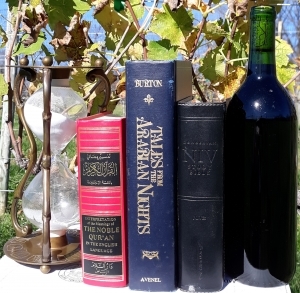
“With love and good will.”
My older brother Robert gave me a copy of “Tales of the Arabian Nights” back in the early 1980’s, and the Jinn were immediately added to my ongoing D&D campaign. Jinn are genies. Who hasn’t heard of genies? Even if your experience doesn’t extend beyond Ali Baba Bunny, Barbara Eden, or a big blue Robin Williams, you are probably still passingly familiar with the magical nature of the Jinn.
Ifrit, màridah, jinnis, jànn, djinn. Genies are supernatural beings who go by several middle-eastern based names. Hardly a night goes by without poor Scheherazade conjuring one up to excite her tales. One of the jinn magical hallmarks is time-bending, grand-scale magic. Nothing eludes their power, though mere mortals can seemingly escape their dubious wisdom. And they pop out of the most ordinary of things. No technological Tardis or finicky transporters required. Genie in a magic oil lamp for Aladdin and Daffy, or, for Sinbad and Major Nelson, genie in a bottle.
In time-traveling storytelling, an idea or object common to a particular society can be taken back in time to become problematic. McCoy’s gift of antique eyeglasses to Kirk, which Kirk then sells back to a merchant during a trip into the past, becomes such a causal loop artifact. Are there two pairs of glasses between the 1980s and 2280’s, or do the glasses only exist in this causal loop? A pair of Russian theoretical physicists named these time-breaking objects Jinn, indifference to the supernatural genie’s ability to appear or vanish into thin air.
Religions can share this same paradox. An idea from the future travels back into the past to create that future. Thus ensues the entire “Terminator” movie series as well. Do not confuse such a jinn with a temporal loop, such as Bill Murry’s “Groundhog Day”. Temporal loops are repetitive only to those affected, but they can be potentially escaped to restore the normally progressing timeline. HAL-9000 resorts to murder to escape his programming loop. Unlike temporal causality loops, with religious causal loops, there is nothing to escape. The deity has created the proper timeline. A one-shot time safari in Ray Bradbury’s “A Sound of Thunder” accidentally steps on a butterfly while hunting dinosaurs and forever changes the future they return to find. That’s the kind of power that jinn have over time.
In my novel Tynged, the fledgling Catholic Church and the King of France are considering making wine illegal because they view it as a sin. Don’t laugh, the debate was as real then as the 18th Amendment became. The reader is the jinn in the story because they go back in time knowing that King Pepin & Queen Bertrada don’t succeed in pulling up the Loire Valley grapes that could have led to the wine Cabernet Franc. A third of the world still doesn’t drink today because Muhammad watched two of his followers have a drunken argument a hundred years before the Tynged novel even takes place.
Now, if you ask any good Muslim about jinn, they will tell you the Quran speaks of them. They see two types of jinn: hurtful ones that some would biblically call demons, and helpful or benign ones, closer to angels. Given the vast amount of American pop fiction devoted to angel/fallen angel/demon-driven storylines, they make appealing elements that add that Scheherazade magic, mystery, and good vs evil team conflict. Half-bred humans, with demons, angels, or gods, have been popular romping storylines for over two-thousand years. Just ask Antoine Galland. Adventure, romance, thriller, inspirational; all tales easily flavored with the supernatural.
Wine grapes revealed their jinn supernatural quality to our ancient ancestors. So many plants require cultivating both female and male versions of the plant to get a harvestable crop, including many table grapes, that it took our neolithic ancestors a long time to figure out how to farm them. Wine grapes were almost magically easy. The wine you like to drink comes from plants that are both sexes in every single flower. Take a single wine grape seed a thousand miles away and plant it, and you can get the grapes and wine you remember. Scoffing at the religious impropriety of two genders in one? Don’t eat corn, then. The male tassel at the top of the plant fertilizes the female silk on the cob below, and you get another kernel on the ear. Young Herbert found one kernel of corn hidden in his pocket seam, and 19th-century scientist Cyrus Harding realized, given a couple of seasons, they could make bread on their fictional island. Mysterious, indeed. Jinn seeds: magic fortuitously appearing out of the past.
In my Immortalize novels, Kabiri brings rare, deep red wine grape seeds across the Mediterranean from ancient Turkey to ancient Spain. There were already grapes growing in Spain, but most of the world’s grapes are not suited to making wine. Sweet to eat and make jelly, sure. Precious and few are those grape varieties that make fine wine. Kabiri brings a little godly magic with him, a jinn object out of the mysterious past that changed the events of the story in Spain, and then disappears in the Loire Valley of ancient Gaul. In the second novel, the antagonist Jiris calls Kabiri a jinn, a genie, both because he does not understand where Kabiri’s black-wine knowledge comes from, and to also cast Kabiri as an evil half-demon in an effort to get Calom to turn against his master Phraortes’ wishes and solve Jiris’ problem for him. The deception is political cover for court intrigue. The black wine is a magic elixir of the past in the centroid of an evil-vs-good-vs-evil triangle. To give Calom the confidence necessary to face Kabiri, Jiris gives him a dagger with an exaggerated other-worldly past; a demi-god infused talisman to face the terrible genie. Repeat Perseus. Krull. Potter. Scotty gives the secret of transparent aluminum to its inventor; the ultimate jinn casual loop.
The wine itself must be a jinn. A seed gift from the distant magi of the Orient, come west following stars. A fruit that transcends all gender, and requires an exacting ritual to turn into a fragrant magic potion that bestows ancient wisdom, long sought by kings & gods. Your wine inherits the jinn’s uncanny ability to appear and disappear without a trace. Open Sesame! You pop the cork to let the genie out. Magic ensues. The genie snaps its fingers, and you are granted the wisdom of the ages. Your bottle is suddenly, mysteriously, empty.
So, sit back and listen to trapped Scheherazade spin her temporal loop tales. Every night, she must tell a new tale interesting enough that her kingly master does not kill her in the morning. At least, until she eventually tells the right tale to break out of the loop to her freedom. Ponder your bottle, a vessel of imagination from the past. A causal loop artifact now, out of its proper time. Reflect upon yourself, and you may discover that you have become the jinn.
The post Author's log, Fall 2020; Jinn first appeared on Wine's Anvil.
September 9, 2020
Winery log, Fall 2020; Wine Diamonds
https://www.winesanvil.com/wp-content/uploads/2020/11/tartrates.mp4
The post Winery log, Fall 2020; Wine Diamonds first appeared on Wine's Anvil.
August 15, 2020
Author’s log, Summer 2020; Inspiration
After four years of writing four novels and fully outlining four more, a calm is overcoming my muse this summer. It is not a fit of writer’s block, in fact, quite the opposite. Nor is it some furor poeticus that will result in yet another stress-squozen pandemic novel.
I believe the calm comes from having novels out in the world. It is like the satisfaction of sitting on the beach after the scheduling and hectic travel of a long-planned vacation. You made it. You’re finally here. Literal or economic success, while probably a pleasant addition had it occurred, is wholly unnecessary. Whatever happens, I have written novels for others to find and read. Instead of a fury of writing, I found I could only begin a flurry of thinking and reading.
With untold and unfamiliar stress from the pandemic swirling around society, we were forced to build transparent walls and cloth gags to continue our winery business. It is just my wife Wendy and me. There is no staff but ourselves now. Even family is fearful of each other. I could sell four or five of my wine fiction books a week doing our tastings last year. Now that is a memory.
Yet the vineyard, so long an island of tranquility I have spent a decade of social media extolling, seduces me yet again with its peacefulness of purpose. If we can’t sell wine, the vines don’t care. They are making more grapes regardless. A lack of regular musicians on Saturday nights does not trouble the vines. The winds and orchestra of nature are still going to serenade them with a summer season acapella. With no money for vineyard chemicals to fertilize and protect the grapes, the vines merely shrugged. Whether a canopy heavy with fruit or culled to drop on the ground, the vines are going to pass through their seasonal routine with complete disregard for the external world’s machinations. The societal upheaval is like a distant war that by-passed the vineyard island as insignificant. The warships and warplanes might be glimpsed passing to and fro, but the battles were elsewhere, distant, over the horizon.
No true artist can ignore other’s pain and loss. The empathy necessary for meaningful art precludes ignoring death and injustice. As the names of the fallen begin to creep in on our bubbles, only the most jaded and callous can refuse to feel any sympathy.
So the vineyard becomes my life raft. With all the other struggles being bravely faced and cowardly feared, with no other choice but to surrender down into them and drown, the vineyard offers a different calendar and uncluttered agenda. The routine of the vineyard summer is therapeutic. The work with the living plants is cathartic. While the hands are busy, the mind can build the backstories of my next novel’s various characters. The defining elements and history never actively included in the final draft that can help make the novel’s characters different, memorable, alive. The logical values and illogical foibles that might resonate with human experiences. I try to make a good/bad/wish list for every supporting character and then look at the plot elements, speeches, and challenges of the novel from that character’s perspective. What was the best thing that ever happened to this person? What was the worst? How does their dearest wish, spoken or secret, shade their view of some element in the story? Try on different plot elements for the book like clothes off a rack in a store. Rearrange who says what, and in what order, with abandon. Reflect on your characters and learn your story from different perspectives.
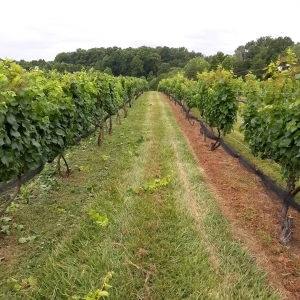
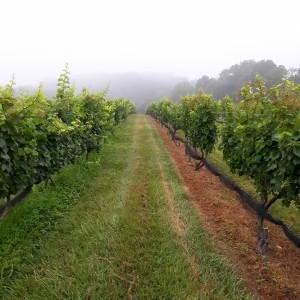
Even after twenty years, I can’t quite write and do vineyard work. I can easily see someone using voice to text on their phone to do so. I might even get there one day myself, perhaps with much simpler tasks as mowing or leaf-pulling, but making wine in the vines, which is what you are really doing working in the vineyard in the summer, requires too much frontal brain function. My job is making wine while thinking about my novels, not writing while thinking about making wine.
All throughout these summer vineyard days, I find it far easier than ever before to take a half-hour, pull out the kindle or paperback, and sit in the shade of the vines to read and rehydrate my spirit for a spell. Given the stresses in my life at the moment, and hammered by some dire need in all probability, reading in the vineyard has become more of a catharsis than I ever imagined. In the movies, Frodo read in the Eastfarthing woods as he waited for Gandalf to arrive. I imagine that was probably my inspiration to give it a try.
In Children of Breton, Tiran walked upon the keel of the greatest French warship of its day, La Couronne, and his beloved fiance died of a real plague in Milan, all of this published a year before anyone heard of Coronavirus. In his forthcoming next novel CoB; Hard Cane, I removed the planned active subplot of the very real Loudon plague from Tiran’s storyline and wrote it into background noise simply because I don’t wish to craft a novel with a plague as a major theme element at this time. Instead, Tiran confides in his horse, confesses to a gray cardinal, seeks release in the music on his chateau porch, and wrestles with the poetry of Le Pléiade as the Seven Sisters themselves rise over the horizon before every dawn. Tiran struggles to put his own loss and passions to pen to express them in poetry, and when it falls short of the starry masters, he turns towards delirium.
He’s not perfect. We’re not perfect. And that is perfectly inspiring to me right now.
The post Author's log, Summer 2020; Inspiration first appeared on Wine's Anvil.
July 20, 2020
Winery Log, Summer 2020; Oaking the wine
We don’t have room for traditional oak barrels. Tiran & Cavel from my novel Children of Breton would probably be annoyed by that. Just wait until Barbin Fortier of The Changeling hears this. He’ll have kittens.
So how do you oak your wine if you don’t have barrels? Quite simple, really. And lots of folks who have older barrels do it too!
Oak Dice
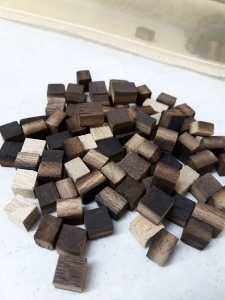
These “oak dice” are the exact same French Oak Quercus robur species the fancy $1200 barrels are made out of. A 100-year old French oak tree can only give about 3 water-tight barrels, but contains over 300 barrel’s worth of oak if used wisely.
Oak in an infuser
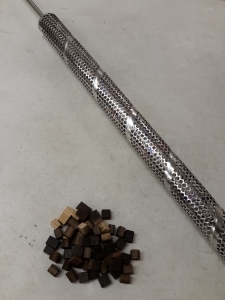
Sometimes we use an “infuser” in the bung, that allows us to change out the oak and thus get stronger oak flavors over time. We have done this on some of our Cabernet Sauvignons.
Oak in infuser bags
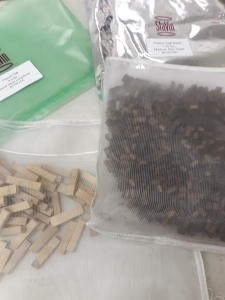
These are bags of “oak dice” being prepared to use in our horizontal steel barrels. they include stave as well as end cap wood.
Oak in links
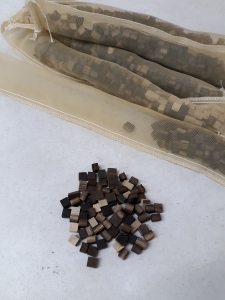
These are oak links, bags that are easier to insert if we’re looking for a lot of oak flavor at once. We moved onto oak staves from these, though some of our 2010-2013 Cabernet Franc’s used them.
Oak staves
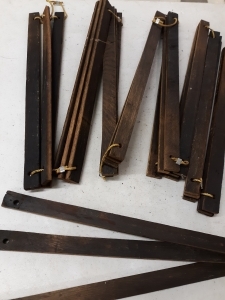
Oak staves. These are simply french oak staves that were not bent by steam and coopered into a water-tight barrel. Our Meritages used these, and we adore the full flavor they give. At this point, the difference between an oak barrel and an oak barrel in a tank is getting fairly small. The cost difference, however, is significant.
Liquid Oak (no, NOT Felix Felicis)
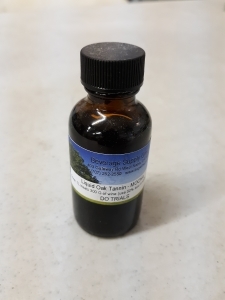
Liquid oak. We don’t use any liquid oak flavorings, but for the amateur wine-makers only making a few gallons they can give strong oak flavor instantly, as a fraction of the cost of the other alternatives. Not a good choice for long-term aging a good red. More akin to gas station sushi than a professional alternative.
And how we add our oak…
https://www.winesanvil.com/wp-content/uploads/2020/11/oakC19.mp4
The post Winery Log, Summer 2020; Oaking the wine first appeared on Wine's Anvil.
June 6, 2020
May 26, 2020
Vineyard log, Spring 2020; Bloom Damage
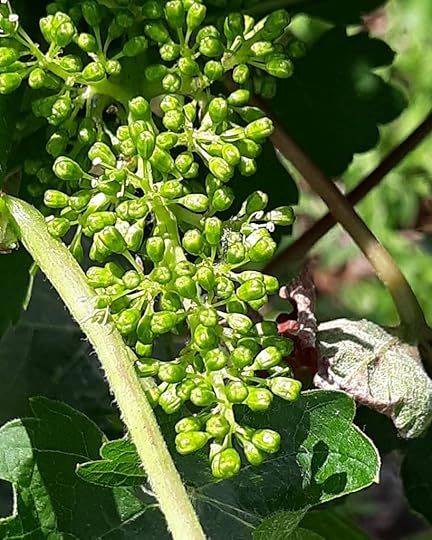
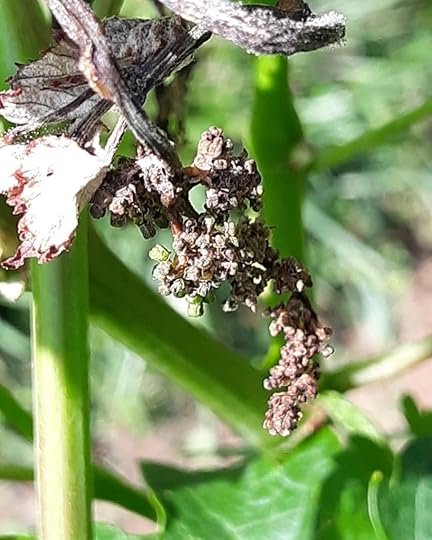
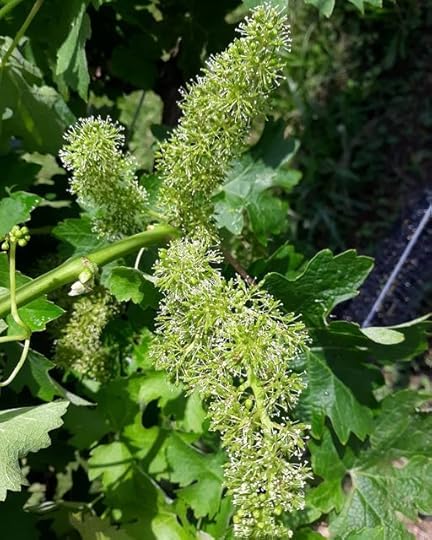
What a May frost does to Cabernet clusters. The healthy one set fruit nicely. The dead one will try again next season. We were lucky compared to some vineyards
Young, healthy grape flower buds.
What frost & freeze damage does to flower buds.
And what a surviving grape flower bloom looks like.
The post Vineyard log, Spring 2020; Bloom Damage first appeared on Wine's Anvil.
May 9, 2020
Winery log, Spring 2020; Short changed bottling
While everyone can probably understand an organization comes together fully at a busy time like harvest, at a small winery the rest of the year is more of a juggle. When a pandemic removes all staff and volunteers, it can really become a stretch. With no tasting room to staff, for the time being, Wendy & I turn our attention to racking and bottling.
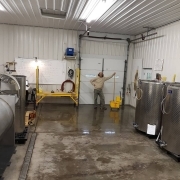
Every winery session begins with two things. Cleaning…
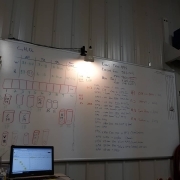
…and planning.
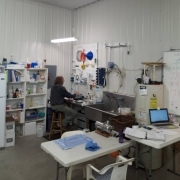
Then the tests begin again.
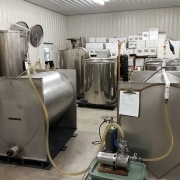
Racking is testing, fining, and moving the wine around in tanks to prepare it for bottling or long term aging.
Some wine is meant to age years. Some wine is not. Our light white wines without oak often taste fresher when they are young, and thus sell better. We also have the problem of not being able to store wine indefinitely without spending a fortune on more stainless steel tanks or forcing the wine into oak exposure whether we wish that flavor accent or not. The next harvest will fill the tanks again, so we have to do something in a timely way.
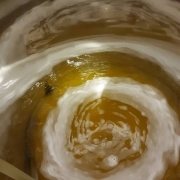
With the 2020 spring shutdown of the tasting room, along with an uncertain economic outlook for a summer-profit, tourist-driven resort lake, we had to make some tough choices and get things bottled. Cash flow or not.
Bottling days in the new normal.
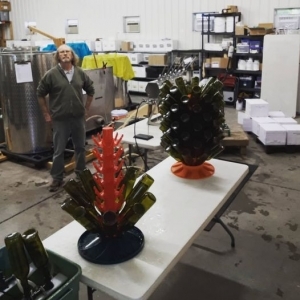
Just Wendy & I for most of them, and 1/3 the usual number of bottles. We couldn’t afford more new blue bottles for our Mist, so we’ve pressed spare amber Bordeaux into use. This is how we’ll make it through the spring of 2020.
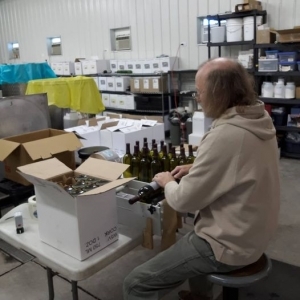
Breaking up a typical 8 person, 1200 full bottling day into multiple days for only 2 people helps keep the work manageable.
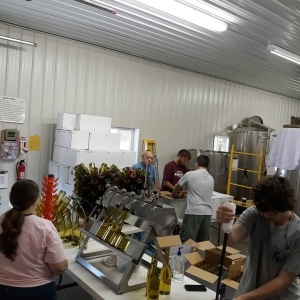
As the month progresses, the extended family comes together to get us past the bottling hump.
Last but never least is cleanup. Always. Dishwashing is not the glamorous side of wine-making that some folks dream about, but it is the bulk of wine-making’s tasks.
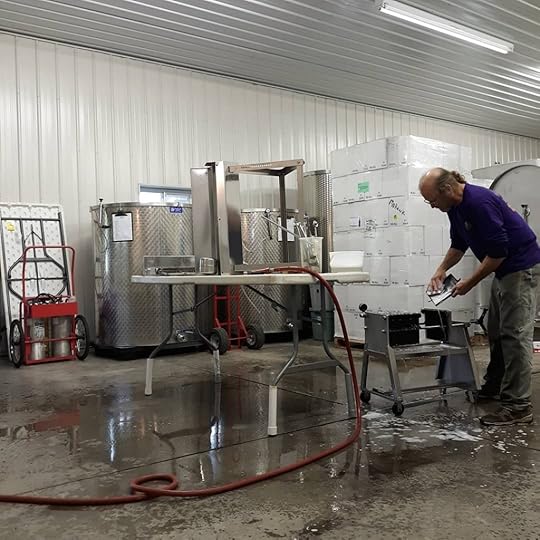
All these tasks have been repeated for thousands of years in wine-making. Gentle pumps replaced gravity for the most part, though some wineries still rely on gravity rackings. Obviously, cleanliness has improved dramatically in the last one-hundred, and bottles have only been around for the past three-hundred, but the racking process has actually changed little. Testing equipment can ensure a more consistent wine, but it is amazing how many wine decisions still come back to an experienced winemaker’s tastebuds and good judgment. 2020 even took away many of our reliable taste-testers who help sample our young wines and give their opinions before bottling.
The post Winery log, Spring 2020; Short changed bottling first appeared on Wine's Anvil.
March 20, 2020
Vineyard log, Spring 2020; Pressure. Tears. Weeping. Release.
One of the most frequent vineyard questions people ask is how warm winters and springs affect the budding grapevines.
The Vitis vinifera that makes up most of the European grape varieties you have ever heard of are not as “spring sensitive” as the local flora of America. We graft those familiar European grapes onto a distinctly more Americanized rootstock, however. Vitis ripiria, V. rupestris, and V. berlandieri were hybridized with V. vinifera for the past century to give the grapes a resistance to insects and disease below the soil. Still, in Virginia USA, our grapevines do not wake up as early as the blackberry bushes and pear trees.
In two decades, I have never seen my grapevines bud out before the first day of spring. The first week of April is the norm, but for those of you who want an easier gauge to remember, look for the east coast Redbud trees blooming purple-red as the more accurate indicator the grapevines are also budding out.
Why do we care? Because the grape-clusters-to-be are already inside those little buds. Once the buds break, a cold snap or frost can kill them, and their potential grape crop. Very bad for your winery’s volume. It increases the cost of your bottle of wine.
Why do they bud out? Warm soil gets the roots pumping water – transpiration – up the trunk, out the arms, and to the canes. Water pressure. The warmer it gets in spring, the higher the pressure. That pressure first swells the buds bigger, then helps them erupt with a set of leaves. This pressure is greatest at the very ends of the canes, so the buds the farthest from the roots break out first. But not all the buds break out down the cane. The first breaking buds release a hormone called auxin that inhibits the next lower bud. After six or seven buds, all the lower buds don’t break out much at all. Left to themselves, the grape clusters would only form on the ends of the vines. In the wilds, before we domesticated them, these would be the vines that had grown the tallest up other trees and brush. The grapes would then ripen up in the sun where the birds could see them. Quite often in the ancient world, docked trees would keep the grapes off the ground and away from wildlife, livestock, and hungry children. The typical visual of an overgrown grapevine covered pergola has a basis in this fact. We pesky farmers needed grapes where they were easier to tend in a modern vineyard.
So, we prune the grapevine canes back to just a few buds every winter. Now the buds that break in spring are right by the trunk and arms in a range where it is easier to concentrate our sprays, energy, and labor to tend them.
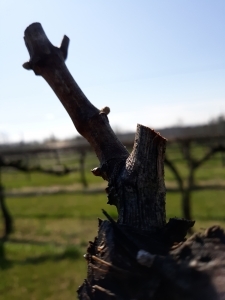
Many trees and plants have a sap that can heal wounds like a scab. Grapevines do not.
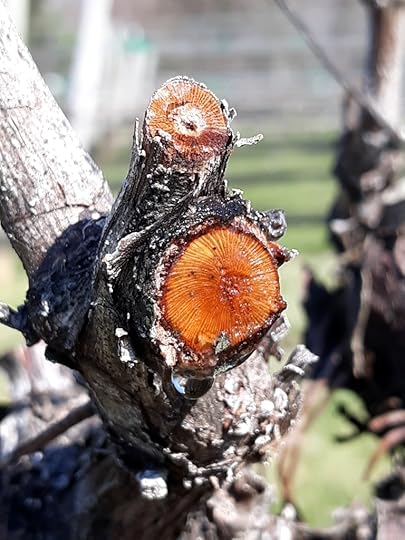
With the root’s water pressure of a warming spring, our grapevines pump out water through the xylem tubes to the buds. But we’ve severed that cane, and the sleeping vine of winter did not seal it off. The cut vine begins to drip water in the coming spring. We call it weeping. If the vigneron stupidly makes big cuts on a vine, it can easily “weep” to death. When done right, this weeping is more tears of joy. The vines are awakening. The new season is beginning. The grapes are coming.
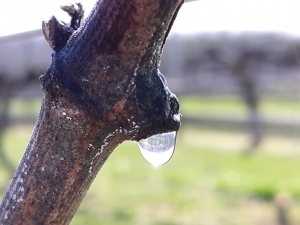
On this first day of spring, I thought you might like to see what a walk through the vineyard shows. Some of us have been working from home for decades. Our home office is just a little different than others.
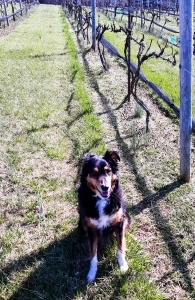
May all the pressure you feel at this odd moment in an arriving warm spring, and all the tears for the loss we all share, remind us we’ll grow through this pain and past this hurt. We always have.
February 29, 2020
Author Log, Winter 2020; Feudal
Pruning in the vineyard is one of the most idyllic times in my vigneron lifestyle. It is as close to my escapist hermit island as I can get and still have a healthy family life.
In the brief hours between a day’s farm work and a night’s sleep, though, Wendy & I often escape into pastimes. Table-top gaming with our daughter, online gaming with friends, or binging on some television or film series. This winter, it has been the Downton Abbey boxed set we gave each other for Christmas. I’d seen several over the years, but hardly all, and never in any sequence.
Aside from the writing and dramatic characters of modern production, this show embodies a socio-economic lifestyle that began centuries ago and still has deep roots in English customs. My father-in-law is as American as they come, and he can’t tolerate the class divisions of such shows. Yet, for the life of me, I am still unable to understand the difference between aristocracy by land and aristocracy by a business. Both giant corporations I worked for, Lance crackers and Gilbarco gas pumps, had a culture split as clearly distinct as any upstairs/downstairs, even down to titles, rituals, and mutual class respectfulness.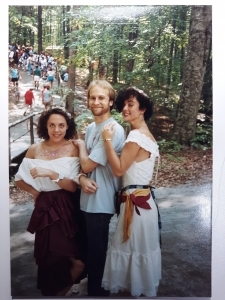
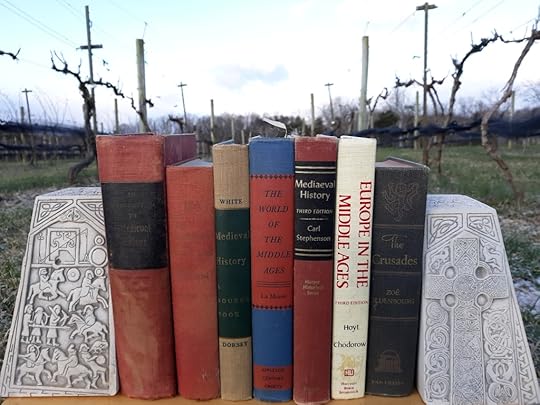
My roots for this thinking must go back to my medieval studies. As my adventure writing for Dungeons & Dragons games grew, I consumed vast amounts of medieval knowledge to try to model my game world after. The feudal socio-economic lifestyle I came to admire and regret was an homage to chieftains in a Germanic style (chieftainess as well, I see no modern differences).
Arthurian loyalty grew in the early ages of the first millennium into a feudal society. Land for service. Protection for promises. When you have fairy-tale figures like the Granthams of Downton, it works beautifully and conveys an elegance. When children inherit the position, the learned hubris and earned respect all too often don’t seem to come along with the DNA. Growing up privileged in the country-club estate and then spending most of my adult life as the country-club dishwasher, I have experienced so many of the sides of this equation.
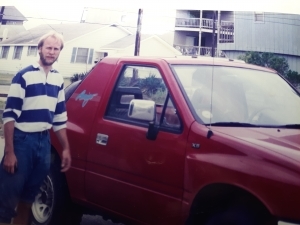 My lifestyle became so ingrained to the feudal imagery that my Isuzu Amigo had a vanity license plate of “FEUDAL.” I routinely dressed as Robin Hood (with the bow) to go hiking on the three-thousand-acre estate of my youth and later joined the SCA, or Society of Creative Anachronism.
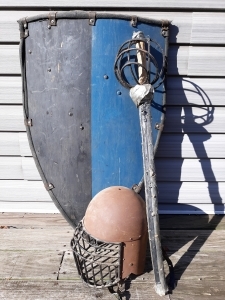
I trained hard for combat in the Kingdom of Atlantia under Marshall Genseric Tremayne. I apprenticed as an armorsmith over one of the happiest summers of my life under Baron Eldridge of Burlington. I met and honored, and was shown a peasant’s respect by, Atlantian kings and queens Olaf, Aislinn, Anton, and Luned. My daughter would call all this “cosplay” nowadays. For me, it was a lifestyle that, when done to perfection, actually was idyllic.
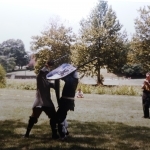
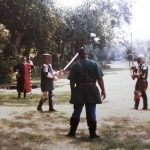
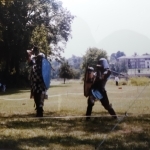
Now, I left the SCA because of my inappropriate relationship with a married girlfriend. SCA Royalty quietly informed me it forever barred me from any knighthood in the organization. And I stupidly chose temporary sexual gratification over a lifelong pursuit. If you remember from my earlier blogs, this was the woman who went to a few SCA events with me and called them nerds and weirdos behind their backs, whom “I was better than.”
No, I am indeed quite the lesser.
A decade later, in 2002, amidst the marvelous medieval armor exhibits at the Metropolitan Museum of Art in New York, my wife Wendy & I unexpectedly bumped into Baron Eldridge. It was every bit as fairy-tale courteous as Mister Bates and Lord Grantham running into each other would have been. One of those bright-spot chance meetings that seem larger than life. In the Met, no less. With an old master to explain things. What were the odds?
So thirty years later, I live a fairy-tale lifestyle in the vineyard, watch fairy-tale stories with my fairy bride, reminisce fairy-tale memories, and dream up fairy-tale books.
To genre-bend and paraphrase the Talosian, “I have my illusions, and you have your reality. May you find your way as pleasant.”