
Calvin Shields's Blog
July 29, 2025
Launch of What Remains
The post Launch of What Remains appeared first on Calvin Shields Author.


June 9, 2025
One way to deal with post-retirement blues…Cross Greenland on skis
Retirement comes as a bit of shock to most people and many people founder in the doldrums of loss of pupose and direction. I decided at 66 years old that I needed a challenge to reinvigorate my life and restore my self-esteem. I stupidly decide to cross Greenland on skis; a five week journey of 600Km pulling an 85Kg sledge over the world’s second largest ice cap in temperatures down to -40 degC
The crunch of Inuits walking through the snow outside the bright yellow clapper-board community centre masked the yapping of the huskies in the village. Jagged snow-covered mountains surrounded the brightly painted, steep-roofed houses of Tasiilaq situated on an ice-bound inlet in eastern Greenland. Polar bear skins stretched on frames dried in the feeble noon-day sun and pale-yellow huskies chained to posts, barked and frolicked in the deep snow.
Greenland was once a Danish colony and Inuit children were required to complete their education in Denmark. Many did not return, but those who did, failed to make much of an impression on the Inuit way of life. Amauti and mukluks may have given way to colourful North Face jackets and synthetic snow boots, but the Inuit still hunt and fish in the traditional way. Alcohol is a problem and bars are only allowed to open for limited periods at the weekends. Neglected Inuit children were cared for by Danish missionaries in the hall below out dormitory. I read children’s stories to a group of the kids each day and one little girl was fascinated by the hairs on my arms. I could only assume that Inuit have little body hair.
We were scheduled to helicopter across the iceberg strewn Denmark Strait to the Hann glacier to start our crossing of Greenland. Our planned route was across the icecap from Tasiilaq to Kangerlussuaq on the west coast. It was six hundred kilometres and would take about five weeks. We were unsupported and we aimed to drag our provisions, cooking fuel and clothing in orange plastic sledges called pulkas by ropes attached to our belts.
The pulkas weighed about 85 Kg and we would haul them over the 9,000ft high icecap wearing thin Nordic skis with sealskins. We would then descend the very gentle slope towards the west coast, where the icecap terminated in a confusion of tortured ice, melting snow and crevasses known as the ice fall.
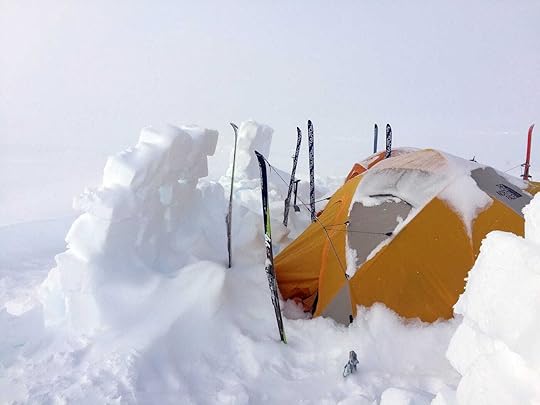
We needed to be prepared for a violent catabatic wind called ‘the Piteraq’ which could sweep down without warning from the ice cap at over 300 kilometres per hour. Each night we had to build a two-metre-high wall of ice blocks around our tents to protect our camp.
Polar bears migrate north in the spring and often take a short cut inland to the west of Tasiilaq.
Our track crossed their migration route, so our guide, Max, and I went to a trading post to rent a gun. We walked down a narrow icy path towards a large snow drift with a chimney stack belching black smoke sticking out the top. The dilapidated wooden trading post was almost hidden in the bank of snow and, under a small porch, fur pelts hung from pegs either side of the deeply scratched door. We pushed our way in and walked into a gloomy, smoky room. The walls were lined with stuffed animals and shelves overflowing with hunting equipment. The flames from an old iron stove in a corner cast dancing shadows among the cluttered bric-a-brac. I moved towards the stove and gratefully warmed my hands.
“Costs me a fucking fortune!”
An enormous man with long white hair and a bushy grey beard stood behind the cluttered counter, peering at me with his beady eyes. He looked like an albino ferret poking it’s nose out of a Polar bear’s arse.
He bit off a piece of hardfiskur and chewed noisily.
“You don’t get much wood round here.” he continued in a heavy Danish accent, wiping his mouth with the back of his hand.
“Can I help?” he asked, spraying us with flecks of dried fish.
Max explained what we wanted, and the trader lifted down a dusty, antiquated rifle and placed it on the counter. He wiped if off, opened the breech and showed us how to use it. He put the safety catch on and handed me the heavy weapon.
He asked us why we wanted it, and I explained.
“For Fanden!” he muttered “are you mad?”
I pointed the gun towards the door and squinted through the sights. I noticed the barrel was significantly bent towards the left.
“No problem” he laughed, “just aim 5 centimetres to the right”
I felt very encouraged.
The bright red helicopter leaped into the air in a cloud of ice and snow and clattered back to Tasiilaq leaving us alone on the ice. We were a team of five including the French guide. Two of the skiers were almost half my age, built like brick shit houses who had taken part in a race to the magnetic north pole the previous year.
I was Methuselah’s granddad built like custard pudding and had trouble just staggering to the local pub. I felt seriously inadequate. I had trained for 9 months pulling a tractor tyre around a field, but I had serious doubts.
We started off and I quickly discovered that pulling the pulkas in soft snow uphill was seriously difficult. I had rope, a shovel and an ice axe strapped to the top of my pulka which made it top heavy. Max’s sledge rolled over onto its side, slid down the slope and broke the polar bear gun in two.
I hoped we wouldn’t stumble across any migrating Polar bears.
I was bloody cold and knackered.
I lay in my sleeping bag wearing my down jacket and a woolly hat. Each time I exhaled, my warm breath rose to the top of the tent, condensed and fell on me as a personal mini- snow storm. Gareth, the doctor, was beside me in the cramped two-man tent boiling water from chunks of ice on the small Primus stove. We didn’t carry water, we used the stove to melt ice, and we needed eight litres of water each. That’s an awful lot of snow and ice to melt in our piddly little one-litre kettle. It took forever.
The food was high calorie, high protein and highly boring. Dinner commenced with an amuse-bouche of cup-a-soup followed by the plat principal of ‘Turmat’ freeze-dried expedition food and finished off by le dessert of muesli with powdered milk and chocolate. Yum!
After a few days of arduous trekking, the mountains of the fjords of the east coast were no longer visible behind us. We were at the centre of a giant upturned china plate which stretched to the horizon and merged seamlessly with the nebulous, chalky sky.
When Buzz Aldrin walked on the moon, he described it as ‘beautiful, magnificent desolation’. Greenland is a cold featureless plain of white moon-dust, nothing grows, and nothing can survive.
A little bird landed on my pulka in a snow storm and sheltered behind the shovel. How could it be so far off course? We tried to feed it, but in the morning, it was gone.
I felt sad.
We averaged 25–30Km each day and made good progress towards the top of the ice cap.
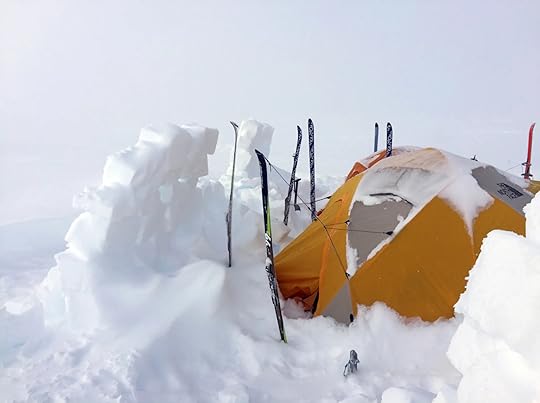
The wind turned southwest, and a snow storm blew up. We had trekked for twelve hours and we now had to build a second wall. I forced the tip of the ice saw into the snow and sawed the ice into 60cm blocks. The blizzard drove the snow into drifts as we made the walls from the blocks. It was back- breaking work and it took two hours to build our defences.
Eventually, I crawled into my sleeping bag exhausted.
The wind was ferocious during the night and tugged at the thin material of the tent relentlessly. The diaphanous layer of nylon was all that was between us and probable death. Part of the wall collapsed in the middle of the night with a mighty woomph. I prayed that we wouldn’t have to get up and repair it. Luckily no-one stirred.
In the morning the wind had died down and I had my first ever attack of claustrophobia. Snow had piled against the sides of the tent, making the small space smaller. I felt suffocated, overwhelmed, out of control, everything was closing in on me. There was no way I could continue, what on earth was I doing there? It was time to call it a day. But I couldn’t give up, rescue wasn’t possible. I would let the team down and I couldn’t live with that.
I was suffocating.
I had to get out
Hyperventilating, I scrambled out of my sleeping bag, I threw on my clothes and frantically unzipped the door of the tent. I stepped into a magical world; in the curling mist the sun’s pale disk peeked over the horizon and a pavane of ice crystals tumbled and glittered in the early morning light.
I looked up to the sky, opened my arms and took a deep breath. All would be OK.
I had mouth ulcers and my bleeding lips were cracked from frost bite. I slept on my back with my mouth closed and by the morning my lips had fused together with scabs. I gently poked my tongue out through the corner of my mouth and worked it along my lips to open my mouth. God it hurt!
The temperature approached -40C and froze our lungs with every breath. We had rasping coughs and Gareth had frost bite on his face. I ignored severe blisters on my heels, I had no choice.
The routine was always the same. With military precision I had a shit every morning at 6.10am in a snow hole which we dug the night before. The name of the game was to do it as quickly as possible without freeze-drying one’s arse. It was a time-consuming ritual to prepare for the dash outside. First, we scraped the ice from our sleeping bags and then pulled on long johns and sweaters while sitting in the sleeping bag. Finally, we donned our parkas, quilted trousers and snow boots and made the dash outside. The secret was to expose your arse to the elements for as little time as possible. Undo belt pull down trousers, long johns and underwear in one smooth action. Squat — shit — wipe arse — pull up clothing, hope your gonads hadn’t frozen and dropped off or, in your eagerness, you hadn’t commenced the shitting action too soon.
The turds froze before they hit the snow with a thud.
‘We must be there soon.’
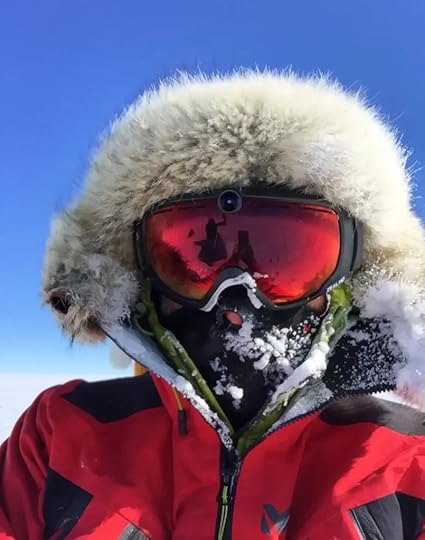
Gusts of wind tugged at my anorak, hurling clouds of ice laden snow in my face. The matted fur ruff around my hood, crusted with frozen snow and ice, flapped noisily against my steamed-up goggles.
‘Just follow the skis.’
‘Left-right,-left-right.’
The greasy green anorak of Max was dimly visible in front of me. He pulled his dented orange pulka topped with a bulbous faded blue tarpaulin. The drifting snow piled up under the runners and covered my tarp, adding extra weight and making it difficult to pull.
Max purposely strode forward, the ropes attached to his waist slackened and tightened with each step, jerking the heavy sledge fitfully forward.
‘Keep the rhythm.’ ‘One-two-three-four.’
My lime green skis looked ridiculously narrow and the skins made a metallic sound with each stride as they scythed through the snow. My faded black expedition boots were ripped along one seam and beginning to show the signs of excessive wear. Would they last the distance? A scatter-gun of ice shards hurled by the Piteraq penetrated the layers of my leggings, stung my skin and melted, only to refreeze in my boots.
With our heads bowed against the maelstrom, my three companions were strung out in a ragged conga. Their anoraks were a splash of vivid reds and greens in a landscape utterly devoid of any definition or colour, vibrant ice breakers in a crystallised moonless sea.
‘Don’t lose the rhythm.’
‘The-Grand Old-Duke of York — he had- ten thou-sand men.’
The blizzard was ferocious. The relentless wind barrelled down from the icecap whipping up the surface of the snow into a frenzy, the wind chill dropped to well below -50C. Capricious gusts of wind found their way into every crevice, every weak spot, the headwind was an invisible hand pushing me back.
I was so tired.
I had imagined that we would be romantic adventurers like Nansen or Shackleton. It seemed like a good idea at the time
How fucking stupid.
Six hundred sodding kilometres pulling an 85 kg sledge in temperatures down to minus 40? Are you mad? My friends said.
They were right.
We’d been battling for twelve hours, we must be there soon. I could no longer feel my legs. My arms ached from the repetitious pulling and striding. I was sweating profusely under my anorak, my merino wool underwear wicked out the moisture which froze instantaneously into a white fuzz of hoar frost. I resembled a lurching, shambling Yeti.
I’m sure the others weren’t suffering like me, but I mustn’t let them see I was struggling
Each step was a gargantuan effort ‘He-marched them-up to the-top of the-hill.’
The sound of the wind was deafening, it roared, flapped tugged and swirled. A cannonade of ice pellets hit my hood with a thunderously disorientating clatter.
‘And he-marched them-down-a-gain.’
There was a hardly definable, subtle change in the light, a fleeting moment of texture, a slight shadow. I was sure I could see something in the distance through the crinkled clingwrap of my world. It was an amorphous blur, a smudge in the infinite distance.
Was I mistaken?
‘One-green-bottle-hanging on a-wall.’
Doggedly we continued.
Whatever it was, it was large, a brooding intangible ghostly galleon, a murky satanic mill.
The slope increased gently, and the pace slowed. The wind forced the snow between my mask and stung my face, my goggles steamed up inside and there was no way to wipe them. My vision became more and more myopic, there was no horizon no sky, nothing.
‘There’d be-no-green bot-tles, and-no bloody-wall.’
In the maelstrom the shape became darker and more defined, the blurred edges sharpened into purposeful angles. It appeared to be a frozen Taj Mahal. The Mughal dome slowly metamorphosed into a multi-faceted, gigantic golf ball, the minarets into ice encrusted aerials.
It was a cathedralic sanctuary from the elements. Majestic organ music filled my befuddled mind as we wearily unclipped our pulkas and clambered stiffly and unsteadily down a steep snow drift to a broken metal door flapping cantankerously on the side.
The abandoned radar station welcomed us into its eerily silent, frigid maw.
It was dark and cold, very cold. Snow drifts filled the corridors and spilled into the bedrooms. Ice hung from pipes in the ceilings and coated the peeling walls. Marie-Celeste-like, mattresses, newspapers and overflowing ashtrays littered the rooms.
We forged through the snow filled corridors and clambered up the stairs to the canteen. The stainless-steel kitchen equipment glinted in the light from our head lamps and a faded poster of a woman in an Hawaiian skirt hung incongruously on a wall. A green plastic Christmas tree stood on a table by the entrance.
Dye 2 early-warning radar station was an early casualty of the thawing Cold War. It was quickly abandoned in 1986 and left to sink ignominiously into the Greenland icecap.
It was so out of place, a blot on the pristine landscape. It would have been nice if the Americans had taken their rubbish with them when they left.
The icecap descends towards the west, and as it changes direction, crevasses form in the bends. It terminates in a tumble of steep, house-sized chucks of ice called the icefall.
Normally the gaps between the ice blocks were filled with snow which made it easy to ski, but the snow had melted prematurely.
We spent a day roped together as we crossed a crevasse field. The dark blue chasms disappeared into the void below our feet as we trudged along. By the end of the day the snow had become wet and slushy.
We broke camp on our last day. We were almost there, it was a heady feeling. Thirty minutes later we were amazed to find a lake in front of us shimmering in the bright sunlight. It stretched as far as we could see. We made a long detour around the lake, but we were forced to cross fast flowing streams of ice-cold water and slush. Max led the way and we followed in his footsteps.
The sound of rushing water filled my ears as I inched towards the stream. My skis, partially obscured by floating slush, slipped below the surface. The resistance of the moving water slowed each step and soon my calf-high boots filled with water. My feet instantly froze. The water gradually rose above my knees as I pushed forward. What if I was dragged under by the pulka? What if I missed the track and stepped into deeper water? I started to breathe heavily with my heart racing. The water was almost to my waist in mid-stream when my pulka followed me into the river. Thankfully it floated, but it shot downstream and nearly yanked me over. The current had carved a steep bank in the snow on the far side where Max waited to help me out. My pulka tugged at me as I tried to negotiate the steep slope and my skis crossed. I grabbed Max’s outstretched hand but fell chest deep into the torrent. Max and Gareth dragged me out and I lay shivering and panting on the ice.
We were wet and miserable as we continued towards Kangerlussuaq, aiming for a moraine at the base of the icefall. At the beginning of the day the planned distance was 19.7km. We had trekked for hours, but we weren’t far from where we started.
The flat watery icescape slowly gave way to an uneven vista of ice hillocks and crevasses. Streams flowed into the fissures and hollowed out the ice underneath which collapsed into huge holes known as kettles. We crossed the crevasses without a second thought, I became blasé and paused with the tips and tails of my skis either side of the gaping crack to take photographs of the bottomless blue-black crevice below.
Eventually we reached the icefall proper and started to navigate the mountains of ice. It was exhausting dragging the pulkas up the steep sides of the mounds. At the top, I continued over the brow and paused with the pulka just below the apex on the far side. As soon as I pulled the pulka over the top it became an unguided missile. I side-stepped and jinked one way or another but my homicidal pulka took me out every time. On one occasion I was certain that I had outwitted it, but it crashed into the back of my heels and knocked me backwards on top of it. We careered down the slope and fell into a small stream meandering between the hills of ice with a splash.
We stopped for dinner on the ice as the sun dipped towards the horizon at 11pm. We had been trekking for 14 hours and still had 9km to go. We voted to continue through the night.
Wispy bands of cirrus clouds in the azure sky radiated from the horizon and embraced the half-moon above. The ice field was clearly visible in the twilight as Max climbed a large mound to survey our route towards the setting sun. It was still and calm.
Our progress was slow, and when the sun rose at 3am, we took off our skis and continued on crampons. We glimpsed the moraine in the distance, I never thought a slab of brown rock could look so welcoming. It was the first piece of dry land we had seen for four weeks.
Seven hours later we reached the base of the moraine after 26 hours of non-stop effort.
It wasn’t quite the end, we had to drag our equipment 200 metres up the moraine to meet our transport. At 11am I fell asleep in the middle of the road and was nearly run over by our truck.
We were housed in a faded brown wooden Nissan hut on the old US Airforce base of Sondestrom and it felt better than any five-star hotel I had ever been in.
I have been asked what I wanted most when I arrived. Surprisingly it wasn’t a beer, it was a shower. I stood under the hot stream of water and looked down. I was ripped, I could see my feet for the first time in ages. I had lost 17 Kg and even my muscles had muscles.
I felt great.
I had achieved something special, I felt validated.
I had overdosed on endorphins. We walked 1,300,000 steps and burnt 8,000 calories a day. I felt fantastic for a while, but after a few months I was depressed again.
Cold turkey.
Instead of feeling contented, I felt hollow, something was missing.
I needed another hit.
The post One way to deal with post-retirement blues…Cross Greenland on skis appeared first on Calvin Shields Author.
The games we used to play
To alleviate the boredom on long-haul flights on the Beach Fleet we played word games on the Passenger Address.
Extract from my book — “Dancing the skies and falling with style.”We sometimes played a game on the PA. The cabin crew gave us a word which we had to include at some point in our passenger address. If we didn’t include the word, we had to buy the cabin crew a drink each. However, if we did, they had to buy us one. The stakes were high as there are 15 of them and just 3 of us. It required a great deal of ingenuity to include words such as ‘salmon,’ or ‘dreadlocks’ seamlessly into a passenger briefing.
Our flight was from from Gatwick to Montego Bay in the north of Jamaica, and then across the island to Kingston. We were about to start the engines when the chief stewardess came onto the flight deck to announce that boarding and security checks were complete. She was a bubbly, extroverted blonde with a wicked sense of humour.
“Right boys,” she sniggered, “your word for today is ‘bollocks’.”
She clambered on her broomstick and flew out of the flight-deck.
The First Officer was responsible for the announcements on the first leg. I looked at him in despair, trying to calculate how much 15 rum punches would cost in Kingston. Pale and grim he looked at me. At the top of climb he did his introductory speech to the passengers. Sweating slightly, I listened in, but no ‘Bollocks!’ I put my head in my hands. Similarly, there was no ‘Bollocks’ anywhere in his remaining briefings. We were scuppered!
I considered going sick in Montego Bay.
We landed and glumly taxied towards the apron. The docking guidance system was lined up with my seat, so I took control to park. As we approached, I asked the First Officer to call for the doors to be switched to manual and cross checked.
He switched on the PA and announced.
Cabin Crew, doors to bollocksand cross check!”
I was stunned.
The chief stewardess rushed onto the flight deck and said we had cheated.
I replied smugly that we had followed the rules, and we were looking forward to five, frosted Red Stripes each when we arrived in Kingston.
She stormed out in a rage.
Feeling very pleased with ourselves we taxied out for the short hop to Kingston. The chief re-entered the flight deck.
“Right, I’ve got you now,” she said with a malicious glint in her eye.
“Your word, Colin is ‘Chlamydia’.”
My jaw dropped.
Cackling, she left the flight deck with a flourish.
My vision of free beer all night quickly evaporated. How on earth could I use that word on the PA? It was impossible.
The 747 wasn’t designed for short flights and I didn’t have time to think, completing checklists, doing calculations and weaving through the thunderstorms over the Blue Mountains took all my time and concentration.
Finally, on the approach my interest in history came to my rescue.
I pressed the button and spoke to the passengers.
“Ladies and gentlemen. We are now making our approach to Port Royal airport, and we should be landing in 5 minutes time. Port Royal was a notorious pirate town which sank after an earthquake in 1692.
It is rumoured that Captain Clam hid here when chased by the Royal Navy in 1685.”
I had a bit of a hangover the next day.
The post The games we used to play appeared first on Calvin Shields Author.
June 8, 2025
Flying a jet airliner over the Atlantic at 50 feet
In the late 1960’s flight simulators were in their infancy and didn’t accurately represent the flight characteristics of actual aircraft.
Extreme manoeuvres and emergency procedures required for pilot certification were practiced in a real aircraft which was flown far from densely populated areas.
BOAC based a 4-engine, 190 seat VC10 jet at Shannon in the west of Ireland for training purposes and the licencing exercises were performed high above the Atlantic Ocean.
The majority of Training Captains were ex-RAF war time pilots and my Training Captain had taken part in the famous “Dam-Buster” bombing raid over Germany in World War II. At the end of each training session he would descend to 50 feet above the Atlantic and relive his illustrious foray.
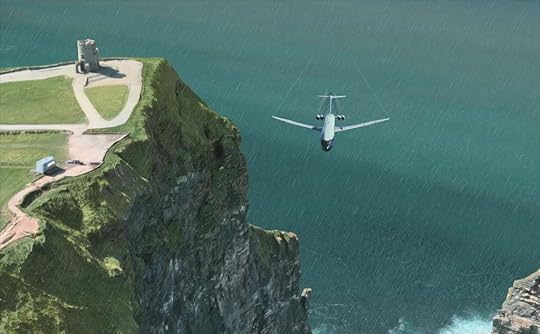
An excerpt from my book-”Dancing the skies and falling with style.”We hurtled towards the immense, dull sepia sandstone cliffs towering above us, just visible in the spray between each frantic stroke of the windscreen wiper. The gusting wind blew across the ocean current below us, stirring the slate-grey sea into a frenzied chop, from which spray was flung high in the air. We were flying at 50ft above the Atlantic at our maximum speed of 280 knots directly towards the 700ft high foreboding Cliffs of Moher in a BOAC VC10 airliner. The noise from the slipstream was deafening, the air was turbulent, and the aircraft shuddered and shook. It was difficult to read the instruments, but the Flight Engineer called out the altitude from the radio altimeter.
“52 feet, 50 feet, 48 feet!” he squeaked.
The pitch of his voice on the intercom rose as our altitude decreased. If we had flown any lower, I’m sure he could have sung Castrato in an Italian opera.
The massive stratified rock face virtually filled the whole windscreen, casting us in its shadow. I could make out O’Brien’s Tower perched on the precipitous summit with flocks of seagulls circling and wheeling around it. Atlantic rollers crashed into the base of the cliffs in an explosion of spume.
In the seat beside me was a bemedaled, ex RAF ace who had flown on the famous ‘Dam Buster’ raid during the war. He sat ram-rod straight, hands firmly on the controls, staring intently ahead with a manic grin on his face.
Who was I to question him? A mere Cadet? I didn’t dare.
We were going to crash into the cliffs, but I said nothing.
My sphincter was going ‘half-crown, thrupenny bit, half-crown thrupenny bit’ as I closed my eyes.
But I’m getting ahead of myself.
The post Flying a jet airliner over the Atlantic at 50 feet appeared first on Calvin Shields Author.
The day Granddad got up my nose
The terrorist attacks on the Twin Towers in New York changed aviation for ever. Security was tightened, baggage was screened, and thorough searches caused frustration and long delays. Passengers were advised to check in three hours before departure.
It was the death knell for the notion that flying was romantic.
Four aircraft were hijacked, the terrorists forced their way into the cockpits and slashed the throats of the pilots with box cutters. They flew two of the aircraft into the Twin Towers in New York, one into the Pentagon and the fourth crashed into a field in Pennsylvania.
Airlines were forced to fit armoured cockpit doors and no one was allowed onto the flight deck apart from crew. The door was locked at all times and a security camera system monitored the access. We were not allowed into the cabin to talk to the passengers and we became hermetically sealed in our lonely and boring eyrie.
I was a Captain of a Boeing 747 and I must admit that I kept the emergency fire axe by my side just in case.
Excerpt from my book — “Dancing the skies and falling with style.”We were preparing a flight from London to Chicago. It was snowing lightly and we were de-icing the aircraft as a precaution. The Dispatcher came onto the flight deck, his red cap wet with snow. He looked tired.
“Captain, sorry, but we have a problem. An Indian passenger has the ashes of his Grandfather with him in a small brass urn. It’s a security issue.”
I looked at him quizzically and wondered how an urn full of ashes could pose a threat. Someone could hit us with the urn or blind us with the ashes I supposed.
The dispatcher wiped the melting snow off his face and sighed.
“Security X-rayed the box and there is a ceremonial dagger inside. We can’t have it in the cabin.”
“I see. OK. Can’t we put it in the hold?”
“Captain, I’m sorry, but he won’t have it. He’s making a heck of a fuss, so I suggested that you might consider carrying it on the flight deck?”
I turned to the First Officer who was finishing his pre-flight checks.
“Any thoughts, Jim? Seems OK to me.”
He shook his head.
“Fine with me, Captain” he replied and continued flicking switches and testing systems.
“OK. Bring it up just before we leave,” I said to the dispatcher over my shoulder.
Half an hour later the door-bell chimed and the dispatcher came in carrying an ornately black lacquer and brass etched brass urn about 20 tall.
“Where do you want me to put Grandad?” he asked.
I shrugged.
“Um, just put him on the floor under the observers table, he’ll be OK there.”
Reverently he placed him on the carpet and backed out the door.
It was odd having someone’s remains on the flight deck, but we kept Grandad entertained all the way to Chicago. We chatted to him, told him jokes and explained what all the instruments did.
Thankfully he didn’t show much interest in the cheeseboard.
It was the First Officer’s turn to fly the aircraft. Chicago is a notoriously busy airport and the tower asked us to land on the shortest runway. The weather was poor with low cloud and a stiff cross-wind. The First Officer did an excellent job and arrived over the runway in exactly the right place but a sudden gust of wind hit us in the flare, and he had no option but to land the aircraft firmly. The runway was short and wet, so he hit the brakes hard when we thumped onto the ground. Cutlery and glasses crashed in the galley and we came to a shuddering halt like a nodding donkey.
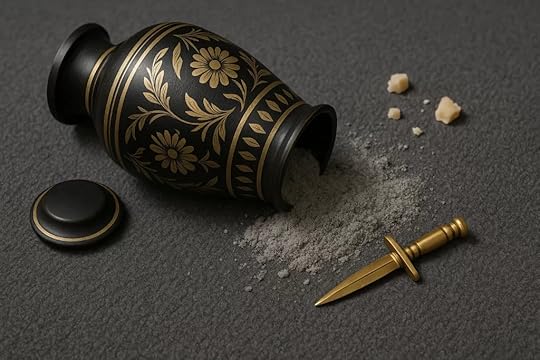
Gingerly, we taxied towards the terminal. I looked around and, horror of horrors, Grandad’s urn had fallen over, the lid had come off, and the ashes were spread over the scruffy carpet. In the middle of the pile, gleamed a small gold ceremonial dagger.
“Shit!” I said to Jim. “Grandad’s escaped!”
We parked at the terminal and I kept the door locked while we dealt with Grandad.
Two minutes later, I sheepishly handed the urn to the handling agent.
Inside was the dagger, most of Grandad, carpet fluff and a few crumbs of cheese.
The post The day Granddad got up my nose appeared first on Calvin Shields Author.
Bizarre death at Piarco
Late at night in 1990 I was Captain of a Boeing 747 preparing for a flight from Piarco in Trinidad to Antigua.
Extract from my book — “Dancing the skies and falling with style.”Available on Amazon and https://calvinshields.com/dancing-the-skies-and-falling-with-style/
At 10pm we ran through the pre-flight checks for our return to Antigua. Faint flashes of lightning illuminated a line of thunderstorms in the distance and silhouetted the hills surrounding the airport. The warm, humid trade wind blew across the brightly lit apron as the last passengers boarded the aircraft and the doors were finally closed.
The overhead air louvre blew hot air onto my face, sweat ran down my back and my damp collar stuck to my neck. The ait-conditioning fans whirred, struggling in vain to control the heat from the instrument panel.
“Before start checklist.” I called
The engineer motored his seat forward and leant between the front seats and read the checklist in a slow monotone. Craig was tanned and wiry with a mop of dark brown hair. He wore an almost perpetual mischievous grin.
The First officer turned systems on and flicked switches in response to the checklist. Ian was reserved with curly short black hair. He was a Phantom F4 pilot and had recently joined BA from the RAF.
One by one we started our agricultural Prat and Whitney JT9D jet engines and taxied towards the departure runway.
“Before take-off checklist.” I called.
A rusty perimeter fence was visible in the taxy lights as we slowly taxied past.
“Speedbird 257 Piarco, hold your position!” The tower called urgently, “there’s someone below your aircraft.”
“Speedbird 257 Roger, hold position” Ian replied.
I slowed to a halt and applied the parking brake. I looked at Ian, he shrugged.
The whir of the air conditioning fans circulated some welcome cool air in our cramped cockpit.
We waited for further information.
I turned to the engineer.
“Craig, would you mind going outside and having a look?”
“Don’t leave me behind,” he answered as he left the flight deck and descended to first-class. He lifted the carpet at the rear of the cabin and pulled open the trap door to the electronics bay. He opened the small hatch in the floor of the bay and slid out a retractable ladder.
Craig returned to the flight deck.
“I’ve been down to the tarmac and had a good look around, I can’t see anything.”
Clearly agitated, the tower called.
“Speedbird 257 security have arrested the man, continue taxying, you are cleared to line up and wait runway one-zero.”
“257, continue taxying. Cleared to line up and wait one-zero.” Repeated Ian.
I opened the throttles and steered the lumbering 280 tonne aircraft onto the runway.
An hour earlier, in a run-down room in an insignificant hotel near the airport a fight broke out. It started as a lover’s tiff but rapidly deteriorated into something much more serious. Two naked men, high on drugs, shouted and punched each other viciously, smashing the furniture as they rolled about the room. One, a US Marine, picked up a heavy brass lamp and smashed it on the skull of his smaller partner. His skull caved in and he slumped lifeless to the floor. The marine shook his partner, and realising the enormity of what he had done, ran naked into the corridor in a panic. He grabbed a fire extinguisher from the wall, put the nozzle in his mouth and pulled the trigger. The extinguishant shot into his mouth and he fell backwards onto the floor coughing and spluttering. He stumbled out of the hotel, crawled through a hole in the airport fence and ran towards a large aeroplane taxying towards the runway.
He ran under the slowly moving behemoth in a daze as it came to a halt. A pickup truck appeared, and three large black security guards jumped out, they bundled him inside and drove off. The big man sat in the back and shivered as the two guards laughed and taunted him. Still high on adrenaline, he attacked the guards, knocked one unconscious and broke the neck of the other. The driver stopped the truck, ran off into the dark and the grim-faced marine took his place.
The tower called us once again
“Speedbird 257, Hold your position. He’s escaped and hijacked a truck. Standby.”
“257, Roger, standby.”
Baffled, I applied the brakes and looked out of the windscreen for the truck. The runway carpet lights surrounded us, and the runway edge lights stretched into the distance. Two or three vehicles with yellow flashing beacons moved frantically about in the distance on the right but there was nothing close by.
It was so crazy and slapstick, it was like an episode from Keystone Cops. I told the passengers there was nothing to be alarmed about.
How wrong I was.
The controller answered our calls with “Standby!” and I sensed he was struggling to cope.
We were blocking the only runway and two aircraft circled overhead waiting to land. The PanAm flight suggested that someone should ‘shoot the guy.’
A yellow flashing light appeared off to the right and sped up the blue taxiway lights parallel to our runway. It stopped and turned to face across the runway half-way down.
“Speedbird 257, the truck’s behind you. You are cleared for immediate take-off!” The controller said urgently.
I looked at Ian and we both shook our heads.
“257, Negative!”
“257, Take off now!”
“257, Negative, negative” I shouted back.
The truck moved onto the runway and accelerated towards us. A figure hunched over the steering wheel of the yellow truck materialised in the landing lights. It shot past the right of the nose and hit us hard. The aircraft shook.
I’m convinced that he was waiting to crash into us during our take-off roll.
It would have been catastrophic.
The engine fire bell rang loudly, and red lights flashed.
“Fire engine 3 checklist!” I called.
We shut the engine down with well-practiced actions, and the engine spluttered to a halt, the fire extinguished.
“Bloody hell!”
“Craig, have a look.” I pointed towards the flight deck door.
Craig unclipped his seat belt and strode from the flight deck.
“257, we’ve been hit by the truck!” Exclaimed Ian on the radio, “the runway is blocked. Standby.”
There was no reply.
The two waiting flights diverted.
Craig came back to the flight deck from the upper deck.
“Captain, the engine’s a mess, there’s something smouldering on top of the wing, but it’s OK. I think the cab must have gone straight through.”
The marine had hit engine the engine head on. The bottom of the engine cowl is five feet from the ground, and it had smashed the windshield and ingested the cab. He ducked at the last moment and scraped under the length of the engine. Bleeding heavily, he drove away in his now convertible truck. A few hundred meters later the Toyota ground to a halt with a pierced radiator.
BA had only two staff in Trinidad, they were both passenger handling agents with little technical knowledge. I called the office on company frequency.
“Arjun, can you come out to the aircraft and have a look at the engine?”
Five minutes later, tubby, turbaned Arjun Singh walked towards us in the landing lights.
My headset crackled as he plugged in.
“Captain, Arjun here.”
“Hi, Arjun.”
There was a brief pause.
“Captain! I have to go. He’s running at me!”
“Run. Quick!” I yelled.
Arjun ran away with arms and legs flailing in the bright landing lights.
We heard a strange noise, it was a subtle change of engine pitch. I looked at the gauges, nothing looked out of order.
Arjun turned around, ran back to the aircraft and plugged in.
“Captain, you’re not going to believe this, but he’s just jumped into engine 2!”
“What! Arjun, are you sure?”
“I’m afraid so.”
I took my headset off, put it on the coaming, buried my head in my hands and called for the engine shut down checklist.
The chief steward came onto the flight deck and I explained what had happened. He explained that the stewardess sitting by door 2 left had seen him jump into the engine and had collapsed with shock.
I reassured the passengers, we taxied back to the apron on two engines and disembarked them through the front right-hand door. The stewardess was taken to hospital.
I contacted Speedbird London on HF radio and asked to be connected to the Chief Pilot.
A sleepy voice answered, and he soon woke up when I explained what had happened. He couldn’t believe it, neither could I.
We discussed a plan of action. A team of engineers and experts would be sent from Heathrow to New York on Concorde, and then by chartered jet to Trinidad. They should arrive in less than 24 hours. They asked me to assess the damage, secure the aeroplane and await further instructions. Down time of our aircraft was extremely expensive, and BA wanted the aircraft repaired as soon as possible and returned to service.
We secured the aircraft and I walked down the steps to the apron to inspect the engines. The damage to the engine he had hit with the truck looked serious, the cowling was badly dented, the blades were bent and there were some wrinkles in the pylon.
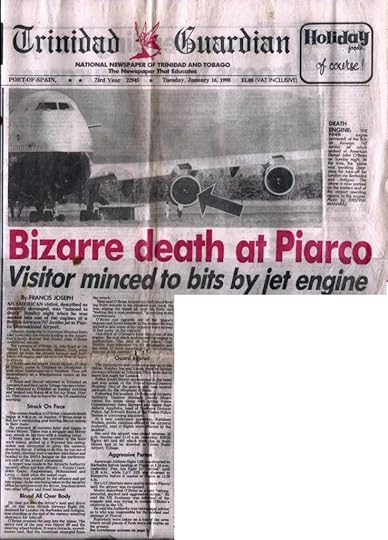
The intake of the other engine was covered in blood, it was red, very red. I suppose blood is that colour when oxygenated by an engine rotating at thousands of revolutions per minute. Chunks of meat, entrails and teeth were jammed into every crevice, and a line of what looked like pale brown ribs were stuck on the inside of the cowling.
I jumped. Two eyes, in half a face stared lifelessly at me from behind an inlet guide vane.
‘What could have driven him to do this?’ I wondered, feeling decidedly sick.
Apart from a few bent blades, the engine looked in remarkably good condition.
The crew nicknamed the aeroplane ‘The Blender”
The post Bizarre death at Piarco appeared first on Calvin Shields Author.
May 25, 2025
Welcome to my world
Hello, and welcome to my website.
This space is where my stories begin, where memories and imagination meet. Whether you’ve stumbled here by accident or arrived with intent, I’m glad you’re here.
I’m Calvin Shields — a writer, a lifelong traveller, and a curious observer of history and humanity.
This website is both a home for my books and a place to share glimpses behind the pages — thoughts on writing, research, inspiration, and the moments that shaped my stories.
If you’re interested in:
Forgotten corners of historyStories rooted in real lives and eventsReflections on travel, war, memory, and meaning…then I hope you’ll feel at home here.
You can explore my books, listen to the music that shaped my journey, and follow along as I uncover the threads that led to my latest novel, What Remains, and my upcoming work, Fault Line.
This is just the beginning. Thanks for joining me.
— Calvin
The post Welcome to my world appeared first on Calvin Shields Author.
May 11, 2025
This is your first post. Edit or delete it, then start wr...
This is your first post. Edit or delete it, then start writing!
The post appeared first on Calvin Shields - Author.
April 4, 2025
Hello world!
Welcome to WordPress. This is your first post. Edit or delete it, then start writing!
The post Hello world! appeared first on Author Name - Explore the Depths of Emotion and Mystery.
March 27, 2025
Hello world!
Welcome to WordPress. This is your first post. Edit or delete it, then start writing!


