Crystal Estell's Blog
May 3, 2020
How To Survive A Gut Punch: Tips for Surviving the Querying Trenches
Tips for Surviving the Querying Trenches

Querying is NOT for the faint of heart. It’s a process that will steal your sleep, your breath, all while tying your once calm demeanor into a knot of anxiety. It’s that bad. Days spent questioning why you ever wrote a book in the first place. Nights spent battling the urge to just burn your manuscript.
But don’t do it.
You can survive this. The fact you wrote a book in the first place is something to be proud of, something not everyone can do. And remember, querying is not writing. It’s marketing what you wrote through a multi-layered process that requires patience, endurance, and skin as tough as leather. So be prepared.
Because you will face rejection.
We all do. And while you may get a full manuscript request, an agent offer, even a publishing contract along the way, you won’t do it without hearing: Sorry, I just don’t believe this project is a good fit for me—at least once. And it stings. No, it breaks your heart like an iron fist to the chest. But before you curl up in bed and never leave, know that there are ways to lessen the pain. Not take it away completely, but definitely knock it down a few notches. Bandaids and balms to help ease the discomfort. Not a cure. Just me, a hopeful writer, helping another hopeful writer reach their goal.
DON’T BLAME THE AGENT
This is a hard-to-swallow truth because as humans, blaming makes us feel better. It’s easier to think someone caused our demise. To point fingers at the person who ruined our chance for success or won’t give us a fair shot. But the reality is, it’s no one’s fault. Most of the time, we’re just different people looking for different things.
An agent is just one of those people.
So if you view them as some enemy blockade wedged between you and great success, or as some wall you have to break down, you’ll never make it. And I mean never. Snagging an agent is about cultivating a relationship, locking hands with a partner who’s ready to escort you into the world of publishing.
They are not your enemy. I repeat. They are not your enemy.
And if you hope to get traditionally published one day, I’d recommend treating them like you would a friend. I know. I know. You want to hate them. It feels good to call them names and send them ugly emails. But don’t! Because later, after the anger settles, you’ll regret it. And those bridges you just doused with gasoline and set on fire will be nothing but ash.
So before you destroy your chances, look at querying like you would speed dating. You can court your awesome self around all night, but regardless of how great you are, a connection has to happen. Sparks must fly. Or neither one of you will go anywhere fast. It’s just a fact of life. You want someone special to fall in love with your manuscript, and an agent want someone’s book to love.
Neither of you can make money or fulfill dreams without the other.
DON’T TAKE THE PASS PERSONAL

Agents pass on great books. It happens. And why, you ask?
For several reasons. And believe it or not—it’s not always about you or your writing. You very well could be the next Dean Koontz or Stephen King, but if you queried someone looking for Debbie Macomber, then guess what? PASS. Or in this case, you might not even get a response. But I write Amish Romance and the agent said in her profile she LOVES Amish Romance. So what’s the problem? Maybe you write short and choppy sentences, and the agent you queried loves long and flowery ones.
Either way, it’s a subjective process, and again—they have to fall in love.
And you want them to because if they don’t, your book will never get its wings. Seriously, the last thing you want as a writer is for your manuscript to be tucked away in some agents To-Be-Read drawer collecting dust. From there, the world will never see it, and your hopes for success will suffocate.
Maybe I can explain it better like this.
My daughter LOVES literary fiction, the kind where on page 1 the author is describing, in intricate and metaphoric detail, an urn. Not the person who owns it. Not the house it’s in. Just the urn. On page 15, we’re still reading about this urn, which now has transformed into some allegoric parallel to womanhood. This is her world. She eats this stuff for breakfast.
I’m a person who loves heartfelt—or funny—romance. I want just enough details to give me a sense of place and then pour on the story. Make me feel. Take me any place you want as long as we get to a happy ending. If you do, I’m in heaven.
How does this relate to agents? Agents are people with specific tastes, just like most readers. And they know taking on a book means they need to love the premise and the voice because they’ll be reading it more than once.
Remember, they can only champion what they love. So be patient. Finding love takes time.
STOP OVERANALYZING AND LET IT REST
You’re getting passes, but now you’re also getting requests—or even personalized rejections. All of which propels you into hours of self-assessment and before you know it, you’re pulling out the scissors and kleenexes at the same time.
Slow down before you do something crazy.
Of course, it’s not the manuscript requests that are the problem, It’s those rejections, breakups in a relationship that almost was, that make you crazy. Which is why you need to ask yourself this one, simple question before you do anything else: Was it me, or was it them?
Evaluate your query letter. Is it captivating? Are your conflicts clear? Are you getting any requests? Etc… Now check your sample pages. Do they snag attention? Are you starting at the right place? Do other beta readers and critique partners—notice I didn’t say Grandma Dot—seem intrigued and eager to read more?
If you answered yes, then you’ve done your best. Now just wait for your person [agent] to love it as much as you and all your writer/reader friends do.
Here’s the flipside to that coin. Are you getting a lot of similar feedback, multiple people pointing out the same problem with either your query or writing sample? If yes, then it’s back to the drawing board to fix it. And if you need help with that, here are some great resources to check out. Keep in mind, though, alter only as needed, not every time someone offers their opinion.
And here’s why.
My first attempt at querying… Hold on, I’m laughing hysterically… Catching my breath now… Okay, I’m back. Yes, that first attempt to land an agent was a disaster. And my manuscript? An even bigger disaster. Sometimes, I still pull it out, wondering if it has any redeeming qualities, and the answer is always the same. Absolutely not!
But I learned from my mistakes, kind of.
The second attempt, I was onto something. I had a unique premise, comedy, love, all the makings of a great book—but I queried way too soon. A common newbie mistake. The manuscript requests (multiple ones) came in quicker than I expected and left me rushing to edit, which didn’t turn out well.
Then on to my next mistake. I sliced and diced my manuscript to fit every piece of feedback given. I murdered my book, like chopped it up into tiny, unrecognizable pieces.
Thankfully, I didn’t let it stay that way. I went back—after reading about plot pacing and the use of beat sheets—and rewrote it into a manuscript I was proud to put my name on. Unfortunately, I had already queried everyone, including God it seemed, and had no one left. Well, no one that was interested in representing my genre, anyway. But to my good fortune, people who believed in me and my potential encouraged me to self-publish.
I’m glad I listened. Because even with a very meager, almost non-existent marketing budget and time, I was able to sell almost 3,000 books in ten months and have over 69,000 pages read. No, that’s not Nora Roberts or Danielle Steele numbers, but it’s something I’m proud of because in the end—people liked my book. My hard work paid off.
Now, here I am querying another book—less than ten months later. And I’m doing that while working full time as a registered nurse (teleheath), home schooling three kids through a pandemic, and helping my twenty-year-old find her own space to finish out the college semester at home. Not to mention worrying about my twenty-two-year-old who lives in a viral hotspot.
The point of telling you all that is to remind you it can be done. Will you be sad? Yes. Will there be days you want to give up? Absolutely. But if getting traditionally published is your goal, something you truly desire and want to see happen in your future, then keep going.
On to my next point…
ACCEPT THE PAIN

This is tough. On days when a rejection pops up in my email, a heavy sadness falls over me. I can’t stop it. I can’t wish it away. It happens, and for whatever amount of time it takes to pass, I’m stuck with it. One day, I had two passes land in my inbox back-to-back, right after I’d just been cursed out by a patient projecting their healthcare frustrations onto moi.
What a horrible day.Two days later, though, I received a full manuscript request. Three days after that one—another. Woo hoo! And guess what? My entire mood shifted. I’m popping corks on wine bottles, dancing around the house full of hope and energy. The creative juices are flowing with a—my dreams might finally come true—attitude. Further proof that querying is like steering a boat in a hurricane. You’re all over the place. Climbing up. Crashing down. Plowing under. Riding over. Hurling forward. Dragging back. Through it all, your stomach’s just a queasy mess of nerves, and you’re gnawing fingernails like they’re candy.
A week from now, guess what? You’ll do it all over again.
Which is why you have to accept the emotions for what they are—feelings that can and will change. Sometimes hourly. Sometimes daily. What they shouldn’t do, though, is define you. Because you are more than a rejection or a pass. You are an author, and the sooner you start believing that, the quicker you’ll reach your goals.
KNOW WHY YOU WRITE
Why does this matter, you ask? It matters because it gives you purpose—a reason for querying in the first place. A sprinkle of promise along the tough path to publishing. Because in reality, there are so many things no one ever tells you about the writing process, things you are left to learn as you go.
All the more reason to know why you want to publish a book.
After my first failed attempt at querying, back when my goal was to become super rich and famous overnight [yes, you can laugh], I took time to evaluate why I really wanted to be an author. What did I hope to accomplish with my books? What I discovered is that money wasn’t the driving force behind my writing. I didn’t spend hours typing away at a computer until my fingers went numb—after charting on patients all day—just for the money.
I made sacrifices because I love writing.
I enjoy putting the crazy stories floating around in my head on paper. I love it even more when someone reads them—and likes them. One of the best reviews I’ve ever received was from a woman who thanked me. She’d had a lot of stressors in her life lately and wrote that my book took her mind off of those things. Her words made my day—gave my work validation.
And that’s the reason I create goals for myself, things I hope to accomplish every time I write or query. Things I can look forward to, like having my children see my books on the shelves of Barnes and Nobles and other book stores.
And it’s those goals that get me through the querying process, knowing that one day someone will fall in love with my books and give the world the chance to do the same.
READ FAMOUS AUTHOR’S SUCCESS STORIES
I don’t have much to say about this, other than it seriously helps. When I read about how many novels some of these authors had to write before one actually sold, it gave me hope. As I imagine Stephen King going from papering his walls with rejection letters to becoming a millionaire author with hundreds of books under his belt—I can’t help but feel encouraged. And when I learned that Nora Roberts wrote a book while snowed in with her young boys—I’m filled with hope. Even Nicholas Sparks faced rejection. A manuscript that never sold. The Notebook, a novel that launched his career, passed over by so many before someone finally said yes.
In the book I’m reading, The Essential Guide to Getting Your Book Published, they have a whole chapter dedicated to these types of stories. Years of rejection that end in great success. And whenever I feel like hope is lost, this is where I turn. To the stories of author’s who kept going, the writer’s who never stopped at rejection. This is the fuel that keeps me pressing forward.
NEVER GIVE UP

There are days when I want to quit, and I’d argue I’m not alone.
The first bad review I received for A Not So Immaculate Conception broke my heart. It truly did, even though I had a lot more uplifting feedback than negative. Still, I let it break me for reasons I believe a lot of us do. We want everyone to like our work, and when they don’t, it feels like they don’t like us. Of course, that’s not true, and deep down we know it. But still, our books are our babies. We want to protect them—protect the heart we poured into them.
But, if we are to be successful, we must understand that the path to publishing, from query to agent to contract, takes more than just a good book. Or even a great one. It takes patience and a spirit that keeps going. Knowing that a pass today, isn’t a pass forever. Markets change. Agents’ tastes change. And remember this. Not every agent, reader, or publisher will love you or your story, and that’s okay. You can’t please them all. But if you surrender, if you let rejection rule over persistence, then there is a 100% chance that your manuscript will never find its home. It will remain nothing more than a haunting regret.
So don’t let it be.
If your dream is to become a traditionally published author, then never give up. Learn from the process, take corrective criticism with a smile on your face, and keep pushing forward. Know that many a great author has trudged through years of rejection to get where they are today. Let their stories be your motivation. Keep hammering away like every successful writer that came before you.
And above all, believe in yourself. You CAN and WILL survive the hellish querying trenches.
Share on facebook
Share on twitter

For those of you who need some reasons for why agents pass, proof that it’s not always about you, here are some samples to prove it from: https://mswishlist.com/queries.
Dorian Maffei @DorianMaffei · 28 Mar 2019
Q6: I’m sure this book will hit the mark for another agent, but I don’t feel I can move forward for subjective reasons. I’m usually not the best fit for books with this subject matter. Pass. #10queries
Dorian Maffei @DorianMaffei · 28 Mar 2019
Q8: Love this premise. Always interested in seeing unique takes on ghost stories. Hooked by pitch & I can tell this author did their homework on me
Upon reading pgs, I’m just not connecting w the writing. Hard to pass but I need complete passion behind the work. Pass #10queries
Ali Herring @HerringAli · 26 Jul 2018
Q6: Too similar to something one of my clients has done. Pass #10queries
Kaitlyn Johnson – Closed to Queries @RedPenKaitlyn · 26 Apr 2018
P2 – ?? Historical [image error]


September 2, 2019
6 Reasons I Love Nora Roberts
 Photo by Hush Naidoo on Unsplash Edited by Estell's Place
I swear. I cannot get enough of Nora Roberts. I love her books. And yes, I know I’m carrying on like a crazed fan right now—because I am. Yes, I read other romance novels, and I enjoy them. They’re great. But then I come back for my Nora fix because her story-telling talent is amazing. No author can pull me into a story better than her—not yet anyway. So this made me think, what is it about her writing that sets her apart.
And here is what I found:
THE FIRST LINE HOOK
Nora Roberts has mastered the hook, plain and simple. Pick up any one of her books, and read the first line. It draws you in and force you to read more? It makes you ask burning questions that need answers. And the only way to get them is to read more. Thus, the purpose of the hook.
Examples:
Year One—“When Ross MacLeod pulled the trigger and brought down the pheasant, he had no way of knowing he’d killed himself. And billions of others.
How did he kill himself? Was the pheasant infected? How did it spread to others? What is it? Who dies? Who survives?
The Witness—“Elizabeth Fitch’s short-lived teenage rebellion began with L’Oréal Pure Black, a pair of scissors, and a fake ID. It ended in blood.
Does she die? Why did she rebel in the first place? Where was she going that she needed a fake ID? Short hair and makeup? Why is she trying to look older?
Undercurrents—“From the outside, the house in Lakeview Terrace looked perfect.”
This lets me know it is all a facade. Why do they need the outside to look perfect? What’s so imperfect on the inside? What are they hiding?
The Obsession—She didn’t know what woke her, and no matter how many times she relived that night, no matter where the nightmare chased her, she never would.
What happened when she woke? Why would she call it a nightmare? Why is she still reliving the moment?
Carolina Moon—“She woke in the body of a dead friend.”
How did her friend die? Why would she wake in her body? Does she have special powers? Is she a psychic? Is there a mystery to be solved?
The Search—“On a chilly morning in February with a misty rain shuttering the windows, Devin and Rosie Cauldwell made, slow, sleepy love.”
The way she describes the environment around them lets me know this is not an exciting, passionate lovemaking between a couple who should love each other, but a duty. And why is it so dreary?
The Welcoming— “Everything he needed was in the backpack slung over his shoulders. Including his .38. If things went well he would have no use for it.”
Why does he need a gun? Who is he going to meet? What needs to go well?
Second Nature—“…With the moon full and white and cold. He saw the shadows shift and shiver like living things over the ice-crusted snow. Black on white.”
Where is he? Why is he there? What is moving on the ice? Is it dangerous?
JD Robb Connections in Death—“The legalized torture of socializing lined right up with premeditated murder when you added the requirement of fancy shoes.”
Obviously, this man deals in homicide cases to make such a comparison. Why does he hate socializing or dressing up? Does he think it’s all a game where people hide their true selves?
River’s End—“The monster was back. The smell of him was blood. The sound of him was terror.”
Who is the monster? Why is he so terrifying? If there’s blood, then he’s killed before? Who is he after?
See how her lines whirlpool you into her stories—without the dreaded purple prose? Her sentences, through strong verbs and continuous action, drives home the purpose, the motivation, and the needs of her characters. She gets straight to the point using ONLY the words that matter.
VIVID, LAYERED DESCRIPTIONS
 Photo by Ales Krivec on Unsplash Edited by Estell's Place
Not only does Nora paint a clear picture of the scene she drops you in, she layers it with action and a sense of direction. And she never stops the flow of events to spend five minutes explaining the Polaroid of a tree or beach or fire. No, she draws you into the story, then takes you on a journey. She plants you in the frozen tree line with Alice from Come Sundown, drives you through pounding sleet to the looming house on Whiskey Beach with Eli, and then flies you over a raging fire with Rowan in Chasing Fire.
No matter which book you read, Nora’s vivid and layered descriptions suck you into the story.
Examples:
Come Sundown—“Alice Bovine relieved herself behind a thin screen of lodgepole pines. She’d had to trudge through knee-high snow for the screen, and her bare ass (with the dragonfly tattoo she’d had inked in Portland) shivered in the wind that soughed like the surf.”
Whisky Beach—”Through the chilly curtain of sleet, in the intermittent wash of the great light on the jutting cliff to the south, the massive silhouette of Bluff House loomed over Whiskey Beach. It faced the cold, turbulent Atlantic like a challenge.”
Chasing Fire—”Caught in the crosshairs of wind above the Bitterroots, the jump ship fought to find its stream. Fire boiling over the land jabbed its fists up through towers of smoke as if trying for a knockout punch.
From her seat Rowan Tripp angled to watch a seriously pissed-off Mother Nature’s big show. In minutes she’d be inside it, enclosed in the mad world of searing heat, leaping flames, choking smoke. She’d wage war with shovel and saw, grit and guile. A war she didn’t intend to lose.”
FLAWED CHARACTERS
Yes, she gives us sexy women and handsome men—but not perfect ones. And I don’t mean she slaps a lazy eye, a chipped tooth, or hammer toes on them to skew perfection. She goes much deeper, gifting them with internal demons and real-life struggles, thorns in their side that they can’t shake. And she capitalizes on these by showing how they learn to live with their struggles, not by making them disappear.
Think about it. An alcoholic who kicks his addiction for the love of his life is still a person who battles addiction. Now he’s just a person in love battling addiction. And even though he’s successful, it doesn’t mean he’s not tempted or that his past actions have suddenly disappeared. It means he’s found a place for them and a way to cope.
As humans, we all have flaws, tendencies towards behaviors we’d rather not possess. Shopaholics, gossipers, enviers, adulterers…the list goes on and on. And though we might not act on them, we still battle.
Too often, we are eager to write away the flaws, to resolve them completely. But I believe that’s not always the best way. In fact, I believe Nora has proven, through her extremely (yes, I added an adjective on purpose because she deserves it) successful career that characters should reflect reality. Sex addicts don’t find love and never think about sex. Obsessive-compulsive people don’t get married and decide it’s okay to live in a messy house.
Romance and love should not cure your character—or lobotomize their brain—but it should heal them, bring light into their otherwise dark world, and show them there is hope despite imperfections.
Yet another technique perfected by Nora Roberts.
WELL-EXECUTED CHARACTER ARCS
 Photo by Dino Reichmuth on Unsplash Edited by Estell's Place
You know what you’ll never find in a Nora Roberts’ book? Insta-Love. Why? Because it doesn’t exist and rarely works well in novels. If you believe it does, you might have it confused with its sisters, Insta-Lust and Insta-Infatuation. Trust me, they are not the same.
Now to understand why Nora Roberts is so amazing at writing characters arcs, it helps to know what a character arc is. A character arc is the inner journey that a character takes from the beginning of the story to the end. It’s the change, good or bad or flat, that takes place in the character. Sounds easy enough, right?
Well, it’s not. Those changes have to occur at the perfect time in the story, or the story fails. Imagine playing the right keys on the piano at the wrong time. It’s no longer a song, well, not the one you meant to play.
The same goes for the character’s journey.
And while I’d love to give examples of Nora’s mastery in this category, I can’t without spoilers. But I promise, if you read just one of her books you’ll see exactly what I’m talking about.
WRITES WITHOUT BOUNDARIES
What does this mean? Have you checked the list of over 200+ books that Nora has written? Surprise, they’re not all romance. She has paved her way through thrillers, suspense, and fantasy—with ease.
But how? Because she’s just that damn good.
SEX SCENES ROCK
On a heat level, I would say most of what I’ve read from Nora lingers around the middle. In a world full of ghost peppers, she’s a jalapeño. But sex scenes are about more than just heat, they should be about the emotion. They should make you feel something beyond the surface layer, something beyond the raw act.
The lack of emotion is where some books fail, but not Nora. No, she rises to the occasion. Because she doesn’t make sex in a book just about sex. Even the sex that is “just sex” has a purpose, as it should. Why is the character stripping off their clothes and laying with another person they don’t love or care about? The answer shouldn’t be just because. It should be the same as with all the other scenes, action, fights, sex, death, etc. should add meaning to the story and propel the story forward.
If not, execute the scene immediately.
Nora knows this. Her characters make out when it fits the flow of the story. And she does a wonderful job capturing the emotion of these scenes.
Example from The Witness:
“When she thought she couldn’t bear it, couldn’t contain it, everything went bright and free. She heard herself moan, the long, long throaty sound of it as her head dropped heavily on his shoulder.
She wanted to twine around him, curl inside him, but he angled her back, wrapped her trembling legs around his waist. And he drove into her.”
If that tiny snippet doesn’t make you feel something… [smh]
PREDICTABLE ENDINGS DELIVERED UNPREDICTABLY
Before I share how great Nora’s endings are, I need to climb on my soapbox. Romance novels are predictable. Period. Dot. Com. It’s not a romance novel unless there is a happy for now or a happy ever after. That’s why people, just like myself, read a romance novel. Because we enjoy the reassurance that everything will work out. Despite the conflict, this couple will pull through.
True romance readers welcome the happy endings.
So it always blows my mind when I read a negative rating on anyone’s romance book that says that the novel was too predictable. Or, I knew they would get together after the first chapter.
Duh, is that not the point?
Now, I’ll climb down and give Nora her dues. She has a way of adding enough suspense and drama to the known, that I’m often forced to remind myself of the expected. No matter what mud and muck she drags her characters through, they will end up happy for now or happy ever after.
It’s the reason I read romance novels and watch Hallmark movies. Knowing the characters I’ve grown attached to will ride off into the sunset, surrounded by rainbows and butterflies, leaves me warm and fuzzy. Nothing drives me more crazy than a cliffhanger or a surprise horrible ending. No offense to those that love them, my daughter included.
But as for me, I need Nora’s unpredictable delivery of the predictable.
Do you have a favorite author, one you tend to read more than the others? Are you a writer? If so, what author inspires you? Please share!
June 29, 2019
A Complete Guide to Mastering Plot Pacing
 Photo by Karsten Würth (@karsten.wuerth) on Unsplash Edited by Estell's Place
You set your finished manuscript aside to breathe. Several weeks later, after a few celebratory glasses of wine, you dust off the pages and read it again—for the first time. And it flows with the consistency of sour milk. It’s terrible. But why?
You’ve mastered the plot points and the rise and fall of conflict. The dialogue is sharp and the characters well-developed. So what is the freaking problem?
If I was a betting woman, and I am occasionally with a good game of Blackjack, I’d say your problem lies in the pacing. Scenes must happen at, or near, specific times in the novel for it to flow smoothly.
[Covering my head as the pansters throw tomatoes]
I know… I know… I know! Stephen King is a panster, Nora Roberts, the Queen of Romance, is a panster. But they are author prodigies, people born with an innate sense of story. Just because Stevie Wonder can tickle the ivories without ever reading a sheet of music doesn’t mean I—or you—can do the same. And I would argue that even prodigies don’t always get it right on the initial try.
When I finished my manuscript the first time, I read it to my family. They smiled and said, “It’s okay.”
“Okay? Okay doesn’t sell books! How can I fix it?” I asked.
They didn’t have an answer and offered no guidance. After several days of moping around the house, my husband patted me on the back and assured me I had a great book concept. Some parts made him laugh and were enjoyable. Unfortunately, the execution of that concept left him underwhelmed, and the book as a whole didn’t click.
So with that knowledge, I buried myself in resource books, trying to find a tool I could use to dig my way out of the crap I’d created.
I came across tons of helpful advice, but not one book or resource was the standalone key to fixing my problem. Frustrated, I decided I would take bits and pieces of advice from each of them and compiled them together. And it worked!
In fact, the copyeditor who proofread my completed novel said the pacing was, “very tight and read like a seasoned pro.” Thanks to the methods I’ll share with you here.
**If your manuscript is complete and you need help with polishing it, no worries. I’ll discuss that, too!**
GATHER YOUR RESOURCES
THE REQUIRED RESOURCES
Structuring Your Story K.M. WeilandSave the Cat Writes a Novel Jessica BrodyThe Emotional Wound Thesaurus Angela Ackerman and Becca PuglisiCreating Character Arcs K.M. WeilandHow to Write Dynamite Scenes Using the Snowflake Method Randy IngermanMake a Scene Jordan RosenfeldRomancing the Beat Gwen Hayes [for Romance Writers]Edit Your Own Romance Novel Ebony McKenna [Romance Writers]START WITH STRUCTURING YOUR NOVEL
If you have been writing stories for a while, or are familiar with the main story structure of a novel, you can skip this part. But for anyone who is just starting out, I highly recommend reading this book. In it, you will discover the essential plot points your manuscript should have and where they should be placed. You’ll also gain a basic understanding of story progression, acts, and timing.
Once you have grasped those concepts, try to outline what events or scenes might take place at each of those plot points. Remember, nothing is carved in stone. Things can and should change as you develop your story. But for now, at least give yourself a sense of direction.
Okay, I did what you said, but what about the other 200+ pages of the story? What goes there?
TIME TO OPEN SAVE THE CAT WRITES A NOVEL
Read this amazing book, and afterwards, download the beat sheet. You will need it. Now, take the vague outline you have from Structuring Your Novel and transfer those plot points onto your Save the Cat beat sheet:
Inciting Incident> Catalyst
First Plot Point> Debate
First Pinch Point> Fun & Games
Midpoint> Midpoint
Second Pinch Point> Bad Guys Close In
Second Plot Point> Black Moment
Climax> Act III/Finale
Resolution> Final Image
Once you have those filled in, consider what you might put in the other spaces, what other scenes would fit the flow of your book. Remember, some of these plot points will be composed of multiple scenes ( i.e. FUN & GAMES). With that in mind, brainstorm ideas that would help your character move from one plot point to the next.
Please note, you are vaguely outlining your plot. You are not, and I repeat, you are not limiting the creativity of your overall story. When artists paint pictures, they outline the subject. They then use the sketch as a guide to keep things in proportion. It is not the finished masterpiece no more than your plot outline is a finished novel.
And don’t worry my fellow romance authors, I’ll discuss those smooches and happy ever afters before we’re done.
TURN TO THE EMOTIONAL WOUND THESAURUS
Sure, it’s fun dragging our characters up mountains, pushing them off, and watching them parachute to safety. But it doesn’t mean anything if they never had a reason for climbing the mountain the first place. And if you threw them off the mountain—you better have a good reason for doing such a cruel thing.
In other words, action without motive doesn’t make sense.
So how do we find motive? With this wonderful book, of course. It’s true that our behavior choices are often guided by our experiences. Your character is no different.
This book helps you determine your character’s wound, their fatal flaw, the lie they believe, the thing that caused them to become the person they are in your novel. And then, it teaches you how to pull them out of their slump—give them the thing they need.
Good books feature well-developed characters that respond to the events you throw at them in an appropriate manner, at the appropriate time. The key to perfect pacing is more than perfectly timed events.
CREATING CHARACTER ARCS

You’ve explored the inner soul of your character and now grasp a full understanding of why they are who they are. Now what? Well, it is time to take them on a journey, help them get to the thing they need the most, or take them away from it. How you do that depends on your character’s arc: positive, flat, or negative.
Before you panic, just stop! You don’t have to learn a new language, or take a quiz. You just need to choose how you want your character to grow.
Are you going to throw things at them that make them a better person? Then your story is following a positive arc. Is your character a great person with a stable moral compass who doesn’t need to change but is confronted with a dragon battle? Then you are writing a flat character arc. Will your character end in a worse place than she began? If you were so cruel—then your book is on a steady negative arc course.
The main driving point, or takeaway, is, it is important to create a consistent and well-paced inner character journey.
“Plot and character are integral to one another. Remove either one from the equation (or even just try to approach them as if they were independent of one another), and you risk creating a story that may have awesome parts, but which will not be an awesome whole.”
Weiland, K.M.. Creating Character Arcs: The Masterful Author’s Guide to Uniting Story Structure, Plot, and Character Development (Helping Writers Become Authors Book 7) (p. 16). PenForASword Publishing. Kindle Edition.
Remember when my husband said my story had good parts, but overall didn’t flow? Well, that was one of my problems. My character’s arc didn’t flow with my plot. So keep your character’s emotional growth in line with the events in your plot if you want to master pacing.
Enter the Character Arc Beat sheet. It’s necessary, so don’t skip it!
So now you have the plot points, how do you make them flow together?
LET’S BUILD OUR STORY
Time to read How to Write Dynamite Scenes Using the Snowflake Method and Make a Scene. Because in order to turn your plot points, character arcs, and conflict into a bigger story, you have to master scenes. Scenes are a sequence of continuous action that drive the story forward from point A to point B. They are, in essence, mini-stories within a bigger story.
Imagine them as you would Legos, stack each block in just the right place and those colorful cubes become a charming castle. Get it wrong and who knows what you’ll end up with—a shack? And if you don’t do the scenes justice, don’t understand the necessary components of each, you’ll either bore your readers to death or drive them into a panic attack.
So, take your time and learn how to craft a scene properly. The better the understanding, the better the flow, the better your story will flow—all leading to perfect pacing.
But what about me, I write Romance?
FOR THOSE WHO WRITE ROMANCE
 Photo by Fabrizio Verrecchia on Unsplash
Anyone who writes romance will tell you, even voice frustration, that the structure elements don’t always include the necessary romance elements. You’ve heard of the meet-cute, right? Where would that fit?
Now, I’ve read quite a few books for writing romance and the ones I like the best so far are: Romancing the Beat Gwen Hayes and Edit Your Own Romance Novel Ebony McKenna. What I love about Romancing the Beat is that it reminds me when to add important romantic elements, i.e. the meet-cute, and gives me an overview of what should happen in each of those elements.
And because I have a crazy beat sheet obsession, I take it a step father and combine the beats of Romancing the Beat with Save the Cat into my own master beat sheet, adding the elements where they fit best.
ACT I
Intro H1/H2 & Meet-Cute> Setup
No Way Beat 1> Catalyst
Adhesion Plot Thrust> Debate
ACT II
No Way Beat 2, Inkling> B-Story
Deepening Desire & Maybe This Could Work> Fun & Games
Midpoint of Love Plot Thrust> Midpoint
Inkling Doubt> Bad Guys Close In
Deepening Doubt, Retreat, Shields Up> All is Lost
Break up & Dark Night> Break up
ACT III
Wake up & Grand Gesture> Finale
What Whole Hearted Looks Like & Epilogue> Final Image
Ebony McKenna’s book, Edit Your Own Romance, saved my first novel. After reading all the other books, I still couldn’t “see” where my problem lied. In her book, she suggests using index cards to organize the scene and acts, making sure the number of scenes are balanced on each half of the book.
And finally, I could see my problem. The first half of my book was loaded with plenty of scenes and the second half—not so much. From there, I was able to give my book a makeover, liposuction the front side, augment the back side, and poof! I had a masterpiece [or so I hope].
And so can you!
Have any pacing advice you’d like to offer? Any stories of pacing issues that you solved in your writing? Feel free to share!
Share on facebook
Share on twitter
June 8, 2019
How to Design A Professional eBook Cover
Ah…the book cover. You’ve overworked your brain, pumped out the best story of your life, and now comes the decision. Do you pay someone for a professional cover? Does your budget demand a DIY version? Are time constraints boxing in your options? No worries! I’m here to help. I’ll teach you how you can create your own professional ebook and print cover—in a flash.
***The instructions I provide will require at least the FREE versions of Picmonkey and Canva. If you use another editing service, don’t panic. Just follow along and improvise with what you have.
***I will use my own book cover and a made-up book cover as examples. Do not copy either for your personal use, please.
EBOOK COVER DESIGN
Sign into Picmonkey or Canva and choose: CREATE NEW> BLANK CANVAS > KINDLE BOOK COVER
Add the photo, or photos, you wish to use in your design: GRAPHICS> ADD YOUR OWN IMAGE > UPLOAD. Adjust the size and position by hovering over the edge until the drag or stretch icons appears.
 This is the picture I purchased from Adobe Stock Photo to use for my book cover.
 Photo by Marvin Meyer on Unsplash
If you don’t want the entire cover to be your photo, then go back and add rectangles to fill the blank spaces, or another photo: GRAPHICS > BASIC> [choose rectangle] or GRAPHICS> ADD YOUR OWN> UPLOAD. Drag and stretch the rectangle to fit the space. If you need another one for the bottom, right-click the rectangle and then click duplicate.
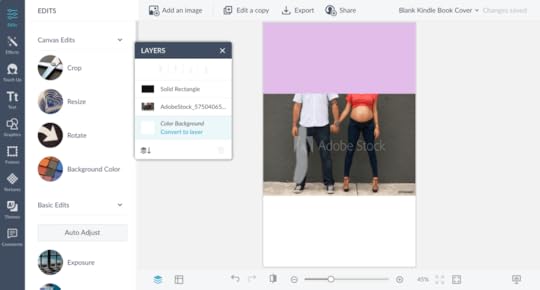
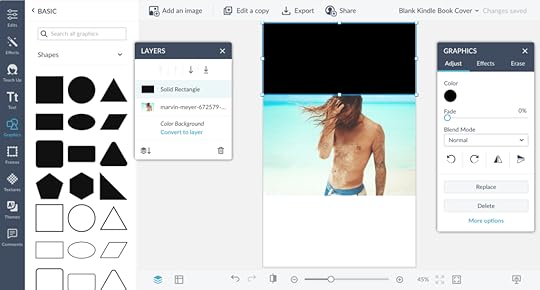
TIP: You can change the color of your rectangle by clicking the color circle in the graphics box. You can also add special effects using EFFECTS or TEXTURES. Try layering images, adding textures to images and fonts, fading one image over another. The possibilities are endless, so I recommend taking advantage of the easy-to-understand tutorials Picmonkey and Canva offer. Experiment. It is incredibly user friendly.
Once you have the design elements appropriately placed, you can move on to adding a title and author name.
Unless you want to turn your photo into artwork like I did for my romantic comedy, A Not So Immaculate Conception. If so, I’ll show you how.
TRANSFORMING YOUR STOCK PHOTO INTO ARTWORK
Select the photo you will use, then choose: EFFECTS> WARHOL. Don’t panic! It will look crazy…but we will change that.

Click the colored circles and make them all the SAME color, whichever color you will paint with first. When you are ready for the next color, change all the circles to match again.
Click the paintbrush icon in the upper righthand corner next to the word WARHOL. When the Erase & Brush box appears, click the paintbrush icon again and voila, your picture is normal.
But before you start painting, change the settings. Set your brush to the size you need for the area you are painting. Set Fade to 0% and set Strength and Hardness to 100%.
 See the red shoe? That's it! The start of great things.
Now, you are ready to paint. And no worries, if you mess up or color outside the lines, just click the eraser icon and fix your mistakes.
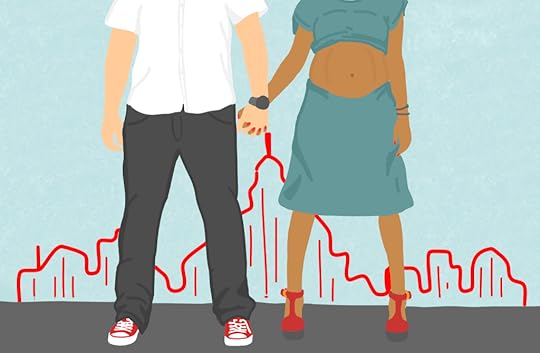 The finished product! Woohoo!
With your photo transformed into the next Picasso masterpiece, it’s time to move on to the next step, adding your title and author name: TEXT> ADD FONT.
Play around with your title design, choose different fonts, add font effects and overlays. Highlight different words and change the color, bold, italicize. Move and angle the words wherever you like. Do whatever makes your ebook cover rock!
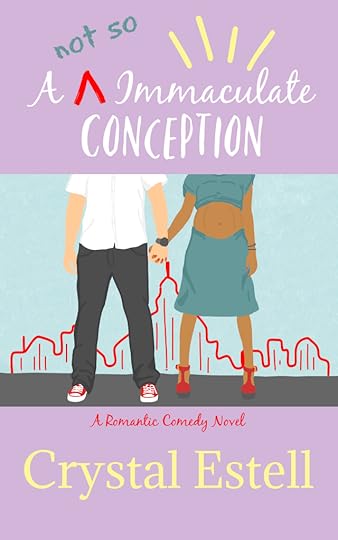
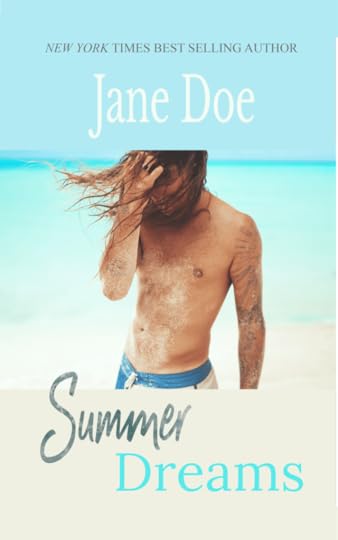
With your front cover complete, creating your print book will be a breeze!
PRINT BOOK COVER
First, you need to download the kindle e-book cover template here. You will need to enter the specifics of your book to obtain your template: choose 6″x9″ and enter # of pages.
FRONT COVER
Go into Picmonkey and click: CREATE> COMPUTER> [choose your kindle book template]
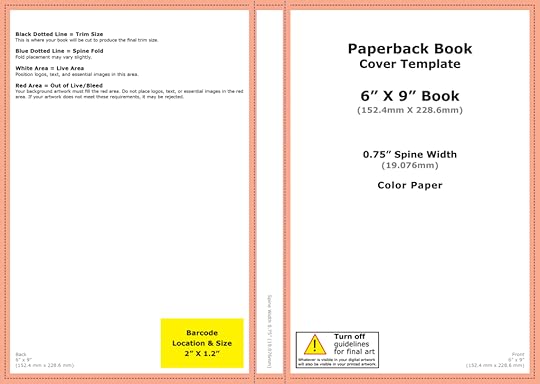
The key to getting this done quickly and without a headache is working in sections. I start with the front cover. And guess what?
If you’ve already created your ebook cover add it now: GRAPHICS> ADD YOUR OWN> [choose your ebook cover]. Now, stretch it to fit. Drag it to fit the top, bottom, and outside edge [none of the template should be visible on those edges] and just to the dotted line on the inside edge [spine side]. If you have not created your ebook cover, then use those instructions to complete the front cover of your print book now.
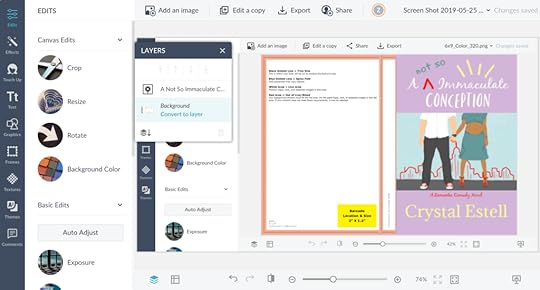
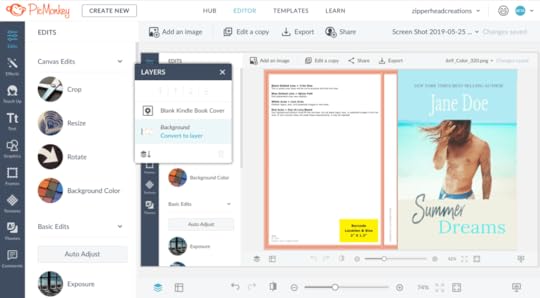
BACK COVER
The back cover requires space for the barcode. To make sure you leave a space for this in the correct place, create a rectangle that matches the size now: GRAPHICS> BASIC> [choose the rectangle]
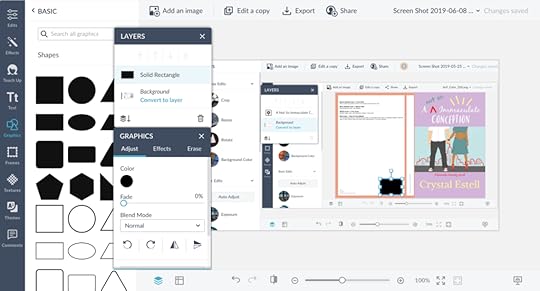
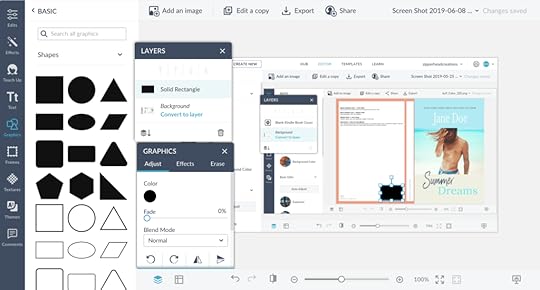
Now, make the background for your back cover: GRAPHICS> BASIC> [choose rectangle]> [flip it using the rotating icon in the box view]. Stretch it the same way you did the front cover. At this point, the only visible template section should be the spine. Wait?! The barcode box is gone. How do I find it?
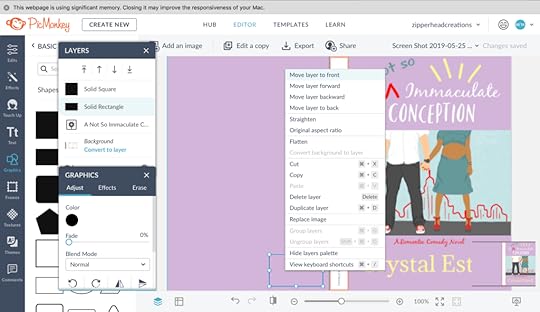
In the Layers box, choose the rectangle that represents your barcode> right-click> Move to Front. *Note: Once it appears, do not touch it. This will be where the barcode goes permanently.
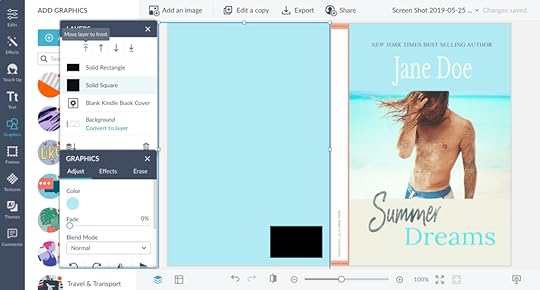
Time to get creative. You can add more rectangles or a paper graphic to place your blurb on, or even add more photos. Do whatever you feel best fits your design.
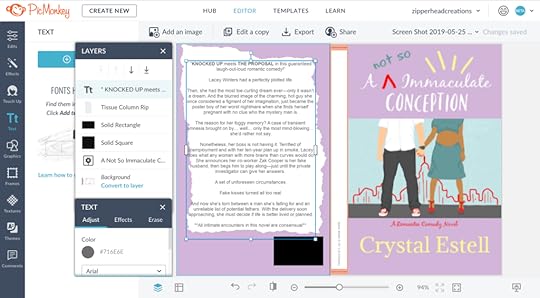
To add the blurb: TEXT> ADD TEXT> [type your blurb or copy and paste it]> [choose the font and font size]. Then drag your text box to fit the area you would like it to stay.
TIP: Anything past the outside dotted lines of the template may be cut off in the book design. So be careful with your blurb placement.
SPINE COVER
Create a rectangle box that fits the spine: GRAPHICS> BASIC> [choose rectangle]. Flip and stretch it to fit the center of the template.
Note: I would leave this a different color for now, for better visibility.
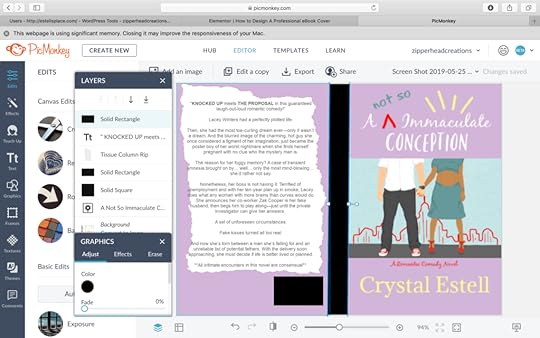
If you want your spine to match your front photo, you can stretch your front cover until it meets the dotted edge that begins the back cover. If you do this, make sure you stretch both sides [even though you won’t see the part that extends the outside edge] so your title stays centered.
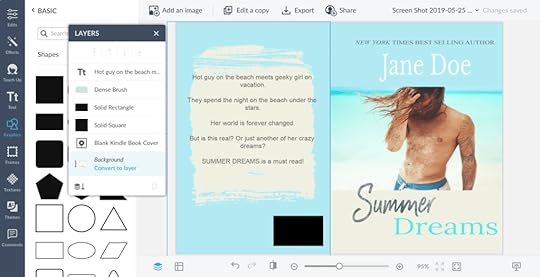
How you place your title and author name on the spine will be decided by how you created your front cover. If you made it from scratch on the print template, then:
In the Layers box, choose the text box used for the title or author name [work with one box at a time] > right-click> duplicate.Grab the top circle on the text box you selected and rotate it until it is at 90°. Change the font size and position so that it fits within the spine, making sure to leave some room so it does not bleed over the bend. Repeat until the title and author name are aligned where you like them.
If you created your front cover by uploading your ebook cover and stretching it to fit, then:
Click TEXT> ADD TEXT> [choose the same font used for your title and author name, using more than one text box as needed].
Once you have them recreated, rotate each one until it is at 90°. Change the font size and position so that it fits within the spine, making sure to leave some room so it does not bleed over the bend. Repeat until the title and author name are aligned where you like them.
After you have the title and author name in the correct place, change the color of the rectangle on the spine cover to match the rest of your book or to the color you desire.
Note: Ignore this if you stretched your front cover over the spine.
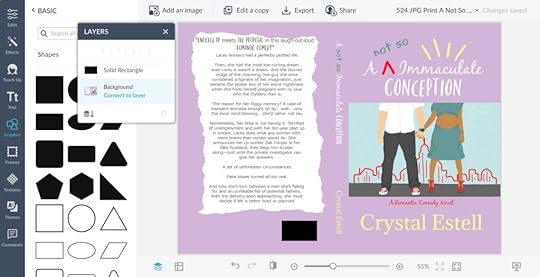
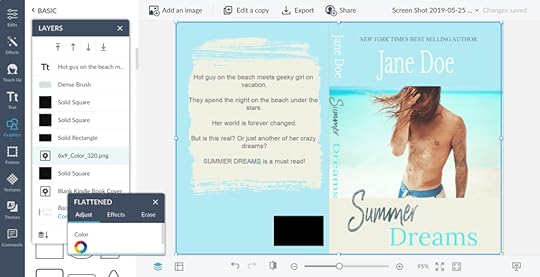
Yay! Your print book cover is complete…well…almost. Kindle and Barnes & Nobles require a PDF format. Picmonkey only allows you to save to this format with a very expensive upgrade, beyond the affordable and recommended subscription. And just to throw a monkey wrench in your plan, Barnes & Nobles wants the cover a tad bit larger than the one you created.
But no worries! I’ve figured out a simple solution.
CONVERT THE PRINT COVER TO A PDF
Kindle Cover PDF:
Open CANVA> CREATE A DESIGN> CUSTOM DIMENSION> 228.6mm x 152.4mmBarnes & Noble Cover PDF:
Open CANVA> CREATE A DESIGN> CUSTOM DIMENSION> 12.8 in x 9.25in
Click UPLOAD> UPLOAD IMAGE> [choose your print book cover]. It will not fit at first, but that’s okay. We will fix it.
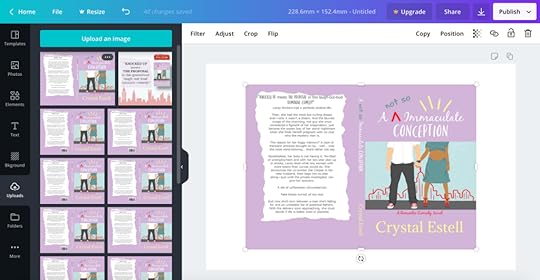
Stretch the picture to fit, one side at a time and just to the edge. Then stretch the top and bottom to fit.
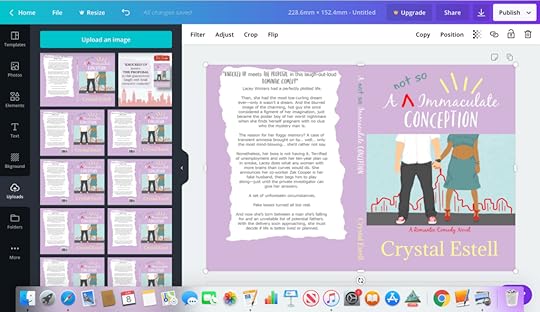
Time to download the PDF version: Click the Underlined Down Arrow in the top right corner next to Publish. Then click PDF Print> Download. Note: Do this for both versions, the Kindle and Barnes & Nobles.
Believe it or not, you’re done! Upload your new covers along with your awesome manuscript and prepare to sell books. Want to share your own tips and tricks? Or your finished product? Please share!
Your friend and cohort!
Share on facebook
Share on twitter
#mc_embed_signup{background:#fff; clear:left; font:14px Helvetica,Arial,sans-serif; width:100%;}
/* Add your own Mailchimp form style overrides in your site stylesheet or in this style block.
We recommend moving this block and the preceding CSS link to the HEAD of your HTML file. */
Join Typewriters, Toolboxes, and Bandaids Monthly Newsletter for FREE MONTHLY GIVEAWAYS
A NOT SO IMMACULATE CONCEPTION RELEASE DAY COUNTDOWN
Days Hours Minutes
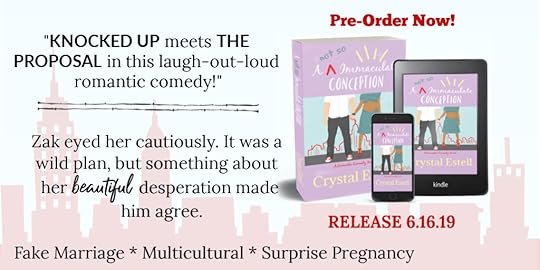
Want to read the first FIVE chapters FREE? Click here!
May 31, 2019
Sex Amnesia: The REAL Condition That Inspired My Book

Anyone who’s read the blurb for my new book, A Not So Immaculate Conception, knows about Lacey Winters’ most toe-curling dream ever—the one that wasn’t a dream but a case of sex amnesia. But are you aware that sex-amnesia (or more officially, transient global amnesia caused by sex) is a REAL condition?
Let me stop the naysayers here. I am not referring to cases of nonconsensual sex or trauma that causes a person to lose, or suppress memories. As a strong supporter of the #metoo movement, and for personal reasons I’d rather not discuss, I would NEVER write about such a sensitive topic. So with that said, I guarantee dubious-free content in my book and that all intimacy is 100% consensual. I make this fact very clear.
Now, back to the inspiration. As a registered nurse, I’ve encountered tons of medical conditions, disorders, illnesses, syndromes, etc. You name it, and after 18 years of nursing, chances are I’ve either seen it or heard about it—sex amnesia included.
WHAT TRIGGERED THE BOOK IDEA?
Initially, I had this vague plot concept floating around in my head [along with the other crazy stuff] about a woman getting pregnant and having to go on a hilarious search for the unknown father. I knew I wanted her to be Type A, an avid life-planner, and have this situation be something totally outside of her norm. I just didn’t know how to construct it without delving into dubious content.
Then, it happened. The inspiration. I encountered a woman suffering from missing memory, not a complete loss, but foggy recollections after having intercourse with her spouse. The light bulb went off! A night of mind-blowing sex could be the trigger for Lacey’s blurred memories. But the stakes needed to be higher than just finding the father. So, I threatened her career and forced her into a fake marriage to save it, added an unreliable private investigator, and sent her on a wild, and hilarious journey to find her baby’s daddy.
Thus, a story was born.
WAIT-WHAT IS SEX AMNESIA AND WHAT CAUSES IT?
Transient global amnesia (TGA) is a temporary loss of memory, or a fragmenting of memory, that occurs right after a strenuous activity—such as sex. What makes this happen? No one knows for sure, but there is a theory.
Whenever we strain, such as during an orgasm or a bowel movement or lifting weights, we increase the pressure inside our abdomens. This interferes with the blood flow into the brain, decreasing the oxygen supply to certain parts. One of those parts is the hippocampus, the tape-recorder of the brain, the section that records short-term memory. Lack of blood flow to this area keeps new memories from being recorded and blurs recent ones.
The good news is it is rare, occurring in only 3-5 out of 100,000 people, and it generally happens only once.
For Lacey Winters’… once is all it took.
The even better news is that most people recover quickly, gaining back their memory. But unfortunately, not the recollection of the event that triggered it. And sex is by far the most frequent cause, still.
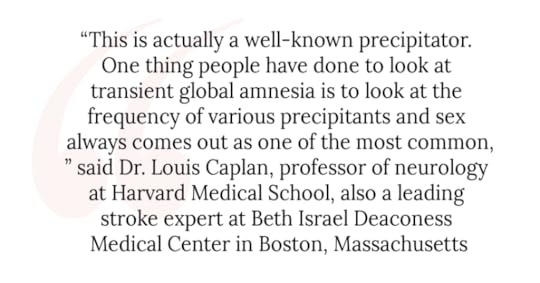
Now, some factors can predispose a patient to a case of TGA. People who have a history of migraine headaches, especially coital headaches [head pain after orgasms] are most at risk. It makes sense, considering one of the possible causes of migraines is blood flow changes in the brain.
No doubt, experiencing transient global amnesia is scary, for both the patient and their spouse or family. But as terrifying as it is, it does not lead to long-term brain damage. For some, the event is extremely brief, minutes even.
And what about Lacey Winters? What happens to her? Don’t worry, she gets her happy ending.
You can read about it here!
Share on facebook
Share on twitter
RESOURCES:
https://www.livescience.com/16488-sex-mind-blowing-amnesia.html
http://www.cnn.com/2009/HEALTH/11/04/transient.global.amnesia/index.html
https://jnnp.bmj.com/content/63/2/260
https://www.hopkinsmedicine.org/health/conditions-and-diseases/headache/how-a-migraine-happens
#mc_embed_signup{background:#fff; clear:left; font:14px Helvetica,Arial,sans-serif; width:100%;}
/* Add your own Mailchimp form style overrides in your site stylesheet or in this style block.
We recommend moving this block and the preceding CSS link to the HEAD of your HTML file. */
Join Typewriters, Toolboxes, and Bandaids Monthly Newsletter for FREE MONTHLY GIVEAWAYS
First FIVE Chapters of A Not So Immaculate Conception FREE!!! Click Here!
August 28, 2018
13 Things No One Tells You About Writing

Do you remember the first time that award-winning book idea struck? The exact second the plot of a lifetime dropped itself into your undeserving brain?
I do.
It was right after I finished reading… [buries face]… the 50 Shades of Grey Trilogy. Motivated and shocked by the small fortune E. L. James had amassed from the series, I rushed straight to my computer. Armed with an idea and a delusion, I started my journey to authorship. Eight months later, I had created a masterpiece [remember the delusion? yeah, that was it]. It didn’t take long for me to realize my book was worthy of nothing more than the delete button. Any why? Where had I gone wrong? I took a step back and reevaluated my purpose for writing.
Since childhood, I’d dreamed of becoming an author, even received a typewriter for my birthday one year. It was cheap and had plastic keys but kept up with seventh-grade fingers. To my disappointment, my poverty-stricken parents returned it for a refund six-months later. Their decision crushed me but didn’t destroy my love for writing, I knew writing would never provide me a dependable income.
That’s when it hit me. It didn’t have to. I had a full-time job. My book could be for me, an accomplishment I could be proud of whether it brought me one dollar or five-thousand dollars. Because real writing is never about the money. It’s about the passion, the art of creating. Writing is about sharing the story floating around in my head, a story that would only exist if I told it. And so I did, with my first debut novel.
But looking back… I wished someone had told me the things people never tell you about writing.
1. IT WON’T MAKE YOU RICH
Yes, some writers strike gold, becoming overnight millionaires, the same way one person in forty-five million wins the lottery. It’s possible but rare. So, remove those dollar signs from your eyes and fill them with question marks. Why write? For most, the answer is because they can’t rest until they tell the story.
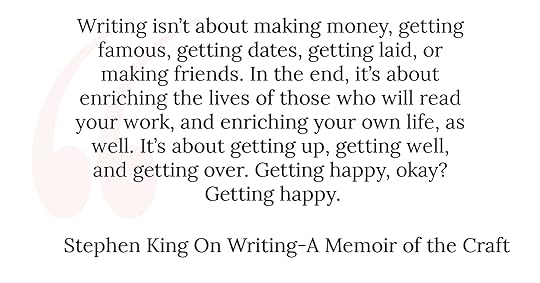
2. BYE-BYE CLEAN HOUSE
Before I had the crazy notion to write a book, I kept my house in tip-top shape. Everything I owned, even the miscellaneous junk, stayed tucked into its assigned place. The floors shined, the windows sparkled, and the mirrors gleamed. And we expected company, I turned into a broom-wielding maniac on a mission. After writing? I’d just settle for clean underwear.
3. WRITING IS EASY
I’d always read about writing being hard, demanding, ciphering. Goodbye free time. But no one ever said, it’s easy. And it is. It takes no time to write a novel—the first draft, anyway. Unfortunately, the first draft is a piece of junk that will never sell. I learned that lesson the hard way.
4. EDITING IS ENDLESS
I could look at my book right now and find something I could change, a word or sentence to tweak. But then I stop myself and remember, I’m telling a story, not perfecting the English language.
5. EVERYTHING BECOMES INSPIRATION
I’m sure any writer reading this will cosign the notion story ideas happen whenever and wherever. The other day I walked around my block and saw someone take out their trash, the same as I had hundreds of times before. But on this occasion, it triggered a hilarious, suburb-based book idea. And before I made it back to my yard, I had already typed half of the plot points in my Notes app.
6. IT REQUIRES RESEARCH
If you were the person in high school who hated research papers, then reconsider becoming a writer—or at least a quality writer. Because when you’re writing your character into jobs and illnesses and places you know nothing about, it requires research for accuracy. You might think no one will notice, but I promise you, they will. As a registered nurse, it’s hard for me to watch movies or TV shows that perform medical procedures… like CPR [coughs]… terribly.
7. EVEN INTROVERTS NEED FRIENDS

It’s true. Break out of your shell and speak to people, pick their brains. If writing were just writing, maybe you could survive locked in a room with your computer all day. But it’s not. Questions need asking, critiques need requesting, and so much more before you publish. Feedback is valuable. And not to forget, you need allies to market your book!
8. IT’S A BUSINESS
As much as we want to believe it’s all about the creativity, it’s not. Don’t believe me? Check out Manuscript Wishlist and Publisher’s Marketplace for examples. They often have specific requests. And remember when vampires and zombies saturated the market… or still do?… Many agents made it clear not to send them any queries that mentioned either of those supernatural beings. Oh, you’re self-publishing? Well, in that case, you can write whatever you want—but you still have to sell it. So, write something someone will buy.
9. GROW THICK SKIN
Nora Roberts is an amazing writer—and my absolute favorite. She’s written over 200 romance novels and has an uncanny ability to draw you into her stories from the first line. Did I mention her net worth is in the millions? Yet, she has critics, harsh ones. No matter how great you are or how much effort you exhaust in people pleasing tactics, others will still spread their discontentment with you. To succeed, you can’t take it personally.
10. YOU’LL NEED A GOOD SENSE OF TIME
I know you’ve read at least one book where the author lost track of the timeline, and it tossed you out of the story. Those moments when the character is in shorts and a t-shirt and then two days later wraps a thick scarf around his neck. Carefully track time to keep readers invested in your story.
11. YOU’LL EAT TOO LITTLE OR TOO MUCH
When you’re in the throes of creativity, you may forget to eat… or you may snack out of compulsion. Either is not ideal. So, take the time to eat healthy, well-balanced meals. Your brain will thank you.
12. CARPEL TUNNEL SUCKS
I’ve had a carpal tunnel release on my right hand and need the left one fixed, as well. Part of my problem is my Ehler’s Danlos Syndrome along with its friend arthritis. But typing away half the day without paying attention to the proper wrist position and without using the proper ergonomic tools irritates the nerves even more. So, be aware and use the proper techniques. Take breaks, shake your hands out. Keep your back straight. Your body will thank you later.
And remember, writing is a journey not a marathon. Embrace it. Go where the road leads you and don’t be afraid to venture off on your own every now and again. In the end, it’s about sharing the story inside you, giving back to the world. A world that is eagerly awaiting your masterpiece.
Your friend and cohort,
Crystal
Is there something you wished someone had told you about writing before you started? Please feel free to share!
Share on facebook
Share on twitter