Mike Madaio's Blog
February 26, 2026


(Almost) Lost Italian Grapes: Pecorino — Part 1
Note: This is a free preview of my eBook monograph (Almost) Lost Italian Grapes: Pecorino. Medium subscribers have access to the full text by clicking the Part 2 link at the bottom, or non-subscribers can purchase the book for $1.99 on my website.
Though I can’t remember the exact details of where or when I encountered this, my first exposure to the grape Pecorino — no, not the cheese — came in the form of the seemingly perfect origin legend. Presumed extinct, it was rediscovered, the tale went, growing wild in a ravine in rural, mountainous central Italy. Daydreaming, I pictured an aged, grizzled sheep farmer, ponderously peering down a perilous incline of pure granite, wondering about a single vine that somehow forced its way through a minuscule crack in the craggy rock. I dreamt of experiencing the wonder and excitement that followed this discovery, once it became clear that this grape a) was no longer growing anywhere else, and b) made excellent wine.
As such, it was initially disappointing to learn that the true story — Pecorino was purposely revived by southern Marche vintner Guido Cocci Grifoni and friends — was less romantic than what I had either read or concocted in my own head (or perhaps a combination of both). Once Grifoni’s story unfurled itself, however, it became obvious that this tale, one of dogged determination and unwavering belief that the Ascoli Piceno comune could indeed produce a world class white wine, stands firmly on its own in the pantheon of wine history. (Abruzzo, it should be noted, will also have its say before this chapter is done.)
Today, Pecorino is one of the hottest commodities in Italian wine, producing at its best a full-bodied, complex and serious wine that’s versatile at the table, worthy of the cellar, and still a comparative value.
The beauty of Pecorino is its ability to develop rich, honeyed fruit flavors without sacrificing its backbone of herbal notes and bright acidity. In the right hands, Pecorino can even develop tropical flavors — pineapple, mango, maybe banana — without ever becoming flabby, something that can’t often be said about other grapes of similar ripeness levels. The result, then, is a lush, opulent wine that manages to finish light on its feet.
It’s a perfect example of the world-class quality of Italian whites that sit behind the mass-produced Pinot Grigio and other beachfront fare that perhaps closes off wine connoisseurs to the potential that still lies under the radar here along the Adriatic coast.
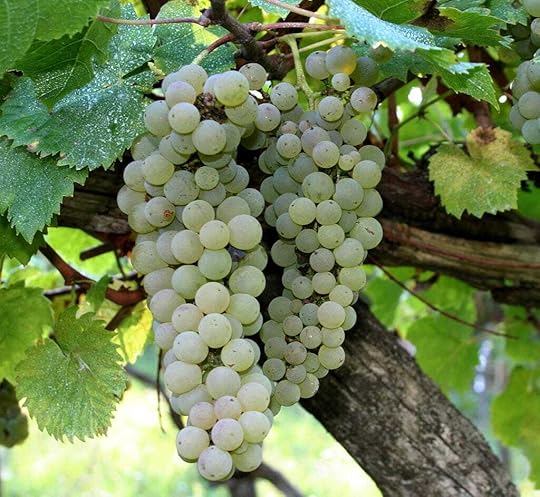 Pecorino grapes in Arquata del Tronto (photo by interminatispazi, via Wikimedia Commons)
Known as a trailblazer long before he started thinking about Pecorino, in the 1960s Guido Cocci Grifoni established a dedicated wine production facility independent from the family farm, something quite uncommon at the time. He was instrumental in creating the Rosso Piceno DOC in 1968, and also bottled the first wine from this DOC, in 1970. At the time, reds were the strength of the region, with stalwarts Montepulciano and Sangiovese leading the way.
“In the early 1980s, he realized the problems we had with our white grapes,” Marilena Cocci Grifoni said of her father, who passed away in 2010. “Trebbiano mainly, but Malvasia and Passerina as well.”¹ The comune’s most notable white — Falerio dei Colli Ascolani, today simply Falerio — had held DOC status since 1975, but predominantly featured the often over-farmed and thus lackluster Trebbiano Toscano, with much smaller allowed percentages of other regional whites. While the local market for Falerio was reasonably strong, outside this small region it generated little interest.
“He traveled to Vinitaly,” Marilena continued, speaking of the country’s most important wine industry trade fair, “and saw that our white wines could not compete with the rest of Italy. So he understood that he had to find a new grape.” Verdicchio, of course, is the star white of Marche, but it only thrives in the northern part of the region, not in the more southern Ascoli Piceno area (which lies just north of the Abruzzo border), due to climate and terrain differences.
Cocci Grifoni began to research other native white varieties. “He did not have an agronomy degree,” Marilena said. “He didn’t even finish middle school, because his father passed away from cancer when [Guido] was very young. He had to take care of his mother.”
For much of the mid-to-late 20th century, Ascoli Piceno remained underdeveloped. “I would not say the area was poor,” Marilena remembered. “People could feed themselves. But it was very limited, basic. We did not have technology. No central heating, simplistic washing machines and dishwashers.” This continued in the vineyards, which already were riding a wave of progress in more famous wine areas. “There was no research approach for vinification or production. We didn’t have a university close to us, or an experimental research office in the region. Nothing.”²
Because the cooperative wineries, which most growers still worked with, were paying based on quantity (as opposed to quality), this meant farmers were focused on the same, producing huge amounts of swollen, waterlogged grapes that — considering they were mostly Trebbiano Toscano — surely led to bland, forgettable wines.
None of this, however, deterred Guido in his quest to discover the region’s own great white. “My father, he didn’t talk much,” Marilena recalled. “He didn’t know how to communicate, like a lot of southern Marche people, but he was serious and honest, and a strong work ethic was fundamental to his life.”³ Despite his limited schooling, he procured books on local grapes and read them with his wife. He sought out like-minded friends and colleagues in the industry, in particular Teodoro Bugari, a teacher, author, judge and sommelier, the latter “before anyone in our area knew that word,”⁴ as Marilena put it.
Nicknamed “Maestro,” Bugari was an original member of the Associazione Italiana Sommelier (AIS), founding both the AIS Commission for Education — in which he dedicated himself to the professional training of many wine students — and the regional AIS branch for Marche, Abruzzo and Molise. For Bugari, said Marilena, education was his life’s purpose. “He was totally addicted. He worked his entire life, never becoming rich, because for him, to be an educator, to be a teacher, was his mission.”
“When we say maestro,” she continued, “it is different than saying professor in English. Professor is something else. For us, maestro means a person who dedicates his life to educating the new generation. Teodoro Bugari was Maestro.”⁵
End of free preview
Medium subscribers: Read Part 2
Non-subscribers: buy the full eBook on my website ($1.99)
View Bibliography and Notes here.
[image error](Almost) Lost Italian Grapes: Pecorino — Part 1 was originally published in Vintager on Medium, where people are continuing the conversation by highlighting and responding to this story.
March 16, 2025
Subs, Hoagies, and Heroes: The Story Behind America’s Favorite Sandwich
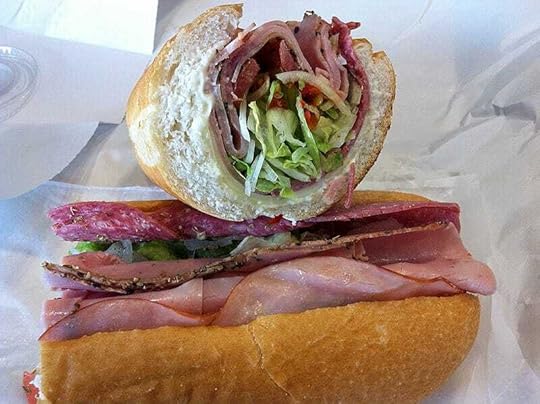 wikicommons
History and food geeks: let’s take a deep dive into the development of the submarine sandwich, which has roots in Italy but was introduced in the late 19th century in the United States.
The submarine is known by many regional names, including blimpie, grinder, hero, hoagie, po’ boy, spuckie, torpedo, wedge and zep, among others. It was developed in the late 1800s by Italian immigrants to the eastern US, especially in cities with large enclaves such as NYC, Philly and New Orleans.
Back in Italy, these future Italian immigrants mostly lived agrarian lifestyles where meals were more formal, thus sandwiches likely played less of a role in their daily lives. When they came to the US en masse in the late 1800s and early 1900s, on the other hand, they worked as laborers, thus requiring portable, hearty and quick meals.
That said, there are a number of Italian sandwiches that may have influenced the development of the Americanized versions, albeit indirectly. I’ll highlight a few before we get to subs.
Pane Cunzato
Literally translating to “seasoned bread,” this Sicilian dish features a rustic bread split open and dressed with olive oil, tomatoes, anchovies, oregano, and cheese (such as caciocavallo).
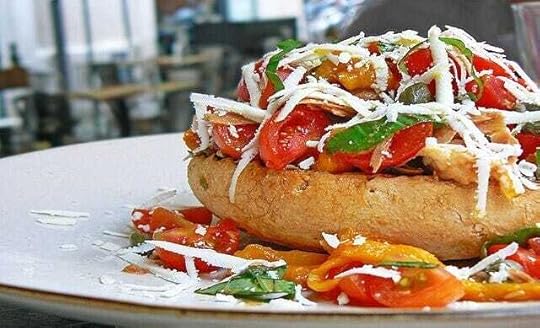 📷 wikicommons
Piadina
A thin, soft flatbread from Emilia-Romagna, this is perhaps closer to a wrap but nonetheless has been eaten in central Italy for centuries as a quick, portable choice, especially among laborers and shepherds.
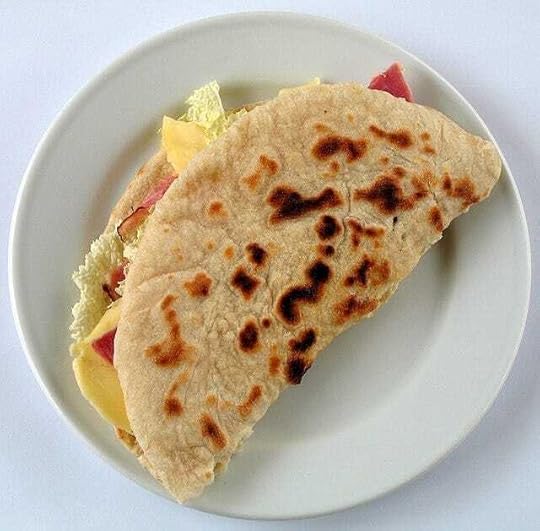 📷 wikicommons
Vastedda / Pane ca meusa
In Palermo street cuisine, this bread is stuffed with fried spleen or panelle (chickpea fritters) and cheese. Interestingly, the vastedda roll is similar to the type of bread used for early subs: soft on the inside and firm on the outside.
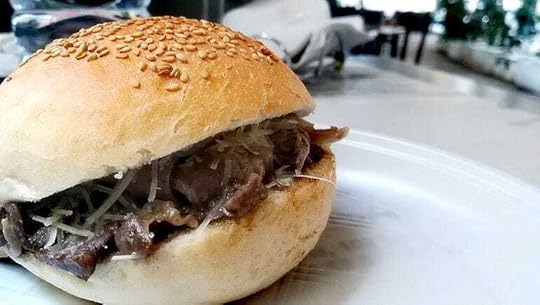 📷 wikicommons
Panino con Porchetta
Perhaps one of the closest relatives to subs, porchetta sandwiches often use crusty bread and a hearty, flavorful filling that can be satisfying as a meal. This is a classic dish with a long history in central Italy.
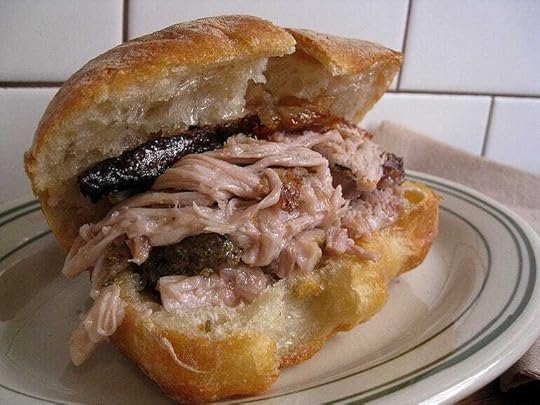 📷 wikicommons
Other Italian sandwiches that may have influenced the development of Italian American sandwiches include: Lampredotto (Florence), Focaccia Ripiena (Liguria), Crostone/tini (Tuscany), Frico di Montasio (FVG), etc. But let’s move on to subs.
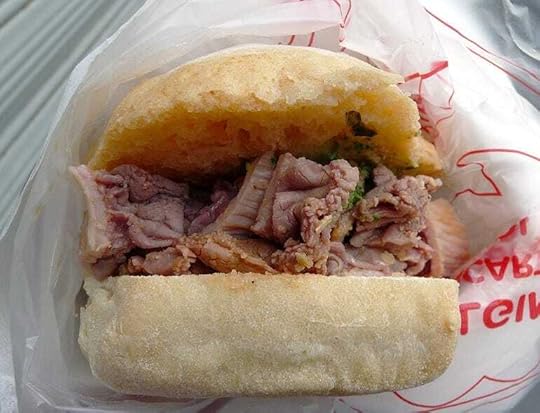 Lampredotto 📷 wikicommons
While it is human nature to try to assign a single origin to every “invention,” it’s improbable that there is one specific entry point for subs. Rather it’s far more likely these sandwiches evolved in parallel across different clusters of Italian immigrants.
That said, the first to successfully sell Italian American sandwiches at scale was almost surely NYC’s Angelo Basso, dubbed “Angelo of the Sandwiches” by the New York Sun. Basso arrived in 1868 and ran a popular deli/grocery, cutting slices from large Italian loaves to make his sandwiches, as opposed to serving sub-like rolls. Basso designed and built the five cent sandwich, wrote the Sun, “broad and deep, that fills hungry men.”
On Basso’s counter, continued the Sun, “there were rows of those big Italian loaves, shaped like a hassock, crusty and golden hued, with specks of the ash still upon them. Then there was a great boned ham, a cheese, gray and musty as to its shell, and several cylinders of the Italian bologna bound about with foil and twine. One spoke the word, off came two generous slabs of the Italian loaf, a smear of butter was larded in between and then a thick slice of ham, of cheese or bologna was slipped in between the two retaining walls of bread like the struts that support a house to be moved. All of this and a smile from Angelo thrown in for five cents.”
Basso’s sandwiches “were known all over New York,” wrote the New York Tribune in 1908. “No one thought in the old days that he had enjoyed himself at Madison Square Garden unless he had eaten several of ‘Basso’s sandwiches.’”
Other notable NYC sandwich shops that helped develop the submarine (now locally known as a hero) include John’s Italian Hero Shop (BK), Sandro’s Delicatessen, Manganaro’s, Di Palo’s Fine Foods and countless other street carts and small shops. Beyond NYC, of course, there were other notable Italian sandwich upstarts.
Around 1900, for example, Giovanni Amato began selling rolls to dock workers & laborers at the waterfront in Portland, ME. Legend says these workers asked him to fill the rolls w/ meats, cheese & vegetables to create a meal, which led to an ‘Italian sandwich’ business that thrives to this day.
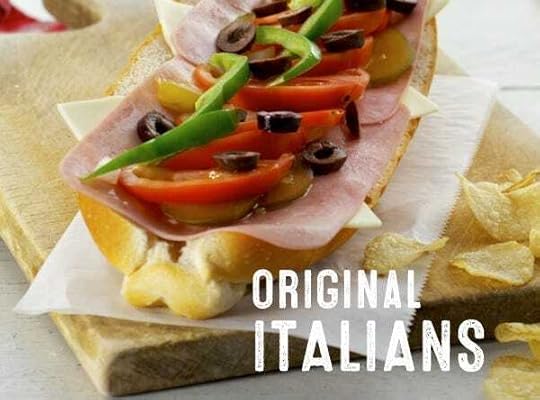 📷 Amato’s website
In 1906, as another example, Salvatore Lupo introduced the muffuletta sandwich at his Central Grocery store in New Orleans, the city a popular destination for Sicilian immigrants. Muffuletta was a common table bread in Sicily, but Lupo appears to have been the first to stuff it with meats, cheeses and the now signature olive salad.
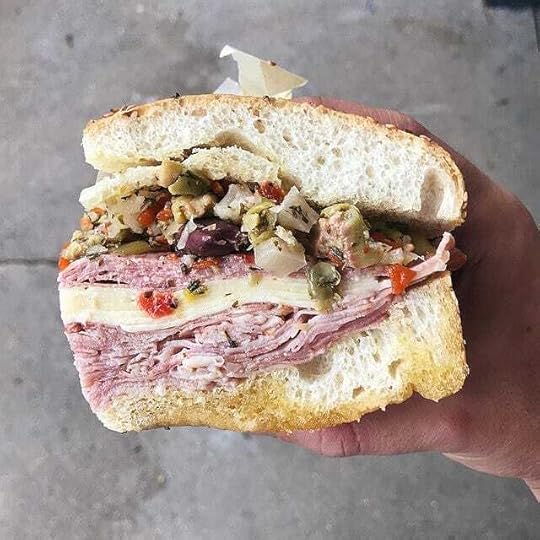 📷 wikicommons
While muffuletta bread wasn’t often used for sandwiches in Sicily, it’s relatively similar to the aforementioned vastedda, which of course is used for several popular sandwiches in Palermo and thus may have helped inspire the American muffuletta.
1920s New Orleans then saw the introduction of the po’ boy, a sub-like sandwich on a long roll. While today po’ boys are often stuffed with seafood, early versions were more commonly filled with deli meats like other Italian-style sandwiches.
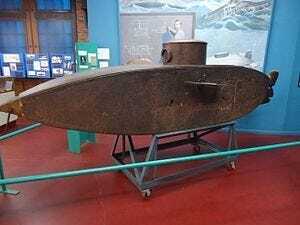 Holland I Sub 📷 wikicommons
Around 1910, Italian immigrant Dominic Conti opened a grocery store in Paterson NJ. According to his granddaughter Angela Zuccaro, he sold sandwiches “made from a recipe he brought with him from Italy” (specifically Campania, near Naples) on a long, crusty roll that was “filled with cold cuts, topped with lettuce, tomatoes, peppers, onions, oil, vinegar, Italian spices, salt, and pepper.” So the bread would not become soggy, Conti buffered the filling on both sides with a layer of cheese.
“My mother often told me about how my grandfather came to name his sandwich the submarine,” said Zuccaro. “She remembered the incident very well, as she was 16 years old at the time. She related that when grandfather went to see the Holland I in 1927, the raised submarine hull that was put on display in Westside Park, he said, ‘It looks like the sandwich I sell at my store.’ From that day on, he called his sandwich the ‘submarine.’ People came from miles around to buy one of my grandfather’s subs.”
A 1931 Paterson newspaper appears to contain the first written usage of ‘submarine sandwich,’ and from there the literal paper trail turns south to Wilmington, DE, in 1936 and Philadelphia in 1937 (the latter before ‘hoagie’ was ever used).
As such, when Groton, CT claims it coined the term near a naval station in WWII, this can be easily disproved. (Also, the term ‘grinder’ seems to be more classically used in that area of New England.)
In conclusion, Italian-style sandwiches that would become known as subs (et al) were most likely developed in parallel in NYC, the mid-Atlantic, New England and even New Orleans, but the name ‘submarine’ almost certainly comes from New Jersey.
If you enjoyed this brief article, I also wrote a book about the history of sandwiches in Philly, which goes much deeper into the stories behind Philly hoagies specifically, as well as cheesesteaks, roast pork and more.
Newspaper quotes via Newspapers.com
[image error]Subs, Hoagies, and Heroes: The Story Behind America’s Favorite Sandwich was originally published in Vintager on Medium, where people are continuing the conversation by highlighting and responding to this story.
February 9, 2025
Is Fettuccine Alfredo Italian or American?
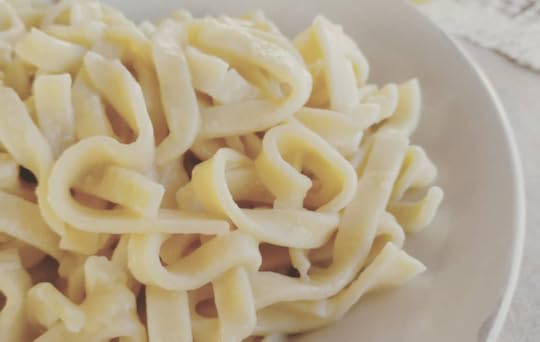
Despite its prevalence (and continued bastardization) in the United States, Fettuccine Alfredo “is actually the most ancient pasta dish in…
January 28, 2025
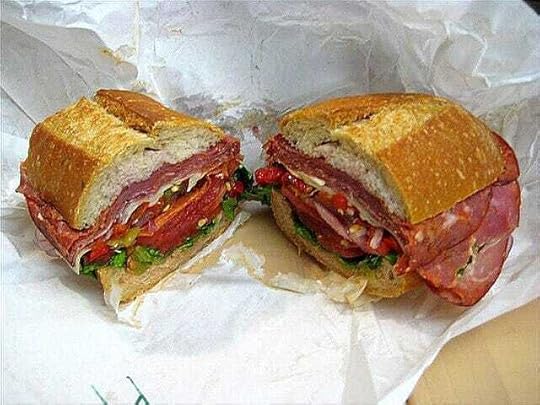
January 30, 2024
Did Medieval People Really Drink Wine or Beer Instead of Water?
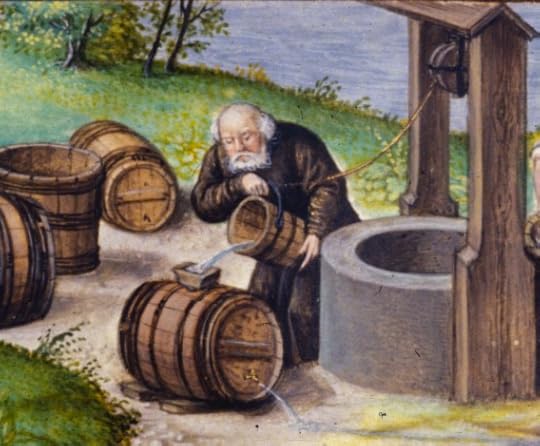
While this concept is so prevalent today that most people don’t even think to question it, the notion that medieval humans predominantly…
September 22, 2023
On Châteauneuf-du-Pape bottles, what does the embossed crest tell us about the wine?
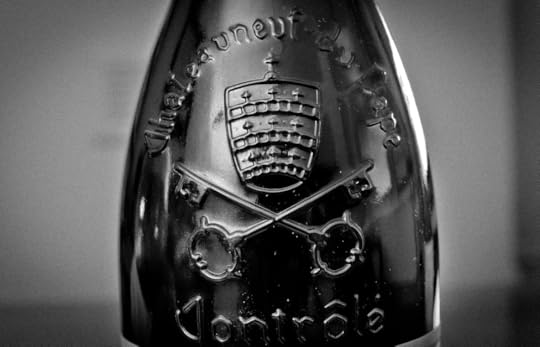
Apparently, the type of embossed crest on these wine bottle can say more than it initially might seem.
August 16, 2023
Mysterious Origins of the Italian Wine Formerly Known as Tocai
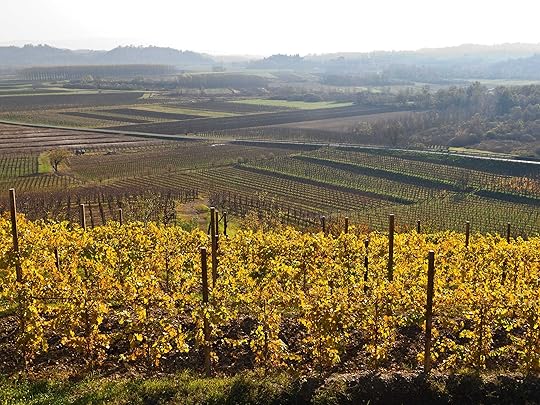
DNA researchers have found connections to a lost French grape, but it is far more complicated than that.
July 27, 2023
What’s the deal with WHITE Port?
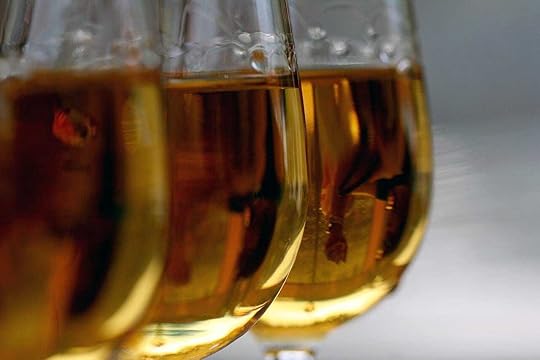
About the different types of White Port, which can be surprisingly diverse and complex.