David Booram's Blog
October 8, 2020
Where Do You Pin Your Hopes Right Now?
 “I pin my hopes to quiet processes and small circles in which vital and transforming events take place.” Rufus Jones (1863-1948)Hope is an essential, yet tenuous prod in life. We need hope to keep going, to continue to fight the good fight. Yet hope is not something we can talk ourselves into and it’s especially difficult to come by these days. No matter what the issue, whether the pandemic, the upcoming election, systemic racial injustice, white supremacy, or the vicious political divide in our nation, things don’t seem to be getting better, but getting worse. So, let me ask you a question. Where do you pin your hopes right now?The quote at the beginning of this post has long been one of my favorites. It’s so graphic and elegant in the way it depicts pinning our hopes to something we’ve come to trust. I’ve often shared it as a way to explain what possessed me, after 25 years of working in big, complex organizations, to turn toward the quiet work of spiritual direction. Sitting with individuals, helping them attune to God’s loving presence, and then watching them be transformed has awakened hope and deep joy. Interestingly, Quaker Rufus Jones wrote these words in a letter to a friend during an equally tumultuous time. It was shortly after the end of the First World War and the Second World War was looming. Jones was tasked with leading an international effort to influence the world toward a path of peace. Though he gave excellent leadership to this global endeavor, he found hope in a different place: in the “quiet processes and small circles in which vital and transforming events take place.”As I ponder his words today and the context in which they were written, I wonder if Jones understood something about human nature and how fundamental change happens in societies. He named two specific domains where the kind of vital and transforming events take place that have potential to genuinely change people and societies: quiet processes and small circles.Quiet ProcessesWhat are quiet processes, we might wonder? When I think of this expression, it brings to mind my own times of prayerful reflection and examination. Times when I sat alone, or with David, or a good friend and quietly processed something that was difficult for me to wrap my mind around. Times of wrestling, when I knew something wasn’t well within me, that I needed to change, and only the Spirit of God could do the changing.The Psalmist captured the idea of quiet process in this prayer:Search me, God, and know my heart; test me and know my anxious thoughts. See if there is any offensive way in me, and lead me in the way everlasting.(Psalm 139: 23-24)I’m reminded of such a time, a time of anxious wrestling, which happened a few years ago. I was navigating a difficult professional relationship and lacked clarity in terms of what to do. So, I asked my friend and fellow spiritual director, Bev, if we could talk. As Bev listened quietly, she finally made the observation, “It sounds like you’re dissatisfied.” At first, the word dissatisfied didn’t sit well with me. I corrected her and said, “Maybe disappointed.” She cocked her head and asked, “What’s the difference?” As I considered her question, I realized that I didn’t like the term “dissatisfied” because it put the onus on me to do something about the situation. This quiet process helped me see what needed to happen and the responsibility I needed to take.It’s through examining our lives that we’re able to make corrections and align ourselves more fully with Jesus’s way of life. Yet examining requires quiet moments of process. In silent reflection we’re able to consider our lives thoughtfully and thoroughly, coming to terms with where we’re missing the mark, where we need to change. Until we allow God’s Spirit to search us and expose the motives that drive us, we won’t be open to the significant shift that transformation asks of us. Each of us must do our work. Individually.Small CirclesJones further pinned his hopes on the transformative nature of small circles. This image is a bit more straight-forward. In our mind’s eye we might picture a handful of people circling their chairs, listening to one another, caring, challenging, and ultimately affecting each other for good. These relationships make us a better version of ourselves. They help us mature, to see more clearly, to cultivate a winsome and authentic faith.It’s important to note that for these small circles to be transformative, they must be composed of a certain kind of people. In my recent reading and thinking about neuroscience and secure attachment, I’ve read many of the works of E. James Wilder. Wilder writes at length about the transforming impact of being with others who have a “better brain.” What he’s suggesting is that something happens in us, in our literal brains, that heals and matures us when we are with people with healthy brains, who think with God, whose relational circuits for love are firing on all cylinders.Here’s an example of such a circle. Months ago I listened to the On Being podcast with Krista Tippett as she interviewed former white nationalist Derek Black (ironic last name) about the college friendships that changed him. During his time at New College Florida, Black was invited (repeatedly) by fellow student and Orthodox Jew Matthew Stevenson to attend his Shabbat dinner each week. Much to the consternation of the other students who attended, Black finally came. This began a small circle of friendships that led to many long conversations, which ultimately led Derek Black to denounce his generational KKK-loving, white-nationalist upbringing.What Rufus Jones and many of us know is that we can’t change or mature or grow apart from being in healthy relationships with others. But not just any others. Consider the kind of people you are “circled” with. Do they have better brains? Do you experience them as people motivated by the love? Are they mature and do their words and actions resemble Jesus? “For where two or three gather in my name,” Jesus said, “there I AM in their midst” (Matthew 18:20).Hope TodaySo, where do you pin your hopes right now?In the upcoming presidential election, in the appointing of a new Supreme Court Justice, in the growing momentum to confront systemic racial injustice, in a vaccine for Covid-19? There’s a lot of things we’re hoping for right now and many of them have the potential to bring about change. In fact, better government, both local and national, as well as citizen-led movements of peaceful protest are essential and necessary in order for people and nations to awaken and thrive. But will the change they bring be enough? Will these events be sufficiently vital and transforming in order to heal our souls and the soul of our nation?I confess that I’m partial to Rufus Jones’s vision today. I pin my hopes on quiet processes and small circles because I’ve come to trust them as places where genuine and enduring healing happens. I trust the change that is possible when you and I humble ourselves before God and allow the Spirit to examine our hearts, help us repent, and heal us of our sins of selfishness, indifference, greed, and the lust for power. Societal change isn’t possible unless a significant portion of its citizens become spiritually, relationally, and emotionally mature through doing our own inner work. I also know that doing my own work isn’t enough. I need others to help me.I trust the change that is only possible when we come together in small, diverse circles of people, some with better brains, wrestling together with what it means to live out the gospel of Jesus today. Admittedly, there is no small shortage of these kinds of circles. So, what is keeping us from fostering them? Instead of waiting for an opportunity to come to us, why not instigate a quiet revolution by forming a small circle of trust of our own?If Rufus Jones were living today, would he pin his hopes on the same things he did pre-WWII? I think he would because I believe that quiet processes and small circles continue to be proven places where critical, life-giving transformation happens. And when these quiet processes and small circles begin to multiply, generating other quiet processes and small circles, before long we will see ourselves and our culture change. Yes, it’s slow work, and not nearly as flashy or impressive as big national campaigns. But over time, this kind of revolution brings with it enduring conversion and a place where hope can root and flourish.


August 20, 2020
"Beauty is Warfare"
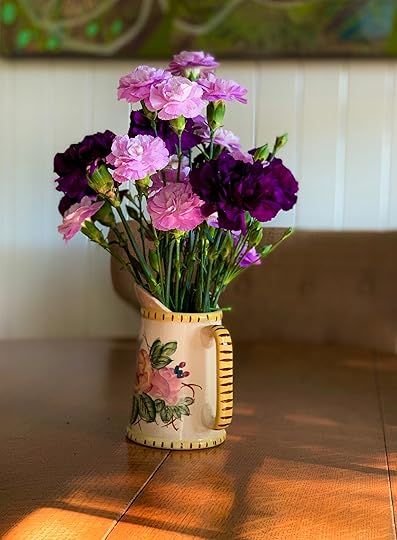 “Beauty is warfare,” my friend said on her Marco Polo message. “What was that?” I thought to myself? It sure seemed like an unlikely combination of words. I learned later that Dan Allender is the originator. Not surprising--it sounds like something Dan would say. As much as I don’t like the “warfare” part, there’s something startling and true in its message.What kind of enemy does beauty confront, do you think? I think it wages war against the enemy of hopelessness, a pernicious adversary who worms its way into us, beating us down by convincing us that there’s nothing good—or beautiful—left in the world to fight for.Isn’t that what you think these days when you watch the news? So many overwhelming problems that are not getting better but getting worse. Isn’t that what you observe when you scroll through your Face Book feed? So much ugliness, hatred, selfishness, and meanness heaped upon you, the unsuspecting bystander.So is beauty some sappy veneer we slap on the top of all the awful, discouraging, and truly ugly human exhibitions we’re witnessing today? Don’t go there so quickly. Think about it.What happens when you notice beauty? What happens when you name it to yourself, to a friend? What happens when you create beauty and savor beauty and celebrate it? Doesn’t it remind you that there’s a lot in life that is worth fighting for— “fighting” in the most loving, non-violent sense of the word?Yes, beauty has that affect on me. Over our July sabbatical, I took time to create beauty. I love to imagine and design peaceful, tranquil, inviting spaces for myself, my family, and those who come to Fall Creek Abbey for retreats. So, with an enormous amount of help from Dave Booram, I redecorated and rearranged the living room and created new ambiance on the front porch. The effect? I feel hopeful.Beauty lifts my spirits and nourishes my heart. That’s why I love nature and treasure walks in beautiful places, just to soak in the natural beauty around me. That’s why I love color and gorgeous food and exquisite visual art. I don’t think beauty is superfluous. It, as Dostoevsky put it, saves us! It saves us from feeling hopeless.What if we started a counterattack on all the ugliness and hatred that is waging war on our souls by lifting-up the beautiful! I’d like to invite you to consider noticing, naming, creating, and celebrating the beauty in your life. A beautiful poem, a scripture, a picture. A beautiful landscape or setting. A beautiful act of human kindness or a story that embodies beauty. And how about including #beautyiswarfare each time you post?If you’re game, I am! I’ll start with the photograph below, which David sent me while I was at the grocery store. I’d bought and arranged some flowers the other day in one of my favorite small pitchers. He noticed it and the light coming in the window behind it and sent me the picture with the text: Beauty is warfare! Indeed it is! Tag—you’re it!
August 8, 2020
Treading Water
 Have you ever tried to tread water? I learned how during Senior Life Saving class in high school. I remember how difficult it was to remain upright as I sculled with my hands and frog-kicked my legs. The odd thing about it was the fact that, though I was moving, I wasn’t going anywhere. Doesn’t it seem like we’re treading water right now? It’s like our boat’s been capsized, and we’re bobbing in a raucous sea of unpredictability, impermanence, and upheaval. The waves come, one after another, and there’s no land in sight. No certain rescue on its way.We’re treading water in the sense that it’s difficult to plan for life. We don’t know if we can take a vacation or go to our family reunion or see our grandma in her nursing home. We don’t know what variation of school our kids will be offered and how we will need to be involved. For David and me, we don’t know if we’ll be able to offer our spiritual direction training in person or host retreatants. It’s hard to not be able to plan!Because we can’t plan, it’s also hard to look forward. The land is too far off. Returning to “normal” is not going to happen for some time. Treading water is hard when the “normal” we look forward to seems so uncertain and such a long way off. Not being able to look forward to experiences that bring us joy is depressing and draining.It’s also hard right now to make progress, at least the kind of progress we’re used to making. So much of life seems to be at a stand-still. Or, when we try to make progress it takes longer and way more energy than normal. Most of us aren’t used to marking time, staying home, having our wings clipped, needing to be content with what is, rather than what could be. Everything about this experience plays to my weaknesses. I falter in liminal spaces, unable to bring closure to my plans and desires—to my creative energies. My strength is to organize life, get things done, and be helpful to others. Not being able to do that in the ways I’m used to feels stifling to my most native way of being in the world.This is hard, friends! It’s hard for all of us. It’s not just your imagination or mine.As I return to my analogy of treading water, I think about what I learned of this life-saving skill. It’s not something I can do forever, but it’s something I can do for a time. What it does is help me keep my head above water and enables me to see others who might be drowning and need support.So, I’ve been paying attention to the ways God is meeting me in this “treading water” moment in history, and here’s what I’ve noticed: Treading water helps me re-center during this destabilizing time. Like a vertical plumb line set upon the horizon of a tilted and undulating sea, I am forced to find my bearings, to re-center myself on the North Star, and align my life with who God created me to be and what it means to be a follower of Jesus. I’ve been asking myself questions like, “Who am I and what am I to be about?” “What is mine to do, and what isn’t?” “What am I for and what am I against?”Treading water teaches me patience as I wait for the storms to pass. One of the temptations when capsized on the open sea is to expend energy trying to get somewhere you can never reach. The land is too far off. The flotsam isn’t a reliable buoy. Friends, we won’t be here forever. We will be rescued; I am confident of that. But we need to be patient and sincerely trust in God’s abiding presence, an ever-present help in this time of trouble.Treading water invites me to develop my “mindfulness muscle.” While I can’t do much planning, looking forward, or making progress right now, I can be mindful of what is. Practicing presence is a wonderfully life-giving aptitude that opens me to see the beauty in the small features of life that often go unnoticed.Treading water develops strength and other-centered resolve. It’s a skill not only to save myself, but to save others who might be at risk of drowning. Treading water enables me to look around and see those who are struggling and need support. To see who I can reach out to—just to say, “You’re not alone.” “I see you.” Treading water helps me make the respectful choice to social- distance and wear a mask—not just to protect myself, but to protect others who are more vulnerable than me!The very stuff God uses to teach us how to love like Jesus comes from the curriculum of our own lives. So, here we are, treading water. Marking time. At a stand-still. And sure enough, in this place we discover daily opportunities to allow God’s loving character- formation and capacity-building to come from it. So—hang in there! You’re not alone. Keep sculling!
July 30, 2020
Unimpeachable Truth
As a young person, I remember pondering the question, “Do I believe there is a God?” The unimpeachable truth that answered back was “Yes.” I knew intuitively, instinctively that there was more to life, to the world, to myself than just what I could see with my eyes.Since that innocent age of 14, I’ve been on a spiritual journey. I’ve heeded the spiritual questing that feels hard-wired within me and pressed toward life, curiously examining the depths and expanses of it.I’m a spiritual being. Having accepted that truth has intensified my experience of life. It has added color, texture, and dimension to what otherwise might be a flat, inarticulate montage of things and forces. Being a spiritual being has helped me become resilient and to hope, even during hard times, times when God's presence is obscured, that I can face what is and believe that eventually I will find God in it. I haven’t chosen to be a spiritual being. I’ve simply become who I am at my core. How can I deny that “something” that I perceive with my spirit? How can I question the slender thread of Providence that has sewn life together with such obvious grace?I am a spiritual being. And today, as I live in my physical body, I lean down to see the marvel of a skittering spider, attune to the wren chirping on a bush nearby, trace the droplets of rain caressing a hydrangea leaf, taste the minty residue of tooth paste in my mouth, and smell the humid breath of green, living things.I am a spiritual being, living in a physical body and world, soaking in the light that is all around me, knowing that there is more—so much more than what I detect with my five senses. Admittedly, I grieve for those who deny being a spiritual being, who never recognize the scent of God that permeates everything and gives it substance. 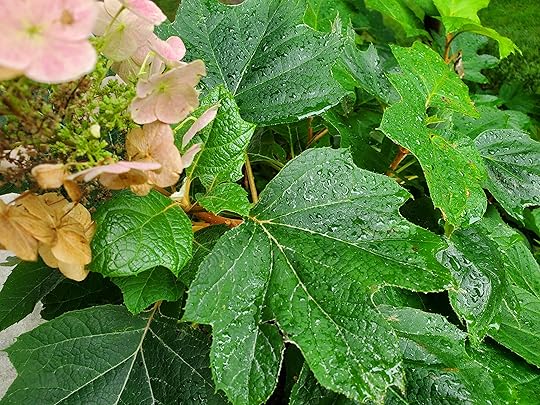
July 14, 2020
Ziplines and New Podcast with Renovare
 I'll keep this short and sweet. Beth and I just returned from a long weekend with our entire family (yes, 9 adults and 6 grands!) at a beautiful camp in southern Indiana. Many, many highlights, including watching Mrs. Booram zipline!Before we left we had the honor to be guests with Nathan Foster on Renovaré's podcast. Nathan just let us know that the podcast is now live and we thought some of you might want to listen in. We are grateful for communities like theirs with whom we resonate so deeply. Have a listen and add them to your playlist!https://renovare.org/podcast/beth-and-david-booram-when-faith-becomes-sight
June 2, 2020
A Silence that Isn't Violence
On Saturday afternoon, David and I took a bike ride to downtown Indy. We were clueless of what had happened the night before, nor of what was happening at that moment as protesters gathered at Monument Circle. When we circled back toward home, we came upon a group of about 200 protesters, signs lifted high along with their voices. “Silence is violence.” “Silence is violence.” We watched for several minutes as traffic stopped and the police stood by. But when I rode on, I couldn’t get their rallying cry out of my head. “Have I been silent?” “Is my silence an act of violence?” There is for sure a “silence that is violence,” as when police officers stood by, saying and doing nothing, while a fellow officer pinned the neck of George Floyd against the ground until he suffocated. However, there are other times and other reasons to be silent. There’s silence when there are no words. Sometimes we choose silence because our words are paltry, empty, unsuitable for a time, and situation. The tragedies and injustices we’ve witnessed recently, symptomatic of deeply ingrained injustice and bigotry, are awful. Truly awful. Words are hard to find and feel so pathetic given the gravity of the situation. So there’s silence when there are no adequate words. There’s silence for introspection. The protesters’ chants provoked me to look within myself and to search out my complicity within the systemic injustices that black and brown-skinned people face every day of their lives. To be introspective and earnest to identify my contributions, my prejudice, requires silence. Space to be quiet before the Spirit who searches hearts and reveals their thoughts and intentions. A silence that begets sorrow and leads to true and sincere repentance. There’s silence to listen. There’s a time to speak up and there’s a time to listen. Right now, I need to listen. To listen to what my brothers and sisters of color have to say about their experience of living in this country. I need to listen to people who know more than I know, understand things that I don’t understand, and truthfully have a right to speak. Do I? Do white folks like me have much to say of value? I’m not so sure. Other than “I’m so very sorry.” “Help me understand.” There’s silence for prayer. The grievous chains of oppression, inequality, and injustice that pervade our society are spiritual issues. Pride, greed, hegemony, prejudice, intolerance, and xenophobia are moral and spiritual sins that blind us and bind us. As with all spiritual issues, the solutions must be spiritual, as well. I’m not suggesting an anemic, “Hey, prayin’ for you.” kind of solution. I’m talking about those deep, guttural, anguished prayers of the saints begging for God’s intervention and healing. I’m envisioning an all-out “sack cloth and ashes,” “Lord, in your mercy, hear our prayers.” kind of praying. There’s a silence that is necessary to engage in that changes us. And that is a silence we all desperately need to engage. 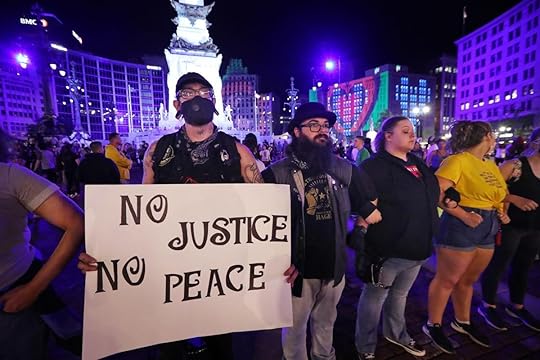 Yes, there’s a silence that is violence and there's a silence that isn't. So please don't assume that because someone is being silent, they're indifferent or uncaring. I’m mindful today to be careful and not simply add my voice to the din of voices crying out and lashing out. Like the voices I saw on the WTHR live feed last night as protesters marched to the Governor’s mansion. Voices spewing condemnation and others joining the chorus of the protesters. It’s so noisy no one can hear anything. Can we have a moment of silence? Just a moment?
Yes, there’s a silence that is violence and there's a silence that isn't. So please don't assume that because someone is being silent, they're indifferent or uncaring. I’m mindful today to be careful and not simply add my voice to the din of voices crying out and lashing out. Like the voices I saw on the WTHR live feed last night as protesters marched to the Governor’s mansion. Voices spewing condemnation and others joining the chorus of the protesters. It’s so noisy no one can hear anything. Can we have a moment of silence? Just a moment?
June 1, 2020
Happy 8th Anniversary, Fall Creek Abbey!
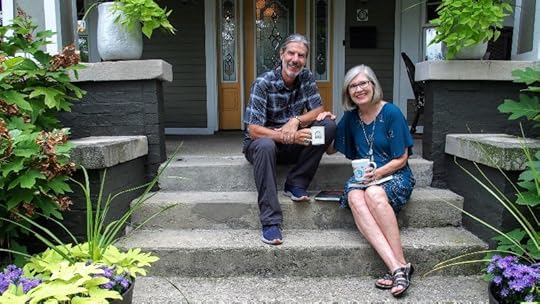 Hello, friends—The last three months have been indescribably odd and void of so many things that have typically given us life. It’s so quiet around here. No guests showing up on our doorstep. No retreatants gathered around our table, engaging in rich and satisfying conversation. No cohorts of students from our spiritual direction training filling the great room with laughter and engaging banter. As I said, it’s so quiet around here.Truthfully, we are grieving. While nothing currently threatens our livelihood or well-being, we feel deprived of the life that once filled these rooms and hallways of the Abbey with such meaning and joy. We’ve noticed what a loss it is to not be able to offer hospitality to the spiritual seeker. We’ve noticed the energy drain from not having face-to-face, life-giving conversations with our directees and others with whom we typically engage. We’ve noticed the subdued, confined, monotony of our days.While I’m tempted right now to say, “Hey, don’t worry about us—we really are okay!” I’m choosing to stop myself—even though we really are okay. Why? Because I want to resist the temptation to be intolerant to feeling loss and grief. Our unfortunate human propensity is to move quickly to put a bow on life, add some sappy spiritual quip, and carry on! David and I believe that feeling the grief of our world and the fragility of our existence is a good thing, a humbling thing. And who of us doesn’t need humbling?We want you to know how much we miss you. For those who are regulars at Fall Creek Abbey, for those who’ve come once and hope to come again, for those who’ve come from far away and others who come from down the street, we want you to know that we ache for the day that you can return and find us at the door, able to hug you (if you want to be hugged!), welcoming you to this still point in our city.So we’re embracing this time with hope that deep and good shifts are happening inside us as we consent to be shaped by God through the strain of this pandemic. And if you’re wondering when we will re-open—the answer is today! On a limited basis! We are open to hosting guests for half-day or full day retreats, on a limited basis. However, we will not host outside groups or teams through the end of August. At that point, we will re-evaluate. If you’d like to schedule a retreat, fill out this contact formand we’ll get back with you ASAP.May I tell you a story?Since it’s our eighth anniversary, will you indulge me a bit? May I tell you a story? Our story. A story I still love telling. It’s about how this all came to be.Eight years ago on June 1, 2012, we embarked on an adventure with no certainty of where it would take us! We moved from our family home of 17 years located in Fishers, Indiana to a 110-year-old, three-story home near downtown Indianapolis. We took out the biggest mortgage we’ve ever had, moved into the largest home we’ve ever lived in, all to start something new! Our vision was to create a welcoming, dedicated space for individuals to come away for personal retreats and for small teams to gather and accomplish good work together. From the get-go, we began offering a training program for individuals interested in becoming spiritual directors. And simultaneously, we started meeting with a growing number of individuals for spiritual direction.Over our eight years, we’ve hosted approximately 9,000 guests, completed 14 year-long spiritual direction training cohorts, accompanied more than 60 individuals in spiritual direction each month, facilitated dozens of retreats, while still managing to take lots of bike rides, celebrate our 40th anniversary in Ireland, host numerous family celebrations throughout the years, and write a book together! Whew!David puts it best when he says that it seems as though we’re experiencing the full flowering of our lives! Indeed, it seems that way. Thank you all for being part of it. Part of this adventure and part of the Fall Creek Abbey fan club. Thank you from the deepest places in our hearts!With love and affection, Beth and David Booram P.S. If you’d like to take a look at our new, fun project, here’s a link to the Examen Q’s—a set of 35 cards with provocative questions that you can use personally, in spiritual direction, mentoring, or discipling, or around the dinner table. Examen Q’s are just $18 plus shipping!
May 25, 2020
Sparrow on the Housetop
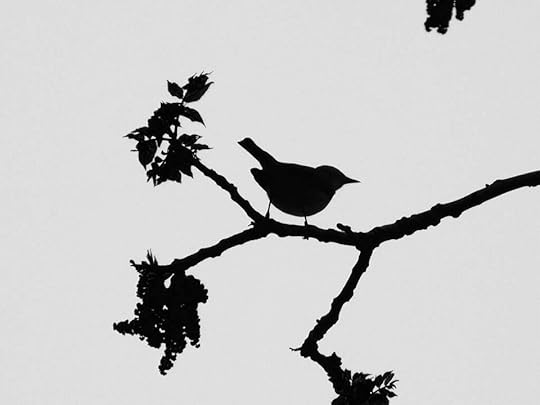 Remember junior high English class when you learned about metaphors and similes? They’re potent terms of comparison. The only difference is that similes compare two things using like or as. In my opinion, there’s nothing like a great metaphor or simile to capture the human experience! And so it is with this simile "like a sparrow on the housetop.”The Psalmist, after crying out in agony for God to hear his earnest appeal, wrote:I lie awake, And am like a sparrow alone on the housetop.Psalm 102:7 (NRSV)Classic writers like St. John of the Cross and Teresa of Avila referred to this sparrow as a depiction of the soul’s longing for God amidst a lonely, desperate time. There’s something haunting, resonating about a lone sparrow on the housetop. I would suggest that it embodies the experience of our souls these days as we respond to the anxiety, isolation, and disrupted sleep amid Covid-19. After all, what’s more common than a sparrow?The pandemic, as many have noted, has been a great equalizer. It has required all of us, whether rich or poor, educated or uneducated, famous or infamous, to experience a common plight, a common susceptibility. We’ve all been asked to take common measures to protect one another, actions on behalf of the common good. Our common plight has also evoked a fair amount of resistance. Who wants to be as ordinary and undistinguished as a common sparrow? This predicament collides with the most established and rampant infectious disease in the West—individualism—which is often code for doing our own thing, no matter whether it’s at the expense of the common good. It’s the resistance witnessed this week in the viral video of an unmasked man at Costco who was asked to leave. His retort, “I’m doing it because I woke up in a free country!”While much of what drives human vitriol is the ego’s insistence that it must distinguish itself to be noticed and valued, the sparrow suggests otherwise. It’s lonely perch on the housetop invites us to embrace our commonness and consider the gift in it. We can relate to each other. We share much in our common humanity. We are all vulnerable. We all have needs. We are all spiritual beings with spiritual longings for God that surface most when we feel defenseless.In Luke’s gospel, Jesus reminds us that though five sparrows have little monetary value, God never forgets a single one of them. And if God has as much regard and affection for a sparrow, how much more regard and affection does God have for us? (Luke 12: 6-7)St. John envisioned the sparrow on the housetop as someone seeking the “high, lonely places” where one engages with God. In her perch, little sparrow turns toward the wind, just as the soul of the seeker turns toward the Spirit of Love. She sings out her song for God and her neighbors to hear. The ubiquitous sparrow, then, is a positive reminder to the prayerful of our common dilemma, our common concerns.So, the next time you see a sparrow, whether on the ground or perched on a housetop, may it be a reminder of your common place among common people. And may said sparrow prompt you to pray. Why? Because we woke up this morning in a free country, a gift we honor by doing what is best for the common good and by living out the gospel to love our neighbor as ourselves. Happy Memorial Day!
May 23, 2020
Why Am I Still Here
 This weekend, as Beth and I were walking at Crown Hill Cemetery, I confessed that this forced adjustment to our work and our community was beginning to feel a bit like a pre-cursor to retirement. Maybe a cemetery is not the best place to reflect on questions like this, but here I was, considering large, philosophical questions. One of the questions that has kept needling me is, why? Not why is Covid-19 happening or why do such tragic things happen in our world. No, the question I seem to keep returning to is – why am I here? Or really, at 64, why am I still here? As I sit with the question and honestly listen to my own heart, along with what I perceive as the heart of God for me, I am starting to hear a number of responses. But, the one that continues to echo in my mind is the simple fact that I am here to learn. That’s right, learn. Although life-long learning is a catchy maxim, accepting the reality and invitation that I am here to be a learner until I take my very last breath seems startlingly new. It also gives profound meaning to each day and every experience.So that brings us to our present moment and this current context of learning to live in the midst of a world-wide pandemic. What do I notice I’m being drawn to learn? Here’s what I noticed. How about you?I am learning who I am apart from work; that my identity is not dependent on my work or contribution.I am learning humility.I am learning that everything that I enjoy or sustains me is received as a gift.I am learning I don’t need to prove myself.I am learning that my security does not lie in money or the economy.I am learning to let go, to unlearn, to release, and submit.I am learning to be more comfortable with mystery.I am learning to listen to my body.I am learning that every idea I have is not for me, nor is it necessarily a good idea.I am learning to discern when I am oriented toward God or away from God. I am learning to feel my feelings, become more aware of them, and have words to acknowledge and share them.I am learning what is important and what is priority.As I look at this list I don’t feel overwhelmed by how much I still have to learn. I actually want to learn them. I’m not discouraged to learn (there’s that word again) that I’m still in school. And what is this school I’m still enrolled in from which I will never graduate? I think of it as the School of Love. The school where I progressively shed and unlearn fear and all that hinders my freely living from my true self. And this school is always in session, whether in a brick and mortar building or a virtual classroom. Who would have thought that one of the courses we would find ourselves enrolled in would be Pandemic 101. But here we are! What are you drawn to learn or unlearn during this present moment?
May 19, 2020
They're in! Examen Qs
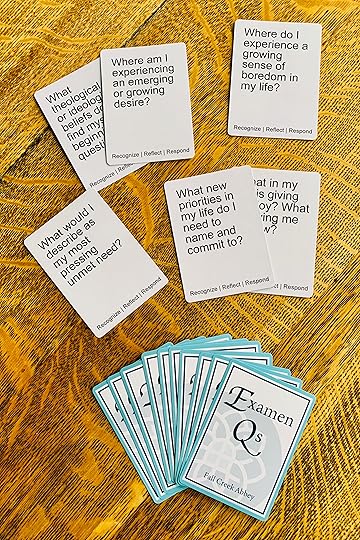 Behind the scenes we've been working on a new project - Examen Qs. And they just arrived! The principal “power tools” of spiritual direction and contemplative spirituality are well-timed, clearly stated questions that prompt reflection. We've crafted a unique pack of 35 cards with some of our favorite questions to help draw attention to the real features of our life experience and the presence and action of God.The questions included in the Examen Qs are designed to help you: (1) Recognize where God is present and active; (2) Reflect on what God’s movement is stirring in you; (3) And prayerfully consider how you want to Respond.These cards can be used in a variety of ways. They can serve as a focus for your daily Prayer of Examen, choosing one at random, or searching for a topic that draws you. They can also be used with individuals for whom you offer guidance. Finally, they can be enriching for a group or dinner table to help promote meaningful conversation about our life with God.
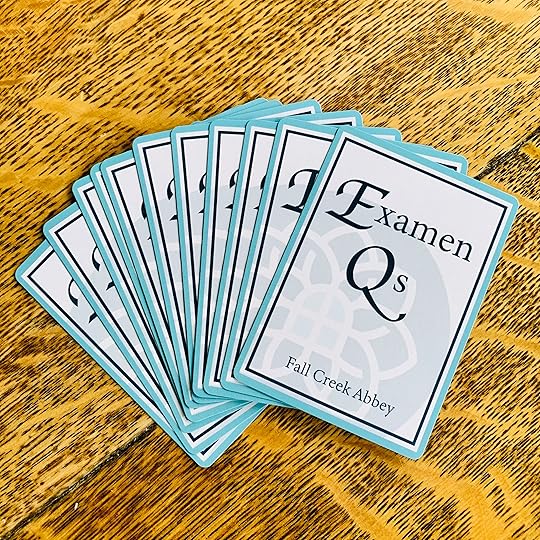 We hope these Examen Qs generate many moments of dynamic engagement between you, God and others.You can order your set here ($18 includes shipping):https://www.fallcreekabbey.org/product-page/examen-qs-card-set