Misha Crews's Blog
November 27, 2025
Looking Back With Gratitude, Looking Forward With Hope
Hello friends. I’m still here, and I’m sorry I’ve been so quiet. This past year has been one of big changes. We moved to Ohio, I started a full-time job, and we said goodbye to two beloved family members: my father-in-law in May and my aunt just a few days ago.
I can’t believe how fast the time has flown. It feels like I blinked and the whole year slipped past.
But today, on Thanksgiving, I simply want to say: thank you. 
Thank you for reading.
Thank you for cheering me on.
Thank you for giving my stories a place to land and a home in your hearts.
I am grateful for every kind message, every shared moment, and every reader who believes in cozy tales with a hint of mystery. 

And as we move into a new year, I promise to be more present, more active, and more connected than I have been in the year gone by.
Here’s to new chapters, wherever they take us. 


June 23, 2025
Self Care From Between the Pages


 View all responses
“When you say ‘yes’ to others make sure you are not saying ‘no’ to yourself.” — Paulo Coelho
How do you practice self-care? (There is no wrong answer.)
For me, self-care isn’t bubble baths and spa days, although if that’s your thing, more power to you (and personally, I never say no to cucumber water!). My own version of self-care is quieter, slower, and stitched together with stories. I practice it every time I close the door, pick up my coffee cup, and open a book. I practice it when I sit down to write, even if the words come out in a tangle.

Reading and writing are a refuge. They remind us that imagination is powerful, and that joy doesn’t have to be loud. Sometimes, the best medicine is a quiet morning with a cozy mystery, or an hour spent in a fictional town where the leaves are always turning and the scones are always hot. We give ourselves permission to step away from the noise and into those worlds, knowing we’ll come back feeling a little more like ourselves.
And yes, there are days when self-care looks like getting the bookkeeping done, organizing my desktop, or even answering emails. But more often than not, it looks like turning the page. Because stories heal. Stories help us breathe.
Okay, your turn. How do you practice self-care?
June 19, 2025
Some Houses Remember: The Story of the Yellow Door
Welcome to Angel River, where every corner holds a secret and every landmark has a tale to tell. In this series, Storied Places of Angel River, we explore the hidden histories, whispered legends, and unforgettable moments that make our little town more than just a dot on the map. Whether you’re a longtime resident or just passing through, these stories are your invitation to discover the heart and soul of Angel River—one storied place at a time.
In a quiet corner of town, tucked behind a vine-covered arbor and framed by tapering porch columns, sits a small Craftsman cottage with diamond-paned windows and a yellow front door. To passersby, it may seem like just another sweet old house—but the truth is, it’s a house that was born of hope, built with love, and kept alive by dreams.

The cottage was constructed in the late 1920s by a woman named Azelie Damont Beaufort, a French widow who had married into the genteel Beaufort family and brought with her a flair for beauty and a deep well of kindness. She built it not for herself, but for her stepdaughter, Millie Beaufort, a gentle young woman who never asked for much—except, once, in a moment of quiet honesty.
To Azelie’s nephew, Lucien, Millie once said wistfully: “All I really want is a home of my own. A cute place that’s big enough for a family. I want a nice husband who treats me kindly and doesn’t care if I’m plain or sometimes stupid. I want a couple of kids who I can dress real cute and teach how to read and write. A boy who will play baseball, a girl to have tea parties with. And a dog. A sweet, fluffy dog that will lie by my feet when I sit in front of the fire in the evening. I want a cute house with cozy corners, where the sunlight comes into the kitchen in the morning. And I want a yellow door, because yellow is the color of hope.”
Lucien repeated the words to Azelie, who quietly set about making Millie’s dream come true. The house was built by hand—local carpenters added the diamond-paned windows, and the porch was made extra deep to keep it cool in the summer and to hold laughter in the fall. The fireplace was set with river stones, the kitchen faced east, and Azelie herself picked the paint for the front door: a soft, hopeful yellow.
Millie moved in with her new husband and, not long after, a baby boy. The fluffy dog came next. For a time, everything she dreamed of was real.
Years later, when life took a turn—as it often does—Millie sold the house to a man named Jon Ross Sullivan, a chauffeur-turned-entrepreneur who opened the Sweet Music store in town. The little cottage became his sanctuary, filled with sheet music, old record albums, and the warm smell of cedar and tea. After his passing, his daughter Goldie moved in with her girls, Marianne and Josie, and the house filled again with bedtime stories, hairbrush arguments, Saturday pancakes, and music drifting through the windows.
After Goldie passed, the girls moved out, and the house became a rental—still owned by the Sullivan family, but quieter than it had been in decades.
Then came 2008, and a gray-skied afternoon when a man named Pete Trevino, new to town and unsure of his place in the world, happened to walk past the little house.
He stopped, drawn in by the curve of the brick walkway and the mysterious hush of the porch. The yellow door gleamed deep within the shadows, a hidden beacon. He didn’t know it then, but the woman who would become his wife—Josie Sullivan—was inside that house, wondering if she should close the family music store for good.
Pete didn’t believe in fate. But he paused in front of that house longer than he meant to. And the yellow door waited, quiet and hopeful.
A new family lives there now, complete with fluffy dog and little ones to play in front of the flickering fireplace. Sunlight still pours through the east-facing kitchen window every morning, just like Millie once wished. And the yellow door still shines.
Because some houses are not just wood and brick.
Some houses are made of promises.
Some houses remember.
And this one—the little Craftsman with the yellow door—was built for love, and has never once forgotten it.
♡♡♡
The House with the Yellow Door features prominently in Sweet Music, the fourth book in the Angel River series, where you can find romance, mystery, and maybe a bit of magic.
Subscribe to this blog, sign up for my newsletter, and follow me on Amazon to be the first to hear when new books are released.
Thanks for visiting one of the storied places of Angel River. If you enjoyed this glimpse into our town’s past, be sure to follow along for more tales still to come. If you have a favorite Angel River memory or a place you think deserves the spotlight, I’d love to hear from you. Leave a comment or email me at misha@mishacrews.com.
Sending hugs from between the pages,
Misha
 In paperback and on Kindle Unlimited.
June 17, 2025
Daily Prompt Reflection: What I Love About Myself


 View all responses
I haven’t participated in one of these writing prompts in a while, but I do love reading the responses of others, so I thought I would give this one a whirl.
Daily Writing Prompt Question: What’s Your Favorite Thing About Yourself?I used to think this was a trick question. It always felt like bragging in disguise—like you were supposed to blush and say something humble, like “I guess I’m a good listener,” then immediately ask about the other person to change the subject.
But the truth is, my favorite thing about myself is that I never stopped being curious. About people. About stories. About why old houses creak and how friendships fall apart and whether ghosts remember who they were.
That curiosity has carried me through careers, heartbreaks, reinventions, and rewrites. It’s what makes me pull off the road to take a picture of a crumbling farmhouse, or eavesdrop in coffee shops, or spend hours researching 1980s medical malpractice cases for a single scene in a book. Curiosity is the spark behind everything I write, and everything I love about writing. It keeps life a little mysterious, a little magical—just the way I like it.
So, no blushing. No turning the question around. That’s my answer. I’m curious, and I cherish that part of myself.
What about you? What’s your favorite thing about you?
June 9, 2025
The Angel River Café: A Love Story in Every Cup
Welcome to Angel River, where every corner holds a secret and every landmark has a tale to tell. In this series, Storied Places of Angel River, we explore the hidden histories, whispered legends, and unforgettable moments that make our little town more than just a dot on the map. Whether you’re a longtime resident or just passing through, these stories are your invitation to discover the heart and soul of Angel River—one storied place at a time.
 The Angel River Café: A Love Story in Every Cup
From sweet beginnings to ghostly whispers, and a legacy of love that spans generations.
In the sleepy town of Angel River, the streets are paved with stories, a café has stood for over a century—watching the world change, one love story at a time.
1905: The BeginningAt the heart of town, on a quiet corner of Main Street, a young couple named Thomas and Eleanor Whitaker built something meant to last: a modest café with brick walls, big windows, and a long polished counter. They named it the Rosewood Café, after Eleanor’s dream of cultivating a rose garden in the small patch of grass behind the building.
From the very start, the café carried an almost enchanted charm. Locals whispered about the faint scent of roses that lingered long after Eleanor’s bouquets had wilted, and about a young woman seen wandering the upstairs windows at dusk—a quiet figure said to be a bookish tenant who once lived in the apartment above and passed away in 1912, still waiting for a sweetheart who never returned. No one knew her name, they only referred to her as “The Girl Upstairs.”
1920s–1930s: A Café for LoveBy the roaring twenties, the Rosewood Café had become a sanctuary for sweethearts. Couples flirted over coffee and pie, serenaded by records that Thomas played records on his pride and joy: a 1916 Victor Victrola. Despite the hardships of the Great Depression, Thomas and Eleanor kept their doors open. Customers who couldn’t pay would tuck handwritten IOUs beneath the sugar jars—a system born of Eleanor’s steadfast belief that kindness should always outweigh coins.
It was during these years that a young boy named George Brent spent his childhood roaming the café. His mother, a waitress, brought him in daily, and George grew up with the scent of fresh pastries and the comforting hum of conversation. He loved everything about the place—especially a girl named Virginia, his childhood companion who spent countless afternoons helping Eleanor prune the roses or spinning on the café’s green stools.
George dreamed of two things: owning the café and marrying Virginia.
1940s: War and WaitingWhen World War II broke out, the Rosewood Café became a place of hopeful goodbyes. Soldiers left scribbled notes for their sweethearts under the sugar jars—notes that, inexplicably, remained crisp and legible even years later. Some returned to find their messages untouched, preserved as if by unseen hands.
One soldier swore he saw The Girl Upstairs standing by the window humming a lullaby. Eleanor believed The Girl was a guardian of love, ensuring no promise was forgotten. A single candle remained in the café’s window every night the war dragged on, a silent vigil for every soldier not yet home.
1950s–1960s: Ghost Lights and Old LovesAfter the war, the café thrived again. A jukebox replaced the Victrola. When a song played that had once been special to a long-lost couple, the café’s lights would flicker softly, as though The Girl Upstairs was encouraging one last slow dance.
Now a grown man, George bought the café he had loved since boyhood. He renamed it the Angel River Café—an homage to the town, to his mother, and to the countless moments of magic he had witnessed within those brick walls.
Though Virginia had married someone else and started a family, she never left Angel River. George remained close to her, quietly cherishing their shared history. In the early 1960s, Virginia’s daughter, Lana, began working at the café. George took her under his wing, becoming the father figure she had never known, and treating her with quiet affection and pride.
1970s–1990s: A Ghost of Its Former SelfAfter George’s untimely death, the Angel River Café was sold to a group of out-of-town investors. They modernized the décor and stripped away the character, turning the once-beloved spot into a dim shadow of its former self. The jukebox disappeared, the flowerboxes wilted, and the scent of roses faded.
Locals mourned the change. Even The Girl Upstairs seemed affected. Strange sounds and flickering lights became less charming and more eerie, like a warning that the soul of the café had been forgotten.
2000s: Restoration and RenewalIn the early 2000s, a woman named Mae Wallace moved to Angel River. Looking for a fresh start and captivated by the building’s sad charm, she bought the café. And with her hands, heart, and family recipes, began the slow, loving process of restoring it.
Mae brought back the rose garden. She polished the counter. She reinstalled a vintage jukebox. She baked pastries that reminded people of Eleanor’s kindness and George’s quiet strength.
The old warmth returned. The whispers upstairs softened into lullabies again. The café’s lights flickered just so when a couple held hands in the corner booth.
Today, the Angel River Café is once again the heart of the town—a place where love is remembered and new stories are written. And although most of the townsfolk have long forgotten The Girl Upstairs, she remains in the shadows, watching over it all.
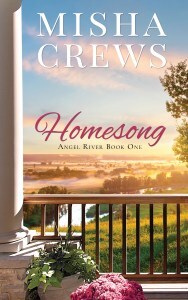
The Angel River Cafe features prominently in Homesong and The Book of Forgotten Angels. Subscribe to this blog, sign up for my newsletter, and follow me on Amazon to be the first to hear when the next book is released.
Thanks for visiting one of the storied places of Angel River. If you enjoyed this glimpse into our town’s past, be sure to follow along for more tales still to come. If you have a favorite Angel River memory or a place you think deserves the spotlight, I’d love to hear from you. Leave a comment or email me at misha@mishacrews.com.
Sending hugs from between the pages,
Misha
 In paperback and on Kindle Unlimited.
 In paperback and on Kindle. Read for free when you sign up for my newsletter!
June 2, 2025
Sunlight on Old Wallpaper: The Secret History of Finley Street
Welcome to Angel River, where every corner holds a secret and every landmark has a tale to tell. In this series, Storied Places of Angel River, we explore the hidden histories, whispered legends, and unforgettable moments that make our little town more than just a dot on the map. Whether you’re a longtime resident or just passing through, these stories are your invitation to discover the heart and soul of Angel River—one storied place at a time.
Today we’re taking a journey outside of Angel River and heading north by northeast to Arlington County, Virginia—a notable suburb of Washington, D.C., and the setting for the house on Finley Street. This is the world of Still Waters, the fifth book in the Angel River series, and the only one that doesn’t actually take place in Angel River itself.

We enter the Finley Street house in 1956. Jenna Appleton has been a widow for six years, and her son, Christopher, is celebrating his fifth birthday. Family friend Adam Ballentine is back in the States after years abroad with the Navy’s Construction Brigade, also known as the Seabees. How this little family navigates the storm of tragedy and deception to find their happily ever after is the heart of Still Waters.
But what was the house’s story, before their story began?
Before the houses came, the landscape was green and rural, with whispering woods and sprawling fields.
The house on Finley Street was brand new in 1939, bought by a young carpenter and his wife, a schoolteacher. They brought with them a little boy, a baby girl, and the bright hopes of a future filled with possibility. What they didn’t know was that the land had once been a kind of sanctuary—a quiet meeting ground for wanderers, workers, and travelers seeking rest beneath the wide Virginia sky. Among them was Elias Whitmore, a man without a permanent home but with a heart that belonged to the open road.
Elias had lived in the area for years, watching life shift and change—camps rising, people vanishing, stories whispered over firelight. He never asked for much, just the shelter the land could offer. And when his time came, he slipped away, as quietly as he had arrived.
But something of him remained.
For the first two years, the carpenter and the schoolteacher raised their children in peace. Neighbors said you could often smell bread baking from the open kitchen window. In the backyard garden, vegetables grew alongside a row of marigolds planted simply because the schoolteacher loved their cheerful color. Through it all, Elias was there. A silent guardian. He kept the children from wandering too far. Flickered the lights when storms approached. A whisper of presence in a house filled with life.
When war came in 1941, everything changed. The carpenter joined the Army. A gold-framed photo of him in uniform held pride of place on the wall by the front door. His wife took over his chores—mowing the lawn, fixing the squeaky gate—and wrote him letters every night from the same desk where she graded her students’ papers.
During those years, the house saw blackout curtains drawn, ration coupons counted, and quiet evenings spent gathered around the radio. Stories were read aloud. Hopes were folded into every load of laundry and tucked inside every bedtime prayer. Elias remained, gently closing open doors, making sure the house never grew too cold.
When the carpenter returned in ’45, he was quieter than before. But the house made room for that too. In time, his laughter returned, slow and tentative—like a flower relearning how to bloom.
In 1947, an opportunity arrived: a land development company in Utah, started by two of the carpenter’s wartime buddies, was hiring skilled workers. The family packed up and moved west, chasing a new beginning. And Elias, sensing his chapter had ended, returned once more to the wind.
By the spring of 1948, the house stood quiet and waiting. Ready for new voices, new dreams, and a new story. The past doesn’t haunt the house on Finley Street, but it lingers gently. Like sunlight on old wallpaper. Like the hush before a story begins.
The house on Finley Street features prominently in Still Waters, and will play a role in the upcoming Angel River novel One Secret Summer. Subscribe to this blog, sign up for my newsletter, and follow me on Amazon to be the first to hear when that book is released.
Thanks for visiting one of the storied places of Angel River. If you enjoyed this glimpse into our town’s past, be sure to follow along for more tales still to come. Have a favorite Angel River memory or a place you think deserves the spotlight? I’d love to hear from you. Leave a comment or email me at misha@mishacrews.com.
Sending hugs from between the pages,
Misha
 Still Waters
is available in paperback and on Kindle Unlimited.
Still Waters
is available in paperback and on Kindle Unlimited.
May 26, 2025
Romance and Mystery Come to Stay: The Angel River Hotel
Welcome to Angel River, where every corner holds a secret and every landmark has a tale to tell. In this series, Storied Places of Angel River, we explore the hidden histories, whispered legends, and unforgettable moments that make our little town more than just a dot on the map. Whether you’re a longtime resident or just passing through, these stories are your invitation to discover the heart and soul of Angel River—one storied place at a time.
The Angel River HotelBuilt in 1901, the Angel River Hotel was the first brick building in town—a bold statement of permanence in a community still finding its identity. Commissioned by the town council at the turn of the century, the hotel was meant to attract visitors, investors, and perhaps a little prestige. To achieve that vision, they brought in renowned Dutch architect Anders du Wees, whose Romanesque Revival designs were celebrated for their elegance and endurance.

From the moment it opened, the Angel River Hotel was more than a place to sleep—it was a destination. With its rounded arch windows, turreted corners, and carefully laid brickwork, it brought a touch of old-world grandeur to what had been a modest riverside settlement. Locals still tell tales of travelers who arrived dusty and exhausted from the road and wept with relief at the sight of its flickering lanterns and warm hearth.
In the early decades of the 20th century, the hotel was a hub of activity, hosting masquerade parties, traveling musicians, civic meetings, and even a wedding that ended—so the story goes—in a broken engagement and a champagne-fueled footrace through the town. During World War I, officers passing through were often housed on the top floor, where their names can still be found etched discreetly into the windowpanes of the east-facing rooms.
Perhaps the hotel’s most enduring mystery stems from the tale of a vaudeville magician who vanished during a thunderstorm in 1924, leaving behind only his top hat and a very confused stage assistant.
By the 1940s, the hotel’s star had dimmed a bit. The top floor was closed, the piano in the lobby fell silent, and the once-bustling tea room served more coffee than conversation. Still, it remained a cherished gathering place for Angel River residents—a setting for birthday parties, retirement dinners, and the occasional high school prom.
In the early part of the new century, a young single mother stumbled across the hotel. Enchanted by its faded grandeur, she purchased the building and launched a painstaking restoration. She peeled back layers of wallpaper, uncovered original plasterwork, and brought the old place back to life. Thanks to her efforts—and help from local artisans and historians—the Angel River Hotel entered a new golden age.
Today, the hotel blends historic charm with modern comforts, offering guests a stay that feels both cozy and a little enchanted. The lobby, with its hand-carved staircase and creaky floors, invites long conversations and lingering glances. The library overlooks a magnificent garden. And those who listen carefully might just hear echoes of the past drifting through the halls.
The Angel River Hotel isn’t just a place to stay—it’s a place to remember. Whether you’re passing through or you’ve lived in town all your life, it’s a reminder of how history endures, brick by brick.
The Angel River Hotel appears in the books Homesong, The House on the Hill, and Sweet Music. It will feature prominently in the next two books of the Angel River series: One Secret Summer and A Bend in the River. Follow this blog, sign up for my newsletter, and follow me on Amazon to be the first to hear when those books are released.
Thanks for visiting one of the storied places of Angel River. If you enjoyed this glimpse into our town’s past, be sure to follow along for more tales still to come. Have a favorite Angel River memory or a place you think deserves the spotlight? I’d love to hear from you. Leave a comment or email me at misha@mishacrews.com.
Sending hugs from between the pages,
Misha
May 19, 2025
A Journey Through Time: The House on the Hill
Welcome to Angel River, where every corner holds a secret and every landmark has a tale to tell. In this series, Storied Places of Angel River, we explore the hidden histories, whispered legends, and unforgettable moments that make our little town more than just a dot on the map. Whether you’re a longtime resident or just passing through, these stories are your invitation to discover the heart and soul of Angel River—one storied place at a time.
The House on the HillPerched on the tallest hill in Angel River, the house rides the ridge like a gleaming white ship upon an emerald sea, its gables and turret catching the light just so. It’s been known by many names: The Fitzgerald House, The Doyle House, Haven House. But most locals just call it The House on the Hill. It’s as if the place itself insists on remaining a little mysterious, a little untouchable, no matter how many footsteps cross its threshold.

The house’s story begins, as so many of Angel River’s stories do, with Gerald Fitzgerald, the town’s founder and its most restless dreamer. On a moonlit night in 1865, Gerald stumbled up the hill, his newborn grandson in his arms, and chose that spot for his family home. Years later he finally built the house, constructing a grand Victorian mansion with a sweeping wraparound porch and a round tower that became a kind of lighthouse in the landscape. With its gingerbread trim and sharp, steep roof, the house seemed to float above the town below, a symbol of hope, prosperity, and permanence.
But permanence is never promised. In the summer of 1912, a fire tore through the house in the dead of night. Only a few survived. The cause of the fire was never discovered, and rumors—whispers of a feud, a hidden ledger, a ghost—have followed the ashes ever since. For fifty years, the charred remains stood like bones against the skyline, a haunting silhouette and a reminder of the fragility of all we hold dear.
Then, in the 1960s, change came once more. The Doyle family, newcomers with quiet means and a fondness for solitude, rebuilt the house from the ground up, honoring the original design while adding modern comforts. Their version of the house stood strong for over two decades, until 1987, when they left town without warning. The reasons for their departure—and the secrets they left behind—are chronicled in Homesong, a tale that has become almost as woven into the house’s legacy as the fire that came before it.
And still the house endures. In the new century, it found fresh purpose as a foster home, a place not for grandeur but for grace. The elderly brother and sister who run it now were themselves once foster children. Under their care, the House on the Hill has become a refuge for those in need of stability, compassion, and a place to call home.
Each era leaves its mark. Each incarnation of the house seems to hold echoes of the ones before. And always, always, it watches over Angel River, a sentinel of stories. What will it become next? A retreat? A school? A ruin reclaimed by ivy? Only time knows. But if history is any indication, The House on the Hill will continue to transform, and to endure, riding the edge of fate like a boat on open water.
The House on the Hill features prominently in the books Homesong and The House on the Hill, and a 1917 visit is paid to its charred wreckage in Sweet Music. It will continue to appear in most, if not all, of the Angel River series.
Thanks for visiting one of the storied places of Angel River. If you enjoyed this glimpse into our town’s past, be sure to follow along for more tales still to come. Have a favorite Angel River memory or a place you think deserves the spotlight? I’d love to hear from you. Leave a comment or email me at misha@mishacrews.com.
Sending hugs from between the pages,
Misha
May 12, 2025
Back of the Moon Lake: Storied Places of Angel River
Welcome to Angel River, where every corner holds a secret and every landmark has a tale to tell. In this series, Storied Places of Angel River, we’ll explore the hidden histories, whispered legends, and unforgettable moments that make our little town more than just a dot on the map. Whether you’re a longtime resident or just passing through, these stories are your invitation to discover the heart and soul of Angel River—one storied place at a time.
If you turn off one of the many winding back roads outside of Angel River, you’ll find yourself in a place that feels suspended in time. The trees hush their leaves there, the sky hangs lower, and the lake, known as Back of the Moon, glows with an uncanny kind of stillness.
Tucked in a secluded clearing along its shore are two aging houses known as the Twin Sisters. At first glance, they seem like sentinels from another life, two souls frozen in quiet conversation across the years. One is a compact Craftsman, all clean lines and charm. The other is a small Victorian—tall, ornate, and a little proud, as if still holding its chin high.
The houses were built in 1940 by Joseph Kittlewatt, a descendant of one of Angel River’s oldest families. He constructed them as engagement presents for his twin daughters, who, much like the houses, shared little beyond their bloodline. One was practical and reserved, the other romantic and full of fire.
Their weddings were to take place the following year. But the world had other plans. When the United States entered World War II, both of their fiancés were called overseas. Neither man came home.
The sisters never married. Some say they never truly lived in the houses after that. One version of the story claims they did—for a little while—each in her own space, unable to bear the grief of being near, or the grief of being apart. But however it unfolded, eventually the windows went dark, the doors closed, and time moved on without them.
The Victorian house, though weathered, still stands upright like a stubborn ghost. The Craftsman is beginning to fade into the trees, its secrets crumbling into the earth. Locals say if you visit the lake late at night, you can hear something in the silence—whispers, perhaps, or just the sigh of a story unfinished.
Back of the Moon lake and the Twin Sisters houses appear briefly in The Book of Forgotten Angels, and will feature prominently in the upcoming novel One Secret Summer. You can read more about Angel River at this page on my website, and find all the books on Amazon.
Thanks for visiting one of the storied places of Angel River. If you enjoyed this glimpse into our town’s past, be sure to follow along for more tales still to come. Have a favorite Angel River memory or a place you think deserves the spotlight? I’d love to hear from you. Leave a comment or email me at misha@mishacrews.com.
Sending hugs from between the pages,
Misha
May 7, 2025
Discover Angel River: A Small Town with Big Secrets
With spring in full bloom and summer not far away, it feels like a good time to welcome you (or welcome you back) to Angel River—the little town with a big heart, and even bigger secrets.
If you’re new here, let me introduce you: Angel River is a quiet, tucked-away community where the coffee is strong, the friendships are complicated, and every home has its own story to tell. Set against the backdrop of the 1880s to the 21st Century, the Angel River Series weaves together women’s fiction, mystery, and romance, with a dash of small-town nostalgia and the kind of heartfelt moments that linger long after the last page.
So, What’s the Series About?At its heart, Angel River is about the truths we bury and the love that unearths them. Each book follows a pair of strong, flawed, unforgettable people who are drawn to this unusual town for reasons they don’t fully understand until they’ve faced the past, uncovered a few buried secrets, and taken a chance on love (and themselves).
You can find all the books on Amazon, and read more about the series on this page of my website.
What You Can Expect from the Angel River Series: Emotionally rich storytelling that blends suspense, romance, and hope
 Small-town charm with just the right amount of grit
 Multi-generational characters with compelling arcs
 Dual timelines (past and present) that slowly reveal the full picture
 A touch of folk mystery that keeps you turning the pages
 A book club-worthy experience with themes of redemption, love, and legacy
If you’re a fan of Kristin Hannah, Celeste Ng, Jojo Moyes or Kate Morton, or if you love getting swept away in beautifully written stories about imperfect people trying to do the right thing—Angel River is for you. Whether you’ve already strolled the streets of Angel River or this is your first visit, I invite you to settle in with your favorite beverage, in a comfy reading spot, and let the stories unfold. The next book is coming soon, and trust me—you won’t want to miss what’s waiting beneath the surface.
Hugs and Happy Reading,
Misha